Eloquent Images by Gary Hart
Insight, information, and inspiration for the inquisitive nature photographer
Breaking My Own Rules
Posted on April 3, 2025

Follow the Lights, Snaefellsnes Peninsula, Iceland
Sony α1
Sony 14mm f/1.8 GM
ISO 3200
f/1.8
6 seconds
My goal is to create images that celebrate Nature, images that allow viewers to imagine a world untouched by humankind. So it makes sense that I avoid including anything manmade in my images. But I also rail against (most) camera clubs for their rule-bound creative constipation, and those strong feelings collided earlier this year on a chilly January night Iceland. I resolved the conflict by reminding myself that any time I’m following rules (even my own rules), I’m not being creative.
Earlier in my photographic life I was somewhat less discriminating with my subject choices. In fact, I’d actively seek any outdoor subject that I found beautiful, regardless of its origins. Though many of my bridge and skyline images from those days were on (or atop) my personal bestseller list ($$$), as my career evolved, I found myself resenting humankind’s intrusion on the natural world and became less inclined to validate that intrusion with a photograph. These subject choices eventually, and pretty organically (not consciously), evolved into my present style: photograph the world untouched by humans, which made the mere presence of a building, fence, path, or human being reason enough to put my camera down.
I don’t think it’s wrong to photograph manmade objects—in fact I enjoy others’ photos of a wide variety of subjects outside my wheelhouse—it’s just that I’m not personally drawn to photograph them. But since I am still a photographer at heart, it’s difficult to pass beauty of any sort. In recent years, I’ve scratched the itch to preserve “unnatural” beauty with my iPhone. Though I rarely do anything with these images spontaneous snaps, somehow knowing I’ve saved the scene makes me feel better.
Since becoming so hardcore about avoiding manmade objects, I have encountered a handful of scenes that tested my resolve. For example, there was that frigid night beneath the Milky Way atop Mauna Kea in Hawaii, when a giant telescope made too perfect a foreground to ignore. And the night, also beneath the Milky Way, at Cape Royal on the North Rim of the Grand Canyon, when a SpaceX Falcon 9 rocket photobombed my scene—that time I almost resisted photographing it, and am so glad I didn’t.


But whether it’s a streaking rocket, dilapidated fence, or photogenic bridge, some things are too beautiful not to preserve just because of some self-imposed rule. Most recently, on this January night in Iceland the northern lights outperformed our most unrealistic expectations, but for a little while the best display included a road and our hotel. (I already described that night in my recent Shock and Awe blog post, so I won’t bore you again with the story.)
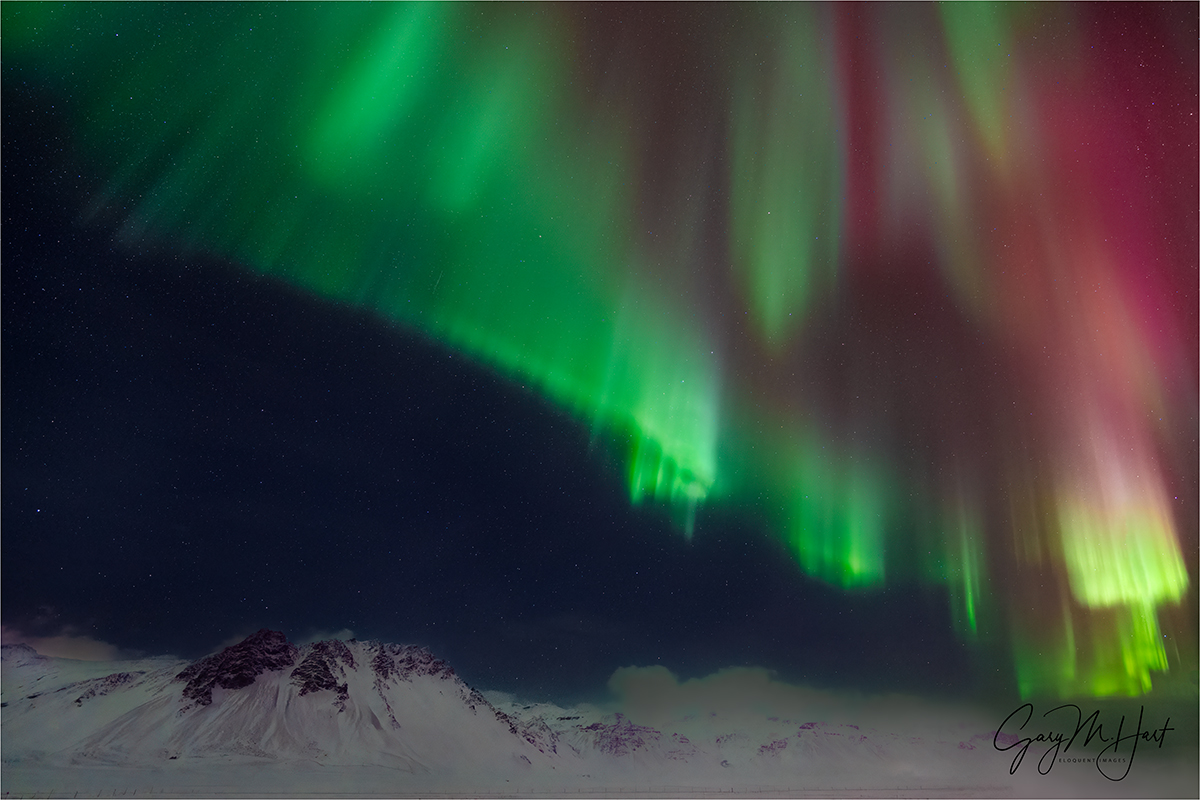
Night Lights, Snaefellsnes Peninsula, Iceland
For most this night’s kaleidoscope display, the aurora danced beautifully above snowy peaks and pristine snowfields—dark sky and no human intrusion involved. But as usually happens in the most intense aurora shows, the lights weren’t limited to the northern sky, and this evening they seemed to be especially drawn westward, where the “highway” (in the sense that it’s the main route encircling Snaefellsnes—we didn’t see a single car while we were out there) and the lights of our small hotel intruded on any scene I could imagine.
Nevertheless, I regularly checked-in on the rest of the sky and at one point just couldn’t ignore what was happening in the west. Grabbing my tripod/camera, I hustled to the road to look for any composition that might work. It was immediately obvious that the road would be unavoidable, but I saw that by moving farther west, I could at least eliminate the hotel and a few other minor distractions.
Given that the road was a non-negotiable condition of photographing in this direction, I just decided to lean into it and make the gently curving blacktop into an actual subject that guided the eye skyward. Orienting my camera vertically maximized the aurora and highway, and minimized potential distractions on the periphery. I only took a couple of frames in this direction, and it wasn’t until I saw the results on my camera that I realized how much I like this “unnatural,” rule-breaking image.
Don Smith and I just added a 2026 Iceland Northern Lights workshop
Workshop Schedule || Purchase Prints || Instagram
Human Interference
Click any image to scroll through the gallery LARGE


Shock and Awe
Posted on February 27, 2025
Night Lights, Snaefellsnes Peninsula, Iceland
Sony α1
Sony 14mm f/1.8 GM
ISO 3200
f/1.8
5 seconds
That night at dinner, one person in the workshop group asked if there was a chance we’d see the northern lights, or if he could safely have another beer. I laughed and told him, while I can’t predict the future, I’d be shocked if the northern lights happened this night and to just go ahead and have that beer. I’ve never been happier to be wrong (and that my advice didn’t ruin his evening).
Each winter Don Smith and I do a winter workshop in Iceland. There are many reasons to visit Iceland in winter, but for most of our workshop students, at the top of the list is the northern lights. Because northern lights success doesn’t just happen, each day Don and I powwow with our Iceland guide to assess our odds for aurora success that night, and to plan our strategy to be there when it happens. We base these decisions on forecast aurora activity, expected cloud coverage, dark sky (no light pollution) views of the northern sky, and the experience we’ve gained from prior northern lights shoots.
Our second night on Snaefellsnes Peninsula (the workshop’s third night), the expected KP-index (the universally accepted 0 to 9 scale of aurora activity) was a very disappointing 1—about as low as we ever see in Iceland. Worse still, an incoming storm had already started to spread clouds, further reducing the night’s aurora expectations.
But regardless of the target (aurora, lightning, Milky Way, and so on), past surprises have taught us to never not have a plan in the event of the unexpected, so at dinner this evening we laid out the bad news to the group, but promised to keep an eye on the sky and notify them if anything changes. Though the incoming storm meant we wouldn’t be able to drive to another location if the aurora surprised us, we told the group that just across the road from our remote hotel was an unobstructed, dark-sky view of the northern sky above snowy peaks—perfect for the northern lights.
With a plan in place, everyone retreated to their rooms for the night with the lowest of expectations. At about 9:30 I was still up, answering e-mails and doing other boring business stuff, when I glanced at my phone and saw at least a dozen notifications from the WhatsAp Iceland group thread. Well that’s interesting…
It seems that Siggi, our exceptional Icelandic guide, had gone outside at around 9:15 and discovered clear skies and aurora. Without bothering to read all the other exclamations from the group, I bundled up, grabbed my gear, and rushed out as fast as I could. I expected something similar to the aurora display we had over Kirkjufell the prior night—enough to show up in the camera, but not bright enough for our eyes to register—but as soon as I stepped out into the cold and looked up, I spotted a soaring shaft of light that told me tonight would be different. Much different.
I hurried to the outline of photographers assembled across the road and quickly trudged through two feet of snow to set up at barbed wire fence. Out here, away from the hotel’s lights, it was even more apparent that something special was underway.
Don, Siggi, and I had prepared the group for photographing the northern lights, but with any type of night photography, there’s no substitute for experience. Since this was the first aurora experience for many in the group, I spent my first few minutes out there moving around, helping get people up to speed. While focus is always tricky at night, aurora focus is no different than any other night scene. The greatest challenge for aurora first timers, even those with lots of night experience, is the need to constantly monitor the rapidly changing exposure. An exposure bright enough to reveal foreground detail and aurora color one minute, might completely blow out the aurora the next. And a 15 second exposure might be fine when the aurora is changing slowly, but it blurs intricate detail when the aurora’s activity ramps up. Fortunately, it didn’t take long for everyone to settle in, and soon my instructions were down to occasional shouts reminding everyone that the brightness had changed, or to point out a different area of the sky that had ramped up.
The WhatsAp notice had gone out to everyone, but I soon realized it had only been a fluke that I’d noticed, so after a few minutes I decided to take attendance. Easier said than done in the extreme darkness, especially since there were a few people out there who weren’t in our group, and everyone was bundled head-to-toe. But I did determine that Don wasn’t out there, and one other person in the group (turns out there was a second person missing, but we didn’t realize it until the next morning). I called the missing workshop participant first, but that call went straight to voicemail—then another person in the group said she’d called him and he’d decided to pass (apparently he’d been asleep and regrettably wasn’t thinking rationally when he got that call). Don, on the other hand, was especially grateful for the call and made it out in record time.
An aurora show is special anytime, but it wouldn’t be an understatement to say this one truly shocked me by its unexpected splendor that ranks right up there with the very best I’ve seen in my half dozen years of photographing Iceland in winter. It was very bright, covered most of the sky, and was infused with lots of red, but what stood out most for me this evening was the dancing waves and shafts that twisted and fold right before our awestruck eyes.
Join Don and me for a very special Iceland photo workshop in 2026
Iceland Aurora Collection, 2019 – 2025
Click any image to scroll through the gallery LARGE


Organic Discovery
Posted on May 30, 2024

Sunbeams, Lóndrangar, Iceland
Sony a7R V
Sony 24-105 f/4 G
ISO 100
f/13
1/40 second
When I sit down each week to write a new blog post, I usually have a general idea of where I want to go, but little plan for how I’m going to get there. I’ll start with a couple of relevant sentences, then just see where that leads me. Depending on the topic, and my state of mind at the time, the effort that gets me from concept to completed blog can range from simple to Sisyphean. Regardless of the struggle, I’m always surprised by the insights the creation process itself uncovers—I learn so much about myself, photography, and the natural world in general, simply through exploring with words, that I realize writing this blog is as much for me as it is for my audience.
It occurs to me that this is very much the way I approach my photography—I’ll arrive at a location and identify something I like, but am usually not quite sure how I want to handle the scene until I frame it in my camera and start working. Or more accurately, I might think I know how I want to handle the scene from that initial spark of attraction, but usually discover much more as I work.
Whether I’m writing or taking pictures, beyond an overall general concept or theme (like coffee table books, or a moonrise), I prefer my creation to happen organically. That’s because, for me at least, I find going in with a predetermined mindset stifling. In life, the instant you think you know the answer is the instant you stop learning; in photography, the instant you think you have the shot is the instant you stop seeing.
I’m reminded of this every time I conduct a workshop image review and see the mind boggling variety of images shared. We’re all going to the same places, but everyone’s seeing something different. Even if the execution isn’t perfect, the vision that shines through can be downright inspiring.
Just as every writer starts with a blank page, when looking for photographs I try to challenge myself with the reminder that the shots are there, that my ability to see them is limited only by my own creativity. I’ve learned that my best view into a scene’s essence doesn’t come instantly—it happens organically, and can’t be rushed. Much like the first draft of whatever I’m writing, my first click is only the starting point that serves as a catalyst for the discovery process to follow.
Landscape photography in particular, with its primarily stationary subjects, lends itself to this organic discovery approach. Rather than anticipate and react, as sports and wildlife photographers must, as a photographer of mostly stationary landscape subjects, landscape photography (usually) provides all the time I need to identify a potential subject and evaluate it fully before pressing my shutter. I just feel more creative when I know that, no matter how long I take, my subject will still be there when I’m finally ready.
This need to spend time with my subjects, adjusting my compositions as they come to me, is a prime reason I feel so strongly about using a tripod. I’m old enough to remember writing longhand on paper with pen or pencil. And while it’s undeniable that some of the greatest writing in human history happened this way, largely because of my need to edit as I go, my own writing took a significant leap forward when I started using a computer and word processor.
I can say the same thing about the switch from the delayed results of film to the instant feedback of digital, and the tripod played a major part in that. I’ve always used a tripod with most of my photography because it allows me frame up my scene and study it as long as necessary. But since the arrival of digital capture and its instant feedback, my tripod plays an even bigger role. In addition to allowing me to spend time with my scene before clicking, with a digital camera I can immediately study my results and identify necessary adjustments secure in the knowledge that the composition that needs tweaking is patiently waiting in the viewfinder atop my tripod.
As happens with my writing, this edit on the fly approach almost always takes my images places I hadn’t imagined when I started. I can’t tell you the number of times I’ve ended up with something much different, and better, simply because I had quality, unhurried time with my scene.
The image I share above was from this year’s version of the Iceland photo workshop that Don Smith and I partner on each winter. Snaefellsnes Peninsula is filled with visual highlights, especially in winter, but Londrangar is a highlight among highlights. This image features several of the (many) reasons we choose winter for our Iceland workshop: brooding clouds, pounding surf, and fresh snow. And while the prime focal point here is the Londrangar sea stack, the volatile conditions always provide something new to consider with each visit.
So this year when the group arrived at Londrangar, I was initially drawn to the dramatic surf and clouds, starting pretty wide to include more of these features—including very large waves battering the rocks about 40 feet below me. But as I worked the scene, the dusting of white snow on the rugged basalt drew my eye, so I tightened my composition to emphasize it.
Given how much I dislike a disorganized foreground and messy borders, in a scene like this, with its jumble of rocks and ever-shifting surf, create a particular challenge. It took me awhile to find a composition that satisfied those instincts, but once I had a working composition fixed atop my tripod, I was free to play with different motion effects in the surf. With churning surf, I’ll often use multi-second exposures, with the help of my Breakthrough Filters 6-Stop Dark Polarizer, but this time I was so enamored of the white-water explosions with each wave, I also tried freezing the collision with a fast shutter speed.
As I grew familiar with the waves’ patterns—how to anticipate their arrival point and timing—I refined my composition further. Then, with little warning, the sun broke through to cast golden beams on the gray horizon, forcing me to jettison my casual pace and respond quickly to the sudden beauty. Fortunately, by this time I’d become so familiar with the scene and all its idiosyncrasies that I didn’t feel at all rushed. With only slight adjustments to my current composition to balance the sea stack with the shafting sunlight, I spent the next five or so minutes timing the surf and enjoying the view.
The Motion of the Ocean
Click any image to scroll through the gallery LARGE


To the Pain
Posted on April 12, 2020

Winter Storm, Londrangar, Snaefellsnes Peninsula, Iceland
Sony a7RIV
Sony 24-105 G
Breakthrough 6-stop polarizing ND
30 seconds
F/11
ISO 100
Wherever you are, whatever you’re doing, I hope you’re safe and well.
As nice as it is to stroll up to a scene and find the image of my dreams just sitting there, waiting for me to click the shutter, the most memorable photography usually comes from the shots I have to work for. That “work” can take many forms, but the bottom line is, I prefer feeling like I earned an image. And honestly, photographers can’t afford to just sit around, waiting for a gift from heaven to land on their sensors.
Many years ago I broke down the work that consistently good photography requires into a mnemonic I call, “The 3 P’s of Nature Photography”:

1: Preparation is your foundation, the vision and mastery of your craft that allows you to wring the most from any moment in nature. It’s the experience you’ve earned, the homework you’ve done, and the research that puts you in the right place at the right time. Preparation can take many forms, from laying the foundation of exposure and hyperfocal focus, to researching subjects to learn when the light is best or the waterfall is full. The moon’s appearance above Yosemite Valley on this snowy February evening was no fluke—while (from all appearances) most of the photography world was in Yosemite Valley with their cameras trained on Horsetail Fall, I waited with just a few other photographers at Tunnel View for the moon to appear. The Horsetail Fall crowd was disappointed this evening; we were not.

2: Persistence is patience—with a dash of stubbornness. It’s what keeps you going back when the first, second, or hundredth attempt has been thwarted by unexpected light, weather, or a host of other frustrations, and keeps you out there long after any sane person would have given up. Many years ago I was holed up for several days beneath a solid gray deck of low clouds in Lone Pine, waiting for the clouds to lift enough for Mt. Whitney to come out to play. Every morning I’d drive up into the Alabama Hills to wait for for a sunrise that never happened. But I kept going up, and was finally rewarded when the clouds cleared just as the sun crested the Inyo Mountains to the east.

3: Pain is the willingness to suffer for your craft. I’m not suggesting that you risk injury or death for the sake of a coveted capture, but you do need to be able to experience a little discomfort, and to ignore the tug of a warm fire, full stomach, sound sleep, and dry clothes, because the unfortunate truth is that the best photographs usually seem to happen when most of the world would rather be inside. Pain is definitely what I felt as I sprawled on the hard ground to get the best angle for a face-to-face with these poppies. No, my life wasn’t in danger, but have you ever tried micro-focusing on the thin edge of a poppy petal with a sharp rock jabbing your ribs?
To the pain
So which of my 3 P’s do I credit for this one?
Perched on a cliff above the frigid, churning Atlantic felt a little insane, especially given my less than comfortable relationship with heights. But I had found the only place I could get the angle I wanted. Adding to my discomfort was the numbing cold that made me feel like I’d lost my feet below my ankles, amplified by a piercing wind that turned tiny snowflakes into stinging projectiles. But when you schedule a photo workshop for January, as Don Smith and I now do each year, you had better be prepared to suffer a little. And while it has been said that life is pain, my life would have been far less painful had I opted to wait in the idling bus. But to consider missing the opportunity to photograph Londrangar in a snowstorm was, well, inconceivable.
This was our group’s first full day in Iceland, and so far the weather had ping-ponged between miserable and almost miserable. When we arrived at Londrangar, it wasn’t snowing and was merely almost miserable; within 30 minutes a snow-bearing squall blew in and quickly turned things miserable. When wind increased and the visibility decreased, some retreated to the bus, but when the snow started frosting the rocks, I decided to venture out onto the insane cliffs. Was I in danger? I considered the rocky terrain and decided I’d be fine if I watched my step and made no sudden moves. Once I found my composition, I experimented with motion blur and eventually went extreme, employing my Breakthrough 6-stop polarizing ND for a 30-second shutter speed.
Experiences like this remind me that no matter how miserable conditions are, when the photography is good, even when I’m very aware of the cold, I just don’t feel the pain.
Skip to the end
Most of us are probably looking for distractions as the pandemic shutdown enters its second month. The next time you find yourself with a little extra time, or even when you’re crazy-busy but just need a mental break, try picking one of your favorite images and try to identify which (or how many) of the 3 P’s you invested in its capture. Unless I am wrong (and I am never wrong), your shrinking world will feel just slightly better.
Workshop Schedule || Purchase Prints
To the Pain


 Eloquent Images by Gary Hart