Eloquent Images by Gary Hart
Insight, information, and inspiration for the inquisitive nature photographer
The calm above the storm
Posted on September 12, 2013

The Calm Above the Storm, Grand Canyon and Lightning by Moonlight, Mather Point
Canon EOS 5D Mark III
30 seconds
F/4
ISO 200
73 mm
If you’ve ever taken off in a violent storm, watched the exploding sky just beyond your window, felt the plane buck until you verged on panic, then suddenly broken through the clouds into utter peace, you might appreciate the dichotomy depicted in this scene.
* * * *
Overwhelmed by the euphoria the Grand Canyon workshop’s final sunrise was this moonlight experience on the South Rim a couple of nights earlier, the highlight of the workshop until that unforgettable morning. Don Smith and I had planned all along for this to be the group’s moonlight night, always a workshop highlight, but we got much more than we bargained for when we found the North Rim under a full scale assault from multiple electrical cells. The moonlit tranquility of our South Rim vantage point was a striking contrast to what was happening across the canyon. Several times per minute the clouds would strobe with lightning hidden by the clouds, and once or twice each minute a bolt would land near the rim for all to see. Above all this activity, the stars twinkled peacefully, clearly indifferent to the violence below.
Unlike the moonless experience at Kilauea a couple of weeks later, photographing with a full moon is pretty straightforward. Not only does the moon make a great focus point (just don’t forget to turn off autofocus before clicking your shutter), you can actually see your camera, its controls, the scene itself, and all potential obstacles (photographers, tripods, camera bags). And because exposures are generally short, do-overs are easy. So my job was easy, pretty much reduced to wandering around reminding everyone to vary their compositions, and making sure they’d all had a success.
Everybody got something that excited them that night, and the variety of images was amazing. I saw vertical and horizontal frames, wide and tight, most aimed north like this one, but there were also some great lightning captures to the east, up the canyon. My own favorite was this one that captured a bolt’s origin through a window high in the clouds, and its forked impact with the rim. While a wide composition would have increased the likelihood of capturing a strike somewhere in my frame, it would have also further shrunk the already distant lightning. My 73mm focal length in this case reflects my desire to make the lightning more prominent, and my confidence in the frequency of strikes in this direction (the more disperse the strikes, the wider I compose). Usually my night exposure decisions are designed to minimize star motion, but in this case I opted for 30 seconds to maximize the chance for capturing a strike (or more) during the exposure—a close look at the stars here clearly shows the onset of motion blur despite the fact that I was aimed north, where star motion is minimal.
This image reminds me why video is no substitute for still photography. Video’s benefits are undeniable, but the ability spend forever in a single instant like this is priceless.
Last night, at the volcano…
Posted on September 4, 2013
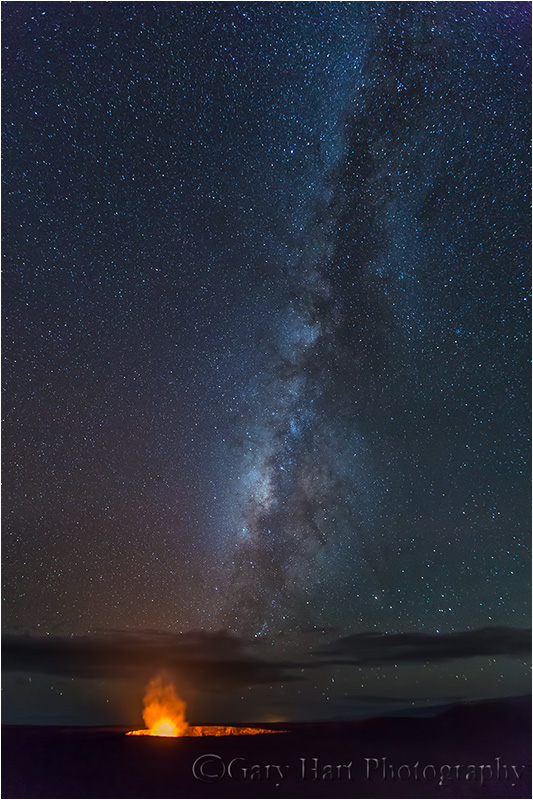
Milky Way Above Halemaʻumaʻu Crater, Kilauea, Hawaii
Canon EOS 5D Mark III
15 seconds
F/2.8
ISO 3200
16 mm
Sitting here on my balcony above Hilo Bay, it’s hard to believe that 10 days ago I was photographing sunrise lightning on a chilly morning at the Grand Canyon. But there’s Mauna Kea, and over there is Mauna Loa. And it’s 6 a.m. and I’m in shorts and flip-flops, so this really must be Hawaii. Ahhhh.
Oh yeah, it’s all coming back to me…. Last night I took my Hawaii workshop group up to Kilauea to photograph the volcano beneath the stars. I always stress about this shoot in particular because the opportunity to photograph the glow of Halemaumau Crater beneath the Milky Way is what brought many of the workshop participants to Hawaii in the first place. My stress is due to factors largely beyond my control: clouds, inadequate equipment (“The guy at Best Buy said this tripod should be fine”), technical problems (“Oh, I thought a five percent battery charge would be enough”), and just plain user error (“It looked sharp in the LCD”). Each year I do my best to mitigate as many problems as I can: I send copious reminders (“Don’t forget to bring…”) and how-to documents (starting months in advance), give a night photography training session the afternoon of the shoot, do a group equipment set-up and checklist in the parking lot before we walk out to the view point, and frequently check on participants during the shoot. But while all that preparation seems to help, so far I haven’t been able to do anything about the weather. The best I’ve been able to do is time my primary volcano shoot early enough in the workshop to allow us the option of returning in the event of a mass fail.
So yesterday afternoon we drove up to Kilauea, stopping first at the Visitor Center (I’m something of a souvenir T-shirt addict), then walking through the lava tube (always a hit), before wrapping up the daylight portion of the day with a really nice sunset at the Jaggar Museum (the closest point from which to view the caldera). Then we headed to dinner beneath a tantalizing (traumatizing) mix of clouds and sky—were the clouds incoming or outgoing? Dinner was great, but I’d have surely enjoyed it far more if I’d have known we’d leave the restaurant and see starry skies. And stars there were, millions and millions (or so it seemed). Phew.
Once the stars did their part, the rest of the night was up to me—despite all the preparation, I know from experience that basic photography skills such as composition, camera adjustments (even though I’d given everyone starting exposure values in the parking lot, most people usually need to tweak something), and (especially) finding focus, become completely foreign in the near absolute darkness of a moonless night. These problems are compounded by the fact that a flashlight, while necessary to light the path to the location, is absolutely taboo once we’re there (their light can leak into others’ frames, and flashlights make it almost impossible to adjust to the darkness)—instead we rely on the soft glow of our cell phone screen to see our controls.
I started with a test exposure to verify the exposure values I’d had everyone set earlier. So far, so good. Then the real fun began—for the next 45 minutes I bounced from pleading shape to pleading shape (faces are unrecognizable): “My camera won’t focus” (Try auto-focusing on the caldera—if that doesn’t work, we try creative solutions such as auto-focusing on a flashlight 100 feet up the trail or a best-guess manual focus on the caldera rim); “My camera won’t shoot” (Turn off autofocus);“ Is this image sharp?” (Magnify the LCD and zoom in on the stars or caldera wall); “My picture is black” (The correct exposure is 30 seconds, not 1/30 second). And so on. (I should make clear that these problems were more an indication of the disorientation caused by the darkness than a reflection of the photographer’s skill.)
But slowly the cries for help turned to exclamations of joy as successful images started popping up on LCDs. Pretty soon I was wandering around looking for someone who needed help, anyone…. When it finally became clear that my offers to help were more of a distraction, I returned to my camera (no small feat in the dark) and tried a few frames of my own. While I had no illusions of getting anything new (or even anything much different than what others had), I tried several variations. Most of my images were oriented vertically to maximize the length of the serpentine Milky Way, and to minimize the black void surrounding the glowing crater. I also varied my focal length a bit, and played with my ISO and shutter speed settings so I could choose later (with the benefit of a larger screen) between more noise, less star motion and vice versa.
In addition to the photography, I always make a point to stop everyone and remind them to simply appreciate what we’re viewing. The orange glow is molten rock, the newest material on the Earth’s surface; overhead are pinpoints of starlight that originated tens, hundreds, even thousands of years ago. It’s both humbling and empowering.
We finally wrapped up a little before 11. Everyone seemed quite happy (okay, downright giddy) with what they’d gotten. At breakfast this morning a few people said they’d checked their images after returning to the hotel, but most said they just collapsed into bed. Nevertheless, I’m already starting to receive whispered requests to return to Kilauea one more time. I won’t take a lot of convincing.
* * * *
:: Join me next year as we do this all over again in the 2014 Hawaii Big Island Volcanoes and Waterfalls photo workshop ::
Beneath the stars
Posted on October 1, 2012

Bristlecone Star Trails, Schulman Grove, White Mountains, California
Canon 1Ds Mark II
36mm
22 minutes
F/4
ISO 200
October 2012
I lead photo workshops in lots of beautiful, exotic places, but I particularly look forward to the Eastern Sierra workshop for the variety we get to photograph. Mt. Whitney and the Alabama Hills, Mono Lake and Yosemite’s Tuolumne Meadows, lots of fall color in the mountains west of Bishop and Lone Pine, and the ancient bristlecones in the White Mountains, east of Bishop.
It’s the opportunities to photograph the mountains surrounding Bishop that most stimulate my creative juices. Each fall the small lakes, sparkling streams, and steep canyons west of Bishop are lined with aspen decked out in their vivid autumn yellow. Contrast that with the arid White Mountains east of Bishop, where virtually nothing thrives except the amazing bristlecone pines. The bristlecones are among the oldest living things on Earth, and they look it. The character they’ve earned by enduring up to 5,000 years of cold, wind, thin air, and water deprivation makes them ideal photographic subjects. There’s wonderful texture in the bristlecone’s twisting trunk and branches, but sometimes I like to turn off the texture with a silhouette that emphasizes the gnarled shape.
The bristlecone here clung to a steep hillside in the Schulman Grove of the Ancient Bristlecone Pine Forest. I was there with three friends on a moonless, late September night in 2007. They wanted to light-paint the tree, but I wanted something that just emphasized the tree’s shape against the stars. With our shots set up, I delayed my exposure for a few seconds while they hit the tree with a bright flashlight, clicking as soon the world went dark. Then we just sat and waited in the chilly air, enjoying the sky, laughing quite a bit, but sometimes just appreciating a silence that’s impossible to duplicate anywhere in our “normal” (flatland) lives.
As we waited we scanned the sky, thick with stars, for a rogue airplane that might threaten to soil our frames. Only one appeared, and when it did I held my hat in front of my lens, holding it there for about fifteen seconds, until the plane moved on. (If you look closely you can actually see a small gap in the same place on the otherwise continuous star trails.)
We had long exposure noise reduction turned on, so we couldn’t see our results until our cameras finished their processing. The pictures didn’t pop up on to our LCDs until we were halfway back to Bishop, but I was driving and had to wait until we got back to town. We pulled into Bishop, tired and hungry, so late that we had a hard time finding anything open, but everyone was so pleased with their images that even Denny’s tasted good.
An Eastern Sierra Gallery
(Click an image for a closer look, and to enjoy the slide show)


Riding the celestial carousel
Posted on August 28, 2012

Star Trails, Desert View, Grand Canyon
Canon EOS-5D Mark III
28 mm
31 minutes
F/4
ISO 400
It’s pretty difficult to feel important while reclined beneath an infinite ocean of stars, peering into the depths of the Grand Canyon. Below you unfolds a cross-section of Earth’s last two billion years, chronological layers of landscape sliced by gravity’s inexorable tug on the Colorado River; overhead is a snapshot of the galaxy’s (perceived) pinwheel about the axis of our planet’s rotation.
From our narrow perspective, at any given time, the Universe appears fixed. But observe the night sky for a few hours and you soon realize more is at play. Those points of light overhead all follow the same east to west arc across the celestial sphere, ultimately disappearing beneath the horizon (or behind the glow of daylight). Most return to the same place twenty-four hours later, but a few shift relative to the stellar background. For millennia explaining these wanderers while maintaining our position at the center of the Universe required convoluted solutions that defied scientific scrutiny. Then Copernicus, in one elegantly simple paradigm shift, removed Earth from the center of the universe and set us spinning about the Sun, pouring the foundation for humankind’s understanding of our place in the Universe. The humbling truth is that we inhabit a small planet, orbiting an ordinary star, on the outskirts of an average galaxy.
Thanks to Copernicus, Galileo, and others who followed, we now take for granted that Earth revolves about the sun, secured by gravity’s invisible string. And while it appears that our star-scape spins above our heads, it’s actually you and me and our seven billion Earth-bound neighbors who are spinning. (It helps to imagine Earth skewered through our north and south poles and spinning around a pole of infinite length.)
For those of us in the Northern Hemisphere, the centerpiece of this nightly show is the North Star—Polaris. Conveniently (and coincidentally) positioned less than one degree from the northern axis of our spin, Polaris is a white-hot ball of ionized gas six times the size of our Sun. (It’s so distant that when the light we see tonight left Polaris’ surface, Copernicus was less than a generation dead and Galileo was a teenager.)
Locked into our terrestrial frame of reference, distracted by the problems of life, we stay generally oblivious to the celestial dance overhead. But I can think of no better way to get some perspective on our place in the universe than to look up on a moonless night, far from city lights. On these nights our planet’s rotation, too slow to be perceived at any given instant, is captured beautifully by a fixed, Earth-bound camera that rotates with us, blending multiple, sequential instants into a single frame. This long exposure stretches each star, a discrete point to our eye, into continuous arc of light, the length of which is determined by the duration of the shutter’s opening—one degree of arc for every four minutes of exposure.
From our perspective the northern sky appears to circle the north celestial pole (occupied by Polaris). Images that include celestial north are etched with concentric arcs—if there were some way to continue the exposure for twenty-four hours (say in the dead of winter at the North Pole), our image would show Polaris like a brilliant gem ringed by full, perfectly symmetrical circles. To a camera centered on the celestial equator (the halfway point between the north and south axes of rotation), a long exposure reveals divergent arc, with the stars north of the celestial equator bending around the north celestial pole and stars south of the celestial equator bending the other direction, around the south celestial pole.
A few words about this image
The above image was captured during my 2012 monsoon trip to the Grand Canyon. Don Smith and I had spent the day chasing (and dodging) lightning, but because we didn’t feel we’d taken enough risks, we thought it might be a good idea to stumble about with the mountain lions, in pitch dark, on the rim of a one mile deep chasm.
While photographing late afternoon and sunset from Desert View, we scouted potential starlight locations in daylight, and returned to the car to eat sandwiches and wait for darkness. And dark it was. Dark enough that I couldn’t really see the canyon’s edge, which was about two feet from my tripod.
Also dark enough that focus was a real challenge. Using my fastest lens, a 28mm Zeiss f2, I found the brightest star and centered it in my viewfinder, then switched to live-view, magnified the view 10 times, and manually focused on the star, which was faintly visible near the center of my LCD. (My Zeiss doesn’t have autofocus—if you try this with an autofocus lens, don’t forget to switch it to manual focus before shooting.)
With focus set, I tried some test frames to get the exposure and composition. It was too dark to compose the canyon through my viewfinder, so I bumped my ISO to 24600 and took a series of wide open (f2), 30-second exposures, tweaking the composition after each until I got it right. Knowing that increasing my exposure duration from 30-seconds to 30-minutes would add six stops of light, I subtracted six ISO stops (25600 to 400). (I’m still learning this lens’s capabilities—next time I’ll stay at f2 and go all the way down to ISO 100 for a 30-minute exposure.)
Waiting for our exposures to complete, Don and I just kicked back and admired the night sky. We saw several meteors cut the black, and several satellites drift by. The city of Page, sixty-five miles north, was a faint glow to our eyes (but much brighter to the camera). Sporadic lightning flashes illuminated clouds to the northwest, well beyond the North Rim and probably as far away as Utah. And the Milky Way, the community of billions of gravitationally connected stars to which our Sun belongs, spread from horizon to horizon.
Read more about after dark photography
Workshop Schedule || Purchase Prints
An After Dark Gallery
Click an image for a closer look, and a slide show. Refresh the screen to reorder the display.


Photographic reality: Accumulate light
Posted on May 27, 2012

Moonbow and Big Dipper, Yosemite Falls, Yosemite
“Photography’s gift isn’t the ability to reproduce your reality, it’s the ability to expand it.”
(The fourth installment of my series on photographic reality.)
Before getting too frustrated with your camera’s limited dynamic range, remember that it can also do things with light that your eyes can’t. While we humans experience the world by serially processing an infinite number of discrete instants in real time, a camera accumulates each instant, storing and assembling them into a single additive frame. The result, among other things, is a view into human darkness that reveals “invisible,” albeit very real, detail and color.
Nothing illustrates this benefit better than a moonlight image, particularly one that reveals a “moonbow.” Several years ago I photographed Yosemite Falls by the light of a full moon a couple of hours after sunset. While there was enough light to see the fall and my immediate surroundings, the world was dark and colorless. Knowing the possibility of a moonbow existed, but unable to see it, I positioned myself with my shadow (cast by the moonlight) pointing more or less in the direction of the fall and dialed in an exposure long enough to make the scene nearly daylight bright. An extremely wide, vertical composition included the Big Dipper high overhead, as if it was the Yosemite Falls’ source.
The result (above) is nothing like what my eyes saw, but it really is what my camera saw. The processing to complete this image involved cooling the color temperature in the raw processor to a more night-like blue; noise reduction to clean up the relatively long, relatively high ISO capture; a little (mostly futile) attempt to moderate the vertical distortion caused by the wide focal length; a slight wiggle in Curves to darken the sky and pop the stars; mild dodging and burning to even tones; some desaturation of the sky (I swear); and selective detail sharpening, avoiding the clouds and darkest shadows.
Starry, starry night
Posted on March 14, 2012

Winter Star Trails, Half Dome and the Merced River, Yosemite
Canon 1Ds Mark III
28 mm
24 minutes
F/2.8
ISO 400
Yosemite is beautiful any time, under any conditions, but adding stars to the mix is almost unfair. I started doing night photography here on full moon nights about six or seven years ago, but recently I’ve enjoyed photographing the exquisite starscape of moonless Yosemite nights. With no moonlight to wash out the sky, the heavens come alive. Of course without moonlight visibility is extremely limited, and focus is sometimes an act of faith. But eyes adjust, and focus improves with experience (I promise).
After photographing, among other things, Yosemite Valley with a fresh blanket of snow and Horsetail Fall in all its illuminated splendor, last month’s Yosemite winter workshop had already been a success. Nevertheless, after dinner on our next to last night I took the group to this peaceful bend in the Merced River to photograph Half Dome beneath the stars.
I started with a high ISO test shot to get the exposure info for everyone, then converted to a long exposure that allowed me to ignore my camera for a half hour or so while I worked with the rest of the group. Helping with focus, composition, and exposure, I made sure everyone had had a success before suggesting we wrap up.
The fabulous photography is only part of what makes these night shoots memorable–they’re also just plain fun. That night we ended up staying out for about an hour, shooting, shivering, and laughing–lots of laughing. And as the group packed up, I returned to my camera and found this waiting for me.
Check out next year’s Yosemite winter workshop.
Almost Heaven
Posted on August 29, 2011

Almost Heaven, Big Dipper and Fog, Big Sur
Canon EOS-1Ds Mark III
28 mm
25 seconds
F/4
ISO 400
On the first night of Don Smith’s Big Sur workshop last week, Don and I gathered our group at (aptly named) Hurricane Point above Bixby Bridge for a round of night photography. While the stars were already out in force as we set up, the last light of day persevered on the western horizon, softly illuminating the sea of fog blanketing the Pacific. The fog, which in California summers lurks offshore by day, was making its nightly assault on the coast. On this evening, under the cover of darkness, it was in full-out attack mode. Rushing to determine the exposure settings for our group of inexperienced night photographers, I managed to fire off three frames before the charging fog engulfed us and we aborted the mission.
I wasn’t sure I’d captured anything of value in my haste until I returned home and found this. It’s a 25-second, 400 ISO exposure that underscores the camera’s ability to accumulate enough light to reveal color beyond the ability of the human eye/brain. In other words, this is pretty much the way my camera saw it: My processing was limited to a slight cooling of the light temperature in the Lightroom raw processor, fairly mild noise reduction, a small wiggle in Photoshop Curves for contrast, and a little dodging to bring out more detail in the fog. Each time I look at this image it revives some of the emotion of being there.

 Eloquent Images by Gary Hart