Eloquent Images by Gary Hart
Insight, information, and inspiration for the inquisitive nature photographer
Magenta moonrise, Half Dome, Yosemite
Posted on November 21, 2011

Magenta Moonrise, Half Dome, Yosemite
With my camera I’m able to create my own version of any view, adjusting focal length (the amount of magnification) and composition to emphasize whatever elements and relationships I find most compelling. Today’s image was captured on the final shoot ofmy most recent fall workshop, three sunsets after my previous image, from virtually the same location.
On Sunday evening (the first sunset), with Yosemite Valley emerging from swirling clouds and the moon high above Leaning Tower, I chose a wide composition that encompassed the entire scene. Wednesday evening the eastern horizon was partially obscured by a uniform layer of translucent clouds. As the sunset progressed, we watched the moon’s glow rise through the throbbing pink clouds. When it slipped into a small opening I quickly tightened my composition to create a frame that was all about Half Dome and the moon. I made the Sunday moon a delicate accent, the Wednesday moon a bold exclamation point. These decisions remind me that photography is more than simply documenting a moment; it’s taking that moment and using the camera’s unique vision to convey its essence.
One more thing: By the last day of a workshop, relationships have been forged and inside jokes have blossomed. The group interaction feels more like a family gathering (minus the disfunction) than the assembly of diverse strangers we were three-and-a-half days earlier. On this evening in particular we had a great time laughing about things that anyone who hadn’t been in the workshop couldn’t appreciate. It was lots of fun, and a wonderful way for me to wrap up this year’s fall workshop season.
Isolation
Posted on November 11, 2011
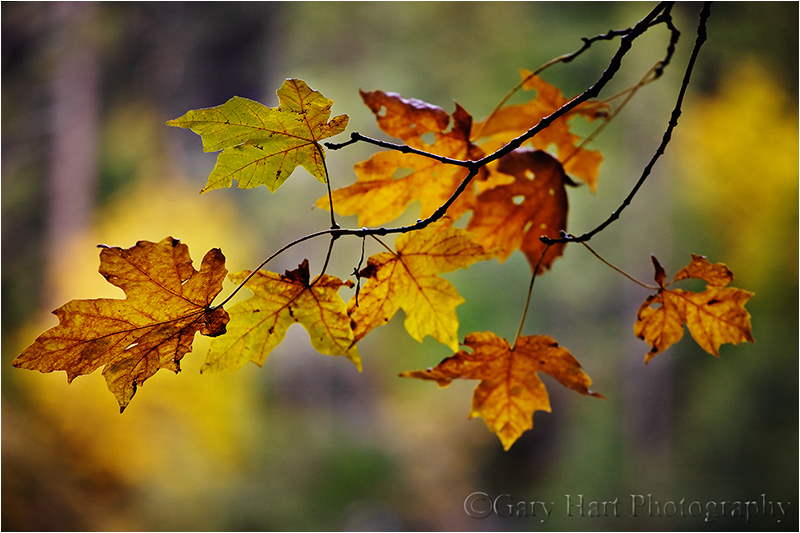
Forest Autumn, Yosemite
Canon EOS-1Ds Mark III
200 mm
1/25 second
F/4
ISO 200
I love sweeping panoramas, but when I’m alone I often gravitate to the intimate locations that make nature so personal. In Yosemite’s dark corners, places like Bridalveil Creek beneath Bridalveil Fall, and the dense mix of evergreen and deciduous trees lining Merced River near Fern Spring and the Pohono Bridge, I scour the trees and forest floor for subjects to isolate from their surroundings.
Helping your subjects stand out is often the key to a successful image. Sometimes subject isolation is a simple matter of finding something that stands out from its surroundings, an object that’s physically separated far from other distractions. But more often than not, effective isolation requires a little help from your camera settings, using contrast, focus, and/or motion to distinguish it from nearby distractions.
A disorganized tangle of weeds or branches can become a soft blur of color when you narrow your depth of field with a large aperture, close focus point, and/or long focal length. Likewise with motion, where a long shutter speed can smooth a rushing creek into a silky white ribbon. And a camera’s inherently limited dynamic range can render shadows black, and highlights white, creating a perfect background for your subject.
After finding these dangling leaves, just across the road and a little downriver from Fern Spring in Yosemite Valley, I juxtaposed them against the vertical trunks of background maples and evergreens. Zooming to 200mm reduced my depth of field, separating the sharp leaves from the soft background of trunks and branches. A large aperture further blurred the background to a simple, complementary canvas of color and shape. Slight underexposure and a polarizer (to remove glare) helped the color pop.
On my website you can read more about my favorite Yosemite photo locations.
A gallery of isolation


A landscape photographer’s time
Posted on June 25, 2011

Double Rainbow, Yosemite Valley
Canon EOS-1Ds Mark II
38 mm
1/5 seconds
F/16
ISO 100
On my run this morning I listened to an NPR “Talk of the Nation” podcast about time, and the arbitrary ways we Earthlings measure it. The guest’s thesis was that the hours, days, and years we measure and monitor so closely are an invention established (with increasing precision) by science and technology to serve society’s specific needs; the question posed to listeners was, “What is the most significant measure of time in your life?” Most listeners responded with anecdotes about bus schedules, school years, and work hours that revealed how our conventional time measurement tools, clocks and calendars, rule our existence. Listening on my iPhone, I wanted to stop and call to share my own relationship with time, but quickly remembered I wasn’t listening in realtime to the podcast. So I decided to blog my thoughts here instead.
Landscape photographers are governed by far more primitive constructs than the bustling majority, the fundamental laws of nature that inspire, but ultimately transcend, clocks and calendars: the Earth’s rotation on its axis, the Earth’s revolution about the Sun, and the Moon’s motion relative to the Earth and Sun. In other words, clocks and calendars have little to do with the picture taking aspect of my life; they’re useful only when I need to interact with the rest of the world on its terms (that is, run the business).
While my years are ruled by the changing angle of the Sun’s rays, and my days are inexorably tied to the Sun’s and Moon’s arrival, I can’t help fantasize about the ability to schedule my spring Yosemite moonbow workshops (that require a full moon) for the first weekend of each May, or mark my calendar for the blizzard that blankets Yosemite in white at 3:05 p.m. every February 22. But Nature, despite human attempts to manipulate and measure it, is its own boss. The best I can do is adjust my moonbow workshops to coincide with the May (or April) full moon each year; or monitor the weather forecast and bolt for Yosemite when a snowstorm is promised (then wait with my fingers crossed).
The insignificance of clocks and calendars is never more clear than the first morning following a time change. On the last Sunday of March, when “normal” people moan about rising an hour earlier, and the first Sunday of November, as others luxuriate in their extra hour of sleep, it’s business as usual for me. Each spring, thumbing its nose at Daylight Saving Time, the Sun rises a mere minute (or so) earlier than it did the day before; so do I. And each fall, on the first sunrise of Standard Time, I get to sleep an an entire minute longer. Yippee.
Honestly, I love nature’s mixture of precision and (apparent) randomness. I do my best to maximize my odds for something photographically special, but the understanding that “it” might not (probably won’t) happen only enhances the thrill when it, or maybe something unexpected and even better, does happen. The rainbow in today’s image was certainly not on anybody’s calendar; it was a fortuitous convergence of rain and sunlight (and ecstatic photographer). My human “schedule” that evening was a 6 p.m. get-to-know/plan-tomorrow dinner meeting with a private workshop customer. But seeing the potential for a rainbow, I suggested that we defer to Mother Nature, ignore our stomachs, and go sit in the rain. Fortunately he agreed, and we were amply rewarded for our inconvenience and discomfort.
Workshop Schedule || Purchase Prints
A Gallery of Rainbows
Click an image for a closer look, and a slide show. Refresh the screen to reorder the display.


The Other Ninety-Nine Percent
Posted on May 2, 2011

Cradled Crescent, El Capitan and Half Dome, Yosemite
Canon EOS 1DS Mark III
4 seconds
400 mm
ISO 400
F8
Thomas Edison said, “Genius is one percent inspiration and ninety-nine percent perspiration.” (Without claiming genius) I think this applies to photography as well: Many successful images are more the product of being in the right place at the right time than divine inspiration. Of course anyone can stumble upon a lucky convergence of location and conditions and come home with a great photo, but the “genius” behind creating great photos consistently is preparation and sacrifice–a.k.a., perspiration.
The moonrise on the final sunrise shoot of last week’s Yosemite workshop spurred these thoughts about inspiration and effort. We were all in more or less the same place, photographing the same thing. And while everyone probably captured very similar images (in this case of a crescent moon squeezing between El Capitan and Half Dome), the true magic was simply being there.
But why were we the only ones there to witness this special moment that probably won’t repeat for decades? Determining the moon’s altitude and azimuth from any location on Earth is as easy as visiting one of many websites, or using one of many astronomical software applications such as The Photographer’s Ephemeris or (my preference) the Focalware iPhone app. Armed with this data, aligning the moon’s rise with any landmark isn’t rocket science.
Based on my calculations and plotting, I scheduled my “Yosemite Dogwood and Rising Crescent” workshop to coincide with a sunrise crescent moon. The dogwood bloom isn’t as reliable, but I know interesting weather is still possible in Yosemite in late April and early May. What we ended up with was mostly clear skies (great for tourists, but definitely not for photographers) and a very late dogwood bloom in Yosemite (probably two weeks behind “schedule”), forcing me to shift the daytime emphasis of my spring workshop to rainbows. I’m happy to report Bridalveil and Yosemite Falls delivered more photogenic rainbows than I can count, from a number of different locations.
As spectacular as they were, overshadowing the rainbows was the moonrise on our penultimate morning. I promised the group that departing at 4:50a.m. would get us to Tunnel View in time to photograph a 7% crescent moon rise above Yosemite Valley, between Sentinel Dome and Cathedral Rocks, in the pre-dawn twilight. (I knew this because I’ve been calculating moonrise and moonsets in Yosemite and elsewhere for many years, and have photographed more of these from Tunnel View than any other location.) That moonrise came off exactly as advertised–so far so good.
But the Tunnel View success, as beautiful as our images were, was merely a warm-up that gave everyone an opportunity to hone their silhouette exposure and composition skills in advance of the rare moonrise opportunity I’d planned for the next morning. When scheduling this workshop I’d determined that about 45 minutes before sunrise on May 1 of this year (2011), a delicate 3% crescent moon would slip into the narrow gap between El Capitan and Half Dome for anyone watching from Half Dome View on Big Oak Flat Road.
Lunar tables assume a flat horizon, so unless I’m at the ocean, the primary uncertainty is when the moon will appear above (or disappear below) the not-flat horizon. Once I’ve photographed a moonrise (or set) from a location, I simply check the precise time of its appearance (or disappearance) against the altitude/azimuth data for that day to get the exact angle of the horizon from there. Until I have this horizon information, I only have the moon’s direction and elevation above the unobstructed horizon and can only make an educated guess as to the time and location of its appearance.
The other big wildcard in moon and moonlight photography is the weather, but a last minute check with the National Weather Service confirmed that all systems were go there. Nevertheless, despite all my obsessive plotting, checking, and double-checking, having never photographed a moonrise from this location, and the fact that an error would affect not just me but my entire group, I couldn’t help feel more than a little anxious.
The afternoon before our second and final pre-dawn moonrise, I brought the group to Half Dome View so they could familiarize themselves with the location and plan their compositions. Due to the horizon uncertainties I just described, the first time I photograph a moonrise/set from a location, I generally give my group only an approximate time and position for the moon’s rise/set. But during this preview someone asked exactly where the moon would rise, and I confidently blurted that it will appear in the small notch separating El Capitan and Half Dome between 5:15 and 5:20 a.m. (about 25 minutes after the official, flat-horizon moonrise). Standing there that afternoon, however, I realized how small the notch really is, meaning that even the slightest error in my plotting could find the moon rising much later, from behind El Capitan or Half Dome. So I quickly qualified my prediction, explaining that I’ve never photographed a moonrise here and the uncertainty of knowing the horizon. But given all of my perfectly timed waterfall rainbow hits so far, not to mention our Tunnel View moonrise success earlier that morning, I had the sense that my group had unconditional (blind) confidence in me. (Yikes.)
Sunday morning we departed dark and early (4:45 a.m.), full of anticipation. We arrived at Half Dome View a little after 5:00, early enough to enable everyone to set up their tripods, frame their compositions, and set their exposures. Then we waited, all eyes locked on the gap separating El Capitan and Half Dome. Well, almost all eyes–mine made frequent detours to my watch and the Focalware iPhone app responsible for my bold (rash?) prediction. (What was I thinking, promising a moonrise into a paper-thin space in a five minute span from a spot where I’d never photographed a moonrise?) My watch crawled toward the 5:15-5:20 window: 5:15 (Is the notch shrinking?); 5:16 (It’s shrinking–I swear I just saw Half Dome inch closer to El Capitan); 5:17 (I entered the coordinates wrong, I know I did–what if it comes up behind us?). Surely this wasn’t the kind of perspiration Edison was thinking about.
As I frantically re-checked my iPhone for the umpteenth time, somebody exclaimed, “There it is!” I looked up and sure enough, there was the leading sliver of nearly new moon perfectly threading that small space between El Capitan and Half Dome. Phew. The rest of the morning was a blur of shutter clicks and exclamations of delight (plus one barely audible sigh of relief). (How could I have even dreamed of doubting the tried and true methods that had never failed me before?)
Before the shared euphoria abated, I suggested to everyone that they take a short break from photography and simply appreciate that they’re probably witnessing the most beautiful thing happening on Earth at this moment (a feeling every nature photographer should experience from time to time). It’s always exciting to witness a moment like this, a breathtaking convergence of Earth and sky that may not occur again exactly like this in my lifetime. It’s even more rewarding when the event isn’t an accident, that I’m experiencing it because of my own effort, and that I get to share the fruit of my perspiration with others who appreciate the magic just as much as I do.
Workshop Schedule || Purchase Prints || Instagram
A Crescent Moon Gallery
Click any image to scroll through the gallery LARGE


Make the world your own
Posted on January 19, 2011
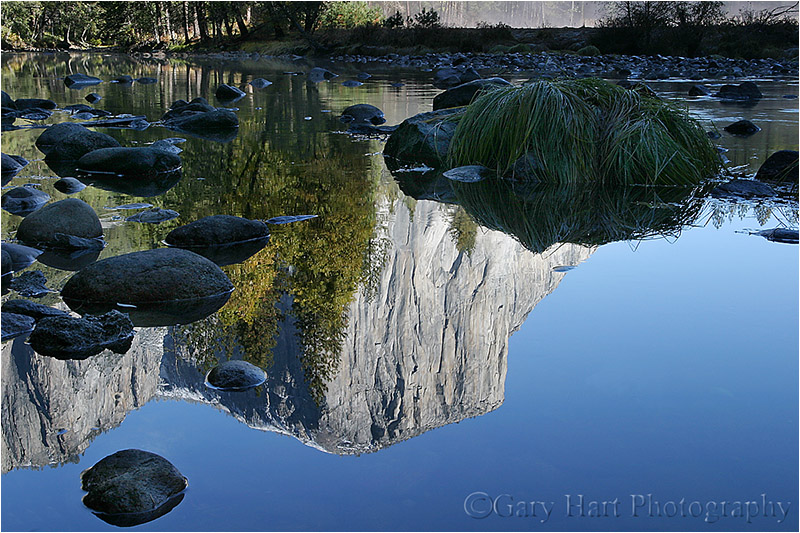
El Capitan Reflection, Valley View, Yosemite
Canon EOS 10D
1/4 second
F22
ISO 100
27 mm
Pretend you’re a musician who wants to make music your career. Let’s say Eric Clapton is your favorite artist, and “Layla” is your favorite song. Do you think your quickest path to fame and fortune would be to record a song that perfectly replicates “Layla”? (Especially given the difficulty you’d have resurrecting Duane Allman.)
So why is it that so many nature photographers with grand aspirations spend so much time trying to duplicate the shots of others, rather than trying to find and refine their own artistic vision? Using Eric Clapton as a model for your music is great—the more you listen to Clapton, the more your guitar playing will be influenced by his craftmanship. But at some point you need to choose between carving your own musical path or languishing in anonymity.
This applies equally in photography. In my photo workshops I encounter many people who have travelled a great distance to duplicate a photo they’ve seen online, in a book, or in a print. I certainly understand the impulse, and I can’t say that my portfolio doesn’t contain its share of these clichés. But, as I frequently urge my workshop students, if you must photograph something exactly as it’s been photographed before, make that version your starting point and not your ultimate goal.
Once you get your “iconic” (that word is a cliché itself) shot, slow down and work the scene. Look for foreground and background possibilities, find unique perspectives. Play with depth and motion. If your original frame was horizontal, try something vertical, and vice versa. Take your camera off the tripod and pan slowly, zooming in and out as you go until something stops you (don’t forget to bring the tripod back before clicking). Still feel uninspired? Try a longer lens—often the truly unique images are tighter shots that isolate elements of the conventional composition.
It’s true that the longer spend time with a scene, the more you’ll find to photograph. Make a mental checklist of the above steps (feel free to add your own) and go through them without rushing: Often the mere mechanical (uninspired) process of seeking something unique gives you deeper insight that leads to a creative capture if you stick with it long enough.
This image of El Capitan reflected in the Merced River resulted from just such an approach. I’d rolled into Yosemite at around 10:00 a.m. on a mid-November morning. The air was crisp and still, scoured clean by an overnight shower. At Valley View I found this perfect reflection, only possible in the quiet-water days of autumn. Working on a tripod, I started my compositions wide and captured many of the beautiful but conventional shots that have been done a million times here. But wanting something different, I removed my camera from my tripod continued probing the scene through my viewfinder. I eventually isolated the reflection, realizing it was so sharp the morning that it was the thing that really set this moment apart. Despite the advancing sunlight that would soon reach the river and wash out the reflection, I didn’t rush.
On my computer at home, it was fun to view my process through the series of captures that morning. I finally zeroed in on this frame that has become one of my most successful images. Did I create the photographic equivalent of “Layla” that morning? Doubtful. But I did come up with an image that pleases me, and something that’s a pretty unique take on this heavily photographed location.
Are you a photographer or a tourist?
Posted on January 14, 2011
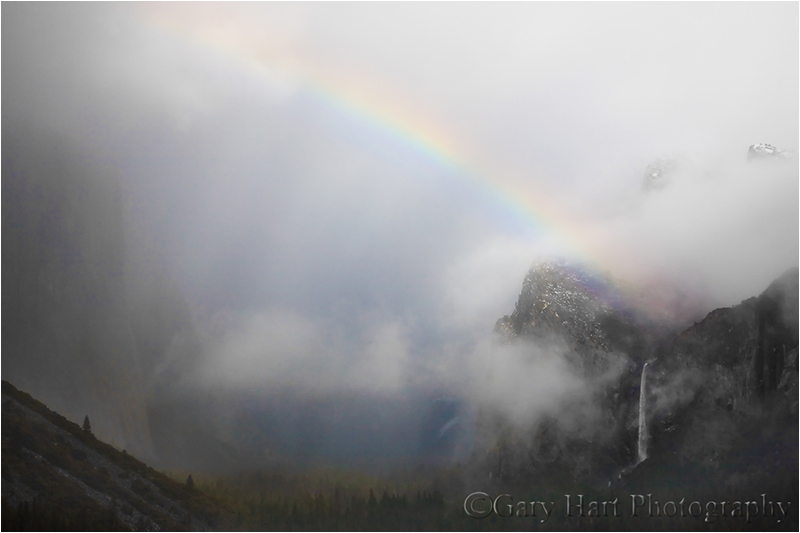
Storm’s End, Yosemite Valley
When the weather gets crazy, do you sprint for cover or reach for your camera? Your answer may be a pretty good predictor of your success as a photographer. It’s an unfortunate fact that the light, color, and drama that make memorable landscape photos all come when most sane people would rather be inside: at sunrise, when the rest of the world is asleep; at sunset, when everyone else is at dinner; and during wild weather, when anyone with sense is on the sofa in front of the fire.
Last spring I guided a photo workshop group through Yosemite. On the final day we circled Yosemite Valley in a steady rain, stopping to photograph many of my favorite cloudy-sky spots. Through it all my hardy group persevered, wet but happy, but by mid-afternoon their energy had started to wane a bit. Rather than risk mutiny, I detoured to Tunnel View to give everyone a breather.
With El Capitan, Half Dome, Cathedral Rocks, and Bridalveil Fall all on prominent display, it’s no secret why Tunnel View is the most photographed location in Yosemite. After a storm, Yosemite’s dramatic landmarks emerge from swirling clouds as if appearing on earth for the first time. Storms in Yosemite clear from west to east, making Tunnel View the first place to capture this unforgettable experience and my go-to place to wait out Yosemite weather.
The rain fell in sheets as we pulled into the Tunnel View parking area. Throughout the workshop I’d tried to impress on everyone how quickly conditions change in Yosemite, but it’s pretty hard to appreciate exactly how quickly until you actually experience a change yourself. So, despite my prodding to the contrary, when I donned my rain gear and invited the group to join me in the rain, they all opted for the warmth of the cars. And there I stood, five soggy minutes later, accompanied only by my tripod and camera (me beneath an umbrella, my camera beneath a plastic garbage bag), when without warning a ray of sunlight broke through, briefly painting a rainbow above Yosemite Valley, from El Capitan to Bridalveil Fall. After rousing the group I had time for three frames before the rainbow faded into the clouds. Everyone else was still wrestling with their gear.
Did I know a rainbow was going to happen? Of course not. In fact, if I were a betting man, I’d have wagered I wasn’t going to get anything but wet. But no matter how slim the odds were, a special image was infinitely more likely in the rain than in the car.
So. Are you a photographer or a tourist? There’s nothing wrong with the tourist mentality that only takes you outdoors with the masses, well rested and appetite sated in midday warmth. On the other hand, if one spectacular success is compensation enough for the other hundred tired, hungry, cold, and wet failures, you may just be a photographer.
Every picture has a story
Posted on January 7, 2011

Bridalveil Dogwood, Yosemite National Park
Canon EOS 10D
1/15 second
F/22.0
ISO 100
48 mm
Every picture has a story. (And as Rod Stewart reminded us, every picture tells a story as well, but it’s not necessarily the same story and that isn’t really what I want to talk about anyway.) The story of a compelling nature photograph can include every bit of the good stuff that makes for gripping narrative in a book or movie: adventure, peril, suffering, and yes, sometimes even romance, humor, and foolish mishaps.
The story of this image goes back to the beginning of the story of my path as a nature photographer, all the way back to an afternoon when the ten-year-old me joined my father, a serious amateur photographer, on a hike to the top of Sentinel Dome in Yosemite. For those unfamiliar with the most beautiful place on Earth, Yosemite’s Sentinel Dome is a towering, rounded knob of granite that does indeed appear to stand sentinel above the surrounding terrain. At 8,000 feet, its summit provides a 360-degree highlight reel of Yosemite’s most dramatic features: Cathedral Rocks, El Capitan, Yosemite Falls, and Half Dome, among others, are all on prominent display here. With the exception of a single gnarled jeffrey pine, exquisitely captured by Ansel Adams and many other photographers (and now dead and lying on its side), Sentinel Dome’s summit is also as bald as a bowling ball.
On the day of our hike thunderstorms had been firing all afternoon, stabbing the granite near El Capitan and Yosemite Falls just across the valley. Dad’s goal was to photograph lightning, and what vantage point better than Sentinel Dome with its panoramic view, not to mention a photogenic tree for the foreground. My dad wasn’t a stupid man, but personal experience has since helped me understand how his desire to “get the shot” can temporarily overwhelm good sense. So, when the storm crept closer and rain started to fall on our location, rather than descend to safety, Dad handed me an umbrella and asked me to extend it high above his treasured Leica.
So there I stood, proudly and without question, perched atop an elevated and completely exposed peak, extending heavenward a metal rod. I have no memory of fear or even of being aware of the foolishness of our efforts—I just remember sensing Dad’s intense desire to get his shot, and wishing with all my heart for the lightning bolt that would make it happen.
We didn’t get our lightning that day, and more importantly, the lightning didn’t get us. But later that afternoon, as the whole family enjoyed the view in a light rain just down the road at Glacier Point, the storm broke and delivered without warning a brilliant rainbow that arced magnificently across the face of Half Dome. My father, despite being transformed by family priorities from photographer to tourist, still dangled his Leica from his neck—he simply had to lift the camera, meter the scene, and click to get the shot of his lifetime.

Here’s my dad’s Half Dome Rainbow, captured on a summer afternoon in the mid-sixties.
I’ll never forget the contrast of Dad’s emotions that afternoon, which ranged from frustration and disappointment atop Sentinel Dome, to shear euphoria at Glacier Point. I experienced them as strongly as if they were my own, and while photography dropped from my radar as I spent the remainder of my youth occupied with the typical distractions of adolescence, few childhood memories are more permanent than that one. In hindsight it’s clear that Dad’s emotions were a microcosm of the reasons I became a nature photographer. For every success there are ten disappointments, but every once in a while you’re gifted with a surprise that makes all the frustration worthwhile.
Fast-forward to 2004. A gentle spring rain falls as I wander the banks of the Merced River in Yosemite Valley. I have image in mind. Like that afternoon on Sentinel Dome, I have no guarantee of getting the shot I want: a dogwood bloom with one of Yosemite’s landmarks in the background. I make several stops, and as I search I’m only vaguely aware of the steady but light rain (fortunately, there’s no lightning).
I can’t remember how much my thoughts this wet morning drifted to the afternoon on Sentinel Dome with my dad all those years ago, but I have no doubt that it was prime catalyst in my path from enthusiastic assistant, to serious amateur, and ultimately to full-time professional photographer. I now completely understand that need to get the shot with little concern for the consequences, and how easy it can be to mentally eliminate distractions, discomfort, and physical obstacles (and sometimes good sense).
I got my shot that day, a raindrop-festooned dogwood blossom, large and sharp in the foreground, with a roaring Bridalveil Fall soft in the distance. On my drive home I was cold, wet, and happy. Photography’s funny that way. Thanks, Dad.
A sampling of personal favorites
Click an image for a closer look, and a slide show. Refresh the screen to reorder the display.


