Let’s get vertical
Posted on June 12, 2011
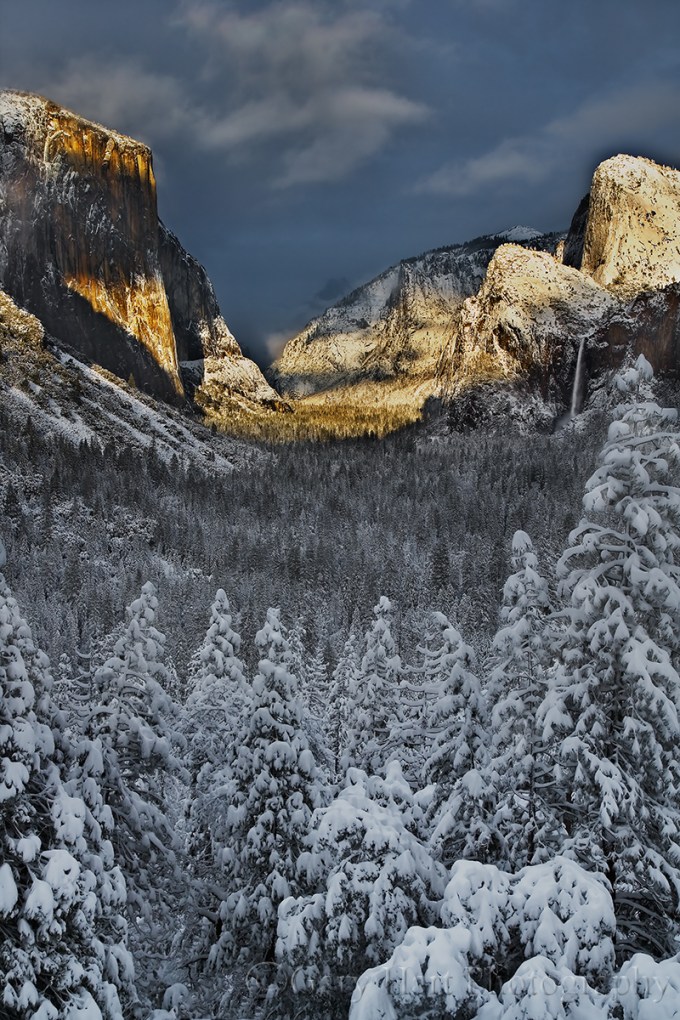
Storm’s End, Tunnel View, Yosemite
Canon EOS-1Ds Mark II
1/30 second
F/11
ISO 100
40 mm
Whose bright idea was it to lable horizontal images “landscape,” and vertical images to be “portrait”? To them, let me just say: “Huh?” As a landscape-only photographer, about half of my images use “portrait” orientation. Sometimes I wonder if this unfounded naming bias explains why so many people default to a horizontal orientation for their landscape images, missing some great opportunities to improve their photography in the process.
Every image contains implicit visual motion that’s independent of the eyes’ movement between the image’s compositional elements. Horizontal or vertical, the eye tends to move along the frame’s long side, a reality that allows photographers to complement the eye’s movement among the frame’s compositional elements (for example, a vertically oriented waterfall image), or to create tension by contrasting the elements’ visual motion with the frame’s long border (for example, a horizontally oriented waterfall image).
Vertical images can also enhance the illusion of depth so important in a two-dimensional photo, because the natural tendency to follow the long side of an image enhances the front-to-back eye movement so essential to the sense of depth.
More than just guiding eye movement through the frame, vertical orientation also narrows the frame, essential when we need to eliminate less compelling objects to the left and right of the prime subject(s). I use this approach quite a bit at Yosemite’s Tunnel View, where I think photographers generally tend to compose too wide (more on this below).

This image is entirely about the amazing cloud illuminated by Eastern Sierra sunset light. To capture it I found a single tree atop a ridge for the bottom of the frame, oriented the frame vertically, and gave the cloud over 80 percent of the frame. A horizontal orientation that captured this much of the cloud would have introduced distractions on the right and left, and shrunk the cloud significantly.
A vertical orientation is a great way to emphasize something dramatic in the close foreground, distant background, or sky. I love showing off a beautiful sky by placing the horizon at the bottom of a vertical frame; conversely, I can focus most of the attention on a compelling foreground by placing the horizon at the top of a vertical frame. The more dramatic the element I want to emphasize, the more room I’ll give it by placing the horizon line closer to the top or bottom of the frame.
Despite all these reasons to do otherwise, why do so many photographers default to a horizontal orientation of a landscape image? I think it starts with the subconscious need to maintain harmony with the horizontal orientation of the horizon, a bias that starts the first time we put a camera to our eye. It doesn’t help that the placement of the shutter button only encourages this behavior–on most cameras it’s just easier to snap a picture when they’re oriented horizontally.
But I’m afraid the horizontal bias carries over to landscape photographers on a tripod, using a remote shutter release. In this case, in addition to the built-in horizontal-horizon bias, I blame the awkward maneuvering a vertical orientation on a tripod requires–it’s just easier to have your camera sitting right there in the center of the tripod at it’s highest possible elevation. Tilting the camera to vertical drops the eyepiece several inches, forcing the photographer to either stoop or lower the tripod to compose. It’s also destabilizing to position the camera away from the tripod’s center of gravity; some poor-quality tripod heads simply can’t handle the weight of a camera and lens that’s not directly atop the head.
What’s a photographer to do? If you’re really committed to landscape photography, I can think of no single piece of equipment that will improve your experience in the field more than an L-plate. For less than $200, you can purchase an L-shaped plate that attaches to your camera’s base and wraps around one side. The plate is camera-specific (a new camera requires a new L-plate); it attaches to a corresponding quick-release plate on your tripod’s head. Switching between horizontal and vertical is a simple matter of disengaging the quick-release, flipping the camera, and re-engaging the quick-release. Not only is this quite simple and fast, it keeps the camera over the tripod’s center of gravity and the eyepiece always at the same level, regardless of orientation.
The above image from Tunnel View was one of many (duh) I captured that March evening several years ago. I’d waited in a blizzard for two hours, hoping (praying?) for something just like this. When the light appeared just a few minutes before sunset, it was clear that the most compelling aspects of the scene (besides the always compelling El Capitan, Half Dome (lurking in the clouds in the top-center of the frame), Cathedral Rocks, and Bridalveil Fall was absolutely not the granite cliffs left of El Capitan and right of Cathedral Rocks; it was the clouds swirling above Yosemite Valley, the amazing light, and (especially) the snow-laden trees in the foreground. Going with a vertical orientation seemed like a no-brainer, as it allowed me to capture only the scene’s most beautiful elements, emphasize the foreground trees with a high horizon, and guide my viewers’ eyes through the scene, from the magical trees to Yosemite’s iconic landmarks.
* * * * * * * * *
One unrelated note about today’s image: This is where I met my good friend and fellow pro photographer, Don Smith. Don and I were two of four or five photographers to brave the elements, with no guarantee of success, that chilly afternoon. Because at that time there was room for no more than five tripods in the prime (unobstructed by trees) Tunnel View viewing spot, photographers had to claim and hold their space rather than simply wait in the car for the weather to clear. Over the couple of hours we waited for the storm to clear, Don and I got chatting and a life-long friendship was born. See, you never know what you’ll find when you go out in crazy weather.
Workshop Schedule || Purchase Prints
Just Vertical


Style points
Posted on June 9, 2011
 Conducting photo workshops allows me to observe hundreds of other photographers each year. It’s clear that each brings his or her own personality to the act of creating an image, from the way they search for compositions, to the things they notice (and don’t notice). I could go on and on about any of these differences, but today’s image really underscores a particular aspect of my approach, so (since this is my blog) I thought I’d write about that.
Anyone who has ever photographed with me knows how deliberate I am in the field. It starts with a large measure of calculation, evaluating the scene to determine what to include and exclude, and the best way to do it. And when I finally arrive at something I like, I’ll wait as long as it takes for the conditions to be perfect, refining my composition in the process; once everything’s right, I’ll
work the composition to with in an inch of its life. Many charitably label me “patient,” though often it feels more like stubbornness: “I’m not leaving here until I get exactly what I want.” Whatever you call it, this approach works for me because careful observation and measured response is the way I relate to the world.
I’ve observed that other, more spontaneous, photographers are very frenetic in the field, constantly moving and exploring, rarely dallying at one spot at risk of missing something special elsewhere. These photographers expose themselves to more opportunities, capturing far more variety on any given shoot, than I do. While I believe it’s important to observe other photographers and borrow from them when something resonates, ultimate success comes from being true to your own instincts and inclinations. Just as I wouldn’t do well rushing from spot to spot, a more kinetic photographer might go crazy wasting time on one shot when there’s so much other great stuff nearby.
On the penultimate evening of Don Smith’s Northern California workshop, Don and I landed our group on the Mendocino Headlands about ninety minutes before sunset. Scanning for elements to assemble into a composition, the first thing that caught my attention were the colorful wildflowers dotting the cliffs. The cove and ocean beyond was clearly photo-worthy (though an assortment of large rocks in the water would need to be handled with care to avoid introducing distractions or disturbing the frame’s balance). On the horizon bloomed billowing cumulus, vestiges of the day’s rain. The sun was still fairly high, an initial hindrance that could potentially become an opportunity if the clouds cooperated as sunset approached. All I needed to make an image was a focal point, a compelling subject to anchor my frame. My eyes immediately darted to a patch of poppies overlooking the Pacific, as if waiting with the rest of us for the sun to set. Though they’d closed for the day, I just couldn’t resist the color and grace of my favorite flower.
Once I identified the elements for my frame, I still had to assemble them into an image and immediately dropped to the ground to exaggerate the poppies and minimize a less appealing patch of weeds behind them. A vertical composition allowed me to fill the entire bottom of the frame with poppies while including a lot of sure-to-be-dramatic sky. Anticipating the position of the sun’s exit, I used the diagonal cliff edge to point at the island and create a virtual triangle (poppies, island, sun) for balance. With everything positioned in my frame, I was pretty sure I’d found my shot, but still had an hour to kill before sunset. No problem–I confidently locked-in the composition on my tripod and rose to check on the rest of the group. Several were set up within a few feet of me; others were distributed up and down the headlands. All were most pleased with the scene and potential for more.
As I moved among the other workshop photographers, I kept my eyes open for other compositions. Singular focus is great, but experience (i.e., a few frustrating misses) has taught me not to be so locked on a subject that I become blind to other great stuff such as changing light or an even better composition I might have missed.
Convinced that I’d made the best choice (for me) that evening, I returned to my camera to wait. But even the act of waiting is far from static. First I made sure my polarizer was oriented properly and readied my graduated neutral density filters. Next, I started the exposure process by identifying the scene’s variables. Knowing first and foremost the foreground poppies must be sharp, I chose f16 for the best combination of depth of field and lens sharpness (to avoid diffraction and soft corners, I try to avoid going smaller than f16). I focused midway through the foreground poppies, confident that, at my chosen 28mm focal length, f16 would ensure complete sharpness in the poppies and acceptable sharpness in the background. But the small aperture also meant a one second exposure at my preferred ISO 100; while the breeze was light, I felt much more comfortable at ISO 400 and 1/4 second.
With all this worked out, I was able to spend the rest of my waiting time monitoring the waves and tweaking my composition. There wasn’t a lot going on in the surf, but I soon realized that the small arch in the middle-right stood out best as a wave washed through. The other dynamic issue was distracting white surf that appeared when waves struck a rock just outside the frame on the left. And I’d initially overlooked a small patch of poppies on the bluff, beyond my foreground patch, but soon appreciated that this bunch nicely filled an otherwise blank space if I took care to avoid trimming it with the frame’s border.
By the time the sun dropped to the horizon and the clouds started to light up, I was so familiar with everything in my scene that slight composition adjustments to account for the rapidly moving clouds were easily handled without impacting the factors I’d identified earlier (surf, background poppy patch, focus point, potential wind motion, and so on). This familiarity also enabled me to occasionally recompose wider, tighter, or horizontal then quickly return to my primary (this) composition.
If you’ve made it all the way to the bottom of this wordy post (congratulations!), you may just be as patient and detail-oriented as I am. But if you’re not comfortable shooting this way, no worries. As you can see, this was a very nice sunset–a quick look at my thumbnails would reveal to some an alarming frame-to-frame similarity. In this case I’m extremely happy to have a large variety of versions of this composition from which to choose, but if I’d have been less than satisfied with my decisions (as sometimes happens), unlike those who moved around that evening, I’d have no alternatives as potential consolation. Truth be told, studying, refining, and becoming intimately familiar with a scene just makes me happy, and if you can’t be happy taking pictures, what’s the point?
Naturally saturated
Posted on June 2, 2011

Okay, let’s have a show of hands: Who read my previous post? If you did, you no doubt remember my lament that photographing a redwood forest isn’t easy. Problem number one is the bright sky that always seems to find its way through even the most dense forest canopy, scattering small patches of sunlight that simply don’t play well with the prevailing shade. Rain clouds darken these highlights significantly, reducing the overhead brightness to a manageable level, painting the entire scene in soft, shadowless light that enables fully saturated color without Photoshop intervention. Unfortunately, rain introduces a new problem for the photographer: it’s wet.
Given that some of the best photography occurs when it’s raining, staying inside is not an option for serious photographers. We all have our own methods for dealing with it–mine starts with making sure I am absolutely dry: waterproof boots and wool socks, rain pants that slide over my regular pants, a waterproof parka, all topped by a wide-brimmed rain hat (every time I don this ensemble I flash back to fourth grade, splashing on the playground during a downpour in my yellow slicker and red galoshes). Waterproofing myself frees me to concentrate entirely on keeping my camera dry. This I achieve with a plastic garbage bag (I keep a box in my car, but if for some reason I don’t have one, I rob a bag from the hotel wastebasket) and an umbrella. The garbage bag slides over the camera when it’s on the tripod, only coming off when I’m ready to compose. Conversely, the umbrella stays closed, opening the second the garbage bag comes off. I don’t stress too much about a few raindrops on my camera; my sole objective is to keep any water from marring my lens element (or more precisely, my polarizer–more on this later). I also keep a lens cloth in a pocket to dab the rogue drop that penetrates my defenses, and a hand towel in my camera bag in case a more extreme measures are required.
The rain was falling pretty hard when Don Smith and I landed the workshop group at Lady Bird Johnson Grove in Redwood National Park; unsure how prepared for the conditions everyone was, so we gave them an hour to meander the grove’s one mile loop. But within fifteen minutes it became pretty clear that the light was special, and everyone seemed to be dealing with the rain fairly well, so we quickly added another hour. Wise move.
My goal when photographing redwoods is to resist the urge to capture too much; instead I seek a single element that stands out. In this image and in the image in my previous post, rather than force a composition, I designed my composition to use the light available to me. The image in my previous post emphasized the light illuminating translucent leaves against the dark forest background; in today’s image, I chose a mossy tree as the focus point of a scene that tries to convey the opulent beauty of a redwood forest. The dramatic light here is on the moss lining the diagonal tree, but the entire forest was shrouded in an ethereal mist that bathed the scene in shadowless light that begged to be photographed.
My previous image used limited depth of field to focus all attention on the luminous leaves and soften the towering redwoods into a background canvas. Here, wanting maximum depth of field and despite the forest’s darkness, I stopped down to f16 and bumped my ISO to compensate. Even at ISO 400, the combination of deep shade, dark sky, and microscopic aperture forced a four-second exposure. Fortunately there was very little breeze, and I was more than content to live with the single blurred fern in the foreground, pretty much the only thing that moved even slightly during my lengthy exposure.
One final, important, and often overlooked element here is the value of a polarizer in shade. Because of the polarizer’s obvious (and often dramatic) ability to darken the sky, many photographers are ignorant of its impact in shade and overcast. The next time you’re photographing in indirect light (shade or overcast), try adding a polarizer and turning it slowly with your eyes on a reflective surface–the effect will be clear. So despite the fact that removing my polarizer would have dropped my shutter speed from four to one second, the harsh glare introduced by that move would have diluted color and created a major distraction. Shade and overcast like this is when my polarizer, uh, “shines.” It’s what enabled me to fully saturate the grove’s deep, primordial green (with no Photoshop augmentation).
Seeing the forest for the trees
Posted on May 30, 2011
 Photographing a redwood forest is an exercise in humility. Even on the brightest of days, a mature redwood forest is twilight-dark, not a problem until you realize that its nearly cave-like setting is invariably marred by random spots of daylight that seem designed to taunt your camera’s limited dynamic range. Any attempt to capture the forest’s exquisite shadow detail is peppered with distracting blown (overexposed to absolute white) highlights. Score one for the redwoods.
Another problem is the shear immensity of the forest’s scale. The difficulty capturing this scale with a photograph is underscored for me when I see people’s reactions upon their visit first visit to California’s redwoods–they’ve seen the pictures, but no image can prepare them for the actual size these trees. (This post refers to California’s coastal redwoods, but similar observations apply to photographing the slightly less tall but far more massive giant sequoia of the Sierra.) The only way to photograph a redwood tree from top to bottom is an extreme wide, vertical composition that shrinks the entire world, and distorts the forest into a assemblage of tilting sticks. Redwoods two, photographer nothing.
But let’s say that you’ve found a composition that doesn’t involve an entire tree, and somehow avoids the highlights. In the forest darkness, the aperture necessary for any amount of depth of field forces, even after resorting to a noise-inducing high ISO, shutter speeds long enough to blur foliage in the slightest of breezes. Strike three.
Despite all these limiting factors, I can’t help returning to the redwoods with my camera. My favorite time to visit is when rain or dense fog mitigates the dynamic range, delivering the entire scene in even, shadowless light. But apparently Mother Nature’s priorities are different from mine. Last week, while assisting Don Smith’s Northern California workshop, I found myself wandering beneath the dense canopy on the Ten Taypo trail in Redwood National Park. The sky was clear. Our small group, all alumni of previous workshops (Don’s and/or mine), was more than comfortable without my input, enabling me to get into my creative zone, a luxury I don’t have in most workshops.
For all the reasons detailed above, success in a redwood forest requires subverting the urge to bite off too much of the experience. Instead, I seek a single aspect of the scene to highlight, and let other aspects of the scene complement or fade into the background. In this case I found my eye drawn to a branch of delicate, green, new-growth leaves (can anyone help me out with the identification of this tree?), backlit by indirect sky-light. Attached to dark branches and juxtaposed against the deeply shaded redwood foliage, these translucent leaves appeared to be individually lit and suspended in midair.
Positioning myself to best frame the leaves meant including splashes of light that leaked through distant trees. A confusion of thin, bare branches added distracting disorganization between my leaves and the redwood backdrop. Not that easily discouraged, I removed my camera from my tripod and experimented with some compositions. I found that dropping a little lower and shooting slightly up allowed me to eliminate most of the tangled branches while still placing the leaves against the towering trees in the background. While dropping shooting up meant introducing even more background light, I found that zooming tighter on the leaves (113mm) and using a large aperture turned the bright points of light into fuzzy balls, a jewel-like effect that I though actually added interest without being a distraction. It also made the parallel trunks just recognizable for context, without competing with the leaves I wanted to emphasize.
I spot metered on the bright leaves, taking care that my exposure ensured wouldn’t blow any of the RGB channels (each pixel is actually a combination of red, green, and blue light values). A very soft breeze intermittently nudged the leaves, so I bumped up to ISO 400 (I try to avoid going higher than this whenever possible) to maximize my shutter speed. With my camera secured to the tripod, I refined my composition, then switched to live-view mode, magnified to 10x the leaf I most wanted sharp, and manually focused there. I clicked a series of fairly wide f-stops, adjusting my shutter speed accordingly and closely monitoring the magnified live-view LCD image, clicking only when it was completely still. At home I decided that f5.6 gave me the best combination of blurred light-jewels and redwood trunks that were soft enough to recede into the background, but just sharp enough to be recognizable.
This image reminds me of an essay I wrote several years ago on the “ooh” and “ahhh” of nature photography. I got a lot of really nice images on this trip, probably more than most trips, many of which will no doubt generate more oohs than this one. But this kind of image makes me so much happier than the large, dramatic scene. I love the effort and precision of its execution, from concept to completion, and the feeling that it’s one-of-a-kind. It may not have the electric ooh-power to draw you from across the room, but (for me at least) it has the ahhh-factor that holds you once you arrive.
Making memories: Experience counts
Posted on May 24, 2011
 Several of my first experiences of the world are etched forever (and exclusively)
in my mind: the unfathomable immensity of the Grand Canyon; the jutting monoliths of Stonehenge; the gleaming white marble of the Taj Mahal; and the belching orange fire of Hawaii’s Kilauea Caldera. After a lifetime of vicarious marvel via books, film, and photos, I believed I was prepared to view (and photograph) each firsthand, only to be humbled by the experience.
Experience. Not a scene or view to be photographed, but a three dimensional, multi-sensory, memory-etching moment. Standing on the rim of the Kilauea Caldera that night, I knew my camera couldn’t convey the significance of being firsthand witness to the newest rock on earth bubbling beneath celestial pinpoints that began their journey thousands of years ago. So I was content to just stand and appreciate before engaging my camera to capture the two-dimensional memory-trigger you see here.
Am I frustrated by my inability to recreate reality with my camera? Of course not. In fact, I appreciate the things my camera does differently than my eyes, but that’s a thought for another day. Right now I just want to stare at this image, remember my first volcano, appreciate the way my camera has guided and refined my experience of the world.
Dogwood Bouquet
Posted on May 19, 2011
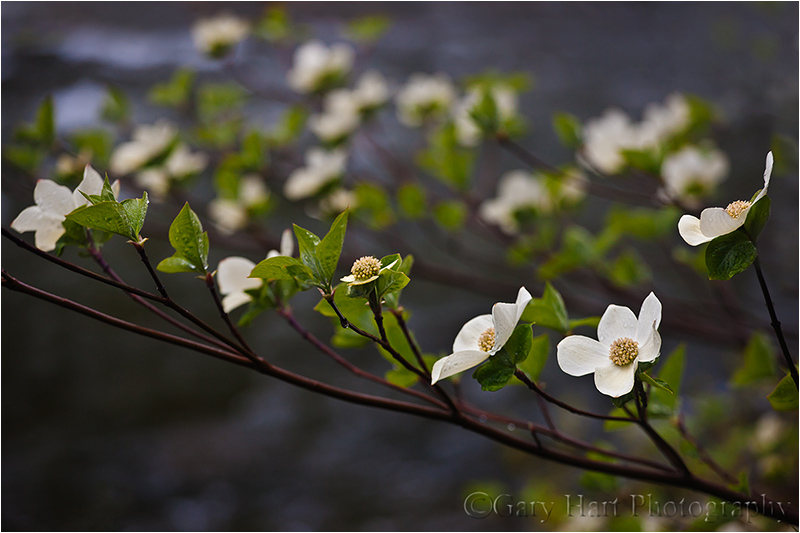
Earlier this week I had the good fortune to be in Yosemite for the peak of the annual dogwood bloom. Photographing dogwood is one of my favorite things, yet in recent years it seems I’ve been thwarted in my attempts to capture the event at its peak. Yosemite’s average peak bloom is around May 1, but that can vary by a couple of weeks; since I generally schedule my workshops a year in advance, and always time them to coincide with a full or crescent moon, all I can do is hope everything aligns. Of course that doesn’t stop me from driving up for the dogwood on my own, a last-minute luxury that should (in theory) enable me to photograph the peak with watchmaker’s precision. You’d think. Last year I nailed the dogwood peak on a quick overnight trip, only to have my car break down and end up spending two days in Fresno instead. Yippee.
On to 2011. By the end of my April 28-May 1 workshop, the dogwood blossoms had barely started to emerge from their pods and I guessed two weeks would be about right for the peak. So last week I got the car serviced and booked Sunday and Monday nights in Yosemite. The dogwood were indeed at full strength. But so, I’m afraid, was the sun and with it the tourists. Parking lots were jammed, getting a meal at any of the park’s cafeteria’s or food counters was an exercise in patience, and it seemed that every roadside deer or squirrel incited a rubber necker’s convention. But when the rain arrived Monday afternoon, I couldn’t help the eerie feeling that the Rapture had arrived and photographers had somehow been overlooked (go figure). For the rest of my stay the roads were empty and it seemed the only people I saw were wielding tripods.
I love photographing dogwood in shadowless, overcast light. And in addition to their crowd dispersing qualities, raindrops give the flowers an opalescent quality. Shortly before heading home Tuesday evening, I found this young tree in full bloom beside the Merced River, across from Bridalveil Fall. As often happens, the more I worked the scene, the more compositions I found. A wind that ranged from light to nonexistent allowed me to experiment with various depths of field at ISO 400; it wasn’t until I saw the images on my computer that I chose this frame with a wide-open aperture that blurred the background river and blooms, emphasizing the graceful, glistening foreground display.
What’s on your hard disk?: A project for a sunny day
Posted on May 13, 2011
 One of the risks of making photography your livelihood is the possibility (likelihood?) that the business will preempt the photography. Even though I’ve consciously chosen to continue photographing only what I want to photograph without concern for the marketability of an image, when I return from a trip the demands of the business often leave little time for my captures.
A few days ago I received a request for an image that sent me digging through my archives. I found what I was looking for, but in the process stumbled upon a few images I’d forgotten about; probably nothing that will make me rich, but at the very least some that make me happy. This got me thinking that every photographer might benefit from occasionally revisiting rejected captures. Often our first impression, influenced by the mood of the moment, is entirely different from our current impression. You’ve no doubt grown as a photographer, re-defined your tastes, refined your eye, improved your processing skills–all factors that might lead to different conclusions about past rejects. The next time you find yourself in a photography state of mind, and the bright sun and blue sky outside offer little promise, try returning to past captures. If an image stops you, open it and play a bit. Correct flaws, experiment with different crops, sharpen–whatever you think it might need. Who knows, you may just find yourself pleasantly surprised by what’s there.
Today’s image is one such find. As a Yosemite photo destination, Valley View is probably second only to Tunnel View in popularity. I take all my workshop groups to Valley View, and usually can’t resist a peek when I’m in the park on my own, but rarely photograph there anymore. But on a visit a couple of autumns ago, finding the light and clouds irresistible, I set out to see if I could create something I didn’t have. With the clouds enshrouding El Capitan lending an air of mystery, I chose a vertical composition to eliminate less compelling surroundings. Rather than emphasize the almost irresistible reflection in the meandering Merced, I adjusted my polarizer to reveal the river-rounded rocks beneath the surface. The result was a high-key perimeter framing the darker scene that gives the frame a negative feel, where the darkest regions do the most work. Despite liking it as soon as it flashed in my LCD, I thought little more about this image until I stumbled upon it last week. While this won’t likely be the image I retire on, at the very least it nudged me into digging a little deeper on my hard drives to see what else might be out there. Stay tuned….
Shoot now, think later
Posted on May 7, 2011

Sunrise Trio, Crescent Moon Above El Capitan and Half Dome, Yosemite
Canon EOS-1Ds Mark II
Canon 100-400 L
.6 seconds
F/11
ISO 200
Magic moments in nature are rarely static, and reacting to them as they happen is rarely productive. But taking the time to do you homework helps you anticipate these special moments well enough to consistently put yourself in position before they happen. Understanding the conditions necessary for a rainbow, anticipating a sky favorable for a colorful sunset, and plotting the moon’s position above an iconic landscape puts nature photographers in position to photograph the magic. But when that magic happens, it’s time to turn off your left (logical) brain and give control to your right (creative) brain. In other words, don’t think, shoot!
A lot of thought goes into taking a picture, but when comes time to click the shutter, the impulse needs to start from your heart, not your brain. After many years conducting photo workshops, I’ve concluded that a prime factor hindering photographers’ ability to shoot from the heart (along with an inflexible adherence to photography “rules”) is their struggle to master metering, exposure, and their camera. I’m afraid that the “intelligence” built into today’s cameras misleads people into thinking their camera can handle everything. It can’t. Mastering photographic fundamentals until they’re second nature, until they happen without conscious thought, frees you to connect with the beauty of the moment and compose by feel.
My most recent spring workshop group made the most of its opportunity to photograph this once in a lifetime* moonrise event from Half Dome View on Big Oak Flat Road, across the Merced River Canyon from Yosemite’s more heralded Tunnel View. Our goal was to underexpose the scene just enough to silhouette Yosemite’s two most recognizable monoliths against the rich twilight glow on the eastern horizon. Automatic metering would have made a mess of this.
The moonrise happened on our final morning, giving the group three days to overcome any automatic-mode bias in favor of the manual control this scene required. We’d exorcised most of the exposure kinks with a silhouette shoot from Tunnel View the morning prior, and visited Half Dome View the prior afternoon to familiarize everyone with the scene. A 4:45 a.m. departure got us in place about fifteen minutes early, more than enough time to set up tripods, frame initial compositions, meter, and focus. When the moon appeared, everyone was ready to stop thinking and simply shoot.
We were dealing with two changing variables that morning, the moon’s ascent and the increasing light. As the moon moved first toward (and partially behind) and then above Half Dome, the compositional balance in the frame changed. And the brightening of the sky, gradual enough that the eye couldn’t really register change from moment to moment, necessitated constant exposure adjustment.
Throughout the shoot I called out reminders to vary compositions, wide/tight and horizontal/vertical, and monitor exposure. If you train yourself to glance at your histogram every few frames, exposure adjustment at sunrise is simply a matter of making a one-click-at-a-time (1/3 stop in most cameras) exposure subtraction—no need to re-meter or even look through the viewfinder for anything besides composition.
I’m happy to report that everyone was successful that morning. A quick review of my image series shows that I captured thirty-two frames over twenty-two minutes, eighteen horizontal and fourteen vertical. I shot everything with my 100-400 lens, and used the entire focal range from 100mm to 400mm (the majority were closer to 400mm than 100mm), trending wider as the moon rose. The image in this post was captured about twelve minutes after the image in last Monday’s post. Not only has the moon moved quite a bit, the light has increased significantly, and the sunrise color has really started to kick in.
I have no memory of consciously making exposure decisions, but I know my process in the field well enough to predict the progression of my settings. Reviewing my EXIF data confirms that once I got my initial exposure, I shifted into unconscious exposure mode (small adjustments, without re-metering, as the light changes). My “default” settings (for best image quality) are f11 at ISO 100 (adjusting shutter speed to control the exposure), but that morning I started at f8 and ISO 400 to allow a faster shutter speed because my first exposures were long enough that I was concerned about motion-blur in the moon and a stiff wind.
As the light increased, I first increased my shutter speed because the wind made vibration my prime concern (rather than noise from a too-high ISO, or softness from a less-sharp f-stop). When my shutter speed was no longer measured in seconds, I adjusted my ISO down to 200; as the light increased more, I went to f11, the aperture at which that lens is sharpest (for me). After that my shutter speed increased in 1/3 stop increments until the light from rising sun washed out the foreground/sky contrast I needed. There were no frame-to-frame adjustments greater than one stop.
* Once in a lifetime because it will be many, many years before a 3% crescent moon slips through the narrow gap separating El Capitan and Half Dome in the pre-dawn sky.
Join Me in Yosemite for a Photo Workshop
A Gallery of Yosemite Moons


The Other Ninety-Nine Percent
Posted on May 2, 2011

Cradled Crescent, El Capitan and Half Dome, Yosemite
Canon EOS 1DS Mark III
4 seconds
400 mm
ISO 400
F8
Thomas Edison said, “Genius is one percent inspiration and ninety-nine percent perspiration.” (Without claiming genius) I think this applies to photography as well: Many successful images are more the product of being in the right place at the right time than divine inspiration. Of course anyone can stumble upon a lucky convergence of location and conditions and come home with a great photo, but the “genius” behind creating great photos consistently is preparation and sacrifice–a.k.a., perspiration.
The moonrise on the final sunrise shoot of last week’s Yosemite workshop spurred these thoughts about inspiration and effort. We were all in more or less the same place, photographing the same thing. And while everyone probably captured very similar images (in this case of a crescent moon squeezing between El Capitan and Half Dome), the true magic was simply being there.
But why were we the only ones there to witness this special moment that probably won’t repeat for decades? Determining the moon’s altitude and azimuth from any location on Earth is as easy as visiting one of many websites, or using one of many astronomical software applications such as The Photographer’s Ephemeris or (my preference) the Focalware iPhone app. Armed with this data, aligning the moon’s rise with any landmark isn’t rocket science.
Based on my calculations and plotting, I scheduled my “Yosemite Dogwood and Rising Crescent” workshop to coincide with a sunrise crescent moon. The dogwood bloom isn’t as reliable, but I know interesting weather is still possible in Yosemite in late April and early May. What we ended up with was mostly clear skies (great for tourists, but definitely not for photographers) and a very late dogwood bloom in Yosemite (probably two weeks behind “schedule”), forcing me to shift the daytime emphasis of my spring workshop to rainbows. I’m happy to report Bridalveil and Yosemite Falls delivered more photogenic rainbows than I can count, from a number of different locations.
As spectacular as they were, overshadowing the rainbows was the moonrise on our penultimate morning. I promised the group that departing at 4:50a.m. would get us to Tunnel View in time to photograph a 7% crescent moon rise above Yosemite Valley, between Sentinel Dome and Cathedral Rocks, in the pre-dawn twilight. (I knew this because I’ve been calculating moonrise and moonsets in Yosemite and elsewhere for many years, and have photographed more of these from Tunnel View than any other location.) That moonrise came off exactly as advertised–so far so good.
But the Tunnel View success, as beautiful as our images were, was merely a warm-up that gave everyone an opportunity to hone their silhouette exposure and composition skills in advance of the rare moonrise opportunity I’d planned for the next morning. When scheduling this workshop I’d determined that about 45 minutes before sunrise on May 1 of this year (2011), a delicate 3% crescent moon would slip into the narrow gap between El Capitan and Half Dome for anyone watching from Half Dome View on Big Oak Flat Road.
Lunar tables assume a flat horizon, so unless I’m at the ocean, the primary uncertainty is when the moon will appear above (or disappear below) the not-flat horizon. Once I’ve photographed a moonrise (or set) from a location, I simply check the precise time of its appearance (or disappearance) against the altitude/azimuth data for that day to get the exact angle of the horizon from there. Until I have this horizon information, I only have the moon’s direction and elevation above the unobstructed horizon and can only make an educated guess as to the time and location of its appearance.
The other big wildcard in moon and moonlight photography is the weather, but a last minute check with the National Weather Service confirmed that all systems were go there. Nevertheless, despite all my obsessive plotting, checking, and double-checking, having never photographed a moonrise from this location, and the fact that an error would affect not just me but my entire group, I couldn’t help feel more than a little anxious.
The afternoon before our second and final pre-dawn moonrise, I brought the group to Half Dome View so they could familiarize themselves with the location and plan their compositions. Due to the horizon uncertainties I just described, the first time I photograph a moonrise/set from a location, I generally give my group only an approximate time and position for the moon’s rise/set. But during this preview someone asked exactly where the moon would rise, and I confidently blurted that it will appear in the small notch separating El Capitan and Half Dome between 5:15 and 5:20 a.m. (about 25 minutes after the official, flat-horizon moonrise). Standing there that afternoon, however, I realized how small the notch really is, meaning that even the slightest error in my plotting could find the moon rising much later, from behind El Capitan or Half Dome. So I quickly qualified my prediction, explaining that I’ve never photographed a moonrise here and the uncertainty of knowing the horizon. But given all of my perfectly timed waterfall rainbow hits so far, not to mention our Tunnel View moonrise success earlier that morning, I had the sense that my group had unconditional (blind) confidence in me. (Yikes.)
Sunday morning we departed dark and early (4:45 a.m.), full of anticipation. We arrived at Half Dome View a little after 5:00, early enough to enable everyone to set up their tripods, frame their compositions, and set their exposures. Then we waited, all eyes locked on the gap separating El Capitan and Half Dome. Well, almost all eyes–mine made frequent detours to my watch and the Focalware iPhone app responsible for my bold (rash?) prediction. (What was I thinking, promising a moonrise into a paper-thin space in a five minute span from a spot where I’d never photographed a moonrise?) My watch crawled toward the 5:15-5:20 window: 5:15 (Is the notch shrinking?); 5:16 (It’s shrinking–I swear I just saw Half Dome inch closer to El Capitan); 5:17 (I entered the coordinates wrong, I know I did–what if it comes up behind us?). Surely this wasn’t the kind of perspiration Edison was thinking about.
As I frantically re-checked my iPhone for the umpteenth time, somebody exclaimed, “There it is!” I looked up and sure enough, there was the leading sliver of nearly new moon perfectly threading that small space between El Capitan and Half Dome. Phew. The rest of the morning was a blur of shutter clicks and exclamations of delight (plus one barely audible sigh of relief). (How could I have even dreamed of doubting the tried and true methods that had never failed me before?)
Before the shared euphoria abated, I suggested to everyone that they take a short break from photography and simply appreciate that they’re probably witnessing the most beautiful thing happening on Earth at this moment (a feeling every nature photographer should experience from time to time). It’s always exciting to witness a moment like this, a breathtaking convergence of Earth and sky that may not occur again exactly like this in my lifetime. It’s even more rewarding when the event isn’t an accident, that I’m experiencing it because of my own effort, and that I get to share the fruit of my perspiration with others who appreciate the magic just as much as I do.
Workshop Schedule || Purchase Prints || Instagram
A Crescent Moon Gallery
Click any image to scroll through the gallery LARGE


My camera can beat up your camera (and other photography myths)
Posted on April 28, 2011
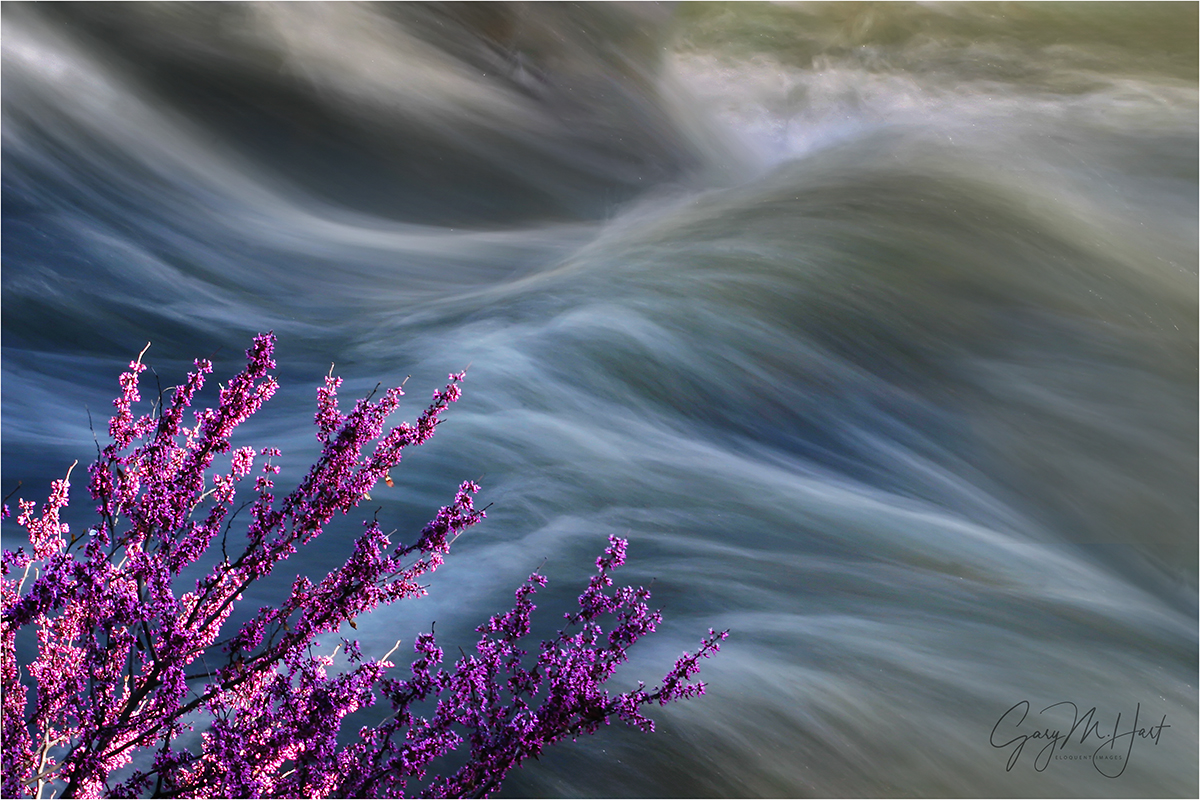
Redbud, Merced River Canyon
Canon EOS 10D
2/3 second
F/32 (the only way I could get the shutter speed I wanted)
ISO 100
80 mm
Want to know how to tell a pro landscape photographer from an amateur? Here are a few telltale indicators:
- The pro photographer has no emotional attachment to her camera and refuses to invest any energy in the “My camera can beat up your camera” debate
- The pro photographer is the one with duct tape on his tripod and camera bag
- The pro photographer is the one pointing her camera in the opposite direction from all the other photographers
- The pro photographer is the one using the garbage bag to protect her camera from the rain
- When you ask the pro photographer for his business card, he takes longer than .5 nanoseconds to produce it, and when (if) he finds it, it resembles a used napkin
- The pro photographer never asks, “How many megapixels is that camera?”
For me the last point, this megapixel thing, is a particular irritation, because until we all get wise to the reality that megapixels are not a measure of image quality (they’re merely a measure of image size), the camera manufacturers will continue shoving megapixels down our throats rather than giving us something of real value, like wider dynamic range or clean high ISO performance. And consider this: All things equal (identical technology), the more megapixels on a sensor, the lower the image quality. That’s because increasing the megapixel count requires smaller and/or more densely packed photosites, both of which reduce image quality.
How much resolution do you need? While there’s no absolute answer, consider that many of my most successful images are jpegs captured many years ago with my six megapixel Canon 10D. The riverside redbud image at the top of this post is one of my top sellers, an image that I still sell at 24×36 without apology.
Here are few more of my 6mp 10D jpeg favorites (all of which I have no problem enlarging to 24×36 or larger):


What does all this mean?
It’s hard to deny that digital cameras have improved. A lot. But the new technology is greatly underutilized by most photographers, the majority of whom display primarily online and rarely print larger than 12×18. Granted, more megapixels increase the margin for error (ability to crop a usable image from the original image) of any frame. And improved technology give newer cameras better dynamic range and high ISO performance than their predecessors. But most of these improvements are of limited value to the vast majority of photographers.
Of course photography needs to be a source of pleasure. So if it makes you happy to have the newest, fanciest, and most expensive equipment, by all means go for it. But understand that the latest camera is not a shortcut to professional success. If better photography is your goal, and you have a less than unlimited budget for camera gear, increased resolution should be toward the bottom of the dollar priority list, far below essential equipment that will make a tangible difference in your images and serve you for many years, additions like the highest quality lenses possible and a sturdy tripod that’s easy to carry and use.
Added 3/2/12: I’ve been shooting with the same camera since 2008. In that time I’ve purchased lenses, tripods, four new computers (two desktops, two laptops), a new printer, and lots of processing software upgrades. Each of these purchases has made a tangible difference in my results. And while I’ll probably be replacing my four-plus year-old camera this year, it won’t be to add resolution. It will be because the new technology finally gives me significantly better dynamic range and high ISO performance.
Added 3/8/14: I’ve now been using my 5DIII for two years. Is it better than my 10D? Absolutely, not even close. But I’d say that for at least 80 percent of my images, the differences between my 10D and 5DIII images make virtually no practical difference. So three years after this post, I still say that unless you have an unlimited photography budget, if you already have a DSLR of any vintage, you’re much better off spending your money on the best lenses and tripods (and maybe even a workshop or two).

 Eloquent Images by Gary Hart