Eloquent Images by Gary Hart
Insight, information, and inspiration for the inquisitive nature photographer
Looking back, looking forward
Posted on December 29, 2014
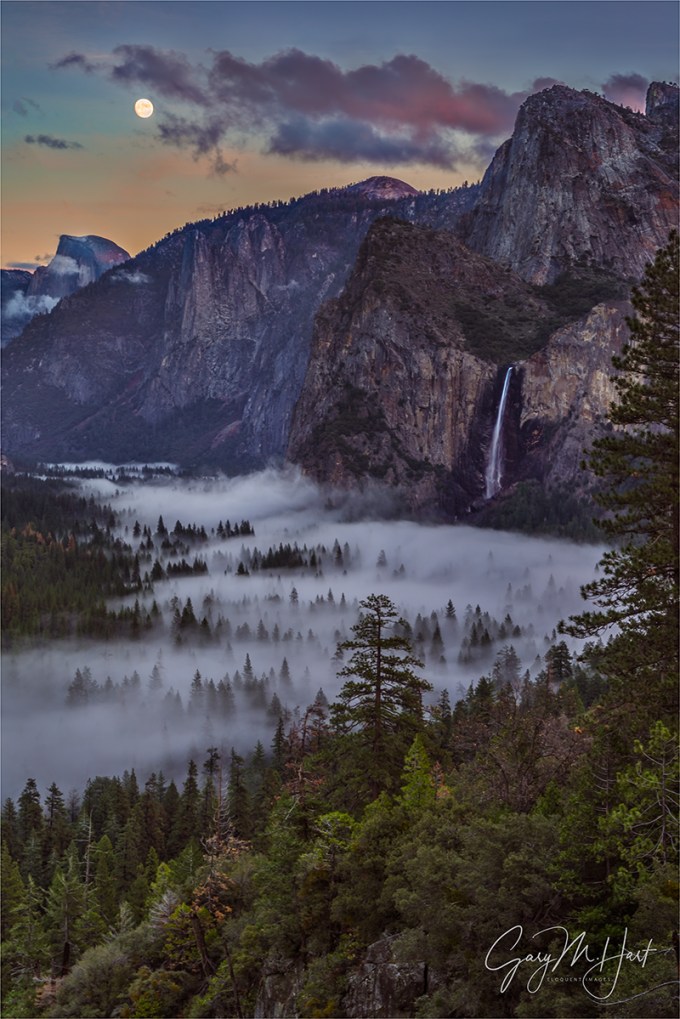
For the final shoot of my final 2014 workshop, I guided my group up the rain-slick granite behind Yosemite’s Tunnel View for a slightly different perspective than they’d seen earlier in the workshop. I warned everyone that slippery rock and the steepness of the slope could make the footing treacherous (and offered a safer alternative), but promised the view would be worth it. Then I crossed my fingers.
While sunset at Tunnel View is often special, the rare sunset event I’d been pointing to for over a year, a nearly full (96%) moon rising into the twilight hues above Half Dome, is a particular highlight, one of my favorite things in the world to witness. But after an autumn dominated by clear skies that would have been perfect for our moonrise, a much needed storm landed just as our workshop started, engulfing Yosemite Valley in dense clouds, recharging the waterfalls, and painting the surrounding peaks white. Rain clouds make great photography, but they’re not so great for viewing the moon.
As you can see from this image, the clouds this evening cooperated, glazing the valley floor, but parting above Half Dome enough to reveal the moon. The moon was already high above Half Dome when it peeked out, and shortly thereafter the retreating storm’s vestiges were fringed with sunset pink. As I often do at these moments, I encouraged everyone to forget their cameras for a minute and just appreciate that they may be viewing the most beautiful thing happening on Earth at this moment. Together we enjoyed what was a once-in-a-lifetime moment for them, and a fitting conclusion to another wonderful year of photography for me.
Like any other photographer who makes an effort to get out in difficult, unpredictable conditions, I had many of these “most beautiful thing on Earth” moments in 2014—they’re what keep me going. The last couple of weeks I’ve been browsing my 2014 captures and re-appreciating my blessings. Among other things, in 2014 I rafted the Colorado River through the Grand Canyon, was humbled by the Milky Way’s glow above the Kilauea Caldera, shivered beneath starlit bristlecone pines, and was electrified by the Grand Canyon monsoon’s pyrotechnics.
Most of my trips start with a plan, and while a lot of my 2o14 experiences followed the script, many deviated from my expectations, often in wonderful ways. My original vision of the moonrise on this December evening was clear skies that would allow the moon to shine; an alternate vision was a sky-obscuring storm that provided photogenic clouds. We ended up with the best of both, a hybrid of clouds and sky that I dared not hope for.
While I have a general plan in place for 2015, some places I’ll be returning to, others I’ll photograph for the first time, I know from experience that my plans won’t always go as planned. Clouds will hide the moon and stars, clear skies will cast harsh light, rivers will flood, waterfalls will wither, rivers will flood. But I also know that many of those thwarted plans will lead to unexpected rewards like this.
Here’s to a great 2015!
2014 in Review
Click an image for a closer look, and a slide show. Refresh your screen to reorder the display.


Classic Yosemite
Posted on December 3, 2014

Clearing Storm, Yosemite Valley, Yosemite
Sony a7R
33 mm
1.6 seconds
F/11
ISO 125
December 3, 2014: A brief post to share my workshop group’s good fortune this morning
I’m in Yosemite this week for my Winter Moon photo workshop. Scheduling a December workshop in Yosemite is one of those high risk/reward propositions—I know full well we could get some serious weather that could make things quite uncomfortable for photography, but winter (okay, so technically it won’t be winter for another two-a-half weeks, but it’s December for heaven’s sake, so don’t quibble) is also the best time to get the kind of conditions that make Yosemite special. In the days leading up to the workshop I’d warned everyone about the impending weather, but I’d also promised them that they were in store for something special at some point during their visit. Then I crossed my fingers….
We started Monday afternoon to blue skies and dry waterfalls, but by Tuesday morning the first major storm of California’s (usually) wet season rolled in and everything changed (literally overnight). A warm system of tropical origin, what this storm lacked in snow, it more than made up for in rain, copious rain. Starting before sunrise, we got a little shooting in before the serious stuff started, but the rest of the day was wet, wet, wet. When weather settles in like this, the ceiling drops and Yosemite’s granite features disappear behind a dense, gray curtain. Nevertheless, we found some nice photography and everyone finished the day saturated but satisfied.
This morning (Wednesday) I got the group up to Tunnel View for sunrise, where were met with more of the same—opaque clouds and lots of rain, but little else. Since Tunnel View is usually the best place to wait out a Yosemite storm (thanks to the panoramic view, and the fact that the weather almost aways clears on Yosemite Valley’s west side first), I told everyone we’d just sit tight and see what happens. A few huddled in the cars, but most of the group donned our head-to-toe rain gear and stood out in the rain, waiting (hoping) for the show to begin.
As if on cue, at just about the advertised sunrise time (there was no actual sunrise to witness), the sky brightened and the curtain parted: El Capitan was first on stage, followed closely by a rejuvenated Bridalveil Fall, and soon thereafter the star of the show, Half Dome, appeared center-stage. Radiating from the valley floor, a thick fog rolled across the scene like a viscous liquid, changing the view by the minute—for nearly an hour everyone got to experience a classic Yosemite clearing storm.
As many times as I’ve witnessed a clearing storm from Tunnel View, the experience never fails to thrill me. Overlaying one of the most beautiful scenes on Earth, infinite combinations of cloud, sky, color, and light make each one unique. And as if that’s not enough, sometimes fresh snow, a rainbow, or rising moon are added to the mix. On this morning the clearing was only temporary, with no direct light or hint of blue sky, and the rain soon returned. Not that this was a problem—with more weather in store, this morning just turned out to be the opening act.
Check out my schedule of upcoming photo workshops
A Tunnel View Clearing Storm Gallery
Click an image for a closer look, and to enjoy the slide show


It’s Greek to me
Posted on March 3, 2014

Double Rainbow, Tunnel View, Yosemite
Canon EOS-1Ds Mark III
1/5 second
F/16.0
ISO 100
38 mm
Photograph: “Photo” comes from phos, the Greek word for light; “graph” is from graphos, the Greek word for write. And that’s pretty much what we photographers do: Write with light.
Because we have no control over the sun, nature photographers spend a lot of time hoping for “good” light and cursing “bad” light. There’s no universal definition of good and bad light; it’s usually more a function of whatever it is we want to do at the moment. Just as portrait photographers have complete understanding of the artificial light they use to illuminate their subjects, nature photographers should understand the sunlight they photograph: what it is, what it does, and why it does it.
It’s this understanding of light that allows me to be in the right place for vivid sunrises and sunset, to know the best time and location for blurring water, and that helped me anticipate this amazing rainbow. To learn more about light, read the Light article in my Photo Tips section.
About this image
May 26, 2009
On my drive to Yosemite the sky above the San Joaquin Valley was clear, but I was encouraged to see dark cumulus clouds billowing above the Sierra to my east. Sierra thunderstorms in May are rare, but not unprecedented. At the very least I knew the clouds would make for interesting photography. As I entered the park via Big Oak Flat Road, a few large drops dotted my windshield. The afternoon sun was now obscured by clouds, but the sky to the west remained virtually cloudless, a good sign, but nothing I hadn’t seen before.
By the time I reached Yosemite Valley the rain had increased enough to require me to engage my wipers and get my mental wheels turning. I was in the park for a one day, private photo tour with a couple from Dallas. The arrangement was to meet at Yosemite Lodge for dinner to plan the next day’s activities, then to go shoot sunset. As I continued toward my appointment I allowed myself to consider the possibility of a rainbow. Going for it would require rushing to meet my customers, delaying dinner, and possibly sitting in the rain with no guarantee of success.
Still undecided but with about 20 minutes to spare, I dashed up to Tunnel View to survey Yosemite Valley. I liked the way things were shaping up; if I’d have been by myself I’d have skipped dinner. Leaving Tunnel View I continued surveying the sky—by the time I reached the lodge I knew I could be sued for malpractice if I didn’t at least suggest the possibility of a rainbow.
We completed our introductions in front of the cafeteria, but before entering I suggested that maybe we should forget dinner for now. Robert and Kristy were as excited about the conditions as I was (phew) but had just completed a long hike and were famished, so we rushed in and grabbed pre-made pizzas to eat on the road.
Twenty minutes later we were sitting on my favorite granite slope above Tunnel View. We were immediately greeted by a flash of lightning, followed not too many seconds later by a blast of thunder. As a lifelong Californian, I’m not particularly experienced with lightning, so I deferred to the Texans and found comfort in their lack of concern (knowing what I know now, I probably should have been more concerned).
Rainbow photography is equal parts preparation and providence. The preparation comes from understanding the optics of a rainbow, knowing the conditions necessary, where to look, then putting yourself in the best position to capture it; the providence is a gift from the heavens, when all the conditions align exactly as you envisioned. Robert, Kristy, and I had been admiring the view and photographing intermittently in a light, warm rain for about thirty minutes when a rainbow appeared. It started slowly, as a faint band in front of El Capitan, and quickly developed into a vivid stripe of color. For the next seven minutes we shot like crazy people—I varied my compositions with almost every shot and called to them to do the same. When it ended we were giddy with excitement—never let it be said that a professional nature photographer can’t get excited about his subjects—and even though the rainbow never quite achieved a complete arc across the valley, it had been everything I dared hope for.
Little did we know that this first rainbow was just a prelude—less than ten minutes later a second rainbow appeared, becoming more vivid than the first, growing into a full double rainbow that arced all the way across Yosemite Valley, from the Merced River to Silver Strand Fall. It lasted over twenty minutes, long enough for me to set up a second camera and do multiple lens changes on each. We actually reached the point where we simply ran out of compositions and could only laugh as we continued clicking anyway.
One more thing: This is the third time I’ve processed this image. I’ve never been completely happy with some of the color tones and overly bright highlights, so I decided to give it one more shot. Using Lightroom 5 and Photoshop CS 6, I was finally able to come up with something that more accurately represents the experience of this unforgettable moment.
Workshop Schedule
A Gallery of Rainbows


 Eloquent Images by Gary Hart