Eloquent Images by Gary Hart
Insight, information, and inspiration for the inquisitive nature photographer
Cliché for a reason
Posted on October 29, 2013

Autumn Snow, Valley View, Yosemite
Canon EOS 5D Mark III
1/15 second
F/16
ISO 100
24 mm
It’s actually even a cliché just to say it, but some things really are “cliché for a reason.” And as much as I try to avoid the cliché shots in Yosemite, sometimes they just can’t be helped.
My Yosemite Fall Color workshop began yesterday, and even though I’d spent all day Saturday in the park, yesterday morning a storm filled Saturday’s blue skies with rain and I felt like I should go check on the conditions before we started. The wet weather had slowed me enough that I didn’t really have time to take pictures, but when I found not only the red and yellow leaves I’d seen on Saturday, and the swirling clouds I’d hoped for, but also Yosemite Valley’s colorful trees and meadows etched with snow, I was tempted at every turn to reach for my camera. Nevertheless, with the exception of a brief breakdown at Cook’s Meadow, I managed to resist temptation.
Unfortunately, the Cook’s Meadow stop had put me even more behind schedule, so I told myself while approaching Valley View that any stop here would be just reconnaissance. And anyway, Valley View images are a dime a dozen, clichés that I’d done more than my share to perpetuate over the years. Then I got there….
I mean seriously, cliché or not (deadline or not), how does a photographer pass up a scene like this? With my group meeting me in just an hour, I really, really didn’t have time for pictures, which is exactly what I kept reminding myself as I leaped from my car, snatched my camera and tripod, and sprinted down to the river. I only snapped four frames, two vertical and two horizontal, before racing back to the car and toward my impending rendezvous.
It’s images like this that remind me that nature’s beauty transcends any human judgement of “cliché.” Pro photographers, myself included, can get a little snobbish about frequently photographed scenes. And while I think it’s important to take the time to find a unique perspective, sometimes it’s best to let Mother Nature speak for herself.
Happy ending
I made it to my workshop with minutes to spare, conducted a lightning-fast orientation, and hustled everyone back outside as quickly as possible. We ended up circling Yosemite Valley several times, photographing without a break until dark. I heard no complaints.
A gallery of clichés


Double your pleasure
Posted on November 29, 2012

Autumn Reflection, El Capitan and the Merced River, Yosemite
Canon EOS-5D Mark III
21 mm
1/8 seconds
F/16
ISO 100
It seems that people stay away from Yosemite in autumn because that’s when the waterfalls are at their lowest. True story. But believe it or not, Yosemite isn’t all about waterfalls. El Capitan, Half Dome, Cathedral Rocks, Sentinel Rock (I could go on), are great subjects in their own right. Subtract the waterfalls but add the yellows, oranges, and reds of Yosemite Valley’s many deciduous trees and you have what I think is a pretty a fair trade. And when the water is low, the usually turbulent Merced River smooths to a reflecting ribbon of glass and suddenly, pretty much any scene can be doubled at your feet.
These reflections add layers of creative possibilities impossible the rest of the year. Sometimes I’ll split the scene in the middle for a 50/50 mirror effect; other times I’ll photograph only the reflection. In the image above I went with a more conventional composition, emphasizing El Capitan’s bulk against clouds that were spitting small, wet snowflakes.
Autumn Shroud, El Capitan, Yosemite
In this image I split the frame 50/50, but dialed down the reflection with my polarizer. Even polarized, the bright sky’s glare washed out much of the river surface, painting the outline of El Capitan like a negative that uses the trees with a jigsaw of submerged river rocks.
* * * *

Leaves and Reflection, El Capitan, Yosemite
Here I used El Capitan’s reflection as a background for the Merced’s brilliant autumn veneer.
Want to photograph this in person? My 2014 Yosemite fall workshop filled months ago, but there’s still room in the 2015 Yosemite Autumn Moon workshop.A gallery of Yosemite autumn reflections


Uncharted territory
Posted on November 19, 2012
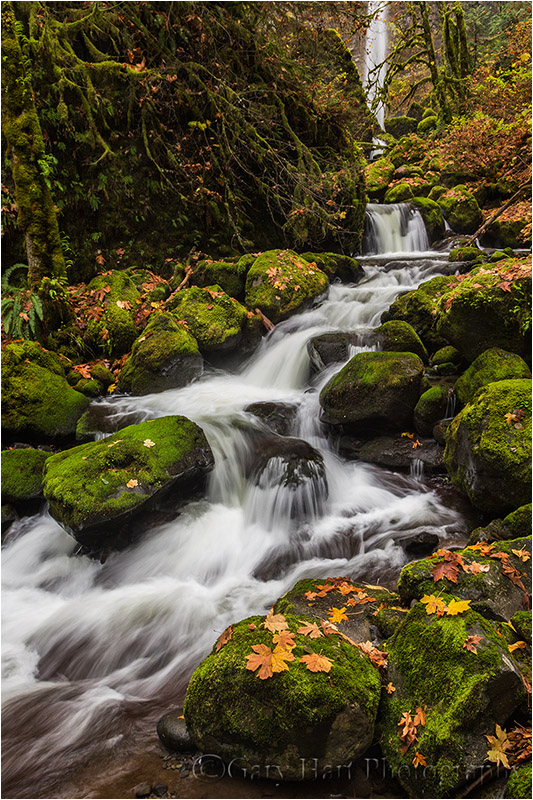
Fall Color, Elowah Fall, Columbia River Gorge, Oregon
Canon EOS-5D Mark III
28 mm
1/3 second
F/16
ISO 400
A few months ago I accepted an invitation to speak to the Cascade Camera Club in Bend, Oregon. With my fall workshops behind me, I decided to take the opportunity to spend a few days exploring the Columbia River Gorge, a place long on my “must see” list. I wasn’t disappointed.
Undeterred by steady rain throughout most of my visit, I found more photo opportunities than I had time to photograph. I’d only been there a couple of hours before it become clear that I’d be coming back, which caused me to change my strategy a bit. Rather than try to squeeze as many photographs as possible into my three days there, I decided to make my priority reconnaissance that would help me be more efficient on future trips.
My emphasis was on waterfalls, something the Gorge has an ample selection of. I was also pleased to find vestiges of fall color, well past prime, but quite nice nevertheless. Though I spent most of my time familiarizing myself with the area, identifying locations and the best conditions for photographing them, I still managed to find plenty of photographs.
The first waterfall I visited was Elowah Fall (about a one mile hike in a steady rain), where I was rewarded with a plethora of yellow leaves (some of which were still falling as I shot) accenting a tumbling cascade just downstream from the fall. Rather than follow the trail all the way to the bridge at the base of the fall, I scrambled about 75 feet down to McCord Creek for a perspective that would allow me to feature the leaves and cascades up close, with Elowah Fall in the background.
When the hill turned out to be a little steeper than I’d anticipated, and the footing a bit slipperier, I had visions of myself reprising Michael Douglas and Kathleen Turner’s wild ride through the Columbian jungle in “Romancing the Stone.“ But I made it to the bottom unscathed (Galen Rowell I’m not), and proceeded to work this scene to within an inch of its life. I don’t think I moved more than fifteen feet from this spot for the hour or more I was there, starting atop a rock directly above the creek and eventually working myself down closer and closer, until I finally ended up standing in the water.
Composing this was mostly a matter of organizing the leaves, rocks, and water into something coherent. By going wide and vertical, I chose to make the leaves the prime focus point, using the creek to guide your eye to the fall itself. F16 ensured depth throughout the frame, while ISO 400 gave me a 1/3 second shutter speed in the limited light, slow enough to blur the water, but fast enough that the water maintained some character. My polarizer was turned to minimize reflections, allowing the color to come through the significant sheen on the wet leaves, rock, and moss, and on the surface of the dark water.
Fall into winter
Posted on November 14, 2012

First Snow, El Capitan, Yosemite
Canon EOS-5D Mark III
.4 seconds
F/16
ISO 100
24 mm
Probably the number one question I’m asked about Yosemite is, “What’s the best season for photography?” My response always sounds like it was crafted by a waffling politician, but I swear I just don’t have the absolute answer everyone wants: Yosemite in spring is all about the water, a time when the vertical granite can’t seem to shed the winter snowpack fast enough; summer offers High Sierra splendor (Glacier Point, Tuolumne Meadows, the backcountry), with wildflowers, exposed granite, and gem-like lakes inaccessible most of the year; autumn is when trees of yellow and red mingle in mirror-reflections and carpet the forest floor with color; and winter is the sunset fire of Horsetail Fall and the possibility (fingers crossed) of a glistening winter cathedral of white.
But surpassing all of this is the rare opportunity to combine the best of two seasons. For example, a few years ago, while in Yosemite Valley to photograph the fall color, I survived twenty-four hours of nonstop downpour, six inches of rain that sent Yosemite Valley into spring flood mode, giving me an opportunity photograph the fall color with the waterfalls at their spring peak. And last year, extreme drought conditions kept the high country open into January, providing access to High Sierra terrain in ice and snow conditions usually the exclusive domain of hardy wildlife.
And then there was last Saturday, when I was in Yosemite Valley to photograph this year’s fall color “peak” (always a moving target), only to encounter an early winter storm that deposited six inches of fresh snow in Yosemite Valley. Seriously folks, there are simply no words to describe Yosemite Valley with fresh snow, and adding an explosion of yellow and red is just off the charts. But rather than sink further into hyperbole, I’ll just submit this image, one of many from this trip that will surely require many hours to wade through.
(In addition to the snow and color, I also witnessed classic Yosemite clearing storm conditions, but that’s a story for another day.)
A few words about this image
I’ve been doing this photography thing long enough to have learned how to separate my experience from my camera’s, to appreciate what I’m seeing without forgetting that my camera “sees” it differently. On this autumn morning I wanted capture the best of everything going on—fresh snow (duh), fall color, and reflection—easy for stereoscopic eyes embedded in a swiveling head, but not so easy to capture in a single, two-dimensional frame. With some ideas of how I might accomplish this, I beelined to this hidden spot along the Merced River, a little downstream from Bridalveil Meadow.
Once there I had to move around until all the elements—snow-covered rocks, floating leaves, reflection, and El Capitan—fell into a coherent relationship: Too far to the right and I’d lose El Capitan’s reflection behind the rocks; too far to the left and I’d be in the frigid river (not that there’s anything wrong with that). As it was, I was balanced on an icy rock with my tripod in two feet of water (and thanking the photography gods for live-view).
All of the “action” in the scene was along a line starting at my feet and terminating at El Capitan, so the decision to go vertical was easy—including everything on my line in a horizontal composition would have introduced all kinds of superfluous real estate on the left and right, and required me to compose so wide that El Capitan would have shrunk to virtual insignificance. I really liked the large, submerged leaf right in front of me and used it to anchor the bottom of my frame. And since the sky above El Capitan was mostly gray clouds, I composed as tightly as possible above El Capitan.
Top and bottom decided, I moved back as far as I could to increase my focal length and maximize El Capitan’s size as much as possible. Wanting sharpness throughout my frame, I stopped down to f16 and focused on the leaf frozen to the rock in the lower center, about five feet away. (An experience-based guess—my iPhone, with its hyperfocal app, was buried in a pocket several layers deep, and I was reluctant to disturb my precarious balance on the slippery rocks.) I was extremely careful orienting my polarizer, turning it slowly, multiple times, until I was confident I’d found the ideal balance between removing sheen on the leaves without erasing the reflection in the river. A three-stop soft graduated neutral density filter held down the brightness in the sky. Click.
In Lightroom I warmed the image a little to remove a blue cast in the snow, and applied standard exposure adjustments to subdue highlights and open shadows. In Photoshop I dodged and burned to hide (minimal) unwanted shading introduced by my GND, to further darken the clouds, and to bring out the reflection somewhat. And I gave all but the scene’s brightest and darkest areas a slight wiggle in curves for contrast.
Join me in a Yosemite photo workshop
Yosemite seasons
Click an image for a closer look, and a slide show. Refresh the screen to reorder the display.


Missing the tree for the forest
Posted on November 2, 2012
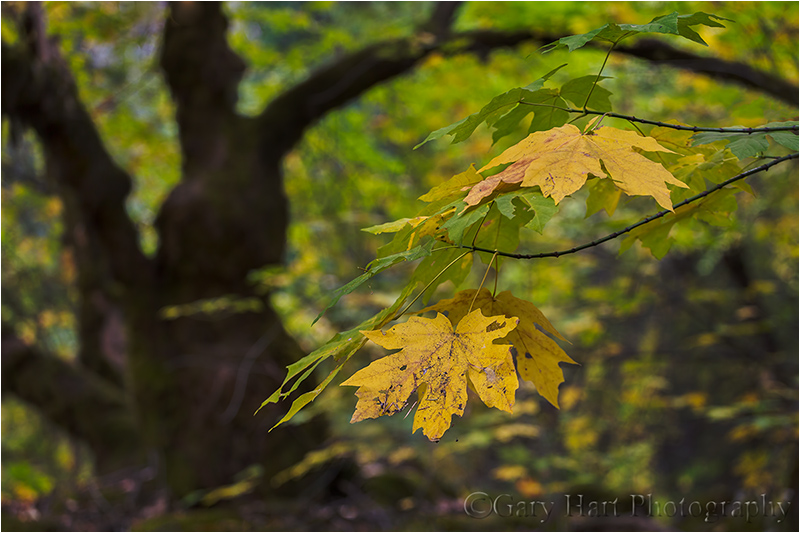
Fall Color, Yosemite Valley
* * * *
One of my favorite Yosemite autumn destinations is Fern Spring. It’s usually my first stop after entering Yosemite Valley because the leaves here give me a pretty good handle on the status of the fall color: If I can still see lots of water on the spring’s pond, I know I’m a little early; lots of brown leaves and I’m late.
I haven’t actually photographed the spring itself in years; instead I cross the road and explore the half-mile stretch of trail that parallels the river, downstream to the Pohono Bridge, upstream to Bridalveil Meadow. When I brought my fall workshop group here last week, we found so much to photograph that we had to come back. Some of the group stayed at the spring and crafted compositions featuring the stairstep cascade descending from the small reflecting pool. Others followed me to the river and quickly scattered in search of larger scenes.
When I’m leading a group my priority isn’t my own photography, so that afternoon I stayed in the vicinity of the spring to help people with exposures and compositions. But this was fairly far into the workshop, and as is usually the case, everyone had become pretty comfortable with what they were doing—suddenly I felt pretty inessential.
(Rather than pout) I set my sights on the nearby possibilities. My goal is always to find something new, pretty easy when photographing small scenes featuring ephemeral leaves (in contrast to the relative permanence of Yosemite’s granite). But uniqueness is just the start: To set themselves apart, most scenes, large and small, need (among other things) photography’s often overlooked third dimension, depth. So I’m never content with simply finding a photogenic primary subject—regardless of my subject, if it’s distant I want a complementary foreground; close and I want a complementary background.
I’d been to Fern Spring so much, I was pretty sure I’d pretty thoroughly mined the possibilities here. So imagine my surprise to spy a heretofore overlooked tree with a sturdy trunk and arcing branch, a wealth of untapped compositional possibilities, right across the road from Fern Spring. How could I have missed this in my hundreds of visits here? I can only imagine the number of times I’d rushed past this beautiful specimen in my haste to probe the forest’s more private depths. Shame on me.
But anyway, no time for self-flagellation…. I studied the tree and its surroundings, looking for leaves to isolate. My eyes quickly landed on a solitary branch sporting several leaves in varying stages of fall transition—in a perfect world the leaves would have been backlit (for that fall color glow I so love), but that would have put me on the wrong side of the scene, and the world is rarely perfect anyway.
My lens of choice in these autumn leaves scenes is a telephoto, most often my 70-200 f4 because I almost always prefer its sharpness, speed, and ease of use over the extra reach of the 100-400. So, with 70-200 in place, I circled the leaves until I thought they aligned properly with the tree in the background. Removing my camera from my tripod, I framed the scene through the viewfinder, searching for the best relationship between the yellow leaves and brooding tree. I found that by dropping to the ground I could eliminate the less interesting foreground and frame my leaves with the curved branch.
And on the ground I stayed, for I don’t know how long. I tweaked the composition until I had it “just right,” then (with the composition locked in on my tripod) went to work on the exposure, depth, and focus point. Dense shade makes the area around Fern Spring dark on even the brightest day, but this was late afternoon in autumn, so the sun’s fading light had been further extinguished by Yosemite Valley’s steep walls. As if that wasn’t enough, a bright sheen on the leaves made a polarizer an absolute necessity, subtracting two more stops of precious light. And while it wasn’t windy, neither was the air perfectly still, a problem compounded by my proximity to a road teaming with rushing vehicles.
Fortunately my goal was a soft background, which required a large aperture—had I needed to go to f16 I probably would have been out of luck. Nevertheless, even at f4 I had to go to ISO 800 to expose at 1/12 second, a pretty marginal shutter speed in these conditions. I used live view magnified ten times to ensure precise focus, targeting the veins on the closest leaf, and carefully timing exposures for lulls in the wind.
As I usually do when I have a composition so heavily dependent on depth of field, I bracketed my f-stops, stopping down to f8 in one-stop increments, bumping my ISO even further to ensure a reasonable shutter speed. But at home on my large monitor I wasn’t crazy about the busyness in the leaves introduced as the depth of field increased, and decided f4 was best.
Also on my large screen I was thrilled to see how perfectly sharp the images were (I love that lens), and how noise free they are at ISO 800 (I love my new camera). It’s one of those images that stands up to even the closest scrutiny—the more I examine it, the more I see: small holes, dirt smudges and mote, and even miniscule particles of debris suspended by a delicate spider web, the “imperfections” that underscore nature’s perfection.
I have no illusions that this image will make me rich—most people are drawn to far more dramatic captures. But when I decided to photograph nature for a living, I promised myself to only photograph what I want to photograph, and never to base my choices on what will sell. I can’t even begin to express how much I enjoyed photographing this scene, and how much pleasure this image (and others like it) bring me. It’s a reminder of why I do what I do, and why success should never be measured in dollars alone.

Fern Spring, Yosemite: Each spring I gauge the progress of the fall color in Yosemite Valley by the leaves around Fern Spring.
My favorite season
Posted on October 12, 2012

Reflection, Half Dome in the Merced River, Yosemite
* * * *
It’s been a while since I’ve posted something from Yosemite. The truth is, while I lose track of the number of times I visit Yosemite each year, Yosemite’s crowds and blue skies for the most part keep me away in summer. Not only that, by summer’s end (and sometimes much sooner), Yosemite’s waterfalls, which just a few months earlier appeared to explode from solid granite, have vanished. Even booming Yosemite Falls, the valley’s spring centerpiece and continuous soundtrack, by September has vanished, its demise reduced to a dark outline on the light granite, like the negative of a crime scene chalkline.
Enter October. The vacation crowds have returned to work and school, and California’s weather has started its trend toward winter, brushing Northern California with clouds that inject a little character into our skies. By the end of the month, the oak, cottonwood, maple, and dogwood trees have fired up, warming Yosemite Valley with shades of yellow and red. But my favorite part of autumn in Yosemite is the now relaxed Merced River, its once churning surface subdued to a meandering ribbon of glass.
Yosemite is never as spectacular as it is with a fresh coat of winter snow, or more dramatic than when it echoes with the roar of spring runoff, but for just plain creative photography, I don’t think I’m ever happier in Yosemite than I am in autumn.
About this image
I have many go-to autumn reflection locations in Yosemite Valley. A particular favorite is this bend in the Merced River near Yosemite Village, just east of Sentinel Bridge. I arrived this evening to find cottonwood upstream had already shed most of their leaves, their white skeletons reflecting in the slow water. In shadowless light only possible when the sun is several minutes below the horizon, I juxtaposed Half Dome’s reflection against the trees’ reflection. Concerned that patches of drifting white foam drifting would distract from the scene, I chose small aperture and low ISO settings that would require a multi-second shutter speed. The resulting thirty-second exposure revealed more detail in the low light than my eyes could register, and reduced the foam to faint white streaks on the river’s surface.
Photographic reality: Framing infinity
Posted on May 16, 2012
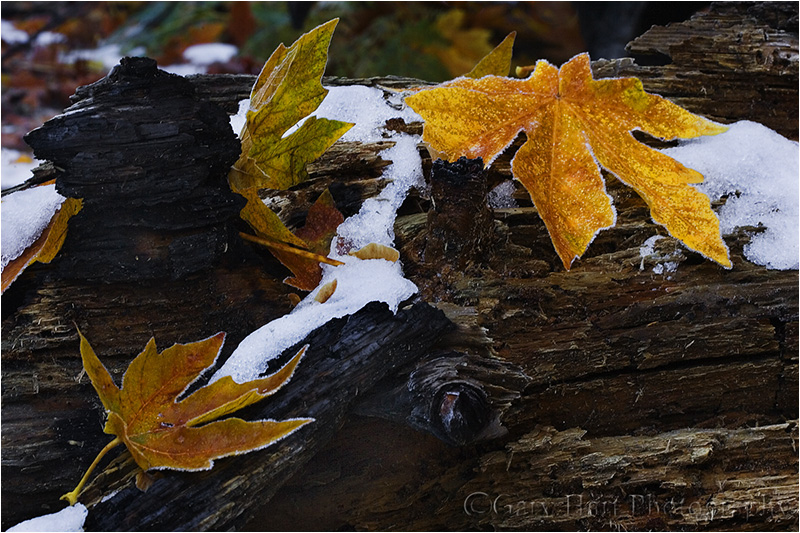
Snow and Autumn Leaves, Yosemite
“Photography’s gift isn’t the ability to reproduce reality, it’s the ability to expand it.”
(The second installment of my series on photographic reality.)
If you’ve ever tried to point out to someone a small detail in nature that pleases you, perhaps you’ve experienced a conversation like this:
You: “Look at that!”
Friend: “What?”
You: “Those leaves—look at the frost on those leaves.”
Friend: “What leaves?”
You: “There on the log—with the snow.”
Friend: “Those dead ones? Yeah, cool. Man, I can’t believe I ate all those fries at lunch.”
You: “Whatever.” Sigh.
It’s really great to enjoy nature, to take in all of its infinite, three dimensional, multi-sensory splendor: its smells, sounds, depth, and motion. But all this input is a lot to process, and because everybody interacts with the world a little differently, each person is drawn to different things—what moves you might be overlooked by others. If only there were some way to show others what you see. Hmmm….
Unlike us humans, a still camera experiences the world in single-sensory, discrete frames. Rather than being a disadvantage, a camera’s “limitations” provide an opportunity to isolate whatever aspects of a scene that moves you, and to remove extraneous elements that distract. In other words, the camera’s field of vision, determined by you, has finite boundaries that make a frame in which you can organize relationships and eliminate distractions through careful selection of your lens’s distance (or focal length) and direction.
The golden leaves in the above image were three among thousands dotting the forest floor on this November morning near Cathedral Beach in Yosemite. I wanted to juxtapose fall and winter, and reveal the leaves’ frosty fringe. A wide frame would have more closely represented the entirety of the scene as I experienced it, but without something to anchor the frame, I knew viewers’ eyes would wander and they’d be unsure of my intent.
So I put on my 100mm macro lens and moved closer, finding this trio of leaves on a log, surrounded by patches of snow. I started by positioning myself so none of the leaves merged—that each stood by itself, balanced in the frame. Framing the leaves tightly eliminated the rest of the world, giving you no choice but to only look at what I wanted you to see. F14 and careful focusing gave me enough depth of field to make the leaves and log sharp with the background distractions blurred to insignificance.
Up next: See the light
Autumn Leaves (and winter arrives)
Posted on March 17, 2012
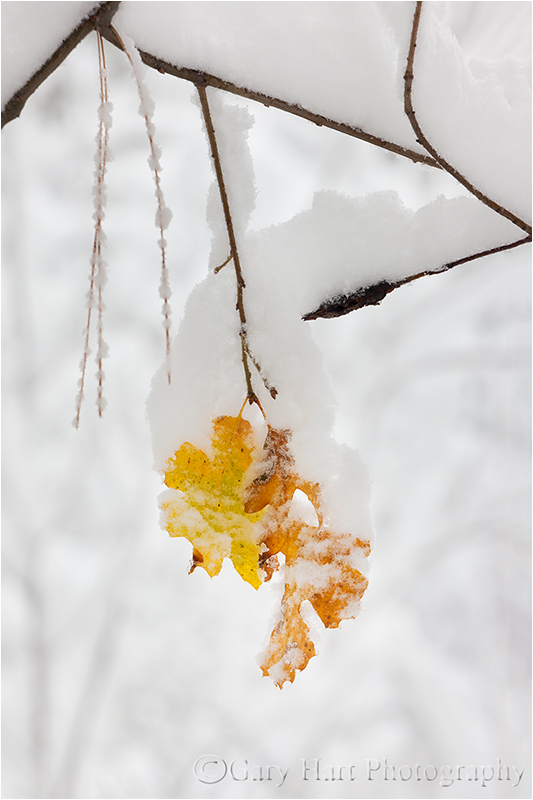
Leaves and Snow, Yosemite
I’ve been in Maui since Monday (scouting for a new workshop), and despite the fact that there’s more to photograph here than there is time to photograph (seriously), I still find time to check the Yosemite webcams every day. In fact, even surrounded by all this tropical splendor, I’ll admit to a few pangs of homesickness when today’s webcams showed fresh snow, with more falling, in Yosemite Valley.
(I’ll get to my Maui pictures when I’m home, but until then here’s one from November.) At only 4,000 feet above sea level, Yosemite Valley is warm compared to most of the Sierra. It’s often raining here when it’s snowing just a little up the road. When it does snow in Yosemite Valley, for an hour or two scenes like this are quite common. But as soon as the sun comes out, the snow starts disappearing.
To see Yosemite Valley covered in white requires being there while it’s snowing–if you wait to leave until you hear it snowed in Yosemite, you’re too late. Photographing Yosemite while the snow is falling can be difficult, but the payoff is huge. Often the ceiling drops to the valley floor, obscuring everything that’s recognizable as Yosemite, but with the disappearing icons also vanishes the swarms of visitors and suddenly you feel like you’re alone in the world. Is there any silence more pure than the silence of falling snow?
The best nature photography often highlights the drama of change: the passing from day to night and back, the collision of ocean and land, an approaching or retreating storm. And, because it happens so gradually and only once each year, the movement from one season to the next is a rare photographic opportunity.
So that November morning my attention turned to shocked autumn leaves, lulled by weeks of benign fall weather, forced to cling to their colorful glory against winter’s sudden assault. After nearly a month as the main event, these leaves were lone survivors along a quiet bend in the Merced River. Within a couple days they no doubt fell to the forest floor, or were swept into the river, as inevitable winter prevailed.
What’s on your hard disk?: A project for a sunny day
Posted on May 13, 2011
 One of the risks of making photography your livelihood is the possibility (likelihood?) that the business will preempt the photography. Even though I’ve consciously chosen to continue photographing only what I want to photograph without concern for the marketability of an image, when I return from a trip the demands of the business often leave little time for my captures.
A few days ago I received a request for an image that sent me digging through my archives. I found what I was looking for, but in the process stumbled upon a few images I’d forgotten about; probably nothing that will make me rich, but at the very least some that make me happy. This got me thinking that every photographer might benefit from occasionally revisiting rejected captures. Often our first impression, influenced by the mood of the moment, is entirely different from our current impression. You’ve no doubt grown as a photographer, re-defined your tastes, refined your eye, improved your processing skills–all factors that might lead to different conclusions about past rejects. The next time you find yourself in a photography state of mind, and the bright sun and blue sky outside offer little promise, try returning to past captures. If an image stops you, open it and play a bit. Correct flaws, experiment with different crops, sharpen–whatever you think it might need. Who knows, you may just find yourself pleasantly surprised by what’s there.
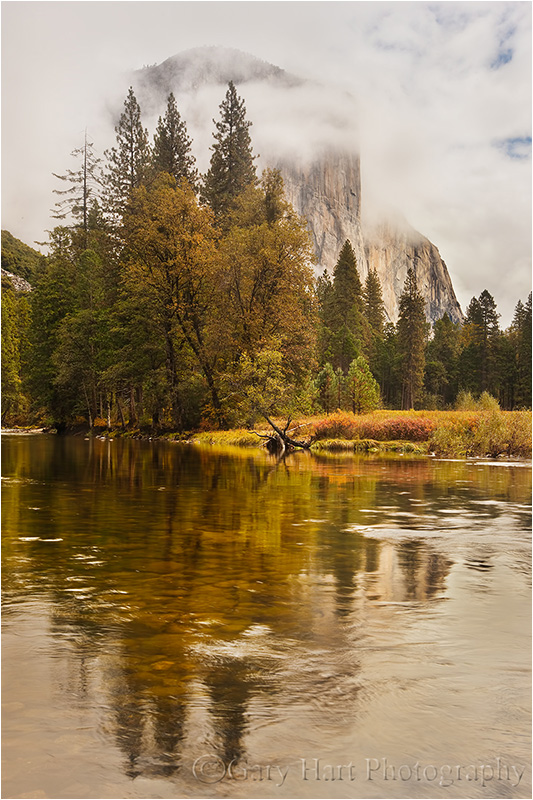
Today’s image is one such find. As a Yosemite photo destination, Valley View is probably second only to Tunnel View in popularity. I take all my workshop groups to Valley View, and usually can’t resist a peek when I’m in the park on my own, but rarely photograph there anymore. But on a visit a couple of autumns ago, finding the light and clouds irresistible, I set out to see if I could create something I didn’t have. With the clouds enshrouding El Capitan lending an air of mystery, I chose a vertical composition to eliminate less compelling surroundings. Rather than emphasize the almost irresistible reflection in the meandering Merced, I adjusted my polarizer to reveal the river-rounded rocks beneath the surface. The result was a high-key perimeter framing the darker scene that gives the frame a negative feel, where the darkest regions do the most work. Despite liking it as soon as it flashed in my LCD, I thought little more about this image until I stumbled upon it last week. While this won’t likely be the image I retire on, at the very least it nudged me into digging a little deeper on my hard drives to see what else might be out there. Stay tuned….
Are you insane?: A control freak’s prescription for photographic success*
Posted on February 11, 2011

Fall Into Winter, Valley View, Yosemite
Canon EOS 1DS Mark III
60 mm
1/15 seconds
F/16
ISO 200
* This message isn’t for everybody. If your photographic pleasure derives from simply breathing fresh air and admiring the view, or if your camera is just an accessory that helps you share and relive those outdoor experiences later, you’re already a successful photographer. But if you aren’t achieving the results you long for, either in the quality of your images or the attention they attract, please read on.
Are you insane?
Albert Einstein defined insanity as doing the same thing over and over again but expecting different results. Hmmm. For some reason this reminds me of the thousands of good landscape photographers with hundreds of truly beautiful images they can’t sell. These photographers have a good eye for composition, own all the best equipment, know when to be at the great locations, and are virtual gurus with state-of-the-art processing software. Yet they haven’t achieved (their definition of) success.
Conducting photo workshops gives me pretty good insight into the mindset of the most serious amateur photographers (the photographers serious enough to spend lots of money and vacation time for several days of sunrise-to-sunset photography). I’m frequently struck by the number of amateur photographers with serious aspirations who are so mesmerized by today’s technology that they’ve turned over control of the most important aspects of their craft to their camera. Their solution to photographic failure is to buy more equipment, visit more locations, and master more software. The tool they overlook is the one on top of their shoulders.
Knowledge vs. understanding
Just as a new camera won’t make you a better photographer, simply upgrading your photography knowledge won’t do it either—knowledge is nothing more than ingested and regurgitated information. Understanding, on the other hand, (among other things) gives you the ability to use information to create new knowledge—solve problems.
Many photographers invest far too much energy acquiring knowledge, and far too little energy understanding what they just learned. For example, it’s not enough to know that a longer shutter speed or bigger aperture means more light if that knowledge doesn’t translate into an understanding of how to manage light, motion, and depth with your camera.
Take control
Automatic modes in most cameras handle static, midday light beautifully, yet struggle in the limited light, extreme dynamic range, and harsh conditions that artistic photographers seek. I see many serious amateur photographers with so much faith in technology that they possess a critical deficiency of two fundamental photographic principles:
- How a light meter determines the exposure information it gives you. This seems so basic, but auto-exposure and histograms have fooled many into thinking they understand metering and exposure.
- How to use the reciprocal relationship between aperture, shutter speed, and ISO to manage photography’s three variables: light, depth, and motion. This is the universal tool that enables photographers to handle the limiting factors of every scene.
Books and internet resources are a great place to start acquiring these principles, but the knowledge you gain there won’t turn to understanding until you get out with your camera and apply them. When these principles become second nature, you’ll be amazed at what you’ll be able to accomplish with your photography.
For example
The image at the top of the post is from a visit to Yosemite’s Valley View last November. I chose it because it demonstrate how I applied the essential photographic principles above to accomplish my goal.
I arrived at Valley View that afternoon to find it blanketed with fresh snow—had I opted for the obvious composition, I’d have captured a gorgeous version of something that’s already been captured thousands of times. But I wanted something different, so I headed upriver a hundred feet or so to this dogwood I remembered from previous visits. (In fact, it’s the same dogwood featured in one of my favorite images.) I found that the sudden snow had caught the dogwood’s colorful leaves off-guard, leaving many still dangling from the snowy branches like frozen Christmas ornaments.
I wanted to emphasize the collision of seasons, and once I had my composition, I started working on how to deal with the factors limiting my objective for the scene:
- With the foreground leaves so close, and Bridalveil Fall in the background, sufficient depth of field was my prime concern
- The light was limited in the dense overcast
- A slight breeze swayed the branches
The light in this scene was low but easy, with a very narrow dynamic range that fit easily within my camera’s range of capture. Because I was on a tripod, camera-shake wasn’t a concern; in the low light I only needed to worry about finding a shutter speed that would stop the breeze. Wanting lots of depth of field, but concerned about diffraction (from a too-small aperture), I decided f16 would give me complete sharpness in the leaves (essential), with just a little softness in the background and minimal diffraction. But f16 at my preferred ISO 100 resulted in a 1/8 second exposure that I feared wouldn’t be enough to freeze the swaying branches. So I bumped my ISO to 200, confident that I could make 1/15 work if I timed my exposure for a lull in the breeze (I was not at all concerned about the minimal noise introduced by the higher ISO). I clicked several frames just to be sure the breeze hadn’t introduced motion blur too small to detect on my LCD.
Insanity is in the mind of the beholder
If landscape photography gives you what you want, then by all means, continue doing what you’re doing. But if you’re having a hard time achieving a photographic goal, I suggest that the solution is likely not doing more of what you’re already doing. Instead, reevaluate your comprehension of fundamental photographic principles that you might not have thought about for years. You’ll know you’re there when you have complete control of the light, motion, and depth for every scene you encounter, know how to get the result you want or that it’s simply not possible.
Do I really think you’re insane for doing otherwise? Of course not. But I do think you’ll feel a little more sane if you learn to take more control of your camera.
Workshop Schedule || Purchase Prints || Instagram
When Seasons Collide
Click an image for a closer look, and to view a slide show.


 Eloquent Images by Gary Hart