Eloquent Images by Gary Hart
Insight, information, and inspiration for the inquisitive nature photographer
There’s no whining in photography
Posted on January 14, 2012

Moonset, Soberanes Point, Big Sur
Canon EOS-1Ds Mark III
10 seconds
F/16
ISO 50
28 mm
January 2012
I just wrapped up a long week that underscores the best and worst of my life as a landscape photographer. In the plus column I’ll put visits to Big Sur and Yosemite and the opportunity to spend quality time with a great bunch of photographers; in the negative column goes long days, dull weather, and lots of solo miles.
Sunday morning I left for Big Sur to co-lead Don Smith’s winter workshop, where we spent three-and-a-half days yo-yoing up and down one of the most beautiful coasts in the world. Wednesday night, after photographing sunset with the group at Point Lobos, I made the long trip home, arriving with barely enough time to repack my suitcase and gas-up before hitting the road for Yosemite Thursday afternoon. Following a sunrise to sunset day guiding two photographers from the Netherlands around Yosemite, I drove home late Friday.
But when a long week includes scenes like today’s image, you can see I have little to complain about. I’m extremely fortunate to live where I do, less than four hours drive from locations people travel around the world to visit: Yosemite, Big Sur, San Francisco, Point Reyes, Muir Woods, the Sonoma and Mendocino coasts, the Napa and Sonoma Wine Country, Mt. Shasta, Mt. Lassen, Lake Tahoe, and Mono Lake.
As has become California’s norm this winter, Big Sur delivered mild temperatures and cloudless skies. But, since poor conditions should never be an excuse for staying inside, here’s a little secret for dealing with bland skies: the best light for photography comes before the morning sun reaches the scene, and after the evening sun leaves. Without direct light, the entire landscape is bathed in even, contrast-smoothing light reflected from the sky, and the pastel hues of the Earth’s shadow colors the sky and paints the horizon. All you need to capture the magic is a decent camera (any digital SLR will do) and sturdy tripod.
I time all of my moonrise/moonset shoots for the small window when the moon is in this day-night transition zone—often, the more clear the sky, the better the twilight color on the horizon opposite the sun (and right where the full moon sets/rises). But adding a full moon in limited light like this can be tricky—the moon is daylight bright, while the rest of the scene is in deep shade. Some photographers blend multiple images to handle the extreme contrast; I prefer graduated neutral density filters. For example, to capture the above image of the moon setting into the Pacific at Big Sur’s Sobranes Point, I used a Singh-Ray three-stop reverse GND filter to subdue the moon and hold the sky’s color during an exposure that had to be long enough to reveal the foreground detail.
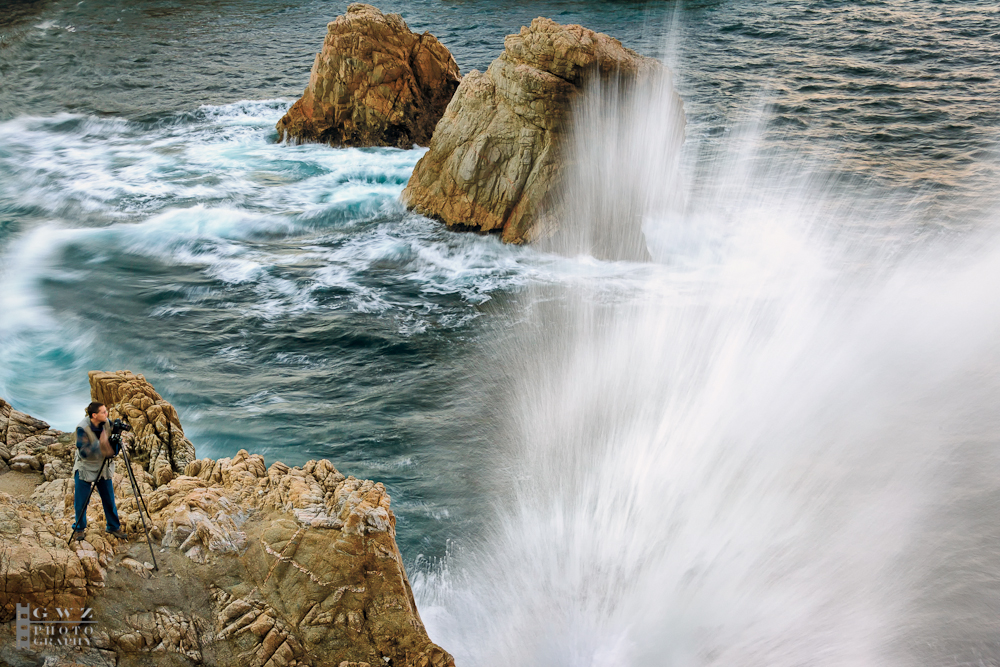
It was more night than day when Don and I got the group to Sobranes Point for our sunrise shoot. A white strike of moonlight reflected on the black Pacific, and nearby sea stacks, mere shapes in the dark, were under continuous assault from the violent surf. Following a brief orientation, everyone spread out along the cliffs—Don led some of the group southward along the cliffs; I guided the rest northward toward a not yet visible arch. When my eyes adjusted and the light came up, I wound my way along a narrow path that ended on a granite prominence jutting thirty feet or so above the ocean. While most of the waves crashed harmlessly beneath me, every few minutes a particularly large surge would strike at just the right angle, obliterating my view with spray that rose twenty feet above my head (see below). Had the generally prevailing onshore wind not been absent that morning, I’d have been thoroughly drenched. After the first wave explosion I was a bit uneasy about my location, but once I realized I was out of range I kind of enjoyed the ride.
All the visual activity makes this a tricky scene to photograph—I’ve shot here a number of times, but until now have never come away with anything that completely satisfies me here. With most of the action is on the right side of the frame, I’ve always found wide, horizontal compositions unbalanced. Going for a tighter vertical orientation to emphasize the strong coastline, I never find a left edge that doesn’t cut the sea stacks awkwardly. And horizontal or vertical, with a host of smaller rocks protruding from the nearby surf, I struggle placing the bottom of my frame. But adding the moon’s significant visual weight to the left of the frame gave me the horizontal balance I wanted, and hiding the protruding foreground rocks behind the weathered granite cliff gave a solid base for my composition.
When I finally found a composition that worked, I needed to find the focus point that would maximize the depth of field. A quick check of the hyperfocal app on my iPhone told me that f16 at 28mm would give me sharpness from 2 1/2 feet to infinity if I focused on the foreground granite about five feet away. To ensure correct focus, I used my camera’s live view and magnified my focus point 10x. There wasn’t enough light to even think about freezing the surf at a useable ISO, so I just went with a long exposure that smoothed the water.
When photographing waves, many photographers fail to account for the change from one frame to the next. So, knowing my composition was locked securely in place on my tripod, I stood back and monitored the waves closely, clicking about a dozen frames to capture a range of surf action, from placid to violent. This ten second exposure included a single moderate wave and several minor swells.
I was probably cold, damp, and sleepy, but I don’t remember. And it would have been easy to complain about the boring skies, or feel sorry for myself during my many lonely hours behind the wheel, but mornings like this one are exactly why I do this, and a perfect example of why there really is no whining in photography.
Familiarity breeds content
Posted on September 5, 2011
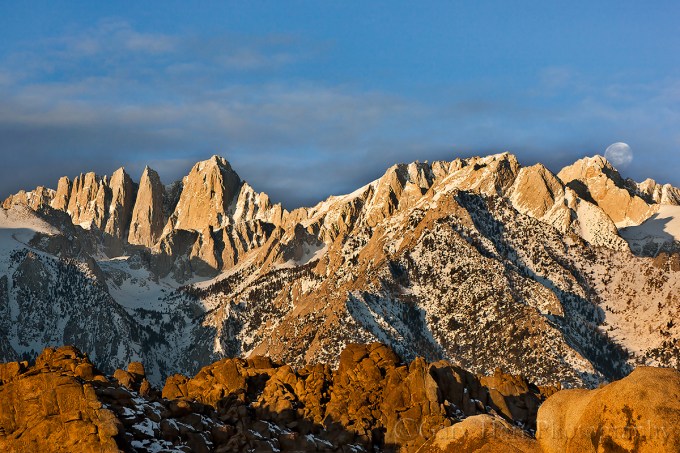
Goodbye Moon, Mt. Whitney and the Alabama Hills, California
Canon EOS-1Ds Mark III
145 mm
1/40 second
F/11
ISO 200
Content (con-tent‘): A state of peaceful happiness….
I’ve photographed Mt. Whitney from the Alabama Hills in sunlight and moonlight, in scorching heat and drifting snow. Sharing favorite spots here with a workshop group is as rewarding as a solitary night under the stars. I’ve never photographed in the Alabama Hills without feeling better afterward than I did when I started.
These feelings aren’t unique to the Alabama Hills; rather, they’re a benefit I’ve come to associate with all the locations I regularly photograph. While new locations are always a treat, visiting familiar terrain like the Alabama Hills, Yosemite, Mono Lake, Death Valley, the California coast, and the central Sierra foothills recharges me in a way not possible at a location that I’m trying to absorb for the first time. It’s like the difference between a quiet reunion with old friends and a raucous party with strangers: both have their place, but the reunion always elevates my spirits.
Content (con‘-tent): Substantive information or creative material….
With familiarity comes the knowledge that I’ll always be able to find something to photograph, regardless of the conditions. I can take my time, let my eyes search the terrain, probe every nook and cranny until something stops me. Everything at a familiar location settles comfortably into place, while at a new location my brain spins at it tries to process a seemingly infinite supply of unfamiliar elements while biased by a lifetime of viewing interpretations from other photographers. As stimulating as it might be, new input is a distraction to the creative process.
My goal, always, is to photograph a scene in a way that it’s never been photographed. That’s usually difficult (especially at many of the locations I photograph), but it seems impossible until I can process a scene and get comfortable with it, something that rarely happens in my first or second (or even third) visit. But each visit to familiar locations like the Alabama Hills seems to peel away additional layers of distraction, allowing me to see just a little deeper into whatever it is that makes that place special.
* * *
Sunrise light on Mt. Whitney, and a few minutes later on the Alabama Hills themselves, is a singular treat. The abrupt face of the Sierra towering over the terrain to its east creates rare opportunities witness the unfolding of a new day, as the sun’s first rays kiss the Sierra crest long before they reach observers below. The angle and quality of Mt. Whitney’s first light varies with season and conditions; as I’ve become more tuned to it, I’ve attempted to use this light to highlight the foreground for the larger scene.
Of course the prime show on this frigid morning last January was a full moon setting behind the snowcapped Sierra crest (Mt. Whitney, the highest point in the 48 contiguous United States, is the shark-tooth peak on the left). But rather than “settle” for that exquisite scene, I tried to complement the serrated peaks with the craggy and complementary contours of the nearby boulders. The warm sunrise light on the granite became my friend, creating extreme contrast that further emphasized rocks’ rugged character.
Workshop Schedule || Purchase Prints
A Mt. Whitney Gallery


The Other Ninety-Nine Percent
Posted on May 2, 2011

Cradled Crescent, El Capitan and Half Dome, Yosemite
Canon EOS 1DS Mark III
4 seconds
400 mm
ISO 400
F8
Thomas Edison said, “Genius is one percent inspiration and ninety-nine percent perspiration.” (Without claiming genius) I think this applies to photography as well: Many successful images are more the product of being in the right place at the right time than divine inspiration. Of course anyone can stumble upon a lucky convergence of location and conditions and come home with a great photo, but the “genius” behind creating great photos consistently is preparation and sacrifice–a.k.a., perspiration.
The moonrise on the final sunrise shoot of last week’s Yosemite workshop spurred these thoughts about inspiration and effort. We were all in more or less the same place, photographing the same thing. And while everyone probably captured very similar images (in this case of a crescent moon squeezing between El Capitan and Half Dome), the true magic was simply being there.
But why were we the only ones there to witness this special moment that probably won’t repeat for decades? Determining the moon’s altitude and azimuth from any location on Earth is as easy as visiting one of many websites, or using one of many astronomical software applications such as The Photographer’s Ephemeris or (my preference) the Focalware iPhone app. Armed with this data, aligning the moon’s rise with any landmark isn’t rocket science.
Based on my calculations and plotting, I scheduled my “Yosemite Dogwood and Rising Crescent” workshop to coincide with a sunrise crescent moon. The dogwood bloom isn’t as reliable, but I know interesting weather is still possible in Yosemite in late April and early May. What we ended up with was mostly clear skies (great for tourists, but definitely not for photographers) and a very late dogwood bloom in Yosemite (probably two weeks behind “schedule”), forcing me to shift the daytime emphasis of my spring workshop to rainbows. I’m happy to report Bridalveil and Yosemite Falls delivered more photogenic rainbows than I can count, from a number of different locations.
As spectacular as they were, overshadowing the rainbows was the moonrise on our penultimate morning. I promised the group that departing at 4:50a.m. would get us to Tunnel View in time to photograph a 7% crescent moon rise above Yosemite Valley, between Sentinel Dome and Cathedral Rocks, in the pre-dawn twilight. (I knew this because I’ve been calculating moonrise and moonsets in Yosemite and elsewhere for many years, and have photographed more of these from Tunnel View than any other location.) That moonrise came off exactly as advertised–so far so good.
But the Tunnel View success, as beautiful as our images were, was merely a warm-up that gave everyone an opportunity to hone their silhouette exposure and composition skills in advance of the rare moonrise opportunity I’d planned for the next morning. When scheduling this workshop I’d determined that about 45 minutes before sunrise on May 1 of this year (2011), a delicate 3% crescent moon would slip into the narrow gap between El Capitan and Half Dome for anyone watching from Half Dome View on Big Oak Flat Road.
Lunar tables assume a flat horizon, so unless I’m at the ocean, the primary uncertainty is when the moon will appear above (or disappear below) the not-flat horizon. Once I’ve photographed a moonrise (or set) from a location, I simply check the precise time of its appearance (or disappearance) against the altitude/azimuth data for that day to get the exact angle of the horizon from there. Until I have this horizon information, I only have the moon’s direction and elevation above the unobstructed horizon and can only make an educated guess as to the time and location of its appearance.
The other big wildcard in moon and moonlight photography is the weather, but a last minute check with the National Weather Service confirmed that all systems were go there. Nevertheless, despite all my obsessive plotting, checking, and double-checking, having never photographed a moonrise from this location, and the fact that an error would affect not just me but my entire group, I couldn’t help feel more than a little anxious.
The afternoon before our second and final pre-dawn moonrise, I brought the group to Half Dome View so they could familiarize themselves with the location and plan their compositions. Due to the horizon uncertainties I just described, the first time I photograph a moonrise/set from a location, I generally give my group only an approximate time and position for the moon’s rise/set. But during this preview someone asked exactly where the moon would rise, and I confidently blurted that it will appear in the small notch separating El Capitan and Half Dome between 5:15 and 5:20 a.m. (about 25 minutes after the official, flat-horizon moonrise). Standing there that afternoon, however, I realized how small the notch really is, meaning that even the slightest error in my plotting could find the moon rising much later, from behind El Capitan or Half Dome. So I quickly qualified my prediction, explaining that I’ve never photographed a moonrise here and the uncertainty of knowing the horizon. But given all of my perfectly timed waterfall rainbow hits so far, not to mention our Tunnel View moonrise success earlier that morning, I had the sense that my group had unconditional (blind) confidence in me. (Yikes.)
Sunday morning we departed dark and early (4:45 a.m.), full of anticipation. We arrived at Half Dome View a little after 5:00, early enough to enable everyone to set up their tripods, frame their compositions, and set their exposures. Then we waited, all eyes locked on the gap separating El Capitan and Half Dome. Well, almost all eyes–mine made frequent detours to my watch and the Focalware iPhone app responsible for my bold (rash?) prediction. (What was I thinking, promising a moonrise into a paper-thin space in a five minute span from a spot where I’d never photographed a moonrise?) My watch crawled toward the 5:15-5:20 window: 5:15 (Is the notch shrinking?); 5:16 (It’s shrinking–I swear I just saw Half Dome inch closer to El Capitan); 5:17 (I entered the coordinates wrong, I know I did–what if it comes up behind us?). Surely this wasn’t the kind of perspiration Edison was thinking about.
As I frantically re-checked my iPhone for the umpteenth time, somebody exclaimed, “There it is!” I looked up and sure enough, there was the leading sliver of nearly new moon perfectly threading that small space between El Capitan and Half Dome. Phew. The rest of the morning was a blur of shutter clicks and exclamations of delight (plus one barely audible sigh of relief). (How could I have even dreamed of doubting the tried and true methods that had never failed me before?)
Before the shared euphoria abated, I suggested to everyone that they take a short break from photography and simply appreciate that they’re probably witnessing the most beautiful thing happening on Earth at this moment (a feeling every nature photographer should experience from time to time). It’s always exciting to witness a moment like this, a breathtaking convergence of Earth and sky that may not occur again exactly like this in my lifetime. It’s even more rewarding when the event isn’t an accident, that I’m experiencing it because of my own effort, and that I get to share the fruit of my perspiration with others who appreciate the magic just as much as I do.
Workshop Schedule || Purchase Prints || Instagram
A Crescent Moon Gallery
Click any image to scroll through the gallery LARGE


 Eloquent Images by Gary Hart