Eloquent Images by Gary Hart
Insight, information, and inspiration for the inquisitive nature photographer
Cliché for a reason
Posted on October 29, 2013

Autumn Snow, Valley View, Yosemite
Canon EOS 5D Mark III
1/15 second
F/16
ISO 100
24 mm
It’s actually even a cliché just to say it, but some things really are “cliché for a reason.” And as much as I try to avoid the cliché shots in Yosemite, sometimes they just can’t be helped.
My Yosemite Fall Color workshop began yesterday, and even though I’d spent all day Saturday in the park, yesterday morning a storm filled Saturday’s blue skies with rain and I felt like I should go check on the conditions before we started. The wet weather had slowed me enough that I didn’t really have time to take pictures, but when I found not only the red and yellow leaves I’d seen on Saturday, and the swirling clouds I’d hoped for, but also Yosemite Valley’s colorful trees and meadows etched with snow, I was tempted at every turn to reach for my camera. Nevertheless, with the exception of a brief breakdown at Cook’s Meadow, I managed to resist temptation.
Unfortunately, the Cook’s Meadow stop had put me even more behind schedule, so I told myself while approaching Valley View that any stop here would be just reconnaissance. And anyway, Valley View images are a dime a dozen, clichés that I’d done more than my share to perpetuate over the years. Then I got there….
I mean seriously, cliché or not (deadline or not), how does a photographer pass up a scene like this? With my group meeting me in just an hour, I really, really didn’t have time for pictures, which is exactly what I kept reminding myself as I leaped from my car, snatched my camera and tripod, and sprinted down to the river. I only snapped four frames, two vertical and two horizontal, before racing back to the car and toward my impending rendezvous.
It’s images like this that remind me that nature’s beauty transcends any human judgement of “cliché.” Pro photographers, myself included, can get a little snobbish about frequently photographed scenes. And while I think it’s important to take the time to find a unique perspective, sometimes it’s best to let Mother Nature speak for herself.
Happy ending
I made it to my workshop with minutes to spare, conducted a lightning-fast orientation, and hustled everyone back outside as quickly as possible. We ended up circling Yosemite Valley several times, photographing without a break until dark. I heard no complaints.
A gallery of clichés


Shocking truths about lightning
Posted on October 23, 2013

Color and Light, Bright Angel Point, North Rim, Grand Canyon
Canon EOS 5D Mark III
1/3 second
F/11
ISO 100
24-105 f4L lens
While working on an upcoming “Outdoor Photographer” magazine article on photographing lightning at the Grand Canyon, I’ve been revisiting the images from my August workshop with Don Smith. While I still feel like I’ve only scratched the surface with the trip’s lighting images, it’s clear that at least half of my captures came on that amazing final morning, when we witness two hours of virtually nonstop lightning punctuated by a vivid section of rainbow balanced atop Powell Point. The first image I posted from that morning included the rainbow sharing the rim a trio of simultaneous, parallel strikes. The difficulty I’m having now is choosing which of the other pretty spectacular images to feature (FYI, this is a great problem to have).
Fortunately, I varied my compositions enough that many of my favorite captures are different from each other. Here, a single strike lands just east of the rainbow, close enough that they somehow seem related. This image is an example of why I’m constantly preaching to my workshop participants to switch between horizontal and vertical, even (especially) when one orientation seems more obvious than the other. Fortunately, I practiced what I preached (not always a sure thing) throughout the morning—instead of having one great capture of lighting with that morning’s rainbow, I now have two (and counting) that are different enough from each other to share.
Another byproduct of my magazine article is the research I’ve been doing on lightning. I’ve always been something of a weather geek, but it seems each time I revisit a topic, I learn something new. So, while I doubt you’ll find this stuff quite as fascinating as I do, here are some cool lightning facts I just can’t resist sharing:
- Earth is struck by lightning eight million times each day.
- While lightning is still not completely understood, scientists know that the rapid upward and downward motion of raindrops in a thunderstorm creates extreme electrical polarity—a negative/positive imbalance within a cloud, between clouds, or between a cloud and the ground. Nature abhors any imbalance and will remedy the problem as efficiently as possible: Lightning.
- The visible portion of a lightning strike originates on the ground and travels up to the cloud.
- In a lifespan measured milliseconds, a lightning bolt can release 200 million volts and heat the surrounding air to 50,000 degrees. More than enough to fry a photographer.
- Most of us know that lightning and thunder occur simultaneously. What many don’t know is that you can’t have one without the other—it’s the lightning that causes the thunder, and if you see lightning but hear no thunder, you’re just too far away. This even applies to what is often called “heat lightning,” which still generates thunder you’d hear if you were close enough.
- The fact that lightning and thunder occur simultaneously, but light travels much faster than sound, allows us to roughly establish the distance of the lightning. For all intents and purposes, we see the lightning the instant it happens, while the thunder pokes along at the speed of sound, a pedestrian 1,100 feet per second. That works out to about five seconds to travel one mile. So, if you start counting as soon as you see lightning (one-thousand-one, one-thousand-two, …), dividing by five the number you’re at when the thunder arrives gives you the approximate distance in miles.
- Let’s say you get all the way to fifty before the thunder arrives—that would be ten miles. You’re safe, right? Wrong. Lightning bolts exceeding one hundred miles in length have been documented, as have bolts with no rain and even with blue skies overhead. That’s why we’re warned to stay inside whenever you can see lightning or hear thunder. (It’s also why I say do as I say, not as I do.)
- A car is not a magic lightning sanctuary, and the safety a car does offer is because of its metal frame, not its rubber tires. (Don’t believe me? Go stand on a couple of rubber tires in the next lightning storm and have your next of kin report back to me.) Even when you’re inside a car, you need to keep the windows up and don’t touch anything metal. And stay away from convertibles.
Here are a couple of lightning safety websites:
Are you interested in risking your life to photograph lightning? Join me in a Grand Canyon photo workshop.
A Lightning Gallery
Click an image for a closer look and slide show. Refresh the window to reorder the display.


Favorite: Sunset Palette
Posted on October 17, 2013

Sunset Palette, Half Dome from Sentinel Dome, Yosemite
Canon EOS-1Ds Mark II
Canon 24-105
2 seconds
F/20.0
ISO 100
Usually an image comes together on the spot, an organic blend of location and light unique to the moment. But some images I carry around in my brain for years, fully aware of the elements and how I want them assembled, and hopeful to be present when that happens. I have a number of these “dream” images rattling around between my ears, and every once in a while the stars align and I actually get to capture one. For example, on every visit to Sentinel Dome I would eye the granite indentations on the southeast flank and picture them as pools of rainwater reflecting the sunset sky, framing Half Dome in the distance. Wouldn’t it be great if….
One showery October afternoon a few years ago I made the hike to Sentinel Dome with these indentations in mind. I knew that the recent rain would quite likely have filled them, allowing at least part of my dream to come true. After summiting the dome I beelined to the other side and found “my” pools exactly as I’d hoped. The sky was a promising mix of blue and gray, but the sun was still at least an hour above the horizon. Nevertheless, the air was clean and western horizon was clear, essential ingredients for the colorful sunset I so wanted. Dare I hope?
I walked around a bit and mentally refined my composition—rather than set up close and use an ultra wide-angle, I moved back as far as the terrain would permit. This allowed me to fit the pools in the frame at a longer a focal length, which would compress the distance separating Half Dome and the pools. To reduce the expanse of granite behind the pools, I flattened my tripod as far as it would go and framed my shot. With closest pool about six feet in front of me, stopping down to f20 and focusing on a point about twelve feet away gave me sharpness throughout the frame. With my composition set and waiting on my tripod, I readied my two-stop hard graduated neutral density filter and adjusted my polarizer, then sat down on the (hard) granite, and waited.
The sunset color that finally came was more than I dared hope for. The sun was at my back, but with clouds overhead and the western horizon wide open, the crimson glow stretched all the way to the eastern horizon. I clicked this frame when the color was at its most intense, so brilliant in fact that every exposed surface seemed to throb with its glow.
Workshop Schedule || Purchase Prints || Instagram
A Few Images On or Including Sentinel Dome


Night and Day
Posted on October 9, 2013

Night and Day, Crescent Moon Rising Above Mono Lake
Canon EOS 5D Mark III
3.2 seconds
F/5.6
ISO 800
40 mm
October 2013
It’s dark. It’s cold. It’s early—so early that some would still consider it late. But you drag yourself out of bed anyway, for the promise of something most people never experience. And experience is the operative word here, because it’s much more than just the view. Or the photography. It’s the opportunity to witness the transition from night to day, to bask in a quiet that’s impossible in our metropolitan mayhem, to inhale clean, chilled air, and to watch the rising sun’s warm hues push back Earth’s indigo shadow to devour the twinkling vestiges of night. Of course you can watch this happen in reverse after sunset, but it’s just not the same in a world has been lived in for a dozen or so hours.
I’d scheduled this year’s Eastern Sierra workshop to conclude on the one day each month when a sliver of moon floats in the transition between night and day. To photograph the moon this small and close to the sun, I try to be in place an hour before “official” sunrise (the posted sunrise time, when the sun would crest a flat horizon), when darkness still predominates. With a five mile drive on a rugged, unpaved road, and a half mile (or so) trail-less walk through sand and mud, I got the group on the road at 5:15 for our 7:00 a.m. sunrise. Despite some blurry eyes, there was no grumbling; and by the time we were ready to trek to the lake, everyone was in great spirits.
On this morning Mother Nature rewarded us by chasing away the clouds that had dogged the horizon the last couple of days. These clouds had given us brilliant color, but had also preempted our night photography shoot just ten hours earlier; I was concerned that they’d obscure the moon I’d been so looking forward to. No problem—in the clouds’ place we found this two-percent slice of old moon, one day removed from new, just as I’d ordered. Phew.
Because this was the last day of the workshop, everyone had pretty much mastered the difficulty of exposing for a dark foreground beneath a bright horizon—some blended multiple exposures, others reached for their graduated neutral density filters—allowing them to concentrate on creativity. I tried a variety of compositions, horizontal and vertical orientations from wide to tight, and encouraged the rest of the group to do the same (though I suspect that by now they’d all learned to tune me out).
This is one of the first images I captured that morning. It was still dark enough that the amount of light required to bring out any detail in the foreground also revealed lots of lunar detail in the earth-shadow, and stars still pierced much of the sky. Nice. To ensure that I didn’t get motion blur in the moon, I made some compromises: I dropped to f5.6 (depth of field wasn’t a concern, but lenses are slightly slightly less sharp as the approach their extreme apertures) and bumped to ISO 800 (with my 5D Mark III and today’s noise reduction software, noise at ISO 800 is no longer much of a concern). For most of my images that morning I used a two-stop hard-transition graduated neutral density filter to subdue the bright horizon, but this was one of my earliest images, captured before that was necessary.
The group was pretty quiet for most of this sunrise, usually a sign that they’re pretty happy with what they see and the images they’re capturing. Every once in a while I’d answer a question, or offer suggestions, but it seemed like people were pretty much “in the zone.” Nevertheless, I did pause couple of times to remind everyone not to get so caught up in their photography that they forget to appreciate what we’re witnessing.
These ephemeral moments in nature change subtly but quickly—soon the stars disappeared and moon faded into the advancing daylight. By the time the sun crested the horizon, our attention had turned to the warmly lit peaks behind us. And then it was over.
Uhhh, I can explain…
Posted on October 4, 2013
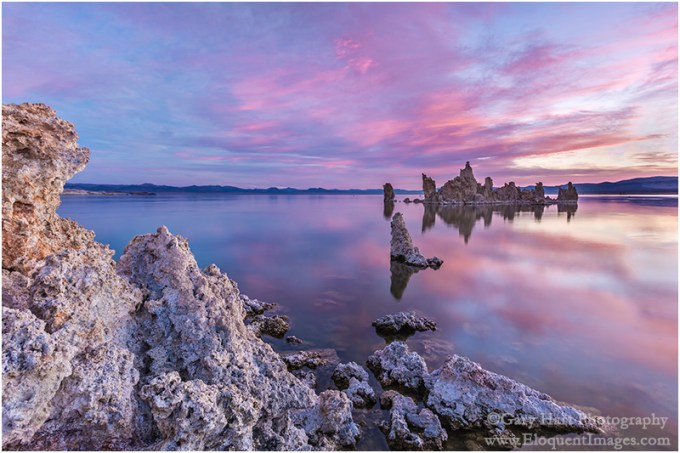
Before Sunrise, South Tufa, Mono Lake
Canon EOS 5D Mark III
3.2 seconds
F/16
ISO 100
17 mm
October 4, 2013
On my just completed Eastern Sierra workshop, the fact that I was in possession of three (THREE!) iPhones was a frequent source of amusement (dismay?) to my group. I thought I did a pretty good job justifying (rationalizing?) my obsession, only to return to read my daughter’s recent blog rekindling my defensive instincts (as an extremely proud but unbiased dad, I hope you take the time to read Ashley’s short piece). But sometimes it takes our kids to shine the light of perspective, and Ashley is just the mix of Laura Ingalls pioneer and jailbroken Android super-geek, knitter/blogger (who makes her own soap and tweets from the cozy wifi comfort of her commute train) to do it.
The truth is, I’ve been drawn to my “toys” ever since my college roommate and I de-boxed, connected, and powered on my brand new component stereo system. I have no memory of the first album to wobble my woofers (though I’m certain it was a painstaking decision process), but I’ll never forget the receiver’s soft blue glow illuminating my otherwise dark dorm room—ahhhh.
But anyway…. A couple of years ago I was permanently scarred when I accidentally drowned my (only!) iPhone on a shoot in Hawaii. I travel a lot, often to locations with little or no connectivity, and suddenly having to live without my iPhone’s contact, e-mail, map, sunrise/sunset, hyperfocal, and other data necessary to execute my business on the road gave me some inkling of the suffering endured by the Donner Party. I immediately replaced that iPhone with a 4s (thank God for insurance), and when the iPhone 5 came out, rather than sell the 4s, I kept it as a backup—even though the cell service is turned off, I keep it fully synced via wifi, so it’s always ready to jump into action in the event of the untimely demise of my iPhone 5.
But three iPhones? Okay, this one’s a bit more of a stretch, but here goes. When I replaced the stereo on my (7-year old, 130,000 miles thank-you-very-much) Honda Pilot (somehow I didn’t get the fancy-new-car gene), the USB interface wasn’t fully compatible with my iPhone 5, so my backup iPhone took a full time position in the center console as the dedicated travel entertainment center.
Then the iPhone 5s came out. I tried to resist. I really did. But a fingerprint sensor? 64-bits? Improved camera? Dual flash? A dedicated motion detecting coprocessor? You had me at fingerprint sensor. My original plan was to sell the 5 (because who needs 3 iPhones?). But before I could do it, possibility started to conspire against reason: With my iPhone 5 I can again have a dedicated backup. Not only that, with the 5’s GPS and fully synced iTunes library, I won’t have to get my new 5s sweaty on my daily runs, nor will my they be interrupted by phone calls or e-mail. Plus…. Okay, I can see this isn’t working.
But seriously. As someone who remembers phones with cords and rotary dials, I sometimes shake my head at the technology in my pocket that allows me to communicate instantly with almost anyone from the most remote locations on Earth (sometimes with the help of an amazing two-way satellite receiver). But more than a communication device, this little block of aluminum and glass instantly puts information at my fingertips that once required multiple trips to the library and days of research. It entertains me on long trips with my entire music collection, reads to me, guides me, and allows me to record and report whatever activity or sight currently engaging me. Do I need three? Of course not. (Thanks, Ash.)
About this image
Believe it or not, despite the demands of managing three iPhones, I was able to find time for photography this week. My Eastern Sierra workshop started in Lone Pine, where we photographed Mt. Whitney and the Alabama Hills. From there we moved and hour north to Bishop, concentrating there on the bristlecone pine forest of 4,000 year-old trees, and the brilliant fall color decorating North Lake and Bishop Creek. While that part of the workshop was great, it was dogged by persistent blue skies that made being outside nice, but were less than ideal for photography.
That changed on the Lee Vining stage of the workshop. The clouds arrived just in time for our two days at Mono Lake, blessing with a South Tufa sunset that I can only describe as electric, reprised by an equally spectacular South Tufa sunrise the next morning. We also enjoyed a surprise sunset at Minaret Vista (a substitute location to replace suddenly inaccessible Olmsted Point in just-closed Yosemite), and wrapped up with crescent moon enhanced, sunrise at a remote, solitary Mono Lake beach that never disappoints.
At Mono Lake I aways cross my fingers for the still lake surface that delivers the mirror-like reflections that make photographs there particularly special. On this trip we were fortunate to get reflections at each of our three Mono Lake shoots, reflections ranging from gently abstract to utterly mirror-like. This image is from our South Tufa sunrise shoot on workshop day-four. The previous night’s sunset was more vivid than this, as was the subsequent sunrise a few minutes later (and I’ll no doubt share those images at some point). But I liked the softness of the subdued hues of this moment, when the morning was still under the influence of twilight. I snapped this when the light was still low, enabling an exposure long enough to smooth gentle, breeze-stirred ripples.
To best capture the exquisite detail of the tufa (calcium carbonate towers formed by submerged springs, exposed by receding lake levels), I focused toward the back of the long, low tufa at the bottom center; at 17mm I probably could have gotten away with f11, but I wanted a longer shutter speed to better smooth the water. I used a two-stop hard graduated neutral density filter to hold back the bright sky, hand-holding it at a 30-degree (or so) angle along the top-right edge of the frame. The 3+ second shutter speed allowed me to move the GND slightly during the exposure, all but eliminating the telltale GND transition line. What little transition remain was easily blended away with a few Photoshop dodge/burn brush strokes.
Epilogue, September 2016
I’m back to one iPhone now.
Eastern Sierra Photo Workshops
An Eastern Sierra Gallery
Click an image for a closer look and slide show. Refresh the window to reorder the display.


 Eloquent Images by Gary Hart