Eloquent Images by Gary Hart
Insight, information, and inspiration for the inquisitive nature photographer
Out of my depth
Posted on September 27, 2015

Hidden Waterfall, Akaka Falls State Park, Hawaii
Sony a7R II
Sony 70-200 f4
1/10 second
F/16
ISO 1600
A couple of weeks ago I wrote about appreciating the small stuff. Writing that article opened my eyes to how much I’d gotten away from aspects of photography that give me great pleasure, and that were a big part of my photographic style. Not completely away, but far enough to notice a difference when reviewing my images from the last year or so, a year that coincides with my switch from Canon DSLR to Sony mirrorless. While I can’t attribute this shift to a shortcoming in my Sony gear (far from it), I do believe the timing is more than coincidence.
First, with its radically different interface and shooting workflow, mirrorless is a new trick and I’m an old dog, and I think I underestimated the ramifications of the mirrorless switch. Nevertheless, within a few weeks I felt reasonably comfortable seeing through an electronic viewfinder, had embraced a new focus and metering paradigm, and became sufficiently familiar with my Sony a7R’s features, buttons, dials, and menus. So far, so good.
But simply knowing a camera doesn’t mean I don’t have to think about using it. And it’s the unconscious control of photography’s technical side—the focusing, metering, setting exposure variables, and so on—that frees my brain to create. (I suspect it’s this way for most other photographers too.) So until I can make my camera an unconscious extension that functions more like an extra limb, the interface is a distraction. After ten years, I’d taken for granted my ability to control every aspect of my Canon DSLRs by feel, in the dark if necessary, without conscious thought—simply put, it’s taken nearly a year to achieve that familiarity with my Sonys.
In that gap between familiar and intimate with my Sony bodies, bad (lazy) habits formed. Because while I was getting used to a new way of shooting, I became so enamored of my a7R’s extreme dynamic range that my photography began to skew in that direction. Suddenly sunrises and sunsets that had been especially difficult (or impossible) with my Canons, were easy, a luxury I was all too happy to indulge. Then came the a7S, with its mystical ability to see in the dark, and suddenly night photography was occupying much more of my photography time.
Compounding the problem, these high dynamic range scenes tend to be more dramatic, and drama impresses the masses more than subtle. I’d post a new image to rave reviews (“Stunning!”), and soon found myself lured by the instant validation. I loved what I was shooting, others loved what I was shooting, so what could possibly be wrong?
Or maybe a better way to put it, what’s missing? I’d scroll through my recent images and couldn’t avoid the vague sense that there were fewer images that excited me personally. There were some, but not as many as I’d been accustomed to. And then it hit me—my images lacked depth.
Depth is the final frontier for aspiring photographers. Photography attempts to render a three-dimensional world in a two-dimensional medium, and intuitive disconnect. But while true depth in a photograph is impossible, what is possible is the illusion of depth. I’ve always felt that most people can compose a nice two-dimensional landscape, but what separates the great photographers from the good is their ability to convey depth.
Conveying the illusion of depth starts with not settling for a dramatic background or striking foreground subject, but using that as the starting point for a scene that contains visual points throughout the (missing) front-to-back plane. If the primary scene is in the distance, find nearer objects that balance and complement it. Likewise, if your subject is in the foreground, make every effort to include complementary background elements.
But finding a complementary foreground and background is just the beginning. Once you’ve identified your foreground and background (and mid-ground if possible) elements, you have to manage their relationships while mentally subtracting the camera’s missing third dimension (depth). Things like creating imaginary lines that connect objects at different distances; avoiding merging of discrete objects; perspective management with focal length and subject distance choices; focus (depth of field) control to emphasize/deemphasize foreground/background elements (to name a few). All of these things take a scene from more literal, two-dimentional snaps to interpretive, artistic creations that exist only in your brain until the shutter is clicked.
And that’s what I think has suffered in the year since my Sony switch—I’m still getting captures that excite me (and others), but in settling for the scenes the Sony sensor makes so easy, I lost my way a bit. Now that I recognize what’s been lacking, it’s time to up my game and apply that amazing Sony sensor to our three dimensional world.
About this image
I traveled to Hawaii earlier this month vowing to reinvigorate my quest for depth in my images. With lush rainforests, rugged volcanic beaches, vivid sunsets, and an active volcano, it’s a great spot for filling the frame from front to back.
One place in particular I looked forward to visiting was Akaka Falls State Park. The little scene in this image is extremely familiar to me—it’s near the end of Akaka Falls loop, after the view of the fall, making it easy to think the show is over as you beeline back to the parking lot to escape the humidity. Each time I pass this spot I stop and try to make it work, which starts with finding a way to pull detail from the dense shade without blowing out the fully exposed foreground foliage. And even if I can make the dynamic range work, I still have to figure out how to balance the conflicting need for a small aperture that ensures adequate depth of field, against the need for a shutter speed long enough to pull the waterfall from the extremely dense shade, but fast enough to avoid blurring the leaves in the almost unavoidable breeze.
But several things worked in my favor on this visit. A heavy cloud cover reduced the foreground brightness to a more manageable level, and my new Sony a7R II has at least two stops more dynamic range than the Canon 5D III I’d used on prior visits—suddenly, dynamic range wasn’t a deal-breaker. Also, someone had flipped the switch on Hawaii’s usually reliable trade winds—the still, humid air was extremely uncomfortable, but far better for this kind of close photography. Last but not least, the high ISO capability of my a7R II made me quite comfortable shooting at ISO 1600, high enough to permit f16 while maintaining a fast enough shutter speed.
My focal length was 154mm, so even at f16 I needed to be careful about focus. In scenes where I’m not sure whether I’ll have enough depth of field to ensure front-to-back sharpness, I almost always find a point that keeps my closer elements sharp. To maximize depth of field, I’ll focus as far behind the closest visual anchor (in this case the closest flowers) as I can without sacrificing any foreground sharpness. In this case I was pretty sure I could focus on the back flower and still keep the closer flowers sharp. In a perfect world I’d have liked just a little more motion blur in the water, but even with the air relatively still, I wasn’t comfortable going beyond 1/10 second.
Read more about controlling depth of field
The illusion of depth
Click an image for a closer look, and a slide show. Refresh the screen to reorder the display.


Kilauea Milky Way fun (with the a7S)
Posted on September 14, 2015

Starfire, Halemaumau Crater, Kilauea, Hawaii
Sony a7S
Rokinon 24mm f1.4
10 seconds
F/1.4
ISO 1600
Rain in Hawaii is great for almost everything—it fills the waterfalls, cleans the air (for the best sunrise/sunset color), sparks rainbows, and makes photographing Hawaii’s lush foliage a joy. But it’s not so great when your objective includes stars. And based on the forecast for this year’s Hawaii Big Island workshops, our odds for finding the Milky Way above Kilauea weren’t too good. But a nature photographer who relies entirely on the odds will soon be an ex nature photographer.
The first night my group visited Kilauea we were completely shutout by a wet fog that obscured the world beyond 100 feet and deposited tangible flecks of moisture on every exposed surface. Undaunted, the next night we returned to the caldera despite rain in Hilo falling faster than our wipers could erase it. The downpour pounded us all the way through town, then eased a bit as we started to climb.
Despite the improving conditions, frequent skyward peeks through the windshield offered no cause for optimism. By the time we entered Hawaii Volcanoes National Park, the rain had stopped completely, but the clouds persisted. Parking at our destination we still saw no stars, but the caldera’s orange glow throbbed below and the clouds above reflected its orange glow—a definite improvement over the previous night. While not the grand prize, this reflected fire makes beautiful photographs too, offering a small consolation for a group of photographers with their hearts set on the Milky Way.
In the complete darkness a starlight shoot requires, the less setup required at the shooting location, the less we need to use our lights and the sooner everyone’s eyes adjust. So at the cars everyone’s polarizers came off, our apertures were opened wide, and the ISOs were pushed as far as the camera’s image quality will allow. Pared down to just a tripod, one camera, and one lens, we marched off to the caldera.
Ever the optimist, midway through the short walk to the rim I ventured one more glance upward—what had just seconds earlier been a solid blanket of orange-tinted grayness had suddenly acquired a jet-black rip sprinkled with twinkling points of light. I turned off my headlamp to confirm and there it was, the Milky Way, spread like a bag of sugar spilled on a pool of ink.
Most of the group had no experience with night photography, so despite the previous day’s training, I knew most of my time would be taken helping everyone find a composition, tweak exposures, and (somehow) focus through a virtually black viewfinder (or LCD). Because the caldera’s brightness varies daily, and the amount of moisture in the air affects the overall light that reaches the camera, I started with a test shot of my own to determine that night’s exposure. Then Don Smith and I bounced around from person to person, helping them achieve starlight autonomy.
Some mastered it quite quickly, while others were slowed by a slew of problems ranging from simple lens cap removal to more difficult camera errors. On my travels I’d occasionally stop at my camera long enough to click a frame of my own (and maybe check the frame I’d clicked on my previous pass). Eventually the pleas for assistance abated and I was able to stay at my camera long enough to recompose and experiment with different exposures.
After about an hour the clouds started to fill back in. I was pretty confident that everyone had had a success by then, but I made my way up and down the line to ensure that everyone was satisfied, and thanking my lucky stars for our good fortune.
This was the sixth year I’ve attempted photographing Kilauea at night. As my experience has grown, my equipment has evolved as well. The first time my fastest lens was f4, and I was reluctant to push my Canon 1Ds Mark III beyond ISO 1600. Looking back on those early images, I’m appalled by the noise I considered acceptable. I also shake my head now at the effort required to simply get a focused frame.
Fast forward to last year, when I shot the caldera with a Canon 5D Mark III and Zeiss 28mm f2 lens. I was pretty happy with my results and the ease with which success was achieved. But this year was my first attempt with the Sony a7S and my new Rokinon 24mm f1.4, and it’s a whole new ballgame.
My excitement was underscored as I helped those in the group still using DSLRs. My a7S viewfinder and live-view LCD displayed the caldera and stars with brilliant clarity, while even the best the SLR viewfinders and LCDs were virtually black. While I composed and focused in about 3 seconds (and didn’t even bother checking my results), the SLRs took minutes to compose, focus, and confirm (the only way to ensure sharpness on one of these cameras is to replay and magnify a picture).
Night photography is limited by a camera’s ability to display the scene for composition and focus, and the viewfinder of an SLR has advanced about as far as it can. On the other hand, electronic viewfinders have barely tapped their potential—the better the sensors become, the more detail they’ll be able to pull out of the dark. Once upon a time, low-light performance was a reason to stick with an SLR, but I suspect it won’t be long before the quality of an electronic viewfinder image renders SLR viewfinders unnecessary. The a7S is there already; for higher resolution mirrorless bodies, it’s only a matter of time.
Hawaii Photo Workshops
A starlight gallery
Click an image for a closer look, and a slide show. Refresh the screen to reorder the display.


Appreciating the small stuff
Posted on September 9, 2015
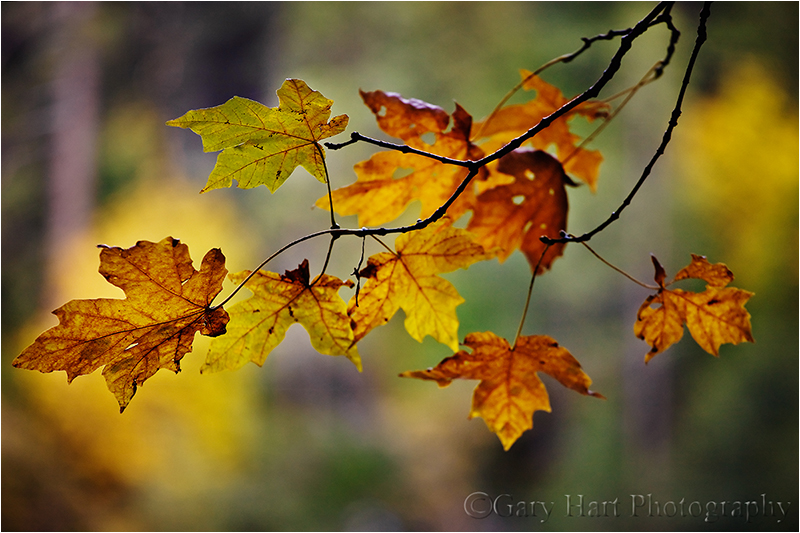
Forest Autumn, Yosemite
Canon EOS-1Ds Mark III
1/25 second
F/4.0
ISO 200
200 mm
Posting as much as I do here in my blog and on Facebook, it’s sometimes easy to be sucked into sharing images that I know will generate the most enthusiastic response. But that’s not a complete reflection of my relationship with nature, or the reason I take pictures for a living. So every once in a while I find myself needing a reset, a re-focus on images for me.
Here’s an example of the kind of stuff that makes me happy. Fall color is always beautiful, but merely putting your eye to your camera and photographing a beautiful scene is no guarantee of a successful image. The closer you can come to identifying a scene’s essence, what about the scene that moves you (and not what you think will move others), the more your photography will resonate.
The obvious draw of fall color is (duh) the color. But beyond that, I particularly love the way leaves light up when they’re backlit. So when I wander forests in the fall I look for backlit leaves that stand out, leaves I can isolate from the distraction of their surroundings. When I find something that works, my job has just begun. Next I look for a complementary background that (if I’m lucky) also adds context (location, conditions, and so on). And finally I need to make my depth of field decision—do I want lots of DOF, or will too much background detail distract from my subject?
I found this group of leaves as I wandered the Merced River near Fern Spring in Yosemite Valley a few years ago. I move around until the leaves aligned with vertical evergreen trunks and a splash of deciduous color. The forest had lots going on, so I opted for a wide open aperture to reduce it to a barely recognizable blur of color, shape, and line.
Scenes like this underscore my desire to be in charge of as much of my camera’s decision making process as possible: spot metering in manual mode, manual focus, raw capture—all these things remove the decision process from my camera and give it to me. In this case, before composing I metered on a bright leaf and set the exposure to what I thought would give me the best color (in manual mode I can point my camera’s meter anywhere and not have to worry about my settings changing when I recompose).
The wind was nearly calm, but to be safe I bumped my ISO to 200 (the quality difference between ISO 100 and 200 is nearly imperceptible) to further ensure against microscopic motion blur. And since I shoot in raw mode, I never have to make my white balance decisions until I’m in the comfort of my home office.
When all my settings were complete, I returned my camera to the tripod, focused carefully on the center vein of the most prominent (left-most) leaf (at f4 there’s no margin for focus error), and clicked. It’s unfortunate that nature’s subtle beauty doesn’t attract the attention that the dramatic sunrises, sunsets, and spectacular weather do. I enjoy photographing those scenes as well, but I never want to forget to appreciate the small stuff.
A gallery of unspectacular beauty
(Subtle beauty you need to slow down to appreciate)
Click an image for a closer look, and a slide show. Refresh the screen to reorder the display.


Fallen color
Posted on September 5, 2015
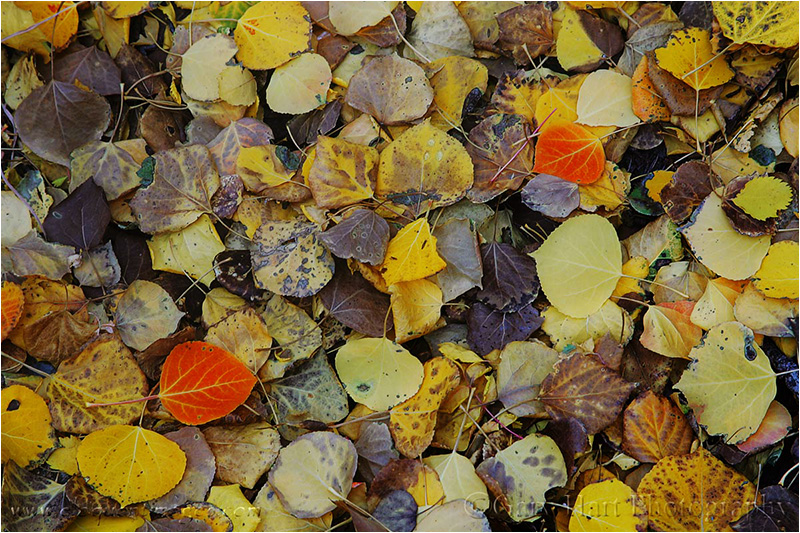
Fallen Color, Rock Creek Canyon, Eastern Sierra
Canon EOS-1D Mark II
3/10 second
F/9.0
ISO 100
85 mm
When you’re surrounded by beautiful scenery, it’s easy to overlook the small details that make a scene special. But there’s no substitute for the pleasure that comes from spending a little time in a scene, identifying its intricacies, and creating an image that conveys this connection to others. Capturing these intricacies can be the most rewarding aspect of photography, because they’re almost always uniquely reflective your own vision.
About this image
People frequently look at this image and ask if I arranged the red leaves. The answer is an emphatic, No! I usually go on to remind them that you can draw a straight line between any two objects on the face of the earth (or any other planet, as far as I know). In fact, the only arranging I do to an image is myself—circling, rising, dropping—and in that regard I’m quite aggressive.
In the field I look for individual elements to isolate in my frame; or better yet, groups of elements. Of course finding a subject is not the end of the job—without properly positioning the subjects in the frame, the scene is likely to fail. But rather than moving your subjects (the lazy solution), move yourself.
In this scene I circled the leaves slowly, camera to my eye, until the frame felt balanced. And while the leaves ended up at the “rule of thirds” points, that wasn’t a conscious decision on my part, but rather confirmation that the rule of thirds is indeed valid (sometimes).
Putting the Rule of Thirds in its place
What is the rule of thirds? Very simply, imagine a tic-tac-toe grid on your frame—the Rule of Thirds says that important linear elements (like the horizon) should be on the lines, and important compositional elements (like these leaves) should be at (or near) the intersections.
I hesitate to even bring the Rule of Thirds up because it’s one of the easiest photography “rules” to be broken effectively. It’s also probably the rule most frequently abused by well meaning judges at your local camera club. (If you get too much abuse about your Rule of Thirds choices in images you really like, don’t change your compositions, change your camera club.)
I think the Rule of Thirds true value is to help remind beginners not to bullseye subjects, or not to crowd elements against the edges. In fact, I could probably show about as many successful images that break the Rule of Thirds as follow it. When I’m composing a shot, any Rule of Thirds voices in my head are overruled by my intuition, my sense for what what balances a frame, and even more simply, what feels right.
Read more about photographing fall color
A fall color gallery
Click an image for a closer look, and a slide show. Refresh the screen to reorder the display.


 Eloquent Images by Gary Hart