Peak Color
Posted on January 9, 2024

Twin Peaks, Mt. Tasman and Aoraki / Mt. Cook, New Zealand
Sony α1
Sony 24 – 104 f/4 G
ISO 100
f/11
.6 seconds
The first time I visited New Zealand (way back in 1995), I was surprised not just by the number of mountains, but also by their size. New Zealand’s mountains reminded me very much of the Eastern Sierra peaks I visit every year for the way their serrated profiles tower above the surrounding landscape. And while the east-side view of the Sierra Crest is truly spectacular, the New Zealand mountain experience also includes glaciers, rainforests, and an assortment of massive, glacier-carved turquoise lakes that are so pristine, locals drink straight from them.
It’s no coincidence that Don Smith and I concentrate our annual New Zealand winter workshop in the Southern Alps, the backbone of the South Island and home to all 20 of New Zealand’s 10,000+ foot peaks and all of its glacial lakes. We choose winter not just for the Milky Way’s prominence in the night sky, but also to maximize the snow on the Southern Alps.
Fox Glacier on the South Island’s West Coast is the farthest north our groups get. Our stated reason for being here is our heli-hike on Fox Glacier (we helicopter onto the glacier for a guided hike and an intimate view of its crevasses, caves, pools, and seracs), we’ve come to appreciate many other features of this segment of our workshop—specifically, the (aptly named) Blue Pools as well as the various waterfalls of Haast Pass, and the spectacular views of New Zealand’s two tallest peaks, Mt. Tasman (on the left in this image; 11,473 feet) and Aoraki / Mt. Cook (12,218 feet).

Dark Sky Dreams, Lake Matheson, New Zealand
Our Lake Matheson hike during our stay in Fox Glacier (also the name of the town where we stay) is a particular highlight because of its mirror reflection of Tasman and Aoraki/Cook. But on our last morning in Fox Glacier, we photograph sunrise on the two peaks from Fox Glacier Vista, an underrated vantage point that’s a great way to wrap up our stay.
Given all the sights we see throughout the 10 days of this workshop, it’s easy to overlook this brief stop before our long drive to Aoraki / Mt. Cook National Park on the other side of the Southern Alps (less than 30 miles as the crow flies, but nearly 300 (breathtaking) miles as the Mercedes Sprinter Van drives). But the view here is nice, even during an ordinary sunrise, and always worth the stop.
The sunrise on our Fox Glacier departure morning in 2022 was anything but ordinary. We always depart for this shoot expecting a nice shoot, but usually my mind is more on the long drive ahead and I’m content to stand back an drink in the view. But this morning we could tell from the instant we arrived that the ingredients were in place for something truly special: Right at our feet, a frosty glaze covered the meadow and spread all the way to the trees, and in the distance, layers of broken clouds hovered above the peaks, which in the crystal clear air appeared etched against the horizon.
Read about the science behind sunrise/sunset color
Though it was still fairly dark, hints of color were already seeping into the clouds behind the Southern Alps. This was Don’s and my first visit following two years lost to COVID, and I immediately saw that the vista we knew so well had been expanded and upgraded, something I initially found disorienting. While the rest of the group rushed to set up at the most obvious vantage point, I took a couple of minutes to explore along the short trail to make sure we weren’t missing something new, before returning confident that we were indeed in the best place. (I was so focused on the view during this little jaunt that I failed to notice a small piece of jutting root that aggressively reached out to send me sprawling in the dirt—my skinned knees and bruised ego were only slightly comforted by the knowledge that no one actually witnessed my face-plant.)
In these situations, when spectacular conditions rival the scene I came to photograph, I try not to get too cute with my compositions. If there’s an obvious complex option that doesn’t distract from the natural beauty of the moment, I’ll take it, but generally I prefer to let the scene speak for itself by keeping my composition as simple as possible.
But that doesn’t mean I don’t pay attention to the entire scene. In this case we were limited by a fence between us and the meadow, and since I already knew the view, I concentrated on simple framing. With the combination of matching snow-capped Tasman and Aoraki bookending the closer Craig Peak, and parallel horizontal layers throughout the scene, it didn’t take a rocket scientist to identify an opportunity for what I call “aggressive symmetry.” The pair of larger foreground trees, while not perfectly in balance with the rest of the frame, were close enough to symmetrically arranged that I was pleased with their (unavoidable) inclusion.
Given the way the color was progressing as the sun brightened behind the mountains, I worked out my composition long before it peaked, clicking every few seconds while saying to myself each time, surely this must be maximum color. But it just kept intensifying—the thrill of witnessing it was matched only by the thrill of listening to the rest of the group react to what we were seeing.
As I clicked, I couldn’t help think that this was turning out to one of those sunrises (or sunsets) with color so vivid that I know people viewing the images won’t believe they’re real. Fortunately, from sunrises/sunsets to wildflowers to auroras, photographers know that there’s nothing subtle about color in Nature, and that when Mother Nature wants to, she really can dial the vivid up past the point of credibility. The best way to describe these moments is that to me it feels like the atmosphere possesses a physical component that penetrates my skin and pretty much everything else it touches until I feel like the entire world is actually humming with color.
You never know when Nature’s little (or big) surprises will happen, but their possibility is the thing gets me out of bed in winter darkness, keeps me out well past dinnertime, and makes all the cold, rain, snow, or whatever other hardships Mother Nature wants to throw my way, tolerable.
Join Don and me in New Zealand
Workshop Schedule || Purchase Prints || Instagram
Sunrise / Sunset Color
Click any image to scroll through the gallery LARGE


The Exception That Proves the Rule
Posted on January 2, 2024
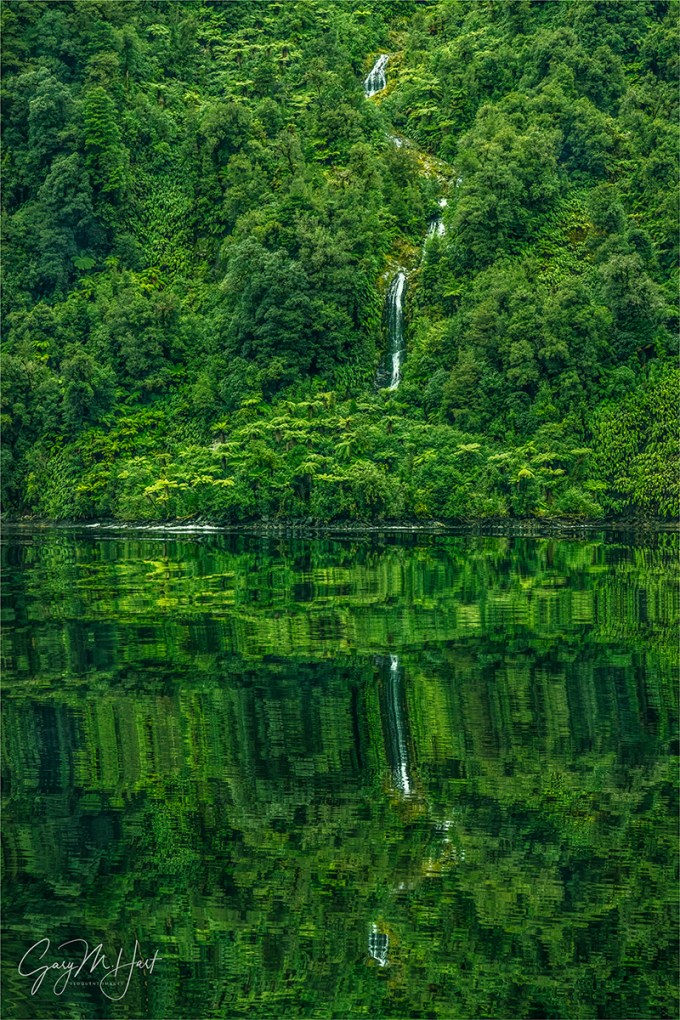
Lush Reflection, Doubtful Sound, New Zealand
Sony a7R V
Sony 24-105 f/4 G
ISO 800
f/8
1/80 second
A few years ago I blogged about shooting sans tripod on my annual Grand Canyon raft trip. You have no idea how large a paradigm shift this was for me, but I tried to rationalize my sacrilege by saying that any shot without a tripod is better than no shot at all. Since then I’ve been a little more willing to forego my tripod when the situation calls for it, but each each time I do only reinforces for me all the reasons I’m so committed to tripod shooting in general.
But I can’t deny that there are times when a tripod just won’t work. For example, sports and wildlife shooters who deal with moving targets can’t be tied down by a tripod. And climbers usually have better things to do with their hands than fumble with a tripod, not to mention the fact that tripods tend to perform less than optimally on a vertical surface. On the other hand, because I only shoot landscapes on solid ground, my own style has evolved to incorporate the tripod’s many benefits, with only extremely rare exceptions.
Part of my landscape-centric, tripod-only approach is a simple product of the way I’m wired—I’m pretty deliberate in my approach to most things, usually tilting toward planning and careful consideration over quick decision making and cat-like reflexes. That likely explains why my sport of choice is baseball, (even though I’m not a golfer) I actually enjoy golf on TV, and prefer chess and Scrabble to any video game (I’m pretty sure that the last video game I played was Pong). It also explains my preference for photographing stationary landscapes—I just need to know that my subject will still be there when I’m ready, no matter how long that takes.
But no matter how stationary the subject is, adding a bobbing boat to the equation pretty much negates the tripod. One example is the Grand Canyon raft trip, which involves many hours each day floating through spectacular, continuously changing scenery, and where every bend in the river advances the story like turning pages in a novel. And every (non-COVID) winter Down Under since 2018, Don Smith and I have done a New Zealand photo workshop, that, among many spectacular solid ground opportunities, features an all day cruise on Doubtful Sound.
Misnamed, Doubtful Sound isn’t a sound at all, but rather a spectacular fiord (FYI, that’s how they spell fjord down there)—a narrow, twisting, multi-fingered ocean inlet lined with towering glacier-carved walls cut by plunging waterfalls. And as if that’s not beautiful enough, consider also the sound’s ubiquitous rainforest green against a background of snow-capped peaks, and you might understand why this breathtaking fiord is near the top of my list of reasons for declaring New Zealand the most beautiful place I’ve ever photographed.
Because I once rigidly proclaimed that I never take a (serious) photo without my tripod, on my earliest Grand Canyon raft trips I settled for low-res, “I was there” jpeg snaps with a waterproof point-and-shoot—fine for social media, but far from the quality a professional photographer requires. But after several years I finally (I’m a slow learner) admitted to myself that I was missing too many great images by only shooting solid ground images, and started breaking out my “adult” camera while floating the Colorado River’s many long stretches between rapids.
So, by the time Don and I started doing the annual Doubtful Sound cruise, I was mentally fortified enough to forego my tripod for a full day without suffering a panic attack. This transition wasn’t without its growing pains—photographing “stationary” landscapes from a moving boat was challenging enough (as far as I was concerned, my subjects were no longer stationary), but me trying to capture, using a camera set-up for tripod-only landscapes, dolphins leaping in our boat’s wake was downright downright comical. The best dolphin images I could manage that first year were of the splashes left after their tails disappeared beneath the water. Since then I’ve just accepted the fact that I’m not a wildlife shooter and have just been content to watch the (thrilling) show—but I do now at least take the time before each cruise to set up my camera for action, just in case…
Thanks to its lofty walls and numerous twists, most of Doubtful Sound is sheltered enough to allow glassy reflections throughout. And given the number of waterfalls plunging into the sound—many that that flow year-round, far more that pop up only after one of the sound’s (frequent) showers—I don’t know if anyone has bothered to name the smaller ones like the one in this image from last year’s cruise.
This waterfall stood out for its verdant surroundings and shimmering reflection. With our boat moving laterally fast enough that the scene changed by the second (my worst nightmare), I moved much more quickly than I’m comfortable to capture it, pretty much just framing and clicking by feel.
Of course this whole experience further underscored why I prefer using a tripod. But it also fortified my resolve not to be limited by my tripod-always-no-exception rule. As this image demonstrates, today’s stabilization and high ISO technology obviates what was once considered the tripod’s primary value: eliminating hand-held motion blur. Despite standing on a rocking boat and shooting at 104mm and 1/80 second, this image really is just as sharp as it would have been with my tripod.
But just as sharp is only part of the quality equation, because capturing it also forced me to compromise by using 800 ISO—far from a dealbreaker, given my camera’s high ISO capability and today’s noise reduction processing tools, but less than ideal. Nevertheless, the thing I most miss without my tripod (or at least, without the stationary world that allows me to use a tripod) is the ability to craft my image and give a beautiful scene like this enough attention to find those extra little somethings that take it to the next level.
As much as I appreciated the ability to fire at will while floating beneath Doubtful’s vertical green walls, the landscape photographer in me missed the ability to savor the scene, and to be the one who decides when it’s time to click, and time to move on. In this case, had my tripod and I been solidly planted on terra firma, I’d have taken the time to study the subtly variegated foliage, identify the most distinctive shrubs and patterns, and monitor the shifting reflection, before framing and clicking. And had I been using a tripod, I’d also have had much more shutter-speed flexibility for managing the scene’s motion—both in the tumbling fall and the undulating reflection.
But alas, none of that was possible in this situation. So I have to settle for being extremely happy that I was able to capture a very small part of what makes Doubtful Sound (and New Zealand) so special.
Don and I would love to share New Zealand with you in person
Workshop Schedule || Purchase Prints || Instagram
The Most Beautiful Place on Earth
Click any image to scroll through the gallery LARGE


2023: The Year of Fire and Ice
Posted on December 26, 2023


One of my favorite things to do at year’s end is to look back at the images that made the year especially memorable. And my favorite part of this exercise is the realization that, even though I can’t say how, I know I’ll be similarly rewarded in the coming year.
But what to do with the images I’ve selected? I’ve always struggled with the popular “top-whatever” end-of-year countdowns because the choices are so subjective and criteria dependent. Am I trying to identify my “best” images (and anyway, how is “best” defined?), or should I focus on my most memorable experiences?
Instead, I simply prefer identifying the images that make me happiest, using a variety of criteria that can include special memories, great effort, personal creativity, or just plain gifts from Nature that are so beautiful my only job is to not screw the moment up. And I’ve done enough of these end of year retrospectives to know that my favorites won’t necessarily be yours—and vice versa.
Among 2023’s unforgettable experiences were the two greatest northern lights shows I’ve ever witnessed, a volcanic eruption, a photobombing rocketship, and a lightning display that was as thrilling as it was unexpected. But also in there are some quiet moments, like wandering through a stand of blooming dogwood in a light rain, or exploring fall color draped cascades and pools beneath a towering waterfall. It was especially gratifying to share most of these experiences with workshop students.
Coming up with a predetermined number of images, then putting those selections in some kind of order, is arbitrary and inevitably requires choices I don’t want to make—and will almost certainly regret. So I just put them all in a gallery, set them to sort randomly (the order will be different for each viewer and each visit), and let you pick your own favorites. One year the Highlights gallery might have only seven or eight images; the next year there could be two dozen. Maybe 2023 was an especially bountiful year, or maybe it’s just that my standards have dropped, but this year I ended up with 36 images—and reserve the right to add more. And since virtually every one of them was featured in a blog, you can browse 2023 blog history (just keep scrolling down until you get to the image you’re looking for) to read the story of any image that especially strikes you.
Workshop Schedule || Purchase Prints || Instagram
2023 Highlights (Unabridged)


A Shot in the Dark
Posted on December 19, 2023

Nature’s Light Show, Aurora Over Dyrhólaey Coast, Iceland
Sony α1
Sony 12-24 GM
6 seconds
F/2.8
ISO 6400
At its best, still photography reveals aspects of the world invisible to, or overlooked by, human vision. In nature photography, we create these visual revelations when we use an extremely fast exposure to freeze the intricate detail of a lightning bolt that’s a memory before our brain registers it. Or when we dial up a long exposure to turn pinpoint stars into symmetrical arcs that reveal Earth’s rotation.
As a lifelong admirer of the night sky, I’m a huge fan of the camera’s ability to see in the dark far better than I can, extracting stars and celestial color too faint for my eyes. This is possible because cameras can accumulate light over an extended period, and because the camera’s ability to “see” color is less dependent on the amount of light it captures than the human eye is.
No subject more clearly demonstrates the camera’s light gathering ability better than the Milky Way. A relatively faint ribbon of light in even the darkest sky, a high ISO (extremely light sensitive), large aperture, multi-second exposure (30 seconds or less to minimize star streaking) brings to life the exquisite color and detail of starlight infused with interstellar dust and gas.
This ability to accumulate light also helps the camera extract color from apparent darkness. But just as important to the camera’s light gathering advantage over the human eye is the way it does it. The human eye uses a collaboration of rods and cones to collect light, with the rods doing the heavy lifting in low light, pulling enough monochrome information for us to discern shapes, while providing little help with color and depth. The cones that complete the scene with color and depth information require much more light to do their job. But a digital sensor, though blind to depth, captures photons using tiny photosites specifically designed to discern color.
With the first DSLRs, way back in the early 2000s, successful night photography required help from external light, like light painting with artificial light (which I never do) or moonlight (which I did all the time). But sensor technology has improved steadily over the years, not just the sensors’ resolution, but their light capturing ability too. Today I don’t hesitate photographing dark sky, the darker the better. Nevertheless, despite many years photographing the night sky, it wasn’t until 5 years ago that I got to photograph an aurora.
In January of 2019 Don Smith and I had traveled to Iceland to scout for a future photo workshop. We chose winter to ensure the longest, darkest nights for the best chance to view an aurora. Having seen thousand of pictures of the northern (and southern) lights, I believed I had an idea of what to expect, but I had no idea. No. Idea.
Before I start raving about the camera’s ability to photograph an aurora’s unseen color, let me just say that no picture can do justice to the experience of witnessing an aurora in person. I’m not talking about the green, horizon-hugging glow that lucky high-latitude Lower-48 residents enjoy from time to time (that’s still worth staying up and freezing for, BTW), but an actual sky-spanning dance of light beams, waves, and swirls. Rivaled only (in my book) by a total solar eclipse and a brilliant comet, a brilliant aurora display might possibly be the most beautiful thing you’ll ever witness in Nature.
But, despite lacking the dynamics of personal aurora experience, a camera does do better than the eye in one important aurora aspect: color. That’s because to the naked eye, many aurora displays aren’t bright enough to engage the cones and appear monochrome to our eyes. A camera, on the other hand, reveals auroras in all their kaleidoscopic glory. And though color in an extremely strong aurora is indeed plainly visible to the unaided eye, no matter how strong the aurora, the camera will always “see” more color than we will.
Since that first visit, I’ve returned to Iceland most winters, and have viewed many beautiful northern lights shows. Each was unique and beautiful in its own way, but hold a gun to my head and ask me to pick a favorite, and I think it would be a tie between back-to-back nights early this year (January)—first at Kirkjufell, then at Dyrhólaey on the South Coast. The Kirkjufell night was special because it featured a spectacular display above an Iceland icon. The Dyrhólaey show, while lacking the instantly recognizable foreground of the previous night, was even brighter and more expansive, at times spanning the entire sky.


I blogged about both nights earlier this year:
- Kirkjufell: It’s All About the People
- Dyrhólaey 1: Lights, Camera, Action!
- Dyrhólaey 2: Blessings
The image I’m sharing today is another one from the Dyrhólaey night. With our eyes we could actually see a little of the green, but not the red. And as beautiful as this image is, even with my 12 – 24 lens at its widest, it didn’t come close to capturing the entire horizon-spanning display.
One more thing
When there’s not enough light for visible color, colors in the night sky become the photographer’s processing choice. For my Milky Way images, that’s mostly a matter of adjusting my white balance in Lightroom until sky color feels right. I find a lot of other photographers’ night images too cyan for my taste, and if you look at my older night images, you’ll see that I used to skew them fairly blue. But in my recent night images, I’ve gone for something closer to black with just a hint of blue/violet, which is what I’ve done with the background sky in this image.
The color of the northern lights is similarly subjective, and starts with the color temperature my camera’s auto white balance chooses. Since I don’t have as much experience photographing auroras as I do the Milky Way, I’ve started identifying northern lights images that I like, taken by other photographers, then try to adjust my own images’ white balance in Lightroom to something that comes close to that. But looking at the gallery below, with greens that skew toward yellow (warmer), and some that skew toward blue (cooler), it’s clear that this is still a work in progress. But it does appear that I’m moving a toward cooler aurora images. And believe it or not, none of my northern lights images have any saturation added because they don’t need it—just giving the scene a little more light than my eyes see is all that’s necessary to bring out this eye-popping color.
The Lights Fantastic
Click any image to scroll through the gallery LARGE


Dressed to Chill
Posted on December 13, 2023
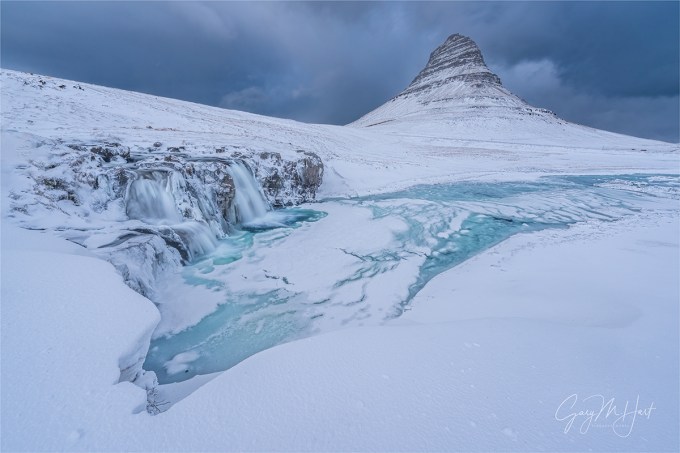
Winter Chill, Kirkjufell and Kirkjufellsfoss, Iceland
Sony a7R V
Sony 12-24 GM
1 second
F/11
ISO 100
From brisk to chilly to freezing to downright frigid, we warm blooded humans have lots of labels for the discomfort imposed by low temperatures. But I’ve always felt that we need something beyond frigid, something that adequately conveys the true suffering low temperatures inflict, and would like to submit an even chillier option: stupid cold. At the risk of stating the obvious, “stupid cold” is so cold, the only people out in it without a life-or-death reason (for example, the house is on fire) are, well….
Before I get into my latest encounter with stupid cold, let me offer a little background. Being California born and raised, I often find myself with a slightly higher “it’s too cold” threshold than the average person. I’m not exactly proud to say that pretty much any time the temperature drops below 50, I’m breaking out the wool hat, gloves, and down jacket. Without shame. I get a lot of grief for this from workshop participants hardened by more extreme climes, but I take the abuse with a shrug and smile because I’m warm. In fact, no matter how cold it gets in California, I’ve always been able to bundle up enough to stay comfortable. Viva la Mediterranean climate.
So why in the world would Don Smith and I schedule Iceland photo workshops in January? Because Mediterranean climates alone do not a photographer make. And as you’ve heard me say many times, the best time for photography is usually the worst time to be outside.
As you might guess, Iceland winters are no exception to this rule. While Iceland is beautiful year round, in winter low-angle sunlight creates an all-day golden “hour,” long nights maximize the aurora viewing potential, pristine snow purifies the harsh terrain, cathedral-like ice caves dot the island’s many glaciers, and storm-whipped surf attacks the volcanic coast with relentless fury.
On the other hand, witnessing Iceland’s winter beauty means enduring “normal” highs in the 30s and lows in the 20s in the warmest parts of the country, and colder if you venture north and away from the ocean. Suffice to say, even on a good day, January in Iceland approaches my own stupid-cold threshold. Add to that frequent cold snaps that drop the mercury down to single digits and lower, combined with wind that can rip off a car door (Icelanders always park facing the wind), and I start feeling stupider by the minute.
Of course many people live places that get this cold, but how many of them actually go out specifically at the times when it’s coldest (after dark until sunrise)—and then just stand there? Unfortunately, when you’re a photographer, sitting by the fire when the northern lights are dancing, or staying in bed at sunrise, are never viable options.
So anyway, about those single digit lows. Surely, I rationalized, anyone who can endure San Francisco Giants night games at Candlestick Park (RIP) in July (as Mark Twain never said but should have, “The coldest winter I ever spent was a summer in San Francisco.”) can (given enough layers) handle whatever Iceland has to dish out. So, on my first visit I simply employed my tried and true Candlestick Park infinite layer approach. I mined my closet for cold weather gear, crammed everything I found into my largest suitcase, then crossed my fingers when the IcelandAir ticket agent hefted the bulging cube onto the scale (49.8 pounds, thankyouverymuch). Off to Iceland.
Don and I landed in Reykjavik to find temperatures as advertised. Wind too. I know, now you’re going to tell me about your Antarctica penguin expeditions, or that time in Saskatchewan when you stayed up all night to photograph the northern lights, but you don’t know true suffering until you sit through the last pitch of a night game at “the Stick.” Or so I thought.
My Candlestick more-is-better strategy turned out to be okay for Iceland (I didn’t die), but I can’t say I didn’t suffer for my craft on that first visit. Flannel-lined pants kept my legs happy enough, and my torso survived inside a long-sleeve undershirt, Pendleton wool shirt, and a Patagonia Down Sweater. A conventional wool cap kept my ears from turning black and falling off, but I fear they’ll never forgive me.
Worst of all, the thing thirty years of Candlestick experience hadn’t prepared me for, was cold hands and feet. Oh. My. God. Wool socks and high-top hiking boots? Not even close. And I thought I was ready with my thin poly running gloves as liners beneath thick wool gloves. Ha! The problem, I soon realized was that as cold as Candlestick’s concrete was, it wasn’t nearly as cold as the Iceland snow I stood on for hours at a time. And unless you’re keeping score, watching a baseball game doesn’t require hands unless there’s something to cheer for (a rare event indeed during most of my Giants Candlestick years). At the ‘Stick I could sit on my (gloved) hands, or bury them in pockets or beneath my wool blanket (never left home without one), and not think about them again until I pulled my keys from my pocket in the parking lot. But a camera, it turns out, requires hands. Fingers too. I quickly found that I could compose, focus, and click maybe three frames before the cold drove me to our car to pound life back into my numb digits. Not a productive approach.
Never let it be said that I don’t learn from my mistakes. When Don and I returned the next year, I was ready. And on each subsequent visit, I’ve upped my cold weather game to the point that I now scoff at single digits with sub-zero wind chills.
For me it’s all about layers. Not just piling on California-grade cold weather gear until I’m comfortable (but look like an Apollo astronaut), but actually layering clothing designed for layering and extreme cold: silk, wool, down, and Gore-Tex. Now I start winter mornings with thin wool liner socks under thick wool socks, heavy-duty insulated (don’t skimp on the insulation) and waterproof boots, silk long-johns, fleece-lined guide pants (jeans, even lined, don’t cut it and are worthless when wet), lined powder pants (lifesavers in extreme cold), silk or wool long-sleeve undershirt, insulated flannel shirt, down vest, down parka, layered gloves (more on this later), neck gaiter, and a down hat that covers my ears and snaps under my chin. I don’t usually wear all of these layers at once; instead, I add and subtract layers as conditions dictate, but never make the mistake of packing a layer away in the suitcase where I can’t get to it until I get to my room (and I no longer need it).
This year another big concession I made to Iceland’s winter cold was upgrading my jacket (again). Since the Patagonia Down Sweater I used on that first visit was woefully inadequate, the next year I upgraded to super-puffy North Face down jacket (picture the Michelin Man). That was plenty warm enough, but not waterproof, or as long as I’d like. So this year I purchased the warmest down parka LL Bean sells—it’s waterproof and drops all the way down below my butt.
Another important consideration is rain (worse than snow). Since my boots and parka are waterproof, all I need to add to my warmth layers when the forecast hints at the possibility of rain (no matter how slight), are waterproof over-pants (the powder pants qualify, but can be too warm), a waterproof hat, and an umbrella. Since I’m waterproof head-to-toe, the umbrella is more for my camera than me when I’m shooting.
Back to the gloves. Gloves are probably the number one Catch-22 for most photographers because thick enough to keep your fingers warm pretty much guarantees too thick to control a camera. But after years of trying, and drawers full of abandoned gloves, I think I’ve finally cracked the code.
It starts with the acceptance that there’s no one size fits all solution. Therefore, on all cold weather trips I always carry three pairs of gloves. First, I have a pair of Eddie Bauer First Ascent gloves that are thick enough to provide some warmth on their own (warmer than my running gloves), but tactile enough to enable me to easily control all my camera’s buttons and dials, as well as my phone’s touch screen, with all fingers. Over these I slip a pair of Black Diamond convertible (the top pulls back to expose the fingers beneath) fleece mittens. My third pair is the warmest down gloves I can find—these go on (and the others come off) when I’m just standing around (for example, waiting for the northern lights) and my fingers are starting to chill from inactivity.
The thinner gloves and mittens combination while shooting keeps my hands warm enough (though not quite toasty) to use my camera in single digit, windy conditions. And since, even with the mittens fully engaged, I can still focus and press the shutter button, I only need to expose the thinner glove (of one hand) for a few seconds at a time to adjust a dial or press a button.
About this image
Going through prior trips searching for unprocessed images, I found this one from early in this year’s first (of two) Iceland workshops. This was an unusually chilly evening on the Snaefellsnes Peninsula, even by Iceland January standards. I don’t have the exact numbers, but I’m guessing that the temperature was around 20F, and the wind was around 20 MPH as well. But I was ready.
Despite the clouds this evening, I found the fresh snow especially beautiful and set out to find a composition to capture it. Because Kirkjufellfoss (the waterfall) was flowing nicely (it’s often frozen when we visit), I walked a little farther down the trail than I normally do to get a better angle on the fall. Also wanting to feature lots of foreground snow and turquoise water, and include all of Kirkjufell and some clouds, I opted for my 12-24 lens. Going to 12mm relegated Kirkjufell to a less prominent role than it plays when you’re actually there, but that was fine because this emphasizes my favorite elements that evening: the snow and water.
Join Don and Me in Iceland (add yourself to the waiting list for first shot at the next trip)
Workshop Schedule || Purchase Prints || Instagram
Stupid Cold
Click any image to scroll through the gallery LARGE


A Dose of Perspective
Posted on December 6, 2023

Celestial Reflection, Milky Way Over the Colorado River, Grand Canyon
Sony a7SIII
Sony 20mm f/1.8 G
ISO 12800
f/1.8
30 seconds
Nothing in my life delivers a more potent dose of perspective than viewing the world from the bottom of the Grand Canyon. Days are spent at the mercy of the Colorado River, alternately drifting and hurtling beneath mile-high rock layers that reveal more than a billion years of Earth story. And when the sun goes down, the ceiling transforms into a cosmological light show, each stellar pinpoint representing a different instant in our galaxy’s past.
I’ve done this raft trip eight times now—long enough to know that when I stop doing it, the night sky is what I’ll miss most. To ensure the darkest skies (and the most stars), each trip is timed around the lunar minimum when the moon’s only appearance is a thin crescent is shortly before sunrise or after sunset. For most of my rafters, these are the darkest skies they’ll ever see—so dark that the Milky Way actually casts a faint shadow.
While cloudless nights down here always deliver a seemingly impossible display of stars, viewing the glowing core of our Milky Way galaxy is never assured. In the Northern Hemisphere, even when the galactic core reaches its highest point, it’s still relatively low in the southern sky. So, given the Grand Canyon’s general east/west orientation (high walls north and south), the best Milky Way views are usually blocked by the canyon’s towering walls. But these trips spend the first two nights in the north/south-trending Marble Canyon stretch of Grand Canyon, where we can enjoy open views of the north and south sky. And even after the canyon’s westward bend just downstream from the Little Colorado River confluence, a few fortuitous twists in the river open more nice southern views.
Campsites along the Colorado River are all first-come, first-served—if you set your sights on a Milky Way spot and arrive to find it occupied, there’s no option but to continue downstream. Over the years my (incomparable) guides and I have become pretty adept at identifying and (equally important) securing the best sites for Milky Way views—if the weather cooperates, we always score one or (usually) more quality Milky Way shoots.
One more Grand Canyon Milky Way obstacle I should mention is that even in the most favorable locations, the galactic core doesn’t rotate into the slot between the canyon walls until around 1:00 or 2:00 in the morning. Often rafters go to bed with every intention of rising to photograph it, but when the time comes to rise and shoot, their resolve has burrowed somewhere deep in the cozy folds of their sleeping bags. The best antidote for this is willpower, bolstered by bedtime preparation. To assist my rafters, I prescribe at the very least:
- Pick your campsite strategically, with the Milky Way in mind. (The first thing I do when we land is let everyone know where the Milky Way will appear.) That means either setting up your cot or tent with a good view of the southern sky, or at a place with easy access (in pitch darkness) to your desired shooting spot.
- Before going to bed, identify your composition, set up your camera, lens, and tripod, set your exposure (a relative constant that I’m able to help with), and focus at infinity.
- Have your camera ready atop the tripod and beside your cot (or outside your tent) when you go to bed. Some people just wake and shoot from their campsite (sometimes not even leaving their cot), but I usually prefer walking down to the river for the best possible foreground.
- Better still, if it can be done without risk of someone stumbling over it in the dark, leave the camera composed and focused at your predetermined shooting spot. But if this spot happens to be beside the river, check with the guides because the river level fluctuates on a known schedule (based on releases from Glen Canyon Dam timed for peak flow during peak electricity demand, and distance downstream).
I’ve learned that it isn’t practical to plan a group shoot for the wee hours of the morning, so I let people know when I plan to be up and where I’ll be, then let them decide whether to join me, choose their own time or place, or just stay in bed.
Regardless of the night’s Milky Way plan, I always forego the available but optional tent in favor of the unrivaled celestial ceiling. At home I’m a read-until-the-book-drops-to-my-chest guy, but down here I just lie flat on my back with my eyes locked heavenward, scanning for meteors, constellations, and satellites until my eyelids fail me. Here’s a sample of the mind-boggling thoughts that crowd my mind as I gaze:
- The light from every single pinpoint up there was created at a different time, and took many, sometimes thousands of, years to reach us—I really am peering back into the past.
- That streaking meteor was no larger than a pea and had probably been drifting around the solar system for millions, or billions, of years.
- Many of these stars host planets capable of hosting life.
- Our Milky Way galaxy is home to 10 times as many stars as there are people on Earth.
- For each star in the Milky Way, there are at least 20, and possibly as many as 200, galaxies in the Universe—many with trillions of stars.
Mind sufficiently boggled, I’ll eventually drift off to sleep (resistance is futile), but am fortunate that I don’t usually need to set an alarm to wake up—at bedtime I just tell myself what time I want to be up and trust my body’s clock. Then I psych myself into getting up by thinking I’m just going to fire off a dozen or so frames and then go back to bed. Of course I usually end up staying out much longer—always when there are others up and needing help, but often just because once I’m awake, the sky is just too beautiful to go back to sleep.
Rising for the galactic core’s arrival gives a good two or three hours of quality Milky Way time before the sky starts to brighten noticeably in the camera, sometime around 4:00 a.m. (the eyes don’t see the brightening for another half hour or so). I use all that dark time to work on a variety of compositions and exposure settings, sometimes moving around, but often staying put and just letting the Milky Way do the moving across the scene, from one side of the canyon to the other.
Since the “star” of the Grand Canyon night images is the sky, and vertical orientation gives me more of the vertically oriented Milky Way framed by the canyon’s vertical walls, my initial compositions are usually vertical. But the longer I do this, the more I’ve tried to lean into horizontal compositions as well, giving the canyon walls billing equal to the Milky Way.
Today I’m sharing a newly processed image from my 2021 raft trip—you can read the story of this night, and see a vertical version of the scene, here. This spot has become one of my favorite campsites because of the way, when the flow is just right, the water here spreads and pools at an extreme bend in the river. The reflection this night was spectacular, probably the best I’ve ever seen here, and (needless to say) I got very little sleep.
FYI
This image (like all of my images) is a single click (no compositing of multiple frames) with no artificial light added (no light painting or any other light besides stars and skylight). I was using my 20mm f/1.8 lens, which was wide enough, but I sure wish I’d have had the 14mm f/1.8 that was on order but didn’t arrive on time.
I had to skip the 2023 Grand Canyon raft trip, but am excited to be returning in May of 2024—and I just scheduled my 2025 trip.
Milky Way Favorites (one click—no blending)
Click any image to scroll through the gallery LARGE


Dark and Early
Posted on November 29, 2023
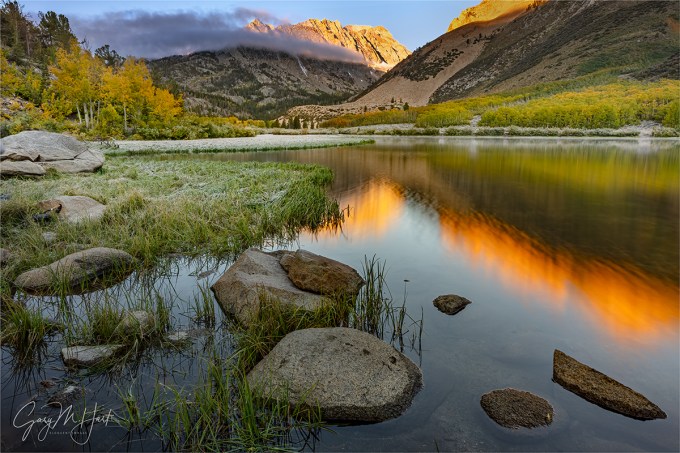
Autumn Chill, North Lake Reflection, Eastern Sierra
Sony α1
Sony 16-35 f/2.8 GM
ISO 50
f/18
20 seconds
The key to successful sunrise photography is arriving early—dark and early. Not just to photograph the early morning twilight, but to familiarize yourself with the surroundings to be ready for whatever the rapidly changing morning light delivers.
Exactly how early is “dark and early”? Well, another way of looking at it would be, if you can navigate without a flashlight, you’re too late. I know, I know, you’re sleepy, hungry, and it’s cold, but it shouldn’t take more than one or two mad sprints beneath fading crimson skies to motivate you to pull back those covers and plop your bare feet onto the bedroom floor just a few minutes earlier. And guess what—when you arrive early enough to savor the sunrise rather than rush through it, you’ll soon appreciate the simple purity of air, sound, and light that just can’t be found at any other time of day. Not to mention the sky-spanning transition of color and light that precedes the sun’s arrival.
At popular sunrise spots like North Lake (west of Bishop in the Eastern Sierra), arriving at least forty-five minutes before sunrise has the added advantage of beating most of the people with whom you’ll soon be competing for choice photography real estate. Arriving this early, the chilly air at North Lake is often graveyard-still and the lake a perfect mirror—already worth the sacrifice. And though the sky is so dark to that a few stars still burn overhead, you’re not too early to start photographing. Long exposures in the pre-sunrise darkness reveal even more of the remaining stars, unveil invisible color in the aspen surrounding the lake, and smooth any ripples disturbing the lake’s surface.
The image here was captured a couple of months ago, during the second sunrise shoot of this year’s Eastern Sierra Fall Color photo workshop. In our brief parking lot orientation before taking the short walk to the lake, I’d advised everyone to be very careful about the place they choose to set up because soon there won’t be enough room on the lakeshore to move anywhere else. And since experience here has shown me that people don’t always appreciate how well today’s digital sensors perform in low light, my job once we got out there and everyone had set up was to move around encouraging my group to take advantage of the shadowless early light their eyes couldn’t yet register.
As predicted, the crowd soon increased to the point where we all had to live with the foreground we’d chosen. So when the scene’s features started to reveal themselves to our eyes, my attention turned to helping my group incorporate into their compositions whatever foreground was in front of them. By the time the sun kissed the highest peaks, I still hadn’t taken any pictures of my own. But when small clouds began to form in invisible updrafts playing among the peaks, I was grateful to have claimed my own spot before the masses had arrived.
Surveying the scene this morning, I thought about the iconic autumn Maroon Bells in Maroon Lake (near Aspen, Colorado) that I know only by reputation (Google it—I’d be very surprised if you’ve never seen an autumn image from here). And while the autumn sunrise crowds at North Lake can be a challenge, from what I hear, they’re nothing compared to the Maroon Bells morning mayhem.
I won’t try to claim that this North Lake view is better than Maroon Lake’s, but one thing I do think is better (based on the images I’ve seen of the Maroon Bells reflected in Maroon Lake) is North Lake’s foreground possibilities that enable a tremendous variety of compositions. Not only are there lots of great foreground features that vary significantly depending on where you set up, they also vary from year-to-year, as even very small changes in the lake level make a big difference in the rocks, both exposed and submerged, that are visible.
An added bonus this morning was the frost glazing the grass that lined the lake. With the clouds and light changing quickly, I went to work trying to find the best way to feature all of this morning’s best elements: sunlit peaks, wispy clouds, golden aspen, rippled reflection, frosted grass, and protruding granite rocks. That’s a lot to deal with.
Having allowed my group to claim their own turf before staking mine, I’d ended up at the far end of the line (so I was in no one’s way), then rock-hopping out to a flat rock a couple of feet into the lake and actually extending one tripod leg into the water. Being essentially in the water gave me the cleanest view of the entire reflection and the best control over the rocks/reflection relationship. This morning I dropped my tripod a couple of feet to minimize the empty space between the rocks and the peaks’ reflection. And since the sky above the peaks was (boring) blank blue, I included the absolute minimum amount of blue I thought I could get away with.
The downside of getting started so late was the glassy reflection that we’d enjoyed much of the morning was gone, so I added my Breakthrough Filters 6-Stop Dark Polarizer for a water-smoothing long exposure. By dialing to ISO 50 and stopping down to f/18, with the filter I was able to stretch my shutter speed all the way out to 20 seconds. I turned the polarizer only enough to cut the reflection around the rocks without erasing the rest of the reflection.
Often the seeds of an image are planted long before the shutter is clicked. This image was captured well after the morning’s darkness had left, but as with many of my favorite sunrise images, it wouldn’t have been possible if I hadn’t been out there dark and early to claim my spot and familiarize myself with the scene’s many variables.
We’ll return to North Lake in my next Eastern Sierra photo workshop
Workshop Schedule || Purchase Prints || Instagram
The Joy of Sunrise
Click any image to scroll through the gallery LARGE


Playing the Odds
Posted on November 21, 2023

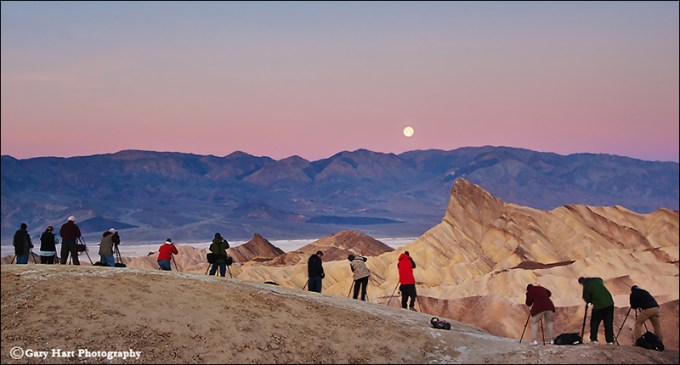
Twilight Moon, Zabriskie Point, Death Valley
Sony a7R V
Sony 24-105 f/4 G
ISO 100
f/10
1/13 second
First and foremost, a good landscape image usually requires…, well…, a good landscape. But merely getting yourself to the good landscapes is only half the image success equation, because good landscape photography also requires good conditions: colorful sky, dramatic clouds, complementary light, a striking celestial object, or some other natural quality that elevates the scene to special.
One way to include these ephemeral variables is to monitor conditions closely enough to respond in time to photograph them. Which of course also requires being relatively nearby when the conditions become favorable. Not necessarily a problem when my desired subject is close to home and the only affected schedule is my own, but my photo workshops need be planned more than a year in advance, so the proximity and react quickly approach doesn’t really work. Instead, the best I can do is schedule workshops to maximize the odds for ideal light, interesting skies, and other photogenic conditions—then cross my fingers.
For example, visiting Iceland in January or February increases the odds for the northern lights and low angle all-day sunlight; June in New Zealand provides the best chance for snowy peaks, and it’s the month when the core of the Milky Way up all night; and early August (+/- a week or so) at the Grand Canyon is generally the peak of the Southwest monsoon’s spectacular lightning and rainbows. While each of these features can be thwarted by uncooperative weather, at least we’re close enough to be there when the good stuff happens.
My annual Death Valley / Mt. Whitney photo workshop is another example of playing the odds. I love clouds and Death Valley. But because Death Valley only gets about an inch of rain each year, it suffers from chronic blue skies. To maximize the possibility of clouds for my DV/Whitney workshop groups, I schedule the workshop from mid-January through early February, when temperatures are farthest from summer’s intolerable heat, and the (still remote) chance for rainfall and (more likely) clouds is highest.
While I always wish for clouds in my workshops, cloudless skies in Death Valley don’t mean lousy photography. Places like Mosaic Canyon and Artist’s Palette are nice in the soft shade of early morning and late afternoon. And few sights are more dramatic than the sun’s first or last rays on the curves and lines of the undulating Mesquite Flat Dunes. Another benefit of cloudless skies is the beautiful pink and blue pastels that hover above the horizon opposite the sun before sunrise and after sunset.
To further hedge my bets, in Death Valley I always give myself one more blank-sky card to play: the moon. Scheduling this workshop around a full moon opens moonlight opportunities, and gives my groups at least two mornings to photograph the setting moon in the pre-sunrise twilight pastels: first at Zabriskie Point, where it aligns beautifully with Manly Beacon, then in Alabama Hills, where we can photograph it slipping behind the alpenglow enriched Sierra Crest, bookended by 14,000 feet-plus Mt. Whitney and Mt. Williamson.
This year’s DV/Whitney workshop, last February, had more clouds than usual—great for our daytime photography, but a source of stress f0r the workshop leader as the Zabriskie Point sunrise moonset approached. But instead of thwarting my Zabriskie moonset plan, I woke this morning to find that most of the clouds had departed overnight, leaving behind just a handful of ideally placed cotton balls for the moon to play with.
Zabriskie Point is an extremely popular sunrise location, so I got my group out there nearly 45 minutes before sunrise. We ended up being the first ones out there (better to be 10 minutes early than 1 minute late)—too early, in the pre-dawn darkness, to capture detail in the daylight-bright moon and the rest of the scene in a single image, but since the moon was still fairly high, I suggested to everyone that they compose it out (shoot beneath the moon) and just concentrate on revealing the foreground in the sweet, shadowless light.
While waiting for the foreground to brighten, I enjoyed watching the clouds dance around the moon, alternating between obscuring, revealing, and framing. The darker the sky, the better the moon stands out, but when the sky is too dark, an exposure that captures detail in the moon also has an unrecoverably dark foreground (either its completely black, or there’s too much noise in the processing-recovered darkness). As the sun approaches the horizon behind us, the lighter the sky gets and the easier it becomes to get detail in both the moon and the landscape. But soon the sky becomes so bright, contrast between the moon (which isn’t getting any brighter) and sky is lost and the moon becomes less and less prominent.
My window for photographing a full moon is from 15 minutes before sunrise/sunset to 15 minutes after sunrise/sunset (maybe a few minutes earlier/later if I’m extremely careful with my exposure). At sunrise, the best moon photography is on the earliest side of this window, when the moon/sky contrast is highest; the easiest exposure (greatest margin for exposure error) is toward the end of the window. And of course this unfolds in reverse at sunset.
To ensure that I don’t miss any of the best photography when the moon exposure window opens, I always start a few minutes before my 15 minute window opens so I can identify later in Lightroom the earliest usable image. The image I’m sharing today wasn’t my very first usable click that morning, but it did come 14 minutes before sunrise, when the contrast was still high. I chose this one because it came shortly after the pink hues of the sun’s longest rays started pushing the Earth’s shadow toward the horizon, absolutely my favorite part of sunrise. For me, capturing the moon in this night/day transition is the Holy Grail of full moon photography.
Locations like Death Valley are always great to photograph, regardless of the conditions, so it always feels like I’m playing with house money there. But looking back at all the things I bet on when scheduling this workshop, I can see that this year most of them paid off. Thanks to the (long shot) clouds, we got beautiful sunset color at Dante’s View one evening, and on the dunes another. One morning the clouds cleared enough to paint the dunes in beautiful sunrise light (one reason we do sunrise and sunset there), and another morning just enough hung around to enhance, without obscuring, our beautiful moonset. We all felt like winners.
I actually have a couple of openings in my upcoming Death Valley workshop
Moons Over Death Valley and the Alabama Hills
Click any image to scroll through the gallery LARGE


One Morning in Middle Earth
Posted on November 15, 2023

Middle Earth Morning, Matagouri Trees Near Glenorchy, New Zealand
Sony a7R V
Sony 24-105 f/4 G
ISO 100
f/16
1/40 second
Having reached a much anticipated break in my workshop schedule, I’m excited for the opportunity to carve out a little time to process images from past trips. For as long as I’ve been doing this photo workshop thing, I’ll return from a workshop, take a cursory trip through my captures, process one or two (maybe a couple more if time permits), make a mental note of the images I want to return to, then get to work on the business stuff that has to take priority. But about 80 percent of those “return to” images just seem to languish on my hard drive like the books on my Kindle that I always plan to get to later.
With no illusions of making a significant dent in this multi-year image accumulation, I started browsing my 2023 trips with no particular agenda, finally landing on the folder from the New Zealand workshop Don Smith and I do each June (winter Down Under). I got no farther than the images from our first morning…
Journey With Me
After leaving Queenstown (FYI, without a doubt the most beautiful city I’ve ever laid eyes on) dark and early, our sunrise stop is a sheltered cove on shore of Lake Wakatipu. Despite dense, low clouds obscuring the cross-lake mountain views Don and I love so much about this spot, our group enjoys nice reflections in the always crystal clear water (people actually drink from the lakes in New Zealand!)—not spectacular, but a lovely start to a day that will soon get much better.
I love the drive along Lake Wakatipu’s northeast shore. I’ve made it more times than I can count, and each time I like to imagine I’m being transported back to Middle Earth. This morning is no different.
A few miles beyond our sunrise spot, the clouds start teasing us with ephemeral views of the Thomson Mountains’ snowy summits across the lake, but the overcast’s overall persistence only adds to the drive’s ethereal feel. With clouds still ruling the sky as we enter the tiny village of Glenorchy at the top of the lake, we stop at Mrs. Wholly’s General Store for warm greetings, hot coffee, and tasty treats (not to mention handmade New Zealand wool goods), and to allow the overcast time to clear for the journey’s next leg. Clouds or not, this stop has become something of a workshop tradition.
The world really starts changing after putting Lake Wakatipu, Glenorchy, and the paved road in the mirror—a transformation enhanced this morning by patches of blue sky and a brightening landscape that hints at the sun’s imminent arrival. Despite the missing pavement, the road is quite smooth as we approach tiny Paradise, known in Middle Earth as Parth Galen and Lothlórien. Just beyond is Mt. Aspiring National Park—Isengard and more Lothlórien.
Now the undulating terrain is punctuated by native matagouri trees; in the distance, the highest peaks of the Humboldt and Richardson Mountains are starting to emerge in all their snowcapped glory and our transition to Middle Earth feels complete. The view is spectacular and the group wants to stop to photograph, but Don and I know this route well and ask our driver to continue to a spot that will allow us to add a foreground of matagouris to our dramatic mountain background. In a couple of minutes we round a bend and pull to a stop in front of a stand of twisted matagouri trees jutting from a frosty pasture.
Seeing the trees and the distant mountains haloed by the last vestiges of the diaphanous clouds, I barely avoid getting trampled as the group rushes out to capture the scene. As beautiful as the mountains are, I’m especially thrilled by the trees and want to find the best way to feature them without diminishing the peaks.
I digress
Rendering our three dimensional world in a two-dimensional medium requires a paradigm shift for photographers accustomed to capturing the world as it appears to their eyes. But while it’s impossible to create a true three-dimensional image, it is possible to create the illusion of that missing dimension.
Creating illusion of depth starts with of a couple of simple principles. First, never settle for your primary subject. When your primary subject is in the distance, look for a complementary element nearby. Conversely, when your subject is in the nearby, pay special attention to the image’s background.
While leading lines, like a fence, road, creek, or lakeshore, can guide the eye through the frame, you can also create virtual leading lines with a prominent rock, shrub, or tree that your viewers can subconsciously connect to other visual elements. Your complementary subjects don’t need to be especially compelling, they just needs to provide a brief stopping point that starts your viewer on a visual journey between the scene’s near and distant elements. When possible, I try to connect my complementary elements diagonally to move my viewers simultaneously across both of my (2-dimensional) image’s planes.
An easily overlooked flaw that can rob a scene of depth is merged visual elements on different front-to-back planes. For example, even though to your eye that distant rock is clearly behind the tree right in front of you, unless the two are completely separated horizontally (left/right, up/down), in the camera’s two-dimensional world they’ll appear at first glance to be a single object. Often the solution is as simple as moving left/right, forward/backward, or up/down.
Meanwhile, Back in Middle Earth
I start by scanning the scene to identify the most striking tree, then position myself to put the tree front-and-center in my frame. Once there I realize that I can actually frame the tallest peaks with the tree’s most prominent branches and set up at a spot that puts the other nearby trees along a more or less diagonal line that recedes from the primary tree. I compose the scene as tightly as I can to minimize the now empty sky and relatively bland grass at my feet.
While the exposure itself isn’t particularly difficult for my camera, the way I achieve it is important—given the need for front to back sharpness, I start by stopping down to f/16. With no wind this morning, I just go with ISO 100 and dial my shutter speed until the histogram looks good.
The final critical decision I need to make is exactly where to focus. The closest tree is about 10 feet away; at f/16, my hyperfocal app gives me a hyperfocal distance of about 13 feet. But those numbers are never precise and in fact vary depending on many variables, so I always like leaving myself some hyperfocal wiggle room. Focusing on the tree itself will soften the mountains, and focusing right at the hyperfocal distance will still give me nearly 4 feet of sharpness in front of the tree that I don’t need (since focusing on the hyperfocal point gives “acceptable” sharpness from half that distance to infinity). So I focus a little farther back—using that small piece of wood about 3/4 of the way to the second tree—to ensure distant sharpness. Click.
After leaving here we continue into the dense forest of Mount Aspiring National Park. No Elves or Hobbits this time, but it’s only our first day…
Don and I still have a couple of openings for New Zealand 2024
Workshop Schedule || Purchase Prints || Instagram
The Illusion of Depth


Back in My Happy Place
Posted on November 7, 2023
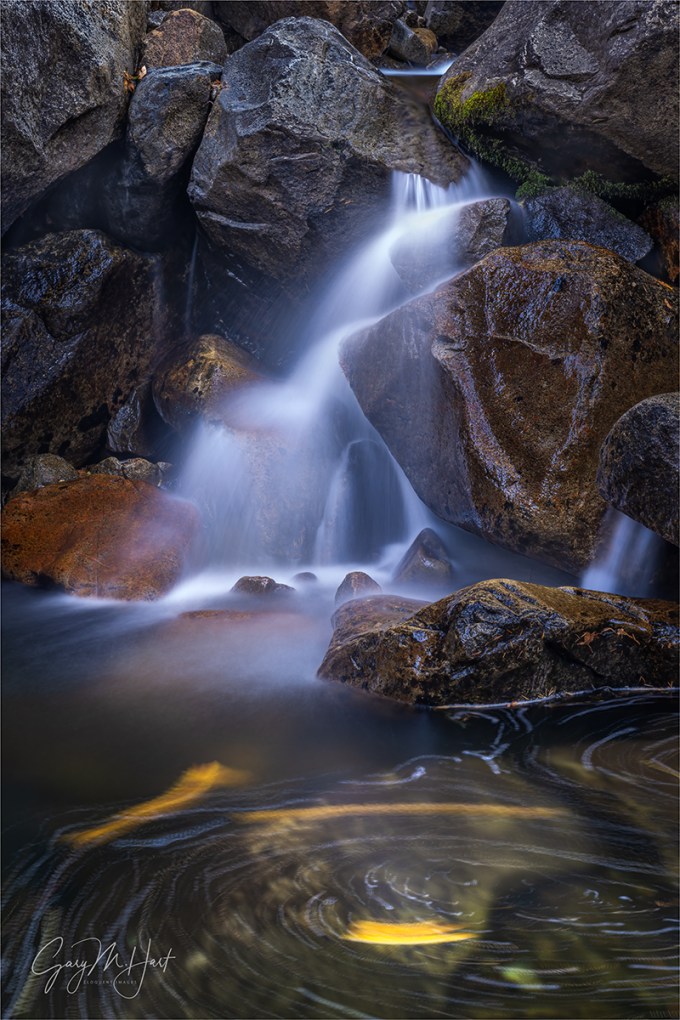
Autumn Spiral, Bridalveil Creek, Yosemite
Sony a7R V
Sony 24-105 f/4 G
ISO 50
f/16
13 seconds
Auroras, lightning, and a volcanic eruption—anyone viewing this year’s images might think my camera and I are most drawn to Nature’s purest drama. But as breathtaking as these phenomena are (they are!), I think I’m happiest with a camera in my hand when I’m working to extract subtle beauty from Nature’s quiet places. Rare, dramatic beauty is an instant stimulant that grabs your eyes and pretty much demands to be photographed. Not so much for the peaceful scenes that subtly soothe, but that doesn’t mean their beauty can’t compete—you just have to work for it.
Extracting photographs from these quiet places combines observation, position, and subtraction: observing to identify the scene’s essential elements; positioning to create relationships between these elements and the camera; subtraction of all that’s not essential through careful framing and/or management of the exposure variables. It’s rarely quick work, but I’m never happier than when I feel like I’ve created a synergy between these components.
My Yosemite Valley happy place has to be Bridalveil Creek. I’m not talking about the nearby view of the fall itself, I’m talking about the area just beneath the fall, where the creek tumbles and pools among granite and maples. Rather than feasting on views of Yosemite’s magnificent monoliths and waterfalls, I come to Bridalveil Creek to meditate and create in Nature’s more understated beauty.
Lacking the most photographed views of Yosemite’s icons, the Bridalveil Creek area probably shouldn’t be the starting point for a first-time visitor. On the other hand, when timed right, this (relatively) peaceful spot does provide a wonderful respite from Yosemite’s teeming masses, as well as ample opportunities to stretch your creative muscles.
Bridalveil Fall is the only Yosemite Valley waterfall that reliably flows year-round, but its volume varies tremendously depending on the season, the prior winter’s snowpack, and the amount of recent rainfall. In spring, Bridalveil Creek is an angry torrent that splits into three distinct channels just beneath the fall, each spanned by its own stone footbridge that provides an excellent platform for photography. In wet years all three channels run year round; in the driest years, by late summer two are nothing but dusty, rounded boulders, with only the east-most bridge offering views of flowing water.
I visit here each time I visit Yosemite, but my favorite season by far is autumn. Whether one, two, or three channels are flowing, by autumn the remaining water has lost the urgency of spring, pausing to rest in still pools before descending the next cascade. And autumn is when the suddenly yellow maples shed a seemingly infinite number of leaves that settle briefly atop rocks, accumulate in nooks and crannies, blanket the forest floor, and drift atop the swirling pools.
I always start my workshops’ final day at Bridalveil Creek, setting my groups free to roam the trail and its bridges, clamber down to the still pools, and rock-hop the cascades in search of inspiration. Early in the workshop many students are still battling their cameras and personal vision, but waiting until workshop’s end to bring my groups here gives everyone three-plus days to settle into the photographic zone that’s necessary to get most of their time here.
I never considered that I might lose this spot until 2019, when the NPS started work on a much anticipated overhaul of the whole Bridalveil Fall area. To speed the work, they decided to close everything (parking lot, toilets, trails, and creek access) while they rerouted the trails, reconfigured the parking lot, and (my favorite upgrade) replaced the aromatic vault toilets with actual flush-toilet bathrooms. Though I was disappointed that I’d have to forego my happy place for a year or (God forbid) two, I rationalized that the promised improvements would be worth the sacrifice. When COVID happened, I resigned myself to maybe another year of waiting.
When the park reopened after the pandemic, and on every visit since, Bridalveil Creek has my first Yosemite Valley stop. And while it always looked like an active worksite (barricades, equipment, and stacked construction material), progress seemed to be frustratingly slow. In fact, despite those signs of activity, I rarely saw any actual activity underway. Even my NPS contact couldn’t give me a date for reopening.
It was more of the same in 2021, 2022, and for my winter and spring workshops earlier this year. So, after seeing no announcement online or in my daily Yosemite news e-mail, I approached this year’s Yosemite Fall Color and Reflections workshop resigned to another year of Bridalveil disappointment. That pessimism was confirmed when I drove by the Bridalveil Fall parking lot Tuesday morning (on my pre-workshop scouting run) and saw it still locked tight with no sign of activity. Sigh.
This was my first trip to Yosemite since early May (I don’t visit Yosemite in summer), and while I was aware of some traffic-flow improvements made to the valley’s east side since my last visit, I had no idea how extensive they’d been. So I decided to make another loop around the park to reset my bearings (it’s never a good look when the workshop leader gets lost), which took me past the Bridalveil Fall area one more time. This time I decided to park and check out the short hike to the creek from the other side—I’ve done this many times, as recently as my previous visit last spring, and have always found the trail fenced off and signage making it very clear they want no one back there. So imagine my surprise (not to mention delight), when I found this side open with full access to the creek! The parking lot and bathrooms were still closed, but I found the trails and all of the bridges open.
On Friday, for the first time in four years, I guided a workshop group back to Bridalveil Creek. As much as I wanted to explore my favorite Bridalveil Creek haunts, I remained on the trail and bridges where most of my workshop group had gone to work. But, as often happens here, one-by-one they set out to explore farther afield, until with about a half-hour before I’d instructed them to be back at the cars, I found myself completely alone on the middle bridge. Though 30 minutes is hardly enough to time do any quality work here, I couldn’t help beelining back to one of my favorite spots—upstream, around a motorhome-size rock, and a quick scramble over rocks and a log down to the water. The last few years before the shutdown this spot had been partially largely by fallen trees, but I was very pleased to see that part of the improvement process had been dead tree removal.
I’d told the group about this spot before we started and thought one or two might still be there, but they’d all moved on and I found myself alone with maybe 20 minutes to work. I’m very familiar with the little cascade back here, and the pool it lands in, but depending on the amount of water and the timing of the fall color, the scene is different each time I visit. Sometimes the leaves form a mosaic on the pool’s surface, but this time I found most of the leaves huddled at the far end and out of the composition that came to me first.
Since speed was essential, I just went with that first composition, which was some version of the cascade tumbling over the rocks and into the pool. (For scale, I estimate that this cascade, from top to bottom, is at least 6 feet and no more than 8 feet high.) I knew that even an exposure of just a second or two would render the cascade as a gauzy veil, and that in the deep early-morning shadow of Yosemite Valley’s south wall, not to mention the trees and an overcast sky, a multi-second exposure would be nearly impossible to avoid. Seeing little flecks of floating foam, I decided to just lean into the long exposure to streak the foam and emphasize swirling motion on the pool’s surface. (I didn’t need a neutral density filter because I was satisfied being in the 10-15 second range by just stopping down to f/16 at ISO 50.)
There was so much sheen on the rocks and glare on the water that a polarizer was essential (and even with polarization maximized, I couldn’t eliminate all of it). The polarizer had the added benefit of revealing submerged rocks that would have been exposed in drier years. As I worked, an occasional leaf would ride the cascade into the pool, or drift down from overhead, to take a couple of laps in the pool before sinking or exiting stage left. No problem—their yellow swirl lasted just long enough to add a final touch to my happy little scene.
Join me for a Yosemite photo workshop
Autumn at Bridalveil Creek
Click any image to scroll through the gallery LARGE


 Eloquent Images by Gary Hart