Eastern Sierra Love
Posted on October 5, 2024

Descent, Lone Pine Creek Fall, Whitney Portal
Sony a7R V
Sony 24-105 f/4 G
ISO 100
f/16
1.6 seconds
I just returned last night from my annual Eastern Sierra autumn trip. Each time I’m there, I marvel at not just the quality of the scenery east of the Sierra Nevada, but even more impressive to me is the variety of the scenery. I’ve always believed if America could do it all over again and allocate it’s national parks before a varied assortment of land ownership and water rights entangled the land here, the Eastern Sierra would hands-down be one of America’s national park gems. But given the crowds clogging our national parks, and the relative quiet of the Eastern Sierra region, maybe the current situation is for the best.
Known more for the beauty of its serrated peaks, tumbling creeks, and placid lakes, the Eastern Sierra is also home to a small handful similarly beautiful, but far less heralded, waterfalls. Of these, without a doubt my favorite is Lone Pine Creek Fall, just above the parking area at the end of Whitney Portal Road. Stair-stepping down nearly vertical granite, Lone Pine Creek Fall flows year-round. Beautiful in any season, I’ve always been partial to autumn here, when I can catch the brief window when the fall is framed by an assortment of deciduous trees and shrubs. I always right around October 1, which puts me comfortably in the fall color window—sometimes slightly before peak, sometimes a slightly after, but always (so far) with enough color to enhance my images.
Turns out this year’s visit perfectly nailed the peak color. The color was so nice that, rather than settle for a variety of wide and telephoto compositions near the base of the fall, I took the time to scale the steep slope beside the fall in search of new perspectives. This wasn’t rock climbing, just a little extra effort in search of something different. Fortunately, I didn’t have to climb too far to find something I loved, because the climbing above this point would have been a lot more challenging.
I spend a lot of time encouraging my workshop students to build their images: identify strong visual elements, then to position themselves to create the best relationships connecting these elements. In this scene, in addition to the fall itself and the surrounding colorful leaves, I was drawn to the granite boulders beneath this section of fall, and the parallel curving trunks of the yellow trees to the right of the fall. And I was bothered by the bright sky visible just above the fall.
After considering both horizontal and vertical framing, I decided horizontal would be the best way to eliminate the bright sky while still including all the features I’d identified, without adding peripheral elements that dilute the image. To achieve the relationships and framing I wanted, and to avoid blocking the right side of the fall with a jutting branch, I moved as far to the left as I could safely (any farther left would have put me in the water on a 60-degree slick granite slope—splat!).
Given the falling water’s speed and the fact everything was in full shade, my only option for rendering the fall was some amount of motion blur. Lucky for me, the tendrils of water thinly spread across the fall created a lovely veil effect that (in my opinion) actually enhances the scene. And with objects near-to-far throughout the scene, I had to take special care with my focus point, choosing to focus on the closest foreground rock on the left to achieve sharpness throughout.
With my exposure and general framing set, I started working on micro-adjustments that led me to this image: specifically, making sure I didn’t cut off any of the large curved stick on the far right, the foreground rocks directly in front of me, and any of the large rock on the left (that I focused on).
I’m never happier as a photographer than I am when photographing scenes like Lone Pine Creek Fall—scenes with a disorganized abundance of diverse ingredients that challenge me to apply my creative instincts to assemble into something coherent and appealing. The Eastern Sierra offers something like this pretty much every direction I turn. A few years ago I wrote an article for Outdoor Photographer magazine (RIP) highlighting the many joys of photographing the Eastern Sierra’s diverse scenery, then turned a version of that article into a Photo Tips article here on my blog. I’ve spent a little time today updating the article while this week’s trip is still fresh in my mind, and am sharing it below. (And will soon be updating it in my Photo Tips section.)
Photograph the Eastern Sierra
Skirting the east side of the Sierra Nevada, US 395 enchants travelers with ever-changing views of California’s granite backbone. Unlike anything on the Sierra’s gently sloped west side, US 395 parallels the range’s precipitous east flank in the shadow of jagged peaks that soar up to 2 miles above the blacktop. More than just beautiful, these massive mountains form a natural barrier against incursion from the Golden State’s major metropolitan areas, keeping the Eastern Sierra region cleaner and quieter than its scenery might lead you to expect.
It would be difficult to find any place in the world with a more diverse selection of natural beauty than the 120-mile stretch of 395 between Lone Pine and Lee Vining: Mt. Whitney and the Alabama Hills, the ancient bristlecones of the White Mountains (east of the Sierra, across the Owens Valley), the granite columns of Devil’s Postpile, Mono Lake and its tufa towers, and too many lake-dotted, aspen-lined canyons to count. Long a favored escape for hikers, hunters, and fishermen, in recent years photographers have come to appreciate the rugged, solitary beauty possible only on the Sierra’s sunrise side.
I prefer photographing most Eastern Sierra locations at sunrise, when the day’s first rays paint the mountains with warm light, and the highest peaks are colored rose by alpenglow. (Without clouds, Eastern Sierra sunset light can be tricky, as you’ll be photographing the shady side of the mountains against the brightest part of the sky.) Devoid of large metropolitan areas, minimal light pollution also makes the Eastern Sierra one California’s finest night photography destinations. But regardless of the time of day, the key to photographing the Eastern Sierra is flexibility—if you don’t like the light in one direction, you usually don’t need to travel far to find something nice in another direction.
Lone Pine area

Dawn’s Early Light, Mt. Whitney, Alabama Hills, California
The southern stretch US 395 bisects the Owens Valley, a flat, arid plane separating the Sierra Nevada to the west from the Inyo ranges to the east. Just west of Lone Pine lies the Alabama Hills. Named for a Confederate Civil War warship, the Alabama Hills’ jumble of weathered granite boulders and proliferation of natural arches would be photogenic in any setting. Putting Mt. Whitney (the highest point in the 48 contiguous states), Lone Pine Peak (the subject of Mac OS X Sierra’s desktop image), and the rest of the serrated southern Sierra crest seems almost unfair.
The Alabama Hills are traversed by a network of unpaved but generally quite navigable roads. To get there, drive west on Whitney Portal Road (the only traffic signal in Lone Pine). After 3 miles, turn right onto Movie Road and start exploring. If you’re struck by a vague sense of familiarity here, it’s probably because for nearly a century the Alabama Hills has attracted thousands of movie, TV show, and commercial film crews.
Mobius Arch (also called Whitney Arch and Alabama Hills Arch) is the most popular photo spot in the Alabama Hills. It’s a good place to start, but settling for this frequently photographed subject risks missing numerous opportunities for truly unique images here. To get to Mobius Arch, drive about a mile-and-half on Movie Road to the dirt parking area at the trailhead. Following the marked trail down and back up the nearby ravine, the arch is an easy ¼ mile walk. There’s not a lot of room here, but if the photographers work together it’s possible to arrange four or five photographers on tripods with Mt. Whitney framed by the arch. And don’t make the mistake many make: the prominent peak on the left is Lone Pine Peak; Mt. Whitney is serrated peak at the back of the canyon.
Sunrise is primetime for Alabama Hills photography, but good stuff can be found here long before the sun arrives. I try to be set up 45 minutes before the sun (earlier if I want to ensure the best position for Whitney Arch) to avoid missing a second of the Sierra’s striking transition from night to day.
The grand finale from anywhere in the Alabama Hills is the rose alpenglow that colors the Sierra crest just before sunrise. Soon after the alpenglow appears, the light will turn amber and slowly slide down the peaks until it reaches your location, warming the nearby boulders and casting dramatic, long shadows. But unless there are clouds to soften the light, you’ll find that the harsh morning light will end your shoot pretty quickly once the sunlight arrives on the Alabama Hills.
Whitney Portal Road (closed in winter) ends about 11 miles beyond Movie Road, at Whitney Portal, the trailhead for the hike to Mt. Whitney and the John Muir Trail. On this paved but steep road, anyone not afraid of heights will enjoy great views looking east over the Alabama Hills and Owens Valley far below, and up-close views of Mt. Whitney looming in the west. At the back of the Whitney Portal parking lot is a nice waterfall that tumbles several hundred feet in multiple steps.
The Alabama Hills are one of my favorite moonlight locations. Because the full moon rises in the east right around sunset, on full moon nights the Alabama Hills and Sierra crest are bathed in moonlight as soon as darkness falls. Lit by the moon, the hills’ rounded boulders mingle with long, eerie shadows, and the snow-capped Sierra granite radiates as if lit from within.
If you find yourself with extra time, drive about 30 miles east of Lone Pine on Highway 136 until you ascend to a plain dotted with photogenic Joshua trees—after you’ve finished photographing the Joshua trees, turn around and retrace the drive back to Lone Pine on 136 to enjoy spectacular panoramic views of the Sierra crest. And just north of Lone Pine on 395 is Manzanar National Historic site, a restored WWII Japanese relocation camp. Camera or not, this historic location is definitely worth taking an hour or two to explore.
Bristlecone pine forest

Bristlecone Night, Milky Way from the White Mountains, California
Continuing north from Lone Pine on 395, on your left the Sierra stretch north as far as the eye can see, while the Inyo mountains on the right transition seamlessly to the White Mountains. Though geologically different from the Sierra, the White Mountains’ proximity and Sierra views make it an essential part of the Eastern Sierra experience.
Clinging to rocky slopes in the thin air above 10,000 feet, the bristlecone pines of the White Mountains are among the oldest living things on earth—many show no signs of giving up after 4,000 years; at least one bristlecone is estimated to be 5,000 years old.
Abused by centuries of frigid temperatures, relentless wind, oxygen deprivation, and persistent drought, the bristlecones display every year of their age. Their stunted, twisted, gnarled, polished wood makes the bristlecones suited for intimate macros and mid-range portraits, or as a striking foreground for a distant panorama.
The two primary destinations in the bristlecone pine forest are the Schulman and Patriarch Groves. Get to the bristlecone pine forest by driving east from Big Pine on Highway 168 and climbing about 13 car-sickness inducing miles. Turn left on White Mountain Road and continue climbing another 10 twisting miles to reach Schulman Grove. Despite the incline and curves, the road is paved all the way to this point. A couple of miles before reaching Schulman Grove I recommend stopping at the breathtaking Sierra panorama—in addition to the spectacular view, it’s a great opportunity to pause, collect yourself, and maybe let your car-sickness subside.
Stop at the small visitor center in the Schulman Grove to pay the modest use fee, then choose between the 1-mile Discovery loop trail, and the 4 1/2 mile Methuselah loop trail. Both trails are in good shape, but the extreme up and down in very thin air will test your fitness. Most of the trees on the Methuselah Trail get more morning light, while the majority of the Discovery Trail trees get their light in the afternoon.
If you’re unsure of your fitness, or have limited time, the Discovery Trail is definitely the choice for you. Because the photogenic trees start with the very first steps (if you go the recommended counter-clockwise direction), on this trail you can turn around at any point without feeling cheated of opportunities to photograph nice bristlecones. And along the way you’ll appreciate the handful of benches for enjoying the view and catching your breath. Hikers who can make it to the top of the switchbacks are rewarded great views of the snow-capped Sierra across the Owens Valley.
The Discovery Trail climbs for a couple hundred more yards beyond the switchbacks, but just as you’re beginning to wonder whether all the effort is worth it, the trail levels, turns, and drops. Soon you’ll round a 90-degree bend and be rewarded for your hard work with two of the most spectacular bristlecones in the entire forest. Spend as much time here as you have, because the rest of the loop back to the parking lot has nothing to compete with these two trees.
The pavement ends at the Schulman Grove, but the unpaved 12-mile drive to the Patriarch Grove is navigable by all vehicles in dry conditions. Home to the Patriarch Tree, the world’s largest bristlecone pine, the Patriarch Grove is more primitive and much less visited than the Schulman Grove. Unlike the Schulman Grove, where I rarely stray far from the trail, I often find the most photogenic bristlecones here by venturing cross-country, over several small ridges east of the Patriarch Tree. Even without a trail, the sparse vegetation and hilly terrain provides enough vantage points that make getting lost difficult.
Clean air, few clouds, and very little light pollution make the bristlecone groves a premier night photography location. On moonless summer and early autumn nights, the bright center of the Milky Way is clearly visible from the slopes of the bristlecone forest. For the best Milky Way images, look for trees that can be photographed against the southern sky. And no matter how warm it is on 395 below, pack a jacket.
The bristlecone forest closes in winter.
Bishop area

Autumn Morning, North Lake, Eastern Sierra
An hour north of Lone Pine on 395 is Bishop. Its central location, combined with ample lodging, restaurant, and shopping options make Bishop an excellent hub for an Eastern Sierra trip—if you want to anchor in one spot and venture out to the other Eastern Sierra locations, Bishop is probably your best bet.
West of Bishop are many small but scenic lakes nestled in steep, creek-carved canyons that are lined with aspen (and some cottonwood) that turn brilliant yellow each fall. Many of these canyons can be accessed on paved roads, others via unpaved roads of varying navigability, and a few solely by foot.
Of these canyons, Bishop Creek Canyon is the best combination of accessible and scenic. To get there, drive west on Highway 168 (Line Street in Bishop). After about 15 miles you can decide whether to turn left on the road to South Lake, or continue straight to reach North Lake and Lake Sabrina (pronounced with a long “i”).
One of the area’s most popular sunrise spots, North Lake is a 1-mile signed detour on a narrow, steep, unpaved road—easily navigated in good conditions by all vehicles, but the un-railed, near vertical drop is not for the faint of heart. A mile or so beyond the turn to North Lake the road ends at Lake Sabrina, a fairly large reservoir in the shadow of rugged peaks and surrounded by beautiful aspen (but its bathtub ring when less than full is not for me).
South Lake is another aspen-lined reservoir that shrinks in late summer and autumn. Highlights on South Lake Road are a manmade but photogenic waterfall leaping from the mountainside, clearly visible on the left as you ascend, and Weir Lake, just before South Lake.
Both Bishop Canyon roads are worth exploring, especially in autumn, when the fall color can be spectacular. Each features scenic tarns and dense aspen stands accented by views of nearby Sierra peaks. Rather than beeline to a fall color spot, in autumn I drive the Sabrina and South Lake roads and pick the best color.
Highway 395 north of Bishop features a few of my favorite fall color destinations, including Rock Creek Canyon and McGee Creek. About a half hour north of Bishop, detour west off the highway to postcard-perfect Convict Lake. And just beyond the road to Convict Lake is the upscale resort town of Mammoth Lakes, just a few miles west of 395. The drive on 203 through Mammoth Lakes takes you past the Mammoth Mountain Ski slopes to Minaret Vista. This panoramic view of the sawtooth Minaret Range, Mt. Ritter, and Mt. Banner captures the essence of high Sierra beauty. From here, follow the road down the other side to see the basalt columns of Devil’s Postpile, and to take the short hike to Rainbow Fall.
Lee Vining area
Leaving Bishop, Highway 395 climbs steeply, crests near Crowley Lake, skirts the communities of Mammoth Lakes and June Lake, finally dropping down into the Mono Basin and Lee Vining. Though this is an easy, one-hour drive, you’ll feel like you’ve landed on a different planet. In October, detour onto the June Lake Loop, another popular fall color drive.

Before the Sun, South Tufa, Mono Lake
By far the most popular Mono Lake location is South Tufa, a garden of limestone tufa towers that line the shore and rise from the lake. Tufa are calcium carbonate protrusions formed by submerged springs and revealed when the lake drops. In addition to the striking tufa towers, South Tufa is on a point that protrudes into the lake, allowing photographers to compose with both tufa and lake in the frame while facing west, north, or east.
To visit South Tufa, turn east on Highway 120 about 5 miles south of Lee Vining. Follow this road for another 5 miles and turn left at the sign for South Tufa. Drive about a mile on an unpaved, dusty but easily navigated road to the large dirt parking lot. From here it’s an easy ¼ mile walk to the lake, but wear your mud shoes if you want to get close to the water. And don’t climb on the tufa.
While South Tufa can be really nice at sunset, mirror reflections on the frequently calm lake surface, and warm light skimming over the low eastern horizon, make this one of California’s premier sunrise locations. To get the most out of a sunrise shoot here, it’s a good idea to photograph South Tufa at sunset to familiarize yourself with the many possibilities here (and who knows, maybe you’ll get lucky and catch one of the Eastern Sierra’s spectacular sunsets).
In the morning, arrive at the lake at least 45 minutes before sunrise to ensure a good spot at this popular location—you can start shooting as soon as you arriving, using long exposures to brighten the scene and smooth the water. I usually start with scenes to the east, capturing tufa silhouettes against indigo sky and water. As the dawn brightens, keep your head on a swivel and be prepared to shift positions with the changing light.
As the sun approaches and the dynamic range increases in the east, I often turn to face west. Soon the highest Sierra peaks are colored with pink alpenglow, followed quickly by the day’s first direct sunlight. With the sun rising beneath the horizon behind me, its light slowly descends the Sierra peaks stretching before me. When the sunlight finally reaches lake level, for a few minutes the tufa towers are awash with warm sidelight, creating wonderful opportunities facing north. As with the Alabama Hills, without clouds to soften the sunlight and make the sky more interesting, the sunrise show is terminated quickly by contrasty light.
Other options in and near Lee Vining are the excellent Mono Lake visitor center on the north side of town, the small but very informative Mono Committee headquarters in the middle of town, any meal at the Whoa Nellie Deli in the Mobil Station (trust me on this), and Bodie, an extremely photogenic ghost town maintained in a state of arrested decay, less than an hour’s drive north. And a sinuous 20-minute drive west, up 120 (closed in winter) lands you at Tioga Pass, Yosemite’s east entrance and the gateway to Tuolumne Meadows.
Fall color in the Eastern Sierra

Autumn Light, North Lake, Eastern Sierra
Each fall the Eastern Sierra becomes a Mecca for photographers chasing the vivid gold coloring the area’s ubiquitous aspen groves. The show starts in late September at the highest elevations, and continues well into October in some of the lower elevations. Fall color timing and locations vary from year-to-year, but the general fall color rule to follow here is: If the trees are still green, just keep climbing.
The best way to photograph the Eastern Sierra’s fall color is to explore: Pick a road that heads west and start climbing until something stops you. To give you a head start, here are a few of my favorite spots, from south to north. (Rather than beeline to specific locations in these ever-changing canyons, I’ve found it’s best to drive slowly and stay alert for opportunities along the way.)
Bishop Creek Canyon: Nice any season it’s open, Bishop Creek Canyon (detailed earlier) comes alive with gold each autumn. Aspen surrounding the canyon’s many lakes make for spectacular reflections. Of these, North Lake is probably the most popular, but autumn mornings can be extremely crowded here. The color in Bishop Creek Canyon usually peaks in late September at the highest elevations (near North Lake, Lake Sabrina, and South Lake), but lasts until mid-October farther down the canyon.
Rock Creek Canyon: Near the crest of the climb out of Bishop on 395, turn left at the sign for Rock Creek Lake. Climb this road along Rock Creek all the way up to its terminus at Mosquito Flat trailhead. Over 10,000 feet, this is the highest paved road in the Sierra. As with Bishop Creek Canyon, the best photography in Rock Creek Canyon is usually found at random points along the road—drive slowly and keep your eyes peeled.
McGee Creek: When you see Crowley Lake on the right, look for the road to McGee Creek on the left. This 2-mile unpaved road is navigable by all vehicles, but take it slow. It ends at a paved parking lot that’s the launching point for a hike up McGee Creek, into the canyon, and the mountains beyond. Unlike most other Eastern Sierra canyons, the dominant tree here is cottonwood. While I’ve had good success photographing along the creek right beside the parking lot, you can find nice color as far up the canyon as your schedule (and fitness) permits.
Convict Lake: The road to Convict Lake is just south of Mammoth Lakes. It’s a 2-mile paved drive to a beautiful lake nestled at the base of towering mountains—definitely worth the short detour off of 395.
June Lake Loop: Between Mammoth Lakes and Lee Vining is a 15 mile loop that exits 395 near the small town of June Lake (look for a gas station on the left) and returns to 395 a few miles down. Along the route you’ll find several lakes, and a waterfall at the very back of the loop (visible from the road).
Lundy Canyon: About 5 miles north of Lee Vining, turn left onto the Lundy Canyon road to enjoy one of my favorite Eastern Sierra fall color spots. The lower half of this road, below Lundy Lake, is often a good place to find late season color, but my favorite photo spots aren’t until road turns bad, just beyond the lake.
Driving slowly and with great care, most vehicles can make the 2 unpaved miles along Mill Creek to the end of the road. In addition to beautiful creek scenes, you’ll find several small, reflective beaver ponds along the way. If you make it to the end of the road, park and follow the trail up the canyon, through an aspen grove, for about ¼ mile to reach a small, waterfall-fed lake. The overgrown lakeshore makes photography here difficult, but a short walk along the shoreline to the left, toward the lake outlet, will take you to a massive beaver dam. Roll up your pants and get your feet (and more) wet for the best views of the lake.
Dunderberg Peak and Virginia Lakes: Shortly after the turn to Lundy Canyon, 395 climbs steeply to Conway Summit, at 8143 feet, it’s the highest point on the entire route. On the left, just past a spectacular view of the entire Mono Basin (worth the stop), is the road to Virginia Lakes. Here you’ll find some of the area’s earliest aspen to turn. Just beyond the Virginia Lakes road are colorful views of Dunderberg Peak and its aspen-blanketed slopes.
Let me share the joys of the Eastern Sierra with you next fall
Workshop Schedule || Purchase Prints || Instagram
An Eastern Sierra Gallery
Click any image to scroll through the gallery LARGE


The Method To My Madness
Posted on September 28, 2024

Lush, Onomea Falls, Hawaii
Sony α1
Sony 16-35 GM
1 second
F/16
ISO 400
Last Saturday I did a Zoom presentation for a camera club in Texas. My topic was seeing the world the way your camera sees it, a frequently recurring theme for me, but preparing for and delivering this presentation put it in the front of my mind as I processed this image from my recent Hawaii Big Island workshop.
Most of us know the feeling of coming across a scene that moves us to photograph it. And now that we all carry around powerful, pocket-size cameras, never has it been easier to fulfill that urge. For some, it’s enough to merely snap a quick shot that saves the memory—even if you never look at that picture again (many won’t), there’s genuine comfort in the knowledge that you can revisit that memory any time you want to.
For others, professional and closet photographers alike (if you can’t help pausing to photograph something that excites you, and aren’t satisfied until that photo is just so, you might be a photographer and not even know it), it’s important to convey something of the experience of being there, or the specialness that moved you to stop and pull out your camera. But if your results matter that much, you also know the feeling of disappointment when revisiting or sharing an image of an especially beautiful scene, only to find that it somehow fails to generate the enthusiasm you felt being there.
Disappointing results usually happen when we fail to fully appreciate that the camera sees the world differently than we do, and therefore fail to take the camera’s (from smartphone to large format) unique vision into account when crafting our image. So I thought I’d share my process in creating this Onomea Falls image from my recently completed Hawaii workshop, and how I attempted to leverage my camera’s vision to get the most from the scene.
I’ve visited the Hawaii Tropical Botanical Garden dozens of times in the 15 or so years I’ve been photographing Hawaii’s Big Island. From our hotel in Hilo, it’s just a 20 minute drive that winds along an wonderfully lush road. How lush? When the property that was to become the garden was purchased by Dan and Pauline Lutkenhouse in 1977, they didn’t even know it had a waterfall.
For the next 7 years, Dan and one helper labored with nothing but hand tools to clear dense foliage and carve paths in the hard black basalt, toiling 7 days a week until the garden was ready to open. Of course the work wasn’t done then, and in fact managing the dense, fast growing plants remains a year round effort. Dan passed in 2007, but the love that guided his meticulous care lives on, and is clearly visible in the garden’s every square inch.
The crown jewel of HTBG is Onomea Falls. Originating on the slopes of Mauna Kea, Onomea Stream stair-steps its way through the garden, forming one of the most beautiful waterfalls on the entire island. I’ve always been drawn to the tumbling water and lush foliage of Onomea Falls, and every time I visit work hard to overcome the challenges of photographing it. Some visits I succeed more than others, often getting “nice” images (it’s hard to go wrong here), but rarely getting something that thrills me.
This year I vowed to change that.
First, I’ll say a few words about the differences between camera and human vision that applied to this scene:
- Dynamic range: The dynamic range of digital sensors improves each year, but has not yet gotten close to human vision. Often shadow detail clearly visible to our eyes is rendered black in an image exposed to spare brilliant highlights; or clearly visible highlight detail is rendered white when we expose for the shadows. The problem is especially difficult when a densely shaded scene contains splashes of brilliant sunlight. There are many ways to overcome dynamic range shortcomings, such as blending multiple images (which I never do) or neutral density filters (which I rarely use anymore, and are useless in a shaded scene with random sunlight anyway). Complete shade is the great dynamic range equalizer, and I always try to photograph flowing water like Onomea Falls in overcast or full shade to soften the light and significantly reduce the scene’s dynamic range.
- Missing dimension: Photography attempts to render a 3-dimensional world in a 2-dimensional medium. And while that’s impossible, what is possible is creating the illusion of depth by ensuring that my composition has elements that draw or guide the eye throughout. Onomea Falls’ descending stair-step layout, and abundant surrounding plants, provide ample opportunity to create the depth illusion I seek.
- Depth of field: The human eye quickly adjusts focus from near to far, allowing us to view every aspect of the world in sharp focus (virtually) at once. While the camera can often achieve front-to-back focus throughout an entire scene, there are limitations to this capability, and achieving it often requires great care. That’s especially true in a scene like this, where I have important visual elements from just a few feet away all the way to the top of the hill at the back of the scene.
- Constrained view: While the human experience of any scene is 360 degrees and multi-sensory, a still image is always constrained by a rectangular box. Using a wide angle lens will include more of the world, but also shrinks everything in the scene. There’s a lot going on at this Onomea Falls view, and deciding what to include and exclude is an important part of the creative process here.
- Motion: Like photography’s missing dimension, our world’s continuous motion is impossible to duplicate in a still photo. The best we can hope to do is convey a sense of motion with our shutter speed choice. Of course many landscape scenes are completely stationary, rendering the motion problem irrelevant, but that isn’t the case at Onomea Falls, where the water’s motion is the scene’s primary focal point.
The afternoon I brought my group to the botanical garden was a mixture of clouds and sunlight. Since it was fairly cloudy when we arrived, I actually started here and got in a few frames with nice light before the direct sunlight returned. But it wasn’t until I returned at the end of our visit, once the sun had gone behind the hill above the fall, that I got the complete shade I wanted.
But that first visit wasn’t a complete loss because it gave me the opportunity to spend quality time with the scene and identify an approach for when I returned later. First and foremost, I wanted to take advantage of all the beautiful visual elements throughout the scene. I’ve always loved the lush, verdant feel down here, and found myself especially drawn to the moss-covered rock (in hindsight, this also could be an old tree stump—I have to remember to check the next time I’m there—but for now I’m going with rock) smothered in a variety of tropical plants right on the other side of the vista’s railing.
I decided to go for a wide composition using my 16-35 f/2.8 lens, putting the foreground plants front and center while shrinking Onomea Falls enough that the plants became the scene’s focal point. As I said earlier, there’s a lot going on in this scene, so even after my general decision to feature the nearby plants and shrink the fall, I still needed to determine what else to include and eliminate.
This is where the camera’s constrained view helps. I briefly considered a horizontal frame, but opted for a vertical frame that allowed me to excise lots of superfluous foliage around the perimeter, and minimize the relatively bland pool at the base of the fall, in favor of the scene’s most important elements: the foreground plant-covered rock and cascading Onomea Falls.
I knew that the lower and closer I got to the foreground plants, the more of my frame they would occupy. Getting my camera as low as possible required significant tripod contortions. I ended up with all three tripod legs splayed fairly wide—one on the pavement, one on the low wall (upon which the short rail was mounted), and one just out of sight among the plants. This put the closest plants about less than 3 feet from my lens.
I stopped down to f/16, framed up a general idea of what I was going for, and clicked. Each time I’d stand back to evaluate the latest result on my camera’s LCD, make small adjustments to my position and composition, and click again. My position relative to the various elements in my frame is key to the illusion of depth that’s so important, so my decision to reposition was solely based on the relationships the new position created, with special care taken to avoid merging elements at different distances (to the extent that was possible).
I ultimately ended up with this position because I liked the way the lowest section of the fall was framed with two fairly prominent bunches of leaves. I chose this camera height because any lower would have merged the fall with the foreground foliage, while higher created an unnecessary empty zone between the foliage and fall. (In a perfect world that small fern frond wouldn’t jut up into the bottom of the fall, but the world is rarely perfect.)
Through this click, evaluate, refine process, I took half dozen or so “draft” frames before I was satisfied with the overall relationships. Next I zeroed in on the important micro-elements in my frame, identifying how the various elements move the eye, and checking my borders to minimize potential distractions that might invite the viewer’s eye out of the frame. For example, I took great care not to cut off either of the framing leaf groups with the frame’s border. And at the bottom of the frame, while I knew I’d be cutting off something, I chose a spot that allowed me to include some of the nicely textured moss and a couple of red ferns, without cutting of the most prominent leaves.
The longer I worked the scene, I more I became aware that just above the fall, the foliage opened up and brightened quite a bit. Rather than hinting at the world beyond my scene, I chose to put the top of my frame just below the point where the foliage thinned out, creating the illusion that this lush world might continue for miles up the mountainside.
With my composition worked out, the next piece of the puzzle was ensuring front-to-back sharpness. My focal length was around 24mm, making my hyperfocal distance at f/16 around 4 feet (I verified this on my DOF app). But the hyperfocal point is an approximation based on “acceptable” sharpness (a notoriously fickle target based on an arbitrary definition of “acceptable”). In this case, I focused on the farthest of the foreground leaves (atop the rock), which I guessed were about 5 feet away. I chose to focus beyond the hyperfocal point to ensure more sharpness at the back of the scene, and because focusing closer would have given me foreground sharpness I didn’t need.
And finally, I needed to decide on the motion effect I wanted. With the sun behind the mountain, this always inherently shady scene was especially dark. Adding to that was the fact that I needed f/16 for depth of field, so at any reasonable ISO, my choice was how much motion blur rather sharply frozen splashing water drops. At ISO 100, a multi-second exposure was no problem, but by increasing my ISO up to around 1600, in 1 stop increments, I gave myself a range of shutter speeds up to 1/4 second. All created some amount of blur, but after closely scrutinizing all my frames on my computer, I chose this one that used 1 second at ISO 400, because it retained very subtle texture in the rushing water. Much faster than 1 second created a little bit of scratchiness in the water that I didn’t like; longer than 1 second completely smoothed out the water’s texture.
I should also add that polarizing this scene was an essential component of the final result. Scenes like this are filled with reflective sheen on the water, leaves, and wet rock. Polarizing it significantly reduces that sheen, greatly enhancing the rich green.
This picture doesn’t reproduce exactly what my eyes saw, nor does it attempt to. But by staying true to what my camera saw, I was able to more clearly convey the scene’s lushness.
Workshop Schedule || Purchase Prints || Instagram
Lush
Click any image to scroll through the gallery LARGE


Danger in Paradise
Posted on September 21, 2024
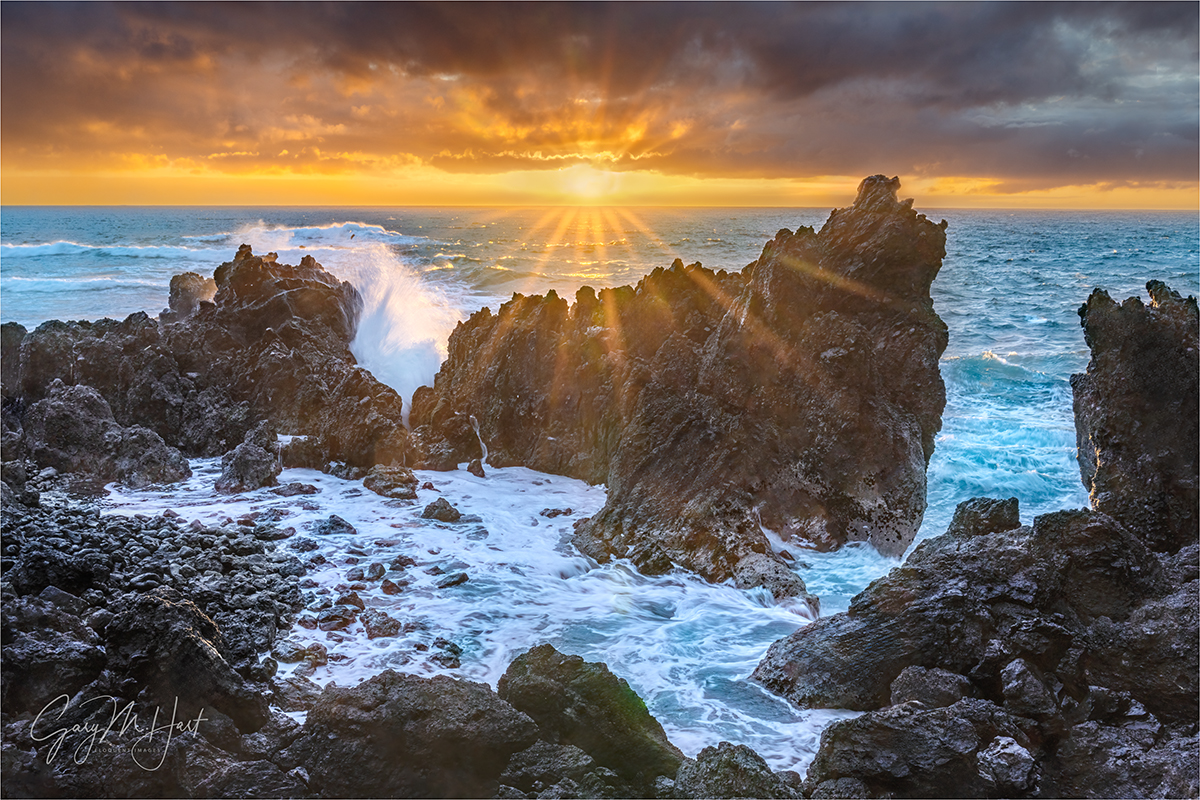
Sunrise, Laupahoehoe Point Sunstar, Hawaii
Sony a7R V
Sony 24-105 f/4 G
ISO 100
f/18
1/13 seconds
Battered for millennia by earthquakes, floods, volcanic eruptions, and tropical cyclones, it’s no wonder Hawaii’s residents keep one eye on the ocean, the other on the mountains—all while closely monitoring the sky overhead. I’ve visited each of Hawaii’s major islands many times (okay, so technically, on Oahu I haven’t been outside the airport, which is its own sort of disaster), and have personally experienced a veritable smorgasbord of these natural events. (Yet somehow I keep returning—go figure.)
The Hawaii earthquakes I’ve felt have been relatively minor jiggles to my earthquake-hardened California bones, but each served as a reminder that Hawaii has a history of large earthquakes, with magnitudes at least into the high 7s. Active volcanism makes the Big Island particularly vulnerable: as recently as 2018 it was shaken by a magnitude 6.9 earthquake; in 1975 a magnitude 7.7 quake rocked the Puna Coast just south and west of Hilo. Moving north, the Hawaiian Islands’ earthquake risk decreases: Maui has experienced a couple of magnitude 6 quakes in historic times (just offshore), while Oahu only gets a moderate jostling from time to time (but does get a pretty good jolt from the strongest Big Island quakes)—only Kauai, the oldest island, is (relatively) seismically stable.
Hawaii’s volcanoes are sexier than its earthquakes, actually attracting visitors (you don’t see too many people rushing toward an earthquake). I missed the recent Mauna Loa eruption, but have witnessed numerous Kilauea eruptions, in many forms: many time I’ve enjoyed standing on the rim at night to view the glow and smoke emanating from the lava lake bubbling just out of sight on the caldera floor far below; last year, I stood on the edge of (the recently seismically remodeled) Kilauea caldera with my workshop group and peered down at dozens of towering lava fountains less than a mile away. In 2010, Don Smith and I hiked close enough to a Kilauea lava flow that we felt its heat and heard trees explode. But despite their dramatic aesthetic appeal, Hawaii’s volcanoes are still too powerful to be taken lightly. While most of its eruptions lack the explosiveness of many more dangerous volcanoes around the world, as recently as 2018 Hawaii’s effusive lava flows have wiped out entire towns, destroying hundreds of homes on their way to the ocean.
And then there are the tropical cyclones that lash the islands several times each decade. By far the most significant storm damage to a Hawaiian island was inflicted by Hurricane Iniki in 1992, striking Kauai as a Category 4 storm with winds up to 140 miles per hour. While I’ve never experienced anything that extreme on my visits, in September of 2018, each of my two workshops was altered by a different hurricane: first on the Big Island when, a few days before that workshop started, a close brush with Category 5 Hurricane Lane deposited up to 58 inches of rain that flooded many of my locations. I departed Hawaii for Maui and my second workshop, only to have Hurricane Olivia (downgraded to a tropical storm just before landfall) force me to relocate the workshop’s two nights in Hana, and find replacement locations for those days.
I’ve also learned firsthand that it doesn’t take a hurricane to generate floods in Hawaii. In 2016 I was on Maui when just regular old torrential rainfall caused a 500-year flood in the Iao Valley and Central Maui, destroying homes and swamping cars. While driving through Central Maui after the water receded, I saw cars still mired in water to their doors.
Even given this history of disasters, compounded by my own personal experience with some of Hawaii’s most extreme natural elements, I would argue that Hawaii’s greatest natural risk is tsunamis. Despite their relative rarity, tsunamis have killed more people than all other Hawaiian natural disasters combined. The islands’ position smack in the middle of the Pacific Ring of Fire, which happens to be the source of nearly 3/4 of Earth’s tsunamis, means Hawaiians need to think in terms of when, not if, the next tsunami hits, and plan accordingly.
Unlike conventional waves, which are wind-generated and affect only the ocean’s surface, a tsunami is formed when a cataclysmic event displaces water from the ocean surface all the way down to the ocean floor. Potential ocean-moving events include submarine landslides, volcanic eruptions, and meteor impacts. But by far the most frequent force behind a tsunami is subduction earthquakes, when one tectonic plate thrusts beneath another and displaces the overlying plate and all the water above it.
In the simplest terms possible, the energy of an ocean wave is the product of its amplitude (maximum height) and wavelength (the distance between amplitudes). In the open ocean, with deep water and no obstructions, a tsunami’s energy is almost entirely committed to spreading outward at 400-600 miles per hour (around the speed of a commercial airliner). At those speeds, a tsunami’s wavelength could be 100 miles, with amplitudes of a foot or two. In fact, with an open ocean amplitude of just a foot or so, when a tsunami passes beneath a boat, the boat’s occupants feel nothing.
But as a tsunami approaches land, it starts dragging on the ocean floor, eventually slowing to around 30 miles per hour. Since the next waves in line are still racing through open ocean at hundreds of miles per hour, when the wave in front of them slams on the brakes, water begins piling up as most of the forward energy is suddenly transformed into wave-building energy: A massive wave is born.
As we’ve seen in recent, and not so recent, history, the power and suddenness of a tsunami can be catastrophic. The Indian Ocean tsunami of 2004 killed over 230,000 people, some as far away as 3,000 miles. The 2011 Japan tsunami killed 10,000 people in Japan, and was directly responsible for the meltdown at the Fukushima nuclear power plant. (It also caused some minor damage in Hawaii, among other places.)
Hawaii’s long tsunami history includes many small and moderate events, and a handful that can be labeled major (and tragic). Since the beginning of the 20th century, three especially significant tsunamis stand out:
- April 1, 1946: Generated by a magnitude 8.5 in the Aleutian Islands, this tsunami is considered as Hawaii’s most significant for the 159 lives it took, and the major damage dealt to every Hawaiian island.
- May 23, 1960: Generated by a magnitude 9.5 earthquake near Chile—the largest earthquake ever measured and more than 30 times stronger than the 1946 Aleutian earthquake. Despite the lessons of 1946, many lives were lost by Hilo residents who didn’t heed warnings.
- November 29, 1975: Generated by a magnitude 7.7 earthquake south of Hilo. on the east flank of Kilauea—though its damage was mostly limited to Hawaii’s southeast coast, this tsunami arrived too quickly following the quake for its victims to flea to safety.
I’m reminded of Hawaii’s tsunami history each time I visit Laupahoehoe Point on the Big Island’s east coast. This is where the 1946 tsunami took the lives of 24 residents, including 16 students and 5 teachers who were waiting at the local schoolhouse for school to start. Adding to the tragedy, warnings of the approaching peril were ignored as April Fools’ Day jokes.
Based on the inexplicable inability to warn people thousands of miles, and many hours, from the tsunami’s source, the US Tsunami Warning Center was formed. Another response to this tragedy was the significant upgrade of local building practices. For example, the 8-story Hilo Hawaiian Hotel, where my Big Island workshops are based, is right on Hilo Bay (you could literally hit the water with a rock from our balconies) and potentially ground-zero for the next tsunami. Constructed in 1975 atop (extremely reinforced) concrete columns, significant sections of the Hilo Hawaiian’s bottom two floors are completely open to the elements, with no walls on either side, designed specifically to allow any large wave to sweep right through rather than push against the structure. Throughout Hilo are tsunami warning sirens that are tested once each month, and evacuation routes are clearly signed.
In 2015 I actually got a firsthand look at how seriously tsunamis are taken in Hilo when, while there for a workshop, a magnitude 8.3 earthquake near Chile triggered a Pacific tsunami warning. Fortunately, today’s satellite technology and ocean buoy network enables much better tsunami tracking than was available in 1946 and 1960, so not only did we get many hours notice, by the time the wave reached Hawaii it was measured in inches and the warning had been long suspended (and I enjoyed a peaceful sleep rather than spending the night in an evacuation shelter).
About this image
Sunrise, Laupahoehoe Point Sunstar, Hawaii
In most of my workshops, our first sunrise is at Laupahoehoe Point. Before we start, I emphasize to my group the location’s tsunami history, and point out some of the tsunami damage still visible. In fact, the location where we photograph is just a few hundred feet from the location of the teachers’ cottages that were swept away in the 1946 tsunami.
You may (or may not) notice that I have several very similar images of this scene. That’s partly because it in fact provides a very nice composition that I always enjoy photographing, but mostly because we’re at Laupahoehoe at the beginning of the workshop, making it especially important that I stay tethered to my group. Which means the variety I get at Laupahoehoe Point is more about conditions than compositional inspiration.
This morning was especially nice for a couple of reasons: first, recent hurricane near-misses had seriously stirred up the Hawaiian surf; second, getting a break in the clouds right on the horizon isn’t especially common in Hawaii. Seeing the opening this morning, I was able to anticipate the opportunity for a nice sunstar and believed I was ready for it.
Unfortunately, I made a couple of mistakes because I’d spent most of the morning working with my group. The first was that I thought I was using my 16-35 f/2.8 lens that provides a much better sunstar than the 24-105 f/4 lens I was actually using. The second mistake was forgetting to remove the ND filter I’d been using earlier in the morning to smooth the waves. After helping people in my group prepare for their sunstar opportunity, I rushed to my camera and started clicking as soon as the sun appeared, realizing with the first click that I’d need to wait out the 20-second exposure my camera had started. Fortunately, it all worked out, and I was actually able to get a couple of frames like this one, capturing the instant of an explosive wave’s impact.
At the risk of stating the obvious, another thing I want to point out is how hard it is to photograph directly into the sun. When I got around to processing this image at home, not only did I have serious dynamic range problems to deal with, I also had tons of nasty lens flare blobs to clean up. Fixing lens flare was mostly just a tedious process with the Remove tool; the dynamic range was a matter of processing the sky and foreground separately. Since I no longer use graduated neutral density filters, and I never blend multiple exposures, my margin for exposure error was extremely small, but by monitoring my histogram and pushing my highlights to the limits of recoverability when I captured the image, I ended up with shadows that still contained enough clean detail to work with.
Workshop Schedule || Purchase Prints || Instagram
Lots More Sunstars


One Click Wonders
Posted on September 12, 2024

Milky Way Reflection, Puna Coast, Hawaii
Sony a7R V
Sony 14mm f/1.8 GM
ISO 6400
f/1.8
20 seconds
For as long as I can remember, I’ve gazed at the night sky in wonder. Around the age of 10, my wonder was augmented by inquisitive fascination that I pursued in books, magazines, and through the lens of my very own telescope. Throughout my adulthood, I longed to express that celestial wonder with my camera, but for years was thwarted by the camera’s inability to capture the night sky’s splendor. The Milky Way has long been a particular source of simultaneous attraction and frustration—two sides of the same coin.
Hawaii’s Big Island is the site of my first real Milky Way photography success. Starting with my first Hawaii workshop in 2011 (two workshops that year, actually), I could count on taking my groups to the Kilauea caldera rim and finding lava churning in Halemaʻumaʻu, the small crater on the caldera floor that had been active since 2008. Though the lava itself was usually (but not always) too low to be seen, its orange glow stood out brilliantly at night. Thanks to scouting prior to the first workshop, I located the spot on the rim where the Milky Way aligned with Halemaʻumaʻu, and for the first 8 years virtually every group (unless we were shut out by clouds) enjoyed Kilauea Milky Way success. So spectacular was the sight of the Milky Way’s luminous core above an active volcano, we’d often return 2 or 3 times.
I’d been attempting to photograph the Milky Way ever since my transition to digital in 2003, but for years found the technology not quite ready for prime time—there just wasn’t enough light for a usable foreground—and my one-click-only Milky Way foregrounds were either too dark or too noisy. Blending multiple images, one exposed for the foreground and the other for the sky, was against my personal rules, and I can’t stand light painting—it’s one-click, natural light only for me.
But Kilauea created its own foreground light that illuminated the caldera’s detail—natural light painting! I was in business.


Then in 2018, Kilauea’s continuous summit eruption ended in a blaze of glory when the magma chamber supporting it sprung a major leak that delivered devastating lava flows along the volcano’s East Rift Zone, before eventually draining into the Pacific and creating 875 acres of brand new oceanfront real estate. With its magma chamber drained, Kilauea’s summit crater (as we knew it at the time) collapsed, taking with it, among many things, Halemaʻumaʻu and my reliable volcano/Milky-Way photo opportunity.

Stairway to Heaven, Milky Way Over the Puna Coast, Hawaii (2021)
Of course, even without an eruption, the Big Island is (in my opinion) Hawaii’s most photo-worthy island, so I kept coming back. And fortunately, in the years I’d spent enjoying all that Kilauea Milky Way success, sensor technology (light capturing ability) evolved enough that a foreground light source was no longer necessary for a Milky Way foreground, greatly expanding my Milky Way horizons.
After a little research and exploration, in most of my post-2018 workshops, I still managed to give my Hawaii groups at least one night shoot. One year we drove to the summit of (nearly 14,000 foot) Mauna Kea and photographed the Milky Way above the giant telescopes up there, and a couple of other times we just happened to catch one of Kilauea’s many sporadic post-2018 eruptions, each more spectacular than the eruptions I’d seen on the pre-2018 trips.
For several reasons, Mauna Kea turned out to be an impractical long term Milky Way location, so on visits when Kilauea was quiet, I turned my eyes to the Puna Coast. With a rugged volcanic shoreline interspersed with still tide pools and black sand beaches, the Puna Coast is hands-down my favorite coastline in the world. But frequent clouds (usually a good thing) and air dense with moisture make night photography here a little trickier. But, as I learned in 2021, the reward of success justifies going for it despite the lack of certainty. In fact, despite its challenges, I’d have to rate the Puna Coast right up there with New Zealand and the Colorado River (at the bottom of Grand Canyon) as a favorite place to photograph the Milky Way.
Despite the improved light capturing capability of today’s digital sensors, and the quality of current wide, fast prime lenses, successful Milky Way photography requires many compromises: specifically, (much) less than ideal f-stops, ISOs, and shutter speeds. Not to mention, even when everything is as perfect as possible, you also need to lower your personal image quality standards.
Let’s Review
My Milky Way approach, excerpted and (significantly) updated from previous blog posts
Even though I’ve been fulltime digital for more than 20 years, and am not one of those photographers still pining for the days of film (not even close), I still approach my craft like a film shooter. Another way of looking at it would be that I want my creativity to happen in the camera, not the computer. That said, processing, though not my favorite part of photography, is an essential digital windfall that has enabled color shooters like me to extract results that were never possible with film. In fact, like every other digital photographer, I couldn’t succeed without processing. And processing is doubly important for Milky Way images.
But processing starts with the raw file, because the better the quality of the capture, the greater your processing options, flexibility, and ultimate result.
The method to my madness
I’ll start with my definition of a successful Milky Way image:
- One click—no blending. That doesn’t mean I think (honest) blending is wrong, it’s just not for me.
- Minimal noise with maximum detail: Since these two qualities are mutually exclusive in Milky Way image, my exposure, noise reduction, and processing efforts are always about finding the right balance. And the definition of “minimal” for a Milky Way image is not same as it is for a daylight image (see “compromise” reference above).
- Some foreground detail: The foreground doesn’t need to be daylight bright (shouldn’t be), but I want to be able to see something visually appealing/interesting there.
- The right sky color: As far as I’m concerned, the color of the sky in a Milky Way image is the photographer’s creative choice because no one knows what color it’s supposed to be (although I do hear from people who claim to know, and who aren’t shy about “educating” me—I mean, even if science says the sky should be green, I’m not going to make a green-sky Milky Way image, thankyouverymuch). If you look at my recent Milky Way images, you’ll see that I tend to avoid a blue/cyan sky in favor of something more blue/purple. And as time goes by, my sky-color preference has been trending closer to black, with a less saturated blue/purple tint. This just feels more night-like to me. But that’s just my opinion and I empower you to go with whatever color makes you happy.
- Uniform sky tone and hue (as much as possible): I don’t like a huge difference between the sky near the horizon and up toward the top of the frame, and usually try to even it out in processing.
- The stars should pop—within reason: I want the sky to be fairly dark, but the stars to stand out, but don’t overdo it (and be careful with Clarity and Texture).
- No part of the Milky Way should be blown out: While I want the stars bright, I don’t want them too bright.
The right gear
First, if you’re going to do it my way (one click, natural light), I can’t emphasize the importance of the right gear. Specifically relatively new full-frame camera model, a wide and fast lens, and a sturdy tripod.
In general, the newer your sensor technology, the better its low light performance will be. (A broad generalization that tends to be more true than not.) And a full frame sensor will almost always perform better in low light than a comparable-vintage APS-C sensor. I used to use whatever the current 12 megapixel Sony a7S body was (at this writing in September 2024, that would be the a7SIII), and while I’ll acknowledge that these are the best dark sky 35mm bodies in the world, I just couldn’t justify the marginal quality difference between my 12 megapixel Sony a7SIII, and my 61 megapixel Sony a7RV—so I sold the a7SIII and only use my a7RV.
For dark sky photography (it doesn’t have to include the Milky Way), light gathering is job-one. So you want to be using the fastest possible lens that’s wide enough to include the Milky Way and some foreground. My rule of thumb when advising my workshop students is 24mm or wider, but wider is better. And while f/2.8 is fast enough, faster is better. Because the quality of prime lenses is generally better than zooms, and you’ll likely be shooting wide open (usually the most problematic f-stop), I prefer primes for night.
While I have in my bag f/2.8 12-24 and 16-35 lenses, for night photography I use (in this order) my 14mm f/1.8, 20mm f/1.8, and 24mm f/1.4. And honestly, since getting the 14mm f/1.8 lens, I don’t think I’ve used the other two at all—the 14mm is the perfect combination of wide and fast (with excellent border-to-border quality). Before the release of the 14mm lens, I preferred wider view and compactness of the 20mm over the marginally faster (and arguably better quality) 24mm f/1.4. The only other lens in my bag I might use at night is the 12-24—but only if I thought the extra 2mm width would make a difference.
Exposure compromise
My processing choices depend a lot on my exposure choices, which as I said earlier, are all compromises. The real art of one-click Milky Way photography is balancing these compromises well enough that none ruin the image.
Capturing light usually trumps everything. For example:
- I generally go with the highest ISO that gives me a usable image. ISO 3200 is probably the lowest I’d recommend, but if you can pull off 6400 (or more), so much the better. And while any high ISO image will have borderline unusable noise that cleans up pretty well with noise reduction software (which has gotten pretty amazing), every camera has an ISO beyond which even the best noise reduction software can’t save. That ISO might vary depending on several factors—for example, since heat generate noise and long exposures generate heat, the longer your exposure, the more noise you’ll get. And I have a theory (that I haven’t tested yet) that my New Zealand Milky Way images are cleaner than my Grand Canyon and Hawaii Milky Way images because it’s winter (much colder) when I photograph in New Zealand.
- To avoid start motion I try to avoid 30 second exposures, something I can afford to do with my f/1.8 lens. Though some photographers resist a 30-second night exposure at all costs because of the slight star motion it creates, if you’re shooting with an f/2.8 (or slower) lens, I’d probably compromise a little star motion for the extra light 30 seconds provides—pinpoint stars are irrelevant if the image is too dark or noisy to use.
- While most lenses aren’t at their best wide open, unless the flaws of shooting wide open are egregious enough to render the image unusable, I’m always shooting wide open (or unless stopping down just 1/3 stop makes improves the quality significantly).
With my 14mm at f/1.8, I can usually keep my a7RV at ISO 6400, with a 15 or 20 second exposure time—all quality compromises, but my results are usually within the acceptable range. That’s typically where I start my Milky Way exposures, but when I find a composition I like and I know my focus is locked in, I almost always shoot a series of frames with a variety of exposure settings (e.g., maybe dropping my ISO to 3200 and bumping my shutter speed to 30 seconds) to give myself a range of choices when I can view the images on my computer.
Noise reduction
For all of my images, my standard noise processing is Topaz DeNoise AI plugin in Photoshop. But for my Milky Way photography (only), I start with Lightroom’s Denoise tool, paying close attention to the magnified view and experimenting with the reduce noise and save detail controls.
The balance you’re looking for is between reducing noise and sparing detail: we all know what too much noise looks like, but too much noise reduction can be even worse. As you make your adjustments, magnify the view to at least 100 percent and try to limit the amount of noise reduction to a point right before the scene starts to take on a smooth, plasticky texture. And examine multiple locations in the foreground, especially the darkest areas, because the amount of noise reduction and detail salvaging is not uniform across the scene.
Even though Lightroom does a great job, when I’m done processing my image in Lightroom, the first thing I do after opening the Lightroom-processed image in Photoshop is a very gentle application of the Topaz DeNoise plugin as well. For this step, again I magnify the view to 100% and apply as much noise reduction as I can without muddying the detail, taking extra care not to overdo it (not enough is usually better than too much). When my chosen amount of Topaz noise reduction works well for much of the scene, but still plasticizes a few areas, I often use the History brush at some opacity less than 100% (experiment) to recover the lost detail.
Processing
I’m frequently asked about my processing workflow for Milky Way images, and I’ve always been a little reluctant to share a lot because I don’t do any kind of image blending, I’m far from an expert, and my Milky Way workflow is always a work in process. Nevertheless, I get asked enough that I’ve decided it might still help for me to share my general mindset and approach. (Plus, it might help others to understand why my images, while more “real,” aren’t as necessarily more dazzling as the images of those that blend.)
This is where things start to get more vague, because my approach is less a recipe of processing steps, than it is a trial and error approach to finding the best way to achieve the results I want—steps that can vary a lot from image to image. Sometimes I can do most of what I want mostly in Lightroom, other times I lean more heavily on Photoshop—usually it’s some balance of the two.
When processing a Milky Way image, I make extensive use of Lightroom and Photoshop’s History panels. There’s no single best way to do anything, so I make a lot of “what-if?,” trial-and-error adjustments that I only stick with if I’m satisfied. That means you’re not going to get specific processing steps from me as much as you’ll get things to try and accept/reject. The other thing I want to emphasize (again) is the importance of magnifying the image to 100% (1:1) when you’re trying to decide whether or not to accept an adjustment.
Anyone viewing my Milky Way images over the years might notice how the color of my skies have changed. For years, whatever night sky color I’ve ended up with has entirely a function of the color temperature I choose when I process my raw file in Lightroom—no artificially changing the hue, saturation, or in any other way plugging in some artificial color. Since I do think the foreground (non-sky) of a night image looks more night-like (I don’t want a night image that looks like daylight with stars) with the bluish tint I get when the color temperature is cooled to somewhere in the 3000-4000 degrees range, for years I cooled the entire image with a single color temperature stroke—hence the blue night skies. But Lightroom now makes it super easy to process the sky and foreground separately and seamlessly, so I no longer cool my night skies nearly as much as before (or at all). Now my night skies tend to be much closer to black, less saturated and trending a little to the purple side of blue (avoiding the cyan side).
After Lightroom’s noise reduction, whether it’s the sky or foreground, I start with the Highlights/Whites/Shadows/Blacks sliders, performing lots of up/down trial-and-error adjustments to find the right balance (gotta love that History panel). The Lightroom Clarity and Texture sliders will make the stars pop (but don’t overdo it!), but will also exaggerate noise. And Dehaze will add contrast to the sky that really enhances the Milky Way, but like most Photoshop steps, overdoing it is usually worse than under-doing it.
For the foreground, a color temperature in the 3000-4000 degree range usually works, but specifying a temperature value isn’t an option for a Mask, so I just cool it to taste. To get the sky color I want, I play with both the temperature and tint sliders, usually going with something a little warmer than the foreground, with a slight nudge of the Tint slider toward red.
If I have to tweak the color in Photoshop (usually very minor adjustments on very small areas of the image), I select the area I want to adjust, Feather it fairly loosely (large Feather Radius), and adjust Color Balance and/or Saturation. I do lots of trial-and-error moves with Color Balance; with Saturation I almost always work on specific colors, and will adjust some combination of Hue, Saturation, and Lightness until I’m satisfied. Also, I find that some of the other adjustments I make in Lightroom and Photoshop pump up the color too much, so I often desaturate the sky a fair amount in Photoshop.
To make the Milky Way more prominent, a few passes with the Dodge brush set to Highlights can do wonders, brightening the stars without affecting the sky. I prefer multiple passes at low Opacity (<20). Probably the trickiest thing to contend with is a different hue near the horizon than I get in the rest of the sky. I can usually mitigate that somewhat with a feathered selection of the area and a Color Balance or Saturation layer, described above. And sometimes, if I’m really brave, I’ll select the offending area, Feather it, use the Eyedropper tool to pick the color I want from another part of the sky, and use the Paint Bucket tool to apply the color to the selected area. I usually get better results with Tolerance set fairly high (>50) and Opacity fairly low (<30), but not always, so experiment (like everything else, it can vary from image to image). If you do this, don’t expect it to work every time, and always examine the results at 100% because it can introduce some pretty nasty blotchiness that doesn’t jump right out at you on first glance at lower magnification.
With most of my images, the last thing I do before saving is sharpen. But since night images are rarely about fine detail, and sharpening exacerbates noise, I don’t usually sharpen my Milky Way images.
These tips are not intended to be the final word on Milky Way processing—I just wanted to give you some insight into my approach, both my goals and the steps I take to achieve them. I’ve been using Photoshop for a long time, but don’t consider myself a Photoshop expert, by any stretch. While there may be (and probably are) better ways to do many of these things, I’ve always been a simple-first photographer: Do things the simplest possible way, until you find some way that’s better, or until you encounter something you just can’t do. And if you take nothing else away from this, I hope you at least feel empowered to experiment until you achieve results that make you happy.
Back to the image at hand
Milky Way Reflection, Puna Coast, Hawaii
Based on the weather forecast for the Puna Coast, I wasn’t especially optimistic for Milky Way success in this year’s Hawaii workshop, but as I said earlier, the rewards of success always make it worth trying. I also had a backup location in mind for a couple of nights later—not as nice a foreground, but a greater likelihood of clear skies.
Despite the tremendous success of the Puna location I used in 2021 (the last two years, Kilauea was erupting and we did our night shoots up there), I decided not to return there because the precariousness of the location atop a 20-foot cliff above pounding surf made me nervous. So I decided to go to my favorite Puna “beach,” a wide spot on Kalapana-Kapoho Road with no real name—just a spot I stumbled upon years ago and have been bringing my groups to ever since.
As you can see from this image, my pessimism was unjustified and we enjoyed a spectacular shoot. I’d given everyone a Milky Way primer during the afternoon training, but it definitely helped that we could all set up in very close proximity, making it easy for Don Smith (who was helping me with this workshop) and me to get around and assist anyone who needed help.
The tide pool at our feet was a spectacular bonus, providing a mirror reflection of the stars and even a little Milky Way—a rare opportunity that I encouraged everyone to take full advantage of, even if it meant getting a little less Milky Way than they wanted. About 20 minutes into our shoot, a big black cloud moved in overhead and obliterated the stars, but within 10 minutes it moved on as quickly as it appeared—in this image you can see it exiting stage right.
The last point I want to make before (finally) ending this very long post is how much fun these Milky Way shoots are. Everyone was giddy with excitement for what they were seeing on the backs of their cameras, and that giddiness contributed to a party-like atmosphere with lots of conversation and laughter as we worked. One of my most memorable Milky Way shoots ever!
Join me in Hawaii next year!
Workshop Schedule || Purchase Prints || Instagram
More One-Click Wonders


Full Circle
Posted on September 7, 2024

Sunset Mirror, Lake Manly (Badwater), Death Valley
Sony a7R V
Sony 24-105 f/4 G
ISO 100
f/11
1/15 seconds
For many people of my generation, their earliest memories of landscape photography are some version of Dad pulling the family wagon up to an iconic vista and beelining (camera flapping around his neck) to the railed viewpoint to snap a few frames—if you were lucky, he’d take long enough for you to use the bathroom. In most cases these pictures would be quickly forgotten—until 50 years later when, while searching through Mom and Dad’s garage/attic/basement/closets arguing with siblings about what stays and goes, you come upon shoe boxes stuffed with prints or slides of scenes that you feel absolutely no connection to.
I think the fact that I became a landscape photographer has something to do with an intermediate step that most people missed: when my dad’s slides came back from the lab, he would meticulously peruse and purge, then label and organize the survivors, before sequestering the family in our darkened living room until the each Kodak Carousel had completed its cycle. Sometimes we’d have to sit through multiple shows of the same pictures as friends and family visited.
I won’t pretend that my brothers and I loved these shows, or (let’s be honest) that we enjoyed them in any way. But in hindsight, I think on some level the message came through each time we visited Yosemite, the beach, or drove across the country (have tent trailer — will travel), that the beauty we experienced was worth preserving.
Learning that pictures could possess an actual aesthetic value that others could enjoy also helped me register that a camera could be much more than a mere outdoor accessory. Which probably explains why, when I became old enough to start creating outdoor memories of my own, preserving on film the beauty that moved me just seemed the natural thing to do.
Of course when I first picked up a camera, I naively believed that the only ingredients necessary for a successful picture were a camera and a pretty scene. That might have something to do with the fact that Dad’s photo stops were rarely timed for light or conditions, because vacations and photography don’t mix: the best time for photography is the worst time to be outside. Despite prioritizing family over photography like the good father he was, I appreciate now that he really did know his way around a camera, and how to frame a scene.
(Like many blog posts, I started with a point I wanted to land on, and now have ended up following a most circuitous route getting there. But here we are.)
I’m thinking about the influences that got me to where I am today, and need to give Dad a twofer on this one: prioritizing family over photography, while still modeling a photographer’s aesthetic. My own pursuit of photography started after childhood, but long before I married and had children, and while it went somewhat dormant during my daughters’ formative years (limited mostly to snaps of family moments), the interest came roaring back when the girls spread their wings and rendered my wife and me empty nesters—an event that (fortuitously) coincided with the advent of digital capture.
Acquainting myself with the new digital paradigm, I couldn’t help reliving some of my father’s enthusiasm for photography and the cutting-edge technology of his time (autofocus, through-the-lens automatic metering), that (I realize now) coincided with my parents’ own sudden empty-nester status. Digital photography was perfect for me—similar enough to film photography that there wasn’t lots to relearn, but with an infusion of the technical world I’d spent nearly 20 years in. Also like my father’s experience, the new-found freedom to research, study, and explore taught me (among other things) the importance of light on the landscape, and that I must prioritize the conditions when scheduling my photo trips.
Since virtually every family vacation of my childhood was a camping trip somewhere scenic, it made sense that my first instinct was to return to the locations of my strongest childhood memories. While a few vacations were rigorously planned interstate adventures with a different stop each night (I’m having flashbacks to KOA campgrounds and AAA TripTiks), more frequently we’d pick a picturesque setting and set up camp for a week or two, relaxing and enjoying day-trips to nearby sights. These are the locations that especially drew me with my new digital camera.
My strongest childhood memories of vacations were our summer Yosemite trips, but a couple of times Dad got a week off during Christmas break and Death Valley was the logical destination. So after I’d harvested Yosemite’s low hanging visual fruit, Death Valley was the next logical step for my burgeoning photography aspirations.
As a kid I was more interested in Death Valley’s mining and ghost town attractions, but returning as a photographer, it was the uniquely beautiful geology that got my juices flowing. In my previous blog post, I wrote about the proximity of the highest point in the 48 contiguous United States (Mt. Whitney) to the lowest point in the Northern Hemisphere, so I guess it makes sense to circle back to Death Valley.
That lowest point is Badwater, which also happens to be a personal Death Valley favorite. So what’s going on here? When you’re lower than all surrounding terrain, not only does water tend to find you, it can only exit via evaporation. In an inherently arid environment like Death Valley, inundation usually outpaces evaporation, leaving behind only minerals carried by the water but too heavy to evaporate. The predominant residual mineral at Badwater is salt, with a little more accumulating with each evaporation. As the mud beneath the salt layer dries, polygonal cracks form, creating openings that can accumulate extra salt. Death Valley’s intense summer heat causes this salt to expand and form corresponding polygonal shapes that stretch for miles atop the otherwise flat surface.
Extending miles in the shadow of 11,000 foot Telescope Peak, Badwater is always photographable, but its year-to-year variation is a source of great angst and celebration. Some winters I find these shapes filled with water, sparkling like faceted jewels; or when dry their color can range from muddy brown to as white as a bleached sheet. But by far my favorite happens when recent rains have flooded Badwater Basin to form Lake Manly, a shallow ephemeral lake that turns the entire basin into a giant mirror. During my 2005 visit, I watched a kayaker glide across the lake.
To explain a little more about Lake Manly, here’s an excerpt from my February 14, 2024 blog post:

Sweet Sunset, Lake Manly and Badwater Basin, Death Valley
The origins of Lake Manly in Badwater Basin date back nearly 200,000 years. In its earliest millennia, Lake Manly was much deeper, far more expansive, and persisted year-round. But in recent millennia, it has become an ephemeral lake, usually dry and filling only when rare intense storms generate enough runoff. The life of these recent versions of Lake Manly is measured in weeks or months.
The current version of Lake Manly formed when Tropical Storm (and former hurricane) Hilary saturated Death Valley with more than a year’s worth of rain (2.2 inches) in one day. Because Death Valley isn’t equipped to handle so much water at once, Hilary brought flooding that washed out roads, displaced rocks, carved new channels, and reshaped canyons. And with no outlet for all this water, after doing its damage, this runoff had to come to rest somewhere—and where better than the lowest place in North America?
At its peak volume last August, the newest incarnation of Lake Manly was 7 miles long and 4 miles wide, but no more than 2 feet deep. By late January its surface area had shrunk to half its original size, and the lake’s depth was measured in inches.
Despite its diminished size, Lake Manly was more than big enough to provide spectacular, valley-wide reflections for my workshop group. In addition to photographing mountain and sky reflections from the valley floor, we also enjoyed beautiful sunset reflections from Dante’s View, more than 5000 feet above Badwater.
I captured today’s blog image on the same evening as the image I shared in that February post. Because the sky is important as the foreground in a landscape image, my compositions this evening followed the rapidly scooting clouds, capturing the changing color as I went. I shifted my position on the lakeshore (and have the muddy boots to prove it) to ensure the best foreground/clouds relationship, and continued moving and tracking the clouds until they encountered a nearly full moon rising above the looming Amargosa Range.
On those childhood visits to these special places, rolling my eyes Dad’s goofy obsession and the inevitable boring slideshow in store, I had no appreciation for the foundation that was being laid, or for the full circle journey I was embarking on.
2026 Death Valley Winter Moon Photo Workshop
Workshop Schedule || Purchase Prints || Instagram
Death Valley


More Than Skin Deep
Posted on August 29, 2024

Sunrise Moonset, Mt. Williamson, Alabama Hills (California)
Sony a7R V
Sony 24-105 f/4 G
ISO 100
f/16
.6 seconds
Beauty
In the eye of the beholder, more than skin deep…
We’ve all heard the clichés implying that beauty is both subjective and personal, and like many (most?) clichés, they’re founded in truth. Landscape photography is the glorious pursuit of natural beauty, however we choose to define it. In my mind, the beauty of the subjects I pursue transcends the visual and is rooted in their natural history, their geological evolution, and their interactions with the rest of the natural world. And as much as I try to convey these internal qualities in my images, sometimes I have to use my words. (Hence this blog.)
Speaking of beauty…
Photographing natural beauty starts with identifying relationships, then framing those relationships into something coherent and compelling. Sometimes the relationships are permanent fixtures on the landscape, like the rounded boulders of the Alabama Hills beneath the serrated peaks of the Sierra Crest. Other natural relationships are just as reliable but temporary, like a full moon setting behind a prominent peak. And then there are the completely random relationships, like a beautiful sunrise coloring the sky above the scene you traveled to photograph. Understanding the science underlying all these moving parts amplifies the joy I get from photography, and magnifies the beauty of whatever moment I’m witnessing.
The undeniable beauty of the Alabama Hills and Sierra Crest have drawn me for more than two decades, a draw that has only been enhanced by learning the geology of the area. For starters, I’ve long been fascinated that 14,500-foot Mt. Whitney, the highest point in the contiguous 48 states, and it’s almost as tall neighbor Mt. Williamson, are only 85 miles from Badwater—which, at 282 feet below sea level, is the lowest point in North America. Just 125 feet shorter than Whitney, in many ways I find Mt. Williamson even more impressive than its more famous big brother. Unlike Whitney, which is easily lost in the jumble of surrounding peaks, Williamson’s summit stands alone, looming nearly 10,000 feet above the Owens Valley.
How these towering peaks can exist in such close proximity to sunken Badwater has always boggled my mind. Turns out, mighty mountain ranges separated by plunging valleys are distinctive features of the Basin and Range Province of the American Southwest. Over the last 20 million years or so, as the Pacific Plate edges fitfully northwestward relative to the North American plate, large chunks of the Southwest have fractured and deformed. Complex stresses exerted by these shifting plates have forced some of these blocks upward relative to the surrounding terrain, while other blocks have remained in place or dropped.
Another detail I find fascinating about this area is that both the seemingly indestructible Sierra Nevada, and the worn, weathered Alabama Hills, are comprised of the same granite formed deep beneath the surface about 85 million years ago. While the Sierra granite was uplifted and exposed to atmospheric weathering (wind, rain, snow, and ice), the Alabama Hills granite was subjected to subterranean chemical weathering. The resulting differences are very apparent in images that include both.
But if you think 85 million years was a long time ago, consider that our moon is 53 times older. Current wisdom says that the moon formed 4.5 billion years ago, when a Mars-size object (planet? death star?) collided with our still molten planet. Some of the vaporized and molten debris from that collision was reabsorbed into Earth, some was jettisoned into space, and some coalesced into an object that we know now as the moon. You might also be interested to know that at its birth, our moon was much closer to Earth, but each year moves about 1 1/2 inches farther away. But don’t worry, the sun will explode and take us all out before the moon can escape.
The presence of the moon this Alabama Hills morning, while fleeting, was no fluke. Each year I schedule my Death Valley workshop to coincide with the January or February full moon, and we finish the workshop with a sunset and sunrise in the Alabama Hills, a 90-minute drive from Death Valley. The sunrise shoot always includes a moonset.
Knowing what was in store, I positioned myself to align the moon with Mt. Williamson long before the sun arrived. My original plan was to wait until the moon touched the peak, and use my 200-600 lens with a 2X teleconverter to make it as big as possible. But when the sky colored up a few minutes before sunrise (you can actually see the first kiss of sunlight on Williamson), I switched to my 24-105 to include more sky and nearby boulders.
The color you see is courtesy of the very first rays of sunlight, when all but the longest (red) wavelengths have been filtered out. On a cloudless day in the Alabama Hills we don’t see this red light until it touches the crest, and it only lasts for a few seconds before warming to amber. But when we’re lucky enough to have clouds in the west and clear path for the sunlight on the eastern horizon, we enjoy more red, for longer. And while I was pretty thrilled about the color this morning, and was well aware that we needed clouds to see it, I couldn’t tell how thick they were and was concerned that they’d completely swallow the moon. As you can see, everything worked out.
Looking at a picture, any picture, and knowing the natural processes that went into creating that scene, I find truly beautiful. While a lot of the information about my subjects I share has accumulated in my brain over a lifetime of study and experience, I can’t pretend that I can rattle all this info off the top of my head. But I never tire of learning (and sharing), and I think nature photography is the perfect catalyst for this pursuit.
Workshop Schedule || Purchase Prints || Instagram
Head for the Hills
Click any image to scroll through the gallery LARGE


Every. Single. Thing.
Posted on August 23, 2024

Sunset Reflection, North Lake, Eastern Sierra (2008)
Canon EOS-1Ds Mark III
Canon 17-40 f/4 L
10 seconds
F/11
ISO 200
A few days ago, while browsing old images looking for something else, I came upon this one from a solitary sunset visit to North Lake above Bishop almost 16 years ago. It’s a great reminder to appreciate my past efforts, and to not forget that, even though some images from my distant photography past evoke a “What was I thinking?” face palm, I really did have an idea of what I was doing—even if my execution wasn’t always perfect.
One of the earliest lessons I learned on this path to where I am as a photographer today, a lesson I work hard to impart on my workshop students, is the photographer’s responsibility for each square inch (and pixel) in the frame. Not just the beautiful elements, but everything else as well. Every. Single. Thing.
It’s always heartening to see the genesis of that approach in my older images. Rather than just framing and clicking the obvious, I can see signs that I took the time and effort to assemble the best possible image. That assembly process might start weeks or months before I arrive (planning for a moonrise, fall color, the Milky Way, and so on), or it could simply be a matter of making the best of whatever situation I’m presented when I arrive.
Either way, once it’s time to take out the camera and get to work, before clicking the shutter I try to make a point of surveying the scene to identify its most compelling elements. Once I’m comfortable with the possibilities, I position myself to create the ideal relationships between the various elements, then frame the scene to eliminate distractions, and finally, choose the exposure variables that achieve the motion, depth, and light that create the effect I want. And while my execution still isn’t always perfect (and will always have room for improvement), I think this image in particular illustrates my assembly process.
I’ve been visiting North Lake in autumn for nearly 20 years, both on my own and in my workshops. Most of these visits come at sunrise, but this time, by myself in Bishop with an evening between workshops, I decided to explore some of my favorite spots near the top of Bishop Creek Canyon. I pulled into North Lake and was surprised to find it completely devoid of photographers—a refreshing difference from the customary autumn sunrise photographer crowds that usually outnumber the mosquitos.
Early enough to anticipate the sunset conditions and plan my composition, I was especially excited by the western sky above the peaks, which was smeared with broken clouds that just might (fingers crossed) color up when the sun’s last rays slipped through. Without the swarm of photographers I was accustomed to here, I took full advantage of the freedom to roam the lakeshore in search of a composition that would do the (potential) sunset justice. Rather than simply settle for the standard version of this inherently beautiful scene that might be further enhanced by a nice sunset, I wanted a composition that assembled the best of the scene’s various features—colorful sunset sky, serrated peaks, golden aspen, crisp reflection, small granite boulders—into coherent relationships that allowed everything to work together that might be a little different.

Autumn Reflection, North Lake, Eastern Sierra
I eventually rock-hopped to this mini granite archipelago near the lake’s outlet and found what I was looking for. Since I’d always gone horizontal at North Lake to feature the arc of peaks framing the aspen-lined lake, this time I decided to emphasize the foreground rocks and reflection with a vertical composition. (I’ve since had great success with vertical frames at North Lake, but this is the one that really opened my eyes to the vertical possibilities here—see the image on the right from two years later.)
First I positioned myself so the line of small granite rocks formed a diagonal along the bottom half of the frame, enhancing the scene’s illusion of depth. Next, I lowered my camera (on a tripod, of course) to minimize the empty patch of lake between the rocks and reflection.
As much as I like my images to have uncluttered borders, in nature it’s often impossible to avoid cutting something off, or to prevent a small piece of an object outside the frame from jutting in (like a rock or branch). In this case, from my chosen location, including the foreground rocks I considered essential meant cutting off other rocks. When I run into these situations where a clean border is impossible, I at least need to make my border choice very deliberate. In this case, I took care to include all of the rocks at the bottom, but chose to cut the rocks on the left boldly, right down the middle, so they don’t look like an afterthought (or a never-thought).
As much as I liked the mountain, aspen, and sunset parts of the reflection, I found the reflection of the sky above the colorful clouds pretty dull. So I dialed my polarizer just enough to erase the bland part and reveal the (more interesting) submerged rocks near the lakeshore, taking care not to lose the best part of the reflection.
Of course, including the nearby rocks added another layer of complication: ensuring that everything, from the foreground rocks to the distant mountains, was sharp. Because every image has only one perfectly sharp plane of focus, in a scene like this, finding the right focus point and f-stop is essential.
Of the various techniques photographers apply to ensure proper focus, Hyperfocal focusing is the most reliable. Hyperfocal focusing determines the combination of focal length, f-stop, sensor size, and focus point that ensures the ideal position and depth of the frame’s zone of “acceptable” sharpness. Since identifying the precise hyperfocal point (the point of maximum depth of field) requires plugging variables into a chart (the old fashioned way) or smartphone app (the smart way), many photographers foolishly decide it’s not worth the effort. But, like most things that start out difficult, regularly applying hyperfocal focus technique soon reveals its underlying simplicity. (I rarely have to check my app anymore, usually relying instead on experience-based seat-of-the-pants hyperfocal focusing.)
Today, with my mirrorless cameras, I am able to precisely position my focus point using a magnified viewfinder view, and I completely trust my camera’s autofocus. But because the evening of this image was back in my DSLR days, when I never completely trusted autofocus when the margin for error was small, I know I manually focused it.
So where did I focus? Well, even though I no longer remember, I’d bet money that it was on first small rock beyond the trio of rocks at the bottom. I think that because, 1) that just seems like where I’d instinctively focus, and 2) my hyperfocal app tells me that the hyperfocal distance for this image’s settings (thank you EXIF data) was a little less than 3 feet, and that rock was about 3 feet away. Since close scrutiny at 100 percent confirms that the image is sharp from front to back, I’m pretty confident that’s where I focused.
The final piece of the puzzle was exposure. At the time I was shooting with a dynamic range limited (compared to my Sony Alpha cameras) Canon 1DSIII, so I’m pretty sure I used a 3-stop soft graduated neutral density filter to subdue the bright sky. (FYI, I no longer carry a GND.) This always requires a little extra work in Photoshop because I hate, hate, hate the GND transition’s darkening effect on the landscape immediately beneath the sky, which always requires a little dodging and burning to eliminate.
There really was a lot going on in this scene, and I’m pretty pleased that I was able to make everything work together. Of course that doesn’t always happen, but I find the more I’m able to consider every single thing in a scene, the happier I am with my results.
Workshop Schedule || Purchase Prints || Instagram
Image Building
Click any image to scroll through the gallery LARGE


Grand Canyon Lightning 2024: Part 2
Posted on August 16, 2024

Bent, Grand Canyon Lightning
Sony a7R V
Sony 24-105 f/4 G
ISO 50
f/18
1/6 second
When I returned from my Grand Canyon Monsoon photo workshop earlier this month, I was so excited about this year’s last-day lightning experience that I immediately processed a few images and sat down to blog about them. But when my blog started approaching 4000 words, I thought for everyone’s sanity (both yours and mine), it might not be a bad idea to split my ramblings into two blogs. In the first one I detailed, among other things, the story of the actual shoot that produced nearly 60 lightning images on the day the workshop ended. I also wrote about the Southwest monsoon in general, and the genesis of my lightning chasing obsession.
Now I’ll move on to some of the science of lightning, and my thoughts on including lightning in an image. Without further adieu…
Here’s Part 2
When you’ve been writing a weekly photo blog for over 13 years, at some point you’re bound to run out of new things to say. When that happens, the goal becomes finding fresh ways to express potentially stale thoughts. So forgive me if you’ve heard this before, but it bears repeating: Landscape photography captures the relationship between Nature’s enduring and ephemeral elements.
In the simplest terms possible, Nature’s enduring elements are those landscape features we travel to view and photograph, confident in the knowledge that they’ll be waiting for us when we arrive: mountains, lakes, rocks, trees, waterfalls, and so on. On the other hand, Nature’s ephemeral phenomena include the always changing light and weather, celestial events, and seasonal variations that play in, on, and above the landscape—never-guaranteed phenomena we might hope (and plan) to find when we arrive at our enduring destinations, but also those conditions that simply surprise (or disappoint) us. Regardless of how they converge, the landscape photographer’s job is to combine the best of Nature’s enduring and ephemeral elements in the most compelling way possible.
Pretty straightforward, right? For some things perhaps, but maybe not so much for others. I’d put lightning in the not-so-much category: for starters, we never know where it will strike next, or if it will even strike at all. And even when it does happen, lightning comes and goes faster than our shutter fingers can respond. But, like most of Nature’s most fickle ephemeral phenomena (alliteration anyone?), the more I understand lightning, the better my success.
Where my lightning pursuit is concerned, it doesn’t hurt that I’ve always been something of a weather nerd, starting in my early teens with an inexplicable fascination with the weather forecast segment of KGO-TV’s (Channel 7 in San Francisco) nightly news (thank you, Pete Giddings), continuing with meteorology classes in college, as well as my ongoing consumption of weather articles, books, blogs, and podcasts.
Despite this general interest in meteorology, I never really took the time to study lightning closely until I started trying to photograph it. I knew the basics, but the deeper I looked, the more fascinated I became. And not coincidentally, the more lightning success I had.
For starters, a lightning bolt is an atmospheric manifestation of the truism that opposites attract. When two oppositely charged objects come in close proximity, an equalizing spark is produced. For example, when you get shocked touching a doorknob, on a very small scale, you’ve been struck by lightning.
On the atmospheric scale, understanding the mechanism isn’t too difficult to get your mind around if you remember a few basic facts:
- Warm air rises because it’s less dense than cold air. And cold air falls because it’s more dense.
- This warm air rising, cold air falling thing is the underlying engine of convection: air that’s warmer than its surroundings rises, until it cools enough be colder than its surroundings.
- Since warm air holds more moisture (water vapor) than cold air, anything that makes air cooler (like rising through the atmosphere) squeezes its moisture out, which causes its contained water vapor to condense and form clouds.
- The greater the temperature difference between the warmer lower layers of the atmosphere, and colder higher layers, the more unstable the atmosphere is said to be. This instability drives the convection process that leads to thunderstorms.
- Warm air will continue rising until it is no longer warmer than the surrounding air, potentially ascending high enough for the water vapor it carries to condense and freeze. Or until it encounters an inversion.
- An inversion is a cap (layer) of warmer air sitting atop cooler air, an aberration that puts the brakes on the rising warm air.
Of course weather phenomena are rarely simple, but in general the ingredients for lightning are moist air (high humidity), an unstable airmass atmosphere uncapped by inversion, and surface heating to initiate the convection process. With these ingredients in place, adjacent columns of ascending and descending air generate collisions between the contained water molecules.
When ascending and descending water molecules collide, negatively charged electrons stripped by the collision attach to descending molecules, giving them a net negative charge; the remaining molecules, now with a missing electron and a net positive charge, are lighter and continue upward. This electron imbalance is called ionization. The result is a polarized cloud that’s positive on top and negative at the bottom. The most powerful convective updrafts carry water droplets high enough that they freeze, shifting the ionization process into overdrive with ice particle collisions.
Since nature really, really wants to correct a charge imbalance, and always takes the easiest path, if the easiest path to electrical equilibrium is between the cloud top and cloud bottom, we get intra-cloud lightning; if it’s between two different clouds, we get inter-cloud lightning. And when the net charge beneath the cloud is positive while the cloud bottom is negative, we get cloud-to-ground lightning. (This describes negative lightning; positive lightning, where the cloud/ground charges are reversed, is also possible, but less common.)
In addition to the vertical motion within a thunderstorm, there is also horizontal motion that moves a cell across the landscape. This movement feels a little more random because it’s driven by invisible winds in the middle levels of the atmosphere. But keeping an eye on a storm can at least enable a general understanding of the direction it’s moving—important information when you want to photograph lightning (also when you want to stay alive).
With lightning comes thunder, the sound of air expanding explosively when heated by a 50,000-degree jolt of electricity. While lightning’s flash zips to our retinas at more than 186,000 miles per second, thunder lumbers along at the speed of sound, a pedestrian 750 miles per hour—nearly a million times slower than light.
Knowing that the thunder occurs at the same instant as the lightning flash, and the speed at which both travel, we can calculate the approximate distance of the lightning strike. While we see the lightning pretty much instantaneously, thunder takes about 5 seconds to cover a mile. So dividing by 5 the number of seconds between the instant of the lightning’s flash and the arrival of the thunder’s crash gives you the lightning’s approximate distance in miles (divide by 3 for kilometers).
Technically, if you’re close enough to hear the thunder, you’re close enough (probably within 10 miles) to be struck by the next lightning bolt. But watching lightning at Grand Canyon over the last dozen years, I’ve become pretty comfortable reading the conditions and determining when the storm’s too close. I still err on the side of safety, shutting down a shoot sooner than many in the group might like, but I haven’t lost anyone yet, so I must be doing something right. (And seriously, I know people understand when I terminate a shoot because lightning is too close, and it frustrates me just as much as it does them.)
Understanding thunderstorms in general, and lightning creation in particular, has helped me more accurately determine where to point my camera for the best chance of success. Given the number of Grand Canyon vistas with views extending dozens of miles up, down, and across the canyon, at the beginning I’d just point my camera and Lightning Trigger in the direction of any cloud that was producing rain. But now I know that all rainclouds aren’t created equal, and that the clouds most likely to produce lightning are the darkest and tallest. The darker a cloud, the more moisture it contains, and the greater the potential for ionizing collisions. The taller a cloud, the more likely it is to contain the ice that supercharges the ionization process.
And since lightning often precedes thunderstorm’s motion, striking the rim (or inside the canyon) in front of the falling rain I’d previously targeted my compositions on, I’ve become better able to anticipate where the next bolt might strike and adjust my composition proactively.
On the day I captured this (and nearly 60 other) lightning images, with ample monsoon moisture from the Gulf of Mexico and an uncapped atmosphere, all that was needed was warming sunlight to kick off the convection process that sends the moisture skyward. The morning started cloudless, and from my vantage point at Grand Canyon Lodge (right on the North Rim), by midmorning I could see billowing clouds far to the south. Even though the workshop had ended that morning, about half the group had stayed, so I summoned them with a text message.
We started seeing lightning less than an hour later. During the three or so hours of activity, it was fun watching various cells bloom, mature, and peter out. During most of that period of activity there was overlap, as one cell was diminishing, another was starting up—sometimes in the same general direction, other times over a completely different part of the canyon. The overall trend of the storms’ motion was east-to-west, across the canyon, along the South Rim.
I’ve said it before, but it bears repeating that I think the absolute best way to really appreciate lightning is to spend time closely scrutinizing a still image. With a lifespan measured in milliseconds, a lightning bolt is the epitome of ephemeral—whether in person or in a video, it’s a memory before we fully register that lightning just fired. We have a general idea of its location and overall shape, but it’s not until we’re presented with a frozen instant of that lightning bolt’s peak energy that we fully understand the details of what took place.
It doesn’t take long to realize that each strike has its own personality, distinctly different from all others. Examining my images later, I always look to process the lightning images with the most personality. One bolt’s most striking (pun unavoidable) feature might be the circuitous route it followed to get from cloud to ground, or the network of related simultaneous bolts associated with it, or the numerous spiderweb filaments it produced, or maybe the sheer power and brilliance it displayed.
Thinking in terms of matching these ephemeral features with the enduring canyon, on a macro scale the enduring aspect was determined when I decided to visit Grand Canyon during monsoon season. But my decisions for how to combine the landscape ephemeral lightning have evolved, influenced now by the knowledge I’ve gained, and also by shifting priorities. With so many in my images lightning portfolio, my goal is no longer to capture lightning no matter what (by simply pointing in the direction most likely to get lightning, regardless of the scene there)—now I can now afford to factor the better composition into my framing decisions. While that shift might reduce the number of strikes I capture, it increases the chance of getting strikes I especially like.


Above is a series of four strikes from the afternoon’s most active cell, captured over a 12 minute span. Despite similar origin and landing locations, you can see that each bolt is unique. I remember them in a very general sense because each induced from the group reflexive, giddy exclamations that far surpassed the standard “Ooooh!” every lightning bolt elicits. Despite retaining a vague memory of their shapes and paths, I love that I was able to freeze each one for detailed examination.
JOIN ME FOR NEXT YEAR’S GRAND CANYON LIGHTNING CHASE
Workshop Schedule || Purchase Prints || Instagram
Lots More Lightning
Click any image to scroll through the gallery LARGE


Grand Canyon Lightning 2024: Part 1
Posted on August 11, 2024

Fire in the Hole, Grand Canyon Lightning
Sony a7R V
Sony 24-105 f/4 G
ISO 50
f/18
1/6 second
Back at it—the chase is on
Every year I schedule one or two (and one time three) photo workshops for the peak weeks of the Southwest US monsoon. Despite the summer crowds (which I’ve become pretty good at avoiding), I’d argue that monsoon season is the best time to photograph Grand Canyon. Given the monsoon’s frequent mix of thunderstorms and sunlight, adding colorful sunrises/sunsets and rainbows to Grand Canyon’s splendor are always a real possibility. And photographing the Milky Way above Grand Canyon is a true highlight for everyone. But despite these undeniable visual treats, more than anything else, foremost in almost everyone’s mind is lightning.
Each time I start with a new workshop group (that is clearly brimming with lightning aspirations), I’m reminded of the first time I tried chasing lightning—both the extreme disappointment of failure, and (especially) the ultimate euphoria of success. So even with hundreds (thousands?) of lightning images to my name, reviving these memories help me live vicariously through the joy and disappointment of my workshop students.
Though (or maybe because) I’ve never lived anywhere that got much lightning, I’ve been fascinated by lightning since I was a child. (Lightning is so rare here, when Californians hear thunder, instead of sheltering safely like sane people, we run outside so we don’t miss anything.) So I guess it makes sense that ever since I picked up a camera, I’ve dreamed of photographing lightning.
In the beginning…
In 2012, Don Smith and I drove to Grand Canyon to try and make that happen. I mean, how hard could it be? Armed with our cameras and virgin Lightning Triggers, on that first trip we endured enough frustration—lots of lightning that for a variety of rookie reasons, we couldn’t seem to capture—our initial dreams of dozens of lightning images became prayers for just one.

Lightning Strike, Zoroaster Temple and Brahma Temple, Grand Canyon (2012)
Those prayers were answered many times over toward the end of the visit, when a surge in monsoon thunderstorms on and near the South Rim coincided with just enough of a bump in experience (and humility) to equal success. On our last day, so thrilled were we by our South Rim lightning experience, that instead of heading straight home as planned, we detoured four hours in the opposite direction to the North Rim. There, in just a few hours, we captured even more new lightning, more than enough to energize our long drive back to California. I was hooked.
After those beginner’s ups and downs, my lightning success has increased each year. Of course when no lightning happens, there isn’t much I can do about it, but learning to interpret the forecasts (including the fairly technical NWS forecast discussions), understanding the patterns of monsoon storm development and behavior in and around Grand Canyon, increased familiarity with my Lightning Trigger, and (finally) finding an app that reliably alerts me about lightning far outside my range of vision, has significantly increased my lightning success rate.
Lightning Trigger love
For daytime lightning, I can’t overstate the importance of a reliable lightning sensor with range. First, don’t even think about trying to photograph lightning in daylight without a device that detects the lightning and triggers your camera. I know people try the see-and-react technique, but success with this approach is mostly luck—if you do get a bolt, it was almost certainly not the one that made you press the shutter, it was a secondary or tertiary (or later) bolt that followed the initial one. And one of the most common mistakes I see aspiring daylight lightning shooters make is adding an extreme neutral density filter to achieve the long exposures that yield so much success at night. But night lightning shows up because of the extreme contrast between the brilliant lightning against black surroundings; that contrast disappears in daylight, so you end up with a many-second/minute exposure with lightning bolts that last a minuscule fraction of a second, rendering the lightning faint or (more likely) invisible.
Fortunately, the lightning sensor Don and I started with has turned out to be the best, saving us lots of frustration, research, and money. You’ll find many lightning sensor options, most of which I’ve encountered in a workshop, but the only one that I’ve seen work reliably is the Lightning Trigger (though people use the name as a generic, this is the only one that can use it legally). There are fancier sensors, and cheaper sensors, but I’ve found none that combine reliability and range as well as the Lightning Trigger. (I’m not saying that the others don’t work, I’m saying that I’ve never seen any that work as well as the Lightning Trigger, so even though I get no kickback or other benefit from pushing it, the Lightning Trigger is the only lightning sensor I recommend.)
Playing the odds
On a textbook monsoon day, the storms start firing south of the canyon (around Flagstaff and Williams) mid-/late-morning, and move northward as the sun ascends, usually arriving at the canyon late morning or early afternoon. While waiting for the storms to arrive, I rely on my Lightning Tracker Pro app to monitor the approaching activity and get ahead of it, especially when I’m on the South Rim, where my groups stay about 10 minutes from the rim. (It’s easier on the North Rim because our cabins are right at the rim.)
Chasing lightning means obsessive monitoring of weather forecasts. And counterintuitively, my workshop groups have the most success not when the forecast calls for lots of thunderstorms, but when the thunderstorm odds are in the 20 to 40 percent range. That’s because Grand Canyon has a multitude of the vistas with broad, distant views up, down, and across the canyon. These views, combined with the Lightning Trigger’s incredible range (I’ve used mine to capture daylight lightning more than 50 miles away), enables us to safely photograph distant storms—storms usually so far away that we don’t hear the thunder.
So a 20 percent chance of thunderstorms means that (very roughly) 20 percent of the forecast area will get lightning, so it’s usually not difficult to stand on the rim and find lightning happening somewhere within the Lightning Trigger’s range. On the other hand, when the forecast calls for a 50 percent or higher chance of thunderstorms, we do indeed get much more rain and lightning, but usually there’s too much to photograph safely because you never want to be photographing the storm you’re in.
Let’s go fishing
As thrilling as chasing lightning might sound, it’s really about 95 percent arms folded, toe-tapping, just-plain-standing-around-scanning-the-horizon, suddenly interrupted by random bursts of pandemonium. Often, (and despite years of experience) after all that anticipation-infused waiting, the response to the first lightning bolt is either: 1) Crap, the lightning is way over there; or 2) CRAP! The lightning is right here! What ensues is a Keystone Cops frenzy of camera bag flinging, tire screeching, gear tossing, tripod expanding, camera cursing, Lightning Trigger fumbling bedlam. Followed by more waiting. And waiting. And waiting….
I’ve always found the waiting part of lightning photography a lot like fishing—spiced up by the understanding that these fish have the ability to strike you dead without warning. Both fishing and lightning chasing are an intoxicating mix of serene communing with nature, with an undercurrent of giddy anticipation. And whether you’re fishing or trying to photograph lightning, a strike is far from a guarantee that you’ll reel anything in.
Just as fish somehow slip the hook, seeing a lightning bolt is no guarantee that my camera recorded it. Some of my lightning “the one that got away” stories, especially when I was just starting, turned out to be something I did wrong (and my list of stupid mistakes is too long, and embarrassing, to detail in public), but usually it’s simply because lightning can sometimes come and go before even the fastest camera can respond.
One frustration that I’ve learned to deal with is that when a Lightning Trigger is attached and turned on, the camera is in its shutter half-pressed mode (to allow the absolute fastest response), which disables many/most (varies with the camera) controls and the LCD image review—and I guarantee that the surest way to ensure another lightning strike is to turn off your Lightning Trigger to review the last frame, because the instant you do, a spectacular triple-strike will fire right in the middle of your frame. Guaranteed. (This is an extension of the axiom every photographer knows: The best way to make something you’ve been waiting for happen, is to put away your camera gear.) And though there’s no way to prove it, I think we all know that each time we pull the line out of the water to make sure the worm is still there, the “big one” swims right by.
Better late than never
This year I only did one Grand Canyon Monsoon workshop, and true to form, nearly got carpal tunnel scrolling through the weather forecasts in the weeks leading up to the trip. One week in advance, the conditions looked promising, but as the workshop approached, I was alarmed to see it trending drier with each forecast. By the time we started, the NWS was promising clear skies from start to finish.
I’ve seen forecasts like this before, and while they often do come true, I’ve also seen them change on a dime. I also found hope in the forecasts for Flagstaff and Williams to the south (that’s right, I don’t just obsessively scroll the Grand Canyon forecasts, but the nearby forecasts as well), which had thunderstorm chances in the 20-30 percent range all week. This told me that the moisture was nearby, and only a very slight change would send it the 70 or so miles north to Grand Canyon.
The evening of the workshop’s first day (Monday), a few clouds were added to the Thursday forecast—no rain, but at least the moisture was moving in the right direction. Then, in the forecast released Tuesday evening, we were “promised” a 20 percent chance of rain on Friday. With each subsequent forecast (they’re updated several times a day), it appeared things were trending in the right direction for the end of the week and beyond. Unfortunately, the workshop ended Friday morning. So I encouraged everyone with flexibility in their schedule to extend their stay at least through Friday afternoon, and about half the group was able to do it—including Curt (the photographer assisting me) and me.
This workshop enjoyed beautiful sunrises and sunsets, including a real jaw-dropper at Cape Royal on Thursday evening, plus a pretty great Milky Way shoot the night before. And a few in the group stayed up late on Thursday night and got some nice, though fairly distant, night lightning from the Grand Canyon Lodge deck. But those of us who opted to stay an extra day hung our lightning hopes on the Friday and Saturday forecasts.
Much to the consternation of those who added a night hoping for lightning, Friday morning dawned cloudless. But I reassured everyone that this is actually a good thing (it really is), because clear skies maximize the surface heating that fuels the convection thunderstorms require. Though the workshop officially ended after that morning’s sunrise shoot, I promised them I’d be around and happy to help. For starters, I created a text thread that enabled me keep them up to date on the thunderstorm development.
Then I camped out in the Grand Canyon Lodge Sun Room, keeping one (or more) eye on the spectacular view across the canyon to the South Rim and beyond. Late morning my lightning app started reporting strikes north of Williams, less than 60 miles due south. A little before 1:00 p.m. clusters of towering cumulus started blooming just south of the rim, and I knew the lightning wouldn’t be far behind—right on schedule. I texted the group that it’s go-time, then started setting up.
I captured my first lightning strike at 1:15, and between then and 4:00 p.m. captured a total of 59 frames with lightning. I know the others who stayed also captured many nice strikes. Though first bolts were relatively distant, things started to get really good a little before 2:00. I can’t express how much fun it is to be set up and ready, waiting for the next strike, and hearing the exclamations from the group when one hits.
The first strikes started behind the South Rim, a little east (left) of straight across, more or less in the direction of (and beyond) Grandview Point. Gradually the activity moved to the right and closer, approaching the rim, with the strikes increasing in frequency, proximity, and size as they moved. The quantity and volume of the exclamations increased correspondingly. In the nearly two hours of peak activity, the best stuff happened south and southwest of our position.
The two things that I wish for most in a lightning image is a bolt that lands inside the canyon, and capturing a bolt’s actual point of impact. This image checks both boxes. You can clearly see the lightning strike several hundred feet below the rim, and while it might not be clear in this downsized jpeg, my full-size original clearly shows the red/orange point of impact, as well as a fainter branch landing even farther down.
Another thing I love about this image in particular (and one other very similar capture titled “Rim Shot” in the gallery below), is the distance it traveled, and the circuitous route it took. Those familiar with Grand Canyon might be interested to know that this bolt emerges from the clouds more or less above Pima Point on Hermit’s Rest Road, and after more random direction changes than a frightened squirrel, finally smacks the wall a few hundred feet below Yavapai Point, about 5 horizontal miles away. Pretty cool.
Epilogue
Given our successful Friday, Curt and I hit the road for home Saturday morning. But I did keep in contact with others, and the reports were that the Saturday lightning was at least as good as Friday.
In a few days I’ll post Part 2, with more images from this day, plus an updated explanation of the science of lightning.
Join me for next year’s Grand Canyon lightning chase
Lots of Lightning
Click any image to scroll through the gallery LARGE


The Joy of Sunrise
Posted on August 5, 2024

Grand View, Sunrise at Grandview Point, Grand Canyon
Sony a7R V
Sony 24-105 f/4 G
ISO 100
f/18
1/3 second
Most people who rise before the sun do it because they have to. And sadly, because we’ve been so conditioned by a lifetime of rising for school and work, rushing to “pressing” obligations, the joys of early mornings never seem to outweigh the pleasure of staying in bed.
While I won ‘t pretend that I truly relish a 4:30 a.m. alarm, not only have some of my favorite images come before the sun (or just after), some of my very best memories have as well. I mean, what’s not to love about witnessing twilight’s soft, cool light slowly warmed by the approaching sun, or breathing in the cleanest air of the day, and simply being alone with the purest sounds and smells of nature?
For those who haven’t learned to appreciate the joy of the pre-sunrise world, let me help you reset your bias with a few tips for making early mornings happen:
- For the full experience, plan to be at your spot at least 45 minutes before your chosen location’s “official” (flat horizon at that latitude and longitude) sunrise. The eastern horizon will already be brightening noticeably by then, but you’ll be early enough to see the brighter stars gradually snuffed out. (This is for mid-latitude locations—twilight starts early and lasts longer in the high latitudes, and starts later and ends sooner in the low latitudes.)
- Get organized before going to bed. Lay out your clothes, assemble your gear, make sure everything’s charged, and prime the coffee maker. You do all this so you can…
- Set your alarm for the absolute minimum time necessary to get ready. Trust me: Your commitment will be much stronger at bedtime than when the alarm blares—the less time you have to delay, the less the chance you’ll lose your resolve to the cozy warmth of your bed. A last-minute alarm also gives you the maximum amount of sleep possible. And don’t forget, one of the best things about being up when no one else is up and it’s dark is that it really doesn’t matter how you look.
- Under no circumstances use the snooze button on your alarm. Rising early is like ripping off a Band-Aid—the sooner you get it over with, the happier you’ll be; the longer you drag it out, the harder it is.
Of course the joy of sunrise isn’t limited to photography—in fact, the more you can consider any images a bonus, the more you’ll appreciate the experience itself. And ironically, in the long run, lowering your photography expectations will result in more great images. That’s because when your prime goal isn’t photography, you’ll go out even when the conditions don’t look good, and put yourself in position for Nature’s frequent surprises.

Three Strikes, Lightning and Rainbow from Bright Angel Point, Grand Canyon
Some of my most memorable sunrises have happened on mornings I’d have skipped if I’d relied solely on weather reports, or on the way things looked at bedtime or when I peeked out the window after the alarm. I could cite many examples, but the perhaps the most memorable came the morning at Grand Canyon when I captured (among many, many images) three simultaneous lightning bolts and small rainbow fragment in a single, 1/3 second frame.
The weather report for this morning had called for clear skies, with no chance of rain. With photography expectations low, Don Smith and I headed out to meet our group for the workshop’s final shoot, simply looking forward the sensory pleasures of a Grand Canyon sunrise. So boring was the forecast, I’d considered just leaving my camera in the room, and several in the group opted to stay in bed. But on the walk to Bright Angel Point, we could see the lightning illuminating the darkness above the South Rim and quickened our pace. Turns out there was no reason to rush as for the next two hours we enjoyed a lightning show started in the east and slowly moved westward along the rim, and was still going when the storm ultimately crossed the canyon and moved out of our view.
Last Tuesday my alarm woke me 4:10 a.m., and with no clouds in the forecast, I won’t say that sunrise surprise wasn’t on my mind as my feet hit the floor. And while we didn’t get lightning, we did get enough clouds to catch sunrise color above Grandview Point. For most of the morning I was content to just enjoy the peaceful ambiance, but as the sun approached I returned to my car to get my camera bag.
I’d set my sights on a solitary tree standing sentinel atop a limestone pedestal a hundred yards or so down the trail, and saw an opportunity use it as the third point in a visual triangle that would also include the Colorado River and the rising sun. And with an opening on the horizon, I figured I may as well turn the sun into a sunstar.
Because the sun rises surprisingly quickly and the ideal window for a sunstar is measured in seconds, not minutes, I wanted to be completely set up and ready before the sun arrived. After a little moving around and zooming through my viewfinder, I decided on a composition with my 24-105 lens that used a focal length of around 50mm. Unfortunately, while the 24-105 is my most frequently used lens, it’s not the best sunstar lens, especially zoomed out to 50mm.
For a good sunstar, I went with f/18, which was also was helpful for my composition’s challenging depth of field. I pulled out my hyperfocal app and determined that at f/18 and 50mm, the hyperfocal distance was about 15 feet. The tree was about 20 feet away, but since hyperfocal data uses old parameters (based on 8×10 print viewed from about a foot), when possible I try to factor in a buffer that increases my margin for error. In this case I knew focusing 30 feet away would still put the tree well within the zone of “acceptable sharpness,” while giving me more distant sharpness.
The problem was, there was nothing in my frame that was 30 feet away, so before the sun appeared, I popped my camera off the tripod and pointed at a tree outside my frame that I guessed was about 30 feet away. I then magnified the resulting image in my viewfinder to verify the front-to-back sharpness.
Join me at the Grand Canyon
Sunrise Joy
Click any image to scroll through the gallery LARGE


 Eloquent Images by Gary Hart