Eloquent Images by Gary Hart
Insight, information, and inspiration for the inquisitive nature photographer
It’s more than a hole with red rocks
Posted on September 1, 2013

Wildflowers and Aspen, North Rim, Grand Canyon
Canon EOS 5D Mark III
1/80 second
F/4
ISO 200
32 mm
Still charged with energy from the Grand Canyon lightning/rainbow Three Strikes morning, I decided to change things up and visit some of the trip’s more intimate, albeit less spectacular, images, scenes that portray the underrated diversity of the Grand Canyon’s beauty. Despite a wealth of options, I knew immediately that I wanted to start with a wildflower discovery the second group made at East Rim View. (Actually, credit for the discovery goes to workshop co-leader Don Smith.) Don and I had been at this spot on a scouting trip a few days before the workshops began, immediately recognizing it as the best location to combine the North Rim’s beautiful wildflower display with a more expansive view of the Grand Canyon and (especially) the Vermillion Cliffs. While we liked the view enough to stage both workshop group-photos here, we nevertheless tried to time our visits for the overcast skies and calm winds that make for the best wildflower photography.
As the group slowly trickled back to the the cars around the prescribed departure time, Don and a couple of participants returned with word of a wildflower discovery in the woods just a few hundred yards up the trail. The description sounded too good to be true, but when Don shared a few LCD previews of what he’d found, I was sold. So, after a quick consultation, Don and I jettisoned Plan A and added another hour to our East Rim View stay. Good call.
What we found was everything promised: a mature, sprawling aspen grove, carpeted with a dense array of yellow, daisy-like wildflowers (I don’t know what these flowers are, but I’m sure some reader will illuminate me). Virtually untouched by wind and evenly illuminated beneath a heavy, gray sky, this was macro photography heaven. But rather than do the obvious and pull out my macro lens and extension tubes, I decided to do the entire shoot with my 70-200 and 16-35 lenses, playing with compression, perspective, and depth. Using my 70-200, I compressed the background (made it appear closer to my subject than it really was); getting up-close with my 16-35, I emphasized the foreground and expanded the background. I also had tons of fun playing with depth of field—when I found a composition I liked, I ran entire range of f-stops, from f2.8 to f22, in one-stop increments. After reviewing these images on a big screen, I decided I prefer the narrow DOF frames for the way they guide the eye where I want it to go, rather than distract with the extraneous background detail the small aperture frames displayed.
I find it a bit ironic that, while intimate images like those in here are usually far more reflective of a photographer’s skill and creativity than the spectacular moments captured in scenes like the Three Strikes image, it’s the spectacular that commands the most attention (just count the number of Facebook “Likes”). In most of my lightning images, the most challenging aspect was being there; on the other hand, these wildflower scenes not only required discovery, most involved contorting while flat on the ground, and each required careful management of every aspect of the scene, from relationships, depth, light, and motion.
The entire group got similar stuff on our lightning morning (while so far I haven’t seen any others who were fortunate enough to get three parallel strikes, that’s exactly what my image was: the good fortune to click at just the right instant). On the other hand, I’m pretty sure nobody else got anything like these wildflower images (nor did I get wildflower images like the others got). So does that mean I like these wildflower images more my “Three Strikes” image? Uh…, no. That was a once-in-a-lifetime capture that every landscape photographer dreams of. But I think ultimately I take more pride in the skill and effort required to craft something like these.
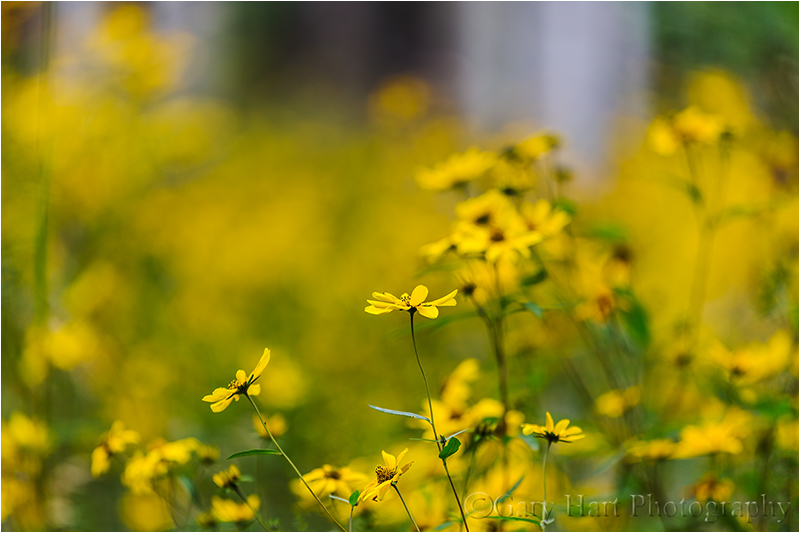
Forest Wildflowers, North Rim, Grand Canyon
Canon EOS 5D Mark III
1/100 second
F/4
ISO 200
200 mm
The reason I do this
Posted on August 27, 2013

Three Strikes, Bright Angel Point, North Rim, Grand Canyon
Canon EOS 5D Mark III
1/3 second
24-105L
ISO 100
F11
August 2013
Nature photographers plan, and plan, and plan some more, but no amount of planning can overcome the fickle whims of Mother Nature. Few things are more disappointing than a long anticipated and perfectly executed shoot washed out by conditions beyond my control. But when all of nature’s variables click into place, the world becomes a happy place indeed. And when nature ups the ante by adding something unexpected, euphoria ensues.
Don Smith and I just returned from two weeks photographing the Grand Canyon. We did a little of our own photography on the trip, but the prime focus was our two four-plus day photo workshops, split evenly between the Grand Canyon’s North and South Rims. These workshops were scheduled to give our groups the opportunity to photograph the Grand Canyon, day and night, under the influence of the annual Southwest monsoon: billowing clouds, vivid rainbows, and (especially) lightning. But any workshop requiring specific weather conditions is fraught with uncertainty and anxiety—we were fairly certain the photography would be great (after all, it is the Grand Canyon), but few natural phenomena are more fickle than lightning.
When plotting a workshop schedule (or any landscape photo shoot), the best a photographer can do is maximize the odds: We try to schedule all the non-photography requirements (meals, sleep, travel, training) for the times least likely to conflict with the best photography. For example, we know that because the monsoon thunderstorms usually don’t develop before midday, Grand Canyon summer sunrises often lack the clouds and pristine air necessary for the vivid color photographer’s covet. Therefore our photography emphasis for this workshop is on getting our groups out from mid-morning through (and sometimes after) sunset. That doesn’t mean we blow off sunrise, it just means that the sunrises are generally better for exhausted, sleep-deprived photographers to skip than the sunsets are.
Nevertheless, we rallied the troops at 5 a.m. Friday for our second workshop’s final shoot, a ten minute walk from our rim-side cabins to Bright Angel Point. The forecast was for clear skies, but the workshop had already had so many wonderful shoots, I considered this final one just a little bonus, the cherry atop an already delicious sundae.
My mind was already on the long drive home—in fact, as Don and I exited our cabin in the pre-dawn darkness, I predicted that I wouldn’t even take my camera out of my bag that morning. My words as I turned the doorknob were, “But if I leave my bag here, we’ll probably get lightning and a rainbow.” Little did I know how grateful I’d be to have brought my gear….
What followed was what Don and I later agreed was probably the single most memorable workshop shoot either of us had ever experienced. Gathering in the lobby of Grand Canyon Lodge, we saw lightning flashes across the canyon, but it was impossible to tell in the darkness how far away it was. Hiking to the vista, we saw several distinct bolts stab the rim, and by the time our gear was set up, the show had intensified, delivering numerous violent strikes in multiple directions that illuminated the canyon several times per minute.
The morning’s pyrotechnics continued for over two hours, awing us first in the dark, then through twilight, and finally into and beyond a magenta sunrise. And as if that wasn’t enough, as the sun crested the horizon behind us, a small but vivid fragment of rainbow materialized on the canyon’s rim, hanging there like a target for the lightning to take potshots at it.
This was more than just good photography, this was a once-in-a-lifetime convergence of weather, location, and light that more than made up for the many times nature has disappointed. Rather than bore you with more words, here are a few images from that morning:

Lightning Before Dawn, Bright Angel Point, North Rim, Grand Canyon
Arriving on the rim about 45 minutes before sunrise, we found the South Rim under full attack. This 30 second exposure captured a pair of strikes near Mojave Point.
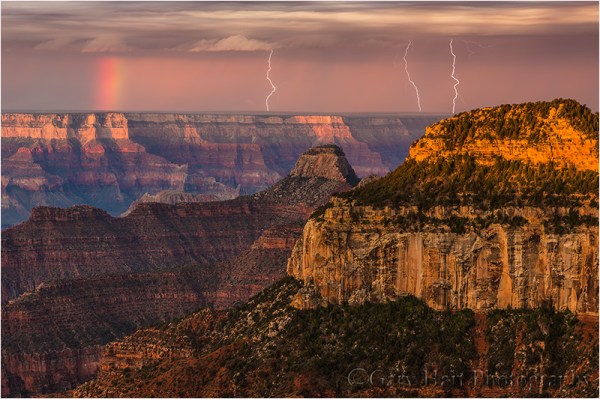
Three Strikes, Bright Angel Point, Grand Canyon
As the sun neared the eastern horizon, I couldn’t help sneaking an occasional peek behind me. Seeing clear skies in the rising sun’s direction, I crossed my fingers for the clouds to hold off long enough to allow the sunlight to illuminate the lightning show before us. As the sun topped the horizon, its rays caught the rain falling along the rim, balancing a nearly vertical section of rainbow atop Powell Point. In this single, 1/3 second exposure, I managed to capture the rainbow briefly sharing the rim with three simultaneous lighting strikes.

Color and Light, Bright Angel Point, North Rim, Grand Canyon
The rainbow persisted as the lightning continued. Confident that I’d captured enough horizontal frames, I switched to a vertical composition in time to catch one more strike with the rainbow.

Storm’s Approach, Bright Angel Point, North Rim, Grand Canyon
As the sun rose, the rocks reddened and the storm edged closer. Ridges visible earlier were slowly overtaken by the advancing rain, and long, rolling waves of thunder echoed overhead. Preceding the rain were billowing clouds; here I went with an extreme wide (17mm) vertical composition to capture the incoming storm skewering the rim with by a single bolt. I had to retreat to shelter shortly thereafter.
Grand Canyon Photo Workshops
Read about photographing lightning
A Lightning Gallery


Too close for comfort
Posted on August 22, 2013
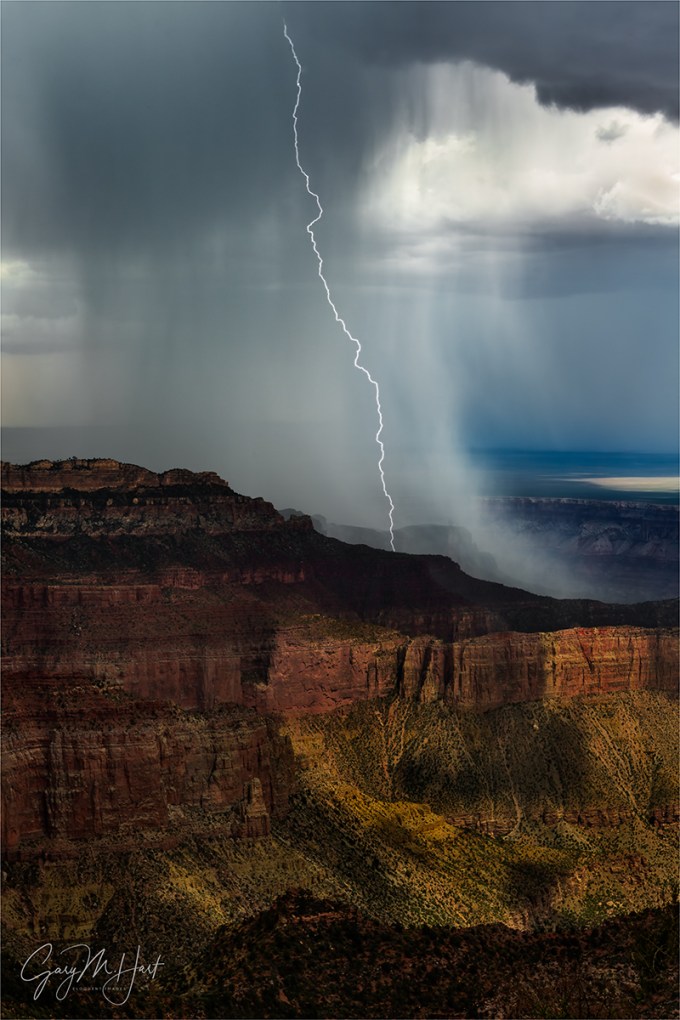
Electric Downpour, Point Imperial, North Rim, Grand Canyon
Canon EOS 5D Mark III
Canon 16-35 f/2.8L
1/8 second
F/16
ISO 50
After wrapping up our first Grand Canyon Monsoon workshop, Don Smith and I stayed a couple of extra nights on the North Rim to check-out potential locations for the second workshop. Saturday morning Don and I left our cabin with every intention of scouting (I swear) some remote, west-facing vista points, but black clouds and rolling thunder in the east (which we already knew quite well) gave us pause. The farther we drove, the blacker the clouds became, and the weaker our resolve to go scouting. A jagged bolt on the ridge north and east of the highway (a sign?) was more than enough to convince us to scuttle the scouting plan and beeline to Point Imperial.
With a 200 degree-plus east-facing panorama that includes the Vermillion Cliffs, the Painted Desert, the sheer walls of the Mosaic Canyon, and many named and unnamed red ridges and monuments, Point Imperial is one of my favorite North Rim vistas. By the time we arrived, the lightning was firing every thirty seconds north of us, well beyond the closest ridge. Gear in hand, I scrambled quickly down onto the rocks beneath the designated vista point for a better view—nobody moves faster than a photographer who feels like he’s missing the show (or so I thought). Don, a month out from knee replacement surgery, stayed up above, near the railed vista area.
Soon my Lightning Trigger had my camera firing away, usually at unseen bolts (it detects flashes obscured by clouds, or too distant for the eye), but occasionally at photogenic strikes too distant for the thunder to reach me. For the first thirty minutes the sky overhead was mostly blue and I watched with very little anxiety as the rain curtain with the most activity drifted slowly eastward. But when a thunder clap rolled across my exposed vantage point I glanced upward and saw nothing but angry clouds. So caught up in the awe of the moment, I’d failed to realize that the lightning frequency had intensified, and now some of the ridges I’d been photographing had disappeared behind an advancing downpour that looked that someone had opened a drain in the sky and released all the water in Heaven. Somewhat uncertain of my safety, I found comfort in the knowledge that the vista point above me still teamed with gaping tourists who surely knew better than this life-long California resident.
My comfort turned to concern when a rapid series of pulses drilled all the way down to the canyon floor just off to my right: One-thousand-one, one-thou… Boom! Hmmm. Maybe just a couple more frames…. Then I got the idea that, since it wasn’t raining on the point, I would leave my camera out to capture the action while waited in the car for the lightning to pass. About two steps into my controlled retreat the sky exploded. While I was pretty sure I’d broken land speed records descending the rocks when I arrived, that feat didn’t come close to the speed with which I flew back up to the car. Phew. Then the rain arrived, and suddenly my idea of leaving the camera out didn’t seem quite so brilliant. So, with rain (mixed with marble-size hail) falling, for the second year in a row, I performed a heroic rescue. Once again, with no regard for my personal safety, I dodged raindrops, hailstones, and lightning bolts (well, two out of three) to liberate my camera from the jaws of death.
Shortly thereafter the advancing column of water marched over us and set up camp. We eventually decided to move on to other locations, and while we saw lots of lightning, some of it too close to even start counting the seconds, we weren’t able to find a vantage point far enough removed from the action for photography. But for nearly an hour on Point Imperial, we had it as good as I could have imagined.
Join me in a Grand Canyon workshop
Workshop Schedule || Purchase Prints
Lightning
Click an image for a closer look, and to view a slide show.


Last Light
Posted on August 16, 2013

Advancing Squall at Dusk, Desert View, Grand Canyon
Canon EOS 5D Mark III
30 seconds
F/14
ISO 200
29 mm
It occurred to me while processing this image that, just like the lightning strike image in my previous post, this was my next-to-last image of the day. Which got me thinking about why I like these late-light images, and also about the similarities and differences between the two images.
Both images were captured in conditions much darker than the final image indicates. In this scene from Desert View on the Grand Canyon’s South Rim, the sunset’s fading vestiges clung to the northeast horizon, while a rain squall swept across the opposite rim. The workshop group had just wrapped up a glorious sunset shoot that included a double rainbow in the east, and fully illuminated, golden curtains of rain in the west. While I have many far more spectacular images from that evening (that I’ll no doubt get to eventually), there was something about the quiet of the rim after most of the photographers and sunset gawkers had vacated, that caused me to keep shooting in the gathering darkness.
As with Saturday night’s lightning image, the canyon’s color this evening was no longer visible, but it was still light enough to make out definition in the walls all the way down to the twisting Colorado River. And unlike the lightning shoot, when I was tense with anticipation of the next strike, my feeling this evening at Desert View was one of utter calm. I’d found my scene, the light was fading gradually, and all I had to do was wait for the advancing rain squall to move into my frame. Sublime.
Grand Canyon monsoon
Posted on August 12, 2013

Twilight Lightning, Roosevelt Point, Grand Canyon North Rim
Canon EOS 5D Mark III
8.6 minutes
F/8.0
ISO 200
85 mm
After a marathon drive (that included four states and one unscheduled visit with a Utah Highway Patrol officer) from Northern California to St. George, Utah, Don Smith and I arrived at the North Rim of the Grand Canyon on Saturday afternoon. Our goal was advance scouting for our back-to-back Grand Canyon Monsoon workshops, which start this afternoon (Monday). Though we’re both pretty familiar with the North Rim, we wanted to check the conditions there (the wildflowers are gorgeous right now), and since these would be our first workshops at the North Rim, we also wanted to get a better handle on the drive times to our various locations.
Another motive was to scrape the rust on our lightning triggers, which hadn’t been used since last summer. Unfortunately, the Grand Canyon weather reports were less than promising, so when we headed out to shoot sunset Saturday night, lightning wasn’t on our mind. But shortly after arriving at our sunset destination, Walhalla Point, we saw a bolt strike across the canyon, above the Painted Desert. So out came the lightning triggers, and we spent the entire shoot bouncing between the (occasional) lightning in the east and truly gorgeous sunset color and sidelight along the rim to the south.
Don and I had much better luck with the sunset than we did with the lightning triggers (it turns out the rust was more on the photographers than the triggers). Our lightning attempts targeted one area in particular, but as the light faded, so did the lightning our target zone, and we became resigned to chalking this first night up to experience. But about the time we were ready to wrap up (ever notice how many stories of successful images start with those words?), we started seeing more lightning strikes farther north. Though it was getting cold up there at 9,000 feet, we thought we’d give it one more shot and move a few miles north to Roosevelt Point.
Twilight was in full bloom by the time we arrived at Roosevelt Point; fortunately, so was the lightning. I started with my lightning trigger, but soon switched it off in favor of long exposures. It seemed that one out of every two or three 30-second exposures seemed to capture a bolt, but with the light fading quickly, I needed to adjust my exposure after each frame. Soon I found myself in bulb mode, with exposures measured in minutes. The image here is my penultimate frame, a nearly nine-minute exposure captured forty-five minutes after sunset. The long exposure was able to wring out just enough light to reveal detail in the canyon. (The final frame, though exposed 2 1/3 stops brighter, was even darker than this one.)
This image perfectly illustrates the difference between the camera’s reality and ours. The scene my eyes saw was dark: not only was the Grand Canyon’s rich red completely lost to my eyes, its ridges and chasms were reduced to barely perceptible dark shapes. And the bolts you see here were not simultaneous—the one on the right fired early in the exposure, the two on the left came together toward the end. But through my camera’s unique vision, I was able to reveal the Grand Canyon in a way we human’s can only imagine.
March madness
Posted on April 2, 2013

Comet PanSTARRS and the Grand Canyon by Moonlight, Yavapai Point
* * * *
Scheduling most workshops at least a year in advance, it’s easy to forget that distant dates will eventually become current dates. And so as 2013 approached I started looking somewhat askance at my spring schedule. Hmmm…, only four days at home from March 7 to March 29—what in the world had I been thinking? Ten days circling Maui and ten days bouncing between Phoenix, the Grand Canyon, Page, and Sedona seemed like such a good idea at the time, but now that I was actually going to have to pack my suitcase and hit the road (as much as I looked forward to each destination), I seriously wondered if I’d made a mistake. Well, with March 2013 now in my rearview mirror, I’m happy to not only did I survive, I thrived. A little worn around the edges perhaps, but nevertheless quite happy with an unforgettable month of photography and friendship.
Helping me survive March was my good friend and fellow pro photographer Don Smith—Don assisted my Maui workshop, I assisted his Northern Arizona workshop, and we shared the Spring Training experience with Don’s son Aaron. Truth be told, Don and I have far more fun on the road than two grown men should have—we returned from these adventures with a fresh trove of stories that included a beer glass accident resulting in a free dinner for our entire table (thanks, Don), and a car stuck in the mud on a remote dirt road we (I) had no business attempting.
Another March treat that can’t be overstated is the opportunity leading workshops provides to make new photographer friends and reconnect with old ones. Spending hours driving to and from locations, sharing meals, and waiting in the dark for the sun or stars is a great way to get to know people—I never fail to marvel at photography’s ability to bond people with such diverse professions, cultures, interests, and values.
For those of you who haven’t been paying attention, here’s a review of some of the great sights I was blessed with in March (in no particular order):
* * *

Comet PanSTARRS and New Moon, Haleakala, Maui
Regular readers know that I’m a lifelong comet enthusiast, so a major March highlight for me was the opportunity to photograph Comet PanSTARRS from atop Haleakala, the location of the PanSTARRS telescope that discovered the comet. I’m always surprised when people don’t realize how incredibly beautiful (and photogenic!) a comet is, but I’m pretty sure I made a few comet converts this year.
* * *

Sky on Fire, Hopi Point, Grand Canyon
The Grand Canyon delivered colorful sunrises and sunsets each day, and the extreme cold (remember, I’d just returned from Maui) was a reasonable price for avoiding the flat blue skies that frequently make the Grand Canyon so difficult to photograph.
* * *

Bamboo Sky, Maui, Hawaii
As someone who loves seeing things I’ve never seen, the exotic beauty of Maui’s bamboo forest was a particular thrill.
* * *
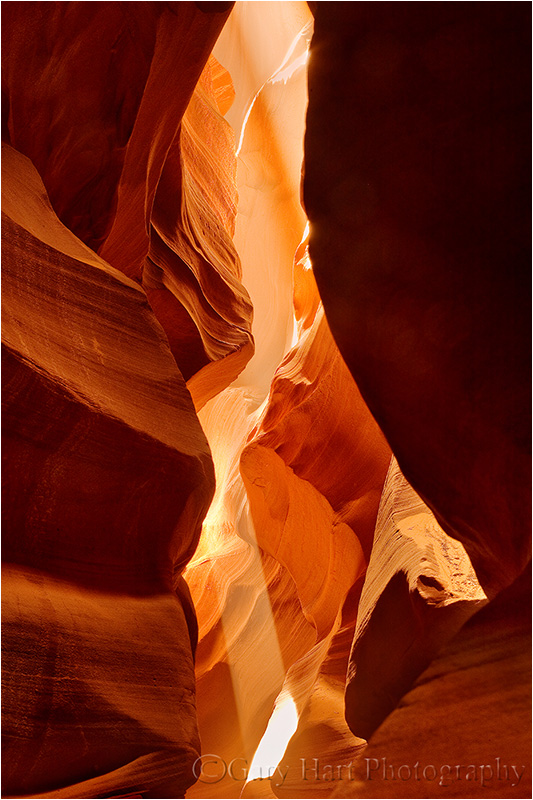
Heavenly Beam, Upper Antelope Canyon, Arizona
At Upper Antelope Canyon, not only did our workshop group get the much coveted beams of light, the timing of our tour somehow managed to avoid the crowds at the beam locations. (I’ve photographed there enough to know that this was a total fluke that couldn’t have been planned.)
* * *

Waterfall and Pool, Road to Hana, Maui
I’ll never tire of the Road to Hana, with a surprise at every turn and a seemingly infinite supply of waterfalls. My goal with each visit is to find something new—this time I scrambled and rock-hopped up a narrow canyon to find a 100 foot waterfall plunging into a translucent turquoise pool.
* * *

Lava Pool, West Maui, Hawaii
After nearly marooning on a muddy, remote dirt road on West Maui, on our final night Don and I returned to find out whether the spot was worth the trouble—it was.
* * *
Comet PanSTARRS and the Grand Canyon by Moonlight, Yavapai Point
* * *

Giants/Angels at Tempe Diablo Stadium, March 24, 2013 (click to enlarge)
Somehow in the midst of all this photography Don and I managed to indulge my baseball passion by tacking a four day Arizona Spring Training visit to the Northern Arizona photo trip. The weather couldn’t have been better (unless you don’t like 80 degrees and blue skies) and we got a healthy dose of our (World Champion!) San Francisco Giants. I’ve made this pilgrimage about fifteen times (I’ve lost the exact count) in the last twenty-five years and it never fails to disappoint.
* * *
And that was my March, a month that could have battered me but instead reminded me how fortunate I am to do what I do. Bring on April!
In my right mind at the Grand Canyon
Posted on March 30, 2013
Sky on Fire, Hopi Point, Grand Canyon
Canon EOS-5D Mark III
1 second
F/16.0
ISO 400
20 mm
Photographing the Grand Canyon isn’t easy (I’ve said this before)
The Grand Canyon is a very difficult place to photograph. Or more accurately, the Grand Canyon is a very difficult place to photograph well. More than any place I photograph, the Grand Canyon incites right/left (creative/logical) battles that can kill an image.
Despite (and likely because of) the Grand Canyon’s sweeping grandeur, you can’t expect to simply walk up to the rim and find a shot that does the scene justice. The view at the rim puts your emotional, creative brain on overload, and you instantly forget that the Grand Canyon’s depth and breadth, the very things that make it so breathtaking in person, are completely lost to the camera’s two-dimensional, confined perspective.
Overcoming these losses starts with understanding your camera’s vision and refining your ability to recognize and organize your scene’s compositional elements (subject, color, depth, light, visual flow), and how to manage them with your camera’s variables (f-stop, shutter speed, ISO, focal length). With that in place, you’re ready to formulate an actual plan for approaching the scene you plan to photograph. But keep in mind that plans can be a creative straightjacket (especially in a dynamic, unpredictable location like the Grand Canyon)—you also need the flexibility to overcome disappointment and quickly shift to Plan B when Plan A doesn’t materialize. For me, implementing all this means arriving early and spending every non-shooting moment familiarizing myself with my surroundings, the light, and the conditions in the sky.
Once my plan is in place, I put my left brain to bed and wake my right brain. Ultimately, despite all the analysis and planning that goes into setting up a shot, I try to click the shutter with my heart—does it feel right?
Putting it all together
My “plan” for this evening at the Grand Canyon’s Hopi Point was to photograph a full moon rising in the east, above the canyon, an image I’ve long sought. When clouds hugging the eastern horizon thickened I could have stubbornly stuck to my guns and hoped the moon would somehow find its way through. On the other hand, I knew if the moon didn’t show and something nice started in the west (where the sky looked more promising), I’d have to scramble to the other side and hope to quickly find a composition that did the moment justice. Always conscious to avoid reactive photography, I jettisoned the east-facing moonrise plan and headed over to re-familiarize myself with Hopi Point’s west side (but that didn’t keep me from sneaking back around for an occasional peek to the east).
The Grand Canyon is great for this kind of anticipatory photography because the unobstructed view of the horizon from the rim allows provides good insight into what’s in store. Once I switched views, I spent the rest of my pre-shooting time walking Hopi Point’s western rim, identifying trees, shrubs, and rocks that could anchor my frame and balance the distant ridges, river, sun, and clouds.
The moon that evening was in fact a no-show (until it was far too late to photograph), but the view to the west rewarded me with about forty-five minutes of productive, continuously improving photography as the sun slipped in and out of gaps in the clouds before finally dropping to and below the horizon. The highlight came couple of minutes after sunset, when a fan of thin clouds spewing from the sun’s exit point started throbbing with crimson, creating a flame-like effect.
But I wasn’t satisfied with a nice sky above the beautiful canyon (nor should you be)—I needed relationships between my foreground and background. After spending most of my shooting time emphasizing the canyon’s vast lateral expanse with wide, horizontal compositions anchored by a distinctive tree, I wanted a vertical composition that would turn the emphasis to the canyon’s depth beneath the flaming sky. Continuing with my horizontal frame would have been too wide to capture the sky’s impact. But because I’d spent so much time exploring earlier, I went right to this spot where a small (albeit unassuming) shrub jutted from the textured rim rock.
Given the extreme depth of field my composition required, I opted for f16, live-view focusing on the rock just behind the shrub. A gusty breeze forced me to bump my ISO to 400 and time my shutter click to coincide with the wind’s intermittent lulls. My 3-stop reverse graduated neutral density filter reduced the significant dynamic range to a very manageable level that allowed me to capture the entire range of light in a single frame (my personal rule). (Later I smoothed the barely visible GND transition with a few dodge/burn brush strokes in Photoshop.)
Photographing in my right mind
Once I’ve identified a scene’s compositional elements and exposure variables, I turn off my left (logical) brain and engage my right (creative) brain. (This is no longer conscious, nor is it genius—it’s pretty much just the product of years of repetition.) I composed the scene in my viewfinder (still haven’t embraced the live-view composition thing), moving up/down, forward/backward, left/right, and zooming in and out until everything felt balanced. While I’d love to claim that I was conscious of the virtual diagonals connecting the flaming sky and flame-shaped shrub, and the shimmering sliver of the Colorado River and nearby vein of light colored rock, I really wasn’t. But neither do I believe relationships like this are accidental—I’ve done this long enough to know that compositional relationships happen organically when I free my mind from distractions that force me to think when I should be creating.
Epilogue
It’s interesting to compare this image with one I created from within a few feet of this location a few years ago. While each contains many of the same elements, the conditions were vastly different, and so were my objectives, and ultimately, my compositional choices.

Sunset, Hopi Point, Grand Canyon
Grand Canyon Photo Workshops
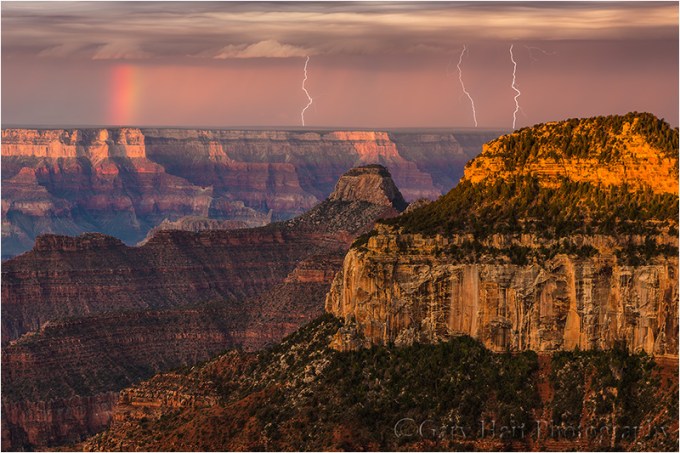
Three Strikes, Bright Angel Point, North Rim, Grand Canyon National Park
A Grand Canyon Gallery
Click an image for a closer look, and a slide show. Refresh the screen to reorder the display.


Reliving the dream: Comet PanSTARRS above the Grand Canyon
Posted on March 25, 2013

Comet PanSTARRS and the Grand Canyon by Moonlight, Yavapai Point
* * * *
A couple of weeks ago I wrote about fulfilling my Comet PanSTARRS dreams from atop Haleakala (the location of PanSTARRS’ discovery) on Maui. After nearly a year of anticipation, being able to photograph this beautiful comet paired with a new moon had left me sated. And anyway, with the comet fading fast, I had no illusions that I’d be able to top what I already had. But less than two weeks removed from Maui, finding myself in Arizona to assist Don Smith’s Northern Arizona workshop (Don assisted me in Maui) and still seeing nice PanSTARRS images online, I decided to check PanSTARRS’ location relative to the Grand Canyon (where the workshop kicks off). And guess what…. Not only did it look like we could align PanSTARRS with the Grand Canyon, the 93% waxing gibbous moon would be perfectly positioned to illuminate the canyon, normally a bottomless black pit at night.
I should mention that Don and I preceded our Northern Arizona trip with a few days watching Spring Training baseball (go Giants!) in Phoenix, a much needed respite separating a grueling week on Maui from an equally grueling trip to the Grand Canyon, Page (Antelope Canyon, Horseshoe Bend), and Sedona. (I know, I know, if our life gets any tougher U2 will probably be doing a benefit concert for us, but Don and I are just givers.)
Our original plan had been to catch the Giants and Angels in Tempe on Sunday afternoon, then take a leisurely drive to our hotel near the South Rim that night. But when I told Don about the opportunity to reprise our Maui PanSTARRS shoot, he was all for it. We bolted the Giants’ game in the seventh inning and rolled into the parking lot at Yavapai Point (by my calculation the only easily accessible, ideally aligned location) about 30 minutes after sunset.
We found the rim gloriously empty (and shockingly cold after Maui and Phoenix). The western horizon still held traces of warmth from the just finished day, but moonlight had already started spilling into the canyon. By the time we were set up and ready to shoot the sky had darkened enough that it was about dark enough to shoot. After a couple of test shots to get the exposure right and locate PanSTARRS (it’s too faint now to be seen with the naked eye), we got down to business. The comet was clearly visible as a white smudge on my LCD screen, even more visible than I expected it to be, making framing it in the composition easy. I just kept clicking, trying many horizontal and vertical variations as I could, until the comet finally faded into the orange haze.
Tonight we’ll take the group out and try again….
Heaven on Earth
Posted on September 4, 2012

Heaven on Earth, Lipan Point, Grand Canyon
* * * *
Let’s see, this day included an eight hour drive, a torrential downpour, lightning, and a rainbow, all sandwiched between breakfast in Barstow and this sunset. Just another day at the office….
Top to bottom landscapes
Many people spend a tremendous about of time pursuing beautiful images with little or no regard for the half of the scene. They end up with a beautiful scene beneath a bland sky, or a tremendous sky above whatever happens to be in front of them. Combining foreground and sky takes a little bit of preparation, a little bit of good fortune, and a fair degree of sacrifice.
But when sky and foreground do come together, your ability to share the beauty starts with appreciating it personally. Don’t get so caught up in photography that you neglect to take a deep breath and take in what you’re witnessing. Now, with the proper sense of awe in place, it’s time to figure out how to do the moment justice.
Did you Photoshop that?
I find that images from the most special moments are those that engender the most skepticism, that generate the looks, comments, and queries that really all ask the same question: “Did you Photoshop that?” Of course the obvious answer is, “Of course I Photoshopped it.” Photoshop is to digital photography as thunder is to lightning. But since the people asking this question have identified themselves as the people most likely not to understand that there hasn’t been an image captured in the history of photography that wasn’t subjected to processing of one form or another (many actually believe that a jpeg is an unprocessed image), acknowledging any processing at all usually just evokes a condescending (albeit ignorant) nod that says, “I knew it.” These skeptics’ real concern is that I’ve somehow deceived them, and to that I can plead emphatically, with a clear conscience, not guilty.
We all have our own rules for what is and isn’t an appropriate way to handle an image. And regrettably, there are photographers who have no qualms about deceptive processing. But there are many less justified reasons for skeptical scrutiny of dramatic images. One is that that many people simply forget how vivid color is in nature. Also, because the best conditions for photography are usually the worst conditions for being outside, relatively few people actually see the world at its most beautiful. And finally, many people (photographers included) hold a photograph to an impossible standard: to reproduce the world exactly as they experience it. Dynamic range, range of focus, motion, a scene’s depth and boundaries are all different to a camera than they are to you and me. Understanding and using these differences is the key to transcendent photography.
My personal standard is to remain true to my camera’s reality and to apply my creativity in my camera and not my computer. While I refuse to add things that weren’t present at capture (this doesn’t make me unique), I nevertheless love the control Photoshop gives me, control that I never had in my 25+ years of shooting color transparencies. Much as black and white photographers have done for years, I can now photograph a difficult scene, one that would have been impossible in my film days), in a way that anticipates the processing necessary to reproduce it. And even though I can’t see it in the small jpeg reproduction on my LCD, I know when my raw file contains everything I need to complete my vision, just waiting for Photoshop to finesse it out. Ansel Adams labeled this capture-to-print approach “visualization”; it was the cornerstone of his success.
For example: capture
When the setting sun fanned crepuscular rays that bathed the Grand Canyon in golden light, my first thought was that nobody will believe this. Sigh. But my more immediate concern was how to deal with the extreme difference between the brilliant sky and shadowed canyon (dynamic range). I knew that without assistance I’d have to choose between capturing the canyon’s layered detail beneath a white sky, or the sky’s rich color above a black canyon. Since I (stubbornly) refuse to use HDR (high dynamic range blending of multiple images), that left my graduated neutral density filters as the best option for neutralizing the scene’s extreme dynamic range.
The biggest problem with a GND is hiding the transition between the dark and light halves of the filter, but locations like the Grand Canyon, with its straight horizon lines, are ideal for GNDs. In this case I started with my 3-stop reverse GND and checked the exposure. Not enough. I added a 2-stop hard-transition GND and checked again, confirming that 5 stops of ND did indeed subdue the brilliant sunlight enough to capture its warm color while allowing a foreground exposure that revealed canyon detail. Unfortunately, this recipe rendered the clouds from dark gray to nearly black. Nevertheless, the histogram showed enough shadow detail that I was confident I’d be able to rescue the clouds in processing.
For example: processing
The difficult light and use of 5-stops of neutral density required far more processing than typical for me. I started with basic Lightroom processing of the raw file, tweaking the color temperature (warming slightly), adding a light touch of vibrance and clarity, and applying a little noise reduction and the standard lens correction. Then it was on to Photoshop, where I found the processing for the foreground remarkably simple—pretty much adding a little contrast and slightly dodging some of the darker shadows.
The sky was a different story, demanding probably 90 percent of this image’s processing. While I was able to bring up the exposure in the clouds, this introduced lots of noise. In general clouds lack fine detail and can stand quite a bit of noise reduction, and that was (fortunately) the case here. Not wanting to touch the canyon half of the frame, I created a layer for the clouds and applied a heavy dose of Topaz Denoise. This left the clouds a little more homogenized that I like, but it’s nothing I can’t live with.
With the noise out of the way, I went to work with my dodge/burn brush, working carefully (painstakingly?) to smooth out any evidence of GND use, and also to fine tune the clouds. I referred to the original, unprocessed raw file with the exposure cranked way up (to make the differences more obvious), doing my best to brush in the actual relative lightness/darkness of the numerous cloud layers.
Finally I went after the color, which, while not enhanced, was to me was too intense in its unprocessed state to make a credible image. (Sadly, I’m rarely present to defend nature’s color to dubious viewers). So I created several layers to desaturate and lighten the blue sky and gold sunlight. I also removed a slight blue cast from the canyon’s shadows.
The finished product is an image that pleases me greatly. While it lacks the depth and dynamic range of being there, it does convey to me the majesty of this moment that ended a memorable day, when the sky opened and heaven poured through.
Riding the celestial carousel
Posted on August 28, 2012

Star Trails, Desert View, Grand Canyon
Canon EOS-5D Mark III
28 mm
31 minutes
F/4
ISO 400
It’s pretty difficult to feel important while reclined beneath an infinite ocean of stars, peering into the depths of the Grand Canyon. Below you unfolds a cross-section of Earth’s last two billion years, chronological layers of landscape sliced by gravity’s inexorable tug on the Colorado River; overhead is a snapshot of the galaxy’s (perceived) pinwheel about the axis of our planet’s rotation.
From our narrow perspective, at any given time, the Universe appears fixed. But observe the night sky for a few hours and you soon realize more is at play. Those points of light overhead all follow the same east to west arc across the celestial sphere, ultimately disappearing beneath the horizon (or behind the glow of daylight). Most return to the same place twenty-four hours later, but a few shift relative to the stellar background. For millennia explaining these wanderers while maintaining our position at the center of the Universe required convoluted solutions that defied scientific scrutiny. Then Copernicus, in one elegantly simple paradigm shift, removed Earth from the center of the universe and set us spinning about the Sun, pouring the foundation for humankind’s understanding of our place in the Universe. The humbling truth is that we inhabit a small planet, orbiting an ordinary star, on the outskirts of an average galaxy.
Thanks to Copernicus, Galileo, and others who followed, we now take for granted that Earth revolves about the sun, secured by gravity’s invisible string. And while it appears that our star-scape spins above our heads, it’s actually you and me and our seven billion Earth-bound neighbors who are spinning. (It helps to imagine Earth skewered through our north and south poles and spinning around a pole of infinite length.)
For those of us in the Northern Hemisphere, the centerpiece of this nightly show is the North Star—Polaris. Conveniently (and coincidentally) positioned less than one degree from the northern axis of our spin, Polaris is a white-hot ball of ionized gas six times the size of our Sun. (It’s so distant that when the light we see tonight left Polaris’ surface, Copernicus was less than a generation dead and Galileo was a teenager.)
Locked into our terrestrial frame of reference, distracted by the problems of life, we stay generally oblivious to the celestial dance overhead. But I can think of no better way to get some perspective on our place in the universe than to look up on a moonless night, far from city lights. On these nights our planet’s rotation, too slow to be perceived at any given instant, is captured beautifully by a fixed, Earth-bound camera that rotates with us, blending multiple, sequential instants into a single frame. This long exposure stretches each star, a discrete point to our eye, into continuous arc of light, the length of which is determined by the duration of the shutter’s opening—one degree of arc for every four minutes of exposure.
From our perspective the northern sky appears to circle the north celestial pole (occupied by Polaris). Images that include celestial north are etched with concentric arcs—if there were some way to continue the exposure for twenty-four hours (say in the dead of winter at the North Pole), our image would show Polaris like a brilliant gem ringed by full, perfectly symmetrical circles. To a camera centered on the celestial equator (the halfway point between the north and south axes of rotation), a long exposure reveals divergent arc, with the stars north of the celestial equator bending around the north celestial pole and stars south of the celestial equator bending the other direction, around the south celestial pole.
A few words about this image
The above image was captured during my 2012 monsoon trip to the Grand Canyon. Don Smith and I had spent the day chasing (and dodging) lightning, but because we didn’t feel we’d taken enough risks, we thought it might be a good idea to stumble about with the mountain lions, in pitch dark, on the rim of a one mile deep chasm.
While photographing late afternoon and sunset from Desert View, we scouted potential starlight locations in daylight, and returned to the car to eat sandwiches and wait for darkness. And dark it was. Dark enough that I couldn’t really see the canyon’s edge, which was about two feet from my tripod.
Also dark enough that focus was a real challenge. Using my fastest lens, a 28mm Zeiss f2, I found the brightest star and centered it in my viewfinder, then switched to live-view, magnified the view 10 times, and manually focused on the star, which was faintly visible near the center of my LCD. (My Zeiss doesn’t have autofocus—if you try this with an autofocus lens, don’t forget to switch it to manual focus before shooting.)
With focus set, I tried some test frames to get the exposure and composition. It was too dark to compose the canyon through my viewfinder, so I bumped my ISO to 24600 and took a series of wide open (f2), 30-second exposures, tweaking the composition after each until I got it right. Knowing that increasing my exposure duration from 30-seconds to 30-minutes would add six stops of light, I subtracted six ISO stops (25600 to 400). (I’m still learning this lens’s capabilities—next time I’ll stay at f2 and go all the way down to ISO 100 for a 30-minute exposure.)
Waiting for our exposures to complete, Don and I just kicked back and admired the night sky. We saw several meteors cut the black, and several satellites drift by. The city of Page, sixty-five miles north, was a faint glow to our eyes (but much brighter to the camera). Sporadic lightning flashes illuminated clouds to the northwest, well beyond the North Rim and probably as far away as Utah. And the Milky Way, the community of billions of gravitationally connected stars to which our Sun belongs, spread from horizon to horizon.
Read more about after dark photography
Workshop Schedule || Purchase Prints
An After Dark Gallery
Click an image for a closer look, and a slide show. Refresh the screen to reorder the display.


 Eloquent Images by Gary Hart