Eloquent Images by Gary Hart
Insight, information, and inspiration for the inquisitive nature photographer
In the Pink
Posted on February 14, 2026
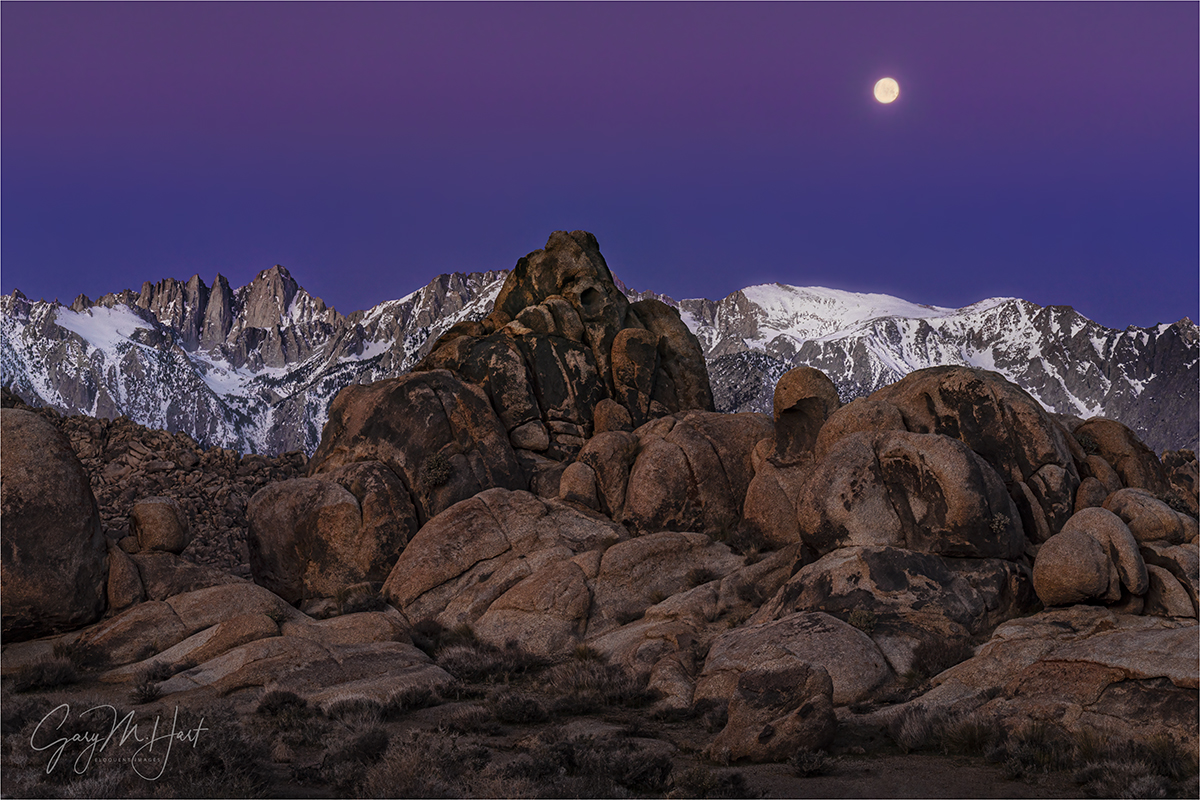
Twilight Wedge and Setting Moon, Mt. Whitney and the Alabama Hills, Eastern Sierra
Sony a7R V
Sony 24-105 G
1/5 second
F/16
ISO 100
The rewards of rising before the sun are many. For me, the opportunity to witness twilight’s soft, cool light slowly warmed by the approaching sun, to breathe in the cleanest air of the day, and to simply be alone with the purest sounds and smells of nature, are ample compensation for whatever chill and sleep deprivation I might experience. And on mornings when the sky is cloudless and the air especially pure, there might just be a bonus.
To collect that bonus, about 20 minutes before sunrise, look for parallel bands of vivid pink and steely blue hugging the horizon opposite the rising sun. Many photographers, myself included, call this early display the “twilight wedge,” but it has other similarly non-scientific names. Closer to the horizon, the dark blue band is actually Earth’s shadow—the final section of sky not receiving any direct light from the soon to appear sun; just above, the pink band is the the day’s first rays of direct sunlight. It’s pink because the sun is just far enough below the eastern horizon that the only its longest, red wavelengths manage to battle through the atmosphere all the way to the other side of the sky. The cleaner the air, the more vivid the twilight wedge’s color. (This color is also possible after sunset, but by day’s end there are usually more color-robbing particles in the air, and Nature’s quiet is often disturbed so much by human activity that some of the magic is lost.) And when towering peaks soar far enough above the viewer’s vantage point that they jut into this pink twilight wedge band, we call it alpenglow.
I love finding beautiful scenes to go with the gorgeous pre-sunrise sky opposite the sun. Near the top of my list is the Alabama Hills, in the shadow of the highest Sierra Nevada peaks. The Alabama Hills are a disorganized jumble of massive, weathered boulders covering many square miles, making an ideal foregrounds for the assortment of serrated peaks looming to the west. A more perfect arrangement for nature photographers couldn’t be assembled—and, as if that’s not enough, the Alabama Hills are also among the best places on Earth to photograph alpenglow.
Of course all this is no secret, and the Alabama Hills has become one of the most popular photography spots in California. To improve my chances of capturing unique images here, I love adding the moon to my Alabama Hills / Sierra Crest scenes. (And when I say “add,” I mean the honorable, old-fashioned way, not with AI or other digital shenanigans.) For years, I’ve timed my Death Valley winter workshop to allow me to take my group to the Alabama Hills, just a 90 minute drive from Death Valley, for the workshop’s final sunset, followed by the moon setting behind the Sierra Crest at sunrise the final morning.
Of course, because there’s only one “best” day in each lunar cycle to photograph a full (-ish) moon setting behind the Sierra Crest, I have no wiggle room when scheduling this workshop—a day early, and the moon is gone before the landscape is light enough to photograph; a day late, and the sky is much too bright by the time the moon drops close to the mountains.
But even nailing the day doesn’t ensure success. Clouds are of course a concern, especially in winter. And each year the timing and position of the moon’s disappearance behind the crest is a little different. In January and early February (when I always schedule this workshop), viewed from my preferred location, the moon sets somewhere between Mt. Whitney and Mt. Williamson (California’s two highest peaks), usually closer to Williamson.

Before Sunrise, Mt. Whitney and the Alabama Hills, California (30 minutes before sunrise)
I like to get my groups out to the Alabama Hills about 30 minutes before we can start photographing the moon. The foreground will still be quite dark to our eyes, and the moon will at least 10 degrees above the crest, but I tell my students to start shooting as soon as we arrive.
Using a long exposure in a frame that doesn’t include the moon (the top of the frame is below the moon), captures much more (mostly shadowless) foreground detail than our eyes see, while juxtaposing the mountains’ light gray granite against a sky that’s darker than the peaks—a magnificently striking sight indeed, especially when there’s snow on the peaks. We’ll keep shooting versions of this until it’s time to include the moon in the festivities.
For any moon photography, the darker the sky, the better the moon stands out. But too early and it’s impossible to capture foreground detail without completely blowing out the moon. For me, the time to photograph any setting full moon starts about 20 minutes before sunrise—basically, as soon as the landscape has brightened enough foreground and lunar detail with one click. And if we’re especially lucky, when that time arrives, we’ll find the moon in the midst of a vivid pink twilight wedge.
This opportunity only lasts a few minutes, because as the sky brightens and the foreground exposure gets easier, the color fades and the essential contrast between the sky and moon decreases. The twilight wedge lasts less than 10 minutes, and is followed by slowly warming sky. By maybe five minutes after sunrise, the good color is long gone and the moon/sky contrast has decreased enough for me to put my camera away.
This year’s Alabama Hills moonset was especially nice. One of my favorite things about my Death Valley / Alabama Hills workshop is that we get two “ideal” (moon setting as the color and light are at their best) sunrise moonsets for the price of one. On our last day in Death Valley, from Zabriskie Point we photograph the moon setting behind Manly Beacon, one of Death Valley’s most striking and recognizable features. Because the mountains behind which the moon sets from Zabriskie rise only about 3 degrees above a flat horizon, this moonset happens much closer to the “official” (flat horizon) sunrise that’s universally used for any celestial rise and set. The next morning we’re in the Alabama Hills—even though the moon sets about an hour later than it did the day before, because the Sierra Crest towers about 10 degrees above the horizon when viewed from the Alabama Hills, the actual moonset we see happens at just about the same time as the prior day’s moonset.
Which is exactly things unfolded for this year’s workshop group. We followed up a beautiful Death Valley Zabriskie Point sunrise moonset, with a similarly outstanding Alabama Hills sunrise moonset the next morning. The vivid hues of the twilight wedge had just peaked when I clicked this image. To my eyes, this entire scene (except the moon), and especially the foreground, was much darker than this image shows. But my camera’s ridiculous dynamic range, combined with Lightroom’s masking that allows me to process the sky and foreground independently from each other, enabled me to expose the scene dark enough to capture essential lunar detail, yet remain confident I had enough recoverable detail in the foreground.
Workshop Schedule || Purchase Prints || Instagram
Alabama Hills Gallery
Click any image to scroll through the gallery LARGE


Ten Reasons to Take Up Nature Photography
Posted on January 16, 2025

Lunar Peek, Zabriskie Point, Death Valley
Sony a7R V
Sony 24-105 f/4 G
ISO 125
f/11
1/4 second
Recently I was talking to a friend on the cusp of retirement, and while she was looking forward to her impending freedom, she wasn’t sure what she was going to do with all her free time. I instantly blurted, “Nature photography!,” then started listing reasons. I surprised even myself with everything I came up with, and how quickly it came, which got me thinking the subject would make a good blog post. So here are my (very biased) thoughts on why nature/landscape photography makes the ideal pastime. (After reviewing the list, it turns out that most of my points apply to many other kinds of photography as well.)
- Save experiences: Ours is a beautiful, dynamic world. Over my lifetime, I’ve been fortunate to have witnessed Nature at its very best, more times than I can count. Though he’s no longer here to thank, for this I’m most grateful to my father—a serious amateur photographer who wouldn’t dream of traveling without a camera—for modeling the importance of recording these moments. It’s no wonder that, almost as soon as I was old enough to make my own major financial decisions, I purchased a 35mm SLR system of my own—mostly because (thanks to my dad) I thought that’s just what adults do. Thanks to my camera, the knowledge that I can revisit Nature’s ephemeral moments any time I want to is a source of great comfort.
- Share experiences: I think my father got as much pleasure sharing his travel experiences as he did recording them. Back in Dad’s time, most non-professional photographers’ images only reached other eyes when (captive?) visitors were sequestered in front a projection screen in a darkened living room (because there was really only one answer to the dreaded question, “Hey, do you want to see the pictures from our vacation?”). And while I won’t pretend Dad never subjected our visitors to the occasional slide show, as a United Methodist minister, he had a whole congregation filled with potential viewers, not to mention access to a large space ideal for sharing. Given the number of people who attended his shows without being compelled or held hostage, I’d say his images were well received. Today, the thrill of taking pictures that please others is as great as it’s ever been, but the opportunities to share them in our digitally connected world have increased exponentially.
- Low start-up cost: Camera gear can be ridiculously expensive, but it doesn’t need to be. Your smartphone will take surprisingly good pictures—good enough to reap most of the benefits listed here long enough to determine whether a bigger investment is justified. And when you do decide you want more serious dedicated photo gear, you can find quality equipment at pretty much any price point. In other words, expense should not be a reason not to pursue photography.
- Flexible income potential: I encounter many people who would like to make a living with their photography. And while there is still excellent money to be made with a camera, nature photography is not among the more lucrative options—not by a long shot (sorry). Fortunately, earning money with a camera doesn’t require you to quit your day job. You can pursue photography as an avocation, reaping the many personal benefits while dipping your toes into selling images (for publication), prints, and services until it grows into something lucrative. That was my path: More than 20 years ago I started doing weekend art shows while keeping my adult job, then gradually segued into workshops, training, and photography-related writing, until I felt confident pursuing photography as a profession. For a while after going fulltime I continued with the art shows, which were both lucrative and fun, but doing art shows and workshops felt like working two different jobs, and the path to a fulltime income with workshops was much clearer, so I dropped the art shows. On the other hand, I know photographers who earn a good living through art and gallery shows. And today, social media has increased the money-making opportunities far beyond what was available when I started.
- See the world (large): Need an excuse, or maybe just a catalyst, to travel? Try photography. It’s easy to get so locked into a day-to-day comfort zone that our dreams of visiting yearned-for locations are never fulfilled. I’m afraid that would probably describe my life were it not for photography. But, going all the way back to when photography was just a hobby, my camera and I have visited remote corners of the globe, enjoyed river rafting adventures in Grand Canyon, and witnessed more celestial and meteorological sights than I ever imagined possible.
- See the world (small): More than just visiting exotic locations, viewing the world with a photographer’s eye enables me to see beauty everywhere, from the distant horizon to right at my feet. I can say with absolute certainty that my own photographer-eyes have become hyperaware of my surroundings, noticing colors, textures, relationships, and minute detail everywhere—not just when I’m actively taking pictures, but pretty much as long as I’m awake: driving, walking, running, or simply sitting still. Not only that, to this day, the more time I spend taking pictures, the more this heightened vision improves.
- Commune with Nature: For many people, myself included, few things are more soothing than quiet time with Nature. This enhanced relationship with the natural world can be active or passive. When I’m immersed in a natural environment, away from the din of “civilization,” all of my senses intensify and seem to work in synergy, providing peace I don’t feel at any other time. But there’s more—even when I’m stuck inside, my life as a photographer inspires me to pursue deeper understanding of my subjects that helps me appreciate them even more.
- Ideal solitary activity: Are you an introvert who recharges by being alone? Nature photography has you covered. I think most of us have times when we just need to dial down the pressures and sensory dissonance of daily life. I can think of no better way than full immersion in the serene sights and sounds of the natural world, completely absent the need to please, impress, or in any other way interact with the rest of the world. When I’m alone in Nature, time seems to stand still, my senses amplify, and my connection to my surrounding is never stronger.
- Ideal group activity: Are you an extrovert who recharges by being around others? Nature photography has you covered. Some of the most memorable experiences of my photography life were made that way because I was able to share them with other like-minded individuals. The joy of these moments is contagious, at times amplified enough by the presence of others to move me to tears.
- Cultivate your creative and analytical brains: I can think of few endeavors that more perfectly blend the right and left brain than photography. Some photographers are drawn by photography’s creative opportunities to view and express the world; others love the technical aspects of managing exposure and focus with their camera’s many controls. While it’s possible to take pictures with just one side of the brain or the other engaged, most people who take up photography are surprised to learn that there is indeed life on the other side of the brain.
About this image
Lunar Peek, Zabriskie Point, Death Valley
The Zabriskie Point moonset is always a highlight of my Death Valley Winter Moon photo workshop. Often we get no clouds, making this sunrise moonset a no-stress event for me. This time (January 2024), when clouds threatened to wash out the shoot entirely, was not one of those events.
The moon was visible above the clouds when we arrived, but the sky was much too dark to capture lunar and foreground detail with one click (my personal requirement). When the moon dropped into the clouds and disappeared completely, I tried to rationalize that at least we’d have nice clouds for our moonless sunrise, but I used all the positive energy I could muster to will the clouds into parting.
Though it lasted for only a couple of minutes, the moon did indeed slip into a small opening long enough for everyone in the group to get a few frames before being swallowed for good. Though only had time for a handful of frames with enough moon to be worthwhile, I think most photographers would take quality over quantity any time.
Workshop Schedule || Purchase Prints || Instagram
The Joy of Nature
Click any image to scroll through the gallery LARGE


Playing the Odds
Posted on November 21, 2023

Twilight Moon, Zabriskie Point, Death Valley
Sony a7R V
Sony 24-105 f/4 G
ISO 100
f/10
1/13 second
First and foremost, a good landscape image usually requires…, well…, a good landscape. But merely getting yourself to the good landscapes is only half the image success equation, because good landscape photography also requires good conditions: colorful sky, dramatic clouds, complementary light, a striking celestial object, or some other natural quality that elevates the scene to special.
One way to include these ephemeral variables is to monitor conditions closely enough to respond in time to photograph them. Which of course also requires being relatively nearby when the conditions become favorable. Not necessarily a problem when my desired subject is close to home and the only affected schedule is my own, but my photo workshops need be planned more than a year in advance, so the proximity and react quickly approach doesn’t really work. Instead, the best I can do is schedule workshops to maximize the odds for ideal light, interesting skies, and other photogenic conditions—then cross my fingers.
For example, visiting Iceland in January or February increases the odds for the northern lights and low angle all-day sunlight; June in New Zealand provides the best chance for snowy peaks, and it’s the month when the core of the Milky Way up all night; and early August (+/- a week or so) at the Grand Canyon is generally the peak of the Southwest monsoon’s spectacular lightning and rainbows. While each of these features can be thwarted by uncooperative weather, at least we’re close enough to be there when the good stuff happens.
My annual Death Valley / Mt. Whitney photo workshop is another example of playing the odds. I love clouds and Death Valley. But because Death Valley only gets about an inch of rain each year, it suffers from chronic blue skies. To maximize the possibility of clouds for my DV/Whitney workshop groups, I schedule the workshop from mid-January through early February, when temperatures are farthest from summer’s intolerable heat, and the (still remote) chance for rainfall and (more likely) clouds is highest.
While I always wish for clouds in my workshops, cloudless skies in Death Valley don’t mean lousy photography. Places like Mosaic Canyon and Artist’s Palette are nice in the soft shade of early morning and late afternoon. And few sights are more dramatic than the sun’s first or last rays on the curves and lines of the undulating Mesquite Flat Dunes. Another benefit of cloudless skies is the beautiful pink and blue pastels that hover above the horizon opposite the sun before sunrise and after sunset.
To further hedge my bets, in Death Valley I always give myself one more blank-sky card to play: the moon. Scheduling this workshop around a full moon opens moonlight opportunities, and gives my groups at least two mornings to photograph the setting moon in the pre-sunrise twilight pastels: first at Zabriskie Point, where it aligns beautifully with Manly Beacon, then in Alabama Hills, where we can photograph it slipping behind the alpenglow enriched Sierra Crest, bookended by 14,000 feet-plus Mt. Whitney and Mt. Williamson.
This year’s DV/Whitney workshop, last February, had more clouds than usual—great for our daytime photography, but a source of stress f0r the workshop leader as the Zabriskie Point sunrise moonset approached. But instead of thwarting my Zabriskie moonset plan, I woke this morning to find that most of the clouds had departed overnight, leaving behind just a handful of ideally placed cotton balls for the moon to play with.
Zabriskie Point is an extremely popular sunrise location, so I got my group out there nearly 45 minutes before sunrise. We ended up being the first ones out there (better to be 10 minutes early than 1 minute late)—too early, in the pre-dawn darkness, to capture detail in the daylight-bright moon and the rest of the scene in a single image, but since the moon was still fairly high, I suggested to everyone that they compose it out (shoot beneath the moon) and just concentrate on revealing the foreground in the sweet, shadowless light.
While waiting for the foreground to brighten, I enjoyed watching the clouds dance around the moon, alternating between obscuring, revealing, and framing. The darker the sky, the better the moon stands out, but when the sky is too dark, an exposure that captures detail in the moon also has an unrecoverably dark foreground (either its completely black, or there’s too much noise in the processing-recovered darkness). As the sun approaches the horizon behind us, the lighter the sky gets and the easier it becomes to get detail in both the moon and the landscape. But soon the sky becomes so bright, contrast between the moon (which isn’t getting any brighter) and sky is lost and the moon becomes less and less prominent.
My window for photographing a full moon is from 15 minutes before sunrise/sunset to 15 minutes after sunrise/sunset (maybe a few minutes earlier/later if I’m extremely careful with my exposure). At sunrise, the best moon photography is on the earliest side of this window, when the moon/sky contrast is highest; the easiest exposure (greatest margin for exposure error) is toward the end of the window. And of course this unfolds in reverse at sunset.
To ensure that I don’t miss any of the best photography when the moon exposure window opens, I always start a few minutes before my 15 minute window opens so I can identify later in Lightroom the earliest usable image. The image I’m sharing today wasn’t my very first usable click that morning, but it did come 14 minutes before sunrise, when the contrast was still high. I chose this one because it came shortly after the pink hues of the sun’s longest rays started pushing the Earth’s shadow toward the horizon, absolutely my favorite part of sunrise. For me, capturing the moon in this night/day transition is the Holy Grail of full moon photography.
Locations like Death Valley are always great to photograph, regardless of the conditions, so it always feels like I’m playing with house money there. But looking back at all the things I bet on when scheduling this workshop, I can see that this year most of them paid off. Thanks to the (long shot) clouds, we got beautiful sunset color at Dante’s View one evening, and on the dunes another. One morning the clouds cleared enough to paint the dunes in beautiful sunrise light (one reason we do sunrise and sunset there), and another morning just enough hung around to enhance, without obscuring, our beautiful moonset. We all felt like winners.
I actually have a couple of openings in my upcoming Death Valley workshop
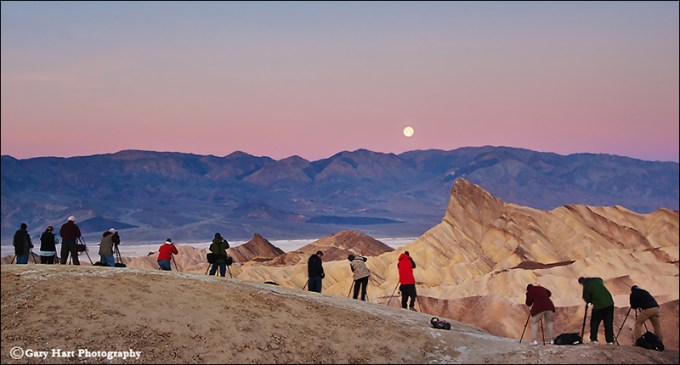
Moons Over Death Valley and the Alabama Hills
Click any image to scroll through the gallery LARGE


Perfect Timing
Posted on March 14, 2023

Big Moon, Mt. Williamson, California
Sony α1
Sony 200-600 G
Sony 2x teleconverter
ISO 800
f/13
1/500 second
In the Alabama Hills to photograph sunrise in neck-craning proximity to the Sierra Crest, I knew precisely what time, on this date, the sun’s first rays would color the towering granite, and exactly when a 98% moon would would disappear behind the left flank of Mt. Williamson, California’s second highest peak.
Clocks and calendars enable us to time some aspects of our lives, like sunrises and moonsets, to within microseconds. But when I scheduled this sunrise moonset more than a year ago, I had no idea whether the sky would be clear, perhaps feature a few clouds that would catch the sunrise hues, or be completely filled with overcast that would block sunlight and hide the moon. I didn’t know how much snow would drape the peaks, or whether the peaks even would be visible at all.
Clocks and calendars are essential, but as a self-employed landscape photographer, I’m beholden to far more fundamental constructs than the bustling majority is. I work when there’s work to be worked, and play when (fingers crossed) there’s play to be played. The business side of my life sometimes requires a clock and calendar, but the actual photography part is governed by fundamental laws of nature that transcend the rest of the world’s clocks and calendars.
The irrelevance of conventional time measurement is never more clear than immediately following a time change. On the second Sunday of each March, when “normal” people moan about lost sleep and having to rise an hour earlier, the sun thumbs its nose at Daylight Saving Time and rises a mere minute (or so) earlier than it did the day before. So do I. And on the first Sunday of November, as others bask in their extra hour of sleep, I’ll get to sleep an entire minute longer. Yippee.
The immutable natural laws that are the foundation of our clocks and calendars, that keep the world on schedule and enable us to precisely predict events like sunrise/sunset, the moon’s phase and position, as well as countless other celestial phenomena, are also solely responsible for the uncertainty that torments the lives of landscape photographers. While I can’t tell you what thrills me more, the impeccably punctual appearance (or disappearance) of a full moon, or the unpredictable explosion of a lightning bolt, I find it ironic that the precision of a moonset and the (apparent) randomness of a lightning strike are ultimately the product of the same celestial choreography.
Earth’s rotation on its inclined axis and revolution about the Sun, the Moon’s monthly journey around Earth, are are timed to microseconds. But this celestial dance also drives the atmospheric and tidal machinations that generate weather, stir oceans, and make every day unique and unpredictable.
This year the mercurial photography gods smiled on me and my Death Valley workshop group. For our 3 days in Death Valley, instead of the blank blue sky that often greets me here, we had a wonderful mix of clouds and sky—enough clouds to make the sky interesting, but enough sky to allow the sun to color the clouds at sunrise and sunset.
On the workshop’s penultimate day we drove to Lone Pine to wrap up with a sunset and sunrise shoot in the Alabama Hills. The highlight of this trip is always the Alabama Hills sunrise that I try to accent with the moon, just a day past full, setting behind the Sierra Crest. But this is winter, and these are the Sierra Mountains, so success is far from guaranteed.
A few years ago I drove to Yosemite on New Year’s Eve (because what else is there to do on New Year’s Eve?) to photograph a full moon rising between El Capitan and Half Dome. After a successful shoot (nearly thwarted by clouds), I hopped in my car and made the 6 1/2 hour drive to Lone Pine to photograph the moon setting behind Mt. Whitney.
I’d picked out a location along Highway 136 where I could align the moon and Mt. Whitney, and far enough back to allow an extreme telephoto big moon while still including all of Whitney. I went to bed really looking forward to this opportunity to get an image I’d thought about for years, and woke to clouds that completely obscured the moon and Sierra Crest. With nothing better to do, I still drove out to my spot, and even caught a very brief glimpse of the moon about 1/2 hour before zero-hour, but ended up not clicking a single frame. Such are the travails of anyone who pins their hopes on Nature’s fickle whims.
My plan this morning was far less grand. Since I was leading a workshop group, the goal was to get everyone in place for the best possible photography, not to assuage my own failed moonset wounds. And the good fortune that blessed us in Death Valley followed us to Lone Pine. (You can read more about this morning here.) In addition to a clear view of the moon and mountains, I was especially grateful to find the entire Sierra Crest frosted top-to-bottom with snow.
My photography day began in near darkness with my Sony a7R V and Sony 100-400 GM lens, photographing the descending moon throughout the morning’s many stages of advancing light. My starting focal length was 100mm, wide enough to include some of the Alabama Hills, then went progressively tighter as the moon dropped.
My favorite big moon images don’t usually happen until the moon is within a moon-width of the horizon, but I like to give myself a little wiggle room to get the composition balanced and focus just right. So when the moon got about 3 diameters from Mt. Williamson, I turned to my Sony α1, which was standing by with my Sony 200-600 G lens and Sony 2X Teleconverter already attached. And while 3 moon diameters might sound like a reasonable cushion, if you want to appreciate the speed at which the moon transits the sky, try pointing 1200mm at it and keeping it in your frame.
I love my Really Right Stuff Ascend tripod, but because the camera-shake margin of error is microscopic at 1200mm, I had the α1 pre-mounted on my (much more robust) RRS 24L Tripod with the RRS BH-55 ball head (carrying 2 tripods is a luxury I allow myself when I don’t have to fly to my location). I bumped to ISO 800 for a 1/500 second shutter speed, and switched from my standard 2-second timer (beep, beep, beep, BEEEEEEP—the Sony mating call) to a 5-second timer (I’m not crazy about any of Sony’s remote options, wired or wireless), to give the whole setup plenty of time to settle down—probably overkill, but I was taking no chances.
With my composition ready and focused, I just let the moon slide through my frame and started clicking. The alpenglow on Mt. Williamson was just about peaking when to moon first touched it. Perfect timing.
Workshop Schedule || Purchase Prints|| Instagram
More Massive Moons
Click any image to scroll through the gallery LARGE


Dynamic Juxtaposition
Posted on February 4, 2018

Moonset Eclipse, Zabriskie Point, Death Valley
Sony a7RII
Sony 100-400 GM
ISO 800
f/11
1/4 seconds
Much of my photography is about juxtaposition of elements with the landscape. Sometimes that’s simply combining static terrestrial features, but when possible I try to add something more dynamic, such as meteorological subjects like lightning or a rainbow, or celestial objects like the Milky Way or the Moon. The challenge with dynamic juxtapositions is timing—while the meteorological juxtapositions are usually a matter of playing the odds, celestial juxtapositions are gloriously precise.
Lunar choreography
Just as the Earth revolves around the Sun, the Moon revolves around Earth; at any point in this celestial dance, half of Earth is daylight and half is night, while half of the Moon is lit and half is dark. The amount of the Moon we see (its phase) depends on the relative position of the Sun, Moon, and Earth in this dance, and once each month all of the sunlit side of the Moon faces the dark side of Earth, and we Earthlings enjoy a full Moon.
This alignment of three or more orbiting celestial bodies necessary for a full (and new) Moon is called ‘syzygy.’ Due to the Moon’s orbit around Earth, the Sun, Earth, and Moon achieve syzygy twice each lunar month: once when the Moon is between the Sun and Earth (a new Moon), and again when Earth is between the Sun and Moon (a full Moon).
The Moon completes its trip around Earth every 27.3 days, but it takes 29.5 days to cycle through all its phases, from new to full and back to new again. The Moon’s phases need that extra 2+ days because as the Moon circles Earth, Earth also circles the Sun, taking the syzygy point with it—imagine a race with a moving finish line.
Viewed from Earth, the Sun and Moon are on opposite sides of the sky when the Moon is full, so a full Moon rises in the east at sunset and sets in the west at sunrise. We rarely see a full Moon rising exactly as the Sun sets (or setting as the Sun rises) because: 1) the point of maximum fullness (when the Sun, Earth, and Moon align perfectly) only happens at one instant on the full Moon day—at every other instant of each month’s full Moon day, the Moon is merely almost full (but still full enough to appear full); 2) published Sun/Moon rise/set times assume a flat horizon—if you have mountains between you and the horizon, your view of the true Sun/Moon rise/set is blocked; and 3) The more extreme your latitude (angular distance from the equator), the more skewed the Sun/Moon alignment appears.
Knowing this, it should make sense that the closer the Moon is to full, the longer it’s in the night sky, and a full Moon is in the sky all night long. Less intuitive but very important for lunar photographers to know, each day the Moon rises an average of 50 minutes later (between 30-70 minutes) than it rose the previous day—I usually mentally round to an hour for quick figuring.
Lunar Eclipse
If the Moon orbited Earth on the same plane Earth orbits the Sun, we’d have an eclipse with each syzygy: every new Moon, Earth would pass through the Moon’s shadow and somewhere on Earth would experience a solar eclipse; every full Moon the night side of Earth would witness a lunar eclipse as the Moon passes into Earth’s shadow. But the Moon’s orbit is tilted about 5 degrees from Earth’s orbit, making the perfect alignment an eclipse requires relatively rare.
It turns out that the alignment of the Sun, Earth, and Moon necessary for a lunar eclipse happens from two to four times each year. Of these, about one-third are total eclipses, when Earth’s shadow completely covers the Moon. At totality, most of the sunlight illuminating the Moon is blocked by Earth, and the only light to reach the Moon has passed through Earth’s atmosphere, which filters out all but the long, red wavelengths. For the same reason sunsets are red, during a total lunar eclipse we see a red or “blood” Moon.
Putting it all together
As frequent and familiar as the rise and set of the Moon is, the opportunity to witness the beauty of an eclipse is rare. But in the last six months, after being shut out by schedule or weather for many years, I’ve managed to photograph my first total solar and lunar eclipses. I wasn’t able to juxtapose the August solar eclipse with a favorite landscape, but I wasn’t going to let that happen again for last week’s lunar eclipse.
Viewed from Death Valley’s Zabriskie Point in winter, the setting full Moon’s azimuth aligns nicely with Manly Beacon, one of the park’s most recognizable features. Though this year’s alignment was particularly good, the morning of the eclipse was a day earlier than I’d normally photograph the Zabriskie Point moonset—the next day the Moon would be setting about 45 minutes later, providing ample time to photograph the landscape in the warm early light before the Moon descended behind the Panamints. Nevertheless, I decided that a total lunar eclipse trumps everything, and since Zabriskie was the best place for the eclipse, that’s where we were.
We started with telephoto compositions of the beautiful “blood Moon” phase because there wasn’t enough light to include the eclipsed Moon with the landscape without compositing two exposures. Composites are fine, but I prefer capturing scenes with one click. For wider images that included the landscape I waited until totality had passed, shortly before the Moon set, and switched to the Sony/Zeiss 24-70 with my Sony a7RIII, moving my Sony 100-400 GM to my Sony a7RII.
I captured this image about 25 minutes before sunrise, normally too early to capture landscape detail without over exposing the Moon. But this morning, following the total eclipse, the lit portion of the moon was still darkened by Earth’s penumbral shadow, which reduced the dynamic range to something my cameras could handle.
To enlarge the Moon and emphasize its juxtaposition with Manly Beacon, I went with the 100-400. With my composition and focus set, I slowly dialed up the shutter speed until I saw my a7RII’s pre-capture “zebra” highlight alert. After clicking I magnified my image preview and examined the moon to confirm that I did indeed still have detail. The foreground was quite dark on my LCD, but my histogram indicated the shadows were recoverable, something I later confirmed in Lightroom.
A Gallery of Dynamic Juxtapositions
Click an image for a closer look and slide show. Refresh the window to reorder the display.


 Eloquent Images by Gary Hart