Favorite: The Big Dipper
Posted on August 6, 2013
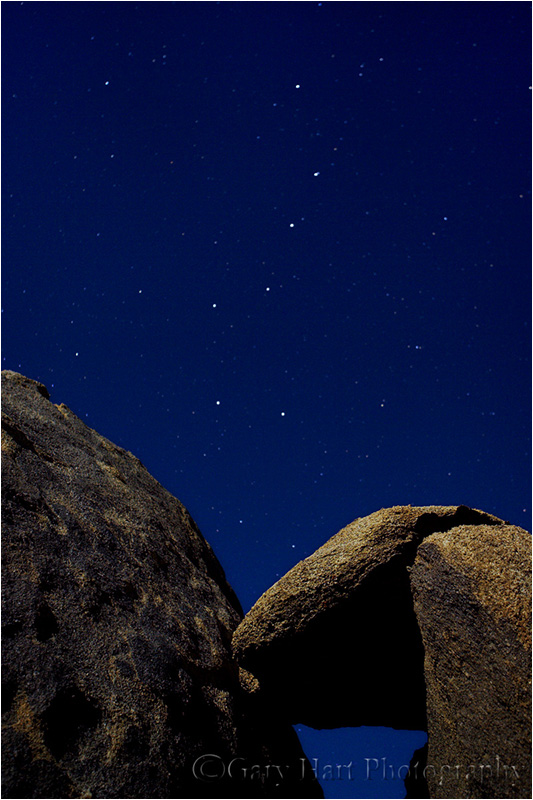
Big Dipper, Alabama Hills, California
Canon EOS-1D Mark II
20 seconds
F/2.8
ISO 200
25 mm
I’ve decided to turn my new Favorites gallery into an irregular series on each of the images there.
* * * *
This image of the Big Dipper above moonlit granite boulders in the Alabama Hills will always have a special place in my heart because it was my first moonlight “success.” I was still coming to terms with the low light capabilities of digital photography, and figured that a full moon over the Alabama Hills might be a good opportunity to play. I was in Lone Pine with my brother to explore the endless daylight possibilities among the weather granite boulders just west of town.
Jay and I started that night by simply photographing the Sierra crest, anchored by Lone Pine Peak and Mt. Whitney, from the side of the road. It wasn’t long before I was confident that I had the exposure settings right (arriving through trial and error at the moonlight exposure recipe I still use), and we soon set out for less prosaic surroundings, ending up in a box canyon at the end of an obscure spur off (unpaved) Movie Road. All of my attention was on Lone Pine Peak and Mt. Whitney in the west, but while waiting for an exposure to complete, I noticed the Big Dipper suspended above the northern horizon.
I wish I could say this composition was divine inspiration fueled by my innate artistic instincts, but it was more of a casual click using a couple of anonymous boulders whose prime attraction was their convenience. Focus was tricky, and while I don’t specifically remember all my decisions, I know I must have realized that sharp foreground rocks trumped sharp stars (that would be moving slightly anyway). I’ve done enough moonlight photography since to know that while manual focus in the dark is difficult, it’s not impossible. Finding focus involves rapidly twisting the focus ring in decreasing concentric arcs around the point where the target “feels” sharp—subsequent experience has taught me that (for me at least) the results are usually better than I fear they are. And of course it doesn’t hurt that even at f2.8, 25mm gives me quite a bit of depth of field.
I remember thinking when the image popped up on the postage-stamp LCD of my 1D Mark II, “That’s pretty cool.” But I couldn’t have been too impressed because I only took two frames before returning to the (ultimately forgettable) Sierra compositions. The next memory I have is looking at my images on my laptop later that night—it was quite clear that this image was my favorite, by a long-shot, and I wished I’d have tried more. I’ve tried unsuccessfully to find these boulders on subsequent visits, but I haven’t given up. I can’t even say that I’d photograph them again, but I’d at least love to see them once more.

We photograph the Alabama Hills in my Eastern Sierra photo workshop—click for details
Picking favorites
Posted on August 1, 2013
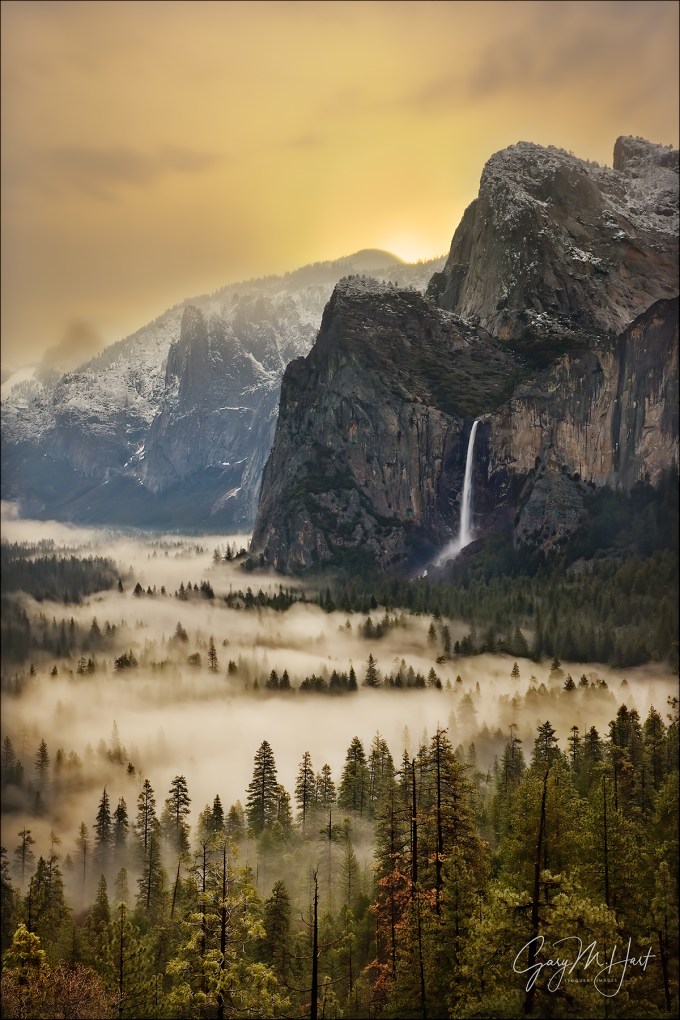
First Light, Yosemite Valley
Canon EOS-1Ds Mark III
3/10 second
F/16.0
ISO 100
65 mm
A few weeks ago I added a Favorites gallery to my website, which of course forced me to make all kinds of difficult choices. First I had to figure out what “favorite” means. Is the gallery going to represent my favorites, or will it be the images that sell best (often not the same thing)? My mercenary instincts told me that, since this is page allows people to click to purchase ($$$), I should go with the bestsellers. But when I decided to make my living with photography, I vowed to only photograph what I want to photograph, and to never base my decisions on what will sell.
While things became easier once I decided to go with my personal favorites, that decision put me in something of a Sophie’s Choice quandary. I really never select any image to display unless I like it a lot, but if I want to keep my Favorites gallery down to a manageable number, I need to choose my favorite “children.” (It occurs to me in hindsight that choosing a favorite image by what sells best would be kind of like choosing a favorite child based on who gives the best presents. Hmmm….)
Once I hardened myself to the process (sorry kids), it became an enlightening exercise that, among other things, showed me how my style has evolved. Disabling the analytical side of my brain and going with “feel” enabled me to revisit my entire portfolio with new eyes, to shed old biases and reject images that had become default favorites, in favor of images for which I discovered a new affinity.
It also became clear to me that “favorite” is a moving target—what I choose today isn’t necessarily what I’ll choose tomorrow. (I’ve even made a few changes as I work on this post.) I plan to make this a pretty dynamic gallery, so please feel free to visit often (no purchase necessary).
First Light, Yosemite Valley
Labeling the image in this post a “favorite” was a no-brainer—it’s always been a personal favorite, and it has become one of my top sellers (not to mention my WordPress avatar). And even though Tunnel View images are a dime a dozen, this was a special, one-of-a-kind spring morning that I never tire of revisiting.
I was there with a workshop group, and if memory serves, we’d had a nice sunrise shoot, but nothing truly unique. The air was crystal clear and quite cold for April, still enough to allow the moist valley air to condense into a radiant fog that hugged the floor, ebbing and flowing like liquid. As the sky brightened we photographed a pink veneer of translucent clouds, a particular treat for those who’d never been to Yosemite.
When the color started to fade, I was about to move the group on to our next location when a brightness behind Sentinel Dome caught my attention. So I waited. And as we watched, the light intensified, expanding before our eyes into a diaphanous film that spread a buttery glow that turned our world into an amber light box. I captured several frames; this is my favorite.
Join me in an upcoming photo workshop
A gallery of favorites


Moon over wherever
Posted on July 26, 2013
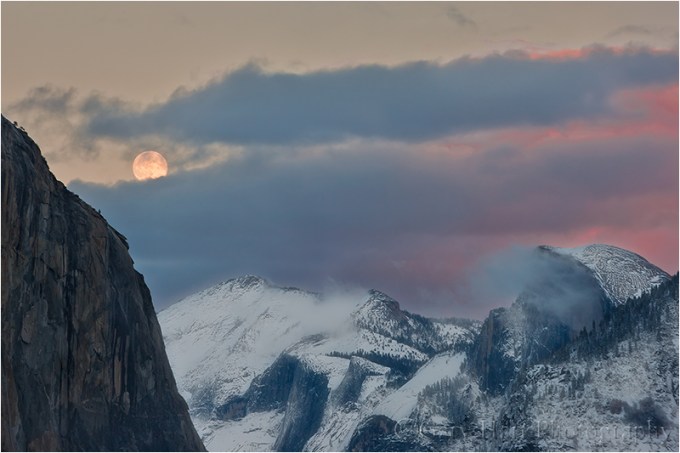
Winter Moonrise, Half Dome, Yosemite
Canon EOS-1Ds Mark III
1/6 second
F/11.0
ISO 100
188 mm
Often, including a rising or setting moon will turn an ordinary landscape into something special. Of course, like most things worth doing, moon photography adds a couple of layers of complication: First, there’s the matter of getting there at the right time, with the moon in the right place (it does little good to arrive as the moon rises if it’s skewed 90 degrees from the scene you came to photograph); and once you have everything lined up, you still have to contend with the almost always tricky exposure issues.
A little lunar geometry (you can skip this section of you’re more interested in “how” than “why”)
Many factors, some within our control, some completely beyond our control, determine the time, location, and phase of the moon at any time. The factors beyond our control are things like the earth’s rotation and the moon’s orbit, which determine the moon’s phase and its absolute position in the sky. On the other hand, we can control our location, and take the steps necessary to get us in the right place at the right time.
A full moon always rises and sets directly opposite the sun, rising in the east at sunset and setting in the west at sunrise. This actually makes perfect sense when you take a little time to understand the monthly choreography of the earth, moon, and sun. Just as the earth revolves around the sun, the moon revolves around the earth; at any point in this dance, half of the earth is lit (daytime) and half of the earth is dark (nighttime), half of the moon is lit and half of the moon is dark.
What we on earth see as a full moon is simply that one day each month that the moon’s entire lit side faces the earth’s dark side—that is, when the earth is directly between the sun and the moon (picture a beam of light that follows a straight line that starts at the sun, passes through earth, and ends on the moon). On that day only, as the point of your location on earth rotates from day to night, you’ll see the sun disappear in the west and the moon rise in the east. As the earth keeps rotating away from daylight and into night, the full moon rises higher and higher, reaching its highest point around midnight, then dropping as your location rotates back toward the sunlit side (and sunrise).
So then why do we rarely see a full moon rising exactly as the sun sets? That’s because: 1) the point of maximum fullness (when the sun, earth, and moon align perfectly) only happens at one instant each month—at every other instant of each month’s full moon day, the moon is only almost full (but still full enough to appear completely full); and 2) sun/moon rise/set times we see published always assume a flat horizon—if you have mountains between you and the horizon, your view of the actual sun/moon rise/set will be blocked.
Due to its monthly orbit about the earth, each day (or night) the moon rises a little later and gains or loses a little bit of its disk (the farther it has revolved from that sun->earth->moon line, the less of the moon’s lit side we see). So the night after the moon is full, it rises after sunset and is a little less full. The next night it rises a little later still, and is even less full, and so on. Eventually (in a little more than two weeks after it was full) the moon has revolved all the way around the earth until it lies between the earth and sun (now our imaginary line goes sun->moon->earth); all of its sunlit side faces away from the earth and we have a new (invisible) moon.
We call the moon “new” because the night before it disappears into the sun, all that was left of the shrinking moon (that was completely full about two weeks ago) was a small sliver that shined briefly on the eastern horizon just before sunrise, then disappeared as soon as the sky brightened (it’s still up there, but completely overpowered by the sun’s brightness). The next day the moon won’t appear at all because seeing it would require looking directly into the sun; but the following day, there it is, this time as a thin sliver on the western horizon immediately after sunset (again, it was up there most of the day, we just can’t see it until the sun sets and the sky darkens). This brand new crescent slips below the horizon shortly after it appears. And for the next two-plus weeks it will rise a little later, and grow a little larger, each night, until it’s full again and rising at sunset. Cycle complete.
If we do the math (this won’t be on the test), we can infer that if the moon takes 29.5 days to complete its cycle (from full to new and back to full), and there are 24 hours in a day, the moon must be rising about 50 minutes later each day (29.5/24=48.8). This rough approximation varies with many factors; for simplicity I usually round it to an hour when I do rough calculations in my head. And I always rely on much more precise software or astronomical charts for my critical calculations.
Locating the moon
Those who don’t do a lot of moon photography are amazed at how much the moon shifts above the landscape throughout the year—you can sight a full moon rising between Half Dome and El Capitan one month, and a few months later it’ll be rising above Leaning Tower (far to the south). Fortunately, like many things in nature that appear random to the uninformed, there is actually nothing random about the moon’s location once you take the time to figure it out.
If the idea of figuring anything saps the pleasure from your photography (or sends you into a panic), you’ll be happy to know that sometimes it’s enough to simply know that the moon will be rising in the east a little before sunset (this info is available in many places, in many forms, but the most complete source I’ve found is the US Naval Observatory website). Armed with that knowledge, you can go out to a location with a view of the western horizon, wait for the moon to appear, and start shooting.
On the other hand, juxtaposing the moon with a specific landmark requires more planning. And because its position is so not random, many others have done the heavy lifting for the rest of us. There are far too many moon phase/position resources to name even a small percentage of them, so rather than even try, I’ll just give you a couple of techniques, and the tools that enable them:
- My old fashioned way (old trick for an old dog): I figured out my technique for locating the moon long before computer software and smartphone apps took away most of the effort. Nevertheless, I continue to do it this way because I’ve already done all the hard work (figuring out how to do it), and I can do it in the field, with zero connectivity (no wifi or cell signal required). After relying for years on a the US Naval Observatory website for the info I need (moon phase and moon/sun rise, set, altitude, and azimuth), I now get all the pertinent data from my Focalware iPhone app (I never said I’m opposed to new technology), plugging it into my National Geographic Topo! (that’s NG’s exclamation point, not mine) mapping software (discontinued) to plot the direction of the moon’s rise/set. To determine when the moon will appear above (or disappear behind) the surrounding terrain, I plug distance and elevation information from Topo! into the trigonometric functions of my HP 11C scientific calculator (originally an actual calculator, but now also an iPhone 11C emulation app) to compute the elevation in of my horizon.
- Software (the better way for 99.999 percent of you): The Photographer’s Ephemeris (a free computer download or fairly inexpensive smartphone app) is the most complete solution that I know of (though I’m sure there are others I don’t know of)—I probably would have never taken the time to figure out my technique if TPE had been available. Not only does TPE give you the sun and moon’s location and elevation above the flat horizon, it also figures out the the actual (terrain included) horizon. The downside is that because it uses Google Maps, TPE requires connectivity and is better used in advance of your shoot (usually not a problem). Recent TPE versions also allow you to download the maps to your device for offline access—if I were a TPE user, I’d be doing this before every trip.
Exposure
My rule for photographing a rising/setting full moon is that I must capture detail in the landscape and the moon. If my landscape is black (or just too dark), or my moon is a white disk (or blob), my image has failed. But since the post-sunset landscape is in full shade, and the moon is as bright as a sunlit landscape (because it is a sunlit landscape), the dynamic range of a full moon scene is pretty extreme, often too extreme for a camera to handle with a single click (always my goal).
But here’s the great part—if you figure that the moon rises about an hour later each day, and the full moon rises at sunset, then it stands to reason that the day before it’s full the moon will rise about an hour before the sun sets. Factoring in the terrain on the horizon (and assuming you’re not at the base of a mountain), that means that the day before the moon is full is the best opportunity to photograph a nearly full (say 97%, give or take a percent or two) moon rising in the east above a landscape painted with the warm sunlight of the golden hour. Conversely, if your view is to the west, you can photograph a nearly full moon setting in warm sunrise light the day after it’s full. Either way, the day before or after the full moon gives you everything you need to capture your scene in nice, photographable light that’s still sufficient to hold the moon’s highlights at bay.
I’ve found that if I’m really careful with my exposure, I can usually capture enough foreground and lunar detail until five or ten minutes after sunset. Shooting after sunset usually requires raw capture, then massaging the dark foreground brighter, and bright moon darker, in the raw processor. A graduated neutral density filter can increase this threshold to maybe fifteen or twenty minutes after sunset—after that my foreground is unusably dark (or my moon is recoverably bright).
Another technique that works when the light gets too extreme is a composite—two images, one exposed for the landscape and the other exposed for the moon, combined in Photoshop. In the “Rules According to Gary,” this isn’t cheating if you don’t change the size or position of the moon. (Though it doesn’t break my rules, I no longer do composites because I have this weird compulsion to get everything with one click.)
The final piece of exposure advice I’ll add is to make sure your camera’s blinking highlights (also called highlight alert) are set (as far as I’m concerned, they should be set anyway because I see no downside to highlight alert). The moon is usually so small in your frame that it won’t register in the histogram, which means blinking highlights are usually the only way to know that you’re blowing out the moon. I monitor my highlights closely after each exposure and have found that, when shooting raw (jpeg shooters don’t have as much margin for error), I can usually recover enough detail with an exposure 2/3 to 1 stop brighter than the exposure that first showed blinking.
Just do it
Like most things photographic, don’t expect resounding success the first time you try adding a full moon to your landscape. But each time you go out, not only will you improve, you’ll probably come away with ideas for how to do it differently the next time.
Read more about moon photography
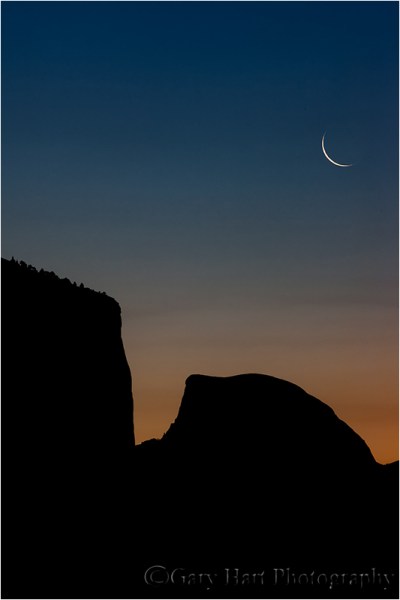

The Moon: (Sometimes) Size doesn’t matter
Posted on July 21, 2013

Goodnight Moon, Sierra Foothills, California
Canon EOS SL1
8/5 seconds
F/5.6
ISO 100
300 mm
A few years ago I proposed an article to “Outdoor Photographer” magazine on photographing the moon. The editor at the time (not the current OP editor) replied that moon photographs don’t work because the moon appears so much smaller in a photograph than people remember it. I couldn’t argue—the moon does indeed look smaller in a photograph than we perceive it in person. But I’ve never thought the moon needs to appear large to be an effective subject because its emotional power gives even the smallest moon enough visual weight to grab the eye and hold a disproportional segment of the frame. Ansel Adams certainly had this figured out, making a small moon the prime focal point of many images, including the image that’s arguably his most famous, “Moonrise, Hernandez, New Mexico.” Nevertheless, it took a new editor to finally get OP to acknowledge that size doesn’t matter and publish my “Shoot the Moon” article.
Today, more photographers than ever are using a small moon to accent familiar landscapes. But as nice as these images can be, sometimes it’s nice to make the moon BIG. I’m afraid the vast majority of images displaying a BIG moon looming over an iconic scene are composites, wide compositions with a telephoto moon superimposed on top. My feeling about these moon composites ranges from “Ugh,” when the photographer has at least had the integrity to label it a composite, to “Foul!,” when the photographer pretends that the entire scene was captured with a single click.
Your ability to enlarge the moon naturally (with a single click) is determined by the amount of telephoto you use: The longer your focal length, the larger your moon. But increasing the focal length shrinks the field of view, so matching a large moon with a particular scene requires positioning yourself a long way from the scene. For example, if I want to photograph the moon rising above Lake Tahoe, Tahoe’s size means I’m pretty much stuck with a wide angle (small moon) scene. In the Emerald Bay sunrise scene below, I was about a half mile from the lake, but even at 40mm I’m unable to fit all of the bay, and the moon is quite small.

Moonrise, Emerald Bay, Lake Tahoe
On the other hand, Yosemite Valley offers many distant vantage points that allow me to isolate Half Dome or El Capitan with a telephoto lens. I make a point of knowing when I can align a crescent or full moon with Half Dome and do my best to get myself (or a workshop group) there to photograph it. The image here is a 400mm (full frame) shot that completely isolates Half Dome from the rest of the scene.

New Day, Half Dome and Crescent Moon, Yosemite
Compare it to the image taken from the same location—at 105mm, Half Dome shrinks and the moon becomes an accent in a much larger scene.

Rising Crescent, Yosemite Valley
The image at the top of this frame perfectly illustrates my approach to moon photography. Because I can’t always get to Yosemite (and I like some variety in my images), I keep a mental database of nearby locations that align with a subject I can silhouette against the east or west horizon (the general direction of the moon’s rise and set) when viewed from a distant vantage point. Near the top of my list is a pair of trees topping a hill in the foothills east of Sacramento (the same trees featured in my July 12 post). Not only can I photograph these trees against the sky, from a distance, the ability to shift a fairly good distance north or south without losing my view of the trees allows me to juxtapose them against the moon, which shifts a significant amount from month to month.
The July 12 image was photographed the same night at 330mm with my full frame 5D Mark III; today’s image was photographed at 300mm with a 1.6 crop camera, for an effective focal length of 480mm. I plan to return to this spot a few more times for even tighter (larger moon) captures. I’d also like to try some with the full moon—since the view here is to the west, I’ll need to photograph the full moon when it sets at sunrise. Stay tuned….
* * *
About my new camera
Some photographers may be mortified to see that I shot this with a Canon Rebel SL1. For those who don’t know, the Rebel line is Canon’s entry level, consumer camera (by inference, something no self-respecting pro would ever be caught dead using). But, while the Rebel cameras have some limitations, image quality isn’t one of them. So here’s my reasoning.
For about a year my primary camera has been my 5D Mark III. While the 5DIII gives me more dynamic range and better high ISO performance than my five year old 1DSIII, rather than sell the 1DSIII (still a great camera), I decided to keep it as a backup. Unfortunately, it’s also a brick, an absolute pain to lug around in the remote chance my 5DIII goes down. And its an even bigger pain to fly with.
Another problem with my 1DSIII as my prime backup is, like my 5DIII, it has a full frame sensor. I prefer having a “crop” (smaller sensor) body as my backup, because it gives me something I don’t have with a full frame (60% more reach from my lenses). So when I heard about Canon’s SL1, I checked it out and learned: It takes all my lenses; has an 18mp sensor; and is incredibly compact, hands down the tiniest SLR I’ve ever seen (if I didn’t shoot everything on a tripod, I might find it almost too small to shoot). It’s also only $650. So I bought one.
Now my 1DSIII will still travel with me wherever I drive (as will my 5DIII and my SL1), because I’ll have room. And if my 5dIII ever goes down for an extended period, my 1DSIII will become my primary body until the 5DIII returns to health. But when I fly anywhere, it’ll just be my 5DIII and my SL1. And in those situations where I want to carry two cameras in the field—for example, when I photograph the moon and want both wide and long shots—the tiny SL1 will always be the second camera. (So I guess size also matters when I’m choosing a backup camera.)
Epilogue: The image in this post was captured on my very first shoot with the SL1, and I’m happy to report that it performed wonderfully.
Watch out for that tree…
Posted on July 15, 2013
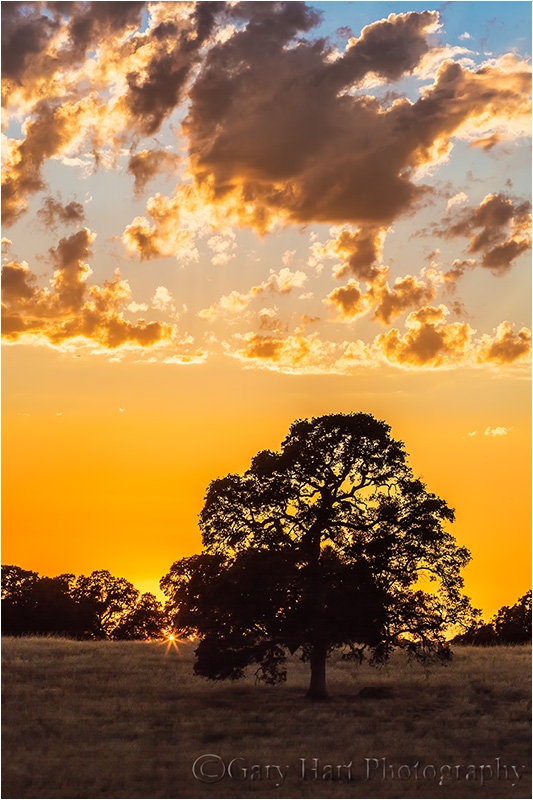
Sunburst, California Oak, Sierra Foothills
Canon EOS-1Ds Mark III
1/40 second
F/16.0
ISO 100
140 mm
I have a story that doesn’t really have anything to do with photography, except maybe that the experience got me thinking about my relationship with trees, and the number of images I have where a tree or trees are the primary subject. That connection was made because my story, in which a tree stars prominently, happened on the morning that I photographed this oak tree (and the crescent moon and oak trees image in my previous post).
Here goes (not for the faint of heart)
I’ve been a daily runner for nearly 22 years. For many years it was 50 miles per week, no days off; in recent years I’ve toned it down to a more sane 3 to 5 miles per day, with an occasional day off. I run on city streets, sometimes in the dark, dodging vehicles often guided by chatting, texting, speeding, angry, and/or drowsy drivers. I’ve stampeded sheep in New Zealand, breathed textured air in India, and have been chased by dogs, soaked by rain, and pelted by hail. Once, a squirrel ran up my leg.
But, while there are clearly many dangers to worry about while running, trees are pretty far down the list. They’re large, stationary, with no reputation for aggressive behavior. Which might explain why, until last Wednesday, (like most runners) I’d never actually run into a tree. Not even close.
Wednesday morning was hot, much hotter than I prefer, but I’d gotten out early enough that the houses and trees on the east side of my route cast occasionally useful shade. While I normally run in the street (believe it or not, asphalt is quite a bit softer than cement), on this morning I spent lots of time on the sidewalk when it meant the difference between shade and sunlight. By about 2 1/2 miles into my planned 3-miles the shade was rapidly shrinking, forcing me to stray even farther onto the sidewalk for relief. And so it happened that I found myself just close enough to the yard side of the sidewalk that a deceptively aggressive palm tree was able take a swipe at me as I flashed by. (That’s my story and I’m sticking to it.)
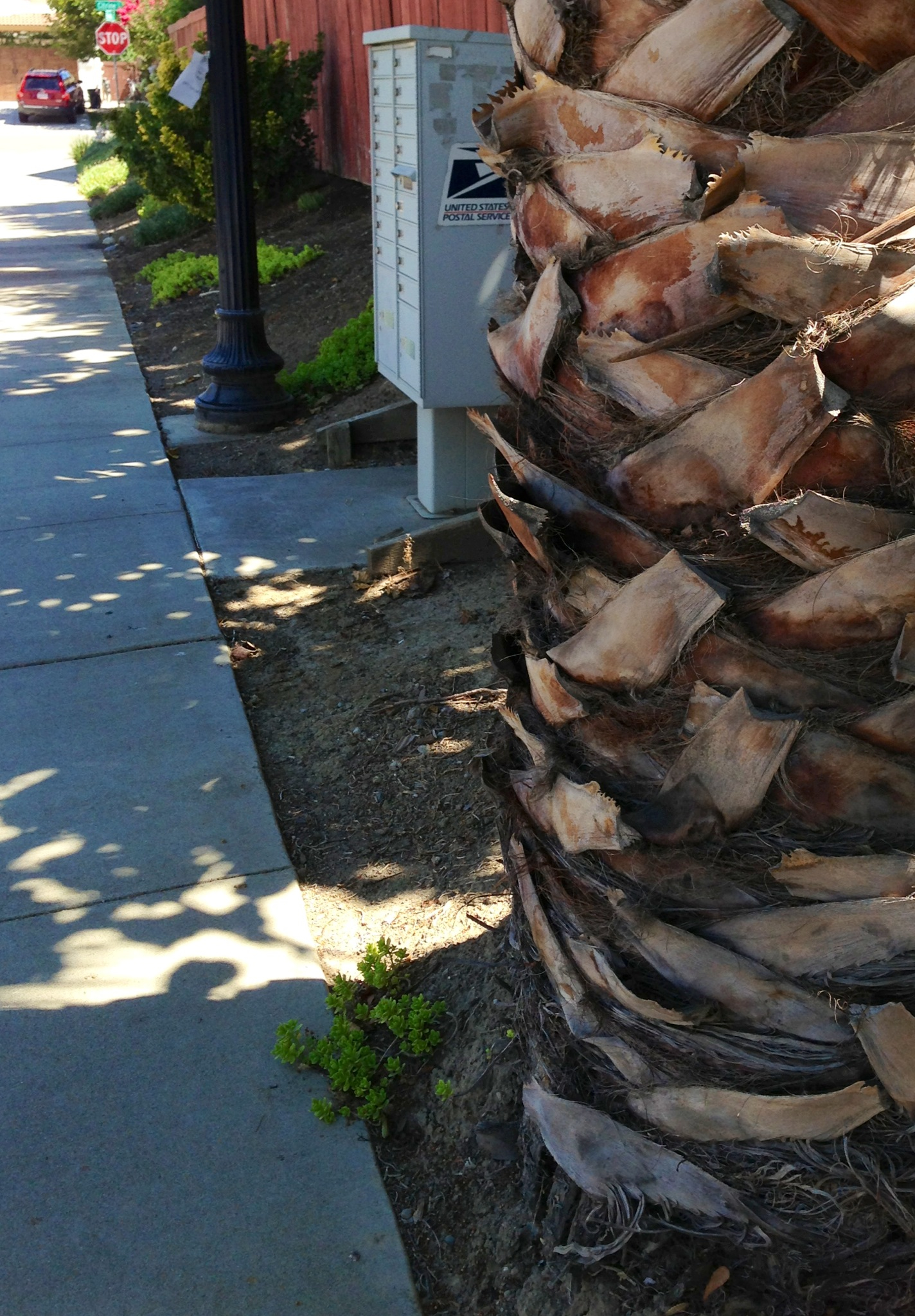
Mean Palm Tree, Sacramento
In my defense, my arborous encounter was not a George of the Jungle face-plant; rather, the collision was more of a glancing blow, something a ninja might incur after deftly eluding an enemy’s death swipe. Nevertheless, it left my upper forearm with a gaping wound that pretty much stunned me with sudden pain and flowing blood.
While my first impulse to any injury has always been to pretend that nothing happened in the hope that nobody will notice whatever foolish thing I did to cause the injury, the blood dripping down my arm and trailing me on the sidewalk made that pretty much impossible. By the the time I reached the next intersection I was bleeding so much that I prayed there’d be no cars who might call 911 to report a crime (what would you do if you saw a bleeding man running down the street?). At home I had to warn my wife to prepare for something gruesome before I entered the room. Once we got it cleaned up, it was clear that what I had was not so much a cut as it was an excavation—somewhere on that palm tree is an almond-size chunk of my flesh.
Today, nearly a week later, this stupid thing is still bleeding (I probably should have gotten stitches), though it’s down to just a few drops on the dressing each time I change it. As with all my running injuries, I tend to ignore them and hope they’ll go away. (And I must confess to kind of relish the coolness factor associated with running down the street with a slight limp.) Unfortunately, in this case, despite the ugliness of the wound, nobody can see it when I’m running and there’s really nothing cool about my answer when I’m asked what happened. I suppose I could have claimed to gotten it in a knife fight with a competing photographer (say, contesting a small patch of prime Yosemite real estate); instead I opt for the high road and just fess up: I, uh, ran into a tree. In broad daylight. Sigh.
But anyway….
As I mentioned in my July 12 post, my plan for this night had been to photograph a pair of oak trees in the foothills beneath a crescent moon. But my buddy and I arrived early, so we drove a few miles down the road to another group of trees that I like to photograph. The throbbing in my arm, while chasing trees, that got me thinking that evening about the morning’s mishap in the context of my “regular” relationship with trees. I chuckled about how I can be hyper-aware of some trees, yet so oblivious to others. Maybe not life changing insight, but food for thought at least.
The sun just disappearing as we pulled up to this second group of trees. Hoping hoping to catch a sunburst, I jumped out of the car, set up my tripod, pulled out my graduated neutral density filter (two-stop hard), metered, focused, and clicked in maybe fifteen seconds. Fortunately I nailed the first click, because by the time I recomposed a horizontal frame, the sun was gone.
One part plan, one part serendipity, one part impulse
Posted on July 12, 2013

Dusk, Crescent Moon and Oaks, Sierra Foothills, California
Canon EOS-1Ds Mark III
1.6 seconds
F/11.0
ISO 400
330 mm
Nature photography is a particularly serendipitous art form. We do our best to get ourselves in the right place at the right time, but it’s ultimately up to Mother Nature to deliver. Fortunately, some things in nature are more certain than others. Among them is the phase, location, and timing of the moon, each of which can be anticipated with near absolute precision. Another certainty I’ve grown to depend on is clear skies in California in July. Armed with those two truths, Wednesday night a friend and I headed to the foothills to photograph a thin crescent moon in the western twilight.
My criteria for photographing any twilight scene include finding a striking shape to silhouette against the sky. And like a portrait photographer who can’t get enough of a particular model, there a number of “go-to” trees scattered about the foothills that I return to whenever I get the urge to photograph a sunset near home. For a long time I’ve known the hilltop perch of one pair would allow me to juxtapose them with a setting moon. I’d already photographed this pair many times with good success (one of these images was on a magazine cover), and one time got them with a crescent moon. But that success only made me greedy for a tight shot with the moon large, among the trees. I check the moon info each month to see if its phases and position align with my schedule (for obvious reasons, I’m often away from home when the moon is at its photographic best), and Wednesday night looked like everything might just fit into place, so out we went.
By about two hours before sunset it became pretty clear that clouds would be part of our sky that evening. While not unprecedented, this unexpected intrusion could be: A) Good, if the clouds added sunset color while parting enough to reveal the moon; or B) Bad, if the clouds thickened to obscure the moon and block the color. Serendipity.
Mark and I pulled up to “my” trees about fifteen minutes before sunset, but with the clouds starting to look like they might deliver a colorful sunset, and since we didn’t need to be in position for the moon until 25 or 30 minutes after sunset, I made the snap decision to continue about five miles down the road to another group of trees that I thought would be particularly nice for a colorful sunset. The sunset was indeed worth the detour, but that’s a story for another day. When it was over, we hightailed it back to the hilltop tree spot to find the moon playing hide and seek with the clouds above and just a little south of the trees. Definitely photo-worthy, but not aligned so perfectly that I could get the tight telephoto shot I’d envisioned.
While photographing from the narrow shoulder here is fairly easy (though a bit unnerving), the angle we needed to align the trees and moon required scaling a small hill. Behind a barbed wire fence. Hmmm. But wait—what’s this? A gate! And it’s unlocked! So, all with about as much restraint as two ten-year olds at the all-you-can-eat dessert bar, up the hill we traipsed, dodging cow patties and listening for rattlesnakes. As expected, the new vantage point provided exactly the angle we needed, but I have to say that in the growing darkness my impulsiveness enthusiasm was soon replaced by visions of tomorrow’s headlines:
- LOCAL PHOTOGRAPHERS ARRESTED FOR TRESPASSING
- PHOTOGRAPHERS SHOT BY FRIGHTENED FARMER
- ANGRY BULL GORES DISTRACTED PHOTOGRAPHERS
Fortunately, none of that stuff happened, and Mark and I made it back to my car, undetected and intact. Impulsive urges notwithstanding, I ended up with several “keeper” images, thanks in no small part to the convergence of my plan with the fortuitous appearance of clouds to color our summer sky. Sometimes things just work out.
Later, I had to admit that going up there like that violated one of my personal rules: Get permission before entering private property (I’ll often offer a print as thanks). But this time I rationalized that since we’d do no harm, and because time was absolutely of the essence, it would be okay to maybe go just a little bit beyond the fence. And while it worked out this time, that’s the kind of decision that inspires hindsight (and I have the stories to prove it).
Read more about photographing a crescent moon
A Crescent Moon Gallery
Click an image for a closer look and slide show. Refresh the window to reorder the display.


Literally breathtaking
Posted on July 6, 2013
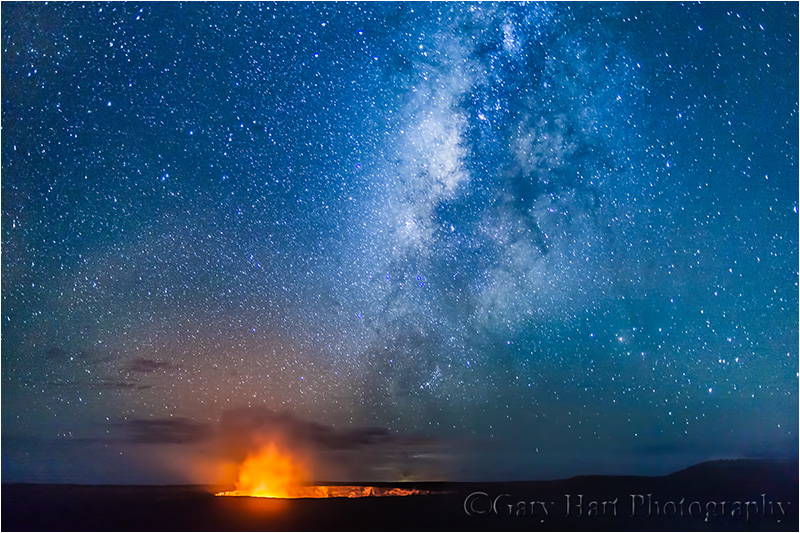
Under the Milky Way, Kilauea Caldera, Hawaii
Canon EOS-1Ds Mark III
30 seconds
F/2.0
ISO 800
28 mm
Even with the number beautiful things I get to photograph, certain natural wonders will forever thrill me. Near the top of that list is the view into the Kilauea Caldera on Hawaii’s Big Island. I thought I knew what to expect, but even after a lifetime of National Geographic specials and an occasional “Breaking News!” disaster video, I was little prepared for the in-person experience of peering into an active volcano.
Approaching Kilauea from Hilo, the first sign that something unusual is in store is the plume of thick smoke and vapor rising in the distance and spreading with the wind. If you didn’t know a volcano was nearby, you might mistake the smoke for a forest fire. The billowing plume becomes more prominent as you draw closer to the volcano, and once in Hawaii Volcanoes National Park you’re soon surrounded by white puffs of steam rising from the ground on both sides of the road.
On the drive to the caldera you’ll be tempted by several vista opportunities, but the best perspective is from the Jaggar Museum at the end of the road (the loop road that once circumnavigated the caldera is now closed at the museum due to the risk of noxious fumes beyond). For first-time visitors I recommend foregoing the preliminary views in favor of the Jaggar view, which makes the most impactful first impression—you can return to the other views on the drive out.
When visiting during the day you’ll see white smoke pouring from a large hole on the caldera’s floor, but no sign of orange flame—the sunlight simply overpowers the volcano’s fire. While any view of a volcano is memorable (trust me), nothing compares to the experience of seeing the caldera after dark. I usually arrive at the caldera in time for sunset, go to dinner, then return once darkness is complete. Not only does this break allow time for darkness, I also find that the clouds that frequently obscure the sunset sky dissipate once the sun is down (in other words, don’t forego a night visit simply because your daytime visit was cloudy).
Even if you do find clouds after dark, the clouds beautifully radiate the caldera’s glow to bathe the entire scene in orange, a subtle effect to the naked eye that comes alive in a long exposure. If you’re lucky enough to visit on a night with few or no clouds, you’ll be treated to the churning lava’s orange fire, reflected by belching white smoke, beneath a sea of stars. My first time seeing the caldera beneath the Milky Way I literally gasped, and it was several seconds before I realized I was holding my breath. Breathtaking indeed.
* * * *
Let me add that finding the Milky Way above the caldera isn’t without its difficulties. Even if the clouds cooperate, simply showing up at the Jaggar Museum after dark isn’t enough because the properly aligned vantage point varies with the date and time of night you visit. In the Northern Hemisphere the best views of the Milky Way are moonless summer nights (moonlight washes out the sky as much as city lights). If you find yourself there with the Milky Way visible, aligning it with the caldera is usually a matter of driving or walking the rim until you find the spot.
We’ll be photographing the Milky Way above Kilauea in my upcoming Hawaii Big Island workshop is September 2-6. While it filled several months ago, a recent cancellation leaves me with one opening. And I still have lots of openings in my 2014 Hawaii workshop, September 15-19.
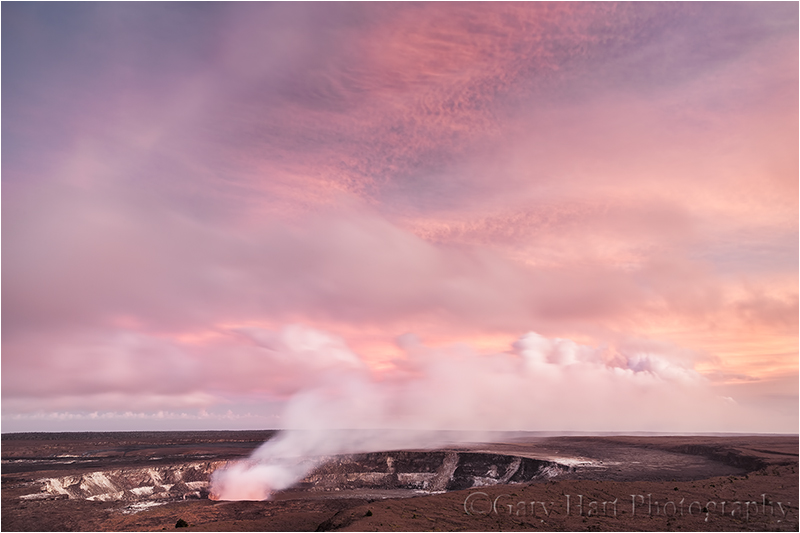
Earth on Fire, Kilauea Caldera, Hawaii :: The sunset light had dimmed just enough that the lava lake’s fiery orange is just visible. Even just few minutes earlier the scene was too bright to see any color in the caldera.
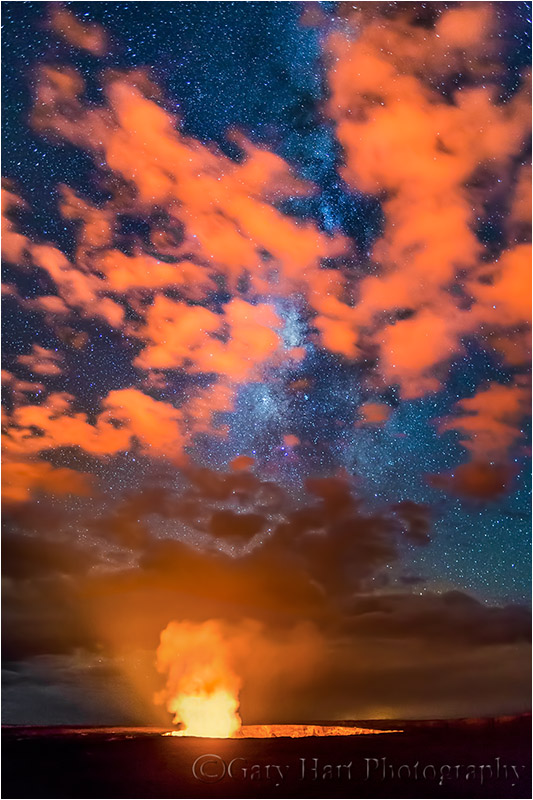
Milky Way and Clouds, Kilauea Caldera, Hawaii :: Here the clouds reflect the lava’s glow, but part just enough to reveal the Milky Way behind.
Looking on the bright side
Posted on July 1, 2013

Oaks at Sunset, Sierra Foothills
Canon EOS-1D Mark II
1/250 second
F/11.0
ISO 200
131 mm
There has been a lot of photographer hand wringing in the wake of Adobe’s Creative Cloud power play. I know of very few photographers, amateur or pro, who are happy to suddenly be forced to pre-pay for Photoshop upgrades they’ve always been able to evaluate before deciding they’re worth purchase. Now our choices are between biting the bullet and signing up for Adobe’s rental plan (“You can check out any time you like, but you can never leave”), or hopping off the Photoshop upgrade train.
Applying the most optimistic spin possible, my hope is that Adobe’s new Photoshop rental paradigm forces photographers to evaluate their Photoshop habit and (fingers crossed) realize that having the latest processing tool isn’t as essential as they might think. I can’t help but flash-back to my color transparency days, when I had no idea at capture whether I’d squeezed the scene’s light in the narrow dynamic range (and hadn’t somehow included my thumb), knowing that I’d be pretty much stuck with whatever came back from the lab. Compare that to today’s instant feedback and the processing magic possible with raw capture and Lightroom/Photoshop. Pretty cool. I mean, in my film days if someone had offered me all the capabilities of, say, Photoshop CS2 for the rest of my photography life, I’d have been thrilled. But somehow we became hooked, and no matter what the current processing capabilities are, we can’t live without the next great thing. While progress is wonderful, I’m afraid our upgrade addiction has created many photographers who care more about processing than capture.
So. Let me suggest that do yourself a favor and take a deep breath before committing your photography future to Adobe’s whims. Consider this an opportunity to use the time you would have spent learning the next processing tool or technique to work instead on your photography. What a concept. For example, if you can’t get your exposure to within 1/3 of a stop of where it should be with the first click, you and your camera have work to do. If you can’t determine the aperture and focus point that gives you the desired depth of field (or you can’t determine when the desired depth of field isn’t possible), you and your camera have work to do. And most importantly, no matter how strong you are with exposure and hyperfocal focus now, your vision and composition skills always have room to grow.
Am I opposed to Photoshop? Absolutely not. Nor am I suggesting that you shouldn’t commit to ACC (and I can’t even say that I’ll never do it). I just think that before committing to ACC, you understand that once you do, using anything above Photoshop CS6 means paying Adobe every month for the rest of your life, regardless of features, quality, and service. And the alternative, to stay with CS6, might just free you up to spend more time taking pictures. I can think of worse things.
About this image
One spring afternoon a few years ago, instead of sitting at my computer working on images, I tossed my camera bag in the car and headed for the hills. There was nothing particularly compelling about the conditions, I just wanted to take pictures. I ended up on a narrow country road near Plymouth, south and east of Sacramento. With sunset approaching, I picked these trees to frame the setting sun. This ordinary scene on an ordinary evening became an image that makes me very happy, something that never would have happened had I not just gone out and looked. It’s what photographers do.
Where did you get those shoes?: Storytelling for landscape photographers
Posted on June 25, 2013
Tree at Sunset, McGee Creek Canyon, Eastern Sierra
Canon EOS-1Ds Mark II
1/40 second
F/7.1
ISO 400
126 mm
Let’s have a show of hands: How many of you have been advised at some point in the course of your photographic journey to “tell a story with your images”? Okay, now how many of you actually have a clue as to what that actually means? That’s what I thought. Many photographers, with the best of intentions, parrot the “tell a story” advice simply because it sounded good when they heard it, but when pressed further, are unable to elaborate.
Telling a story is more easily accomplished in the photographic forms that allow photographers to arrange scenes and light to suit their objective (an art in itself), or journalistic photography intended to distill the the essence of an instant in time: a homeless man feeding his dog, dead fish floating in the shadow of belching smokestacks, or a wide-receiver spiking a football in the end zone.
This isn’t to say that landscape photographers can’t tell stories with our images, or that we shouldn’t try. Nor does it mean that one photographic form is inherently more or less creative than another. It just means that the rules, objectives, advantages, and limitations are different from form to form. Nevertheless, simply advising a landscape photographer to tell a story with her images is kind of like a coach telling a pitcher to throw strikes, or a teacher instructing a student to spell better. Okay, fine—now what?
Finding the narrative
First, let’s agree on a definition of “story.” A quick dictionary check reveals this: A story is “a narrative, either true or fictitious … designed to interest, amuse, or instruct….” That works.
The narrative part is motion. Your pictures need it. Narrative motion isn’t the visual motion of the eyes through the frame (also important), it’s a connection that pulls a viewer into a frame and compels him to stay. While narrative motion happens organically in media consumed over time, such as a novel or a movie, it can only be implied in a still photograph. And unlike the arranged or journalistic photography forms I mentioned above, landscape photographers are tasked with reproducing a static world as we find it—another straightjacket on our narrative options. But without some form of narrative motion, we’re at a dead end story-wise. What’s a photographer to do?
Photography as art
Every art form succeeds more for what happens in its consumer’s mind than for what it delivers to the consumer’s senses. Again: Every art form succeeds more for what happens in its consumer’s mind than for what it delivers to the consumer’s senses. A song that doesn’t evoke emotion, or a novel that doesn’t paint mental pictures, is soon forgotten. And just as readers of fiction unconsciously fill-in the visual blanks with their own interpretation of a scene, viewers of a landscape image will fill-in the narrative blanks with the personal stories the image inspires.
Of course the story we’re creating isn’t a literal, “Once upon a time” or “It was a dark and stormy night” (much more effective in photography than literature, I might add) story. Instead, the image we make must connect with our viewer’s story to touch an aspect of their world: revive a fond memory, provide fresh insight into a familiar subject, inspire vicarious travel, to name just a few possible connections. If we offer images that tap these connections, we’ve given our image’s viewers a reason to enter, a reason to stay, and a reason to return. And most important, we’ve given them a catalyst for their internal narrative. Bingo.
Shoot what you love
Think about your favorite novels. While they might be quite different, I suspect one common denominator is a protagonist to whom you can relate. I’m not suggesting that immediately upon finishing that book you hopped on a raft down the Mississippi River, or ran out to have a dragon tattooed on your back, but in some way you likely found some personal connection to Huckleberry Finn or Lisbeth Salander that kept you engaged. And the better that connection, the faster the pages turned.
And so it is with photography: Our viewers are looking for a connection, a sense that there’s a piece of the photographer in the frame. Because we can’t possibly know what personal strings our images might tug in others, and because those strings will vary from viewer to viewer, our best opportunity for igniting their story comes when we share our own relationship with a scene.
What? Didn’t I just say that it’s the viewer’s story we’re after? Well, yes—but really what needs to happen is the viewer’s sense of connection between our story and hers. If you focus on photographing the scenes that most move you, those scenes (large or small) that might prompt you to nudge a loved-one and say, “Oooh, look at that!,” the greater your chance of establishing each viewer’s sense of connection. Whether you’re drawn to mountains, crashing surf, delicate wildflowers, or prickly cactus, that’s where you’ll find your best images.
But what about the shoes?
The cool thing is that your viewer doesn’t need to understand your story; he just needs to be confident that there is indeed a story. That’s usually accomplished by avoiding cliché and offering something fresh (I know, easier said than done). For some reason this makes me think of Steely Dan lyrics, which rarely made sense to me, but they were always fresh and I never for a second doubted that they did indeed (somehow) make sense. In other words, rather than becoming a distraction, Steely Dan’s lyrics were a source of intrigue that pulled me in and held me. So when I hear:
I stepped up on the platform
The man gave me the news
He said, You must be joking son
Where did you get those shoes?
I’m not bewildered, I’m intrigued. Donald Fagen’s lyrics aren’t trying to tap my truth, they simply reflect his truth (whatever that might be). And even though I have no idea what he’s talking about, the vivid mental picture Fagen’s lyrics conjure (which may be entirely different, but no more or less valid, than your mental picture) allows me to feel a connection. You, on the other hand, may feel absolutely nothing listening to “Pretzel Logic,” while “I Want To Put On My My My My My Boogie Shoes” might give you goosebumps for KC and the Sunshine Band. Different strokes….
Returning from the abstract to put all this into photographic terms, the more your images are true the world as it resonates with you, and the less you pander to what you think others want to see, the greater the chance your viewer’s story will connect with yours.
The story of this image
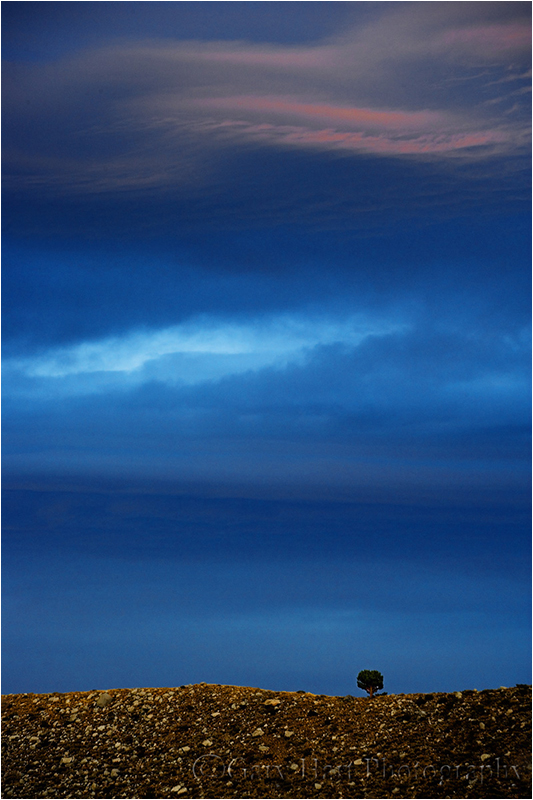
My own story of this image involved a frantic rush to capture a beautiful but rapidly fading sunset. I was with my brother on a dirt road in the Eastern Sierra. I’d been on this road many times and knew this tree well. Despite its rather ordinary appearance, the tree’s solitary perch atop a barren, rocky ridge had always intrigued me. I’ve always longed for a home with a sweeping view, and envied this tree’s perpetual 360 view of the Sierra crest to the west, the White Mountains to the east, and Crowley Lake below.
As the sunset started to materialize that evening, I realized that we were close enough that I might be able to include the tree in the sunset shoot. We hustled my truck back down the road, pulling into to a wide spot beneath the ridge several minutes after the best color had faded. Jay, who had no personal connection to “my” tree, stayed in the truck while I sprinted along the road with my camera and tripod until my position aligned the tree with the final, rippled vestiges of sunset. I only clicked a couple of frames, slightly underexposed to hold the color. (The slight blue cast is the color of the twilight light.)
That’s my story, and while it’s personally satisfying, I have no illusions that any of that comes across in the image. I’ve displayed this print in many shows and watched people walk right by without breaking stride. But I’ve also been pleased to watch many people stop, linger, and return. While I have no idea what “story” this image taps for them—solitude? conquest? perseverance?—I don’t think it really matters.
Adobe plays Monopoly with your photos (required reading for all Photoshop users, present and future)
Posted on June 17, 2013
Poppy Hillside, California Gold Country
Canon EOS-1D Mark II
1/250 second
F/5.6
ISO 320
70 mm
Storm brewing
Adobe recently announced the new Adobe Creative Cloud paradigm for its Creative Suite software (Photoshop, Illustrator, Dreamweaver, et al). While Photoshop is an essential part of my workflow, I’m not a power user and earn no income from Photoshop training, so I hadn’t really given this change a lot of thought. My plan has always been to simply stick with my current Photoshop CS6, which I’m quite happy with, and to stay out of the fray. That was before Michael Frye’s recent blog post, and the comments it generated, started me thinking a little deeper about the ramifications of Adobe’s change.
Once upon a time
Under the pricing model replaced Adobe replaced with ACC, Photoshop (I’m going to limit my comments to Photoshop, which is all that matters to me and most of my readers) has been updated every year or two (closer to two years than one); current users, after an initial $600+ purchase landed them on the Photoshop carousel, could upgrade to the latest version for an upgrade fee of $200 or so. While the initial price and the upgrade fee were far more than I typically pay for software and upgrades, not only do I need Photoshop, it’s amazing software that I’ve always felt was worth the price.
Send in the cloud
Enter Adobe Creative Cloud. Starting immediately, all subsequent Photoshop versions will be available on a subscription-only basis: $20/month for Photoshop only (because I’m looking more at ACC’s long-term ramifications, I’m ignoring the introductory, twelve-month, Photoshop for $10/month lure Adobe is offering); $50/month for the entire suite (plus a few other subscription options depending on use and current license status). For your ACC subscription you get lots of features of dubious value, free cloud storage (limited value for most), and, most importantly, instant access to new Photoshop features.
New users (surely there are still a few photographers out there not using Photoshop yet), rather than having to shell out the initial $600 (or whatever—there are lots of special offers that can reduce the Photoshop entry price somewhat), simply have to start a subscription: Score one for new users. Existing Photoshop users who paid their $600 initiation and have loyally contributed the $200 sub-annual upgrade dues, have gotten nothing but a shrug and an, “Oh well,” from Adobe. Score one for Adobe. While this doesn’t seem like a particularly great way to treat loyal customers, I haven’t been particularly critical of this aspect of the change because I always felt each version of Photoshop gave me my money’s worth.
What’s all the grumbling about?
ACC has inspired lots of complaints that would be easy to write it off as the standard grumbling that happens whenever an industry leader changes something (interface, security, pricing, etc.). And some Adobe Creative Suite multi-product users are singing the praises of Adobe’s move, pointing out that it will actually save them money in the long run. So what’s the problem?
Most of the praise and complaints about ACC are misguided and shortsighted. It’s true that ACC will cost most casual users more in the long run, with little added benefit (over continuing the current upgrade-fee paradigm). And even for many more serious users, the extra cost won’t add much benefit. For example, while I haven’t missed an upgrade in many years, I rarely upgrade immediately upon availability, and am even slower to incorporate the latest features. Generously assuming an upgrade outlay of $200 of every eighteen months under the current scheme (the historic average isn’t that frequent), at $20/month I’d be paying Adobe $360 every year and a half, $160 more than I currently pay. Since the new features are rarely an immediate game changer for me, and all the extra ACC “perks” are of zero interest, I see no way paying more money for ACC can be better than the current arrangement. Nevertheless, if Adobe had simply increased its upgrade fees, I’d have been less than thrilled but would have continued buying upgrades with little complaint.
On the other hand, those who use multiple ACC products and have a limited budget must be thrilled with the savings: the more ACC products you use, the more money you’ll save. And Photographers who must have the latest feature the instant it’s available will probably be very happy with the opportunity to fulfill their first-kid-on-the-block urges because they won’t need to wait a year or two for the next new Photoshop version.
It’s not just a game
Monopoly: exclusive control of a commodity or service in a particular market, or a control that makes possible the manipulation of prices.
Adobe Photoshop has held a monopoly on serious photo processing for years (and years). After pretty much saturating the market for new Photoshop users, Photoshop’s potential for growth more or less flatlined, making upgrades Adobe’s revenue bread-and-butter. But, since users could decide whether or not to spring for the latest upgrade based on its benefits over the prior version, Adobe was actually competing with itself only—in other words, to entice users to shell out $200 for the new version, Adobe wasn’t battling outside competition, the only competition they had to outdo was themselves (their previous version).
I suspect Adobe became a little tired of this (after all, what good is a monopoly if you can’t kick back with your feet on your desk, flicking cigar ashes on the floor?). Enter the cloud. While Adobe wasn’t at risk of losing money under the old model, it just found an opportunity to make more money. That’s what capitalism is all about. The problem is, capitalism starts to fall apart when monopolistic power supresses competition. And with no competition, Adobe has much less incentive to please its users. Since Adobe had no other competition to eliminate, they changed the rules to remove themselves from the equation—bingo, instant monopoly. If you’re not convinced that’s what happened here, ask yourself whether Adobe would have attempted something like this if its customers had any other options. And why they haven’t allowed us to choose between the old model and the new model.
Under the old model, Adobe had to deliver something of value before we gave them our money—if we didn’t think the latest version was worth the upgrade fee, we could simply wait until the next one (or the one after that). Now, under ACC, Adobe asks us to pay today and trust them to continue providing value in the form of performance improvements, reasonable pricing, and (especially) new tools. And if at any point we decide they’re not giving us value, withholding our money not only stops future improvements from landing on our computer, it sends us all the way back to where we are today (CS6).
Compounding the problem is the likelihood that improvements will, sooner or later, render new Photoshop files incompatible with CS6. Perhaps future ACC features will be so significant that there’s no avoiding backward compatibility limitations as the versions diverge; but a cynic might argue that backward incompatibility is also a smart business strategy that would very effectively lock ACC users into perpetual rent payment. It would also insulate Adobe against a mass exodus should they, let’s say, decide to increase the rent. And when the day comes when you can’t take your ACC-processed images elsewhere, you’re at Adobe’s mercy.
From Adobe’s perspective, ACC is genius, its long term profit potential limited mostly by their ability to convince the world that it’s actually in Photoshop users’ best interest. But I’m afraid that, in addition to the simple cost hits cited earlier (again, not a huge deal as far as I’m concerned), ACC is an opportunity for Adobe to get fat and lazy. Even if that’s not in their plan, there’s nothing like competition to inspire innovation, service, and reasonable prices. And there’s nothing like a monopoly to suppress all those inconvenient revenue drains. So, even if you believe that Adobe is an inherently good corporation that bases all decisions not on what will maximize its revenue but rather on what will most benefit users, removing the need to compete (even if it was only with itself) eliminates the motivation that has spurred them to consistently amaze us with the great and unexpected.
Meet the new boss
Should you allow Adobe to become your landlord? That’s your call; the answer isn’t absolute and depends on your circumstances and priorities. But you should at least approach the decision with full understanding of the longterm ramifications. Moving out of your reliable, fully paid for image processing home and into a flashy new image processing rental means trusting that your Photoshop landlord will be a benevolent monopolist (not just today, but tomorrow and the next day too), that they’ll continue to be at least as innovative and timely with fixes and improvements as they’ve ever been, even if they don’t have to. Because once you’re in, you’re in.
Five years from now, if you realize that Adobe has had its development feet on the desk for a while, jacking the rent while the cigar ashes accumulate on the floor, you’ll have two options: continue paying rent hoping that they’ll eventually fix the plumbing and add that new pool and gym you’ve been waiting for; or, simply stop paying rent, get evicted, and move back into to that place where you used to live (that hasn’t been worked on in five years). Oh, and you won’t be able to take any of your new stuff with you either.
* * * *
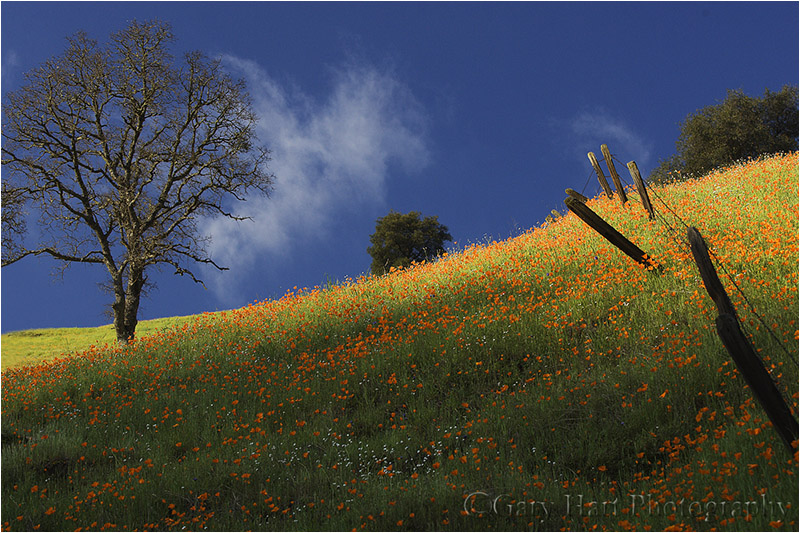
I chose the image at the top of this post because it has a cloud. (Genius!)

 Eloquent Images by Gary Hart