Eloquent Images by Gary Hart
Insight, information, and inspiration for the inquisitive nature photographer
You’re smarter than your camera, because…
Posted on September 24, 2016

Cradled Crescent, Sierra Foothills
Sony a7RII
Tamron 150-600 (Canon-mount with Metabones IV adapter)
.4 seconds
F/8
ISO 400
Your camera is stupid (and you’re not)
In a previous life, I spent a dozen or so years doing technical support. In this role, job-one was convincing people that, despite all failures and error messages to the contrary, they are in fact smarter than their computers. Most errors occur because the computer just didn’t understand: If I misspel a wurd, you still know what I meen (rite?); not so with a computer. A computer can’t anticipate, reason, or create; given a task, it will blithely continue repeating a mistake, no matter how egregious, until it is instructed otherwise, fails, or destroys itself.
All this applies equally to today’s “smart” cameras—no matter how advanced its technology, a camera just can’t compete with your brain. Really. If I’d have allowed my camera to decide the exposure for this crescent moon scene, I’d have ended up with a useless mess: The camera would have decided that the foreground hillside was important and allowed in enough light to expose distracting detail and completely wash out the color in the sky. But I knew better. Wanting to simplify the scene, I manually metered and banished the insignificant details to the black shadows, capturing only the moon’s delicate shape and a solitary oak silhouetted against the indigo twilight.
It’s scenes like this that cause me to never trust my camera’s decision making, and why, in my (many) decades of serious photography, I’ve never used anything but manual metering. And since I try to have elements at different depths throughout my frame, focus is almost always my decision, not my camera’s, as well.
Today’s cameras are more technologically advanced than ever—their auto exposure and focus capabilities are quite good, good enough that nobody should feel they must switch to manual if they fear it will diminish the pleasure they get from photography. But if you define photographic pleasure as getting the best possible images, try spending a little time mastering manual metering and hyperfocal focus, then use that knowledge to override your camera’s inclinations. In my workshops, where I teach (but never require) manual metering and hyperfocal focus to all who are interested, people frequently marvel at how easy and satisfying it is to take control of their camera.
Photo Workshop Schedule
Overriding my camera’s “brain”
(Images I couldn’t have done in Auto mode)


My camera is a time machine
Posted on September 17, 2016

Sunset Pastoral, Sierra Foothills (2015)
Sony a7R
Tamron 150-600 (Canon-mount with Metabones IV adapter)
.6 seconds
F/9
ISO 100
Photographers frequently complain about what their camera can’t do, and take for granted the things it does well. A lot of this is a frustration with the inability to duplicate the world the way we see it. But honestly, what fun is that? My favorite photographs are those that show me something I might have overlooked or were not visible to my eye to my eye at all. As someone who tries to photograph a world untouched by the hand of Man, I particularly love the camera’s ability to return me to simpler times, reducing a scene to its essence by subtracting reminders of human incursion.
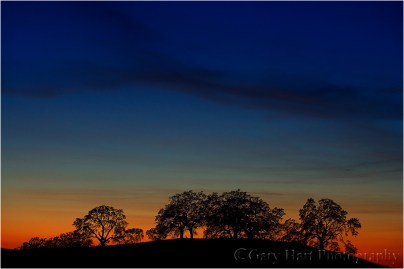
Tequila Sunset, Sierra Foothills, California (2005)
I recently returned to this small stand of oak trees huddled atop a hill in the low foothills east of Sacramento. Since I first photographed this scene over ten years ago, the peaceful country road “my” hill overlooks has evolved into a bustling artery for oblivious commuters. More recently, fencing has sprung up and an arcing dirt road has been carved into the hillside, a harbinger I fear of an impending subdivision. They’re everywhere up here now, these cookie-cutter developments with meaningless, corporate-crafted street names (Aspen Meadows Drive, Teakwood Court), devouring this once bucolic setting like a stage-4 cancer.
Despite the distractions, my camera’s “limited” vision instantly returns me to more peaceful times. Gone in a shutter-click are the highway’s roar and choking exhaust, while the encroaching suburbs are banished by the narrow view of a telephoto lens. And that scar of a road? It disappears in the shadows of the camera’s narrow dynamic range.
Photo workshop schedule
Celebrating the camera’s “limited” vision
Click an image for a closer look and slide show. Refresh the window to reorder the display.


The cure for the summertime blues
Posted on August 15, 2016

New Moon, Sierra Foothills, California
Sony a6300
Tamron 150-600 (Canon-mount with Metabones IV adapter)
1/8 second
F/8
ISO 100
There are many great reasons to be a landscape photographer in California. Summer isn’t one of them. Most people find California’s benign whether appealing—our mild winters and dry summers are one of the Golden State’s prime attractions. But to photographers, blue skies are boring, and California’s summer skies are nothing if not blue.
We say goodbye to our clouds in May, and I go stir crazy waiting for their return in October. One summertime solution is night photography, which requires clear skies. As an added bonus, summer’s warm temperatures make fumbling with camera gear and standing around in the dark much more tolerable, and the Milky Way’s bright center is very much a summer feature. California’s dense population means extreme light pollution through much of the state, but our proximity to mountains make escaping the light relatively easy in summer.
Because I can’t always make it to the mountains, I’ve found other photo opportunities in the foothills closer to home. The wildflowers of spring are gone, and the sun has burned the once green grass a golden brown, but the foothill’s oak trees are reliable silhouettes against the colorful twilight sky. Once upon a time I was satisfied with simple silhouettes, but in recent years I’ve made an effort to include a crescent moon in my foothill oak silhouette scenes.
A crescent moon only appears in close proximity to the sun, hanging in the brightest part of the post-sunset/pre-sunrise sky, above a (relatively) dark landscape. The more of the moon that’s illuminated, the farther in the sky from the sun it will hover (a full moon is exactly opposite the sun, rising at sunset and setting at sunrise). Since a crescent rises and sets just before or after the sun, there’s not a lot of time when it’s above the horizon and the sky is dark enough for its thin outline to stand out.
Getting a crescent moon to align with my foreground subjects is all about timing—for example, some months a new moon follows the sun too closely, dropping below the horizon before the sky has darkened enough to reveal it. The next night the moon lags so far behind the sun that that getting it in the frame with my subject before the sky darkens too much requires a moon-shrinking wide angle lens. As much as I enjoy accenting a scene with a small crescent, I truly love photographing the moon large.
My most recent attempt came last Thursday, a day I’d circled in my calendar several months ago after calculating that the moon would be in the perfect twilight window—not too low or too high—for my favorite trees. My brother and I started the evening at a location with a lower horizon so we could photograph the sun setting into the trees (I blogged about that shoot last week), then zipped up the road to a spot that I’ve been photographing for years.
Sometimes I can photograph this scene from the road, but in summer the new moon sets so far north that we had to angle a little south and climb one small hill and circle another to align it with the trees in the distance. Aligning the trees and moon enabled me to shoot the entire scene with my Tamron 150-600 and Sony a6300 for maximum magnification.
There are actually two trees side-by-side atop this distant hill, but I had so much magnification, I could only photograph one at a time. I gave both trees equal time—today’s image came early in the shoot, when the moon aligned better with the left-most tree. As the moon descended to the right, I eventually turned my attention to the other tree.
Regardless of the tree I was working on, I moved around a lot, left/right and up/back, dodging cow pies, to balance the moon and tree in the frame and find a relationship that worked. By ascending a small hill behind me, I was even able to extend the shoot a few minutes before the moon finally disappeared.
It would have been very easy to stay home and do something else that night. I know these simple images aren’t big money makers, and summer moon and oak silhouettes may not be as spectacular as Yosemite Valley covered with snow, or a rainbow above the Grand Canyon, but I find photographing them no less personally rewarding. (I already can’t wait until next month.)
One more thing: See the small dot of light on the right, at about the same level as the moon? That’s Mercury, another sun-hugging visitor only visible in the dawn or dusk twilight glow.
Read more about photographing a crescent moon
A crescent moon gallery


The Secret Weapon for Overcoming Unsung Landscapes
Posted on July 24, 2015

Crescent at Sunset, Sierra Foothills, California
Sony a7R
Tamron 150-600 (Canon-mount with Metabones IV adapter)
1/6 second
F/9
ISO 800
I travel a lot. A lot. Don’t get me wrong—I know I’m incredibly fortunate to see and photograph the things I do, but sometimes it’s nice to be home. Despite the world-class locations I get to visit, I don’t cease being a photographer just because I’m home. I spend a lot of time exploring and photographing the unsung landscapes near home, landscapes that few would cross borders to photograph, but landscapes that I feel a particular connection to by virtue of a lifetime in California.
Look to the sky
The landscape is only half of an image. Since the best photography is usually more than simply a picture of a pretty thing, I always try to juxtapose my terrestrial subjects with an interesting sky. And unlike stationary terrestrial subjects, you can stand in one place and without moving, watch the sky do some pretty spectacular stuff: moon, stars, clouds, rainbows, whatever.
Sadly, as nice as California’s landscapes are, compared to most places, California has relatively boring skies. If I lived somewhere that gets summer thunderstorms (pretty much anywhere in the United States except the West Coast), I’d find a photogenic tree or creek, then make sure I was there the next time the sky did something special. But in California, I end up doing a lot of moon and star photography (not that there’s anything wrong with that).
Local favorites
My foreground options near Sacramento are rivers and oaks (and wildflowers in spring), and I particularly love our oaks (the rivers near town are often overrun with people). The criteria I use when searching for oaks to put with my sky images are a striking shape (with an oak, that’s usually a given), a distant vantage point that allows me to use a telephoto (to magnify to moon without losing most of the tree), and elevation that puts the tree against the sky instead of other hills and trees. Over the years I’ve collected a number of these spots, and will never tire of looking for more.
Chasing the moon
Last week I drove to the foothills east of Sacramento to photograph a thin slice of moon on the western horizon just after sunset. This wasn’t an exploration mission, it was specifically planned to take advantage of a spot I’d found earlier this year.
Unfortunately, (as I feared) the developers had found my spot too, and I arrived to find “my” trees surrounded by new homes in varying stages of completion—lucky for a handful of homebuyers, but not so much for all the rest of us who enjoy the foothills’ solitude and pristine views.

Tequila Sunset, Sierra Foothills, California

New Moon and Oaks, Sierra Foothills, California
Plan B
Just down the hill from this recently found-and-lost spot was the subject of my very first planned moon shoot, an oak-topped hillside that I’d photographed at sunset many years ago, decided that it would look really nice with a crescent moon, then figured out when to return.
But this time I found the moon far north (to the right) of its position all those years ago (the closer to the summer solstice, the farther north a crescent moon sets), and it soon became clear that only spot that would work was on a shoulderless, blind curve of a busy, two-land road. Compounding the difficulty, the moon this night was also closer to new (thinner and nearer the horizon), significantly shrinking my window of shooting opportunity, which limited the distance I could hike to get there in time. I made several passes in both directions before finding a safe(ish) place to park, then crammed my car all the way up against a tilting fence, two tires in a drainage ditch, and put on my hazard blinkers.
Why did the photographer cross the road?
Getting the alignment I wanted required crossing the road, scaling a barbed-wire fence, and traipsing through knee-high weeds. The knowledge that rattlesnakes pretty much rule these foothills made me acutely aware that the weeds were so thick that I couldn’t really see the landing spot for each step.
I photographed the entire scene with my Tamron 150-600 on my Sony a7R. As the moon dropped, sliding left to right, I moved forward along the fence line to control the relationship between the descending moon and the trees, starting with wider focal lengths that included some or all of the eight to ten trees capping the hill. Because my route dropped as I moved forward, the moon quickly fell into the trees from my perspective, allowing me to include the moon and trees increasingly tighter compositions.
For the night’s grand finale I found an alignment that cradled the moon in the silhouetted branches of a single tree, zooming to 600mm to magnify the moon and eliminate all but one tree. Because a 600mm focal length will catch even the slightest vibration, I went to 800 ISO to maximize my shutter speed in the deepening twilight. Once I shot this I actually rescaled the fence and darted back across the highway attempting to get the moon on the other side of the tree, but by the time I got everything aligned, the trees had been swallowed by the too-dark sky.
Your assignment…
Every location has features that set its landscape apart. Trees, rivers, lakes, mountains, hills, farmland—I could go on, but you get the point. Your local subject doesn’t need to be spectacular, because when the sky is spectacular, all you need is an interesting terrestrial anchor for your image.
The next time you find yourself with time to kill, explore your outskirts and identify unique subjects that you can add to a striking sky. Now, get to work!
Photo workshop schedule
A gallery of unsung landscapes
Click an image for a closer look, and a slide show. Refresh the screen to reorder the display.


Exceeding the sum of the parts
Posted on February 1, 2015
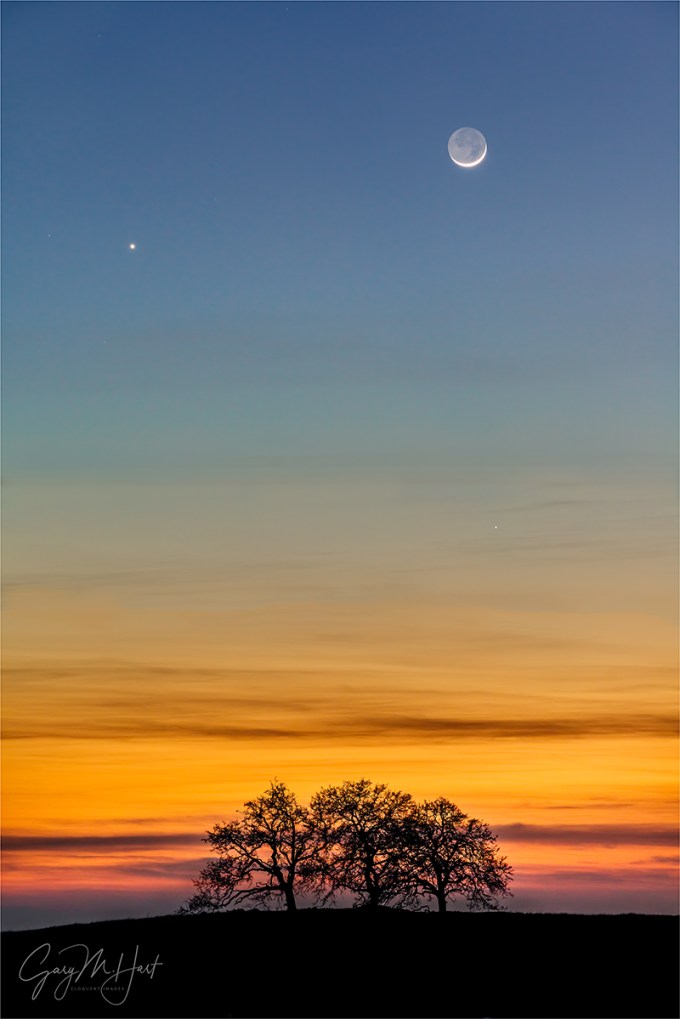
Heaven and Earth, New Moon and Venus, Sierra Foothills
Sony a7R
Sony 70-200 f4 G
2 seconds
F/8
ISO 400
When I decided to make photography my career, I promised myself I’d only photograph what I love. Not because I believed that’s where I’d find my best images (I wasn’t that calculating), but simply because the only good reason I could come up with for leaving an excellent job with a great company was to do something that made me truly happy. And lucky me—today most of my time behind a camera is spent pursuing subjects that touch a special place in my heart, subjects I’m naturally drawn to, camera or not.
For example…
There’s Yosemite, for sure. And pretty much anything celestial. Dramatic weather, dogwood, poppies, oak trees, reflections all thrill me. I could go on…. And as much as I enjoy these subjects individually, I love combining more than one to create (what at least feels to me like) a natural synergy. I mean, photographing Yosemite Valley is always great. And who doesn’t like to see a rainbow? But finding a rainbow arcing above Yosemite Valley? Well, you get the point….
While Yosemite Valley is a bit of a drive, and rainbows are unpredictable, ephemeral phenomena, the oak trees I love so much are deeply rooted less than an hour from home. And the moon is nothing if not predictable. So combining these favorites simply requires mixing a small amount of effort with a little cooperation from the weather.
Over the years, I’ve accumulated a number of candidate views in both directions: east for a full moon at sunset, west for a new moon at sunset; the other way around for sunrise. The east views will work for late afternoon rainbows too, but I’ve yet to capture one of those (it’ll happen).
Marking my calendar
Anxious for something to photograph between my Death Valley and Yosemite winter workshops, I made a point of highlighting the evening of this January’s full moon in my calendar. And rather than return to one of my tried-and-true foothill oak views, I left early enough to explore. After a great afternoon and many discoveries, I finally landed at the end of a new, graded but unbuilt cul-de-sac with a clear view of a distant trio of hilltop oaks.

While waiting for the moon to appear, I fired a few frames, silhouetting the trees against the sun descending through the orange sky, an unplanned and special juxtaposition in its own right. When the moon finally emerged above the darkening horizon, it was flanked by Venus. And when Mercury appeared a few minutes later (center-right, beneath the moon), I had a celestial triangle balanced above the terrestrial oaks. Synergy.
Workshop Schedule || Purchase Prints || Instagram
A gallery of natural synergy
Click any image to scroll through the gallery LARGE


Small steps and giant leaps
Posted on July 20, 2014
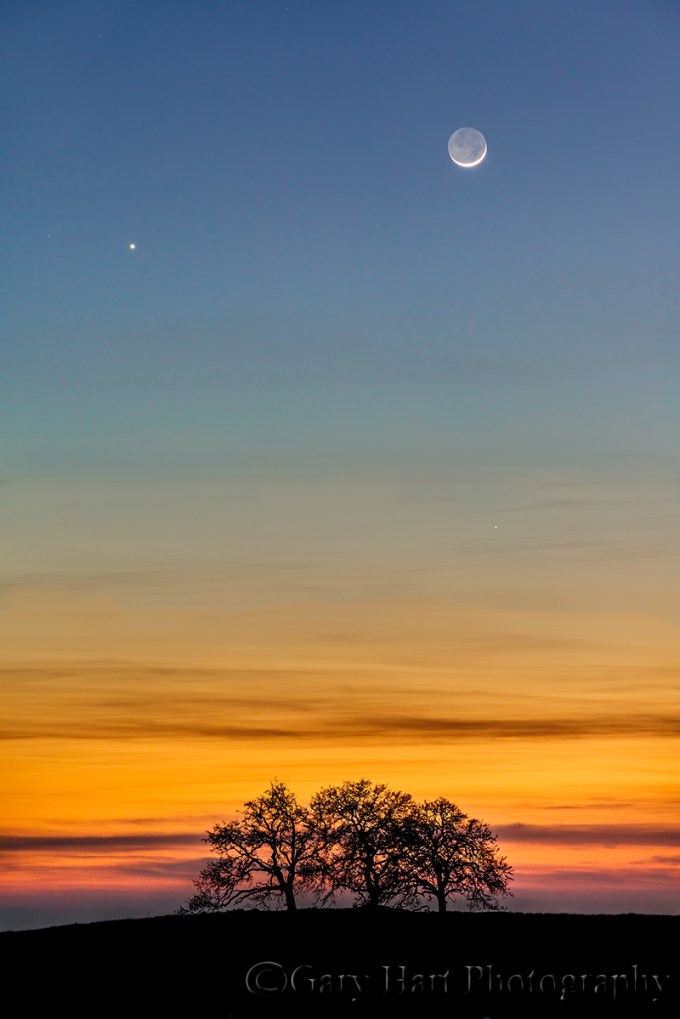
Oak and Crescent, Sierra Foothills, California
Canon EOS-5D Mark III
320 mm
1.6 seconds
F/11
ISO 400
July, 1969
I turned 14 that month. I was into baseball, chess, AM radio, astronomy, and girls—not necessarily in that order. Of particular interest to me in 1969 was the impending moon landing, a milestone I’d been anticipating since tales of American aerospace engineering ingenuity and our heroic astronauts started headlining the Weekly Reader, and my teachers began gathering the class around a portable TV to watch the latest Gemini or Apollo launch or splashdown. If you remember the Sixties, you understand that the unifying buzz surrounding each Apollo mission briefly trumped the divisive tension surrounding headlines detailing Vietnam battles and demonstrations, the Civil Rights movement, and Communist paranoia. Unfortunately, without checking NASA’s schedule or asking for my input, my parents and three couples they knew from college decided mid-July 1969 would be the ideal time for our four families to join forces on a camping trip in the remote, television-free redwoods of Northern California. (“What could we possibly need a television for?”)
Apollo 11 was halfway to the moon when the Locher and Hinshaw families pulled up to our home in Berkeley (the Hardings, coming down from Eastern Washington, would meet us at the campground a couple of days later). The warm greetings exchanged by the adults were balanced by the cool introductions forced on the unfamiliar children. We departed the next morning, caravan style, our cars connected by woefully inadequate walkie-talkies that we’d almost certainly have been better off without (it had seemed like such a good idea at the time). I remember my dad keeping a safe distance behind Hinshaws, as he was convinced that their borrowed trailer, that seemed to veer randomly and completely independently of their car, would surely go careening into the woods on the next curve. But somehow our three-car parade pulled safely into Richardson’s Grove State Park late that afternoon.
In true sixties style, the three dads went immediately to work setting up campsites while the moms donned aprons and combined forces on a community spaghetti dinner. Meanwhile, the younger kids scattered to explore, while the four teens, having only recently met and being far too cool for exploration or anything remotely resembling play, disappeared into the woods, ostensibly on a firewood hunt. Instead, we ended up wandering pretty much aimlessly, kicking pinecones and occasionally stooping for a small branch or twig, just far enough from camp to avoid being drafted into more productive (and closely supervised) labor by the adults.
But just about the time we teens ran out of things not to do, we were relieved to be distracted by my little brother Jim, who had just rushed back into camp breathless, sheet-white, and alone. We couldn’t quite decipher his animated message to the parents, but when we saw our dads drop their tarps and tent poles and rush off in Jim’s tracks toward the nearby Eel River, we were (mildly) curious (to be interested in anything involving parents was also very not cool). So, with feigned indifference, the four of us started wandering in the general direction of the river until we (somehow) found ourselves peering down from the edge of a 50 foot, nearly vertical cliff at the river toward what was clearly the vortex of all the excitement. It was that instant when I think we all ceased being strangers.
The scene before us could have been from a bad slasher movie: Flat on the ground and unconscious (at the very least) was 11 year-old Paul Locher; sitting on a rock, stunned, with a stream of blood cascading from his forehead, was Paul’s 10 year-old brother John. As disturbing as this sight was, nothing could compare to seeing father Don Locher orbiting his injured sons, dazed and covered in blood. The rest of this memory is a blur of hysterics, sirens, rangers, and paramedics.
It wasn’t until the father and sons were whisked away to the small hospital in Garberville, about 10 miles away, that we were able to piece together what had happened. Apparently Paul and John, trying to blaze a shortcut to the river, miscalculated risk and had tumbled down the cliff. My brother at first thought they were messing with him, but when John showed him a rock covered with blood, he sprinted back to fetch the parents. Arriving at the point where the kids had gone over, the fathers made a quick plan. My dad and Larry Hinshaw would rush back to to summon help, and see if they could find a safer path down to the accident scene. Don would stay put and keep an eye on his sons. But shortly after my dad and Larry left, John had looked down at his brother cried, “Daddy, I can see his brains!” Hearing those words, Don panicked and did what any father would do—attempt to reach his boys. Thinking that a small shrub a short distance would make a viable handhold, Don took a small step in its direction, reached for and briefly grasped a branch, lost his grip, and tumbled head-over-heals down to the river.
After what seemed like days but was probably only an hour or two, we were relieved to learn that John needed no more than a few stitches; he was back in camp with us that night. Paul had faired slightly worse, with a concussion and a nasty cut behind his ear—the “brains” his brother had seen was ear cartilage. Paul spent the night in the hospital and was back with us by the time the Harding clan arrived the following afternoon. Don, however, wasn’t quite so fortunate. In addition to a severe concussion, he had opened up his head so completely that over 150 stitches were required to zip things back together. Though Don spent several days in the hospital, needless to say, we were all relieved by the understanding that it could have been much worse.
By Sunday, Don was feeling much better but was still a day or two from release to the dirt and fish guts of our four family campsite. Most of us had visited at one time or another, going in small, brief waves and respecting the hospital’s visiting hours. Nevertheless, there was another priority that had gone unspoken in the first few days following the accident came to prominence with the realization that Don would be fine. I can’t say who first recognized the opportunity, but I’m guessing that Larry Hinshaw had something to do with convincing the nursing staff to look the other way when Don was suddenly host to 20 simultaneous visitors that night. Whatever magic was worked, I’ll never spending that Sunday evening, July 20, 1969, shoehorned into a tiny hospital room, sharing a tiny black-and-white television screen with 20 pairs of eyes, witnessing history.
Besides my parents and two brothers, the rest of the crew that night I’d only met just a few days earlier, but I can still name every single one of them. The relationships formed that week continue to this day. And so do the stories, which, like this story, are filled with some of the greatest joy I’ve ever experienced, and also with some of the greatest tragedy. But it’s this story in particular, the catalyst for all the stories that follow, that explains why the words, “One small step for man, one giant leap for mankind,” have a very personal significance for me.
Today it’s hard for me to look at the moon without remembering that hospital room and the emotional events that enabled me to witness Neil Armstrong’s historic first steps with those special people. As a child of the Sixties who very closely followed all of the milestones and tragedies leading up to that moment, I couldn’t help but wonder while assembling the images for the gallery below about that week’s role in shaping who I am and what I do today.
Workshop Schedule || Purchase Prints
A lunar gallery
Click an image for a closer look, and a slide show. Refresh the screen to reorder the display.


These are a few of my favorite things
Posted on February 3, 2014

California Crescent, Sierra Foothills
Canon EOS 5D Mark III
2.5 seconds
82 mm
ISO 100
F11
Maria von Trapp had them, you have them, I have them. They’re the favorite places, moments, and subjects that provide comfort or coax a smile no matter what life has dealt. Not only do these “favorite things” improve our mood, they’re the muse that drives our best photography. Mine include the translucent glow of a California poppy, a black sky sprinkled with stars, a breathtaking sunrise duplicated in reverse by still water, and the vivid arc of a rainbow following a cleansing rain. Also on my list (as you may have guessed by now) are the rolling hills and stately oaks of the Sierra foothills, a delicate slice of moon hovering above the horizon, and the subtle band of shifting color separating day and night.
I do my best to put myself in position to photograph all of these moments—the more I can combine, the better. For example, on my calendar each month (among other things) are the best days to photograph the old moon before sunrise, and the new moon after sunset. And in my GPS is a collection of foothill locations (though by now I’m sure my car could navigate to these spots on its own) with hilltop oak trees that stand against the sky.
The best evenings for the new moon in the most recent lunar cycle were Friday and Saturday, January 31 and February 1. With plans for Friday, I blocked Saturday and made the drive up to the foothills, where I waited at a favorite spot for the sun to drop and the moon to appear. Over the years I’ve accumulated lots of pictures of these trees beneath a variety of skies, with and without the moon. My composition decisions on each visit were mostly determined by the conditions: clouds, color, the moon’s direction, and the moon’s elevation above the horizon.
Saturday night’s cloudless, unspectacular sky spread a simple canvas that emphasized the crescent moon floating above the day/night transition I love so much. As an added bonus, Mercury joined the party, leading the moon to the horizon (above the tree on the right). In the deepening darkness I moved up and down the road to change the moon’s position relative to the trees. With the moon fairly high, I found that moderately wide, vertical compositions worked best. I underexposed slightly to and emphasize the trees’ shape with a silhouette; with nothing else to balance my frame, I decided on the symmetry of an isosceles triangle connecting the trees and moon.
Same view, different day
-

- Oaks at Sunset, Sierra Foothills
-

- Crescent and Clouds, Sierra Foothills, California
-

- Red Sky, Oak at Sunset, Sierra Foothills
-

- Goodnight Moon, Sierra Foothills, California
Night and Day
Posted on October 9, 2013

Night and Day, Crescent Moon Rising Above Mono Lake
Canon EOS 5D Mark III
3.2 seconds
F/5.6
ISO 800
40 mm
October 2013
It’s dark. It’s cold. It’s early—so early that some would still consider it late. But you drag yourself out of bed anyway, for the promise of something most people never experience. And experience is the operative word here, because it’s much more than just the view. Or the photography. It’s the opportunity to witness the transition from night to day, to bask in a quiet that’s impossible in our metropolitan mayhem, to inhale clean, chilled air, and to watch the rising sun’s warm hues push back Earth’s indigo shadow to devour the twinkling vestiges of night. Of course you can watch this happen in reverse after sunset, but it’s just not the same in a world has been lived in for a dozen or so hours.
I’d scheduled this year’s Eastern Sierra workshop to conclude on the one day each month when a sliver of moon floats in the transition between night and day. To photograph the moon this small and close to the sun, I try to be in place an hour before “official” sunrise (the posted sunrise time, when the sun would crest a flat horizon), when darkness still predominates. With a five mile drive on a rugged, unpaved road, and a half mile (or so) trail-less walk through sand and mud, I got the group on the road at 5:15 for our 7:00 a.m. sunrise. Despite some blurry eyes, there was no grumbling; and by the time we were ready to trek to the lake, everyone was in great spirits.
On this morning Mother Nature rewarded us by chasing away the clouds that had dogged the horizon the last couple of days. These clouds had given us brilliant color, but had also preempted our night photography shoot just ten hours earlier; I was concerned that they’d obscure the moon I’d been so looking forward to. No problem—in the clouds’ place we found this two-percent slice of old moon, one day removed from new, just as I’d ordered. Phew.
Because this was the last day of the workshop, everyone had pretty much mastered the difficulty of exposing for a dark foreground beneath a bright horizon—some blended multiple exposures, others reached for their graduated neutral density filters—allowing them to concentrate on creativity. I tried a variety of compositions, horizontal and vertical orientations from wide to tight, and encouraged the rest of the group to do the same (though I suspect that by now they’d all learned to tune me out).
This is one of the first images I captured that morning. It was still dark enough that the amount of light required to bring out any detail in the foreground also revealed lots of lunar detail in the earth-shadow, and stars still pierced much of the sky. Nice. To ensure that I didn’t get motion blur in the moon, I made some compromises: I dropped to f5.6 (depth of field wasn’t a concern, but lenses are slightly slightly less sharp as the approach their extreme apertures) and bumped to ISO 800 (with my 5D Mark III and today’s noise reduction software, noise at ISO 800 is no longer much of a concern). For most of my images that morning I used a two-stop hard-transition graduated neutral density filter to subdue the bright horizon, but this was one of my earliest images, captured before that was necessary.
The group was pretty quiet for most of this sunrise, usually a sign that they’re pretty happy with what they see and the images they’re capturing. Every once in a while I’d answer a question, or offer suggestions, but it seemed like people were pretty much “in the zone.” Nevertheless, I did pause couple of times to remind everyone not to get so caught up in their photography that they forget to appreciate what we’re witnessing.
These ephemeral moments in nature change subtly but quickly—soon the stars disappeared and moon faded into the advancing daylight. By the time the sun crested the horizon, our attention had turned to the warmly lit peaks behind us. And then it was over.
The Moon: (Sometimes) Size doesn’t matter
Posted on July 21, 2013

Goodnight Moon, Sierra Foothills, California
Canon EOS SL1
8/5 seconds
F/5.6
ISO 100
300 mm
A few years ago I proposed an article to “Outdoor Photographer” magazine on photographing the moon. The editor at the time (not the current OP editor) replied that moon photographs don’t work because the moon appears so much smaller in a photograph than people remember it. I couldn’t argue—the moon does indeed look smaller in a photograph than we perceive it in person. But I’ve never thought the moon needs to appear large to be an effective subject because its emotional power gives even the smallest moon enough visual weight to grab the eye and hold a disproportional segment of the frame. Ansel Adams certainly had this figured out, making a small moon the prime focal point of many images, including the image that’s arguably his most famous, “Moonrise, Hernandez, New Mexico.” Nevertheless, it took a new editor to finally get OP to acknowledge that size doesn’t matter and publish my “Shoot the Moon” article.
Today, more photographers than ever are using a small moon to accent familiar landscapes. But as nice as these images can be, sometimes it’s nice to make the moon BIG. I’m afraid the vast majority of images displaying a BIG moon looming over an iconic scene are composites, wide compositions with a telephoto moon superimposed on top. My feeling about these moon composites ranges from “Ugh,” when the photographer has at least had the integrity to label it a composite, to “Foul!,” when the photographer pretends that the entire scene was captured with a single click.
Your ability to enlarge the moon naturally (with a single click) is determined by the amount of telephoto you use: The longer your focal length, the larger your moon. But increasing the focal length shrinks the field of view, so matching a large moon with a particular scene requires positioning yourself a long way from the scene. For example, if I want to photograph the moon rising above Lake Tahoe, Tahoe’s size means I’m pretty much stuck with a wide angle (small moon) scene. In the Emerald Bay sunrise scene below, I was about a half mile from the lake, but even at 40mm I’m unable to fit all of the bay, and the moon is quite small.

Moonrise, Emerald Bay, Lake Tahoe
On the other hand, Yosemite Valley offers many distant vantage points that allow me to isolate Half Dome or El Capitan with a telephoto lens. I make a point of knowing when I can align a crescent or full moon with Half Dome and do my best to get myself (or a workshop group) there to photograph it. The image here is a 400mm (full frame) shot that completely isolates Half Dome from the rest of the scene.

New Day, Half Dome and Crescent Moon, Yosemite
Compare it to the image taken from the same location—at 105mm, Half Dome shrinks and the moon becomes an accent in a much larger scene.

Rising Crescent, Yosemite Valley
The image at the top of this frame perfectly illustrates my approach to moon photography. Because I can’t always get to Yosemite (and I like some variety in my images), I keep a mental database of nearby locations that align with a subject I can silhouette against the east or west horizon (the general direction of the moon’s rise and set) when viewed from a distant vantage point. Near the top of my list is a pair of trees topping a hill in the foothills east of Sacramento (the same trees featured in my July 12 post). Not only can I photograph these trees against the sky, from a distance, the ability to shift a fairly good distance north or south without losing my view of the trees allows me to juxtapose them against the moon, which shifts a significant amount from month to month.
The July 12 image was photographed the same night at 330mm with my full frame 5D Mark III; today’s image was photographed at 300mm with a 1.6 crop camera, for an effective focal length of 480mm. I plan to return to this spot a few more times for even tighter (larger moon) captures. I’d also like to try some with the full moon—since the view here is to the west, I’ll need to photograph the full moon when it sets at sunrise. Stay tuned….
* * *
About my new camera
Some photographers may be mortified to see that I shot this with a Canon Rebel SL1. For those who don’t know, the Rebel line is Canon’s entry level, consumer camera (by inference, something no self-respecting pro would ever be caught dead using). But, while the Rebel cameras have some limitations, image quality isn’t one of them. So here’s my reasoning.
For about a year my primary camera has been my 5D Mark III. While the 5DIII gives me more dynamic range and better high ISO performance than my five year old 1DSIII, rather than sell the 1DSIII (still a great camera), I decided to keep it as a backup. Unfortunately, it’s also a brick, an absolute pain to lug around in the remote chance my 5DIII goes down. And its an even bigger pain to fly with.
Another problem with my 1DSIII as my prime backup is, like my 5DIII, it has a full frame sensor. I prefer having a “crop” (smaller sensor) body as my backup, because it gives me something I don’t have with a full frame (60% more reach from my lenses). So when I heard about Canon’s SL1, I checked it out and learned: It takes all my lenses; has an 18mp sensor; and is incredibly compact, hands down the tiniest SLR I’ve ever seen (if I didn’t shoot everything on a tripod, I might find it almost too small to shoot). It’s also only $650. So I bought one.
Now my 1DSIII will still travel with me wherever I drive (as will my 5DIII and my SL1), because I’ll have room. And if my 5dIII ever goes down for an extended period, my 1DSIII will become my primary body until the 5DIII returns to health. But when I fly anywhere, it’ll just be my 5DIII and my SL1. And in those situations where I want to carry two cameras in the field—for example, when I photograph the moon and want both wide and long shots—the tiny SL1 will always be the second camera. (So I guess size also matters when I’m choosing a backup camera.)
Epilogue: The image in this post was captured on my very first shoot with the SL1, and I’m happy to report that it performed wonderfully.
One part plan, one part serendipity, one part impulse
Posted on July 12, 2013

Dusk, Crescent Moon and Oaks, Sierra Foothills, California
Canon EOS-1Ds Mark III
1.6 seconds
F/11.0
ISO 400
330 mm
Nature photography is a particularly serendipitous art form. We do our best to get ourselves in the right place at the right time, but it’s ultimately up to Mother Nature to deliver. Fortunately, some things in nature are more certain than others. Among them is the phase, location, and timing of the moon, each of which can be anticipated with near absolute precision. Another certainty I’ve grown to depend on is clear skies in California in July. Armed with those two truths, Wednesday night a friend and I headed to the foothills to photograph a thin crescent moon in the western twilight.
My criteria for photographing any twilight scene include finding a striking shape to silhouette against the sky. And like a portrait photographer who can’t get enough of a particular model, there a number of “go-to” trees scattered about the foothills that I return to whenever I get the urge to photograph a sunset near home. For a long time I’ve known the hilltop perch of one pair would allow me to juxtapose them with a setting moon. I’d already photographed this pair many times with good success (one of these images was on a magazine cover), and one time got them with a crescent moon. But that success only made me greedy for a tight shot with the moon large, among the trees. I check the moon info each month to see if its phases and position align with my schedule (for obvious reasons, I’m often away from home when the moon is at its photographic best), and Wednesday night looked like everything might just fit into place, so out we went.
By about two hours before sunset it became pretty clear that clouds would be part of our sky that evening. While not unprecedented, this unexpected intrusion could be: A) Good, if the clouds added sunset color while parting enough to reveal the moon; or B) Bad, if the clouds thickened to obscure the moon and block the color. Serendipity.
Mark and I pulled up to “my” trees about fifteen minutes before sunset, but with the clouds starting to look like they might deliver a colorful sunset, and since we didn’t need to be in position for the moon until 25 or 30 minutes after sunset, I made the snap decision to continue about five miles down the road to another group of trees that I thought would be particularly nice for a colorful sunset. The sunset was indeed worth the detour, but that’s a story for another day. When it was over, we hightailed it back to the hilltop tree spot to find the moon playing hide and seek with the clouds above and just a little south of the trees. Definitely photo-worthy, but not aligned so perfectly that I could get the tight telephoto shot I’d envisioned.
While photographing from the narrow shoulder here is fairly easy (though a bit unnerving), the angle we needed to align the trees and moon required scaling a small hill. Behind a barbed wire fence. Hmmm. But wait—what’s this? A gate! And it’s unlocked! So, all with about as much restraint as two ten-year olds at the all-you-can-eat dessert bar, up the hill we traipsed, dodging cow patties and listening for rattlesnakes. As expected, the new vantage point provided exactly the angle we needed, but I have to say that in the growing darkness my impulsiveness enthusiasm was soon replaced by visions of tomorrow’s headlines:
- LOCAL PHOTOGRAPHERS ARRESTED FOR TRESPASSING
- PHOTOGRAPHERS SHOT BY FRIGHTENED FARMER
- ANGRY BULL GORES DISTRACTED PHOTOGRAPHERS
Fortunately, none of that stuff happened, and Mark and I made it back to my car, undetected and intact. Impulsive urges notwithstanding, I ended up with several “keeper” images, thanks in no small part to the convergence of my plan with the fortuitous appearance of clouds to color our summer sky. Sometimes things just work out.
Later, I had to admit that going up there like that violated one of my personal rules: Get permission before entering private property (I’ll often offer a print as thanks). But this time I rationalized that since we’d do no harm, and because time was absolutely of the essence, it would be okay to maybe go just a little bit beyond the fence. And while it worked out this time, that’s the kind of decision that inspires hindsight (and I have the stories to prove it).
Read more about photographing a crescent moon
A Crescent Moon Gallery
Click an image for a closer look and slide show. Refresh the window to reorder the display.


 Eloquent Images by Gary Hart