Eloquent Images by Gary Hart
Insight, information, and inspiration for the inquisitive nature photographer
America’s worst idea
Posted on August 13, 2014

Sunrise, Grandview Point, Grand Canyon
Canon EOS-5D Mark III
65 mm
1/4 second
F/11
ISO 100
Today’s homework assignment is “A Cathedral Under Siege,” from the August 9 edition of the “New York Times.”
I really don’t have a lot to add to the thoughts expressed in the article, except that if our National Park system is “America’s best idea,” then what is planned for the Grand Canyon may just be America’s worst idea. I only hope that common sense will prevail over the almighty dollar in time to spare this monumental boondoggle from establishing a precedent that threatens every National Park in America.
(Read a little about this image beneath the gallery.)
A National Park Gallery


About this image
Saturday evening Don Smith and I started the first of two, back-to-back Grand Canyon Monsoon photo workshops. Our first sunset shoot at Desert View was nice, but somewhat limited by haze from smoke caused by several managed fires burning near the canyon’s South Rim. Sunday morning we gathered the group at 4:30 and ushered them to Grandview Point, where we were thrilled to find the haze had cleared—in its place we found the Grand Canyon basking between a mix of clouds and clear sky that usually bodes well for a nice sunrise.
We did indeed enjoy beautiful sunrise reds and pinks that morning, but I think my favorite part of the morning came when the sun crested the horizon and in concert with low, broken clouds sent crepuscular rays skimming the canyon. I quickly pointed my camera upstream and worked on a composition to do the moment justice. The towers, bluffs, and buttes on the left were a must, but they carry a great deal of visual weight. To balance the frame I used the shafting sunlight and Colorado River snaking near the frame’s right side. The low hanging clouds provided a perfect ceiling for my frame. And because the combination of bright sky and canyon shadows created a highlight-to-shadow range that exceeded a camera’s ability to capture, I used a three-stop hard transition graduated neutral density filter from Singh-Ray to bring the difference into a manageable range.
(You might also be interested to know that the proposed tram referenced in the article would land just upriver from the segment of the river you see here.)
Inside the Grand Canyon: The Great Unconformity
Posted on June 28, 2014
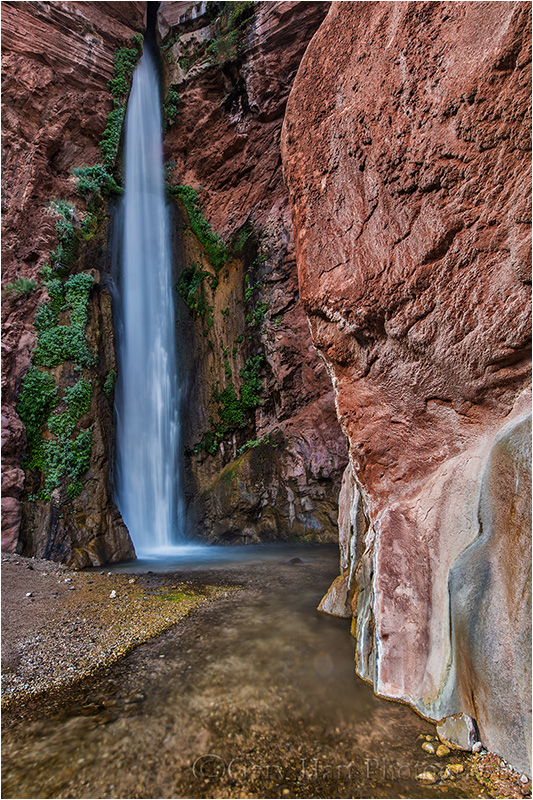
Deer Creek Fall, Grand Canyon
Canon EOS-5D Mark III
19 mm
1.6 seconds
F/16
ISO 100
When we think of the Grand Canyon we tend to visualize expansive vistas, but it takes getting down to the canyon’s foundation to see how incomplete those notions are. Every day on the river our raft group was treated to an assortment of layered rock, turquoise pools, polished slot canyons, and plunging waterfalls that reminded us of nature’s complexity. More than simply beauty, these little gems helped all of us appreciate the intricate, inexorable processes that formed the Grand Canyon, and that are constantly work across our planet.
Deer Creek Fall lands less than a stone’s throw from the Colorado River. Not only is it pleasing to the eye, Deer Creek Fall provides a great opportunity to understand the some to Grand Canyon’s extremely complex geology. Most of the red rock you see in this image is Tapeats Sandstone, deposited beneath an ancient sea over 500 million years ago. This rock wasn’t exposed until the region was uplifted and carved by the Colorado River, most likely in the last 5 million years (that timing is still subject to debate).
What’s most intriguing to me here is the red granite, an intrusive igneous rock injected beneath the Earth’s surface about 1.7 billion years ago. But near the top of the fall are the discernible layers of sandstone. When we see two types of rock immediately adjacent to each other, it’s easy to forget what that interface represents. In this case we have 1.7 billion year old granite underlying 550 million year-old sandstone. What’s missing is 1.2 billion years of geological history. Dubbed the “Great Unconformity” by early Grand Canyon explorer John Wesley Powell, over a billion years of Earth history was erased by processes we can only infer by observing other geological features nearby, or similar rock deposited elsewhere.
To comprehend how long 1.2 billion years is, and all that could have happened during those missing years, consider erosional (wind and water) and uplift (volcanoes and continental collisions) processes that add or subtract just one foot of elevation every thousand years—a little more than an inch every 100 years. (The San Andreas Fault races along 10 times that fast, at an average of about 12 feet every 100 years.) Do the math—at a foot every thousand years, 1.2 billion years would be long enough for a mountain range the elevation of the Sierra Nevada (14,000 feet) to rise and completely erode to sea level over 40 times.
Just a little perspective for the next time you think your barista is taking too long with your latte.
About this image
We pulled up here toward the end of our fourth day of careening through a seemingly endless series of intense rapids (with harmless sounding names like Ruby and Lower Tuna), making the opportunity to recharge in Deer Creek Fall’s cool-but-not-cold pool a welcome respite. Some in the group hiked to the top of the serpentine slot canyon feeding the fall (a story for another day), others danced in a rainbow beneath the fall.
Direct sunlight made photography difficult at first, but by the time I returned from the hike to the top the entire fall was in shade and I went to work. I started on the left side, looking straight up from as close as the spray allowed me. I soon crossed the creek and move a little farther back. When I was done I set down my gear and hopped in the pool beneath the fall for a most welcome shower. We were back on the river a few minutes later, refreshed and giddy about our good fortune to have witnessed this natural marvel up close.
I’m doing it all over again in 2015 (May 11-18)—contact me if you’d like to join me.

Deer Creek Canyon, Grand Canyon (above the fall)
Inside the Grand Canyon: Are you a cook or a chef?
Posted on June 20, 2014

Water and Time, Colorado River, Grand Canyon
Canon EOS-5D Mark III
70 mm
.6 seconds
F/16
ISO 125
Last week I went to see Jon Favreau’s “Chef.”* As someone whose relationship with food is decidedly skewed to the consumption side, I was surprised by how much this film activated my artistic instincts. (In hindsight: “Duh.”) A line that particularly resonated was advice from Favreau’s character to his 11 year-old son (federal copyright laws that forbid me from employing a recording device in a movie theater force me to paraphrase here): “First you choose your ingredients, then you decide what to cook.” Not only does that simple statement beautifully define the difference between a cook and a chef (a cook duplicates, a chef creates), I think it applies equally well to photography.
Do you approach your shoots with a “recipe,” a preconceived notion of what you’ll find and how you want to photograph it? Unless you’re content to photograph only what others have before you have photographed, this is the wrong approach. The longer I do this, the more convinced I become that best photographers examine the ingredients at hand, identify what’s best, and only then decide the most appealing way to prepare them.
For example
All of us rafters came to our Grand Canyon raft trip with ideas of what we’d find, and the photographs we wanted to return with. But because a tight schedule, National Park Service regulations, and the needs of a large group trumped all personal wishes, our campsites were rarely selected with photography as the prime consideration. Each evening I’d have several people ask some form of, “What should I photograph here?” I soon realized that what I needed to do was to help them overcome their photographic expectations and desires, to tear up the “recipe” they brought to the Grand Canyon “kitchen,” and concentrate the ingredients available right now. It wasn’t as if we didn’t have wonderful ingredients, it was just that the ingredients didn’t really work with the meal they’d planned to prepare.
Our third campsite was in a narrow gap between vertical, river-carved walls. Beautiful as it was, the scene was rather confined and lacking the broad views that lend themselves to the expansive majesty we’d grown so accustomed to. While the outer canyon walls, in places, jutted above the steep inner walls confining us, I quickly decided that these views didn’t really compete with some of the wide views we’d already photographed, and were sure to encounter as we continued downriver. I walked along the riverbank with my camera, examining the elements at hand.
What struck me first was horizontal banding on the shear inner wall and the Colorado River’s deep jade hue. I walked a little upstream to a spot where the smooth river was disturbed by section of gentle rapids, hoping that a little whitewater would help the green stand out. Not only did the white and green work wonderfully together, a shutter speed of about 1/2 second blurred the rapids into horizontal bands that beautifully complemented the banding on the inner canyon wall. Nice, but I still needed a foreground. Widening my composition with my polarizer dialed to remove reflections, I found that river rocks beneath the smoother water near the bank stood out enough to add visual interest to my foreground.
I could have stopped here, but I still thought the foreground could use a little more weight. I moved a little farther upstream to where a group of river-smoothed rocks protruded from the river. It took a little doing to fit them into my composition without including other nearby distractions, but I finally found something that worked. Nevertheless, I thought my first couple of frames had too much empty space between the visual weight of my foreground rocks and the visual motion of the blurred rapids, so I shrunk this space and further emphasized my foreground rocks by dropping my tripod to about 18 inches above the ground.
Delicious.
*Great movie, BTW.
I’m doing it all over again in 2015 (May 11-18)—contact me if you’d like to join me.
Inside the Grand Canyon: By the light of a billion stars
Posted on June 11, 2014

Milky Way, Grand Canyon (Tyndall Dome, Wallace Butte, Mt. Huethawali)
Canon EOS-5D Mark III
28 mm
30 seconds
F/2
ISO 6400
It occurs to me sharing the full story of this image will require me to share delicate details not normally seen in a photo blog.
(So consider yourself warned.)
But before getting to the details of this image, let me just say that among a very long list of life-highlights and personal firsts, probably my very favorite thing about spending a week at the bottom of the Grand Canyon was going to sleep to the beneath a sky brimming with more stars than I’d ever seen in my life.
After dark, day one
(Foolishly) imagining that my home bedtime reading habit would transfer seamlessly to the Grand Canyon, I’d packed several books to drift off to sleep to. But just five minutes into the first night I discarded that folly and simply basked in starlight, utterly mesmerized by the volume and variety of stars, constellations, planets, meteors, and satellites overhead. I fought sleep like a two-year-old at nap time—if I would have had access to duct tape I’d have considered taping my eyelids to my forehead.
After dark, day two
Topping off a long but relatively quiet day on the river, on our second night Wiley navigated our rafts into a fantastic campsite with a wide downriver view that opened to the southern sky. Immediately after dinner (before the darkness made composing and focusing extremely difficult) I had everyone line up along the river to set up their shots and focus. I gave a little orientation to everyone who was new to night photography, then we all just kicked back and waited for nightfall.
When the sky darkened and the stars popped out, we had a blast photographing star trails and pinpoint stars above the river. By 11:00 or so, long before the Milky Way rotated into view, everyone was ready for sleep. When I told the group that the best time to photograph the Milky Way would be between 2:00 and 4:00 a.m., there wasn’t a lot of interest. Following a long day in the sun that had started at around 5:00 a.m., the sleep was indeed as wonderful as you might imagine, but the next morning those of us who woke fully rested started having second thoughts when we saw the images captured by the few who rose at 2:00 for the Milky Way. Oh well.
After dark, day three
Day three was all about the rapids, which seemed to come fast and furious all day, rarely allowing more than a few minutes of calm water before we had to hold on tight and “suck rubber” for the next one. Unkar, Hance, Crystal, the gem series, to name just a few, were equal parts thrilling and chilling to us whitewater novices. And also physically draining.
At about 5:00 p.m., equal parts exhilarated and exhausted, we staggered into camp near the canyon’s 110-milestone. Despite my fatigue, I couldn’t help notice that while southern horizon was partially obstructed by the canyon walls, there just might be enough sky there for some of the Milky Way’s brilliant core to appear. Even so, not even another fantastic dinner could completely recharge the group, and for most the visions of another night photography marathon quickly succumbed to the gravitational pull of cot and sleeping bag. Nevertheless, I was one night smarter.
(Now for the delicate part.) I’ll start by going back to the orientation delivered by Wiley, our lead river guide, as it pertains to the evacuation of, uh, personal liquid waste: Peeing. Contrary to everything I’d learned from a lifetime of camping and backpacking, Wiley gave us very explicit instructions to pee nowhere but in the river. That’s right. Apparently the Colorado River’s volume will sufficiently dilute the pee of the several hundred people enjoying the Grand Canyon from the river any given time; the alternative, we learned, would be all these visitors targeting riverside rocks and trees to turn each campsite and trail into a giant litter-box. To achieve this goal the women were issued handy little buckets that allowed them to evacuate their bladders wherever they felt comfortable, then discreetly deposit the contents in the river; the guys, on the other hand, were expected to simply apply the tried and true ready-aim-fire approach.
Wiley had also admonished the group about the hazards of dehydration, imploring us to consume copious amounts of water day and night. While this strategy achieved the desired effect (no one in the group succumbed to dehydration), an unfortunate byproduct was nature’s inevitable call in the, uh, “wee” hours of the morning.
But what could all this possibly have to do with photographing the Milky Way?
Knowing that there was a pretty good chance I’d be trekking down to the river at around two or three in the morning, the last thing I did before crawling into my sleeping bag that night was mount my camera on my tripod, attach my 28mm Zeiss f2 (my night lens), focus it at infinity, and dial in all the exposure settings necessary for a Milky Way shoot. Genius!
When I woke at around two o’clock the next morning, I hopped from my sleeping bag, grabbed my tripod/camera, and made my way down the river. (You’d be amazed at the amount of light cast starlight in a deep canyon with no other light source.) At the river I quickly set up my shot, clicked my shutter (a 30 second exposure), and went about the rest of my business. As a life-long Northern Californian I’m accustomed to sharing delicious fresh water with parched and thirsty Los Angeles—standing there, I couldn’t help find comfort in the knowledge of the ultimate destination of my current contribution.
I’m doing it all over again in 2015 (May 11-18)—contact me if you’d like to join me.
Inside the Grand Canyon: A new perspective
Posted on June 5, 2014

Slot Cascade, Matkatamiba Canyon, Arizona
Canon EOS-5D Mark III
16 mm
2 seconds
F/16
ISO 200
Until last week, when I thought “Grand Canyon,” mental images of rim-top panoramas, plunging cliffs, and sculpted red layers came up. With no firsthand history to instruct me, my mental picture of the Grand Canyon from the bottom was an inverted version of my experience from the rim. But last week I finally had the opportunity strike the Grand Canyon raft trip from my bucket list, six days of complete canyon immersion that completely reset not only all preconceived biases of the down-up experience of the Grand Canyon, but also of my place in the Universe.
Descending into the Grand Canyon is like plunging into a serious relationship—it’s not long before you start understanding that the view from the outside, as compelling as it might be, is the superficial view. Floating on the Colorado River’s smooth jade, careening through its churning whitewater, slipping from brilliant sunlight to cool shade cast by the towering remnants of ancient oceans, reveals intimate details impossible to comprehend from the outside. And falling asleep beneath an impossible starlight blizzard is equal parts breathtaking and humbling.
The whims of the Colorado River and the practicalities of keeping two rafts and 28 photographers on a six-day, 188 mile schedule meant photography wasn’t the trip’s top priority. Often we’d arrive at a breathtaking location in the absolute worst light for photography, but so awed were we by the majesty of our surroundings that the quality of the light rarely seemed to matter—among the many lessons the group learned on this trip was that our experience as humans transcends our needs as photographers. Additionally, I’m guessing that most of the group would say the relationships and memories we formed trumped the photography as well (I know they did for me). That said, I think everyone was pretty thrilled by the images they returned with, and I came home with a plan to ensure more photo opportunities in the next trip (yes, there will be a next trip).
About the trip
For the next few weeks I’ll be sharing some of my images from this trip that started as a lifelong dream and came to fruition with the help my good friend and fellow photographer Mark Zablotsky. Mark (wisely) identified Western River Expeditions as the best candidate to handle our unique needs—they came through with flying colors, offering suggestions, being flexible at every opportunity, and providing the best guides in the world (no exaggeration). Since this would be my first time in the canyon, I wasn’t comfortable treating the trip as one of my workshops and didn’t advertise it anywhere (it turns out I didn’t need to), nor did I attempt to profit from it. Nevertheless, I was a little concerned that the cost would make it difficult to fill two rafts, but after sending an e-mail invitation to past workshop participants (exclusively) last September, within 48 hours all 28 spots were filled, with five on the waiting list.
Twenty-eight people meant we’d have two full rafts, plus our own cadre of four river guides, allowing us to customize the trip to our needs as much as the conditions, river, and National Park Service regulations allowed. For example, WRE was able to accommodate our photography needs by arranging space for and easy access to serious camera gear. My F-stop Guru bag included my Canon 5D Mark III body and my 16-35, 24-105, 70-200 and Zeiss 28 prime (for night photography) lenses, plus a Gitzo 1530 tripod and Really Right Stuff BH-30 ball head. Most people in the group had a similar setup—some with a little more, some a little less. Hike, photo stop, and campsite choices emphasized photo opportunities over things like Grand Canyon history, geology, and what was most convenient for the guides.
About this image
The above image is from Matkatamiba Canyon, a narrow (!) slot canyon, carved in 500 million year-old limestone, that we were told is rarely visited on the “conventional” raft trips. All week Wiley, our trip’s lead guide, had been telling me how much we’d love Matkatamiba Canyon (I listened to the guides pronounce the name all week but it wasn’t until I got home and looked it up that I was completely sure what they were saying), and I have to tell you that it disappointed no one. But I also understand why most trips skip it.
The challenge at Matkatamiba is access—the first 100 yards or so was navigable by everyone, but continuing beyond that involved some pretty technical (for climbing novices lugging photo gear) scrambling. Reaching this spot required teamwork to scale a five-foot waterfall that blocked access to the canyon’s narrowest upper reaches. The waterfall barrier didn’t look too difficult from beneath, but water-smoothed limestone spread with wet moss made footholds impossible. Instead, each of us temporarily shed our gear and handed it up to the person preceding us, then wedged our bodies between the narrow walls, back pressed to one wall and feet planted on the other (so our bodies were horizontal, spanning the creek), then “walked” parallel to the ground up the walls to the top of the fall.
Beyond the fall the canyon’s twists and turns added intrigue, as it seemed like the scene around each corner was even better than the previous scene. Occupied refereeing the photo needs of those below the fall meant I was among the last to ascend to scale the waterfall. While that meant I didn’t advance quite as far as most of the others, it also gave me more alone time with the scenes I found.
I composed this image with the cascade nearest the frame’s top, bottom, left, right, and center, ultimately choosing the symmetry of this centered version. Often symmetrical images can feel static, but I felt in this case that the arc of the creek adds a dynamic that cancels any static concerns. Though my extreme wide focal length gave me lots of depth of field, I was careful to favor the focus on the right wall, where I thought the sharpness was most important. Polarizing the scene removed glare from the rocks and creek, and helped the color of the submerged stones stand out.
I’m doing it all over again in 2015 (May 11-18)—contact me if you’d like to join me.

Rocks, Matkatamiba Canyon, Grand Canyon
The farther up the canyon I climbed, the narrower it became.
Some assembly required
Posted on February 10, 2014

Double Rainbow, Lipan Point, Grand Canyon
California Sunset, Sierra Foothills
Canon EOS 5D Mark III
1/5 second
32 mm
ISO 100
F14
Putting together material for the Grand Canyon Monsoon workshop that Don Smith and I do each August, I came across this image from the first shoot of our first workshop. With so many pictures in the two weeks we were there (for two workshops), and given the incredible events that followed, it’s amazing to me how well I remember the specifics of this early shoot (especially given how poorly I remember so many other things).
When Don and I pulled the group into Lipan Point that afternoon, a handful of puffy clouds floated overhead. But, as if on cue, within minutes of our arrival the clouds organized into a seething, dark gray tower; five minutes after that, a few drops fell—marble-size projectiles that landed with an audible splat at one- or two-second intervals. We ignored the rain and kept shooting, but when a lightning bolt struck a quarter mile away, we couldn’t get out of there quickly enough, retreating to the cars just as all hell broke loose. For the next we were assaulted with a pounding rain that obliterated the view and required shouting to be heard. As suddenly as it started, the rain stopped and the Canyon reappeared, bathed in sunlight. And with the sunlight came a full double rainbow. I mean, what could be more perfect, the Grand Canyon plus a rainbow? Unfortunately, from our vantage point on the rim, the rainbow beautifully framed nothing but sagebrush south of the canyon.
Understanding the physics of rainbows, I knew that there’s nothing random about their position—to get the rainbow above the canyon, I simply had to be on the other rim. With a choice between A: A four hour drive, and B: A twenty mile hike, I chose C: Get as far out into the canyon as the nearby terrain allows and hope for the best.
The “Point” part of Lipan Point refers to a rock protuberance that juts into the canyon. Scrambling onto the rock, I was able to change my angle of view enough to put the north-most end of the rainbow in the canyon before I ran out of point. Not the complete, rim-to-rim view I’d have liked, but at least something to work with. With the Grand Canyon as my background, a rainbow for the middle-ground, all I lacked was a foreground.
Scanning my surroundings, my eyes fell immediately on a group of shrubs side-lit by pristine, warm, late afternoon light. A horizontal composition would have given me too much foreground and too little rainbow, so I went vertical. At a focal length of 32mm, my depth of field app told me I could achieve the 8-foot hyperfocal distance I needed at f14. Spot metering on the brightest shrub, I dialed my shutter speed until the shrub was +2, and clicked.
Looking back at 2013, and ahead to 2014
Posted on January 1, 2014
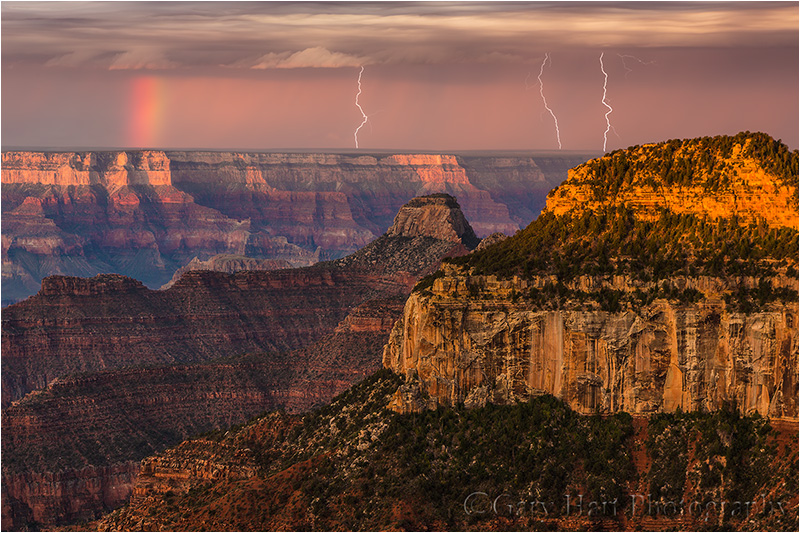
Three Strikes, Bright Angel Point, North Rim, Grand Canyon
This is a single, 1/3 second click that managed capture three simultaneous lightning strikes. Set up on a tripod, I’d composed to balance the frame between the rainbow and the area receiving the most strikes. Rather than try to manually react when I saw a lighting flash, I let my Lightning Trigger detect the lightning and click for me. I got many one and two bolt frames, but this is the only frame that captured three.
Canon EOS 5D Mark III
1/3 second
F/11
ISO 100
24-105 f4L lens
While I’ve been taking a little Holiday break from my blog, I have spent some of my non-family time reviewing my 2013 images. Given the number of trips I take, and images I click, it always amazes me how well I remember every detail of my favorites—who I was with and what the circumstances were, not to mention composition and exposure decisions that are still as clear in my memory as the day I took the picture. I’m guessing it’s that way for other photographers too, because I’m convinced that our best photography comes when we concentrate on those things that move us emotionally. For example, since I’ve always been something of a weather geek, it stands to reason that several of my favorites feature active weather. And another lifetime passion is astronomy, and while I didn’t consciously bias this year’s selections toward the celestial, that sure seems to be how it worked out.
I have lots of great stuff planned for 2014: my regular annual workshops in Death Valley, Yosemite, Hawaii, the Eastern Sierra; my second annual Grand Canyon monsoon workshop with Don Smith; a raft trip down the Grand Canyon in May (bucket list item). And on any photo trip, whether it’s a workshop or a personal trip, I research and plan to make sure the odds for something special are as high as they can be, but it’s usually the unexpected moments that thrill me most—those times when I set out with one intention and found something else, or was disappointed when weather or other conditions beyond my control derailed the original plan.
Case in point: I scheduled an entire workshop around Comet ISON, and while ISON fizzled, if I hadn’t been in Yosemite to photograph it, I never would have witnessed Valley View, decked out in ice, glistening in the light of a full moon. Or the Maui workshop, scheduled before I had any idea of Comet PanSTARRS, that just happened to coincide with the comet’s post-perihelion conjunction with the new moon. But the one that thrill me most was the above sunrise at the Grand Canyon, the final morning of our second workshop—Don and I were going to start the thirteen hour drive home later that morning, and others in the group had flights to rush off to. Given the bland weather forecast, it would have been easy to blow off the shoot and let everyone sleep in. But we got up in the cold and dark, all of us, and were treated to a two hour electric show that started in blackness and culminated with a rainbow as the sun peeked above the canyon’s east rim.
So, without further adieu, and in no particular order, here are my current 2013 favorites (click a thumbnail for a larger version with more info, and to start the slide show):
-

- Before Sunrise, South Tufa, Mono Lake
-
- Facing West, Molokai from West Maui, Hawaii
-
- White-Out, Cook’s Meadow, Yosemite
-

- Night and Day, Crescent Moon Rising Above Mono Lake
-

- Moonlight Cathedral, Valley View, Yosemite
-
- Incoming Storm, Mesquite Flat Dunes, Death Valley
-
- Color and Light, Bright Angel Point, Grand Canyon
-

- Poppy Pastel, Sierra Foothills, California
-
- Crescent Moon and Oaks at Dusk, Sierra Foothills, California
-
- Winter Reflection, Half Dome and the Merced River, Yosemite
-

- Leaf, Bridalveil Creek, Yosemite
-
- Milky Way and Halemaʻumaʻu Crater, Kilauea, Hawaii
-
- Night Lightning, Roosevelt Point, Grand Canyon North Rim
-

- Three Strikes, Bright Angel Point, Grand Canyon
-
- Autumn Snow, Valley View, Yosemite
-

- Comet PanSTARRS and New Moon, Haleakala, Maui
Shocking truths about lightning
Posted on October 23, 2013

Color and Light, Bright Angel Point, North Rim, Grand Canyon
Canon EOS 5D Mark III
1/3 second
F/11
ISO 100
24-105 f4L lens
While working on an upcoming “Outdoor Photographer” magazine article on photographing lightning at the Grand Canyon, I’ve been revisiting the images from my August workshop with Don Smith. While I still feel like I’ve only scratched the surface with the trip’s lighting images, it’s clear that at least half of my captures came on that amazing final morning, when we witness two hours of virtually nonstop lightning punctuated by a vivid section of rainbow balanced atop Powell Point. The first image I posted from that morning included the rainbow sharing the rim a trio of simultaneous, parallel strikes. The difficulty I’m having now is choosing which of the other pretty spectacular images to feature (FYI, this is a great problem to have).
Fortunately, I varied my compositions enough that many of my favorite captures are different from each other. Here, a single strike lands just east of the rainbow, close enough that they somehow seem related. This image is an example of why I’m constantly preaching to my workshop participants to switch between horizontal and vertical, even (especially) when one orientation seems more obvious than the other. Fortunately, I practiced what I preached (not always a sure thing) throughout the morning—instead of having one great capture of lighting with that morning’s rainbow, I now have two (and counting) that are different enough from each other to share.
Another byproduct of my magazine article is the research I’ve been doing on lightning. I’ve always been something of a weather geek, but it seems each time I revisit a topic, I learn something new. So, while I doubt you’ll find this stuff quite as fascinating as I do, here are some cool lightning facts I just can’t resist sharing:
- Earth is struck by lightning eight million times each day.
- While lightning is still not completely understood, scientists know that the rapid upward and downward motion of raindrops in a thunderstorm creates extreme electrical polarity—a negative/positive imbalance within a cloud, between clouds, or between a cloud and the ground. Nature abhors any imbalance and will remedy the problem as efficiently as possible: Lightning.
- The visible portion of a lightning strike originates on the ground and travels up to the cloud.
- In a lifespan measured milliseconds, a lightning bolt can release 200 million volts and heat the surrounding air to 50,000 degrees. More than enough to fry a photographer.
- Most of us know that lightning and thunder occur simultaneously. What many don’t know is that you can’t have one without the other—it’s the lightning that causes the thunder, and if you see lightning but hear no thunder, you’re just too far away. This even applies to what is often called “heat lightning,” which still generates thunder you’d hear if you were close enough.
- The fact that lightning and thunder occur simultaneously, but light travels much faster than sound, allows us to roughly establish the distance of the lightning. For all intents and purposes, we see the lightning the instant it happens, while the thunder pokes along at the speed of sound, a pedestrian 1,100 feet per second. That works out to about five seconds to travel one mile. So, if you start counting as soon as you see lightning (one-thousand-one, one-thousand-two, …), dividing by five the number you’re at when the thunder arrives gives you the approximate distance in miles.
- Let’s say you get all the way to fifty before the thunder arrives—that would be ten miles. You’re safe, right? Wrong. Lightning bolts exceeding one hundred miles in length have been documented, as have bolts with no rain and even with blue skies overhead. That’s why we’re warned to stay inside whenever you can see lightning or hear thunder. (It’s also why I say do as I say, not as I do.)
- A car is not a magic lightning sanctuary, and the safety a car does offer is because of its metal frame, not its rubber tires. (Don’t believe me? Go stand on a couple of rubber tires in the next lightning storm and have your next of kin report back to me.) Even when you’re inside a car, you need to keep the windows up and don’t touch anything metal. And stay away from convertibles.
Here are a couple of lightning safety websites:
Are you interested in risking your life to photograph lightning? Join me in a Grand Canyon photo workshop.
A Lightning Gallery
Click an image for a closer look and slide show. Refresh the window to reorder the display.


A star is born
Posted on September 17, 2013

New Day, Bright Angel Point, North Rim, Grand Canyon
Canon EOS 5D Mark III
3.2 seconds
F/20
ISO 200
16 mm
Truth be told, I’m not a huge fan of sunstars (a.k.a. starbursts). Cool as they are, sunstars have become ubiquitous to the point of cliché. So why do I shoot them? Because sometimes there’s little else you can do when the sun intrudes on the scene you came to photograph. In other words, they’re often more of a lemonade-from-lemons kind of thing.
Despite their ubiquity, sunstars work because there’s universal resonance to witnessing the sun kiss the horizon—I mean, who doesn’t have a warm memory of watching from a special location as the sun begins or completes its daily journey? These moments touch us on a literal, visual level (they’re beautiful), but I think more significantly they serve as a metaphor for the hope or closure we all long for.
Unfortunately, doing justice to these moments in a photograph is difficult: Including the sun in your frame introduces lens flare, extreme (often unmanageable) contrast, and an unattractive eye magnet that overpowers the rest of the scene. And while a sunstar doesn’t capture the literal experience, it does do a pretty good job of conveying the metaphor.
The good news is, despite the difficulties, creating a sunstar is relatively straightforward. Here’s a quick recipe:
- Start with a brilliant, fine point of light: The sun is the most logical candidate, but you can do it with the moon, stars, and pretty much any bright artificial light (lighthouse, headlights, and so on). The finer the light source the more precise the star effect will be, and the less lens flare and blown highlights you’ll have. If it’s the sun you’re using, virtually all of it needs to be hidden to get the delicate, symmetrical distribution of beams that generally work best. In this image the horizon hides most of the sun, but you can use a cloud, tree, rock, or whatever.
- The smaller your aperture, the finer your sunstar will appear: I generally use f16 or smaller (larger f-number).
- Do something to control the highlights: When the sun is entering your frame, you’re invariably dealing with a sky that’s much brighter than your foreground and will need to take steps to avoid the foreground of murky shadows. If you have a foreground shape or shapes against the sky, you could turn the foreground into a silhouette. But when I want to capture foreground detail, I use graduated neutral density filters to hold back the brilliant sky. My 3-stop reverse is my go-to GND in these situations; in particularly difficult light I’ll stack it with a 2-stop hard GND. Whenever I use a GND, I find Lightroom or Photoshop dodging/burning is a great way to disguise the telltale GND transition. HDR blending of multiple images is another way to mitigate extreme sky/foreground contrast (but I don’t do HDR, so you’ll need to Google this).
- Different lenses will yield different results: Experiment with your lenses to see which one gives the most pleasing sunstar effect. For example, I recently replaced my faithful 17-40L lens with a 16-35L Series II lens, and while I was satisfied with the sunstars from my 17-40, the 16-35 results are clearly better.
- Practice: You can practice sunstars any time the sun’s out. Just go outside with your camera, dial in a small aperture, and hide the sun behind whatever object is convenient (a tree, your house, etc.).
On the morning of this image from last month at the Grand Canyon, I had no plan to photograph. But I was working with a workshop student and we found this nice little scene off the trail to Bright Angel Point. The clouds had assembled into an organized formation that seemed to emanate from just beyond the horizon, and when they started to vibrate with sunrise color, I couldn’t resist. I quickly composed my scene, dialed down to f20, metered on the foreground, and stacked my 3-stop reverse and 2-stop hard graduated neutral density filters. The sun appeared a few seconds later and I fired off several frames before its brilliance overcame my filters’ ability to hold it back.
The calm above the storm
Posted on September 12, 2013

The Calm Above the Storm, Grand Canyon and Lightning by Moonlight, Mather Point
Canon EOS 5D Mark III
30 seconds
F/4
ISO 200
73 mm
If you’ve ever taken off in a violent storm, watched the exploding sky just beyond your window, felt the plane buck until you verged on panic, then suddenly broken through the clouds into utter peace, you might appreciate the dichotomy depicted in this scene.
* * * *
Overwhelmed by the euphoria the Grand Canyon workshop’s final sunrise was this moonlight experience on the South Rim a couple of nights earlier, the highlight of the workshop until that unforgettable morning. Don Smith and I had planned all along for this to be the group’s moonlight night, always a workshop highlight, but we got much more than we bargained for when we found the North Rim under a full scale assault from multiple electrical cells. The moonlit tranquility of our South Rim vantage point was a striking contrast to what was happening across the canyon. Several times per minute the clouds would strobe with lightning hidden by the clouds, and once or twice each minute a bolt would land near the rim for all to see. Above all this activity, the stars twinkled peacefully, clearly indifferent to the violence below.
Unlike the moonless experience at Kilauea a couple of weeks later, photographing with a full moon is pretty straightforward. Not only does the moon make a great focus point (just don’t forget to turn off autofocus before clicking your shutter), you can actually see your camera, its controls, the scene itself, and all potential obstacles (photographers, tripods, camera bags). And because exposures are generally short, do-overs are easy. So my job was easy, pretty much reduced to wandering around reminding everyone to vary their compositions, and making sure they’d all had a success.
Everybody got something that excited them that night, and the variety of images was amazing. I saw vertical and horizontal frames, wide and tight, most aimed north like this one, but there were also some great lightning captures to the east, up the canyon. My own favorite was this one that captured a bolt’s origin through a window high in the clouds, and its forked impact with the rim. While a wide composition would have increased the likelihood of capturing a strike somewhere in my frame, it would have also further shrunk the already distant lightning. My 73mm focal length in this case reflects my desire to make the lightning more prominent, and my confidence in the frequency of strikes in this direction (the more disperse the strikes, the wider I compose). Usually my night exposure decisions are designed to minimize star motion, but in this case I opted for 30 seconds to maximize the chance for capturing a strike (or more) during the exposure—a close look at the stars here clearly shows the onset of motion blur despite the fact that I was aimed north, where star motion is minimal.
This image reminds me why video is no substitute for still photography. Video’s benefits are undeniable, but the ability spend forever in a single instant like this is priceless.

 Eloquent Images by Gary Hart