Eloquent Images by Gary Hart
Insight, information, and inspiration for the inquisitive nature photographer
Fall into winter
Posted on November 14, 2012

First Snow, El Capitan, Yosemite
Canon EOS-5D Mark III
.4 seconds
F/16
ISO 100
24 mm
Probably the number one question I’m asked about Yosemite is, “What’s the best season for photography?” My response always sounds like it was crafted by a waffling politician, but I swear I just don’t have the absolute answer everyone wants: Yosemite in spring is all about the water, a time when the vertical granite can’t seem to shed the winter snowpack fast enough; summer offers High Sierra splendor (Glacier Point, Tuolumne Meadows, the backcountry), with wildflowers, exposed granite, and gem-like lakes inaccessible most of the year; autumn is when trees of yellow and red mingle in mirror-reflections and carpet the forest floor with color; and winter is the sunset fire of Horsetail Fall and the possibility (fingers crossed) of a glistening winter cathedral of white.
But surpassing all of this is the rare opportunity to combine the best of two seasons. For example, a few years ago, while in Yosemite Valley to photograph the fall color, I survived twenty-four hours of nonstop downpour, six inches of rain that sent Yosemite Valley into spring flood mode, giving me an opportunity photograph the fall color with the waterfalls at their spring peak. And last year, extreme drought conditions kept the high country open into January, providing access to High Sierra terrain in ice and snow conditions usually the exclusive domain of hardy wildlife.
And then there was last Saturday, when I was in Yosemite Valley to photograph this year’s fall color “peak” (always a moving target), only to encounter an early winter storm that deposited six inches of fresh snow in Yosemite Valley. Seriously folks, there are simply no words to describe Yosemite Valley with fresh snow, and adding an explosion of yellow and red is just off the charts. But rather than sink further into hyperbole, I’ll just submit this image, one of many from this trip that will surely require many hours to wade through.
(In addition to the snow and color, I also witnessed classic Yosemite clearing storm conditions, but that’s a story for another day.)
A few words about this image
I’ve been doing this photography thing long enough to have learned how to separate my experience from my camera’s, to appreciate what I’m seeing without forgetting that my camera “sees” it differently. On this autumn morning I wanted capture the best of everything going on—fresh snow (duh), fall color, and reflection—easy for stereoscopic eyes embedded in a swiveling head, but not so easy to capture in a single, two-dimensional frame. With some ideas of how I might accomplish this, I beelined to this hidden spot along the Merced River, a little downstream from Bridalveil Meadow.
Once there I had to move around until all the elements—snow-covered rocks, floating leaves, reflection, and El Capitan—fell into a coherent relationship: Too far to the right and I’d lose El Capitan’s reflection behind the rocks; too far to the left and I’d be in the frigid river (not that there’s anything wrong with that). As it was, I was balanced on an icy rock with my tripod in two feet of water (and thanking the photography gods for live-view).
All of the “action” in the scene was along a line starting at my feet and terminating at El Capitan, so the decision to go vertical was easy—including everything on my line in a horizontal composition would have introduced all kinds of superfluous real estate on the left and right, and required me to compose so wide that El Capitan would have shrunk to virtual insignificance. I really liked the large, submerged leaf right in front of me and used it to anchor the bottom of my frame. And since the sky above El Capitan was mostly gray clouds, I composed as tightly as possible above El Capitan.
Top and bottom decided, I moved back as far as I could to increase my focal length and maximize El Capitan’s size as much as possible. Wanting sharpness throughout my frame, I stopped down to f16 and focused on the leaf frozen to the rock in the lower center, about five feet away. (An experience-based guess—my iPhone, with its hyperfocal app, was buried in a pocket several layers deep, and I was reluctant to disturb my precarious balance on the slippery rocks.) I was extremely careful orienting my polarizer, turning it slowly, multiple times, until I was confident I’d found the ideal balance between removing sheen on the leaves without erasing the reflection in the river. A three-stop soft graduated neutral density filter held down the brightness in the sky. Click.
In Lightroom I warmed the image a little to remove a blue cast in the snow, and applied standard exposure adjustments to subdue highlights and open shadows. In Photoshop I dodged and burned to hide (minimal) unwanted shading introduced by my GND, to further darken the clouds, and to bring out the reflection somewhat. And I gave all but the scene’s brightest and darkest areas a slight wiggle in curves for contrast.
Join me in a Yosemite photo workshop
Yosemite seasons
Click an image for a closer look, and a slide show. Refresh the screen to reorder the display.


Encore!
Posted on November 11, 2012
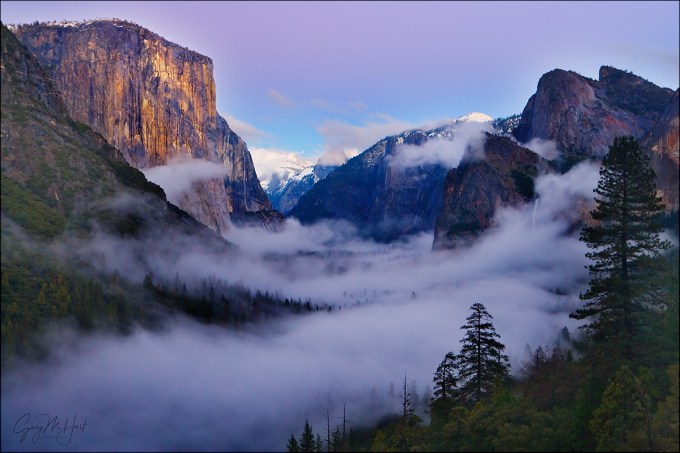
Twilight Fog, Tunnel View, Yosemite
Canon EOS-1Ds Mark II
1.6 seconds
F/7.1
ISO 200
48 mm
Yesterday I spent an incredible day in Yosemite, guiding a group of photographers from the Sacramento area. When I schedule these trips, I do my best to time them for nice conditions, but of course there’s no guarantee things will work out. Yesterday they worked out. Big time. Not only did we catch Yosemite Valley at its fall color peak (it’s late this year), we found everything blanketed with fresh snow that continued to fall lightly, and intermittently, throughout the day. I have lots of images I can’t wait to get to, but until then I offer this one from a few years ago, chosen because it’s quite similar to the scene with which we wrapped up the day yesterday.
Much like last night, the view on this 2005 evening was a classic Yosemite clearing storm. My brother Jay and I arrived at Tunnel View to find El Capitan and Half Dome, partially obscured by swirling clouds, teasing the audience like exotic fan dancers; a carpet of plush fog cushioned the valley floor. With sunlit clouds and granite above a shaded valley, the light was tricky, but as the sun dropped, so did the contrast, making metering simpler. Eventually the direct sunlight left Half Dome entirely, but small, shifting patches spotlighted El Capitan right up until sunset. While the clouds never achieved brilliant sunset pinks and reds, they radiated an ethereal gold that intensified over several minutes before fading.
When the sunlight left entirely, as if on cue, the fog hugging the valley floor expanded, slowly obscuring the scene like a curtain signaling the show’s end. With the view gone, the crowd packed up and headed to wherever they needed to be; suddenly we were alone. But I’ve photographed Yosemite enough to know that it’s a mistake to try to predict the conditions in five minutes based on the conditions now, so I stayed, hoping for an encore.
As quickly as the scene had closed, the foggy curtain pulled back, unveiling Yosemite Valley once more, this time illuminated by the magnificent pink and blue pastels of the Earth’s shadow and belt of Venus. By now the sky was fairly dark, but the remaining faint, shadowless light was enough to reveal the most beautiful view on Earth.
Though this image adds to the seemingly infinite number of Yosemite Tunnel View pictures in my portfolio it remains one of my personal favorites. It’s one of the images I think about every time I consider leaving a scene, and it’s what I showed the group last night when some suggested leaving. So we stayed and were among the very few rewarded with memories of Yosemite Valley’s sweet encore for the drive home.
Workshop Schedule|| Purchase Prints || Instagram
A Gallery of Yosemite Weather
Click any image to scroll through the gallery LARGE


Missing the tree for the forest
Posted on November 2, 2012
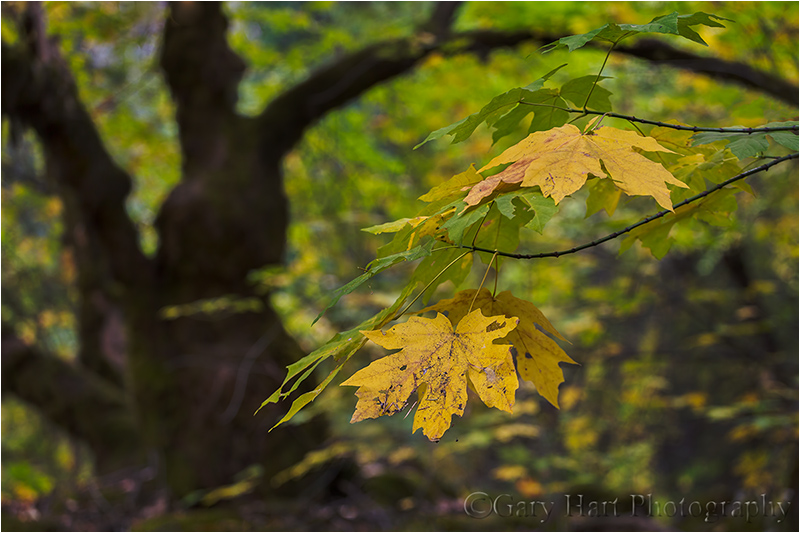
Fall Color, Yosemite Valley
* * * *
One of my favorite Yosemite autumn destinations is Fern Spring. It’s usually my first stop after entering Yosemite Valley because the leaves here give me a pretty good handle on the status of the fall color: If I can still see lots of water on the spring’s pond, I know I’m a little early; lots of brown leaves and I’m late.
I haven’t actually photographed the spring itself in years; instead I cross the road and explore the half-mile stretch of trail that parallels the river, downstream to the Pohono Bridge, upstream to Bridalveil Meadow. When I brought my fall workshop group here last week, we found so much to photograph that we had to come back. Some of the group stayed at the spring and crafted compositions featuring the stairstep cascade descending from the small reflecting pool. Others followed me to the river and quickly scattered in search of larger scenes.
When I’m leading a group my priority isn’t my own photography, so that afternoon I stayed in the vicinity of the spring to help people with exposures and compositions. But this was fairly far into the workshop, and as is usually the case, everyone had become pretty comfortable with what they were doing—suddenly I felt pretty inessential.
(Rather than pout) I set my sights on the nearby possibilities. My goal is always to find something new, pretty easy when photographing small scenes featuring ephemeral leaves (in contrast to the relative permanence of Yosemite’s granite). But uniqueness is just the start: To set themselves apart, most scenes, large and small, need (among other things) photography’s often overlooked third dimension, depth. So I’m never content with simply finding a photogenic primary subject—regardless of my subject, if it’s distant I want a complementary foreground; close and I want a complementary background.
I’d been to Fern Spring so much, I was pretty sure I’d pretty thoroughly mined the possibilities here. So imagine my surprise to spy a heretofore overlooked tree with a sturdy trunk and arcing branch, a wealth of untapped compositional possibilities, right across the road from Fern Spring. How could I have missed this in my hundreds of visits here? I can only imagine the number of times I’d rushed past this beautiful specimen in my haste to probe the forest’s more private depths. Shame on me.
But anyway, no time for self-flagellation…. I studied the tree and its surroundings, looking for leaves to isolate. My eyes quickly landed on a solitary branch sporting several leaves in varying stages of fall transition—in a perfect world the leaves would have been backlit (for that fall color glow I so love), but that would have put me on the wrong side of the scene, and the world is rarely perfect anyway.
My lens of choice in these autumn leaves scenes is a telephoto, most often my 70-200 f4 because I almost always prefer its sharpness, speed, and ease of use over the extra reach of the 100-400. So, with 70-200 in place, I circled the leaves until I thought they aligned properly with the tree in the background. Removing my camera from my tripod, I framed the scene through the viewfinder, searching for the best relationship between the yellow leaves and brooding tree. I found that by dropping to the ground I could eliminate the less interesting foreground and frame my leaves with the curved branch.
And on the ground I stayed, for I don’t know how long. I tweaked the composition until I had it “just right,” then (with the composition locked in on my tripod) went to work on the exposure, depth, and focus point. Dense shade makes the area around Fern Spring dark on even the brightest day, but this was late afternoon in autumn, so the sun’s fading light had been further extinguished by Yosemite Valley’s steep walls. As if that wasn’t enough, a bright sheen on the leaves made a polarizer an absolute necessity, subtracting two more stops of precious light. And while it wasn’t windy, neither was the air perfectly still, a problem compounded by my proximity to a road teaming with rushing vehicles.
Fortunately my goal was a soft background, which required a large aperture—had I needed to go to f16 I probably would have been out of luck. Nevertheless, even at f4 I had to go to ISO 800 to expose at 1/12 second, a pretty marginal shutter speed in these conditions. I used live view magnified ten times to ensure precise focus, targeting the veins on the closest leaf, and carefully timing exposures for lulls in the wind.
As I usually do when I have a composition so heavily dependent on depth of field, I bracketed my f-stops, stopping down to f8 in one-stop increments, bumping my ISO even further to ensure a reasonable shutter speed. But at home on my large monitor I wasn’t crazy about the busyness in the leaves introduced as the depth of field increased, and decided f4 was best.
Also on my large screen I was thrilled to see how perfectly sharp the images were (I love that lens), and how noise free they are at ISO 800 (I love my new camera). It’s one of those images that stands up to even the closest scrutiny—the more I examine it, the more I see: small holes, dirt smudges and mote, and even miniscule particles of debris suspended by a delicate spider web, the “imperfections” that underscore nature’s perfection.
I have no illusions that this image will make me rich—most people are drawn to far more dramatic captures. But when I decided to photograph nature for a living, I promised myself to only photograph what I want to photograph, and never to base my choices on what will sell. I can’t even begin to express how much I enjoyed photographing this scene, and how much pleasure this image (and others like it) bring me. It’s a reminder of why I do what I do, and why success should never be measured in dollars alone.

Fern Spring, Yosemite: Each spring I gauge the progress of the fall color in Yosemite Valley by the leaves around Fern Spring.
I love it when things work out
Posted on October 29, 2012
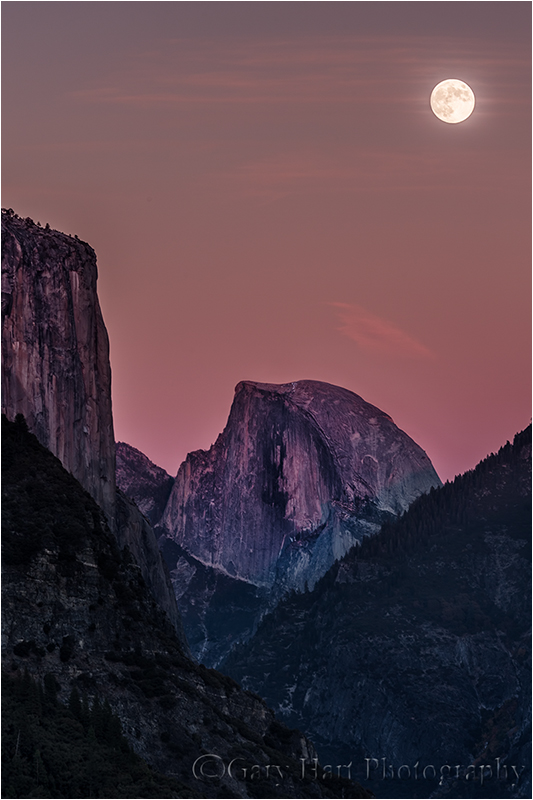
Autumn Moon, El Capitan and Half Dome, Yosemite
Canon EOS-5D Mark III
190mm
.8 seconds
F/11
ISO 100
October 29, 2012
My Yosemite autumn workshop wrapped up last night with a spectacular moonrise above Half Dome at sunset. That my group was there to photograph it was both a source of pride, and great personal satisfaction—I doubt few things on Earth are more beautiful than a full moon rising above Half Dome at sunset, and I love being able to share it.
Some lunar perspective
Imagine a line connecting the sun and moon—the half of the moon skewered by that line is always fully lit. Because the moon orbits Earth, our position relative to that line changes daily. Once every 29 days Earth is on that line too, aligned with (and between) the sun and the moon, perfectly positioned to see all of the moon’s sunlit side during our night (in other words, the side of Earth facing the moon is the side facing away from the sun). Because this alignment is the only time the moon’s fully lit face is visible all night, a full moon always rises at sunset and sets at sunrise.
Why do we rarely see the moon rise exactly as the sun sets? There are a couple of reasons: First, local terrain usually gets in the way—if the moon has to rise above mountains, or the sun sets behind mountains, their rise and set times will be skewed. And second, the moon, sun, and Earth are only perfectly aligned for an instant—we see the moon as full on the day it’s most closely aligned with the sun and Earth, but we’ll only see the rising full moon precisely at sunset when sunset for our location coincides with the instant of perfect alignment, and no mountains are in the way. (There are other orbital and positioning factors, but sometimes technical minutia can clutter understanding, so I’ll just leave it here.)
Targeting Yosemite’s autumn moon
For most Yosemite visitors, viewing a glowing lunar disk above Yosemite Valley doesn’t require much more than being outside and looking up at the right time. But photographers have to be much more precise than that—the camera’s constrained view means anything but a tight composition reduces the moon to small accent (albeit a very beautiful one) to a very large scene. And the camera’s relatively limited ability to simultaneously capture shadows and highlights makes for an extremely narrow time window to photograph a full moon—too early and the moon is lost in still-bright sky (not enough contrast); too late and the dynamic range separating the rising (daylight bright) moon and (rapidly dimming) shadowed foreground terrain is to great for a camera to capture (too much contrast).
So what we want is a moon that rises in very close proximity to Half Dome, at just the right time. When I started planning my 2012 workshops more than a year in advance, I circled October 28 as the date for my favorite Yosemite full moon rise of the year. That was when the moon, 99 percent full, would rise above the steep granite walls of Yosemite Valley, in the general direction of Half Dome as viewed from the valley, at just the right time. I usually choose the famous Tunnel View vista, just east of the Wawona Tunnel, for the autumn moonrise, but my calculations told me that from Tunnel View the moon would rise a little farther to the right of Half Dome than I like, and just a little later than ideal (difficult to expose for anyone without rock-solid understanding of metering and exposure)—still a nice shot, and doable if you’re careful, but I thought there might be something better.
Wanting to be at a higher elevation than, and a little farther north of, my Tunnel View vantage point, I soon realized that the less heralded vista just west of the Wawona Tunnel would be just about right. Not only would this perspective better align the moon with Half Dome, it’s about a mile farther back and over 400 feet higher than Tunnel View (for a slightly earlier moonrise). And being farther back also meant we could use a longer focal length to maximize the distant moon’s size relative to the closer Half Dome. This vantage point doesn’t offer a view of Bridalveil Fall (it wouldn’t be in a telephoto image that includes Half Dome anyway), but that late in the afternoon in autumn Bridalveil is in full shade, and an extremely dry year had reduced it to a mere trickle anyway.
There are lots of apps and software that plot moonrise relative to terrain (Photographer’s Ephemeris being the most popular among photographers), but my moonrise (and set) workflow was in place long before they were available, so I still do it my “old fashioned” way. My technique involves getting the phase, rise/set time, altitude, and azimuth from a website or app (Focalware gives me everything I need), then plotting the moon’s direction with my (now obsolete) National Geographic Topo! software. Topo! gives me the horizontal and vertical distance separating my location and target feature (Half Dome). Plugging that info into my HP11C (scientific calculator) app, I compute the horizon’s altitude in degrees. I plot this altitude and the moon’s azimuth on my Topo! map to pinpoint when and where the moon will appear (or disappear) from any location I choose. I like my approach because I can do everything I need to without Internet or cell service, but for most people it’s probably just simpler to use Photographer’s Ephemeris or PhotoPills before leaving home.
So anyway, I was able to determine that on October 28, from the vista west of the Wawona Tunnel, the moon would rise behind Half Dome’s Ahwiyah Point at around 5:45, and would be directly above (basically, appearing to sit on top of) Half Dome at around 5:50. With a 6:05 sunset, this was just about as perfect as could be.
The moon arrives
I got my group in position at around 5:30 and we just watched and waited. By the end of any workshop everybody has gotten to know each other quite well and idle time is an excuse for fun. This group was no exception. Though I’ve done this enough to be pretty confident the moon would deliver as promised, I couldn’t help feeling secretly anxious that a miscalculation would somehow render my promised workshop grand finale a flop (despite the fact that I’d checked, double-checked, triple-checked, and then checked some more). But a little after 5:40, just as the joviality peaked, a white arc started to glow behind Ahwiyah Point (below) and we were instantly down to business. With foreground for perspective you can really get a sense for how quickly the moon rises—fortunately, everyone was ready with their exposure and composition, so the clicking was pretty much instantaneous and I don’t think anyone missed anything.
As we shot, I encouraged the group to vary their compositions—while it was mostly a telephoto scene, there were wider and tighter versions, as well as horizontal and vertical orientations. I also frequently reminded everyone to monitor the moon’s highlights—as the moon rises, the foreground darkens but the moon remains daylight bright, making exposure increasingly difficult.
My favorite time of evening is the ten or fifteen minutes after sunset, when the shadows have left the landscape and the east horizon is layered with pink and blue pastels. As Earth’s shadow rises from the eastern horizon, the sky’s glow deepens to a rich magenta that and paints entire landscape. The image at the top of the post was one of the last of the evening, several minutes after sunset. If you look closely, you can see the sky’s pink glow bathing Half Dome’s reflective granite (my camera actually picked more of this color than you see here, but I desaturated it slightly in Photoshop).
(I’d love to say that this was the highlight of my day, but as beautiful as the moonrise was, it was trumped by listening to my Giants World Series victory on the drive home.)

This is the moon when it first appeared, about 20 minutes before sunset. As you can see, the contrast is pretty good, but the light isn’t nearly as nice as it was shortly after sunset.
A Yosemite Autumn Moon Gallery


My favorite season
Posted on October 12, 2012

Reflection, Half Dome in the Merced River, Yosemite
* * * *
It’s been a while since I’ve posted something from Yosemite. The truth is, while I lose track of the number of times I visit Yosemite each year, Yosemite’s crowds and blue skies for the most part keep me away in summer. Not only that, by summer’s end (and sometimes much sooner), Yosemite’s waterfalls, which just a few months earlier appeared to explode from solid granite, have vanished. Even booming Yosemite Falls, the valley’s spring centerpiece and continuous soundtrack, by September has vanished, its demise reduced to a dark outline on the light granite, like the negative of a crime scene chalkline.
Enter October. The vacation crowds have returned to work and school, and California’s weather has started its trend toward winter, brushing Northern California with clouds that inject a little character into our skies. By the end of the month, the oak, cottonwood, maple, and dogwood trees have fired up, warming Yosemite Valley with shades of yellow and red. But my favorite part of autumn in Yosemite is the now relaxed Merced River, its once churning surface subdued to a meandering ribbon of glass.
Yosemite is never as spectacular as it is with a fresh coat of winter snow, or more dramatic than when it echoes with the roar of spring runoff, but for just plain creative photography, I don’t think I’m ever happier in Yosemite than I am in autumn.
About this image
I have many go-to autumn reflection locations in Yosemite Valley. A particular favorite is this bend in the Merced River near Yosemite Village, just east of Sentinel Bridge. I arrived this evening to find cottonwood upstream had already shed most of their leaves, their white skeletons reflecting in the slow water. In shadowless light only possible when the sun is several minutes below the horizon, I juxtaposed Half Dome’s reflection against the trees’ reflection. Concerned that patches of drifting white foam drifting would distract from the scene, I chose small aperture and low ISO settings that would require a multi-second shutter speed. The resulting thirty-second exposure revealed more detail in the low light than my eyes could register, and reduced the foam to faint white streaks on the river’s surface.
Bracketing digital style
Posted on June 29, 2012

Dogwood, Merced River, Yosemite
Film shooters used to bracket high dynamic range scenes because there was no way to know if they’d nailed the tricky exposure until the film was processed. For some reason this bracketing approach has carried over to digital photography, when it’s a complete waste of storage and shutter clicks (not to mention all the unnecessary images to wade through at home) that shortens the life of media cards and cameras alike (the shutter is usually the first thing to wear out on a DSLR).
The histogram gives digital shooters instant, accurate exposure feedback with each capture. Today the only reason to exposure bracket is if you plan to blend images later, yet the practice persists. I suspect the persistence of exposure bracketing can be attributed to a subtle but significant paradigm shift introduced by digital capture: With film, each shutter click cost money; with digital, each shutter click increases the return on your investment.
Film shooters use exposure bracketing sparingly, as a last resort for important shots with a small margin for exposure error, but digital photographers get lulled into complacency by the (apparent) free ride digital capture offers. While the invisible per-click cost creates great opportunities, it has also engendered bad habits in digital photographers who either don’t trust their histogram, don’t know how to read it, or simply are too lazy to take the (simple) steps get the right exposure. (I’m not saying you shouldn’t adjust and reshoot when the exposure is off, I’m saying you should try to get the exposure with the first click and only reshoot when you miss.) And I suspect these photographers leave many shots on the table.
On the other hand, I’m a huge advocate of thoughtful application of digital’s “free” click paradigm. In my workshops I encourage students to take lots of pictures, with one proviso: Always have an objective. The objective doesn’t even need to be a good image; sometimes it can just be a “what if” game to educate yourself. But for me the greatest benefit is the ability to work a scene and capture composition, depth, and motion variations that can be selected later with the aid of time and a large monitor.
I apply this approach in virtually everything I shoot. When I find a scene that works (near, far, or in between), I work it obsessively. Compositions wide to tight, orientation horizontal and vertical, depths shallow to broad. And when there’s motion in the scene also vary its effect. Sometimes that means using a variety of shutter speeds; sometimes it means timing the motion differently with a variety of clicks. Ocean waves are a perfect example of this, as is the dogwood image above.
For example
My general approach in the field is to find a subject to isolate and juxtapose it against a complementary background. This is pretty straightforward when everything’s stationary, but when things are in motion I don’t always know what I have until I click and check my LCD. And when things are moving fast, I don’t have enough control over the result to get it with a single click. In May, while photographing dogwood around Yosemite Valley, I found this dogwood branch with two perfect blooms jutting away from other nearby branches. Positioning myself on the Pohono Bridge with my 70-200 lens all the way out to 200mm, I was able to isolate the blooms against the dark green of the Merced River.
With a slight breeze waving the branch, I increased the ISO to 400. To limit depth of field (and help the blooms stand out more) I selected f4, then spot-metered a bloom and dialed my shutter speed until the meter indicated +1 (above a middle tone). I composed so the branch cut diagonally across the scene, clicked, and checked my LCD. The exposure was dead-on (dogwood perfectly exposed against an underexposed river), but what caught my eye was the glistening bubbles whizzing by in the background. They flew by so quickly that I hadn’t really registered their compositional potential, but as soon as I saw them on my LCD I knew I had the potential for something cool.
With the exposure dialed in and my composition still sitting there on my tripod (don’t get me started on my whole tripod rant again), I didn’t need to change a thing, I just needed to time each click for the bubbles. I quickly realized that I could anticipate their arrival by looking upstream, so that’s what I did, timing my exposure and checking the result. After the first few clicks I started to recognize and anticipate patterns.
For the next ten minutes I just stood there on the bridge watching bubbles, timing my click for when they entered the frame. I must have at least twenty versions of this composition, exposed exactly the same, but each with a completely different background. (I also just had a blast.)
It’s my pleasure
Posted on June 7, 2012

New Day, Half Dome and Crescent Moon, Yosemite
Have you noticed a pattern here? Every spring I post an image or two (or three) of a delicate crescent moon rising above Yosemite Valley at sunrise. This spring is no exception, nor will next year’s be. Or the next. Or the next….
I certainly can’t justify this lunar obsession from a business perspective. While the moon rises in a slightly different spot each year, I have more than enough pictures of Half Dome and/or El Capitan silhouetted beneath a sliver of moon, in every possible variation—horizontal, vertical, wide, tight, and everything in between—to last until the next Venus transit.
But here’s the deal. Photography needs to be a source of pleasure. Otherwise what’s the point? So when I decided to make my living taking pictures, I promised myself that I’d photograph only what I want to photograph, without concern for what will or will not sell. For me that’s natural light landscapes. Only. Nothing that moves, nothing that breathes. No people, no wildlife, and nothing manmade. No flash, light painting, or any other artificial light. I don’t blend images or do any fancy Photoshop stuff. And I don’t shoot stock images. (Not that I have a problem with others doing all this other stuff–doing it just doesn’t give me pleasure.)
In other words, if I don’t want to shoot it, I don’t. I joke that if I were photographing a field of poppies and a mountain lion were to leap into my frame, I’d shoo it away. (Okay, so I might have other impulses, but you get the idea.) It also means that when something’s going to happen in nature that I really want to see, you can bet I’ll do my best to be there with my camera. Fresh snow forecast for Yosemite? I’m on the road early enough to be there before the snow starts falling. Moonlight on Badwater in Death Valley (a recent discovery)? Gotta do it. Milky Way above Kilauea Caldera? What do you think?
And of course a crescent moon rising above Yosemite Valley at sunrise. In my world it just doesn’t get any more special than this. And as nice as the images are, nothing compares to the experience of witnessing it. Take one of the most beautiful vistas in the world, add the purity of sunrise, and garnish it with a delicate crescent moon—can’t get enough of it.
Last year I scheduled a workshop to coincide with this event; next year I’ll do the same. But this year I kept it to myself. While the time and position of the moon is never a secret—the information is available all over the Internet, not to mention software and smartphone apps—I never cease to be amazed at how many times I’m the only person present. Maybe that just means a crescent moon above Yosemite Valley doesn’t move others the way it moves me, but that’s fine with me.
Depending on the moon’s azimuth (the number of degrees south of due north) as it crests the horizon behind Yosemite Valley, I have several go-to locations. This year I decided the best spot was Tunnel View, Yosemite’s most popular vista. Each year I fear everyone has figured it out and I’ll be joined by a Horsetail Fall-style riot of photographers. So I held my breath as I approached the parking area a little after 4:30 a.m., and immediately exhaled when I found the lot empty. I set quickly set up two tripods, one with my 1dsIII and my 100-400 lens, the other supporting my new 5dIII and 24-105 lens. While waiting for the moon I composed, exposed, focused each camera, and fired a couple of test frames. Then I waited some more.
The moon appeared right on schedule, a few minutes before 5:00, a fine spear of light peeking above Half Dome. Flanked by my two cameras, a remote release in each hand, I started clicking, pausing every few clicks to adjust the exposure and recompose. I continued like this for about 25 minutes, capturing the moon’s ascent through pre-dawn twilight that transitioned from indigo to blue and finally gold right before my eyes.
As the brightening sky swallowed the moon another car pulled into the parking area and a trio of photographers rolled out, the first people I’d seen all morning. I was detaching cameras and collapsing tripods when they ambled over and casually began setting up, clearly confident that they’d arrived in plenty of time for sunrise. The moon was a faint sliver by then and I heard one of the newcomers comment that maybe they could include it their first few frames. I resisted the urge to show them what they’d missed, but couldn’t help feeling a degree of smug pleasure in what I knew was on my media cards.
Does that make me a bad person?
Photographic reality: The missing dimension
Posted on June 4, 2012

Nature’s Palette, Half Dome from Sentinel Dome, Yosemite

“Photography’s gift isn’t the ability to reproduce reality, it’s the ability to expand it.”
(The sixth and final installment of my series on photographic reality.)
So far I’ve written about focus, dynamic range, confining borders, motion, and time, but I think most obvious (and also I’m afraid most overlooked) difference separating the camera’s vision from our own is the missing dimension: depth.
Photography attempts to render a three dimensional world in a two dimensional medium—the most photographers can hope for is the illusion of depth. While anyone can put a camera to their eye and compose the lateral, left-to-right aspect of a scene, translating their own three-dimensional experience to their camera’s two-dimensional reality is a leap that many miss. This may explain why a sense of depth is often the most significant quality separating a merely good image from an outstanding image.
Achieving the illusion of depth starts with looking beyond your primary subject and finding a complementary foreground or background: If your primary subject is nearby, find a background object, shape, or color that frames, balances, and/or helps your subject stand out; conversely, if your primary subject is in the distance, look for foreground elements that can lead your viewers’ eyes through the frame without distracting or competing for attention.
Once you have your foreground/background elements worked out, your composition isn’t complete. In your three-dimensional view, size and distance are easily interpreted, something we stereographic humans take for granted. But your scene’s depth is lost to your camera. In a two-dimensional world aligned objects at varying distances loose the separation that makes them stand out—you need to visually separate these merged objects—put them on different lines of sight—to allow your viewer to imagine the depth you see at capture. I can’t emphasize how important this is.
In my many years of observing and assisting other photographers working to improve their images, I’ve decided that the single most significant factor holding them back is their ignorance of, or unwillingness to wield, their control over their images’ depth relationships. There seems to be an invisible force that binds tripods to their first landing place. Overcoming this force (to which I’m not immune) requires vigilant attention to each visual element in your frame and taking whatever steps necessary to ensure that each stands alone. If you can’t achieve separation from your current position, move! Simply repositioning a little left/right, up/down, forward/backward really can make a huge difference. In other words, in a static landscape, it’s your job to be dynamic.
For example
With the benefit of a 360 degree view, it was clear that all the elements were in place for a spectacular sunset atop Yosemite’s Sentinel Dome. An afternoon rain had scoured the air of color-robbing particles, and an opening on the west western horizon left a clear path for the setting sun to illuminate the clouds above Half Dome to the east. But as spectacular as I expected the color above Half Dome to be, I wasn’t going to be satisfied with just another pretty picture of Half Dome at sunset.
One of the things I like most about photographing from Sentinel Dome is the variety of foreground subjects: rocks, cracks, and of course the solitary jeffrey pine made famous by Ansel Adams and others, now dead and on its side. On this evening, guessing (hoping) that the earlier downpour had filled indentations I remembered on Sentinel’s southeast flank, I headed over there.
One thing I pride myself in is arriving at a location early, well before the best conditions, to allow time to anticipate the light and assemble the elements of my composition. Being such a deliberate shooter, this is really a necessity for me. So when I found these pools right where I’d hoped, I was able to take the time to figure out how to use them. I started by moving around quite a bit, first to find the angle that would best frame Half Dome with the pools, then forward and backward to get an idea of the best distance and focal length that would give Half Dome enough size while giving the pools enough room. A factor in these distance/focal-length considerations was finding the angle that would allow me to include a reflection of the clouds, which meant moving up and down as well. In this case I dropped quite low, probably no more than a foot off the ground, taking care not to get so low that the bottom of Half Dome merged with the edge of Sentinel Dome. With the composition worked out, I did some depth of field figuring and decided that I’d better stop all the way down to f20 to ensure a perfectly sharp foreground and acceptably sharp Half Dome.I focused on the granite about eight feet away and think I did a pretty good job achieving front-to-back sharpness. (Today I’d use the DOF app on my iPhone, but checking it now confirms that I did okay.)
Being on a tripod with no motion in the scene meant I was able to go with whatever shutter speed gave me the exposure I wanted, at my camera’s native ISO 100. I metered on the foreground and used a graduated neutral density filter to darken the bright sky, starting my exposures before the best color started (you never know when the color will peak—it’s best to have a few too many images than to realize after the fact that the color you’re waiting for isn’t coming), monitoring my histogram and adjusting down in 1/3 stop increments as the light dropped.
On this evening the color just kept getting better and better, until the air seemed to buzz with color and the entire landscape glowed red. Believe it or not, the red was even more vivid than what you see here, but I decided to tone down the saturation a bit because there comes a point where Mother Nature seems to defy credibility. This remains one of my favorite images.
Photographic reality: Accumulate light
Posted on May 27, 2012

Moonbow and Big Dipper, Yosemite Falls, Yosemite
“Photography’s gift isn’t the ability to reproduce your reality, it’s the ability to expand it.”
(The fourth installment of my series on photographic reality.)
Before getting too frustrated with your camera’s limited dynamic range, remember that it can also do things with light that your eyes can’t. While we humans experience the world by serially processing an infinite number of discrete instants in real time, a camera accumulates each instant, storing and assembling them into a single additive frame. The result, among other things, is a view into human darkness that reveals “invisible,” albeit very real, detail and color.
Nothing illustrates this benefit better than a moonlight image, particularly one that reveals a “moonbow.” Several years ago I photographed Yosemite Falls by the light of a full moon a couple of hours after sunset. While there was enough light to see the fall and my immediate surroundings, the world was dark and colorless. Knowing the possibility of a moonbow existed, but unable to see it, I positioned myself with my shadow (cast by the moonlight) pointing more or less in the direction of the fall and dialed in an exposure long enough to make the scene nearly daylight bright. An extremely wide, vertical composition included the Big Dipper high overhead, as if it was the Yosemite Falls’ source.
The result (above) is nothing like what my eyes saw, but it really is what my camera saw. The processing to complete this image involved cooling the color temperature in the raw processor to a more night-like blue; noise reduction to clean up the relatively long, relatively high ISO capture; a little (mostly futile) attempt to moderate the vertical distortion caused by the wide focal length; a slight wiggle in Curves to darken the sky and pop the stars; mild dodging and burning to even tones; some desaturation of the sky (I swear); and selective detail sharpening, avoiding the clouds and darkest shadows.
Photographic Reality: See the light
Posted on May 21, 2012

Crescent and Oaks at Dusk, Sierra Foothills, California
“Photography’s gift isn’t the ability to reproduce your reality, it’s the ability to expand it.”
(The third installment of my series on photographic reality.)
Dynamic range
One of photographers’ most frequent complaints is their camera’s limited “dynamic range,” it’s inability to capture the full range of light visible to the human eye. To understand photographic dynamic range, imagine light as water you’re trying to capture from a tap–if the human eye can handle a bucket-full of light, a camera will only capture a coffee cup. Any additional light reaching your sensor simply overflows, registering as pure white.
Limited dynamic range isn’t a problem when a scene is lit by omnidirectional, shadowless light. But while I can’t speak for other planets, here on Earth we’re illuminated by only one sun. Since most Earthlings prefer blue skies and brilliant, (unidirectional) sunshine that buries everything that’s not directly lit in dark shadows. Fortunately, human vision has evolved to the point where we can see detail in shadows and sunlight simultaneously.
Cameras haven’t evolved quite so far–on sunny days, photographers must choose between photographing what’s in the shade or what’s in direct sunlight. Exposing to capture detail in the shadows brings in so much light that everything in sunlight is overexposed; exposing to avoid overexposure of sunlit subjects doesn’t permit enough light to see what’s in the shadows.
Managing the light
Experienced photographers understand their camera’s limited dynamic range and take steps to mitigate it. For example, artificial light (such as a flash) can be used to fill shadows, or multiple exposures (covering a scene’s range of light) can be digitally blended into one image. But as a natural-light landscape photographer, I don’t even own a flash (really), and given that I only photograph scenes I can capture with a single exposure, I also never blend exposures.
The simplest solution for me is to avoid harsh, midday light. Full shade (absolutely no direct light) works, and a layer of clouds that spreads sunlight over the entire sky illuminates the landscape with even (low contrast), shadowless light that’s a joy to photograph. And the low, very early or very late light that occurs just after sunrise or before sunset has been subdued enough by its long journey through the thick atmosphere that the contrast falls into a camera’s manageable range. I’m also a huge advocate of graduated good old fashioned neutral density filters to reduce the difference between a bright sky and darker foreground.
Less is more
The best photography often results from subtraction. Photographers who merely take steps to make their camera’s world more like their own miss a great opportunity to show aspects of the world easily missed by the human experience. In the right hands, a camera’s limited light capturing ability can be used to emphasize special aspects of nature and eliminate distractions.
Exposing to hold the color in bright sky or water can eliminate unlit distractions and render shaded subjects in shape-emphasizing silhouette. And compositions that feature brightly backlit, translucent flowers and leaves explode with natural color that stands out against a shaded, black background.
Whether the image is a silhouetted mountain or translucent dogwood, the camera’s rendering is nothing like your experience of the scene. But it is a true rendering from the camera’s perspective, achieved without digital manipulation.
For example

Daybreak, El Capitan and Half Dome, Yosemite
Last week I rose at 4:00 a.m. to photograph a thin crescent moon rising above Half Dome almost an hour before sunrise. It was one of those, “I’m witnessing the most beautiful thing on Earth” moments, and I couldn’t believe no one else was there to enjoy it. I arrived about fifteen minutes before I expected the moon to rise, more than enough time to set up one tripod with my 1DS III 100-400 lens bulls-eyed on Half Dome at 400 mm. Another tripod had my 5D III and 24-105 composed to include El Capitan and Half Dome (above).
When the moon arrived I gave the scene just enough light to reveal the rich blue in the twilight sky. At that exposure the thin sliver of moon was completely overexposed (no lunar detail), a crescent of pure white that stands out boldly against the dark blue sky. A few stars pop through the darkness as well.
My eyes had adjusted to the predawn light enough for me to barely discern the trees and granite in Yosemite Valley below, and the rising sun had already started to wash out some of the sky’s color. But at the exposure I chose, my camera saw only Yosemite’s iconic skyline, El Capitan on the left and Half Dome on the right, as distinct black shapes against the cool blue sky. Rendering the image this way reduces erases the rocks and trees that add nothing to the scene, reducing this special Yosemite moment to its most compelling elements, color and shape.

Autumn Light, Yosemite: Here I metered on the brightest part of the backlit leaves, slightly underexposing to capture the leaves’ exquisite gold and turn the shaded background to complementary shades that range from dark green to nearly black. A small aperture softened dots of sky to small jewels of light.
Up next: Accumulate light

 Eloquent Images by Gary Hart