Eloquent Images by Gary Hart
Insight, information, and inspiration for the inquisitive nature photographer
Photographic reality: Framing infinity
Posted on May 16, 2012
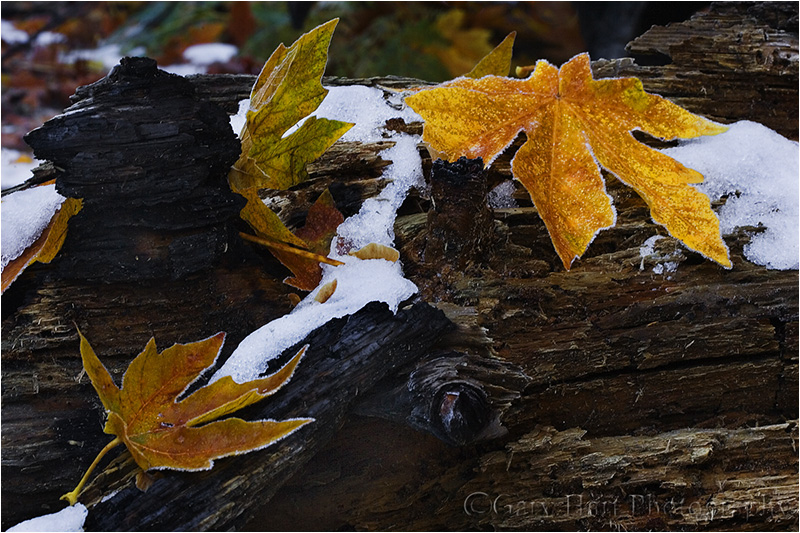
Snow and Autumn Leaves, Yosemite
“Photography’s gift isn’t the ability to reproduce reality, it’s the ability to expand it.”
(The second installment of my series on photographic reality.)
If you’ve ever tried to point out to someone a small detail in nature that pleases you, perhaps you’ve experienced a conversation like this:
You: “Look at that!”
Friend: “What?”
You: “Those leaves—look at the frost on those leaves.”
Friend: “What leaves?”
You: “There on the log—with the snow.”
Friend: “Those dead ones? Yeah, cool. Man, I can’t believe I ate all those fries at lunch.”
You: “Whatever.” Sigh.
It’s really great to enjoy nature, to take in all of its infinite, three dimensional, multi-sensory splendor: its smells, sounds, depth, and motion. But all this input is a lot to process, and because everybody interacts with the world a little differently, each person is drawn to different things—what moves you might be overlooked by others. If only there were some way to show others what you see. Hmmm….
Unlike us humans, a still camera experiences the world in single-sensory, discrete frames. Rather than being a disadvantage, a camera’s “limitations” provide an opportunity to isolate whatever aspects of a scene that moves you, and to remove extraneous elements that distract. In other words, the camera’s field of vision, determined by you, has finite boundaries that make a frame in which you can organize relationships and eliminate distractions through careful selection of your lens’s distance (or focal length) and direction.
The golden leaves in the above image were three among thousands dotting the forest floor on this November morning near Cathedral Beach in Yosemite. I wanted to juxtapose fall and winter, and reveal the leaves’ frosty fringe. A wide frame would have more closely represented the entirety of the scene as I experienced it, but without something to anchor the frame, I knew viewers’ eyes would wander and they’d be unsure of my intent.
So I put on my 100mm macro lens and moved closer, finding this trio of leaves on a log, surrounded by patches of snow. I started by positioning myself so none of the leaves merged—that each stood by itself, balanced in the frame. Framing the leaves tightly eliminated the rest of the world, giving you no choice but to only look at what I wanted you to see. F14 and careful focusing gave me enough depth of field to make the leaves and log sharp with the background distractions blurred to insignificance.
Up next: See the light
Photographic reality: Your camera’s vision
Posted on May 12, 2012

Floating Dogwood, Yosemite
1/160 second
F/4
ISO 400
176 mm
“Photography’s gift isn’t the ability to reproduce your reality, it’s the ability to expand it.”
(The first installment of my series on photographic reality.)
When I hear a photographer say “That’s exactly what I saw when I was there,” I cringe. Not only is capturing human reality in a photograph impossible (really), attempting to do so is so limiting. I’m a strong advocate of “honest” photography, photography that depicts a natural truth without digital deception, but photographic truth isn’t the same as human truth, a fact photographers should celebrate, not deny. Embracing your camera’s reality opens the door to revealing nature in ways humans can’t.
Leveraging your camera’s reality starts with understanding that “reality” is in fact a moving target defined by the medium experiencing it. The human eye’s version of reality is experienced within its narrow confines on the electromagnetic spectrum, limited to only those wavelengths between (about) 400 and 750 nanometers (a nanometer is one billionth of a meter—i.e., really, really small). An x-ray machine’s reality is .01 to 10 nanometers. But if you’ve ever seen an infrared image, you saw another version of reality, this time in the 3,000-14,000 nanometer range. Even your smartphone and microwave oven stake out their own reality turf on the very same electromagnetic spectrum.
My point isn’t to overwhelm you with scientific minutia (this won’t be on the test), it’s to jar you from your human-centric view of the universe. While a camera records light (more or less) within the same range of the electromagnetic spectrum registered by your eyes, a camera’s sensor responds to those wavelength’s a little differently, and it doesn’t benefit from the stereoscopic vision and cerebral processor that conveys depth and motion and adjusts in real time as light and focus needs dictate. And a camera’s sensor can’t handle the same range of light our eyes can, In other words, it’s impossible for a camera to record the world exactly like being there. Thank goodness.
Understanding and controlling the way your camera “sees” allows you to tap its unique vision and emphasize overlooked, unappreciated aspects of the natural world. On the other hand, photographers who see the world only with their own eyes, who use Photoshop or other digital tools to bludgeon their images into something closer to their own reality (or worse, into a manufactured digital reality), rarely add to their viewers’ perception of nature.
Get focused
The camera’s vision differs from yours in many ways. In upcoming posts I’ll cover confining borders, dynamic range, motion, time, and depth. But because I need to start somewhere, I thought I’d begin with an often unappreciated difference: focus. Not only do your eyes have a very wide focus range, they adjust focus (virtually) instantly, responding to a command from your brain in ways your not even conscious of to give you the impression that your entire scene is in crisp focus throughout. The camera, on the other hand, captures the current focus in a static instant. And the reciprocity of shutter speed and aperture make for sometimes impossible choices when trying maximize depth of field in limited light.
Photographers jump through lots of hoops to overcome limited depth of field and more closely approximate their own experience of world. Tiny apertures, tilt-shift lenses, and blended images will do it, albeit with trade-offs. And when all else fails, we’ll bump our ISO into the noisy stratosphere. All that is well and good, but let’s not forget that there’s no rule that says your capture must mimic your experience. Sometimes we can use our camera’s ability to severely limit depth of field to our advantage by eliminating distractions and turning uninteresting backgrounds into a complementary canvas of color and shape.
For example
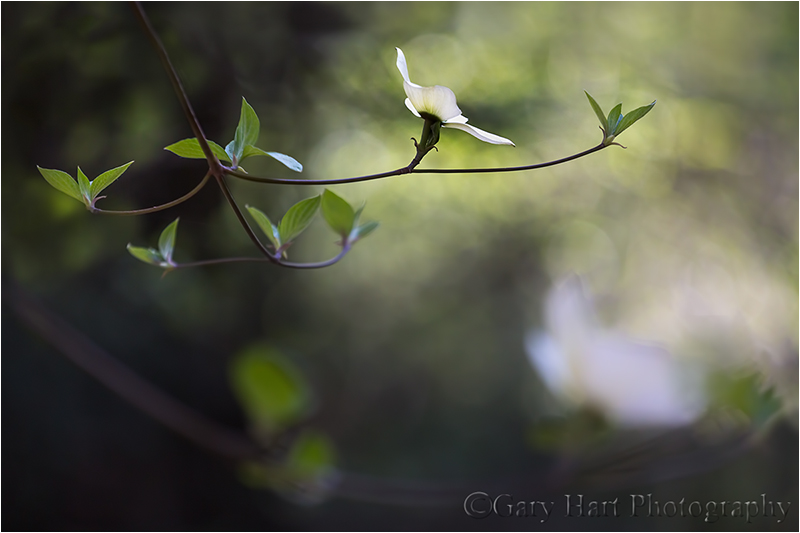
Floating Dogwood, Yosemite
Photographing near the Pohono Bridge in Yosemite, my eyes were treated to an overwhelming variety of input: countless dogwood blooms floating in dappled light; the swollen Merced River, deep and green or fast and frothing; oblivious cars and focused photographers; all this beneath a boring, pale blue sky. (Not to mention the sounds and smells of outdoors.) All of this input demanded attention, but I just wanted to convey the dogwood’s elegant grace in the context of its simple, verdant setting—everything else was superfluous.
While my human senses took in everything with razor sharpness, focusing close with a telephoto lens and large aperture allowed me isolate a single flower, reducing the rest of the visual world to a soft canvas of variegated green. Careful positioning and framing juxtaposed other blurred, complementary elements to provide location context. And using my camera’s inability to capture the range of light my eyes saw, I exposed for the brightly lit dogwood, turning everything in shade into a background ranging from dark green to nearly black.
This is image nothing like what my eyes saw, but it is what my camera saw (minimal Lightroom/Photoshop processing). Using my camera’s vision, I was able to eliminate distractions and isolate only the aspects of the scene I wanted to share. In my next few blog posts I’ll write more about leveraging your camera’s vision to reveal nature’s beauty in ways that are different, but no less real, than being there.
Up next, Framing infinity.
It’s personal
Posted on May 8, 2012

Top of the World, Glacier Point, Yosemite
Some of my oldest, fondest Yosemite memories involve Glacier Point: Craning my neck from Camp Curry, waiting for the orange glow perched on Glacier Point’s fringe to grow into a 3,000 foot ribbon of fire; stretching on tiptoes to peer over the railing to see the toy cars and buildings in miniature Yosemite Valley; standing on the deck of the old Glacier Point Hotel my father’s breathless excitement at the sudden shimmering rainbow arcing across Half Dome’s face.
The National Park Service doused the Firefall in 1968 and my father died almost eight years ago. While El Capitan’s Horsetail Fall delivers a no less spectacular (albeit less reliable) February show across the valley, and my father’s rainbow image is a vivid reminder on my mom’s living room wall, those Glacier Point memories are irreplaceable.
Glacier Point closes with the first significant snow each fall, and doesn’t open until the snow melts in late spring–avoiding summer’s crowds and interminable blue skies means I don’t make it to Glacier Point much anymore. So I was thrilled to learn that this year’s dry winter enabled the NPS to open Glacier Point on April 20, early enough for me to share it with last week’s workshop group.
Because I already had plans for Mirror Lake, moonrise, and moonlight photography later in the workshop, I decided that the workshop’s first sunset was the best time time for the Glacier Point trip. Stopping first at Washburn Point just a short distance up the hill, we were treated to a harbinger of what was to come later–a mix of wave clouds and alto-cumulus above the Sierra crest to the east, and wonderfully warm light on Half Dome. Not knowing how long the light would last, I hustled the group to Glacier Point, arriving soon enough to get a front row seat for what turned out to be the best sunset experience I’ve ever had at Glacier Point.
The light held out all the way to sunset, warming from amber to pink and finally red, painting the sky and saturating the granite landscape with shades of magenta. As it turned out we had many other photogenic moments (dogwood, a moonbow, and the rise of the “super” moon above Yosemite Valley) in the workshop’s remaining three days, but this sunset on Glacier Point will be my fondest memory.
That’s Half Dome front and center, Cloud’s Rest behind it to the right, and Nevada (top) and Vernal Falls in the lower right.
Returning to the scene of the crime
Posted on May 7, 2012
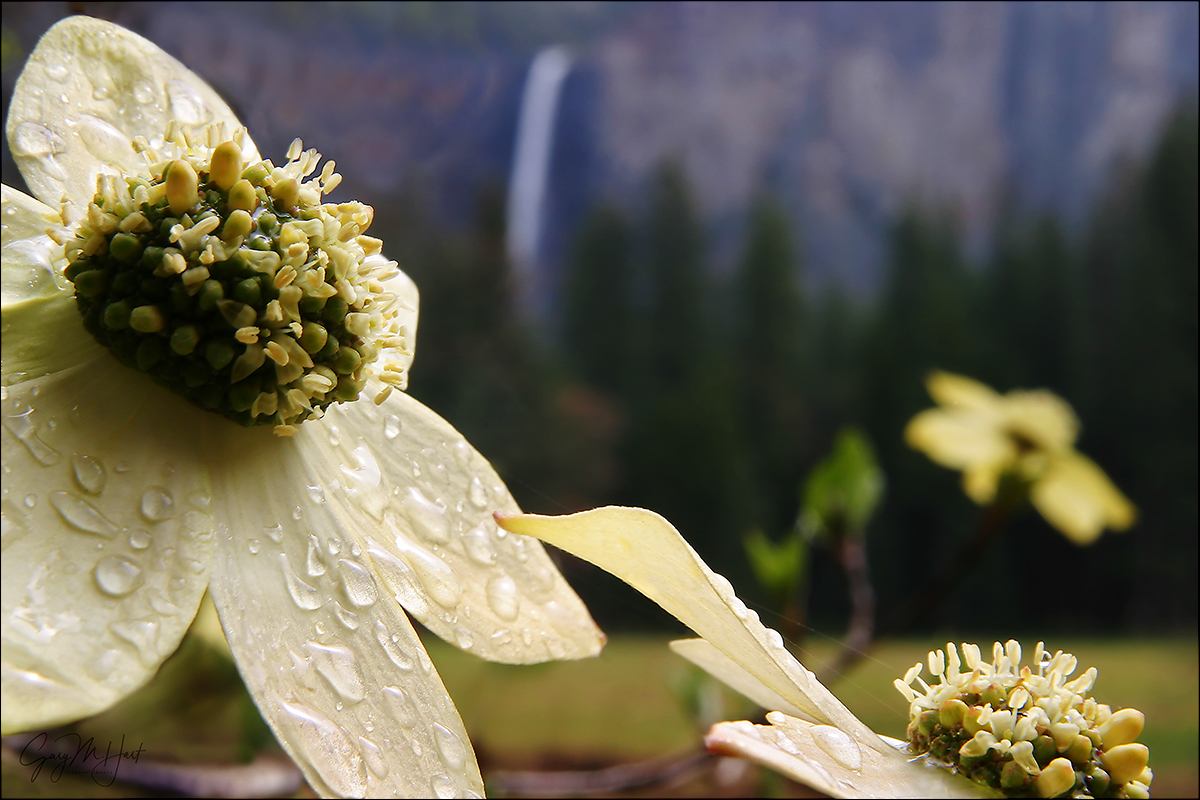
Bridalveil Dogwood, Yosemite
Canon EOS 10D
1/15 second
F22
ISO 100
48 mm
My Bridalveil Dogwood image is eight years old now. It remains one of my most popular images, and is still a personal favorite because it represents so many of my personal goals for each image:
- Use camera’s unique vision to reveal nature’s frequently overlooked details
- Manage the front-to-back plane to create the illusion of depth
- Guide the eye and create location context with selective focus
- Render the world in ways that allow others to imagine a world without human influence
My goal that morning, crystalized on the drive to Yosemite, was to juxtapose a sharply focused, foreground dogwood flower against a Yosemite icon softly focused in the background. I wandered Yosemite Valley in a light rain for a couple of hours before stumbling upon this blooming dogwood tree with Bridalveil Fall in the background. To frame Bridalveil with this pair of flowers I had to drag a log over to stand on, and extend my tripod’s center post much farther than I’m comfortable with (the center post is not terribly stable). An extension tube enabled a close focus that exaggerated the dogwood and softened Bridalveil Fall. Focused that close, getting Bridalveil sharp enough to be recognizable required me to stop down to f22. Fortunately there was no trace of wind.
Someone recently told me they overheard a couple of photographers stalking this tree, talking about my dogwood image, hoping they could duplicate it. While I was flattered, this need to replicate images makes me scratch my head. It’s what creates tripod traffic jams in Antelope Canyon on sunny days, at Mesa Arch every sunrise, and beneath Horsetail Fall each February, to name a few. I’m not saying I don’t have my share of derivative images, but they just don’t give me the satisfaction I get from creating something that I feel is uniquely my own. I tell my workshop students that images that move them to action are great, but they should be the starting point and never the goal. In other words, take an image that excites you and find put your own creative twist to it.
For example, while I have no desire to duplicate any image (my own or anyone else’s), I do return to “my” dogwood tree because I love the way it aligns so perfectly with Bridalveil Fall. A couple of years ago I was in Yosemite during an early snow storm. Many (shocked) colorful fall leaves remained on the trees, suddenly fringed with snow. Wanting to create something that showed the collision of fall and winter and still said Yosemite, I thought of this dogwood. Sure enough, I found a host of colorful leaves clinging like Christmas ornaments and composed something that achieved my goal.
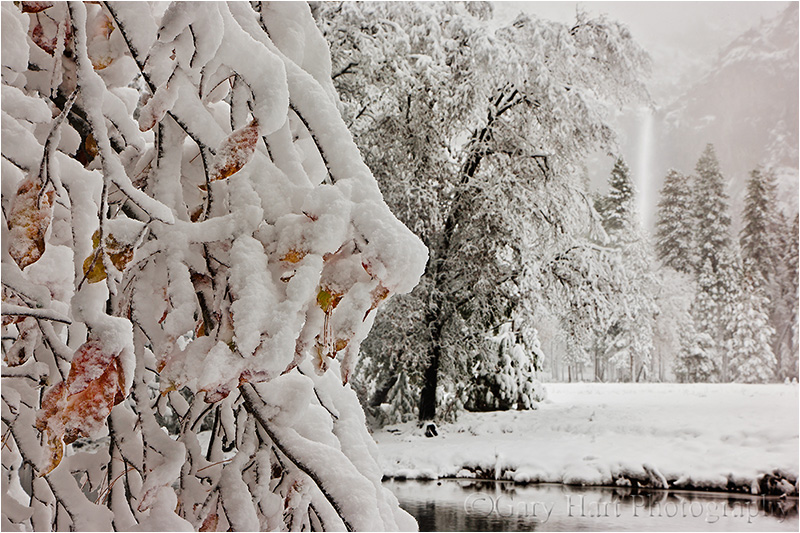
Fall in to Winter, Yosemite
The dogwood were blooming beautifully during my Yosemite workshop that ended Saturday, so one morning I took my group to the Bridalveil dogwood tree. Of course the conditions were entirely different, but from what I saw on several LCDs and during the workshop image review, lots of new images were created. I even tried my own hand at something different, breaking out my 100-400 lens and isolating a sunlit branch wide open at extreme telephoto. I haven’t had a chance to see whether I captured anything worthwhile, but I’ll let you know….
The best laid plans…
Posted on April 13, 2012
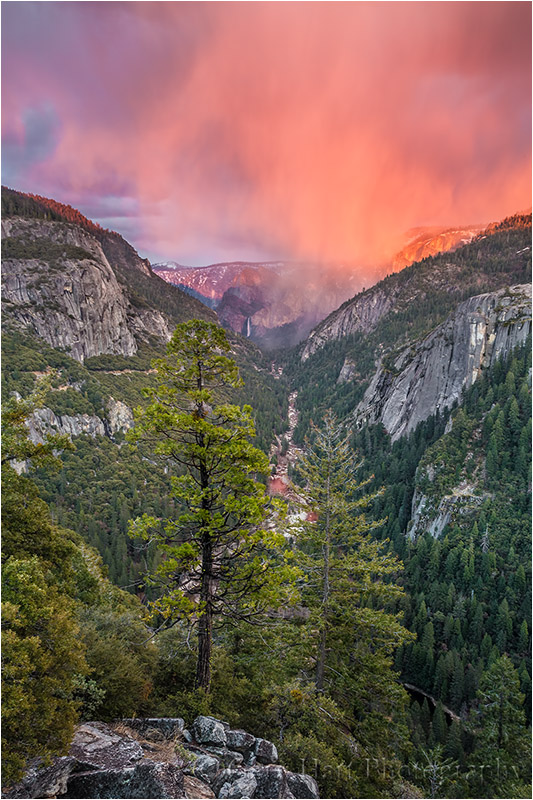
Red Veil, Bridalveil Fall and the Merced River Canyon, Yosemite
The plan was to photograph a full moon rising at the end of the Merced River Canyon, just to the right of Bridalveil Fall, at sunset. It was the final night of last week’s Yosemite Spring: Moonbow and Wildflowers photo workshop, and the moonrise was to be the grand finale. But after a day photographing poppies and waterfalls beneath a sky mixed with sun and clouds, the clouds took over and threatened to obscure everything. Nevertheless, most of the group hung in there to the bitter end, which is how we found ourselves at this vista point on Big Oak Flat Road about 45 minutes before sunset.
We could see Bridalveil but no hint of sky anywhere. Along with the clouds had come a biting cold (for April) wind that included a few snowflakes–most of the week and been quite comfortable, so we were a little unprepared for (and resentful of) the change. But there we stood, cameras poised atop tripods, shivering (us, not the cameras), chatting, and monitoring the horizon for any sign of an opening. I gave my standard “It’s impossible to predict Yosemite’s conditions in five minutes based on the conditions now” speech (it’s true), but the clouds were clearly lowering and even I was secretly pessimistic.
About the time people started eyeing the warmth of the cars, a small patch of light appeared in front of Bridalveil. Given the absolute grayness of the sky, we were a little perplexed, but that didn’t keep anyone from engaging their camera and firing off a few quick frames before the light disappeared. And disappear it did, but only for a minute or so, before returning. After another minute or two it was clear that the light wasn’t shrinking, it was expanding and soon we all started rooting for it to spotlight Bridalveil (photographers are greedy).
Which is exactly what it did. For the next thirty minutes we were treated to a light show that defied explanation. From our perspective there was no break in the clouds, but clearly the sun must have slipped beneath an opening on the western horizon, out of site behind a granite ridge, because soon the shaft expanded to a focused beam that traversed the entire canyon. We’d been so focused on the light that we didn’t at first notice a translucent cloud that had broken away from the flat gray ceiling. As the invisible sun dropped toward the horizon, its light warmed to gold, the shaft ascending the canyon walls, eventually illuminating the sky above Bridalveil. For the next ten minutes we watched the rogue cloud go from a brilliant amber to deep crimson veil draping the canyon.
About the time the color started reflecting in the Merced River far below, I noticed that we were all just standing shoulder-to-shoulder capturing pretty much the same thing, so I quickly moved about 20 feet down in search of a foreground. With the color peaking I managed a few wide frames, framing the Merced River and Bridalveil Fall with two nearby evergreens. After that the color faded quickly and we were all left wondering whether we’d imagined what we’d just seen. I’ve been photographing in Yosemite for my entire adult life and have never seen anything quite like this. I didn’t even think about the moon until it popped over a ridge about two hours later, on my drive home.
Autumn Leaves (and winter arrives)
Posted on March 17, 2012
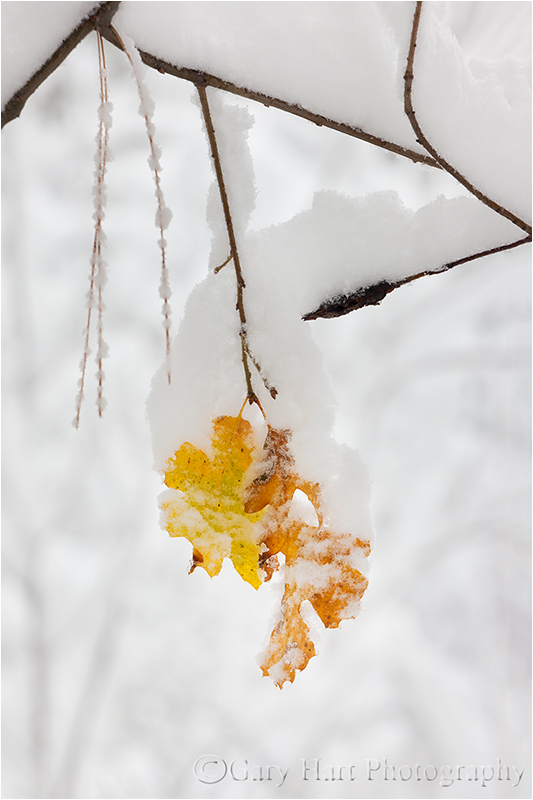
Leaves and Snow, Yosemite
I’ve been in Maui since Monday (scouting for a new workshop), and despite the fact that there’s more to photograph here than there is time to photograph (seriously), I still find time to check the Yosemite webcams every day. In fact, even surrounded by all this tropical splendor, I’ll admit to a few pangs of homesickness when today’s webcams showed fresh snow, with more falling, in Yosemite Valley.
(I’ll get to my Maui pictures when I’m home, but until then here’s one from November.) At only 4,000 feet above sea level, Yosemite Valley is warm compared to most of the Sierra. It’s often raining here when it’s snowing just a little up the road. When it does snow in Yosemite Valley, for an hour or two scenes like this are quite common. But as soon as the sun comes out, the snow starts disappearing.
To see Yosemite Valley covered in white requires being there while it’s snowing–if you wait to leave until you hear it snowed in Yosemite, you’re too late. Photographing Yosemite while the snow is falling can be difficult, but the payoff is huge. Often the ceiling drops to the valley floor, obscuring everything that’s recognizable as Yosemite, but with the disappearing icons also vanishes the swarms of visitors and suddenly you feel like you’re alone in the world. Is there any silence more pure than the silence of falling snow?
The best nature photography often highlights the drama of change: the passing from day to night and back, the collision of ocean and land, an approaching or retreating storm. And, because it happens so gradually and only once each year, the movement from one season to the next is a rare photographic opportunity.
So that November morning my attention turned to shocked autumn leaves, lulled by weeks of benign fall weather, forced to cling to their colorful glory against winter’s sudden assault. After nearly a month as the main event, these leaves were lone survivors along a quiet bend in the Merced River. Within a couple days they no doubt fell to the forest floor, or were swept into the river, as inevitable winter prevailed.
Starry, starry night
Posted on March 14, 2012

Winter Star Trails, Half Dome and the Merced River, Yosemite
Canon 1Ds Mark III
28 mm
24 minutes
F/2.8
ISO 400
Yosemite is beautiful any time, under any conditions, but adding stars to the mix is almost unfair. I started doing night photography here on full moon nights about six or seven years ago, but recently I’ve enjoyed photographing the exquisite starscape of moonless Yosemite nights. With no moonlight to wash out the sky, the heavens come alive. Of course without moonlight visibility is extremely limited, and focus is sometimes an act of faith. But eyes adjust, and focus improves with experience (I promise).
After photographing, among other things, Yosemite Valley with a fresh blanket of snow and Horsetail Fall in all its illuminated splendor, last month’s Yosemite winter workshop had already been a success. Nevertheless, after dinner on our next to last night I took the group to this peaceful bend in the Merced River to photograph Half Dome beneath the stars.
I started with a high ISO test shot to get the exposure info for everyone, then converted to a long exposure that allowed me to ignore my camera for a half hour or so while I worked with the rest of the group. Helping with focus, composition, and exposure, I made sure everyone had had a success before suggesting we wrap up.
The fabulous photography is only part of what makes these night shoots memorable–they’re also just plain fun. That night we ended up staying out for about an hour, shooting, shivering, and laughing–lots of laughing. And as the group packed up, I returned to my camera and found this waiting for me.
Check out next year’s Yosemite winter workshop.
Reflecting on reflections
Posted on March 4, 2012

Winter Reflection, El Capitan, Yosemite
Canon EOS-1Ds Mark III
1.3 seconds
F/16.0
ISO 100
19 mm
What is it about reflections? I don’t know about you, but I absolutely love them–I love photographing them, and I love just watching them. Like a good metaphor in writing, a reflection is an indirect representation that can be more powerful than its literal counterpart. In that regard, part of a reflection’s tug is its ability to engage the brain in different ways than we’re accustomed: Rather than processing the scene directly, we first must mentally reassemble the reverse world of a reflection, and in the process perhaps see the scene a little differently.
Because a camera renders our dynamic world in a static medium, water’s universal familiarity makes it a powerful tool for photographers. We blur or freeze in space a plummeting waterfall to convey a sense of motion that conjures auditory memories of moving water. Conversely, the mere image of a mountain reflecting in a lake can convey stillness and engender the peace and tranquility of standing on the lakeshore.
This El Capitan winter reflection is another from last month’s Yosemite winter workshop. Arriving at Tunnel View before sunrise, we found a world covered in snow and smothered by clouds. But as daylight rose, the clouds parted and we were treated to a classic Yosemite Valley clearing storm scene. The photography was still great when I herded everyone away from Tunnel View so we’d have time to capture as much ephemeral grandeur as possible in the limited time before the snow disappeared. I tell my groups that, while the photography is still great where we are, it’s great elsewhere too. This approach ensure that not only does everyone get beautiful images, they get a variety of beautiful images.
El Capitan Bridge was our second stop after Tunnel View. El Capitan is so large and close here that capturing it and its reflection in a single frame is impossible without a fisheye lens, or stitching multiple images. But sometimes the desire to capture everything the eye sees introduces distractions. Feeling a bit rushed, I inhaled and forced myself to slow down and simply absorbed moment, soon realizing that it was the reflection that moved me most.
I attached my 17-40 and tried fairly wide vertical and horizontal compositions that highlighted the best parts of the scene, twisting my polarizer in search of an orientation that captured the the reflection while still revealing the interesting world beneath the surface. Of the dozen or so frames that resulted, this may be my favorite for the way it conveys everything in those few sunlit, snowy minutes when the world seemed silent and pure.
* * * *
A note to you skeptics: I’m asked from time-to-time why the trees are white, while their reflection is green. This actually makes perfect sense once you realize that you’re looking at the top of the snow-covered branches, while the reflection is of the underside of the branches, which are not covered with snow.
Workshop Schedule || Purchase Prints || Instagram
A gallery of reflections
Click an image for a closer look, and to view a slide show.


If you can’t beat ’em…
Posted on March 1, 2012

Fresh Snow, Half Dome View, Yosemite
If it weren’t for Tunnel View on the Wawona Road, no doubt one of the most photographed vistas in the world, this view from Big Oak Flat Road, across the Merced River Canyon from Tunnel View, would probably be the Yosemite shot we all see. Visitors arriving from Highway 120 round a bend and are greeted with this view, their first inkling of Yosemite’s grandeur.
I’ve stopped here many times, but rarely photograph this view because it seems I always struggle with what to do with the foreground rocks and tree–composing wide enough to include them makes El Capitan, Half Dome, and Sentinel Dome quite small, and I just don’t think they’re interesting enough to occupy so much of the frame. But a couple of weeks ago, while guiding a private workshop student on a snowy morning, I found the entire scene etched in white and immediately saw the possibilities. Like magic, when adorned with a snowy veneer these foreground distractions became a worthy subject.
I moved as far back as the terrain would permit so I could increase my focal length and compress the distance separating the foreground and background. Even so, I was only able to go to 50mm, hardly a telephoto shot. Nevertheless, 50mm with subjects in my close foreground and distant background created depth of field problems. Whipping out my trusty iPhone hyperfocal app, I determined that I could make the scene work at 50mm and f16 if I was very careful with my focus point–focusing a little less than twenty feet away would give me sharpness from about eight feet to infinity. Because I had no way to measure the distance exactly (pacing it off would have ruined the pristine snow) and was more concerned about keeping the foreground sharp than I was about minor softness in El Capitan and Half Dome, I biased my estimate on the close side of twenty feet (making sure I focused between fifteen and twenty feet rather than between twenty and twenty-five feet).
All my previous images from this location have been telephoto shots the emphasize the strength of Half Dome, El Capitan, and Sentinel Dome. In fact, last May a rising crescent moon from this location gave me two of my favorite Yosemite images. But this time I was really happy for the opportunity to go wide and use these foreground features that had bothered me in the past, to come up with a fairly unique capture of Yosemite’s most frequently photographed monoliths.

Crescent Moon, El Capitan and Half Dome, Yosemite

Sunrise Trio, El Capitan and Half Dome, Yosemite
Watch your step
Posted on February 24, 2012
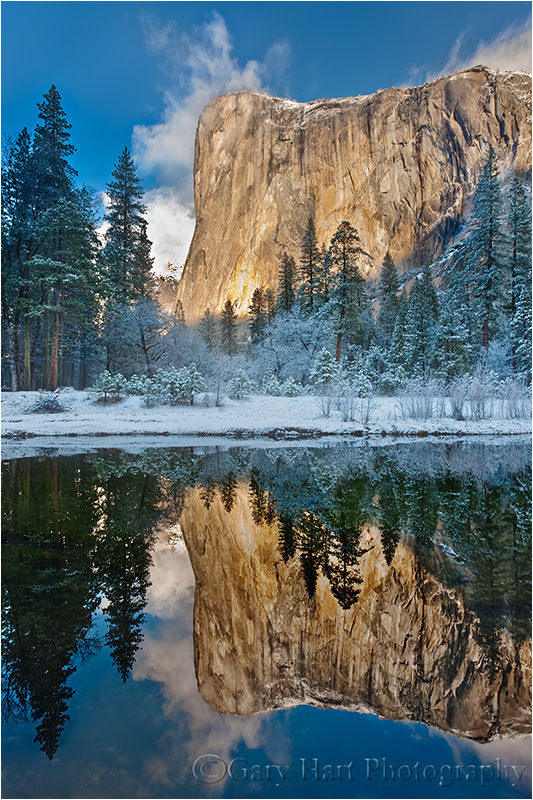
Reflection, El Capitan winter morning, Yosemite
Trouble brewing
I have many “favorite” photo locations in Yosemite Valley–some, like Tunnel View, are known to all; others, like this location along the Merced River, aren’t exactly secrets, but they’re far enough off the beaten path to be overlooked by the vacationing masses. While I used to count on being alone here, as often as not lately I share this shoreline with other photographers. While it’s nice to have a location to myself (so far I can still find a few of those spots in Yosemite Valley), I’m usually happy to share prime photographic real estate with a kindred spirit.
But. In recent years I’ve noticed more photographers abusing nature in ways that at best betrays their ignorance, and at worst reveals their indifference to the fragility of the very subjects that inspire them to click their shutters in the first place. Of course it’s impossible to have zero impact on the natural world: Starting from the time we leave home we consume energy that directly or indirectly pollutes the atmosphere and contributes greenhouse gases. Once we arrive at our destination, every footfall alters the world in ways ranging from subtle to dramatic–not only do our shoes crush rocks, plants, and small creatures, our noise clashes with the natural sounds that comfort humans and communicate to animals, and our vehicles and clothing scatter microscopic, non-indiginous flora and fauna.
For example
A certain amount of damage is an unavoidable consequence of keeping the natural world accessible to all who would like to appreciate it, a tightrope our National Park Service does an excellent job navigating. It’s even easy to believe that we’re not the problem–I mean, who’d have thought merely walking on “dirt” could impact the ecosystem for tens or hundreds of years? But before straying off the trail for that unique perspective of Delicate Arch, check out this admonition from Arches National Park.
Hawaii’s black sand beaches may appear unique and enduring, but the next time you consider scooping a sample to share with friends back on the mainland, know that Hawaii’s black sand is a finite, ephemeral phenomenon that will be replaced with “conventional” white sand as soon as its volcanic source is tapped–as evidenced by the direct correlation between the islands with the most black sands beaches and the islands with the most recent volcanic activity.
While Yosemite’s durable granite may lull photographers into environmental complacency, its meadows and wetlands are quite fragile, hosting many plants and insects that are an integral part of the natural balance that makes Yosemite unique. Not only that, they’re also home to, and nesting places of, native mammals, birds, and reptiles that so many enjoy photographing. Despite all this, I can’t tell you how often I see people in Yosemite (photographers in particular) unnecessarily trampling meadows, either to get in position for a shot or as a shortcut.
Don’t be this person
Still not convinced? If I can’t appeal to your environmental conscience, consider that simply wandering about with a camera and/or tripod labels you, “Photographer.” In that role you represent the entire photography community: when you do harm as Photographer, most observers (the general public and decision makers) go no farther than applying the Photographer label and lumping all of us into the same offending group.
Like it or not, one photographer’s indiscretion affects the way every photographer is perceived, and potentially brings about restrictions that directly or indirectly impact all of us. If you like fences, permits, and rules, just keep going wherever you want to go, whenever you want to go there.
It’s not that difficult
Environmental responsibility doesn’t require joining Greenpeace or dropping off the grid (not that there’s anything wrong with that). Simply taking a few minutes to understand natural concerns specific to whatever area you visit is a good place to start. Most public lands have websites with information they’d love you to read before visiting. And most park officials are more than happy to share literature on the topic (you might in fact find useful information right there in that stack of papers you jammed into the center console as you drove away from the entrance station).
When you’re in the field, think before advancing. Train yourself to anticipate each future step with the understanding of its impact–believe it or not, this isn’t a particularly difficult habit to form. Whenever you see trash, please pick it up even if it isn’t yours. And don’t be shy about reminding other photographers whose actions risk soiling the reputation for all of us.
DEVELOP A “LEAVE NO TRACE” MINDSET
A few years ago, as a condition of my Death Valley workshop permit, I was guided to The Center for Outdoor Ethics and their “Leave No Trace” initiative. There’s great information here–much of it is just plain common sense, but I guarantee you’ll learn things too.
Now go out and enjoy nature–and please save it for the rest of us.
======================================
A few words about this image
I captured this image while guiding a customer on a private workshop the day before last week’s Yosemite winter workshop. After months of clear skies, the sun rose on two inches of fresh snow in Yosemite Valley. As I did two days later when my workshop group was greeted with another dose of overnight snow, I shifted into hurry-up mode to get to as many spots as possible in the couple of hours we had before the snow would be gone–once the sun hits the trees, the snow disappears like magic.
After watching the storm clear from Tunnel View, we arrived here just in time to watch the day’s first light descend the surrounding granite walls. Our timing was ideal, as reflections are never better than when the reflective subject is in sun and the reflective surface in shade.
Shooting on a tripod (always!) enabled me to be at my camera’s ideal ISO 100 and select the f-stop the scene called for, without worrying about the resulting shutter speed. In this case I opted for a wide composition to include all of El Capitan and its reflection, which gave me lots of depth of field. Since the focus point for a reflection is the focus point of the reflective subject, not the reflective surface (that doesn’t mean that you shouldn’t focus on the reflection, it just means you should take care not to focus on something floating on or resting beneath the reflection), at 20mm everything in my frame was at infinity. With depth of field not a concern, I dialed in f11, my lens’s sharpest f-stop (lenses tend to be sharper in their middle f-stops). F11 brought the added benefit of reducing image-softening diffraction that happens at smaller f-stops–I’ll go smaller than f11 only when the composition calls for it (or if I forget to change it from a previous shot).
The dynamic range (the range of light from darkest shadow to brightest highlight) was too much for my camera to handle, but a two-stop hard-transition graduated neutral density filter subdued the brilliant sunlight, enabling enough exposure to reveal detail in the foreground shadows. Hiding the GND transition in the linear band of shoreline trees was easy, and simple dodging and burning in Photoshop brought out shadow detail and ensured that the sunlit El Capitan was brighter than its reflection (as it should be). Also in Photoshop I applied a light touch with Topaz noise reduction, desaturated the sky slightly to prevent it from overpowering the scene, and did selective sharpening (selecting only the areas containing detail).
(While I do take my groups to this quiet spot beside the Merced River, the fragile riverside setting that requires crossing a small meadow makes me reluctant to share it with the general public.)

 Eloquent Images by Gary Hart