Eloquent Images by Gary Hart
Insight, information, and inspiration for the inquisitive nature photographer
A rite of spring
Posted on February 26, 2014

Backlit Poppies, Folsom, California
Canon EOS 10D
1/30 second
F/3.5
ISO 100
100 mm
Today it’s gray and wet in Sacramento, a refreshing break from our ridiculously warm and dry winter (sorry, pretty-much-everywhere-else-in-the-U.S.). Usually by the end of February my thoughts have turned to spring, but this year I find myself feeling a cheated of winter (and wishing the rest of you would have shared). As miserable as it can be, I’ve always loved winter photography—not just snow (which I have to travel to see), but rain, clouds, bare trees, and the low angle of the sunlight.
Another aspect of winter I like is the precipitation that rejuvenates our creeks and rivers and nourishes the wildflowers. It’s hard to know what combination of winter conditions will make a good wildflower spring, but I do know that ample rainfall is an important component. Which makes me a little nervous about the wildflowers’ prospects this spring. But that won’t stop me from what has become an annual ritual, meandering through the foothills east of town, Spring Training baseball on the radio (go Giants!), photographing poppies. I have several go-to poppy spots, but I’m easily distracted and often never make it to my original destination.
The image here is from one of my earliest spring excursions, nearly ten years ago. On my way home, I detoured at the last minute to a spot I knew I’d find a few nice poppies—(believe it or not) the Intel parking lot in Folsom. The poppies were in an elevated bed atop a retaining wall, allowing me to easily drop low and capture them backlit by the setting sun. The sun, distorted and dulled by horizon haze, was a throbbing orange ball that I blurred beyond recognition with an extension tube and a large aperture on my 100mm macro lens. Without wind, focus through my viewfinder on the center poppy’s leading edge was pretty easy (today I’d have used live-view focus). The translucent petals caught the fading sunlight, igniting the flowers like orange lanterns. I underexposed slightly to save the highlights and color, and to turn the shaded background into a black canvas.
One other thing I remember about this shoot was my brief brush with the law. Apparently my activity aroused the interest of Intel Security—after just a few minutes of shooting I was visited by an officer who clearly took his job quite seriously. It took me a few minutes, but I was finally able to convince him that, despite my sinister appearance, I was in possession of no explosive device, nor was I an AMD (Advanced Micro Devices, Intel’s leading competitor) spy seeking the secrets of Intel’s fertile flower bed. After making a theatrical display of checking of my license plate (that clearly communicated, “We know who you are”), and in a tone that made let me know he wasn’t quite convinced and would be watching me, he allowed me to finish.
-

- Poppy Hillside, Sierra Foothills
-

- Sparkling Poppies, Merced River Canyon
-
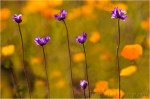
- Spring, California Gold Country, Sierra Foothills
-

- Poppy Pastel, Sierra Foothills, California
-

- Champagne Glass Poppies, Merced River Canyon, California
-
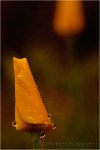
- Raindrops on Poppy, California Gold Country
-

- Poppy Lanterns, Merced River Canyon
-
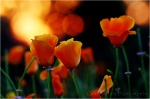
- Backlit Poppies, Folsom, California
-

- Poppies and Oak, Big Sur
-
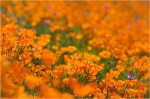
- Poppies, Hite Cove Trail, Merced River Canyon
-
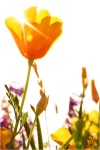
- Brilliant Poppy, American River Parkway, Sacramento
-
- Poppy and Surf, Point Reyes National Seashore
Four sunsets, part four: Saving the best for last
Posted on February 23, 2014

Twilight Magic, Yosemite Valley from Tunnel View, Yosemite
Canon EOS-1Ds Mark III
3 2/3 seconds
F/11.0
ISO 400
45 mm
- Read the first in the series here: Four sunsets, part one: A Horsetail of a different color
- Read the second in the series here: Four sunsets, part two: Classic Horsetail
- Read the third in the series here: Four sunsets, part three: A marvelous night for a moondance
What I love most about photography is its ability to surprise me. Case in point: the final sunset of my recent Yosemite Horsetail Fall workshop, which delivered just one surprise after another.
I’d told my group that we’d get to photograph another moonrise on our last evening, but only if the clouds cooperated. And as the afternoon wore on, it seemed that the clouds that had cooperated so wonderfully all week wouldn’t be on our side tonight. Assembling everyone on the sloped granite above Tunnel View, I eyed the thin (and shrinking) strip of blue sky on the horizon above Half Dome and checked my watch: 5:10—in about fifteen minutes (less than ten minutes before sunset), with no clouds we’d see a full moon poke into view between Half Dome and Sentinel Dome. But our vantage point gave me a clear view of the clouds racing in that direction and our prospects weren’t good. Rather than stress (much), I stayed philosophical: We’d already had three fantastic sunset shoots, expecting a fourth would be downright greedy.
Nevertheless, it was fun to watch the clouds sprint across the sky and pile up behind Half Dome, changing the scene by the minute. Waiting there, I had thoughts about the throngs gathered on the valley floor, hoping (praying) for Horsetail Fall to light up. My group had been lucky on our first two sunsets, but tonight there’d been no sign of sunlight for at least thirty minutes, and with the cloud machine working overtime behind us, I was pretty certain the Horsetail crowd was in for disappointment.
Anticipating a moonrise, I’d gone up our vantage point with just my tripod, 5DIII, and 100-400 lens. Knowing exactly where the moon would appear, my composition was set well in advance—tight, with Half Dome on the far left and the moonrise point on the far right. But without the moon, I realized that the best shots would likely be wide, so I zipped back to the car and returned with another tripod (doesn’t everyone carry two?), my 1DSIII, and my 24-105. Sitting on the (cold) granite, a tripod on my left and my right, I quickly composed a wide shot with my new setup and resumed my vigilance.
By 5:25 I’d stopped watching the incoming clouds, which were streaming in faster than ever, and turned my focus to the moon’s ground-zero, willing the clouds to part for its arrival. At exactly 5:27 and as if by magic, the white glow of moon’s leading edge burned through the trees downslope from Sentinel Dome. I did a double-take—it was as if the moon had pushed the cloud curtain up and slipped beneath. I shouted, “There it is!” and the furious clicking commenced. We ended with about sixty seconds of moonrise, just long enough for the moon to balance atop the trees, before the clouds settled back into place and snuffed it out.
But the surprises had only just begun. While the whole group still buzzed about the moon, I noticed a faint glow on El Capitan. Not quite believing it (and not wanting to jinx anything), I kept my mouth shut and looked closer. But when the glow persisted, I had to point it out, if for no other reason than confirmation that I wasn’t hallucinating. Within seconds all doubts were dispelled as El Capitan exploded with light from top to bottom. So sudden and intense was the light that I’m surprised we didn’t hear the roar from the Horsetail Fall contingent in the valley below us. And rather than fade, as it often does, the light intensified, warming over the next couple of minutes from amber to orange to red. Soon the color deepened to an electric magenta and spread across the sky and all those clouds I’d been silently cursing just a few minutes earlier became allies, catching the color and reflecting it back to the entire visible world.
Giddy about the show, and focused on my two cameras, I’d long given the moon up for dead. So imagine my surprise when, just as the color reached a crescendo, there the moon was, burning through a translucent veil of clouds. So expansive was the scene that a telephoto couldn’t do it justice, so all of my images following the moon’s resurrection were captured with my 5DIII and 24-105. Exposure became trickier by the minute in the advancing darkness, and eventually, pulling detail from the valley without completely blowing out the moon required a 2-stop hard graduated neutral density filter.
Honestly, this was one of those moments in nature that no camera can do justice. I did my best to come find compositions that captured the majesty of Yosemite Valley, the vivid sky and the way it tinted the entire scene, and that Lazarus moon. But take my word for it, you just had to be there….
* * * *
Four Sunsets
-

- Revelation, Horsetail Fall, Yosemite
-

- Fire on the Mountain, El Capitan and Horsetail Fall, Yosemite
-

- Twilight Magic, Yosemite Valley from Tunnel View, Yosemite
Four sunsets, part three: A marvelous night for a moondance
Posted on February 19, 2014
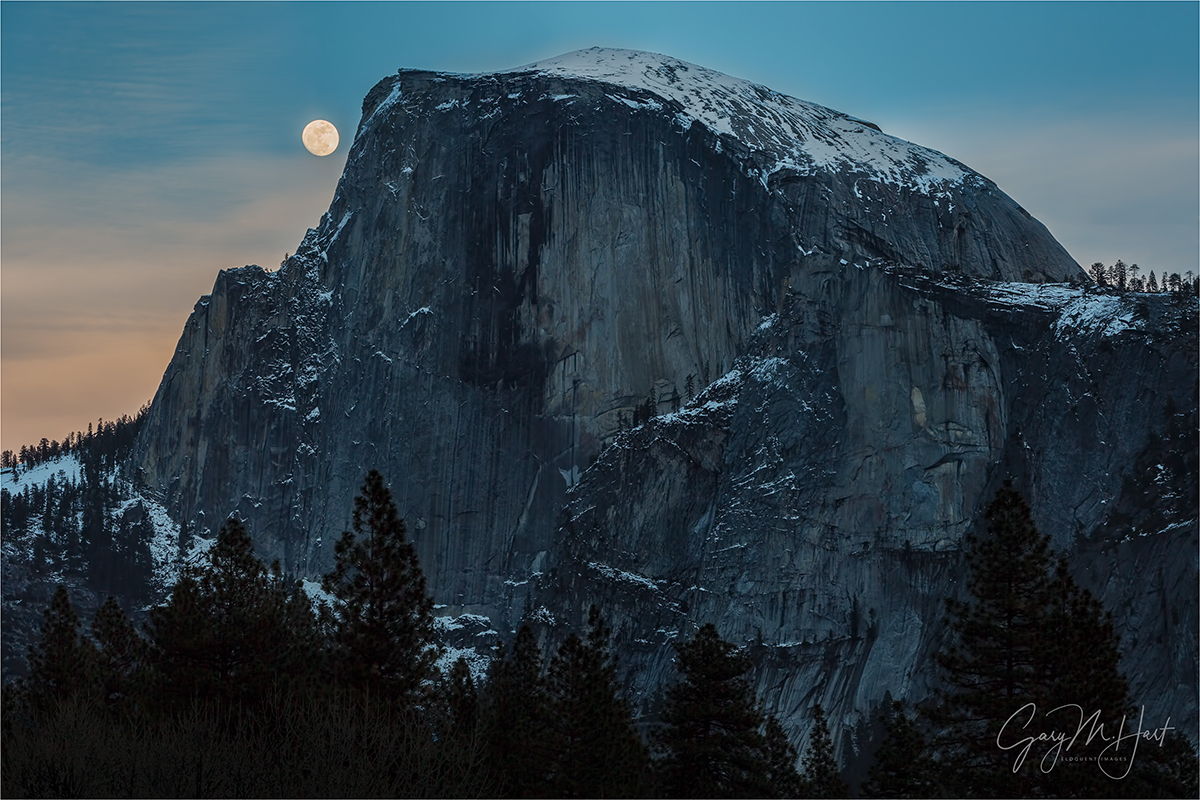
Moondance, Half Dome, Yosemite
Canon EOS 5D Mark III
1/5 second
125 mm
ISO 100
F11
How many Yosemite moonrise images are too many? I have no idea, but I’ll let you know as soon as I find out.
- Read the first in the series here: Four sunsets, part one: A Horsetail of a different color
- Read the second in the series here: Four sunsets, part two: Classic Horsetail
5:10 p.m.
I stand on the bank of the Merced River, eyes locked on the angled intersection of Half Dome’s sharp northeast edge and its adjacent, tree-lined ridge. If the clouds cooperate, and I’ve done my homework right, a nearly full moon (96%) will be poking above this intersection any minute. We’d been fortunate the first two sunsets of my workshop; dare I hope for one more?
If the moonrise happens as I plan (hoped), the sight could rival what we’d gotten from Horsetail Fall on the first two nights of our workshop. But right now the sky behind Half Dome is smeared with thin-ish clouds—how thin I won’t know until the moon appears (or doesn’t). Gazing heavenward, I find it odd that a moonrise, something that can be predicted with such absolute precision, is so subject to weather’s fickle whim. And the clouds aren’t my only concern—just a half-degree error in my plotting would put the moon behind Half Dome and out of sight.
Few things in nature thrill me more than a moonrise. Camera or not, crescent or full, I love everything about a it: the obsessive plotting and re-plotting that gets me out there in the first place; the hand-wringing anticipation while I await the moon’s appearance; the first white pinprick of moonlight on the horizon (Is that it? There it is!); the ridge-top evergreens silhouetted against the rising disk; the glowing sphere hovering above the darkening landscape; and finally, the moonlit landscape beneath a star-studded sky. Everything.
So it shouldn’t surprise that virtually all of my photo trips—workshops and personal—are scheduled around the moon’s phase and some condition of the night sky. Sometimes I target a full moon, sometimes a crescent, and sometimes I want no moon at all (for dark skies that reveal the most stars)—the choice depends on the kind of moonrise and/or night photography I think best suits the landscape I’m traveling to photograph. But because this workshop is timed to coincide with the few February days that Horsetail Fall might turn a molten red at sunset, a calendar window I shrink even further to avoid the crowds that flock a little later in February, the moon is rarely a priority when I schedule the Horsetail Fall workshop. But I still check. And when I started planning my 2013 Yosemite Horsetail Fall workshop a couple of years ago, I was thrilled to discover that not only could I could time this trip for a full moon, I’d also be able to align that moon with Half Dome at sunset. Twice.
5:13 p.m.
I check my watch: 5:13. Sunset is 5:35; the moon should appear almost adjacent to Half Dome at about 5:15, then slowly rise, like a ball rolling uphill along Half Dome’s left side. By 5:30 the disk will have almost reached Half Dome’s summit, less than its own width with from the granite face. That is, if I’ve done my homework right. 5:14.
Any minute now….
I’d done all my figuring months in advance, which of course didn’t stop me from double-, triple-, quadruple-, and so-on-checking my results in the days leading up to my waiting beside the Merced River with a dozen or so other photographers. Part of my anxiety is the particularly fortuitous alignment of location, moon, and time that put the moon appearance above Half Dome right in my “ideal” sunset window as viewed from one of my favorite Yosemite locations. Not only does this spot provide a clear, relatively close view of Half Dome, it also is at a nice, reflective bend in the Merced River. Even without the moon this is a nice spot, end everyone in the group seems to be finding things to photograph. But I want the moon tonight. Really, really want the moon.
(You really don’t need to read this section)
My moonrise/set workflow was in place long before smartphones apps and computer software laid it all out for any photographer willing to look it up. But those tools are new tricks and I’m an old dog. So here’s how I’ve done it for years:
- Use my topo map software to determine the latitude and longitude of the location I want to photograph.
- Give my location’s latitude and longitude to my Focalware app (or, if I need the data to be a little more granular, the US Naval Observatory website), which returns the moon and sun rise/set altitude (degrees above a flat horizon) and azimuth (the angular distance relative to due north, from 0 to 360 degrees—imagine a clock: 12 is 0 degrees; 3 is 90 degrees; 6 is 180 degrees and so on).
- Next I plug the moon’s altitude/azimuth for my location into the plotting tool of my computer’s mapping software. This draws a line from my location (where I’ll be with my camera) to the location of the moonrise (or set). Most importantly, the line shows the moon’s alignment with whatever landscape feature I’m interested in (such as Half Dome). It also gives me both the distance and the elevation change between my location and the point above which it will rise.
- Finally, I use the elevation and distance data with the trig functions of a scientific calculator to get the altitude to which the moon must rise before it’s visible from my vantage point.
If this all sounds convoluted, that’s probably because it is. I suggest that you try something like The Photographer’s Ephemeris or Photo Pills, which does all this for you. But like I say, that’s a new trick….
5:15 p.m.
I squint, hoping to engage my x-ray vision enough to make out the moon’s outline through the clouds. Nothing. With conditions fairly static, the group has gotten their shots and is chatting more than clicking. Moon or not, the photography will improve as the light warms toward sunset. I walk uphill, away from the river and slightly upstream to improve my angle of view. Still nothing. (Did Ansel Adams experience this angst?)
We’ve reached the time that I expect the moon to appear. I’ve been plotting the moon long enough to be fairly confident within about one moon’s width (a half degree in either direction) of where it will rise, and within plus/minus two minutes of when it will rise. But the whether of seeing a moonrise depends on, well, the weather. Will rain, snow, or even just a rouge cloud shut us out? There’s really no way to know until the day arrives. And sometimes, for example this very instant, I can’t tell whether the sky will cooperate until I actually see the moon.
I’ve learned that the best time to photograph a full moon (when I say “full,” I often mean almost full, generally between 95 and 100 percent of the complete disk illuminated) is during a ten minute window straddling sunset. Much earlier and the light isn’t particularly interesting, and there isn’t enough contrast between the moon and the sky for the moon to stand out dramatically; much later and there’s too much contrast between the moon and everything else in the scene for the camera to handle.
Choosing this location introduces another unknown. Remember when I said that I can pinpoint the moonrise within about its width? Well, in this case that margin of error is just enough to give me pause, because rising slightly to the right of where I think it will rise puts the moon behind Half Dome until about five minutes after sunset. Sentinel Bridge, just a short distance downstream, would have been safer, but the Sentinel Bridge Half Dome shot is far more common, the bridge is usually teaming with people at sunset, and the moon would have been a little higher in the sky during “prime time.” So here we stand.
5:17 p.m.
What’s that faint white blob in the clouds? Without saying anything I squint and look closer. Sure enough, there it is, barely visible, less than one degree above the ridge (its rise above the ridge a couple of minutes ago must have been obscured by the clouds), pretty much where I expect it. Phew. I announce the moon’s arrival to the rest the group, but need to guide their eyes to it. As everyone’s attention returns to their cameras, I cross my fingers for the clear sky in its path to hang in there until at least sunset.
5:25-5:45 p.m.
The moon finally climbs above the clouds and I exhale. Still daylight bright, it now makes a striking contrast against the darkening sky. For the next fifteen minutes we shoot continuously, pausing only to recompose and monitor the highlights. Compositions, which I’d had everyone practice before the moon arrived, range from wide reflections that reduce the moon to a tiny accent, to tight isolations of the moon and Half Dome’s face.
As sunset approaches, the biggest concern becomes those lunar highlights—too small to register on the camera’s histogram, the moon’s face is easily blown out as we try to give the darkening foreground more light. Before we started I made certain everyone has engaged their camera’s Highlight Alert (“blinking highlights”) feature. They all know that when the moon starts flashing, they’ve reached the exposure threshold and must back off on their exposure and lock it in (a few “blinkies” are recoverable in Lightroom or Photoshop, but if the entire disk is flashing, the moon’s detail is probably lost for good)—while the moon will remain the same brightness (can’t take any more exposure), from that point on the foreground will continue darkening until it becomes too dark to photograph. Then we go to dinner.
Like everyone else, I used a variety of compositions. I already have a wide reflection image from a prior shoot, so the image I share here is a moderate telephoto—any tighter (to enlarge the moon further) would have truncated some of Half Dome’s face, something I just cant bring myself to do.
We finally wrapped up at about 5:45, when long exposures to bring out detail in the dark landscape made capturing detail in the bright moon impossible. Everyone was pretty thrilled at dinner, and even though the clouds thickened and washed out our planned moonlight shoot, there were no complaints. And little did we know, Mother Nature had concocted a grand finale for our final sunset.
Join me in Yosemite
PURCHASE PRINTS || PHOTO WORKSHOPS
A Gallery of Yosemite Moons


Four sunsets, part two: Classic Horsetail
Posted on February 16, 2014

Molten Monolith, Horsetail Fall, Yosemite
Canon EOS 5D Mark III
1/5 second
122 mm
ISO 100
F11
- Read the first in the series here: Four sunsets, part one: A Horsetail of a different color
While we’d been incredibly fortunate with our Monday night Horsetail Fall shoot, we didn’t get the molten glow everyone covets (though I’d argue, and several agreed, we got something better). Nevertheless, based on the relatively clear skies, I decided to take everyone back for one more try on Tuesday.
On Monday we’d been able to photograph in relative peace from my favorite spot on Southside Drive, but given that the weekend storm had left us in its rearview mirror, and that word had no doubt gotten out that Horsetail Fall was once again flowing, I guessed that the Horsetail day-trippers (Bay Area, Los Angeles, Central Valley photographers who cherry-pick there Yosemite trips based on conditions) would begin crowding into Yosemite Valley. To be safe, I got my group out there a little after 4:00 (sunset was 5:35). Despite being earlier, both parking turnouts were already teeming cars (if everyone squeezes, there might be room for fourteen legally parked cars)—just a few minutes later and we’d not have found room for our three vehicles (all the late arriving cars that had attempted creative, shoulder parking solutions returned to find parking tickets decorating their windshields). With so many more cars, I wasn’t surprised to find my preferred spot down by the river was already starting to fill—but we spread out a bit and everyone managed to squeeze in.
Unlike Monday evening, the Tuesday sky started mostly clear, with only an occasional wisp of cloud floating by. While the scene lacked the drama of Monday, the clear skies boded well for the fiery show we were all there for. We watched the crisp, vertical line separating light and shadow advance unimpeded across El Capitan. The mood was optimistic—borderline festive. Then, a little after five, with no warning the light faded and El Capitan was instantly reduced to a homogeneous, dull gray. Many people reacted as if their team had fumbled on the two yard-line, but those of us who know Horsetail Fall’s fickle disposition just smiled.
In all the years I’ve been photographing Horsetail Fall, I’ve come to recognize how much it likes to tease—while this is more of a gut feeling, it has always seemed to me that the evenings when the shadow marches without pause toward sunset, the light is much more likely to extinguish right before the prime moment. On the other hand, my best success seems to come on the evenings when the light comes and goes, teasing viewers right up until it suddenly reappears in all its crimson glory just before sunset. So, until the light disappeared I was a little concerned that things were going too well. But when the light faded I was able to guide them away from the ledge and reassure them that there’s no reason to panic just yet. And sure enough, about ten minutes later the sunlight came flooding back and everyone exhaled.
As shadow advances from the west, the remaining light warms—by 5:25 it had reached a rich amber. Once it reaches that stage my advice to everyone was that, since the show will either get better (more red) or worse (the light snuffed), and there’s no way of telling which it will be, they should just keep shooting until the light’s gone. And that’s what we did. At first there were no clouds and my composition was fairly tight to eliminate the boring sky. Then, just a few minutes before the “official” 5:35 sunset (I should add that “sunset” when you see it published refers to the time the sun sets below a flat horizon—it set far earlier for those of us on the valley floor, and it wouldn’t set on elevated Horsetail Fall until nearly 5:45), a nice cloud wafted up from behind El Capitan and I quickly went wider to include it.
On the way to dinner with the group I breathed a sigh of relief knowing that my life had just become much easier. For many in the group, what we’d just photographed was their primary workshop objective—for some Horsetail Fall is a bucket-list item. But the nights Horsetail Fall doesn’t light up are far more frequent than the nights it does, and in fact I’ve seen Februarys when it’s only lit up like that once or twice (and I’m sure there have been years when it doesn’t happen at all). While I knew nobody would hold me accountable if Horsetail didn’t put on a show for us, the fact that it did (not to mention the fabulous Horsetail shoot of our first night), meant that I was free to focus the group’s final two sunsets two very special moonrises.
Next up, sunset number three: A marvelous night for a moondance
* * *
Four sunsets, part one: A Horsetail of a different color
Posted on February 14, 2014
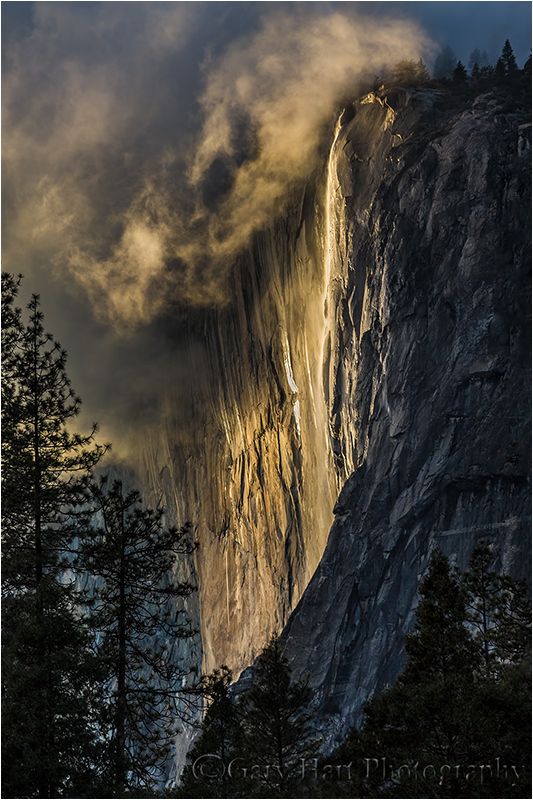
Revelation, El Capitan and Horsetail Fall, Yosemite
Canon EOS 5D Mark III
1/20 second
154 mm
ISO 100
F11
If the National Weather Service website were human, it would have long ago slapped me with a restraining order. You see, California is in the throes of an unprecedented drought that has shriveled lakes, rivers, creeks, and reduced even the most robust waterfalls to a trickle. With my Yosemite Horsetail Fall (which on a good day is rarely more than a thin white stripe on El Capitan’s granite) workshop just around the corner, recent weeks have seen me behave more like an obsessed infatuee, as if constant monitoring will somehow make my weather dreams come true. But so far this winter, each time I thought Mother Nature had winked in my direction, I found my hopes quickly dashed as every promising storm made an abrupt left into the open arms of the already saturated Pacific Northwest.
So, imagine my excitement when, just in time for this week’s workshop, an atmospheric river (dubbed the “Pineapple Express” for its origins in the warm subtropical waters surrounding Hawaii) took aim at Northern California. During the four days immediately prior to my workshop, our mountains were drenched with up to ten inches of liquid—not nearly enough to quench our three-year-and-counting drought, but more than enough to recharge Yosemite’s parched waterfalls for the three-and-a-half days of the workshop. Phew.
Monday morning I arrived in Yosemite to find, as hoped, the waterfalls brimming and Horsetail Fall looking particularly healthy. Eying Horsetail from the El Capitan picnic area a few hours before the workshop started, I suddenly remembered the stress that comes with other photographers counting on me for the bucket-list shot they’d traveled so far to capture. It occurred to me that hen Horsetail Fall is dry I can concentrate without distraction on Yosemite’s other great sunset options; when Horsetail is flowing, I need to decide whether to go for the notoriously fickle sunset light and risk no photographable sunset at all if it doesn’t happen. That’s because, not only does Horsetail Fall need water, the red glow everyone covets also requires direct sunlight at the exact instant of sunset—never a sure thing, even on seemingly clear days. And if Horsetail doesn’t get sunset light, there’s little else to photograph from its prime vantage points. With the forecast for the workshop’s duration called for a disconcerting mix of clouds and blue sky, our odds were even longer than ordinary. Compounding my anxiety was the full moon that I’d promised for workshop sunsets three and four (of four total sunsets)—if we don’t get Horsetail on sunset one or two, I’d have to decide between going for Horsetail or the moon. (And woe betide the workshop leader whose group watches a fiery sky or ascending moon from an unsuitable location—tar and feathers, anyone?)
During the orientation I did my best to establish reasonable expectations. I told the group that we’ll go all-in on Horsetail for sunsets one and two, and that if it doesn’t happen, I’ll decide our priority for sunsets three and four based on the conditions. What I meant was, we’ll go all-in for Horsetail on sunsets one and two, and I’ll hope like crazy it that does happen and I won’t have to decide anything for sunsets three and four. What followed was four sunsets filled with anxiety, each culminating with a rousing success—two our our successes were of the exactly-what-I’d-hoped-for variety, while the other two were far beyond what I could have imagined.
Sunset number one, above, was in the more than I could have imagined category. After the orientation I took the group to Tunnel View, where we kicked off the workshop with Yosemite Valley beneath a nice mix of clouds and sky. From there we headed to the night’s sunset destination, my favorite Horsetail Fall view on Southside Drive. A few years ago I could pull in to this spot a few minutes before sunset and be relatively confident of finding enough room for my entire group. But this spot is no longer a secret; on the drive there I crossed my fingers that the storm had kept most of the day-trip photographers home—if not, Plan B was to loop over to the El Capitan picnic area where there’s more parking and ample room for many photographers. On this afternoon my concerns were unwarranted as we found only two other cars there, and nobody down by the river where I like to set up. And set up we did, with a little more than an hour to wait. From the time we arrived the clouds were nice, but with no sign of the sun the scene was a little flat, with gray the predominant color—nevertheless, I encouraged everyone to be ready because it can change in a heartbeat. Little did I know….
As we waited we watched Horsetail Fall, spilling more water than I’d seen in years, play peek-a-boo with the storm’s swirling vestiges. But without direct sunlight, the scene, while pretty, wasn’t spectacular. Then, shortly before 5:00, without warning the clouds lit up like they’d been plugged in and I (unnecessarily) told everyone to start shooting, that we have no idea how long this light will last. For the next ten minutes we were treated to a Horsetail Fall show the likes of which I’ve never seen. Suddenly the exposures, quite easy in the flat gray, became quite tricky and I spent lots of time bouncing between workshop participants struggling with exposure. I managed to get off a handful of frames, some fairly wide, and a few a little tighter like this one. When the light faded we were left with cards devoid the “classic” Horsetail image; instead, we had something both beautiful and unique, a difficult combination for such a heavily photographed phenomenon. From the conversations in the car, and from images shared later during image review, it was pretty clear that everyone else was as happy as I was. Nevertheless, I sensed most still wanted the red Horsetail image, and I was ready to give it one more try with sunset number two.
Next up, sunset number two: The “classic” Horsetail.
* * *
Some assembly required
Posted on February 10, 2014

Double Rainbow, Lipan Point, Grand Canyon
California Sunset, Sierra Foothills
Canon EOS 5D Mark III
1/5 second
32 mm
ISO 100
F14
Putting together material for the Grand Canyon Monsoon workshop that Don Smith and I do each August, I came across this image from the first shoot of our first workshop. With so many pictures in the two weeks we were there (for two workshops), and given the incredible events that followed, it’s amazing to me how well I remember the specifics of this early shoot (especially given how poorly I remember so many other things).
When Don and I pulled the group into Lipan Point that afternoon, a handful of puffy clouds floated overhead. But, as if on cue, within minutes of our arrival the clouds organized into a seething, dark gray tower; five minutes after that, a few drops fell—marble-size projectiles that landed with an audible splat at one- or two-second intervals. We ignored the rain and kept shooting, but when a lightning bolt struck a quarter mile away, we couldn’t get out of there quickly enough, retreating to the cars just as all hell broke loose. For the next we were assaulted with a pounding rain that obliterated the view and required shouting to be heard. As suddenly as it started, the rain stopped and the Canyon reappeared, bathed in sunlight. And with the sunlight came a full double rainbow. I mean, what could be more perfect, the Grand Canyon plus a rainbow? Unfortunately, from our vantage point on the rim, the rainbow beautifully framed nothing but sagebrush south of the canyon.
Understanding the physics of rainbows, I knew that there’s nothing random about their position—to get the rainbow above the canyon, I simply had to be on the other rim. With a choice between A: A four hour drive, and B: A twenty mile hike, I chose C: Get as far out into the canyon as the nearby terrain allows and hope for the best.
The “Point” part of Lipan Point refers to a rock protuberance that juts into the canyon. Scrambling onto the rock, I was able to change my angle of view enough to put the north-most end of the rainbow in the canyon before I ran out of point. Not the complete, rim-to-rim view I’d have liked, but at least something to work with. With the Grand Canyon as my background, a rainbow for the middle-ground, all I lacked was a foreground.
Scanning my surroundings, my eyes fell immediately on a group of shrubs side-lit by pristine, warm, late afternoon light. A horizontal composition would have given me too much foreground and too little rainbow, so I went vertical. At a focal length of 32mm, my depth of field app told me I could achieve the 8-foot hyperfocal distance I needed at f14. Spot metering on the brightest shrub, I dialed my shutter speed until the shrub was +2, and clicked.
These are a few of my favorite things
Posted on February 3, 2014

California Crescent, Sierra Foothills
Canon EOS 5D Mark III
2.5 seconds
82 mm
ISO 100
F11
Maria von Trapp had them, you have them, I have them. They’re the favorite places, moments, and subjects that provide comfort or coax a smile no matter what life has dealt. Not only do these “favorite things” improve our mood, they’re the muse that drives our best photography. Mine include the translucent glow of a California poppy, a black sky sprinkled with stars, a breathtaking sunrise duplicated in reverse by still water, and the vivid arc of a rainbow following a cleansing rain. Also on my list (as you may have guessed by now) are the rolling hills and stately oaks of the Sierra foothills, a delicate slice of moon hovering above the horizon, and the subtle band of shifting color separating day and night.
I do my best to put myself in position to photograph all of these moments—the more I can combine, the better. For example, on my calendar each month (among other things) are the best days to photograph the old moon before sunrise, and the new moon after sunset. And in my GPS is a collection of foothill locations (though by now I’m sure my car could navigate to these spots on its own) with hilltop oak trees that stand against the sky.
The best evenings for the new moon in the most recent lunar cycle were Friday and Saturday, January 31 and February 1. With plans for Friday, I blocked Saturday and made the drive up to the foothills, where I waited at a favorite spot for the sun to drop and the moon to appear. Over the years I’ve accumulated lots of pictures of these trees beneath a variety of skies, with and without the moon. My composition decisions on each visit were mostly determined by the conditions: clouds, color, the moon’s direction, and the moon’s elevation above the horizon.
Saturday night’s cloudless, unspectacular sky spread a simple canvas that emphasized the crescent moon floating above the day/night transition I love so much. As an added bonus, Mercury joined the party, leading the moon to the horizon (above the tree on the right). In the deepening darkness I moved up and down the road to change the moon’s position relative to the trees. With the moon fairly high, I found that moderately wide, vertical compositions worked best. I underexposed slightly to and emphasize the trees’ shape with a silhouette; with nothing else to balance my frame, I decided on the symmetry of an isosceles triangle connecting the trees and moon.
Same view, different day
-

- Goodnight Moon, Sierra Foothills, California
-

- Crescent and Clouds, Sierra Foothills, California
-

- Red Sky, Oak at Sunset, Sierra Foothills
-

- Oaks at Sunset, Sierra Foothills

 Eloquent Images by Gary Hart