The “Oooh” and “Ahhh” of photography
Posted on July 6, 2012

Sunset, Point Lobos, Big Sur
Canon EOS-1Ds Mark III
81 mm
1/8 seconds
F/11
ISO 200
It’s a getaway weekend and you’re browsing a quiet photo gallery near the wharf. The photography is nice, but soon Vivaldi’s gentle strings mingling with the aroma of warm banana bread command most of your attention. Your brain starts bouncing between Thai or Italian for dinner, and you wonder whether you remembered to close the garage door—maybe your brother-in-law can swing by the house and check it on his way home from work…. Suddenly, just as you reach for your cell phone, your eyes stop, your brain exclaims, “Oooh…” as your eyes latch onto a Pacific sunset on the far wall, a solitary cypress clinging to the rocks above the surf. Instantly the cell phone is back in its holster and your hunger has vanished.
What just happened? Volumes have been dedicated to identifying the combination of composition, color, and light that “grabs” a viewer in just this way. But what then? Do you simply nod approval and return to your phone? Or do you cross the room, plant yourself before the the scene, and beckon your date? Maybe you’re even moved enough to check the price, to mentally banish to the attic the flower print above the sofa that has survived three moves, an earthquake, and come to think of it, you can’t even remember what kind of flower it is.
Art of any form appeals on two seemingly contradictory planes: it must stimulate enough to attract, yet soothe enough to sustain. These are art’s “oooh” and “ahhh” factors. You probably understand the “oooh!” that grabs your attention and draws you from afar, but once that initial jolt has faded, it’s the soothing “ahhh…” that holds you. We each have our own oooh and ahhh triggers. Some are touched by an intimate flower portrait, others find inspiration in a sweeping landscape; some seek connection to a familiar place, others long for vicarious exploration. Before reaching for your wallet, you need to know whether this is a scene that will uplift you each time you enter the room.
The way we enjoy art is just as personal as the art itself. I sometimes browse other photographers’ online galleries, but much prefer the intimacy of paging leisurely through a glossy, hardcover photography book. Art shows are fun, but a little frenetic; galleries can be nice, albeit somewhat pretentious. But nothing beats having a special print on my wall, though I see far more I’d like to own than I can afford to own. Nevertheless, I’ve purchased prints from other photographers. (And of course my walls at home bear many of my own prints.)
I’m very thankful that some people do decide that my prints are worthy of living with. But I can’t pretend to know what inspires your oooh’s and ahhh’s, nor can I let those thoughts influence my photographic choices. Before plunking down $600 dollars for that stunning sunset image (or the orange and black velvet matador that your date’s been eyeing), spend a little time with it. Does its virtual world transcend your literal world, even briefly? Do the emotions it generates rejuvenate or deplete your energy? My own, private answers to those questions determine the things I photograph and the way I photograph them. I think it’s also why photography will always be a source of pleasure for me.
A sand and surf gallery
Click an image for a closer look, and a slide show. Refresh your screen to reorder the display.


Bracketing digital style
Posted on June 29, 2012

Dogwood, Merced River, Yosemite
Film shooters used to bracket high dynamic range scenes because there was no way to know if they’d nailed the tricky exposure until the film was processed. For some reason this bracketing approach has carried over to digital photography, when it’s a complete waste of storage and shutter clicks (not to mention all the unnecessary images to wade through at home) that shortens the life of media cards and cameras alike (the shutter is usually the first thing to wear out on a DSLR).
The histogram gives digital shooters instant, accurate exposure feedback with each capture. Today the only reason to exposure bracket is if you plan to blend images later, yet the practice persists. I suspect the persistence of exposure bracketing can be attributed to a subtle but significant paradigm shift introduced by digital capture: With film, each shutter click cost money; with digital, each shutter click increases the return on your investment.
Film shooters use exposure bracketing sparingly, as a last resort for important shots with a small margin for exposure error, but digital photographers get lulled into complacency by the (apparent) free ride digital capture offers. While the invisible per-click cost creates great opportunities, it has also engendered bad habits in digital photographers who either don’t trust their histogram, don’t know how to read it, or simply are too lazy to take the (simple) steps get the right exposure. (I’m not saying you shouldn’t adjust and reshoot when the exposure is off, I’m saying you should try to get the exposure with the first click and only reshoot when you miss.) And I suspect these photographers leave many shots on the table.
On the other hand, I’m a huge advocate of thoughtful application of digital’s “free” click paradigm. In my workshops I encourage students to take lots of pictures, with one proviso: Always have an objective. The objective doesn’t even need to be a good image; sometimes it can just be a “what if” game to educate yourself. But for me the greatest benefit is the ability to work a scene and capture composition, depth, and motion variations that can be selected later with the aid of time and a large monitor.
I apply this approach in virtually everything I shoot. When I find a scene that works (near, far, or in between), I work it obsessively. Compositions wide to tight, orientation horizontal and vertical, depths shallow to broad. And when there’s motion in the scene also vary its effect. Sometimes that means using a variety of shutter speeds; sometimes it means timing the motion differently with a variety of clicks. Ocean waves are a perfect example of this, as is the dogwood image above.
For example
My general approach in the field is to find a subject to isolate and juxtapose it against a complementary background. This is pretty straightforward when everything’s stationary, but when things are in motion I don’t always know what I have until I click and check my LCD. And when things are moving fast, I don’t have enough control over the result to get it with a single click. In May, while photographing dogwood around Yosemite Valley, I found this dogwood branch with two perfect blooms jutting away from other nearby branches. Positioning myself on the Pohono Bridge with my 70-200 lens all the way out to 200mm, I was able to isolate the blooms against the dark green of the Merced River.
With a slight breeze waving the branch, I increased the ISO to 400. To limit depth of field (and help the blooms stand out more) I selected f4, then spot-metered a bloom and dialed my shutter speed until the meter indicated +1 (above a middle tone). I composed so the branch cut diagonally across the scene, clicked, and checked my LCD. The exposure was dead-on (dogwood perfectly exposed against an underexposed river), but what caught my eye was the glistening bubbles whizzing by in the background. They flew by so quickly that I hadn’t really registered their compositional potential, but as soon as I saw them on my LCD I knew I had the potential for something cool.
With the exposure dialed in and my composition still sitting there on my tripod (don’t get me started on my whole tripod rant again), I didn’t need to change a thing, I just needed to time each click for the bubbles. I quickly realized that I could anticipate their arrival by looking upstream, so that’s what I did, timing my exposure and checking the result. After the first few clicks I started to recognize and anticipate patterns.
For the next ten minutes I just stood there on the bridge watching bubbles, timing my click for when they entered the frame. I must have at least twenty versions of this composition, exposed exactly the same, but each with a completely different background. (I also just had a blast.)
Goosebump moments
Posted on June 22, 2012
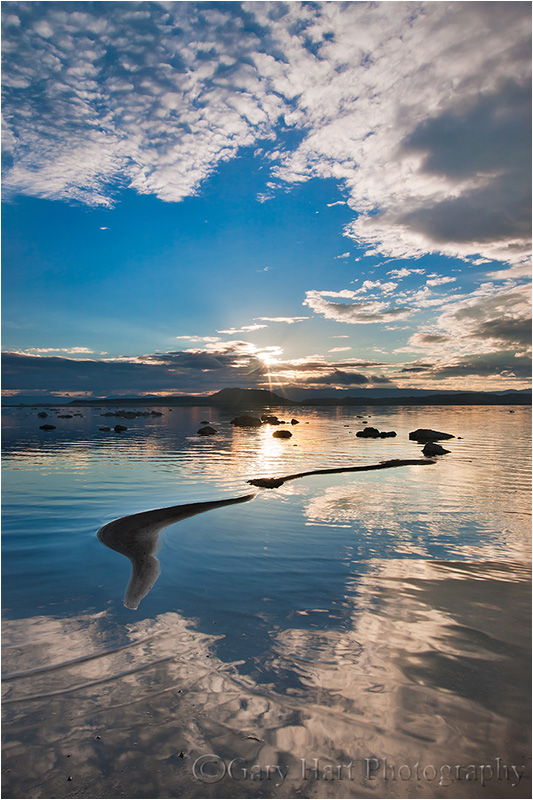
Sunrise Reflection, Mono Lake
Canon EOS-1Ds Mark III
1/13 second
F/16.0
ISO 100
25 mm
On consecutive nights last week I had the good fortune to witness two memorable non-photographic events: Last Wednesday I watched on TV as Matt Cain pitched Major League Baseball’s twenty-second Perfect Game (and the Giants’ first ever); on Thursday night my wife and I went to see the touring Broadway production of “Wicked.” Both events were amazing, but only one moved me to tears. If you know I’m a life-long baseball fan who harbored Major League aspirations all the way through college, you probably guessed which one.
I’m not sure what this has to do with photography, except that I think it’s the unexpected component of sports and nature photography that moves me. The understanding that nothing is promised, and that no matter how hard we work to to do our absolute best, we ultimately have no control over the result and just about anything is possible. When something truly special does happen, an event we’ve never witnessed before, it feels like a gift.
The tears that well up after witnessing a Perfect Game or Olympic Gold performance are stirred by empathy—I’ve had similar dreams and understand some of what the athlete must be feeling. But other people experience a physical response to great theater (and are bored to tears by baseball). My response to a magic moment in nature is actual chills and hair-raising goosebumps—different, but no less emotional (or controllable).
The morning I captured this sunrise on Mono Lake, I was there because it was the last day of my Eastern Sierra workshop and that’s where I take my groups for our final sunrise. No divine insight or lofty expectations guided me—simply a good knowledge of the area and prior experience that told me this is a nice spot in any conditions. I certainly never expect (and try not to even permit myself to hope for) something as magic as what we got that morning.
We rose in the frigid, predawn darkness, navigated a network of rutted dirt roads, and walked a trail-less half mile by flashlight through heavy sand and (ultimately) shoe-sucking mud to get here. The morning brightened to reveal a perfect mix of herringbone clouds and blue sky. The air was utterly still and the lake surface spread before us like an infinite mirror. We started with silhouettes, using the shoreline shapes as foreground elements, and when the color arrived we found shots in all direction. As the color faded, but before the sun appeared, I made sure everyone was ready for the brief opportunity to capture a sunburst as the sun peaked above the horizon: We dialed our apertures down (f16 or smaller) and prepared for the difficult light by pulling out graduated neutral density filters (my choice) or setting up bracketing to allow post-exposure blending. When that was over we still had a few minutes of exquisite warm sidelight. One of my responsibilities during these shoots is to remind everyone to stop being photographers long enough to appreciate what they’re witnessing—it seems counterproductive, but I truly believe tapping these goosebump feelings inspires the best photography.
Just as not everyone who loves theater has a Tony, or everyone who loves baseball has thrown a Perfect Game, not everyone who loves nature has people clamoring for their photos. But I’m pretty sure that those who have risen to the highest level of their profession have chosen something that touches them in ways they can’t completely understand or control.
My essential smartphone apps for photography
Posted on June 12, 2012

Moonset, Zabriskie Point, Death Valley
I have a few iPhone apps that I use all the time, and am always on the lookout for more (so feel free to share). There are many great apps out there, but given the amount of photography time I spend off the grid, a prime consideration for me is the ability to use an app without cell or wifi coverage, taking many out of the running. For example, I think The Photographer’s Ephemeris is a great piece of software for getting sun and moon information, but never use the app because I rarely photograph in locations with adequate cell or wifi service. (A recent update may now enable PE to pre-download maps, but my sun/moon workflow is already in place so I haven’t tried it yet.)
On the other hand, at the top of my own list of essential apps is Focalware, which gives me sun and moon rise/set time, altitude, and azimuth for any location on Earth, regardless of connectivity. For example, until recently Death Valley had no cell coverage whatsoever; even now most of Death Valley is a cell dead zone, and wifi is limited to the (extremely unphotogenic) hotels in Furnace Creek Ranch and Stovepipe Wells. But using my iPhone’s GPS to pinpoint my location, Focalware gave me the sunrise and moonset information I needed to capture this full moon setting behind Manly Beacon (I won’t even touch the Freudian ramifications of that name) at Zabriskie Point. It’s also handy to be able to input the GPS coordinates of any location, which allows me to get the astronomical data I need for remote locations as well.
Another app that works great regardless of connectivity is Depth of Field Calculator by Essence Computing. With it I’m able to quickly compute hyperfocal focus info for any camera or lens. I don’t need it all the time, but having this information instantly available when I’m trying to focus near and far objects in a single frame makes my life considerably easier. It’s also a fun app to play what-if games when I find myself waiting on hold or in line somewhere. I just plug in arbitrary values and try to guess the hyperfocal distance—a great exercise for improving hyperfocal focus skills.
Dropbox is a bigger part of my home and mobile computing, but I do use my Dropbox app to access essential files when I’m on the road and away from a computer and the Cloud. While the Dropbox app requires connectivity to access files in the main Dropbox folder in the Cloud, I can specify files as “Favorites” to be kept downloaded and current on my iPhone at all times. My most important files are always flagged as favorites, and before leaving home I add other files I’m pretty sure I’ll need on that trip.
The state of the tides makes a huge difference when photographing coastal scenes. Tide pools will materialize or vanish with the tide, and the look of the coast can change drastically when the tide swallows or reveals rocks. And some areas I’m accustomed to shooting may be completely inaccessible when the tide’s in. For all these reasons, before photographing on the coast I check the state of the tide with Ayetides. Ayetides stores its information on my iPhone, so I don’t need to worry about connectivity. On the other hand, I’m not crazy about Ayetides’ interface, which I find less than intuitive.
Another app that I recently started using and have high hopes for is Trail Maps by National Geographic. In theory it’s exactly what I need—-an app that allows me to download specific topographic maps onto my iPhone for anytime, any connectivity access. It also allows me to plot point-to-point azimuth and distance for any location, great for computing moon and sun rise/set position. While I’ve been able to use it some, I’m afraid the current version of this app has far too many bugs, large and small, for me to recommend it.
Since I don’t have vast experience with other similar apps, I can’t guarantee that the apps I mention here are the best. But I can say that they work great for me, and they make my photography life much easier. How about you? Do you have any apps on your iOS or Android phones that you find indispensable?
It’s my pleasure
Posted on June 7, 2012

New Day, Half Dome and Crescent Moon, Yosemite
Have you noticed a pattern here? Every spring I post an image or two (or three) of a delicate crescent moon rising above Yosemite Valley at sunrise. This spring is no exception, nor will next year’s be. Or the next. Or the next….
I certainly can’t justify this lunar obsession from a business perspective. While the moon rises in a slightly different spot each year, I have more than enough pictures of Half Dome and/or El Capitan silhouetted beneath a sliver of moon, in every possible variation—horizontal, vertical, wide, tight, and everything in between—to last until the next Venus transit.
But here’s the deal. Photography needs to be a source of pleasure. Otherwise what’s the point? So when I decided to make my living taking pictures, I promised myself that I’d photograph only what I want to photograph, without concern for what will or will not sell. For me that’s natural light landscapes. Only. Nothing that moves, nothing that breathes. No people, no wildlife, and nothing manmade. No flash, light painting, or any other artificial light. I don’t blend images or do any fancy Photoshop stuff. And I don’t shoot stock images. (Not that I have a problem with others doing all this other stuff–doing it just doesn’t give me pleasure.)
In other words, if I don’t want to shoot it, I don’t. I joke that if I were photographing a field of poppies and a mountain lion were to leap into my frame, I’d shoo it away. (Okay, so I might have other impulses, but you get the idea.) It also means that when something’s going to happen in nature that I really want to see, you can bet I’ll do my best to be there with my camera. Fresh snow forecast for Yosemite? I’m on the road early enough to be there before the snow starts falling. Moonlight on Badwater in Death Valley (a recent discovery)? Gotta do it. Milky Way above Kilauea Caldera? What do you think?
And of course a crescent moon rising above Yosemite Valley at sunrise. In my world it just doesn’t get any more special than this. And as nice as the images are, nothing compares to the experience of witnessing it. Take one of the most beautiful vistas in the world, add the purity of sunrise, and garnish it with a delicate crescent moon—can’t get enough of it.
Last year I scheduled a workshop to coincide with this event; next year I’ll do the same. But this year I kept it to myself. While the time and position of the moon is never a secret—the information is available all over the Internet, not to mention software and smartphone apps—I never cease to be amazed at how many times I’m the only person present. Maybe that just means a crescent moon above Yosemite Valley doesn’t move others the way it moves me, but that’s fine with me.
Depending on the moon’s azimuth (the number of degrees south of due north) as it crests the horizon behind Yosemite Valley, I have several go-to locations. This year I decided the best spot was Tunnel View, Yosemite’s most popular vista. Each year I fear everyone has figured it out and I’ll be joined by a Horsetail Fall-style riot of photographers. So I held my breath as I approached the parking area a little after 4:30 a.m., and immediately exhaled when I found the lot empty. I set quickly set up two tripods, one with my 1dsIII and my 100-400 lens, the other supporting my new 5dIII and 24-105 lens. While waiting for the moon I composed, exposed, focused each camera, and fired a couple of test frames. Then I waited some more.
The moon appeared right on schedule, a few minutes before 5:00, a fine spear of light peeking above Half Dome. Flanked by my two cameras, a remote release in each hand, I started clicking, pausing every few clicks to adjust the exposure and recompose. I continued like this for about 25 minutes, capturing the moon’s ascent through pre-dawn twilight that transitioned from indigo to blue and finally gold right before my eyes.
As the brightening sky swallowed the moon another car pulled into the parking area and a trio of photographers rolled out, the first people I’d seen all morning. I was detaching cameras and collapsing tripods when they ambled over and casually began setting up, clearly confident that they’d arrived in plenty of time for sunrise. The moon was a faint sliver by then and I heard one of the newcomers comment that maybe they could include it their first few frames. I resisted the urge to show them what they’d missed, but couldn’t help feeling a degree of smug pleasure in what I knew was on my media cards.
Does that make me a bad person?
Photographic reality: The missing dimension
Posted on June 4, 2012

Nature’s Palette, Half Dome from Sentinel Dome, Yosemite

“Photography’s gift isn’t the ability to reproduce reality, it’s the ability to expand it.”
(The sixth and final installment of my series on photographic reality.)
So far I’ve written about focus, dynamic range, confining borders, motion, and time, but I think most obvious (and also I’m afraid most overlooked) difference separating the camera’s vision from our own is the missing dimension: depth.
Photography attempts to render a three dimensional world in a two dimensional medium—the most photographers can hope for is the illusion of depth. While anyone can put a camera to their eye and compose the lateral, left-to-right aspect of a scene, translating their own three-dimensional experience to their camera’s two-dimensional reality is a leap that many miss. This may explain why a sense of depth is often the most significant quality separating a merely good image from an outstanding image.
Achieving the illusion of depth starts with looking beyond your primary subject and finding a complementary foreground or background: If your primary subject is nearby, find a background object, shape, or color that frames, balances, and/or helps your subject stand out; conversely, if your primary subject is in the distance, look for foreground elements that can lead your viewers’ eyes through the frame without distracting or competing for attention.
Once you have your foreground/background elements worked out, your composition isn’t complete. In your three-dimensional view, size and distance are easily interpreted, something we stereographic humans take for granted. But your scene’s depth is lost to your camera. In a two-dimensional world aligned objects at varying distances loose the separation that makes them stand out—you need to visually separate these merged objects—put them on different lines of sight—to allow your viewer to imagine the depth you see at capture. I can’t emphasize how important this is.
In my many years of observing and assisting other photographers working to improve their images, I’ve decided that the single most significant factor holding them back is their ignorance of, or unwillingness to wield, their control over their images’ depth relationships. There seems to be an invisible force that binds tripods to their first landing place. Overcoming this force (to which I’m not immune) requires vigilant attention to each visual element in your frame and taking whatever steps necessary to ensure that each stands alone. If you can’t achieve separation from your current position, move! Simply repositioning a little left/right, up/down, forward/backward really can make a huge difference. In other words, in a static landscape, it’s your job to be dynamic.
For example
With the benefit of a 360 degree view, it was clear that all the elements were in place for a spectacular sunset atop Yosemite’s Sentinel Dome. An afternoon rain had scoured the air of color-robbing particles, and an opening on the west western horizon left a clear path for the setting sun to illuminate the clouds above Half Dome to the east. But as spectacular as I expected the color above Half Dome to be, I wasn’t going to be satisfied with just another pretty picture of Half Dome at sunset.
One of the things I like most about photographing from Sentinel Dome is the variety of foreground subjects: rocks, cracks, and of course the solitary jeffrey pine made famous by Ansel Adams and others, now dead and on its side. On this evening, guessing (hoping) that the earlier downpour had filled indentations I remembered on Sentinel’s southeast flank, I headed over there.
One thing I pride myself in is arriving at a location early, well before the best conditions, to allow time to anticipate the light and assemble the elements of my composition. Being such a deliberate shooter, this is really a necessity for me. So when I found these pools right where I’d hoped, I was able to take the time to figure out how to use them. I started by moving around quite a bit, first to find the angle that would best frame Half Dome with the pools, then forward and backward to get an idea of the best distance and focal length that would give Half Dome enough size while giving the pools enough room. A factor in these distance/focal-length considerations was finding the angle that would allow me to include a reflection of the clouds, which meant moving up and down as well. In this case I dropped quite low, probably no more than a foot off the ground, taking care not to get so low that the bottom of Half Dome merged with the edge of Sentinel Dome. With the composition worked out, I did some depth of field figuring and decided that I’d better stop all the way down to f20 to ensure a perfectly sharp foreground and acceptably sharp Half Dome.I focused on the granite about eight feet away and think I did a pretty good job achieving front-to-back sharpness. (Today I’d use the DOF app on my iPhone, but checking it now confirms that I did okay.)
Being on a tripod with no motion in the scene meant I was able to go with whatever shutter speed gave me the exposure I wanted, at my camera’s native ISO 100. I metered on the foreground and used a graduated neutral density filter to darken the bright sky, starting my exposures before the best color started (you never know when the color will peak—it’s best to have a few too many images than to realize after the fact that the color you’re waiting for isn’t coming), monitoring my histogram and adjusting down in 1/3 stop increments as the light dropped.
On this evening the color just kept getting better and better, until the air seemed to buzz with color and the entire landscape glowed red. Believe it or not, the red was even more vivid than what you see here, but I decided to tone down the saturation a bit because there comes a point where Mother Nature seems to defy credibility. This remains one of my favorite images.
Photographic reality: Expand time
Posted on May 30, 2012

Cascading Ferns, Russian Gulch Fall, Mendocino
Canon EOS-5D Mark III
81 mm
.6 seconds
F/11
ISO 400
“Photography’s gift isn’t the ability to reproduce your reality, it’s the ability to expand it.”
(The fifth installment of my series on photographic reality.)
There’s probably no better example of the difference between a camera’s reality and yours than the way we handle motion. In my previous post I compared the camera’s ability to accumulate light to the serial, real-time processing of seamless instants we humans do. In a static world, given the right exposure a photographic image can be rendered fairly literally (missing dimension notwithstanding). But photograph a world in motion and wonderful things start to happen.
A slow shutter speed allows a sensor to record the position of everything it “sees” during the exposure, expanding one frame into a recreation of every instant of its capture. When the capture includes objects in motion, the result a scene very different from the human experience: Rushing water smoothes to white, wind-whipped flowers blur to color, and Earth’s rotation renders stars as parallel streaks of light.
Blurred water
Labeled as cliché and unnatural by people who don’t understand photography, blurred water gets a bum rap. The cliché part ignores the fact that most rapidly moving water photographed in the best light (shade or overcast) is virtually impossible to not to blur. The “unnatural” label just cracks me up—when asked, detractors reply that freezing the motion (the only other option) would be more natural, to which I reply (usually to myself only, tongue firmly clamped between teeth), how many times have you seen water drops frozen in midair? The truth is, the camera and human eye handle motion differently, and photographers need to accept and appreciate it. Once you can accept that blurring water is often the best way to imply motion in a static medium, the fun begins.
First you need to understand that you can’t just blur every moving river, stream, or wave. Motion blur requires a slow shutter speed, impossible with water in full sunlight without a neutral density filter to cut the light. So you need to start by finding moving water darkened by overcast or shade (any sunlight in the frame at all will overexpose and likely ruin the image). Whitewater is best; if you find yourself photographing whitewater in shade or overcast, the question isn’t how to blur, it’s how much?
Unfortunately there’s no magic shutter speed for motion blur. The amount of blur you get depends on the speed of the water, how close you are to the water, how much you’re zoomed, and the angle of your capture relative to the direction of motion (and maybe some other things I’ve overlooked). And while there isn’t a ideal amount of blur, I find that there’s sweet spot (that changes with all the variables above) between very slight blur that’s not quite enough and just appears scratchy, and extreme blur that’s pure white. In some tight compositions of extremely fast water you get beautiful slight blur at 1/1o second; with wider compositions and/or slower water, the same amount of blur requires 3/4 second or longer. And achieving noticeable blur in a wide capture of a distant waterfall may require several seconds of exposure. My advice is to bracket your shutter speeds, varying your ISO and/or f-stop (take care that you don’t choose an f-stop that compromises your depth of field)—you’ll find the more you do it, the more you’ll get a sense for what works.
In the image of Russian Gulch Fall near Mendocino (at the top of the post), I arrived early enough to allow a full two hours to work the scene before sunlight blighted the forest floor. And work it I did, starting wide and trending tighter as I became more familiar with the scene. The dense forest dark didn’t allow a fast enough shutter speed for effective slight blur without severely compromising ISO and aperture (depth of field), so I just went with the extreme blur. Even though the air seemed perfectly still, I was a little concerned about slight wind motion in the ferns, so I bumped to ISO 400 and f11 (at 80 mm, f11 gave me about a 15 foot range of front-to-back sharpness–just enough). This resulted in a one second exposure that caused extreme blur (I call it extreme because I didn’t notice much difference between one second and five seconds) that, as it turned out, made the delicate strands of water quite lovely.
One other often overlook component of a forest water scene is a polarizer: I wouldn’t even attempt a scene like this without the glare reducing benefit of a polarizer. (And a polarizer has the added bonus of reducing the light by a couple of stops.)

Bristlecone Star Trails, White Mountains, California
Star trails
Star trails—parallel streaks of light caused by Earth’s rotation during a long exposure–are an extreme example of the same motion effect that blurs water. I find that moonless nights work best for star trails—a moonlit sky is usually too washed out for effective star trail photography, while the limited light of a moonless night maximizes the motion by allowing even the dimmest stars to shine through.
On a moonless night, a large aperture and high ISO can record enough light to allow a relatively fast 30-second shutter speed that records stars as near pinpoints of light, but doesn’t allow enough light to fully eliminate the foreground. On the other hand, a slower shutter speed that accumulates enough light to reveal the foreground also results in streaking stars—star trails. An added advantage of star trail photography is that the exposures are long enough to enable a smaller aperture (more DOF and better image quality) and lower ISO (less noise).
Some people have great success combining a series short-exposure frames to create a single star trail image, but all of my images are single-click capture (that’s just me, I have no problem with those who choose to blend multiple captures) using a trial and error approach I’ve worked out over the years. I start by taking a test (throw-away) exposure at my camera’s highest ISO and lens’s widest aperture, then tweaking the exposure and repeating until I get it right. I’ve also found that in the near total darkness of a moonless night, these test exposures are the best way to ensure my composition and focus are okay. Once I have my exposure, composition, and focus right (it usually takes two or three images), I figure out how many stops of light my desired shutter speed (usually around thirty minutes) adds to my successful test exposure, then subtract an equal amount of light through a combination of aperture and ISO reductions. (I’ll try to post a more thorough tutorial on my approach to star trails soon.)
I photographed the above bristlecone pine against backdrop of streaking stars with three friends who were light painting the tree—sweeping the beam of a bright flashlight across the trunk and branches for the first few seconds of exposure to illuminate the tree’s weathered wood enough for their cameras to capture the exquisite detail. But all my images use only natural light, so I opted for a silhouette, positioning myself as low as I could get to juxtapose as much of the tree against the sky as possible. I started my exposure as soon as the others’ light painting ended (no more than ten seconds), and for the next twenty-two minutes the four of us reclined there at nearly 11,000 feet, watching the sky and waiting for the exposure to complete. We talked and laughed some, but mostly we just appreciated a sky dense with stars and silence so complete (and foreign) that it almost hurt my ears. We were well down the road toward our hotel in Bishop before my camera finished its processing, and it wasn’t until I was able to view the image on my laptop that I knew I’d had a success.
Photographic reality: Accumulate light
Posted on May 27, 2012

Moonbow and Big Dipper, Yosemite Falls, Yosemite
“Photography’s gift isn’t the ability to reproduce your reality, it’s the ability to expand it.”
(The fourth installment of my series on photographic reality.)
Before getting too frustrated with your camera’s limited dynamic range, remember that it can also do things with light that your eyes can’t. While we humans experience the world by serially processing an infinite number of discrete instants in real time, a camera accumulates each instant, storing and assembling them into a single additive frame. The result, among other things, is a view into human darkness that reveals “invisible,” albeit very real, detail and color.
Nothing illustrates this benefit better than a moonlight image, particularly one that reveals a “moonbow.” Several years ago I photographed Yosemite Falls by the light of a full moon a couple of hours after sunset. While there was enough light to see the fall and my immediate surroundings, the world was dark and colorless. Knowing the possibility of a moonbow existed, but unable to see it, I positioned myself with my shadow (cast by the moonlight) pointing more or less in the direction of the fall and dialed in an exposure long enough to make the scene nearly daylight bright. An extremely wide, vertical composition included the Big Dipper high overhead, as if it was the Yosemite Falls’ source.
The result (above) is nothing like what my eyes saw, but it really is what my camera saw. The processing to complete this image involved cooling the color temperature in the raw processor to a more night-like blue; noise reduction to clean up the relatively long, relatively high ISO capture; a little (mostly futile) attempt to moderate the vertical distortion caused by the wide focal length; a slight wiggle in Curves to darken the sky and pop the stars; mild dodging and burning to even tones; some desaturation of the sky (I swear); and selective detail sharpening, avoiding the clouds and darkest shadows.
Photographic Reality: See the light
Posted on May 21, 2012

Crescent and Oaks at Dusk, Sierra Foothills, California
“Photography’s gift isn’t the ability to reproduce your reality, it’s the ability to expand it.”
(The third installment of my series on photographic reality.)
Dynamic range
One of photographers’ most frequent complaints is their camera’s limited “dynamic range,” it’s inability to capture the full range of light visible to the human eye. To understand photographic dynamic range, imagine light as water you’re trying to capture from a tap–if the human eye can handle a bucket-full of light, a camera will only capture a coffee cup. Any additional light reaching your sensor simply overflows, registering as pure white.
Limited dynamic range isn’t a problem when a scene is lit by omnidirectional, shadowless light. But while I can’t speak for other planets, here on Earth we’re illuminated by only one sun. Since most Earthlings prefer blue skies and brilliant, (unidirectional) sunshine that buries everything that’s not directly lit in dark shadows. Fortunately, human vision has evolved to the point where we can see detail in shadows and sunlight simultaneously.
Cameras haven’t evolved quite so far–on sunny days, photographers must choose between photographing what’s in the shade or what’s in direct sunlight. Exposing to capture detail in the shadows brings in so much light that everything in sunlight is overexposed; exposing to avoid overexposure of sunlit subjects doesn’t permit enough light to see what’s in the shadows.
Managing the light
Experienced photographers understand their camera’s limited dynamic range and take steps to mitigate it. For example, artificial light (such as a flash) can be used to fill shadows, or multiple exposures (covering a scene’s range of light) can be digitally blended into one image. But as a natural-light landscape photographer, I don’t even own a flash (really), and given that I only photograph scenes I can capture with a single exposure, I also never blend exposures.
The simplest solution for me is to avoid harsh, midday light. Full shade (absolutely no direct light) works, and a layer of clouds that spreads sunlight over the entire sky illuminates the landscape with even (low contrast), shadowless light that’s a joy to photograph. And the low, very early or very late light that occurs just after sunrise or before sunset has been subdued enough by its long journey through the thick atmosphere that the contrast falls into a camera’s manageable range. I’m also a huge advocate of graduated good old fashioned neutral density filters to reduce the difference between a bright sky and darker foreground.
Less is more
The best photography often results from subtraction. Photographers who merely take steps to make their camera’s world more like their own miss a great opportunity to show aspects of the world easily missed by the human experience. In the right hands, a camera’s limited light capturing ability can be used to emphasize special aspects of nature and eliminate distractions.
Exposing to hold the color in bright sky or water can eliminate unlit distractions and render shaded subjects in shape-emphasizing silhouette. And compositions that feature brightly backlit, translucent flowers and leaves explode with natural color that stands out against a shaded, black background.
Whether the image is a silhouetted mountain or translucent dogwood, the camera’s rendering is nothing like your experience of the scene. But it is a true rendering from the camera’s perspective, achieved without digital manipulation.
For example

Daybreak, El Capitan and Half Dome, Yosemite
Last week I rose at 4:00 a.m. to photograph a thin crescent moon rising above Half Dome almost an hour before sunrise. It was one of those, “I’m witnessing the most beautiful thing on Earth” moments, and I couldn’t believe no one else was there to enjoy it. I arrived about fifteen minutes before I expected the moon to rise, more than enough time to set up one tripod with my 1DS III 100-400 lens bulls-eyed on Half Dome at 400 mm. Another tripod had my 5D III and 24-105 composed to include El Capitan and Half Dome (above).
When the moon arrived I gave the scene just enough light to reveal the rich blue in the twilight sky. At that exposure the thin sliver of moon was completely overexposed (no lunar detail), a crescent of pure white that stands out boldly against the dark blue sky. A few stars pop through the darkness as well.
My eyes had adjusted to the predawn light enough for me to barely discern the trees and granite in Yosemite Valley below, and the rising sun had already started to wash out some of the sky’s color. But at the exposure I chose, my camera saw only Yosemite’s iconic skyline, El Capitan on the left and Half Dome on the right, as distinct black shapes against the cool blue sky. Rendering the image this way reduces erases the rocks and trees that add nothing to the scene, reducing this special Yosemite moment to its most compelling elements, color and shape.

Autumn Light, Yosemite: Here I metered on the brightest part of the backlit leaves, slightly underexposing to capture the leaves’ exquisite gold and turn the shaded background to complementary shades that range from dark green to nearly black. A small aperture softened dots of sky to small jewels of light.
Up next: Accumulate light
Photographic reality: Framing infinity
Posted on May 16, 2012
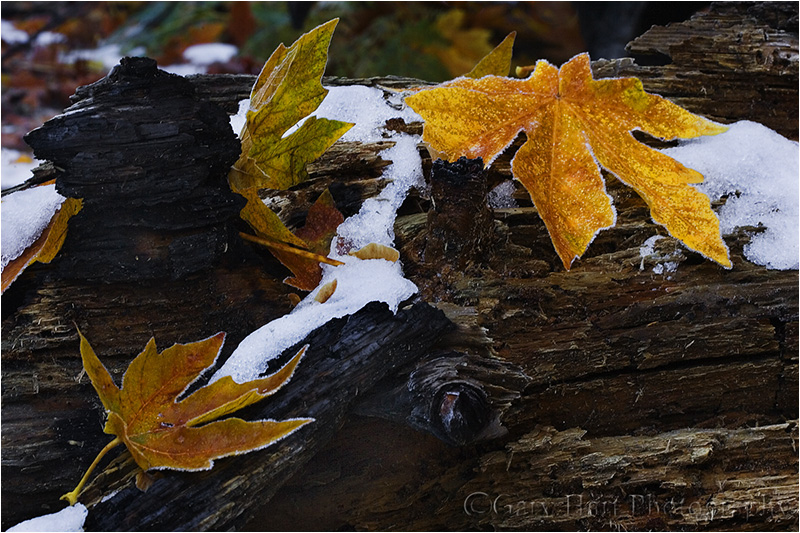
Snow and Autumn Leaves, Yosemite
“Photography’s gift isn’t the ability to reproduce reality, it’s the ability to expand it.”
(The second installment of my series on photographic reality.)
If you’ve ever tried to point out to someone a small detail in nature that pleases you, perhaps you’ve experienced a conversation like this:
You: “Look at that!”
Friend: “What?”
You: “Those leaves—look at the frost on those leaves.”
Friend: “What leaves?”
You: “There on the log—with the snow.”
Friend: “Those dead ones? Yeah, cool. Man, I can’t believe I ate all those fries at lunch.”
You: “Whatever.” Sigh.
It’s really great to enjoy nature, to take in all of its infinite, three dimensional, multi-sensory splendor: its smells, sounds, depth, and motion. But all this input is a lot to process, and because everybody interacts with the world a little differently, each person is drawn to different things—what moves you might be overlooked by others. If only there were some way to show others what you see. Hmmm….
Unlike us humans, a still camera experiences the world in single-sensory, discrete frames. Rather than being a disadvantage, a camera’s “limitations” provide an opportunity to isolate whatever aspects of a scene that moves you, and to remove extraneous elements that distract. In other words, the camera’s field of vision, determined by you, has finite boundaries that make a frame in which you can organize relationships and eliminate distractions through careful selection of your lens’s distance (or focal length) and direction.
The golden leaves in the above image were three among thousands dotting the forest floor on this November morning near Cathedral Beach in Yosemite. I wanted to juxtapose fall and winter, and reveal the leaves’ frosty fringe. A wide frame would have more closely represented the entirety of the scene as I experienced it, but without something to anchor the frame, I knew viewers’ eyes would wander and they’d be unsure of my intent.
So I put on my 100mm macro lens and moved closer, finding this trio of leaves on a log, surrounded by patches of snow. I started by positioning myself so none of the leaves merged—that each stood by itself, balanced in the frame. Framing the leaves tightly eliminated the rest of the world, giving you no choice but to only look at what I wanted you to see. F14 and careful focusing gave me enough depth of field to make the leaves and log sharp with the background distractions blurred to insignificance.
Up next: See the light

 Eloquent Images by Gary Hart