The Road to Hana
Posted on April 1, 2012
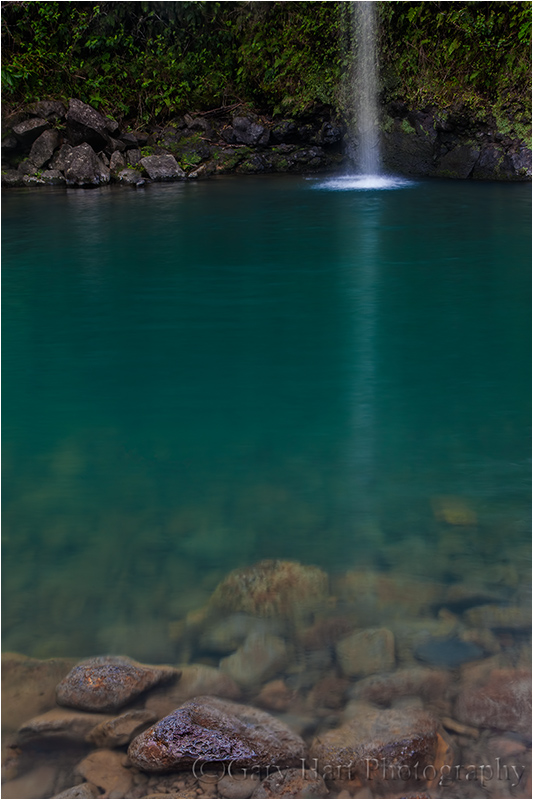
Serenity, Waterfall and Pool, Hana Highway, Maui
Canon EOS-5D Mark III
45 mm
.6 seconds
F/16
ISO 200
In my parents’ day, Maui’s “Road to Hana” was something to be achieved. Negotiating the narrow, undulating, muddy, potholed, serpentine, lonely jungle track was a badge of honor, something akin to scaling Everest or walking on the moon.
Today’s Hana road has been graded, paved, and widened just enough to accommodate a double yellow line that creates the illusion of space for one car in each direction. This sanitized road, now dubbed the “Hana Highway,” hosts a daily bi-directional swarm of tourists whose priorities range from not missing a single leaf, all the way to being the first to cross the finish line in Hana or back in Kapalua. Unfortunately, priorities (among other things) collide at each of the 56 bridges that, due to budget constraints, remain at their original one-lane width. Add to this mix laboring bicyclists, a sky that pinballs between blinding sunshine and windshield-obliterating downpour, an assortment of impatient and sometimes hostile locals (they’re the ones whose music you hear before their pickup rounds the turn), an occasional ten-wheel dump truck large enough to scrape roadside foliage with both mirrors, and random mongooses that pop from the jungle with Wac-A-Mole predictability, and navigating the Road to Hana feels more like a Hope/Crosby movie than a tropical vacation.
But one thing hasn’t changed: The Road to Hana experience remains a living embodiment of the tired axiom, “It’s not the destination, it’s the journey.” Hana itself is a pleasant, Hawaiian town with nice beaches and a small but eclectic assortment of restaurants and lodging. But with every hairpin turn or precipitous drop on the way there, you can’t help feeling that you’ve plopped into Heaven on Earth. The Hana road’s 50-plus miles alternate between dark, jungle tunnels and cliff-hugging ocean panoramas, punctuated by waterfalls (some of which start above you and complete beneath you, on the other side of the car), colorful foliage, and the constant potential for a rainbow. And oh yeah—banana bread. The best banana bread you’ve ever tasted. Still warm.
Sonya and I set out for Hana early Thursday morning—not quite as early as we’d planned, but we hoped early enough. Finding the first few miles beautiful and relatively easy going, we naively congratulated ourselves for our early start. But somewhere around mile-ten, as the curves tightened, the road shrank, and the photography improved, our pace slowed considerably and we found ourselves swept up in the tourist wave. Parking at every scenic turnout was a battle that often resulted in extremely, uh, “creative” solutions. Nevertheless, after a day packed with a year’s worth of scenery, we rolled into Hana at about 5 pm, equal parts exhausted and hungry.
Approaching Hana we’d glanced a sign for a restaurant called “Café Romantica,” offering “Gourmet, organic vegetarian food.” Since Sonya’s a vegetarian, and I don’t eat red meat, meals on the road are sometimes problematic and we were excited about the possibility of rewarding ourselves with a good meal. But the sign offered no specifics and despite our vigilance we found no hint of its existence anywhere.
Once we were comfortably ensconced in our (amazing) room, I pulled out my iPhone and looked up Café Romantica. I found it on Yelp, but no address, website, or phone number anywhere. The Yelp reviews were both amazing (nearly unanimous 5 stars) and intriguing (references to a truck beside the road and bizarre hours) enough that I knew we had to find it. Clicking the “Directions” link on Yelp returned a Google map with a dot on the road about ten miles south of town (in the opposite direction from which we’d arrived)–still no address, but at least solid clue.
In a perfect world we’d have taken an hour or so to clean up, enjoy the setting, and recharge after the drive, but one of the Yelp reviews warned the restaurant closes at 7:00, so we sucked it up and headed right back out. (This might be a good time to mention that the day prior Sonya and I had driven to the top of Haleakala. This is a harrowing drive in its own right, spiraling from sea level to over 10,000 feet in less than thirty miles. On the way down the mountain the brake warning light in our rental blinked on and off intermittently. And on the drive to Hana that morning, our tire pressure warning light had come on a couple of times.)
Twilight was fast approaching, but we felt confident in the Google map on my iPhone, with its bold red dot representing Café Romantica and a blue dot that perfectly pinpointed our location. I mean, even without an address, how hard could it be? Since there’s only one road in and out of town, I figured we’d just drive into the jungle until we found the restaurant where the dots meet.
I watched the road and the dashboard warning lights (so far so good), while Sonya monitored the dots, watching the blue dot inch closer to the red one far slower than we’d expected. It became immediately clear that the road out of Hana is even more challenging than the road into Hana. It’s narrower, shrinking to one lane for long stretches, and much rougher. And while the road into Hana seemed to be about 80-percent fellow gawking (but harmless) tourists, the only vehicles we encountered south of town were clearly locals who seemed to be enforcing their own secret roadway protocol, the prime principle being that, no matter what the hazard or consequence, we are to get out of their way.
About five miles (twenty minutes) into the jungle we rounded a particularly narrow corner to find ourselves headlights-to-headlights with a careening pickup who instantly opted for his horn instead of his brakes. After deftly braking and swerving, I glanced in the mirror and saw that pickup driver had finally discovered his brakes, and in fact had also stumbled upon his reverse gear and gas pedal and as accelerating back in our direction. I boldly applied the gas and disappeared around the next bend, then spent the next two miles with an eye on the mirror. (I’ll probably never understand that little encounter, but fortunately we never saw the guy again.) The road grew more remote with each turn, and we started imagining engine and tire noises–at one point I rolled down the window to see if I could figure out where that tire noise was coming from, but the road noise was drowned out by jungle sounds. My attention alternated between the road in front of us, the rearview mirror, and the dash, while Sonya kept a vigilant eye on the dots and we traded to “Deliverance” jokes to ease the tension.
By the time our dots merged, darkness was almost complete and we were pretty much resigned to the reality that our dinner plan had descended to wild goose chase status. According to Yelp, Café Romantica clings to a remote, vine-covered cliff about two hundred vertical feet above the Pacific—there’s not enough room there for a toaster, let alone an entire restaurant. But at that point we were just happy to find a place wide enough to turn around.
The drive back in the dark was less eventful (and no doubt due to my vigilant scrutiny, the previous day’s warning lights never did return), though at one point we were tailgated by a group of partying teenagers who pushed us along until I found a place wide enough to pull over safely. Needless to say, we were quite hungry by the time we rolled into town at around 7:30. Given Hana’s limited selection of restaurants, its reputation for shutting down early, and our specific culinary needs, we inventoried the food we had in the car and decided rice cakes, graham crackers, and fruit could get us to breakfast without starving.
About two blocks from our hotel a string of lights on the left caught my attention and I slammed on my brakes while my brain struggled to comprehend what I saw. Suspended above a small motorhome on an otherwise vacant lot was an awning with the words, “Café Romantica.” It was so close to our room that the walk there would have been shorter than the walk to our car had been. Besides a man putting away chairs and tables at the back of the property and a woman puttering inside the motorhome, we couldn’t see much activity. Nevertheless, I executed a quick u-turn and parked out front.
The motorhome had an attached awning covering a short counter with three or four stools. Behind a sliding window above the counter puttered the woman. I approached the window, crossed my fingers, and asked if they were still open. She shook her and apologized politely, explaining that she was almost out food. But as I started to summarize our futile hunt of the last hour she must have heard the desperation in my voice, because immediately her face warmed and she reassured us in a most maternal tone that she’d take care of us. She introduced herself as Lori Lee and asked where we were from.
About then another couple walked up, and rather than turn them away, Lori Lee rattled off to the four of us a handful of the most mouth watering, eclectic vegetarian entrées imaginable: rellenos, quiche, curry, …. She qualified each offering with the proviso that she only had one or two servings of each, but since they all sounded so good, the four of us had no problem negotiating who’d get what.
Lori Lee entertained us with friendly conversation as we sipped a wonderful soup (that also gave us great hope for what was to follow) she’d offered to hold us over until dinner was ready. Rather than make you watch me chew, I’ll just say that dinner was so good that we ordered dessert (something we never do), and even added one of her remaining entrees to-go for lunch the next day.
One of my tenets is that things always work out. I have to confess that our drive that evening severely tested my conviction, but without our little misdirection adventure, Sonya and I would have been deprived of probably the most memorable experience of our trip, and a restaurant experience I’ll never forget.
A few words about this picture
This little waterfall is just one of dozens visible along the entire length of the Hana Highway. Many are quite dramatic and stimulating; others, like this one, are more subdued and soothing. I must admit that by the time we pulled up to this fall I was verging waterfall overload. I’d found that my 70-200 lens worked best for most falls because it allowed me to isolate aspects of the scene and also to surgically remove tourists at some of the more popular falls, and I’d started exiting the car without the rest of my gear.
But cresting the small hill that provided a vantage point, I realized I’d left the car with only my 24-105 lens. Rather than walking back to the car (a hike all of maybe 150 feet), I decided to pick my way down to the pool’s edge. And had I not done that, I would have completely missed the beautiful rocks just beneath the water’s surface.
To ensure sharpness throughout the frame, I stopped down to f16, dropped to my knees, and focused on the large rock visible just beneath the surface (behind the protruding rocks). I carefully oriented my polarizer to remove glare on the nearby water and rocks, but not so much that I lost all of the fall’s reflection in the quiet water. I clicked several frames, all vertical. Some included the entire fall, but I like the mystery of this composition, the way it lets you imagine the rest of the fall and the scene surrounding it.
About thirty seconds after I snapped this a teenage girl jumped into the water right in front of me and the shot was gone. Fortunately I had all that I needed and I returned to the car a happy photographer.
Join me in my
Chomping at the bit
Posted on March 26, 2012
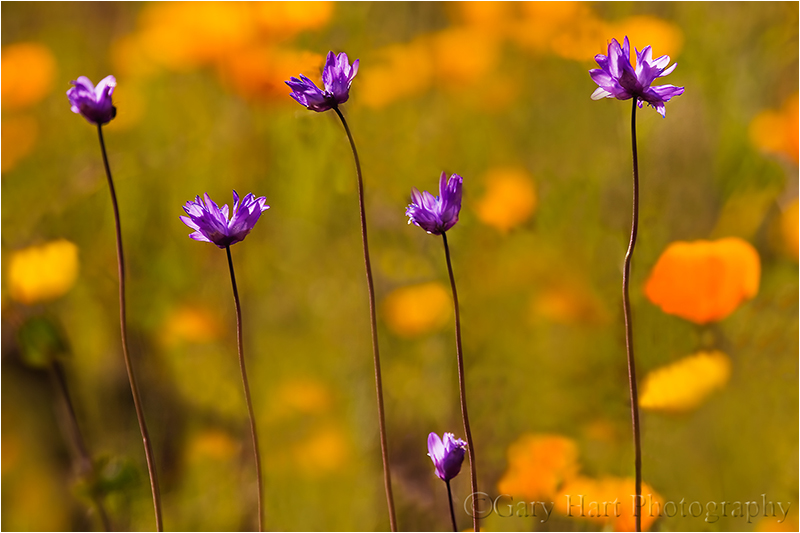
Spring, California Gold Country, Sierra Foothills
It’s been over a week since my last post. I have 350 Maui images on my hard disk, calling my name, but I’ve been so busy since coming home that I haven’t touched them. To give you an idea how busy I’ve been, last Tuesday my new 5D MarkIII arrived and I haven’t clicked the shutter once. That will change in a few days (if it kills me).
I love being a photographer, but it’s an unfortunate reality that turning your passion into your profession risks robbing photography of all the pleasure it once offered. Suddenly earning money takes priority over taking pictures, especially in this day when images just don’t sell the way they used to.
When I decided to make photography my livelihood, it was only after observing other very good digital photographers who, lured by the ease of digital photography, had taken the same path without recognizing that running a photography business requires far more than taking good pictures. Rather than becoming further immersed in their passion, they found themselves forced to photograph things not for love, but because it was the only way to put food on the table. And with the constant need for marketing, collections, bookkeeping, and just plain keeping customers happy, they soon realized that there was no time left to do what caused them to become photographers in the first place. Sigh.
So when I decided to change from photographer to Photographer, it was with a pretty good idea of what I was risking. I vowed that I’d only photograph what I want to photograph, that I’d never photograph something simply because I thought I could sell it. In my case that meant sticking landscapes: no people or wildlife–in other words, pretty much nothing that breathes.
But how to make money? My previous life in technical communications–I’d been a technical writer for a (very) large high tech company and before that had spent many years doing tech support, training, testing, and writing for a small software company–combined with a lifetime of camping, hiking, backpacking, and (of course) photographing throughout the American West, made conducting photo workshops a very easy (and enjoyable) step for me. Supplementing the workshops with writing and print sales has allowed me to pay the bills, visit the locations I’ve always loved, and explore new locations. And most importantly, it has allowed me to keep photographing only the things I love photographing.
One of the things I love photographing most is spring in Northern California. March is a month of bipolar weather swings, a time when blue skies with puffy clouds turn into gray, frog-drowning downpours with alarming suddenness. March is also when our hills reach a crescendo of pupil-dilating green, the oaks leaf out with new life, and poppies start to appear everywhere.
One of my favorite diversions on these spring afternoons is driving into the Sierra foothills east town to photograph the poppies. With the window down, Spring Training baseball on the radio (go Giants!), and doing my best to get lost in the maze of narrow, twisting foothill roads, I’m in photography heaven. I found the above scene a couple of years ago on a quiet hillside beside the Cosumnes River in the Gold Country of the Sierra foothills. But this scene could be just about anywhere in California’s ubiquitous rolling, oak-studded hills.
Despite the current busy schedule, there’s comfort in the knowledge that our spring conditions will persist into June. Next month I’ll find poppies and other wildflowers mixed with redbud in the many canyons roaring with Sierra snowmelt. And come May, it’s dogwood time….
Autumn Leaves (and winter arrives)
Posted on March 17, 2012
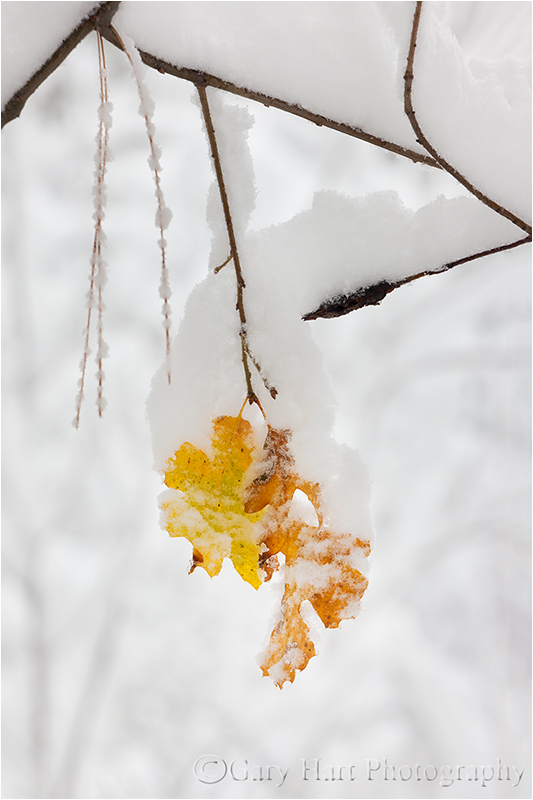
Leaves and Snow, Yosemite
I’ve been in Maui since Monday (scouting for a new workshop), and despite the fact that there’s more to photograph here than there is time to photograph (seriously), I still find time to check the Yosemite webcams every day. In fact, even surrounded by all this tropical splendor, I’ll admit to a few pangs of homesickness when today’s webcams showed fresh snow, with more falling, in Yosemite Valley.
(I’ll get to my Maui pictures when I’m home, but until then here’s one from November.) At only 4,000 feet above sea level, Yosemite Valley is warm compared to most of the Sierra. It’s often raining here when it’s snowing just a little up the road. When it does snow in Yosemite Valley, for an hour or two scenes like this are quite common. But as soon as the sun comes out, the snow starts disappearing.
To see Yosemite Valley covered in white requires being there while it’s snowing–if you wait to leave until you hear it snowed in Yosemite, you’re too late. Photographing Yosemite while the snow is falling can be difficult, but the payoff is huge. Often the ceiling drops to the valley floor, obscuring everything that’s recognizable as Yosemite, but with the disappearing icons also vanishes the swarms of visitors and suddenly you feel like you’re alone in the world. Is there any silence more pure than the silence of falling snow?
The best nature photography often highlights the drama of change: the passing from day to night and back, the collision of ocean and land, an approaching or retreating storm. And, because it happens so gradually and only once each year, the movement from one season to the next is a rare photographic opportunity.
So that November morning my attention turned to shocked autumn leaves, lulled by weeks of benign fall weather, forced to cling to their colorful glory against winter’s sudden assault. After nearly a month as the main event, these leaves were lone survivors along a quiet bend in the Merced River. Within a couple days they no doubt fell to the forest floor, or were swept into the river, as inevitable winter prevailed.
Starry, starry night
Posted on March 14, 2012

Winter Star Trails, Half Dome and the Merced River, Yosemite
Canon 1Ds Mark III
28 mm
24 minutes
F/2.8
ISO 400
Yosemite is beautiful any time, under any conditions, but adding stars to the mix is almost unfair. I started doing night photography here on full moon nights about six or seven years ago, but recently I’ve enjoyed photographing the exquisite starscape of moonless Yosemite nights. With no moonlight to wash out the sky, the heavens come alive. Of course without moonlight visibility is extremely limited, and focus is sometimes an act of faith. But eyes adjust, and focus improves with experience (I promise).
After photographing, among other things, Yosemite Valley with a fresh blanket of snow and Horsetail Fall in all its illuminated splendor, last month’s Yosemite winter workshop had already been a success. Nevertheless, after dinner on our next to last night I took the group to this peaceful bend in the Merced River to photograph Half Dome beneath the stars.
I started with a high ISO test shot to get the exposure info for everyone, then converted to a long exposure that allowed me to ignore my camera for a half hour or so while I worked with the rest of the group. Helping with focus, composition, and exposure, I made sure everyone had had a success before suggesting we wrap up.
The fabulous photography is only part of what makes these night shoots memorable–they’re also just plain fun. That night we ended up staying out for about an hour, shooting, shivering, and laughing–lots of laughing. And as the group packed up, I returned to my camera and found this waiting for me.
Check out next year’s Yosemite winter workshop.
Clouds are Underrated
Posted on March 11, 2012

Early Morning, Mesquite Flat Dunes, Death Valley
Blue skies and bright sunshine are great for tourists, but they can ruin a photographer’s day. Granted, warm sunrise and sunset light casts dramatic shadows and warms the landscape for a few quiet minutes at the beginning and end of the day. But when the sun is up, the light is harsh and tourists swarm like ants to a picnic.
On the other hand, an overcast sky diffuses sunlight, diminishes shadows, and softens the landscape. While diffuse overcast light isn’t usually as dramatic as warm early and late direct sunlight, it’s always wonderfully photographable. It also keeps the teeming masses at bay. If given a choice between dramatic sunrise and sunset light bookending a day of blues skies, or a full day of flat, overcast light, I’d take the overcast day without hesitation.

First Light, Mesquite Flat Dunes, Death Valley: On most mornings, direct sunlight skims Mesquite Flat Dunes’ sandy undulations, etching straight lines and graceful curves that photographers crave.
Death Valley’s Mesquite Flat Dunes are gorgeous when the day’s first light peeks over the Funeral Mountains and skims the dunes’ pristine ridges and curves, casting extreme shadows that exaggerates everything wonderful about sand dunes. In an arid environment that rarely sees clouds, these dunes near Stovepipe Wells are a must-shoot for serious photographers.
But I’m afraid in their desire to duplicate the beautiful, high-contrast sunrise images that have preceded them, photographers overlook the possibilities when the sun doesn’t arrive. I love photographing sand dunes beneath cloudy skies, and can’t understand the disappointment I hear when dune photographers (who should know better) lament cloudy skies. I realize overcast doesn’t offer the kind of bold shadows that create the dramatic images everyone else has, but as someone who constantly looks to photograph things a little differently than others have (of course that doesn’t make me unique), I just love these dunes in more subdued light.
In last month’s Death Valley workshop, it was pretty obvious that we wouldn’t be seeing much sun at sunrise on the morning of our dune shoot. Nevertheless, as we prepared for the one mile trek in the pre-dawn darkness, I reassured everyone that they were in for a treat. (I couldn’t help but wonder if they thought I was selling them a bill of goods, but everyone seemed in good spirits as we followed our flashlights across the sand.)
I’d selected a relatively remote location that tends to offer a better chance of solitude and sand unmarred by footprints. Getting there is slightly more work, but nothing more than anyone in the group could handle. The slightly extra effort turned out to be worth it, as we found only a handful of footprints and saw no other photographers while we were out there.
While it was still fairly dark as we scaled the final dune and prepared to set up, flashlights were no longer necessary. Not only is shadowless twilight vastly underrated for photography, starting early gives everyone a chance to familiarize themselves with the scene before the sky starts to light up, so I encouraged everyone to start shooting as soon as they were ready.
As expected, the rising sun never made its way directly onto the dunes that morning, but it did find enough openings to paint the clouds in all directions with vivid reds and pinks, a rare treat in Death Valley (and an unexpected bonus). The image at the top of the page was captured about forty-five minutes after sunrise–without clouds, the best light would have been long passed by then. To emphasize the delicate, repeating ridges in the sand, I dropped my tripod as close to sand-level as it would go, stopping down to f16 and focusing maybe twenty feet in front of me to maximize depth of field. I used the diagonal “valley” in the middle distance to lead the eye through the scene, and because the sky wasn’t particularly interesting, relegated it to a thin strip above Death Valley Buttes and the Funeral Mountains.
All in all, a nice morning, and (I think) a good lesson for all.
Reflecting on reflections
Posted on March 4, 2012

Winter Reflection, El Capitan, Yosemite
Canon EOS-1Ds Mark III
1.3 seconds
F/16.0
ISO 100
19 mm
What is it about reflections? I don’t know about you, but I absolutely love them–I love photographing them, and I love just watching them. Like a good metaphor in writing, a reflection is an indirect representation that can be more powerful than its literal counterpart. In that regard, part of a reflection’s tug is its ability to engage the brain in different ways than we’re accustomed: Rather than processing the scene directly, we first must mentally reassemble the reverse world of a reflection, and in the process perhaps see the scene a little differently.
Because a camera renders our dynamic world in a static medium, water’s universal familiarity makes it a powerful tool for photographers. We blur or freeze in space a plummeting waterfall to convey a sense of motion that conjures auditory memories of moving water. Conversely, the mere image of a mountain reflecting in a lake can convey stillness and engender the peace and tranquility of standing on the lakeshore.
This El Capitan winter reflection is another from last month’s Yosemite winter workshop. Arriving at Tunnel View before sunrise, we found a world covered in snow and smothered by clouds. But as daylight rose, the clouds parted and we were treated to a classic Yosemite Valley clearing storm scene. The photography was still great when I herded everyone away from Tunnel View so we’d have time to capture as much ephemeral grandeur as possible in the limited time before the snow disappeared. I tell my groups that, while the photography is still great where we are, it’s great elsewhere too. This approach ensure that not only does everyone get beautiful images, they get a variety of beautiful images.
El Capitan Bridge was our second stop after Tunnel View. El Capitan is so large and close here that capturing it and its reflection in a single frame is impossible without a fisheye lens, or stitching multiple images. But sometimes the desire to capture everything the eye sees introduces distractions. Feeling a bit rushed, I inhaled and forced myself to slow down and simply absorbed moment, soon realizing that it was the reflection that moved me most.
I attached my 17-40 and tried fairly wide vertical and horizontal compositions that highlighted the best parts of the scene, twisting my polarizer in search of an orientation that captured the the reflection while still revealing the interesting world beneath the surface. Of the dozen or so frames that resulted, this may be my favorite for the way it conveys everything in those few sunlit, snowy minutes when the world seemed silent and pure.
* * * *
A note to you skeptics: I’m asked from time-to-time why the trees are white, while their reflection is green. This actually makes perfect sense once you realize that you’re looking at the top of the snow-covered branches, while the reflection is of the underside of the branches, which are not covered with snow.
Workshop Schedule || Purchase Prints || Instagram
A gallery of reflections
Click an image for a closer look, and to view a slide show.


If you can’t beat ’em…
Posted on March 1, 2012

Fresh Snow, Half Dome View, Yosemite
If it weren’t for Tunnel View on the Wawona Road, no doubt one of the most photographed vistas in the world, this view from Big Oak Flat Road, across the Merced River Canyon from Tunnel View, would probably be the Yosemite shot we all see. Visitors arriving from Highway 120 round a bend and are greeted with this view, their first inkling of Yosemite’s grandeur.
I’ve stopped here many times, but rarely photograph this view because it seems I always struggle with what to do with the foreground rocks and tree–composing wide enough to include them makes El Capitan, Half Dome, and Sentinel Dome quite small, and I just don’t think they’re interesting enough to occupy so much of the frame. But a couple of weeks ago, while guiding a private workshop student on a snowy morning, I found the entire scene etched in white and immediately saw the possibilities. Like magic, when adorned with a snowy veneer these foreground distractions became a worthy subject.
I moved as far back as the terrain would permit so I could increase my focal length and compress the distance separating the foreground and background. Even so, I was only able to go to 50mm, hardly a telephoto shot. Nevertheless, 50mm with subjects in my close foreground and distant background created depth of field problems. Whipping out my trusty iPhone hyperfocal app, I determined that I could make the scene work at 50mm and f16 if I was very careful with my focus point–focusing a little less than twenty feet away would give me sharpness from about eight feet to infinity. Because I had no way to measure the distance exactly (pacing it off would have ruined the pristine snow) and was more concerned about keeping the foreground sharp than I was about minor softness in El Capitan and Half Dome, I biased my estimate on the close side of twenty feet (making sure I focused between fifteen and twenty feet rather than between twenty and twenty-five feet).
All my previous images from this location have been telephoto shots the emphasize the strength of Half Dome, El Capitan, and Sentinel Dome. In fact, last May a rising crescent moon from this location gave me two of my favorite Yosemite images. But this time I was really happy for the opportunity to go wide and use these foreground features that had bothered me in the past, to come up with a fairly unique capture of Yosemite’s most frequently photographed monoliths.

Crescent Moon, El Capitan and Half Dome, Yosemite

Sunrise Trio, El Capitan and Half Dome, Yosemite
Watch your step
Posted on February 24, 2012
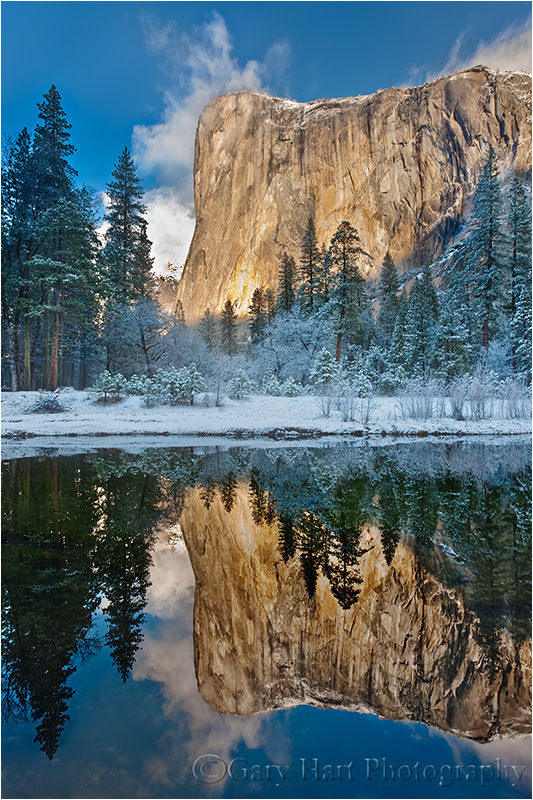
Reflection, El Capitan winter morning, Yosemite
Trouble brewing
I have many “favorite” photo locations in Yosemite Valley–some, like Tunnel View, are known to all; others, like this location along the Merced River, aren’t exactly secrets, but they’re far enough off the beaten path to be overlooked by the vacationing masses. While I used to count on being alone here, as often as not lately I share this shoreline with other photographers. While it’s nice to have a location to myself (so far I can still find a few of those spots in Yosemite Valley), I’m usually happy to share prime photographic real estate with a kindred spirit.
But. In recent years I’ve noticed more photographers abusing nature in ways that at best betrays their ignorance, and at worst reveals their indifference to the fragility of the very subjects that inspire them to click their shutters in the first place. Of course it’s impossible to have zero impact on the natural world: Starting from the time we leave home we consume energy that directly or indirectly pollutes the atmosphere and contributes greenhouse gases. Once we arrive at our destination, every footfall alters the world in ways ranging from subtle to dramatic–not only do our shoes crush rocks, plants, and small creatures, our noise clashes with the natural sounds that comfort humans and communicate to animals, and our vehicles and clothing scatter microscopic, non-indiginous flora and fauna.
For example
A certain amount of damage is an unavoidable consequence of keeping the natural world accessible to all who would like to appreciate it, a tightrope our National Park Service does an excellent job navigating. It’s even easy to believe that we’re not the problem–I mean, who’d have thought merely walking on “dirt” could impact the ecosystem for tens or hundreds of years? But before straying off the trail for that unique perspective of Delicate Arch, check out this admonition from Arches National Park.
Hawaii’s black sand beaches may appear unique and enduring, but the next time you consider scooping a sample to share with friends back on the mainland, know that Hawaii’s black sand is a finite, ephemeral phenomenon that will be replaced with “conventional” white sand as soon as its volcanic source is tapped–as evidenced by the direct correlation between the islands with the most black sands beaches and the islands with the most recent volcanic activity.
While Yosemite’s durable granite may lull photographers into environmental complacency, its meadows and wetlands are quite fragile, hosting many plants and insects that are an integral part of the natural balance that makes Yosemite unique. Not only that, they’re also home to, and nesting places of, native mammals, birds, and reptiles that so many enjoy photographing. Despite all this, I can’t tell you how often I see people in Yosemite (photographers in particular) unnecessarily trampling meadows, either to get in position for a shot or as a shortcut.
Don’t be this person
Still not convinced? If I can’t appeal to your environmental conscience, consider that simply wandering about with a camera and/or tripod labels you, “Photographer.” In that role you represent the entire photography community: when you do harm as Photographer, most observers (the general public and decision makers) go no farther than applying the Photographer label and lumping all of us into the same offending group.
Like it or not, one photographer’s indiscretion affects the way every photographer is perceived, and potentially brings about restrictions that directly or indirectly impact all of us. If you like fences, permits, and rules, just keep going wherever you want to go, whenever you want to go there.
It’s not that difficult
Environmental responsibility doesn’t require joining Greenpeace or dropping off the grid (not that there’s anything wrong with that). Simply taking a few minutes to understand natural concerns specific to whatever area you visit is a good place to start. Most public lands have websites with information they’d love you to read before visiting. And most park officials are more than happy to share literature on the topic (you might in fact find useful information right there in that stack of papers you jammed into the center console as you drove away from the entrance station).
When you’re in the field, think before advancing. Train yourself to anticipate each future step with the understanding of its impact–believe it or not, this isn’t a particularly difficult habit to form. Whenever you see trash, please pick it up even if it isn’t yours. And don’t be shy about reminding other photographers whose actions risk soiling the reputation for all of us.
DEVELOP A “LEAVE NO TRACE” MINDSET
A few years ago, as a condition of my Death Valley workshop permit, I was guided to The Center for Outdoor Ethics and their “Leave No Trace” initiative. There’s great information here–much of it is just plain common sense, but I guarantee you’ll learn things too.
Now go out and enjoy nature–and please save it for the rest of us.
======================================
A few words about this image
I captured this image while guiding a customer on a private workshop the day before last week’s Yosemite winter workshop. After months of clear skies, the sun rose on two inches of fresh snow in Yosemite Valley. As I did two days later when my workshop group was greeted with another dose of overnight snow, I shifted into hurry-up mode to get to as many spots as possible in the couple of hours we had before the snow would be gone–once the sun hits the trees, the snow disappears like magic.
After watching the storm clear from Tunnel View, we arrived here just in time to watch the day’s first light descend the surrounding granite walls. Our timing was ideal, as reflections are never better than when the reflective subject is in sun and the reflective surface in shade.
Shooting on a tripod (always!) enabled me to be at my camera’s ideal ISO 100 and select the f-stop the scene called for, without worrying about the resulting shutter speed. In this case I opted for a wide composition to include all of El Capitan and its reflection, which gave me lots of depth of field. Since the focus point for a reflection is the focus point of the reflective subject, not the reflective surface (that doesn’t mean that you shouldn’t focus on the reflection, it just means you should take care not to focus on something floating on or resting beneath the reflection), at 20mm everything in my frame was at infinity. With depth of field not a concern, I dialed in f11, my lens’s sharpest f-stop (lenses tend to be sharper in their middle f-stops). F11 brought the added benefit of reducing image-softening diffraction that happens at smaller f-stops–I’ll go smaller than f11 only when the composition calls for it (or if I forget to change it from a previous shot).
The dynamic range (the range of light from darkest shadow to brightest highlight) was too much for my camera to handle, but a two-stop hard-transition graduated neutral density filter subdued the brilliant sunlight, enabling enough exposure to reveal detail in the foreground shadows. Hiding the GND transition in the linear band of shoreline trees was easy, and simple dodging and burning in Photoshop brought out shadow detail and ensured that the sunlit El Capitan was brighter than its reflection (as it should be). Also in Photoshop I applied a light touch with Topaz noise reduction, desaturated the sky slightly to prevent it from overpowering the scene, and did selective sharpening (selecting only the areas containing detail).
(While I do take my groups to this quiet spot beside the Merced River, the fragile riverside setting that requires crossing a small meadow makes me reluctant to share it with the general public.)
Horsetail Fall: Yosemite’s natural firefall
Posted on February 19, 2012
Horsetail Fall, El Capitan, Yosemite (2008)
* * * *
This is the story of my 2012 Yosemite Winter workshop Horsetail Fall shoot. For more about when, where, and how to photograph Horsetail, read my Horsetail Fall Photo Tips article.
I returned home late last night from my annual Yosemite winter workshop. I’m happy to report that weeks of snow-dances, incantation, prayer, and just plain crossed fingers seem to have done the trick, as Yosemite Valley’s winter-long dry spell ended with two doses of snow last week. Since the most beautiful place on Earth is never more beautiful than when it’s blanketed in fresh snow, that was definitely the highlight of the week, but it was also fun to share the Horsetail Fall phenomenon with my group.
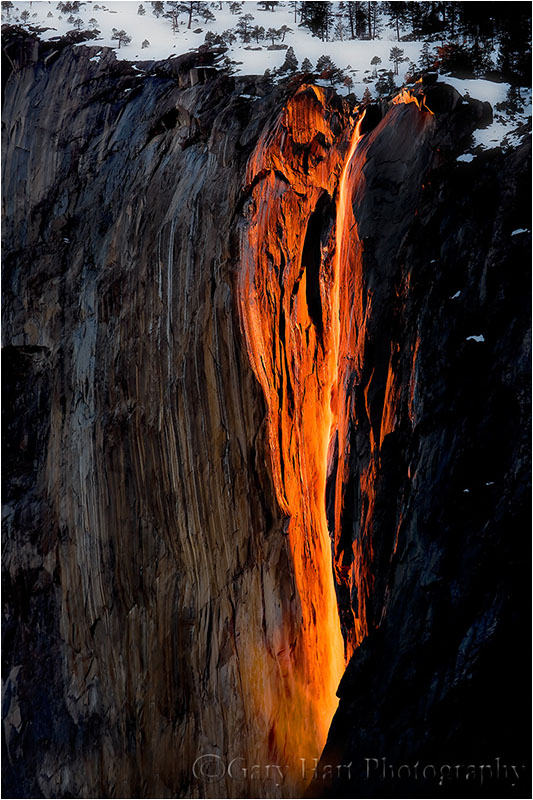
For those who don’t know what I’m talking about, for eleven+ months Horsetail Fall is probably Yosemite’s most anonymous waterfall. Even at its best, this ephemeral cataract is barely visible as a thin white thread descending El Capitan’s east flank–we can be standing directly beneath it and I still have to guide my students’ eyes to it (“See that tall tree there? Follow it all the way to the top of El Capitan; now run your eye to the left until you get to the first tree….”). But for about two and a half weeks in February, the possibility that a fortuitous confluence of snowmelt, shadow, and sunset light might, for a few minutes, turn this unassuming trickle into a molten red stripe, draws photographers like cats to a can-opener.
The curtain rises more than an hour before sunset, when a vertical shadow begins its eastward march across El Capitan’s south-facing flank. As the shadow advances the sunlight warms; as the unseen sun reaches the horizon, the only part of El Capitan not in shadow is Horsetail Fall; for a few minutes when the stars align–water in the fall, no clouds blocking the sun’s path to El Capitan, and enough haze to scatter all but the sun’s red rays–the fall is bathed in a red glow that resembles flowing lava. (Some people mistakenly call the Horsetail spectacle the “Firefall,” but that altogether different but no less breathtaking, manmade Yosemite phenomenon was suspended by the National Park Service in 1968.)
Some years Horsetail delivers sunset after sunset; other years bring daily of frustration. Unfortunately, it’s impossible to predict when all the tumblers will click into place: For every tale of a seemingly perfect evening when the sunset light was doused by an unseen cloud on the western horizon mere seconds before showtime, there’s another story about a cloudy evening when the setting sun somehow found a gap just as tripods were being collapsed. I know photographers who nailed Horsetail on their first attempt, and others who have been chasing it for years.
It’s fun to circle Yosemite Valley on pretty much any mid- to late-February afternoon, just to watch the hordes of single-minded photographers setting up camp like baby-boomers queueing for Stones tickets, securing a vantage point to capture (fingers crossed) their version of Horsetail Fall’s sunset pyrotechnics. When I lead a group it’s a always a tough call whether to sacrifice a nice Yosemite sunset at a more reliable location, or go all-in for the fickle grand prize. Generally, when February skies are cloudless, I might take my groups to the Horsetail circus multiple evenings (until we get it), because that’s what most are there for.
This year (2012) we had fresh snow and great clouds on Tuesday and Wednesday, so I targeted Thursday evening for Horsetail. Because we detoured to photograph the daily rainbow on Bridalveil Fall, I was resigned to dropping my group off, parking down the road, and walking back to the El Capitan picnic area beneath the fall (the spot best suited to large groups). But I was pleasantly surprised to find the necessary three parking spaces still available not much more than an hour before sunset. After a brief orientation (that started with helping everyone locate the fall), we all set up in fairly close proximity, practiced compositions and exposure, and shadow-watched. I’ve reached the point where I spend as much time watching the photographers as I do watching El Capitan–Horsetail Fall in February really has become an Event, not unlike waiting for the next act on the lawn at a concert.
Flow in the fall this year was low (it was bone-dry when I arrived Sunday), even by Horsetail standards, but still enough to make a photograph. We all held our breath, pleaded, and cheered as the shadow approached the fall. Shortly before sunset the amber light acquired a distinct pink hue and the chat, laughter, and cajoling died quickly in favor of clicking shutters. Instead of intensifying to the hoped-for red, the pink held for a few minutes before fading. So while we didn’t hit a home run, I think this year’s group still managed a stand-up triple.
I haven’t had a chance to get to this year’s images, so I’m posting a (better) 2008 Horsetail capture from a different spot. Despite appearances to the contrary, I didn’t have to scale shear granite to achieve this vantage point–I was in fact securely planted on the valley floor, shivering atop a snowbank beside the Merced River. Also of note is that this image was captured on February 9, earlier than many people claim the angle is right. I actually got it like this on consecutive nights that year, leading two different groups.
The definition of breathtaking
Posted on February 11, 2012

Moonlight and Big Dipper, Badwater, Death Valley
Death Valley is notorious for blue skies–great for tourists, but a scourge for photographers. Clouds add interest to a scene, and filtering harsh sunlight through clouds reduces contrast to a range a camera can capture. To mitigate harsh sky problems, I schedule my annual Death Valley workshop for winter to maximize the chance for clouds. And hedging my bets further, I time each workshop to coincide with a full moon–that way, if we don’t get clouds, careful location planning allows me to include a full moon in many of our sunrise and sunset shoots, and allows us to photograph Death Valley’s stark beauty by moonlight.
I returned last night from my 2012 workshop. Not only did we have a creative, enthusiastic group, we also were blessed with a wonderful blend of conditions. On our first two days we were treated to lots of clouds (and even a few snow flurries during a sunset shoot at Aguereberry Point) and beautiful sunrise color on the dunes. But by day three the Death Valley sky was back to business as usual and it was time to plug in a moonlight shoot.
I usually opt for moonlight on the Mesquite Flat Dunes near Stovepipe Wells, but during a pre-workshop visit to Badwater it occurred to me that the salt flat’s white surface was tailor made for the light of a full moon. Since the sky didn’t clear until our third day (the moon rises later every day), I was concerned that the moonlight wouldn’t reach Badwater, 282 feet below sea level and in the shadow of 5,700 foot Dante’s Peak, early enough. I briefly considered returning to the more exposed dunes, but finally decided that I could make Badwater work by simply leading the group out onto the salt flat until we reached the moonlight.
Sure enough, we arrived at Badwater a little after 8:00 p.m. to find ourselves in deep moonshadow. But across the valley, Telescope Peak and Badwater’s west fringe already basked in the light of the rising moon. So off we went to meet the advancing moonlight, following our headlamps through the darkness for about a half mile before reaching the advancing moonlight. With headlamps doused we paused in silence to take in our surroundings: Venus was just disappearing behind Telescope Peak and Jupiter sparkled high overhead; Orion and Sirius decorated the southern sky, while Cassiopeia and the Big Dipper straddled Polaris to the north. And rising above the mountains to the east, the moon painted the playa’s jigsaw surface with its silvery glow. Overuse has reduced “breathtaking” to cliché status, but I can’t help think it’s these moments the adjective was intended for.
After sharing exposure settings, a quick refresher on focus in moonlight, and some composition suggestions, I let the group get to work. We found compositions in all directions except due east, where the moon was simply too bright to include in the frame. With everyone working within a 100 foot radius, it was easy (and gratifying) to hear exclamations of delight as images popped onto LCD screens.
So amazing was the experience that we stayed far later than I’d planned. If I’d have been there by myself I’d have probably stayed out much longer, but I wanted to make sure no one was too tired for the sunrise moonset I had planned (also at Badwater) the following morning. The above image of the Big Dipper was captured toward the end of our shoot, when the entire playa was illuminated, but the moonlight hadn’t quite reached the Black Mountains. I used ISO 800, f5.6, and 30 seconds.
My 2013 Death Valley Winter Moon photo workshop is January 25-29–it’s already nearly full.

 Eloquent Images by Gary Hart