Eloquent Images by Gary Hart
Insight, information, and inspiration for the inquisitive nature photographer
Isolate and Conquer
Posted on November 8, 2024

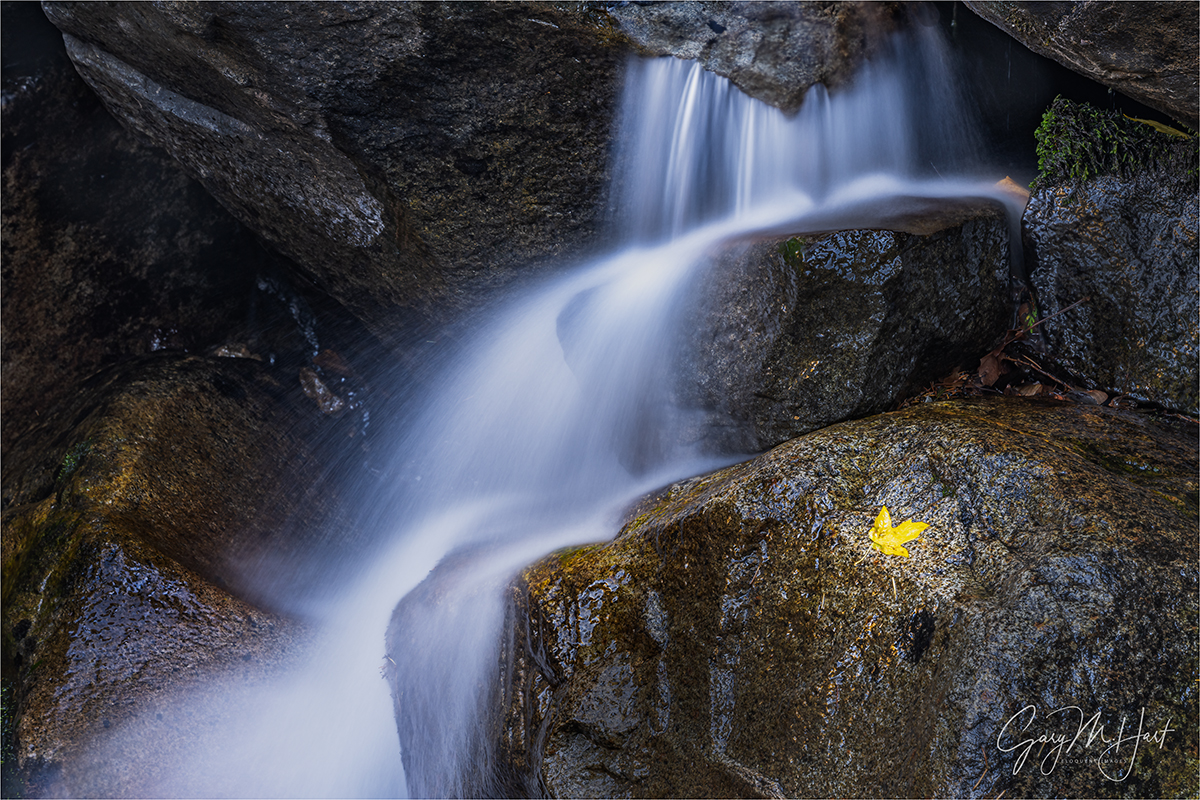
Autumn On the Rocks, Bridalveil Creek, Yosemite
Sony α1
Sony 100-400 GM
3.2 seconds
f/16
ISO 200
This year marked my second autumn visit since the reopening, and everything still feels gloriously new to me. Arriving at Bridalveil Creek on the final morning of last week’s Yosemite Fall Color photo workshop, I started with a brief orientation, then guided the group along the main trail, pointing out the many photography opportunities here. I wrapped up the introduction by inviting anyone who doesn’t mind a little bush-whacking and rock scrambling to follow me to one more spot.
Off the beaten path and often jammed with fallen trees and branches, the scene here is a little different each time I visit. The amount of water in the creek varies, as does the number of leaves on the ground and in the pools. This year the water was nice, but the leaves hadn’t quite reached peak blanket status. But these annual variations are part of what I love about photographing here.
Autumn Leaf and Cascade, Bridalveil Creek, Yosemite
Sony α1
Sony 100-400 GM
8 seconds
f/16
ISO 100
Probably my favorite thing to do at Bridalveil Creek is to find a leaf or leaves swirling in a pool and capture their colorful spiral with a long exposure. But when I couldn’t find any candidates for swirling color on this visit, I went to Plan B and scanned the scene for a leaf I could isolate. Despite lots of beautiful yellow leaves overhead, I only found two candidates on the ground.
Usually I try to get within 10 feet of subjects like this, because the closer I am, the more even a small amount of repositioning affects my foreground/background relationships. But closer access to these leaves was blocked by water, rocks, and downed branches (plus I didn’t want to risk getting in someone else’s frame), so I put away my 24-105 lens in favor of my 100-400, and went to work from an open vantage point about 30 feet back.
As I worked this scene, I couldn’t help remembering that every time I share an autumn image from Bridalveil Creek in Yosemite, I need to brace for the questions: some version of, “Did you place that leaf there?” Usually the tone is friendly curiosity, but sometimes it includes an undercurrent of suspicion bordering on accusation. While these questions are an inevitable part of being a nature photographer, I suspect that I get more than my share because I aggressively seek naturally occurring subjects to isolate and emphasize—and Bridalveil Creek in autumn has them in spades. But regardless of the questioner’s tone, my answer is always a cheerful, unapologetic, and honest, “No.”
I digress
We all know photographers who have no qualms about arranging their scenes to suit their personal aesthetics. The rights and wrongs of that are an endless debate I won’t wade into, other than to say that I have no problem when photographers arrange their subjects openly, without intent to deceive. But photography has to make you happy, and I create my photographic happiness by discovering and revealing Nature, not manufacturing it. I don’t like arranging scenes because I have no illusions that I can improve Nature’s order, and am confident that there’s enough naturally occurring beauty to keep me occupied for the rest of my life.
Order vs. chaos
Nature is inherently ordered. In fact, in the grand scheme, “Nature” and “order” are synonyms. But humans go to such lengths to control, contain, and manage the natural world, we’ve created a label for our failure to control nature: chaos. Despite its negative connotation, what humans perceive as “chaos” is actually just a manifestation of the Universe’s inexorable push toward natural order.
Let’s Take a Trip…
For example, imagine that all humans leave Earth for a scenic tour of the Milky Way. While we’re gone, no lawns are mowed, no buildings maintained, no fires extinguished, no floods controlled, no Starbucks built. Let’s say we return to Earth in 100 years*. While the state of things would no doubt be perceived as chaotic, the reality is that our planet would in fact be closer to its natural state. And the longer we’re away, the more human-imposed “order” would be replaced by natural order.
* Since this is my fantasy, I’ve chartered a spaceship that accommodates all of humankind and travels at 90 percent of the speed of light. While Earth has indeed aged 100 years during our holiday, we travelers return only a year older. (Dubious? Don’t take my word for it, ask Albert Einstein.)
What’s it all about?
Instead of manufacturing false order, I prefer organizing my scenes around naturally occurring relationships in a way that makes the image about something—in other words, finding the natural order and interpreting (translating) it in a way that resonates with humans. To distill this natural order from perceived chaos, nature photographers have a couple of compositional tools in our creative toolbox.
With a wide lens and careful positioning and framing, we can guide viewers’ eye with relationships that start in the close foreground and extend to the distant background, connecting elements to create virtual lines that guide the viewers through the frame. I think most photographers are biased toward these wide landscape images because the wider frame is closer to the way we see the scene with our eyes. But going wide also risks introducing unwanted elements that clutter the frame and pull the viewers’ eyes off their prescribed visual path.
Enter the telephoto lens, an underused landscape tool by most (but not all) photographers. A telephoto lens lets us be more surgical in our subject choice by simplifying the scene to its most essential elements that emphasizes our scene’s most prominent feature or features, and eliminates peripheral distractions. Nevertheless, despite the telephoto’s effectiveness, I often catch myself automatically defaulting to my wide lenses. But I’ve learned that those times when I’m struggling to find a shot, the easiest way to reset my creative instincts in the field is to simply view the scene through a telephoto lens, just to see what might be lost in the visual discord of the wide scene.
Still not convinced? In addition to providing a fresh perspective, telephoto lenses offer undeniable, tangible advantages in landscape photography:
- Bigger subject: Bigger isn’t always better, but there’s often no more effective way to emphasize your subject than to magnify it in your frame.
- Isolate: By zooming closer, you can banish distractions and unwanted objects to the world outside the frame, distilling the scene to its most essential elements.
- Highlight the less obvious: Sometimes a scene’s compelling, but more subtle, qualities are overwhelmed by the cacophony of dramatic qualities that drew you in the first place. By all means, shoot the grand drama that drew you in the first place, but take the time to discover the smaller stuff that’s there as well.
- Selective focus: The longer your focal length, the shallower your depth of field. One of my favorite ways to emphasize a subject that might otherwise be overlooked is to render it as the only sharp object surrounded by a sea of soft color and shape.
If telephoto vision doesn’t come naturally to you in the field, try training your eye in the comfort of your own home by opening any wide angle image in Photoshop (or your photo editor of choice), setting the crop tool to 2/3 aspect ratio (to match what you see in your viewfinder), and see how many new compositions you can find. (I’m not suggesting that you shoot everything wide and crop later—this crop tool suggestion is simply a method to train your eye.) But whether you do it in the field, or later in Photoshop, once your eye gets used to seeing in telephoto, you’ll find virtually every scene you photograph has telephoto possibilities you never imagined existed.
Meanwhile, back at Bridalveil Creek…
On this morning, I shot these leaves—one, the other, and both—horizontal and vertical, from wide to tight (horizontal version shared above). I even experimented with a variety of shutter speeds, but it was so dark back here in the early morning shadow beneath towering granite, darkened further by a canopy of leaves, and with a polarizer essential to mitigate the glare on the wet rocks and leaves, that any reasonable ISO didn’t allow a shutter speed that made a noticeable difference in the water’s blur—the water was moving so fast, 1 second and 10 seconds were virtually identical. So I just went with whatever shutter speed I needed to get the exposure I wanted (the fact that I ended up shooting this frame at ISO 200 instead of ISO 100 was just small oversight, left over from earlier shutter speed experiments).
My starting position was more-or-less at eye level with the cascade, putting the leaves more edge-on. Though they were clearly visible, but their classic maple leaf shape was somewhat obscured by the angle of view. So after exhausting all compositional variations, I scanned my surroundings for a higher vantage point and spotted a rock that would take a little effort to scale (nothing dangerous—mostly navigating a lot of downed trees and branches), but that might work if the view from there was unobstructed.
Turns out shifting those few feet was worth the effort, providing a much better angle that clearly revealed the leaves’ shape. I proceeded to run through another series of compositions similar to what I’d done at the first spot.
I’ve learned to wait until the workshop’s final day to take my groups to Bridalveil Creek. The photography here isn’t as obvious as the rest of Yosemite, so as excited as I am to share it, it takes a while for everyone to refamiliarize themselves with their cameras and warm up their creative muscles. This group was no exception, but when we gathered at the cars after the shoot, I heard the same “I could have stayed here all day!” responses I always get at Bridalveil Creek. Me too!
Join me in Yosemite
Workshop Schedule || Purchase Prints || Instagram
Isolate and Conquer
Click any image to scroll through the gallery LARGE


Back in My Happy Place
Posted on November 7, 2023
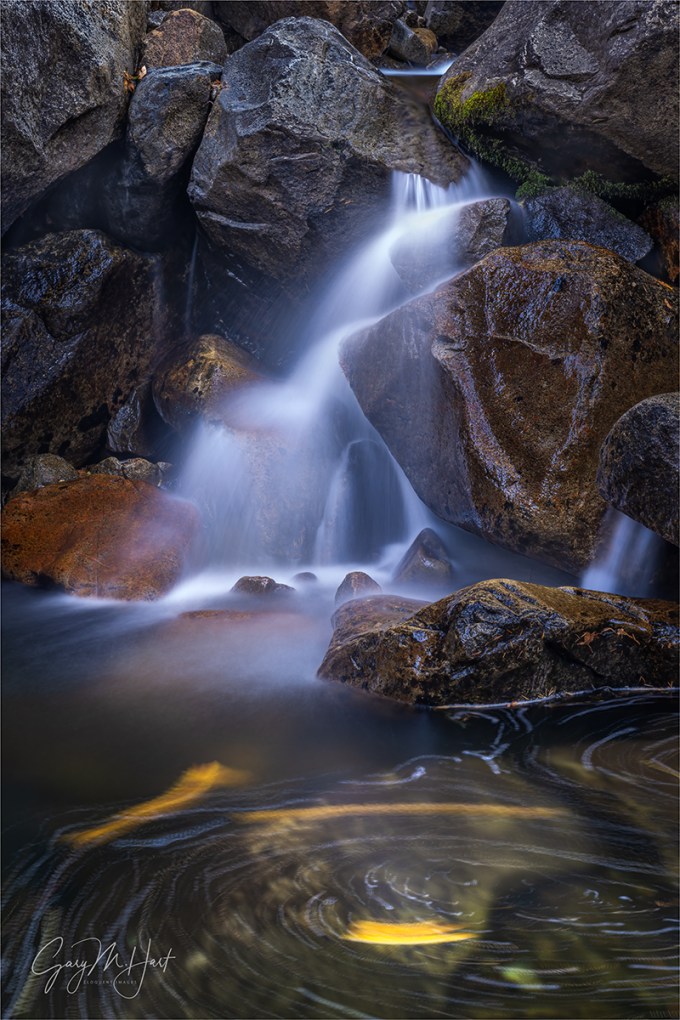
Autumn Spiral, Bridalveil Creek, Yosemite
Sony a7R V
Sony 24-105 f/4 G
ISO 50
f/16
13 seconds
Auroras, lightning, and a volcanic eruption—anyone viewing this year’s images might think my camera and I are most drawn to Nature’s purest drama. But as breathtaking as these phenomena are (they are!), I think I’m happiest with a camera in my hand when I’m working to extract subtle beauty from Nature’s quiet places. Rare, dramatic beauty is an instant stimulant that grabs your eyes and pretty much demands to be photographed. Not so much for the peaceful scenes that subtly soothe, but that doesn’t mean their beauty can’t compete—you just have to work for it.
Extracting photographs from these quiet places combines observation, position, and subtraction: observing to identify the scene’s essential elements; positioning to create relationships between these elements and the camera; subtraction of all that’s not essential through careful framing and/or management of the exposure variables. It’s rarely quick work, but I’m never happier than when I feel like I’ve created a synergy between these components.
My Yosemite Valley happy place has to be Bridalveil Creek. I’m not talking about the nearby view of the fall itself, I’m talking about the area just beneath the fall, where the creek tumbles and pools among granite and maples. Rather than feasting on views of Yosemite’s magnificent monoliths and waterfalls, I come to Bridalveil Creek to meditate and create in Nature’s more understated beauty.
Lacking the most photographed views of Yosemite’s icons, the Bridalveil Creek area probably shouldn’t be the starting point for a first-time visitor. On the other hand, when timed right, this (relatively) peaceful spot does provide a wonderful respite from Yosemite’s teeming masses, as well as ample opportunities to stretch your creative muscles.
Bridalveil Fall is the only Yosemite Valley waterfall that reliably flows year-round, but its volume varies tremendously depending on the season, the prior winter’s snowpack, and the amount of recent rainfall. In spring, Bridalveil Creek is an angry torrent that splits into three distinct channels just beneath the fall, each spanned by its own stone footbridge that provides an excellent platform for photography. In wet years all three channels run year round; in the driest years, by late summer two are nothing but dusty, rounded boulders, with only the east-most bridge offering views of flowing water.
I visit here each time I visit Yosemite, but my favorite season by far is autumn. Whether one, two, or three channels are flowing, by autumn the remaining water has lost the urgency of spring, pausing to rest in still pools before descending the next cascade. And autumn is when the suddenly yellow maples shed a seemingly infinite number of leaves that settle briefly atop rocks, accumulate in nooks and crannies, blanket the forest floor, and drift atop the swirling pools.
I always start my workshops’ final day at Bridalveil Creek, setting my groups free to roam the trail and its bridges, clamber down to the still pools, and rock-hop the cascades in search of inspiration. Early in the workshop many students are still battling their cameras and personal vision, but waiting until workshop’s end to bring my groups here gives everyone three-plus days to settle into the photographic zone that’s necessary to get most of their time here.
I never considered that I might lose this spot until 2019, when the NPS started work on a much anticipated overhaul of the whole Bridalveil Fall area. To speed the work, they decided to close everything (parking lot, toilets, trails, and creek access) while they rerouted the trails, reconfigured the parking lot, and (my favorite upgrade) replaced the aromatic vault toilets with actual flush-toilet bathrooms. Though I was disappointed that I’d have to forego my happy place for a year or (God forbid) two, I rationalized that the promised improvements would be worth the sacrifice. When COVID happened, I resigned myself to maybe another year of waiting.
When the park reopened after the pandemic, and on every visit since, Bridalveil Creek has my first Yosemite Valley stop. And while it always looked like an active worksite (barricades, equipment, and stacked construction material), progress seemed to be frustratingly slow. In fact, despite those signs of activity, I rarely saw any actual activity underway. Even my NPS contact couldn’t give me a date for reopening.
It was more of the same in 2021, 2022, and for my winter and spring workshops earlier this year. So, after seeing no announcement online or in my daily Yosemite news e-mail, I approached this year’s Yosemite Fall Color and Reflections workshop resigned to another year of Bridalveil disappointment. That pessimism was confirmed when I drove by the Bridalveil Fall parking lot Tuesday morning (on my pre-workshop scouting run) and saw it still locked tight with no sign of activity. Sigh.
This was my first trip to Yosemite since early May (I don’t visit Yosemite in summer), and while I was aware of some traffic-flow improvements made to the valley’s east side since my last visit, I had no idea how extensive they’d been. So I decided to make another loop around the park to reset my bearings (it’s never a good look when the workshop leader gets lost), which took me past the Bridalveil Fall area one more time. This time I decided to park and check out the short hike to the creek from the other side—I’ve done this many times, as recently as my previous visit last spring, and have always found the trail fenced off and signage making it very clear they want no one back there. So imagine my surprise (not to mention delight), when I found this side open with full access to the creek! The parking lot and bathrooms were still closed, but I found the trails and all of the bridges open.
On Friday, for the first time in four years, I guided a workshop group back to Bridalveil Creek. As much as I wanted to explore my favorite Bridalveil Creek haunts, I remained on the trail and bridges where most of my workshop group had gone to work. But, as often happens here, one-by-one they set out to explore farther afield, until with about a half-hour before I’d instructed them to be back at the cars, I found myself completely alone on the middle bridge. Though 30 minutes is hardly enough to time do any quality work here, I couldn’t help beelining back to one of my favorite spots—upstream, around a motorhome-size rock, and a quick scramble over rocks and a log down to the water. The last few years before the shutdown this spot had been partially largely by fallen trees, but I was very pleased to see that part of the improvement process had been dead tree removal.
I’d told the group about this spot before we started and thought one or two might still be there, but they’d all moved on and I found myself alone with maybe 20 minutes to work. I’m very familiar with the little cascade back here, and the pool it lands in, but depending on the amount of water and the timing of the fall color, the scene is different each time I visit. Sometimes the leaves form a mosaic on the pool’s surface, but this time I found most of the leaves huddled at the far end and out of the composition that came to me first.
Since speed was essential, I just went with that first composition, which was some version of the cascade tumbling over the rocks and into the pool. (For scale, I estimate that this cascade, from top to bottom, is at least 6 feet and no more than 8 feet high.) I knew that even an exposure of just a second or two would render the cascade as a gauzy veil, and that in the deep early-morning shadow of Yosemite Valley’s south wall, not to mention the trees and an overcast sky, a multi-second exposure would be nearly impossible to avoid. Seeing little flecks of floating foam, I decided to just lean into the long exposure to streak the foam and emphasize swirling motion on the pool’s surface. (I didn’t need a neutral density filter because I was satisfied being in the 10-15 second range by just stopping down to f/16 at ISO 50.)
There was so much sheen on the rocks and glare on the water that a polarizer was essential (and even with polarization maximized, I couldn’t eliminate all of it). The polarizer had the added benefit of revealing submerged rocks that would have been exposed in drier years. As I worked, an occasional leaf would ride the cascade into the pool, or drift down from overhead, to take a couple of laps in the pool before sinking or exiting stage left. No problem—their yellow swirl lasted just long enough to add a final touch to my happy little scene.
Join me for a Yosemite photo workshop
Autumn at Bridalveil Creek
Click any image to scroll through the gallery LARGE


In the Flow
Posted on October 18, 2020

Autumn Drift, Bridalveil Creek, Yosemite || Canon EOS 1DS Mark III :: Canon 70-200 f/4 L :: 15 seconds :: F/16 :: ISO 100
“Natural” is a moving target that shifts with perspective. Humans experience the world as a 360 degree, three-dimentional, five-sense reel that unfolds in an infinite series of connected instants that our brain seamlessly assembles as quickly as it arrives. But the camera discards 80 percent of the sensory input, limits the view to a rectangular box, and compresses all those connected instants into a single, static frame. In other words, it’s impossible for a camera to duplicate human reality—the sooner photographers get that, the sooner they can get to work on expressing the world using their camera’s very different but quite compelling reality.
Despite the creative opportunities the differences between human and photographic vision offers, many photographers expend a great deal of effort trying to force their cameras closer to human reality (HDR, focus blending, and so on)—not inherently wrong, but in so doing they miss opportunities to creatively reveal our natural world. Subtracting the distractions from the non-visual senses, controlling depth of focus, and banishing unwanted elements to the world outside the frame, a camera can distill a scene to its overlooked essentials, offering perspectives that are impossible in person.
Blurred water
Motion is one thing that an image “sees” differently from you and me. But working in a static medium doesn’t mean photographers can’t convey motion, or use motion in a scene to creative effect.
One question I’m frequently asked is, “How do I blur water?” And while there’s no magic formula, no shutter speed threshold beyond which all water blurs, blurring water isn’t that hard (as long as you use a tripod). In fact, when you photograph water in the full shade or cloudy sky conditions I prefer, it’s usually more difficult to freeze moving water than it is to blur it.
The amount of moving-water blur depends on several variables:
- The water’s speed: Whether it’s a flowing river or crashing surf, the faster the water moves, and the greater the blur. And regardless of the speed, white water (surf or whitewater) blurs better than blue or green water.
- The water’s direction of motion relative to your position: Water moving at right angles to your position will blur more than water moving toward or away from your position.
- Your focal length: The longer the focal length, the greater the blur.
- Your distance from the water: Motion blur increases as you move closer
- And of course, the shutter speed: The longer your shutter is open, the greater the blur.
Of these variables, it’s shutter speed that gets the most attention. That’s because focal length and subject distance are compositional considerations, and we usually don’t start thinking about blurring the water until after we have our composition. To achieve a longer shutter speed without overexposing, you need to reduce the light reaching (or detected by) the sensor. There are several tools at your disposal, each with its own advantages and disadvantages:
- Only photograph moving water in overcast or full shade.
- Reduce your ISO (light sensitivity): Many cameras allow you to expand their ISO below their native value (usually, but not always, 100). This capability is often disabled when the camera comes out of the box, so you need to check your manual to see if your camera has a menu setting that enables “expanded ISO” (or whatever your camera manufacturer calls it). Unlike the film days, when a lower ISO (we called it ASA back then) meant better image quality, any ISO value lower than the camera’s native ISO is emulated (manipulated with internal programming) and may result in slightly lower image quality. This degradation isn’t usually enough to make a huge difference, but it’s still something to avoid unless it’s the best way to achieve a longer shutter speed.
- Shrink the aperture (larger f-stop number): A smaller aperture reduces the light that reaches the sensor. It also increases the depth of field, which could be good, bad, or irrelevant. And a smaller aperture increases diffraction, which soften of the image. While this softening isn’t usually a problem unless you’re making big prints, its best to avoid using a smaller aperture than you need. As a general rule, I resist going with an aperture smaller than f/11 (but don’t hesitate to when it’s the only way to achieve my desired effect).
- Add a polarizing filter: In addition to reducing reflections, a polarizer will subtract 1 to 2 stops of light (depending on its orientation). When using a polarizer, you need to be vigilant about orienting it each time you recompose (especially if you change your camera’s horizontal/vertical orientation), and monitoring its effect on the rest of your scene.
- Add a neutral density filter: A neutral density filter is, as its name implies, both neutral and dense. Neutral in that it doesn’t alter the color of your image; dense in that it cuts the amount of light reaching your sensor. While a dark enough ND filter might allow you to blur water on even the brightest of days, it does nothing for the other problems inherent to midday, full sunlight shooting (specifically, extreme dynamic range). ND filters come in variable and fixed-stop versions—the flexibility of variable NDs (the ability to dial the amount of light up and down) means living with the vignetting they add to my wide angle images.
- Don’t even think about any kind of subject blur without a sturdy tripod. For help selecting the right tripod, read the Tripod Selection article in my Photo Tips section.
Other motion blur opportunities
Motion blur opportunities aren’t limited to crashing waves and rushing whitewater. For example, I love using long shutter speeds to smooth the undulations and chop on the surface of an ocean, lake, or flowing river. And a particular favorite approach of mine is blurring something floating atop moving water, like dots of foam or autumn leaves. And my favorite time and place for this is each autumn at Bridalveil Creek in Yosemite. Here, beneath Bridalveil Fall and shaded by Yosemite’s towering granite walls, are countless pools surrounded by colorful trees and fed by tumbling cascades.
The motion of the cascade’s entry and exit creates arcs and spirals of motion in the pool, punctuated by small pockets of stillness near the perimeter. Leaves fall from the trees and land on the water, or flow down from upstream, congregating on the pool’s surface. Some just make a single arced pass before continuing downstream, others join a circular dance that can last for hours. It’s usually impossible to see any organization to the pool’s motion without something floating on the surface, but a long enough exposure with leaves or floating foam will reveal a distinct flow pattern.
After finding a pool adorned with drifting autumn leaves, I set up my tripod and camera, find a composition, and dial in a shutter speed measured in seconds. Depending on the speed of the circulation, sometimes 10-second shutter speeds are enough, but usually I try to go to 20 or 30 seconds. With the help of a neutral density filter, I’ve gone as long as 3 minutes (and maybe longer).
Once the blur patterns reveal themselves in my images, I tweak my composition and shutter speeds accordingly. Because there are usually many leaves, and each leaf takes a slightly different path depending on its size and interaction with other swirling leaves, each click results in a unique image. I’ll sometimes work a single composition for 15 or 20 minutes, collecting as many motion patterns to choose between as possible, before moving on to another composition or scene.
The image I’ve shared here is a 15-second exposure, captured at Bridalveil Creek in 2009. Because this location is always in full shade, and this was a cloudy day, the scene was dark enough that I could slow my shutter enough with just a polarizer. I’ve always felt like a polarizer is essential to remove glare from the water, leaves, and rocks in these scenes, but at the time I always had to decide between a polarizer or neutral density filter—I couldn’t do both. (I now have a Breakthrough 6-stop darkening polarizer that achieves the best of both worlds.)
Workshop Schedule || Purchase Prints || Instagram
World In Motion


Fall Color Photography Tips
Posted on September 13, 2020

Autumn Yin and Yang, Bridalveil Creek, Yosemite
Canon EOS-1Ds Mark II
Canon 70-200 f/4 L
10 seconds
F/13
ISO 100
This is the second of my two-part fall color series
Read part one: The Why, How, and When of Fall Color
Vivid color and crisp reflections make autumn my favorite season for creative photography. While most landscape scenes require showing up at the right time and hoping for the sun and clouds to cooperate, photographing fall color can be as simple as circling your subject until the light’s right. For photographers armed with an understanding of light and visual relationships, and the ability to control exposure, depth, and motion with their camera’s exposure variables, fall color possibilities are virtually unlimited.
Backlight, backlight, backlight
The difference between the front-lit and backlit sides of fall foliage is the difference between dull and vivid color. Glare and reflection make the side of a leaf facing its light source, whether that leaf is in direct sunlight or simply faces an overcast sky, appears flat. But the other side of the same leaf, the side that’s opposite the light from the sun or sky, glows with color.
In the image below (Autumn Reflection, Merced River, Yosemite), my camera has captured the sky-facing side of most of the leaves. But I’ve captured the underside of the leaves on the top-right of the branch—even though it’s an overcast day, can you see how these backlit leaves glow compared to the others?

Autumn Reflection, Merced River, Yosemite
The moral of this story? If you ever find yourself disappointed that the fall color seems washed out, check the other side of the tree.
Isolate elements for a more intimate fall color image
Big fall color scenes are great, but isolating your subject with a telephoto, and/or by moving closer, enables you to highlight and emphasize specific elements and relationships.
- Train your eye to find leaves, groups of leaves, or branches that stand alone from the rest of the tree or scene, or that stand out against a contrasting background.
- Zoom close, using the edges of the frame to eliminate distractions and frame subjects.
- Don’t concentrate so much on your primary subject that you miss complementary background or foreground elements that can balance the frame and provide an appealing canvas for your primary subject.
Selective depth of field is a great way to emphasize/deemphasize elements in a scene
Limiting depth of field by composing close with a large aperture and/or telephoto lens can soften a potentially distracting background into a complementary canvas of color and shape. Parallel tree trunks, other colorful leaves, and reflective water make particularly effective soft background subjects. For an extremely soft background, reduce your depth of field further by adding an extension tube to focus even closer.
Underexpose sunlit leaves to maximize color
Contrary to what many believe, fall foliage in bright sunlight is still photographable if you isolate backlit leaves against a darker background and slightly underexpose them. The key here is making sure the foliage is the brightest thing in the frame, and to avoid including bright sky in the frame. Photographing sunlit leaves, especially with a large aperture to limit DOF, has the added advantage of an extremely fast shutter speed that will freeze wind-blown foliage.
Slightly underexposing brightly lit leaves not only emphasizes their color, it turns everything that’s in shade to a dark background. And if your depth of field is narrow enough, points of light sneaking between the leaves and branches to reach your camera will blur to glowing jewels.


A sunstar is a great way to liven up an image in extreme light
If you’re going to be shooting backlit leaves, you’ll often find yourself fighting the sun. Rather than trying to overcome it, turn the sun into an ally by hiding it behind a tree. A small aperture (f16 or smaller is my general rule) with a small sliver of the sun’s disk visible creates a brilliant sunstar that becomes the focal-point of your scene. Unlike photographing a sunstar on the horizon, hiding the sun behind a terrestrial object like a tree or rock enables you to move with the sun.
When you get a composition you like, try several frames, varying the amount of sun visible in each. The smaller the sliver of sun, the more delicate the sunstar; the more sun you include, the more bold the sunstar. You’ll also find that different lenses render sunstars differently, so experiment to see which lenses and apertures work best for you.


Motion blur
When photographing in overcast or shade, it’s virtually impossible to freeze the motion of rapid water at any kind of reasonable ISO. Rather than fight it, use this opportunity to add silky water to your fall color scenes. There’s no magic shutter speed for blurring water—in addition to the shutter speed, the amount of blur will depend on the speed of the water, your distance from the water, your focal length, and your angle of view relative to the water’s motion.
All blurs aren’t created equal. When you find a composition you like, don’t stop with one click. Experiment with different shutter speeds by varying the ISO (or aperture as long as you don’t compromise the desired depth of field).
Reflections make fantastic complements to any fall color scene
By autumn, rivers and streams that rushed over rocks in spring and summer, meander at a leisurely, reflective pace. Adding a reflection to your autumn scene can double the color, and also add a sense of tranquility. The recipe for a reflection is still water, sunlit reflection subjects, and shaded reflective surface.
When photographing leaves floating atop a reflection, it’s important to know that the focus point for the reflection is the focus point of the reflective subject, not the reflective surface. This is seems counterintuitive, but try it yourself—focus on the leaves with a wide aperture and watch the reflection go soft; then focus on the reflection and watch the leaves go soft.
A wide focal length often provides sharpness from the nearby leaves to the infinite reflection, but sometimes achieving sharpness in your floating leaves and the reflection requires careful hyperfocal focus. And sometimes the necessary depth of field exceeds the camera’s ability to capture it—in this case, I almost always bias my focus toward the leaves and let the reflection go a little soft.
Don’t forget the polarizer
I can’t imagine photographing fall color without a polarizer. Fall foliage has a reflective sheen that dulls its natural color, so a properly oriented polarizer can erase that sheen and bring the underlying natural color into prominence. Not are reflections on the foliage a problem, reflections on nearby water and rocks can pull the eye and distract from your primary subject.
To minimize the scene’s reflection, slowly turn the polarizer until the scene is darkest (the more you try this, the easier it will be to see). If you have a hard time seeing the difference, concentrate your gaze on a single leaf, rock, or wet surface.

Fallen Color, Rock Creek Canyon, Eastern Sierra
A polarizer isn’t an all-on or all-off proposition. When photographing a scene with still water, it’s often possible to maximize a reflection in the water without dialing up the reflection on the leaves. To achieve this, dial the polarizer’s ring and watch the reflection change until you achieve the effect you desire. This technique is particularly effective when you want your reflection to share the frame with submerged feature such as rocks, leaves, and grass. In the image below, I turned my polarizer just enough to reveal the nearby submerged rocks without removing the mountain a trees reflection.
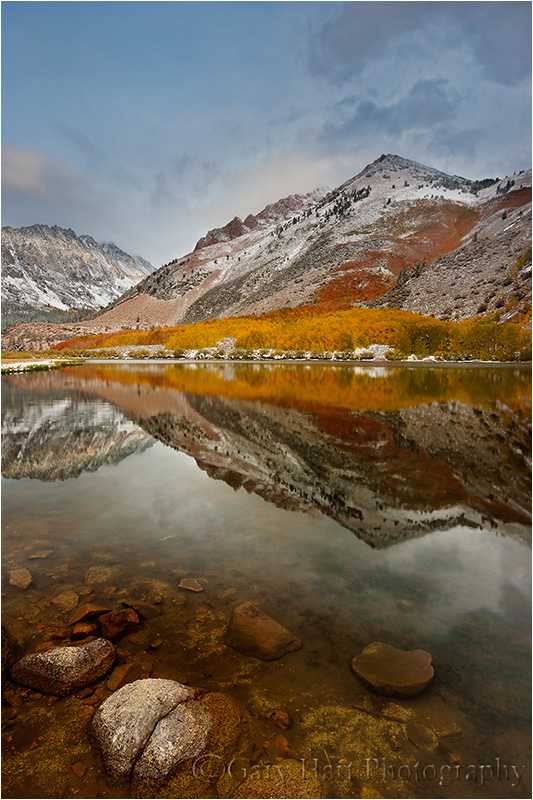
Morning Reflection, North Lake, Eastern Sierra
Nothing communicates the change of seasons like fall color with snow
Don’t think the first snow means your fall photography is finished for the year. Hardy autumn leaves often cling to branches, and even retain their color on the ground through the first few storms of winter. An early snowfall is an opportunity to catch fall leaves etched in white, an opportunity not to be missed. And even after the snow has been falling for a while, it’s possible to find a colorful rogue leaf to accent an otherwise stark winter scene.
About this image

Autumn Yin and Yang, Bridalveil Creek, Yosemite
People sometimes accuse me of adding or positioning leaves in my frame. Those who know me know I don’t do that, but that doesn’t protect me from their (good natured) abuse. For those who don’t know me and who don’t believe I found this leaf like that, I don’t really know what to say, except to explain that the joy I get from photography comes from discovering natural beauty, and a manufactured scene that isn’t natural has zero appeal to me. (I think this is also why I don’t do composites.) I don’t think it’s wrong to place elements in a frame (or to blend multiple images), as long as it’s done honestly—it’s just not something that interests me. But anyway…
I don’t really understand why people think it’s so unusual to find a leaf (or two, or three…) isolated from its surroundings. I aggressively look for small scenes like this, so it should be no surprise that I have a lot of them in my portfolio. While the position of the leaves in my images is randomly determined by nature (or maybe by the unscrupulous photographer who preceded me at the scene), there’s nothing random about my position when I capture these scenes.
Probably my favorite place to photograph isolated leaves is Bridalveil Creek, just beneath Bridalveil Fall in Yosemite. The entire area is decorated with an assortment of deciduous trees that deposit their leaves liberally among the rocks and cascades each fall. And unlike Yosemite’s other waterfalls, Bridalveil Fall runs year-round. Even in autumn, when it’s often barely more than a trickle, there’s enough water to cascade, splash, and pool among the rocks.
Another great thing about Bridalveil Creek is that its location just beneath Cathedral Rocks and Leaning Tower means it gets very little direct sunlight in autumn. So even when the sun’s out, I can spend hours photographing here in the full shade that’s ideal for this type of photography.
On this cloudy October morning I was doing my usual thing, bounding about on the rocks upstream from the trail looking for single leaves to isolate in my frame. My of the cascades here are active enough to splash and wet the rocks, so when a descending leaf hits a wet rock just right, it sticks like glue. I didn’t see this leaf land and stick, but I’ve seen it happen enough to know this isn’t that unusual.
This cascade was about 20 feet away, above a pool that was deeper than I wanted to wade, so I went to my 70-200 lens. I spent a little time casually working this scene, circling, framing it from a variety of positions using different focal lengths. But when I got to this spot and saw the smooth curves and dark flowing into light, my mind immediately went to the Yin and Yang symbol (okay, so maybe you need use your imagination a bit). I dropped down a bit and refined my composition, then started working on the exposure.
Not only was this spot in full shade, the morning was overcast. With my polarizer on to cut the sheen on the rocks and leaves, I knew that slowing the water enough to capture any detail was virtually impossible, so I went all-in on the motion blur and just turned the water a homogenous white. It turns out this decision actually enhanced the yin/yang effect I was going for.
Workshop Schedule || Purchase Prints || Instagram
To better understand the science and timing of fall color, read
The Why, How, and When of Fall Color
A Gallery of Fall Color


:: More photography tips ::
The Why, How, and When of Fall Color
Posted on September 6, 2020

Autumn Cascade, Bridalveil Creek, Yosemite (2005)
Canon EOS-1Ds Mark II
Canon 70 – 200 f/4 L
1 second
F/10
ISO 160
Autumn is right around the corner. To get things started, I’ve updated a previous post that demystifies why, how, and when of fall color.
Few things get a photographer’s heart racing more than the vivid yellows, oranges, and reds of autumn. And the excitement isn’t limited to photographers—to appreciate that reality, just try navigating New England backroads on a Sunday afternoon in the fall.
Innkeeper logic
Despite all the attention, the annual autumn extravaganza is fraught with mystery and misconception. Showing up at at the spot that guy in your camera club told you was peaking at this time last year, you might find the very same trees displaying lime green mixed with just hints of yellow and orange, and hear the old guy behind the counter at the inn shake his head and tell you, “It hasn’t gotten cold enough yet—the color’s late this year.” Then, the next year, when you check into the same inn on the same weekend, you find just a handful of leaves clinging to exposed branches—this time as the old guy hands you the key to your room he utters, “That freeze a couple of weeks ago got the color started early this year—you should have been here last week.”
While these explanations may sound reasonable, they’re not quite accurate. Because the why and when of fall color is complicated, observers resort to memory, anecdote, and lore to fill knowledge voids with partial truth and downright myth. And while we still can’t predict fall color the way we do the whether, science has provided a pretty good understanding of the fall color process.
A tree’s color
The leaves of deciduous trees contain a mix of green, yellow, and orange pigments. During the spring and summer growing season, the volume and intensity of the green chlorophyl pigment overpowers the orange and yellow pigments and the tree stays green. Even though chlorophyl is quickly broken down by sunlight, the process of photosynthesis that turns sunlight into nutrients during the long days of summer continuously replaces the spent chlorophyl.
As the days shrink toward autumn, things begin to change. Cells at the abscission layer at the base of the leaves’ stem (the knot where the leaf connects to the branch) begin the process that will eventually lead to the leaf dropping from the tree: Thickening of cells in the abscission layer blocks the transfer of carbohydrates from the leaves to the branches, and the movement of minerals to the leaves. Without these minerals, the leaves’ production of chlorophyl dwindles and finally stops, leaving just the yellow and orange pigments. Voilà—fall color!
The role of sunlight and weather
Contrary to popular belief, the timing of the onset of this fall color chain reaction depends much more on daylight than it does on temperature and weather. Triggered by a genetically programmed day/night-duration threshold (and contrary to innkeeper-logic), the trees in any given region will commence their transition from green to color at about the same time each year, when the day length drops to a certain point.
Nevertheless, though it doesn’t trigger the process, weather does play a significant part in the intensity, duration, and demise of the color season. Because sunlight breaks down the green chlorophyl, cloudy days after the suspension of chlorophyl creation will slow the chlorophyl’s demise and the coloring process that follows. And while the yellow and orange pigments are present and pretty much just hanging out while they wait all summer for the chlorophyl to relinquish control of the tree’s color, a tree’s red and purple pigments are manufactured from sugar stored in the leaves—the more sugar, the more vivid a tree’s red. Ample moisture, warm days, and cool (but not freezing) nights after the chlorophyl replacement has stopped are most conducive to the creation and retention of the sugars that form the red and purple pigments.
On the other hand, freezing temperatures destroy the color pigments, bringing a premature end to the color display. Drought can stress trees so much that they drop their leaves before the color has a chance to manifest. And wind and rain can wreak havoc with the fall display—go to bed one night beneath a canopy of red and gold, wake the next morning to find the trees bare and the ground blanketed with color.
Since the fall color factors come in a virtually infinite number of possible variations and combinations, the color timing and intensity can vary a lot from year to year. Despite expert advice that seems promise precise timing for the fall color, when planning a fall color trip, your best bet is to try to get there as close as possible to the middle of the color window, then cross your fingers.
About this image
Looking for something to do in this COVID-constrained world, I dialed my way-back machine all the way back to 2005 and landed on this image. I wish I could tell you I have a memory of its capture, but I don’t. I do, however, have lots of general memories of photographing fall color at Bridalveil Creek in Yosemite, just below Bridalveil Fall. Since I’ve never visited Yosemite in autumn without shooting here, when I set out find a fall color image in my archives, I specifically targeted my Bridalveil Creek shoots.
I started by digging up another image from this trip that I’ve always liked, but felt was too soft to share. Given that I virtually never take a single frame of a nice scene, I was pretty confident that I’d find something similar, and crossed my fingers that the sharpness problem was a one-off that I quickly corrected. This is actually the very next image I clicked, and I was very pleased to confirm that it is indeed sharp.
This image is a perfect example of my approach to intimate fall color scenes: Look for color to juxtapose with another feature in the scene. Often that’s a single leaf (no, I do not place leaves, ever), but in this case I accented a nice little cascade with a group of fallen leaves that were plastered against water-soaked granite. And when there’s water motion in the scene, I usually shoot it at a variety of shutter speeds to give myself multiple motion effects to choose between. Looking through my captures from this shoot, I can tell that’s exactly what I did. This image is a 1-second exposure, long enough to blur the cascade, but not so long that I obliterated all detail. And though I have no memory of it, I know I used a polarizer because I always use a polarizer when photographing fall color, and I can tell that the sheen has been removed from the rocks, leaves, and water.
Autumn Intimates
Click an image for a closer look, and to view a slide show.


Up a creek
Posted on February 12, 2017

Wonderland, Bridalveil Creek, Yosemite
Sony a7R II
Sony/Zeiss 16-35 f/4
1/4 second
F/10
ISO 100
Many photographers vary their portfolios by visiting as many locations as possible. While I love visiting new locations, I’ve always preferred the kind of intimate familiarity that’s only possible with frequent, quality visits. And as enjoyable as it is photograph the icons, for my personal pleasure I’m most drawn to quiet pastorals and intimate portraits of nature that could be anywhere—wildflowers, fall color, solitary oaks, sparkling reflections, and tumbling creeks can keep me happy for hours.
One of my favorite intimate settings is Bridalveil Creek beneath Bridalveil Fall in Yosemite. Not only is there lots to photograph here, it’s different every time I visit. In spring the water in all three of the creek’s branches roars down the slope beneath Bridalveil Fall like it can’t get to the Merced River soon enough. And I’m especially fond of Bridalveil Creek in autumn, when the flow is often down to a single leisurely trickle, its whispering cascades and spinning pools adorned with vivid yellow leaves. Winter can find Bridalveil Creek in a variety of states that range from a gentle rivulet to a raging torrent. During one particularly cold winter the creek was solid ice, as if some frostbitten wizard had waved his wand and frozen the flowing water in place.
For some reason I haven’t had as much success here in winter as autumn or spring, so this winter I redoubled my efforts. On last month’s snow trip, while waiting for Yosemite’s monoliths to emerge from the clouds, I headed to Bridalveil Creek and found every square inch covered with snow—not a fine etching, but a dense glazing that covered virtually every exposed surface with several inches of white powder.
I hadn’t even crossed the first bridge when I was stopped by the scene here. I extended my tripod and evaluated the possibilities, starting on the bridge before moving down to a rock right on the creek. My first compositions were horizontal, but I eventually adjusted to vertical to emphasize the creek. Following my standard click, review, refine, click process, I finally landed on this composition—just wide enough to include both sides of the creek, and tall enough to include the parallel tree trunks and the creek’s exit from the bottom of the frame. I had to drop down quite low to get beneath an overhanging branch and keep it from occluding part of the creek.
The non-compositional variables I had to consider were motion and depth of field—there was no wind to sway the branches, but I knew the water’s blur would vary greatly with my shutter speed choice. And because I wanted everything in my frame sharp, I needed to be careful with my f-stop choice. The closest point of interest, the snowy foreground rock, was about five feet away. My hyperfocal app told me that at my 22mm focal length and f/8, my hyperfocal distance was about six feet (sharp from three feet to infinity). Because hyperfocal data draws the acceptable sharpness line a little less critically than I do, I stopped down to f/10 and focused on a small rock about eight feet away. Playing with a few ISOs to vary my shutter speed for different water motion effects, I decided I liked 1/4 second because it blurred the creek enough to clearly convey the water’s speed, but not so much that it lost its definition.
Intimate and Anonymous
Click an image for a closer look and slide show. Refresh the window to reorder the display.


Photographic matchmaking
Posted on December 7, 2016
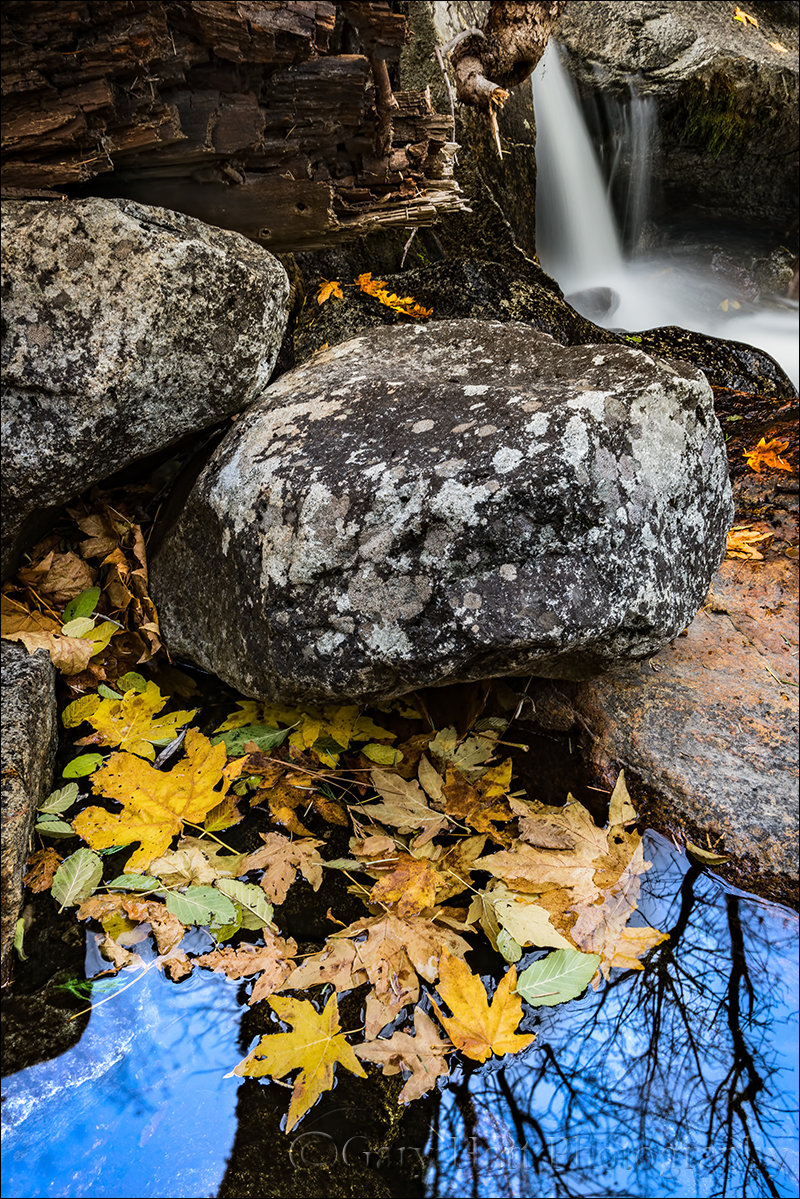
Autumn Pool and Cascade, Bridalveil Creek, Yosemite
Sony a7R II
Sony/Zeiss 16-35 f4
6 seconds
F/16
ISO 200
While everyone loves a pretty scene, I’m afraid our aesthetic sense has been numbed by the continuous assault of “stunning” images online. A picture grabs our eyes on Instagram or Facebook and we reflexively click Like and move on to the next (similarly) stunning image. The photography equivalent of pop music, formula fiction, or (most) network television, these images exit our conscious about as fast as they entered because they fail to make a personal connection.
But every once in awhile an image surprises us and we pause, float our eyes around the scene, examine detail, bask in its mood. Who knows the trigger for such a response? Maybe is as simple as aspect of the scene that spurs a memory or taps a longing. Or maybe the connection reaches deeper than that.
Pictures succeed not just by virtue of their visual elements, but also by how those elements are connected. I used to believe that the sole purpose of including visual elements throughout my frame was to create the illusion of depth in photography’s two-dimensional medium. While I still strongly agree, I think the value of multiple points of visual interest goes deeper than that. Just as humans seek interpersonal connections in our daily lives, I think we’re programmed to favor images with relationships between heterogeneous elements in the nature. Not just Grand Canyon, but Grand Canyon speared by lightning; not just Half Dome, but Half Dome beneath a rising full moon; not just glowing Kilauea Caldera, but glowing Kilauea Caldera beneath the Milky Way.
Creating relationships between elements work on a smaller scale as well (albeit, usually without the opportunity for planning that celestial or meteorological phenomena provide)—small forest scenes and intimate macros benefit from inclusion of multiple elements as well. Of course an image with a disorganized arrangement of elements, no matter how beautiful each is individually, probably won’t get a second look. But find a way to organize a scene’s elements in a way that allows the eye to flow effortlessly through the frame and you have the potential for visual synergy—an image that’s greater than the sum of its visual parts.
The opportunity to connect disparate elements is everywhere if you look, from the broadest panorama to the most intimate macro. Whatever the scale, the key is not locking onto your subject until you find something to pair it with. In other words, finding a photo-worthy subject should never be your goal, it should be your starting point.
Without diving too deeply into the concept of visual weight (a subject in and of itself), I try to create a frame with balance between visual elements (not loaded too much in on of the scene’s quadrants: upper left, upper right, lower left, lower right). I also try to keep objects with a strong visual tug away from the edges of my frame. And finally, I look to position my elements so they’re connected by virtual diagonal lines.
About this image
On the final morning of last month’s Yosemite Autumn Moon photo workshop, I set the group loose in the forest beneath Bridalveil Fall to scour the possibilities in and around Bridalveil Creek. Always a workshop favorite, I usually save the Bridalveil Creek until the workshop’s final day, when my students have found their creative zone after three days of shooting and training. This approach seems to pay off, because no matter how much time I give them in there, it never seems to be enough.
When I found this accumulation of just-fallen autumn leaves floating in a glassy pool, I knew I had the start of a nice scene. Scanning my surroundings, I didn’t have to look hard to find a small cascade to connect with my colorful leaves. But with the pool tucked beneath a fallen log, accessing the best angle was tricky. Sprawling nearly flat on my back beneath the overhanging log, with one tripod leg in the water, turned out to be the best way to maximize the virtual diagonal connecting the leaves and cascade.
The other consideration here was depth of field—the leaves started no more than three feet from my lens, while the cascade was about 12 feet away. To ensure maximum sharpness throughout with getting too far into the diffraction zone, I stopped down to f/16 and focused on the back of the leaves. I wasn’t too concerned about shutter speed and the cascade’s blur because the difference between one and six seconds was insignificant, and freezing the water would have required a ridiculously high ISO, while the pool was so still that I could discern no motion at all.
Purchase Prints
Workshop schedule
A Gallery of Relationships


Letting motion work for you
Posted on December 1, 2014

Autumn Swirl, Bridalveil Creek, Yosemite
Canon EOS-5D Mark III
154 mm
30 seconds
F/22
ISO 100
Of the many differences between our world and our camera’s world, few are more significant than motion. Image stabilization or (better yet) a tripod will reduce or eliminate or photographer-induced motion, but we often make compromises to stop motion in our scene, sacrificing depth of field or introducing noise to shorten the shutter speed enough to freeze the scene.
But what’s wrong with letting the motion work for you? While it’s impossible to duplicate the human experience of motion in a static photo, a camera’s ability to record every instant throughout the duration of capture creates an illusion of motion that can also be quite beautiful. Whether it’s stars streaked into parallel arcs by Earth’s rotation, a tumbling cascade blurred to silky white, or a vortex of spinning autumn leaves, your ability to convey the world’s motion with your images is limited only by your imagination and ability to manage your camera’s exposure variables.
I came across the this little scene in the morning shade beneath Bridalveil Fall in Yosemite. A thin trickle of water entering at the top of the pool, and exiting just out of the frame behind me, was enough to impart an imperceptible clockwise vortex. To my eye, the motion here appeared to be random drift, but I guessed a long exposure might show otherwise.
To ensure sharpness from the closest rock all the way back to the cascade, I was already at f22; by dropping my ISO to 100, dialing my polarizer to minimize reflections (thus darkening the scene by two additional stops), in the already low light I achieved a 30-second exposure. The result was an image that recorded the path of each leaf for the duration of my exposure, revealing that what looked like random drift, was indeed organized rotation.
Visualizing the way your camera will record motion requires practice—the more you do it, the better you’ll become at seeing as your camera sees. Sometimes you’ll want just the barest hint of movement; other times, lots of movement is best. I usually bracket exposures to cover a broad range of motion—not only does this give me a variety of images to choose from, each click improves my ability to anticipate the effect the next time.
A gallery of motion
Click an image for a closer look, and to enjoy the slide show


 Eloquent Images by Gary Hart