Eloquent Images by Gary Hart
Insight, information, and inspiration for the inquisitive nature photographer
My Favorite Things
Posted on August 28, 2022

Sunset Triple Lightning, Hopi Point, Grand Canyon
Sony a7RIV
Sony 24-105 G
1/4 second
F/11
ISO 320
Maria von Trapp had them, you have them, I have them. They’re the favorite places, moments, and subjects that provide comfort or coax a smile no matter what life has dealt. Not only do these “favorite things” improve our mood, they’re the muse that drives our best photography. Sometimes they even inspire dreams about making a living in photography.
But sadly, turning a passion into a profession often comes at the expense of pleasure because suddenly earning money is the priority. When I decided to make photography my livelihood, it was only after observing other very good (formerly) amateur photographers who, lulled by the ease of digital photography, failed to anticipate that running a photography business requires far more than taking good pictures. Rather than an opportunity for further immersion in their passion, their new profession forced them to photograph not for joy, but to pay the mortgage and put food on the table. And with the constant need for marketing, networking, bookkeeping, collections, taxes, and just plain keeping customers happy, these newly minted photographers soon found that precious time remained for the very thing that led them to become photographers in the first place.
Nearly 20 years ago (yikes), armed with these observations I changed from photographer to Photographer. After seeing what this change had done to others, my transition was founded on a vow to photograph only my favorite things.
It shouldn’t take much time in my galleries to figure out where I find my photographic joy. I could point to locations like Yosemite, Grand Canyon, and New Zealand, but even more important to me than locations are the natural phenomena that fascinate me. Whether celestial or terrestrial, I find myself inexorably drawn to the natural processes that created and affect the world we share.
The why of this starts with growing up in a family that camped for our vacations—I just have lots of great memories of nature. But the other significant factor behind my favorite photographic subjects comes from a fascination with the physical sciences that started in my single-digit years with an interest in comets, and quickly grew to include pretty much anything in the night sky. But even then I wasn’t satisfied with simply looking at the night sky, I wanted to understand what was going on up there. And with that came a realization that Earth is actually part of the cosmos, and soon I was reading about geology and meteorology and pretty much any other ology that had to do with my place in the Universe.
All of this came before I ever picked up a camera. But it might explain why I feel so strongly actually understanding the things I photograph—if they give me join, they’re worth knowing. Whether it’s lightning, reflections, the Milky Way, rainbows, a beautiful location, or whatever, I’ve reached the point where I simply won’t post an image of something I don’t understand.
And because I enjoy writing as much as I enjoy photography, you may have noticed that I also virtually never share an image without writing something about it. I know a lot of people just follow my blog to see my images, and that’s totally fine. But these really are my favorite things in the world, and I truly appreciate that you’ve taken the time to view, and (especially) to read this far.
Keeping in that spirit, here’s a little information about lightning, excerpted from my Lightning Photo Tips article:
A lightning bolt is an atmospheric manifestation of the truism that opposites attract. In nature, we get a spark when two oppositely charged objects come in close proximity. For example, when you get shocked touching a doorknob, on a very small scale, you’ve been struck by lightning.
In a thunderstorm, the up/down flow of atmospheric convection creates turbulence that knocks together airborne water (both raindrops and ice) molecules, stripping their (negatively charged) electrons. Lighter, positively charged molecules are carried upward in the convection’s updrafts, while the heavier negatively charged molecules remain near the bottom of the cloud. Soon the cloud is electrically polarized, with more positively charged molecules at the top than at the base.
Nature really, really wants to correct this imbalance, and always takes the easiest path—if the easiest path to electrical equilibrium is between the cloud top and cloud bottom, we get intracloud lightning; if it’s between two different clouds, we get intercloud lightning. And the less frequent cloud-to-ground strikes occur when the easiest path to equilibrium is between the cloud and ground.
With lightning comes thunder, the sound of air expanding explosively when heated by a 50,000-degree jolt of electricity. Thunder travels at the speed of sound, a pedestrian 750 miles per hour, while lightning’s flash zips along at the speed of light, more than 186,000 miles per second—nearly a million times faster than sound.
Knowing that the thunder occurred at the same instant as the lightning flash, and the speed both travel, we can calculate the approximate distance of the lightning strike. While we see the lightning pretty much instantaneously, regardless of its distance, thunder takes about five seconds to cover a mile. So dividing by 5 the number of seconds between the instant of the lightning’s flash and the arrival of the thunder’s crash gives you the lightning’s approximate distance in miles (divide by three for kilometers).
But anyway…
About this image
As a lifelong Californian, lightning was just something to read about, and maybe see in movies, but rarely viewed in person. And photographing it? Out of the question.
That changed in 2012 when Don Smith and I traveled to the Grand Canyon with our brand new Lightning Triggers and absolutely no clue how to photograph lightning. We returned with enough success to be completely hooked on lightning photography, and a plan to offer Grand Canyon photo workshops focused on the Grand Canyon monsoon and (fingers crossed) lightning. After a few years Don cut back on his schedule and dropped most of his domestic workshops (we still partner for New Zealand and Iceland workshops), but I’ve continued with the Grand Canyon Monsoon workshops. This year I did two Grand Canyon Monsoon workshops, the second of which was probably my most memorable lightning workshop so far—if not for the quantity of the lightning (very good but not record breaking), certainly for the quality.
The image I’m sharing today came on that workshop’s penultimate evening, and came the day after a similarly spectacular lightning show at Cape Royal (I blogged about it two weeks ago). At Cape Royal I commented that this was one of the top five lightning shoots I’ve ever had. Little did I know…
The following night we rode the shuttle out Hermit’s Rest Road, stopping first at the very underrated Pima Point. After spending nearly an hour at Pima, pointing at a potential cell that only teased us, we packed up and headed to Hopi Point for sunset. There really wasn’t much going on when we got there, but the clouds were nice and the sky looked promising for a good sunset.
As sunset approached, what may have been the remnants of the cell that had disappointed us at Pima Point seemed to regroup and start moving from left to right across our scene and toward the canyon. The first reaction to this development was, “No big deal” (fool me once, …). But just one relatively weak bolt was enough to send us all scrambling for our Lightning Triggers. Everything after that is pretty much a blur because as the storm slowly advanced, some unseen force turned the lightning up to 11—both its frequency and intensity.
In my July 31 post I shared an image of a rogue Hopi Point lightning bolt that was somehow perfectly placed above the canyon right at sunset. As the only lightning we saw all evening, this one felt like a gift from heaven. This evening’s lightning was similarly positioned, but much bigger, and I lost track of the number of bolts we saw: double strikes, triple strikes, serpentine strikes—pretty much a lightning photographer’s entire wish list all in one show.
Hopi Point access is by shuttle-only, which means if we miss the last shuttle we’re walking more than 2 miles back in the dark. The lightning was still going strong when we hopped onto the final shuttle in growing darkness, but given what we all knew we had, no one was too disappointed.
Here are a couple of images from Cape Royal the night before this image


And here are the two more images from this night’s shoot at Hopi Point


I realize that I get far more excited about lightning than the average person. And I’m truly sorry for sharing so many lightning images, but you’ll just have to understand that not only is lightning a novelty for me, and (please) recognize my good fortune for being able to make my living photographing nothing but my favorite things.
These Are A Few Of My Favorite Things
Click an image for a closer look, and to view a slide show.


In a Fog
Posted on August 21, 2022

Morning Glory, Point Imperial Sunstar, Grand Canyon
Sony 𝛂1
Sony 24-105 G
.6 seconds
F/20
ISO 100
Born and raised in California, my relationship with fog is both long and complex. I spent the first 12 years of my life in the San Joaquin Valley, where winter “tule fog” could be so thick that sometimes drivers could only navigate by opening the door and hanging their head out to follow the yellow line. Accidents involving dozens of cars were common. In elementary school (we called it grammar school back then), my classmates and I celebrated the “fog days” when school was cancelled because the visibility was too poor for the school buses to safely navigate their routes. On the foggy days school wasn’t cancelled, a favorite recess activity was to venture far enough onto the playground for the school to disappear, spin a few times to erase all sense of direction, then try to find our way back to school before the bell rang. And at least once I actually got lost walking to school in a dense fog.
When we moved to Berkeley the summer before I started middle school (a.k.a., junior high), my relationship with fog changed. No longer a winter phenomenon, fog in Berkeley blew in through the Golden Gate on summer afternoons, turning a shorts and T-shirt lunchtime into a long pants and sweater dinnertime. Most summer days required multiple wardrobe changes.
Playing baseball at Skyline College (San Bruno) and San Francisco State University, I realized that Bay Area fog provided a true home field advantage. I have very vivid memories of sitting in the dugout or bullpen, toasty-warm in my insulated warm-up jacket, and watching our opponent, who had arrived dressed for the comfortable warmth of pretty much any other California location, huddled against the wind and fog in the visitors’ dugout—and, I suspect, contemplating rubbing bats together to start a fire (yes, all baseball bats used to be made of wood, even in college).
Photographing Yosemite in my adult years, I quickly grew to appreciate the fog that hovers on the floor Yosemite Valley on chilly, still mornings. And to many, the shape-shifting fog that wraps Yosemite Valley as a storm clears is the Holy Grail of Yosemite photography.
Though fog comes in many forms, it can be a simple matter of perspective: to the viewer at sea level, a missing mountain peak has been swallowed by clouds; the mountain climber on the summit, however, thinks she’s ascended into a fog bank. Both are right. And while many processes are at play, the bottom line is that fog (and clouds) will form when the temperature of moist air drops to its saturation point.
Despite (or maybe because of) my lifelong relationship with fog, I’m afraid I’ve taken it for granted. This fact became pretty clear one morning at the Grand Canyon earlier this month. On a trip where lightning was the undeniable goal, the most memorable shoot of the first workshop was a foggy sunrise at Point Imperial. To say this wasn’t on my radar would be an understatement.
At 8900 feet above sea level, Point Imperial is the highest vista in Grand Canyon National Park. This extreme elevation provides a top-of-the-world view to the north, east, and south to a who’s who of Northern Arizona landmarks: the Vermillion Cliffs, the Painted Desert, Marble Canyon, and the confluence of the Colorado and Little Colorado Rivers (you can’t see the rivers themselves, but you can see the intersection of their canyons). And as if weren’t enough, Point Imperial’s foreground landscape is dotted with an assortment of prominent mesas, buttes, and other rocky outcrops. My favorite view here is facing east and south, where a natural bowl filled with layered sedimentary prominences is anchored by nearby Mt. Hayden, a towering spire that dominates the view.
Sunrise was still more than 30 minutes away when I guided my first workshop group into the parking lot at Point Imperial. Below us, a few wisps of fog dotted the bowl, but offered no hint of what was in store. With several spots to set up here, in the darkness I was more focused on making sure my group was situated than I was on the scene, but when I looked back toward the view it was pretty clear that the fog was spreading and rising. With everyone in place, I raced back to the car and grabbed my camera bag.
For the next hour or more, we watched (and photographed!) the rocky features become islands in the clouds, submerge completely, then gradually reappear. A couple of times the fog rose enough to completely engulf us and erase the view. The first time this happened, the group was ready to pack up and return to the cabins with the morning’s (already thrilling) spoils, but remembering similar fog formation experiences in Yosemite, I suggested that there’s a good chance the fog will retreat as quickly as it advanced, and that we might be able to photograph everything we just witnessed, only in reverse. Sure enough, within five minutes the rocky island reemerged, and soon the entire view was back. And just when it looked like the show might be over, here came the fog again.
Because my group gets a little spread out at Point Imperial, I wasn’t able to take as many pictures as I otherwise would have, but here are three of the morning’s highlights I did manage to capture (with brief descriptions below).
One Foggy Morning at Point Imperial (July 28, 2022)


Before rising into a cloud layer that covered most of the sky, the sun slipped through a small opening on the horizon long enough to fringe the billowing fog with golden light just as I’d set up for a sunstar. And the sun wasn’t quite done. I’ve always been a fan of the way the rising sun illuminates Mt. Hayden and the surrounding rocks with warm light, but when I glanced in that direction, I saw no direct sunlight on the rocks. I did, much to my surprise, see a small fragment of rainbow that served as a perfect accent to the foggy scene in that direction. The third image came toward the end of the shoot, shortly after the final wave of fog had started to retreat. The rocky spire peaking through the fog in the foreground is Mt. Hayden.
Lots More Fog
Click an image for a closer look, and to view a slide show.


Beam Me Up
Posted on August 7, 2022

Evening Glory, Desert View, Grand Canyon
Sony a7RIV
Sony 24-105 G
1/100 second
F/20
ISO 100
I won’t lie: The primary reason I go to the Grand Canyon in monsoon season—and for that matter, the primary reason most people sign up for my Grand Canyon monsoon workshops—is to photograph lightning. But as we all know, lightning is a fickle phenomenon, even during the Grand Canyon’s usually electric monsoon season. Because lightning is never guaranteed, I always do my very best to moderate my own expectations, and to let people who sign up for a workshop know I can’t promise it. But still…
Fortunately, the Grand Canyon in any season is pretty spectacular, and especially so during the monsoon. The carved sediment’s enduring beauty, combined with billowing cumulus clouds that turn some shade of pink, red, and/or orange at sunrise/sunset, and sometimes (fingers crossed) deliver vivid rainbows, makes the Grand Canyon summer monsoon my favorite time to be on the rim, even without lightning. But still…
The forecast the for the final day of this year’s second (and final) workshop was “Sunny,” the first such forecast I’d seen in my nearly two weeks at the Grand Canyon. But I’ve learned that a monsoon “Sunny” forecast just means fewer clouds, and rarely no clouds. And you never know—even with no rain or clouds in the forecast, I made sure everyone in the group packed a Lightning Trigger because I can share multiple stories of similar Grand Canyon forecasts that nevertheless resulted in lighting. Alas…
If you were expecting one of those plot-twist happy endings, you’ll be disappointed. Because as you might infer from this image, we did not get any lightning this evening. But as you can also see, we had no reason to be disappointed.
After a short stop at Moran Point, the group and I spent the rest of that afternoon and evening photographing my three favorite Grand Canyon vistas, first at Lipan and Navajo Points, before setting up for our final sunset at Desert View.
All three of these views stand out for their view of the Colorado River’s 90 degree detour from a north/south trending river to an east/west trending river. Standing on the rim at any of these vistas offers expansive views north, upstream and into Marble Canyon, and west, downstream toward what’s arguably Grand Canyon’s most iconic stretch. I can’t think of any other rim view that offers bigger, better views of the canyon than these east-most South Rim vistas. (But Hopi Point is close.)
Despite lowered expectations, we departed this afternoon hoping for lightning (which, I should add, given the two sunset lightning shoots that preceded this sunset, was downright greedy). Instead we found the canyon walls bathed in warm light shafting through scattered clouds hang above the western horizon. Not lightning, but too shabby either.
Even before the light started to warm, I decided that the best show this evening would be to the west, featuring the canyon’s receding ridges below the setting sun. And with a slight haze hanging in the canyon, what excited me most was the potential for sunbeams streaming through openings in the clouds and gaps in the ridges.
I digress
This might be a good time to explain the difference between some popular but different phenomena popular among landscape photographers: sunstars (or sunbursts, starbursts, and probably some other labels I’ve missed), sunbeams, and crepuscular rays.
- Sunstars are diffraction spikes that are created in the lens when sunlight is bent by the slight change of direction at the intersection of the lens iris’s blades (that comprise the aperture). They’re a photographic phenomenon, visible in the viewfinder and resulting image, but not to the unaided eye.
- Sunbeams are atmospheric phenomena caused when sunlight passes through openings in clouds or landscape features like tree branches or mountain peaks. They’re visible to the unaided and most prominent when the atmosphere is filled with water or dust particles that scatters the sunlight.
- Crepuscular rays are sunbeams that happen at twilight, only when the sun is below the horizon and its light passes through clouds, mountain peaks, or some other unseen obstruction beneath the horizon. As a subset of sunbeams, crepuscular rays are also atmospheric phenomena visible to the unaided eye, and benefit from airborne dust or water vapor.
So anyway…
Expectations reset, I shifted to the dual potential for both a large sun and sunbeams, and prepared accordingly: already on my Sony a7RIV was my Sony 24-105 f/4 G lens; to my Sony 𝛂1 I added my Sony 100-400 GM lens and Sony 2X Teleconverter. I started shooting as soon as the sunbeams appeared, using the wider setup to capture as much canyon and shafting light. Early on I occasionally switched to the telephoto; once the sun dropped below (most of) the clouds and the sunbeams faded, I finished up entirely with the telephoto combination.
The trick to exposing a scene like this with one click (always my goal) is to make sure I don’t blow out (overexpose) the highlights. While I had no expectation of capturing detail or color in the sun (it was too bright to prevent from blowing out), I knew the surrounding clouds and sky had the potential to turn a rich yellow-gold before the sun dropped below the horizon. Saving the sky color would mean underexposing the canyon, but closely monitoring my histogram enabled me to capture just enough foreground light to retain the outline of the ridges shrinking in the distance, at the same time preventing that great sky color from washing out.
The result is this image, with a sky that’s remarkably close to what I saw and a foreground that’s much darker than my eyes saw. Since this image is all about the sky and sunbeams, letting the canyon go dark (-ish) aided that emphasis. Even though the canyon looked nearly black on my camera’s image-review screen, a moderate Lightroom Shadow-slider increase confirmed later that the dark foreground contained exactly the amount of detail I wanted. Score another win for the histogram. (And if you’re wondering why I used f/20, it’s because I’d set up for a possible sunstar and forgot to switch back to the f/11 I usually default to.)
One more thing
Lest you feel sorry for my second workshop group for not getting lightning, let me reassure you that this group did not lack for quality lightning. At Cape Royal two nights before this, we witnessed what I instantly called one of the top-5 lightning shoots of my life. Then at Hopi Point the next night, we witnessed a lightning display that arguably topped it. I have so many excellent lightning images from these two shoots that I haven’t had time to go through them and decide which ones to process. And since I shared a lightning image (from the first workshop) last week, I figured I’d share something that’s not lightning. But rest assured, I’ll be sharing more lightning soon. Lots more.
Grand Canyon Photo Workshops
More Monsoon Magic
Click an image for a closer look, and to view a slide show.


Wait for it…
Posted on July 31, 2022

Electric Sunset, Hopi Point Lightning, Grand Canyon
Sony 𝛂1
Sony 24-105 G
.4 seconds
F/16
ISO 200
Landscape photographers have a couple of ways to make nice images. By far the most important is the ability to see the special but less obvious, then know how to compose and expose that special vision in ways that clarify and convey the previously unseen beauty. But sometimes we just need to know when to show up and where to point the camera, and the patience to wait for the special to come to us.
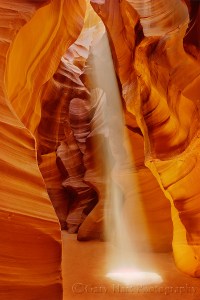
Pretty much any sunrise or sunset at a nice location qualifies for the show up and wait approach, as can popular classics such as Yosemite’s Horsetail Fall in February, or the midday shaft of light in Upper Antelope Canyon’s main room. But whether it’s a planned sunset that went even better than hoped, or a rainbow that seemed to materialize out of nowhere, in their own way these gifts from Nature that don’t require great vision are just as thrilling as the hidden discoveries we work so hard for.
-

- Horsetail Fall and El Capitan, Four Mile Trail, Yosemite
-
- Heavenly Beam, Upper Antelope Canyon, Arizona
Lightning photography requires a lot of the show up and wait approach, because all the compositional skill in the world can’t make a great lightning image if the lightning doesn’t happen. I can’t tell you how many times I’ve been photographing lightning and seen a beautiful composition—some perfect combination of landscape and conditions—in a different direction, and said to myself, “Wow, wouldn’t it be great if the lightning fired right there.” Unfortunately, lightning is a fickle phenomenon that rarely does what photographers want it to do. In fact, it sometimes feels like the lightning is consciously avoiding the composition I want, always in favor of something much less interesting. Sigh…
Right now I’m at Grand Canyon, trying to take advantage of its expansive vistas that frequently provide views of multiple rain cells with lightning potential. While the vast majority of these potential lightning sources never deliver, my original approach to photographing them was to maximize my chances by identifying and targeting the cell with the most potential, without concern for the composition. An alternate approach to photographing lightning is to target the rain cell with the nicest composition, regardless of the strength of its potential—then hope.
Because I’ve learned that lightning neophytes are usually thrilled to capture any lightning, I generally encourage my workshop students, most of whom have never captured great (or any) lightning images, to favor success over the best composition by simply pointing in whatever direction the lightning is most likely to fire.
I’ll never forget the first time I traveled to the Grand Canyon with the sole desire to photograph lightning, and those first few fruitless days on the rim, pointing my camera toward a promising cell only to see it fizzle. I’d have given anything to have just one frame with lightning, composition be damned. And I also never forget the thrill the first time my camera captured lightning.
Ten years later, I’ve reached the point in my lightning photography where I’ve had enough successful captures that I can afford to be a little more selective. In recent years I frequently find myself pointing at the potential lightning spot that has the composition I like most, shunning the one that appears most likely to produce lightning. It’s often a recipe for failure, but the infrequent successes more than compensate.
I got my most recent dose of compensation last Wednesday evening, in this year’s first (of two) Grand Canyon monsoon photo workshops. My group had already enjoyed several lightning shoots from various locations on the South Rim, but nothing spectacular so far. For sunset Wednesday evening, we took the shuttle out Hermit’s Rest Road (no cars allowed). There are many vistas on this route, so I gave my group enough time to visit as many stops as the wanted to, with the understanding that we’d all gather back at Hopi Point to shoot sunset together there.
Soon after arriving at Hopi Point about 45 minutes before sunset, I checked my My Lightning Tracker app and saw that all of the activity was at least 50 miles away and didn’t really align with anything interesting. While the view at Hopi Point is one of my favorites, I’ve photographed here so much that now I only bring out my camera when there’s potential for something spectacular—either lightning, or great color and/or clouds. So my camera stayed in the bag.
With almost 100 percent cloud cover, my decision seemed reasonable, but as the sun dropped, a small opening appeared on the western horizon, directly in the sun’s path. “Hmmmm,” I said, inching toward my bag. I looked again. A sky filled with clouds and a hole on the horizon is the ideal combination for a colorful sunset, so I pulled out my Sony α1, already loaded with my Sony 24-105 G lens, and set up shop along the rail to wait with the rest of my group.
As we chatted, it became pretty clear that the opening would persist through sunset, and that something nice was in store. A few minutes later, when a small rain curtain spread just to the right of the sun’s path, I said out loud, “All this scene needs is a lightning bolt.” I was half joking, but this thought prompted me to check my lightning app one more time. Still nothing really exciting, but there were hints of distant, minor lightning activity in the general direction of the sunset, so I pulled out my Lightning Trigger—just in case. I encouraged the rest of the group to get theirs out too, then quickly scanned the horizon for other rain curtains with potential for lightning—I saw a couple that might produce, but nothing promising enough to justify anyone diverting from the sunset.
Then we waited and clicked as the sun dropped and started to light the sky. It turned out that the opening wasn’t as open as we’d hoped, so not enough sunlight made it through to color the entire sky, and we never actually even saw the sun. But all was not lost, as the clouds near the horizon throbbed a brilliant reddish orange and I could tell by all the clicking that everyone was pretty thrilled.
When a few higher clouds lit, I oriented my camera vertically and angled farther upward for more sky than I usually include here (Pro tip: the Grand Canyon is usually more interesting than the sky.) Already pretty content with what I had so far, imagine my surprise when, just as the color reached its crescendo, a streak of light darted from the clouds and kissed the horizon. My first reaction was that it came from higher in the sky than I’d have expected, but it happened so fast and unexpectedly that I really wasn’t sure what I’d seen. In fact, if the rest of the group hadn’t exclaimed in unison, I might not have believed I’d seen it at all.
The unified exclamation quickly turned to joyful laughter from those who had taken the time to attach their Lightning Triggers, and regretful moans from those who hadn’t. When a couple of people defied my recommendation to not check to see if they’d captured the bolt (you have to turn off the Trigger to review images, and often lightning’s not as visible on the review screen as it is on a computer) and reported success, I couldn’t resist and checked mine too.
There it was. I instantly saw why it had appeared to originate so much higher: the bolt had emerged high, slid across the front of the thunderhead, and weaved through a window in the clouds before disappearing and emerging one last time. And perfectly aligned with the Colorado River, it couldn’t have struck in a more ideal place if I’d have drawn it in myself.
I’ll admit that this image isn’t a creative masterpiece (the composition isn’t much different from several of my other Hopi Point images), but I will take a little credit for being there, and also for the foresight to be ready for lightning when its possibility wasn’t obvious. And honestly, it was simply an honor to be there for something so magnificent—my only job was to wait, and not screw it up.
My Lightning Gallery || My Lightning Photo Tips Article
Worth Waiting For
Click an image for a closer look, and to view a slide show.


Thank You, Dad
Posted on June 19, 2022

Dark Night, Milky Way Above the Colorado River, Grand Canyon
Sony a7SIII
Sony 14mm f/1.8 GM
ISO 6400
f/1.8
20 seconds
Last night I completed a 30-hour odyssey that started in Sacramento, included stops in San Francisco, Fiji, and Aukland, before finally reaching its merciful conclusion in Queenstown, New Zealand (one car, one taxi, one bus, three airplanes, and lots of airport walking throughout). So forgive me if I’m not in shape (or in the mood) for writing a new blog. Instead, in honor of Father’s Day, I’m sharing this blog post from a couple of years ago honoring my father. I did, however, muster the energy to write few paragraphs about this image taken on the first night of last month’s Grand Canyon raft trip, which I have added at the bottom of this post, just above the gallery.
Had we not lost him 18 years ago, my dad would be turning 92 next month. He was a such a vibrant, healthy person, both mentally and physically, that I have no doubt he’d still be going strong if Alzheimer’s hadn’t taken him. I have always been grateful for Dad’s love, gentle discipline, wisdom, advice, and laughs (can’t forget the laughs), but it takes being a parent to fully appreciate our own parents’ love, and their influence on the adults we become.
Dad was a United Methodist minister who literally practiced what he preached. Just one example: In 1965, when Martin Luther King issued a plea for clergy to join him on his voting rights march to Montgomery, Dad borrowed money and flew across the country to join Dr. King in Selma, Alabama (where he was on national TV getting arrested with hundreds of other marchers).
His was an inclusive, Jesus-centric theology that honored all religions and people. He’d do things like open his pulpit to the local rabbi on Sunday morning, then reciprocate the following Saturday with a sermon of his own at the synagogue. Dad welcomed everyone into his churches, and became an outspoken advocate for LGBT rights long before it reached the mainstream. He frequently provided odd-jobs around the church to people who were down on their luck, and I lost track of the number of homeless people, including families with young children, we housed while they tried to get back on their feet.
In addition to the values he instilled, so many of the things that define my personality are directly attributable to my dad’s influence. My positive spirit, sense of humor, and love for sports were absolutely modeled by Dad. And when asked how I became a photographer, the instant answer has always been that my dad was a serious amateur photographer whose 80-hour work week offered too little time to pursue his passion, so he made up for lost time on our summer family vacations. So frequent were our photo stops, I grew up believing that a camera was just a standard outdoor accessory.
But I think his influence on my photography goes deeper than that. More than simply modeling camera use, Dad instilled in me his appreciation of nature’s beauty, and his longing for its soothing qualities. I realize now, because I see it in myself, that it’s not simply photography that dad loved, he was motivated by an insatiable desire to record and share the people and places he loved.
On a minister’s budget, our family summer vacations were, without exception, camping trips—always tent-camping, though in the later years we splurged on a used, very basic tent trailer (no kitchen, bathroom, or any of the other luxuries available in today’s tent trailers). These vacations usually took advantage of the mountain scenery within a few hours of our California home (we were just as close to the ocean, but our vacations were almost always in the mountains), but a few times our family (Dad, Mom, my two younger brothers, and I) hit the road for a much longer camping trip. Some of my most significant childhood memories came on the full month we camped all the way across the United States and back, and a multi-week camping adventure into and around the Canadian Rockies.
Of our more frequently visited destinations, Yosemite was the clear favorite. Marveling at the Firefall from Camp Curry and Glacier Point, waiting in lawn chairs with hundreds of fellow tourists at the Yosemite garbage dump for the bears to arrive for their evening meal (really), rising in the dark for a Dad and Gary (only) fishing expedition to Tuolumne Meadows, family hikes up the Mist Trail to Vernal and Nevada Falls, are just a few of the memories that I realize in hindsight formed the bedrock of my Yosemite connection.

Here’s my dad’s Half Dome Rainbow, captured on a summer afternoon in the mid-sixties.
My favorite Dad photography story happened when I was about ten. It involves an electrical storm atop Sentinel Dome, and his desire to photograph a lightning bolt, a desire so great that it trumped common sense. As his ignorant but trusting assistant, to keep his camera dry I stretched high to extend an umbrella above Dad’s head. (In his defense, as Californians, the novelty of lightning obscured a full comprehension of its dangers.) We didn’t get the lightning, and more importantly, it didn’t get us. But that’s not the end of the story.
After risking our lives on Sentinel Dome, the family ended up at Glacier Point, just down the road. Dad had returned to tourist mode as we browsed the shop at Glacier Point Lodge, no doubt seeking souvenirs that would fit our meager budget. But when a vivid rainbow appeared out of nowhere to arc across the face of Half Dome, Dad was ready with his camera still draped around his neck. Watching Dad’s excitement, better than any souvenir, this felt as if God was giving him a much deserved, “I got your back.”
I love you, Dad.
About this image
Another life-long interest I can thank my dad for is my love for astronomy. Even though Dad’s interest in astronomy was little more than an enthusiastic marveling at the stars we saw on our summer camping trips, as soon as he sensed my attraction to the night sky, he went to work figuring out how to get me a telescope. Limited, as always, by his minister’s salary, he somehow negotiated with a fellow Kiwanis member and serious amateur photographer the gift of a no longer used 6-inch reflector telescope that was far better than anything I could have hoped for. (I was especially proud to discover this photographer’s name in the photo credit for a nebula image in one of my astronomy books.)
Today I trace my lifetime fascination with the night sky all the way back to this simple act of support from my father, a fascination that manifests today in a love for photographing the stars above my favorite landscapes. It’s why so many of my workshops attempt to account for the night photography opportunities, including my annual Grand Canyon raft trip, which I always schedule a moonless week in May.
Because in May a view of the brilliant core of the Milky Way requires a good view toward the southern horizon, and the Grand Canyon trends mostly east-west, and campsites are first-come, first-served, it’s not necessarily a sure thing. Other important factors are an open view of the river for a foreground, and raft parking upstream from our river view.
In the eight years I’ve done this trip, I’ve identified several target campsites, and on the first night of this year’s trip we found at a new camp that instantly became one of my favorites. The problem here was the only place to put the rafts was right in front of the view, so as soon as we had the rafts unloaded I went exploring and found a great little beach a couple of hundred yards downstream.
The problem was that getting here required a little boulder scrambling that was doable for most in broad daylight, but not an option in the utter darkness of a Grand Canyon night. But just past the boulder field I found a spot with enough room for campsites and a straight, easy walk down to the river. So I advised the group that anyone interested the best night photography should lug their gear up the hill and over the boulders now.
At least six others took my advice. Relying on my aging body’s inability to sleep through the night, I didn’t bother setting an alarm and woke up naturally (always the best way) around 2 a.m., just as the Milky Way’s core was slipping over the canyon wall. I found two or three already shooting away at the river, and during the hour or so I was down there we were joined by several others.
Most of us started at the most easily accessed spot right on the river, but after a while I moved a few dozen yards downstream to see what the view was like there. After negotiating a few boulders, I found myself on a flat sandstone platform just a couple of feet above the river, with what I thought was an even better view. I let everyone know my discovery and was soon joined by two or three more adventurous souls. A great start to a great trip.
One more thing
I’m sure my dad had no idea at the time the significance his simple act of support would have on the rest of my life. Just something that I hope all parents, or prospective parents, keep in mind.
Join me in the Grand Canyon
Night Sky


It’s a Wide, Wonderful World
Posted on June 13, 2022

Cascade, Deer Creek Fall, Grand Canyon
Sony 𝛂1
Sony 12-24 f/4 G
1/4 second
F/16
ISO 100
I used to consider my 16-35 lens ultra-wide (by many definitions, it is), and as such, all the focal width I needed—the difference between 12mm and 16mm didn’t seem enough to justify another lens. I photographed in blissful ignorance until 2015, when, on a spring morning in Yosemite, I borrowed a friend’s Canon 11-24 lens. With the help of my Metabones adapter, I mounted the lens to my Sony a7RII and peered into the viewfinder toward a familiar scene that I’d only known through my 16-35 lens. The scene that greeted me had instantly transformed into something I’d never imagined possible. Suddenly I could capture everything rather than having to decide what to exclude.
The epiphany that there is indeed a significant difference between 16mm and 12mm caused me to briefly entertain the idea of buying (and adapting) my own Canon 11-24 lens. But that lens’s extreme bulk, that was matched only by its extreme price tag, quickly cured me of that urge. My reward for passing on the Canon lens came two years later, when Sony announced the 12-24 f/4 G lens that was less than half the weight, almost half the price, and just as sharp. A couple of years later Sony added a 12-24 f/2.8 GM lens, even sharper than its predecessor, while still faster, smaller, and (a little) cheaper than its Canon counterpart.
So of course I now own both (because I couldn’t bring myself to part with the G when I got the GM). Now my primary Sony 12-24 is the GM lens, but I don’t hesitate to use the G version when ounces matter, such as on my Grand Canyon raft trip, or when I’ll be doing significant hiking. (I also bring it to my Yosemite workshops to loan to Sony shooters at some of the spots that beg for 12mm.)
While I don’t use my 12-24 lenses as much as I use my 24-105 or 16-35 lenses, that focal range has become such an important part of my creative workflow in the field that I can’t imagine not having one with me at all times. Not only does a 12-24 provide greater compositional flexibility, I feel like it’s upped my creative game too.
But, to paraphrase Spider-Man (okay, so actually it was his Uncle Ben), with great power comes a steep learning curve. Despite the fact that wide angle is the reflex response to most landscapes by virtually every tourist who picks up a camera, I quickly discovered that good ultra-wide photography is not easy. From shrunken backgrounds to skewed verticals, wide angle lenses pose problems that magnify as the focal length widens. Fortunately, these problems can be turned to opportunities when they’re fully understood. With that in mind, here are a few insights that might help:
- Put something in your close foreground. I can’t emphasize this too much. Some of my wide angle images put the primary subject front and center, but when the background scene is my main subject, I try to find something of visual interest for my foreground. Browse the gallery at the bottom of this post and note how many images have an empty foreground (Hint: Not very many). Sometimes I’m able to include something as striking as a mirror reflection or colorful leaves, but often my wide angle foregrounds are as simple as a rock or shrub. If there’s nothing at my feet and I need to find something a little farther away, at the very least I want the foreground of my wide image to be filled with features worthy of the space they occupy.


- In a rectilinear lens (which most wide lenses are), parallel lines will be rendered straight only if the camera is level. To confirm, try this: Mount an ultra-wide lens (whatever your widest lens is) on your camera, point it at a row of nearby trees, and slowly tilt the camera up and down while looking through your viewfinder. Note how the trees straighten as the camera approaches level, and increasingly skew the more the camera tilts. For example, the two images below were captured the same day using 12mm with the same 12-24 f/4 G lens—see how straight the trees are in the El Capitan image compared to the Yosemite Falls image? In other words, when you see extreme tilt in an ultra-wide lens, blame (or credit) the photographer, not the lens.


- Take advantage of the extreme depth of field wide angle provides. For example, at 12mm and f/11, the hyperfocal distance is 18 inches (focus 18 inches away and everything from 9 inches to infinity will be acceptably sharp). Stop down to f/16 and the hyperfocal distance is 12 inches (acceptably sharp from 6 inches to infinity). While hyperfocal focusing in today’s age of extreme resolution is a little more nuanced than that, the point is, you can get really close to your subjects and be sharp from front to back. Read more about hyperfocal focusing.


About this image
My annual Grand Canyon raft trip has so many mind-blowing sights that I really can’t give you a favorite—the best I can do is offer an unranked list of favorites. I’ve already shared images from last month’s trip of two on that list (Little Colorado River and Elves Chasm), so today I’m sharing a third: Deer Creek Fall.
Deer Creek Fall is visible from the Colorado River and far from a secret, but my guides and I have become pretty good at getting it to ourselves, and this year we succeeded wonderfully. While about half the group embarked on the short (1/2 mile) but steep (!) hike to the slot canyon above the fall and the beautiful “patio” area beyond, I stayed behind to photograph a rainbow at the bottom of the fall, and to wait for the light to improve. Since you can walk right up to this 150 fall (and under it if you’re adventurous), I immediately reached for my Sony 12-24 f/4 G lens and attached it to my Sony α1.
Starting at the fringe of the pool beneath the fall, I played with a variety of compositions before eventually clambering down into this little cascade about 30 feet downstream. And when I say into, I really do mean in-to—to get close enough and align the cascade with the fall, I had to stand in about 18 inches of rushing water with my tripod splayed in three directions—two legs nearly horizontal and planted on opposite sides of the creek, and one leg pressed against a submerged rock. To use my viewfinder, I had to drop down and sit on a rock with my legs in the creek above my knees. While I wasn’t any any personal danger, I was very aware of the precarious position I’d put my (brand new) camera in and the potential for it to get swept downstream.
Once I had the general setup stabilized, I did my standard click-evaluate-refine cycle, gradually inching closer until the cascade was less than 2 feet away. With each adjustment I found myself dropping lowerSettling on a composition I liked, I focused on the rocks and played with a variety shutter speeds. You might get an idea of how close I was, and how fast the water was moving, when you realize that this was captured at 1/4 second.
Join me for next year’s Grand Canyon raft trip
Workshop Schedule || Purchase Prints || Instagram
Going Wide


Tapping the Essence
Posted on June 5, 2022
Churn, Little Colorado River, Grand Canyon
Sony α1
Sony 24-105 f/4 G
1/3 seconds
F/16
ISO 100
Spend enough time viewing landscape images on Facebook and Instagram and it soon becomes clear that dramatic spectacle and saturated color generates the most fan attention. Fueled by this knowledge, photographers seeking online praise try to outdo the drama and color of prior images, both their own and others’, with every shoot. The unfortunate consequence is a photographic feedback loop where one ostentatious image spawns increasingly ostentatious images, which then encourage even more ostentatious images, and on, and on….
This accelerating cycle reminds me of Top 40 music, where one breakthrough success generates a flood of uninspired clones. Catchy tunes are fine for a few listens, but few possess staying power and are soon forgotten. Contrast that to artists like the Beatles (am I dating myself?), who aggressively resisted repetition of prior success in favor of new sounds—sounds that the world has been listing to pretty much nonstop for nearly 60 years.
Admittedly, few artists are blessed with the Beatles’ creative genius, but that’s no excuse to shortcut your own creativity. As with music, images that elicit a reflexive Like and Share from digital passersby, and (if you’re lucky) maybe even a “Stunning!” in the comments box, are usually forgotten with the next click. But images that resonate on a personal level by revealing something unseen, or by touching a hidden place inside the viewer, have the power to grab people in their tracks and not let go.
Of course this sounds great in theory, but how is it accomplished? If the answer were easy, we’d all be doing it. But, like Dorothy and the Ruby Slippers, perhaps we’ve had the power all along.
Because most people long for a connection to the world around them—not simply a connection with nature, but also a connection with kindred souls—a good place to start would be to give viewers of your images something of yourself to latch on to, by concentrating on subjects that resonate with you.
Which might be why my own photography took a significant leap forward when I started photographing simply to please myself. In other words, the more I pursue moments in nature that touch me personally, (as if by magic) the more unique, gratifying, and successful my images became. While my most personal images don’t please everyone, the people they do reach seem to feel a deeper connection than they do to my images intended to impress. And best of all, they make me happy.
About this image
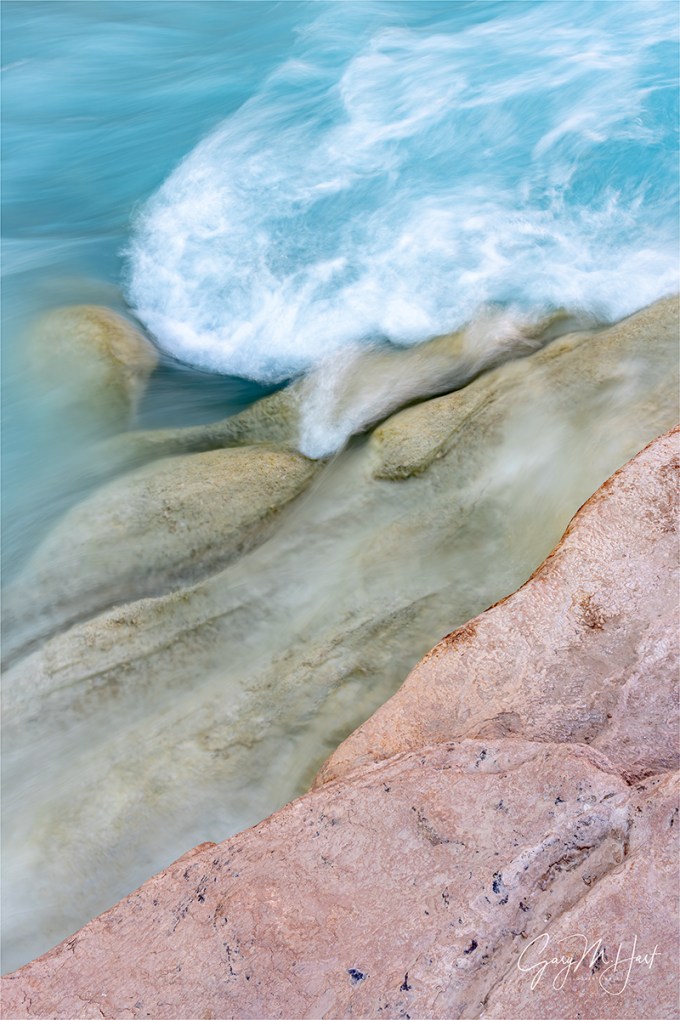
I’ve spent many hours at the bottom of the Grand Canyon, roaming the banks of the incomparable Little Colorado River near its confluence with the Colorado River. I’ll never forget my reaction the first time I saw the Little Colorado’s impossible blue. I had no inkling of what was in store when I hopped from the raft and rounded the corner, but when that blue hit my eyes I stopped short and stared for a few seconds trying to process it, then spun around and strode back to the raft to tell my lead guide, “We’re going to need more time here.”
Despite all the time spent here (and admittedly, it hasn’t all been photography—on warmer days my group enjoys cooling off by floating down a natural water chute about 1/2 mile upstream), I’ve struggled to make images that I feel really does the scene justice. But last year something clicked when I started looking closer, emphasizing the intimate beauty at my feet: the juxtaposition of red, white, and blue water and rock; the rock’s rich texture; the curves, angles, and levels of the limestone layers; and the play of the river among all these elements.


This year I took my look-closer approach a step further. After spending a hot afternoon at the Little Colorado doing more swimming than photography, I rose at 5:00 the following morning to return along with a half-dozen hardcore photographers in my raft trip group for a solid hour of just-plain-photography (taking advantage of our campsite directly across the river that allowed us to shuttle back and forth). While I landed that morning with no real plan, after a handful of uninspired clicks I came across this little rapid that stopped me in my tracks. Exactly 101 images later it was time to hustle back to the raft.
That’s right, 101 images of this one little rapid—and it was probably the most photography fun I’ve had all year. Every single frame was different from the others, and know I’d have found 101 more unique captures if I’d have had time.
Using my Sony 24-105 G lens on my Sony α1, I started with a tighter, horizontal composition, refining until the framing felt balanced, then ran a series of shutter speeds (by varying my ISO) ranging from 1 second to 1/100 second in (more or less) 1-stop increments. Then I’d find a new composition by going slightly wider, and occasionally changing my position and orientation. For each composition I’d use a similar series of shutter speeds, though it wasn’t long before I decided that the range I liked best was between 1/2 second and 1/30 second. (I like shooting motion with a range of shutter speeds so I can defer my final choice until I can view everything on my large monitor at home.)
Not until the last 10 minutes or so did I expand my composition enough to include the red rock platform on which I stood. Sometimes it takes working a scene for a while to distill it to its truest form, and it turns out really I love the strong diagonal this originally overlooked addition adds, not to mention the extra color and texture.
Like many of my favorite images, I know this one won’t accumulate the abundance of Likes that a landscape icon beneath a vivid sunset might, but it’s these intimate frames that capture the essence of the scene that make me happiest.
Join me as I do it all over again next year
Tapping the Essence
Click an image for a closer look, and to view a slide show.


Breaking Murphy’s Law
Posted on March 29, 2022
 Rain Curtain Lightning, Lipan Point, Grand Canyon
Sony a7RIV
Sony 24-105 G
1/8 second
F/9
ISO 160
Things go wrong. Or, as more succinctly attributed to 20th century aerospace engineer Edward Murphy, “Anything that can go wrong, will go wrong.”
In my previous post I wrote about some of the physical hardships nature photographers endure while chasing their shots. This got me thinking about all the things that can go wrong for a photographer, in the field for sure, but also at home, in the office, and on the road. I’m talking about lost, stolen, or broken gear, computer crashes, failed memory cards, and so on. I’ve personally experienced my share of these crises, and in workshops have witnessed firsthand the mishaps of others, ranging from amusing, to frustrating, to devastating.
In Iceland four photographers who believed they were being cautious lost cameras and lenses to a sneaker wave. In my most recent Yosemite workshop, a woman dropped her telephoto lens and cracked its body, then a little while later (in a completely unrelated mishap) discovered that none of the data on her memory card was readable. I’ve had workshop students lose cameras and computers to theft, and have a friend who drove off with his camera bag on top of his car and when he returned just a couple of minutes later, it was gone. I once had a memory card with an entire workshop’s worth of images somehow slip from my pocket while I was on a walk near home. The one thing each of the victims in these mishaps had in common was none of us believed anything would go wrong when we set out that day.
But yes, things do in fact go wrong. My trademark move seems to be leaving gear behind. I’ve done it several times, usually when I’ve set something down while working with a group, then forgetting about it when it’s time to move to the next location. My most recent such offense occurred on last May’s Grand Canyon raft trip, but there have been others before that. I usually rationalize this carelessness by playing the “I was distracted by my workshop group” card, but how then do I explain the time I reached into the trunk of my Lyft and realized I’d left my entire camera bag on the sidewalk in front of the Las Vegas Marriott?
Another source of trauma inflicted on our expensive gear is our own fumble-fingers. Here I don’t think I’m any better or worse than the average photographer—drops happen. In my many decades as a photographer, I’ve had a couple of drops that cost me a body and lens, but nothing that compares to the trauma I witnessed in a Yosemite workshop a few years ago.
This was during the peak of a record-breaking spring runoff, when every river and creek in the park flowed savagely high and fast. We were at Bridalveil Creek, beneath Bridalveil Fall. Normally this is a fairly benign creek, with photogenic cascades that tumble musically between reflective pools. But on this morning the creek was a roaring white torrent, higher than I’ve ever seen it, with no distinct cascades or pools—just a frothing churn.
In typical springs my groups leave the trail and wander upstream and down among the cascades, but this morning each person had safely set up somewhere along the paved trail. I was on the middle of three stone bridges that span the creek, and could feel the water’s vibration in my legs, something I’d never imagined was possible. About 15 feet to my left was one of my workshop students, a recent college graduate in the midst of a cross-country photo trip with his dad. He’d set up near the spot where the creek accelerated and disappeared beneath the bridge.
While marveling at the scene, I became aware of sudden movement on my left and looked just in time to see my student’s tripod, camera, and lens tip into the water (I learned later it had been an inadvertent hip-check as he bent for his bag) and get sucked faster than a flushing toilet under the bridge to downstream points unknown. I could see by his forward lean and the flex in his knees that his first reflex was to leap after his gear, a decision that very likely would have been fatal. He came to his senses before I could reach him or even call out, and instead let out the most pained wail I think I’ve ever heard. For the next 30 minutes he was literally inconsolable as he processed the loss of his camera, favorite lens, only tripod, and memory card containing I don’t know how many days worth of images, not to mention the ramifications of all this loss on his trip with his dad.
I’m sharing all this not to frighten you, but to remind you that being careful is only half the equation, and that you can act now to minimize the trauma of the inevitable unexpected equipment loss or failure. We all tend to get excited enough about a trip, or distracted by a scene, that our judgement suffers—we skip steps, leave things out, underestimate risks, and so on. And sometimes technology simply fails.
I have enough experience, both my own and witnessing others, to feel comfortable offering practical suggestions for preserve not just the wellbeing of your gear and images, but more importantly, your own mental wellbeing. Below are some of the things I do to keep myself sane when the unexpected tries to ruin my day:
- Insure your gear: I’ve lost track of the number of times someone in one of my groups has damaged or lost a piece of equipment in one of my workshops, and told me it’s not insured. At the very least, add your equipment to your homeowner’s insurance policy. Better still, get a completely separate policy, so when you file a camera gear claim, your entire homeowner’s premium doesn’t go up. For 20 years my gear has been insured through my membership in NANPA (North American Nature Photography Association)—the premiums are reasonable, the claims service is fantastic, and (because it’s a group policy) my claims don’t affect my rate. They even insure my computers. One time I lost a lens in the middle of a trip (set it down at a location and it somehow walked away before I returned—sigh)—I filed a claim right on the spot, ordered a new lens that was delivered the next day, and my check was waiting for me when I got home.
- Backup gearCamera: If you’re serious about photography, you really should have more than one camera body. For those photographers whose work is close to home and not time critical, I suppose if something breaks you could just go home and wait for it to be fixed, or for its replacement to arrive. But most of us shoot in situations where being without a camera for even a few hours or minutes means missing opportunities that will never come again. Full frame shooters on a budget should consider an APS-C (cropped sensor) backup body. They’re less expensive, more compact, and give you 50% more reach on all your lenses. I’ve been known to set down a full frame body in favor of my APS-C backup camera to make the moon as big as possible.
- Lens: Duplicating every lens in your bag is a luxury few can afford, but no matter how convenient that 18-300 lens is, you should never go on an important photo trip with only one lens.
- Tripod: If you’re as obsessive about using the tripod as I am, you’ll have more than one (I’m embarrassed to say how many I own). It’s a luxury I can’t afford when I fly, but when I drive to a location I always have a second tripod in my car. For workshops I don’t have to fly to, I also bring a loaner tripod and have lost track of the number of times someone has needed to borrow it.
- Image management—backup, backup, backup. And then backup some more. Below is my own image management workflow—I’m not saying you need to do what I do, I’m just saying that your image management needs to be organized, regular, and redundant.Because all my cameras take two cards (something I highly recommend), my image backups start with each click. I know there are several options for handling these extra cards, but I don’t think any is as important as insuring against data loss. Cards do fail (see above), and as rare as that might seem, cards go missing too (see above). When I lost my card, my reaction was, “Oh crap, I need to buy a new card,” not, “OH CRAP! I’VE LOST AN ENTIRE WORKSHOP WORTH OF IMAGES!”
- When I travel to a shoot, I try to import my images every day (and always when I think I’ve captured something special, but during a workshop I sometimes don’t have the time or energy at the end of the day). Because I like the option of processing on either of my two computers, my import destination is a 4TB SSD drive that lives in my computer bag. And even if I have imported my images, I never delete my cards until I get home. Those times I’m especially excited about what I’ve captured, before flying home I take the time to copy my images to a second SSD drive that stays in my suitcase. That means for the duration of my trip, I have two copies of my images in my camera (which lives in my camera bag), one copy on an SSD drive in my computer bag, and one copy on an SSD in my suitcase. Having them in so many locations while I travel makes it very unlikely I’d lose every copy.
- As soon as I’m home, I copy all of the trip’s images to a 10TB spinning drive that lives on my desk and is automatically backed up to the cloud using Backblaze. And finally, I also copy those images to a RAID 6 NAS (network attached storage) that lives in my office.
About this image

Rain Curtain Lightning, Lipan Point, Grand Canyon
I captured this lightning strike during the same storm that produced the thunderhead in the image I shared last week. It came nearly 40 minutes later, when the sun was near the horizon and the light was noticeably warmer. The rain curtain that’s so visible here was just starting to form in the earlier image, but once it did form it remained pretty stationary and continued to dump like this for at least 45 minutes—no doubt generating flash floods up the canyon.
Something I’ve learned when photographing lightning is to keep my eye on the sky. There’s so much waiting, long lulls where nothing happens, that it’s easy to get distracted by the view, fellow photographers, or a smartphone. As much as I try to advise everyone in my groups to keep watching, attention usually wanes until one or two people exclaim excitedly about a bolt—but by the time the rest of the group looks up (no matter how fast they are), it’s too late. By staying vigilant, you get a good idea of where your camera should be aimed, when the activity is waining, the direction the cell is moving, and whether activity is picking up elsewhere.
One of the cool things about photographing lightning at the Grand Canyon is the breadth of the view, which often provides multiple active cells to choose between. While this cell remained active for quite a while, most of its lightning was behind the rain and we were only aware of it when it registered in our lighting app (usually within a minute or two after the strike).
There were actually a couple of cells delivering more visible lightning, but one was more distant, and the other was out over the Painted Desert and away from the best view. So I stayed zeroed in on this cell, hoping to capture a bolt against the rain curtain. I got a couple that were close, but this is the only one to pierce the rain curtain during its peak.
I had one more realization while watching this intense downpour—anyone fortuitously positioned on the North Rim, perhaps somewhere around Roosevelt Point, would be enjoying an absolutely epic rainbow. All you need for a rainbow is direct, low-angle sunlight directly behind you as you look toward airborne water droplets. I had two out of three—low-angle sun striking airborne water droplets (you can clearly see the sunlight illuminating the falling rain)—but I was in the wrong place. Oh well.
Workshop Schedule || Purchase Prints || Instagram
Lots of Lightning
Click an image for a closer look, and to view a slide show.


What Would Michael Scott Do?
Posted on March 20, 2022

Thunderhead and Lightning, Lipan Point, Grand Canyon
Sony a7RIV
Sony 24-105 G
1/10 second
F/9
ISO 100
“You miss 100% of the shots you don’t take. — Wayne Gretzky” — Michael Scott
Rules are important. The glue of civilization. Bedtime, homework, and curfews constrained our childhood and taught us to self-police to the point where as adults we’re so conditioned that we honor rules simply because we’ve been told to. (Who among us doesn’t always wait for the signal to change, even with no car or cop in sight?)

As important as this conditioning is to the preservation of civil society, rules can sometime keep us from taking shots that might have turned out to be special. Rather than trusting their own instincts, less than confident photographers are often held back by blind adherence to the (usually) well-intended photography “experts” proliferating online, in print, and maybe even in your very own camera club. These self-proclaimed authorities love nothing more than to issue edicts for their disciples to embrace. But my general advice to anyone seeking photography guidance is to beware of absolutes, and when you hear one, run (don’t walk) to the nearest exit. The truth is, there are very, very few absolutes in photography. (Remove the lens cap?)
A more insidious hindrance to photographers is our own rules—things we truly believe to be true. These are like training wheels that served us so well at the start that we never considered removing them: the rule of thirds, never blow your highlights, don’t center the horizon, everything sharp from front to back, avoid bright sunlight, just to name a few. But they’re insidious because, while they may be founded on some basic truth, they also hinder our growth. Like walls that give comfort by protecting us from intruders, photographic rules obscure the horizons of our creativity.
The truth is you often don’t know whether an image will work until you click the shutter—and sometimes not even until you get home and look at it on your computer. The more you’re able to turn off that internal editor (who keeps repeating all the rules spewed by others), the better your results will be. Just remember this: If you’re not breaking the rules, you’re not being creative.
The image I share above might never have happened had I followed a couple of rules—one I hear all the time from well-intended photo judges, another I often impose on myself: A photo judge might ding it for the centered lightning bolt and (more or less) centered horizon; and I may have never had the opportunity to photograph this beautiful thunderhead at all had I not overcome my personal aversion to photographing in midday light.
The afternoon I captured this came during one of three Grand Canyon Monsoon photo workshops last summer. The sky was blue and the forecast for lightning not so great, but we headed out toward Desert View that afternoon anyway. Shortly after pointing east along the rim on Highway 64, I saw this towering thunderhead blooming in the distance. Given all the twists and turns on the road, I wasn’t even sure at first it would be in our scene at Desert View. And since our destination was still about 30 minutes away, I was even less confident that even if the thunderhead was over the canyon, it would still be active by the time we got there.
I was assisted in this workshop by my friend and fellow photographer Curt Fargo. I can always count on Curt, realtime lightning app open, relaying instant reports on the activity as we drive, and it wasn’t long before he determined that thunderhead had to be where the app showed a lot of lightning activity about 15 miles up the canyon from Desert View—not exactly close, but at least the viewing angle would work. At that point all we could do was drive, watch the cloud, and pray it didn’t peter out before we got there. (Why is the speed of the car in front of you always inversely proportional to the amount of hurry you’re in?)
As you can see, we made it. Rather than drive all the way out to Desert View, we stopped at the first good view of the canyon and thunderhead—Lipan Point, about two miles closer with a much shorter walk to the rim. By the time we were set up the lightning activity had peaked, but we still got a few strikes. We also got to watch this cell absolutely dump an ocean of water on one spot for nearly an hour, no doubt creating a significant flash flood for whatever canyon drained it. This is the only image I captured that included the entire thunderhead.
The moral is, whenever you find yourself basing composition or exposure decisions on pre-conceived ideas (either your own or others’) of how things should be, just slow down a bit and challenge yourself to break the rules. Go ahead and get your standard shot, but then force yourself to try something outside your comfort zone. And remember Michael Scott.
Here’s my guide for photographing lightning
Breaking the Rules


2021 Highlights: Looking Back, Looking Forward
Posted on January 2, 2022


Last week I shared a brief summary of the year just passed; this week I offer the fruits of all that labor.
Leading photo workshops for a living, I spend a lot of time in places I’ve visited many times, but it seems each spot feels more a part of me with each visit. This year in particular, I sought opportunities to add the Milky Way, a moonrise, fresh snowfall, an electrical storm, or some other transient natural phenomenon to my scene to further elevate these familiar landscapes.
But thrilling images notwithstanding, for me, and I suspect (hope?) for many, the true joy of nature photography isn’t the image itself, it’s the chase—all the planning and physical sacrifice that made it possible—as well as the humbling awe of being there. Last year, despite its difficulties, was chock-full of those experiences.
As you may have guessed, many of the scenes in the gallery above were shared with workshop participants. It took losing more than a dozen workshops to the pandemic to fully appreciate how much it lifts me to experience Nature’s best displays with people who are as awestruck as I am, and I felt blessed to get that back in 2021.
On the other hand, I feel similarly blessed for those rare opportunities to commune with Nature in meditative solitude. With 16 workshops last year (and all the planning and organization they required), I had precious few truly private photo moments in 2021. But the opportunities I did have still resonate clearly.
Looking forward
Another thing that happens when I review images from the year just ended is a reminder of the visual treats in store for the coming year. I have no idea what I’ll see in 2022, but I’ve been doing this long enough to know that I’ll create more images that thrill me, and more memories to sustain me.
Thanks to each of you for your support, in whatever form that takes. Whether you’re a workshop student, an avid follower, or just a casual browser, I’m so happy you’ve joined me on this amazing ride.
See more in my…
2021 Highlights Gallery

 Eloquent Images by Gary Hart