Eloquent Images by Gary Hart
Insight, information, and inspiration for the inquisitive nature photographer
Eye on the sky
Posted on April 27, 2016

High Sierra Moonrise, Glacier Point, Yosemite
Sony a7R II
Sony/Zeiss 24-70 f4
2.5 seconds
F/10
ISO 200
I spend much of my photography time chasing the moon. Most of my trips factor in the moon’s phase and location—usually to catch a full or crescent moon rising or setting above a particular landmark, and often to photograph a landscape by moonlight (full moon) or starlight (no moon). But sometimes the moon catches me less than fully prepared, and I need to improvise.
For example
I enjoyed the January full moon with my workshop group in Death Valley and the Alabama Hills; in February my Horsetail Fall workshop group photographed a full moon rising above Yosemite Valley; in March I was in Sedona with Don Smith to photograph the full moon as it rose above Cathedral Rock and Oak Creek; and last week my Yosemite Moonbow and Wildflowers workshop group photographed the April full moon above Bridalveil Fall and the Merced River Canyon, then headed off to catch a moonbow in the mist at the base of Lower Yosemite Fall. And chasing the moon isn’t all about the full moon—already this year I’ve photographed several thin crescents in the Sierra foothills, and next week I raft Grand Canyon, where my group will (fingers crossed) witness a waning crescent moon just after sunset, and later that night photograph the canyon illuminated by nothing but the Milky Way and thousands of stars only visible in a moonless sky.
All this planning around the moon does indeed get me to many beautiful locations at just the right time, but sometimes the moon catches me in situations where, without the necessary knowledge at hand, I’m forced to think on my feet (and smartphone). Most recently was the unplanned moonrise added to last week’s Yosemite workshop. When the National Park Service opened Glacier Point about a month earlier than expected, I quickly inserted a Glacier Point sunset into the workshop but didn’t have time for anything more than a cursory moonrise check.
Beautiful clouds and light made our Glacier Point sunset a success, but as we were about ready to return to the warmth of the cars, the moon’s imminent arrival crept into the back of my mind. What I knew was that this night, from Glacier point the moon would be rising far to the right of Half Dome (out of the primary view), and probably just slightly too late to photograph effectively (not enough light to capture both landscape and lunar detail). Nevertheless, before packing up my gear I pulled out my iPhone to be certain we weren’t making the classic photographer’s mistake of leaving too early.
This won’t be on the test
Without a strong cell signal, I had to resort to apps that function offline. I started with Focalware, my go-to app for the sun’s and moon’s altitude and azimuth from any location on Earth. Next, now armed with the moon’s azimuth, I opened MotionX-GPS (with the map pre-downloaded) to plot its location relative to the current landscape, determining that it would emerge from behind Mt. Clark.
The final (and most difficult) piece of the puzzle was determining when the moon would appear. This is tricky because published moonrise times always assume a flat horizon—great if you’re on a ship at sea, but not so much anywhere else, and especially not in the mountains.
Using the topo info in the MotionX app, I determined that Mt. Clark’s elevation was around 11,500 feet. Knowing the Glacier Point is at 7,200 feet, I subtracted 7,200 from 11,500 and got 4,300 feet, the vertical distance between my location and the point where the moon would appear. Because the MotionX app also gave me the horizontal (as the crow flies) distance between me and Mt. Clark (about 8.2 miles, or around 43,300 feet), I had everything I needed to plug into my HP-11C (scientific calculator) app and compute the altitude, in degrees, that the moon would need to achieve before cresting the peak (thank God I stayed awake in trigonometry). With that information, it was a simple matter of returning to Focalware to see what time the moon would ascend to that altitude (appear above Mt. Clark).
There are apps that will do all this for me (PhotoPills and The Photographer’s Ephemeris are the ones I recommend), but they require connectivity, and the foresight to do the work when my signal is strong enough to download the maps. (Plus, I just like doing it my way.)
I never tire of this stuff
So, after less than five minutes of figuring, I was confident enough to tell everyone the moon would appear from behind Mt. Clark at 7:57 p.m., plus or minus two minutes. That gave us a couple of minutes to prepare a composition, and sure enough, right around 7:55, the clouds behind Mt. Clark started to glow; at 7:58, there it was and we were in business. In this case the thin clouds on the horizon subdued the moon’s brilliance just enough that I could give the foreground enough light without turning the moon to a white disk.
As often as I do this (sometimes I plot the moon just for fun, even though I know I can’t be there to enjoy it), few things thrill me more than my eyes on the exact point on the horizon at the moment the moon first nudges into view.
Understanding vs. knowledge
I know my process sounds complicated, but it really isn’t—in fact, plotting the moon this way doesn’t require any special insight beyond what most of us learned in high school. But it does illustrate something I constantly stress: the advantage of understanding over knowledge. When we know something, we can respond to a finite set of circumstances; when we understand something, we can reason our way to knowledge beyond our training.
One more quick example: A couple of days ago, I was scouting a potential sunrise location in the Columbia River Gorge. Because I’m reluctant to trust compass apps that point an arrow (or whatever) in a general direction, I pulled out Focalware and saw that tomorrow’s sunrise azimuth would be 70 degrees. Focalware also told me that the sun’s current azimuth was 253 degrees. Since I know that a (solar) shadow always points exactly 180 degrees from the sun’s current azimuth, I knew that my shadow was pointing directly at the 73 degree azimuth (253 minus 180), more than close enough to figure out where the sun would appear (in this case, farther north than ideal).
Whether it’s lunar geometry, exposure settings, depth of field, or whatever, understanding (and visualizing) a system’s underlying principles is always superior to memorizing its facts. And amazingly, it’s almost always simpler than we imagine. Since the position of the sun, moon, and stars are important to me, I try to visualize the celestial choreography.
Likewise, the more you can understand what’s happening when you adjust your shutter speed, f-stop, and ISO, the better prepared you’ll be to reason your way through difficult exposure puzzles, such as, I really need a lot of depth of field to get this tree and that mountain sharp, but the breeze is really blowing the leaves?, or, The exposure is perfect for this 20-second pinpoint stars image, but how can I do a 30-minute star trail shot of the same scene without changing the exposure?.
Photo Workshop Schedule
A gallery of celestial wonders


My Technology Can Beat Up Your Technology
Posted on April 18, 2016

Skylight, Lower Antelope Canyon, Arizona
Sony a7R II
Sony/Zeiss 24-70 f4
1/100 second
F/11
ISO 200
For some reason, the technology choices of others seem to be the source of profound angst to many (self appointed) online “experts.” Whether it’s vinyl vs. digital music, Windows vs. Mac OS, Android vs. iOS, Nikon vs. Canon vs. Sony, mirrorless vs. DSLR, nothing seems to incite in-your-face rancor like someone else’s technology choice. While I’ve been quite content to remain on the sidelines during these pointless battles, I must confess to being an occasional (amused) observer.
One thing I’ve observed during these skirmishes is that most desperate attacks seem to come from the side playing catch-up—the underdog. I mean, was there anyone more annoying than an Apple user in the nineties?
On the other side, it seems that the job of the front-running users who are under attack, those users with the technology embraced by the masses, is to respond with smug condescension. Which of course only further inflames the underdog. I mean, is there anyone more smug than an Apple user today?
(Before you accuse me of Apple-user bashing, let me assure you that I’m a committed Apple zealot who long ago lost track of the number of iDevices within arm’s reach. In place of Apple you could plug in Nikon/Canon/Sony, vinyl/digital, and so on and easily find the same attack/condescend cycle repeating.)
But given all this, imagine my concern since exiting the Canon vs. Nikon battle zone for the relative peace of Sony in 2014—suddenly I was photographing with gear that seemed too anonymous to incite emotion from pretty much anyone. Where had I gone wrong? Which is why it was with great excitement that I recently read a blog post disparaging Sony mirrorless shooters—to be more specific, Sony full-frame mirrorless shooters, a fraternity of which I’m a card carrying member. It was like the new phone book had arrived and suddenly, “I’m somebody!”
According to this self-proclaimed authority, as a Sony shooter I’m an ignorant lemming with dubious lineage and poor bathing habits. (Okay, so maybe I’m reading between the lines a bit, but I have no doubt the argument would have gotten there soon enough.) Rather than take offense, I viewed this blogger’s anti-Sony rant as a badge of honor, a sign that my Sony mirrorless gear has achieved enough status to stir the juices of the insecure. Not only that, I’m now in a position to respond with condescending smugness—a significant milestone indeed.
But seriously
Okay, but seriously, who cares? Who? Cares? Are people really that insecure about their technology choices that they feel threatened by mine? I have my own very specific photography needs, as I’m sure you do as well. You can’t pretend to know my needs, I can’t pretend to know yours. I find no offense (or, I must confess, interest) in the equipment you choose, and certainly hope that you find none in mine.
On the other hand, I’ve reached the point in my career that my equipment choices do affect the decisions of others. People who like my pictures ask what equipment I use, and for my opinion on the equipment they should purchase. While I’m happy to answer these questions (as time permits), the real answer is that the equipment matters very little in relation to the person operating it. Today’s technology is pretty much across-the-board amazing compared to what used to be considered state-of-the-art. The limiting factor in your photography will almost certainly not be your equipment.
For anyone looking to upgrade their equipment, my advice is to filter out all the noise, target the few features that are most important to you, and try to identify the system that best suits you. It almost certainly won’t be exactly the same as the system that best suits the online “experts,” no matter how loudly they make their case.
And beware, often the people most willing to share their opinions are far more ignorant than they realize. Before taking the word of any stranger, especially when it comes to how and where to spend your own hard-earned money, at the very least you should review their images to confirm that: 1) they actually have an idea of what they’re doing, and 2) what they’re doing actually resonates with you.
All that said, I’d like to explain why I’m confident that I’ve found the best camera system for my photography. It comes down to the realization over the year-and-a-half I’ve been shooting Sony full-frame mirrorless, that I’m getting images that I never could have gotten with my Canon DSLRs. For me, that means ridiculous dynamic range from my a7RII, and similarly ridiculous high ISO performance from my a7SII. It also means more room in my bag, enabling me to carry more gear, which helps me be more prepared for whatever Mother Nature delivers.
The most recent validation of my Sony system was captured late last month, on bright afternoon visit to Lower Antelope Canyon near Page, Arizona. Upper and Lower Antelope Canyons are narrow slot canyons carved in red sandstone by millennia of extreme drought punctuated by brief flash-floods. I’ve photographed these canyons many times in the last ten or so years; while I’ve always loved photographing there, I’ve also been frustrated by the extreme dynamic range that forces me (and pretty much everyone else) to decide between the scene’s highlights or shadows.
Since I don’t blend images (if I can’t capture it in one click, I don’t shoot it), dynamic range is a huge deal for me. Our cameras just can’t capture in one click the range of light—from darkest shadows to brightest highlights—that our eyes see. But that doesn’t prevent me from trying to squeeze out as much dynamic range as my camera will allow (and always hoping for more).
Already aware that my Sony a7RII (and the a7R before it) has more dynamic range than any camera I’ve ever used, on this year’s Antelope Canyon visit (helping good friend Don Smith with his Northern Arizona workshop), I decided to put the camera to the test with an extreme dynamic range scene that has always overwhelmed any camera I’ve thrown at it: in one frame, attempting to capture detail in the red rock buried in Antelope Canyon’s deepest shade, and the brilliant, sunlit blue sky outside.
On this visit, for most of the walk through Lower Antelope, a thin layer of clouds obscured the blue sky overhead. But as we were heading toward the exit, I looked up and saw a break in the clouds through the narrow slit overhead. I quickly metered the scene, targeting the brightest part of the remaining clouds and pushing the highlights as far I could without clipping (overexposing) them beyond recovery. On my LCD the image looked like a failure, with blinking (overexposed) highlights and black shadows, but the histogram told me I’d gotten the exposure as close to correct as possible—it showed a little clipping on both sides, but maybe (fingers crossed), there’d be enough in the highlights and shadows to salvage the image.
Despite the unusable appearance on the camera, and my previous (Canon) experience trying to photograph Antelope Canyon with sky, on my computer a small miracle happened: Tugging Lightroom’s Highlights slider to the left restored all the detail to the clouds and blue to the sky. So far so good, but on previous attempts, capturing blue sky in an Antelope Canyon image was always a death knell for the shadows. So imagine my surprise when I started pulling Lightroom’s Shadows slider to the right and rich red sandstone magically appeared, even in the darkest shadows. It was all there!
Does this mean that my new Sony mirrorless bodies are better than my Canon DSLR bodies? I can’t say, nor will I try to say—we each make the choice that best suits our style and needs, and all the online ranting from experts shouldn’t sway us. But for me, regardless of what others might say, or how loudly they might say it, I know I’m getting images that I never could have gotten before. And that’s really all that matters.
Workshop Schedule || Purchase Prints || Instagram
Previously Impossible (shots I wouldn’t have gotten with “lesser” technology)


Your camera is not an Etch A Sketch
Posted on April 11, 2016
(In defense of the tripod)

Grand Morning, Yavapai Point, Grand Canyon
Sony a6300
Sony/Zeiss 16-35 f4
.6 seconds
F/10
ISO 200
Who remembers the Etch A Sketch? For those who didn’t have a childhood, an Etch A Sketch is a mechanical drawing device that’s erased by turning it upside-down and shaking vigorously.
When I come across a scene I deem photo-worthy, my first click is a rough draft, a starting point upon which to build the final image. After each click I stand back with the latest frame on my LCD and scrutinize my effort, refine it, click again, evaluate, refine, and so on. On a tripod, each frame is an improvement of the preceding frame.
Taking this approach without a tripod, I feel like I’m erasing an Etch A Sketch after each click. That’s because every time I click, I have to drop the camera from my eye and extend it in front of me to review the image, essentially wiping clean my previous composition. Before I can make the inevitable adjustments to my most recent capture, I must return the camera to my eye and completely recreate the composition I want to refine.
I bring this up because a week or so ago, on another landscape photographer’s blog I read that she rarely uses a tripod anymore because image stabilization is so good—and anyway, even when stabilization won’t be enough to prevent camera shake, she can just increase her ISO. Reading comments like this reminds me how many landscape photographers don’t get that the tripod’s greatest value isn’t its ability to prevent hand-held camera shake, its the ability the tripod provides for making incremental improvements to a static scene (such as a landscape).
Before I continue, let me just acknowledge that there are indeed many valid reasons to not use a tripod. For example, you get a tripod pass if your subject is in motion (sports, wildlife, kids, etc.), you photograph events or in venues that don’t allow tripods, you have physical challenges prevent you from carrying a tripod, or even if you just plain don’t want to (after all, photography must ultimately be a source of pleasure). But if you’re a landscape shooter who wants the best possible images, “Because now I can get a sharp enough image hand-holding” is not a valid reason for jettisoning the tripod.
Technology certainly has changed the tripod equation. There was a time—way back in the film days, when ISO was ASA and anything above 400 was really pushing the limit, before instant LCD review and image stabilization—when the tripod’s prime function was preventing hand-held camera shake. But today, probably 80 percent of my images could be acceptably free of camera shake without a tripod. Yet the tripod survives….
For example
Last month I was at the Grand Canyon to help my friend Don Smith with his Northern Arizona workshop. A week earlier I’d added the brand new Sony a6300 to my camera bag, but a ridiculously busy schedule had kept it there. Sony had requested a sample image for their Sony Alpha Universe page, and I was down to just one day to deliver.
Our first morning on the rim was my only chance to meet Sony’s deadline before the workshop started. Landing at Mather Point about 45 minutes before sunrise, I beelined along the rim to Yavapai Point (about a mile), straight to a tree I’d been eyeing for years. On all previous attempts, something had foiled me: either the light was wrong, the sky was boring, or there were too many people. One sunrise a few years ago, I found the tree and canyon bathed in beautiful warm light, and the sky filled with dramatic, billowing clouds—perfect, except for the young couple dangling their legs over the edge and making goo-goo eyes beneath “my” tree. They looked so content, I just didn’t have the heart to nudge them over the edge (I know, you don’t have to say it, I’m a saint).
But this morning, everything finally aligned for me: nice clouds, beautiful sunrise color, and not a soul in sight. I went to work immediately, trying compositions, evaluating, refining—well, you know the drill. As I worked, I started honing in on the proper balance of foreground and sky, alignment of the tree with the background, depth of field, focus point, framing—I was in the zone.
When I thought I had everything exactly right, I stood back for a final critique and realized I’d missed one thing: The tree intersected the horizon. While not a deal-breaker, it’s something I try to avoid whenever possible. To rectify the problem, my camera needed to be about eight inches higher. I made the adjustment, and when the color reached its crescendo about two minutes later, I was ready.
Raising the camera would have been no simple task if I’d been hand-holding, but (since my Really Right Stuff TVC-24L tripod, with head and camera, elevates to about six inches above my head) it was no problem with my tripod (though I wish the a6300 LCD articulated for vertical compositions). But the extra tripod height was just a bonus. The true moral of this story, the thing that so perfectly illustrates the tripod’s value, is that there is no way I’d have gotten all the moving parts just right with a hand-held point and click approach.
Of course your results may vary, and as I say, photography must ultimately be a source of pleasure. So if using a tripod truly saps pleasure from your photography, by all means leave it home (and enjoy your $3,000 Etch A Sketch). But if your pleasure from photography derives from getting the absolute best possible images, the tripod is your friend.
Grand Canyon Photo Workshops
A Grand Canyon Gallery


Look Behind You
Posted on April 3, 2016
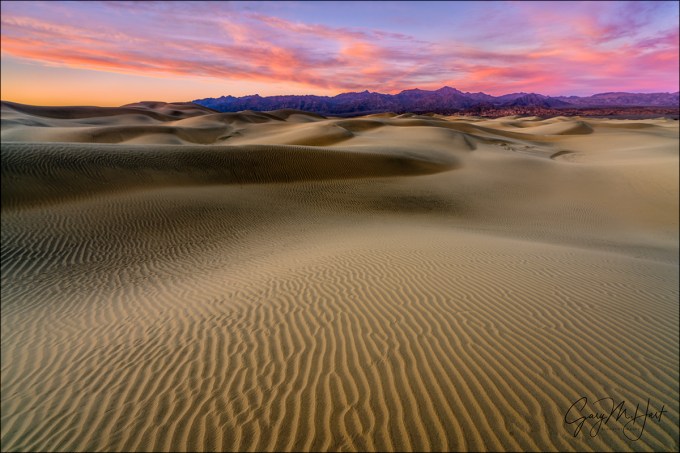
Painted Dunes, Mesquite Flat Dunes, Death Valley
Sony a7R II
Sony/Zeiss 16-35 f4
.4 seconds
F/11
ISO 100
Every once in a while we find ourselves at just the right place when Mother Nature delivers something special. When that happens, the best thing to do is stay calm and keep your head on a swivel.
In January my Death Valley workshop group had one of those moments. We’d walked almost a mile to get out to dunes that hadn’t been trampled, then waited while a sky that was solid overcast broke up just as the sun dipped below the horizon. The result was about ten minutes of horizon-to-horizon red that at its peak painted the dunes as well.
We’d been watching a hole in the clouds to our north shift in our direction, and I started to get an inkling that the ingredients were there for a vivid sunset about fifteen minutes earlier, when peaks in the northeast, then the clouds overhead, started to glow with warm, late light. I’d been using my 70-200 telephoto lens to isolate areas of the dunes, but realized that if the sky did indeed light up, I’d almost certainly want something wider and switched to my 16-35. I also encouraged everyone to do the same, and to anticipate the color and identify sunset compositions now, before it happened. Shortly thereafter we got our first hints of pink and the show was on.
That evening was a great example of something I preach in my workshops: No matter how great the scene you’re photographing, every once in a while take a few seconds to look around. On this evening I was excitedly photographing in one direction when I realized everyone in the group was photographing in the opposite direction. Turning to admonish them, I saw what they were photographing and shut up, quickly aiming my camera in that direction instead.
Read more about that evening, and see a picture of the other direction, here: Finding a new sandbox.
Sunset color
As I’ve written before, the ingredients for sunset (or sunrise) color are clouds, direct sunlight, and clean air (the cleaner the better). The idea that polluted or dusty air is good for sunset is a myth. (If that were true, Los Angeles and Beijing would be know for their sunsets, not Hawaii or the Caribbean.)
The red you see at sunset is the only color remaining after the white sunlight we see at midday has been stripped of all other wavelengths. It’s actually a rather interesting process (to me at least) that you can read more about here: Sunset Color.
Join Me in Death Valley
A gallery of sunset magic
Click an image for a closer look, and a slide show. Refresh the screen to reorder the display.


 Eloquent Images by Gary Hart