Eloquent Images by Gary Hart
Insight, information, and inspiration for the inquisitive nature photographer
Creative Juices
Posted on September 4, 2022

Infinity, Lake Wanaka, New Zealand (June 2019)
Sony a7RIII
Sony 16-35 f/2.8 GM
30 seconds
F/8
ISO 100
One of my favorite summer treats is the smoothie I whip up for lunch on hot days. I grab whatever fruit is available, toss it in my Vitamix with a little macadamia milk and ice, and let it rip. Each smoothie tastes different, but it’s always delicious.
Why am I sharing food prep tips in a photo blog? Because I can think of no better analogy for the Sony Kando event I experienced this week in Sun Valley, Idaho. Though Kando is truly indescribable, I’ll attempt the impossible and explain that it’s Sony’s gift to the creative photographers and videographers who share their love for Sony products with the world (that’s my definition, not Sony’s). Each year Sony takes a couple hundred of these Creatives, tosses them together at Kando, mixes in a variety of creative, social, and educational opportunities (and food!), and presses Blend. The result is a concoction that’s distinctly different from anything that preceded it, but always delicious. Just like my smoothies.
Kando is a Japanese word without a perfect English equivalent, but as near as I can tell it is the feeling of intense pleasure and excitement that happens when we encounter something truly exceptional. I’ve attended each of the four in-person Kando gatherings—Kando 1.0, just north of Santa Barbara; 2.0 at Asilomar near Carmel; 3.0 in Bend, Oregon; and this year’s 4.0 in Sun Valley, Idaho—enough to know that the event is aptly named. There are fundamental similarities between each one: the multi-day structure, the positive energy, and it is populated by many of the same people (blended each year with a liberal sprinkling of new faces)—yet somehow each event feels different in its own stimulating way.
Creativity is always on display at Kando, but this year I think the creativity was on steroids. The mix of Sony Creatives, as always, included a cadre of established photographers/videographers with a massive body of work (many of whom you’d recognize by name, or if not by name, by their work), infused with a liberal dose of young social media “influencers” with 6- and 7-digit followers. Still-photography, video, and even audio were well represented.
Some of the Creatives taught classes or participated in panels discussing their creative process and insights, and everyone shared by example. We were all encouraged to shoot and share throughout the week, with opportunities ranging from models, action, elaborate sets, and field trips available both day and night. At any given instant, it seemed half the Creatives would be creating, and the other half was watching. And I can’t begin to express how much fun it is to watch creative people do their thing.
For me Kando’s greatest lesson is the reminder that creative opportunities are infinite, and we’re limited only by our ability to see them. To say I was in awe of the creativity surrounding me would be an understatement. But I don’t think there was a single person present who wasn’t in awe of the creativity surrounding all of us.
So, fresh off my Kando week with my creative juices still flowing, I’m reaching into the archives for and image from one of my most memorable shoots in recent years. I chose this image for several reasons: in the context of creativity, there’s my recent post about finding unique takes on this solitary tree; then there’s my recent post about fog; and (especially) because a couple of weeks ago I discovered that, for some reason I’m unable to explain, and despite having shared this image many times since its capture in 2019, I’ve never written about it or the shoot—a blatant violation of my personal rule to never share an image without writing something on its capture and/or inspiration.
And in the spirit of full disclosure, my original Wanaka Tree Fog image had some minor flaws that (though not necessarily visible to anyone else) always bugged me, so I reprocessed it. And when I went back to the original raw file, I found another frame captured just a minute or so later that was compositionally very similar, but just a little cleaner to my eye.
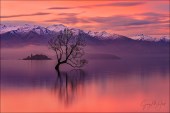
Red Sunset, Lake Wanaka, New Zealand
This was the first of two New Zealand winter workshops Don Smith and I did in June 2019. The prior evening our group had enjoyed what was probably the best sunset we’ve ever had in New Zealand. We went to bed basking in the glory of that shoot, and woke to dense fog that obscured everything beyond 100 yards.
Since this was a sunrise, and the tree was easy walking distance from our hotel, we’d instructed the group to meet us out there 40 minutes before sunrise. Walking out in the dark, Don and I ran into one workshop participant who told us it was too foggy and he was going back to bed. We tried to convince him that the fog created a spectacular opportunity for something unique, but his mind was made up. At the tree, a couple of others in the group were already shooting, and a few more joined us soon, but I can’t remember whether anyone else was turned away by the fog.
Despite the darkness, it was obvious that something special was happening and I started shooting as soon as I could get set up. To give you an idea of how dark it was when we started, today’s image is a 30-second exposure at f/8 and ISO 100.
As special as the scene was, given its static nature, my biggest concern was finding a sufficient variety of unique takes. The conditions pretty much wiped out the go-to creative tools I use to vary a composition: the air and water was completely still, removing motion as a tool; the lack of any background and my distance from the tree eliminated any depth-of-field opportunities; though the morning brightened slowly, the light was completely uniform and shadowless; and the fog completely obliterated the visibility beyond 100 yards, so it did little good to move around to juxtapose the tree against different backgrounds.
Looking the images in Lightroom’s grid view, I count 38 frames over a 40 minute span this morning. And while I have very little specific memory of most of them, just looking at this history I can see what my mindset was.
The first two frames I captured in rapid fire (well, as rapid as 30-second exposures can be) the instant I hit the lakeshore. I remember being so excited by what was in front of me, I just shot to make sure I had something in case the fog lifted.
The next set of frames, and the bulk of my images from this morning, started about 3 minutes later. I know after comparing the tree in the two sets, that I realized the angle at the first spot was poor and the tree was noticeably compressed. To fix this, I moved along the lakeshore until I had the best possible angle on the tree’s distinctive low, sweeping branch (now gone).
Once I was here and confident that I’d captured something nice, I slowed down and started really working the scene. Each of the 36 images I captured after moving into the better position was distinct from the rest of the images (no duplicates). Of this 36, 20 were horizontal and 16 were vertical. I also varied my focal length and framing, sometimes going wider, other times tighter.
In nearly every frame, the tree is centered on the horizontal axis, and sometimes on the vertical axis too (smack-dab in the middle of the frame). This was because there wasn’t really anything to balance the frame horizontally if I put the tree off-center. But just to cover myself, toward the end I did take a couple of horizontal frames with the tree left and right of center.
I had the most fun playing with my polarizer, emphasizing the reflection in some frames, and revealing the submerged foreground rocks in others. As you can see, I went with one with the rocks visible, but revisiting the images now, I can see others I’d like to process, including one that’s all reflection and no rocks.
Circling back to Kando and this whole creativity thing, I feel like my creativity pales in comparison to some of what I saw last week. But I also know that my own creative process that I tried to share a small part of here, is very personal, and that it serves my objective to share Nature’s beauty and (I hope) inspire others to appreciate Nature as much as I do. But whatever gets your creative juices flowing, I can tell you absolutely that being around other creative people is good for the soul and a great place to start.
The Shot Less Taken
Click an image to scroll through the images LARGE


My Favorite Things
Posted on August 28, 2022

Sunset Triple Lightning, Hopi Point, Grand Canyon
Sony a7RIV
Sony 24-105 G
1/4 second
F/11
ISO 320
Maria von Trapp had them, you have them, I have them. They’re the favorite places, moments, and subjects that provide comfort or coax a smile no matter what life has dealt. Not only do these “favorite things” improve our mood, they’re the muse that drives our best photography. Sometimes they even inspire dreams about making a living in photography.
But sadly, turning a passion into a profession often comes at the expense of pleasure because suddenly earning money is the priority. When I decided to make photography my livelihood, it was only after observing other very good (formerly) amateur photographers who, lulled by the ease of digital photography, failed to anticipate that running a photography business requires far more than taking good pictures. Rather than an opportunity for further immersion in their passion, their new profession forced them to photograph not for joy, but to pay the mortgage and put food on the table. And with the constant need for marketing, networking, bookkeeping, collections, taxes, and just plain keeping customers happy, these newly minted photographers soon found that precious time remained for the very thing that led them to become photographers in the first place.
Nearly 20 years ago (yikes), armed with these observations I changed from photographer to Photographer. After seeing what this change had done to others, my transition was founded on a vow to photograph only my favorite things.
It shouldn’t take much time in my galleries to figure out where I find my photographic joy. I could point to locations like Yosemite, Grand Canyon, and New Zealand, but even more important to me than locations are the natural phenomena that fascinate me. Whether celestial or terrestrial, I find myself inexorably drawn to the natural processes that created and affect the world we share.
The why of this starts with growing up in a family that camped for our vacations—I just have lots of great memories of nature. But the other significant factor behind my favorite photographic subjects comes from a fascination with the physical sciences that started in my single-digit years with an interest in comets, and quickly grew to include pretty much anything in the night sky. But even then I wasn’t satisfied with simply looking at the night sky, I wanted to understand what was going on up there. And with that came a realization that Earth is actually part of the cosmos, and soon I was reading about geology and meteorology and pretty much any other ology that had to do with my place in the Universe.
All of this came before I ever picked up a camera. But it might explain why I feel so strongly actually understanding the things I photograph—if they give me join, they’re worth knowing. Whether it’s lightning, reflections, the Milky Way, rainbows, a beautiful location, or whatever, I’ve reached the point where I simply won’t post an image of something I don’t understand.
And because I enjoy writing as much as I enjoy photography, you may have noticed that I also virtually never share an image without writing something about it. I know a lot of people just follow my blog to see my images, and that’s totally fine. But these really are my favorite things in the world, and I truly appreciate that you’ve taken the time to view, and (especially) to read this far.
Keeping in that spirit, here’s a little information about lightning, excerpted from my Lightning Photo Tips article:
A lightning bolt is an atmospheric manifestation of the truism that opposites attract. In nature, we get a spark when two oppositely charged objects come in close proximity. For example, when you get shocked touching a doorknob, on a very small scale, you’ve been struck by lightning.
In a thunderstorm, the up/down flow of atmospheric convection creates turbulence that knocks together airborne water (both raindrops and ice) molecules, stripping their (negatively charged) electrons. Lighter, positively charged molecules are carried upward in the convection’s updrafts, while the heavier negatively charged molecules remain near the bottom of the cloud. Soon the cloud is electrically polarized, with more positively charged molecules at the top than at the base.
Nature really, really wants to correct this imbalance, and always takes the easiest path—if the easiest path to electrical equilibrium is between the cloud top and cloud bottom, we get intracloud lightning; if it’s between two different clouds, we get intercloud lightning. And the less frequent cloud-to-ground strikes occur when the easiest path to equilibrium is between the cloud and ground.
With lightning comes thunder, the sound of air expanding explosively when heated by a 50,000-degree jolt of electricity. Thunder travels at the speed of sound, a pedestrian 750 miles per hour, while lightning’s flash zips along at the speed of light, more than 186,000 miles per second—nearly a million times faster than sound.
Knowing that the thunder occurred at the same instant as the lightning flash, and the speed both travel, we can calculate the approximate distance of the lightning strike. While we see the lightning pretty much instantaneously, regardless of its distance, thunder takes about five seconds to cover a mile. So dividing by 5 the number of seconds between the instant of the lightning’s flash and the arrival of the thunder’s crash gives you the lightning’s approximate distance in miles (divide by three for kilometers).
But anyway…
About this image
As a lifelong Californian, lightning was just something to read about, and maybe see in movies, but rarely viewed in person. And photographing it? Out of the question.
That changed in 2012 when Don Smith and I traveled to the Grand Canyon with our brand new Lightning Triggers and absolutely no clue how to photograph lightning. We returned with enough success to be completely hooked on lightning photography, and a plan to offer Grand Canyon photo workshops focused on the Grand Canyon monsoon and (fingers crossed) lightning. After a few years Don cut back on his schedule and dropped most of his domestic workshops (we still partner for New Zealand and Iceland workshops), but I’ve continued with the Grand Canyon Monsoon workshops. This year I did two Grand Canyon Monsoon workshops, the second of which was probably my most memorable lightning workshop so far—if not for the quantity of the lightning (very good but not record breaking), certainly for the quality.
The image I’m sharing today came on that workshop’s penultimate evening, and came the day after a similarly spectacular lightning show at Cape Royal (I blogged about it two weeks ago). At Cape Royal I commented that this was one of the top five lightning shoots I’ve ever had. Little did I know…
The following night we rode the shuttle out Hermit’s Rest Road, stopping first at the very underrated Pima Point. After spending nearly an hour at Pima, pointing at a potential cell that only teased us, we packed up and headed to Hopi Point for sunset. There really wasn’t much going on when we got there, but the clouds were nice and the sky looked promising for a good sunset.
As sunset approached, what may have been the remnants of the cell that had disappointed us at Pima Point seemed to regroup and start moving from left to right across our scene and toward the canyon. The first reaction to this development was, “No big deal” (fool me once, …). But just one relatively weak bolt was enough to send us all scrambling for our Lightning Triggers. Everything after that is pretty much a blur because as the storm slowly advanced, some unseen force turned the lightning up to 11—both its frequency and intensity.
In my July 31 post I shared an image of a rogue Hopi Point lightning bolt that was somehow perfectly placed above the canyon right at sunset. As the only lightning we saw all evening, this one felt like a gift from heaven. This evening’s lightning was similarly positioned, but much bigger, and I lost track of the number of bolts we saw: double strikes, triple strikes, serpentine strikes—pretty much a lightning photographer’s entire wish list all in one show.
Hopi Point access is by shuttle-only, which means if we miss the last shuttle we’re walking more than 2 miles back in the dark. The lightning was still going strong when we hopped onto the final shuttle in growing darkness, but given what we all knew we had, no one was too disappointed.
Here are a couple of images from Cape Royal the night before this image


And here are the two more images from this night’s shoot at Hopi Point


I realize that I get far more excited about lightning than the average person. And I’m truly sorry for sharing so many lightning images, but you’ll just have to understand that not only is lightning a novelty for me, and (please) recognize my good fortune for being able to make my living photographing nothing but my favorite things.
These Are A Few Of My Favorite Things
Click an image for a closer look, and to view a slide show.


In a Fog
Posted on August 21, 2022

Morning Glory, Point Imperial Sunstar, Grand Canyon
Sony 𝛂1
Sony 24-105 G
.6 seconds
F/20
ISO 100
Born and raised in California, my relationship with fog is both long and complex. I spent the first 12 years of my life in the San Joaquin Valley, where winter “tule fog” could be so thick that sometimes drivers could only navigate by opening the door and hanging their head out to follow the yellow line. Accidents involving dozens of cars were common. In elementary school (we called it grammar school back then), my classmates and I celebrated the “fog days” when school was cancelled because the visibility was too poor for the school buses to safely navigate their routes. On the foggy days school wasn’t cancelled, a favorite recess activity was to venture far enough onto the playground for the school to disappear, spin a few times to erase all sense of direction, then try to find our way back to school before the bell rang. And at least once I actually got lost walking to school in a dense fog.
When we moved to Berkeley the summer before I started middle school (a.k.a., junior high), my relationship with fog changed. No longer a winter phenomenon, fog in Berkeley blew in through the Golden Gate on summer afternoons, turning a shorts and T-shirt lunchtime into a long pants and sweater dinnertime. Most summer days required multiple wardrobe changes.
Playing baseball at Skyline College (San Bruno) and San Francisco State University, I realized that Bay Area fog provided a true home field advantage. I have very vivid memories of sitting in the dugout or bullpen, toasty-warm in my insulated warm-up jacket, and watching our opponent, who had arrived dressed for the comfortable warmth of pretty much any other California location, huddled against the wind and fog in the visitors’ dugout—and, I suspect, contemplating rubbing bats together to start a fire (yes, all baseball bats used to be made of wood, even in college).
Photographing Yosemite in my adult years, I quickly grew to appreciate the fog that hovers on the floor Yosemite Valley on chilly, still mornings. And to many, the shape-shifting fog that wraps Yosemite Valley as a storm clears is the Holy Grail of Yosemite photography.
Though fog comes in many forms, it can be a simple matter of perspective: to the viewer at sea level, a missing mountain peak has been swallowed by clouds; the mountain climber on the summit, however, thinks she’s ascended into a fog bank. Both are right. And while many processes are at play, the bottom line is that fog (and clouds) will form when the temperature of moist air drops to its saturation point.
Despite (or maybe because of) my lifelong relationship with fog, I’m afraid I’ve taken it for granted. This fact became pretty clear one morning at the Grand Canyon earlier this month. On a trip where lightning was the undeniable goal, the most memorable shoot of the first workshop was a foggy sunrise at Point Imperial. To say this wasn’t on my radar would be an understatement.
At 8900 feet above sea level, Point Imperial is the highest vista in Grand Canyon National Park. This extreme elevation provides a top-of-the-world view to the north, east, and south to a who’s who of Northern Arizona landmarks: the Vermillion Cliffs, the Painted Desert, Marble Canyon, and the confluence of the Colorado and Little Colorado Rivers (you can’t see the rivers themselves, but you can see the intersection of their canyons). And as if weren’t enough, Point Imperial’s foreground landscape is dotted with an assortment of prominent mesas, buttes, and other rocky outcrops. My favorite view here is facing east and south, where a natural bowl filled with layered sedimentary prominences is anchored by nearby Mt. Hayden, a towering spire that dominates the view.
Sunrise was still more than 30 minutes away when I guided my first workshop group into the parking lot at Point Imperial. Below us, a few wisps of fog dotted the bowl, but offered no hint of what was in store. With several spots to set up here, in the darkness I was more focused on making sure my group was situated than I was on the scene, but when I looked back toward the view it was pretty clear that the fog was spreading and rising. With everyone in place, I raced back to the car and grabbed my camera bag.
For the next hour or more, we watched (and photographed!) the rocky features become islands in the clouds, submerge completely, then gradually reappear. A couple of times the fog rose enough to completely engulf us and erase the view. The first time this happened, the group was ready to pack up and return to the cabins with the morning’s (already thrilling) spoils, but remembering similar fog formation experiences in Yosemite, I suggested that there’s a good chance the fog will retreat as quickly as it advanced, and that we might be able to photograph everything we just witnessed, only in reverse. Sure enough, within five minutes the rocky island reemerged, and soon the entire view was back. And just when it looked like the show might be over, here came the fog again.
Because my group gets a little spread out at Point Imperial, I wasn’t able to take as many pictures as I otherwise would have, but here are three of the morning’s highlights I did manage to capture (with brief descriptions below).
One Foggy Morning at Point Imperial (July 28, 2022)


Before rising into a cloud layer that covered most of the sky, the sun slipped through a small opening on the horizon long enough to fringe the billowing fog with golden light just as I’d set up for a sunstar. And the sun wasn’t quite done. I’ve always been a fan of the way the rising sun illuminates Mt. Hayden and the surrounding rocks with warm light, but when I glanced in that direction, I saw no direct sunlight on the rocks. I did, much to my surprise, see a small fragment of rainbow that served as a perfect accent to the foggy scene in that direction. The third image came toward the end of the shoot, shortly after the final wave of fog had started to retreat. The rocky spire peaking through the fog in the foreground is Mt. Hayden.
Lots More Fog
Click an image for a closer look, and to view a slide show.


Beam Me Up
Posted on August 7, 2022

Evening Glory, Desert View, Grand Canyon
Sony a7RIV
Sony 24-105 G
1/100 second
F/20
ISO 100
I won’t lie: The primary reason I go to the Grand Canyon in monsoon season—and for that matter, the primary reason most people sign up for my Grand Canyon monsoon workshops—is to photograph lightning. But as we all know, lightning is a fickle phenomenon, even during the Grand Canyon’s usually electric monsoon season. Because lightning is never guaranteed, I always do my very best to moderate my own expectations, and to let people who sign up for a workshop know I can’t promise it. But still…
Fortunately, the Grand Canyon in any season is pretty spectacular, and especially so during the monsoon. The carved sediment’s enduring beauty, combined with billowing cumulus clouds that turn some shade of pink, red, and/or orange at sunrise/sunset, and sometimes (fingers crossed) deliver vivid rainbows, makes the Grand Canyon summer monsoon my favorite time to be on the rim, even without lightning. But still…
The forecast the for the final day of this year’s second (and final) workshop was “Sunny,” the first such forecast I’d seen in my nearly two weeks at the Grand Canyon. But I’ve learned that a monsoon “Sunny” forecast just means fewer clouds, and rarely no clouds. And you never know—even with no rain or clouds in the forecast, I made sure everyone in the group packed a Lightning Trigger because I can share multiple stories of similar Grand Canyon forecasts that nevertheless resulted in lighting. Alas…
If you were expecting one of those plot-twist happy endings, you’ll be disappointed. Because as you might infer from this image, we did not get any lightning this evening. But as you can also see, we had no reason to be disappointed.
After a short stop at Moran Point, the group and I spent the rest of that afternoon and evening photographing my three favorite Grand Canyon vistas, first at Lipan and Navajo Points, before setting up for our final sunset at Desert View.
All three of these views stand out for their view of the Colorado River’s 90 degree detour from a north/south trending river to an east/west trending river. Standing on the rim at any of these vistas offers expansive views north, upstream and into Marble Canyon, and west, downstream toward what’s arguably Grand Canyon’s most iconic stretch. I can’t think of any other rim view that offers bigger, better views of the canyon than these east-most South Rim vistas. (But Hopi Point is close.)
Despite lowered expectations, we departed this afternoon hoping for lightning (which, I should add, given the two sunset lightning shoots that preceded this sunset, was downright greedy). Instead we found the canyon walls bathed in warm light shafting through scattered clouds hang above the western horizon. Not lightning, but too shabby either.
Even before the light started to warm, I decided that the best show this evening would be to the west, featuring the canyon’s receding ridges below the setting sun. And with a slight haze hanging in the canyon, what excited me most was the potential for sunbeams streaming through openings in the clouds and gaps in the ridges.
I digress
This might be a good time to explain the difference between some popular but different phenomena popular among landscape photographers: sunstars (or sunbursts, starbursts, and probably some other labels I’ve missed), sunbeams, and crepuscular rays.
- Sunstars are diffraction spikes that are created in the lens when sunlight is bent by the slight change of direction at the intersection of the lens iris’s blades (that comprise the aperture). They’re a photographic phenomenon, visible in the viewfinder and resulting image, but not to the unaided eye.
- Sunbeams are atmospheric phenomena caused when sunlight passes through openings in clouds or landscape features like tree branches or mountain peaks. They’re visible to the unaided and most prominent when the atmosphere is filled with water or dust particles that scatters the sunlight.
- Crepuscular rays are sunbeams that happen at twilight, only when the sun is below the horizon and its light passes through clouds, mountain peaks, or some other unseen obstruction beneath the horizon. As a subset of sunbeams, crepuscular rays are also atmospheric phenomena visible to the unaided eye, and benefit from airborne dust or water vapor.
So anyway…
Expectations reset, I shifted to the dual potential for both a large sun and sunbeams, and prepared accordingly: already on my Sony a7RIV was my Sony 24-105 f/4 G lens; to my Sony 𝛂1 I added my Sony 100-400 GM lens and Sony 2X Teleconverter. I started shooting as soon as the sunbeams appeared, using the wider setup to capture as much canyon and shafting light. Early on I occasionally switched to the telephoto; once the sun dropped below (most of) the clouds and the sunbeams faded, I finished up entirely with the telephoto combination.
The trick to exposing a scene like this with one click (always my goal) is to make sure I don’t blow out (overexpose) the highlights. While I had no expectation of capturing detail or color in the sun (it was too bright to prevent from blowing out), I knew the surrounding clouds and sky had the potential to turn a rich yellow-gold before the sun dropped below the horizon. Saving the sky color would mean underexposing the canyon, but closely monitoring my histogram enabled me to capture just enough foreground light to retain the outline of the ridges shrinking in the distance, at the same time preventing that great sky color from washing out.
The result is this image, with a sky that’s remarkably close to what I saw and a foreground that’s much darker than my eyes saw. Since this image is all about the sky and sunbeams, letting the canyon go dark (-ish) aided that emphasis. Even though the canyon looked nearly black on my camera’s image-review screen, a moderate Lightroom Shadow-slider increase confirmed later that the dark foreground contained exactly the amount of detail I wanted. Score another win for the histogram. (And if you’re wondering why I used f/20, it’s because I’d set up for a possible sunstar and forgot to switch back to the f/11 I usually default to.)
One more thing
Lest you feel sorry for my second workshop group for not getting lightning, let me reassure you that this group did not lack for quality lightning. At Cape Royal two nights before this, we witnessed what I instantly called one of the top-5 lightning shoots of my life. Then at Hopi Point the next night, we witnessed a lightning display that arguably topped it. I have so many excellent lightning images from these two shoots that I haven’t had time to go through them and decide which ones to process. And since I shared a lightning image (from the first workshop) last week, I figured I’d share something that’s not lightning. But rest assured, I’ll be sharing more lightning soon. Lots more.
Grand Canyon Photo Workshops
More Monsoon Magic
Click an image for a closer look, and to view a slide show.


Wait for it…
Posted on July 31, 2022

Electric Sunset, Hopi Point Lightning, Grand Canyon
Sony 𝛂1
Sony 24-105 G
.4 seconds
F/16
ISO 200
Landscape photographers have a couple of ways to make nice images. By far the most important is the ability to see the special but less obvious, then know how to compose and expose that special vision in ways that clarify and convey the previously unseen beauty. But sometimes we just need to know when to show up and where to point the camera, and the patience to wait for the special to come to us.
Pretty much any sunrise or sunset at a nice location qualifies for the show up and wait approach, as can popular classics such as Yosemite’s Horsetail Fall in February, or the midday shaft of light in Upper Antelope Canyon’s main room. But whether it’s a planned sunset that went even better than hoped, or a rainbow that seemed to materialize out of nowhere, in their own way these gifts from Nature that don’t require great vision are just as thrilling as the hidden discoveries we work so hard for.
-

- Horsetail Fall and El Capitan, Four Mile Trail, Yosemite
-
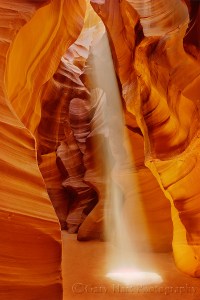
- Heavenly Beam, Upper Antelope Canyon, Arizona
Lightning photography requires a lot of the show up and wait approach, because all the compositional skill in the world can’t make a great lightning image if the lightning doesn’t happen. I can’t tell you how many times I’ve been photographing lightning and seen a beautiful composition—some perfect combination of landscape and conditions—in a different direction, and said to myself, “Wow, wouldn’t it be great if the lightning fired right there.” Unfortunately, lightning is a fickle phenomenon that rarely does what photographers want it to do. In fact, it sometimes feels like the lightning is consciously avoiding the composition I want, always in favor of something much less interesting. Sigh…
Right now I’m at Grand Canyon, trying to take advantage of its expansive vistas that frequently provide views of multiple rain cells with lightning potential. While the vast majority of these potential lightning sources never deliver, my original approach to photographing them was to maximize my chances by identifying and targeting the cell with the most potential, without concern for the composition. An alternate approach to photographing lightning is to target the rain cell with the nicest composition, regardless of the strength of its potential—then hope.
Because I’ve learned that lightning neophytes are usually thrilled to capture any lightning, I generally encourage my workshop students, most of whom have never captured great (or any) lightning images, to favor success over the best composition by simply pointing in whatever direction the lightning is most likely to fire.
I’ll never forget the first time I traveled to the Grand Canyon with the sole desire to photograph lightning, and those first few fruitless days on the rim, pointing my camera toward a promising cell only to see it fizzle. I’d have given anything to have just one frame with lightning, composition be damned. And I also never forget the thrill the first time my camera captured lightning.
Ten years later, I’ve reached the point in my lightning photography where I’ve had enough successful captures that I can afford to be a little more selective. In recent years I frequently find myself pointing at the potential lightning spot that has the composition I like most, shunning the one that appears most likely to produce lightning. It’s often a recipe for failure, but the infrequent successes more than compensate.
I got my most recent dose of compensation last Wednesday evening, in this year’s first (of two) Grand Canyon monsoon photo workshops. My group had already enjoyed several lightning shoots from various locations on the South Rim, but nothing spectacular so far. For sunset Wednesday evening, we took the shuttle out Hermit’s Rest Road (no cars allowed). There are many vistas on this route, so I gave my group enough time to visit as many stops as the wanted to, with the understanding that we’d all gather back at Hopi Point to shoot sunset together there.
Soon after arriving at Hopi Point about 45 minutes before sunset, I checked my My Lightning Tracker app and saw that all of the activity was at least 50 miles away and didn’t really align with anything interesting. While the view at Hopi Point is one of my favorites, I’ve photographed here so much that now I only bring out my camera when there’s potential for something spectacular—either lightning, or great color and/or clouds. So my camera stayed in the bag.
With almost 100 percent cloud cover, my decision seemed reasonable, but as the sun dropped, a small opening appeared on the western horizon, directly in the sun’s path. “Hmmmm,” I said, inching toward my bag. I looked again. A sky filled with clouds and a hole on the horizon is the ideal combination for a colorful sunset, so I pulled out my Sony α1, already loaded with my Sony 24-105 G lens, and set up shop along the rail to wait with the rest of my group.
As we chatted, it became pretty clear that the opening would persist through sunset, and that something nice was in store. A few minutes later, when a small rain curtain spread just to the right of the sun’s path, I said out loud, “All this scene needs is a lightning bolt.” I was half joking, but this thought prompted me to check my lightning app one more time. Still nothing really exciting, but there were hints of distant, minor lightning activity in the general direction of the sunset, so I pulled out my Lightning Trigger—just in case. I encouraged the rest of the group to get theirs out too, then quickly scanned the horizon for other rain curtains with potential for lightning—I saw a couple that might produce, but nothing promising enough to justify anyone diverting from the sunset.
Then we waited and clicked as the sun dropped and started to light the sky. It turned out that the opening wasn’t as open as we’d hoped, so not enough sunlight made it through to color the entire sky, and we never actually even saw the sun. But all was not lost, as the clouds near the horizon throbbed a brilliant reddish orange and I could tell by all the clicking that everyone was pretty thrilled.
When a few higher clouds lit, I oriented my camera vertically and angled farther upward for more sky than I usually include here (Pro tip: the Grand Canyon is usually more interesting than the sky.) Already pretty content with what I had so far, imagine my surprise when, just as the color reached its crescendo, a streak of light darted from the clouds and kissed the horizon. My first reaction was that it came from higher in the sky than I’d have expected, but it happened so fast and unexpectedly that I really wasn’t sure what I’d seen. In fact, if the rest of the group hadn’t exclaimed in unison, I might not have believed I’d seen it at all.
The unified exclamation quickly turned to joyful laughter from those who had taken the time to attach their Lightning Triggers, and regretful moans from those who hadn’t. When a couple of people defied my recommendation to not check to see if they’d captured the bolt (you have to turn off the Trigger to review images, and often lightning’s not as visible on the review screen as it is on a computer) and reported success, I couldn’t resist and checked mine too.
There it was. I instantly saw why it had appeared to originate so much higher: the bolt had emerged high, slid across the front of the thunderhead, and weaved through a window in the clouds before disappearing and emerging one last time. And perfectly aligned with the Colorado River, it couldn’t have struck in a more ideal place if I’d have drawn it in myself.
I’ll admit that this image isn’t a creative masterpiece (the composition isn’t much different from several of my other Hopi Point images), but I will take a little credit for being there, and also for the foresight to be ready for lightning when its possibility wasn’t obvious. And honestly, it was simply an honor to be there for something so magnificent—my only job was to wait, and not screw it up.
My Lightning Gallery || My Lightning Photo Tips Article
Worth Waiting For
Click an image for a closer look, and to view a slide show.


Watch Out For That Tree
Posted on July 24, 2022

Reflection on the Rocks, Wanaka Willow Tree, New Zealand
Sony a7RIV
Sony 12-24 f/4 G
1/5 second
F/11
ISO 100
I’m incredibly blessed to make my living guiding enthusiastic photographers to many of our planet’s most beautiful locations. While this makes my life far too rich for complaint, let me say (without complaining) that a particular challenge imposed by frequent return visits to the same locations is finding unique ways to photograph them.
My usual go-to approach at these familiar locations is to play with the scene’s “creative triad,” using the exposure variables manage my images’ motion, light, and depth. Whether it’s blurring or freezing water, going for silhouettes or high key, or choosing depth-of-field from narrow to extreme, I love love playing with these variables to create something unique. But some scenes don’t even offer a lot of those opportunities.
Never is that more clear than when I visit the solitary willow tree near the south shore of Lake Wanaka in New Zealand. This striking tree just stands by itself in a lake (most of the time), with little motion, silhouette, or depth of field options to play with.
Nevertheless, each time I visit Wanaka, I challenge myself to find a version of the scene that’s different from anything I’ve captured. And just because I don’t have my full arsenal of creativity weapons doesn’t mean I’ve arrived completely disarmed.
Without the creative triad, my creativity relies largely on some combination of conditions, juxtaposition, and focal length. As you can see in the gallery below, the conditions at the time of my visit play a huge role in my creative choices. Weather conditions for sure, but also things like the quality of the reflection, the light, and whether it’s day or night.
Because a picture is worth a thousand words, I’ll spare you long explanations and share some examples with just a few words of explanation

Wanaka Reflection, New Zealand
New Zealand’s winter clouds are a frequent source of delight. This image was captured late-morning (not usually great light), but the clouds and reflection were so nice that I couldn’t resist shooting. I chose a horizontal composition because it allowed me to include more clouds reflection, while filling the frame top-to-bottom with the tree and its reflection, than a vertical would.

Red Sunset, Lake Wanaka, New Zealand
Juxtaposition is almost always a prime consideration. I especially love the snow-capped Southern Alps, so all things equal, I’ll usually position myself so they’re in the background. In this scene the reflection was slightly disturbed by gentle undulations on the lake’s surface, so I added a 6-stop neutral density filter to smooth the water. The resulting 30-second exposure also softened the fast moving clouds—a bonus.
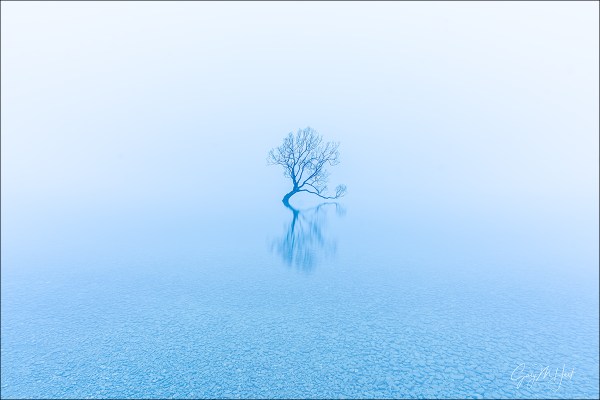
Gray Dawn, Lake Wanaka, New Zealand
But it’s not always about background juxtaposition. For example, one morning the fog was so thick, the background was completely irrelevant, so I chose a spot that best emphasized the tree’s shape and allowed me to fill my foreground with a mosaic of barely submerged stones.


One of the conditions I have at least partial control over is stars. By going out after dark on a clear night, I can include stars. And depending on the timing, I can juxtapose the tree with the Milky Way. Because these images were captured at different times of the night, including the Milky Way resulted in completely different backgrounds. The first image came a few hours after sunset, when the Milky Way hung above the amber lights of Wanaka; the second image came on a different night, a couple of hours before sunrise, when the Milky Way had rotated above the Southern Alps.
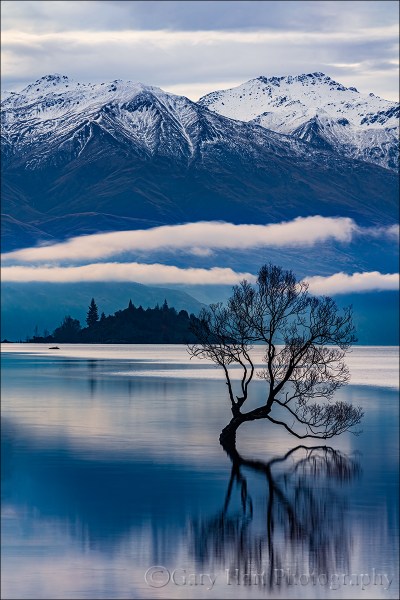
Lone Willow Reflection, Lake Wanaka, New Zealand
I wasn’t really crazy about the sky when I captured this image, but I liked the background peaks and low-hanging clouds. So I retreated down the lakeshore, away from the tree, and then climbed a gentle slope to distance myself even further, then used a telephoto to enlarge the tree and shrink the distance between it and the mountains and clouds.

Reflection on the Rocks, Wanaka Willow Tree, New Zealand
This image is the product of a last minute change to the sunset plan in this year’s New Zealand workshop that I do with Don Smith. We had a feeling something special might happen at Lake Wanaka, and wanted make sure we had the group in the best possible spot in case it did. Read more about this evening in my June 28 blog post.The beautiful clouds that had started the evening over the Southern Alps were quickly moving southeast and out of my frame. My options were to hold my position and photograph the tree with the mountains and no clouds, or reposition myself to feature the best of the clouds against the town of Wanaka. I went with the clouds.
Because I saw the potential for a beautiful sky, I went went wide to maximize the sky, choosing my Sony 12-24 f/2.8 GM lens on my Sony a7RIV body. I positioned myself so the reflection mirrored the arc of retreating clouds, creating a frame for the tree. I was aware that I was picking up the homes and buildings lining the opposite lakeshore, but felt that was justifiable compromise to ensure the best clouds and sunset color potential.
The light was beautiful when I started, but it just kept improving as the color ramped up. Every few minutes I repositioned myself to keep the tree framed by the shifting clouds. Wanting to feature the flat, multi-toned rocks visible beneath a thin veneer of still water, I dropped my tripod and moved it a foot or so into the water. And finally, I shifted just enough for the trunk to split the gap between two distant peaks. Going vertical allowed me to get the full arc of clouds and their reflection above the rocks, with less far lakeshore than a horizontal composition would have.
This image required very little processing, but I did burn the far lakeshore a little to deemphasize the buildings there.
Workshop Schedule || Purchase Prints || Instagram
Variations on a Tree


Looking Up Down Under
Posted on July 17, 2022

Milky Way and Small Magellanic Cloud, Lake Wakatipu, New Zealand
Sony a7SIII
Sony 14mm f/1.8 GM
ISO 1600
f/1.8
20 seconds
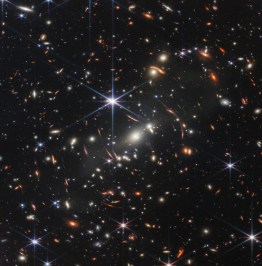
James Webb Space Telescope’s First Deep Field image
Are you as thrilled as I am by the mesmerizing images we’re seeing from the James Webb Space Telescope? There’s nothing like a heaping dose of perspective to remind humans of our insignificance in the grand scheme things, and these images deliver perspective in spades.
I think my favorite Webb image is the view deep into a seemingly tiny black region of sky that reveals thousands of galaxies. How tiny? According to the NASA website, “This slice of the vast universe covers a patch of sky approximately the size of a grain of sand held at arm’s length by someone on the ground.”) The light from these galaxies traveled as far as 13.1 billion years to reach us, which means we’re getting a view of our nascent Universe as it was less than a billion years after the Big Bang.
I get another dose of perspective, albeit on a much smaller scale, each time I visit the Southern Hemisphere. After a lifetime living north of the equator, I pretty much take for granted the Northern Hemisphere night sky. When I’m outside after dark, I reflexively look up and locate the Big Dipper. Using the Dipper’s pointer stars, my eyes slide to Polaris (the North Star) to locate north, then slowly scan the surrounding sky for other familiar features: bright stars Arcturus and Spica, constellations Cassiopeia and Corona Borealis, among many. If it’s dark enough, I try to pick out the Little Dipper and the Andromeda Galaxy.
Looking up at night in the Southern Hemisphere is downright disorienting. Most of the stars and constellations are completely unfamiliar (but no less beautiful), and those that are familiar (like Orion), appear “upside down.” (There’s no true up and down in space because up/down, left/right is always relative to the viewer’s frame of reference.) The Milky Way down here is reversed, and I’ll never forget the first time I watched a Southern Hemisphere moonrise and realized that it moved left (north) as it rose—duh.
A personal Southern Hemisphere highlight is the opportunity to see the Large and Small Magellanic Clouds. Like the first (only) time I saw the Taj Mahal and Stonehenge, my first view of the Magellanic Clouds was like spotting a celebrity I’d heard about my entire life but never imagined I’d see in person.
The Magellanic Clouds are satellite galaxies of our Milky Way. The Large Magellanic Cloud is about 160 light years from Earth and estimated to contain 30 billion or so stars; the Small Magellanic Cloud is about 200 light years distant and weighs in at around 3 billion stars. It also appears the the SMC orbits the LMC, making it a satellite of a satellite.
In a dark Southern Hemisphere sky, both Magellanic Clouds appear as smudges of light, faint but clearly visible. The diameter of the LMC is about 5 degrees, while the SMC spans less than 2 degrees (for reference, the Sun and Moon are each about 1/2 degree across when viewed from Earth). None of Magellanic Clouds’ individual stars are bright enough to be resolved with the human eye.
About this image
In an earlier post I detailed the night I photographed the Milky Way over Cecil Peak and Lake Wakatipu. It was the first night of the New Zealand winter photo workshop Don Smith and I do each year, and we were pretty pleased that the conditions cooperated so nicely.
We came straight here from our sunset shoot, then waited for the sky to darken enough for the Milky Way to appear. Toward the end of the shoot, once everyone was locked in and feeling good about their results, I started to look for ways to do something a little different and my eyes landed on the Magellanic Clouds. But there were a couple of problems: first, there’s a lot of sky between them and the Milky Way, which was still going to be my primary subject; second, they were both above a blob of large shrubs (or small trees) on the lakeshore.
It’s times like this that I especially love the wide field of view of my Sony 14 f/1.8 GM lens. This lens is always great in New Zealand because the Milky Way’s core here is so high in the sky, the wide field of view enables me to get lots of Milky Way and foreground. This evening I found that by going horizontal at 14mm, I could in fact get the Milky Way and Small Magellanic Cloud in my frame without crowding either too close to the border.
But now the ugly shrubs were in my frame too. The solution for that problem was simply to walk about 50 yards up the lake. Engaging the Bright Monitoring feature on my Sony a7SIII (Sony shooters need to look up this underused feature that’s fantastic for night photography—mine’s assigned to a custom button on all of my bodies), I saw in my viewfinder that the shrubs were no longer a problem.
I only shot here for about 5 minutes, but by the time I made it back to the group, the group was ready to head back to the hotel for dinner—always a good sign that everyone was happy with their results.
Here’s my Photo Tips article on Milky Way photography
New Zealand Photo Workshops
Looking Up
Click an image for a closer look, and to view a slide show.


Unexpected Rewards
Posted on July 10, 2022

Clearing Storm, Hooker River, New Zealand
Sony a7RIV
Sony 12-24 f/4 G
1/4 second
F/16
ISO 100
One summer when I was a kid, my family took a camping vacation to the Canadian Rockies. Bits and pieces of that trip return to me as vague memories, but one memory permanently etched in my brain is the color of Lake Louise and Moraine Lake. My dad, a very passionate amateur photographer, was frothing with excitement and must have exhausted half his film budget (remember those days?) at Moraine Lake alone. Nevertheless, and despite my dad’s pictures, I couldn’t fully process a world where water could be that color, and for many years after that doubted my memory.
Long before visiting New Zealand I accepted that water really can be that color, but still had few opportunities to view it. Then I started visiting New Zealand, where photographing the lakes and rivers gives me a little déjà vu—it’s just plain disorienting to see water this color.
So what’s going on?
In areas of persistent cold, snow often accumulates faster than it melts. Over many years of accumulating, the snow’s weight compresses it into ice and a glacier is born. A glacier is incredibly heavy; since pressure decreases the freezing point of ice, at the interface between the glacier and the underlying rock (where the pressure of the ice’s weight is greatest), melting ice lubricates the glacier and allows it to move downhill. The glacier’s extreme weight, combined with this forward motion, breaks up the rock. Embedded with rock fragments, the glacier behaves like sandpaper, grinding the rock on which it slides into finer and finer particles. The finest of these particles is called “glacial flour.”
Meltwater from the glacier flows downhill, carrying scoured rock with it. While the larger rock particles simply sink, the glacial flour remains suspended in the runoff. While most of the sunlight striking water infused with glacial flour is absorbed by the suspended particles, the green and blue wavelengths aren’t absorbed; instead they scatter back to our eyes and we are treated to turquoise water. The water’s exact hue (whether it appears more green or blue) is determined by the size of the suspended particles, which dictates the relative amount of green and blue wavelengths they scatter.
About this image
After losing two years to COVID, Don Smith and I were thrilled to resume our annual New Zealand winter photo workshop last month. I’ve been home for about a week now and despite (surprisingly mild) jet lag, am slowly making my way through my images. We had so many special moments that it’s hard to decide which one to process next—but I’m not complaining. I chose this one because it stands out as one of the trip’s most unexpected treats.
Our last stop before returning to Queenstown was Twizel, a tiny town near Aoraki / Mt. Cook National Park. A couple of days earlier we’d rushed here from Te Anau, hoping to make it up to Tasman Lake ahead of a storm. Our effort was rewarded with a nice Tasman Lake sunset shoot, and though the storm did come in overnight as promised, we even managed to squeeze in a beautiful sunrise at nearby Lake Pukaki before the sky completely opened up.
The rest of that day was wet and gray. Despite the nasty weather, we drove back up to the park that afternoon, but eventually turned around because the farther we drove, the harder it rained. And since we’d logged a lot of miles in the last 9 days, the group didn’t seem mind a little break. Instead of taking pictures, we spend a couple of nice hours sharing images by the fire.
Based on the rain and forecast, on the morning we were to leave for Queenstown we had no reason to expect any quality photography. But we’re photographers, and this was our final full day in what is arguably the most beautiful country in the world, so we headed back up to the national park with no plan except to see what we could find. For the entire 45 minute drive the gray ceiling hid the mountains and showed no sign of lifting. We decided to head for the bridge over the Hooker River and see what happened.
We decided to hang out near the bridge over the Hooker River, and weren’t there long before the clouds started to brighten. Soon patches of blue appeared overhead. A few minutes later rapidly thinning clouds draped Mt. Blackburn and the surrounding peaks, catching the warm rays of the morning sun to create a clearing storm experience that rivaled anything I’ve seen in Yosemite.
We had about 45 minutes of great photography before more clouds smothered the peaks. I photographed from both sides of the river, but my favorite position was in the middle of bridge. This narrow, one-lane bridge had a pedestrian walkway, but it was on the upstream side—to get this shot I had to stand on the bridge with one eye on the scene and the other on the road. At one point a bus approached and I vaulted the rail onto the pedestrian walk, then waited while the bus squeeze by with about 6 inches room on each side.
That morning was a great reminder to each of us that the best photography often happens when you least expect it. We had no reason to believe conditions would improve, but we went out anyway. Many times the conditions never improve and we’re disappointed—as we had been the previous afternoon—but these times when Nature surprises is a more than ample reward for all the prior disappointment.
Unexpected Rewards
(Beautiful moments I had no reason to expect)
Click an image for a closer look, and to view a slide show.


Before and After
Posted on June 28, 2022

Reflection, Lake Wanaka Willow Tree, New Zealand
Sony 𝛂1
Sony 24-105 G
1/20 second
F/11
ISO 100
I’m sitting in the Queenstown, New Zealand airport waiting to board the first of four flights that will total 26 hours and land me a mere 2-hour drive from home. While I’m still coherent, I’ll attempt to whip out this week’s (slightly late) blog post, using low hanging fruit from the just-completed New Zealand workshop: The always beautiful Wanaka Willow Tree.
Each year (that we’re not thwarted by a global pandemic) Don Smith and I guide one or two groups of photographers to our favorite locations on New Zealand’s indescribable South Island. In a land brimming with highlights, right near the top of this workshop’s highlights is our visit to the lone willow tree in Lake Wanaka.
The Wanaka Willow is arguably the most photographed tree in the world. Rising in solitary splendor from the glassy surface of Lake Wanaka, further enhanced by a backdrop of snow-capped peaks, the graceful outline of this arboreal icon has pleased visitors for decades. With free public parking just 100 yards away (or a five minute stroll from the workshop hotel), the tree’s effortless access makes it easy for all to enjoy.
I first photographed the tree in 2017, and have returned maybe a dozen times since—sunrise and sunset, day and night. In addition to the wonderful photography, on each visit I’m struck by the pleasure viewing it brings to everyone present. Whether they came to photograph, meditate, or simply gaze, each visitor is soothed by its presence, and seems infused with an infectious, positive spirit.
So, right at the start of the pandemic, to say I was mortified to learn that someone had vandalized this glorious tree would be an understatement. Visitors that morning in March 2020 were shocked to discover that overnight someone had taken a saw to several of the branches, including the graceful bottom branch that dipped toward the water before arcing skyward. I won’t even try to comprehend what would motivate someone to damage this source of so much joy for so many people, but it’s disturbing to know that we share the same planet.
Given all this, I was somewhat apprehensive about my first post-pandemic visit to the Wanaka Willow. Had it been ruined? Will we be forced to strike Wanaka from our New Zealand workshop destinations?
After photographing it twice on this month’s trip, I’m happy to declare that, while the Wanaka Willow may be (metaphorically) down, it’s far from out. Despite its scars, this solitary survivor has maintained its essence, and the joy remains. This year’s experience showed me that the Wanaka Willow’s appeal is so much more than its distinctive outline, and given its sublime setting, the new version has a chance to establish a new distinctive (albeit somewhat less graceful) outline.
The Wanaka Willow Before and After


Every time Don and I take a group to Wanaka, we like to give them a preview of the tree so their first exposure to it isn’t in the dark, at the start of the sunrise shoot. This year we checked that box with a lunch stop as we passed through town on our way to Fox Glacier.
Returning to Wanaka a couple of days later, the original plan called for a sunset shoot elsewhere on the lake, followed by a sunrise shoot at the tree. But with a forecast that included a chance of rain the next morning, we decided the tree shoot in particular is too important to risk and offered to split the group so anyone who wanted to go to the other spot could. Fortunately, the vote was unanimous to stay at the tree.
I love it when things work out and I look a lot smarter than I am. That evening’s sunset delivered beautiful pink clouds reflecting on a mirror surface. I captured this image toward the end of the sunset, after most of the clouds had moved on. As I was about to pack up, I spied one remaining cloud fragment reflecting in the lake and ran down to a spot where I could juxtapose it with the tree. While the earlier brilliant pink had softened to muted pastels, I thought the subdued tones enhanced the moment and perfectly reflected the quiet peace I felt.
More Trees


Thank You, Dad
Posted on June 19, 2022

Dark Night, Milky Way Above the Colorado River, Grand Canyon
Sony a7SIII
Sony 14mm f/1.8 GM
ISO 6400
f/1.8
20 seconds
Last night I completed a 30-hour odyssey that started in Sacramento, included stops in San Francisco, Fiji, and Aukland, before finally reaching its merciful conclusion in Queenstown, New Zealand (one car, one taxi, one bus, three airplanes, and lots of airport walking throughout). So forgive me if I’m not in shape (or in the mood) for writing a new blog. Instead, in honor of Father’s Day, I’m sharing this blog post from a couple of years ago honoring my father. I did, however, muster the energy to write few paragraphs about this image taken on the first night of last month’s Grand Canyon raft trip, which I have added at the bottom of this post, just above the gallery.
Had we not lost him 18 years ago, my dad would be turning 92 next month. He was a such a vibrant, healthy person, both mentally and physically, that I have no doubt he’d still be going strong if Alzheimer’s hadn’t taken him. I have always been grateful for Dad’s love, gentle discipline, wisdom, advice, and laughs (can’t forget the laughs), but it takes being a parent to fully appreciate our own parents’ love, and their influence on the adults we become.
Dad was a United Methodist minister who literally practiced what he preached. Just one example: In 1965, when Martin Luther King issued a plea for clergy to join him on his voting rights march to Montgomery, Dad borrowed money and flew across the country to join Dr. King in Selma, Alabama (where he was on national TV getting arrested with hundreds of other marchers).
His was an inclusive, Jesus-centric theology that honored all religions and people. He’d do things like open his pulpit to the local rabbi on Sunday morning, then reciprocate the following Saturday with a sermon of his own at the synagogue. Dad welcomed everyone into his churches, and became an outspoken advocate for LGBT rights long before it reached the mainstream. He frequently provided odd-jobs around the church to people who were down on their luck, and I lost track of the number of homeless people, including families with young children, we housed while they tried to get back on their feet.
In addition to the values he instilled, so many of the things that define my personality are directly attributable to my dad’s influence. My positive spirit, sense of humor, and love for sports were absolutely modeled by Dad. And when asked how I became a photographer, the instant answer has always been that my dad was a serious amateur photographer whose 80-hour work week offered too little time to pursue his passion, so he made up for lost time on our summer family vacations. So frequent were our photo stops, I grew up believing that a camera was just a standard outdoor accessory.
But I think his influence on my photography goes deeper than that. More than simply modeling camera use, Dad instilled in me his appreciation of nature’s beauty, and his longing for its soothing qualities. I realize now, because I see it in myself, that it’s not simply photography that dad loved, he was motivated by an insatiable desire to record and share the people and places he loved.
On a minister’s budget, our family summer vacations were, without exception, camping trips—always tent-camping, though in the later years we splurged on a used, very basic tent trailer (no kitchen, bathroom, or any of the other luxuries available in today’s tent trailers). These vacations usually took advantage of the mountain scenery within a few hours of our California home (we were just as close to the ocean, but our vacations were almost always in the mountains), but a few times our family (Dad, Mom, my two younger brothers, and I) hit the road for a much longer camping trip. Some of my most significant childhood memories came on the full month we camped all the way across the United States and back, and a multi-week camping adventure into and around the Canadian Rockies.
Of our more frequently visited destinations, Yosemite was the clear favorite. Marveling at the Firefall from Camp Curry and Glacier Point, waiting in lawn chairs with hundreds of fellow tourists at the Yosemite garbage dump for the bears to arrive for their evening meal (really), rising in the dark for a Dad and Gary (only) fishing expedition to Tuolumne Meadows, family hikes up the Mist Trail to Vernal and Nevada Falls, are just a few of the memories that I realize in hindsight formed the bedrock of my Yosemite connection.

Here’s my dad’s Half Dome Rainbow, captured on a summer afternoon in the mid-sixties.
My favorite Dad photography story happened when I was about ten. It involves an electrical storm atop Sentinel Dome, and his desire to photograph a lightning bolt, a desire so great that it trumped common sense. As his ignorant but trusting assistant, to keep his camera dry I stretched high to extend an umbrella above Dad’s head. (In his defense, as Californians, the novelty of lightning obscured a full comprehension of its dangers.) We didn’t get the lightning, and more importantly, it didn’t get us. But that’s not the end of the story.
After risking our lives on Sentinel Dome, the family ended up at Glacier Point, just down the road. Dad had returned to tourist mode as we browsed the shop at Glacier Point Lodge, no doubt seeking souvenirs that would fit our meager budget. But when a vivid rainbow appeared out of nowhere to arc across the face of Half Dome, Dad was ready with his camera still draped around his neck. Watching Dad’s excitement, better than any souvenir, this felt as if God was giving him a much deserved, “I got your back.”
I love you, Dad.
About this image
Another life-long interest I can thank my dad for is my love for astronomy. Even though Dad’s interest in astronomy was little more than an enthusiastic marveling at the stars we saw on our summer camping trips, as soon as he sensed my attraction to the night sky, he went to work figuring out how to get me a telescope. Limited, as always, by his minister’s salary, he somehow negotiated with a fellow Kiwanis member and serious amateur photographer the gift of a no longer used 6-inch reflector telescope that was far better than anything I could have hoped for. (I was especially proud to discover this photographer’s name in the photo credit for a nebula image in one of my astronomy books.)
Today I trace my lifetime fascination with the night sky all the way back to this simple act of support from my father, a fascination that manifests today in a love for photographing the stars above my favorite landscapes. It’s why so many of my workshops attempt to account for the night photography opportunities, including my annual Grand Canyon raft trip, which I always schedule a moonless week in May.
Because in May a view of the brilliant core of the Milky Way requires a good view toward the southern horizon, and the Grand Canyon trends mostly east-west, and campsites are first-come, first-served, it’s not necessarily a sure thing. Other important factors are an open view of the river for a foreground, and raft parking upstream from our river view.
In the eight years I’ve done this trip, I’ve identified several target campsites, and on the first night of this year’s trip we found at a new camp that instantly became one of my favorites. The problem here was the only place to put the rafts was right in front of the view, so as soon as we had the rafts unloaded I went exploring and found a great little beach a couple of hundred yards downstream.
The problem was that getting here required a little boulder scrambling that was doable for most in broad daylight, but not an option in the utter darkness of a Grand Canyon night. But just past the boulder field I found a spot with enough room for campsites and a straight, easy walk down to the river. So I advised the group that anyone interested the best night photography should lug their gear up the hill and over the boulders now.
At least six others took my advice. Relying on my aging body’s inability to sleep through the night, I didn’t bother setting an alarm and woke up naturally (always the best way) around 2 a.m., just as the Milky Way’s core was slipping over the canyon wall. I found two or three already shooting away at the river, and during the hour or so I was down there we were joined by several others.
Most of us started at the most easily accessed spot right on the river, but after a while I moved a few dozen yards downstream to see what the view was like there. After negotiating a few boulders, I found myself on a flat sandstone platform just a couple of feet above the river, with what I thought was an even better view. I let everyone know my discovery and was soon joined by two or three more adventurous souls. A great start to a great trip.
One more thing
I’m sure my dad had no idea at the time the significance his simple act of support would have on the rest of my life. Just something that I hope all parents, or prospective parents, keep in mind.
Join me in the Grand Canyon
Night Sky


 Eloquent Images by Gary Hart