Eloquent Images by Gary Hart
Insight, information, and inspiration for the inquisitive nature photographer
Yosemite Reflections
Posted on October 28, 2017

Spring Sunset, Leidig Meadow, Yosemite
Sony a7R II
Sony/Zeiss 16-35
3.2 seconds
F/9
ISO 200
Rather than attempt the impossible task of choosing a favorite season in Yosemite, I find it easier to identify the things I like most about each season. From colorful fall to white winter to saturated spring, Yosemite becomes a completely different place with each season. (FYI, summer is for tourists.) But regardless of the season, I think it’s Yosemite’s reflections that make me happiest.
Yosemite’s reflection locations vary with the season. After a storm, small reflective pools form in Yosemite’s ubiquitous granite, then disappear almost as quickly as they appeared. The Merced River, is a continuous ribbon of reflection in the late summer and autumn low-water months, and a churning torrent in spring. But even in those high snowmelt months, reliable pockets of calm can be found along the riverbank, and there are a handful of spots where the river widens and smooths enough to reflect color and shape.
I think my favorite Yosemite reflections may be the ones I find in the flooded meadows during a wet spring, not necessarily because they’re any more beautiful than the other reflections, but mostly because they’re much more rare. Many years we don’t get these vernal pools at all, and even when they do form, their lifetime is measured in days or weeks.
Following years of drought, a record winter snowfall earlier this year translated to a record spring snowmelt, sending the Merced River well over its banks and into many of Yosemite’s normally high-and-dry meadows. This wasn’t “run for your life!” flooding, it was a gradual rise that seeped into and eventually submerged meadows, trails, and even some Yosemite Valley roads.
Leidig Meadow west of Yosemite Lodge is one of those spots that doesn’t usually flood, but flooding here is far from unprecedented. This year when I parked in my usual spot west of the meadow and attempted the normally relaxing 1/4 mile stroll along the river, I had to wade through eight inches of water to make it to the meadow. When I returned a few days later with my workshop group, even after choosing another somewhat less treacherous parking spot, we still had to pick our steps carefully or risk a shoe-full of water.
Meadows are always fragile, but never more-so than when they’re wet, so rather than venture further into the meadow, we set our sights on the numerous reflections among the trees near the (mostly submerged) trail. Even still, we ended up with a number of wet shoes and pant legs, some accidental and some by design (to get the shot, of course).
When it appeared the sunset show was over, the group started to pack up and head back to the cars. About the time I was ready to call it myself, I noticed a little bounce-back pink in the thin clouds overhead and warned everyone that they might be packing it in a little too soon. Many were anxious to get dry and escape the mosquito feast, but those of us who stayed were rewarded with about ten minutes of post-sunset color that went from pale pink to electric magenta, one of those moments in nature that you think just can’t get any better until somehow it does.
Reflecting a bit on reflections
A reflection can turn an ordinary pretty picture into something special. Of course they aren’t always possible, but when the opportunity exists I pursue reflections aggressively, scanning the scene for potentially reflective water and positioning myself accordingly. Too often I see people walk up to a reflection, plop down their tripod, and make a picture of whatever happens to be bouncing off the water at their feet. But maximizing reflection opportunities starts with understanding that, just like a billiard ball striking a cushion, a reflection always bounces off the reflective surface at exactly the same angle at which it arrived.
Armed with this knowledge, when I encounter a reflective surface, I scan the area for something worthy of reflecting. Sometimes that’s easy (Half Dome, for example), sometimes it’s a little tougher (like a rapidly moving sunlit cloud). Knowing that all I need to do is position myself in the path of the reflection of my target subject, I move left/right, forward/backward, up/down until my object appears. I’ve observed that many people are pretty good about the left/right thing, not quite so good with the forward/backward part, and downright miserable at the up/down. But I’ve found that once I get the left/right position nailed, it’s the up/down that makes the most difference.
For example, in the spring reflection of Half Dome at the top of this post, it’s not an accident that the Half Dome and North Dome reflections are centered and uncluttered by all the grass and leaves scattered throughout the water. The centering part was pretty easy, but finding a large enough clean surface to reflect the two domes required a lot of forward/backward maneuvering, combined with frequent up/down dipping—I’m sure to the uninformed observer it appeared that I was trying out a new dance routine.
Read more about reflections
A Gallery of Yosemite Reflections


Playing with my new toy
Posted on October 21, 2017

Tufa Pastel, South Tufa, Mono Lake
Sony a7R II
Sony 12-24 f4 G
1/20 second
F/10
ISO 160
Leading 15-20 photo workshops per year means coming to terms with photographing the same locations year in, year out. This is not a complaint—I only guide people to locations I love photographing—but it sometimes makes me long for the opportunity to capture something new. Which is why I’m loving visiting my familiar haunts with my newest lenses, the Sony 12-24 G and Sony 100-400 GM. (I’ve had the Tamron 150-600 for a couple of years, but find it too big to lug routinely.)
Back-to-back Eastern Sierra workshops earlier this month meant multiple visits to Mono Lake. My first group hit the jackpot on our South Tufa sunset shoot, finding a glassy reflection (usually reserved for sunrises here) beneath a striking formation of cirrocumulus clouds. Because I was with my group, and I’d guided them all to the spot where the majority wanted to be (justifiable so for first-time visitors), I couldn’t go out in search of something a little different. Instead I just whipped out my 12-24 lens, dropped my tripod to lake-level with one leg in the water, and started composing.
I’m still getting used to shooting at 12mm, which is not only considerably different from what my eyes see, it’s considerably different from what I’ve become used to seeing in my viewfinder (the difference between 16mm and 12mm is huge). The lesson here is the importance of a strong foreground in a wide composition—the wider the focal length, the more important the foreground becomes. Here the entire lakebed was so alive with color and shape, and the water was so still and clear, finding a foreground wasn’t really a problem. I just needed to make sure I organized all the scene’s visual elements into something coherent.
Anchoring my frame with a nearby quartet of small rocks (just a couple of feet away) and a larger protruding lump of tufa a little behind it (everything else in my foreground was submerged), I peered into my viewfinder and quickly decided to go for symmetry with the larger background elements. The clouds couldn’t have been more perfectly positioned—combined with their reflection, they seemed to point directly my composition’s centerpiece, the “Shipwreck” tufa formation (not really an official name, but widely used) that is probably Mono Lake’s most recognizable feature. At 12mm depth of field wasn’t a huge concern—I focused about three feet into the scene and was able to achieve sharpness throughout my frame.
Anyone who has ever been to Mono Lake’s South Tufa can appreciate, looking at this image, how 12mm on a full frame body shrinks distant subjects—the Shipwreck is a very prominent feature here, but the wide lens shrinks it to almost secondary status. On the other hand, dropping down and getting as close as possible to the shore at 12mm really emphasizes the beautiful submerged patterns.
A Mono Lake Gallery
Click an image for a closer look and slide show. Refresh the window to reorder the display.


How a polarizer works
Posted on October 5, 2017

Autumn Reflection, North Lake, Eastern Sierra
Canon EOS-1Ds Mark III
Canon 17-40L
1/5 second
F/16
ISO 200
Some people couldn’t care less how a polarizer works—they’re satisfied knowing what a polarizer does, and how to make it happen. But if you’re like me, you also need to understand why things behave the way they do.
Put simply…
A polarizer cuts reflections. On the surface that not might seem so desirable for someone who likes photographing reflections as much as I do, but reflections are a much bigger part of our visual experience than most people realize. Virtually every object reflects at least a little, and many things reflect a lot more than we’re aware. Worse still, these reflections often hide the very surface features and color we most love to photograph.
When reflections hide an object’s underlying beauty, a polarizer can restore some of that beauty. I use a polarizer when I want to capture the submerged rocks or sand hidden by the reflection atop a river or lake, the rich color overwhelmed by glare reflecting from foliage, or the sky’s deep blue washed out by light scattered by atmospheric molecules.
Put a little less simply…
In reality, reflections are merely collateral damage to your polarizer. What a polarizer really does is eliminate light that’s already been polarized. To understand what’s really going on with a polarizer, read on….
Essential terminology
- Oscillation is motion relative to a fixed point. For example, when you snap a whip, the whip “oscillates” along its length. Without external interference (e.g., friction from the atmosphere or other objects), motion in one direction along the whip will have an identical motion in the opposite direction (e.g., up=down, left right, and so on), and that motion will move forward along the whip.
- A wave is oscillation along or through a medium (such as air, water, or space). The bulge that moves up and down (oscillates) along a cracked whip is a wave. For the liberal arts folks, (in this context) wave is a noun, oscillate is a verb. A wave is measured by its wavelength and frequency—the higher the frequency, the shorter the wavelength.
- Frequency is the number of times a wave peak passes a discrete point in a given unit of time (usually one second: “per second”).
- Wavelength is the distance from one wave peak to the next at any instant frozen in time.
- A transverse wave oscillates perpendicular (90°) to its direction of motion. To imagine the motion of a transverse wave, picture an ocean wave, which oscillates up and down as it advances through the water. Now think about a bottle floating in the open ocean—bobbing up and down with each wave, its up/down motion is perpendicular to the wave’s forward motion, but when that wave has passed, the bottle is in the same place it was before the wave arrived. (Waves don’t move bobbing bottles across the ocean, wind and currents do.)
- Visible light is electromagnetic radiation that reaches our eyes as a transverse wave somewhere in the wavelength range the human eye can register, about 380 to 740 nanometers (really small).
- Sunlight (or more accurately, solar energy) reaches earth as a transverse wave with a very broad and continuous spectrum of wavelengths that include, among others, the visible spectrum (lucky for photographers), infrared (lucky for everyone), and ultraviolet (lucky for sunscreen vendors). The oscillation of solar energy’s transverse wave is infinitely more complicated than an ocean wave because light oscillates in an infinite number of directions perpendicular to its direction of motion. Huh? Think about the blades of a propeller—each is perpendicular to the shaft upon which the propeller rotates, so in theory you can have an infinite number of propeller blades pointing in an infinite number of directions, each perpendicular to the shaft. So a light wave oscillates not just up/down, but also left/right, and every other (perpendicular) angle in between.
Polarization
While an unpolarized light wave oscillates on every plane perpendicular to the wave’s motion, polarized light only oscillates on one perpendicular plane (up/down or left/right or 45°/225° and so on).
Polarization can be induced many ways, but photographers are most interested in light that has already been polarized by reflection from a nonmetallic surface (such as water or foliage), or light that has been scattered by molecules in our atmosphere. Light scattered by a reflective surface is polarized parallel to the reflective surface; light scattered by molecules in the atmosphere is polarized perpendicular to the direction of the light.
Polarization can also be induced artificially with a polarizing filter (“polarizer”), a filter coated with a material whose molecular structure allows most light to pass, but blocks light waves oscillating in a specific direction. When unpolarized light (most of the light that illuminates our lives) passes through a polarizer, the light that enters the lens to which it’s attached has been stripped of the waves oscillating in a certain direction and we (through the viewfinder) see a uniform darkening of the entire scene (usually one to two stops).
But that uniform darkening is not usually what we use a polarizer for. (I say usually because sometimes we use a polarizer to reduce light and stretch the shutter speed in lieu of a neutral density filter.) Photographers are most interested in their polarizers’ ability to eliminate reflective glare and darken the sky, which occurs when their polarizer’s rotating glass element matches the oscillation direction of light that has already been polarized by reflection or scattering, cancelling that light. By watching the scene as we rotate the polarizing element on the filter, photographers know that we’ve achieved maximum polarization (reflection reduction) when we rotate the polarizer until maximum darkening is achieved—voila!
The exception that proves the rule
Most photographers know that a polarizer has its greatest effect on the sky when it’s at right angles (90°) to the sun, and least effective when pointed directly into or away from the sun (0º or 180°). We also know that a rainbow, which is always centered on the “anti-solar point” (a line drawn from the sun through the back of your head and out between your eyes points to the anti-solar point) exactly 180° from the sun, can be erased by a polarizer. But how can it be that a polarizer is most effective at 90° to the sun, and a rainbow is 180° from the sun? To test your understanding of polarization, try to reason out why a rainbow is eliminated by a polarizer.
Did you figure it out? I won’t keep you in suspense: light entering a raindrop is split into its component colors by refraction; that light is reflected off the back of the raindrop and back to your eyes (there’s a little more bouncing around going on inside the raindrop, but this is the end result). Because a rainbow is reflected light, it’s polarized, which means that it can be eliminated by a properly oriented polarizer.
About this image
Long before achieving international fame as the background scene for Apple OS X High Sierra, North Lake near the top of Bishop Canyon in the Eastern Sierra has been beloved by photographers. Each autumn this little gem of a lake teams with photographers longing for even one of the following conditions: peak gold and red in the aspen, a glassy reflection, or a dusting of snow.
I visit North Lake multiple times each autumn, sometimes with my workshop groups, sometimes by myself. I’ve found pretty much every possible combination of conditions: snow/no-snow; early, peak, or late fall color; and a lake surface ranging from mirror smooth to churning whitecaps.
One sunrise early October of 2010 I hit the North Lake trifecta. Crossing my freezing fingers that the reflection would hold until I was ready, I lowered my tripod on the rocky shore and framed the aspen-draped peak and its vivid reflection. I used a couple of protruding rocks to anchor my foreground, slowly dialed my polarizer until the entire lake surface became a reflection, and clicked. But rather than settle for that shot, I reoriented my polarizer until the reflection virtually disappeared and a world of submerged granite rocks appeared. I clicked another frame and stood back to study the image on my LCD.
As much as I liked the rocky lakebed version, I knew there was no way I could pass on the best reflection I’d ever seen at North Lake. So I returned my eye to my viewfinder and very slowly dialed the polarizer again, watching the reflection reappear across the lake and advance toward me until the entire mountain unfolded in reverse atop the lake. Stopping just at that midway polarization point, I had the best of both worlds: my pristine reflection and an assortment of submerge rocks.
I Use Breakthrough Filters
Dialing In My Polarizer
Click an image for a closer look and slide show. Refresh the window to reorder the display.


Going wide
Posted on August 6, 2017
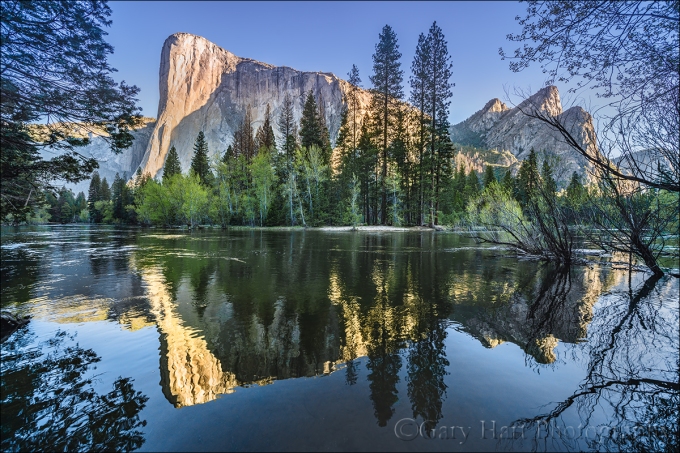
El Capitan and Three Brothers Reflection, Merced River, Yosemite
Sony a7R II
Sony 12-24 f4 G
12mm
1/25 second
F/8
ISO 100
After years of drought, in spring of 2016 I had the good fortune to photograph Yosemite Valley with actual flooding—nothing devastating, just enough for the Merced River to overspill its banks and create reflections where meadows normally exist. One such location was a spot beneath El Capitan, where I found myself faced with the challenge of capturing more scene than my 16-35 lens could handle.
Stitching multiple frames was an option, but because I have a thing about not doing things I couldn’t do with film, my goal is to always capture a scene with one click (this is my problem, and in no way do I mean to discourage others from entering the 21st century). One benefit of my self-imposed one-click rule is that I often find creative compositions I might have overlooked had I settled for the easy solution, but in this case I really, really wanted to photograph the entire scene. The photography gods were smiling upon me that day, as I was leading a workshop and the photographer assisting me generously offered to loan me his Canon 11-24 f/4 lens (thanks, Curt). Since I had in my possession a Metabones adapter that allowed me to pair Canon glass to my Sony body, I leapt at the opportunity.
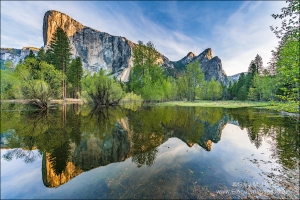
Spring Reflection, El Capitan and Three Brothers, Yosemite
That was an epiphany moment for me, because even though I knew that the difference between 11mm and 16mm is more significant than it sounds, I’d never really compared the two focal lengths side-by-side. Replacing my 16-35 with Curt’s 11-24, suddenly I had the entire scene in my viewfinder, with room to spare. Not only that, I learned as soon as I put the images up on my monitor that the Canon lens was really sharp—I was in love. Sony shooter or not, I came home fully intending to purchase the Canon lens, and came very close to making a big mistake.
My decision not to pull the trigger on a Canon 11-24 purchase was three-fold: 1) it was $3000 2) it’s so massive that it could never be a full time resident of my camera bag 3) I knew Sony was committed to expanding their lens lineup, and that I’d be wracked with regret if Sony released a similar lens soon after I’d sunk $3,000 into a lens that could double as a boat anchor. But still….
Imagine my relief when my Sony doused my Canon fantasies with an ultra-wide lens of their own this spring. Given the opportunity to test the Sony 12-24 f/4 G lens before it was announced, I immediately took it to Yosemite where the flooding on the Merced was even more extreme than last year. Finding “my” spot underwater, I probed the riverbank for nearby vantage points and found the view I’ve shared at the top of this post.
It wasn’t difficult to see that the Sony 12-24 is every bit as sharp as the Canon 11-24. And not only does it not require an adapter to use on my Sony bodies, it weighs less than half of what the Canon ultra-wide weighs. I ordered the 12-24 immediately and this week packed for my first trip with it.
When I drive to a photo destination I bring virtually every piece of camera gear I own, but when I fly, I need to be a little more selective. As I chewed on what to bring and what to leave out, not only did I quickly confirm that the 12-24 would make the cut, I discovered that the new lens is small and compact enough to occupy a permanent space my camera bag.
Which brings me to another thought. I shoot Sony mirrorless for several reasons—foremost is the image quality: Sony’s unmatched combination of resolution, dynamic range, and low-light capability is exactly what I need for landscape photography. And after a few growing pains, I’ve come to love the electronic viewfinder and can’t imagine ever going back. Sony’s lenses are as sharp or sharper than anything I had from Canon, but I don’t think the compactness of Sony’s f/4 glass gets the credit it deserves for their ability to provide so much quality in such a compact package. How compact? They’re small enough to slide into a slot in my bag oriented up/down (resting on an end rather than along a side), which gives me so much more room for more gear (and what photographer doesn’t love more gear).
Here’s what’s in my camera bag (F-stop Tilopa) for this week’s trip to the Grand Canyon:
- Sony a7RII
- Sony a7SII
- Sony a6300
- Sony 12-24 f/4 G
- Sony/Zeiss 16-35 f/4
- Sony/Zeiss 24-70 f/4
- Sony/Zeiss 70-200 f/4 G
- Rokinon 24 f/1.4
- Two Lightning Triggers
That’s three (!) bodies and five (!) lenses, with room for even more stuff. Photographer heaven.
A few words about wide angle photography
Despite the fact that wide angle is the reflex response to most landscapes by virtually every tourist who picks up a camera, good wide angle photography is not easy. From diminished backgrounds to tilting verticals, wide angle lenses pose problems that can be turned to opportunities if they’re fully understood. I’ll save a full discussion of wide angle photography for another day, but here are a couple of tips that might help:
- Put something in your foreground: Many of my wide angle images put the primary subject front and center, but even when the background scene is my main subject, I try to have something of visual interest in my foreground. Browse the gallery below and note how many images have an empty foreground (Hint: Not very many). Sometimes I’m able to include something as striking as a mirror reflection or colorful flowers, but often my wide angle foregrounds are as simple as nearby rocks or leaves. If there’s nothing at my feet and I’m required to use something distant, at the very least I want the foreground of my wide image to be filled something worthy of the space it occupies.
- The tilting of vertical lines caused when you’re close to your subject is minimized when the sensor is on the same plane as the subject (not tilted up or down): Mount on your camera a wide angle lenses at its widest focal length, point it at a row of nearby trees (or some other vertical lines that spans the edges of your frame), and tilt up and down while looking through your viewfinder. At what point do the trees appear straightest? Most slanted? I rest my case.
Going Wide
Click an image for a closer look and slide show. Refresh the window to reorder the display.


Workshop prep: It’s more than just showing up
Posted on July 22, 2017

Twilight Reflection, Mount Tasman and Mount Cook, Lake Matheson, New Zealand
Sony a7R II
Sony/Zeiss 24-70 f4
2 seconds
F/10
ISO 100
A couple of years ago a friend joined a New Zealand photo workshop and found that his leaders had never been to New Zealand. In lieu of scouting, these leaders had done a lot of googling, studied some maps, and read a few guides. During the workshop, they were still trying to put things together without firsthand knowledge of drive-times, the length (or difficulty) of the hikes, where to find the best views (not just the popular ones), the best photography conditions for each location, and how early to arrive or long to stay. Yikes.
Though I can only speak for myself, I can’t image that this is common practice—I believe most workshop leaders are both responsible and prepared. But this story did get me thinking as Don Smith and I started planning our own New Zealand photo workshop. Even the most thorough armchair research can’t prepare a leader for how to respond to the unexpected: extreme weather, a sudden closure or detour, or even a simple cloud that obscures a planned moonrise.
Which is why, before adding a workshop, I do a lot of scouting. A lot of scouting. Not just for my customers’ benefit, but for my own mental health. This might have something to do with being backup obsessive (compulsive?)—whether it’s data, batteries, keys, or photo locations, I just can’t sleep without knowing I can handle an unexpected loss without a hiccup.
At first this was easy because I started with workshops in locations that I’ve been visiting my entire life: Yosemite, Death Valley, the Eastern Sierra. These spots are all just a few hours from my home, so scouting was mostly a matter of double-checking to confirm what I already knew, maybe revisiting under certain conditions.
But when I started adding workshops a little farther afield, at locations where I didn’t have a lifetime’s knowledge, I had to do cram courses to get up to speed. I started with the standard internet searches, map scouring, and guide reading, but any photo-related activity that anyone can do without getting out of the recliner is hardly photography. Armed with this background knowledge, I was ready to put my money where my browser was, and follow-up with multiple, lengthy visits to my new location.
I started doing these scouting trips thinking that I’d just be confirming the knowledge I’d gleaned from my recliner. How wrong I was. As important as this research is, recliner-knowledge pales in comparison to the insight gained by interviewing (pestering?) locals, and simply driving/hiking around constantly asking myself, “What’s over there?”
Another thing I’ve learned is that the priorities for a scouting trip are different than the priorities for a photo trip. I certainly take my camera, and do my best to get as much quality photography time as possible, but a necessary frustration of a scouting trip is the inability to land at every spot at just the right time. Sometimes it’s because I don’t know the right time until I’ve actually put my eyes on a spot, but usually it’s just that there isn’t time to put my eyes on every location at just the right time.
On this month’s New Zealand scouting trip with Don Smith, one spot we’d targeted was Lake Matheson, just outside the little town of Fox Glacier. After seeing the pictures and reading the reports, we knew Lake Matheson offered striking reflections of Mount Tasman and Mount Cook that made it a possible sunrise or sunset spot for our groups. But our long day had started several hours away at Lake Wanaka, detoured east (away from Fox Glacier and Lake Matheson) on an unpaved road through a mountain valley, before finally meandering up and over Haast Pass to New Zealand’s west coast. Further distracted by an unexpected abundance of photo opportunities on Haast Pass, Don and I didn’t pull into Fox Glacier until 90 minutes before sunset.
Checking into our hotel, we learned that that the best views at Lake Matheson were at the back of the lake, about a one-mile walk from the parking lot. Since this was a sunset candidate for the workshop, as tempting as it was to go straight to our room and then to dinner, we bolted for the lake. We arrived with just enough time to hike out to the views, but hadn’t anticipated the rainforest and how beautiful the hike itself would be. With little time to spare, we were forced to race by many lush, intimate scenes that would have justified the hike even without the views, but that’s why we scout—next year, when we return with our groups, now we know to arrive early enough for everyone to enjoy the rainforest as much as we longed to.
We ended up setting up shop for sunset at what we’d learned was the final, and consensus “best,” mountain view on the two-mile lake loop. For a first visit this was probably the best choice, though I think in future visits I’ll make an effort to find something a little less conventional. Though we didn’t get much in the way of clouds, we enjoyed beautiful light on the peaks right up until sunset. As the air chilled, a thin layer of radiation fog formed above a meadow just beyond the lake, and a few wisps of clouds formed beneath the crest.
As nice as the warm light is opposite the sun just before sunset and after sunrise, I’ve always preferred the soft pink and blue pastels and shadowless landscape of the pre-sunrise and post-sunset alpenglow. Some locations are great for this, and others aren’t so much. Mt. Whitney, with its serrated peaks that jut high enough to make it into the pink part of the pre-sunrise sky above the Alabama Hills, is the alpenglow poster child that I judge all other locations against.
As revealed by this image, this evening’s visit was enough to demonstrate that Lake Matheson offers sunset alpenglow potential to rival Mt. Whitney at sunrise. That means we’ll need to make sure the group comes armed with flashlights so we can keep out a little longer than we would if we wanted to get them back to the van before dark.
Join Don Smith and me in New Zealand

Alpenglow: The Twilight Sky Opposite the Sun
Click an image for a closer look and slide show. Refresh the window to reorder the display.


Winter in July
Posted on July 9, 2017
Mt. Eglinton, Mirror Lakes, Fiordland National Park, New Zealand
iPhone 7 pano
I’ve been home from New Zealand for less than 24 hours, and I already miss it. I miss the mountains, the fiords (AKA, fjords, but when in New Zealand…), the lakes, the rivers, the skies, the people, and the winter—right now (when it’s 105 in Sacramento), especially the winter. FYI, picking a favorite season for photography is kind of like having to pick a favorite child—but asking me now would be like asking right after one of my children brought me breakfast in bed, so today I’m going with winter.
But anyway…. As I mentioned in my previous post, I was in New Zealand with Don Smith; we were scouting for our New Zealand workshop, scheduled to debut next June. When I posted my first New Zealand image a few days ago, I’d only been there a couple of days and had seen lots of clouds but not many mountains. That changed on the day we drove the road to Milford Sound, through Fiordland National Park. For the rest of the trip (with a couple of exceptions), the majority of the clouds we saw were the ephemeral, radiation variety that form when the air cools to the dew point. Sometimes the clouds swirled and hovered near the mountain peaks, other times they hugged the lakes and meadows in the still hours around sunrise and sunset. One day we spent a couple of hours driving in a dense fog that had lifted just enough to reveal trees and hillsides glazed with frost.
I’m afraid a scouting trip emphasizes quantity of locations over the quality of the photography—with so much territory to cover, it’s just impossible to time our visits to each spot for the best possible time to photograph it. The priority is to get our eyes on locations, as many as possible—first to see if they’re photo-worthy, and second to determine the lay of the land so we can bring our groups back when they are most photo-worthy. Which is how I happened to be at Mirror Lakes in Fiordland National Park carrying nothing but my iPhone.
We’d left the little town of Te Anau after a glorious sunrise at a remote location, found thanks to a local tip (thanks, Steve at Trips & Tramps), heading for Milford Sound. We were rushing to get in as much scouting as possible before doubling back and driving all the way up to that night’s hotel in Wanaka. So, at the turnout for the short walk down to Mirror Lakes, Don and I just hopped out of the car armed with nothing but iPhones. Fortunately, the scene was perfect for a pano, and the dynamic range was just within the bounds the iPhone could handle.
I’ve never been shy about snapping a quick shot with my iPhone to share on my personal Facebook page or with my wife, but this is the first time I’ve actually put an iPhone image in a blog. Honestly, I’ve never really scrutinized the iPhone images very closely, but I have to say that I’m pretty pleased with the results. Who knows, maybe this is the start of a whole new career….
Contact me to be notified as soon as we have the details of our New Zealand workshop.
A Winter Gallery
(Most of these aren’t New Zealand images, and only one is an iPhone image)


Greetings from Tomorrowland
Posted on July 3, 2017

Overcast, Lake Wakatipu, New Zealand
Sony a7R II
Sony/Zeiss 16-35
1/15 second
F/13
ISO 200
One of my favorite childhood books was “Upside-Down Town,” about a little town where everything was opposite the rest of the world. People walked backward so they could see where they’d been, stores paid people to take their goods, and (my personal favorite at the time) schools were only in session on holidays.
That’s kind of the way it feels visiting New Zealand in July. When I left Sacramento it was 110 degrees. After a week on Kauai (I was working the whole time, I swear), where it was tank tops and flip-flops 24/7, I arrived in the teeth of a Queenstown, New Zealand winter. Every day has been some variation of gray and drizzly, with high temperatures around 40 (that’s Fahrenheit—still haven’t embraced the Celsius thing) and lows in the 20s. Overnight my summer-wear was replaced by fleece, wool, and down full body armor. But I’m not here for comfort, and New Zealand has reminded me why winter is my favorite season for photography.
Of course this Southern Hemisphere winter in July wasn’t a surprise, but it definitely was a shock. Other adjustments (driving on the left; to leave a building, we don’t look for the Exit, we have to find the “Way Out”; and what’s with these power outlets?) have been relatively minor. And I’m still not used to the fact that as far as my wife and family back home are concerned, it’s pretty much always tomorrow here.
But one thing that’s universal is beauty, which is simply off-the-charts here. I was last in New Zealand in 1995, and though I wasn’t here as a photographer (in my previous life I traveled to train programmers), I found New Zealand so beautiful that I carried a camera on my seven-mile sunrise run each morning. Now I’m back with my good friend, frequent partner in crime, and fellow professional photographer, Don Smith. We’re here to scout for a New Zealand photo workshop that will debut in June (winter!) of 2018.
Our first couple of days were in the Queenstown area, where we explored the shores of the spectacular Lake Wakatipu. We could probably do an entire workshop in the Queenstown area, but that would only just scratch the surface down here. Today (tomorrow to you) we’re in Te Anau, having just returned from an all-day cruise on even more spectacular Doubtful Sound. Other locations on this week’s itinerary include Wanaka, Milford Sound, and Fox Glacier.
I’m sharing here my first of what will be many New Zealand images. On the road from Queenstown to Te Anau, we skirted the shore of the south arm of Lake Wakatipu. It had been raining on and off all day, a light rain with no wind, ideal conditions for photography. The snow-capped mountains that flank the entire west side of the lake were shrouded in clouds, but the light was great and we stopped at several locations to photograph.
Rain felt imminent as we pulled off at an unmarked roadside vista, hopped out for a quick reconnaissance, and rushed back to the car for our gear. Taking different routes to the lake, we each found scenes that excited us. Don concentrated on a creek flowing into the lake near the car, while I walked a hundred yards or so up the shore toward a tree topping a dark rock that sloped into the lake, pausing to click a frame or two along the way.
The crescent-shaped beach was naturally sheltered, especially down in my direction. With no wind or waves to disturb the surface, the lake surface here was like turquoise glass that clearly revealed the small, smooth beach rocks continuing beneath the water, and returning crisp reflections of the cloud-shrouded mountains across the lake.
Using the tree and sloping rock to frame the right side of my scene, I played with a variety of compositions. I started with a foreground that included two or three microwave-size rocks lodged in the beach and protruding from the water, gradually moving closer to the tree until my scene was simplified to what you see here. I could have stayed and worked this spot for hours, but soon the wind kicked up and a light rain started and it was time to move on. Later today we’ll drive back by this spot and my fingers will be crossed that the mountains will be out and I’ll get an opportunity to capture it differently.
After four days in New Zealand I’ve completely adjusted to the weather, can now quickly navigate my way out of any building, and am pretty confident I’ll be okay with the left-hand drive thing by the time I fly home. But I’m still trying to wrap my head around the fact that according to my airline itinerary, I’ll actually arrive home before I left. Tomorrowland indeed.
Workshop Schedule || Purchase Prints
A Cloudy Day Gallery
Click an image for a closer look and slide show. Refresh the window to reorder the display.


Yosemite game-changer
Posted on June 26, 2017

Evening Reflection, Mirror Lake, Yosemite
Sony a7R II
Sony 12-24 f4 G
12mm
1/15 second
F/9
ISO 100
“Game changer” is most certainly a cliché, but every once in a while I get to use the term without shame. I used it when I switched from film to digital; again when I discovered that the Sony a7R (and now the a7RII) gave me 2- to 3-stops more dynamic range than my Canon 5DIII; one more time when I first turned the Sony a7S (since replaced with the a7SII) toward the night sky. And I think I’ll trot it out once more for Sony’s new 12-24 f4 G lens.
Of course I can only speak for the 12-24’s change in my game—your results may vary. But as a landscape-only shooter who spends a lot of time in Yosemite, this lens allows me to capture images that were heretofore not possible with anything in my bag: Game changed.
Early last month, with only a few days to play with the new (and at the time, top secret) lens, I beelined to Yosemite. My first stop was Mirror Lake, a wide spot in Tenaya Creek that isn’t technically a lake (it’ll be dry by summer’s end), but each spring is most definitely a mirror. The coveted feature here is Half Dome, which towers more than 4,000 feet above the glassy water, close enough to require some serious neck craning. Many times at Mirror Lake I’ve visualized a composition that includes Half Dome and its reflection, only to be thwarted because even at its widest, a 16-35 lens isn’t wide enough.
Since my days with the lens were limited, I wasn’t able to time my visit for interesting weather or some celestial event. No worries, I rationalized, even on Yosemite’s standard blue-sky days, I can always count on warm, late afternoon light bathing Half Dome—not spectacular, but reliably nice.
I arrived at the lake about an hour before sunset and immediately started seeking out compositions to put the new lens to the test. I can’t tell you how thrilled I was to mount the 12-24 on my a7RII, put my eye to the viewfinder, and see all of Half Dome and its reflection with room to spare. It wasn’t long before I zeroed in on the scene you see here (that required me to balance atop a rock about three feet from the shore, tripod 10 inches deep in frigid snowmelt).
As luck would have it, just as the light started to warm, a few clouds drifted down from the north, so I quickly adjusted my composition and waited for them to slip into my composition. They were moving quite fast, leaving a window of just a few seconds when they filled the sky without being seriously truncated by the border. With composition, exposure, and focus set, I clicked a half dozen rapid-fire frames before the clouds started drifting out of the frame.
This was just my first stop with this lens. On the walk back to my car I stopped for a shot that I shared a few weeks ago; that night, and again the next morning, I tried it at a favorite El Capitan View with great success (to be shared in a future blog). And before returning home, I discovered a completely unexpected use at Yosemite Falls. Needless to say, I’ve already ordered this lens—I expect to see it next month.
Workshop Schedule || Purchase Prints
A Half Dome Gallery
Click an image for a closer look and slide show. Refresh the window to reorder the display.


Happy Father’s Day, Dad
Posted on June 18, 2017

Sunset Palette, Half Dome from Sentinel Dome, Yosemite
Canon EOS-1Ds Mark II
Canon 24-105L
2 seconds
F/20
ISO 100
June 2017
This summer it will be 13 years since I lost my dad to Alzheimer’s disease. He would have turned 87 next month, and I have no doubt that his body would still be going strong if the Alzheimer’s hadn’t taken over. Sadly, it’s difficult to fully appreciate a parent’s influence until they’re gone. We’re certainly aware of the love, wisdom, advice, discipline, tears, and laughs while we’re in the midst of growing up, but it takes being a parent to fully appreciate our parents’ influence on the adults we become.
Dad was a United Methodist minister who literally practiced what he preached. In 1965, when Martin Luther King issued a plea to clergy to join him, Dad borrowed money and flew across the country to march with Dr. King in Selma, Alabama (he was on national TV getting arrested). His was an inclusive theology that respected all religions: I can remember Dad preaching at the local synagogue on a Saturday, and reciprocating in our Sunday service by opening his pulpit to the rabbi. And I’ve lost track of the number of homeless people, including families with young children, we housed while they tried to get back on their feet.
More than the values he instilled, so many of the things that define me today are directly attributable to my dad’s influence. My love of sports and sense of humor for sure. And when asked how I became a photographer, I have to cite Dad. My standard answer has always been that Dad was a serious amateur photographer whose 80-hour work week offered too little time to pursue his passion, so he made up for lost time on our summer family vacations—I grew up believing that a camera was just a standard outdoor accessory. But I think his influence goes deeper than that. More than simply modeling camera use, Dad instilled his appreciation of nature’s beauty, and his longing for its soothing qualities.
Our vacations were, without exception, camping trips—always tent-camping, though in the later years we splurged on a used, very basic tent trailer (no kitchen, bathroom, or any of the other luxuries available in today’s tent trailers). A few times we (Dad, Mom, my two brothers, and I) hit the road for a longer camping trip, one summer taking a month to camp all the way across the country, another summer venturing into the Canadian Rockies. But usually we took advantage of the mountain scenery (always the mountains) closer to our California home.
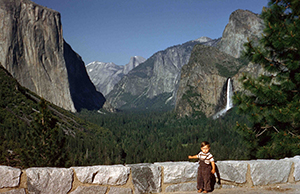
Me, on an early (but probably not my first) Yosemite trip
Of these locations, Yosemite was the clear favorite. Marveling at the Firefall from Camp Curry and Glacier Point, waiting in lawn chairs at the Yosemite dump for the bears to arrive for their evening meal (really), rising in the dark for a fishing expedition to Tuolumne Meadows, family hikes up the Mist Trail to Vernal and Nevada Falls, are just a few of the memories that I only realize in hindsight formed my Yosemite connection.

My father’s rainbow
My favorite Dad photography story happened when I was about ten. It involves an electrical storm atop Sentinel Dome, and his desire to get the shot that was so great that it trumped common sense. As his ignorant assistant, I stretched to hold an umbrella high above Dad’s head to keep his camera dry. (In his defense, as Californians, lightning was a true novelty that trumped full appreciation of its dangers.) We didn’t get the lightning, and more importantly, it didn’t get us. But what I remember more than anything about that day was Dad’s excitement when later that afternoon he was able to photograph a rainbow arcing across the face of Half Dome.
This story has achieved family legend status, and we’ve felt a special connection to Sentinel Dome as a result. When it came time to scatter Dad’s ashes, Sentinel Dome was the obvious choice.
One more thing
I have the reputation for being very lucky where photography conditions are concerned: The clouds that part just as the moon rises, the snowstorm that blankets Yosemite Valley just as the workshop begins, the rainbow arcing across the Grand Canyon. In our family we like to believe that Dad is somehow up there pulling some strings. It’s just the kind of thing he’d do.
I love you, Dad.
Workshop Schedule || Purchase Prints || Instagram
Sharing the Love: A Yosemite Gallery
Click any image to scroll through the gallery LARGE


Downhill All the Way
Posted on June 5, 2017

El Capitan Reflection, Yosemite
Canon EOS 10D
1/4 second
F22
ISO 100
27 mm
On Saturday, with little fanfare, Alex Honnold stunned the climbing world when he free-soloed El Capitan in Yosemite, the world’s largest granite monolith. (What’s the big deal? From this image, you can clearly see that it’s downhill all the way….)
But seriously…
Speaking for all non-climbers, Alex Honnold didn’t just stun the entire climbing world, he stunned the entire rational world. Soaring three-thousand feet above Yosemite Valley, El Capitan is the Holy Grail of climbing. Among climbers, if you’ve summited El Cap, you’ve made the Major Leagues.
First conquered by Warren Harding in 1958, today dozens of climbers dot El Capitan’s vertical surface on any non-winter day with reasonable weather in the forecast. But until Saturday, all who scale El Capitan do it with ropes and a virtual hardware store worth of climbing aids. Most require multiple days to summit.
Alex Honnold chose to ascend El Capitan unencumbered by ropes or safety hardware of any sort (free climbing uses ropes for safety only; free-soloing is completely sans rope), scampering up the shear granite the old fashioned way, using only his hands and feet like a kid climbing a tree in his backyard. Even more astonishing, he accomplished his feat in less than four hours.
I’m not a climber, and in fact have a difficult time getting within three feet of any un-railed vertical drop greater than thirty feet. But I’ve always lived vicariously through climbers, devouring climbing books, videos, and documentaries just to marvel at their accomplishments. And for years Alex Honnold has been the climber I’ve followed most closely, not just because he’s the best (he is), but also because of our common affinity for Yosemite, and the fact that my daughters went to high school with him (and I was a Honnold fan even before I knew this connection).
I also admire Alex Honnold not only for his skill and accomplishments, but for his humble demeanor (I suspect that he’d prefer climbing in complete anonymity) and quiet wisdom. And though we’ve never met, I can’t help worrying a little about him when I think of the number of mistakes I make with my camera—”Oops, I’m still at ISO 3200 from last night’s Milky Way shoot”; “Crap, I forgot to orient my polarizer”; “Did I remember to focus?” (I could go on)—and realize that for Alex Honnold, even one small mistake likely means death. I mean, even if I knew with absolute certainty that missing my exposure by just 1/3 stop would cause my camera to explode, I’m pretty sure I’d still be dead long ago.
So hats off to you, Alex Honnold, here’s wishing you many happy years as the world’s greatest living climber.
Links
- Check out this “60 Minutes” segment
- Here he is climbing El Sendero Luminoso in Mexico
- And if the video makes you squeamish, here’s a simple interview
An El Capitan Gallery


 Eloquent Images by Gary Hart