Eloquent Images by Gary Hart
Insight, information, and inspiration for the inquisitive nature photographer
Dome Sweet Dome
Posted on November 15, 2024

Sunset Sentinel, Half Dome, Yosemite Glacier Point
Sony a7R V
Sony 24-105 f/4 G
ISO 100
f/13
1 second
Poll 100 random people about the feature they most associate with Yosemite, and you’ll probably get a variety of answers. Near the top of the list will be El Capitan and Yosemite Falls. Bridalveil Fall might get some love too. But I’d wager more than half of the votes would go to Half Dome, both for its striking profile, and for the way it towers in prominent magnificence over its granite domain.
The Half Dome story began more than 150 million years ago, with the start of the slow-motion collision between the oceanic Farallon, and continental American, tectonic plates. The Farallon Plate, being heavier, was subducted beneath the westward plowing American Plate. Over the next 100 million or so years, the Farallon Plate was driven deeper, toward the super-hot mantle, where it became hot enough melt and form large pockets of magma. Some of this magma made it to the surface as volcanic eruptions. The magma that didn’t reach the surface slowly cooled and hardened into the granitic batholith (a large, subterranean mass of igneous rock) that forms today’s Sierra Nevada range.
But how did this subterranean granite, still miles beneath Earth’s surface, come to rise to the nearly 3 miles above sea level we see today? I thought you’d never ask.
Deep beneath Earth’s surface, the same inexorable tectonic forces that initiated the subduction process continued (and continues to this day), slowly deforming and pushing upward the crust and underlying granite. The uplifted overlying sedimentary rock was far more easily eroded than the much harder granite and eventually swept away, exposing the Sierra’s signature granite backbone.
Once exposed to wind, rain, and snow on the surface, granite is subject to its own form of erosion. Rather than consisting of a single molecular structure, granitic rock is made up of a variety of minerals in varying percentages (for simplicity, I’ve just lumped all the various granitic rocks into a single “granite” designation). Depending on its composition, some granites are prone to horizontal jointing that causes it to break along parallel planes. Other granites experience exfoliation, breaking away in concentric sheets. The jagged granite of the Sierra Crest near Mt. Whitney is the result of jointing; Yosemite’s rounded granite domes (like Half Dome) are the result of exfoliative sheeting.
The granite that would eventually become Half Dome formed deep beneath Earth’s surface nearly 90 million years ago. Of course at formation it was just a blob of granite that didn’t resemble the Half Dome we know today, but through millions of years of uplift, exfoliation, and exposure to the elements, a rounded granite pedestal began to take shape. But it still wasn’t Half Dome.
Though one look will tell you why it’s called Half Dome, the truth is, that’s a misnomer. A better, albeit less glamorous, name would be Eighty-Percent Dome. That’s because there is no missing half—we still enjoy about 80 percent of this prestigious monolith’s original form.
Another common misconception is that Half Dome was carved by glaciers: it was not. Instead of half of its bulk being carved off by glaciers, Half Dome’s flat northeast face got that way incrementally, as the most exposed of many preexisting parallel cracks filled with water, that froze and expanded each winter. Each freezing cycle expanded the crack a bit more, until eventually the exposed sheet of granite fell away. This exposed another crack, and the freeze/expand cycle continued, until about 20 percent of the rock was lost.
Many people are surprised to learn that no glacier ever reached the top of Half Dome—the largest, the Sherwin Glacier, which receded about one million years ago, still left 800 feet of Half Dome’s summit exposed; subsequent glaciers were much smaller. But while glaciation didn’t carve and polish Half Dome, glaciers did sweep away the granite debris that had fallen from what we now call the face.
It’s fun to travel around Yosemite and photograph the product of all this natural sculpting from as many angles as possible. Since I time my personal trips and Yosemite workshops to avoid summer crowds, my viewing locations are mostly limited to Yosemite Valley. But even from the valley, there are extreme differences: compare the Tunnel View perspective in the west, to the many views from the valley’s east side: Sentinel Bridge, Cook’s Meadow, Ahwahnee Meadow, and (especially) Mirror Lake.
I do get to see Half Dome from Olmsted Point each October, and when a fall color trip happens before Glacier Point closes for the winter. This year’s Yosemite Fall Color and Reflections workshop threaded the needle between a couple of temporary snow closures (it will close for the season with the next major storm) and I managed to get my group up there for sunset one evening.
I love the face-to-face relationship with Half Dome that Glacier Point offers, but I’ve been here enough that I rarely photograph this view anymore. But when the sunset sky started to pink up this evening, I couldn’t resist clicking off a few frames. As you can see, I didn’t really come up with anything terribly unique, but I enjoyed creating a close-up portrait of Half Dome beneath a beautiful sky. In fact, as I took this picture, I thought the composition was so ordinary that I’d probably never process it. But going through my images while trying to view them through the eyes of people much less familiar with Yosemite’s magic, I decided to go ahead and share it.
Let me share Yosemite’s beauty with you in a photo workshop
The Many Views of Half Dome
Click any image to scroll through the gallery LARGE


Isolate and Conquer
Posted on November 8, 2024

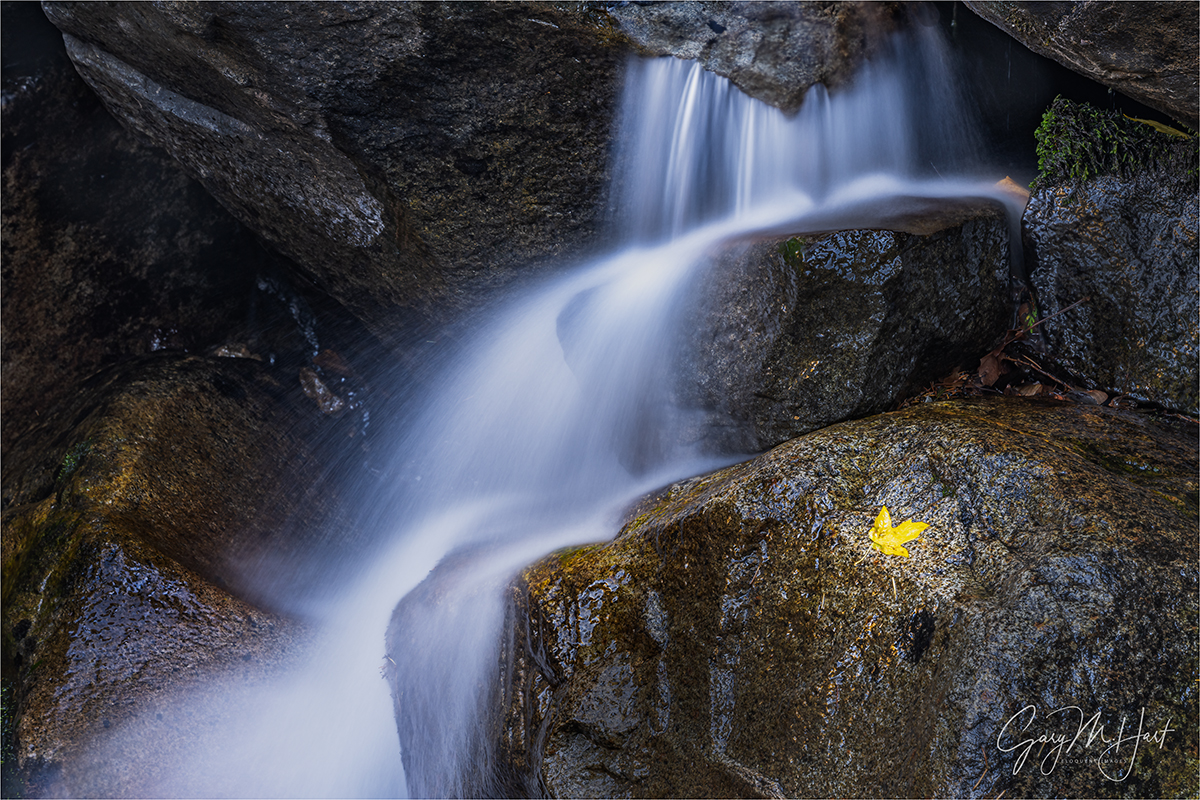
Autumn On the Rocks, Bridalveil Creek, Yosemite
Sony α1
Sony 100-400 GM
3.2 seconds
f/16
ISO 200
This year marked my second autumn visit since the reopening, and everything still feels gloriously new to me. Arriving at Bridalveil Creek on the final morning of last week’s Yosemite Fall Color photo workshop, I started with a brief orientation, then guided the group along the main trail, pointing out the many photography opportunities here. I wrapped up the introduction by inviting anyone who doesn’t mind a little bush-whacking and rock scrambling to follow me to one more spot.
Off the beaten path and often jammed with fallen trees and branches, the scene here is a little different each time I visit. The amount of water in the creek varies, as does the number of leaves on the ground and in the pools. This year the water was nice, but the leaves hadn’t quite reached peak blanket status. But these annual variations are part of what I love about photographing here.
Autumn Leaf and Cascade, Bridalveil Creek, Yosemite
Sony α1
Sony 100-400 GM
8 seconds
f/16
ISO 100
Probably my favorite thing to do at Bridalveil Creek is to find a leaf or leaves swirling in a pool and capture their colorful spiral with a long exposure. But when I couldn’t find any candidates for swirling color on this visit, I went to Plan B and scanned the scene for a leaf I could isolate. Despite lots of beautiful yellow leaves overhead, I only found two candidates on the ground.
Usually I try to get within 10 feet of subjects like this, because the closer I am, the more even a small amount of repositioning affects my foreground/background relationships. But closer access to these leaves was blocked by water, rocks, and downed branches (plus I didn’t want to risk getting in someone else’s frame), so I put away my 24-105 lens in favor of my 100-400, and went to work from an open vantage point about 30 feet back.
As I worked this scene, I couldn’t help remembering that every time I share an autumn image from Bridalveil Creek in Yosemite, I need to brace for the questions: some version of, “Did you place that leaf there?” Usually the tone is friendly curiosity, but sometimes it includes an undercurrent of suspicion bordering on accusation. While these questions are an inevitable part of being a nature photographer, I suspect that I get more than my share because I aggressively seek naturally occurring subjects to isolate and emphasize—and Bridalveil Creek in autumn has them in spades. But regardless of the questioner’s tone, my answer is always a cheerful, unapologetic, and honest, “No.”
I digress
We all know photographers who have no qualms about arranging their scenes to suit their personal aesthetics. The rights and wrongs of that are an endless debate I won’t wade into, other than to say that I have no problem when photographers arrange their subjects openly, without intent to deceive. But photography has to make you happy, and I create my photographic happiness by discovering and revealing Nature, not manufacturing it. I don’t like arranging scenes because I have no illusions that I can improve Nature’s order, and am confident that there’s enough naturally occurring beauty to keep me occupied for the rest of my life.
Order vs. chaos
Nature is inherently ordered. In fact, in the grand scheme, “Nature” and “order” are synonyms. But humans go to such lengths to control, contain, and manage the natural world, we’ve created a label for our failure to control nature: chaos. Despite its negative connotation, what humans perceive as “chaos” is actually just a manifestation of the Universe’s inexorable push toward natural order.
Let’s Take a Trip…
For example, imagine that all humans leave Earth for a scenic tour of the Milky Way. While we’re gone, no lawns are mowed, no buildings maintained, no fires extinguished, no floods controlled, no Starbucks built. Let’s say we return to Earth in 100 years*. While the state of things would no doubt be perceived as chaotic, the reality is that our planet would in fact be closer to its natural state. And the longer we’re away, the more human-imposed “order” would be replaced by natural order.
* Since this is my fantasy, I’ve chartered a spaceship that accommodates all of humankind and travels at 90 percent of the speed of light. While Earth has indeed aged 100 years during our holiday, we travelers return only a year older. (Dubious? Don’t take my word for it, ask Albert Einstein.)
What’s it all about?
Instead of manufacturing false order, I prefer organizing my scenes around naturally occurring relationships in a way that makes the image about something—in other words, finding the natural order and interpreting (translating) it in a way that resonates with humans. To distill this natural order from perceived chaos, nature photographers have a couple of compositional tools in our creative toolbox.
With a wide lens and careful positioning and framing, we can guide viewers’ eye with relationships that start in the close foreground and extend to the distant background, connecting elements to create virtual lines that guide the viewers through the frame. I think most photographers are biased toward these wide landscape images because the wider frame is closer to the way we see the scene with our eyes. But going wide also risks introducing unwanted elements that clutter the frame and pull the viewers’ eyes off their prescribed visual path.
Enter the telephoto lens, an underused landscape tool by most (but not all) photographers. A telephoto lens lets us be more surgical in our subject choice by simplifying the scene to its most essential elements that emphasizes our scene’s most prominent feature or features, and eliminates peripheral distractions. Nevertheless, despite the telephoto’s effectiveness, I often catch myself automatically defaulting to my wide lenses. But I’ve learned that those times when I’m struggling to find a shot, the easiest way to reset my creative instincts in the field is to simply view the scene through a telephoto lens, just to see what might be lost in the visual discord of the wide scene.
Still not convinced? In addition to providing a fresh perspective, telephoto lenses offer undeniable, tangible advantages in landscape photography:
- Bigger subject: Bigger isn’t always better, but there’s often no more effective way to emphasize your subject than to magnify it in your frame.
- Isolate: By zooming closer, you can banish distractions and unwanted objects to the world outside the frame, distilling the scene to its most essential elements.
- Highlight the less obvious: Sometimes a scene’s compelling, but more subtle, qualities are overwhelmed by the cacophony of dramatic qualities that drew you in the first place. By all means, shoot the grand drama that drew you in the first place, but take the time to discover the smaller stuff that’s there as well.
- Selective focus: The longer your focal length, the shallower your depth of field. One of my favorite ways to emphasize a subject that might otherwise be overlooked is to render it as the only sharp object surrounded by a sea of soft color and shape.
If telephoto vision doesn’t come naturally to you in the field, try training your eye in the comfort of your own home by opening any wide angle image in Photoshop (or your photo editor of choice), setting the crop tool to 2/3 aspect ratio (to match what you see in your viewfinder), and see how many new compositions you can find. (I’m not suggesting that you shoot everything wide and crop later—this crop tool suggestion is simply a method to train your eye.) But whether you do it in the field, or later in Photoshop, once your eye gets used to seeing in telephoto, you’ll find virtually every scene you photograph has telephoto possibilities you never imagined existed.
Meanwhile, back at Bridalveil Creek…
On this morning, I shot these leaves—one, the other, and both—horizontal and vertical, from wide to tight (horizontal version shared above). I even experimented with a variety of shutter speeds, but it was so dark back here in the early morning shadow beneath towering granite, darkened further by a canopy of leaves, and with a polarizer essential to mitigate the glare on the wet rocks and leaves, that any reasonable ISO didn’t allow a shutter speed that made a noticeable difference in the water’s blur—the water was moving so fast, 1 second and 10 seconds were virtually identical. So I just went with whatever shutter speed I needed to get the exposure I wanted (the fact that I ended up shooting this frame at ISO 200 instead of ISO 100 was just small oversight, left over from earlier shutter speed experiments).
My starting position was more-or-less at eye level with the cascade, putting the leaves more edge-on. Though they were clearly visible, but their classic maple leaf shape was somewhat obscured by the angle of view. So after exhausting all compositional variations, I scanned my surroundings for a higher vantage point and spotted a rock that would take a little effort to scale (nothing dangerous—mostly navigating a lot of downed trees and branches), but that might work if the view from there was unobstructed.
Turns out shifting those few feet was worth the effort, providing a much better angle that clearly revealed the leaves’ shape. I proceeded to run through another series of compositions similar to what I’d done at the first spot.
I’ve learned to wait until the workshop’s final day to take my groups to Bridalveil Creek. The photography here isn’t as obvious as the rest of Yosemite, so as excited as I am to share it, it takes a while for everyone to refamiliarize themselves with their cameras and warm up their creative muscles. This group was no exception, but when we gathered at the cars after the shoot, I heard the same “I could have stayed here all day!” responses I always get at Bridalveil Creek. Me too!
Join me in Yosemite
Workshop Schedule || Purchase Prints || Instagram
Isolate and Conquer
Click any image to scroll through the gallery LARGE


Feeding My Muse
Posted on May 22, 2024
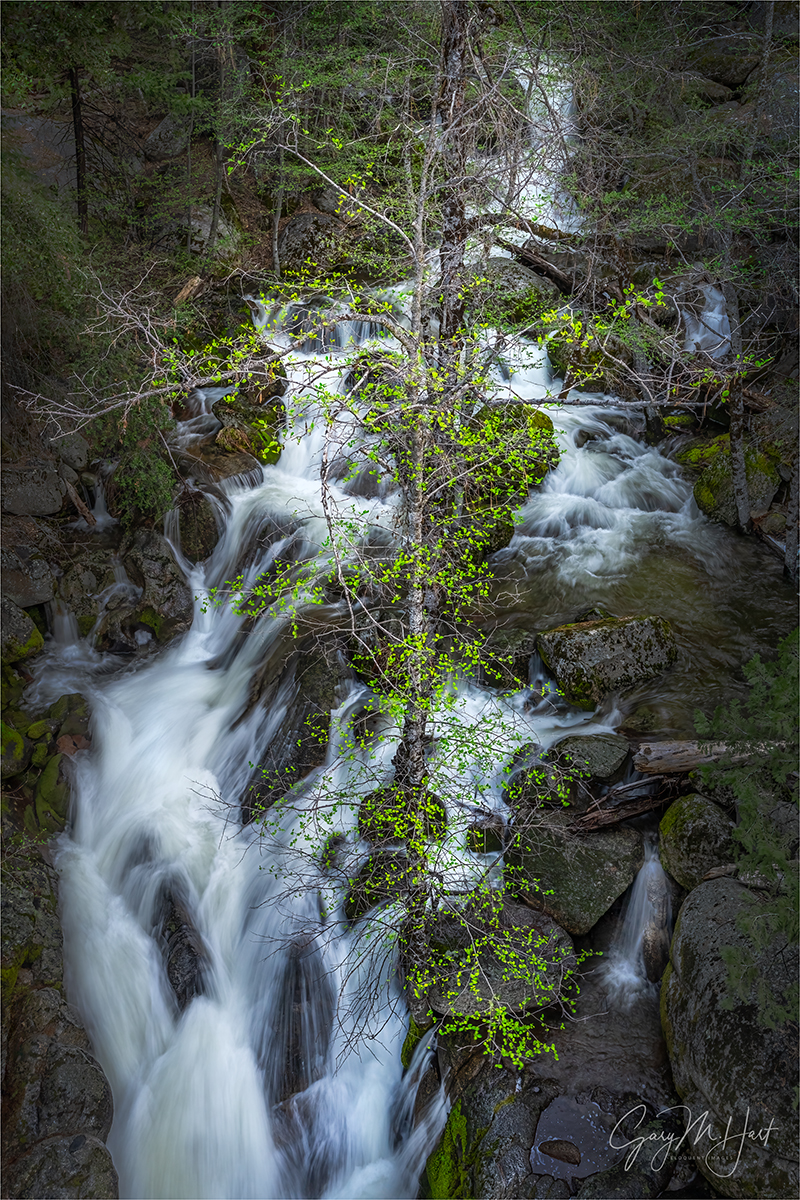
Spring Cascade, Tamarack Creek, Yosemite
Sony α1
Sony 16-35 f/2.8 GM
ISO 800
f/11
1/4 second
Ode to the Coffee Table Book
I grew up in an era when coffee table books were a thing. For decades, these dense rectangular blocks, packed with thick, glossy pages containing far more picture than text, dominated living rooms across America. Whether acquired by purchase or gift, once installed on a coffee table, most coffee table books would rest unopened for years, virtually untouched except by an occasional dust cloth, and maybe a micro-adjustment on the way to answer the door for company. It seems the CTB’s prime function was to generate the illusion of sophistication by enabling its owner to feign interest in a variety of esoteric subjects: the churches Europe, windmills, Iceland’s waterfalls, and so on.
But here’s a little secret. Turns out, many of these books were actually quite enjoyable. Who knew? As a child naive to the hands-off rules, to occupy myself while the adults were busy chatting about boring stuff, I’d sometime heft one of these beefy tomes onto my lap and page through it.
I found myself most drawn to books dedicated to nature and landscapes—pretty much anything with pictures of mountains, forest, desert, or coastline. For many years my attention was solely on the pictures and I paid no attention to the photographer responsible for them. But eventually I became aware that the images I lingered on longest came courtesy of David Muench. While some were in theme-based CTB photo anthologies filled with images from many photographers, I got to where I could instantly identify Muench’s beautiful captures before checking the photo credit. And I was especially excited whenever I found a book filled exclusively with Muench’s beautiful images of the American outdoors: the Southwest, National Parks, the Rockies—it didn’t really matter.
As a child, my analytical skills and photography aspirations were still many years in the future—I just knew I could spend several minutes on each page, visually caressing each mountain, lake, rock, tree, leaf, and flower. In hindsight, I know that my own photography today, both the scenes I’m drawn to as well as the way I approach them, were organically and profoundly influenced by this exposure to David Muench’s images.
Revelation
I’m writing about this because last month I had the good fortune to get my hands (and eyes) on William Neill’s latest book, “Yosemite: Sanctuary in Stone.” The instant I cracked it open, those childhood feelings of profound awe came flooding back, and instantly I was reminded how much, in this age of ubiquitous screens, I miss the tactile relationship with beautiful photography that can only be provided by a large, well-printed book.
Though it would be undeniably true, labeling “Yosemite: Sanctuary in Stone” a book full of pretty pictures would be a gross understatement. The opposite of derivative, Neill’s images are revelatory in their vision, a reminder that, in any scene, there’s so much more to photograph than we see at first glance.
Most of the images Neill shares in this book are intimate portraits featuring interactions of Earth’s more permanent features with its ephemeral elements, such as light, shadow, water, clouds, rain, fog, and snow. Though few depict the recognizable icons we associate with Yosemite (monoliths and waterfalls), each reveals the natural patterns, color, and contrast that makes Yosemite unique, somehow blending all this into coherent scenes that are so simple, it’s hard to believe no one saw them sooner. The product is a celebration of Nature’s most subtle beauty, rendered all the more beautiful because it’s been pulled from obscurity by a photography master. These images inspire me to continue cultivating my own personal vision, and to bolster my creative foundation by spending more time with profound photography like this.
Feeding My Muse
When I set out to write this, my intent was a straightforward piece honoring William Neill’s beautiful book, and acknowledging the role of the muse in its more conventional sense: an external influence that stimulates an artist’s creative instincts. But the more I wrote, the more I found myself leaning toward my own muse as an internal collaboration between a lifetime of external inputs.
Huh? What I mean is, we’re all influenced by the creations of others, and by our general interactions with the world. That influence can be conscious, like my experience paging through “Yosemite: Sanctuary in Stone,” or unconscious, like my childhood exposure to David Muench’s photography, or simply by spending a night on my back beneath a dark sky generously sprinkled with stars. Regardless, all that input is processed by my internal muse and organically output as inspiration: my internal muse.
A successful image happens at the intersection of vision and craft. Craft taps the analytical part of the brain, enabling us to master a scene’s motion, light, and depth through the control of the camera’s exposure variables, as well as command of hyperfocal technique for managing focus. Vision, more than the mere “eye for composition” many photographers talk about, is the ability to conjure unseen possibilities, and to channel the camera’s unique vision to uncover hidden patterns and relationships. Craft can be refined and honed by study and repetition, while vision is more elusive.
This is where I call on my internal muse to blend vision and craft to create (I hope) photographic synergy. But like any creative instinct, the internal muse must be nurtured and fed. I fear that the decline of big photography books like Neill’s has robbed many photographers’ internal muse of a prime source of sustenance. For proof, look no further than the proliferation of derivative photography online, a feedback loop of sameness where Photoshop amplification and AI manufacturing substitutes for inspiration and vision.
Of course taking my muse out into the field is easier said than done. I love sharing beautiful locations with my workshop students, but when I’m leading a photo workshop, my own priorities take backseat to theirs. I can’t explore and experiment the way I do when I’m on my own. But that doesn’t keep me from trying.
Putting My Muse to Work
In April I did two Yosemite workshops that focused on Yosemite at its saturated spring best. Both groups chased rainbows in Yosemite’s booming waterfalls, mirror reflections in the valley’s many ephemeral pools, and pristine dogwood blooms decorating the swollen Merced River. A particular highlight this year was the opportunity to share the Upper Cascades in full flow.
The Upper Cascades vantage point I like is the Cascade Creek Bridge on Big Oak Flat Road, just upstream from the Cascade Creek and Tamarack Creek confluence (which is visible from the bridge). Like most waterfalls, Upper Cascades is best in overcast or full shade. So the open southern exposure, and the fact that overcast is relatively rare in California, makes it difficult to find Upper Cascades in ideal light. And since Upper Cascades is fed entirely by snowmelt, its window of opportunity is very small. So I’m thrilled any time I can make it here when the water’s flowing and the light is soft.
On the visit with my first group, after a brief orientation and getting everyone set up, almost as an afterthought I pointed to the bridge over Tamarack Creek just 50 yards or so up the road, telling them it’s a beautiful little creek, but so overgrown that it’s pretty difficult to photograph. But when I noticed a couple heading that way a little later, I couldn’t help wander up there myself to see what they’d found.
This might be a good time to mention that one exercise I use to stimulate my muse when I’m in the field is to think of specific favorite images that were almost certainly not the obvious shot, then challenge myself to find my own less obvious shot. One of those favorite images is William Neill’s Dawn, Lake Louise, Banff National Park, Canada; another is Charles Cramer’s (wait for it…) Cascade Creek, Spring, Yosemite, captured just yards from where I stood that morning. (William Neill also has his own version of the Cascade Creek tree—not a duplicate and equally beautiful—and I honestly don’t know which came first. I default to Charles Cramer’s because it’s the first one I saw, but I love them both.)
So anyway, scanning my the scene, I was first bothered by a single alder tree, just starting to sport its spring green, right smack in the middle of the scene. Then it occurred to me that I could actually use that tree to anchor my scene. My idea was a wide, vertical composition that placed the tree front and center, with the creek racing down the steep slope directly behind it. After working with it for a while, I decided that, while I really liked the composition, the tree needed more leaves. So I made a mental note to try again in a week, on my second group’s Upper Cascades visit, when the leaves might have filled in more.
And that’s exactly what I did. While not as full as I’d hoped, on that second visit the leaves were definitely more visible than the first time and I went straight to work. Though it’s difficult to tell in a two-dimensional image, Tamarack Creek approaches waterfall steep right here. Since there wasn’t enough light to freeze the water at any reasonable ISO, so I just went all-in on motion blur.
Having already worked out the composition on my first visit, I just ran a range of shutter speeds from 1/10 to 5 seconds. Examining my results as I worked, it quickly became clear that the speeds from 1/5 to 1/2 would be best: faster than 1/5 looked scratchy (still blurred, but not smooth); longer than 1/2, the water started to lose definition. This image used 1/4 second—I chose it because it smoothed the water nicely, while still retaining all the definition that conveys its extreme speed.
Opportunities like this during a workshop are fairly rare because I usually need to put my muse on hiatus to focus on my group. When that happens, my best images are usually the more obvious beauty, such a vivid sunrise/sunset, arcing rainbow, rising/setting moon, or any of the many other natural phenomena nature photographers covet and chase relentlessly. But as beautiful as those special moments are, my muse and I are never happier than the quiet times I get to spend working in subtle light, using my creative instincts to extract a scene’s essence.
Workshop Schedule || Purchase Prints || Instagram
My Muse and I
Click any image to scroll through the gallery LARGE


Visualize the Future
Posted on May 6, 2024

Twin Falls, Ribbon Fall and Bridalveil Fall, Yosemite
Sony α1
Sony 16-35 f/2.8 GM
ISO 50
f/16
2.5 seconds
Virtually every scene I approach with a camera is beautiful, but a beautiful scene isn’t enough if all the parts don’t work together. Human experience of the world differs greatly from what the camera captures—the photographer’s job is to understand and use those differences.
Ansel Adams and visualization
Most photographers know that Ansel Adams visualized his final print, and the darkroom work necessary to create it, before clicking the shutter. This ability to look into the future of each capture is part of what set Ansel Adams apart from his peers.
But Adams’ extensive darkroom work is often cited by digital photographers defending their over-processesed images. We’ve all heard (and perhaps even uttered ourselves) statements like, “Ansel Adams spent more time in the darkroom than he did in the field,” or “Ansel Adams would love Photoshop.” Perhaps true, but using Ansel Adams’ darkroom mastery to justify extreme Photoshop processing misses a significant point: Adams’ mental picture of the ultimate print was founded upon a synergistic relationship between his own vision and his camera’s vision, coupled with a master’s control of capture variables like composition, light, motion, and depth. In other words, Adams’ gift wasn’t merely his darkroom skills, it was an overarching vision that enabled him to make decisions now based on invisible realities he knew he’d encounter later.
I bring this up because I’m concerned about many photographers’ Photoshop-centric “fix it later” approach that seriously undervalues capture technique. This mindset ranges from simple over-reliance on the LCD for exposure with no real understanding of the histogram or how metering works (shoot-review-adjust, shoot-review-adjust, shoot-review-adjust, until the picture looks okay; or shoot so it looks good, not realizing the exposure is wrong until they get it on their computer), to photographers who channel their disappointment with an image into an overzealous Photoshop transformation, pumping color, adding “effects,” or inserting/removing objects until they achieve the ooooh-factor the image lacks.
The better approach is to understand the potential in a scene while actually viewing it in Nature, camera in hand, then to anticipate the processing the image will require and shoot accordingly. In other words, Photoshop should inform capture decisions, not fix them.
Putting Photoshop in its place
Every image ever captured, film or digital, was processed. Just as the processing piece was easy to ignore when the exposed film you sent to a lab magically returned as prints or slides, many digital shooters, forgetting that a jpeg capture is processed by their camera, brag that their jpeg images are “Exactly the way I shot them.” Trust me, they’re not.
Whether you shoot monochrome film, Fuji Velvia slides, low-compression jpegs, or (especially) the latest smartphone there’s nothing inherently pure about your “unprocessed” image. On the other hand, digital landscape photographers who understand that processing is unavoidable, rather than relinquish control of their finished product to black-box processing algorithms built into the camera, usually opt for the control provided by raw capture and hands-on processing.
Unfortunately, Photoshop’s power makes it difficult for many (myself included) to know where to draw the processing line. And every photographer draws that line in a different place—one photographer’s “manipulation” is another’s “masterpiece.” The reality is, Photoshop isn’t a panacea—its main function should be to complement the creativity already achieved in the camera, and not to fix problems created (or missed) at capture.
While I’m not a heavy Lightroom/Photoshop user, I readily acknowledge that they’re amazing tools that are an essential part of my photography workflow. I particularly appreciate that LR/PS give the me ability to achieve things possible with black and white film and a decent darkroom, but difficult-to-impossible with the color transparencies I shot for over 25 years. Of course processing is an ever-evolving art itself, one I’m still learning. I’m afraid to this day I find myself mortified by some of my earlier processing choices—as I no doubt will be at some later date by processing choices I make today.
Creating an image, from start to finish
Normally when I find myself at a popular Yosemite location like Valley View, I won’t get my camera out unless I can find something that feels truly unique. Last month, not wanting to stray from my workshop group, I was content to observe and assist. But when the clouds draping El Capitan and Cathedral Rocks started turning pink in the evening’s last light, I couldn’t resist.
I raced to my car and grabbed my tripod and Sony a1, already loaded with my 16-35 GM lens, and headed down to the large log embedded along the riverbank, just downstream from the parking lot. This log has been a Valley View fixture for years, but each year it gets nudged a little by spring runoff—some years more than others. I’m sure it will eventually be swept away entirely.
A trio of photographers was already in place on and around the log, but spying a spot I could squeeze into, I scaled the log and tightroped my way toward the small opening. Despite an extreme language mismatch, we were able to pantomime our way into a friendly equilibrium—lots of smiles and pointing, with a mutual thumbs-up for punctuation—that enabled me to set up in a spot that worked for me without disturbing them.
With the light changing quickly, I went right to work, framing up a wide draft version that included the entire Valley View scene: clouds, Ribbon Fall (on the left), El Capitan, Cathedral Rocks, Bridalveil Fall, and the Merced River. I was especially excited to be able to frame the scene with the two prominent waterfalls: well known and year-round Bridalveil on the right, and somewhat anonymous, seasonal Ribbon Fall (Yosemite’s highest vertical drop).
I wasn’t super crazy about the log in the middle of the river, but since it was right in the middle of the scene I wanted to photograph, I decided to lean into it and just make it part of my composition. And while I liked the whitewater, I was less than thrilled by its position in the lower right corner of my frame. Again, just something I’d need to accept and deal with.
Balanced atop my log, I raised my tripod as high it would go to prevent the foreground log’s protruding vertical branch from intersecting the far riverbank. To remove distracting texture from the whitewater, I decided to smooth the water with a long shutter speed, dialing to ISO 50 and stopping down to f/16. Exposure was tricky because the sky still held onto a fair amount of light, while the foreground was darkening fast, so I took care to monitor my histogram until I found a shutter speed that didn’t wash out the color, while still creating a pleasing (to my eyes) motion blur.
The preview image on my LCD looked mostly too dark, with the sky too bright, but I know my camera well enough to know that all the beautiful detail in the shadows and highlights would return like magic in Lightroom. Besides pulling down my highlights and dragging up my shadows, a small color temperature tweak, and some selective dodging/burning, this turned out to be a relatively simple image to process and get to come out exactly as I’d visualized it that evening.
One more thing
Check out the gallery below. All of these images were captured at Valley View. Rather than base my composition on the “standard” shot here, I crafted each to take advantage of whatever conditions were before me at the time. And while a few images do indeed settle for the more conventional composition, my decision to photograph that way was justified (in my mind) by the exceptional conditions that told me I should just get out of the way and let the scene speak for itself. So I guess the moral is, trust your instincts and don’t settle for the obvious—unless the obvious just hits you right over the head and you just can’t ignore it.
Valley View Variety
Click any image to scroll through the gallery LARGE


The Battle of the Brains
Posted on May 3, 2024

Intimate Dogwood, Yosemite Valley
Sony a7RV
Sony 200-600 G
ISO 1600
f/10
1/125 second
Two photographers approach a dense forest festooned with blooming dogwood: One is drawn to a lovely bloom and can clearly visualize a uniquely beautiful image, but he has no idea how to manage his exposure variables to achieve it; the other photographer is so intent on minimizing diffraction while identifying the shutter speed that will freeze the gently swaying bracts without compromising the ISO, that to her, the scene is nothing more than a disorganized assortment of white splashes.
While most photographers don’t fall at these extremes of the creative/analytical continuum, the vast majority do approach their craft with a dominant intuitive or analytical bias, a right-brain versus left-brain struggle with one side or the other significantly stronger than the other. Compounding the problem, rather than simply getting out of the way and letting the strong side do its work, much like an irritating little brother, the less developed (notice I didn’t say “weaker”) side often seems committed to distracting its dominant counterpart.
But every once in a while I run into a photographer who seems to have negotiated a synergistic truce between her conflicting mental camps. She’s able to efficiently analyze and execute the plan-and-setup stage of a shoot, then check-in with her aesthetic counterpart for creative inspiration. As the time to click the shutter approaches, she seamlessly switches between the two camps: the right brain knows how much to soften the background and blur the water, while her left brain knows exactly how to make this happen. The result is images that consistently amaze with their creative inspiration and technical execution.
My job as a photo workshop leader (among other things) is to identify where each photographer falls on this analytical/intuitive spectrum so I can honor and refine the dominant side, and encourage and nurture the less developed side. And after more than 18 years leading photo workshops, I’ve learned that what most photographers perceive as a terminal shortcoming in their creative or analytical aptitude can usually be resolved once it’s untangled from the dominant side.
When I hear, “I have a good eye for composition…,” I know before the “but” exits the photographer’s lips that I’ll need to prove that he’s smarter than his camera (he is). Our time in the field will be spent working on jettisoning the camera’s automatic modes because as smart as it might seem, your camera is not creative. I try to demystify and simplify metering, exposure, and depth management until they become second nature, comforting allies rather than distracting antagonists. Fortunately, despite the fact that much of the available photography education seems designed to intimidate Einstein, laying a foundation for mastering photography’s technical side is ridiculously simple.
On the other hand, before the sentence that starts, “I know my camera inside and out…,” is finished, I know I’ll need to foster this photographer’s curiosity, encourage experimentation, and help her disengage the rules that constrain her creativity. We’ll think in terms of whether the scene feels right, and work on what-if camera games (“What happens if I do this”) that break rules. Success won’t require a brain transplant, she’ll just learn to value and trust her instincts.
Intuition is the key to breaking the rules that inhibit creativity, while simplification and repetition create technical confidence. Alone, these qualities are incomplete; in conflict, they’re mutually exclusive anchors that prevent movement; in concert, their synergy is the foundation of photographic success.
For example
Coincidentally, just this week I happed to find myself in a dense forest festooned with blooming dogwood. Go figure. A few minutes earlier I’d set my workshop group free just upstream from Valley View, and after making sure everyone was content, I grabbed my camera, tripod, and 200-600 lens and went dogwood hunting.
I started by switching on my creative brain and wandering slowly, scanning the surroundings for a dogwood flower (yes, I know they’re technically not flowers, they’re bracts) to isolate from its surroundings. Eventually I made my way across the road, and soon my eyes landed on a single bloom swaying gently in full shade. Its slightly green tint and pristine center (this is where the actual dogwood flowers reside) told me this specimen was young—exactly what I was looking for.
Instead of framing my subject up and clicking, I scanned the background and found a branch with more young flowers a couple of feet away. Positioning myself to align my target flower with the background flowers, I framed up a vertical composition. Briefly engaging my analytical brain, I opened my aperture wide for the absolute softest background, increased my ISO to mitigate the effects of the breeze, and focused on the dogwood’s center. Then I dial my shutter speed until the histogram looked right, checking to be sure my chosen speed could freeze the flower”s gentle bobbing.
My favorite moment when doing these creative selective focus shots is the instant my subject snaps into focus. Suddenly, the world in my viewfinder is completely different from the one outside my camera. In addition to the pillowy background flowers, I liked the way a few rays of sunlight had penetrated the dense branches overhead to illuminate a couple of green leaves in my frame.
My creative brain really liked the framing I’d found, but thought the background could use just a little more definition. So back to my analytical brain I went, stopping down to f/10—just enough to distinguish individual flowers in the soft background. But stopping down also reduced my exposure—since I couldn’t increase my shutter speed to add light, instead I increased my ISO knowing that whatever noise the higher ISO introduced would easily clean up in processing. Click.
Of course this creative/emotional switching doesn’t really happen consciously anymore, but there was a time when I was far more deliberate about the distinction. Like most things in life, the longer I do this, the more unconscious and seamless this switching becomes, and the better my two sides play together.
Workshop Schedule || Purchase Prints || Instagram
More Dogwood!
Click any image to scroll through the gallery LARGE


Happy Earth Day
Posted on April 26, 2024
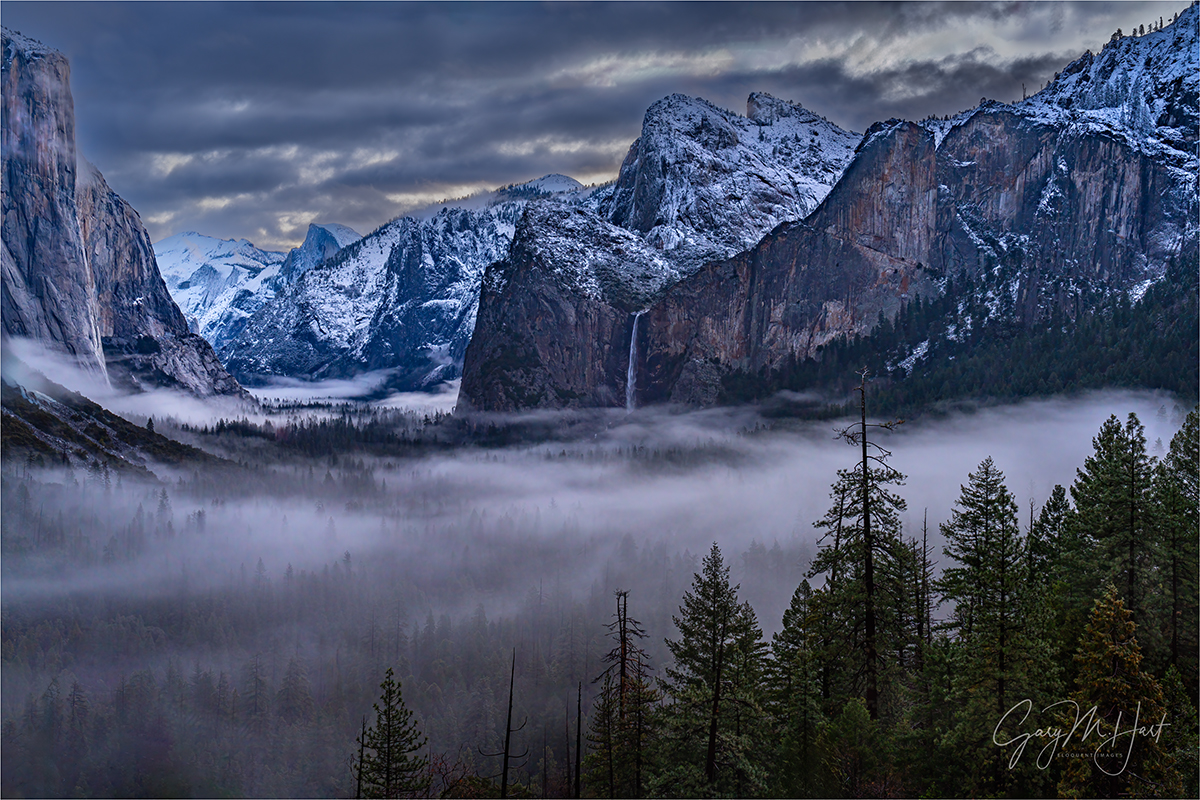
Valley Fog, Tunnel View, Yosemite
Sony a7R V
Sony 24-105 f/4 G
ISO 100
f/10
1/6 second
My commitment for this blog is one image/post per week. With a workshop that started Sunday and ended Wednesday, I’m a little behind this week, but I made it! Next week I have a workshop that goes from Monday through Thursday, and the following week I’ll be completely off the grid rafting the Grand Canyon. But one way or the other, I’ll continue with my once per week commitment, even if I’m a little late. And if I do have to skip a week, I’ll catch up eventually, I promise. I return you now to your regular programming…
Happy Earth Day to you
How did you celebrate Earth Day (April 22) this year? I was fortunate enough to celebrate up close and personal, guiding a workshop group around Yosemite. It’s easy to appreciate a planet when you’re surrounded by some of its most exquisite beauty, and with a group of people who appreciates it as much as you do, but every time I visit, I’m reminded that we may in fact be loving our wonders to death.
It’s impossible to have zero impact on the natural world. Every day, even if we never leave the house, we consume energy that, directly or indirectly, pollutes the atmosphere and contributes the greenhouse gases that warm our planet. The problem only worsens when we venture outdoors. Our vehicles belch exhaust, or consume electricity that was the product of invasive mining. At our destination, the clothing we wear introduces microscopic, non-indiginous flora and fauna, while the noise we create clashes with the natural sounds that comfort others and communicate information to animals. Even foot travel, the oldest, most fundamental mode of transportation, crushes rocks, plants, and small creatures with each footfall. And let’s not forget the artificial light that dilutes our once black night sky.
I’m not suggesting that we all hole up beneath a rock. If everyone just considered how their actions impact the environment and acted responsibly, our planet would be a better, more sustainable place.
Let’s get specific
The damage that’s an unavoidable consequence of keeping the natural world accessible to all is a tightrope our National Park Service does an excellent job navigating. With their EVs, organic, and recycling mindset, it’s even easy for individuals to believe that the problem is everyone else.
I mean, who’d have thought merely walking on “dirt” could impact the ecosystem for tens or hundreds of years? But before straying off the trail for that unique perspective of Delicate Arch, check out this admonition from Arches National Park. And Hawaii’s black sand beaches may appear unique and enduring, but the next time you consider scooping a sample to share with friends back on the mainland, know that Hawaii’s black sand is a finite, ephemeral phenomenon that will be replaced with “conventional” white sand as soon as its volcanic source is tapped–as evidenced by the direct correlation between the islands with the most black sands beaches and the islands with the most recent volcanic activity.
Sadly, it’s Earth’s most beautiful locations that suffer most. Yosemite’s beauty is no secret—to keep it beautiful, the National Park Service has been forced to implement a reservation system to keep the crowds (marginally) manageable. Similar crowd curtailment restrictions are in place, or being strongly considered, at other national parks. And while the reservations have helped in Yosemite and elsewhere, the shear volume of visitors who make it through guarantees too much traffic, garbage, noise, and too many boots on the ground.
While Yosemite’s durable granite may lull visitors into environmental complacency, it is now permanently scarred by decades of irresponsible climbing. And Yosemite’s fragile meadows and wetlands, home many plants and insects that are an integral part of the natural balance that makes Yosemite unique, suffer from each footstep to the point than some are now off-limits.
A few years ago, so many people crowded the elevated bank of the Merced River to photograph Horsetail Fall’s sunset show, the riverbank collapsed—that area is now off limits during Horsetail season. Despite all this, I can’t tell you how often I see people in Yosemite cavalierly trampling meadows to get in position for a shot, as a trail shortcut, or to stalk a frightened animal.
Don’t be this person
Despite the damage inflicted by the sheer volume of garden variety tourists, my biggest concern is the much smaller cohort doing a disproportionate amount of damage: photographers. Chasing the very subjects they put at risk, photographers have a vested interest and should know better. But as the urge to top the one another grows, more photographers seem to be abusing nature in ways that at best betrays their ignorance of the damage they’re doing, and at worst reveals their startling indifference to the fragility of the very subjects that inspire them to click their shutters in the first place.
If I can’t appeal to your environmental conscience, consider that simply wandering about with a camera and/or tripod labels you, “Photographer.” In that role you represent the entire photography community: when you do harm as Photographer, most observers (the general public and outdoor decision makers) simply apply the Photographer label and lump all of us, even the responsible majority, into the same offending group.
Like it or not, one photographer’s indiscretion affects the way every photographer is perceived, and potentially brings about restrictions that directly or indirectly impact all of us. So if you like fences, permits, and rules, just keep going wherever you want to go, whenever you want to go there.
It’s not that difficult
Environmental responsibility doesn’t require joining Greenpeace or dropping off the grid (not that there’s anything wrong with that). Simply taking a few minutes to understand natural concerns specific to whatever area you visit is a good place to start. Most public lands have websites with information they’d love you to read before visiting. And most park officials are more than happy to share literature on the topic (you might in fact find useful information right there in that stack of papers you jammed into your car’s center console as you drove away from the entrance station).
Most national parks have non-profit advocacy organizations that do much more than advocate, maintaining trails and underwriting park improvements that would otherwise be impossible. For example, the Yosemite Conservancy funded Bridalveil Fall’s recently completed (significant) upgrade that included new flush toilets (yay!), new trails and vistas, and enhanced handicapped access.
If you spend a lot of time at a national park, consider supporting its non-profit partner. The two I belong to are Yosemite Conservancy and Grand Canyon Conservancy.
Develop a “leave no trace” mindset
Whether or not you contribute with your wallet, you can still act responsibly in the field. Stay on established trails whenever possible, and always think before advancing by training yourself to anticipate each future step with the understanding of its impact. Believe it or not, this isn’t a particularly difficult habit to form. Whenever you see trash, please pick it up, even if it isn’t yours. And don’t be shy about gently reminding (educating) other photographers whose actions risk soiling the reputation for all of us.
A few years ago, as a condition of my national parks’ workshop permits, I was guided to The Center for Outdoor Ethics and their “Leave No Trace” initiative. There’s great information here–much of it is just plain common sense, but I guarantee you’ll learn things too.
Armed with this mindset, go forth and enjoy nature–but please save some for the rest of us.
About this image

Valley Fog, Tunnel View, Yosemite
When I started taking pictures, long before the dawn of digital, my emphasis was outdoor subjects ranging from natural landscapes to urban skylines and bridges. But as my eye and overall relationship with the world has evolved, I’ve gravitated naturally toward landscapes and away from the cityscapes.
I understand now that this evolution has much to do with my love (and concern) for the natural world, both the beauty that surrounds us and damage we’re doing, and a desire to honor it. In recent years I’ve very consciously striven to, as much as possible, create images that allow people to imagine our planet untouched by humans—perhaps hoping that they’ll understand what’s at risk somehow do their share to stem the tide.
Though only number six on the current list of most visited national parks, Yosemite needs to cram the vast majority of its nearly 4-million annual visitors into the less-than 10 square miles of Yosemite Valley. In fact, for more than half the year, almost all of the park outside of Yosemite Valley is smothered in snow and closed to vehicles. This creates congestion and other problems that are unique to Yosemite.
One of the most beloved vistas on Earth, Tunnel View attracts gawkers like cats to a can-opener—all I have to say about that is, “Meow.” Despite its popularity, and the fact that the vista has indeed been crafted by the NPS (paved parking, enclosed by a low stone wall, and many trees removed to maintain the view), Tunnel View remains one of my favorite places to imagine a world without human interference.
My history with Tunnel View in Yosemite dates back to long before I ever picked up a camera, but I never take it for granted. Each time I visit, I try picture Yosemite before paintings, photographs, and word of mouth eliminated the possibility for utter surprise and awe, and what it must have been like to round a corner or crest a rise to see Yosemite Valley unfolding before you (earlier views of Yosemite were not at the current location of Tunnel View, but the overall view and experience were similar).

Dance of the Veils, Tunnel View, Yosemite
Today, unless I’m there for a moonrise, I rarely take out my camera at Tunnel View, preferring instead to watch the reaction of other visitors—either my workshop students or just random tourists. But every once in a while, the scene is too beautiful to resist. That happened twice for me in February, when I added two more to my (arguably already too full) Tunnel View portfolio: today’s image and the one I shared last week.
This week’s image came in the first workshop, before sunrise following an overnight rain. Though the compositions are similar, the moods of the two images are completely different. First, in last week’s image, the valley sported a thin glaze of snow, while the overnight temperatures for this week’s image weren’t quite cold enough to turn the rain to snow in Yosemite Valley (though we did find some had fallen on the east side of the valley).
But to me the biggest difference between the two images is the mood. In the snowy image I shared last week, the storm had moved on and the sky had cleared—most of the remaining clouds were local, radiating from the valley floor. The warm light of the approaching sun coloring the sky gives the scene a brighter, more uplifting feel.
The new image I share this week came during a break in the storm, but not at its end. With more rain to come, the moisture-laden sky darkened and cooled the scene, creating a brooding atmosphere. I especially like these scenes for the way they convey the timeless, prehistoric feel I seek.
Workshop Schedule || Purchase Prints || Instagram
Tunnel View Views


The Other AI
Posted on April 16, 2024
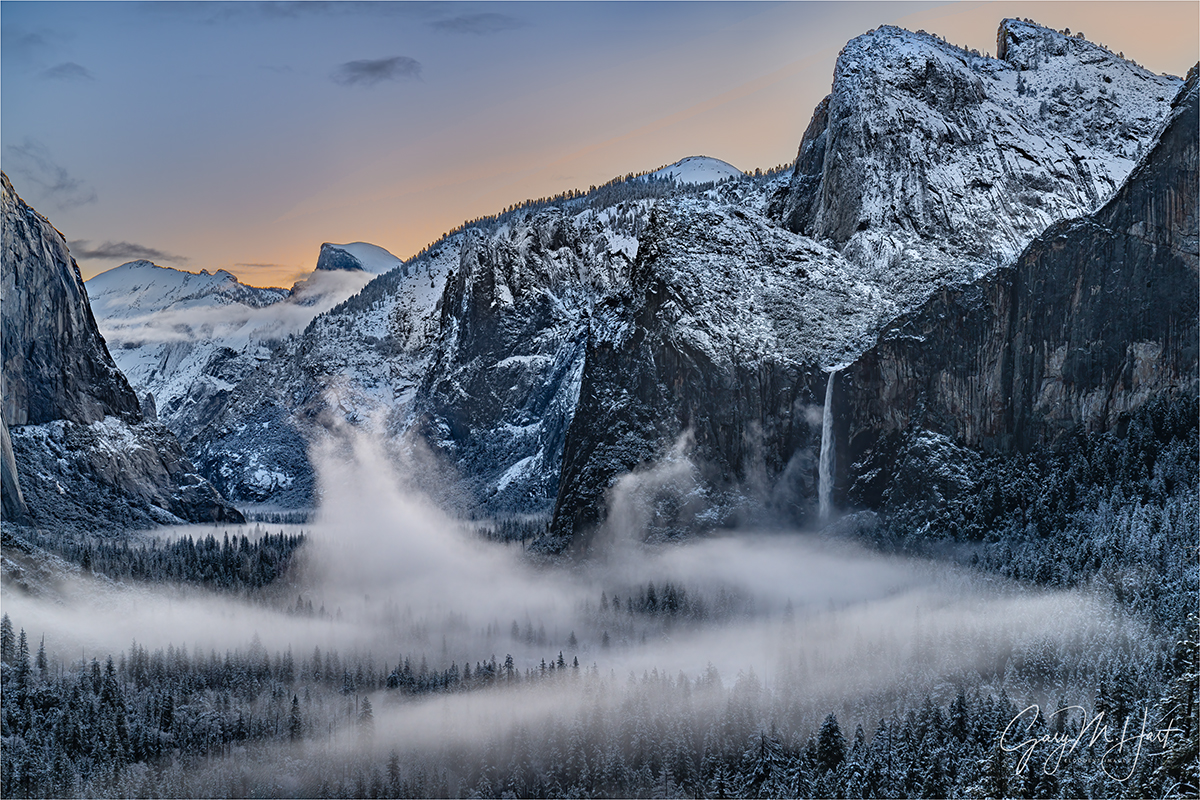
Dance of the Veils, Tunnel View, Yosemite
Sony a7R V
Sony 24-105 f/4 G
ISO 100
f/10
1/10 second
What’s wrong with ACTUAL intelligence (the other AI)?
I love all the genuine eclipse photos popping up on social media—almost as much as I DESPISE all the fake eclipse photos. Though we’ve had to deal with a glut of fabricated photos since the introduction of computers and digital capture to photography (all the way back before the turn of the 21st Century), the advent of artificial intelligence, combined with insatiable social media consumption, has put the bogus image problem on steroids. Despite being downright laughable, these AI frauds seem to fool a disturbing number of viewers. More concerning, many who claim they’re not fooled claim they don’t care because they still find these AI-generated fakes “beautiful.”
Acknowledging that beauty is in the eye of the beholder, all I can do is shrug and offer that my own definition of beauty is founded on truth. Not necessarily a perfect reproduction, or repetition of literal fact, but an overarching connection to some essential reality.
Whether it’s a painting, a work of fiction, a photograph, or any other artistic creation, I need to feel that essential truth connecting the scene, the artist, and me. The reality in a work of art—visual, musical, written, or whatever—doesn’t need to be, in fact usually isn’t, a literal reproduction of the world as I know it. Rather, I prefer artistic creations that reveal a previously unseen (by me) truth about the world. In other words, while paintings are rarely literal interpretations of the world (and in fact can be quite abstract), and novels by definition aren’t factual, the artistic creations I’m drawn to tap the creator’s unique take on reality to expand my own.
Even photographs, once relied on as flawless reproductions of reality, can’t possibly duplicate our 3-dimensional, unbounded, dynamic, multi-sensory reality. But they can, in the right hands, leverage the camera’s reality to expose hidden truths about the world. No matter how “stunning” an AI-generated or dishonest composite (two or more unassociated scenes in one image) image might be at first glance, they lack the artist’s perspective, or any connection to reality, sometimes both. Even worse, counterfeit images pretend to represent a reality that doesn’t exist. While it may be possible for an AI creation to require genuine human insight and creativity, so far all I see is people using AI as a shortcut around actual intelligence.
Of course photographic deception started long before digital capture, but like so many other things computers simplified, digital capture made it easy for people more interested in attention than connection to attract the strokes they covet. At least in the film days, manipulating a photo still required a bit of skill and effort—back then, when it was done honestly, you could at least admire the perpetrator’s skill.
Full disclosure (I digress)
I have to confess that I was actually party to blatant image manipulation at the age of 11, when my best friend Rob and I did a sixth grade Science Fair project on UFOs. In Rob’s backyard (and with help from Rob’s dad), we first photographed a homemade styrofoam “flying saucer” suspended on a wire against a plain tarp. Next, without advancing the film, we photographed our school, then sent the film off to be processed (who remembers those days?).
A few days later, we had a pretty convincing black-and-white print of our school beneath a hovering UFO. But, since our sole goal was to prove how easy it is to fake a UFO sighting, we did reveal the sleight-of-camera trick in our presentation (so no harm, no foul).
The digital dilemma
The introduction of computers to the world of photography, even before digital camera’s were anything more than a promising novelty, created an almost irresistible temptation for photographers who lacked the ethic or inspiration to create their own images. At the time, with no consensus on where to draw the line on digital manipulation, some photographers innocently stepped over the spot where most of us would draw it today.
For example, in the mid-90s, when Art Wolfe cloned extra zebras into his (already memorable) zebra herd image, many cried “Foul!” Wolfe, who had no intent to deceive, was taken aback by the intensity of the blowback, arguing that the resulting image was a work of art (no pun intended), not journalism.
In the long run, the discussion precipitated by Wolfe’s act probably brought more clarity to the broader digital manipulation issue by forcing photographers to consider the power and potential ramifications of the nascent technology, and to decide where they stood on the matter. Expressing his disapproval in a letter to his friend Wolfe, renowned landscape photographer Galen Rowell probably said it best: “Don’t do anything you wouldn’t feel comfortable having fully revealed in a caption.” Great advice that still applies.
Nevertheless, left up to each photographer, the “how much manipulation is too much” line remains rather fuzzy, but I think most credible photographers today agree that it excludes any form of deception. Which brings me back to the absolutely ridiculous eclipse fakes we’ve all been subjected to. I honestly don’t know what upsets me more—the fact that “photographers” are trying to pass these fakes off as real, or the number of people who they fool. (And I won’t even get into the fact that every image and word I’ve shared online has almost certainly been mined to perpetrate AI fabrication—that’s a blog for a different day.)
One risk of that mass gullibility, and people’s apathy about the distinction between real and artificial, is the dilution of photography’s perception in the public eye. As beautiful as Nature is without help, it’s pretty hard to compete with cartoonish captures when a connection to reality isn’t a criterion. I’m already seeing the effects—the volume of enthusiastic praise for obvious fakes is disturbing enough, but even more disturbing to me is the number of people responding to legitimate, creative, hard-earned images with skepticism.
So what can we do?
I’m not sure there is a complete solution to the AI problem, but I hope that enough people crying “Foul!,” on social media and elsewhere, will open eyes and force discussions that might help the public draw a line—just as the zebra debate did three decades ago. If the blowback is strong enough, perhaps even the potential stigma will be enough to discourage AI purveyors and consumers alike.
As much as I appreciate people calling out AI perpetrators in the comments of obviously fake social media posts—I’ll do this occasionally myself when I think I can contribute actual insight that might help some understand why an image is fake—I’m afraid these well-intended comments get so buried (by the “Stunning!” and “Breathtaking!” genuflections) that very few people actually see them. So one step I’ve started taking with every single fake image that soils my social media feeds is to permanently hide all future posts from that page/profile/poster. I’m probably fighting a losing battle, but at least this unforgiving, one-strike-and-you’re-out policy gives me a little satisfaction each time I do it.
About this image
Dance of the Veils, Tunnel View, Yosemite
One thing a still photo can do better than any other visual medium, better even than human vision, is freeze a moment in time. From explosive lightning, to crashing surf, to a crimson sunset, to swirling clouds, Nature’s most beautiful moments are also often its most ephemeral. No matter how much we believe at the time that we’ll never forget one of these special events, sadly, the memory does fade with time. But a camera and capable photographer, in addition to revealing hidden aspects of the natural world, records the actual photons illuminating those transient moments so they can be revisited and shared in perpetuity.
Which was the very last thing on my mind as this year’s February workshop group and I pulled into the Tunnel View parking lot in the predawn gloaming of this chilly morning. Instead, we were abuzz with excitement about the unexpected overnight snow that had glazed every tree and rock in Yosemite Valley with a thin veneer of white.
Our excitement compounded when we saw the scene unfolding in Yosemite Valley below. One of my most frequent Yosemite workshop questions is some version of, “Will we get some of that low fog in the valley when we’re at Tunnel View?” My standard answer is, “That’s only in the Deluxe Workshop,” but they rarely accept that. The real answer is, while this valley fog does happen from time-to-time, it’s impossible to predict the rare combination of temperature, atmospheric moisture, and still air it requires. (It’s much easier to predict the mornings when it absolutely won’t happen, which is most of them.)
But here it was, almost as if I’d ordered it up special for my group. (I tried to take credit but don’t think they were buying it.) Since I’ve seen this fog disappear as suddenly as it appears, or rise up from the valley floor to engulf the entire view in just a matter of seconds, as soon as we were parked I told the group to grab their gear and hustle to the vista as fast as they can. Then I did something I rarely do at Tunnel View anymore: I grabbed my gear and hustled to the vista as fast as I could.
While Tunnel View is one of the most beautiful views I’ve ever photographed, I’ve been here so many times that I usually don’t get my gear out here anymore—not because I no longer find it beautiful, but because it’s a rare visit that I get to see something I’ve not seen before. But since the view this morning, while not unprecedented, was truly special, I just couldn’t help myself. Another factor in my decision to photograph was that here we can all line up together, allowing me to check on and assist anyone who needs help, and still swing by my camera to click an occasional frame. This morning everyone seemed to be doing fine, so I was actually able to capture a couple of dozen frames as the fog danced below.
There were a lot of oohs and ahhs when a finger of fog rose from the valley floor and pirouetted toward Half Dome. There were many ways to photograph it, but I chose to frame it as tightly as possible, ending up with a series of a half-dozen of this particular fog feature before it morphed into something completely different. I included minimal sky because the sky above El Capitan, Half Dome, and Cathedral Rocks was relatively (compared to the rest of the scene) empty and uninteresting.
With the fog continuously shifting, to avoid cutting off any of the zigzag beneath Bridalveil Fall, I had to be extremely conscious of its spread. Depth of field wasn’t a concern because everything in my frame was at infinity. The most challenging aspect was exposure of the bright sky with the fully shaded valley. To get it all, I underexposed the foreground enough to spare the warmth of the approaching sun. The result was a virtually black foreground and colorless sky on my camera’s LCD, but I took special care to monitor my histogram and ensure that I’d be able to recover the shadows in Lightroom/Photoshop.
So, as you can see from my description, I did indeed leverage digital “manipulation” to create the finished product I share here. But my processing steps were designed to brighten the nearly black foreground my camera captured, because exposing it brighter would have resulted in a completely white sky. Since neither a white sky or a black foreground were anything close to our experience this morning, I applied actual intelligence to expose the scene and create an image that more closely reflects this actual (and unrepeatable) event in Nature.
My group rose in the frigid dark and stood bundled against the icy cold to witness this scene and capture permanent, shareable memories of our glorious morning. I imagine it might have be possible for us to have stayed in our cozy hotel rooms, open our computers, and input a few prompts in an AI image generator to come up with something similar (and why not throw in a rainbow, lightning bolts, and rising moon while we’re at it?). But where’s the joy in that?
Ephemeral Nature
Click any image to scroll through the gallery LARGE


Ripping Off the Band-Aid
Posted on April 3, 2024
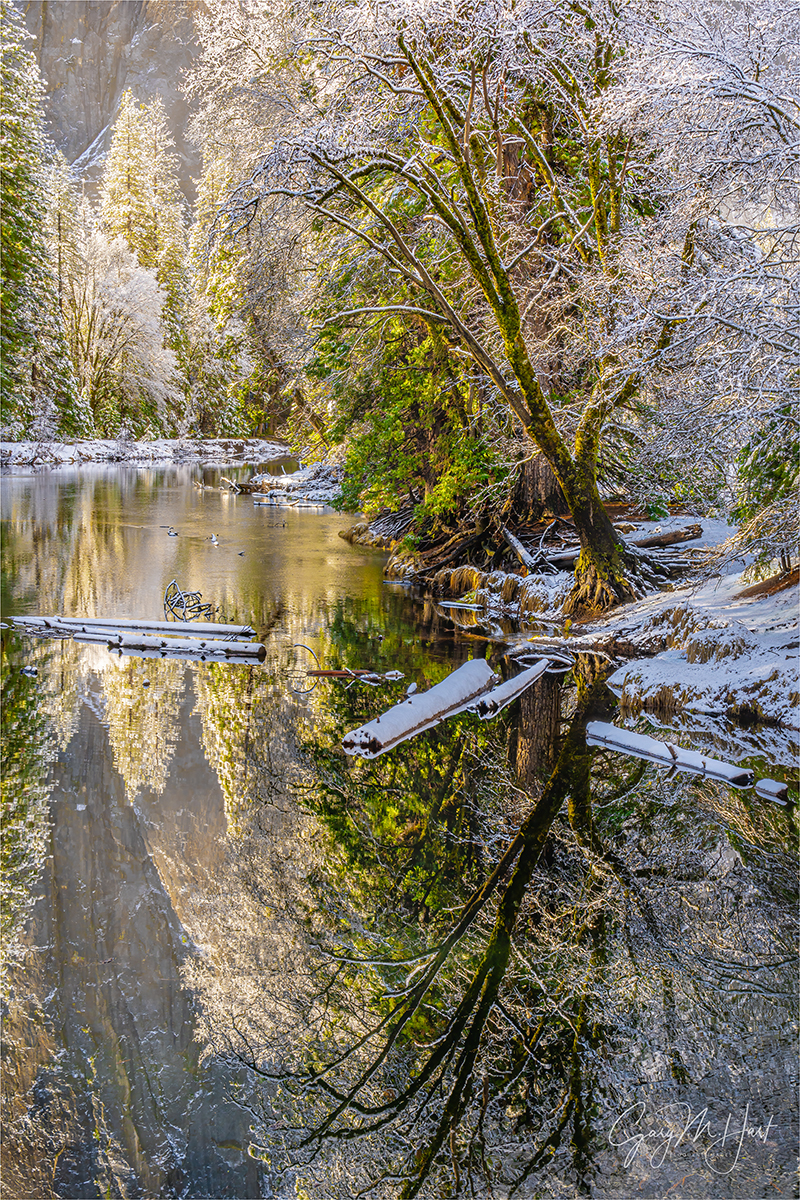
Frosted, Cathedral Rocks from El Capitan Bridge, Yosemite
Sony a7R V
Sony 24-105 f/4 G
ISO 100
f/13
1/10 second
We were in the midst of a beautiful Yosemite Tunnel View clearing storm when I told my group it was time to pull up stakes and move on. Some thought they’d misheard, others thought I was joking. Since we’d only started the previous afternoon, I hadn’t even really had a chance to gain the group’s trust. When one or two in the group hesitated, I assured everyone it’s like ripping off a Band-Aid, that it will only hurt for a minute and they’ll soon be glad they did it.
Many factors go into creating a good landscape image. Of course the actual in the field part is essential—things like photogenic conditions, a strong composition, and finding the ideal camera settings for exposure, focus, and depth of field. You could also cite processing that gets the most of the captured photons without taking them over the top. But an under-appreciated part of creating a good landscape image is the decision making that happens before the camera even comes out.
Some of this decision making is a simple matter of applying location knowledge. Other factors include the ability to read the weather and light, and doing the research to anticipate celestial and atmospheric phenomena (such as the sun, moon, stars, aurora, rainbows, and lightning). All of these decisions are intended to get to the right place at the right time.
A photo workshop group relies on me to do this heavy lifting in advance, and while I can’t guarantee the conditions we’ll find in a workshop scheduled at least a year in advance, my decisions should at least maximize their odds. These decisions don’t end when the workshop is scheduled—in fact, they’re much more visible (and subject to second guessing) after the workshop starts. Case in point: This morning in February.
Though the overnight forecast had promised a few rain showers followed by clearing that would last all day (yuck), before we’d even made the turn in the dark toward our Tunnel View sunrise, it was apparent the forecast had been wrong. Snow glazed all the trees, patches of fog swirled overhead, and I knew my plan to start at Tunnel View would give me the illusion of genius. At this point, my morning seemed easy.
For the next hour or so it was easy and my “genius” status remained intact as my group was treated to the Holy Grail of Yosemite photography: a continuously changing Tunnel View clearing storm, made even better by fresh snow. And if easy were my prime objective, I’d have just kept them there to blissfully bask in the morning’s beauty.
But the secret to photographing Yosemite in the snow is to keep moving, because when the conditions are beautiful in one spot, they’re just as beautiful at others. Since Yosemite’s snow, especially the relatively light dusting we enjoyed this morning, doesn’t last long once the sun hits the valley floor, our window for images of snowy Yosemite Valley was closing fast. I took comfort in the knowledge that it was virtually impossible that everyone in my group didn’t already have something truly spectacular. But, grumpy as they might have been about leaving (no one really showed it on the outside), I also knew I’d be doing them a disservice not giving them the opportunity for more great Yosemite images elsewhere in the park.
So I made the call: we’re leaving. Our next stop was El Capitan Bridge. The obvious view here is El Capitan and its reflection, visible from the bridge, but best just upstream along the south bank (actually, this bank is more east here, but since the Merced River, despite its many twists and turns, overall runs east/west through Yosemite Valley, that’s the way I’ll refer to it), but before everyone scattered I made sure they all knew about the Cathedral Rocks view and reflection from the downstream side of the bridge. Good thing.
As lovely as El Capitan was this morning, it was the downstream view that stole the show. By departing Tunnel View when we did, we were in place on the bridge when the sun broke through the diminishing clouds and poured into the valley, illuminating the recently glazed trees as if they’d been plugged in. I’d hoped that we’d make it here in time for this light, but I’d be lying if I said I expected it to be this spectacular. I hadn’t been shooting when the light hit, but when I saw what was happening I alerted everyone and rushed to capture the display before the sunlight reached the river and washed out the reflection. Some were already shooting it, but soon the rest of the group had positioned themselves somewhere along the rail to capture their own version.
Assessing the scene, I called out to no one in particular (everyone) that we shouldn’t just settle for the spot where we’d initially set up because the relationships between all the scene’s many elements—Cathedral Rocks, snow-covered trees, reflection, floating logs, etc.—was entirely a function of where they stood. With the entire bridge to ourselves, we all had ample space to move around and create our own shot.
I was especially drawn to the moss-covered tree tilting over the river on the bridge’s north (west) side. With a few quick stops on the way, I decided to go all-in on this striking tree and ended up on the far right end of the bridge. Being this far down meant losing some of the snowy trees and their reflection, but I decided I had enough of that great stuff and really liked the tree’s outline and color, not to mention the way this position emphasized the sideways “V” created by the tree and its reflection.
In general, I love the shear face of Cathedral Rocks from El Capitan Bridge (it’s a very popular Yosemite subject, especially among photographers looking for something that’s clearly Yosemite without resorting to its frequently photographed icons), but featuring the granite in this image would mean including blank sky that I felt would be a distraction. And I was also concerned that the sunlit rock just above the top of this frame would be too bright. So I composed as tightly as I could, eliminating the sky and sunlit rock, getting just enough of Cathedral Rocks to create a background for the illuminated evergreens. I was pleased that composing this way still allowed me to get more of the granite in my reflection.
At f/13 with my fairly wide focal length, getting front-to-back sharpness wasn’t a big problem, so I just focused on the featured tree. The greater concern was exposure. Sunlit snow is ridiculously bright, which meant that with much of my scene still in full shade, the dynamic range was off the charts. So I took great care not to blow-out the brightest trees, which of course resulted in the rest of my image looking extremely dark. But a quick check of my histogram told me I’d captured enough shadow info that brightening it later in Lightroom/Photoshop would be difficult.
By the time we were done here, I’m pretty sure everyone’s skepticism of my early exit had vanished, and that the brief sting from ripping off the Tunnel View band-aid was more than assuaged by the images we got after we left. By late morning, the snow was gone.
Yosemite in the Snow


Moon Swoon
Posted on March 6, 2024

Moonrise, Half Dome, Yosemite
Sony α1
Sony 200-600 G
ISO 200
f/8
1/50 second
Given an especially intense workshop schedule to start my year, the only Yosemite workshop I originally planned for February was my annual Horsetail Fall workshop. But in early 2023 I plotted the 2024 February full moon and saw that it would appear above Yosemite Valley, directly behind Half Dome (viewed from Tunnel View), at exactly sunset on Friday, February 23. Hmmm…
Checking my 2024 schedule, I noted that the year’s workshop fun started on January 22 with five days in Death Valley, followed by just a two-day break before I flew to Iceland for eleven days. After returning from Iceland, I had only two days to catch my breath before my four-day Horsetail Fall workshop. Avoiding Yosemite’s weekend crowds (always a problem, but magnified significantly by Horsetail Fall) while including the moonrise, meant the February moon workshop could only start on February 20. That would give me just three days between Yosemite workshops to recharge and recover from jet lag. But that moonrise…
(All this probably isn’t terribly interesting, but surely there’s someone out there interested in the calculus that goes into scheduling photo workshops.) In general, any photo shoot should be timed to pair the static landscape feature (one we know exactly where it is, and that it’s not going anywhere) of your choice with some dynamic natural element (great light, dramatic weather, seasonal features, celestial elements, and so on) that will take the scene (cliché alert) “to the next level.” And while I can’t speak for other workshop leaders, my own scheduling process follows the same rule: start with a beautiful location I’m extremely familiar with, then identify those special external phenomena that I’d travel to photograph even without a workshop.
While personal trips can happen at the last minute, workshops need to be scheduled at least a year in advance, which of course adds an element of uncertainty because I can’t actually promise the event I scheduled the workshop for. And that doesn’t even take into account the other unforeseen events that can shut down a location with little notice. Case(s) in point: since 2020 I’ve lost workshops to a global pandemic (perhaps you remember that), extreme wildfire potential, and a flood threat. And just this week a forecast of extreme snow closed Yosemite for the weekend with very short notice—a bullet narrowly dodged by my February workshops. But none of that stress can trump the potential for a perfectly timed and placed Tunnel View moonrise that I wouldn’t dream of missing myself—so why not share it?
Worst case, I rationalized, I’d be delaying my post-workshop recovery for a week to get four more winter days of Yosemite beauty without having to battle any crowds (who’d be camped out beneath Horsetail Fall) at all my sunset spots. And best case, in addition to all of the above, we’d enjoy two beautiful moonrises, capped by the Tunnel View grand finale on our last shoot.
So schedule it I did. After an inauspicious beginning to the 2024 workshops—forgotten computer in Death Valley, traumatic reindeer encounter in Iceland, and a last-day power outage in the Horsetail workshop—I figured I’d gotten all the bad stuff out of the way just in time for the moon workshop. And despite the inconveniences, the photography in those first three workshops was off the charts—could I keep that photography streak alive in workshop number four?
That question was answered early. On the workshop’s first morning we drove into the park for sunrise and discovered that an unforecast overnight snowfall had decorated Yosemite Valley with a couple of inches of fresh snow. Better still, that storm was just departing as we set up for sunrise at Tunnel View, so my group got to enjoy a truly classic Yosemite clearing storm, followed by an intense dash to capture as much of Yosemite Valley as possible before the snow melted. After that morning, it felt like I was playing with house money. But I still wanted that moon…
One of the unfortunate side-effects of dependence on fickle, ephemeral natural phenomena is the urge to compulsively check their status as the target time approaches. In this case, since I knew exactly when and where the moon would rise (which of course didn’t prevent me from compulsively plotting and replotting, just to be sure), I was wholly dependent on the clouds to cooperate and couldn’t keep my eyes off the weather forecast (as if that would do any good).
On Monday of that week the forecast for Friday was clear. Excellent! By Tuesday, it changed to mostly clear—uh-oh (I always hate to see my weather forecasts trending in the wrong direction.) Sure enough, on Wednesday, Friday was forecast to be partly cloudy. And by the time I went to bed Thursday night, the NWS was calling for mostly cloudy on Friday. Sweet dreams…
We still had a nice moonrise shoot on the valley floor Thursday evening, so technically I’d delivered the “Yosemite Winter Moon” the workshop name promised. Not only was that moonrise a visual treat, it provided an opportunity for everyone to practice the surprisingly tricky exposure techniques a sunset moonrise requires. The tendency is to expose the scene so the darkening foreground looks good on the camera’s LCD, which pretty much guarantees the moon will be an overexposed white blob. The solution is to base the exposure on the moon, making the moon as bright as possible without blowing it out, and trusting that the foreground that looks much too dark on the camera’s LCD can be fixed in Lightroom/Photoshop. (Or you could just take one picture for the moon and one for the foreground, then combine them later in the image processor—but what fun is that?)
After building up the Friday moonrise promised in the workshop’s name, preparation material, and orientation, there was no turning back. And while everyone in the group knew I had no control over the weather, and the Wednesday morning snow and clearing storm guaranteed the workshop was already a huge photographic success, that was old news, and I couldn’t help stressing about the moonrise I’d built this workshop around.
The clouds arrived and lingered on Friday as promised. Throughout the day we got a few glimpses of blue overhead, but nothing that gave me a lot of optimism. Nevertheless, after a nice day of photography, with sunset and the moonrise both at 5:45, I got my people up to Tunnel View a little after 5:00 so they’d have plenty of time to stake out a good spot and get comfortable with the conditions. But there were those clouds…
About half the group followed me to a sloping granite slab behind Tunnel View, while the other half chose to stay with my brother Jay at the more accessible, less vertically exposed regular view in front of the parking lot. Before setting up, I bounced back and forth between the two spots a couple times to be sure everyone was settled in and knew exactly when and where the moon would appear (if the sky were clear).
Ever the optimist, I settled down on my little patch of granite with two tripods, cameras, and lenses. On my (large) Really Right Stuff 24L tripod (with the BH-55 head) was my Sony a1 and 200-600 lens; on my (compact) RRS Ascend 14L was my Sony a7R V and 24-105 lens. I pointed the 200-600 at Half Dome and zoomed to around 450mm to fill the frame with the snow-capped monolith; with the 24-105 I composed a wider scene that included El Capitan, Half Dome, and Bridalveil Fall. The plan, should the moon actually appear, was to start with tight telephotos of just Half Dome, then, as the moon separates from Half Dome, switch to wider frames of the entire scene. But those clouds…
Thinner clouds covered most of Yosemite Valley, but my primary concern was a large stratus blob above and a little west of Half Dome, with the thickest clouds approaching the rock from the west. Not a good setup. A lifetime of photographing Yosemite has taught me that the clouds above Yosemite Valley arrive from the west and exit in the east, which meant the heavier cloud cover was bearing down on the very area of the sky where the moon would appear. But a lifetime of photographing Yosemite has also taught me that as soon as you think you have the weather there figured out, it will prove you wrong.
Around 5:30 I noticed a small patch of blue behind Half Dome, low on the right side where it intersects the tree-lined ridge. This is the area the thicker clouds should be filling, but as I watched, rather than advancing, those clouds seemed to be lifting. Soon it became apparent that the blue behind Half Dome was expanding. With a couple of minutes to go, not only was all the sky directly behind and above Half Dome clear, even the clouds above that appeared to be thinning.
This is probably a good time to say that few sights thrill me more than the first appearance of the moon above any landscape. As the time for the moonrise approaches, I lock my eyes on the spot and don’t move them, even when talking to others—I don’t want to miss a single photon of the moon’s arrival.
And I didn’t. The instant I saw the first molecule of moon nudge above Half Dome I called out to everyone with me and the clicking commenced. I waited about 30 seconds just to enjoy the view a bit, then went to work with my 200-600. As soon as the moon separated from Half Dome, I switched to my a7R V 24-105 as planned and spent the next 15 or so minutes with wider views of the scene. The rising moon soon encountered some clouds, but most weren’t thick enough to completely obscured it, and most actually enhanced the view.
I realize this zoomed image isn’t a compositional masterpiece—I just wanted to get the tightest zoom possible (to make the moon as large as possible), without cutting off any of Half Dome (easy to do if you’re not paying attention). Mission accomplished.
Epilogue
Just when I thought I’d put the inauspicious behind me, I was notified by one of the people in the Yosemite moon group that he’d tested positive for COVID. The next day, I too tested positive for COVID, as did three others in the group. Fortunately, we were all sufficiently vaccinated and no one got terribly sick. For three days I felt pretty miserable (bad cold miserable, nothing that sent me to bed), but was back to my regular morning workout after four days.
Join me in a Yosemite photo workshop
Workshop Schedule || Purchase Prints || Instagram
Yosemite Moonrise
Click any image to scroll through the gallery LARGE


This is Why We Can’t Have Nice Things
Posted on February 20, 2024

Golden Touch, El Capitan and Horsetail Fall, Yosemite
Sony a7R V
Sony 24-105 f/4 G
ISO 64
f/10
1/10 second
I was planning to just write a brief Horsetail Fall update following last week’s workshop, but before I get into that, a couple of recent experiences have me wanting to say a few words about the bad photographer behavior I witness in my many travels.
The first occurred in Iceland, where Don Smith and I, along with our tour guides Albert Dros and Vincenzo Mazza (look them up!), guided our group on a short hike to a beautiful, and slightly off the beaten path, waterfall. Thrilled to find the scene blanketed with pristine snow, and to be the only ones there, we quickly set up on the footbridge spanning the river (the only place to photograph legally).
Everyone was quite content until a couple of other photographers wandered up the trail and joined us. Despite the fact that there was more than enough room for all of us on the bridge, these two newcomers ignored the “Keep Out” signs and hopped the barricade, trampling our perfect snow to set up shop in everyone’s frame as if we were all invisible. We tried in vain to get their attention (they clearly heard us but refused to acknowledge). Soon one of them whipped out a drone (also a violation of posted rules), launching it directly in front of the fall, while the other guy walked straight up to the base of the fall and planted himself directly in the middle of the scene (where it was impossible to compose him out).
I try not to stress too much about photographers who are simply unaware that they’re in my frame because it’s usually not too hard to remove them later, in Photoshop. But this kind of willful disregard for others transcends photography, damaging the experience for all visitors and reflecting poorly on all photographers.

Horsetail Fall Southside Drive crowd (2017): This is why we can’t have nice things (picture from the Yosemite Exploration Center)
The other instance of selfish photography is the “My shot is more important than the wellbeing of the natural beauty I’ve come to photograph” attitude that I witness every time I try to photograph Horsetail Fall. (This isn’t unique to Horsetail Fall.)
The general consensus among Yosemite photographer, with which I agree, is that the best Horsetail Fall photography spot on the valley floor is a raised riverbank on the Southside Drive side of the Merced River. Believe it or not, I used to be able to show up with a group to this location about 45 minutes before sunset, confident that all in my care would be able to find an unobstructed view.
But when the crowds took over (some photographers even claiming the prime spots for this sunset shot before breakfast) and the number of photographers far exceed the number of available places to set up, I started opting for the relative peace of the Northside Drive locations. I wasn’t terribly surprised to witness cars actually driving off-road and into the forest to park, and by the reports of Southside Drive fisticuffs that started to appear. All this Southside mayhem culminated with the riverbank’s collapse under the weight of the assembled masses, leading to the complete shutdown of Merced River south bank Horsetail Fall photography. Problem solved—or so I believed.
Put me in the camp of those who think that the NPS does an amazing job managing the virtually unmanageable crowds that swarm Yosemite Valley to photograph Horsetail Fall each February. The whole experience has gotten better (more enjoyable) with the Southside Drive ban, relatively liberal reservation system (it’s not that hard to view the Horsetail phenomenon with only a little planning and effort) to curtail crowds, and Northside Drive pedestrian accommodations.
Nevertheless, each year I still see photographers attempting to sneak into the prime Southside Drive view as if the rules don’t apply to them. Some simply park in the Southside Drive turnouts clearly marked “No Parking,” apparently oblivious to the $280 that will await their return.
More egregious (because it can’t be written off to ignorance) in my mind are the photographers who park legally, then sneak along the south river, shielded from view from the road by the elevated riverbank. This year, while waiting with the joyful crowd on Northside Drive, I actually saw several of these scofflaws (such a great word) skulking about across the river, apparently completely oblivious to the fact that they are quite visible to everyone on Northside Drive, including the numerous rangers (with 2-way radios), or to the fact that the rangers actually patrol the south riverbank each February afternoon and evening.
Maybe I’m just getting old, but it both angers and saddens me that there are photographers whose selfish desire exceeds their respect for their subjects, because it’s attitudes like these that lead to even further restrictions for everyone. A photograph should never be more important than its subject.
Now I need to go chase some kids off my lawn…
So anyway…
Some years Horsetail Fall is completely dry in February, other years it’s there but you really have to look closely to locate the Horsetail wet spot on El Capitan. This year I’d say the baseline flow in Horsetail Fall is good but not great, clearly visible as a thin white stripe descending from the top of El Capitan’s sloped east shoulder. By “baseline flow” I mean the minimum you can expect on any given day—a decent flow with the potential to ramp up nicely with a warm storm that drops heavy rain on the Horsetail watershed (above 7000 feet). Also this year, thanks to recent high country snowfall, there’s enough snow in that watershed that a few days of sunlight and above average temperatures could bring a noticeable flow increase.
FYI, if you want to photograph the Horsetail Fall phenomenon this year, you have about a week of good light remaining (as I write this on February 20)—but don’t forget that weekend visits require reservations. The crowds this year seem pretty typical, and shouldn’t pose a problem if you can park and start the 1 1/2 mile walk a couple of hours before sunset (the longer you wait to park, the farther you’ll need to walk). (Learn more about photographing Horsetail Fall in my Horsetail Fall Photo Tips article.)
Last week’s workshop group had two successful Horsetail Fall shoots—neither “epic,” but both very nice in their own way (and definitely worth the walk and wait). The workshop started last Tuesday—given the week’s weather forecast, I was more hopeful than optimistic about our Horsetail Fall chances. Since it looked like that first day might be our best (and maybe only) shot at getting it, after our orientation we headed straight up to Yosemite Valley and got ourselves into position beneath the fall, near the El Capitan Picnic Area (not my favorite spot, but the best for this group because of some mobility challenges).
We found the fall flowing decently (well enough to photograph) and the light good, until about 40 minutes before sunset when the afternoon’s promising mix of sunlight and clouds was replaced without warn by sunlight-swallowing clouds. As we waited (hoped) for the sunlight to return, I kept telling my group about my many last-minute Horsetail Fall miracle experiences, when the has dropped into an unseen (from our location the valley floor) gap on the horizon to paint the fall red.

Red Horsetail Fall, El Capitan, Yosemite
And that’s exactly what we got. This time it came so late that the light completely skipped the golden phase, going straight to red for about five minutes before turning off for the night. While the light this evening wasn’t as intense as I’ve seen it, the color was great and everyone was pretty thrilled.
But we weren’t done. The forecast improved as the week progressed, so after a Wednesday rain that recharged the flow, combined with a (new) “mostly sunny” Thursday promise from the weatherman, I decided to give the group another shot. I wouldn’t have done this if I thought the best we could do would be to repeat Tuesday, but because I knew the fall was flowing better, and I’d formulated a plan to get the whole group into an even better position about a quarter mile east of the picnic area, I thought it would be worth going for it. Still, I gave everyone the option to opt out for a different location, but no one took me up and we all returned to Horsetail.
For most of Thursday evening everything went exactly as planned: the fall’s flow was noticeably better, we ended up exactly where I’d hoped, and the sunlight was brilliant. Better still, a collection of clouds spent the evening performing a beautifully choreographed dance atop El Capitan.
The Horsetail Fall great light window lasts less than 10 minutes, starting out brilliant gold before slowly transitioning to orange, then coral, and ultimately (if the light lasts all the way to the end) ruby red. This evening we clicked like crazy as the shadow approached Horsetail and the light warmed to the intense gold stage. But just about the time started to get just a little optimistic that we might be in store for something truly special, the sunlight faded and never returned.
Fortunately, we did end up catching all of the gold phase, which was further enhanced by a few puffy clouds catching the same light, so all was not lost. Even though we missed the red of Tuesday evening, it seemed pretty unanimous that this was the better of the two shoots.
So I guess maybe sometimes we still can have nice things.
Join Me In Yosemite
Workshop Schedule || Purchase Prints || Instagram
Horsetail Fall
Click any image to scroll through the gallery LARGE


 Eloquent Images by Gary Hart