Eloquent Images by Gary Hart
Insight, information, and inspiration for the inquisitive nature photographer
It’s All a Blur
Posted on March 28, 2021
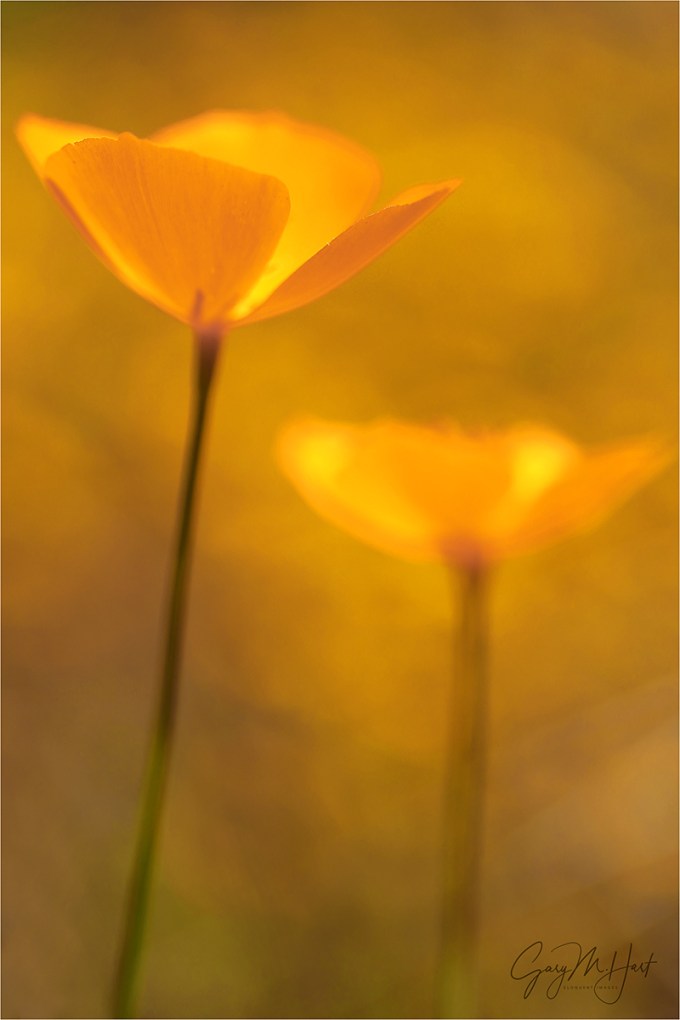
Champagne Glass Poppies, Merced River Canyon, California
Canon 10D
Canon 100mm f2.8 macro
f/2.8
Kenko 20mm extension tube
ISO 100
1/1000 second
This has always been one of my favorite images. It’s also one of the oldest images in my digital portfolio. I photographed it 17 years ago (!) with my very first DSLR, a Canon 10D. Despite the 10D’s postage-stamp-size LCD, being able to instantly view and refine my images led to an epiphany that permanently altered the way I photograph: Even though photography is a two-dimensional medium, the ability to visualize and manage its missing dimension—depth—separates artistic photography from snapshots.
I’m sharing this image today because yesterday afternoon I returned to the location of its capture, a hidden hillside in the Merced River Canyon, just west of Yosemite Valley. It was the last day of my Yosemite Moonbow and Wildflowers workshop, and while there wasn’t enough water to create the explosion of mist a March moonbow requires, the wildflowers were out in force. Rather than pull out my camera and try to reprise this old favorite, I was content to stand by, take in the beauty, and watch my group happily work this now familiar scene. Between occasional iPhone clicks, I mentally returned to that afternoon 17 years ago, and to the lessons I learned that day.

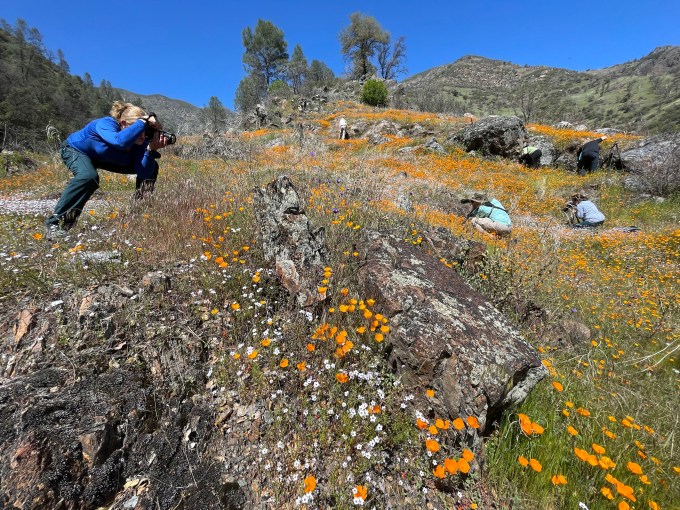
Getting an entire scene, front to back, in sharp focus is important, but fueled by digital photography’s instant feedback, I grew to appreciate the power of shallow depth of field. On shoots like this I’d take a picture, evaluate my result, and notice the way an out-of-focus background smoothes potential distractions into blurs of color and shape. With that realization, I started challenging myself to see how far I could take background blur.
While working on this pair of poppies, my eyes could sharply resolve every background detail, from colorful wildflowers to scraggly weeds, but I found that much detail distracting in an image. Simply blurring the background helped, but I wanted more blur, as well as a background that complemented the closest two poppies that were to be my scene’s focal point.
Circling the poppies, I positioned camera downhill and as close to the ground as possible, which enabled me to shoot uphill, toward the most densely populated part of the poppy covered hillside. To achieve maximum blur, I added an extension tube to my macro lens, set my f-stop to f/2.8 (wide open), and moved my lens to within a few inches of the closest poppy. When the image on my LCD after the first click revealed the hillside blurred into a golden fog, I knew I was on to something.
But I wasn’t done. Nailing the focus point, always important, is even more essential in macro photography. Sometimes the focus point is a difficult choice, but in this case it was pretty clear that the leading edge of the front poppy was where focus needed to be.
With my camera flat on the ground and the lens resting on a beanbag (homemade, from a Ziploc and dried lentils), focus was easier said than done. Had I been doing this today, with my Sony a7RIV, I could have tilted my live-view LCD upward, magnified the front poppy’s leading edge, and focused without getting dirty. But with my ancient Canon I had to do it the “old fashioned” way, sprawling on the ground and contorting to get my eye to the viewfinder. Fortunately, a calm wind gave me the time to get the focus right.
Not only is this one of my personal favorite images, it’s also one of my most popular. And even though the resolution on my 10D was only 6 megapixels, I’ve sold prints of this image up to 24×36. But sprawled in the weeds that afternoon, I had no idea was creating something that would still be important to me 17 years later. Where has the time gone? …
Here’s my Photo Tips article explaining my selective focus technique
It’s All a Blur
Click an image for a closer look, and to view a slide show.


Hold My Gear
Posted on March 21, 2021

Sunstar, Horsetail Fall and El Capitan, Yosemite
Sony a7RIV
Sony 24-105 G
1/6 second
F/20
ISO 100
Most people know how much photographers love their toys. Whether it’s the latest ultra-fast lens, that new space-age composite tripod that’s a full 1/4 ounce lighter, or (especially) a “game changing” camera body with even more megapixels than last year’s game changing camera body (and even though we already have more resolution than we’ll ever need), we can’t wait to get our hands on it and start sharing our new and improved images with the world (while somehow figuring out a subtle way to mention our new gear). But let me share a dirty little secret: Probably the single piece of equipment that most photographers have more versions of than anything else is the camera bag. Yawn. Don’t believe me? Ask any serious photographer how many camera bags they own—if the answer is less than five, they’re lying.
I don’t think anyone can deny that an efficient instrument to store, organize, and transport all this gear is essential. But let’s face it—a camera bag, as essential as it is, isn’t sexy. And when it comes right down to it, what’s the point of having the latest, greatest (and most expensive) gear if it doesn’t foster envy? So we’ll purchase a new bag simply because we can’t imagine living without our newest toy, but never for bragging rights.
Full disclosure: I’m as guilty as the next person of harboring an obscene number of camera bags. More than I can count. In fact, a few years ago I stuffed as many camera bags as I could fit into a 100 gallon garbage bag, shoved it into my attic, and haven’t seen them since.
Here’s my theory
Most photographers fantasize about carrying a compact, lightweight kit in the field (we want all the gear, we just hate carrying it). And to justify the purchase of the next great thing, we convince ourselves that (despite all history to the contrary) this will the final piece of equipment we’ll ever need. Of course since that’s what we told ourselves the last time we bought new gear, our current camera bag is suddenly too small. In other words, our camera bag is always just big enough to carry our current inventory of gear because we never imagine wanting more. Which is all well and good—until we start coveting the next toy.
This cycle repeats many time before the photographer gets wise. And some photographers, even those with a large garbage bag full of slightly used camera bags in their attic, never seem to get wise.
By now you might have guessed…
That’s right, I just got a new camera bag. This time it’s a Shimoda Action X50, to replace the Mindshift Backlight 26L I bought in late 2019. Sigh. In my defense, while I may be a slow learner, I did figure out a few camera bags ago to always get a bigger bag than I think I need. Nevertheless, the need for more space was a factor in this decision because, now that I have two Sony a7RIV bodies, I’ve been trying to store each with a lens attached: my Sony 16-35 GM on one, and my Sony 24-105 G on the other. But this new paradigm suddenly made my Mindshift bag cramped and awkward. Not so bad that I couldn’t have lived with had I loved the bag—but I didn’t, so here we are.
The primary reason to get new bag this time was comfort. While I was originally thrilled with the space and the way my gear fit in the 26L, I made the mistake of not fully loading it and walking around before buying. There are many things to like about the Mindshift bag, but fully loaded comfort over extended distances isn’t one of them. For someone who logs a lot of miles with a camera bag on my back, from trudging switchbacks to scrambling rugged terrain to airport sprints, comfort is essential.
Introducing my new camera bag
I really, really hope the Shimoda Action X50 will be my final camera bag. In case you haven’t figured it out, the numbers both names, the Mindshift 26L and the Shimoda X50, represents the displacement in liters. So the Shimoda has almost twice the capacity. While all of that extra room isn’t just for camera gear (there’s other storage galore), the camera gear section is significantly larger. I can’t imagine either needing, or wanting, to carry any more weight than I currently have, so if I ever decide to replace this one (heaven forbid), it won’t be because I need more space.
The most important thing for me is the X50’s comfort. I had the advantage of test driving a couple in my February workshops. And I’ve been trying mine around the house enough to know that it’s night-and-day better than my Mindshift bag. It feels like an actual back pack, not a camera bag with straps.

Shimoda Action X50 Outside: Yes, that’s my logo on the outside (it’s nice to have generous, talented friends).

Shimoda Action X50 Inside: I’m still tweaking the layout, but as you can see, I have space to spare, even with lenses on both bodies. It has a sleeve that will fit my 16-inch MacBook Pro, and I can also fit my Sony 200-600 in the top compartment if I really want to punish myself.
Let’s look inside
The contents of my camera bag has evolved over the years, from the vanilla 16-35, 24-105, 70-200 lens lineup that most landscape photographer carry, to my current setup that allows covers 12mm to 800mm (1200mm if you factor in the APS-C crop option) at all times—plus the option to go up to 1800mm (factoring in the APS-C crop factor) if I go with my Sony 200-600.
Here’s what’s I carry today (spring 2021):
Always in my bag
- 2 Sony a7R IV camera bodies
- Sony 12-24 f/2.8 GM lens: Though I don’t use it a lot, 12mm allows me to photograph things I never could before, and I love that it’s compact enough to keep with me at all times. (I also can’t wait for the pandemic to end so I can get out and use it for serious night photography this summer.)
- Sony 16-35 f/2.8 GM lens (plus a Breakthrough polarizer): This focal range is covered by other lenses in my bag, but I love the lens too much to leave it behind—crazy sharp, and f/2.8 means it’s fast enough for night photography in a pinch. Plus, it’s a whole lot easier to use with polarizing and neutral density filters than the 12-24.
- Sony 24-105 G lens (plus a Breakthrough polarizer): This is my workhorse—what a fantastic focal range! Really sharp, too.
- Sony 100-400 GM lens (plus a Breakthrough polarizer): Replacing my 70-200 with this slightly bigger lens doubled my focal range—and it’s a fantastic match with the Sony 2X teleconverter.
- Sony 2X teleconverter
- Filters (in a Mindshift filter bag attached to my tripod): 72mm and 77mm Breakthrough 6-stop polarizing ND filters, Breakthrough 2-stop hard graduated neutral density filter (which I don’t use a lot since switching to Sony, but still nice to have)
- Other stuff: Several lens cloths, headlamp, insulated water bottle, extension tubes, Giotto Rocket Blower, and a couple of RX Bars (because photography always trumps meals).
Specialty Equipment (not pictured—stays behind unless I have a specific plan for it)
- Sony a7S III camera body: For Milky Way and other moonless night photography—it’s “only” 12 megapixels (remember when 12 megapixels was huge?), but this camera sees in the dark.
- Sony 24mm f/1.4 GM lens: For Milky Way and other moonless night photography—I can’t believe how compact this lens is.
- Sony 28mm f/1.8 G lens: For Milky Way and other moonless night photography—this one’s even more compact than the 24mm.
- Sony 90mm Macro: I use this lens a lot with extension tubes to get super close for my creative selective focus work (wildflowers, fall color).
- Sony 200-600 G lens: When I want to go big on a moonrise/moonset—sometimes I’ll pare it with the 2X teleconverter and really go crazy. I also use this lens with extension tubes for selective focus fall color.
Support
- Really Right Stuff 24L Tripod with a RRS BH-55 ball head: Sturdy enough for whatever I put on it, in pretty much whatever conditions I encounter. I also like that, fully extended with the head and camera, even without a centerpost it’s several inches taller than I am.
- Gitzo 1530 tripod with a RRS BH-40 ball head: My travel/hiking tripod. Without extending the centerpost it’s not quite as tall as I prefer, but it’s tall enough and I like the compactness for suitcases and long hikes.
Final camera bag thoughts
A camera bag is personal choice, based on many individual variables. So I’m not recommending against the Mindshift bag, which I found great in many ways. Because everyone’s body is different, I can only tell that the Shimoda was best for me.
If you’re in the market for a camera bag, make sure you try your candidate with weight before purchasing. And don’t just throw the bag on your back and call it good—actually walk around with it, bounce up and down, twist, bend over, take it off and put it on, and so on until you’re sure.
I know this kind of testing isn’t easy in this day of online shopping. If you don’t have a chance to try out your next camera bag before placing an order, find a nearby camera store do your research there. But if accept even a little of the camera store’s goodwill, don’t even think of ordering it online—support your local camera store.
About this image
For better or worse, February is Horsetail Fall month in Yosemite. For years I’ve thought about photographing the fall from the Four Mile Trail to Glacier Point, but never had the time or motivation to make it happen. Though this is my favorite trail out of Yosemite Valley, I hadn’t been on it in years and figured I’d need to scout it first. But this year a couple of people in my first February workshop shot Horsetail Fall from there on their own, and were able to give me enough info that I figured I could make it work without any advance recon.
I drove to Yosemite the afternoon before my February Yosemite Winter Moon photo workshop. With all the people, and Southside Drive closed to all parking, I had to walk nearly a mile to get to the Four Mile Trail trailhead. Even I’d been on level ground, my back and shoulders were already fatigued by the time I started ascending the switchbacks. I only had to walk another half mile or so, but by the time I reached my photo spot, I’d decided it was time for a new bag.


After scrambling up a short but steep hillside, I found a small gap in the trees with a good view of Horsetail Fall. Shedding my gear, it was time forget my aches and pains and to get to work. The first thing I noticed was how clearly visible the top of El Capitan was. It’s not visible at all from Northside Drive; it is visible from some of the vantage points on (now closed) on Southside Drive, but this was even better because I could clearly see the Horsetail Creek drainage.
For this shoot I loaded up both a7RIV bodies, one with my 24-105 and the other with the 100-400. Because I was shooting through a window in the surrounding foliage, I thought I’d be shooting mostly telephoto, but when I saw the setting sun slipping through the trees, I recognized a sunstar opportunity as well. This isn’t possible on the valley floor, so I took full advantage. With only one tripod on hand, I frequently switched between my 24-105 and 100-400 bodies, firing non-stop until the light finally faded about five minutes after sunset.
I was already on the verge admitting camera bag my mistake when the pandemic shut everything down, but by the time I made it back to the car that evening my mind was made up. Fingers crossed that I’m finally done.
February 2021
Click an image for a closer look, and to view a slide show.


COVID Reflections
Posted on March 14, 2021

Autumn Snow and Reflection, Half Dome, Yosemite
Sony a7RIV
Sony 16-35 f/2.8 GM
2 seconds
F/16
ISO 50
Last week marked the one year anniversary of the COVID shutdown. WOW. One year.
In hindsight I realize that I might have been a little naive when this thing started because of the way I’d spent the two weeks prior to the shutdown: first in Scottsdale, Arizona for my annual MLB Spring Training trip (go Giants!), followed immediately by a week in Anchorage, Alaska to visit my daughter. In Arizona at the beginning of March I noticed very little difference in people’s behavior (though I did have to search long and hard for hand sanitizer), but winging my way to Alaska, I was struck by how empty the airports and flights were. Hmmm….
Alaska is where I was when it started to dawn on me that a couple of my upcoming workshops might be threatened. When that realization hit, I remember thinking I’ll be fine as long as I don’t lose the New Zealand trip at the end of June. Ha! I ended up losing 12 workshops, including New Zealand in both 2020 and 2021. And the workshops I have managed to pull off (three so far since last March) have been impacted as well, both in terms of group size and COVID protocol.
But this isn’t a woe is me post, I promise. I have so much to be grateful for, starting with the flexibility of being self-employed and working from home. And of course continued good health of my family and me. Oh, and the fact that I’m still in business.
And just like that, here’s 2021, I’m fully vaccinated, with two workshops in the mirror and six queued up over the next eight weeks (maybe I should be careful what I wish for). Life’s good.
But anyway…
I started this blog with the idea of a sentence or two reflecting on the COVID anniversary before diving into some thoughts on this just-processed image from last November. But here I am, nearly 500 words later….
I don’t need to gush any more about this day, a highlight of my pandemic year—you can just go back through the many blogs I’ve already posted about it (7—I counted). What I wanted to say about this image is how it underscores the importance of not merely settling for a beautiful scene, no matter how beautiful it is (something this one irrefutably was). Creating an image that stands out from all the other pictures of inherently beautiful scenes requires understanding the difference between the way your camera sees a scene and the way you see it. Unlike your experience of the world, a still image is devoid of motion and depth, has limited dynamic range and depth of field, and is constrained by a rectangular box. Managing these differences requires the ability to control your camera’s exposure variables (f-stop, shutter speed, ISO, focal length) to create the illusion of depth and motion.
The clouds had just started to part when I arrived at this reflective bend in the Merced River. It’s easy to get walloped by the beauty of a scene like this, frame up something nice, and click. But after indulging the creative side of my brain (camera or not, this scene really was gorgeous), I forced myself to set my awe aside for a few beats to work out the best way to convey the beauty.
My first step in most scenes is to identify the most important thing—what I want the scene to be “about.” If that important thing is in the foreground, I look for a complementary background; if my subject is in the background, I try to identify a complementary foreground.
In this case my “most important thing” was the entire scene across the river, anchored of course by Half Dome, but supported by the snow-covered trees and the reflection. I wandered the riverbank and found a few things to put in my foreground. I started with a mini cove rimmed with leaves that I used to frame a horizontal composition. Then, looking for something that would be better for a vertical composition, I moved on to these floating leaves and partially submerged log just a few feet upstream. Framing everything up at eye-level, I didn’t like the empty gap between the leaves/log and Half Dome’s reflection, so I dropped my tripod as low as it would go and went to work.
While there was a fair amount of dynamic range, I knew it was well within the capabilities of my Sony a7RIV—if I exposed carefully. But exposing carefully means more than just getting the light right—it means getting the light right with a shutter speed that handles the motion, and with an f-stop that handles the depth.
With a few ripples disturbing the reflection, I wanted shutter speed long enough to smooth the water and twisted my Breakthrough 6-stop Dark Circular Polarizer onto my Sony 16-35 f/2.8 GM lens. And since sharpness from the closest leaf to Half Dome’s summit was important, I selected f/16 and focused on the log. (My hyperfocal app assured me that this would give me more than enough depth-of-field for front-to-back sharpness.) Next, with my eye on the viewfinder, I slowly turned my polarizer far enough to remove the reflection from the leaves, but not so much that I erased the primary reflection.
Finally, I was ready to meter and select the shutter speed the gave me a good histogram. At my a7RIV’s native ISO (100), the shutter speed I needed was 1-second. To double that and ensure better smoothing of the ripples, I dialed down to ISO 50. Click.
A COVID Compilation
(Images from the last 12 months)
Click an image for a closer look, and to view a slide show.


My Horsetail Fall Epiphany
Posted on March 7, 2021

Windswept, Horsetail Fall, Yosemite
Sony a7RIV
Sony 100-400 GM
1/15 second
F/9
ISO 100
I’ve written quite a bit about Horsetail Fall over the last few weeks, but believe it or not, I have a few words to add.
In recent years it has become fashionable for photographers, myself included, to criticize the whole trophy shot phenomenon that creates a rugby scrum of photographers jostling to get their own version of something that’s been photographed a million times before. I’m thinking about, to name just a few, events like sunrise at Mesa Arch in Canyonlands, the Maroon Bells fall color reflection, the light shaft in Upper Antelope Canyon, and of course the February sunset light on Horsetail Fall.
Each experience has its own set of undesirable challenges that make it easy for many to wonder why others go through so much hassle to capture something that’s virtually guaranteed not to be anything close to unique. But this year’s Horsetail Fall event was kind of an epiphany for me because on the fourth attempt in two weeks (twice with my first workshop group, once with my second group, and once by myself), it suddenly occurred to me how much I was enjoying myself.


More than anything else, photography should make us happy. For me that happiness comes from witnessing nature at its most special, and Horsetail Fall at its best is truly special. Indescribably special.
But that wasn’t my epiphany. Last month’s epiphany was realizing how much being surrounded by thousands of awestruck others adds to the experience, which is where I think the Horsetail Fall experience is unique compared to most other trophy shots.
That’s because most of these trophy scenes are overrun by far more photographers than can comfortably (or even uncomfortably) fit, creating a Darwinian competition that usually spells disappointment for the defeated majority. At these spots I’ve witnessed failure, tears, and actual fistfights as too many photographers jockey for not enough positions.
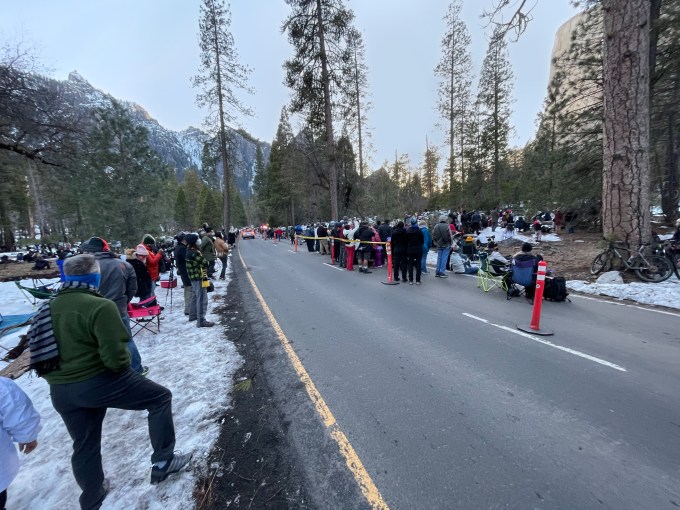
2021 Horsetail Fall Crowd, Northside Drive, Yosemite: This scene repeats itself all along a nearly one mile stretch of Northside Drive as sunset approaches in the last two weeks of February
I won’t argue that the Horsetail Fall scene is ridiculously crowded. But to photograph Horsetail Fall from Northside Drive (the more challenging, and competitive, Southside Drive perspective is now off-limits during Horsetail Fall season), you’re pointing up, and most likely using a telephoto lens (or at least not using a wide angle lens). This means that no matter how many people are trying to view the fall, no one is in anyone else’s shot. The result is a tailgate party atmosphere as the entire crowd unifies around a single goal: that special light on Horsetail Fall.
About this image
My second February workshop was scheduled for the full moon, so I made clear to everyone who signed up that even though we’d be there right in the heart of “Horsetail Fall season,” Horsetail Fall wouldn’t be a priority. But when the crowds pretty much wiped out one of my planned sunset locations, and with the Horsetail Fall conditions so ideal (water in the fall, no clouds), I decided we’d give Horsetail one shot.
By this (my fourth) attempt I had the traffic and parking strategy down to a science, so we were easily in position and set-up with about 90 minutes to spare. I actually like getting there so early because it’s cool, especially for those who haven’t witnessed Horsetail Fall before, to see the light warm as the vertical shadow advances across El Capitan’s face.
While watching the light change, we all chatted and laughed amongst ourselves and with the other nearby gawkers. Some of our neighbors had cameras too, and some were just there to watch.
With so much time to kill, a few of us even spent some time walking up and down Northside Drive, taking in the party atmosphere. Unlike most of the trophy scenes I’ve photographed, I saw lots of kids and even a few (leashed) dogs. Many people had brought chairs and ice chests, some were barbecuing, and everyone seemed to be enjoying themselves.
About 15 minutes before sunset the light had acquired an amber hue and the photographers stopped chatting and went to work. The light this evening warmed steadily, from amber to the deep orange in this image. I tried to time each click for when the wind near El Capitan’s summit caught the falling water just right, spreading it into a glowing veil.
After such a great Horsetail Fall experience with the previous week’s group, it’s impossible not to compare the two. On this evening we had less concern about the light because there was no sign of clouds. And though the prior week’s clouds had created a unique opportunity to have some character in the sky, I was pretty sure that there was a little more water this week. I also noticed that the last light was thinner, more tightly focused on the fall, but also didn’t stretch as far down the fall. And while the color wasn’t quite as red as it had been the prior week, I heard no complaints.
Read about the entire Horsetail Fall experience and how to photograph it
A Few Trophies of My Own
Click an image for a closer look, and to view a slide show.


 Eloquent Images by Gary Hart