Eloquent Images by Gary Hart
Insight, information, and inspiration for the inquisitive nature photographer
Moon Swoon
Posted on March 6, 2024

Moonrise, Half Dome, Yosemite
Sony α1
Sony 200-600 G
ISO 200
f/8
1/50 second
Given an especially intense workshop schedule to start my year, the only Yosemite workshop I originally planned for February was my annual Horsetail Fall workshop. But in early 2023 I plotted the 2024 February full moon and saw that it would appear above Yosemite Valley, directly behind Half Dome (viewed from Tunnel View), at exactly sunset on Friday, February 23. Hmmm…
Checking my 2024 schedule, I noted that the year’s workshop fun started on January 22 with five days in Death Valley, followed by just a two-day break before I flew to Iceland for eleven days. After returning from Iceland, I had only two days to catch my breath before my four-day Horsetail Fall workshop. Avoiding Yosemite’s weekend crowds (always a problem, but magnified significantly by Horsetail Fall) while including the moonrise, meant the February moon workshop could only start on February 20. That would give me just three days between Yosemite workshops to recharge and recover from jet lag. But that moonrise…
(All this probably isn’t terribly interesting, but surely there’s someone out there interested in the calculus that goes into scheduling photo workshops.) In general, any photo shoot should be timed to pair the static landscape feature (one we know exactly where it is, and that it’s not going anywhere) of your choice with some dynamic natural element (great light, dramatic weather, seasonal features, celestial elements, and so on) that will take the scene (cliché alert) “to the next level.” And while I can’t speak for other workshop leaders, my own scheduling process follows the same rule: start with a beautiful location I’m extremely familiar with, then identify those special external phenomena that I’d travel to photograph even without a workshop.
While personal trips can happen at the last minute, workshops need to be scheduled at least a year in advance, which of course adds an element of uncertainty because I can’t actually promise the event I scheduled the workshop for. And that doesn’t even take into account the other unforeseen events that can shut down a location with little notice. Case(s) in point: since 2020 I’ve lost workshops to a global pandemic (perhaps you remember that), extreme wildfire potential, and a flood threat. And just this week a forecast of extreme snow closed Yosemite for the weekend with very short notice—a bullet narrowly dodged by my February workshops. But none of that stress can trump the potential for a perfectly timed and placed Tunnel View moonrise that I wouldn’t dream of missing myself—so why not share it?
Worst case, I rationalized, I’d be delaying my post-workshop recovery for a week to get four more winter days of Yosemite beauty without having to battle any crowds (who’d be camped out beneath Horsetail Fall) at all my sunset spots. And best case, in addition to all of the above, we’d enjoy two beautiful moonrises, capped by the Tunnel View grand finale on our last shoot.
So schedule it I did. After an inauspicious beginning to the 2024 workshops—forgotten computer in Death Valley, traumatic reindeer encounter in Iceland, and a last-day power outage in the Horsetail workshop—I figured I’d gotten all the bad stuff out of the way just in time for the moon workshop. And despite the inconveniences, the photography in those first three workshops was off the charts—could I keep that photography streak alive in workshop number four?
That question was answered early. On the workshop’s first morning we drove into the park for sunrise and discovered that an unforecast overnight snowfall had decorated Yosemite Valley with a couple of inches of fresh snow. Better still, that storm was just departing as we set up for sunrise at Tunnel View, so my group got to enjoy a truly classic Yosemite clearing storm, followed by an intense dash to capture as much of Yosemite Valley as possible before the snow melted. After that morning, it felt like I was playing with house money. But I still wanted that moon…
One of the unfortunate side-effects of dependence on fickle, ephemeral natural phenomena is the urge to compulsively check their status as the target time approaches. In this case, since I knew exactly when and where the moon would rise (which of course didn’t prevent me from compulsively plotting and replotting, just to be sure), I was wholly dependent on the clouds to cooperate and couldn’t keep my eyes off the weather forecast (as if that would do any good).
On Monday of that week the forecast for Friday was clear. Excellent! By Tuesday, it changed to mostly clear—uh-oh (I always hate to see my weather forecasts trending in the wrong direction.) Sure enough, on Wednesday, Friday was forecast to be partly cloudy. And by the time I went to bed Thursday night, the NWS was calling for mostly cloudy on Friday. Sweet dreams…
We still had a nice moonrise shoot on the valley floor Thursday evening, so technically I’d delivered the “Yosemite Winter Moon” the workshop name promised. Not only was that moonrise a visual treat, it provided an opportunity for everyone to practice the surprisingly tricky exposure techniques a sunset moonrise requires. The tendency is to expose the scene so the darkening foreground looks good on the camera’s LCD, which pretty much guarantees the moon will be an overexposed white blob. The solution is to base the exposure on the moon, making the moon as bright as possible without blowing it out, and trusting that the foreground that looks much too dark on the camera’s LCD can be fixed in Lightroom/Photoshop. (Or you could just take one picture for the moon and one for the foreground, then combine them later in the image processor—but what fun is that?)
After building up the Friday moonrise promised in the workshop’s name, preparation material, and orientation, there was no turning back. And while everyone in the group knew I had no control over the weather, and the Wednesday morning snow and clearing storm guaranteed the workshop was already a huge photographic success, that was old news, and I couldn’t help stressing about the moonrise I’d built this workshop around.
The clouds arrived and lingered on Friday as promised. Throughout the day we got a few glimpses of blue overhead, but nothing that gave me a lot of optimism. Nevertheless, after a nice day of photography, with sunset and the moonrise both at 5:45, I got my people up to Tunnel View a little after 5:00 so they’d have plenty of time to stake out a good spot and get comfortable with the conditions. But there were those clouds…
About half the group followed me to a sloping granite slab behind Tunnel View, while the other half chose to stay with my brother Jay at the more accessible, less vertically exposed regular view in front of the parking lot. Before setting up, I bounced back and forth between the two spots a couple times to be sure everyone was settled in and knew exactly when and where the moon would appear (if the sky were clear).
Ever the optimist, I settled down on my little patch of granite with two tripods, cameras, and lenses. On my (large) Really Right Stuff 24L tripod (with the BH-55 head) was my Sony a1 and 200-600 lens; on my (compact) RRS Ascend 14L was my Sony a7R V and 24-105 lens. I pointed the 200-600 at Half Dome and zoomed to around 450mm to fill the frame with the snow-capped monolith; with the 24-105 I composed a wider scene that included El Capitan, Half Dome, and Bridalveil Fall. The plan, should the moon actually appear, was to start with tight telephotos of just Half Dome, then, as the moon separates from Half Dome, switch to wider frames of the entire scene. But those clouds…
Thinner clouds covered most of Yosemite Valley, but my primary concern was a large stratus blob above and a little west of Half Dome, with the thickest clouds approaching the rock from the west. Not a good setup. A lifetime of photographing Yosemite has taught me that the clouds above Yosemite Valley arrive from the west and exit in the east, which meant the heavier cloud cover was bearing down on the very area of the sky where the moon would appear. But a lifetime of photographing Yosemite has also taught me that as soon as you think you have the weather there figured out, it will prove you wrong.
Around 5:30 I noticed a small patch of blue behind Half Dome, low on the right side where it intersects the tree-lined ridge. This is the area the thicker clouds should be filling, but as I watched, rather than advancing, those clouds seemed to be lifting. Soon it became apparent that the blue behind Half Dome was expanding. With a couple of minutes to go, not only was all the sky directly behind and above Half Dome clear, even the clouds above that appeared to be thinning.
This is probably a good time to say that few sights thrill me more than the first appearance of the moon above any landscape. As the time for the moonrise approaches, I lock my eyes on the spot and don’t move them, even when talking to others—I don’t want to miss a single photon of the moon’s arrival.
And I didn’t. The instant I saw the first molecule of moon nudge above Half Dome I called out to everyone with me and the clicking commenced. I waited about 30 seconds just to enjoy the view a bit, then went to work with my 200-600. As soon as the moon separated from Half Dome, I switched to my a7R V 24-105 as planned and spent the next 15 or so minutes with wider views of the scene. The rising moon soon encountered some clouds, but most weren’t thick enough to completely obscured it, and most actually enhanced the view.
I realize this zoomed image isn’t a compositional masterpiece—I just wanted to get the tightest zoom possible (to make the moon as large as possible), without cutting off any of Half Dome (easy to do if you’re not paying attention). Mission accomplished.
Epilogue
Just when I thought I’d put the inauspicious behind me, I was notified by one of the people in the Yosemite moon group that he’d tested positive for COVID. The next day, I too tested positive for COVID, as did three others in the group. Fortunately, we were all sufficiently vaccinated and no one got terribly sick. For three days I felt pretty miserable (bad cold miserable, nothing that sent me to bed), but was back to my regular morning workout after four days.
Join me in a Yosemite photo workshop
Workshop Schedule || Purchase Prints || Instagram
Yosemite Moonrise
Click any image to scroll through the gallery LARGE


Tunnel Vision
Posted on April 24, 2023

Spring Rainbow, Bridalveil Fall, Yosemite
Sony a7R V
Sony 24-105 f/4 G
ISO 100
f/10
1/250 second
For everyone who woke up today thinking, “Gee, I sure wish there were more Yosemite pictures from Tunnel View,” you’ve come to the right place. Okay, seriously, the world probably doesn’t actually need any more Tunnel View pictures, but that’s not going to stop me.
Visitors who burst from the darkness of the Wawona Tunnel like Dorothy stepping from her monochrome farmhouse into the color of Oz, are greeted by a veritable who’s who of Yosemite icons: El Capitan, Cloud’s Rest, Half Dome, Sentinel Rock, Sentinel Dome, Cathedral Rocks, Bridalveil Fall, and Leaning Tower.

Yosemite Tunnel View subjects
Camera or not, that’s a lot to take in. First-time visitors might just just snap a picture of the whole thing and call it good. For more seasoned visitors like me, the challenge at Tunnel View is creating unique (or at least less common) images. But that’s not enough to keep me from returning, over and over.
Many people’s mental image of Yosemite was formed by the numerous Ansel Adams prints of this view. And while it’s quite possible those images were indeed captured at Tunnel View, many Adams prints assumed to be Tunnel View were actually captured from nearby Inspiration Point, 1,000 feet higher.
Before Wawona Tunnel’s opening in 1933 completed the current Wawona Road into Yosemite Valley, the vista we now know as Tunnel View was just an anonymous granite slope on the side of a mountain. Before 1933, visitors entering Yosemite from the south navigated Old Wawona Road, a steep, winding track more suited to horses and wagons than motorized vehicles. Inspiration Point was the Tunnel View equivalent on this old road.
To complicate matters further, there are actually three Inspiration Points in Yosemite. The original Inspiration Point is the location where the first non-Native eyes feasted on Yosemite Valley in the mid-19th century. Decades later, Old Wawona Road was carved into the forest and granite to provide an “easier” (relatively speaking) route between Wawona and Yosemite Valley. The valley vista that was established on this route and labeled Inspiration Point is the one popularized by Ansel Adams. But today that version of Inspiration Point has become so overgrown that hikers hardy enough to complete the steep climb up to the Ansel Adams Inspiration Point, must make their way a short distance down the slope to a spot where the view opens up, forming the New Inspiration Point. But I digress…
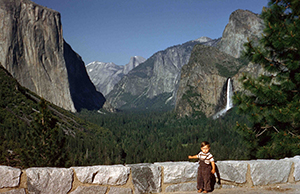
Almost certainly not my first visit
My total visits to Tunnel View, which predate my oldest memories, by now have to exceed 1,000. At first I had no say in the matter, having simply been a passenger on family trips since infancy. But when I became old enough to drive myself, my Tunnel View visits increased—most Yosemite trips included multiple visits.
The Tunnel View counter started clicking even faster as my interest in photography grew. More than just a one-of-a-kind scene to photograph, Tunnel View is also the best place in Yosemite to survey Yosemite Valley for a read on the current conditions elsewhere in the valley.
And as I’ve mentioned (ad nauseam), the view at Tunnel View is beautiful by any standard. And as it turns out, beauty is a pretty essential quality for a landscape image. Unfortunately, another essential landscape image criterion, especially for landscape photographers who pay the bills with their photography, is a unique image—ideally (aspirationally), but not necessarily, a one-of-a-kind image. So Tunnel View’s combination of unparalleled beauty and easy access means million of visitors each year, which makes finding something literally unique (one-of-a-kind) here virtually impossible.
But there are a few things I do to increase my chances of capturing something special enough to at least stand out—things you can do at any popular photo spot. Here are three:
- Experiment with focal length — At Tunnel View usually means using a telephoto to isolate individual elements, or combinations of elements: just El Capitan, or El Capitan and Half Dome; just Half Dome, or Half Dome and Bridalveil Fall; and so on. And an extreme telephoto allows me to zero in on just one aspect of a Tunnel View icon: Half Dome’s summit draped by clouds, El Capitan’s bold diagonals, the mist explosion at Bridalveil’s base, to name just three.
- Look behind you — Even though the granite walls outside Tunnel View’s classic view can’t compete with the money shot, failure to keep an eye on the surrounding walls risks missing light and clouds that can at times be spectacular. And even though I don’t photograph manmade objects, I’ve seen some great images by others using Wawona Tunnel to frame Yosemite Valley, or with the tunnel itself as the subject.
- Include special conditions — My favorite Tunnel View approach is to pair this already beautiful scene with one of the many ephemeral natural events possible here. Not only does the east-facing view mean warm late light on all the granite features, it also makes Tunnel View ideally situated for rising crescent (sunrise) and full (sunset) moons, and afternoon rainbows. And its position on Yosemite Valley’s west end means it’s usually the first place in Yosemite Valley that storms clear. Few sights in Nature more spectacular than a Tunnel View clearing storm, and no two are exactly the same.
The image I’m sharing today combines a couple of these approaches: a tighter than typical focal length, and special conditions. Though the Bridalveil Fall rainbow isn’t exactly unique, its combination of beauty and relative rarity keeps me coming back. And because the sun’s angle at any given moment, as well as the angle of view to Bridalveil Fall, are precisely known, I can predict the rainbow’s appearance each spring afternoon to within a few minutes (it varies slightly with the amount of water in the fall).
This rainbow makes a fantastic first shoot for my spring workshops. Usually I’m content to just stand and watch—and listen to the exclamations from my workshop students—but sometimes it’s to beautiful to resist. This year, with beautiful clouds overhead, dappled sunlight below, and a strong breeze to spread the rainbow’s palette, was one of those times.
Workshop Schedule || Purchase Prints || Instagram
A Tunnel View Gallery


Relationship Building
Posted on April 17, 2023
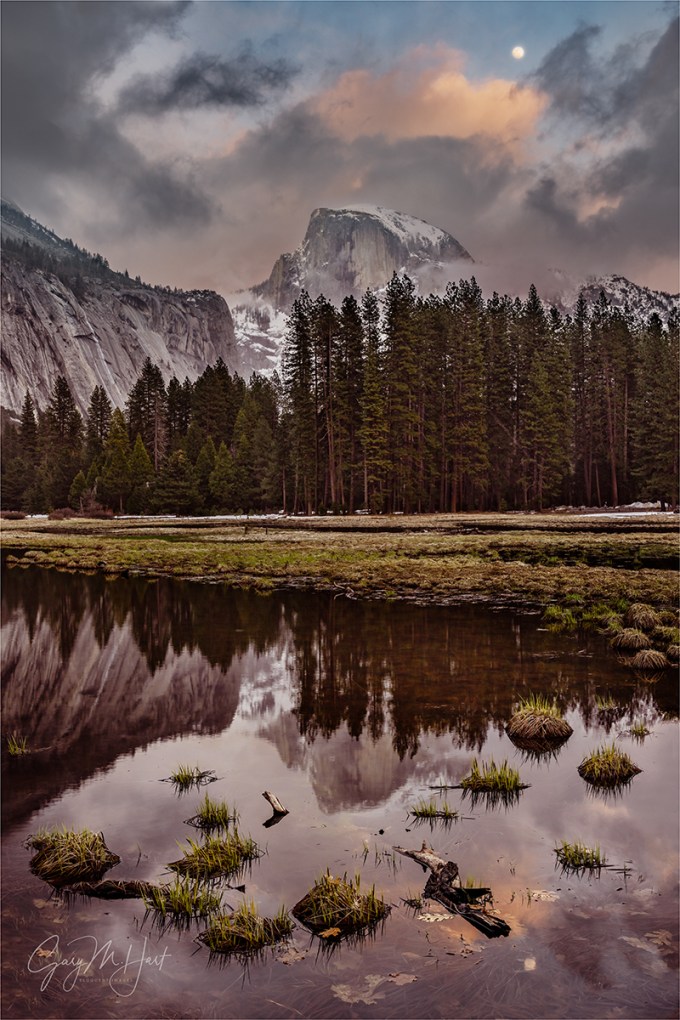
Lunar Reflection, Half Dome and Cook’s Meadow, Yosemite
Sony a7R V
Sony 24-105 f/4 G
ISO 100
f/10
1/8 second
It’s all about relationships
I write a lot about relationships in photography. Often I’m referring relationships with my subjects, which could mean gaining better understanding of a location—not just the where and when of its photo opportunities, but its weather and geology (especially), as well as its flora, fauna, and history. (Of course I love visiting new places too, but I’ve never felt particularly driven to expand my portfolio through relentless pursuit of new locations.)
As important as location relationships are my relationships with the natural phenomena that inspire me understand the science behind the ephemeral phenomena that fascinate me enough to photograph them. Things like lightning, rainbows, reflections, sunrise/sunset color, fall color, and anything celestial simply fascinate me and it never feels like work to study them.
But there’s another side to photography’s relationship coin that takes place within the frame of an image. I’m talking about the visual relationships between disparate subjects—juxtaposing one subject with another physical subject (nearby or distant), or elevating a favorite location by photographing it under the spell of a favorite natural phenomenon.
However these relationships happen, it’s only logical that the best photography takes place when intimate knowledge of location and natural phenomena are combined to create the intra-image relationships that make an image sing.
Sometimes this seems so obvious the we make these connections without realizing we’re doing it. when we visit a vista that includes multiple features, or travel to a favorite location to photograph it with sunset light or fall color. Other times we’re beneficiaries of happy accidents, when something unexpected just happens to manifest while we’re there. And while I love happy accidents as much as anyone, we should never count on them.
In general, the more deliberate we can be about consciously combining the things we love in our photography, the better our images will be. Of course some of my favorite images are happy accidents—something unexpected that just happened to take place while I was there to witness it—but the vast majority were more strategic.
So I guess in a way that would make me a photographic matchmaker, aggressively seeking to create relationships, not just with, but for the things I love most. Whether it’s fresh snow in Yosemite, lightning at Grand Canyon, the northern lights in Iceland, or the Milky Way in New Zealand, it’s usually not an accident that I was there. Of course there are no guarantee any of these things will happen as planned, but I always do my best to maximize my odds.
As much as I’d love to claim that creating these matches makes me some kind of photographic savant, I’m afraid it’s far simpler than that. (Like most people) I can read a weather report and get a few days advance notice of snow in Yosemite Valley; I know that the ingredients for a rainbow are sunlight and airborne water droplets (like rain and waterfall mist), and that my shadow always points in the direction of the rainbow’s center; the time window for any location’s fall color peak is generally common knowledge; and the moon and Milky Way follow precise schedules, and there are plenty of resources that reveal their position in the sky at any time, from any location. All I need to do is act on this information.
Tying it all together
Usually all you need to do to understand the relationships I’m seeking in a workshop is to look at the workshop’s name. The image I’m sharing in this blog post was captured during my Yosemite Moonbow and Wildflowers photo workshop earlier this month—but, as you can see, there is in fact (and fortunately) more to Yosemite in spring than moonbows and wildflowers.
When I scheduled this workshop more than a year ago, I knew for a fact that it would take place during the full moon that’s necessary for the Lower Yosemite Fall moonbow, and that the angle of the rising moon relative to the fall would be just right. And I knew from experience that the odds of wildflowers in April were extremely high. What I didn’t know was whether we’d have clear or cloudy skies, nor could I have anticipated California’s unprecedented wet and cold winter and how it might threaten to throw a wrench in my plans.
This is where the location familiarity part of relationship building comes in handy, as I was able to adjust enough that we ended up with some wonderful photography, albeit something that was much closer to a winter workshop than a spring workshop. This group had chilly temperatures, clouds, a little rain, and lots of snow (mostly on the ground, but a few flakes as well). Nevertheless, as you no doubt know if you read my previous blog post, we were able to catch the very beginning of what has turned out to be a very late (but potentially spectacular) wildflower bloom, so I was able to deliver something as advertised.
The moonbow part of my plan was a little more problematic. While Yosemite Falls is fed entirely by snowmelt, and the Sierra received record snowfall this winter boded well for our chances, the temperatures hadn’t warmed enough yet for the fall to deliver the explosion of mist at its base necessary for the moonbow. (There was nice flow in the fall, just not enough for the moonbow.) We tried, but ended up with a moonlight shoot sans moonbow.
On to Plan B
From the moon to the Milky Way, regular readers of my blog know of my fascination with all things celestial. Orbital geometry aligns Yosemite’s moon with different features as the seasons change, and I try to be there for as many moonrises as possible. Since the full moon happens during this workshop, photographing it is always part of my plan. On the other hand, because the moon doesn’t align as perfectly with Half Dome or El Capitan as it does in winter, it’s more of a bonus than it is something I advertise.
The first night clouds that threatened my moonrise made for great photography, and we kicked off with a nice Tunnel View shoot. Since the wet winter also meant reflective vernal pools in Yosemite Valley’s meadows, to create a sunset match for my workshop students on that cloudy first evening, I opted for the vernal pool in Cook’s Meadow. (For good reason, Cook’s Meadow itself is closed to visitors to allow the meadow to recover from years of pedestrian abuse—we approached the pool from behind, via the trail from the Sentinel Bridge parking lot, and never actually entered the meadow.)
I was actually thinking about multiple matches this evening: not only does this location have a great view of Half Dome, the vernal pool is ideally positioned for a Half Dome reflection. And I knew (but kept to myself for fear of jinxing us) that in the off-chance that the clouds parted, this would be the best location to add the moon to our Half Dome reflection scene.
Between Half Dome, the reflection, and clouds kissed by warm light, I almost forgot about the moon. But about 20 minutes before sunset the clouds opened and there it was. I’d already been strategically moving about to manage the reflection’s relationship to the various features dotting the water’s surface, taking care to frame Half Dome rather than obscure it. So the biggest obstacle I had to overcome was making sure that everyone else had their shot before I got mine.
Since most of us were set up within a few feet of each other, I was able to provide impromptu coaching on how to expose bright enough to capture the shadows without blowing out the moon (read more here). Another (counterintuitive) learning point was to point out that the focus point for a reflection is the same as the focus point for the reflective subject, not the reflective surface (read more here).
One more thing
People ask me if I ever tire of Yosemite, and I can honestly answer, no. Part of keeping Yosemite fresh for me is the infectious excitement that happens when the people I’m with witness something like what we saw this evening. Even without the moon, this Half Dome scene provided a great Yosemite introduction for everyone. But when the clouds lit up and the moon popped out, it elevated to one of those truly special Yosemite moments that I’ll never tire of sharing.
Photographic Matchmaking
Click any image to scroll through the gallery LARGE


Upping Your Vertical Game
Posted on January 16, 2023

Moonrise and Clouds, El Capitan, Yosemite
Sony a7R IV
Sony 24-105 G
1 second
F/11
ISO 100
Greetings from Iceland. Perhaps you noticed that this picture is in fact not Iceland, but that’s only because I simply haven’t had a chance to process my images from the past week. There are many reasons to visit Iceland in winter, and I will very enthusiastically share examples in future posts (northern lights, anyone?), but today I’m sharing one more image from last month’s Yosemite workshop. And because I’m fully immersed in a workshop that occupies me day and night (chasing the low light by day, and the aurora by night), I’m dusting off (and polishing up) a post on a topic that is as important to me today as it was when I wrote it 12 years ago.
Let’s Get Vertical
Who had the bright idea to label horizontal images “landscape,” and vertical images “portrait”? To that person let me just say, “Huh?” As a landscape-only photographer, about half of my images use “portrait” orientation. I wonder if this naming bias subconsciously encourages photographers to default to a horizontal orientation for their landscape images, even when a vertical orientation might be best.
Every image possesses an implicit visual flow that’s independent of the eyes’ movement between the scene’s elements. Understanding that the long side of an image subtly encourages the visual motion through the frame—left/right in a horizontal image, up/down in a vertical image—photographers can choose visual symmetry or tension with the visual movement between the scene’s visible elements.
For example, because a waterfall flows down, orienting a waterfall image vertically complements the water’s motion, instilling a feeling of calm. Conversely, a waterfall image that’s oriented horizontally can possess more visual tension because of the natural inclination for the eye to move laterally in a horizontally oriented image. While there’s no absolute best way to orient a waterfall image (or any other scene), you need to understand that there is a choice, and that choice matters.
By moving the eye from front to back, vertical images can enhance the illusion of depth so important in a two-dimensional photo. Even though a still image lacks the depth dimension, there’s a sense that distance increases from the bottom up in its 2-dimensional world. The viewer’s eye is drawn first to a strong visual element in the foreground, then naturally flows up, and away, from there. The left/right tug of a horizontal image conflicts with this. (Many factors go into creating the illusion of depth, so I’m not saying that horizontal images inherently lack depth.)
More than just guiding the eye through the frame, vertical orientation narrows the frame, enabling us to eliminate distractions or less compelling objects left and right of the prime subject(s). Vertical is also my preferred orientation when I want to emphasize a sky full of stars, dramatic clouds and color, or (as I was reminded earlier this week) an aurora that rockets skyward.
In these scenes with especially dramatic skies, not only do I orient them vertically, I put the horizon near the bottom of the frame to further underscore the drama. When the sky is dull and all the visual action is in the landscape, I’ll put the horizon at the top of my frame. And when the landscape and sky are equally compelling, I have no problem splitting the frame in the middle (regardless of what the photo club rule “experts” might proclaim).
While a horizontally oriented scene is often the best way to convey the sweeping majesty of a broad landscape, I particularly enjoy guiding and focusing the eye with vertical compositions of traditionally horizontal scenes. Tunnel View in Yosemite, where I think photographers tend to compose too wide, is a great example. The scene left of El Capitan and right of Cathedral Rocks can’t compete with the El Capitan, Half Dome, Bridalveil Fall triumvirate, yet the world is full of too-wide Tunnel View images that shrink this trio to include (relatively) nondescript granite that can’t hold a candle to the main scene.
When the foreground and sky aren’t particularly interesting, I tend to shoot fairly tight horizontal compositions at Tunnel View. But when a spectacular Yosemite sky, snow-laden trees, or cloud-filled valley below demand attention, vertical is my go-to orientation because it frees me to celebrate the scene’s drama without diluting it.
When I composed the scene in this image, the moon had just popped out of the clouds. Knowing when and where it was supposed to arrive, I’d been set up with my Sony a7R IV mounted with my Sony 200-600 lens and 2X Teleconverter, hoping to capture the moon BIG as it edged up from behind El Capitan. When the clouds threatened to completely wipe out the moonrise, I’d have been thrilled with any lunar appearance. By the time this wish was fulfilled, I’d long since abandoned my big moon plan and switched to my Sony 24-105 lens.
Because the clouds and color stretched across the sky, and Bridalveil Fall was flowing nicely, I naturally did a horizontal composition of this scene wide enough to include all the good stuff. But that composition shrunk the moon to more of a strong accent, and I wanted something with the moon more front-and-center.

Moonrise and Clouds, Tunnel View, Yosemite
Flipping my camera to vertical, I increased my focal length to limit my terrestrial subjects the business end of El Capitan, with an incognito Half Dome lurking in the background. The longer focal length enlarged the moon enough that, while not the BIG moon I’d once imagined, it stands out far more prominently than it does in my horizontal version.
Breaking News
The night before last, my Iceland workshop group was treated to what may have been the most spectacular northern lights display I’ve ever witnessed. Until last night, when we topped it. Stay tuned to this channel for images (as soon as I get a chance to process them and write some—by my next blog, I hope).
Let’s Get Vertical
Click any image to scroll through the gallery LARGE


Playing the Cards You’re Dealt
Posted on January 9, 2023

Winter Veil, Half Dome, Yosemite
Sony a7R IV
Sony 24-105 G
8 seconds
F/16
ISO 160
In family hearts games when I was a kid, I loved to “shoot the moon” (tremendous reward for success, extreme cost for failure). But simply wanting to shoot the moon wasn’t enough to make it happen, and I didn’t really start winning until I learned to separate my desires from the reality in my hand—I know now to evaluate my cards when they’re dealt, set a strategy, then adjust my strategy as the game unfolds. It’s that way for most card games, and it’s that way with photography.
Given nature’s fickle whims, I try not to lock in on something I want so much that I miss what I can have. I got my latest reminder last month in Yosemite, when I really, really wanted to shoot the moon. It was the workshop’s first sunset, and I knew exactly where I wanted to be to start my workshop group off with a beautiful full (-ish) moon rising above Half Dome at sunset. I’ve written about the weather related moon frustrations in this workshop in other recent posts, but this is where it all began.
This evening’s frustrations were compounded by the fact that not only was the moon a no-show, for most of the our time there it looked as if Half Dome would be joining it. So when we arrived out here, I had to reassure everyone that there really is a view of Half Dome right up there, and it’s really beautiful, I swear.
Because I’d told them before starting the short hike out to this spot that our target would be the moon and Half Dome, when neither appeared, it would have been easy to simply stand around and wait for something to change. So I tried to point out some of the other, more subtle opportunities available.
I suggested using the swirling clouds, bare trees, and pristine snow to convey a frigid wintry atmosphere. And the reflection, while not as dramatic as it can be here, nevertheless nicely complimented the scene, while a long exposure, in addition to smoothing the reflection, could stretch the white dollops of drifting foam into white steaks that reveal the Merced River’s motion.
I visit this spot so much that I often just leave my camera in the bag here, but as I pointed out these subtle features to my group, I started talking myself into the opportunity to photograph something new. So, partly to demonstrate to others and partly to actually capture something of my own, I pulled out my Sony a7RIV and Sony 24-105 and went to work.
While the scene was dark enough to get exposures of a second or so without a neutral density filter, I wanted something a little longer and added a Breakthrough 6-stop Dark Polarizer. I started with horizontal frames that maximized the foreground reflection and middle-ground wintry scene, but when Half Dome’s outline started to materialize through the clouds(a harbinger of good things to come?), I changed my emphasis. And because I’d already been working the scene’s other elements, it was a simple step to start incorporating Half Dome into my compositions.
Half Dome never appeared completely, but for a few minutes it did peek out enough to be recognizable. In fact, the ethereal feel the clouds create are a big part of this image’s appeal for me. This was an 8-second exposure at ISO 160. I wish I could say I chose ISO 160 because 200 was too fast and 125 was too slow, but I’m guessing that my intent was to use ISO 50 for the longest possible shutter speed, but while fumbling with my camera wearing bulky gloves (it was as cold as it looks), I accidentally turned the ISO dial.
This evening is a good reminder that consistently successful nature photography not only requires the ability to anticipate conditions and establish a plan, but also to maintain enough flexibility to adjust when things don’t play out as expected. No shoot is a guaranteed success, and sometimes nature’s cards just don’t fall right. But the more options you have, and the more you can read and respond to conditions, the more winners you’ll come home with.
Workshop Schedule || Purchase Prints || Instagram
Variations on a Scene: Different Takes on the Same Location
Click any image to scroll through the gallery LARGE


The Third Time’s the Charm
Posted on December 12, 2022

Moonrise and Clouds, Tunnel View, Yosemite
Sony a7R IV
Sony 24-105 G
1/4 second
F/11
ISO 100
Large or small, crescent or full, I love photographing the moon rising above Yosemite. I truly believe it’s one of the most beautiful sights on Earth. The moon’s alignment with Yosemite Valley changes from month-to-month, with my favorite full moon alignment coming in the short-day months near the winter solstice when it rises between El Capitan and Half Dome (from Tunnel View), but I have a plan for each season. Some years the position and timing are better than others, but when everything clicks, I do my best to be there. And if I’m going to be there anyway, why not schedule a workshop? (He asked rhetorically.)
Strike one, strike two
For last week’s Yosemite Winter Moon photo workshop, I’d planned three moonrises, from three increasingly distant vantage points. On our first night, despite the cloudy vestiges of a departing storm, I got the group in position for a moonrise at a favorite Merced River sunset spot, hoping the promised clearing would arrive before the moon. The main feature here is Half Dome, but the clouds had other ideas. Though they eventually relented just enough to reveal Half Dome’s ethereal outline and prevent the shoot from being a complete loss, the moon never appeared. Strike one.
With a better forecast for the second evening, we headed into the park that afternoon with high hopes. But as the sun dropped, the clouds thickened to the point where not only did I fear we’d miss the moon again, I was pretty sure Half Dome would be a no-show as well. So I completely aborted the moonrise shoot and opted for sunset at Valley View, where El Capitan and freshly recharged Bridalveil Fall were on their best behavior. The result was a spectacular sunset that made me look like a genius (phew), but still no moon. Strike two.
Revisiting nature photography’s 3 P’s
Because the right mindset is such an important part of successful photography, many years ago I identified three essential qualities that I call the 3 P’s of Nature Photography:
- Preparation is (among many things) your foundation; it’s the research you do that gets you in the right place at the right time, the mastery of your camera and exposure variables that allow you to wring the most from the moment, and the creative vision, refined by years of experience, and conscious out-side-the-box thinking.
- Persistence is patience with a dash of stubbornness. It’s what keeps you going back when the first, second, or hundredth attempt has been thwarted by unexpected light, weather, or a host of other frustrations, and keeps you out there long after any sane person would have given up.
- Pain is the willingness to suffer for your craft. I’m not suggesting that you risk your life for the sake of a coveted capture, but you do need to be able to ignore the tug of a warm fire, full stomach, sound sleep, and dry clothes, because the unfortunate truth is that the best photographs almost always seem to happen when most of the world would rather be inside.
Most successful images require one or more of these three essential elements. Chasing the moon last week in frigid, sometimes wet, Yosemite got me thinking about the 3 P’s again, and how their application led to a (spoiler alert) success on our third and final moonrise opportunity.
Meanwhile…
As we drove into the Tunnel View parking lot, about 45 minutes before sunset, our chances for the moon looked excellent. There were a few clouds overhead, with more hanging low on the eastern horizon behind Half Dome, but nothing too ominous. My preparation (there’s one) had told me that the moon this evening would appear from behind El Capitan’s diagonal shoulder, about halfway up the face, and that area of the sky was perfectly clear. So far so good.
Organizing my group along the Tunnel View wall, I pointed out where the moon would appear, and reminded them of the previously covered exposure technique for capturing a daylight-bright moon above a darkening landscape. Eventually I set up my own tripod and Sony a7R IV, with my Sony 200 – 600 G lens with the 2X Teleconverter pointed at ground 0. In my pocket was my Sony 24 – 105 G lens, which I planned to switch to as soon as the moon separated from El Capitan. Then we all just bundled up against the elements and enjoyed the view, waiting for the real show…
But, as if summoned by some sinister force determined to frustrate me, the seemingly benign clouds hailed reinforcements that expanded and thickened right before our eyes. Their first victim was Half Dome, and it looked like they’d set their sights on El Capitan next. By the time sunset rolled around, my optimism had dropped from a solid 9 to a wavering 2. I knew the moon was up somewhere behind the curtain and tried to stay positive, but let everyone know that our chances for actually seeing it were no longer very good. I reminded them not to get so locked in on waiting for the moon that they miss out on the beauty happening right now. Ever the optimist, I switched to my 24-105, privately rationalizing that even without the moon, we’d had so much spectacular non-moon photography already, nobody could be unhappy. But still…
At that point it would have been easy to cut our losses, come in out of the cold (pain), and head to dinner. But I have enough experience with Yosemite to know that it’s full of surprises, and never to go all-in on it’s next move. So we stayed. And our persistence (we’ve checked all three now) was rewarded when, seemingly out of nowhere, a hole opened in the clouds and there was the moon. The next 10 minutes were a blur of frantic clicking and excited exclamation as my group enjoyed this gift we’d all just about given up on.
A few full moon photography tips
- Sun and moon rise/set times always assume a flat horizon, which means the sun usually disappears behind the local terrain before the “official” sunset, while the moon appears after moonrise. When that happens, there’s usually not enough light to capture landscape detail in the moon and landscape, always my goal. To capture the entire scene with a single click (no image blending), I usually try to photograph the rising full moon on the day before it’s full, when the nearly full (99% or so illuminated) moon rises before the landscape has darkened significantly.
- The moon’s size in an image is determined by the focal length—the longer the lens, the larger the moon appears. Photographing a large moon above a particular subject requires not only the correct alignment, it also requires distance from the subject—the farther back your position, the longer the lens you can use without cutting your landscape subject.
- To capture detail in a rising full moon and the landscape (in a single click), increase the exposure until the highlight alert appears on your LCD (any more exposure blows out the moon). At that point, you can’t increase the exposure any more, even though the landscape is darkening. You’ll be amazed by how much useable data you’ll be able to pull from the in nearly black shadows in Lightroom/Photoshop (or whatever your processing software). In the image I share above, my LCD looked nearly black except for the single white dot of moon. Eventually the scene will become too dark—exactly when that happens depends on your camera, but if you’re careful, you can keep shooting until at least 15 minutes after sunset.
Learn More
Moon Over Yosemite


Variations on a Scene
Posted on November 14, 2022
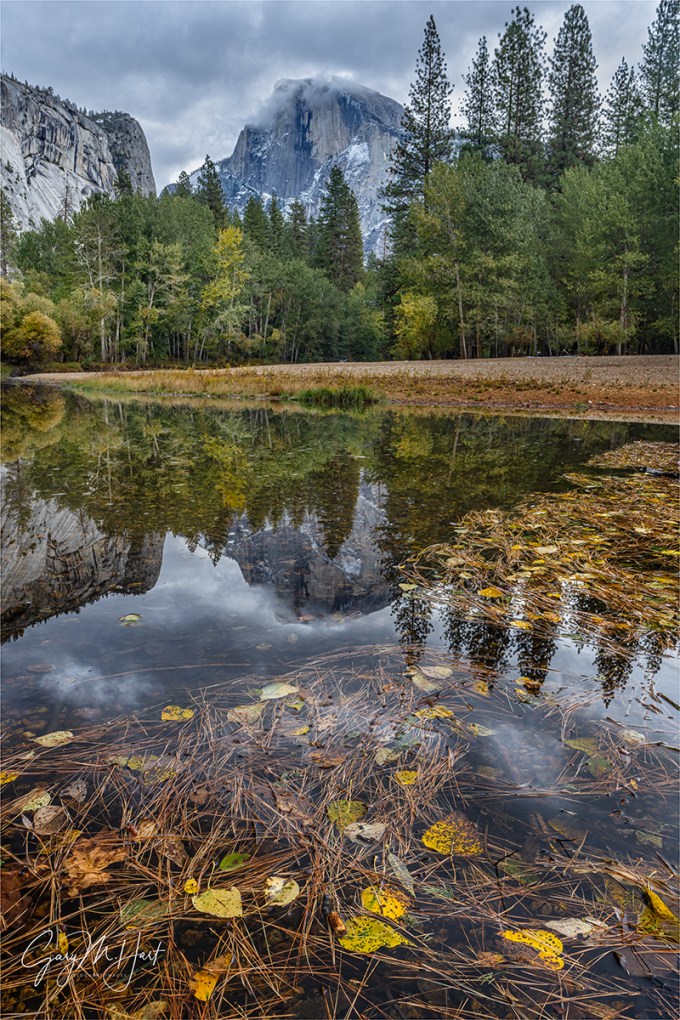
Autumn Leaves and Reflection, Half Dome, Yosemite
Sony α1
Sony 16-35 f/2.8 GM
1.3 seconds
F/11
ISO 100
One million words
January 2023 will mark the start of my (more or less weekly) Eloquent Nature blog’s 13th year. Not counting the 30 or so sporadically created Photo Tips articles, today’s post will be number 710. Doing the math, that actually turns out to be more than 1 blog post per week; at 1500 words per post (a conservative estimate), I’ve written more than 1 million words. Yikes.
According to WordPress, I have nearly 40,000 followers, but so far have resisted the urge to monetize my creation. I have nothing against money (I in fact kind of like it), but haven’t yet found a way to generate dollars from my blogging effort without detracting from the page or cheapening the visitors’ experience. (So, you’re welcome.)
But my motives aren’t entirely altruistic. Writing about creativity and inspiration each week encourages introspection that has given me a clearer understanding of myself and the creative process. And my (obsessive) desire to understand my subjects has cause me to research and ponder countless topics that might otherwise have been off my radar.
My drive to write just seemed to happen organically. I remember in first or second grade, each Monday we’d be assigned a list of spelling words (am I dating myself, or do they still do that?) to learn for the spelling test that always came on Friday. To help us learn that week’s words, the week’s homework assignment was to a create “spelling sentences,” one for each word. Instead of spelling sentences, I would write spelling stories that used every one of a the week’s words—I can’t explain why, except that I thought it was fun.
And ever since, whether it was in school or at work, I somehow became the designated writer—not necessarily because I was better at it, more because I was the most willing to do it. From there it wasn’t much of a leap for that willingness to write to become part of my job description. Eventually I became a tech writer for a large Silicon Valley tech company.
I’ve somehow managed to avoid the trap that befalls many creatives, where merely attempting to monetize their passion robs them of its joy. And I feel extremely lucky to have two creative pursuits, photography and writing, that give me great pleasure and synergistically combine to support me financially.
I’m thinking about this because I’ve decided to (slightly) change my blogging schedule, and I’ve found that a surprising number of people seem to notice when my weekly post is late, even by just a day. (Nothing abusive, more like occasional mild disappointment.) Of course it very much pleases (and surprises) me to hear that people actually look forward to my posts and actually read them.
So what’s this big change? For years my personal commitment was to post a new blog each Sunday. I’ve actually become pretty good at meeting this goal, but as my wife recently pointed out, this commitment pretty much blows up our weekend. Since we both work from home, on schedules entirely of our own making, weekends are really just a state of mind for both of us (there’s a reason we’ve each set our watches to display the day of the week)—I never considered our lost weekends a big deal. But I do have to admit that it would be nice to be a little more in sync with the rest of the world’s weekend state of mind, and have therefore made the radical decision to move my weekly blog day to, wait for it… Monday. Whoa.
(Only a writer would come up with 500 words explaining something that could have been said in 10 words: Effective this week, new blog posts will appear on Mondays.)

Autumn Leaves and Reflection, Half Dome, Yosemite
So anyway
If you’re still with me (thank you), you’ve probably already forgotten about the image at the top of this post. It’s another product of last week’s incredibly rewarding Yosemite Fall Color and Reflections photo workshop. Rewarding because it was a great group that very much deserved the wonderful photography we enjoyed: nice clouds throughout, a couple of clearing storms, a colorful sunrise (not as common in Yosemite as you’d think), (only) one morning of bright sunlight that came just as we were in the perfect spot for it (Cook’s Meadow elm tree, if you must know), and even a little snow.
And what’s a “fall color and reflections” workshop without actual fall color and reflections? This year’s Merced River was its usual low and slow reflective self, and the fall color was just starting to peak. So yeah, a pretty good week.
The workshop’s final shoot was at one of my favorite Yosemite Valley Half Dome views, just upriver from Sentinel Bridge. I photograph here a lot. A. Lot. So much that I rarely get out my camera when I’m with a group. But I made an exception this time because I liked the clouds hovering around Half Dome, the light was just so darn nice, and I found a foreground I could work with.
Finding unique images at frequently photographed locations is usually some combination of special conditions and/or a new foreground. The conditions this evening, while not spectacular, were definitely good, and I was able to combine that with a static pool in the Merced that had accumulated a colorful assortment of leaves and pine needles. Dropping my tripod/camera to about 2 feet above the ground, I eliminated a large empty gap between the leaves and Half Dome’s reflection to make my foreground about nothing but the best stuff.
Because the group was my priority, after finding my composition, I just left the tripod/camera in place while I worked with them, returning every 5 or 10 minutes to fire off a handful of frames. The clouds around Half Dome were changing rapidly, so even though my composition didn’t change (at all), each session gave me something a little different.
The only other thing that changed with each click was my polarizer orientation. This was one of those catch-22 conundrums where dialing up the reflection with my polarizer also dialed up the reflective (color robbing) sheen on the floating leaves, and brightened the water on which the leaves floated (reducing the contrast between the leaves and their background). Dialing the reflection down to maximize the color of the leaves and blacken the water also nearly erased the Half Dome and clouds reflection.
So with each visit to my camera, I fired at least one frame with the reflection maximized, another with it minimized, and a couple somewhere in between. I found that I could in fact hit a midway point with the polarizer that spared most of the reflection beyond the leaves (Half Dome and the clouds), and reduced most of the reflection on and around the leaves.
-

- Autumn Snow, Half Dome Reflection, Yosemite
-

- Autumn Snow and Reflection, Half Dome, Yosemite
-

- Autumn Reflection, Half Dome, Yosemite
I won’t pretend that I’ve created a brand new take on this frequently photographed view, but I am pretty pleased to have found a new variation on one of my favorite scenes.
See you next Monday…
Yosemite Fall Color and Reflections
Click any image to scroll through the gallery LARGE


Just a Dash of Rainbow
Posted on May 22, 2022

Bridalveil Rainbow, Tunnel View, Yosemite
Sony 𝛂1
Sony 24-105 G
1/60 second
F/10
ISO 100
I’ve spent the last week moving, and with my annual Grand Canyon Raft Trip for Photographers launching Tuesday, I haven’t had a lot of time for blogging (and much else). But I’m still committed to posting a new blog each week, so I’m sharing a new image from one of this spring’s Yosemite workshops, and a brief description of its capture. I also dusted off and polished up the Rainbow article from my Photo Tips tab. I’ll be off the grid until May 31, so next week’s post will likely be a little late.
It’s become a tradition to kick off my Yosemite spring workshops with a rainbow on Bridalveil Fall. Though the timing varies with the date, I’ve done it enough to narrow the rainbow’s start down to about a 2 minute window for whatever date I’m there. Not only is this little dash of rainbow a thrilling spectacle and beautiful introduction to Yosemite, it also creates an (unjustified) illusion of genius for the workshop leader.
With rain and maybe even a little snow, this year’s weather forecast for our first day looked great in many ways, but not so much for rainbows. But rainbow or not, Tunnel View is a great spot to start a workshop because it’s the most complete view of all things Yosemite. It’s also the first place Yosemite’s storms clear, so even without sunlight something special might be in store.
The storm was just starting to clear when we arrived and I almost got trampled as my group raced to set up. Between the swirling clouds and Half Dome’s appearance (not always a sure thing during a Yosemite clearing storm), things were already going pretty well when shafts of light broke through to illuminate random parts of the valley and surrounding granite.
I checked my watch and crossed my fingers when I realized that we’d be able to add a rainbow to Bridalveil if the light were to make it there. A couple of minutes later Leaning Tower (the diagonal just to the right of the fall) lit up, and a few seconds later a small patch of light hit the evergreens in front of the fall.
After telling everyone what was about to happen, I set up my composition and said a little prayer that the light would cooperate. The patches of light quickly expanded and merged and there it was. I often shoot this rainbow with a telephoto because the sky is so often blank blue, but the whole scene was so beautiful this afternoon that I went with my Sony 24-105 G lens on my (brand new!) Sony a1.
This was the very first time I’d used this camera, and while I thought I’d set it up to match my Sony a7RIV, I soon discovered that I’d missed a few things. For example, I usually shoot in single shot mode, but my a1 was in fast continuous mode, an oversight that became apparent when my first shutter press (slow and gentle, as always) fired off 6 identical frames before I released my finger. My goodness is this camera fast.
I have so many images of this rainbow that I only photographed it for a couple of minutes—just long enough to be confident that I’d captured something I didn’t have. When I finished shooting I just stood back to watch the rainbow move up the fall—and to listen to the exclamations of marvel from the group.
Fortunately none of my settings oversights were a major hindrance and were quickly corrected. Since that afternoon I’ve used my a1 enough to know that I’m going to love using it, and can’t wait to try it out in the Grand Canyon this week.
Read on to learn about rainbows, how to anticipate them, and how to photograph them…
All About Rainbows
Let there be light
Most people understand that a rainbow is light spread into various colors by airborne water drops. Though a rainbow can feel like a random, unpredictable phenomenon, the natural laws governing rainbow are actually quite specific and predictable, and understanding these laws can help photographers anticipate a rainbow and enhance its capture.
The sun’s visible wavelengths are captured by our eyes and interpreted by our brain. When our eyes take in light comprised of the full range of visible wavelengths, we perceive it as white (colorless) light. Color registers when some wavelengths are more prevalent than others. For example, when light strikes an opaque (solid) object such as a tree or rock, some of its wavelengths are absorbed; the wavelengths not absorbed are scattered (reflected). Our eyes capture this scattered light, send the information to our brains, which interprets it as a color. When light strikes water, some is absorbed, some passes through to reveal the submerged world, and some light is reflected by the surface as a reflection.

Light traveling from one medium to another (e.g., from air into water) refracts (bends). Different wavelengths refract different amounts, causing the light to split into its component colors.
To understand the interaction of water and light that creates a rainbow, it’s simplest to visualize what happens when sunlight strikes a single drop. Light entering a water drop slows and bends, with the shorter wavelengths bending more than the longer wavelengths: refraction. Refraction separates the originally homogeneous white light into the myriad colors of the spectrum: red, orange, yellow, green, blue, indigo, violet (in that order).
But simply separating the light into its component colors isn’t enough to create a rainbow. Actually seeing the rainbow spectrum caused by refracted light requires that the refracted light be reflected back to our eyes somehow.
A raindrop isn’t flat like a sheet of paper, it’s spherical, like a ball. Light that was refracted when it entered the front of the raindrop, continues through to the back of the raindrop, where some is reflected. To view a rainbow, our eyes must be in the correct position to catch this reflected spectrum of color—fortunately, this angle is very consistent and predictable.
Red light reflects at 42 degrees, violet light reflects at 40 degrees, while the other spectral colors reflect back between 42 and 40 degrees. That’s why the top color of the primary rainbow is always red, the longest visible wavelength; the bottom color is always violet, the shortest visible wavelength.
Follow your shadow
Every raindrop struck by sunlight creates a rainbow somewhere. But just as the reflection of a mountain peak on the surface of a lake is visible only when viewed from the angle the reflection bounces off the lake’s surface, a rainbow is visible only when you’re aligned with the 42 – 40 degree angle at which the raindrop reflects light’s refracted spectrum of rainbow colors.
Lucky for most of us, viewing a rainbow requires no knowledge of advanced geometry. To locate or anticipate a rainbow, put your back to the sun and picture an imaginary line originating at the sun, entering the back of your head, exiting between your eyes, and continuing into the landscape in front of you—this line points to the “anti-solar point,” an imaginary point exactly opposite the sun from your viewing position.
It helps to remember that your shadow always points toward the anti-solar point—and toward the center of the rainbow, which forms a 42 degree circle around the line connecting the sun and the anti-solar point. Unless we’re in an airplane or atop a mountain peak, we don’t usually see the entire circle because the horizon gets in the way. So when you find yourself in a mixture sunlight and rain, locating a rainbow is as simple as following your shadow and looking skyward—if there’s no rainbow, the sun’s probably too high.
High or low
Sometimes a rainbow appears as a majestic half-circle, arcing high above the distant terrain; other times it’s merely a small arc hugging the horizon. As with the direction of the rainbow, there’s nothing mysterious about its varying height. Remember, every rainbow would form a full circle if the horizon didn’t get in the way, so the amount of the rainbow’s circle you see (and therefore its height) depends on where the rainbow’s arc intersects the horizon.
While the center of the rainbow is always in the direction of the anti-solar point, the height of the rainbow is determined by the height of the anti-solar point, which will always be exactly the same number of degrees below the horizon as the sun is above the horizon. It helps to imagine the line connecting the sun and the anti-solar point as a fulcrum, with you as the pivot—picture yourself in the center of a teeter-totter: as one seat rises above you, the other drops below you. That means the lower the sun, the more of the rainbow’s circle you see and the higher it appears above the horizon; conversely, the higher the sun, the less of the rainbow’s circle is above the horizon and the flatter (and lower) the rainbow appears.

Assuming a flat, unobstructed scene (such as the ocean), when the sun is on the horizon, so is the anti-solar point (in the opposite direction), and half of the rainbow’s 360 degree circumference will be visible. But as the sun rises, the anti-solar point drops—when the sun is more than 42 degrees above the horizon, the anti-solar point is more than 42 degrees below the horizon, and the only way you’ll see a rainbow is from a perspective above the surrounding landscape (such as on a mountaintop or on a canyon rim).
Of course landscapes are rarely flat. Viewing a scene from above, such as from atop Mauna Kea in Hawaii or from the rim of the Grand Canyon, can reveal more than half of the rainbow’s circle. From an airplane, with the sun directly above you, all of the rainbow’s circle can be seen, with the plane’s shadow in the middle.
Double Your pleasure
Not all of the light careening about a raindrop goes into forming the primary rainbow. Some of the light slips out the back of the raindrop to illuminate the sky, and some is reflected inside the raindrop a second time. The refracted light that reflects a second time before exiting creates a secondary, fainter rainbow skewed 50 degrees from the anti-solar point. Since this is a reflection of a reflection, the colors of the secondary rainbow are reversed from the primary rainbow.
And if the sky between the primary and secondary rainbows appears darker than the surrounding sky, you’ve found “Alexander’s band.” It’s caused by all the light machinations I just described—instead of all the sunlight simply passing through the raindrops to illuminate the sky, some of the light was intercepted, refracted, and reflected by the raindrops to form our two rainbows, leaving less light for the sky between the rainbows.
Waterfalls are easy
Understanding the optics of a rainbow has practical applications for photographers. Not only does it help you anticipate a rainbow before it happens, it also enables you to find rainbows in waterfalls.
A rainbow caused by sunlight on rain can feel random because it’s difficult to know exactly where the rain will fall, when the sun will break through, and exactly where to position yourself to capture the incongruous convergence of rainfall and sunshine. A waterfall rainbow, on the other hand, can be predicted with clock-like precision because we know exactly where the waterfall and sun are at any give time—as long as clouds don’t get in the way, the waterfall rainbow appears with clock-like precision.


Yosemite is my location of choice for waterfall rainbows, but maybe there’s a waterfall or two near you that might deliver. Just figure out when the waterfall gets direct sunlight early or late in the day, then put yourself somewhere on the line connecting the sun and the waterfall. And if you have an elevated vantage point, you’ll find that the sun doesn’t even need to be that low in the sky.
Spring in Yosemite is waterfall rainbow season, and I know exactly where to be and when to be there for both of Yosemite Valley’s major waterfalls. In fact, given the variety of vantage points for viewing each of these falls, I can usually get two or three rainbows on each fall on any given day.
In addition to clouds, there are other variables to deal with. One is the date, because the path and timing of the sun’s arc across the sky changes with each passing week. Another thing that can throw the timing off slightly is the amount of water in the fall—following a wet winter the spring runoff increases, and with it the amount of mist. Generally, the more mist, the sooner the rainbow will appear and the longer it lasts. And finally there’s wind, which spreads the mist and usually improves the rainbow by increasing its size.
While all these variables make it difficult for me share the exact schedule of Yosemite’s waterfall rainbows from the variety of vantage points, I can give you some general guidance: look for a rainbow on Yosemite Falls in the morning, and Bridalveil Fall in the afternoon. And if you don’t mind a short but steep hike, you can also find a rainbow on Vernal Fall in the afternoon.
Moonbows
Understanding rainbow optics can even help you locate rainbows that aren’t visible to the naked eye. A “moonbow” (lunar rainbow) is a rarely witnessed and breathtaking phenomenon that follows all the natural rules of a daylight rainbow. But instead of resulting from direct sunlight, a moonbow is caused by sunlight reflected by the moon.
Moonlight isn’t bright enough to fully engage the cones in your eyes that reveal color, though in bright moonlight you can see the moonbow as an arcing monochrome band. But a camera on a sturdy tripod can use its virtually unlimited shutter duration to accumulate enough light to bring out a moonbow in full living color. Armed with this knowledge, all you need to do is put yourself in the right location at the right time.


Probably the best known moonbow is the one that appears on Yosemite Falls each spring. Usually viewed from the bridge at the base of Lower Yosemite Fall, the best months are April, May, and June, with May probably being the best combination of moonlight angle and ample water.
Unfortunately, this phenomenon isn’t a secret, and the bridge can be quite crowded on spring full moon nights—in high runoff springs, it can also be extremely wet (pack your rain gear). The base of Upper Yosemite Fall can also have a moonbow when viewed from the south side of Cook’s Meadow, especially in wet springs.
Workshop Schedule || Purchase Prints || Instagram
A Gallery of Rainbows
Click an image for a closer look, and to view a slide show.


Watch Your Weight
Posted on May 16, 2022
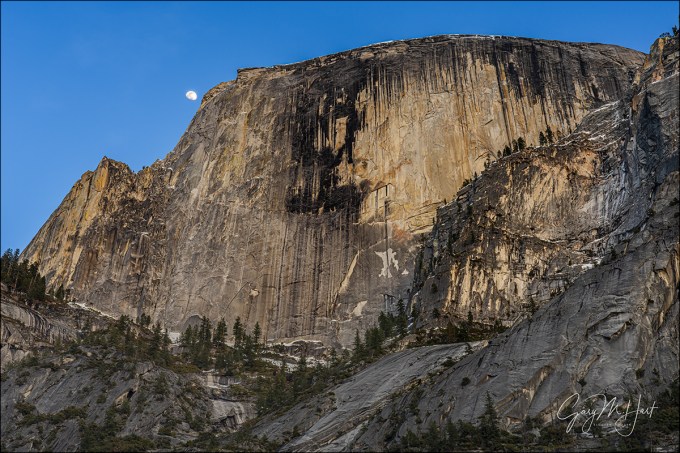
Half Dome and Moon, Mirror Lake, Yosemite
Sony a7RIV
Sony 24-105 G
1/10 second
F/10
ISO 100
Dynamic vs. static
Photographic composition is all about managing the tension between dynamic and static: the dynamic component is the way the eye moves through the frame, while the static component is the overall balance of the scene’s elements.
To synergize these two potentially conflicting factors, I think in terms the “visual weight” of my frame’s contained elements. Like gravity for the eye, visual weight is the amount each of the scene’s various elements might pull the viewer’s vision toward it. Unlike the measurable weight caused by actual gravity—a constant determined by an object’s mass (I’m talking the Earth-based, Newtonian physics that govern our daily lives)—visual weight is a more subjective quality that can be a function of many things that include the object’s size, brightness, contrast, shape, and color.
On the dynamic side, I use the way the viewers of an image subconsciously connect visually weighted objects and mentally draw virtual lines along which their eyes move. Composing a scene, I first identify the objects that possess visual weight—a rock, flower, tree, mountain, whatever—and work to position them in my frame in ways that guide my viewer’s eyes. Additionally, I generally avoid putting visually weighted objects near the edges of my frame, where they might pull my viewer out of the scene.
For the scene’s static component, visual balance, an approach that works for me to imagining my frame as a perfectly rigid print, laid flat and balanced atop a centered point (like a pencil). As I compose, I want the position of the scene’s visually weighted objects organized on my imaginary balanced print so it will rest perfectly horizontal (no tilt).
Just a dash of moon
The concept of visual weight helped me reconcile a frequent complaint of photographers (and at least one editor who used it to reject an article on moon photography) that the moon appears too small in a landscape image. At some point I realized that the moon’s visual weight, even accounting for its brightness and contrast, was greater than its size alone might suggest. That led me to an essential component of visual weight that I’d overlooked: emotional connection. There is just something about the emotional pull of the moon hovering over a landscape that draws the human eye far more than might be expected from its more tangible physical qualities.
This realization freed me to stop stressing about the size of the moon in my frame. Though I have no problem photographing the moon large when the opportunity presents itself, I also won’t hesitate to leverage a small moon’s emotional weight to elevate a relatively ordinary scene, or enhance an already beautiful scene.
For example
The short hike along Tenaya Lake to Mirror Lake is one of the most popular in Yosemite Valley. Though technically not a lake, each spring (and often in winter and early summer as well) Tenaya Creek brims with snowmelt. Rushing from the high country, Tenaya Creek pauses directly beneath Half Dome, flattening and spreading enough to deliver spectacular reflections.
Even more than the reflections, for me the best part of the Mirror Lake experience is its the neck-craning close-up of Half Dome’s face. When I started thinking about the best way to convey Half Dome’s imposing presence, it occurred to me that letting its looming face dwarf a small moon might be exactly what I need.
I write a lot about my love for photographing the moon large, the bigger the better. But sometimes the moon needs to be small. While the moon here is far from the primary subject it would be in a telephoto image, this image is all about Half Dome. Adding little dash of moon creates a balancing counterweight, helps spice up an otherwise boring sky, and creates a size contrast that emphasizes Half Dome’s massive presence.
Take a look at the images in the gallery below, paying extra attention to the moon’s relationship to Half Dome. In some images the moon is the focal point of the frame, in others it’s a balancing element, and sometimes it’s simply an accent that adds interest to a boring sky.
The Moon and Half Dome
Click an image for a closer look, and to view a slide show.


Still Motion
Posted on April 18, 2022

Half Dome and Tenaya Creek, Yosemite
Sony a7RIV
Sony 12-24 GM
1/10 second
F/16
ISO 50
Put me firmly in the camp of those who prefer reading the book to watching the movie. Watching a movie, my gaze is fixed as the scene unfurls before my eyes at a predetermined pace—if something requires scrutiny or triggers my imagination, I have to pause or rewind (often not an option—or at the very least, a source of irritation to others in the room). Reading a book, I’m free to pause, ponder, revisit, and imagine to my heart’s content.
This ability to control the pace of my relationship with the world may explain why I prefer still photography to video capture. Acknowledging that video provides expressive opportunities that still photography can’t, I can’t help but think the power of still photography is under-appreciated.
One important distinction is that the motion in a video is applied by the medium; in a still image, the source of the motion is my own eyes. And while a video dictates the pace of my relationship with the scene, entering the world of a photograph gives my eyes the freedom to linger and explore the scene’s nooks and crannies, to savor its nuances at my own pace.
This still photography bias could be explained by the fact that in virtually all aspects of my life, “think fast” is rarely my default response. Rather, given a choice, I prefer analysis and comprehension to instant reaction. This evaluate-first mindset might also explain why my favorite sport is baseball (which many consider “too slow”), and why I prefer chess and Scrabble to video games (the last video game I played was Pong).
So I guess it should be no surprise that, as a landscape photographer, my subjects don’t move. I love having the time to craft a scene—to position myself, frame my subjects, and manage the exposure variables (that control motion, light, and depth)—confident that when I’m finally ready, my subject will still be there.
But, as we all know (and as Spider-Man reminded us), with great power comes great responsibility. To succeed, we photographers must be sensitive to our viewer’s experience. Is it clear what the picture is a about? Is there a place for the eye to land, and/or a path for the eye to follow?
Just plopping the viewer of an image into the scene without any clues about what to do there is an invitation to a quick exit. Which is why I try in every image to include visual signals to guide my viewer’s eye and make it as clear as possible what they’re supposed to be doing in the world I’m offering. And once they’re there and have examined whatever it is I’m trying to show them, they’re much more inclined to explore further and discover more of the scene’s subtleties.
Visual signals can take many forms. One popular device that I very consciously try not to think about is “leading lines.” Not because I think they’re inherently bad or wrong, but because we’ve heard about them to the point of eye-glazing cliché, and I fear that many photographers (and photography contest judges) have given them too much power—at the expense of other similarly, or even more, important factors. I’m not saying that my images don’t use leading lines, I’m just saying that I only use them when they work organically, without conscious thought.
That said, I am drawn to diagonals—a rock, shoreline, leaning tree trunk, fallen log, and so on. While these diagonals can indeed connect objects and lead viewers’ eyes, I’m more interested in the diagonal’s power to simultaneously move the viewers’ eyes across two planes of my scene: up/down and left/right.
And any line, whether horizontal, vertical, or diagonal doesn’t need to be an actual visible line—virtual lines work too. To understand the concept of a virtual line, I think in terms of visual “visual weight”: any object in my frame that, by virtue of its mass, brightness, position, or some other quality that creates enough visual gravity to pull a viewer’s eye in its direction. I try to avoid visually heavy objects that pull the eye away from the important parts of my frame, and to pair visually heavy objects that the viewer can subconsciously connect into a virtual line.
Another visual aid that I sometimes employ is a virtual frame—some object within the boundaries of my actual frame that holds my viewer’s eye in the scene, or nudges it it back into the scene the way the cushion on a pool table bumps the ball back into the action.
About this image
In last week’s Yosemite Moonbow and Wildflowers workshop (in which we got neither moonbows or wildflowers, but nevertheless enjoyed absolutely spectacular photography conditions), we made the 1 1/2 mile walk up to Mirror Lake. This is one of those hikes that’s as much about the journey as it is about the destination. Along the way I kept my eyes peeled for opportunities to pair Half Dome with churning Tenaya Creek. With Half Dome virtually straight up, of the way I was thwarted by the dense forest canopy, but as the trail steepened for its final ascent to the lake, I found a small gap I thought might work.
After climbing down among the jumbled boulders separating the trail from the creek, I pulled out my Sony a7RIV and attached my Sony 12-24 f/2.8 GM lens. While my Sony 16-35 GM would probably have worked here, I loved the extra room the 12-24 gave me to compose this scene that was beautiful from top to bottom.
With a little scrambling I was able to frame Half Dome with a pair of leaning tree trunks, dropping low to avoid blocking any of its face with a rogue branch. Not only did the leaning trunks provide a nice diagonal to move the eye, they also created a virtual frame to hold the eye in the scene. From my position I was also able to use the rushing creak to create a second diagonal. At 12mm, I was able to include many of the nearby rocks, the closest of which were no more than 2 feet away. These rocks made a great virtual frame across the bottom of the scene.
At 12mm and f/16, I knew I had plenty of focus wiggle room to achieve full front-to-back sharpness, and focused on a rock just a couple of feet into my scene. I wanted to put a slight blur in the water, but the 12-24 isn’t really filter-friendly (it can be done, but requires an expensive and awkward filter system that I haven’t found enough need for), so I couldn’t use a neutral density filter. Fortunately, the water here is so fast that the amount of blur I wanted wouldn’t be a problem. Turns ISO 50 and f/16 gave me enough blur to smooth the motion without losing its definition, exactly what I wanted.
It’s always interesting when I discover that I’d photographed a seemingly random scene before and used a similar composition. On the one hand, it’s a reminder to be careful not to get in a compositional rut, but on the other hand, it’s a confirmation that my compositional process is not random and likely reflective of my personal style.


One more thing
It’s interesting to compare these two images, capture almost exactly 5 years apart. The first one used 13mm, while last week’s was 12mm. The angle of view was similar but not identical, and I was closer to the creek in the first shot. The biggest difference between the two is the amount of sky and the amount of motion blur. Though I have no specific memory of my thoughts when I approach the earlier image, I know my process well enough to know exactly why they’re different. In the early image the sky was lousy (blank blue), and I composed to minimize it; in last week’s image I had clouds that were nice enough to justify including them. And the early image came after sunset (as I was walking back from Mirror Lake), so it was dark enough that it would have been very difficult to get anything but completely blurred water in the extremely fast (and much higher) creek.
Workshop Schedule || Purchase Prints || Instagram
Moving the Eye
Click an image for a closer look, and to view a slide show.


