Eloquent Images by Gary Hart
Insight, information, and inspiration for the inquisitive nature photographer
Seeing in the dark
Posted on November 21, 2014

Autumn Moonlight, El Capitan, Yosemite
Canon EOS-5D Mark III
16 mm
20 seconds
F/4
ISO 800
One of the great joys of the digital photography is the ease with which our cameras reveal the world after dark. Scenes that are merely shadow and shape to the human eye are recorded with unseen color and detail by a digital sensor, and stars too faint to compete with moonlight shine brightly.
After a lifetime of refusing to sap my enjoyment of the night sky by attempting to photograph it with film, about ten years ago (a year or two into my personal digital photography renaissance) I decided to take my camera out after dark in the Alabama Hills to photograph Mt. Whitney and the sawtooth Sierra crest. It took just a few frames to realize that this was a new paradigm, but I wasn’t quite hooked until I viewed my images later that night and found, among a host of similarly forgettable Mt. Whitney among snow-capped peak images, one image of the Big Dipper framed by stacked, moonlit boulders that stood out. Ever since I’ve chased opportunities to photograph my favorite scenes after dark—first solely by the light of the full moon, and more recently (as digital sensors improve) by starlight.

Big Dipper, Alabama Hills, California
As I incorporate night photography into most of my workshops, I have no qualms about guaranteeing success for all my moonlight shoots (barring equipment failure). This month’s Yosemite Autumn Moon workshop was no exception—after photographing a beautiful full moon rising above Half Dome at sunset, we broke for dinner, then returned to the wide open spaces of El Capitan Meadow beneath El Capitan for a moonlight shoot. One of my favorite things about these moonlight shoots is the way everyone is equal parts surprised and delighted by how simple it is, not to mention how beautiful their images are.
I’d spent time that afternoon getting the group up to speed on moonlight photography (it doesn’t take long), so after a brief refresher on the exposure settings and focus technique, everyone seemed to be managing just fine without me. Feeling just slightly unessential, I decided to try a few frames of my own. Struck immediately with how beautifully the autumn gold stood out, I shifted my position to align the most prominent tree with El Capitan. As with most of my night images, I went vertical to maximize the amount of sky in my frame. I also took care to compose wide enough to include Cassiopeia on the right side of the scene.
If you have a digital SLR and a relatively sturdy tripod, you have everything you need for night photography. I have a couple of articles in my Photo Tips section to guide you: It’s best to start with moonlight photography before attempting the much more challenging starlight photography.
A moonlight gallery
Click an image for a closer look, and to enjoy the slide show


Moon whisperer
Posted on November 14, 2014

Twilight Moonrise, El Capitan and Half Dome, Yosemite
Canon EOS SL1
.4 seconds
F/11
ISO 100
140 mm
Just when you start getting cocky, nature has a way of putting you back in your place. Case in point: last week’s full moon, which my workshop group photographed to great satisfaction from the side of Turtleback Dome, near the road just above the Wawona Tunnel.
I love photographing the moon, in all of its phases for sure, but especially in its full and crescent phases, when it hangs on the horizon in nature’s best light. I’ve developed a method that allows me to pretty much nail the time and location of the moon’s appearance from any location, and love sharing the moment with my workshop students. (Because my workflow has been in place for about ten years, I don’t use any of the excellent new software tools that automate the moon plotting process.)
Last week’s workshop was no exception, and after much plotting and re-plotting, I decided that rather than my usual Tunnel View vantage point, the view just west of the Wawona Tunnel would work better for this November’s full moon. Arriving about 30 minutes before “showtime,” I gathered everyone around and pointed a spot on Half Dome’s right side, about a third of the way above the tree-lined ridge, and told them the moon would appear right there between 4:45 and 4:50.
Sure enough, right at 4:47 there it was and I exhaled. We photographed the moon’s rise for about 30 minutes, until difference between the darkening valley and daylight-bright moon became too great for our cameras to capture lunar detail. Everyone was thrilled, and I was an instant genius—I believe I even heard “moon whisperer” on a few lips.
The workshop wrapped up the next evening, and I was still basking in my new-found moon whisperer status as I drove home down the Merced River Canyon with my daughter Ashley in the passenger seat. In a car behind us was workshop participant Laurie, who had never been down that road and wanted to follow me to the freeway in Merced.
Hungry, we stopped at one of my favorite spots, Yosemite Bug Rustic Mountain Resort in Midpines (check it out), for dinner. About an hour later, our stomachs full, we were walking back to the cars when someone pointed to a glow atop the mountain ridge above the resort. Ashley and I recognized it as the rising moon, but since this wasn’t a full disk, immediately entered into a friendly debate as to whether the moon was just peeking above the ridge, or had already risen and was disappearing behind a cloud.
We actually got quite scientific, escalating the passion with each point/counterpoint to make our cases (lest you think this was an unfair contest, I should add that Ashley’s a lawyer). Laurie remained silent. I’m not really sure how long we’d been debating when Laurie finally nudged us and pointed skyward, where, in full view of the entire Western Hemisphere, glowed the landscape illuminating spotlight of the actual full moon. Moon whisperer indeed.
(We never did figure out what the glow was.)
A full moon gallery
Click an image for a closer look, and to enjoy the slide show


Yosemite Valley: Worth getting up for
Posted on November 11, 2014

Autumn Glow, Cook’s Meadow, Yosemite
Canon EOS-5D Mark III
35 mm
.4 seconds
F/20
ISO 100
Yosemite isn’t an inherently great sunrise location. Because most of the views in Yosemite Valley face east, not only are you looking up from the bottom of a bowl, you’re composing toward the brightest part of the sky, at the shady side of your primary subjects (Half Dome, El Capitan, Yosemite and Bridalveil Falls). This is one reason I time my workshops to include one more sunset than sunrise. But I’ve come to appreciate Yosemite Valley mornings for its opportunities to create unique images that don’t resemble the beautiful but oft duplicated afternoon and sunset pictured captured when the iconic subjects are awash with warm, late light.
Over the years I’ve accumulated a number of favorite, go-to morning spots for Yosemite. I love the first light on El Capitan, which starts at the top about 15 minutes after the “official” (flat horizon) sunrise and gradually slides down the vertical granite, is a particular treat when reflected in the shaded Merced River. Other morning favorites include pre-sunrise silhouettes from Tunnel View (especially when I can include a rising crescent moon), the deep shade of Bridalveil Creek beneath Bridalveil Fall, and winter light on Yosemite Falls.
And then there’s Cook’s Meadow. Each spring you can photograph the fresh green of the meadow’s sentinel elm, Yosemite Falls booming with peak flow, and Half Dome reflected in still, vernal pools. In winter the tree is bare, exposing the twisting outline of its robust branches. The highlight each autumn is the few days when the tree is bathed in gold. On the chilliest fall mornings, sparkling hoarfrost often decorates the mounded meadow grass, and if you’re really lucky, when the air is most still, you’ll find the meadow hugged by an ephemeral mist that rises, falls, disappears, and reappears before your eyes.
On last week’s workshop’s opening morning, after a nice sunrise silhouette shoot at Tunnel View, I rushed my workshop group to Cook’s Meadow in time for the first light there. We hit the autumn big three: a hoarfrost blanket, the elm’s autumn gold still going strong, and even a few wisps of mist. The image here I captured toward the end of our shoot, just as the sun kissed the valley floor. My wide, horizontal composition emphasized the foreground, which was far more interesting than the bland (and contrail scarred) sky. I dialed in a small aperture to enhance the sunstar effect, and used a Singh-Ray 2-stop hard-transition neutral density filter to moderate the bright sky.
Within minutes the light was flat and the mist was gone, but the group was happy. Not a bad start to what turned out to be a great week of photography.
Workshop Schedule || Purchase Prints
A Yosemite Morning gallery
Click an image for a closer view, and to enjoy the slide show


If at first you don’t succeed…
Posted on November 7, 2014

Floating Leaves, Merced River, Yosemite
Canon EOS-5D Mark III
105 mm
.6 seconds
F/11
ISO 800
In early November of 2007 I took a picture that didn’t quite work out. That’s not so unusual, but somehow this one stuck with me, and I’ve spent seven years trying to recreate the moment I missed that night.
On that evening seven years ago, the sun was down and the scene I’d been working for nearly an hour, autumn leaves clinging to a log in the Merced River, was receding into the gathering gloom. The river darkened more rapidly than the leaves, and soon, with my polarizer turned to remove reflections from the river, the leaves appeared to be suspended in a black void.
I’d decided my scene lacked a visual anchor, a place for the eye to land, so I waited (and waited) for a leaf to drift into the top of my framed. On my LCD the result looked perfect, and I felt rewarded for my persistence. But back home on my large monitor, I could see that everything in the frame was sharp except my anchor point. If only I’d have bumped my ISO instead of my shutter speed….
Intrigued by the unrealized potential, I returned to this spot each autumn, but the stars never aligned—too much water (motion); dead (brown) leaves; no leaves; too many leaves; no anchor point—until this week. Not only did I find the drought-starved Merced utterly still, “my” log was perfectly adorned with a colorful leaf assortment anchored by an interlocked pair of heart-shaped cottonwood leaves.
I worked the scene until the darkness forced too much compromise with my exposure settings. In the meantime, I filled my card with horizontal and vertical, wide and tight, versions of the scene with the log both straight and diagonal. I also played with the polarizer, sometimes dialing up the reflection of overhanging trees. But I ultimately decided on the one you see her, which is pretty close to my original vision.
I can’t begin to express how happy photographing these quiet scenes makes me. I’ve done this long enough to know that it’s the dramatic landscapes and colorful sunsets that garner the most print sales and Facebook “Likes,” but nothing gives me more personal satisfaction than capturing these intimate interpretations of nature.
Workshop Schedule || Purchase Prints || Instagram
Autumn Intimates
Click any image to scroll through the gallery LARGE


The yin and yang of nature photography
Posted on August 7, 2014
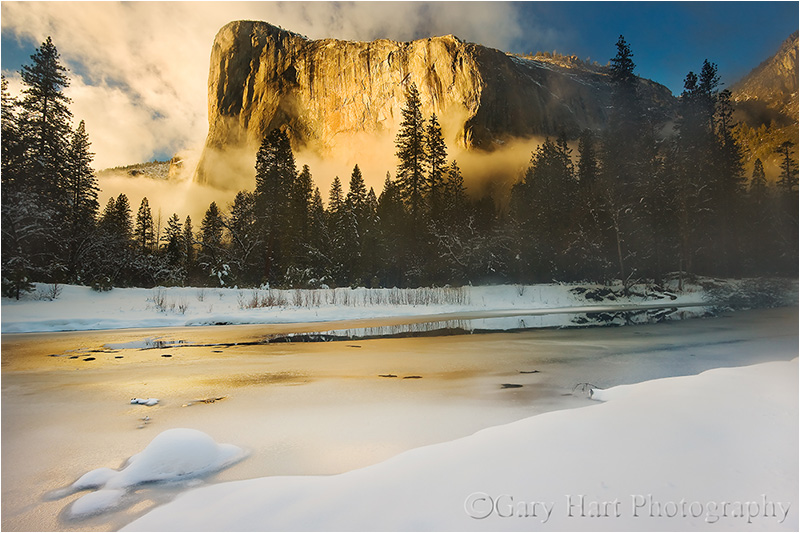
Clearing Storm, El Capitan and the Merced River, Yosemite
Canon 1Ds Mark III
17 mm
1/8 second
F/11
ISO 100
Conducting photo workshops gives me unique insight into what inhibits aspiring nature photographers, and what propels them. The vast majority of photographers I instruct, from beginners to professionals, approach their craft with either a strong analytical or strong intuitive bias—one side or the other is strong, but rarely both. And rather than simply getting out of the way, the underdeveloped (notice I didn’t say “weaker”) side of that mental continuum seems to be in active battle with its dominant counterpart.
On the other hand, the photographers who consistently amaze with their beautiful, creative images are those who have negotiated a balance between their conflicting mental camps. They’re able to analyze and execute the plan-and-setup stage of a shoot, control their camera, then seamlessly relinquish command to their aesthetic instincts as the time to click approaches. The product of this mental détente is a creative synergy that you see in the work of the most successful photograpers.
At the beginning of a workshop I try to identify where my photographers fall on the analytical/intuitive spectrum and nurture their undeveloped side. When I hear, “I have a good eye for composition, but…,” I know instantly that I’ll need to convince him he’s smarter than his camera (he is). Our time in the field will be spent demystifying and simplifying metering, exposure, and depth management until it’s an ally rather than a distracting source of frustration. Fortunately, while much of the available photography education is technical enough to intimidate Einstein, the foundation for mastering photography’s technical side is ridiculously simple.
Conversely, before the sentence that begins, “I know my camera inside and out, but…,” is out of her mouth, I know I’ll need to foster this photographer’s curiosity, encourage experimentation, and help her purge the rules that constrain her creativity. We’ll think in terms of whether the scene feels right, and work on what-if camera games (“What happens if I do this”) that break rules. Success won’t require a brain transplant, she’ll just need to learn to value and trust her instincts.
Technical proficiency provides the ability to control photography variables beyond mere composition: light, motion, and depth. Intuition is the key to breaking the rules that inhibit creativity. In conflict these qualities are mutual anchors; in concert they’re the yin and yang of photography.
About this image
With snow in the forecast for a December morning a few years ago, I drove to Yosemite and waited out the storm. When the snow finally stopped, I made the best of the three or so hours of daylight remaining.
Rather than return to some of the more popular photo locations, like Tunnel View or Valley View, I ended up at this spot along the Merced River. Not only his is a great place for a full view of El Capitan, it’s also just about the only place in Yosemite Valley with a clear view of the Three Brothers (just upriver and out the frame in this image). Downriver here are Cathedral Rocks and Cathedral Spires.
As I’d hoped, the snow was untouched and I had the place to myself. My decision to wrap up my day here was validated when the setting sun snuck through and painted the clouds gold.
Yosemite Winter
Click an image for a closer look and slide show. Refresh the window to reorder the display.


Moonbow: Nature’s little secret
Posted on May 20, 2014

Moonbow and Big Dipper, Lower Yosemite Fall, Yosemite
Canon EOS-1Ds Mark III
22 mm
30 seconds
F/4
ISO 800
Rainbows demystified
A rainbow forms when sunlight strikes airborne water droplets and is separated into its component spectral colors by characteristics of the water. The separated light is reflected back to our eyes when it strikes the backside of the droplets: Voila!—a rainbow.
Despite their seemingly random advent and location in the sky, rainbows follow very specific rules of nature—there’s nothing random about a rainbow. Draw an imaginary line from the sun, through the back of your head, and exiting between your eyes; the rainbow will form a full circle at 42 degrees surrounding that line (this won’t be on the test). Normally, because the horizon almost always gets in the way, we usually see no more than half of the rainbow’s circle (otherwise it would be called a “raincircle”). The lower the sun is, the higher the rainbow and the more of it we see; once the sun is higher than 42 degrees (assuming a flat horizon), we don’t see the rainbow at all unless we’re at a vantage point that allows us to look down (for example, at the rim of the Grand Canyon).
Read more about rainbows on my Photo Tips Rainbows Demystified page.
Moonbows
Moonlight is nothing more than reflected sunlight—like all reflections, moonlight retains a dimmer version of most of the qualities of its source (the sun). So it stands to reason that moonlight would cause a less bright rainbow under the same conditions that sunlight causes a rainbow. And guess what—it does! So why have so few people heard of moonbows? I thought you’d never ask.
Color vision isn’t nearly as important to survival in the wild as the ability to see shapes, so human vision evolved to bias shape over color in low-light conditions. In other words, colorful moonbows have been there all along, we just haven’t be able to see them. But cameras, with their ability to dial up sensitivity to light (high ISO) and accumulate light (long exposures), “see” much better in low light than you and I do.
While it’s entirely possible for a moonbow to form when moonlight strikes rain, the vast majority of moonbow photographs are waterfall-based. I suspect that’s because waterfall moonbows are so predictable—unlike a sunlight rainbow, which doesn’t require any special photo gear (a smartphone snap will do it), capturing a lunar rainbow requires at the very least enough foresight to carry a tripod, and enough knowledge to know where to look.
Nevertheless, even though we can’t see a moonbow’s color with the unaided eye, it’s not completely invisible. In fact, even without color, there’s nothing at all subtle about a bright moonbow—it may not jump out at you the way a sunlight rainbow does, but if you know where to look, you can’t miss a moonbow’s shimmering silver band arcing across the water source.
Yosemite Falls moonbow
Despite frequent claims to the contrary, moonbows can be seen on many, many waterfalls. Among the more heralded moonbow waterfalls are Victoria Falls in Africa, Cumberland Fall in Kentucky, and (of course) Yosemite Falls in Yosemite National Park.
Yosemite Falls is separated into three connected components: Upper Yosemite Fall plummets about 1400 feet from the north rim of Yosemite Valley; the middle section is a series of cascades dropping more than 600 feet to connect the upper and lower falls; Lower Yosemite Fall drops over 300 feet to the valley floor. While there are many locations from which to photograph the moonbow on Upper Yosemite Fall, the most popular spot to photograph it is from the bridge at the base of Lower Yosemite Fall.
The Lower Yosemite Fall moonbow is not a secret. Arrive at the bridge shortly after sunset on a full moon night in April, May, and (usually) June, and you’ll find yourself in an atmosphere of tailgate-party-like reverie. By all means come with your camera and tripod, but leave your photography expectations at home or risk appreciating the majesty of this natural wonder. In springs following a typical winter the mist and wind (the fall generates its own wind) on and near the bridge will drench revelers and cameras alike. After a particularly wet winter, the airborne water and long exposures can completely obscure your lens’s view during the necessarily long exposures. And if the wet conditions aren’t enough, if you can find a suitable vantage point, expect to find yourself constantly jostled by a densely packed contingent of photographers and gawkers stumbling about in limited light. Oh yeah, and then there are the frequent flashes and flashlights that will inevitably intrude upon your long exposures.
But, if you still have visions of a moonbow image, it’s best to come prepared:
- A tripod and digital SLR camera are must (a film camera will work too, but it adds complications I won’t get into here)
- Wear head-to-toe rain gear so you can concentrate on keeping your camera dry
- Bring a chamois or bath towel—you’ll be using it frequently
- An umbrella can help keep water off your lens during a long exposure
- Practice moonlight photography (you’ll find my how-to of moonlight photography, including exposure settings and focus techniques, in the link) before you get there—trust me when I say that you don’t want to be learning how to photograph by moonlight while you’re trying to capture a moonbow.
- Don’t have time to practice before your visit? Stop at the top of the Lower Yosemite Falls trail, where you can see the entire fall from top-to-bottom, and practice there—the conditions are much easier, and moonbow or not, these could turn out to be your favorite images of the night.
About this image
I’d taken my May workshop group to Glacier Point on this night, so we didn’t arrive at Yosemite Falls until nearly an hour after the moonbow started. This late arrival was intentional on my part because California’s severe drought has severely curtailed the mist at the base of the lower fall. In a normal year the mist rises so high that the moonbow starts when the moon is quite low (remember, the lower the sun or moon, the higher the bow); this year, I knew that the best moonbow wouldn’t appear until the moon rose and the bow dropped into the heaviest mist.
I’d given the group a talk on moonlight photography that afternoon, but we stopped at the top of the trail to practice for about 20 minutes, using the exquisite, tree-framed view of the entire fall. When everyone had had a success, we took the short walk up to the bridge and got to work.
We found conditions that night were remarkably manageable—by the time we arrived at the bridge, at around 9:45, some of the crowd had thinned, and our dry winter meant virtually no mist on the bridge to contend with. I started with couple of frames to get more precise exposure values to share with the group (moonlight exposures can vary by a stop or so, based on the fullness of the moon, its size that month, and atmospheric conditions), then spent most of my time was spent assisting everyone and negotiating locations for them to shoot (basically, wedging my tripod into an opening then inviting someone in the group to take my spot).
This image is one of my early test exposures—I went just wide enough to include the Big Dipper (just because it’s a test doesn’t mean I’ll ignore my composition). In wetter years I’ve captured move vivid double moonbows and complete arcs that stretch all the way across the frame, but I kind of like the simplicity of this year’s image. I’ve been including the Big Dipper in my moonbow images for many years because I just can’t resist it. I’ve found that May is the best month to capture it in a position that makes it appear to be pouring in the fall.
Join me as we do it all over again in next year’s Yosemite Moonbow and Wildflowers photo workshop or Yosemite Moonbow and Dogwood photo workshop
Another day, another moonrise
Posted on May 16, 2014
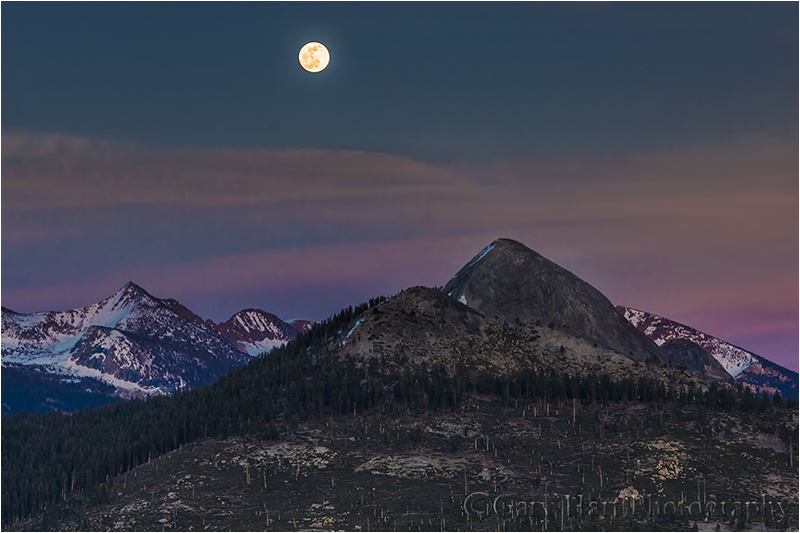
Moonrise, Mt. Starr King, Yosemite
Canon EOS-1Ds Mark III
Canon 100-400L
1/10 second
F/8
ISO 400
* * * * *
Previously on Eloquent Nature

Moonrise, Glacier Point, Yosemite
* * * * *
May 13, 2014
After seeing the images captured by the people in my group followed me on Monday evening, during the next day’s image review session a few in my workshop group asked if we could go back up to Glacier Point for sunset that night. I did a quick-and-dirty plotting and showed them about where the moon would be at sunset (I usually tend to be more OCD about precision when plotting the moon, but “about” was good enough for our purposes), explaining that I’d planned to photograph the moonrise from a different spot that night, but I’d be willing to forego that shoot in favor of a Glacier Point reprise if that’s what everyone preferred. But, I warned, tonight would also be our only opportunity to photograph the Lower Yosemite Fall moonbow—if we drive up to Glacier Point, we probably won’t make it back down to the valley for the moonbow shoot until after 9:00. While that would be plenty early enough for the moonbow, it would mean we’d have been going from before 6:00 a.m. until about 11:00 p.m. But the vote was unanimous, so back up we went.
I love plotting a moonrise. I’ve been doing it for a long time—when done right there’s no mystery to the time and location of the moon’s arrival, but there’s just something thrilling about the watching the moon peek above the horizon. (Not to mention the (unjustified) awe my workshop groups express when it happens exactly when and where I’d predicted.) When we considering altering the schedule I’d them that we’d see the at around 7:40, give or take five minutes, just a little to the left of Mt. Starr King. And sure enough, at 7:36 there it was, a white wafer poking from behind the left flank of Gray Peak (the left-most peak in the above image).
Full disclosure
Before you decide that my moon prediction makes me some kind of photography savant, I should probably explain why the camera I used to photograph this scene was my backup, 1DS Mark III, and not my primary, 5D Mark III. (The 1DS III is still a great camera, it’s just seven-year old technology.) That would be because, genius that I am, my camera bag, complete with camera, lenses, tripod, and filters was still back at the hotel. Fortunately, knowing the way workshops force me out of my routine (leading to a long history of forgotten tripods and cameras abandoned by the roadside), I always have a backup tripod and camera bag with my backup camera and a lens or two in the back of my car. Which is how my 1DS III and 100-400 lens (which I find too bulky and awkward for everyday use) were back there and ready for action. What I didn’t have was my remote release and graduated neutral density filters, essential to my twilight moonrise workflow. Fortunately, one of the workshop students took pity on me and loaned me a GND she wouldn’t be using (thanks, Lynda!); I turned on the 2-second timer to eliminate shutter-press vibrations.
But anyway…
As cool as the moon’s appearance was, the best full moonrise photography doesn’t come until a little later. From about five minutes before sunset, when the sky has darkened enough for the daylight-bright moon stand out, until about ten minutes after sunrise, when the foreground has darkened too much to be captured with a single frame (even with the use of a GND), is my moonrise “prime time.”
But even though the best stuff wouldn’t come until later, I photographed the moonrise from its first appearance, varying my composition as much as the 100-400 lens would allow—getting Half Dome in the frame was out of the question, but since I’d already covered that the night before, this was going to be more of a telephoto shoot anyway. Everything was at infinity, but in this case I opted for f8 (f11 is my usual “default” f-stop) and ISO 400 because, given the weight of the 1DSIII and 100-400 lens, I was a little concerned about my tripod’s ability to dampen completely after 2-seconds. By the time the light got really good and the sky started to pink-up, I was quite familiar with all the compositions and was able to cycle through them very efficiently.
By about 8:15 we were hustling back down the mountain to our date with the moonbow. But that’s a story for a different day….
Join me as we do it all over again in next year’s Yosemite Moonbow and Dogwood photo workshop
Glacier Point moonrise
Posted on May 13, 2014

Moonrise, Glacier Point, Yosemite
Canon EOS 5D Mark III
1.3 seconds
21 mm
ISO 100
F11
May 12, 2014
I’ve been in Yosemite for my annual Moonbow and Dogwood photo workshop. Monday night I took the group to Glacier Point for sunset—an unexpected benefit of California’s drought that allowed Glacier Point Road to open weeks earlier than normal. I knew a nearly full moon would be rising above the Sierra crest that evening, but figured that since it would be so far south, we wouldn’t be able to do a lot with it. But when I arrived Glacier Point and saw the moon rising above Mt. Starr King, I realized that shifting slightly south, away from the popular Glacier Point View, might just allow us to include the moon and Half Dome in a wide shot. Hmmm. But because we had people in the group who had never been to Glacier Point, I decided now was not the time for exploration.
As always happens at Glacier Point on these predominantly clear evenings, the light on Half Dome warmed beautifully as the sun dropped to the horizon behind us. Organizing an expansive landscape into a coherent image can be difficult, especially for first timer visitors. But as I moved between the students positioned along the rail, it seemed that all were doing fine and realized that my greatest value at the moment was to stay out of the way. Appreciating the view, I just couldn’t get that moon, blocked by trees from our vantage point, out of my mind.
When a couple of people in the group asked why I wasn’t shooting (it always makes them nervous when the leader is looking at the same view they’re photographing but shows no interest in shooting), I told them I was simply enjoying the view (quite true). But when someone asked if I had any suggestions for something different, my ears perked up. I told them if I were to be shooting, I’d go back up the trail a hundred yards or so to see if I could get around the trees and find something that included the moon.
When several people sounded interested, I warned them that there’s no guarantee we’d find anything photo-worthy, and relocating so close to sunset would risk missing the show entirely. Much to my delight, a couple of people said, “Let’s do it,” and that was all I needed to hear. I told Don (Don Smith, who’s assisting this workshop—for those who haven’t been paying attention, Don assists some of my workshops, I assist some of Don’s, and we do a few workshops as equal collaborations) that I was taking a few people back up the trail and off we went.
I ended up with five (nearly half the group) at the view just below the Glacier Point geology exhibit. I chose this spot for its open view, and for the way it allowed us to frame the scene with Half Dome on the left, triangular Mt. Starr King and the moon on the right, and Nevada and Vernal Falls in the center. With a couple of trees and dark granite for the foreground, the scene couldn’t have been more ideal if I’d have assembled it myself.
I took out my 16-35 and composed this scene that pretty much seemed to frame itself. Even though I had subjects ranging from the fairly close foreground the the extremely distant background, at 21mm I knew I’d have enough depth of field at f11. I used live view to focus on the foreground tree, more than distant enough to ensure sharpness throughout my frame.
While I almost always rely on my RGB histogram to check my exposure, my general exposure technique when photographing a full moon in twilight is to forego the histogram and concentrate on the moon. As far as I’m concerned, a shot is a failure if the moon’s highlights are blown (a white disk), but since the moon is such a tiny part of the frame, it barely (if at all) registers on the histogram. What does register is the blinking highlight alert that signals overexposed highlights. When the foreground is dark, I’ll continue pushing my exposure up until the moon just starts to blink (not the entire disk, just the brightest spots). I know from experience that I can recover these blown highlights in post processing. I also know that this is the most light I can give the scene, because the moon’s brightness won’t change as the foreground darkens. (While I don’t blend images, for anyone so inclined it’s quite simple to take two frames, one exposed for the foreground and the other exposed for the moon, and combine the two in Photoshop.) In this case I spot metered on the foreground to ensure enough light to retain color and detail in the rapidly darkening shadows, then used a Singh-Ray 2-stop hard graduated neutral density filter to hold back the sky and (especially) protect against blowing the moon.
* * * *
About this scene
This is the view looking east from near Glacier Point. From left to right: Cloud’s Rest (just behind Half Dome), Half Dome, Vernal Fall (below—the white water beneath Vernal Fall is cascades on the Merced River), Nevada Fall (above), Mt. Starr King (triangle shaped peak).
Join me as we do it all over again in next year’s Yosemite Moonbow and Dogwood photo workshop
Visualize, pursue, execute, enjoy
Posted on May 5, 2014

Bridalveil Raindrop, Yosemite
Canon EOS 5D Mark III
1/30 second
100 mm
ISO 1600
F22
I probably worked harder capturing this image than any other image I’ve ever photographed. Worked hard not in terms of physical exertion, but rather in patient pursuit over several years and painstaking execution in difficult conditions. Photographed late last month in Yosemite, this image is something I’ve visualized and actively sought for years. While I have no illusion that this image will be as popular as some of my more conventional images, it makes me so happy that I just have to share everything that went into its capture.
Visualize: The world in a raindrop
I can trace this image back to a spring afternoon a few years ago, when I was doing macro photography in a light rain. My subject was poppies, and peering through my viewfinder I particularly loved the clarity of the raindrops when they snapped into focus. At home on my monitor I magnified one of the images to something like 400% and saw the entire scene surrounding me was inverted in that tiny droplet. The fact of this wasn’t new to me, but actually seeing it up close planted a small seed that bloomed into an obsession I’ve been chasing ever since. I realized that getting even closer to a raindrop might allow me to enlarge its internal scene enough to make it visible without magnification. From that thought it was a short jump to the idea of finding a raindrop that contained a scene others would recognize.
Pursue: If at first you don’t succeed…
Unfortunately, the onset of my raindrop quest coincided with a drought that severely limited my access to raindrops (and if you know anything about me, you know it has to be an actual raindrop—no spray bottles for me). And then there are the daily distractions of running a business, and the fact that many of my trips to prime locations are for workshops, when the time and attention a shot like this requires precludes me from trying it.
Nevertheless, over the last several years I’ve played with my idea when opportunities presented themselves. These experiences allowed me to determine that 100mm macro wouldn’t get me close enough, that I’d need to add multiple extension tubes. And the extremely narrow depth of field that comes with focusing this close would require a very small aperture to get enough of the frame sharp.
These early attempts also enabled me to identify and practice overcoming a few physical challenges: low light, caused not only by the overcast skies, but also by the extension tubes (extension reduces the amount of light reaching the sensor); wind, almost always present in a rain; and a tissue-thin focus plane (even at a small aperture) that severely shrinks my margin for error. I knew going in that it would be difficult, but with each attempt I had to admit that this shot might be even harder than I’d decided it would be the last time I tried it. Of course that’s half the fun.
A couple of weeks ago the (always reliable) weatherman called for an all-day rain in Yosemite. Perfect. Knowing the dogwood were blooming, I freed my schedule and made the 7+ hour roundtrip to Yosemite, leaving early in the morning and returning that night. The raindrop shot wasn’t my sole objective, but it was up there on my list. Unfortunately, while I ended up having a pretty good day, my “all-day” rain stopped about an hour into my visit and I was left to pursue other opportunities.
Undeterred, when the (almost always reliable) weatherman promised more rain a couple of days later, back I went, this time meeting friends Don Smith and Mike Hall. Did I mention that I wanted rain? Well, rain it did. Hard. All day. Donning head-to-toe rain gear, I managed to stay dry, but my equipment wasn’t quite so lucky—without a third arm my umbrella wasn’t much use during the compose/meter/focus phase and the small towel I’d brought to dry things off was completely saturated by the end of our first stop (I should have known better). After that I pretty much contented myself with drying my my lens element just before shooting, trusting (hoping) that my reasonably water-resistant gear would survive—if I wanted to keep shooting, I had no other choice.
As good as the shooting was, by mid-afternoon the three of us were ready to submit to the weather and head for home. But, with my raindrop shot gnawing at the back of my mind, on the way out I suggested a quick stop at the view of Bridalveil Fall on Northside Drive. I’d stopped here on Tuesday and knew the dogwood that hadn’t been quite ready for primetime then would be just about right now. So stop we did (it didn’t take lots of arm twisting).
Execute: Cruel and unusual
While Don and Mike (why does this sound like a drive-time radio program?) went off in search of their own vision, I bee-lined to the “perfect” dogwood I’d identified on Tuesday. But getting a shot like this isn’t just a matter of going out in the rain at a beautiful location. (Full disclosure: there was a time when I believed it might just be.) And in my zealous pursuit, I’d conveniently discounted the difficulties I’d need to deal with:
- Rain (of course I knew it was raining, but I always forget what a pain it is to deal with, even if I just dealt with it fifteen minutes ago)
- My “perfect” tree was on an embankment with a 45-degree slope
- A light but persistent breeze (I never notice a light breeze until I try to do macro)
- Rain (in case you forgot)
Okay, so maybe this won’t be such a quick stop.
After taking stock of the physical difficulties, I attached all three of my extension tubes (72 mm total) to my 100 mm macro lens and scanned the flowers, branches, and leaves for a raindrop that was both large enough to hold the scene (without extreme distortion) and whose long axis (the wide side) was perpendicular to my line of view to Bridalveil Fall. No small feat.
The frustration started immediately: When I did indeed find the “perfect” drop, I realized getting to it without touching the tree (thereby rearranging all its drops) would require powers far beyond my superhero grade. And so it happened that once I navigated “inside” the tree’s canopy to my raindrop, the raindrop was long gone and I had to start over.
Okay, at least I was inside the tree—progress. I ran my eyes along the nearby branches until suddenly, there it was—another perfect (there’s that word again) raindrop dangling from a diagonal branch about 18 inches in front of me. I very carefully maneuvered in its direction, using contortions that might best be described as a hybrid of moves from the party games Twister and Limbo, moves I hadn’t broken out since my (far more limber) college days. (Picture a heist movie where the cat-burglar has to avoid a matrix of electric eye beams to get to the jewels.)
This particular raindrop was about eight inches above my head. Fortunately my new (and wonderfully tall) tripod was up to the task—I extended its legs until my lens was just an inch or two from the drop and began the painstaking process of composing and focusing. With my viewfinder higher than my eye could reach, this part would have been impossible without live-view; with live-view it was a pain but doable.
I found my basic composition fairly quickly, but my ridiculously thin focus plane shifted every time the breeze or nearby raindrop-strike jostled “my” raindrop. Focusing not on the raindrop, but the scene within the raindrop, I waited for a brief lull in the breeze and nudged my focus ring until the equilibrium point around which the drop vibrates was sharp. Then I magnified the drop and waited for the next lull to confirm sharpness. After several attempts I was reasonably confident I was ready to proceed.
Stopping down to f22 with three extension tubes forced me to bump my ISO to 1600 to reach the 1/30 second shutter speed I thought I could get away with. Even this would require timing my shutter for another lull in the breeze, but the alternatives—a larger aperture which would reduce my DOF, or higher ISO that would increase the noise—I wasn’t crazy about.
You’d think after all this I’d be ready to shoot. You’d think. But by now (in case you forgot, it’s still raining) my front lens element was festooned with raindrops. And wiping the lens dry did little good because the slightly upward angle of view oriented my lens ideally for capturing more raindrops. So I extracted the collapsed umbrella I’d proactively jammed in a jacket pocket and carefully threaded it skyward, carefully negotiating the network of overhanging branches without disturbing my raindrop, until the umbrella was in a open space wide enough to unfurl. Open umbrella in my right hand, with my left hand I was able to dry with a small, dry lens cloth I’d also had the foresight stuff in a pocket.
One of the downsides of the “perfect” raindrop is its large size, which gives it a rather inconvenient relationship with gravity. So. After all this preparation and just as I raised my remote release for my first click, my raindrop grew tired of waiting and plunged groundward. True story. Fortunately, an advantage of getting intimate with raindrops is the insight that they tend to reform in the same place. I took a deep breath—with my composition, focus, and exposure already set, I decided to wait (still contorted between branches beneath my umbrella) for the next drop to form. And sure enough, within a couple of minutes I was back in business.
I clicked a dozen or so frames, checking the focus after each, refining the composition slightly, and occasionally varying my exposure settings until I was confident that I had enough frames to give me a pretty good chance of at least one successful image. I probably would have worked on it even longer, but my muscles really were starting to cramp and I figured Don and Mike were ready to move on anyway. Back at the car a cursory run through my images on my LCD was enough to give me hope that I’d achieved my goal, but it wasn’t until I got them home on my large monitor that I was ready to proclaim success.
Enjoy: All’s well that ends well
Most of the images had very slight but nevertheless fatal focus problems—slight motion blur or barely missed focus point—all I needed was one. And this is it.
So what did I end up with? The white stripe on the left is Bridalveil Fall in full spring flow. The branch belongs to my young dogwood tree; behind it are dogwood leaves and new (still greenish) flowers. And inside the raindrop is Bridalveil Fall, Cathedral Rocks, and Leaning Tower. But wait, there’s more: I’d actually had been working on the image a little while before looking closely at the black shape above Bridalveil Fall and realizing that a raven had flashed into my scene at the instant I clicked (it’s in no other frame). Pretty cool.
Favorite: El Capitan Reflection
Posted on April 26, 2014

El Capitan Reflection, Yosemite
Canon EOS 10D
1/4 second
F22
ISO 100
27 mm
I can’t believe this image is over ten years old. It represents a significant milestone for me, because I captured it about the time I made the decision to turn a 25+ year serious hobby into my profession. With that decision came the realization that simply taking pretty pictures, or being a very good photographer, wouldn’t be enough—there are plenty of those out there. I made a very conscious decision to start seeing the world differently, to stop repeating the images that I, and other photographers, had been doing for years—no matter how successful they were. I won’t pretend to be the first person to photograph a reflection and ignore the primary subject, but seeing my scene this way represented a breakthrough moment for me.
I’d arrived in Yosemite mid-morning on a chilly November day. A few showers had fallen the night before, scouring all impurities from the air. The air was perfectly still, and the Merced River was about as low (and slow) as it can get. This set of conditions—clean, still air and water—is ideal for for reflections. The final piece of the reflection puzzle, the thing that causes people to doubt at first glance that this is indeed a reflection, was simply lucky timing. I arrived at Valley View that morning in the small window of time when El Capitan was fully lit while the Merced remained in shade, creating a dark surface to reflect my brightly lit subject.
A couple of other things to note, not because I remember my thought process, but because I know how I shoot and like to think that they were conscious choices: First is the way the rock in the foreground is framed by El Capitan’s curved outline—merging the two would have sacrificed depth. That rock, along with the thin strip of misty meadow along the top of the frame, serve as subtle clues that this is a reflection. And second is my f22 choice—believe it or not, even though the entire foreground is just a few feet from my lens, the depth of field is huge. That’s because the focus point of a reflection is the focus point of the reflective subject, not the reflective surface. So, while the El Capitan reflection is at infinity, the closest rock is no more than four feet away. In other words, to be sharp from about four feet all the way out to infinity required a very small aperture and very careful focus point selection. I’m guessing that I focused on the second foreground rock, which was about 7 feet away, to ensure sharpness from about 3 1/2 feet to infinity.
Since this image, reflections have been a personal favorite of mine. I blogged about their power in my “Reflecting on reflections” blog post, and included a sampling of my favorites below.
Photo Workshop Schedule
A Reflection Gallery
Click an image for a closer look and slide show. Refresh the window to reorder the display.


 Eloquent Images by Gary Hart