Thinking Inside the Box
Posted on February 24, 2019

Winter Moonrise, Full Moon and Half Dome, Yosemite
Sony a6300
Sony 100-400 GM
Sony 2x teleconverter
ISO 200
f/11
1/400 second
Roll over, Ansel
Several years ago, while thumbing through an old issue of “Outdoor Photographer” magazine, I came across an article on Lightroom processing. It started with the words:
“Being able to affect one part of the image compared to another, such as balancing the brightness of a photograph so the scene looks more like the way we saw it rather than being restricted by the artificial limitations of the camera and film is the major reason why photographers like Ansel Adams and LIFE photographer W. Eugene Smith spent so much time in the darkroom.”
While it’s true that Ansel Adams and W. Eugene Smith were indeed darkroom masters, statements like this only perpetuate the myth that the photographer’s job is to reproduce the scene “the way we saw it.” And because I imagine that using Ansel Adams himself to peddle this notion must send Ansel rolling in his grave, I’ll start by quoting the Master himself:
- “When I’m ready to make a photograph, I think I quite obviously see in my mind’s eye something that is not literally there in the true meaning of the word.”
- “Photography is more than a medium for factual communication of ideas. It is a creative art.”
- “Dodging and burning are steps to take care of mistakes God made in establishing tonal relationships!”
Do these sound like the thoughts of someone lamenting the camera’s “artificial limitations” and photography’s inability to duplicate the world the “way we saw it”? Take a look at just a few of Ansel Adams’ images and ask yourself how many duplicate the world as we see it: nearly black skies, exaggerated shadows and/or highlights, and skewed perspectives that intentionally emphasize one subject over another, and on and on. And no color! (Not to mention the fact that every image is a two-dimensional rendering of a three-dimensional world.) Ansel Adams wasn’t trying to replicate scenes more like he saw them, he was trying to use his camera’s unique (not “artificial”) vision to show us aspects of the world he wanted us to see, qualities we might otherwise miss or fail to appreciate.
The rest of the OP article contained solid, practical information for anyone wanting to come closer to replicating Ansel Adams’ traditional darkroom techniques in the contemporary digital darkroom. But the assertion that photographers are obligated to photograph the world as they saw it baffles me.
You’ve heard me say this before
The camera’s vision isn’t artificial, it’s different. Dynamic range, focus, motion, and depth are all rendered differently in a camera than they are to the human eye. And while the human experience of any scene is 360 degrees, a still images is constrained by a rectangular box. Forcing images to be more human-like doesn’t just deny the camera’s unique ability to expand viewers’ perception of the world, it’s literally impossible. Which is why I’ve always felt that the best photographers are the ones who embrace their camera’s vision rather than trying to “fix” it.
For example, limiting dynamic range allows us to emphasize color and shapes that get lost in the clutter of human vision; a narrow range of focus can guide the eye and draw attention to particular elements of interest and away from distractions; and the ability to accumulate light over a photographer-controlled interval exposes color and detail hidden by darkness, and conveys motion in an otherwise static medium.
The box
But what about that rectangular box that constrains the world of a still image? I can think of no better way to excise distractions and laser-focus viewers’ attention on the target subject than taking advantage of the camera’s finite world. While many nature photographers default to their wide angle lenses to expand the visual box surrounding their landscape images and save their long lenses for wildlife, a telephoto lens is an essential landscape tool. The world can be a busy place—in even the most spectacular of vistas, so much is happening visually that going wide in a still photo to include as much beauty as possible introduces many extraneous features, and risks shrinking the scene’s most compelling elements to virtual insignificance.
The best way to overcome wide angle scene dilution is to forego the conventional view (the first thing everyone sees), identify the aspects of the scene that make it special, and isolate them with a telephoto lens. Whether it’s a striking mountain or tree, backlit poppy, or rising moon, isolation enlarges the target subject and removes any ambiguity about what the image is about. And an intimate, up-close perspective of a subject more commonly seen from a distance can be truly mesmerizing.
About this image

Winter Moonrise, Half Dome, Yosemite
I stood atop two feet of packed snow at Tunnel View, more than eight miles from Half Dome, and ten miles from the ridge that would be ground zero for the moonrise that had drawn me in the first place. Along with two other photographers who also seemed aware of the moon’s plans, I had the best (least obstructed) Tunnel View vantage point to myself. Rising full moon or not, before me the table was set for a spectacular Yosemite feast: Brand new snow glazed every exposed surface, and in the pristine winter air, Tunnel View’s veritable who’s who of Yosemite landmarks—El Capitan, Cloud’s Rest, Half Dome, Sentinel Rock, Sentinel Dome, Cathedral Rocks, and Bridalveil Fall—seemed etched into the scene. Above, dark clouds boiled atop El Capitan, while wispy fog radiated from the valley floor.
Occasionally a tourist would wander up and request help identifying Horsetail’s microscopic filament on El Capitan’s vast granite; one or two even pointed at Bridalveil Fall and asked if that was Horsetail Fall. A couple of people, blissfully oblivious to the Horsetail Fall phenomenon, simply wanted their picture taken with this iconic Yosemite backdrop.
About 150 feet down the wall to my right, at least two-dozen photographers on tripods were inexplicably crammed into a significantly less desirable view. While that vantage point gave them an acceptable sightline to Horsetail Fall (as did my own), the rest of the magnificent Tunnel View vista was partially obscured by trees. The only explanation I could muster for their odd choice was that the first to arrive for some reason set up there, and each subsequent photographer assumed that since others have set up here, this must be the spot.
While Horsetail Fall was irrelevant to my objective this evening, the overnight snow still clinging to the trees was undeniable bonus. Getting to Tunnel View had been an adventure, worse even than I’d expected, and I was glad that I’d allowed ample time. The difficulty started with a 30-minute (Horsetail Fall gawker infused) queue at the Arch Rock entrance station. My suspicion that these were mostly inexperienced photographers and tourists (who’d just read an article or seen a news segment and decided to check it out) was confirmed when I was forced to navigate a slalom course of slipping, sliding, spinning cars that had ignored the very clearly communicated chain controls. The serious photographers, those who had photographed Horsetail Fall before, or who had the sense to research the phenomenon well in advance, had been in position for the five-minute show for hours.
With the moon’s imminent arrival upon a scene that already bordered on visual overload, my plan to ensure that the main purpose of my visit didn’t get swallowed by Tunnel View’s conventional post-storm majesty was to start, while the moon was still right on the horizon, with extremely tight compositions. As the moon rose, I planned to widen my focal length, gradually including more scene and turning the moon into more of an accent.
To achieve this, I was flanked by two tripods, and had three camera bodies fired up and ready for action: my Sony a7RIII, a7RII, and a6300. Atop my Really Right Stuff TVC-24L tripod was my a6300 loaded with my Sony 100-400 GM and Sony 2X teleconverter. This combination gave me a 600-1200mm full-frame equivalent focal range (because the a6300 is a 1.5-crop APS-C sensor). When including the rising moon required reducing my focal length below 800mm, I’d switch to my higher resolution, full frame Sony a7RII. And because the moon would rise just about 20 minutes before sunset, I also had to be aware of the possibility that Horsetail Fall would fire up. To handle that possibility, and to cover all my general wide composition needs, mounted on my RRS TQC-14 tripod was my Sony a7RIII and Sony 24-105 f/4 lens.
I pointed my a6300/100-400 at the point where I expected the moon to appear about 20 minutes before sunset, zoomed all the way out to 800mm (1200mm full-frame equivalent), metered, focused, and waited. I started clicking almost immediately after seeing the moon’s leading edge nudge through the trees, refining my composition slightly after each click until I had the right balance of moon and Half Dome. It always surprises me how quickly the moon moves, speed that’s magnified tremendously at such an extreme focal length. Spending the next 40 minutes frantically changing focal lengths, switching lenses and camera bodies, re-metering and re-focusing, and bouncing between tripods, I felt like the percussionist in a jazz band.
When the moon climbed far above Yosemite Valley and the dynamic range between the daylight-bright moon and nighttime landscape made photography impossible, I paused before packing up my gear and just marveled at the beauty. Horsetail Fall had caught a few late rays of sunlight but never did completely light up. I thought about the disappointment of frigid photographers who had waited patiently in the valley below for a show that didn’t happen, and counted my blessings.
Photograph next year’s February full moon in my Yosemite Winter Moon photo workshop
Isolation Sensation
Click an image for a closer look and slide show. Refresh the window to reorder the display.


A Horsetail of a Different Color
Posted on February 19, 2019

Winter Glow, El Capitan, Yosemite
Sony a7R III
Sony 16-35 f/2.8 GM
1 second
F/16
ISO 100
Last week’s Yosemite photo workshop was ostensibly about Horsetail Fall, but it turned out to be so much more than that. In fact, after photographing more snow than I’ve seen in Yosemite in many (many) years, Horsetail Fall was a bit anticlimactic. The only evening that Horsetail Fall got the coveted direct light everyone came on our second day. Going all-in on Horsetail Fall that evening, we got a decent (not spectacular) show that satisfied everyone enough that they were content to return our attention to the rest of snow-covered Yosemite Valley.
Ironically, what could arguably be called the best shoot of a workshop filled with spectacular shoots might just have been at the mega-popular, always packed view of Horsetail Fall on Southside Drive—on an evening when fall didn’t quite light up. To get here we had to trudge 50 yards through 3- to 4-foot deep fresh powder, but we were utterly alone (unprecedented in my many years photographing Horsetail Fall) to watch sunset paint a diffuse glow on El Capitan and magenta clouds overhead. And as the first visitors here since six-inches of snow had erased all evidence of prior human presence, we got to photograph the scene framed by virgin white snow glazing every exposed surface.
Yesterday I returned to Yosemite, making the 8-hour roundtrip not to photograph Horsetail Fall, but to photograph the full (“super”) moon rising behind Half Dome at sunset. But before setting up shop at Tunnel View, I couldn’t resist circumnavigating Yosemite Valley to check out the Horsetail Fall mayhem. With new snowfall decorating the trees and blanketing the roads, conditions were equal parts beautiful and treacherous.
Unlike last year, the National Park Service isn’t requiring permits, but they have blocked off many normally open parking areas. Cruising around in my Subaru Outback, I witnessed multiple cars that had foolishly ignored the R2 chain requirement (chains except for 4WD/AWD with snow tires) slipping, sliding, and spinning tires unproductively—some sliding backward downhill and others blocking the road. I also saw many cars parked illegally on the road or in closed parking areas. Given the fact that Horsetail Fall didn’t deliver last night, I doubt they’ll feel that their parking tickets (or towing bill) were worth the indiscretion.
I also talked to people who pulled into Tunnel View 30 minutes before sunset hoping to photograph Horsetail Fall. Some even thought that Bridalveil Fall was Horsetail Fall. If you plan to photograph Horsetail Fall, please do your homework. It truly can a remarkable experience, but it can also be a nightmare for the unprepared.
And speaking of Horsetail Fall preparation…
Here is a just-revised version of the Horsetail Fall article in my Photo Tips section
(Check out the “Breaking News” section if you plan to photograph Horsetail Fall in 2019)
The Horsetail Fall phenomenon
For eleven-plus months each year Horsetail Fall may just be Yosemite’s most anonymous waterfall. Usually dry or (at best) a wet stain, even at its best this ephemeral cataract is barely visible as a thin white thread descending El Capitan’s east flank. When it’s flowing, my workshop groups can be standing directly beneath Horsetail and I still have to guide their eyes to it: “See that tall tree there? Follow it all the way to the top of El Capitan; now run your eye to the left until you get to the first tree…”. But for a couple of weeks in February, the possibility that a fortuitous confluence of snowmelt, shadow, and sunset light might, for a few minutes, turn this unassuming trickle into a molten stripe draws photographers like cats to a can-opener.
The curtain rises in the second week of February, a couple of hours before sunset, when a vertical shadow begins its eastward march across El Capitan’s south face. As the shadow advances, the sunlight warms; when the unseen sun (direct sunlight is gone from the valley floor long before it leaves towering El Capitan) reaches the horizon, the only part of El Capitan not in shadow is a narrow strip of granite that includes Horsetail Fall, and for a few minutes, when all the photography stars align, the fall is bathed in a red glow resembling flowing lava framed by dark shadow. (Some people mistakenly call the Horsetail spectacle the “Firefall,” but that altogether different, but no less breathtaking, manmade Yosemite phenomenon was terminated by the National Park Service in 1968.)
Some years Horsetail delivers sunset after sunset in February, while other years administer daily doses of February frustration. Unfortunately, it’s impossible to predict when all the tumblers will click into place: I know photographers who nailed Horsetail on their first attempt, and others who have been chasing it for years.
When to photograph Horsetail Fall
The “when” of Horsetail Fall depends on the convergence of three independent conditions:
- The sun’s angle is refreshingly predictable, lining up perfectly only in February (and October, when the fall is almost always dry). Common wisdom says the shadow on El Capitan most precisely targets Horsetail Fall at sunset during the third week of February, from around the 15th through the 22nd (or a little later). While I won’t dispute this, I’ve had some of my best success a week earlier, and my favorite Horsetail shot was captured February 9. I’ve also had success photographing it right up until the end of February. On the other hand, I tried Horsetail once on March 1 and found the shadow no longer cooperating. But the stripe of sunset light on El Capitan is most precisely focused on Horsetail Fall in the third week of February.
- Water in the fall varies greatly from year to year, depending on how much show has fallen on the fall’s extremely small watershed, and how much of that snow is currently melting. A large snowpack and warm daytime temperatures are ideal. Sometimes Horsetail can be frozen solid in the morning, but afternoon warmth can be enough to get it flowing in time for the show. And a heavy rain can get it going strong for a few hours.
- Direct sunlight at sunset is the most fickle aspect of the Horsetail experience—for every tale of a seemingly perfect evening when the sunset light was doused by an unseen cloud on the western horizon mere seconds before showtime, there’s another story about a cloudy evening when the setting sun somehow threaded a gap in the clouds just as tripods were being collapsed.
The problem with targeting February’s third week is that it isn’t a secret: I generally prefer sacrificing Horsetail perfection in favor of Horsetail near perfection and far fewer photographers. But I’ll leave that decision up to you.
Where to photograph Horsetail Fall
It’s fun to circle Yosemite Valley on pretty much any mid- to late-February afternoon just to watch the hordes of single-minded photographers setting up camp like iPhone users on Release Day. In fact, one non-scientific way to find a spot to photograph Horsetail is to simply park where everyone else parks and follow the crowd. Unfortunately, as Horsetail’s popularity grows, so does the distance you’ll need to walk.
If Horsetail Fall is on the top of your bucket list, it’s best to pick your spot and show up early. Really early. Really, really early. The downside of this approach is that, because the best locations for Horsetail aren’t especially good for anything else, you’ll sacrifice a lot of quality Yosemite photography time waiting for something that might not happen.
And no one has commanded that you worship with the rest of the Horsetail congregation: Experienced Yosemite photographers know that any west-facing location with a view of the fall will do. If you find yourself in Yosemite with time to kill, try walking the Merced River between Cathedral and Sentinel Beaches—any place with a view to Horsetail will work. But because of their open space, relative ease access and two spots have become the go-to Horsetail spots for most photographers.
* Breaking News *
From the National Park Service, February 2019:
– Stopping or parking on Southside Dr between El Cap Cross and Swinging Bridge is prohibited.
– All pullouts along Southside Dr between El Cap Cross and Swinging Bridge are closed.
– Roadside parking along Southside Dr between El Cap Cross and Swinging Bridge is prohibited.
– Southside Dr between El Cap Cross and Swinging Bridge is closed to pedestrians.
– The Cathedral Beach Picnic Area is closed.
– The Sentinel Beach Picnic Area is closed.
– Stopping or parking on El Cap Cross is prohibited.
– Roadside parking along El Cap Cross is prohibited.
– The number 2 lane (right, northern lane) of Northside Dr between Camp 4 and El Cap Cross is closed to all vehicles.
– Stopping or parking on Northside Dr between Camp 4 and El Cap Cross is prohibited.
– All pullouts along Northside Dr between Camp 4 and El Cap Cross are closed.
– Roadside parking along Northside Dr between Camp 4 and El Cap Cross is prohibited.
– El Cap Picnic Area is closed to all vehicles except vehicles displaying an ADA placard.
– The speed limit along Northside Dr between Camp 4 to El Cap Cross is 25 MPH unless posted otherwise.
El Capitan Picnic Area
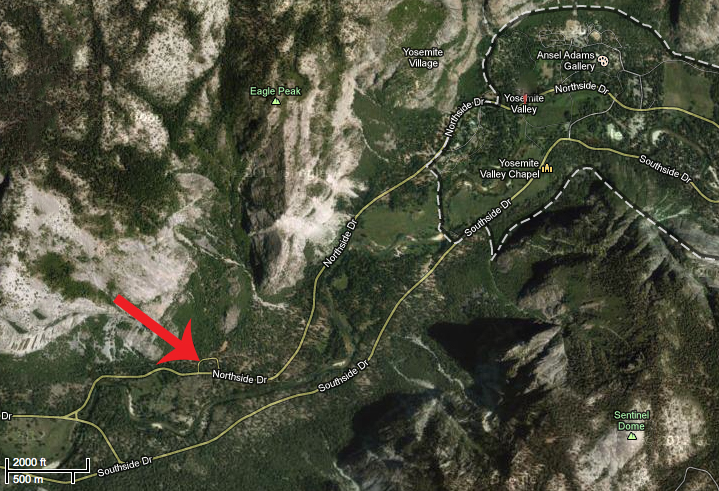
El Capitan Picnic Area, GPS: 37.72782N 119.61844W
The El Capitan Picnic Area, highlighted by Galen Rowell, remains the most popular Horsetail Fall vantage point. The picnic area’s advantages are
that it is the closest view of Horsetail Fall, has the most parking, has the most room for photographers (by far), and has a bathroom (plug your nose). The downside is there really isn’t a lot of composition variety here, and thousands of others will have already captured something as good as or better than what you’ll get.
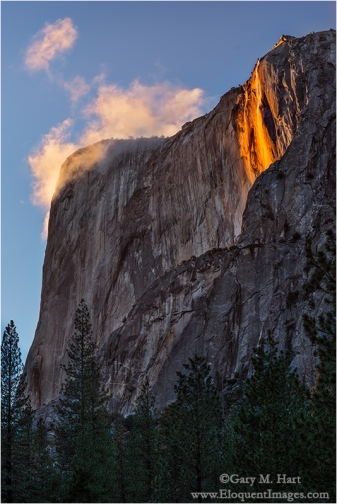
Horsetail Fall from the picnic area
If you like people, the El Capitan Picnic Area is the place to be—more than any other Horsetail vantage point, this one has a festive, tailgate atmosphere that can be a lot of fun. I suspect that’s because people arrive so early and there’s little else to do before the show starts. And since everyone is pointing up with a telephoto, it’s pretty much impossible for anyone to be in anyone else’s way, which eases much of the tension that often exists when shooting among large crowds.
You’ll find the parking lot, with room for twenty or so cars, on Northside Drive, about two miles west of Yosemite Lodge. And in recent years the NPS has blocked a lane of Northside Drive to allow more parking (but don’t park illegally because you will be cited). You can shoot right from the parking lot, or wander a bit east where you’ll find several clearings with views of the fall.
Merced River south bank bend
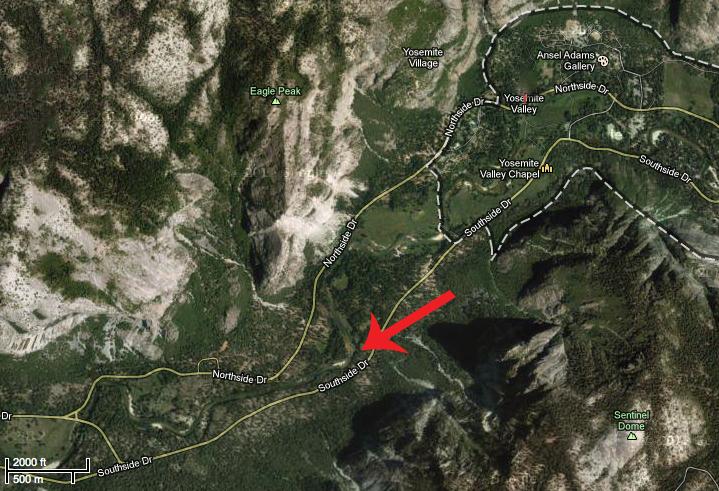
Merced River south bank bend, GPS: 37.72885N 119.60743W
Photographed from the bend on the Merced River’s south bank, El Capitan’s extreme sloping summit creates the illusion that you’re somewhere above Yosemite Valley, eye-to-eye with the top of Horsetail Fall—it’s a great perspective.
I like this location because the river greatly increases the variety of possible compositions, and also because you can pivot your view upstream to photograph Upper Yosemite Fall, and Sentinel Rock almost directly above you (which also gets fantastic late light) while you wait for Horsetail to light up. The downside to photographing here is that there’s precious little room, both to park and to photograph. This requires getting there a couple of hours early, and also can lead to a bit more tension as people jockey for position.
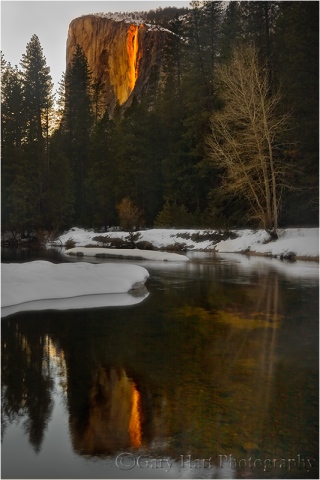
Horsetail Fall reflection from the Southside Drive Merced River view
Driving east on Southside Drive, you’ll parallel the Merced River for most of 1.2 miles beyond the turn for Cathedral Beach. The Horsetail Fall spot is right where the road and river diverge. Parallel park right there in one of two narrow but paved parking areas on opposite sides of the road, where you’ll find room for about a dozen cars.
Since there’s so little parking here, and Southside Drive is one-way eastbound, if you find no parking (don’t try to squeeze in where there’s no room—I’ve seen rangers doing traffic control and ticketing cars that don’t fit), it also helps to know that the spot is about a ½ mile from the 4-Mile Trail parking area and ¾ miles west of the Swinging Bridge parking area—an easy, flat walk.
Because of the potential for crowds, the best strategy here is to arrive early and forego what may be a great view from the elevated riverbank (that is sure to be blocked by late-arrivers trying to cram their way in), in favor of getting as close to the river as possible. Standing at river level gives you many more compositional choices, and nobody else can block your wide shots. (But if there are other photographers already set up on the elevated riverbank when you arrive, please don’t be the one who sets up in front of them.)
How to photograph Horsetail Fall
Regardless of where you set up to photograph Horsetail Fall, it’s pretty difficult to find something that nobody else has done. But that doesn’t mean you shouldn’t try. Since you’ll likely be doing lots of waiting, take advantage of the downtime to experiment with compositions.
Strategy
When the light begins to warm, it’s time to shoot—because you never know when the light will shut off, it’s best to start early and photograph often. Until the light goes away completely, my rule of thumb is that the light now is better than the light a minute ago. Since you have no idea when the light will disappear for good, just keep shooting, especially in the final fifteen minutes before sunset (trust me on this). I’m not suggesting you hold your shutter down in burst mode until your card fills; I usually tell my workshop groups to fire a frame every minute or two until the fall turns amber, then pick up the pace as it goes (fingers crossed) pink and eventually red. The best light is in the final ten minutes before sunset; that’s when you might have a hard time resisting burst mode.
Composition
Viewed from the picnic area, there’s not a lot of visual interest surrounding Horsetail; your most obvious compositions will be moderate telephotos, up to 200mm or full frame. I use my 24-105 and 70-200 lenses almost exclusively here. Use the trees to frame your shots and let them go black; with a telephoto you can isolate aspects of the fall and eliminate the sky and some or all of the trees.
The Merced River bend near Southside Drive is farther away from the fall, with more foreground possibilities, including the river and reflections, so you’ll be able to use a greater range of focal lengths here. Don’t get so caught up in photographing the fall that you overlook wider possibilities that include the river.
From either location I think vertical compositions work best (there’s a reason you don’t see lots of horizontal Horsetail Fall images), but that doesn’t mean there aren’t horizontal opportunities too. I like to identify a go-to composition based on the conditions, then vary between wide/tight and horizontal/vertical. If the sky is boring (cloudless), minimize or eliminate it from your composition. If there are clouds that make the sky interesting, by all means include them.
Filters
If your camera struggles with dynamic range, a graduated neutral density filter will help any shot that includes the sky—a two-stop hard angled across El Capitan parallel to the tree line should do the trick. This usually requires some Photoshop dodging and burning to hide the transition, but it’s the only way to darken the brightest part of the sky, which is usually in front of (not above) El Capitan.
A polarizer will alter your results, so if you have one on, make sure you orient it properly. I often have a difficult time deciding between maximizing and minimizing the reflections with my polarizer, so I hedge my bets and shoot both ways. I’ve found that when Horsetail is flowing strongly, minimizing the reflection is best; when Horsetail is more of a wet or icy stain, maximizing the reflection works better. Either way, this is a decision you should make long before the best light arrives.
Exposure
Automatic metering can be problematic in extreme dynamic range scenes when color is paramount, so I always recommend manual exposure, spot metering on Horsetail Fall. To get the color in the fall and Horsetail, I usually underexpose slightly. The trees have little value beyond framing and usually work better when very dark green to black, a fact that’s completely lost on your meter. And monitor your RGB histogram to ensure that you haven’t clipped the red (Horsetail and El Capitan) or blue (sky) channels. Highlight Alert (blinking highlights) is your friend.
And perhaps most important of all, don’t get so caught up in the photography that you forget to appreciate what you’re viewing. Just take a couple of seconds to stand back and allow yourself to take in the amazing spectacle of Horsetail Fall.
Join me in a Yosemite Photo Workshop
Workshop Schedule || Purchase Prints
A Horsetail Fall Gallery
Click an image for a closer look and slide show. Refresh the window to reorder the display.


Love What You Shoot
Posted on February 17, 2019

Snow and Reflection, El Capitan and Bridalveil Fall, Yosemite
Sony a7RIII
Sony 16-35 f/2.8 GM
1/25 second
F/11
ISO 100
Feel the love
One frequently uttered piece of photographic advice is to “shoot what you love.” And while photographing the locations and subjects we love most is indeed pretty essential to consistently successful images, unless we treat our favorite subjects with the love they deserve, we risk losing them.
My relationship with Yosemite predates my memories, so it’s no wonder that Yosemite Valley plays such a significant role in my photography. Of course my love for Yosemite doesn’t make me unique, and like all Yosemite photographers, I’ve learned to share. While it’s nice to have a location to myself (I can still usually find a few of those spots in Yosemite Valley), I’m happy to enjoy Yosemite’s prime photographic real estate with other tourists and photographers. In fact, I get vicarious pleasure watching others view the Yosemite scenes I’ve been visiting my entire life.
But…
In recent years I’ve noticed more tourists and photographers abusing nature in ways that at best betrays their ignorance, and at worst reveals their indifference to the fragility of the very subjects that inspire them to click their shutters in the first place. Of course it’s impossible to have zero impact on the natural world—starting from the time we leave home, we consume energy that pollutes the atmosphere and contributes greenhouse gases. Once we arrive at our destination, every footfall alters the world in ways ranging from subtle to dramatic—not only do our shoes crush rocks, plants, and small creatures, our noise clashes with the natural sounds that comfort humans and communicate to animals, and our vehicles and clothing scatter microscopic, non-indigenous flora and fauna.
A certain amount of damage is an unavoidable consequence of keeping the natural world accessible to all who would like to appreciate it, a tightrope our National Park Service does an excellent job navigating. It’s even easy to believe that we’re not the problem—I mean, who’d have thought merely walking on “dirt” could impact the ecosystem for tens or hundreds of years? But, for example, before straying off the trail for that unique perspective of Delicate Arch in Arches National Park, check out this admonition from the park.
Hawaii’s black sand beaches may appear unique and enduring, but the next time you consider scooping a sample to share with friends back on the mainland, know that Hawaii’s black sand is a finite, ephemeral phenomenon that will be replaced with “conventional” white sand as soon as its volcanic source is exhausted, as evidenced by the direct correlation between the Hawaiian islands age (and the cessation of volcanic activity) and their proliferation of black-sand beaches.
While Yosemite’s durable granite may lull photographers into environmental complacency, its meadows and wetlands are quite fragile, hosting many plants and insects that are an integral part of the natural balance that makes Yosemite unique. Not only that, they’re also home to native mammals, birds, and reptiles that so many enjoy photographing. Despite all this, I can’t tell you how often I see people in Yosemite (photographers in particular) unnecessarily cutting trails and trampling fragile meadows and shorelines, either to get in position for a shot or simply as a shortcut.
Don’t be this photographer
Still not convinced? If I can’t appeal to your environmental conscience, consider that simply wandering about with a camera and/or tripod labels you, “Photographer.” In that role you represent the entire photography community: when you do harm as Photographer, most observers (the general public and decision makers) go no farther than applying the Photographer label and lumping all of us into the same offending group.
Like it or not, one photographer’s indiscretion affects the way every photographer is perceived, and potentially brings about restrictions that directly or indirectly impact all of us. If you like barricades, permits, restrictions, and rules, just keep going wherever you want to go, whenever you want to go there.
It’s not that difficult
Environmental responsibility doesn’t require joining Greenpeace or dropping off the grid (not that there’s anything wrong with that). Simply taking a few minutes to understand natural concerns specific to whatever area you visit is a good place to start. Most public lands have websites with information they’d love you to read before visiting. And most park officials are more than happy to share literature on the topic (you might in fact find useful information right there in that stack of papers you jammed into your center console as you drove away from the park entrance station).
When you’re in the field, think before advancing. Train yourself to anticipate each future step with the understanding of its impact—believe it or not, this isn’t a particularly difficult habit to establish. Whenever you see trash, please pick it up, even if it isn’t yours. And don’t be shy about gently reminding other photographers whose actions risk soiling the reputation for all of us.
A few years ago, as a condition of my Death Valley workshop permit, I was guided to The Center for Outdoor Ethics and their “Leave No Trace” initiative. There’s great information here–much of it is just plain common sense, but I guarantee you’ll learn things too.
Now go out and enjoy nature–and please save it for the rest of us.
A few words about this image
This year’s Yosemite Horsetail Fall photo workshop started with bang. Normally I start a workshop with a two-hour orientation, but with six inches of fresh snow on the ground and more falling, I did a lightning orientation (15 minutes) and we sprinted into Yosemite Valley in time to catch the storm’s clearing. We found a world dipped in pristine white powder, a Yosemite photographer’s dream. Normally I like to give my groups lots of time at every location, but in the rapidly changing conditions of a clearing snowstorm (shifting clouds and light, trees shedding snow, and footprints increasing by the minute), I try to hit as many spots as possible while the shooting is ideal.
Our third stop that afternoon was Valley View, one of the top two or three photo spots in Yosemite, for obvious reasons. Having visited here so often, I don’t stop here on every visit anymore, but I’d be sued for malpractice if I didn’t take my workshop groups here—especially when it’s glazed with fresh snow. I hadn’t taken my camera out yet, and wasn’t going to get it out here either, but while working with a couple of people in the group just upriver from the parking lot, I saw this view and couldn’t resist the opportunity for something new.
When Yosemite is covered with new snow, I look for compositions that emphasize the snow and use the icons as background. Not only did this view give me lots of fresh snow for my foreground, the recent removal of several trees (evergreens in Yosemite are dying from drought and insect infestation) that blocked El Capitan gave me a perspective I’ve never been able to photograph.
I set up on the line that gave me the best window between the trees to El Capitan and started with vertical compositions that emphasized the Yosemite icon, but soon switched to horizontal to include Bridalveil Fall and Cathedral Rocks and better feature the reflection. With my Sony 16-35 f/2.8 GM lens on my Sony a7RIII camera, I set up close to the nearby snow-covered trees, then kept moving closer, widening my focal length as I went to include as much snow as possible. After framing the scene to include the least possible blue sky, the most snow, and to avoid crowding Bridalveil Fall too close to the right border, I dialed my polarizer to minimize polarization on the water (maximum reflection), metered with an eye on my histogram, focused on branches about four feet from my lens, and clicked.
We made a couple of more stops that afternoon before wrapping up with a truly beautiful sunset at an unexpected (and fortuitous) location. But that’s a story for another day.
Workshop Schedule || Purchase Prints
The Many Faces of El Capitan


Escape from Yosemite
Posted on February 10, 2019

Fresh Snow, El Capitan, Yosemite
Sony a7R III
Sony 12-24 f/4 G
1/10 second
F/11
ISO 100
Cold, wet, exhausted, and ecstatic after a day-and-half of photographing Yosemite Valley glazed with new snow, my brother and I were ready to go home and count our treasures. Gingerly following my headlights down icy Highway 140, I rounded a bend a couple of miles downhill from the Arch Rock entrance station and found my path blocked by an iron gate spanning the road and securely padlocked in place. I knew the park had been closed earlier, but we had been told by the front desk at Yosemite Valley Lodge that 140 had opened hours ago. I glanced at the steep hillside abutting the road and wondered if my Outback could somehow make it around the gate, and quickly discarded the thought. That I even considered it at all was an indication of how desperate I was to go home.
We’d arrived in the park Monday afternoon, got a room at the lodge, and hunkered down against the incoming storm. What had been forecast to be 3-5 inches of overnight snow had just been upgraded to 12-16 inches, so we knew we’d wake Tuesday morning to something exceptional. A peek through the curtains in the predawn darkness confirmed a world of white, with the snow still falling hard. A check of the Yosemite road conditions hotline confirmed it: not only were all park entrances closed, all roads in Yosemite Valley were closed.
I trudged through the snow in the twilight to survey the photography potential near the lodge and found the view of Yosemite Falls completely obscured by clouds. The cafeteria was open, but serving nothing because the employees couldn’t make it to work. At the adjacent Starbucks I found only two people had been able to negotiate the snowy darkness to get to work—it turned out to be the Starbucks manager and his wife, a non-employee drafted into action and put on the front line.
 On my way back to my room I swung by the parking lot and checked my car. About the time I identified the correct white lump, Yosemite Falls made an appearance and I hustled back to the room for my gear. But by the time I got there it had been swallowed by clouds.
My brother and I spent most of the rest of the morning watching the skies, waiting for the views of Yosemite Falls or Half Dome to clear enough to photograph, or simply for the snow to slow enough to allow us to photograph some of the closer views. We the snowfall abated late morning, we ventured out into the elements and forged a trail through the snow to the bridge beneath Yosemite Falls, because any photography is better than no photography.\
Shortly after returning to the room we got a call from the front desk telling us outbound Highway 140 had reopened. We had no plans to evacuate, but I took this as a signal that the valley roads would be open too (otherwise, what use would there be to open 140). So we dug out my Outback and hit the road. With snow still falling, the next few hours were spent circling Yosemite Valley, stopping occasionally when a view appeared, waiting for the clearing that had been promised for late afternoon.
When the storm broke, it broke fast. Blue sky appeared and spread quickly and we move around with much more urgency, hitting as many locations as possible while the snow remained on the trees and before the clouds disappeared completely. Most of the views I chose required battling our way through several feet of fresh, wet snow, an exhausting exercise almost always rewarded with a spectacular view. Pristine snow signaled that we were the first people at every spot we visited. In hindsight that should have been a clue that the park was more shut-down than we realized, but we were too excited by the sights for rational thought.
By the time we got to the day’s final location, the clouds had all but vacated the sky. A thin skin of ice obscured the reflection I’d hoped for, so I went exploring and found this view of El Capitan framed by snow-dipped shrubs. A small cloud hovered on El Capitan’s summit, reflecting a faint pink courtesy of the sun’s last rays. Framing the scene with my Sony 12-24 (on my Sony a7RIII), I widened all the way out to 12mm and moved to within a couple of feet of the shrubs to include as much snowy foreground as possible. A perfect cap to a memorable day.
But now I found myself standing in the middle of Highway 140, jiggling the padlock on the gate to make sure it was really locked, scanning the shoulder for escape routes, and wondering if I was going to make it not only home, but to the Bay Area for a talk I was scheduled to give the following day. I had no phone number that would connect to a human at that hour, and no cell signal with which to do it anyway.
Just about the time I was about to return to my car and admit defeat, a pair of headlights rounded the curve. But instead of pulling up behind us, the truck drove around my car and pulled right up to the gate. This wasn’t a tourist who had missed the same memo I had missed, it was a large work truck filled with maintenance workers returning to the yard after a long day in the park. Soon the driver’s door opened out popped the driver, fumbling with a lump of keys. I couldn’t believe my luck when the gate swung open, but I darted through before he could change his mind (or tell me that he didn’t have the authority to let anyone exit). Without slowing I waved my thanks and motored past him, heading home.
Yosemite Winter Scenes
Click an image for a closer look and slide show. Refresh the window to reorder the display.


Iceland Light Show
Posted on February 3, 2019

Green Twist, Aurora Borealis, Glacier Lagoon, Iceland
Sony a7SII
Sony 16-35 f/2.8 GM
8 seconds
F/2.8
ISO 3200
I’ve seen comets, a meteor storm, fireballs, a total solar eclipse, lots of lunar eclipses, the Milky Way, the Andromeda Galaxy, the Magellanic Clouds, Jupiter’s moons, Saturn’s rings, and many other manifestations of celestial splendor, but I’ve never seen the aurora. So when I scheduled a trip to Iceland this January (the heart of aurora borealis season), ostensibly to scout for the new Iceland photo workshop I’ll be doing with Don Smith next winter, my personal goal was to see the northern lights.
We’d only be in Iceland for one week, long enough for our guide (the expert, energetic, and always entertaining Óli Haukur) to give us a quick view of all the locations we’d visit in next year’s 10-day Iceland workshop (which will also include a local photography guide). With 10:30 a.m. sunrises and 5:00 p.m. sunsets, I didn’t expect the schedule to be too grueling, but I hadn’t accounted for Iceland’s two-hour winter sunrises and sunsets. With many miles to cover beneath a sun that never rises higher than (an extremely photogenic) 8 degrees above the horizon, every minute between our early starts and late dinners was spent spent either driving or photographing (fortunately, the schedule will be a little less compressed during the workshop). But wait, there’s more…. Given our aurora aspirations, each night immediately after dinner, we bundled up and ventured into the frigid dark seeking an electric light show.
For our nightly aurora hunt we’d drive to a pretty scene that had both dark skies (not hard to find in Iceland) and a clear view of the northern sky. There we’d sit for an hour or two, fogging the windows in Óli’s spacious Suburban, trading stories and laughs, and periodically stepping into the cold to scan the sky, before ultimately deciding tonight wasn’t going to be the night.
With just two days in Iceland remaining, I was getting a little anxious, but things were looking up (both figuratively and literally). First, Wednesday’s forecast promised completely clear skies, a first for our visit. And Wednesday’s destination was Glacier Lagoon, a magnificent ocean inlet dotted with floating icebergs and a patchwork of thin ice and reflective water that makes an ideal foreground for the northern lights.
The aurora forecast that night was 2 on the 0-9 KP-index of magnetic activity, where 0 is “Enjoy your sleep” and 9 is “Don’t forget the sunglasses” (or something like that), bu Óli assured us that he’s “seen some great shows on ‘2’ and ‘3’ aurora nights,” though I was skeptical because we’d already struck out more than once with a similar forecast. He also told us that his favorite aurora nights are in the 4 and 5 range because with an index higher than that, the aurora can be so intense that an exposure that doesn’t blow the lights is too dark to capture the foreground.
Pulling into the parking lot Wednesday night and turning off the headlights, I immediately spotted a low fog hovering above the lagoon. Except Óli said that wasn’t fog, it was the beginning of the aurora. Dubious, we followed him down to the lagoon. I was thrilled (understatement) when my camera validated Óli’s assertion: My first view of the northern lights!
We spent a couple of hours photographing a low-hanging, fuzzy green bands, with hints of red, that for a few minutes brightened and took on a little definition. On the drive back to the hotel, Don and I could barely contain our elation, while Óli was pleased but relatively subdued. For an Iceland native, this was just another day at the office; for two photographers from California, it was a personal milestone. And then Thursday happened.
All week Óli had told us our best chance for the northern lights would be Thursday, our tour’s final night. We spent that day photographing spots near Glacier Lagoon: sunrise and sunset at Diamond Beach bookending a visit to a glacier ice cave. But as the day progressed, the wind picked up and clouds formed and thickened. We didn’t stress though, because we had our aurora pictures and it was difficult to imagine anything better than what we’d seen on Wednesday.
Nevertheless, despite a 100 percent cloud cover after sunset, we agreed to meet for dinner with camera gear in tow, ready for an optimistic venture back to Glacier Lagoon. And sure enough, emerging from the restaurant we saw the gray blanket had been replaced by ceiling of stars and we were in business. But still no aurora.
Hoping for a little different perspective, we started by scaling a hill overlooking the lagoon, sinking into thigh-high snow and fighting a 40-MPH headwind to summit. That adventure lasted about five minutes before the wind and less than ideal view (you don’t know until you try) drove us back to the site of last night’s success, in retrospect a wise choice indeed.
Back in the lagoon parking lot, we sat and watched a faint aurora ebb and flow, suddenly aurora snobs (“This is nothing like last night”). What looked promising out my north-facing side window one minute, all but disappeared the next, but then we noticed new activity in the western sky out the windshield. This ramped up so fast that we bolted down to the lagoon like Keystone Cops, and by the time I was set up the had become a green and (occasionally) red psychedelic extravaganza.
The next two hours were a blur as I witnessed what was quite possibly the most beautiful thing I’ve ever seen in my life (rivaled only by, and impossible to compare to, the total solar eclipse in August 2017). Starting across the lagoon, in the western sky, the show gradually moved south(defying all my expectations), forcing me to constantly shift further up the lagoon to keep the ice and water in my foreground.
With my head on a swivel, I watched glowing tendrils stretch skyward, some touching both the east and west horizons, others pulsing, spiraling, and doubling back,. It felt like I was inside a giant lava lamp. At one point I tore my eyes from the show above the lagoon and saw the entire eastern sky ablaze with tangled green ribbons. so intense that I turned my back on the lagoon and quickly scaled the snowy hill behind me for a better view in the other direction. Within ten minutes things picked up again over the lagoon and I raced (and occasionally tumbled) back down the hill.
Lessons learned
This is the only picture from that night that I’ve processed so far. And while it definitely should give you an idea of what I saw, it’s just a fraction of night’s mesmerizing display. Though the color wasn’t nearly this vivid to the eye, thanks to the camera’s extreme light gathering capability, this is pretty much the way it looked in the viewfinder of my Sony a7SII, and on my LCD preview after capture. About the only significant processing I did was tone down the green reflecting on the snow—not because it wasn’t there, but because I feared that keeping the actual amount of green I captured would strain credibility.
Getting a shot like this requires a significant amount of good fortune for sure, but all the good fortune in the world will do you no good if you don’t bundle up and get yourself into the extreme latitudes in winter. Also helpful is a little experience with night photography, specifically the ability to control your camera, compose, and focus in extremely low light.
While I benefited from an a7SII that can virtually see in the dark (making low light composition and focus a breeze), pretty much any relatively recent DSLR will do the job. Add to that a sturdy tripod and wide (24mm or wider), relatively fast glass (f/2.8 or faster, though I was able to make my Sony 12-24 f/4 lens work when the show was at its peak), and you’ll be fine.
I can’t emphasize too much how important finding a foreground to go with your aurora is. The northern lights are so spectacular, it’s easy to just show and forget to compose the scene. An aurora show like this changes so quickly, intimate local familiarity to know where to be without hunting is a big help. Our guide got us to a location with a wealth of foreground opportunities, but it certainly didn’t hurt that this was my third visit to Glacier Lagoon in two days. And when you get there, make sure you find both horizontal and vertical compositions.
And finally (because I know you’re going to ask), a few words about exposure settings. Keep in my that this was in fact my first rodeo, so you might find better advice elsewhere. But my Thursday shoot did benefit from knowledge gained Wednesday night. Specifically, my moonless night photography had been mostly limited to star trail and Milky Way shoots, where it’s all about maximizing light. But despite the moon’s absence for both of our northern lights shoots (though I’m told the moon isn’t the aurora deal-breaker it is with a Milky Way shoot), the rules are different for an aurora shoot because the sky’s brightness changes by the minute, and it’s often much brighter than a Milky Way sky.
On Wednesday I started with exposure settings closer to my Milky Way settings, using exposure times in the 15-30 second range because it’s virtually impossible to give a Milky Way scene too much light (with 2019 or earlier camera technology). But with an aurora, there is definitely such a thing as too much light.
When my exposure blew out the aurora during the Wednesday shoot, I took the opportunity to drop my ISO and f-stop, thinking that would improve my image quality. But the fingers of color shift so quickly in an active aurora like Thursday’s, a long a shutter duration blurs the display’s definition. On Thursday I tried to keep my shutter speed at 10-seconds or faster (faster is better), which was no problem given the aurora’s brightness.
By now you’ve probably figured out that you need to check your highlight alert and histogram with every frame, and adjust accordingly. And unlike most scenes, the RGB histogram is essential—many times my luminosity histogram (the white one) looked fine, but the RGB histogram’s green channel was seriously clipped.
Oh yeah, and don’t make the rookie mistake I made. Extreme cold like this (it was probably around 20F) will suck the life from a lithium ion battery. But because I’ve grown so accustomed to the great battery life of my Sony a7RIII, I forgot to make sure I’d packed my backup battery. I had one back in the room, which made it about as useful as chocolate frying pan. My battery started at 100%, dropped to 70% in about thirty minutes, and completely died 5 five minutes later. Fortunately Don took mercy on me and loaned me one of his four batteries. On Thursday I was much smarter: not only did I bring my backup battery, I brought an Anker portable charging cube and a charger.
I’m writing this on the plane home from Iceland, about to lose the charge on my laptop, so you’ll need to wait until a future post to learn more about the fascinating science of auroras (because I think it’s important to understand what you photograph). And let me just apologize in advance for the number of aurora images I’ll be sharing over the coming months (I’ll do my best to spread them out some, and I certainly have many other Iceland delights to share).
Celestial Wonders
Click an image for a closer look and slide show. Refresh the window to reorder the display.


Seeing the Entire Scene
Posted on January 27, 2019
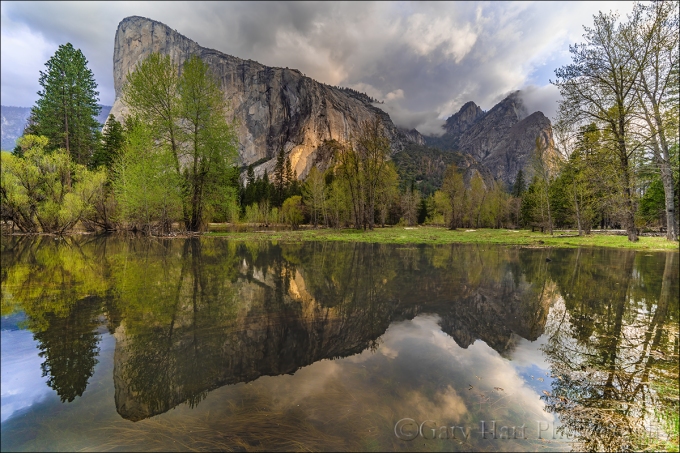
Breaking Light, El Capitan and Three Brothers Reflection, Yosemite
Sony a7R III
Sony 12-24 f/4 G
1/25 second
F/10
ISO 100
As you might imagine, between my own images, my photo workshop participants’ images, browsing other photographers’ pages, and simply being connected to social media, I see a lot of images. A. Lot. Of. Images. And curse or blessing, I can’t help but have opinions—whether my own images or others’, some work wonderfully, others not so much.
There’s a lot that goes into creating a successful image, but if I could whisper in the ear of every photographer just before they click the shutter, it would be a reminder to, “See the entire scene.” It happens to all of us: We’re so drawn to a pretty scene or striking subject that we become blind to what’s happing in the rest of the frame. And it’s the what’s happening in the rest of the frame that separates a mere pretty snap of a beautiful scene from wall-worthy print that satisfies for years.
Dream world
Writer John Gardner talked about creating a “vivid and continuous dream” that so completely immerses readers in the imaginary world on the page, the physical world surrounding them temporarily disappears. Any distraction that jars the reader from the page and back into the present world is a failure.
The same applies to photography. As nature photographers, we invite the viewers of our images into a virtual world of our creation. To encourage these viewers to stay and explore our virtual world, we might offer them a fresh perspective, enable vicarious travel, or perhaps tap latent memories. Regardless of the reason, the longer they stay in our virtual world, the more successful our image. But when a jutting branch on the frame’s border reminds viewers of the world out the scene, or a bright rock tugs their eye and competes for attention with scene’s prime subject, our spell is broken.
Compromise
Sadly, nature rarely presents itself exactly as photographers want it. So many decisions we make are compromises: we bump the ISO to enable the small aperture and fast shutter speed the scene requires; we cut off a rock on the left because panning right would introduce garbage can; we can’t tighten a composition to eliminate a shrub because doing so would cut the top of a mountain; we don’t polarize the sky because the polarizer erases a rainbow; and on and on…. Given these realities, our goal doesn’t need to be perfection, it’s often just to slow down and see the entire scene to ensure the decisions that bring our image as close to perfection as possible.
For example
This flooded Yosemite meadow is a spring phenomenon caused by extreme runoff following a relatively wet winter. Some years it doesn’t happen at all, but last spring’s Yosemite workshop group was fortunate to be there during the few days the Merced River overflowed its banks here (I returned a couple of days later and found the river had receded). I could have plopped my tripod down (or simply raised my camera to my eye) anywhere in a 100 yard radius and been virtually assured of a beautiful picture.
But as beautiful as it was, and as much as I wanted to start clicking, my first stop to take it all in had some problems. From my original vantage point, the stand of trees on the right obscured the Three Brothers, so I moved left along the water’s edge. But given more trees on the left, it soon became clear that part of El Capitan would be obscured. My compromise was to find a spot that exposed both El Capitan’s nose and the Three Brothers.
I’d left the car with my Sony 16-35 f/2.8 GM Sony (on my Sony a7RIII) body because that lens had a polarizer for controlling the reflection—dial it up for the maximum reflection, dial it down to reveal the grassy texture just beneath the water, and maybe even a find midpoint with some reflection and some submerged grass. But 16mm wasn’t wide enough, so I sacrificed reflection control and switch to my Sony 12-24 f/4 G lens.
With my position and lens worked out, I was ready to frame my composition. I felt a little sense of urgency because I didn’t want to miss the rapidly moving splashes of light scooting across El Capitan, but I also didn’t want to rush so much that I missed a problem in my frame.
To dislodge my attention from a scene’s primary focus points, I often use a mnemonic device before clicking: “border patrol.” (Though perhaps in light of current events, I should come up with something different.) Border patrol is a gentle reminder to run my eyes around the border of my frame to check for problems. Potential problems here include cutting off part of a tree on the left or right, a distracting bright spot in the sky near the top of the frame, or inadvertently trimming El Capitan’s reflection on the bottom. (Incomplete reflections and distracting sky holes are some of the most frequently missed distractions.)
In this case I took care to ensure that I got all of El Capitan and its reflection while avoiding a few breaks in the clouds just above this view. I also used the evergreen on the left and the arcing trunks on the right to frame those borders. And by making sure my camera was perfectly level, I managed to keep my vertical lines straight.
Depth of field at 12mm wasn’t a concern; I chose f/10 and focused on the far bank knowing everything would be sharp. Motion wasn’t a concern, so I could just use ISO 100 and go with the shutter speed that gave me the best histogram in the viewfinder (I love mirrorless).
Careful Framing
Click an image for a closer look and slide show. Refresh the window to reorder the display.


The evolution of a landscape photographer
Posted on January 24, 2019

Dogwood Trio, Yosemite
Sony a7RIII
Sony 100-400 GM
ISO 400
f/14
1/50 second
One of my earliest photographic lessons was that clicking a picture of a beautiful subject, no matter how beautiful, does not ensure a beautiful result. A vivid sunset can indeed be quite pleasing to the eye, but picture of that sunset riddled with rooftops and telephone poles—well…, not so much. This got me thinking more about the individual components of a beautiful scene, and how I might best emphasize them and eliminate distractions.
Like most landscape photographers, I started with the low hanging fruit, concentrating on sunrises and sunsets in beautiful locations, but it wasn’t long before I realized that I wasn’t the only person doing this. Of course I haven’t stopped targeting this obvious beauty, but I also started looking for ways to capture nature’s more subtle beauty.
A Yosemite sunset, where everything in the scene is at infinity and stationary, can be captured on today’s cameras in full automatic mode. But framing, focusing, and freezing/blurring more intimate subjects requires complete mastery of motion, depth, and light. This mastery requires a clear understanding of the exposure variables: shutter speed, f-stop, and ISO. Fortunately, I had the advantage of cutting my photographic teeth back before cameras could control every aspect of exposure and focus, and with no ability to check my decision until the pictures returned from the lab, the wrong exposure choices wasted precious dollars—a great motivator.
One of the first intimate subjects I turned my camera toward was the dogwood that decorate Yosemite Valley each spring. Even though I was pretty comfortable with my camera’s exposure variables, it still took a little effort to figure out how to blend these technical skills with the composition side of the craft. The key for me was consciously identifying the qualities of my subject that draws my eye. For example, with dogwood, it’s the symmetrical flowers, the flowers’ candelabra-like spacing, the tree’s translucent petals and leaves, and (especially) the illusion of weightlessness of a suspended dogwood bloom.
Armed with that understanding and my exposure skills, I developed a toolbox of techniques for highlighting these features. Whether it was a close composition with a narrow depth of field against a soft forest background, a swaying dogwood branch suspended above flowing water, or a single bloom with a blurred Yosemite icon in the background, I was having a blast. And it was easy to these techniques to many subjects, from colorful leaves in autumn, to brilliant poppies each spring.
About this image
The dogwood in Yosemite Valley were at peak bloom, but I was dealing with the dynamic range problems inherent to a sunny spring afternoon. Photographers are frequently admonished to “Never blow the highlights,” but I saw an opportunity to use the bright sky to my advantage. Finding a shaded branch with three perfect dogwood flowers high overhead, I moved around until the branch was directly above and against the blue sky. Spot-metering on one of the flowers, I knew that everything my eye saw as blue, my camera would turn a hopelessly overexposed white that becomes a perfect background for these beautiful flowers.
A Dogwood Gallery
Click an image for a closer look and slide show. Refresh the window to reorder the display.


What is real?
Posted on January 20, 2019
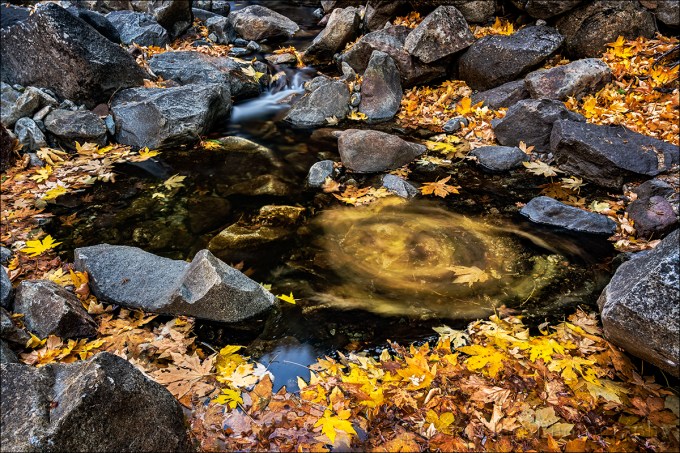
Color Wheel, Bridalveil Creek, Yosemite
Sony a7RIII
Sony 24-105 f/4 G
Breakthrough 6-stop ND filter
3 minutes
F/11
ISO 50
Visual “truth” is relative
Without getting too philosophical, it’s important to understand that, like your camera, your view of the universe is both limited and interpreted. In other words, there is no absolute visual truth. Instead, we (you, me, our cameras, your dentist’s dog, and so on…) each have our own view of the world that’s based on many factors—some we can control, others we can’t. When you look through a viewfinder, the more you turn off your visual biases and understand your camera’s, the more successful your photography will be.
Before lamenting your camera’s limitations, pause to consider that what you and I see is incredibly limited as well. The visible (to the human eye) portion of the electromagnetic spectrum is a minuscule part of the infinite continuum of electromagnetic radiation bombarding each of us, every instant of every day. For example, X-ray machines “see” waves in the one nanometer (one billionth of a meter) range; TVs and radios “see” waves that are measured in centimeters; humans, on the other hand, only see waves between (about) 400 and 750 nanometers.
Using this knowledge, astronomers peer into space with tools designed to detect objects at wavelengths invisible to us. And X-rays allow doctors to view bones hidden beneath opaque skin, while night vision technology uses “invisible” (to us) infrared radiation (heat) to reveal objects in complete darkness. In other words, in the grand scheme of things, there’s no single absolute visual standard—it’s all relative to your frame of reference.
The camera has its own frame of reference. While it records more or less the same visible spectrum our eyes do, the camera is missing an entire dimension. Not only that (since we’re not talking about movies here), a camera only returns a snap of a single instant. And we all know about limited dynamic range and depth of field.
Despite these differences, photographers often go to great lengths to force their camera to record what their eyes see. Not only is their goal impossible, it ignores the camera’s ability to see things in ways we don’t, and the opportunity to provide a fresh perspective.
Our visual input is interpreted before we perceive it, in much the same way a camera’s input is processed before it’s output (to a monitor, printer, or whatever). Visual processing happens in our brain, which makes adjustments for things like color temperature, perspective, motion, and so on. Likewise, every photograph must be processed (interpreted) in some way before it can be viewed, either by the camera, or by the photographer, using Photoshop or some other processing software.
Motion
Capturing motion in a scene is the photographer’s creative choice. Still-photographers can’t capture water motion as we see it, but we can use shutter speed to blur or freeze the water to varying degrees. People who criticize blurred water images for being “false” because that’s not the way water is, completely miss the point. My question to them is, how would you choose to capture water? (It’s a trick question.) When they answer frozen sharp, I ask them how many times they’ve actually seen a wave or water droplet suspended in midair. (Crickets.) The point is, a still camera simply “sees” motion differently than we do. Rather than holding our images to an unattainable human standard, we should feel free to appreciate and convey our cameras’ unique perspective.
But despite its limitations, the camera’s view of motion can expose things missed by human vision. A waterfall frozen in place by a fast shutter speed reveals that what appears to be a mass of solid white water, is really a comprised of individual sparkling droplets. And a long shutter speed reveals patterns in the motion of flowing water.
For example, in the image at the top of this post, when I used a neutral density filter to allow a long shutter speed, a swirl too slow to register to the naked eye appeared. Also interesting to me is the lone stationary leaf, indicating a small patch of calm amidst the swirl.
What is real?
Is this image “real”? While it’s nothing like what I saw, it’s still a very accurate rendering of my camera’s reality. Understanding my camera’s vision, and knowing how to control my exposure variables, enabled me to share a perspective that expands my limited vision and transcends human reality. Pretty cool.
Not What I Saw
Click an image for a closer look and a slide show.


Alone in Yosemite
Posted on January 13, 2019
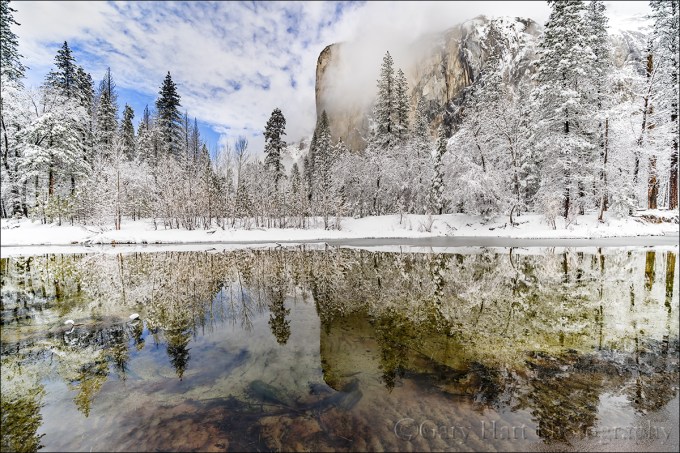
Clearing Storm Reflection, El Capitan, Yosemite
Sony a7R III
Sony 12-24 f/4 G
1/125 second
F/10
ISO 100
Last winter I spent a glorious day by myself in Yosemite Valley, photographing the vestiges of an overnight snowstorm. Inbound to the park the evening before, a continuous strand of outbound headlights reminded me how different a photographer’s priorities are from the general public’s. For a nature photographer, the best time to be outside seems to be everyone else’s worst time to be outside, but we know that before breakfast, at dinnertime, after dark, and wild weather are when all the best pictures seem to happen.
I arrived in Yosemite Valley with just enough light to see El Capitan and Half Dome engulfed in heavy clouds that hinted at what was in store—but so far no snow. With a storm imminent, I had no problem getting a room at a significant discount, virtually unheard of on a typical Yosemite evening. A light mist started after dinner, and I fell asleep to the sound of raindrops tapping leaves outside my window. The next morning I woke before my alarm and lay still, listening in the darkness to the unmistakable silence of falling snow.
Dressing quickly, I opened the door to six inches of untouched snow. In the parking lot I tried to determine which white lump was my Outback, repeatedly punching the lock button on my key fob and following my ears to the lump that chirped back. A little digging confirmed my discovery, and after a few more minutes of excavation I was able to to ease out of my parking space, carving the first tracks into what was probably the road (fingers crossed).
The clouds that had deposited all this powder seemed be trying to squeeze out every possible flake, but they seemed exhausted from their overnight effort and my wipers had no problem keeping up. When the final flake fell a little before 9:00, I was traipsing through drifts near El Capitan Meadow. Patches of blue sky overhead told me it wouldn’t be long before the trees were shedding snow in clumps, so I headed quickly to a favorite spot by the Merced River, hoping for a reflection while the world remained white.
The Merced here was so still and clear that I had to look twice to be sure there really was water in the river. The reflection on the far side was exactly what I had in mind, but the corrugated riverbed on my side was an unexpected complement that wonderfully matched the herringbone clouds above. In the days before my Sony 12-24 lens, I wouldn’t have been able to include all of El Capitan and its reflection in a horizontal frame, but 12mm gave me room to spare (I’m still startled at times by how big the difference is between 16mm and 12mm).
I got lots pictures that make me happy that day, but even more than the pictures, I think I enjoyed the rare opportunity to feel alone in Yosemite for a few hours. The park wasn’t empty, but between the scarcity of people, the reluctance of those who were there to venture onto the roads, and the sound-deadening effect of powdery snow, I had no trouble pretending.
Workshop Schedule || Purchase Prints
Yosemite Winter Reflections


Just a Pinch of Moon
Posted on January 6, 2019
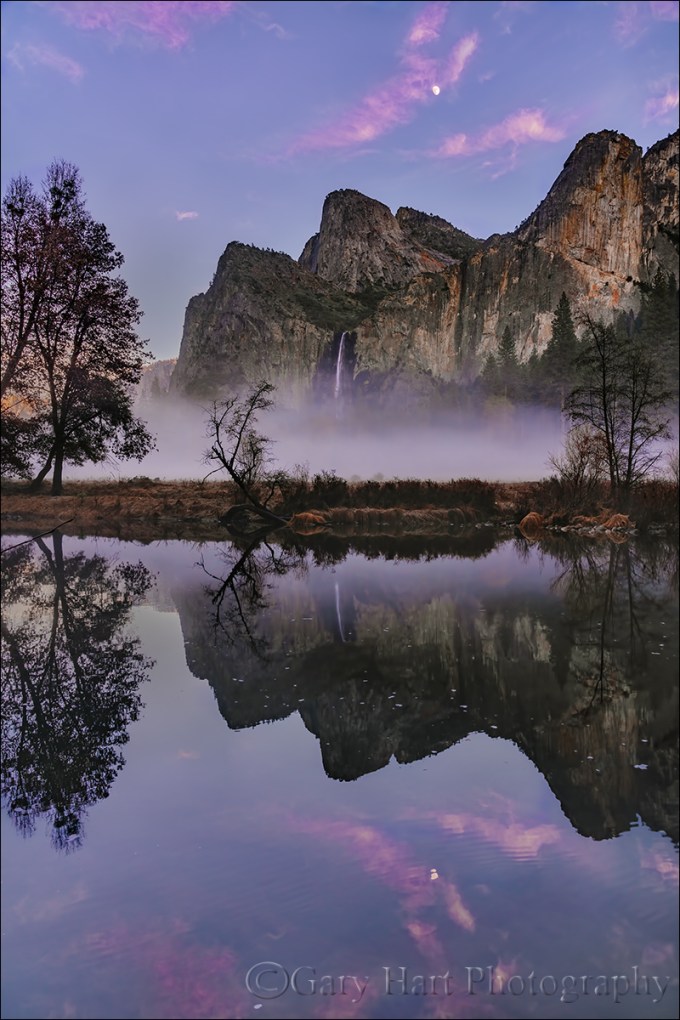
Sunset Moonrise Reflection, Bridalveil Fall, Valley View, Yosemite
Sony a7RIII
Sony 24-105 f/4 G
1/13 second
F/11
ISO 100
A couple of weeks ago I wrote about how to photograph the moon big, the bigger the better, to overcome its tendency to (appear to) shrink in a wide angle image. But the moon doesn’t need to be big to be a striking addition to a landscape photo.
To balance a landscape frame, I think in terms of “visual gravity” (or “visual weight”): how much the scene’s various elements might pull the viewer’s eye. Unlike conventional gravity, which is a constant determined by an object’s mass (period, end of story), visual gravity is a more subjective quality that is a function of the characteristics of an object, such as its size, brightness, contrast, or color. Thinking in terms of the visual gravity of the various elements in my scene, I (usually) try to avoid any hemisphere of the frame feeling significantly heavier than its corresponding hemisphere (top/bottom, left/right).
Certainly any object as bright (and contrasty) as the moon will pull the eye. But after noticing that many objects at least as bright or contrasty as the moon somehow lack the moon’s ability to pull the eye, I realized I’d been missing an essential component of visual gravity: emotional connection. There is just something about the emotional pull of the moon that draws the human eye far more than its more tangible physical qualities might suggest.
For years I’ve tried to leverage the moon’s emotional weight, using it to elevate a relatively ordinary scene, or to add a simple accent that takes an already beautiful scene to the next level. Last month I got just such an opportunity at Valley View in Yosemite. This was the first night of my annual Yosemite Winter Moon photo workshop. I’d planned moonrises for the other three nights of the workshop, but hadn’t really plotted the first night because the moon would be so high at sunset, and during the moon’s twilight “sweet spot” (when the sky is dark enough for good contrast, but the landscape still has enough light to photograph) the moon wouldn’t align with Half Dome from any of Yosemite Valley’s Half Dome vantage points.
Nevertheless, I chose Valley View for sunset knowing that the moon might make a nice accent above Cathedral Rocks and Bridalveil Fall. As soon as we arrived it was clear the conditions had aligned for us on this chilly December evening. In the distance Bridalveil Fall disappeared into a blanket of dense fog hovering above Bridalveil Meadow, while the moon mingled with wispy clouds in the twilight pastels overhead. And at our feet, the Merced River made a perfect mirror.
I knew that capturing all this beauty required a fairly wide composition that would certainly shrink the moon. Because a horizontal composition that included the moon and its reflection would have to be so wide that would shrink everything (and include a lot of less interesting foreground trees), I opted for a vertical composition that emphasized the scene’s primary elements: the moon, Cathedral Rocks, and Bridalveil Fall.
For this shot I went wide with my Sony 24-105 G lens on my Sony a7RIII body. Once I had the general arrangement of my frame worked out, I moved along the riverbank until everything felt balanced. I used the trees on the left to block the empty sky, and the trees on the right to balance them. And I’ve always liked the small diagonal tree a little left of center, and think in this composition it makes a good counterbalance for the visual weight of Bridalveil Fall.
Is the moon the primary subject the way it would likely be in a telephoto image? Certainly not. I know some people might think the moon is too small in this composition, but for someone like me, with a lifelong relationship with the night sky, the moon makes a perfect accent. And in this image I think just that little pinch of moon is enough to balance a frame that would otherwise be a little heavy on the left.
Lunar Accents
Click an image for a closer look and slide show. Refresh the window to reorder the display.


 Eloquent Images by Gary Hart