Eloquent Images by Gary Hart
Insight, information, and inspiration for the inquisitive nature photographer
Lucky strike
Posted on June 10, 2015

Half Dome Lightning Strike, Glacier Point, Yosemite
Sony a7S
Sony/Zeiss 24-70
.4 seconds
F/11
ISO 50
A Lightning Trigger in California is usually about as useful as a fishing pole in the Sahara. But every once in a while a little sub-tropical moisture sneaks up the Sierra crest and blossoms into afternoon thunderstorms. I monitor the weather daily (okay, that’s probably understating it a bit) for just these opportunities, rooting for Yosemite thunderstorms the way a Cubs fan roots for a World Series. And until last weekend, with just about as much success.
Last week the moist vestiges of Hurricane Blanca were sucked into an unstable airmass above the Sierra, just the thunderstorm recipe I’d been looking for. While each day’s Yosemite forecast called for at least a slight chance of afternoon thunderstorms, the Saturday forecast looked particularly promising. Nevertheless, several days out, the Saturday thunderstorm probability from the National Weather Service varied widely, fluctuating with each report between 40 and 70 percent. But as Saturday approached, the chances settled in at around 60 percent and I made plans to be there.
Saturday morning my brother Jay and I left Sacramento a little after 8 a.m., and were pulling into Yosemite Valley before noon. Blue sky prevailed upon our arrival, but by the time we finished our sandwiches at Tunnel View, cumulus puffs were sprouting along the crest, a very good sign. Stomachs full, we continued up the road toward Glacier Point. In the forty or so minutes it took to reach Washburn Point, just up the road from Glacier Point, the cumulus puffs had congealed into roiling gray mass that was already delivering coin-size raindrops to my windshield.
The best way to photograph lightning is from a distance (the greater the better), not impossible at the Grand Canyon, where I can stand on one rim and photograph strikes pounding the opposite rim a dozen or more miles away. But my Yosemite lightning target is more specific: Half Dome, which towers above Yosemite Valley like a granite lightning rod, no more than 2 1/2 miles from any vantage point on the Glacier Point road—well within the Margin of Death of even a moderate thunderstorm. (The Margin of Death, or MOD, is my term for the radius surrounding the last lighting strike within which the next bolt could strike.)
In addition to the dramatic profile of Half Dome above Vernal and Nevada Falls, Washburn Point has the advantage of nearby, elevated parking lot that would allow us to set up a Lightning-Trigger-armed camera on a tripod and wait from the safety of the car with a view of the cameras. So, rather than risk trying the more exposed and more remote (much longer sprint to the car) Glacier Point vistas, we started at Washburn Point.
Setting up, we saw lightning firing on the most distant peaks beyond Cloud’s Rest, and safely behind Half Dome. This being my first real attempt with the Lightning Trigger on my Sony bodies (with the exception of one rushed, impromptu, and unexpectedly successful attempt at White Sands last week), I was looking forward to comparing the response of the Sony bodies to my Canon 5D Mark III (shutter lag is a major body-to-body variable that can make or break a lightning shoot). But since Jay didn’t have a Lightning Trigger, and his body is an older Canon 5DII, good brother that I am (plus, he threatened to tell Mom if I didn’t share), I let him use my Lightning Trigger (I have two) and 5DIII.
Soon the rain and wind intensified, the flashes came more frequently, and the thunder grew louder, but rather than retreat to safety, we stayed with our cameras. The activity continued to approach until it seemed to be centered just down the hill in the general direction of Glacier Point, visible to us not as discrete bolts but rather as general flashes in the clouds. Still, we knew the lightning was close because of the relatively short gap separating flash and bang, yet it wasn’t until Jay said he felt the hair standing up on his head and arms that we got smart. Or rather, less stupid.
Back in the car we watched the show at Washburn Point until it abated, then decided to move down the road a bit, to another view closer to Glacier Point. Here we couldn’t see our cameras from the car, but we were able to park within 50 feet or so of their vantage point. Despite the continued dangerously close proximity of the lightning, we again stayed out a little longer than we should have, finally being driven back to shelter not by lightning but by the wet and cold conditions.
This was my first attempt at lightning since my switch to Sony; I was using the a7S because the a7R wasn’t fast enough for lightning (a problem completely cured on the a7RII). The a7S caught all three of the Half Dome hits I saw, with the twin-branched bolt you see here being the most spectacular. My composition was fairly wide for a couple of reasons: first, because the wider I go, the greater my odds of capturing something; second, with Nevada and Vernal Falls on the right, and Tenaya Canyon and Mt. Watkins on the left, the scene justified it.
To say I was lucky this afternoon would be an understatement. Not only did a lightning bolt hit my intended target, my camera captured it (never a sure thing, no matter how fast the camera), and I actually lived to share the shot with you. Here in the comfort of my recliner, I’m kind of at a loss to explain why I thought it was a good idea to stay out with lightning landing well within the MOD. While there are definitely things to tend to while waiting for lightning—shielding the camera from rain, wiping raindrops from the lens, adjusting exposure as the light changes, monitoring that the camera does indeed fire with a visible strike, and simply answering questions from curious onlookers (and preempting their urge to touch the equipment)—none is important enough to risk my life. In my defense, I am much more cautious when I’m guiding a group, which of course will be small consolation to my wife and kids at my funeral.
Photographing daylight lightning
Here are my tips for photographing daylight lightning:
- You need a lightning sensor that detects the lightning and fires your shutter much faster than your reflexes can react. The only sensor that I’ve found to work reliably is the Lightning Trigger by Stepping Stone Products (I get no kickback, I swear). Of course have brands many to choose from, some much cheaper than the Lightning Trigger. While I have no direct experience with many of the other sensors, I do lead lightning workshops and have witnessed some major fails by other brands.
- Your camera must be fast, the faster the better. The speed you’re looking for is the time from the shutter-button press until shutter release: shutter lag. Unfortunately, shutter lag is a difficult number to find, and it’s rarely (never?) provided by the manufacturer. The best resource I’ve found is the Performance tab of the Imaging Resource camera reviews. Even they can’t provide a simple value because there are multiple variables, and you can’t simply assume that your camera is automatically working at the fastest. To ensure the fastest shutter lag possible, turn off autofocus (this is important) and shoot in manual exposure (on some cameras this might not make much difference, but there’s no way of knowing for sure so I think it’s best to just turn it off). The pre-focused time (shutter button pressed halfway) is what you’re going for, but some (most?) triggers don’t do this—the Lightning Trigger does.
- The shutter-speed “sweet spot” is 1/8 to 1/4 second, but anywhere between 1/15 and 1/2 second should work pretty well. If you’re too fast, you risk missing some of the secondary strikes that often accompany the initial strike; if you’re too slow, the lighting tends to get washed out. Keeping the shutter open long enough to get into the sweet spot in broad daylight often requires the lowest ISO possible (it helps if your camera goes down to ISO 50), and a polarizer (I use Singh-Ray). A neutral density filter will work too, but make sure you don’t go too slow with the shutter speed or the lightning you capture might faint or not even visible.
- Come with a strategy for keeping you and (especially) your gear dry. I never go out to photograph in the rain without my waterproof gear, which keeps me dry from head-to-toe: rain hat, parka, waterproof over-pants, waterproof shoes—a stylish ensemble that frees my umbrella for my camera. This strategy works great when there’s no lightning, but—well, let’s just say that an umbrella might not be the best choice when lightning’s in the area. When photographing lightning, I use a waterproof rain cover for my camera (which I won’t recommend because it’s a pain and I’m looking for something I like better—stay tuned). And as much as I hate lens hoods (they just get in the way), I have to admit that they can help keep raindrops off your front lens element. I also make sure to carry multiple lens cloths in my pockets (because there are too many pockets in photography, so it’s just easier to have a cloth in each pocket than it is to remember which pocket I put it in) and check my front element for raindrops frequently. Also handy is a bath towel to dry all of your equipment before you put it away. A chamois (check your local auto parts store) also works great for this. And a garbage or plastic grocery bag (there’s always one in my camera bag) is great for tossing over your camera any time you’re caught in a sudden downpour.
Some links
- Before attempting to photograph lightning, visit the NOAA lightning safety page
- Read my “Outdoor Photographer” article on Grand Canyon monsoon photography (lots of lightning tips)
- Photo Tip: Lightning Photography
- Sign up for a Grand Canyon monsoon photo workshop, where Don Smith and I do our best to get you lightning captures in one of the most beautiful places on Earth (unfortunately, Yosemite doesn’t offer the frequency of thunderstorms necessary to support a lightning workshop)
Upcoming workshops
A stormy weather gallery
Click an image for a closer look, and a slide show. Refresh the screen to reorder the display.


Nuts and bolts at the Grand Canyon
Posted on September 4, 2014

Too Close, Twin Lightning Bolts, North Rim, Grand Canyon
Canon EOS-5D Mark III
24-105L
1/8 second
F/18
ISO 100
The bolts started around 1:15; the nuts showed up about ten minutes later. There were 14 of us. We were stationed on the outside viewing deck of the Grand Canyon Lodge on the North Rim, tripods, cameras, and lightning triggers poised and ready for action. The “action” we were ready for was lightning, and more specifically, the opportunity to photograph it.
The storm had started fairly benignly, poking at South Rim a comfortable distance away, far enough in fact that we heard no thunder. But as often happens, we became so caught up in the intensifying pyrotechnics that we failed to appreciate how much our sky was darkening and that the bolts were in fact landing closer. We continued in exhilarated ignorance until a tripod-rattling thunderclap and simultaneous white flash returned us to the reality of the moment. Hmmm.
By the time the raindrops started plopping, the lightning show had reached such a crescendo that we found all kinds of rationalizations for persistence in the face of potential death: “I think it’s moving west of us,” or, “The lodge’s lightning rods will protect us,” or, “If it were really that dangerous, the hotel staff would make us leave.” (Ummm: When the strikes are that close, it doesn’t matter where the storm is heading; lightning rods are to protect the (smart) people inside the lodge; the hotel staff isn’t paid enough to go outside for anything that risky.) I wish I could say it was common sense that eventually drove us all inside, but the reality is that when the heavy rain finally arrived, it became impossible to keep the front of our lenses dry.
So what is it about danger that brings out the stupid in photographers? I used to be able to use the “I’m from California and we don’t get lightning so I don’t know any better,” defense, but that won’t fly anymore because I do know better: I know a lightning strike can be fatal, and those who survive are often left with a life-long disability; I know that lightning can hit 10 miles from its last strike; I know that if you can hear the thunder, you’re too close.
And it’s not just lightning that brings out the stupid. While chasing potential shots, I know of a photographer who scaled a cliff far beyond my his skill level, drove without hesitation into (but not out of) a raging creek, and became hopelessly mired in mud on a narrow jungle track. And we’ve all read news reports about the photographer plummeting to her death while angling for a better view, or of the partial remains of a photographer discovered in the stomach of an unfortunate grizzly?
We each have our own safety threshold, a comfort zone beyond which we won’t venture. I have a really tough time getting within three feet of any vertical drop greater than 50 feet, but I know photographers who can spit into the Colorado River from the 1,000 foot vertical rim at Horseshoe Bend. On the other hand, I’ve lived in California my entire life and am always disappointed when I miss an earthquake, but I’ve had people tell me they’ll never set foot in the Golden State for fear of a fault slipping.
But back to this lightning thing. It’s not as if I stand on a peak shaking my fist at the sky and dodging bolts like Bowfinger crossing the highway. I will go inside when lightning gets too close—I just think I probably don’t do it quite as soon as I should, and who knows, maybe someday I’ll be sorry (or worse). But I’m happy to report that the score on this particular afternoon was: Photographers—250-ish (the number of images with lightning), Lightning—0 (the number of photographers lost). Next year? Tornados.
A Grand Canyon lightning gallery


The right stuff with the left brain
Posted on August 17, 2014
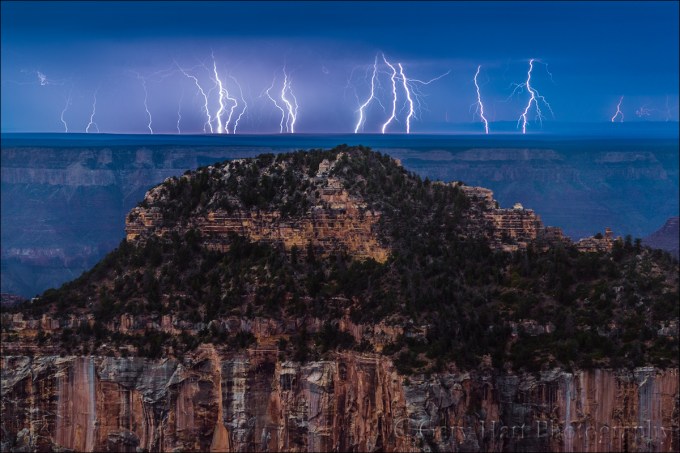
Electric Night, Grand Canyon Lodge, North Rim, Grand Canyon
Canon EOS-5D Mark III
Canon 24-105L
15 1/2 minutes
F/4
ISO 200
Left versus right
Writing about “The yin and yang of nature photography” a couple of weeks ago, I suggested that most photographers are limited by a tendency to strongly favor the intuitive or logical side of their brain (the so-called right-brain/left-brain bias). Today I want to address those intuitive (right brain) thinkers who feel it’s sufficient to simply trust their compositional instincts and let their camera do the thinking.
It was a dark and stormy night
There is absolutely nothing creative about this lightning image from last Monday night at the Grand Canyon. This single click image (one frame—no blending) was captured from the viewing deck of the Grand Canyon Lodge on the North Rim during a nighttime thunderstorm across the canyon. Compounding the darkness of night and the Grand Canyon’s dark pit were dense clouds that obscured a waning gibbous moon—the canyon so dark that I couldn’t see well enough to create anything. To compose, I simply aimed my camera in the general direction the lightning was most active, clicked, and hoped. The original raw file needed cropping for balance, to remove a few lights from the South Rim Village, and to correct a severely tilted horizon.
Don Smith and I had just brought our workshop group back from a sunset shoot at Point Imperial. Some headed back to their cabins to recover from a day that had started at 4:30 a.m., while a few veered to the “saloon” (it’s not quite as raucous as it sounds) for a beer or glass of wine. Lugging my gear back to my cabin, flashes in the clouds above the lodge indicated lightning was firing somewhere in the distant south and I detoured down to the lodge’s viewing deck to check it out. Through the two-story windows of the inside viewing room and before I even stopped walking I saw bolts landing due south across the canyon, and along the rim down the canyon to the west—violent, multi-stroke bolts that illuminated the clouds and canyon walls with their jagged brilliance.
I set up on the west viewing deck with just enough twilight remaining to compose, starting with a composition I liked—it wasn’t in the direction of the most activity, but I’d already seen a couple of strikes in that direction and was hoping I’d catch a bolt or two. But as the sky darkened and my exposures failed to capture anything, it became clear the activity was shifting west and I’d need to adjust my composition. By then the darkness was nearly complete and I simply centered my frame on the black outline of Oza Butte in front of me, going wide enough to ensure maximum lightning bolt captures.
While finding focus for my earlier compositions had been a little tricky, there had been enough light to make focus manageable. But now the absence of any canyon detail made getting a sharp frame extremely problematic using the conventional focus methods. (Contrary to a misconception that lingers from the old film days, when everyone used prime lenses, you can’t simply dial a zoom lens to infinity and assume you’ll be sharp.)
Once I decided on my composition (and focal length), I pointed my camera (still on the tripod) in the direction of the Grand Canyon Village lights on the South Rim centered the brightest light in my viewfinder. I engaged live-view, magnified the scene 5X, re-centered the target light, magnified 10X (5X and 10X are the two magnification options on my 5DIII), and slowly turned my focus ring until the cross-canyon light shrunk from a soft blur to a distinct point. I then swung my camera back toward my the butte and recreated my composition (without changing my focal length).
Because my earlier exposures had been 30 seconds at ISO 1600 ISO, designed to capture just one or two strikes in a composition I liked, but short enough to adjust things relatively frequently. But since my new strategy was to fire directly into the mouth of the beast, and lacking a composition in which I had any confidence, I decided on a long exposure that would capture enough lightning to overcome the unknown but likely relatively bland composition. Instead of 30 seconds, I wanted at least 12-15 minutes of exposure in Bulb mode (instead of a shutter speed that’s fixed at the moment of the click, in Bulb mode the shutter remains open until I decide it’s time to close it).
“You didn’t tell me there’d be math…”
Doing the math: Because each doubling of the shutter speed adds one stop, a 15 minute exposure would add about (close enough to) 5 stops of light to my original 30 seconds:
- 30 seconds x 2 = 1 minute—1 stop
- 1 minute x 2 = 2 minutes—2 stops
- 2 minutes x 2 = 4 minutes—3 stops
- 4 minutes x 2 = 8 minutes—4 stops
- 8 minutes x 2 = 16 minutes—5 stops
Adding five stops of exposure time meant that keeping the amount of light in my next image unchanged, I’d need to subtract a corresponding 5 stops of light in ISO and/or aperture. But since I thought that my previous exposure was at least a stop too dark, and I guessed that the sky would be darkening even more, I decided to drop only 3 stops, from ISO 1600 to ISO 200 (halving the ISO reduces the light by 1 stop). I made my ISO adjustment, clicked my shutter and locked it open on my remote, checked my watch, then sat back and enjoyed the show.
The 12-15 minute plan was just a guideline—since the difference between 10 minutes and 20 minutes would only be 1 stop, my decision for when to close my shutter had quite a bit of wiggle room. In this case after about 15 minutes I noticed the lightning was slowing down and shifting further west, so I wrapped my exposure and recomposed for my next shot. As it turns out, the next frame only captured a third of the number of strikes this one got because the most intense part of the show was winding down.
The worst is over
If you’re one of those “I have a good eye for composition, but…” folks, congratulations for sticking with me this long. I hope this illustrates for you how important understanding metering and exposure basics, and managing them with your camera, is to maximizing your capture opportunities. This technical aspect of photography isn’t something that should intimidate you—if you can multiply and divide by 2, you have all the math skills you need to figure things out on the fly.
I suspect, and in fact have observed, that most “intuitive” photographers are limited more by their belief that they can’t do the technical stuff than they are by an actual inability to it. What seems to have happened is that they’ve been buried by an avalanche of well-intended but less significant technical minutia covering everything from exposure (e.g., “RGB histograms” and “exposing to the right”), to focus (e.g., “circles of confusion” and “hyperfocal distance”), to printing (e.g., “colorspace” and “monitor calibration”). Many of these things are indeed quite important, but nobody should be expected to tackle them until they have a firm grasp on the basics of metering and exposure, and managing the complementary relationships connecting shutter speed, aperture (measured by f-stops), and ISO. I recommend that you ignore all the other technical buzz until this basic stuff makes sense—not only will you be a better photographer for it, you’ll find that the more “complex” stuff isn’t nearly as complex as it sounds.
Want to learn more?
Try these links:
Then go out in your backyard and practice!
But let’s not forget why we go out with our cameras in the first place
You can’t imagine how thrilling it was to watch these bolts firing several times per minute. Not only were they landing in the direction of my composition, they were also going all along the rim to the west. Witnessing this display was an experience I’ll never forget, and photographing it was a highlight of my photography life.
An Electric Gallery


Looking back at 2013, and ahead to 2014
Posted on January 1, 2014
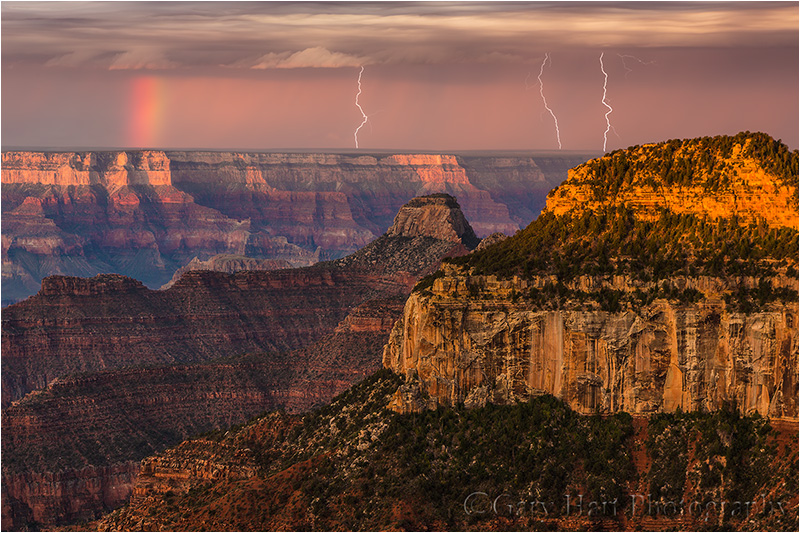
Three Strikes, Bright Angel Point, North Rim, Grand Canyon
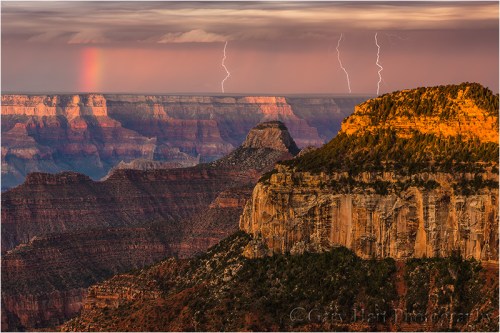
This is a single, 1/3 second click that managed capture three simultaneous lightning strikes. Set up on a tripod, I’d composed to balance the frame between the rainbow and the area receiving the most strikes. Rather than try to manually react when I saw a lighting flash, I let my Lightning Trigger detect the lightning and click for me. I got many one and two bolt frames, but this is the only frame that captured three.
Canon EOS 5D Mark III
1/3 second
F/11
ISO 100
24-105 f4L lens
While I’ve been taking a little Holiday break from my blog, I have spent some of my non-family time reviewing my 2013 images. Given the number of trips I take, and images I click, it always amazes me how well I remember every detail of my favorites—who I was with and what the circumstances were, not to mention composition and exposure decisions that are still as clear in my memory as the day I took the picture. I’m guessing it’s that way for other photographers too, because I’m convinced that our best photography comes when we concentrate on those things that move us emotionally. For example, since I’ve always been something of a weather geek, it stands to reason that several of my favorites feature active weather. And another lifetime passion is astronomy, and while I didn’t consciously bias this year’s selections toward the celestial, that sure seems to be how it worked out.
I have lots of great stuff planned for 2014: my regular annual workshops in Death Valley, Yosemite, Hawaii, the Eastern Sierra; my second annual Grand Canyon monsoon workshop with Don Smith; a raft trip down the Grand Canyon in May (bucket list item). And on any photo trip, whether it’s a workshop or a personal trip, I research and plan to make sure the odds for something special are as high as they can be, but it’s usually the unexpected moments that thrill me most—those times when I set out with one intention and found something else, or was disappointed when weather or other conditions beyond my control derailed the original plan.
Case in point: I scheduled an entire workshop around Comet ISON, and while ISON fizzled, if I hadn’t been in Yosemite to photograph it, I never would have witnessed Valley View, decked out in ice, glistening in the light of a full moon. Or the Maui workshop, scheduled before I had any idea of Comet PanSTARRS, that just happened to coincide with the comet’s post-perihelion conjunction with the new moon. But the one that thrill me most was the above sunrise at the Grand Canyon, the final morning of our second workshop—Don and I were going to start the thirteen hour drive home later that morning, and others in the group had flights to rush off to. Given the bland weather forecast, it would have been easy to blow off the shoot and let everyone sleep in. But we got up in the cold and dark, all of us, and were treated to a two hour electric show that started in blackness and culminated with a rainbow as the sun peeked above the canyon’s east rim.
So, without further adieu, and in no particular order, here are my current 2013 favorites (click a thumbnail for a larger version with more info, and to start the slide show):
-

- Leaf, Bridalveil Creek, Yosemite
-

- Poppy Pastel, Sierra Foothills, California
-
- Facing West, Molokai from West Maui, Hawaii
-
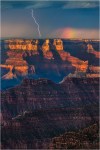
- Color and Light, Bright Angel Point, Grand Canyon
-

- Three Strikes, Bright Angel Point, Grand Canyon
-
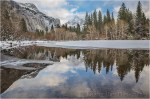
- Winter Reflection, Half Dome and the Merced River, Yosemite
-
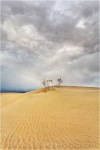
- Incoming Storm, Mesquite Flat Dunes, Death Valley
-
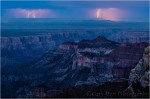
- Night Lightning, Roosevelt Point, Grand Canyon North Rim
-
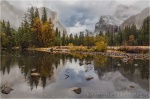
- Autumn Snow, Valley View, Yosemite
-

- Night and Day, Crescent Moon Rising Above Mono Lake
-

- Comet PanSTARRS and New Moon, Haleakala, Maui
-
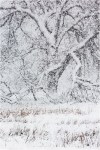
- White-Out, Cook’s Meadow, Yosemite
-

- Moonlight Cathedral, Valley View, Yosemite
-

- Before Sunrise, South Tufa, Mono Lake
-
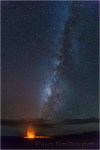
- Milky Way and Halemaʻumaʻu Crater, Kilauea, Hawaii
-
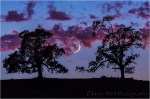
- Crescent Moon and Oaks at Dusk, Sierra Foothills, California
Shocking truths about lightning
Posted on October 23, 2013

Color and Light, Bright Angel Point, North Rim, Grand Canyon
Canon EOS 5D Mark III
1/3 second
F/11
ISO 100
24-105 f4L lens
While working on an upcoming “Outdoor Photographer” magazine article on photographing lightning at the Grand Canyon, I’ve been revisiting the images from my August workshop with Don Smith. While I still feel like I’ve only scratched the surface with the trip’s lighting images, it’s clear that at least half of my captures came on that amazing final morning, when we witness two hours of virtually nonstop lightning punctuated by a vivid section of rainbow balanced atop Powell Point. The first image I posted from that morning included the rainbow sharing the rim a trio of simultaneous, parallel strikes. The difficulty I’m having now is choosing which of the other pretty spectacular images to feature (FYI, this is a great problem to have).
Fortunately, I varied my compositions enough that many of my favorite captures are different from each other. Here, a single strike lands just east of the rainbow, close enough that they somehow seem related. This image is an example of why I’m constantly preaching to my workshop participants to switch between horizontal and vertical, even (especially) when one orientation seems more obvious than the other. Fortunately, I practiced what I preached (not always a sure thing) throughout the morning—instead of having one great capture of lighting with that morning’s rainbow, I now have two (and counting) that are different enough from each other to share.
Another byproduct of my magazine article is the research I’ve been doing on lightning. I’ve always been something of a weather geek, but it seems each time I revisit a topic, I learn something new. So, while I doubt you’ll find this stuff quite as fascinating as I do, here are some cool lightning facts I just can’t resist sharing:
- Earth is struck by lightning eight million times each day.
- While lightning is still not completely understood, scientists know that the rapid upward and downward motion of raindrops in a thunderstorm creates extreme electrical polarity—a negative/positive imbalance within a cloud, between clouds, or between a cloud and the ground. Nature abhors any imbalance and will remedy the problem as efficiently as possible: Lightning.
- The visible portion of a lightning strike originates on the ground and travels up to the cloud.
- In a lifespan measured milliseconds, a lightning bolt can release 200 million volts and heat the surrounding air to 50,000 degrees. More than enough to fry a photographer.
- Most of us know that lightning and thunder occur simultaneously. What many don’t know is that you can’t have one without the other—it’s the lightning that causes the thunder, and if you see lightning but hear no thunder, you’re just too far away. This even applies to what is often called “heat lightning,” which still generates thunder you’d hear if you were close enough.
- The fact that lightning and thunder occur simultaneously, but light travels much faster than sound, allows us to roughly establish the distance of the lightning. For all intents and purposes, we see the lightning the instant it happens, while the thunder pokes along at the speed of sound, a pedestrian 1,100 feet per second. That works out to about five seconds to travel one mile. So, if you start counting as soon as you see lightning (one-thousand-one, one-thousand-two, …), dividing by five the number you’re at when the thunder arrives gives you the approximate distance in miles.
- Let’s say you get all the way to fifty before the thunder arrives—that would be ten miles. You’re safe, right? Wrong. Lightning bolts exceeding one hundred miles in length have been documented, as have bolts with no rain and even with blue skies overhead. That’s why we’re warned to stay inside whenever you can see lightning or hear thunder. (It’s also why I say do as I say, not as I do.)
- A car is not a magic lightning sanctuary, and the safety a car does offer is because of its metal frame, not its rubber tires. (Don’t believe me? Go stand on a couple of rubber tires in the next lightning storm and have your next of kin report back to me.) Even when you’re inside a car, you need to keep the windows up and don’t touch anything metal. And stay away from convertibles.
Here are a couple of lightning safety websites:
Are you interested in risking your life to photograph lightning? Join me in a Grand Canyon photo workshop.
A Lightning Gallery
Click an image for a closer look and slide show. Refresh the window to reorder the display.


The calm above the storm
Posted on September 12, 2013

The Calm Above the Storm, Grand Canyon and Lightning by Moonlight, Mather Point
Canon EOS 5D Mark III
30 seconds
F/4
ISO 200
73 mm
If you’ve ever taken off in a violent storm, watched the exploding sky just beyond your window, felt the plane buck until you verged on panic, then suddenly broken through the clouds into utter peace, you might appreciate the dichotomy depicted in this scene.
* * * *
Overwhelmed by the euphoria the Grand Canyon workshop’s final sunrise was this moonlight experience on the South Rim a couple of nights earlier, the highlight of the workshop until that unforgettable morning. Don Smith and I had planned all along for this to be the group’s moonlight night, always a workshop highlight, but we got much more than we bargained for when we found the North Rim under a full scale assault from multiple electrical cells. The moonlit tranquility of our South Rim vantage point was a striking contrast to what was happening across the canyon. Several times per minute the clouds would strobe with lightning hidden by the clouds, and once or twice each minute a bolt would land near the rim for all to see. Above all this activity, the stars twinkled peacefully, clearly indifferent to the violence below.
Unlike the moonless experience at Kilauea a couple of weeks later, photographing with a full moon is pretty straightforward. Not only does the moon make a great focus point (just don’t forget to turn off autofocus before clicking your shutter), you can actually see your camera, its controls, the scene itself, and all potential obstacles (photographers, tripods, camera bags). And because exposures are generally short, do-overs are easy. So my job was easy, pretty much reduced to wandering around reminding everyone to vary their compositions, and making sure they’d all had a success.
Everybody got something that excited them that night, and the variety of images was amazing. I saw vertical and horizontal frames, wide and tight, most aimed north like this one, but there were also some great lightning captures to the east, up the canyon. My own favorite was this one that captured a bolt’s origin through a window high in the clouds, and its forked impact with the rim. While a wide composition would have increased the likelihood of capturing a strike somewhere in my frame, it would have also further shrunk the already distant lightning. My 73mm focal length in this case reflects my desire to make the lightning more prominent, and my confidence in the frequency of strikes in this direction (the more disperse the strikes, the wider I compose). Usually my night exposure decisions are designed to minimize star motion, but in this case I opted for 30 seconds to maximize the chance for capturing a strike (or more) during the exposure—a close look at the stars here clearly shows the onset of motion blur despite the fact that I was aimed north, where star motion is minimal.
This image reminds me why video is no substitute for still photography. Video’s benefits are undeniable, but the ability spend forever in a single instant like this is priceless.
The reason I do this
Posted on August 27, 2013

Three Strikes, Bright Angel Point, North Rim, Grand Canyon
Canon EOS 5D Mark III
1/3 second
24-105L
ISO 100
F11
August 2013
Nature photographers plan, and plan, and plan some more, but no amount of planning can overcome the fickle whims of Mother Nature. Few things are more disappointing than a long anticipated and perfectly executed shoot washed out by conditions beyond my control. But when all of nature’s variables click into place, the world becomes a happy place indeed. And when nature ups the ante by adding something unexpected, euphoria ensues.
Don Smith and I just returned from two weeks photographing the Grand Canyon. We did a little of our own photography on the trip, but the prime focus was our two four-plus day photo workshops, split evenly between the Grand Canyon’s North and South Rims. These workshops were scheduled to give our groups the opportunity to photograph the Grand Canyon, day and night, under the influence of the annual Southwest monsoon: billowing clouds, vivid rainbows, and (especially) lightning. But any workshop requiring specific weather conditions is fraught with uncertainty and anxiety—we were fairly certain the photography would be great (after all, it is the Grand Canyon), but few natural phenomena are more fickle than lightning.
When plotting a workshop schedule (or any landscape photo shoot), the best a photographer can do is maximize the odds: We try to schedule all the non-photography requirements (meals, sleep, travel, training) for the times least likely to conflict with the best photography. For example, we know that because the monsoon thunderstorms usually don’t develop before midday, Grand Canyon summer sunrises often lack the clouds and pristine air necessary for the vivid color photographer’s covet. Therefore our photography emphasis for this workshop is on getting our groups out from mid-morning through (and sometimes after) sunset. That doesn’t mean we blow off sunrise, it just means that the sunrises are generally better for exhausted, sleep-deprived photographers to skip than the sunsets are.
Nevertheless, we rallied the troops at 5 a.m. Friday for our second workshop’s final shoot, a ten minute walk from our rim-side cabins to Bright Angel Point. The forecast was for clear skies, but the workshop had already had so many wonderful shoots, I considered this final one just a little bonus, the cherry atop an already delicious sundae.
My mind was already on the long drive home—in fact, as Don and I exited our cabin in the pre-dawn darkness, I predicted that I wouldn’t even take my camera out of my bag that morning. My words as I turned the doorknob were, “But if I leave my bag here, we’ll probably get lightning and a rainbow.” Little did I know how grateful I’d be to have brought my gear….
What followed was what Don and I later agreed was probably the single most memorable workshop shoot either of us had ever experienced. Gathering in the lobby of Grand Canyon Lodge, we saw lightning flashes across the canyon, but it was impossible to tell in the darkness how far away it was. Hiking to the vista, we saw several distinct bolts stab the rim, and by the time our gear was set up, the show had intensified, delivering numerous violent strikes in multiple directions that illuminated the canyon several times per minute.
The morning’s pyrotechnics continued for over two hours, awing us first in the dark, then through twilight, and finally into and beyond a magenta sunrise. And as if that wasn’t enough, as the sun crested the horizon behind us, a small but vivid fragment of rainbow materialized on the canyon’s rim, hanging there like a target for the lightning to take potshots at it.
This was more than just good photography, this was a once-in-a-lifetime convergence of weather, location, and light that more than made up for the many times nature has disappointed. Rather than bore you with more words, here are a few images from that morning:

Lightning Before Dawn, Bright Angel Point, North Rim, Grand Canyon
Arriving on the rim about 45 minutes before sunrise, we found the South Rim under full attack. This 30 second exposure captured a pair of strikes near Mojave Point.
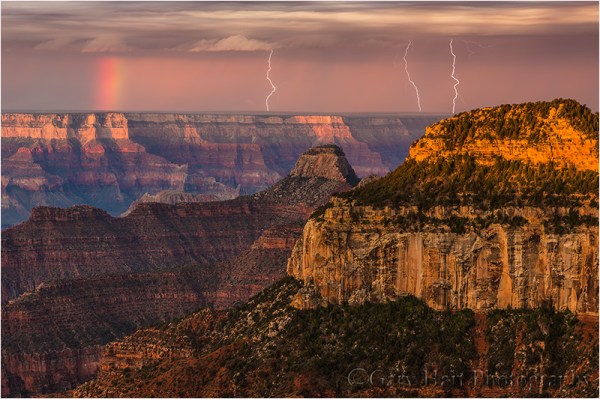
Three Strikes, Bright Angel Point, Grand Canyon
As the sun neared the eastern horizon, I couldn’t help sneaking an occasional peek behind me. Seeing clear skies in the rising sun’s direction, I crossed my fingers for the clouds to hold off long enough to allow the sunlight to illuminate the lightning show before us. As the sun topped the horizon, its rays caught the rain falling along the rim, balancing a nearly vertical section of rainbow atop Powell Point. In this single, 1/3 second exposure, I managed to capture the rainbow briefly sharing the rim with three simultaneous lighting strikes.

Color and Light, Bright Angel Point, North Rim, Grand Canyon
The rainbow persisted as the lightning continued. Confident that I’d captured enough horizontal frames, I switched to a vertical composition in time to catch one more strike with the rainbow.

Storm’s Approach, Bright Angel Point, North Rim, Grand Canyon
As the sun rose, the rocks reddened and the storm edged closer. Ridges visible earlier were slowly overtaken by the advancing rain, and long, rolling waves of thunder echoed overhead. Preceding the rain were billowing clouds; here I went with an extreme wide (17mm) vertical composition to capture the incoming storm skewering the rim with by a single bolt. I had to retreat to shelter shortly thereafter.
Grand Canyon Photo Workshops
Read about photographing lightning
A Lightning Gallery


Too close for comfort
Posted on August 22, 2013
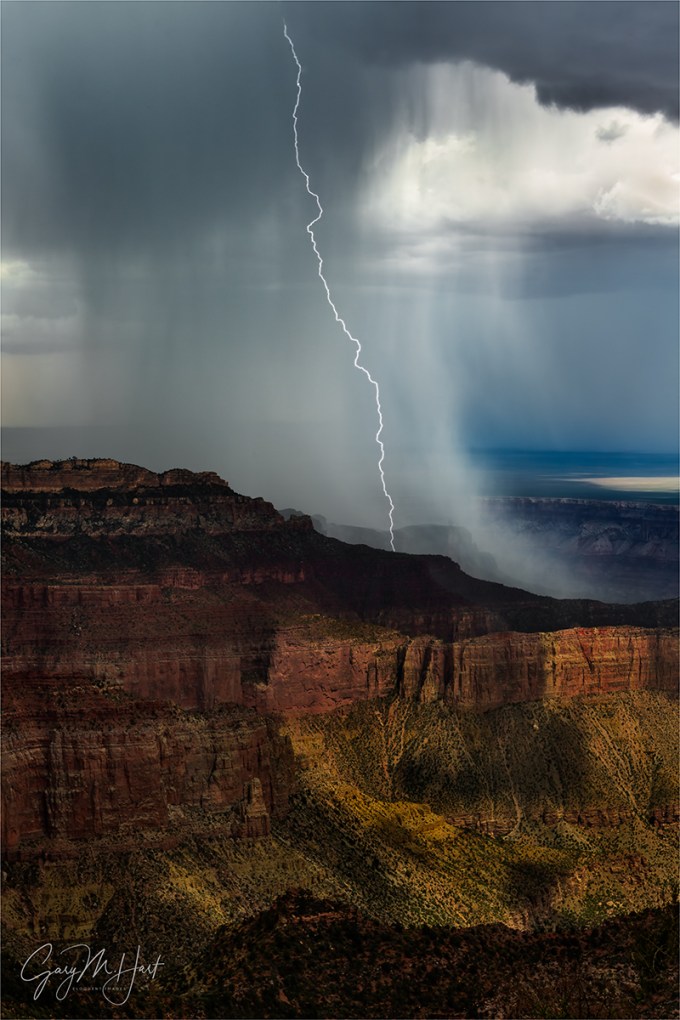
Electric Downpour, Point Imperial, North Rim, Grand Canyon
Canon EOS 5D Mark III
Canon 16-35 f/2.8L
1/8 second
F/16
ISO 50
After wrapping up our first Grand Canyon Monsoon workshop, Don Smith and I stayed a couple of extra nights on the North Rim to check-out potential locations for the second workshop. Saturday morning Don and I left our cabin with every intention of scouting (I swear) some remote, west-facing vista points, but black clouds and rolling thunder in the east (which we already knew quite well) gave us pause. The farther we drove, the blacker the clouds became, and the weaker our resolve to go scouting. A jagged bolt on the ridge north and east of the highway (a sign?) was more than enough to convince us to scuttle the scouting plan and beeline to Point Imperial.
With a 200 degree-plus east-facing panorama that includes the Vermillion Cliffs, the Painted Desert, the sheer walls of the Mosaic Canyon, and many named and unnamed red ridges and monuments, Point Imperial is one of my favorite North Rim vistas. By the time we arrived, the lightning was firing every thirty seconds north of us, well beyond the closest ridge. Gear in hand, I scrambled quickly down onto the rocks beneath the designated vista point for a better view—nobody moves faster than a photographer who feels like he’s missing the show (or so I thought). Don, a month out from knee replacement surgery, stayed up above, near the railed vista area.
Soon my Lightning Trigger had my camera firing away, usually at unseen bolts (it detects flashes obscured by clouds, or too distant for the eye), but occasionally at photogenic strikes too distant for the thunder to reach me. For the first thirty minutes the sky overhead was mostly blue and I watched with very little anxiety as the rain curtain with the most activity drifted slowly eastward. But when a thunder clap rolled across my exposed vantage point I glanced upward and saw nothing but angry clouds. So caught up in the awe of the moment, I’d failed to realize that the lightning frequency had intensified, and now some of the ridges I’d been photographing had disappeared behind an advancing downpour that looked that someone had opened a drain in the sky and released all the water in Heaven. Somewhat uncertain of my safety, I found comfort in the knowledge that the vista point above me still teamed with gaping tourists who surely knew better than this life-long California resident.
My comfort turned to concern when a rapid series of pulses drilled all the way down to the canyon floor just off to my right: One-thousand-one, one-thou… Boom! Hmmm. Maybe just a couple more frames…. Then I got the idea that, since it wasn’t raining on the point, I would leave my camera out to capture the action while waited in the car for the lightning to pass. About two steps into my controlled retreat the sky exploded. While I was pretty sure I’d broken land speed records descending the rocks when I arrived, that feat didn’t come close to the speed with which I flew back up to the car. Phew. Then the rain arrived, and suddenly my idea of leaving the camera out didn’t seem quite so brilliant. So, with rain (mixed with marble-size hail) falling, for the second year in a row, I performed a heroic rescue. Once again, with no regard for my personal safety, I dodged raindrops, hailstones, and lightning bolts (well, two out of three) to liberate my camera from the jaws of death.
Shortly thereafter the advancing column of water marched over us and set up camp. We eventually decided to move on to other locations, and while we saw lots of lightning, some of it too close to even start counting the seconds, we weren’t able to find a vantage point far enough removed from the action for photography. But for nearly an hour on Point Imperial, we had it as good as I could have imagined.
Join me in a Grand Canyon workshop
Workshop Schedule || Purchase Prints
Lightning
Click an image for a closer look, and to view a slide show.


Grand Canyon monsoon
Posted on August 12, 2013

Twilight Lightning, Roosevelt Point, Grand Canyon North Rim
Canon EOS 5D Mark III
8.6 minutes
F/8.0
ISO 200
85 mm
After a marathon drive (that included four states and one unscheduled visit with a Utah Highway Patrol officer) from Northern California to St. George, Utah, Don Smith and I arrived at the North Rim of the Grand Canyon on Saturday afternoon. Our goal was advance scouting for our back-to-back Grand Canyon Monsoon workshops, which start this afternoon (Monday). Though we’re both pretty familiar with the North Rim, we wanted to check the conditions there (the wildflowers are gorgeous right now), and since these would be our first workshops at the North Rim, we also wanted to get a better handle on the drive times to our various locations.
Another motive was to scrape the rust on our lightning triggers, which hadn’t been used since last summer. Unfortunately, the Grand Canyon weather reports were less than promising, so when we headed out to shoot sunset Saturday night, lightning wasn’t on our mind. But shortly after arriving at our sunset destination, Walhalla Point, we saw a bolt strike across the canyon, above the Painted Desert. So out came the lightning triggers, and we spent the entire shoot bouncing between the (occasional) lightning in the east and truly gorgeous sunset color and sidelight along the rim to the south.
Don and I had much better luck with the sunset than we did with the lightning triggers (it turns out the rust was more on the photographers than the triggers). Our lightning attempts targeted one area in particular, but as the light faded, so did the lightning our target zone, and we became resigned to chalking this first night up to experience. But about the time we were ready to wrap up (ever notice how many stories of successful images start with those words?), we started seeing more lightning strikes farther north. Though it was getting cold up there at 9,000 feet, we thought we’d give it one more shot and move a few miles north to Roosevelt Point.
Twilight was in full bloom by the time we arrived at Roosevelt Point; fortunately, so was the lightning. I started with my lightning trigger, but soon switched it off in favor of long exposures. It seemed that one out of every two or three 30-second exposures seemed to capture a bolt, but with the light fading quickly, I needed to adjust my exposure after each frame. Soon I found myself in bulb mode, with exposures measured in minutes. The image here is my penultimate frame, a nearly nine-minute exposure captured forty-five minutes after sunset. The long exposure was able to wring out just enough light to reveal detail in the canyon. (The final frame, though exposed 2 1/3 stops brighter, was even darker than this one.)
This image perfectly illustrates the difference between the camera’s reality and ours. The scene my eyes saw was dark: not only was the Grand Canyon’s rich red completely lost to my eyes, its ridges and chasms were reduced to barely perceptible dark shapes. And the bolts you see here were not simultaneous—the one on the right fired early in the exposure, the two on the left came together toward the end. But through my camera’s unique vision, I was able to reveal the Grand Canyon in a way we human’s can only imagine.
More Grand Canyon lightning (no photographers were harmed in the making of this image)
Posted on August 20, 2012
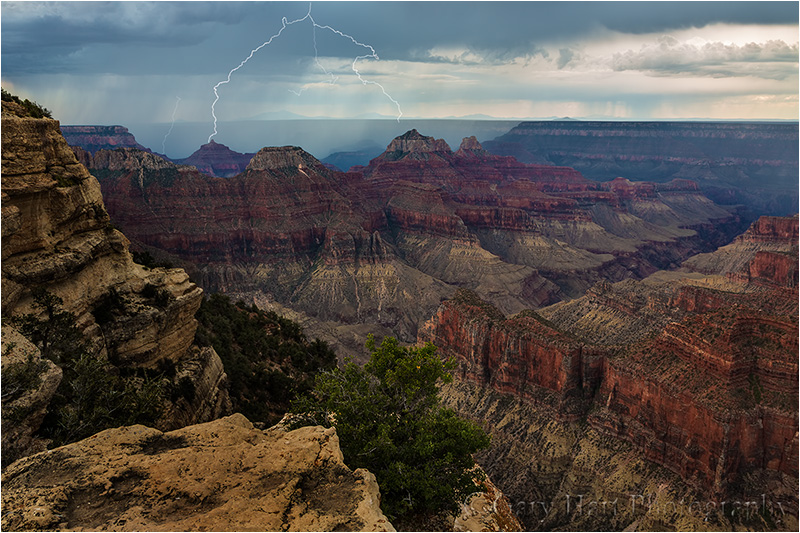
Lightning Strikes Angel’s Gate, Bright Angel Point, Grand Canyon North Rim
* * * *
The bolt was so close that I saw its jagged collision in my rearview mirror, its deafening crack shaking the car less than a second later—three hundred yards, max. “Holy crap!” was our simultaneous (eloquent) response.
Don Smith and I had just negotiated fifteen minutes of natural pyrotechnics unprecedented in our benign, California-sky lifetimes. Obliterating our windshield, flooding the highway, firing warning shots on both sides of the car, Mother Nature was clearly angry at our trespass. This parting shot came just after the rain had eased from opaque sheets to large, individual pellets and we’d started to relax. To these two Californians, rain is a background phenomenon, faint static on the roof and hissing tires on wet blacktop. Earthquakes, which announce their arrival with a rumble and roll that builds slowly enough to allow quick retreat beneath a desk or door jam, are bland compared to the these random explosions that have done their damage and vanished before your brain can register what just happened.
We were in the final miles of a morning’s journey from the Grand Canyon’s popular South Rim to its more isolated North Rim. Safely stashed in the back of the car was the week’s bounty: memory cards, laptops, and backup drives brimming with the Grand Canyon monsoon images we’d come to photograph, including our holy grail, a dozen or so daylight lightning frames apiece. This four-hour detour to the North Rim was a last minute decision with no expectations—whatever we got here would be gravy.
A few minutes later we rolled into the North Rim parking area still buzzing with adrenaline. The thunderstorm we’d just survived had given way to blue skies, so we decided to leave the camera gear in the car and explore. While the lightning was gone, the storm’s rumbling vestiges reminded us not to get too comfortable.
After a quick peek into the Visitor Center to orient ourselves, we headed down to the Grand Canyon Lodge. The cornerstone feature of the lodge, which is perched precariously on the canyon’s north rim, is a large picture window overlooking an expansive deck with an IMAX view across the canyon to the South Rim, ten miles away.
Descending the stairs to the viewing area, we saw people lined up at the window, and stacked two-deep on the deck beyond, all gazing toward the South Rim. It didn’t take long to realize that what had everyone’s attention was a light show dancing across the rim’s entire length. While Don and I had spent the week photographing isolated lightning bolts separated by at least ten minutes, this storm was firing several times per minute. Time to get back to work.
In the short time since our arrival more clouds had organized overhead and Don and I found ourselves dodging juicy raindrops as we hustled back to the car. In less than ten minutes we were tiptoeing back out onto the rim, cameras and tripods in hand. Is this safe? Not only was the storm we were trying to photograph no more than eight miles distant, it was clearly advancing. And there seemed to be other strikes landing much closer somewhere behind us.
Atop a particularly exposed outcrop (with an awesome view!) just below the lodge, I tried to rationalize away all the lightning admonitions I’d read: “Avoid exposed, elevated areas”; “The next bolt can strike ten miles from its last strike”; “If you hear thunder, you’re too close”; “If you see it, flee it”; “If you hear it, clear it”; and so on. At first we set up our cameras as quickly as possible and rushed to (assumed) relative safety beneath a more sheltered ridge while our lightning triggers did the work. But soon, emboldened by the observation that other (presumably lightning-savvy) gawkers were unfazed by the storm’s proximity, we decided to remain with the cameras.
The show lasted about ninety minutes, though the lightning frequency dropped a bit after an hour or so. For variety we’d stay fifteen or twenty minutes at one spot, then move on to a different perspective, eventually making our way all the way out to Bright Angel Point, an elevated knife of limestone sediment protruding a hundred yards or so into the canyon. (In case Bright Angel Point’s elevation and isolation get didn’t get Mother Nature’s attention, the National Park Service has rimmed it with with an iron railing.) And there I stood, as happy as if I had a brain, until the show wrapped up and we went off in search of a sunset location before starting the long drive home.
The above image, taken from the trail to Bright Angel Point, came about twenty minutes into the shoot. The primary bolt is striking Angel’s Gate, about 7 1/2 miles from where I stood. That sounds like a pretty safe distance until you realize that the second fork of this bolt is striking the South Rim near Grandview, also about 7 1/2 miles from Angel’s Gate. The closest strike I recorded that afternoon was about 2 1/2 miles away. I’m sure those with more lightning experience than I will scoff at my hand wringing, and can no doubt share many harrowing tales of far closer encounters, but you gotta walk before you run (and I reserve the right to chuckle as I unpeel them from beneath their desk when that 5.0 tremor strikes.)
For those keeping score at home, here’s the final tally: Gary 51 (bolts), Lightning 0 (photographers).

 Eloquent Images by Gary Hart