Eloquent Images by Gary Hart
Insight, information, and inspiration for the inquisitive nature photographer
Too Much of a Good Thing
Posted on March 10, 2026

Snowfall, Upper Cascade Fall, Yosemite
Sony a7R V
Sony 24-105 G
2.5 seconds
F/11
ISO 100
Greetings from Iceland! And no, despite appearances to the contrary, this image is not Iceland (or even Snowland), it’s Yosemite. (Actually, if you know Iceland, the “not Iceland” giveaway would be all the trees.)
People ask me all the time, what’s the best season to be in Yosemite? While I honestly can’t pick a “best” Yosemite season, I can say that each season in Yosemite offers its own set of good things that distinguish it from the other seasons. Even my least favorite season—yes, I can give you a least favorite Yosemite season—has many good things that I feel fortunate to have witnessed.
My least favorite is easy: summer. Summer is when the crowds swarm every square inch of Yosemite Valley, the waterfalls and meadows dry up, and the sky is chronically blank. But summer is also the only time Yosemite’s high country—Tuolumne Meadows, Olmsted Point, Glacier Point, Sentinel Dome, Taft Point, and the breathtaking High Sierra backcountry—is easily accessible.
While spring is when the tourists start returning to the park after their winter hiatus, it has enough booming waterfalls, fresh green meadows, reflective vernal pools, and ubiquitous dogwood blooms to make the increasing crowds (more than) tolerable. Spring is the Yosemite of postcards and calendar pictures, and probably the best season for first-timers.
In autumn, the now depleted snowpack has completely dried, or at least slowed to a trickle, Yosemite’s heralded waterfalls. But that diminished flow means the low and slow Merced River splits the length of Yosemite Valley like a twisting, reflective ribbon. Adding to these reflections a surprising abundance and variety of fall reds and golds elevates autumn to my personal favorite Yosemite season for creative photography.
That brings me to Yosemite’s most variable of seasons: winter. Come to Yosemite during a dry winter and you’ll find lots of dirt, bare deciduous trees, dry meadows, and unimpressive to nonexistent waterfalls. On the other hand, with the exception of the last couple of weeks in February, Yosemite in winter is refreshingly serene—and even late February’s Horsetail Fall mayhem doesn’t compare to the summer swarms. And even at its worst, winter reflections are quite nice, and it’s still Yosemite (El Capitan, Half Dome, et al haven’t gone anywhere), so I’ll take even the driest Yosemite winter without people over the nicest summer day.
But a Yosemite winter at its best is a sight to behold. Winter is Yosemite’s wet season, making it the best season for capturing a clearing storm. Most of the precipitation in Yosemite Valley falls as rain, but if you’re fortunate enough for your Yosemite visit to coincide with a cold storm that smothers Yosemite Valley in white, you’ll see it at its hands-down most beautiful. And while you may find yourself sharing this beauty with other ecstatic photographers, even the slightest threat of inclement weather seems to repel virtually all tourists.
Falling snow does introduce a host of difficulties that include: limited to impossible access to certain locations, treacherous driving, the potential for chain requirements (usually limited to vehicles without 4WD/AWD), and clouds temporarily shrouding Yosemite’s soaring monoliths and waterfalls. Not to mention the difficulties inherent to photographing in snowy conditions. But if you can overcome these hardships, the payoff is worth it.
The thing is, to witness Yosemite’s fresh-snow majesty, you need to be present among the falling flakes, no matter how cold the temperature or poor the photography. That’s because swirling clouds of a clearing storm vanish so quickly, and the trees start shedding their white coats almost the instant the sun comes out—if you wait until you hear it snowed in Yosemite Valley before rushing to the park, you’re too late. In fact, even if you’re actually present in the park and simply retreat to the shelter of your hotel room or a valley restaurant until the clearing starts, you risk missing some or all of the best stuff.
Living less than four hours from Yosemite Valley, monitoring the Yosemite forecast gives me enough advance notice to get to the park while the snow is still falling. In other words, it’s not by accident that my galleries are filled with so many Yosemite snow images.
But sometimes I just get lucky. Scheduling workshops a year or more in advance means no clue what the conditions will be—the best I can do is try to maximize the chances for something. Horsetail Fall happens in mid to late February, but all the tumblers clicking into place is never guaranteed. Similarly, while I know February is one of the most likely months for snow in Yosemite Valley, no snow is always more likely—but that doesn’t keep me from wishing. (As much as I hope for ideal Horsetail Fall conditions for my workshop—lots of water in the fall and unobstructed sunlight at sunset—I’ll take snow any day.)
This year’s Yosemite Horsetail Fall workshop, which wrapped up just a week before I departed for Iceland, fulfilled those snow dreams many times over. How much snow did we get? Look at the picture above, and consider that it came on our first day, at our second photo location, and that at least two more feet above what you see here fell before the workshop finished.
The compactness of Yosemite Valley, combined with lifetime of Yosemite visits, enables me to adjust my plans on the fly in rapidly changing conditions. On that first afternoon, with a moderate snow falling in the valley I expected poor visibility, so my original plan was to start at Bridalveil Creek, where we could photograph nearby scenes. But when I saw that Bridalveil Fall and El Capitan were still visible despite the falling snow, I headed straight to Valley View.
We enjoyed about 30 minutes of quality photography there before the ceiling dropped and erased everything more than a few hundred yards away. I quickly collected the troops and we beelined up Big Oak Flat Road to Upper Cascade Fall, which I was confident would provide the best combination of photogenic scene that was close enough to still be visible.
I was actually a little surprised to find the top segment of this multitiered waterfall (upper left corner of the image) slightly obscured by the falling snow—fortunately it was visible enough to still be worth photographing. Our biggest challenge turned out to be a strong breeze blowing snow straight down the mountainside and directly onto the front element of any lens trained on the scene.
Normally I shield my camera with an umbrella in rain and snow, but the wind made using an umbrella problematic, so I switched to Plan B and pulled out the large microfiber cloth that lives in my camera bag. While composing, metering, and focusing, I just ignored the snowflakes accumulating on the front of my lens. When everything was ready, I wiped the lens clean, then draped the cloth over it while waiting for my 2-second timer to count down (have I mentioned lately how much I hate Sony’s cable and Bluetooth remotes?), whipping the cloth away at the latest possible instant before the shutter clicked. I continued this way through a series of compositions, until I was confident I’d captured something worthy of processing.
Turns out, this was just the first of many spectacular shoots my group enjoyed. As the workshop continued and we handled every single discomfort and inconvenience the storms served up, all while watching the photography just keep getting better and better, I became more and more convinced that there was no such thing as too much snow in Yosemite, and just kept hoping for more. And more, and more, and more…
On the afternoon before our final day, just as I started believing nothing could go wrong, the National Park Service said, “That’s enough,” and closed the park. I was stunned, and for some reason recalled the time my college baseball team, while on a roadtrip to a distant city, was gorging at an “all you can eat” buffet—until the manager came out and informed us, “That’s all you can eat.”
Even though we were shut out of the park for the workshop’s final day, we still gathered for one last image review on that final day. Based on the images shared, and the excitement everyone had with all of their captures, no one was too disappointed. It was almost as if we all felt that, given what we’d seen so far, to expecting more might just be a little greedy.
I couldn’t agree more. And honestly, despite missing a day and not having access to every location, I have to say this turned out to be one of the most photographically successful workshops in my 20 years leading photo workshops.
Workshop Schedule || Purchase Prints || Instagram
Yosemite Snow
Click any image to scroll through the gallery LARGE


Yosemite and the Joys of Spring
Posted on May 15, 2025
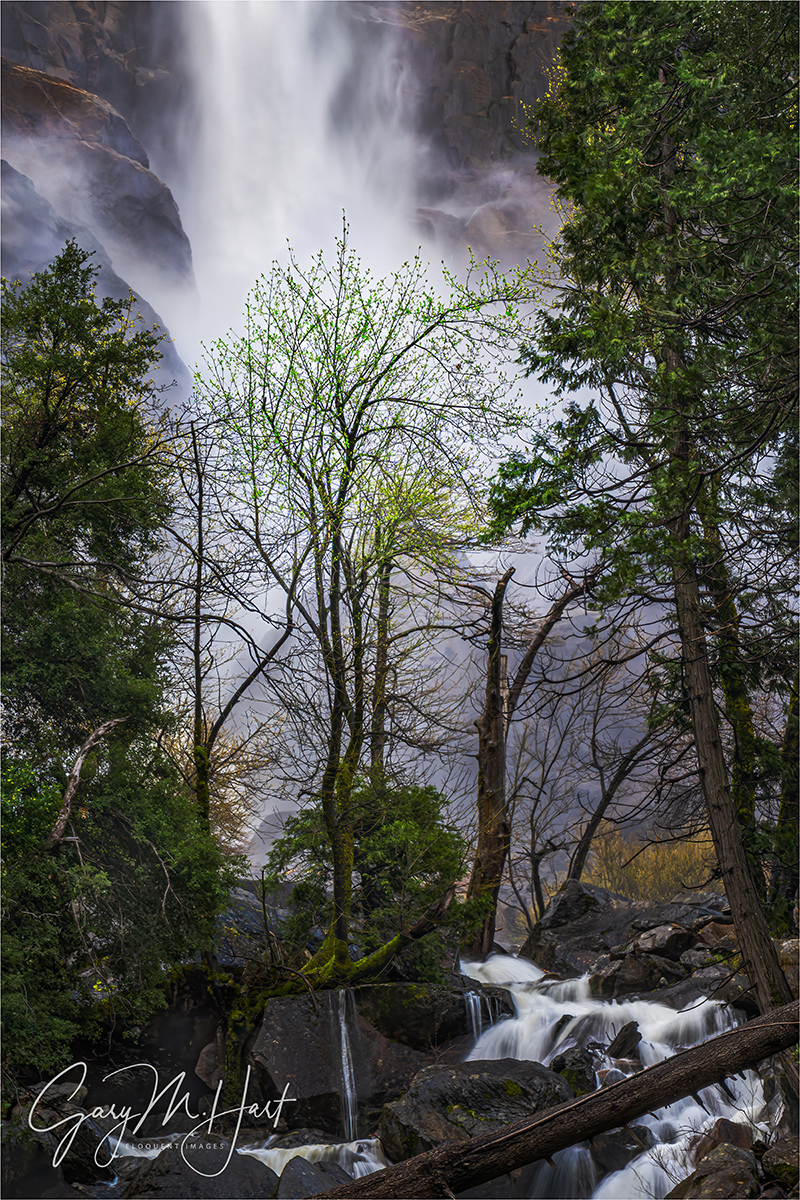
Tree and Bridalveil Fall, Bridalveil Creek, Yosemite
Sony a7R V
Sony 24-105 f/4 G
ISO 200
f/16
1/5 second
Probably the number one question I’m asked about Yosemite is, “What’s the best season for photography?” My response always sounds as if crafted by a waffling politician, but I swear I just don’t have the absolute answer everyone wants. And since I get to photograph Yosemite far more than the average photographer, and have for many years, my priorities are quite likely different than those of the average photographer.
I can say that my least favorite season is summer, because that’s when the waterfalls dry, the sky suffers from a chronic case of the blues (great for tourists, not so much for photography), and tourists swarm the park like ants to ice cream on pavement. But even summer offers beauty not possible any other season, mostly in the form of High Sierra splendor. Closed by snow most of the year, (usually) by late spring the high country roads to Glacier Point and Tuolumne Meadows have opened vehicular access to the exposed granite, wildflower-sprinkled meadows, gem-like lakes, and all the other pristine joys of Yosemite’s incomparable backcountry. And while Yosemite’s high country isn’t quite the respite from crowds it once was, its wide open spaces make solitude still much easier to find.
My own personal favorite season for creative photography is autumn. Though the waterfalls have dried completely or (at best) dwindled to a trickle, in autumn Yosemite Valley’s abundant assortment of deciduous trees throb with yellow and red. Adding to this varied color are mirror reflections in the Merced River, which has been slowed to a crawl along the length of the valley. As an added bonus, by the time the color arrives (mid/late October), dry waterfalls also mean most of the crowds have disappeared.
Winter is probably Yosemite’s most photographically variable season. Show up on a blue sky day in the midst of an (not uncommon) extended dry spell, and you’ll likely find brown meadows, trickling waterfalls, and dirt instead of snow. But arrive during or shortly after a snowstorm, and you’ll enjoy Yosemite Valley at its hands-down most beautiful—arguably one of the most beautiful sights anywhere on Earth. And since winter is the heart of California’s rainy season, the swirling clouds of a clearing storms are never more likely—even when the temperatures aren’t cold enough in Yosemite Valley to turn the rain to snow. Winter (specifically, mid/late February) is also when Horsetail Fall might turn molten red at sunset. Then there’s the rising full moon, which aligns most perfectly with Half Dome only in the winter months.
Yosemite in spring is all about the water—the season when the vertical granite can’t seem to shed the winter snowpack fast enough. Not only are the spring views dominated by well known Yosemite, Bridalveil, Vernal, and Nevada Falls, a seemingly infinite supply of ephemeral falls appear as well for a few weeks or months each spring. Rainbows on the waterfalls, dogwood everywhere, and reflective vernal pools decorating the meadows offer enough beauty to thrill tourists and photographers alike. All that water, paired with fresh green foliage, make spring the time I recommend for first-time visitors—it’s simply the season most likely to live up to expectations, and the least likely season to disappoint.
I stress about the conditions for my students before every workshop, but spring is the least stressful season for me because in Yosemite, there’s just no such thing as a bad spring day. Even though this is a relatively down year for the snowmelt that feeds the falls, last month’s Yosemite Waterfalls and Dogwood got a firsthand taste of all the joys of a Yosemite spring: plenty of water in all the falls, still pools dotting the meadows, and dogwood approaching peak bloom. And despite more clouds than usual, we had enough sunlight to photograph waterfall rainbows from four locations: three from different views of Bridalveil Fall, and one at the base of Lower Yosemite Fall.
One spot I never miss in spring is Bridalveil Creek, which offers an infinite number one-0f-a-kind scenes despite being in the heart of one of the most photographed locations in the world. Autumn is my favorite time to photograph Bridalveil Creek because I can add colorful leaves to the chain of cascades and pools beneath the fall, spring is a close second. While the creek in autumn seems to linger between each cascade, in spring it’s in far too much of a hurry to dally among the rocks.
Because of the intimate setting, its lack of a single obvious subject, and the sheer number of compositional elements begging to be composed into an image, I usually wait until the final day to bring my groups here. By then, everyone has refamiliarized themselves with their cameras, benefited from several days of training and image reviews, and had ample opportunity to get their creative juices flowing.
As usual, I started this group’s final morning at Bridalveil Creek, arriving just as the sky brightened ahead of the rising sun. Because this is an area to wander rather than stick together and photograph as a group, I began with a pretty thorough orientation, then set everyone free. I spent nearly an hour without my camera bag, just walking around trying to reach everyone to answer questions and make sure they were happy. Satisfied that all was well, I walked back to my car and grabbed my camera bag to see what I could find in the nearly one hour remaining.
I often head to the third bridge and work my way to some larger cascades (or small waterfalls) upstream; other times, especially when the group seems to require more help, I just shoot from one of the bridges. But this time I took advantage of a new gap in the trees that opened a new view of the fall just upstream from the third bridge. I’d been especially drawn to a young tree with brand new leaves, and envisioned juxtaposing it against the explosive white mist at the base of the fall. Three or four others in the group were working this scene, so I worked around them and finally ended up with the composition I’d visualized earlier.
With my 24-105 lens I started quite a bit wider, and gradually tightened my compositions as familiarity with the scene’s nuances enabled me to eliminate things. The patterns at the base of the wall changed continuously, so once I found a composition I liked, (true to form) I photographed it more than a dozen times, at several shutter speeds, to give myself a variety of water patterns and blur effects.
Join Me In Yosemite
The Joy of a Yosemite Spring
Click any image to scroll through the gallery LARGE


Isolate and Conquer
Posted on November 8, 2024

Autumn On the Rocks, Bridalveil Creek, Yosemite
Sony α1
Sony 100-400 GM
3.2 seconds
f/16
ISO 200
This year marked my second autumn visit since the reopening, and everything still feels gloriously new to me. Arriving at Bridalveil Creek on the final morning of last week’s Yosemite Fall Color photo workshop, I started with a brief orientation, then guided the group along the main trail, pointing out the many photography opportunities here. I wrapped up the introduction by inviting anyone who doesn’t mind a little bush-whacking and rock scrambling to follow me to one more spot.
Off the beaten path and often jammed with fallen trees and branches, the scene here is a little different each time I visit. The amount of water in the creek varies, as does the number of leaves on the ground and in the pools. This year the water was nice, but the leaves hadn’t quite reached peak blanket status. But these annual variations are part of what I love about photographing here.
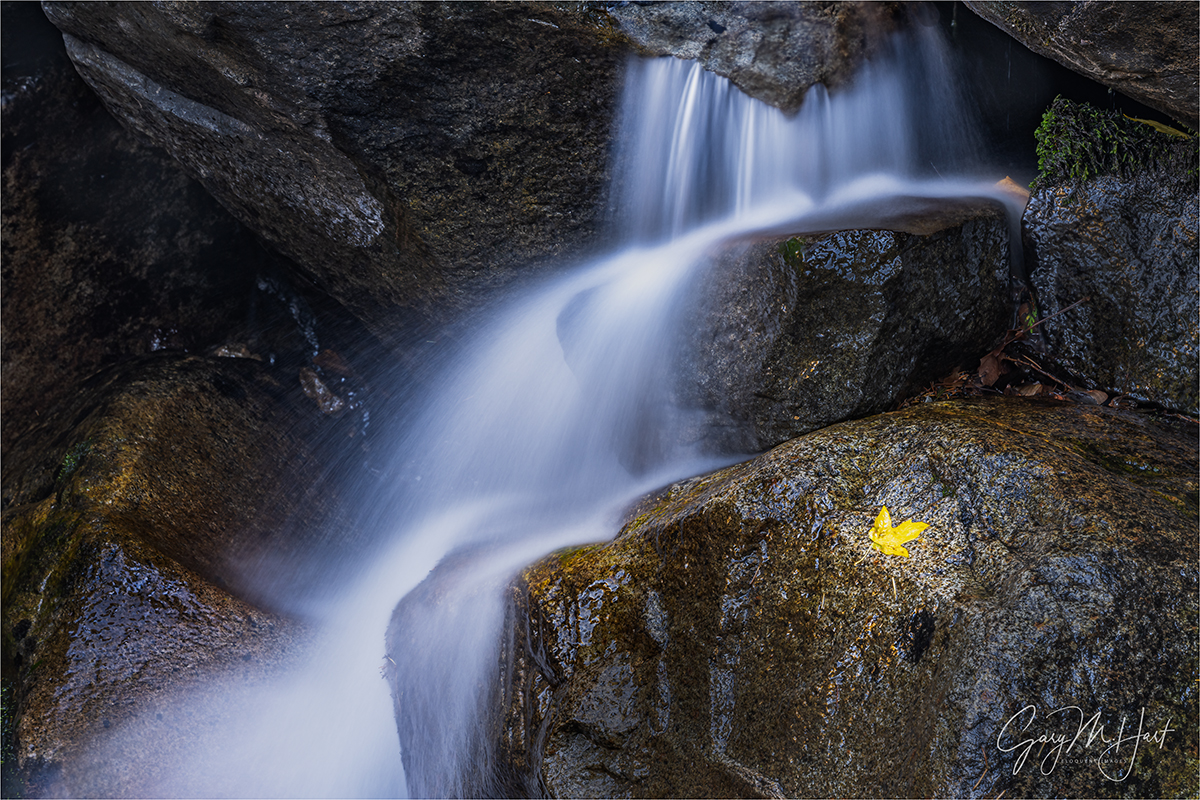
Autumn Leaf and Cascade, Bridalveil Creek, Yosemite
Sony α1
Sony 100-400 GM
8 seconds
f/16
ISO 100
Probably my favorite thing to do at Bridalveil Creek is to find a leaf or leaves swirling in a pool and capture their colorful spiral with a long exposure. But when I couldn’t find any candidates for swirling color on this visit, I went to Plan B and scanned the scene for a leaf I could isolate. Despite lots of beautiful yellow leaves overhead, I only found two candidates on the ground.
Usually I try to get within 10 feet of subjects like this, because the closer I am, the more even a small amount of repositioning affects my foreground/background relationships. But closer access to these leaves was blocked by water, rocks, and downed branches (plus I didn’t want to risk getting in someone else’s frame), so I put away my 24-105 lens in favor of my 100-400, and went to work from an open vantage point about 30 feet back.
As I worked this scene, I couldn’t help remembering that every time I share an autumn image from Bridalveil Creek in Yosemite, I need to brace for the questions: some version of, “Did you place that leaf there?” Usually the tone is friendly curiosity, but sometimes it includes an undercurrent of suspicion bordering on accusation. While these questions are an inevitable part of being a nature photographer, I suspect that I get more than my share because I aggressively seek naturally occurring subjects to isolate and emphasize—and Bridalveil Creek in autumn has them in spades. But regardless of the questioner’s tone, my answer is always a cheerful, unapologetic, and honest, “No.”
I digress
We all know photographers who have no qualms about arranging their scenes to suit their personal aesthetics. The rights and wrongs of that are an endless debate I won’t wade into, other than to say that I have no problem when photographers arrange their subjects openly, without intent to deceive. But photography has to make you happy, and I create my photographic happiness by discovering and revealing Nature, not manufacturing it. I don’t like arranging scenes because I have no illusions that I can improve Nature’s order, and am confident that there’s enough naturally occurring beauty to keep me occupied for the rest of my life.
Order vs. chaos
Nature is inherently ordered. In fact, in the grand scheme, “Nature” and “order” are synonyms. But humans go to such lengths to control, contain, and manage the natural world, we’ve created a label for our failure to control nature: chaos. Despite its negative connotation, what humans perceive as “chaos” is actually just a manifestation of the Universe’s inexorable push toward natural order.
Let’s Take a Trip…
For example, imagine that all humans leave Earth for a scenic tour of the Milky Way. While we’re gone, no lawns are mowed, no buildings maintained, no fires extinguished, no floods controlled, no Starbucks built. Let’s say we return to Earth in 100 years*. While the state of things would no doubt be perceived as chaotic, the reality is that our planet would in fact be closer to its natural state. And the longer we’re away, the more human-imposed “order” would be replaced by natural order.
* Since this is my fantasy, I’ve chartered a spaceship that accommodates all of humankind and travels at 90 percent of the speed of light. While Earth has indeed aged 100 years during our holiday, we travelers return only a year older. (Dubious? Don’t take my word for it, ask Albert Einstein.)
What’s it all about?
Instead of manufacturing false order, I prefer organizing my scenes around naturally occurring relationships in a way that makes the image about something—in other words, finding the natural order and interpreting (translating) it in a way that resonates with humans. To distill this natural order from perceived chaos, nature photographers have a couple of compositional tools in our creative toolbox.
With a wide lens and careful positioning and framing, we can guide viewers’ eye with relationships that start in the close foreground and extend to the distant background, connecting elements to create virtual lines that guide the viewers through the frame. I think most photographers are biased toward these wide landscape images because the wider frame is closer to the way we see the scene with our eyes. But going wide also risks introducing unwanted elements that clutter the frame and pull the viewers’ eyes off their prescribed visual path.
Enter the telephoto lens, an underused landscape tool by most (but not all) photographers. A telephoto lens lets us be more surgical in our subject choice by simplifying the scene to its most essential elements that emphasizes our scene’s most prominent feature or features, and eliminates peripheral distractions. Nevertheless, despite the telephoto’s effectiveness, I often catch myself automatically defaulting to my wide lenses. But I’ve learned that those times when I’m struggling to find a shot, the easiest way to reset my creative instincts in the field is to simply view the scene through a telephoto lens, just to see what might be lost in the visual discord of the wide scene.
Still not convinced? In addition to providing a fresh perspective, telephoto lenses offer undeniable, tangible advantages in landscape photography:
- Bigger subject: Bigger isn’t always better, but there’s often no more effective way to emphasize your subject than to magnify it in your frame.
- Isolate: By zooming closer, you can banish distractions and unwanted objects to the world outside the frame, distilling the scene to its most essential elements.
- Highlight the less obvious: Sometimes a scene’s compelling, but more subtle, qualities are overwhelmed by the cacophony of dramatic qualities that drew you in the first place. By all means, shoot the grand drama that drew you in the first place, but take the time to discover the smaller stuff that’s there as well.
- Selective focus: The longer your focal length, the shallower your depth of field. One of my favorite ways to emphasize a subject that might otherwise be overlooked is to render it as the only sharp object surrounded by a sea of soft color and shape.
If telephoto vision doesn’t come naturally to you in the field, try training your eye in the comfort of your own home by opening any wide angle image in Photoshop (or your photo editor of choice), setting the crop tool to 2/3 aspect ratio (to match what you see in your viewfinder), and see how many new compositions you can find. (I’m not suggesting that you shoot everything wide and crop later—this crop tool suggestion is simply a method to train your eye.) But whether you do it in the field, or later in Photoshop, once your eye gets used to seeing in telephoto, you’ll find virtually every scene you photograph has telephoto possibilities you never imagined existed.
Meanwhile, back at Bridalveil Creek…
On this morning, I shot these leaves—one, the other, and both—horizontal and vertical, from wide to tight (horizontal version shared above). I even experimented with a variety of shutter speeds, but it was so dark back here in the early morning shadow beneath towering granite, darkened further by a canopy of leaves, and with a polarizer essential to mitigate the glare on the wet rocks and leaves, that any reasonable ISO didn’t allow a shutter speed that made a noticeable difference in the water’s blur—the water was moving so fast, 1 second and 10 seconds were virtually identical. So I just went with whatever shutter speed I needed to get the exposure I wanted (the fact that I ended up shooting this frame at ISO 200 instead of ISO 100 was just small oversight, left over from earlier shutter speed experiments).
My starting position was more-or-less at eye level with the cascade, putting the leaves more edge-on. Though they were clearly visible, but their classic maple leaf shape was somewhat obscured by the angle of view. So after exhausting all compositional variations, I scanned my surroundings for a higher vantage point and spotted a rock that would take a little effort to scale (nothing dangerous—mostly navigating a lot of downed trees and branches), but that might work if the view from there was unobstructed.
Turns out shifting those few feet was worth the effort, providing a much better angle that clearly revealed the leaves’ shape. I proceeded to run through another series of compositions similar to what I’d done at the first spot.
I’ve learned to wait until the workshop’s final day to take my groups to Bridalveil Creek. The photography here isn’t as obvious as the rest of Yosemite, so as excited as I am to share it, it takes a while for everyone to refamiliarize themselves with their cameras and warm up their creative muscles. This group was no exception, but when we gathered at the cars after the shoot, I heard the same “I could have stayed here all day!” responses I always get at Bridalveil Creek. Me too!
Join me in Yosemite
Workshop Schedule || Purchase Prints || Instagram
Isolate and Conquer
Click any image to scroll through the gallery LARGE


Feeding My Muse
Posted on May 22, 2024
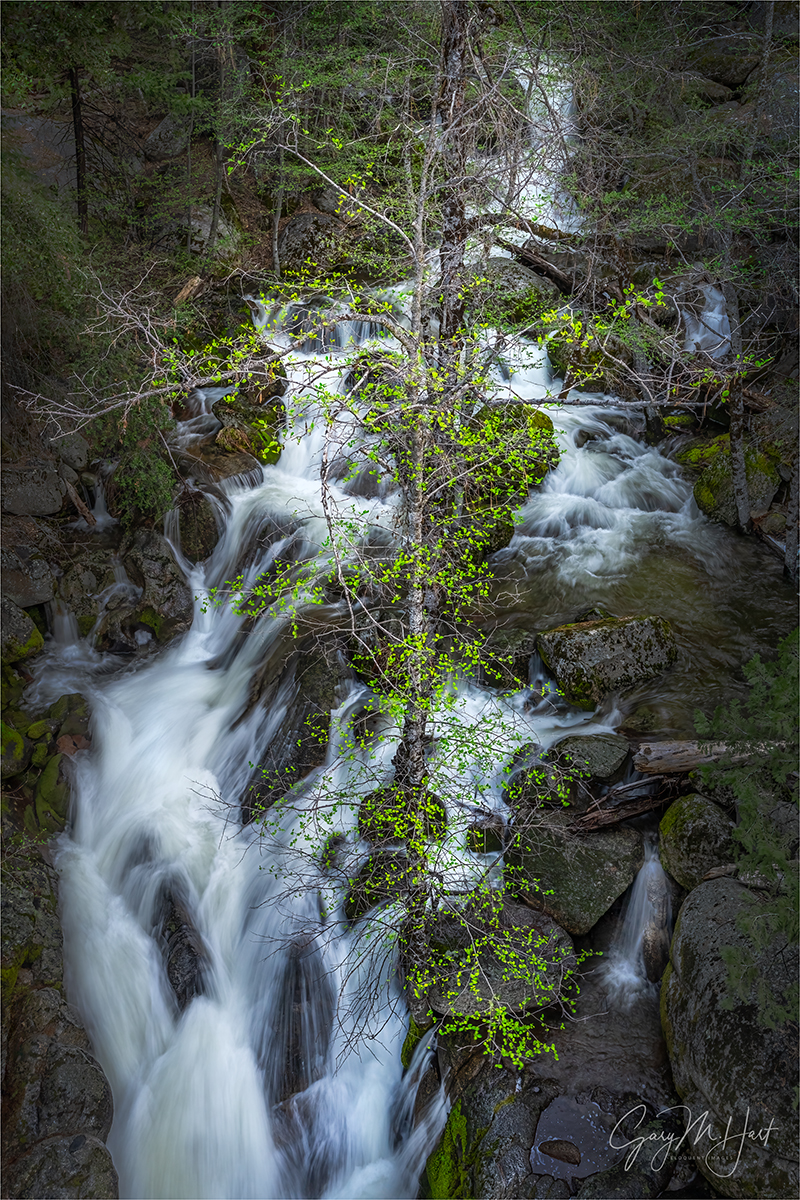
Spring Cascade, Tamarack Creek, Yosemite
Sony α1
Sony 16-35 f/2.8 GM
ISO 800
f/11
1/4 second
Ode to the Coffee Table Book
I grew up in an era when coffee table books were a thing. For decades, these dense rectangular blocks, packed with thick, glossy pages containing far more picture than text, dominated living rooms across America. Whether acquired by purchase or gift, once installed on a coffee table, most coffee table books would rest unopened for years, virtually untouched except by an occasional dust cloth, and maybe a micro-adjustment on the way to answer the door for company. It seems the CTB’s prime function was to generate the illusion of sophistication by enabling its owner to feign interest in a variety of esoteric subjects: the churches Europe, windmills, Iceland’s waterfalls, and so on.
But here’s a little secret. Turns out, many of these books were actually quite enjoyable. Who knew? As a child naive to the hands-off rules, to occupy myself while the adults were busy chatting about boring stuff, I’d sometime heft one of these beefy tomes onto my lap and page through it.
I found myself most drawn to books dedicated to nature and landscapes—pretty much anything with pictures of mountains, forest, desert, or coastline. For many years my attention was solely on the pictures and I paid no attention to the photographer responsible for them. But eventually I became aware that the images I lingered on longest came courtesy of David Muench. While some were in theme-based CTB photo anthologies filled with images from many photographers, I got to where I could instantly identify Muench’s beautiful captures before checking the photo credit. And I was especially excited whenever I found a book filled exclusively with Muench’s beautiful images of the American outdoors: the Southwest, National Parks, the Rockies—it didn’t really matter.
As a child, my analytical skills and photography aspirations were still many years in the future—I just knew I could spend several minutes on each page, visually caressing each mountain, lake, rock, tree, leaf, and flower. In hindsight, I know that my own photography today, both the scenes I’m drawn to as well as the way I approach them, were organically and profoundly influenced by this exposure to David Muench’s images.
Revelation
I’m writing about this because last month I had the good fortune to get my hands (and eyes) on William Neill’s latest book, “Yosemite: Sanctuary in Stone.” The instant I cracked it open, those childhood feelings of profound awe came flooding back, and instantly I was reminded how much, in this age of ubiquitous screens, I miss the tactile relationship with beautiful photography that can only be provided by a large, well-printed book.
Though it would be undeniably true, labeling “Yosemite: Sanctuary in Stone” a book full of pretty pictures would be a gross understatement. The opposite of derivative, Neill’s images are revelatory in their vision, a reminder that, in any scene, there’s so much more to photograph than we see at first glance.
Most of the images Neill shares in this book are intimate portraits featuring interactions of Earth’s more permanent features with its ephemeral elements, such as light, shadow, water, clouds, rain, fog, and snow. Though few depict the recognizable icons we associate with Yosemite (monoliths and waterfalls), each reveals the natural patterns, color, and contrast that makes Yosemite unique, somehow blending all this into coherent scenes that are so simple, it’s hard to believe no one saw them sooner. The product is a celebration of Nature’s most subtle beauty, rendered all the more beautiful because it’s been pulled from obscurity by a photography master. These images inspire me to continue cultivating my own personal vision, and to bolster my creative foundation by spending more time with profound photography like this.
Feeding My Muse
When I set out to write this, my intent was a straightforward piece honoring William Neill’s beautiful book, and acknowledging the role of the muse in its more conventional sense: an external influence that stimulates an artist’s creative instincts. But the more I wrote, the more I found myself leaning toward my own muse as an internal collaboration between a lifetime of external inputs.
Huh? What I mean is, we’re all influenced by the creations of others, and by our general interactions with the world. That influence can be conscious, like my experience paging through “Yosemite: Sanctuary in Stone,” or unconscious, like my childhood exposure to David Muench’s photography, or simply by spending a night on my back beneath a dark sky generously sprinkled with stars. Regardless, all that input is processed by my internal muse and organically output as inspiration: my internal muse.
A successful image happens at the intersection of vision and craft. Craft taps the analytical part of the brain, enabling us to master a scene’s motion, light, and depth through the control of the camera’s exposure variables, as well as command of hyperfocal technique for managing focus. Vision, more than the mere “eye for composition” many photographers talk about, is the ability to conjure unseen possibilities, and to channel the camera’s unique vision to uncover hidden patterns and relationships. Craft can be refined and honed by study and repetition, while vision is more elusive.
This is where I call on my internal muse to blend vision and craft to create (I hope) photographic synergy. But like any creative instinct, the internal muse must be nurtured and fed. I fear that the decline of big photography books like Neill’s has robbed many photographers’ internal muse of a prime source of sustenance. For proof, look no further than the proliferation of derivative photography online, a feedback loop of sameness where Photoshop amplification and AI manufacturing substitutes for inspiration and vision.
Of course taking my muse out into the field is easier said than done. I love sharing beautiful locations with my workshop students, but when I’m leading a photo workshop, my own priorities take backseat to theirs. I can’t explore and experiment the way I do when I’m on my own. But that doesn’t keep me from trying.
Putting My Muse to Work
In April I did two Yosemite workshops that focused on Yosemite at its saturated spring best. Both groups chased rainbows in Yosemite’s booming waterfalls, mirror reflections in the valley’s many ephemeral pools, and pristine dogwood blooms decorating the swollen Merced River. A particular highlight this year was the opportunity to share the Upper Cascades in full flow.
The Upper Cascades vantage point I like is the Cascade Creek Bridge on Big Oak Flat Road, just upstream from the Cascade Creek and Tamarack Creek confluence (which is visible from the bridge). Like most waterfalls, Upper Cascades is best in overcast or full shade. So the open southern exposure, and the fact that overcast is relatively rare in California, makes it difficult to find Upper Cascades in ideal light. And since Upper Cascades is fed entirely by snowmelt, its window of opportunity is very small. So I’m thrilled any time I can make it here when the water’s flowing and the light is soft.
On the visit with my first group, after a brief orientation and getting everyone set up, almost as an afterthought I pointed to the bridge over Tamarack Creek just 50 yards or so up the road, telling them it’s a beautiful little creek, but so overgrown that it’s pretty difficult to photograph. But when I noticed a couple heading that way a little later, I couldn’t help wander up there myself to see what they’d found.
This might be a good time to mention that one exercise I use to stimulate my muse when I’m in the field is to think of specific favorite images that were almost certainly not the obvious shot, then challenge myself to find my own less obvious shot. One of those favorite images is William Neill’s Dawn, Lake Louise, Banff National Park, Canada; another is Charles Cramer’s (wait for it…) Cascade Creek, Spring, Yosemite, captured just yards from where I stood that morning. (William Neill also has his own version of the Cascade Creek tree—not a duplicate and equally beautiful—and I honestly don’t know which came first. I default to Charles Cramer’s because it’s the first one I saw, but I love them both.)
So anyway, scanning my the scene, I was first bothered by a single alder tree, just starting to sport its spring green, right smack in the middle of the scene. Then it occurred to me that I could actually use that tree to anchor my scene. My idea was a wide, vertical composition that placed the tree front and center, with the creek racing down the steep slope directly behind it. After working with it for a while, I decided that, while I really liked the composition, the tree needed more leaves. So I made a mental note to try again in a week, on my second group’s Upper Cascades visit, when the leaves might have filled in more.
And that’s exactly what I did. While not as full as I’d hoped, on that second visit the leaves were definitely more visible than the first time and I went straight to work. Though it’s difficult to tell in a two-dimensional image, Tamarack Creek approaches waterfall steep right here. Since there wasn’t enough light to freeze the water at any reasonable ISO, so I just went all-in on motion blur.
Having already worked out the composition on my first visit, I just ran a range of shutter speeds from 1/10 to 5 seconds. Examining my results as I worked, it quickly became clear that the speeds from 1/5 to 1/2 would be best: faster than 1/5 looked scratchy (still blurred, but not smooth); longer than 1/2, the water started to lose definition. This image used 1/4 second—I chose it because it smoothed the water nicely, while still retaining all the definition that conveys its extreme speed.
Opportunities like this during a workshop are fairly rare because I usually need to put my muse on hiatus to focus on my group. When that happens, my best images are usually the more obvious beauty, such a vivid sunrise/sunset, arcing rainbow, rising/setting moon, or any of the many other natural phenomena nature photographers covet and chase relentlessly. But as beautiful as those special moments are, my muse and I are never happier than the quiet times I get to spend working in subtle light, using my creative instincts to extract a scene’s essence.
Workshop Schedule || Purchase Prints || Instagram
My Muse and I
Click any image to scroll through the gallery LARGE


The Other AI
Posted on April 16, 2024
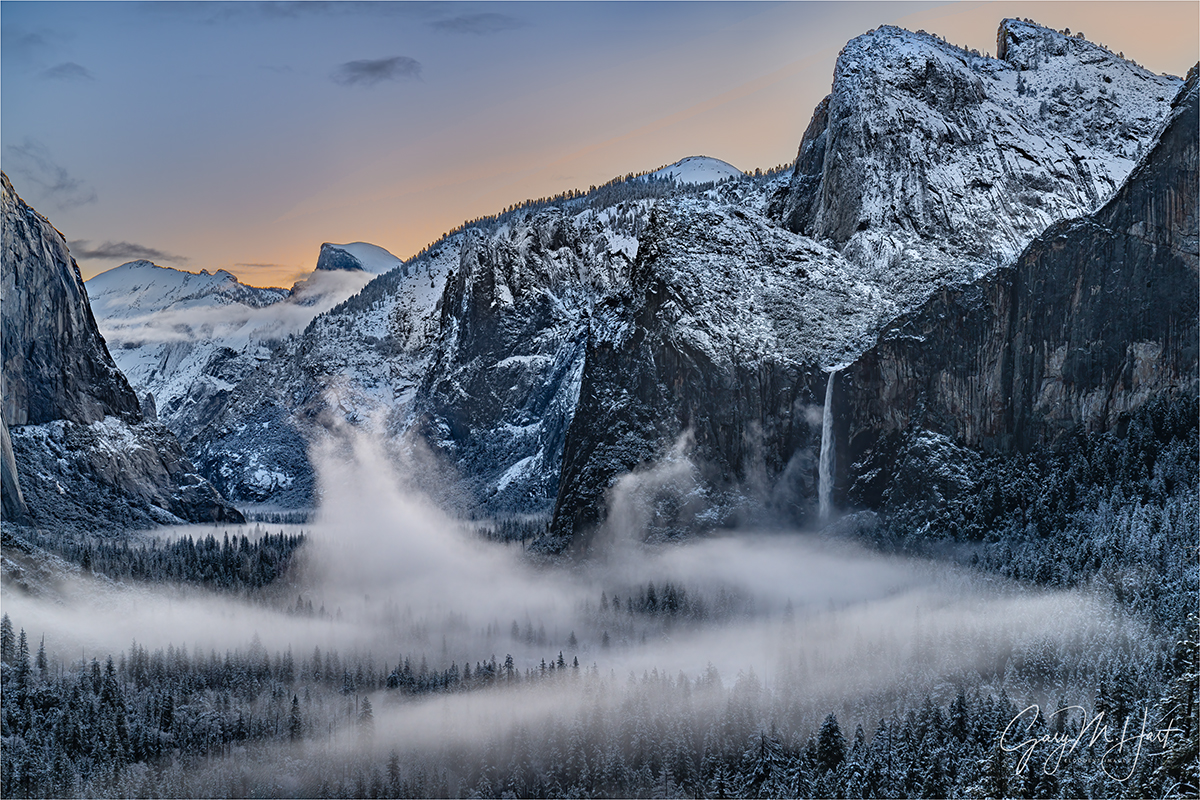
Dance of the Veils, Tunnel View, Yosemite
Sony a7R V
Sony 24-105 f/4 G
ISO 100
f/10
1/10 second
What’s wrong with ACTUAL intelligence (the other AI)?
I love all the genuine eclipse photos popping up on social media—almost as much as I DESPISE all the fake eclipse photos. Though we’ve had to deal with a glut of fabricated photos since the introduction of computers and digital capture to photography (all the way back before the turn of the 21st Century), the advent of artificial intelligence, combined with insatiable social media consumption, has put the bogus image problem on steroids. Despite being downright laughable, these AI frauds seem to fool a disturbing number of viewers. More concerning, many who claim they’re not fooled claim they don’t care because they still find these AI-generated fakes “beautiful.”
Acknowledging that beauty is in the eye of the beholder, all I can do is shrug and offer that my own definition of beauty is founded on truth. Not necessarily a perfect reproduction, or repetition of literal fact, but an overarching connection to some essential reality.
Whether it’s a painting, a work of fiction, a photograph, or any other artistic creation, I need to feel that essential truth connecting the scene, the artist, and me. The reality in a work of art—visual, musical, written, or whatever—doesn’t need to be, in fact usually isn’t, a literal reproduction of the world as I know it. Rather, I prefer artistic creations that reveal a previously unseen (by me) truth about the world. In other words, while paintings are rarely literal interpretations of the world (and in fact can be quite abstract), and novels by definition aren’t factual, the artistic creations I’m drawn to tap the creator’s unique take on reality to expand my own.
Even photographs, once relied on as flawless reproductions of reality, can’t possibly duplicate our 3-dimensional, unbounded, dynamic, multi-sensory reality. But they can, in the right hands, leverage the camera’s reality to expose hidden truths about the world. No matter how “stunning” an AI-generated or dishonest composite (two or more unassociated scenes in one image) image might be at first glance, they lack the artist’s perspective, or any connection to reality, sometimes both. Even worse, counterfeit images pretend to represent a reality that doesn’t exist. While it may be possible for an AI creation to require genuine human insight and creativity, so far all I see is people using AI as a shortcut around actual intelligence.
Of course photographic deception started long before digital capture, but like so many other things computers simplified, digital capture made it easy for people more interested in attention than connection to attract the strokes they covet. At least in the film days, manipulating a photo still required a bit of skill and effort—back then, when it was done honestly, you could at least admire the perpetrator’s skill.
Full disclosure (I digress)
I have to confess that I was actually party to blatant image manipulation at the age of 11, when my best friend Rob and I did a sixth grade Science Fair project on UFOs. In Rob’s backyard (and with help from Rob’s dad), we first photographed a homemade styrofoam “flying saucer” suspended on a wire against a plain tarp. Next, without advancing the film, we photographed our school, then sent the film off to be processed (who remembers those days?).
A few days later, we had a pretty convincing black-and-white print of our school beneath a hovering UFO. But, since our sole goal was to prove how easy it is to fake a UFO sighting, we did reveal the sleight-of-camera trick in our presentation (so no harm, no foul).
The digital dilemma
The introduction of computers to the world of photography, even before digital camera’s were anything more than a promising novelty, created an almost irresistible temptation for photographers who lacked the ethic or inspiration to create their own images. At the time, with no consensus on where to draw the line on digital manipulation, some photographers innocently stepped over the spot where most of us would draw it today.
For example, in the mid-90s, when Art Wolfe cloned extra zebras into his (already memorable) zebra herd image, many cried “Foul!” Wolfe, who had no intent to deceive, was taken aback by the intensity of the blowback, arguing that the resulting image was a work of art (no pun intended), not journalism.
In the long run, the discussion precipitated by Wolfe’s act probably brought more clarity to the broader digital manipulation issue by forcing photographers to consider the power and potential ramifications of the nascent technology, and to decide where they stood on the matter. Expressing his disapproval in a letter to his friend Wolfe, renowned landscape photographer Galen Rowell probably said it best: “Don’t do anything you wouldn’t feel comfortable having fully revealed in a caption.” Great advice that still applies.
Nevertheless, left up to each photographer, the “how much manipulation is too much” line remains rather fuzzy, but I think most credible photographers today agree that it excludes any form of deception. Which brings me back to the absolutely ridiculous eclipse fakes we’ve all been subjected to. I honestly don’t know what upsets me more—the fact that “photographers” are trying to pass these fakes off as real, or the number of people who they fool. (And I won’t even get into the fact that every image and word I’ve shared online has almost certainly been mined to perpetrate AI fabrication—that’s a blog for a different day.)
One risk of that mass gullibility, and people’s apathy about the distinction between real and artificial, is the dilution of photography’s perception in the public eye. As beautiful as Nature is without help, it’s pretty hard to compete with cartoonish captures when a connection to reality isn’t a criterion. I’m already seeing the effects—the volume of enthusiastic praise for obvious fakes is disturbing enough, but even more disturbing to me is the number of people responding to legitimate, creative, hard-earned images with skepticism.
So what can we do?
I’m not sure there is a complete solution to the AI problem, but I hope that enough people crying “Foul!,” on social media and elsewhere, will open eyes and force discussions that might help the public draw a line—just as the zebra debate did three decades ago. If the blowback is strong enough, perhaps even the potential stigma will be enough to discourage AI purveyors and consumers alike.
As much as I appreciate people calling out AI perpetrators in the comments of obviously fake social media posts—I’ll do this occasionally myself when I think I can contribute actual insight that might help some understand why an image is fake—I’m afraid these well-intended comments get so buried (by the “Stunning!” and “Breathtaking!” genuflections) that very few people actually see them. So one step I’ve started taking with every single fake image that soils my social media feeds is to permanently hide all future posts from that page/profile/poster. I’m probably fighting a losing battle, but at least this unforgiving, one-strike-and-you’re-out policy gives me a little satisfaction each time I do it.
About this image
Dance of the Veils, Tunnel View, Yosemite
One thing a still photo can do better than any other visual medium, better even than human vision, is freeze a moment in time. From explosive lightning, to crashing surf, to a crimson sunset, to swirling clouds, Nature’s most beautiful moments are also often its most ephemeral. No matter how much we believe at the time that we’ll never forget one of these special events, sadly, the memory does fade with time. But a camera and capable photographer, in addition to revealing hidden aspects of the natural world, records the actual photons illuminating those transient moments so they can be revisited and shared in perpetuity.
Which was the very last thing on my mind as this year’s February workshop group and I pulled into the Tunnel View parking lot in the predawn gloaming of this chilly morning. Instead, we were abuzz with excitement about the unexpected overnight snow that had glazed every tree and rock in Yosemite Valley with a thin veneer of white.
Our excitement compounded when we saw the scene unfolding in Yosemite Valley below. One of my most frequent Yosemite workshop questions is some version of, “Will we get some of that low fog in the valley when we’re at Tunnel View?” My standard answer is, “That’s only in the Deluxe Workshop,” but they rarely accept that. The real answer is, while this valley fog does happen from time-to-time, it’s impossible to predict the rare combination of temperature, atmospheric moisture, and still air it requires. (It’s much easier to predict the mornings when it absolutely won’t happen, which is most of them.)
But here it was, almost as if I’d ordered it up special for my group. (I tried to take credit but don’t think they were buying it.) Since I’ve seen this fog disappear as suddenly as it appears, or rise up from the valley floor to engulf the entire view in just a matter of seconds, as soon as we were parked I told the group to grab their gear and hustle to the vista as fast as they can. Then I did something I rarely do at Tunnel View anymore: I grabbed my gear and hustled to the vista as fast as I could.
While Tunnel View is one of the most beautiful views I’ve ever photographed, I’ve been here so many times that I usually don’t get my gear out here anymore—not because I no longer find it beautiful, but because it’s a rare visit that I get to see something I’ve not seen before. But since the view this morning, while not unprecedented, was truly special, I just couldn’t help myself. Another factor in my decision to photograph was that here we can all line up together, allowing me to check on and assist anyone who needs help, and still swing by my camera to click an occasional frame. This morning everyone seemed to be doing fine, so I was actually able to capture a couple of dozen frames as the fog danced below.
There were a lot of oohs and ahhs when a finger of fog rose from the valley floor and pirouetted toward Half Dome. There were many ways to photograph it, but I chose to frame it as tightly as possible, ending up with a series of a half-dozen of this particular fog feature before it morphed into something completely different. I included minimal sky because the sky above El Capitan, Half Dome, and Cathedral Rocks was relatively (compared to the rest of the scene) empty and uninteresting.
With the fog continuously shifting, to avoid cutting off any of the zigzag beneath Bridalveil Fall, I had to be extremely conscious of its spread. Depth of field wasn’t a concern because everything in my frame was at infinity. The most challenging aspect was exposure of the bright sky with the fully shaded valley. To get it all, I underexposed the foreground enough to spare the warmth of the approaching sun. The result was a virtually black foreground and colorless sky on my camera’s LCD, but I took special care to monitor my histogram and ensure that I’d be able to recover the shadows in Lightroom/Photoshop.
So, as you can see from my description, I did indeed leverage digital “manipulation” to create the finished product I share here. But my processing steps were designed to brighten the nearly black foreground my camera captured, because exposing it brighter would have resulted in a completely white sky. Since neither a white sky or a black foreground were anything close to our experience this morning, I applied actual intelligence to expose the scene and create an image that more closely reflects this actual (and unrepeatable) event in Nature.
My group rose in the frigid dark and stood bundled against the icy cold to witness this scene and capture permanent, shareable memories of our glorious morning. I imagine it might have be possible for us to have stayed in our cozy hotel rooms, open our computers, and input a few prompts in an AI image generator to come up with something similar (and why not throw in a rainbow, lightning bolts, and rising moon while we’re at it?). But where’s the joy in that?
Ephemeral Nature
Click any image to scroll through the gallery LARGE


The Exception That Proves the Rule
Posted on January 2, 2024
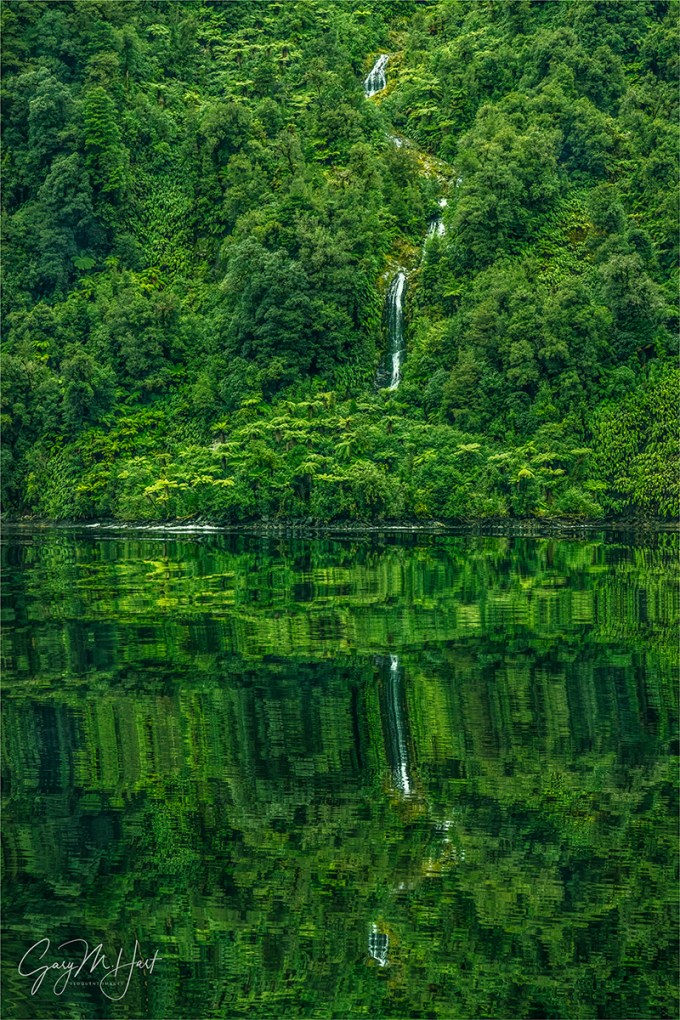
Lush Reflection, Doubtful Sound, New Zealand
Sony a7R V
Sony 24-105 f/4 G
ISO 800
f/8
1/80 second
A few years ago I blogged about shooting sans tripod on my annual Grand Canyon raft trip. You have no idea how large a paradigm shift this was for me, but I tried to rationalize my sacrilege by saying that any shot without a tripod is better than no shot at all. Since then I’ve been a little more willing to forego my tripod when the situation calls for it, but each each time I do only reinforces for me all the reasons I’m so committed to tripod shooting in general.
But I can’t deny that there are times when a tripod just won’t work. For example, sports and wildlife shooters who deal with moving targets can’t be tied down by a tripod. And climbers usually have better things to do with their hands than fumble with a tripod, not to mention the fact that tripods tend to perform less than optimally on a vertical surface. On the other hand, because I only shoot landscapes on solid ground, my own style has evolved to incorporate the tripod’s many benefits, with only extremely rare exceptions.
Part of my landscape-centric, tripod-only approach is a simple product of the way I’m wired—I’m pretty deliberate in my approach to most things, usually tilting toward planning and careful consideration over quick decision making and cat-like reflexes. That likely explains why my sport of choice is baseball, (even though I’m not a golfer) I actually enjoy golf on TV, and prefer chess and Scrabble to any video game (I’m pretty sure that the last video game I played was Pong). It also explains my preference for photographing stationary landscapes—I just need to know that my subject will still be there when I’m ready, no matter how long that takes.
But no matter how stationary the subject is, adding a bobbing boat to the equation pretty much negates the tripod. One example is the Grand Canyon raft trip, which involves many hours each day floating through spectacular, continuously changing scenery, and where every bend in the river advances the story like turning pages in a novel. And every (non-COVID) winter Down Under since 2018, Don Smith and I have done a New Zealand photo workshop, that, among many spectacular solid ground opportunities, features an all day cruise on Doubtful Sound.
Misnamed, Doubtful Sound isn’t a sound at all, but rather a spectacular fiord (FYI, that’s how they spell fjord down there)—a narrow, twisting, multi-fingered ocean inlet lined with towering glacier-carved walls cut by plunging waterfalls. And as if that’s not beautiful enough, consider also the sound’s ubiquitous rainforest green against a background of snow-capped peaks, and you might understand why this breathtaking fiord is near the top of my list of reasons for declaring New Zealand the most beautiful place I’ve ever photographed.
Because I once rigidly proclaimed that I never take a (serious) photo without my tripod, on my earliest Grand Canyon raft trips I settled for low-res, “I was there” jpeg snaps with a waterproof point-and-shoot—fine for social media, but far from the quality a professional photographer requires. But after several years I finally (I’m a slow learner) admitted to myself that I was missing too many great images by only shooting solid ground images, and started breaking out my “adult” camera while floating the Colorado River’s many long stretches between rapids.
So, by the time Don and I started doing the annual Doubtful Sound cruise, I was mentally fortified enough to forego my tripod for a full day without suffering a panic attack. This transition wasn’t without its growing pains—photographing “stationary” landscapes from a moving boat was challenging enough (as far as I was concerned, my subjects were no longer stationary), but me trying to capture, using a camera set-up for tripod-only landscapes, dolphins leaping in our boat’s wake was downright downright comical. The best dolphin images I could manage that first year were of the splashes left after their tails disappeared beneath the water. Since then I’ve just accepted the fact that I’m not a wildlife shooter and have just been content to watch the (thrilling) show—but I do now at least take the time before each cruise to set up my camera for action, just in case…
Thanks to its lofty walls and numerous twists, most of Doubtful Sound is sheltered enough to allow glassy reflections throughout. And given the number of waterfalls plunging into the sound—many that that flow year-round, far more that pop up only after one of the sound’s (frequent) showers—I don’t know if anyone has bothered to name the smaller ones like the one in this image from last year’s cruise.
This waterfall stood out for its verdant surroundings and shimmering reflection. With our boat moving laterally fast enough that the scene changed by the second (my worst nightmare), I moved much more quickly than I’m comfortable to capture it, pretty much just framing and clicking by feel.
Of course this whole experience further underscored why I prefer using a tripod. But it also fortified my resolve not to be limited by my tripod-always-no-exception rule. As this image demonstrates, today’s stabilization and high ISO technology obviates what was once considered the tripod’s primary value: eliminating hand-held motion blur. Despite standing on a rocking boat and shooting at 104mm and 1/80 second, this image really is just as sharp as it would have been with my tripod.
But just as sharp is only part of the quality equation, because capturing it also forced me to compromise by using 800 ISO—far from a dealbreaker, given my camera’s high ISO capability and today’s noise reduction processing tools, but less than ideal. Nevertheless, the thing I most miss without my tripod (or at least, without the stationary world that allows me to use a tripod) is the ability to craft my image and give a beautiful scene like this enough attention to find those extra little somethings that take it to the next level.
As much as I appreciated the ability to fire at will while floating beneath Doubtful’s vertical green walls, the landscape photographer in me missed the ability to savor the scene, and to be the one who decides when it’s time to click, and time to move on. In this case, had my tripod and I been solidly planted on terra firma, I’d have taken the time to study the subtly variegated foliage, identify the most distinctive shrubs and patterns, and monitor the shifting reflection, before framing and clicking. And had I been using a tripod, I’d also have had much more shutter-speed flexibility for managing the scene’s motion—both in the tumbling fall and the undulating reflection.
But alas, none of that was possible in this situation. So I have to settle for being extremely happy that I was able to capture a very small part of what makes Doubtful Sound (and New Zealand) so special.
Don and I would love to share New Zealand with you in person
Workshop Schedule || Purchase Prints || Instagram
The Most Beautiful Place on Earth
Click any image to scroll through the gallery LARGE


Back in My Happy Place
Posted on November 7, 2023
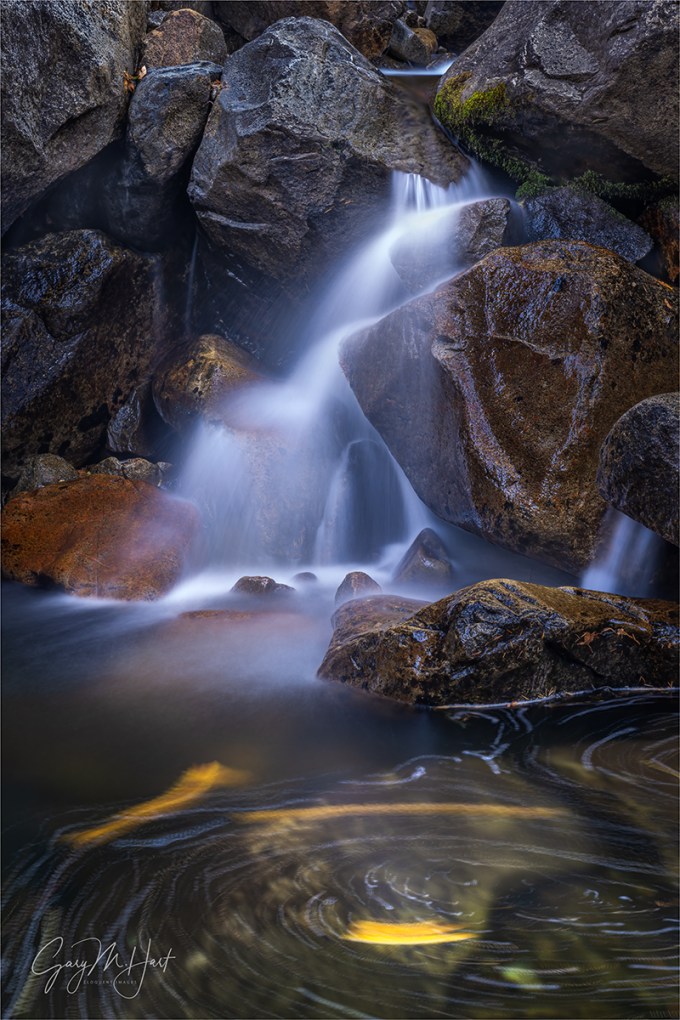
Autumn Spiral, Bridalveil Creek, Yosemite
Sony a7R V
Sony 24-105 f/4 G
ISO 50
f/16
13 seconds
Auroras, lightning, and a volcanic eruption—anyone viewing this year’s images might think my camera and I are most drawn to Nature’s purest drama. But as breathtaking as these phenomena are (they are!), I think I’m happiest with a camera in my hand when I’m working to extract subtle beauty from Nature’s quiet places. Rare, dramatic beauty is an instant stimulant that grabs your eyes and pretty much demands to be photographed. Not so much for the peaceful scenes that subtly soothe, but that doesn’t mean their beauty can’t compete—you just have to work for it.
Extracting photographs from these quiet places combines observation, position, and subtraction: observing to identify the scene’s essential elements; positioning to create relationships between these elements and the camera; subtraction of all that’s not essential through careful framing and/or management of the exposure variables. It’s rarely quick work, but I’m never happier than when I feel like I’ve created a synergy between these components.
My Yosemite Valley happy place has to be Bridalveil Creek. I’m not talking about the nearby view of the fall itself, I’m talking about the area just beneath the fall, where the creek tumbles and pools among granite and maples. Rather than feasting on views of Yosemite’s magnificent monoliths and waterfalls, I come to Bridalveil Creek to meditate and create in Nature’s more understated beauty.
Lacking the most photographed views of Yosemite’s icons, the Bridalveil Creek area probably shouldn’t be the starting point for a first-time visitor. On the other hand, when timed right, this (relatively) peaceful spot does provide a wonderful respite from Yosemite’s teeming masses, as well as ample opportunities to stretch your creative muscles.
Bridalveil Fall is the only Yosemite Valley waterfall that reliably flows year-round, but its volume varies tremendously depending on the season, the prior winter’s snowpack, and the amount of recent rainfall. In spring, Bridalveil Creek is an angry torrent that splits into three distinct channels just beneath the fall, each spanned by its own stone footbridge that provides an excellent platform for photography. In wet years all three channels run year round; in the driest years, by late summer two are nothing but dusty, rounded boulders, with only the east-most bridge offering views of flowing water.
I visit here each time I visit Yosemite, but my favorite season by far is autumn. Whether one, two, or three channels are flowing, by autumn the remaining water has lost the urgency of spring, pausing to rest in still pools before descending the next cascade. And autumn is when the suddenly yellow maples shed a seemingly infinite number of leaves that settle briefly atop rocks, accumulate in nooks and crannies, blanket the forest floor, and drift atop the swirling pools.
I always start my workshops’ final day at Bridalveil Creek, setting my groups free to roam the trail and its bridges, clamber down to the still pools, and rock-hop the cascades in search of inspiration. Early in the workshop many students are still battling their cameras and personal vision, but waiting until workshop’s end to bring my groups here gives everyone three-plus days to settle into the photographic zone that’s necessary to get most of their time here.
I never considered that I might lose this spot until 2019, when the NPS started work on a much anticipated overhaul of the whole Bridalveil Fall area. To speed the work, they decided to close everything (parking lot, toilets, trails, and creek access) while they rerouted the trails, reconfigured the parking lot, and (my favorite upgrade) replaced the aromatic vault toilets with actual flush-toilet bathrooms. Though I was disappointed that I’d have to forego my happy place for a year or (God forbid) two, I rationalized that the promised improvements would be worth the sacrifice. When COVID happened, I resigned myself to maybe another year of waiting.
When the park reopened after the pandemic, and on every visit since, Bridalveil Creek has my first Yosemite Valley stop. And while it always looked like an active worksite (barricades, equipment, and stacked construction material), progress seemed to be frustratingly slow. In fact, despite those signs of activity, I rarely saw any actual activity underway. Even my NPS contact couldn’t give me a date for reopening.
It was more of the same in 2021, 2022, and for my winter and spring workshops earlier this year. So, after seeing no announcement online or in my daily Yosemite news e-mail, I approached this year’s Yosemite Fall Color and Reflections workshop resigned to another year of Bridalveil disappointment. That pessimism was confirmed when I drove by the Bridalveil Fall parking lot Tuesday morning (on my pre-workshop scouting run) and saw it still locked tight with no sign of activity. Sigh.
This was my first trip to Yosemite since early May (I don’t visit Yosemite in summer), and while I was aware of some traffic-flow improvements made to the valley’s east side since my last visit, I had no idea how extensive they’d been. So I decided to make another loop around the park to reset my bearings (it’s never a good look when the workshop leader gets lost), which took me past the Bridalveil Fall area one more time. This time I decided to park and check out the short hike to the creek from the other side—I’ve done this many times, as recently as my previous visit last spring, and have always found the trail fenced off and signage making it very clear they want no one back there. So imagine my surprise (not to mention delight), when I found this side open with full access to the creek! The parking lot and bathrooms were still closed, but I found the trails and all of the bridges open.
On Friday, for the first time in four years, I guided a workshop group back to Bridalveil Creek. As much as I wanted to explore my favorite Bridalveil Creek haunts, I remained on the trail and bridges where most of my workshop group had gone to work. But, as often happens here, one-by-one they set out to explore farther afield, until with about a half-hour before I’d instructed them to be back at the cars, I found myself completely alone on the middle bridge. Though 30 minutes is hardly enough to time do any quality work here, I couldn’t help beelining back to one of my favorite spots—upstream, around a motorhome-size rock, and a quick scramble over rocks and a log down to the water. The last few years before the shutdown this spot had been partially largely by fallen trees, but I was very pleased to see that part of the improvement process had been dead tree removal.
I’d told the group about this spot before we started and thought one or two might still be there, but they’d all moved on and I found myself alone with maybe 20 minutes to work. I’m very familiar with the little cascade back here, and the pool it lands in, but depending on the amount of water and the timing of the fall color, the scene is different each time I visit. Sometimes the leaves form a mosaic on the pool’s surface, but this time I found most of the leaves huddled at the far end and out of the composition that came to me first.
Since speed was essential, I just went with that first composition, which was some version of the cascade tumbling over the rocks and into the pool. (For scale, I estimate that this cascade, from top to bottom, is at least 6 feet and no more than 8 feet high.) I knew that even an exposure of just a second or two would render the cascade as a gauzy veil, and that in the deep early-morning shadow of Yosemite Valley’s south wall, not to mention the trees and an overcast sky, a multi-second exposure would be nearly impossible to avoid. Seeing little flecks of floating foam, I decided to just lean into the long exposure to streak the foam and emphasize swirling motion on the pool’s surface. (I didn’t need a neutral density filter because I was satisfied being in the 10-15 second range by just stopping down to f/16 at ISO 50.)
There was so much sheen on the rocks and glare on the water that a polarizer was essential (and even with polarization maximized, I couldn’t eliminate all of it). The polarizer had the added benefit of revealing submerged rocks that would have been exposed in drier years. As I worked, an occasional leaf would ride the cascade into the pool, or drift down from overhead, to take a couple of laps in the pool before sinking or exiting stage left. No problem—their yellow swirl lasted just long enough to add a final touch to my happy little scene.
Join me for a Yosemite photo workshop
Autumn at Bridalveil Creek
Click any image to scroll through the gallery LARGE


Know Your Subjects
Posted on March 7, 2022

Alpenglow, Kirkjufell, Iceland
Sony a7RIV
Sony 16-35 f/2.8 GM
3 seconds
F/16
ISO 100
One of my personal rules for photography is knowledge of my subjects—I simply get more pleasure from an image when I know something about what I’ve captured. Of the many potential subjects available to a landscape photographer, mountains have always been a particular draw for me. Living my entire life in the shadow of the Sierra Nevada has certainly influenced that connection, as have fond memories of family camping trips in the mountains throughout my childhood, and Sierra backpack trips with friends in my teens and beyond. In college I even majored in geology for several semesters (after astronomy, but before eventually earning my bachelor’s degree in, yawn, economics), and was most interested in the processes responsible for mountain building: tectonics and volcanism.
Kirkjufell, Iceland
Given all this, I guess it makes sense that after returning from last month’s Iceland trip I found myself digging a little deeper into the origins of Kirkjufell, the prominent peak that is arguably Iceland’s most recognizable landmark. Game of Thrones fans who recognize Kirkjufell (Arrowhead Mountain) will be relieved to know that, after several visits over the last few years, I can confirm that the White Walkers appear to have moved on. (But come to think of it, maybe that shouldn’t be much of a relief….)
Kirkjufell rises slightly more than 1500 feet above Breiðafjörður Bay on the Snæfellsnes Peninsula. Given Iceland’s volcanic origins, it would be reasonable to assume that this cone-shaped peak is just one of of the island’s many volcanos. But that assumption would be incorrect. Skeptical? The mountain’s clearly visible parallel strata layers are a giveaway that Kirkjufell is not a volcano. (And viewing from other angles would reveal that Kirkjufell isn’t really cone-shaped either.)
Though many of Kirkjufell’s layers were indeed laid down by lava or explosive debris from nearby volcanos, these igneous layers are interspersed with layers of submarine sediment deposits, each layer a product of the environment at the time of its deposition. Kirkjufell’s base layer was a large lava flow that happened sometime in the last 5 to 10 million years (relatively recently in Earth’s grand geological picture). After that came millions of years of alternating sediment and volcanic deposits, separated by thousands or millions of years for which there’s no record.
This assortment of parallel layers created a horizontal layer cake of strata bearing no resemblance to the mountain we know today (or any mountain for that matter). Because all sedimentary layers are deposited horizontally, and Kirkjufell has a slight SE-NW tilt, it would also be reasonable to assume that at some point since the last layer went down, the entire area to the southeast rose relative to the area northwest.
Once all Kirkjufell’s layers were deposited and tilted, the area was squeezed between two glaciers that carved away most of the surrounding rock, leaving the remaining peak jutting above the glaciers like an island. When the glaciers retreated, the peak we see today remained.
Twilight colors
The other striking feature in this image is the pink that spreads in the shadowless pre-sunrise/post-sunset sky of civil twilight, when the sun is around six degrees or closer to the horizon. Sometimes called the “Belt of Venus,” we get this color because the only the longest, red wavelengths are able to traverse the atmosphere once the sun drops below the horizon.
The interface between the Belt of Venus and the blue-gray Earth’s shadow directly is called the “twilight wedge,” a designation earned because you can sometimes see the earth’s curve in the shadow, with its apex at the anti-solar point (directly opposite the sun). At sunset, the gradual upward motion of the shadow gives the appearance of a wedge being driven into the darkening sky.
About this image
I won’t pretend that there’s anything especially unique about my composition here (and I have the pictures to prove it)—it’s one of those scenes that improves more with conditions than composition, especially if you haven’t been here enough to get really familiar with it.
Because this was the first evening of photography for Don Smith’s and my 2022 Iceland photo workshop, Don and I stayed especially close to the group. From past visits I knew that to align Kirkjufell and Kirkjufellsfoss (the waterfall), you’re pretty limited for places to set up, but we managed to find prime tripod real estate for everyone. I encourage my groups to move around as much as possible, but the thick snow and steep drop to the river further limited our mobility, so we just lined up along the cable barrier between the trail and the drop. And because there were other people besides our group out there, once you landed a vantage point, you were pretty much stuck there until someone moved.
Given the mobility limitations and my desire to align the mountain and waterfall, my composition options were mostly focal length choices. Another, self imposed, compositional limitation was my desire to exclude the footbridge just out of my frame on the left. I like to believe that if I’d have been here by myself, with lots of time to explore, I’d have come up with something a little more creative. But I’m certainly not complaining—between the fresh snow and beautiful sky, the conditions for photography were off the charts and everyone was thrilled.
This image came late in the shoot, just as the twilight wedge reached peak color. By then I was pretty familiar with all my composition options and opted to go with my Sony 16-35 f/2.8 GM lens at 17mm (an my Sony a7RIV body). Turns out my resulting composition is remarkably similar to my northern lights image from later that night, and a sunrise image I captured here 3 years ago. Since I clearly have this composition nailed, I’ll need to challenge myself to find something different next year.


Workshop Schedule || Purchase Prints || Instagram
More Magnificent Mountains


Border Patrol
Posted on January 10, 2021
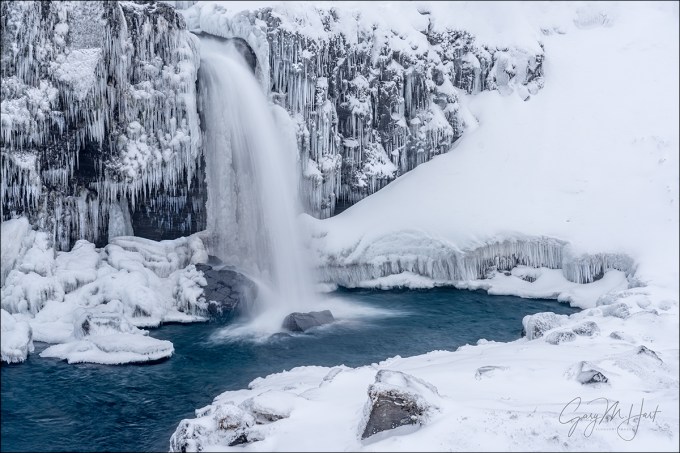
Frozen, Kirkjufellsfoss, Iceland (2020)
Sony a7RIV
Sony 24-105 G
1/2 second
F/9
ISO 200
A year ago Don Smith and I, with the aid of our Icelandic guide (the legendary Óli Haukur), had a blast sharing Iceland’s winter beauty with a great group of photographers. But our trip wasn’t without its challenges. One of our earliest locations was Kirkjufell, arguably Iceland’s most recognizable mountain. While proponents of Vestrahorn might debate this, no one will deny that everyone who visits Iceland wants a picture of Kirkjufell, just as everyone visiting Yosemite wants a picture of Half Dome. And even though Kirkjufellsfoss (the nearby waterfall) is gorgeous and the obvious foreground for Kirkjufell images, the mountain really is the main event here.

Frozen Sunrise, Kirkjufell, Iceland (2019)
So imagine our disappointment on the morning our workshop group visited Kirkjufell and found the mountain completely obscured by clouds. Not only that, the temperature was 25 degrees (F), and a 40 MPH wind made it feel like 5 degrees and turned the sleet into rocketing needles. In other words, it was stupid-cold. Nevertheless, our hardy group geared up, braved the short trudge out to the vista, and went to work without complaint.
While waiting for Kirkjufell to emerge (fingers crossed), I turned my attention to the tiered, multi-channel, ice-encrusted Kirkjufellsfoss. In normal conditions, while waiting for the Kirkjufell to appear it would have been natural to fire off a few oooh-that’s-pretty clicks of the waterfall. But without the distraction of Kirkjufell (or anything else more than 1/2 mile away), I set up my tripod and actually worked the scene like an actual photographer (go figure). And as often happens when I spend quality time with a scene, the longer I worked this one, the more I saw.
Border patrol
With so much going on, the trickiest part of making this image was managing all the scene’s visual elements while minding my frame’s borders. As much as we try be vigilant, sometimes the emotion of a scene overwhelms our compositional good sense—we see something that moves us, point our camera at it, and click without a lot of thought. While this approach may indeed capture the scene well enough to save memories and impress friends, it’s far from the best way to capture a scene’s full potential. So before every click, I do a little “border patrol,” a simple mnemonic that reminds me to deal with small distractions on the perimeter that can have a disproportionately large impact on the entire image. (I’d love to say that I coined the term in this context, but I think I got it from Brenda Tharp—not sure where Brenda picked it up.)
To understand the importance of securing your borders, it’s important to understand that our goal as photographers is to create an image that not only invites viewers to enter, but also persuades them to stay. And the surest way to keep viewers in your image is to help them forget the world outside the frame. Lots of factors go into crafting an inviting, persuasive image—things like compositional balance, visual motion, and relationships are all essential (and topics for another day), but nothing reminds a viewer of the world outside the frame more than an object jutting in or cut off at the edge.
When an object juts in on the edge of a frame, it often feels like part of a different scene is photobombing the image. Likewise, when an object is cut off on the edge of the frame, it can feel like part of the scene is missing. Either way, it’s a subconscious and often jarring reminder of the world beyond the frame.
And there are other potential problems on the edge of an image. Simply having something with lots of visual weight—an object with enough bulk, brightness, contrast, or anything else that pulls the eye—on the edge of the frame can throw off the balance and compete with the primary subject for the viewer’s attention.
To avoid these distractions, I remind myself of “border patrol” and slowly run my eyes around the perimeter of the frame. Sometimes border patrol is easy—a simple scene with just a small handful of objects to organize, all conveniently grouped toward the center, usually requires minimal border management. But more often than not we’re dealing with complex scenes containing multiple objects scattered throughout and beyond the frame.
In this Kirkjufellsfoss scene I had to contend with ice, rocks, snow, and flowing water. The biggest problem was an assortment of randomly dispersed rocks jutting from the snow at bottom of the frame, and a railed pathway visible just above the fall. It wasn’t too hard to eliminate the path with careful placement of the top of my frame, but if my entire focus had been on the waterfall the rocks might have been overlooked. Border patrol. Placing the bottom of my frame a little higher would have cut off the large rock near the bottom-center, an important compositional element that combines with the fall to create a virtual diagonal; placing the bottom lower would have introduced more rocks that I’d have had to cut off somewhere. Instead, I was able find a clean line of snow that traversed the entire bottom of my frame: perfect! (And lucky.)
One other important compositional element that would have been easily easy to overlook is the switchback snow-line that enters the frame at the bottom and exits at the top (or vice-versa). Diagonals like this are strong compositional elements that I love including whenever possible, so I chose a horizontal composition to allow room for each switchback to complete. The eye subconsciously follows lines like this, so cutting them off on the edge of the frame is an tacit invitation to exit the scene, something I try to check for when I execute my border patrol.
Of course nature doesn’t often cooperate and I’m usually forced to chop off parts of visual elements. When I do this, I always want it to be a conscious decision that doesn’t make my viewer think that I’ve cut off something that belongs in the scene, or that something jutting in is part of a different scene. Usually when I have to cut something on the edge (often impossible to avoid), I try to do it boldly, somewhere near the middle of the object, to signal that was my intent and not just an oversight.
I realize because these things are often only noticed on a subconscious level they may seem trivial, but every image is house of cards comprised mostly of small decisions, and you never know which one might send it crashing down.
Epilogue
I did end up photographing Kirkjufell this morning, but didn’t get anything that thrilled me.
Minding the Border
Click an image for a closer look and slide show. Refresh the window to reorder the display.


Out of this World
Posted on May 25, 2020

Fern Cascade, Russian Gulch Fall, Mendocino Coast (2012)
Canon EOS-5D Mark III
Canon 70-200 f/4 L
1 second
F/11
ISO 400
On a quiet spring morning you step from the car and are greeted by electric-pink rhododendrons basking in splashes of early sunlight. Your arms prickle at the morning chill, but you wisely decide to leave the sweater behind, closing the door as softly as possible to preserve the peace. At a mostly overgrown gap in the foliage, you part the branches and step onto a dirt track that leads into the forest.
Following the trail a short distance, you realize you’re witnessing a competition for sunlight, each rhododendron spreading and stretching to get its share, but within a few hundred yards your route descends into old-growth redwoods benefiting from a multi-century head-start. These trees tower above everything, intercepting all but a handful of the sun’s rays, and the rhododendrons have surrendered.
As the trail descends further, you feel like you’re moving back in time. Ducking a spider web that spans the trail, you privately celebrate that you’re the first to pass this way today. Down here, the sunlight has to work harder to penetrate the canopy so the chill remains, but now its invigorating tingle propels you forward.
Before rounding a hairpin bend you pause, inhale, and listen. Gradually, what seemed like absolute silence reveals itself to be breeze-induced swish from swaying redwood boughs. Shortly after your steps resume, a bird’s cry warns the forest of your approach. You’re dropping faster now, but the tap-tap of your feet is dampened by the trail’s powdery surface.
Soon there’s a new sound, subtle and difficult to separate from the wind in the branches. As the trail’s decline moderates, the rhythm of your footfall slows and the new sound finally separates from wind’s gentle swish: rushing water. The creek is nearby but not yet visible. You follow the trail around fallen redwood that nature has repurposed as a giant fern garden and there it is, springing from the dense understory. With the creek comes more ferns and few flying insects, and a smell that’s pleasantly, paradoxically musty and fresh.
Your path parallels the creek now, spongy beneath your feet. You know the sun is well up, but the morning light is subdued, dusk-like. The creek’s music builds with each step, a soundtrack preparing you for something significant. One more bend and you’re facing your goal, a glistening cataract tumbling thirty vertical feet over mossy logs and rocks, framed by ferns.
You’ve arrived at Russian Gulch Fall, deep in the perpetually damp, green hills east of Mendocino on California’s north coast. Down here it’s easy to imagine a world untouched by humans, and finding this eden empty is heaven. The staircase down to the fall is carved into the hillside and almost invisible; the weathered redwood bridge crossing the creek, just downstream, blends with the surroundings to form the ideal platform from which to imagine a prehistoric reality. Even if you’re not so inclined, it’s difficult to be down here without lapsing into something akin to meditation.
About this image
I’ve been to Russian Gulch Fall a number of times, alone and with other photographers. I try to make it to the fall before midmorning, before the sun rises high enough to penetrate the dense redwood canopy and create too much contrast for my camera to capture.
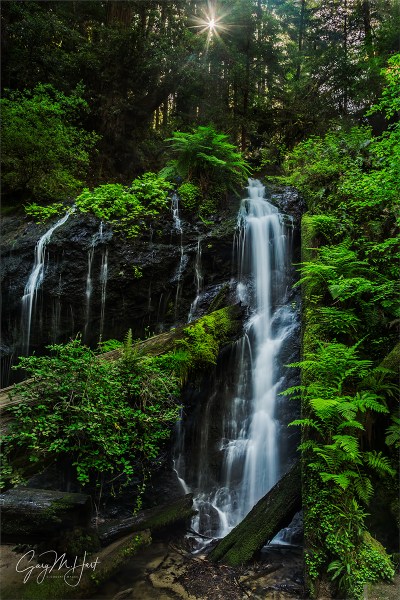
Deep Forest Cascade, Russian Gulch Fall, Mendocino Coast
On this morning I arrived early enough to work the scene for a full two hours before tiny patches of sunlight blighted the forest floor and sent me packing. And work it I did, starting wide and trending tighter as I became more familiar with the scene.
I started by orienting my polarizer, an often overlooked component in a forest water scene like this. Many people think the polarizer’s purpose is to make the sky more blue, but I think its greatest benefit is removing the sheen from foliage and rocks, especially (but not exclusively) when they’re wet. Between the two stops of light lost to the polarizer, and the dense forest dark, achieving a shutter speed fast enough to freeze the water without severely compromising my ISO and f-stop was impossible, so I just went with extreme blur in the water.
The morning air seemed perfectly still, but to guard against an imperceptible breeze nudging the ferns during my exposure, I bumped my ISO to 400. I selected f/11 to ensure front-to-back sharpness, which gave me a one second exposure that created extreme motion blur that I thought made the delicate strands of plummeting water quite nice.
A handful of people came through while I was down there, pausing briefly to savor the scene before continuing on or turning back, but for the most part I had the fall to myself. I photographed until the sun climbed into the treetops, paused a few minutes to bask in the quiet, then started the trudge back to the present.
Keeping the world out
Even when I’m surrounded by people, or signs of human influence, I try to photograph the world as if I’m the only one who has ever been here. It’s not that I don’t like people (I love and need people, as this pandemic has confirmed for me), it’s that I recharge in their absence, and my photography is an extension of that part of me. Whether I’m photographing at a location where I am indeed completely alone, as I was that morning at Russian Gulch Fall, or in the midst of a workshop group, or rubbing elbows with hundreds of gawking tourists (I’m looking at you, Antelope Canyon), I frame my scenes to convey a feeling of solitude.
Many of the images in the gallery below were captured in the presence of others, but the feeling I get from viewing them now is no different than it would be had I been completely alone. While many of my images feature the sky, for this gallery I selected smaller, more intimate scenes that soothe.
Alone in the World
Click an image for a closer look, and to view a slide show.


 Eloquent Images by Gary Hart