Blessings
Posted on February 20, 2023

Aurora Ribbons, Dyrhólaey Coastline, Iceland
Sony α1
Sony 12-24 GM
10 seconds
F/2.8
ISO 3200
I just wrapped up what was no doubt the most intense work/travel stretch of my 17 years leading photo workshops. It started the second week of January with 3 weeks in Iceland leading 2 workshops with Don Smith (with no break in between). After the long flight home (that’s a story for different day), I had just one day to recover before driving nine hours to Death Valley (still very much jet lagged) for another workshop that started the next day. Returning from Death Valley, I actually had a few days to lick my wounds before heading off to Yosemite for my Horsetail Fall workshop (with crowds that make it pretty intense by itself).
I have no one to blame but myself for this schedule (it seemed like such a good idea at the time). And I won’t say that I’m not looking forward to a few weeks off before my next workshop. But honestly, I’d do it all again in a heartbeat. And I should also say that despite appearances to the contrary, I’m actually home far more than I’m on the road, and when I’m home, I’m really home (unless I’m at Starbucks, without a lot of places I’m expected to be. So don’t feel too sorry for me.
The people I get to share my workshops with are constant source of energy and joy that sustains me through these difficult stretches. But today I’m (selfishly) thinking about the bucket-list worthy sights and locations my frequently nomadic life has afforded me. It’s an exercise I try to go through regularly to avoid taking my many blessings for granted.
I’m thinking about this right now because I returned just a few days ago from another Horsetail Fall workshop, where I could be at serious risk of taking for granted a truly beautiful and unique spectacle that I’ve seen literally dozens of times, but that is a genuine bucket list experience for so many others.
One way I try to avoid taking my blessing for granted is to revisit my annual Highlights galleries: 2016, 2017, 2018, 2019, 2020, 2021, 2022. I love creating these galleries not only because the process reminds me of the sights I’ve seen over the past year, but also because it gets me excited for the still unknown sights in the upcoming year. And each time I revisit them, I’m reminded of how lucky I was to have been witness to such beauty. Invariably, after opening a gallery, I’ll find myself thinking, oh wow, surely this was my best year (not necessarily my best photographs—just my best year for the things I got to see), then I go on to another year and have exactly the same thought.
Another thing this exercise makes pretty clear is the things in Nature that excite me most. I’ve always believed that we each make our best pictures when we follow our heart to the subjects we love most. For me that’s locations to which I feel a personal connection, like Yosemite and Grand Canyon, and natural phenomena like weather and all things celestial. Not so coincidently, these are also the subjects I most love studying and understanding.
For the longest time I would say the most beautiful sight I’d ever witnessed was a comet—I just couldn’t imagine anything matching it. Then in 2017 I witnessed a total solar eclipse and that list became two. Then (I bet you know where I’m going here) I saw the northern lights. So now my most-beautiful list is three.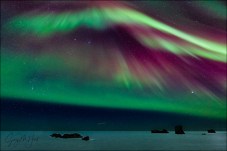
I’ve seen the northern lights many times since that first experience, but that first one always stood out as the best. But Nature always seems to be trying to top itself, and this year it finally managed. The first Iceland workshop group got two consecutive nights with spectacular northern lights shows—the first night at least matching my previous “best,” the second night topping it.
Because I blogged about that night a few weeks ago, I won’t go into all the details. The image I shared in that earlier post was more of a spontaneous capture away from the best scene, simply because the display was so spectacular. The image I’m sharing today is the scene I spent most of the night pointing at because it had the best combination of foreground and aurora display. The dancing lights changed so much from one minute to the next that I could pluck any one of dozens of images from this scene, label it “best,” and get no argument.
Workshop Schedule || Purchase Prints || Instagram
A Few of My Many Blessings


Bonus Blog Post: Horsetail Fall 2023
Posted on February 17, 2023


I returned last night from my Yosemite Horsetail Fall photo workshop and thought I’d briefly share my observations on this year’s experience (since so many people seem to be interested).
First, let’s review
Horsetail Fall is minor waterfall trickling down the east side of El Capitan’s south-facing granite in late winter and early spring, and after a rain. Even when flowing at its best, Horsetail Fall is barely visible from the floor of Yosemite Valley. But for about 2 1/2 weeks in February, thanks to a confluence of terrain and solar alignment, the very last sunset light striking El Capitan illuminates the thin strip of granite occupied by Horsetail Fall. Depending on atmospheric conditions, this light can range from amber to orange to pink to red, giving the impression that the fall has been hit with a colored spotlight. Comparisons to molten lava are apt.
Ansel Adams knew about it and photographed it, but it wasn’t until photographer and writer Galen Rowell started photographing and writing about it did it get people’s attention. When I started photographing Horsetail Fall more than 20 years ago, you could drive up to the best views on either side of the Merced River less than an hour early, find parking, and join a handful of other photographers. But when the media discovered it, Horsetail Fall became a phenomenon. Soon thousands of people were flocking to view it each February evening, praying for enough water and no clouds blocking the sunset light.
For examples of Horsetail Fall through the years, check out the gallery at the bottom of this post. And to read my tips for photographing it, read the Horsetail Fall article in my Photo Tips section.
2023
I can confirm that our wet winter has provided enough snowpack for an at least decent flow in Horsetail Fall through the entire viewing window, which ends late February. The one wildcard in that prediction is the temperature because extreme cold can slow snowmelt and freeze the fall. We saw a little of that on Wednesday evening, when the light was good, but the flow less than what my group saw on Monday because Wednesday’s temperatures were just so cold.
Crowds this year were about normal, which means extreme, but well behaved (friendly and happy) and not a problem for anyone who doesn’t show up at the last minute. I can’t begin to express what a good job the NPS Yosemite folks do to manage the seemingly unmanageable number of people vying for their own view of the Horsetail spectacle.
My advice is to show up at least an hour early—2 hours early is better, but earlier than that is probably not necessary. Come prepared for an easy walk of at least one mile on a flat, paved road. And don’t settle for the first place you see people setting up to view—there are decent places to view from the first parking turnout on the right past Yosemite Valley Lodge, all the way down to the El Capitan Picnic Area.
The farther east you set up, the less straight-up you have to look (better, I think), but the less of the fall you see (it’s more in profile than straight-on). On breezy days, when the fall is blowing, I prefer being more east to better capture the backlit mist; on still days when Horsetail is flowing straight down, I prefer the more straight-on view closer to the picnic area (more west).
And speaking of Monday evening…
Since I bill this as a “Horsetail Fall” workshop, capturing the fall at sunset has to be my priority until it happens. This is always stressful for me because there’s no way to tell in advance whether Horsetail will light up at sunset—for every time it seemed certain to happen but didn’t, I can cite another time when it looked like there was no way it would happen, yet it did. (More on this year’s examples later.)
This Horsetail priority is tough for me because there’s nothing inherently special about the Horsetail Fall photo spots—if you’re position to photograph it and the light gets snuffed, you pretty much end up wasting a sunset. I monitor the weather reports and current conditions and try to make an educated guess, usually erring on the side of being in position (and praying)—since the people in my groups have traveled great distances and paid me money to see Horsetail Fall do its thing, I’d rather go down trying instead of opting for a better sunset spot because I didn’t think Horsetail would light up, only to find out that it did and we missed it. But still…
So anyway, Monday was our first sunset and the conditions looked good. Real good, in fact—Horsetail was flowing nicely (for Horsetail—it’s not a very impressive fall, even with lots of water), and there wasn’t a cloud in the sky. I got my group in place more than an hour before sunset, and we all watched the light warm beautifully, right on schedule.
Sunset this evening was 5:35. On a typical (successful) Horsetail evening, the best light starts about 5 minutes before sunset, and keeps improving until about 5 minutes after sunset, starting out gold, transitioning to orange, and sometimes, if you’re lucky, continuing until it glows an unreal red right before snuffing out.
Much to our chagrin, on this particular evening, the once promising light on Horsetail completely disappeared about 20 minutes before sunset. Since we’re standing on the valley floor with no view of the horizon, we have no way of knowing anything about the position and size of the cloud that has thwarted our dreams, and can only hope that the sun finds a hole before dropping below the horizon.
And hope we did. I tried to display a positive front, reminding everyone of the many times I’ve seen the light return about the time all hope was lost, while simultaneously checking the weather forecast for rest of the workshop on my phone and mentally planning a new strategy: Tuesday, not so good; Wednesday, maybe; Thursday (our last night), maybe.
Then, right around 5:30, the light switched back on and we were suddenly in business. After that, instead of teasing us as Horsetail seems to love doing, the light held strong all the way to the beautiful end. Better still, we enjoyed the entire spectrum of Horsetail hues, up to and including the coveted red, and ecstasy reigned. As did my relief.
With a successful Horsetail Fall experience for our first sunset, I was free to thumb my nose at the Horsetail crowds for the rest of the week, and to share other Yosemite sunset locations in blissful peace. Nevertheless, when the skies cleared on Wednesday, I gave my group the option to reprise Horsetail Fall—7 voted to try something different, and 5 wanted to give Horsetail another shot, so I arranged for those 5 to do their own Horsetail thing while I took the remaining 7 elsewhere. The rogue 5 ended up very happy with their second Horsetail show (though cold temps had cut the flow a bit), while the rest of us enjoyed a gorgeous pink and blue post-sunset Belt of Venus display above Half Dome from Tunnel View.
I think the most interesting story is what happened on Tuesday and Thursday evenings. On Tuesday the forecast called for clouds and a slight chance of snow. When we set up at Valley View about 45 minutes before sunset, the top third of El Capitan was completely engulfed in clouds. Then it started snowing. So imagine my surprise when, about 20 minutes before sunset, the rest of El Capitan appeared and everything suddenly lit up. For about 10 minutes the light was spectacular, and it looked like the Horsetail crowd about 2 miles east was was about to witness another Horsetail miracle—until the light disappeared for good about 10 minutes before sunset. But even though it didn’t happen, this experience was further confirmation that in Yosemite, it’s absolutely impossible to predict the light in 5 minutes based on the light right now. (And why I never, never, never, leave a Horsetail Fall shoot early.)
The second such reminder came Thursday night, when I had my group in place for sunset beneath Half Dome. The day’s forecast called for “increasing clouds.” All afternoon, as promised, Yosemite Valley had been blanketed by a veneer of gradually thickening clouds. About the time I’d accepted that we’d have a non-sunset of pleasant, soft, gray light beneath the cloudy ceiling, Half Dome illuminated as if it had been hit by a spotlight. For 10 minutes or so, right up until sunset, we enjoyed spectacular orange light on Half Dome. I haven’t heard what the Horsetail people beneath El Capitan saw this evening, but it’s quite possible that El Capitan and Horsetail Fall lit up similarly.

Horsetail Fall 2023 and Trees, El Capitan, Yosemite
Sony a7R V
Sony 24-105 f/4 G
ISO 100
f/8
1/4 second
The image above is from Monday evening, right around sunset. You can clearly see the orange turning to pink.

Horsetail Fall 2023 Closeup, El Capitan, Yosemite
Sony a7R V
Sony 100-400 GM
ISO 100
f/8
1/4 second
The second image is from about 3 minutes later, several minutes after sunset, near the peak of the red. The color and light faded soon after this.
Read about photographing Horsetail Fall
A Horsetail Fall Gallery
Click any image to scroll through the gallery LARGE


Distraction Subtraction
Posted on February 14, 2023

Iceberg in Fog, Glacier Lagoon, Iceland
Sony a7R V
Sony 100-400 GM
ISO 200
f/8
1/6 second

Wonderland, Golden Circle, Iceland
Last week’s blog image was an ultra-wide scene chockfull of beauty, ranging from nearby frosted trees and shrubs, to a sky filled with sunset pink clouds, topped with a small dot of moon. It took a bit of work, but I was eventually able to find the position and framing that allowed me to assemble these diverse elements into something coherent.
But because nature doesn’t really care about what we want, photographers frequently must deal with objects we really don’t want or need in our images, or simply can’t make work together. So making a good photo can be as much about what you leave out as it is about what you put in.
Fortunately, we have an array of techniques for subtracting these unwanted elements. One method is careful control of the exposure variables (shutter speed, ISO, and aperture) to disguise or eliminate distracting detail. For example, we can use a long shutter speed to smooth choppy water, a large aperture to soften a busy background, or a silhouette to cloak distractions in black shadow.
But I think the simplest form of distraction subtraction is compositional cropping—shrinking the frame until only the most necessary elements remain. And because nothing shrinks the world better than a long focal length, I rarely leave home without a telephoto zoom—telephoto for shrinking the world, zoom for realtime selective framing.
My midrange zoom lens used to be a 24-70, but I replaced it many years ago with a 24-105. Though 70mm is technically telephoto, I don’t really feel like I’m approaching anything remotely telephoto until I get up to around 100mm. But once i do, I’m actually surprised by how much I appreciate that extra 35mm for the ability to refine my frame it provides. Today I shudder to think about how many images I left unclicked in my 24-70 days, simply because I didn’t take the time to switch to a longer lens when I reached 70mm. (I like to rationalize that I wasn’t really being lazy, I just had failed to discover compositions that would have been obvious had I zoomed a little tighter—it’s likely a little of both.)
For years my fulltime (in my bag at all times) long zoom lens was a 70-200. But after switching to the more compact Sony Alpha mirrorless system, I suddenly had enough room in my bag for something longer. As soon as it was released, Sony’s 100-400 GM lens, while far from tiny, immediately replaced my 70-200. Despite the extra bulk, I find its size manageable enough given the extra focal range control it offers.
I got a firsthand taste of that appreciation in Iceland last month. When Don Smith and I took our workshop groups to Glacier Lagoon, we were surprised to discover far more lagoon than glacier. Normally, large pieces of ice calve from Jökulsárlón Glacier frequently enough to keep the lagoon liberally stocked with floating chunks of ice in a wide variety of shapes and sizes. But prolonged extreme cold in Iceland this year preempted this calving process. There was so little ice, in fact, that the first group didn’t even bother photographing here.
The second group arrived to find the lagoon engulfed in dense fog. There was still not much ice, but through the fog we could see enough floating icebergs on the lagoon’s far side, plus a handful more of small ones a little closer, to photograph. My eye was instantly drawn to the largest, and most distant, iceberg, attracted by its size, shape, and color, plus the way its dazzling blue shimmered atop the relatively calm water.
Without hesitation I reached for my Sony a7R V and Sony 100-400 f/5.6 GM lens. Not only did this long telephoto enable me to nearly fill my frame with the iceberg and its reflection, by zooming out close to 400mm and framing carefully, I was also able to banish a number of small, black birds (that would have mimicked sensor dust in my image), several photobombing indistinct blobs of ice bobbing closer to my camera, and a couple of larger neighboring icebergs I didn’t want sharing the stage with my subject. Tight framing also eliminated most of the bland gray sky and water, keeping only enough to provide contrast for my subject.
One final tip for telephoto landscapes
Because the field of view can be radically different from what my eyes see, when using a telephoto lens, I find it especially helpful to slowly pan the scene with my eye to the view finder until something stops me.
Workshop Schedule || Purchase Prints || Instagram
Telephoto Landscapes


Transcending the Trophy
Posted on February 7, 2023
 Wonderland, Golden Circle, Iceland
Sony a7R V
Sony 12-24 GM
1/40 second
F/11
ISO 200
With the digital-fueled photography renaissance, it seems that the number of trophy destinations has grown proportionally. For example, once no more than an anonymous trickle on El Capitan’s southeast flank, Horsetail Fall now draws thousands of photographers to Yosemite at sunset each February. And long gone are the days of a peaceful midday walk in the quiet coolness of Antelope Canyon.
Because I’ve photographed all of these scenes, and no doubt will continue doing so, I completely understand the urge to bag the trophy shot. They’re trophies because they’re beautiful, and (usually) relatively easy to access. But what puzzles me is why so many photographers pursue trophies to the exclusion of opportunities to create something uniquely their own. To me, the greatest joy of photography isn’t duplicating what others have already done, it’s the search for something new—especially at frequently photographed locations.
That said, I can’t deny that the opportunity to capture a trophy draws many photographers to my workshops. But while I do love helping my workshop students land their trophy, my job doesn’t end there—a significant part of my responsibility is challenging them to not make the trophy shot their goal, make it their starting point. Chances are, I tell them, if a shot is special enough to achieve trophy status, there are lots of other special views and subjects nearby.
Transcending the trophy is a mindset. Once you’ve bagged your trophy, see if you can identify a unique foreground or background, or approach the scene from a different angle. And if the standard view is horizontal, look for something vertical; if it’s wide, try a telephoto—and vice-versa.
And don’t forget that there might be great stuff happening behind you—you’ll never know if you don’t turn around. I try to make a point of checking behind me, but sometimes I need a reminder. For example…
Don Smith and I wrapped up the last day of this year’s back-to-back Iceland photo workshops with an afternoon in the Golden Circle. A recent storm had dumped loads of fresh snow everywhere, a great way to wrap up two fantastic workshops. After spending a couple of hours at massive Gullfoss waterfall, we took the group to Strokkur geyser for our final sunset.
Strokkur is a towering geyser in a beautiful setting. Erupting up to 125 feet every 5 to 10 minutes, Strokkur’s frequency allows many do-overs if you don’t get it right the first (or second, or…) time. This year fast-changing clouds and fresh snow added a new visual dimension I was especially excited to take advantage of.
I think the best shot here is getting the geyser backlit by the setting sun, so I positioned myself accordingly and waited, adjusting my position and composition after each eruption. As the sun set and I prepared for the next eruption, I noticed that our guide Albert Dros was on the other side of the geyser, pointing the exact opposite direction my camera pointed. Normally when I see another photographer not taking what I think is the best shot, I don’t think much of it. But since Albert is such a fantastic photographer, I glanced over my shoulder to see what I was missing. Yikes.
I instantly forgot the geyser, grabbed my gear, and “raced” toward the snow-glazed trees that were now framed by electric pink clouds, and garnished with a dollop of moon. Much to my frustration, the trail was completely coated with ice—since I’d decided to forego the crampons, to avoid falling I could only move about as fast as I do in those dreams when I’m trying to run for my life in a normal speed world, but find I can only move in slow motion (I’m not the only one who has those dreams, right?).
Fortunately, Iceland twilight is slower than any slow-motion dream, and I covered the 50 feet over to this scene with plenty of time to work the composition. I already had my Sony 12 – 24 f/2.8 GM lens mounted on my Sony a7R V, which turned out to be perfect for emphasizing the snowy scene in my immediate foreground, while still maximizing the colorful clouds. Of course this shrunk the moon to almost microscopic proportions—some may disagree, but I kind of love the small moon as a delicate accent to this already magic scene.
Workshop Schedule || Purchase Prints || Instagram
Transcending the Trophy


A River Runs Through It
Posted on January 31, 2023

Sapphire Cathedral, Vatnajökull Glacier Ice Cave, Iceland (vertical)
Sony a7R V
Sony 12-24 GM
.8 seconds
F/18
ISO 50
Among the greatest joys of my photographer’s life is the opportunity to witness rare and exotic beauty I might otherwise have missed. An erupting volcano? Check. The dancing colors of the northern lights? Check. Shafting light in a Southwest slot canyon? Check. Southern Hemisphere night sky? Check. The view from the bottom of the Grand Canyon? Check.
In my California-born-and-raised world, glaciers certainly qualify as beauty both rare and exotic. Fortunately, this photography life takes me to New Zealand, where I get to walk on a glacier, and most recently, to Iceland, where I actually get to walk in a glacier. How cool is that? (Very, actually—no pun intended.)

Sapphire Cathedral, Vatnajökull Glacier, Iceland (horizontal)
Sony a7R V
Sony 12-24 GM
1.3 seconds
F/18
ISO 50
Vatnajökull is the largest glacier in Iceland, and the second largest in Europe. As recently as the 19th Century, Vatnajökull extended all the way to the Atlantic, but thanks to our warming planet, in most places it is now a few miles inland.
As alarming as that is, a consolation prize is the beauty Vatnajökull’s shrinking has produced. Glacier Lagoon is filled with Vatnajökull’s meltwater and decked out in large chunks of calved glacial ice; nearby Diamond Beach is bejeweled with the remnants of the lagoon’s ice; and Sapphire Ice Cave (and its predecessors) was formed in the wake of Vatnajökull’s retreat.
Ice caves are dynamic phenomena that can change noticeably from week-to-week, and over a span of many weeks or months will eventually become unrecognizable. They form when glacial runoff finds, or makes its own, path through glacial ice. Since flowing water is always warmer than the surrounding ice, these voids and channels continue expanding as more ice melts. When the runoff finds a different path, or diminishes in the freezing winter months, the spaces in the ice remain and an ice cave is born (or reborn).
Perhaps the most striking feature of an ice cave is its color. Contrary to popular opinion, this blueness is not reflected color from the sky, but from an inherent quality of the ice itself. Snow is opaque, but centuries of pressure from snow accumulating above compresses the older underlying snow, forcing out air and leaving only translucent ice crystals. As sunlight passes through these ice crystals, all but the shortest visible wavelengths are absorbed, allowing only the blue wavelengths to pass through to bless our fortunate eyes.
Each year Don Smith and I take an Iceland photo workshop group to visit the current incarnation of the Vatnajökull ice cave, and each year it’s completely different. So far it has been in more or less the same location for every visit, but this time, using a bridge across a small creek near the entrance as a reference point, I noticed it had retreated at least 100 yards in the last year. The glacier guides say that within a year or two this cave could be inaccessible or completely gone, requiring them to find another ice cave to blaze a tourist path to. (They’re only open to visitors in winter, one more reason winter is my favorite time to visit Iceland.)
With two Iceland workshops this year (still playing COVID catch-up), Don and I visited the Vatnajökull ice cave twice, 9 days apart. This version is dubbed Sapphire Ice Cave by the guides (earlier versions have been Crystal and Diamond), about 9 days apart. This created a great opportunity to compare, contrast, and witness firsthand the gradual changes that accumulate with time to completely end the cave, or transform it into something brand new.
Iceland’s ice caves can be extremely crowded, making photography difficult. In previous years we’ve started well before sunrise to be the first out there, but this year the morning weather didn’t look good, so we switched to late afternoon to be the last people to leave. To lighten my load for the one-mile walk, I pared my camera bag to nothing but my (brand new) Sony a7R V body, Sony 24 – 105 f/4 G lens, Sony 12 – 24 f/2.8 GM lens, and Really Right Stuff Ascend tripod.
Upon arriving with our second group, rather than start shooting immediately, I took a couple of minutes to survey my surroundings and get a handle on what had changed in the last 9 days. The most obvious difference was the river running through the cave. Recent rain, augmented by warmer temperatures, had created mini (and not-so-mini) springs and even a couple small waterfalls that poured in from intra-glacier reservoirs and streams. And then there were the seemingly ubiquitous and aggressive ceiling drips that (given my many layers) were surprisingly adept at targeting my neck and sliding down my spine. All this water united on the cave’s floor to form the shallow but swift river splitting the length of the main chamber before exiting through the main entrance. (This new river made instantly clear the puzzling presence of a makeshift metal bridge spanning nothing but dry rock and dirt on our first visit.)
Soon other differences came into focus: in addition to the flowing water, I noticed subtly altered curves, a few missing or blunted outcrops, and a handful of overhead portals that provided new views to the sky above. At one point during our visit a small rockslide sent several dozen softball-size rocks crashing about 10 feet from an elevated ice shelf, an instant reminder of an ice cave’s perpetual dynamics (and of why visitors are required to wear helmets at all times in the cave).
Our guide, provided by our Iceland guiding service to assist both workshop groups, was fellow Sony Ambassador Albert Dros (Albert is from the Netherlands; Ambassadors in the US are called Sony Artisans), whose energy is matched only by his creativity (check him out). Albert had most of the group occupied photographing Artie, our ice cave driver/guide (yes, there were 4 guides for 12 workshop participants in the ice cave portion of the workshop: Don, Albert, Artie, and me), whom he had drafted as a model to establish scale for everyone’s images.
With a few minutes to myself, I was both ready and able to begin taking actual pictures. I warmed up by attempting to reprise compositions remembered from the earlier visit. But once I became comfortable with the ice cave’s changes, I moved on to new compositions that emphasized those differences.
I started by concentrating on the waterfalls with my 24 – 105 lens, using long-exposure motion blur to help them stand out. But when I noticed that the view beyond the cave entrance was filled with a nice mix of clouds and sky, I saw an opportunity to highlight the ephemeral river (and to test the dynamic range of the a7R V). Time for my 12 – 24 lens.
Setting up shop on the bridge, I started composing versions of the scene you see here, first horizontal, then vertical. It took a few frames, but I eventually found the combination of position on the bridge, tripod height, and left/right framing (at 12mm) that allowed me to include the new natural skylights on the left (with enough distance from the edge), all of the cave’s entrance (and the sky beyond), plus the ideal balance of river and ceiling.
I wanted to smooth the water enough to eliminate distracting (in my opinion) texture freezing the motion would create. Lacking a neutral density filter for the 12 – 24 lens, I stopped down to f/18 and dropped to ISO 50, which allowed a nearly 1-second shutter speed—just slow enough.
The river was in shadow, but the water’s blueness really came out with the extra light my camera was able to capture. As with the ice cave’s color, the color of glacial water also is not simply reflected sky—or in this case, the ice’s blue. Rather, the water’s color is actually determined by the glacial silt it carries.
To understand this, now might be a good time to mention the counterintuitive truth that even receding glaciers move forward. Gravity carries a glacier downhill, but the glacier can still be retreating despite this downhill motion if it melts faster than it advances. As a glacier moves, embedded rock fragments at its base behave like sandpaper, grinding the rock over which it slides into finer and finer particles, the finest of which is called glacial flour. As the glacial meltwater carries all this scoured rock downhill, the heavier particles soon sink, while the finer glacial flour remains suspended in the runoff.
Most of the light striking water infused with glacial flour is absorbed by the fine suspended particles, but the green and blue wavelengths aren’t absorbed; instead they scatter back to our eyes and we are treated to blue, green, or turquoise water. The exact hue of flowing glacial meltwater is determined by the size of the suspended particles and the wavelengths (color) they scatter.
The product of these glacial machinations is the overwhelming blueness you see here.
BTW
I continue to be blown away by the dynamic range of the Sony sensors. As you may know, I never blend images, so the ability to capture with one click the entire range of tones in a scene like this is extremely important to me. On my LCD (jpeg) preview, the shadows in this image looked nearly black, while the highlights appeared hopelessly bright. But I trusted my histogram and the Sony raw file, and a couple of tugs of Lightroom’s Highlights and Shadows sliders validated that trust.
Join Don Smith and Me in Iceland
Workshop Schedule || Purchase Prints || Instagram
Rare and Exotic Beauty (I Might Otherwise Have Missed)
Click any image to scroll through the gallery LARGE


Lights, Camera, Action!
Posted on January 23, 2023

Wings of Angels, Aurora Above Dyrhólaey, Iceland
Sony α1
Sony 12-24 GM
10 seconds
F/2.8
ISO 3200
A couple of posts back I wrote about Nature’s gifts, natural phenomena that sometimes augment the ordinary enough to defy belief. In that post I cited reflections, relatively ubiquitous phenomena that improve nearly every scene they touch. Toward the other end of the commonness continuum are auroras, colorful lights that dance randomly in the frigid darkness high above Earth’s extreme latitudes.
While everyone has seen reflections, many live their life without ever witnessing an aurora. For most of us, viewing an aurora requires travel at the absolute worst time of year for travel, and then venturing outdoors in the darkest, coldest hours of the day. And even then, there’s no guarantee of success. Some nights the aurora simply doesn’t show up, other (many) nights auroras perform their dance behind a curtain of clouds.
So what’s the deal?
Despite all appearances to the contrary, auroras aren’t magic. Our planet is continuously bombarded by solar energy; a narrow range of these wavelengths (infrared and visible) battles all the way through Earth’s atmosphere to the surface to warm our bodies and light our way. But other wavelengths in the solar wind interact with atmospheric molecules they encounter, stripping their electrons to create ions, which causes a charge imbalance in the atmosphere.
Instead of penetrating the atmosphere to generate havoc on Earth’s surface, most of these ions are intercepted by the magnetosphere, our planet’s protective magnetic shield. The magnetosphere is a teardrop-shaped barrier surrounding Earth—battered by the relentless solar bombardment, its sun-facing side is spread out and compressed to about 6 to 10 Earth radii thick, while the shielded side behind Earth (from the Sun’s perspective) is stretched up to 60 Earth radii into space behind us (beyond the Moon’s orbit).
As Earth rotates inside the magnetosphere, the daylight side at any given moment looks through the wide, compressed region, while the night side peers out toward the extended region. Particles ionized by the sun are pushed by the solar wind from the daylight side of the magnetosphere to the upper regions of the polar latitudes on Earth’s leeward (night) side.
The result of these atmospheric machinations is an accumulation of ionized molecules dancing high in the night sky, creating an atmospheric oval of geomagnetic activity that waxes and wanes with solar activity and the intensity of the solar wind.
The aurora’s color depends on the molecules involved, as well as their location in the magnetosphere. The most plentiful and frequently activated molecules vibrate in the green wavelengths, but reds and blues are possible as well, depending on the intensity and altitude of the activity.
Known colloquially as the northern or southern lights, and more technically the aurora borealis in the Northern Hemisphere and aurora australis in the Southern Hemisphere, to see them you need all of the above: the correct location on or near Earth’s surface, activity in the magnetosphere, and dark, clear skies.
As with terrestrial weather, great effort is taken to predict the aurora, but there’s no such thing as an aurora “sure thing”—the best we can do is put ourselves in position to be as close to the auroral oval on nights with the greatest chance for activity. Planning a winter trip to the high latitudes (the higher the better), like Iceland, is a good start—then just pray for an active sun and clear skies.
Another key to successful aurora chasing is access to and comprehension of the Kp- (or K-) index. The Kp-index is a 0-9 scale of atmospheric electromagnetic activity, with 0 being little or no activity (get some sleep), and 9 being the most extreme activity (don’t forget the sunglasses). Many governments and scientific organizations issue regular Kp forecasts that seem about as reliable as a weather forecast—pretty good, but far from perfect. There are many websites and smartphone apps that will provide you with up-to-date Kp forecasts for your current location—some will even issue alerts. On my iPhone I find the Aurora Pro app essential for both planning and real-time aurora chasing.

Electric Night, Kirkjufell Aurora, Iceland
Last week, armed with all this aurora knowledge, loads of preparation, and a healthy dose of hope, Don Smith and I embarked on the first of this year’s back-to-back Iceland photo workshops ready for action. We’ve had pretty good luck in all of our previous visits, but are wise enough to Nature’s fickle ways not to be too cocky.
After having (what from all reports was) a beautiful display erased by clouds the workshop’s first night, we were blessed with a truly magnificent show at Kirkjufell the next night. Not only did the sky behind the mountain light up, the colorful lights careened about the sky in all directions. On our ride back to the hotel, Don and I agreed that this show rivaled the Glacier Lagoon aurora show on our first trip to Iceland that we considered the best we’d seen so far. The group was happy and life was good.
Departing Snaefellsnes Peninsula for Vik the next morning with a tremendously successful aurora shoot already in the bank, I thought to myself that wishing for anything more would be downright greedy. And since Vik lacks the really great north-facing views that are ideal for photographing the aurora, I wasn’t counting on another northern lights shoot that night.
Nevertheless, because the sky was clear and the aurora forecast was decent, after dinner in Vik we went aurora chasing anyway. Rather than opt for the more sure but mediocre north-facing view, we instead drove to Dyrhólaey, a coastline/ocean vista with nice views in all directions except north. Our rationale was that a truly great display can be viewed in any and all directions, and since we already had our northern lights success in the books, why not just go for broke?
Smart move. An aurora was already blasting so strongly when we arrived that we started photographing the instant we rolled off the bus and didn’t make it out of the parking lot for about 15 minutes. And while the previous night’s aurora display at Kirkjufell rivaled our best ever, this one easily topped it.
Once ensconced at the vista, we spent most of our time photographing westward, where the view up the coastline was the best available, and from where a persistent series of brilliant red and green beams radiated. Very much aware that the show was great in all directions, at one point I glanced southward, out over the Atlantic, and just had to photograph what I saw.
There really wasn’t a lot happening in the foreground, but a few small islands (more like large rocks) saved the day. I took several frames facing south, but chose the one I’m sharing today because it I find its beautiful angel wing shape truly unique.
After using my brand new Sony a7R V at Kirkjufell the previous night (it performed wonderfully), for this entire shoot I used my Sony a1. For both shoots, because the aurora spanned most of the sky, I shot almost exclusively with my Sony 12 – 24 f/2.8 GM lens at 12mm—and would have gone wider if I could have. With the aurora changing continuously, I shot wide open and used ISOs between 3200 and 6400 to keep my shutter speed at 10 seconds or faster. I’m thrilled with how clean these high ISO images were from both cameras, and won’t hesitate to use either one for any future aurora shoot.
2 FAQs
Here are my answers to the two aurora questions I hear most frequently:
- Can you see the aurora’s color?
- For most auroras there simply isn’t enough light to see any (or much) color. But in no way does this detract from the beauty. And when the aurora really gets going, yes, you can indeed see color—at one point this night it did brighten enough that the color was clearly visible, so bright in fact that I had to drop my exposure by 4 stops to avoid blowing out the highlights. And the color you see in my (and probably most) aurora images appears right there on the LCD after capture—in other words, rather than a Photoshop manipulation, aurora color in an image is mostly a simple product of the camera’s ability to accumulate photons.
- Can you see the aurora move?
- Sometimes you can’t see the aurora’s actual motion, but from minute to minute you become aware that its shape is noticeably different. And the bigger and brighter the aurora’s display, the faster it moves, until its motion becomes clearly visible—I’d compare the speed to a fast moving cloud. And a better word than “move” for what an aurora does might be “change.” While clouds seem to scoot across the sky, an aurora continually shifts and moves—the more intense the display, the faster the change.
Workshop Schedule || Purchase Prints || Instagram
A Gallery of Iceland Auroras


Upping Your Vertical Game
Posted on January 16, 2023

Moonrise and Clouds, El Capitan, Yosemite
Sony a7R IV
Sony 24-105 G
1 second
F/11
ISO 100
Greetings from Iceland. Perhaps you noticed that this picture is in fact not Iceland, but that’s only because I simply haven’t had a chance to process my images from the past week. There are many reasons to visit Iceland in winter, and I will very enthusiastically share examples in future posts (northern lights, anyone?), but today I’m sharing one more image from last month’s Yosemite workshop. And because I’m fully immersed in a workshop that occupies me day and night (chasing the low light by day, and the aurora by night), I’m dusting off (and polishing up) a post on a topic that is as important to me today as it was when I wrote it 12 years ago.
Let’s Get Vertical
Who had the bright idea to label horizontal images “landscape,” and vertical images “portrait”? To that person let me just say, “Huh?” As a landscape-only photographer, about half of my images use “portrait” orientation. I wonder if this naming bias subconsciously encourages photographers to default to a horizontal orientation for their landscape images, even when a vertical orientation might be best.
Every image possesses an implicit visual flow that’s independent of the eyes’ movement between the scene’s elements. Understanding that the long side of an image subtly encourages the visual motion through the frame—left/right in a horizontal image, up/down in a vertical image—photographers can choose visual symmetry or tension with the visual movement between the scene’s visible elements.
For example, because a waterfall flows down, orienting a waterfall image vertically complements the water’s motion, instilling a feeling of calm. Conversely, a waterfall image that’s oriented horizontally can possess more visual tension because of the natural inclination for the eye to move laterally in a horizontally oriented image. While there’s no absolute best way to orient a waterfall image (or any other scene), you need to understand that there is a choice, and that choice matters.
By moving the eye from front to back, vertical images can enhance the illusion of depth so important in a two-dimensional photo. Even though a still image lacks the depth dimension, there’s a sense that distance increases from the bottom up in its 2-dimensional world. The viewer’s eye is drawn first to a strong visual element in the foreground, then naturally flows up, and away, from there. The left/right tug of a horizontal image conflicts with this. (Many factors go into creating the illusion of depth, so I’m not saying that horizontal images inherently lack depth.)
More than just guiding the eye through the frame, vertical orientation narrows the frame, enabling us to eliminate distractions or less compelling objects left and right of the prime subject(s). Vertical is also my preferred orientation when I want to emphasize a sky full of stars, dramatic clouds and color, or (as I was reminded earlier this week) an aurora that rockets skyward.
In these scenes with especially dramatic skies, not only do I orient them vertically, I put the horizon near the bottom of the frame to further underscore the drama. When the sky is dull and all the visual action is in the landscape, I’ll put the horizon at the top of my frame. And when the landscape and sky are equally compelling, I have no problem splitting the frame in the middle (regardless of what the photo club rule “experts” might proclaim).
While a horizontally oriented scene is often the best way to convey the sweeping majesty of a broad landscape, I particularly enjoy guiding and focusing the eye with vertical compositions of traditionally horizontal scenes. Tunnel View in Yosemite, where I think photographers tend to compose too wide, is a great example. The scene left of El Capitan and right of Cathedral Rocks can’t compete with the El Capitan, Half Dome, Bridalveil Fall triumvirate, yet the world is full of too-wide Tunnel View images that shrink this trio to include (relatively) nondescript granite that can’t hold a candle to the main scene.
When the foreground and sky aren’t particularly interesting, I tend to shoot fairly tight horizontal compositions at Tunnel View. But when a spectacular Yosemite sky, snow-laden trees, or cloud-filled valley below demand attention, vertical is my go-to orientation because it frees me to celebrate the scene’s drama without diluting it.
When I composed the scene in this image, the moon had just popped out of the clouds. Knowing when and where it was supposed to arrive, I’d been set up with my Sony a7R IV mounted with my Sony 200-600 lens and 2X Teleconverter, hoping to capture the moon BIG as it edged up from behind El Capitan. When the clouds threatened to completely wipe out the moonrise, I’d have been thrilled with any lunar appearance. By the time this wish was fulfilled, I’d long since abandoned my big moon plan and switched to my Sony 24-105 lens.
Because the clouds and color stretched across the sky, and Bridalveil Fall was flowing nicely, I naturally did a horizontal composition of this scene wide enough to include all the good stuff. But that composition shrunk the moon to more of a strong accent, and I wanted something with the moon more front-and-center.

Moonrise and Clouds, Tunnel View, Yosemite
Flipping my camera to vertical, I increased my focal length to limit my terrestrial subjects the business end of El Capitan, with an incognito Half Dome lurking in the background. The longer focal length enlarged the moon enough that, while not the BIG moon I’d once imagined, it stands out far more prominently than it does in my horizontal version.
Breaking News
The night before last, my Iceland workshop group was treated to what may have been the most spectacular northern lights display I’ve ever witnessed. Until last night, when we topped it. Stay tuned to this channel for images (as soon as I get a chance to process them and write some—by my next blog, I hope).
Let’s Get Vertical
Click any image to scroll through the gallery LARGE


Playing the Cards You’re Dealt
Posted on January 9, 2023

Winter Veil, Half Dome, Yosemite
Sony a7R IV
Sony 24-105 G
8 seconds
F/16
ISO 160
In family hearts games when I was a kid, I loved to “shoot the moon” (tremendous reward for success, extreme cost for failure). But simply wanting to shoot the moon wasn’t enough to make it happen, and I didn’t really start winning until I learned to separate my desires from the reality in my hand—I know now to evaluate my cards when they’re dealt, set a strategy, then adjust my strategy as the game unfolds. It’s that way for most card games, and it’s that way with photography.
Given nature’s fickle whims, I try not to lock in on something I want so much that I miss what I can have. I got my latest reminder last month in Yosemite, when I really, really wanted to shoot the moon. It was the workshop’s first sunset, and I knew exactly where I wanted to be to start my workshop group off with a beautiful full (-ish) moon rising above Half Dome at sunset. I’ve written about the weather related moon frustrations in this workshop in other recent posts, but this is where it all began.
This evening’s frustrations were compounded by the fact that not only was the moon a no-show, for most of the our time there it looked as if Half Dome would be joining it. So when we arrived out here, I had to reassure everyone that there really is a view of Half Dome right up there, and it’s really beautiful, I swear.
Because I’d told them before starting the short hike out to this spot that our target would be the moon and Half Dome, when neither appeared, it would have been easy to simply stand around and wait for something to change. So I tried to point out some of the other, more subtle opportunities available.
I suggested using the swirling clouds, bare trees, and pristine snow to convey a frigid wintry atmosphere. And the reflection, while not as dramatic as it can be here, nevertheless nicely complimented the scene, while a long exposure, in addition to smoothing the reflection, could stretch the white dollops of drifting foam into white steaks that reveal the Merced River’s motion.
I visit this spot so much that I often just leave my camera in the bag here, but as I pointed out these subtle features to my group, I started talking myself into the opportunity to photograph something new. So, partly to demonstrate to others and partly to actually capture something of my own, I pulled out my Sony a7RIV and Sony 24-105 and went to work.
While the scene was dark enough to get exposures of a second or so without a neutral density filter, I wanted something a little longer and added a Breakthrough 6-stop Dark Polarizer. I started with horizontal frames that maximized the foreground reflection and middle-ground wintry scene, but when Half Dome’s outline started to materialize through the clouds(a harbinger of good things to come?), I changed my emphasis. And because I’d already been working the scene’s other elements, it was a simple step to start incorporating Half Dome into my compositions.
Half Dome never appeared completely, but for a few minutes it did peek out enough to be recognizable. In fact, the ethereal feel the clouds create are a big part of this image’s appeal for me. This was an 8-second exposure at ISO 160. I wish I could say I chose ISO 160 because 200 was too fast and 125 was too slow, but I’m guessing that my intent was to use ISO 50 for the longest possible shutter speed, but while fumbling with my camera wearing bulky gloves (it was as cold as it looks), I accidentally turned the ISO dial.
This evening is a good reminder that consistently successful nature photography not only requires the ability to anticipate conditions and establish a plan, but also to maintain enough flexibility to adjust when things don’t play out as expected. No shoot is a guaranteed success, and sometimes nature’s cards just don’t fall right. But the more options you have, and the more you can read and respond to conditions, the more winners you’ll come home with.
Workshop Schedule || Purchase Prints || Instagram
Variations on a Scene: Different Takes on the Same Location
Click any image to scroll through the gallery LARGE


Nature’s Gifts: Reflections
Posted on January 2, 2023

Autumn on Ice, El Capitan Reflection, Yosemite
Sony α1
Sony 16 – 35 f/2.8 GM
1/4 second
F/18
ISO 100
Sometimes Nature delivers us something that’s so beautiful, it just has to be a gift. When we think of Nature’s gifts, it’s often in terms of locations, like Yosemite or Grand Canyon (gifts indeed!). But today I’m thinking about Nature’s transient beauty: the perfect arc and vivid colors of a rainbow, a brilliant crimson sunrise or sunset, or an aurora dancing among the stars (I could go on)—beauty that can simultaneously surprise and wow us.
Underrated on Nature’s list of gifts are reflections. Doubling the scene, reflections signal tranquility. And like a metaphor that engages the brain in ways different than we’re accustomed, a reflection is an indirect representation that can be more powerful than its literal double. Rather than allowing us to process the scene directly, a reflection challenges us to mentally reassemble its reverse world, and in the process perhaps see the scene a little differently.
Reflections can feel like a fortuitous gift that we just stumbled upon. But given that reflections are entirely beholden to the laws of physics, they’re far more predictable than many of the natural phenomena we photograph. Taking a little time to understand the nature of reflections and how they’re revealed by a camera enables photographers to anticipate their appearance and craft their relationship to the surrounding landscape in an image.
Without getting too far into the physics of light, it’s important to understand that every object we see (and photograph) that doesn’t generate its own light, comes to us courtesy of reflected light. In other words, what we call a reflection is in fact re-reflected light (reflected first from the object itself, then by the water).
For example, when sunlight strikes El Capitan in Yosemite, some of the sun’s photons bounce back into our eyes, and there it is. But other photons head off in different directions—some to be captured by different sets of eyes, while others land on the surface of the Merced River far below. A few of these photons penetrate the water, illuminating leaves and rocks on the submerged riverbed, while others carom off the water at the same angle at which they struck—only in the other direction, much the way a pool ball ricochets off the pool table’s cushion. When our eyes are in the path of these bounced photons, we see a reflection.
The recipe for a mirror reflection
Water reflections come in many forms, from a mirror-sharp inverted mountain peak glistening atop a still pool, to an abstract shuffle of color and texture on an undulating lake. Both have their place in creative photography.

Autumn Reflection, El Capitan and Three Brothers, Yosemite
The ideal recipe for a mirror reflection is pretty simple: still water, a sunlit subject that’s much brighter than the water’s surface (the greater the contrast the better), and a view angle that matches the angle at which the sunlight struck the water’s surface. And while a sunlit subject and shaded surface aren’t essential, the more photons striking the reflected subject, and the fewer non-reflected photons (ambient light) striking the reflective surface, the greater the contrast that helps the reflection stand out.
El Capitan Autumn Leaves, Yosemite: With El Capitan getting direct sunlight and the slow moving Merced River still shaded, I had the sharp reflection I hoped for. With just a little bit of searching, I positioned myself to include nearby floating autumn leaves.
Playing the angles
Just because you don’t see a reflection in the still water in front of you, doesn’t mean there’s no reflection—it just means you’re viewing from the wrong angle.
Understanding that reflected photons leave the water’s surface at the same angle at which they arrive—imagine the way a tennis player anticipates the ball’s bounce to get in position—allows us to position ourselves to photograph the reflection we want. For example, if the angle from your subject to the water is 40 degrees, its reflection will bounce off the water at 40 degrees in the other direction.

Sunset Palette, Half Dome from Sentinel Dome, Yosemite
To locate the reflection, set your camera aside and move up/down, backward/forward, and left/right until you see find it. Then bring your camera back in and position it exactly where your eyes were when you saw the reflection.
Half Dome from Sentinel Dome, Yosemite: One summer evening I found myself atop Sentinel Dome shortly after an intense rain shower had turned indentations in the granite into small, reflective pools. Seeing the potential for a spectacular sunset above Half Dome, I wanted to include the colorful clouds reflected in the pools. At eye-level the pools reflected nothing but empty sky, so I dropped my tripod almost to granite level until my lens found the angle that intercepted the red clouds just above Half Dome bouncing off the still water.
When the water’s in motion
As spectacular as a crisp, still water mirror reflection is, it’s easy to overlook the visual potential of a reflection that’s not crisp, and to forget your camera’s ability to render a soft or abstract reflection much better than your eyes view it.

Before the Sun, South Tufa, Mono Lake
While a crisp reflection can dominate an image, a splash of reflected color or shape can beautifully accent a striking primary subject. And a reflection that’s lost to the continuously varying angles of rippled or choppy water, magically appears as a soft outline when a long exposure smooths the water’s surface into a gauzy haze.
South Tufa, Mono Lake: In this sunrise image, all the ingredients were in place for a special reflection. Just as the color arrived, a light breeze stirred the lake’s surface with gentle undulations. I used a 6-stop neutral density filter to enable a multi-second exposure that completely smoothed the lake’s surface. While not a perfect mirror, the resulting reflection has a very pleasing soft, gauzy look.
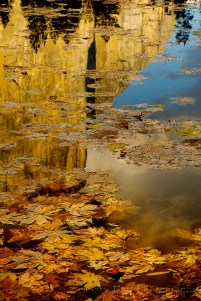
Autumn Reflection, El Capitan, Yosemite
Where to focus
An often misunderstood aspect of reflection photography is where to focus. Though counterintuitive to some, the focus point of a reflection is the reflection’s subject, not the surface it reflects on. This isn’t a big deal when the focus point of everything of visual significance is infinity, but it’s a very big deal when you want both your distant subject’s reflection and the nearby rocks or leaves on or in the water surface to be sharp.
Photographing a distant subject reflecting in a pool of leaves requires the same hyperfocal depth of field approach you’d use for any other close-to-distant image: small aperture and a focus point slightly beyond the closest thing that needs to be sharp.
El Capitan Reflection, Yosemite: Photographing autumn leaves atop El Capitan’s reflection required impossible depth of field to capture sharpness throughout. Even though the leaves and reflection were just a few feet in front of me, focusing for a sharp reflection would have softened the leaves. To increase my depth of field, I stopped down to f/18 and focused toward the back of the closest group of leaves, then magnified the image on my LCD to verify that all of the leaves were sharp. Though El Capitan’s reflection is slightly soft, a soft reflection is almost always more forgivable than a soft foreground.
Polarizer

Reflection on the Rocks, Lake Wanaka, New Zealand
Put simply, a polarizer cuts reflections. Most photographers use a polarizer to darken the sky, and while that can be a nice effect, the polarizer’s value is far greater than that. More than to darken the sky, polarizers remove subtle reflective sheen that washes out color on foliage and rocks.
An underappreciated polarizer use is to erase a reflection to reveal submerged rocks, leaves, and texture. After photographing a reflection with no polarizer or polarization minimized (maximum reflection), rotate the polarizer to minimize the reflection (maximum polarization) and capture submerged features hidden by the reflection. You might be surprised by how different the two images are, and how much you like both versions.
Lake Wanaka, New Zealand: But a polarizer isn’t an all or nothing tool. When photographing the solitary willow tree in Lake Wanaka, I carefully watched the reflection in my viewfinder while rotating my polarizer, stopping when I reached a polarization midpoint that included some reflection, while still revealing the mosaic of stones just beneath the lake’s surface.
Rainbows
Rainbows are a very special kind of reflection that happens when light is refracted (separated into its colorful wavelengths) upon entering airborne water droplets. This refracted light reflects off the back of the droplet to create a rainbow.
Because the laws of physics apply to all reflections, we know that a rainbow would actually form a full, 42 degree circle if it didn’t encounter the horizon. The center of this circle is at the anti-solar point—the point exactly opposite the sun (with your back to the sun, imagine a line from the sun through the back of your head and exiting between your eyes). That means that your shadow will always point at the rainbow’s apex. And the lower the sun, the higher the apex will be. Read more about rainbows.

Rainbow Bridge, Colorado River, Grand Canyon
Double Rainbow, Colorado River, Grand Canyon: Understanding rainbow physics allowed me to anticipate a rainbow despite a black cloud blocking the sun and drenching everyone in my raft trip group. When I saw that the sun was about to pop out of the cloud and into a large patch of blue sky, I rallied my group and pointed to where the rainbow would appear. A few minutes later their skepticism turned to ecstasy when we all started capturing images of a double rainbow bridging the Grand Canyon.
Outside the box
Reflections also provide wonderful creative opportunities. An often overlooked opportunity is the potential found in reflections that aren’t mirror-like. And, in addition to the more conventional reflection composition that’s split somewhere near the middle to give more or less equal frame real estate to the subject and its reflection, some of the most creative reflection images concentrate entirely, or almost entirely, on the reflection.
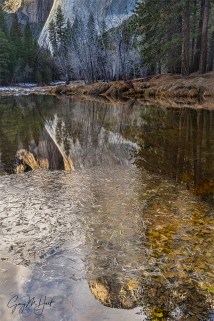
Autumn on Ice, El Capitan Reflection, Yosemite
I found this El Capitan reflection at Cathedral Beach on the final afternoon of last month’s Yosemite Winter Moon photo workshop. After capturing a crisp, top-to-bottom El Capitan reflection, I repositioned myself to juxtapose much of El Capitan against the faceted veneer of ice topping the river. An added bonus of water still enough for ice to form was that it allowed drifting, recently fallen autumn leaves to settle and accumulate on the river-bottom here.
Finding the best spot combine the reflection, ice, and leaves in a single frame, I dropped low enough to get a sharp reflection El Capitan’s nose in the still, iceless water close to the shore. To ensure sharpness in the ice and the reflection (as well as the distant trees and El Capitan), I stopped down to f/18 and focused midway into the ice.
Almost all of the foreground was shaded, but with bright, direct sunlight brightening the clouds and El Capitan, this scene’s dynamic range was a real factor. But my reflection-centric composition eliminated the clouds brightest granite, making the exposure much easier. Finally, I tried multiple polarizer positions until I found the one with the best combination of reflection and submerged leaves.

Sunset Mirror, Yosemit
I was so focused on the other visual elements in this scene, I didn’t fully appreciate the bare trees across the river. But when I started processing the image and viewed it on my large monitor, I was pleased by how much they add to the wintry feel of this image.
Double your pleasure
Whether it’s a shimmering mirror, a gauzy haze of color and shape, or a colorful rainbow, reflections are a gift from Nature—camera or not. By doubling the beauty surrounding us, reflections have the power to elevate ordinary to beautiful, and beautiful to extraordinary.
For photographers, reflections provide boundless creative opportunities. When exploring outdoors with a camera, some reflections seem to jump out and grab us by the eyeballs, while others require a little more work. Either way, when properly conceived and executed, a reflection image possesses a visual synergy, conveying beauty that more than doubles the scene’s two halves.
Workshop Schedule || Purchase Prints || Instagram
El Capitan Reflections
Click any image to scroll through the gallery LARGE


Looking Back at 2022
Posted on December 26, 2022


This is my final blog post of 2022. Going through my images from the past 12 months, I can’t help but celebrate my blessings. What you might (I hope) view as a pretty picture, represents to me a thrilling moment in Nature. And believe me when I say that I remember the experience of witnessing every single image I share here.
2022 was the year my photography life returned to something resembling pre-pandemic “normal.” When the year’s photography highlights started with a northern lights show above Kirkjufell in Iceland, I should have recognized it as a harbinger of blessings in the year to come.
In no particular order, those blessings included returning to New Zealand for the first time in 3 years. Highlights there included a return to Doubtful Sound and Fox Glacier, snowcapped peaks, glacial lakes, and the incredible Southern Hemisphere night sky, where the Large and Small Magellanic Clouds ride high, the Milky Way is reversed, and the cohort of constellations is completely new. And I was extremely relieved to find that the vandalized solitary willow in Lake Wanaka hadn’t lost its essence.
Closer to home, the Grand Canyon, which never lets me down, shared even more gifts than usual. Especially memorable were a foggy sunrise that was unlike any sunrise I’ve ever witnessed, a new view of the Milky Way above the Colorado River (in darkest sky possible), and some of the most thrilling lightning experiences of my life—both in quality and quantity. On Hawaii, enhancing the lush beauty and rugged coast was the return of Kilauea’s eruption, which I hadn’t seen in 5 years. Seeing the volcano’s bubbling lava, and photographing the Milky Way above its incandescent glow, felt almost spiritual. And Yosemite, my special place, was as special as ever.
Finally, I’d be remiss if I didn’t acknowledge all the wonderful people I got to share these moments with. Not only do my workshop students enable me to sustain this wonderful life, they are kindred spirits who make these moments in Nature even better. I have no idea what’s in store for 2023, but my 2022 experiences are a reminder that more special awaits, and I can’t wait to find out what it is. Stay tuned…
My 2022 In Pictures
Click any image to scroll through the gallery LARGE


 Eloquent Images by Gary Hart