If you’re following the rules, you’re not being creative
Posted on January 28, 2014
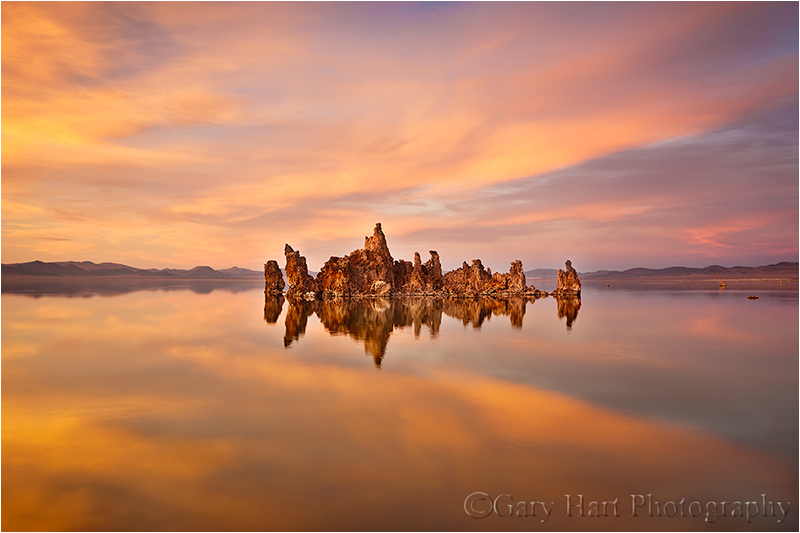
Stillness, South Tufa, Mono Lake
Canon EOS-1Ds Mark III
1 second
F/11.0
ISO 100
32 mm
What do you think would happen if I submitted this image a camera club photo competition? It might elicit a few oohs and ahhs at first, but I’m pretty sure it wouldn’t be long before somebody dismisses it because the primary subject is centered. And while “never center your subject” is standard camera-club advice for a beginner who automatically bullseyes every subject, reflexively reciting “Rules*” is a cop-out for faux critics who lack genuine insight. (Of course I’m not talking about you, I’m talking about that guy over there by the cookies.) Worse still, photographers who blindly follow Rules are leaning on a crutch that will only atrophy their creative muscles.
This is important
Rules are not inherently bad, but it should be the photographer controlling the Rules, not the other way around. In fact, if you’re following the Rules, you’re not being creative. One more time: If you’re following the Rules, you’re not being creative.
A couple of examples
One of the most oft-repeated Rules is the Rule of Thirds, which dictates that the primary subject be placed at the intersection points in an imaginary grid dividing the frame into horizontal and vertical thirds (think tic-tac-toe). Another RoT mandate is to never center the horizon, but to instead place it one third of the way up from the bottom or down from the top. Reasonable advice for people who like their images to look like everyone else’s, but it completely ignores the myriad reasons for doing otherwise.
For example, visual artists are often told to give their subjects more space in the frame in the direction they’re looking. In other words, if the subject is gazing rightward, place them on the left side of the frame so they’re looking across the frame and not directly into a virtual wall. But watching “12 Years a Slave” last weekend (one curse of being a photographer is the inability to turn off my internal critic) I noticed Solomon Northup longingly gazing directly into the left border of the frame, with a vast open sky behind him. It doesn’t take a rocket scientist to figure out that this framing symbolized Northup’s physical and emotional confinement (but who doesn’t know someone who’d ding this framing at the photo club competition?).
And centering a subject is an effective creative tool. Photographing the Mono Lake South Tufa sunset above, I was thrilled to find the kind of mirror reflection usually reserved for sunrise at this often windy location. Enjoying softer light than I’d get shooting toward the sun at sunrise, I tried many compositions before settling on this absolutely symmetrical version to create an equilibrium that conveys the utter stillness I experienced that evening.
Shed the crutch and go forth
Rules serve a beginning photographer in much the way training wheels serve a five-year-old learning to ride a bike: They’re great for getting you started, but soon get in the way. As valuable as these support mechanisms are, you wouldn’t do Tour de France with training wheels, or the Boston Marathon on crutches.
In my workshops I’m frequently exposed to creative damage done to people rendered gun-shy by well-intended but misguided Rule enforcers. Camera clubs and photo competitions are great for many reasons, but I’d love to see them declared no-Rule zones. And if your group can’t no nuclear on Rules, how about at least adding a no-Rule (“best image that breaks a Rule”) competition or category to acknowledge that the Rules are not the final word?
My suggestion to everyone trying to improve their photography is to learn the Rules, but rather than simply memorizing them, do your best to understand their purpose, and how that purpose might conflict with your objective. Then, armed with that wisdom, each time you peer through your viewfinder, set the Rules aside and simply trust your creative instincts.
*Capitalized throughout to mock the deference they’re given
Come break the rules with me in a photo workshop
Eastern Sierra Photo Workshops
Asking for trouble at the camera club
Click an image for a closer look and slide show. Refresh the screen to reorder the display.


Returning to the scene of the crime
Posted on January 24, 2014
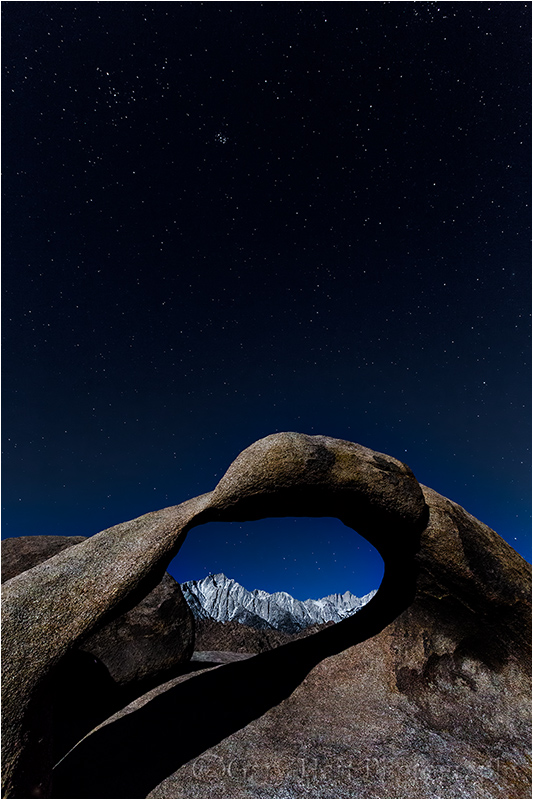
Moonlight, Whitney Arch, Alabama Hills, California
Canon EOS 5D Mark III
15 seconds
16 mm
ISO 3200
F8
* * *
Lone Pine Peak (12,944 feet) is on the left, Mt. Whitney (14,505 feet) is on the right. The small, dipper-shaped group of stars near the upper center is the Pleiades (a.k.a. the Seven Sisters) in Taurus, a cluster of new and still-forming stars about 400 light years distant.
Clueless. That’s one word that would describe my state the first time I attempted moonlight photography. It was about eight years ago, right here in the Alabama Hills. Though exposure and focus were more guesses than decisions, I ended up with a lucky shot of the Big Dipper suspended above moonlit granite boulders and an obsession was born.
Big Dipper, Alabama Hills, California
The other thing I remember about that visit was thinking it would be really cool to photograph a full moon setting behind Mt. Whitney (the tallest point in the 48 contiguous United States). That thought got me researching moonrise/set data, and software that would allow me to plot the view angles. I ended up tapping the wealth of tables on the U.S. Naval Observatory website, which, among other things, returned the azimuth (the number of degrees east of due-north) of the moon for any time and location on Earth, and the moon’s altitude (degrees above the flat horizon) at any specified time. Then I stumbled upon a tool in National Geographic Topo! software that allowed me to plot the azimuth and align my photo spot with my subject: I just pick my base point (the location from which I want to photograph) and click on a point on the map at the moon’s azimuth at the time I want to photograph it. The software conveniently draws a line connecting the two points—anything on the line aligns with the moon. Pretty cool (at least at the time—today there are tons of apps that make this much simpler).
Early one morning the following August, armed with ultimate confidence in my new-found knowledge, I embarked on a six hour drive to the Alabama Hills. My goals were two-fold: In addition to a sunrise moonset behind Mt. Whitney, I wanted to photograph the Whitney Arch by moonlight. I arrived late that afternoon, scouted a bit, photographed a rather boring sunset, then traipsed out to the arch in the dark (this was in the days before the trail that guides visitors right to it), about a quarter mile from the parking area, for a moonlight shoot. My continued cluelessness about moonlight photography was exacerbated this time by the fact that, following the lucky shot of my previous visit, I no longer knew I was clueless.
I had fun photographing in the perfect silence of absolute solitude, spent the night in the back of my truck, and woke to find the moon exactly where I’d plotted it. Phew. It turned out that my moonlight image from the previous night was okay, but the years have made me more aware of its flaws: Because focusing on the Sierra Crest was much easier than focusing on the arch, I ended up with just a little more foreground softness than I like. And my exposure was a little darker than ideal. (Flaws that become more apparent the larger the image.) For years I’ve wanted a do-over, and while I’ve been back many times, until last week circumstances have always prevented me from getting out to the arch in moonlight.
There’s really only room at the arch for three or four photographers to comfortably photograph Mt. Whitney through the opening. And when leading a workshop, my priority isn’t my own photography (one of the reasons I haven’t been able to manage a do-over). But this time only couple of others in my group decided to try their hand at the arch, so I squeezed in and clicked a few frames. I started horizontal, but quickly switched to vertical to maximize the sky (and eliminate a photographer on my left) and soon found a composition that worked. Drawing from experience, this time I focused on the arch, targeting the most distant moonlit spot in my frame. Focus, while difficult, was much easier than my first attempt as I found live-view magnified five times was just clear enough that I was pretty sure I’d found focus (10X was too muddled). But to be certain, I checked the resulting frame, magnified on my LCD, to verify. While the arch was indeed sharp, Whitney was slightly soft at f4, so I stopped down to f8 and bumped my ISO up to 3200. Bingo.
The cure for blue skies
Posted on January 20, 2014
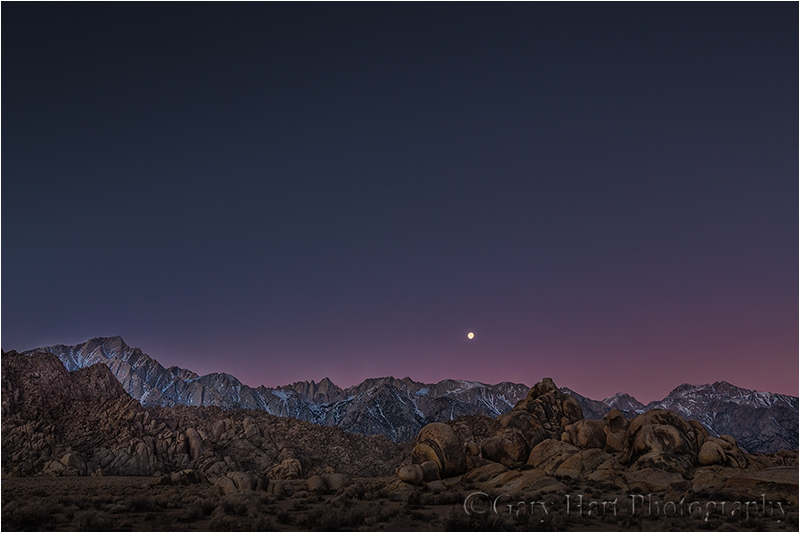
Sunrise Moonset, Sierra Crest, Alabama Hills, California
Canon EOS 5D Mark III
1/8 second
29 mm
ISO 200
F11
* * *
The prominent mountain on the left is 12,944 foot Lone Pine Peak. At 14,495 feet, Mt. Whitney is the highest point in the 48 contiguous United States; it’s the shark-tooth peak left of center. The slightly concave mountain on the far right is 14,380 foot Mt. Williamson.
A good landscape image usually involves, well…, a good landscape. But that’s only half the equation—photographers also need photogenic conditions—soft light, interesting skies, dramatic weather, or anything else that elevates the scene to something special. While we have absolute control over the time and location of our photo outings, the conditions have a significant random (luck) component.
Despite being less than a day’s drive from many of the most treasured photo destinations in the world, most of my photo trips are planned months in advance. Workshops in particular require at least a year of advance planning on my part, and many months of schedule adjustment and travel arrangements for the participants. I think I’ve pretty much established that positive thinking, finger crossing, divine pleas, and ritual incantation (no virgin sacrifice yet) are of zero value where photography is concerned—sometimes conditions work out wonderfully, sometimes not so much. And while I’ve photographed my workshop locations many times, I know most of my workshop participants haven’t, which is why I do my best to schedule my workshops when the odds are best for interesting skies.
My annual Death Valley / Mt. Whitney photo workshop is a perfect example: Among the driest places on Earth, Death Valley gets only about an inch of rain each year and suffers from chronic blue skies. Ever the optimist, I schedule my DV/Whitney workshop from mid-January through early February, when the odds, though still low, are at least best for clouds. And while I’ve actually been pretty lucky with the clouds in past workshops, to hedge my bets further, I always schedule this workshop to coincide with a full moon—if we don’t get clouds, the moon always seems to save the day (and night).
This year’s DV/Whitney workshop wrapped up Saturday morning. Unfortunately, it landed in the midst of what is on its way to becoming an unprecedented drought in California. After two dry winters, this winter is worse—a persistent high pressure system has set up camp above California, creating an impenetrable force field that deflects clouds and and bathes the state weather that is absolutely beautiful for everything but photography. In this year’s DV/Whitney workshop’s four+ days, we enjoyed highs in the glorious 80s, and I don’t recall seeing a single cloud (though there were unconfirmed rumors of a cloud sighting on the distant horizon late in the workshop).
But cloudless skies don’t need to mean lousy photography—they just shrink the window of opportunity. Places like Mosaic Canyon and Artist’s Palette are nice in the early morning or late afternoon shade. And in general, when clouds aren’t in the picture, the best photography skies are on the horizon opposite the sun before sunrise and after sunset. Last week I made a point of getting my group on location at least 45 minutes before sunrise, and kept them out well past sunset to photograph Death Valley’s one-of-a-kind topography beneath twilight’s shadowless pink and blue pastels. Among other things, in this light the dunes were fantastic (I was able to find a relatively footprint free area) all the way from shadowless twilight through high contrast early morning light, and the first light on Telescope Peak from Badwater was wonderful.
But the workshop’s real highlight, the element that elevated our week into something special, was the moon. The real moon show didn’t begin until it showed up above the primary views on our final two sunrises, but we got a nice preview on our first sunset when the waxing gibbous disk rose into the twilight wedge above the mountains east of Hell’s Gate. The next evening I took the group to panoramic Dante’s View; while the prime objective was photographing Death Valley’s last light and the sun setting from 5,000 vertical feet above Badwater, I instructed everyone to walk across the parking lot after sunset to catch the nearly full moon rising above the equally expansive (though significantly less spectacular) panorama of distant peaks to the east. The moon arrived early enough to allow at least ten minutes of quality photography, then we just kind of hung out to watch it for a little while longer. Very nice.
Friday morning’s sunrise we found the moon glowing as promised in the predawn indigo above Zabriskie Point. As the morning brightened, we watched the nearly round disk slide through twilight’s throbbing pink before disappearing directly behind Manly Beacon just a few minutes after sunrise.
But as nice as the Zabriskie shoot was, I think my personal favorite was the workshop’s final sunrise from the Alabama Hills. The group, now expert at managing the difficult contrast between foreground shadows and brilliant moon, immediately spread out to find their own foreground. One or two headed straight for the Whitney Arch (aka, Mobius Arch), while the rest of us were quite content with the variety of boulders west and south of our the arch.
The thing that makes the Alabama Hills such a special location for sunrise is its position between towering peaks to the west, and relatively flat horizon to the east. At sunrise here, the Sierra crest juts into the blue and rose of the Earth’s receding shadow, then transitions to amber when the first rays of sunlight kiss its serrated peaks. You anticipate watch the sun’s arrival by watch the shadow descent the vertical granite until it bathes the weathered boulders with warm, ephemeral sunlight. Then, just like that, the show’s over.
I’ve shot this scene at sunrise so many times that I usually remain a spectator unless something special moves me to pull out my camera. Last Saturday, despite the absence of clouds, I just couldn’t resist the pull of the moon, which hovered like a mylar balloon in the night/day transition. At first there wasn’t enough light to photograph detail in the rocks and moon in a single frame, but eventually, with the help of a two-stop graduated neutral density filter, I was able to capture the image at the top of the blog.
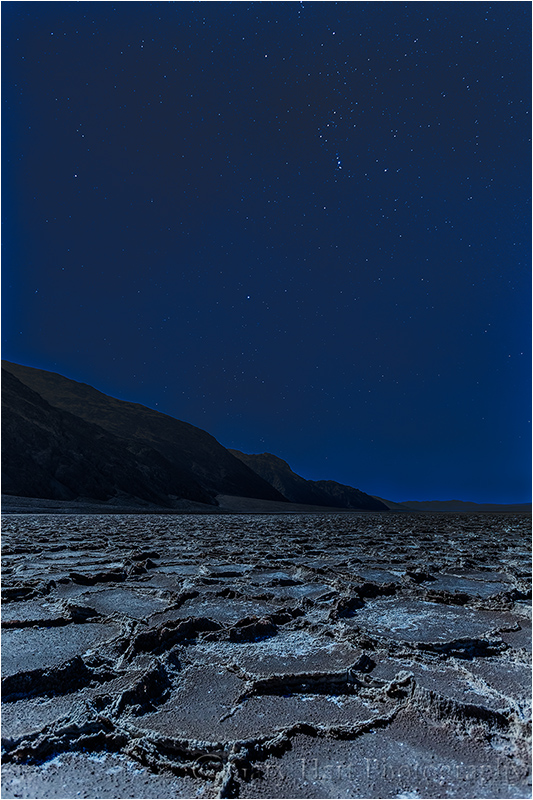
Orion, Badwater by Moonlight, Death Valley
Canon EOS 5D Mark III
15 seconds
17 mm
ISO 1600
F4
* * *
Another great thing about timing the Death Valley workshop to coincide with a full moon is our moonlight shoots. Of all the workshop moonlight shoots I do throughout the year, I think I look forward to the Death Valley Badwater shoot the most. This year’s didn’t disappoint—not only was the photography great, there’s just something about the playa’s warm temperatures and utter stillness that creates a genuinely festive atmosphere.

Moonset, Mt. Whitney and the Alabama Hills, California
* * *
Last year I photographed the same scene in different conditions. While this year’s capture highlights the Sierra crest and uses the blank sky and dark foreground to create a twilight feel, last year’s image was captured shortly after the sun lit the peaks and colored the clouds. I used a tighter composition to emphasize Mt. Whitney, the moon, and the pink clouds.
Stupid cold
Posted on January 12, 2014

Winter Glaze, Sunrise Point, Bryce Canyon
Canon EOS 5D Mark III
.5 seconds
22 mm
ISO 200
F16
We warm blooded humans have lots of ways to express the discomfort induced by low temperatures, ranging from brisk to chilly to freezing to frigid. But because I’ve always felt that we need something beyond frigid, something that adequately conveys the potential suffering, let me submit: stupid cold. At the risk of stating the obvious, “stupid cold” is when it’s so cold, the only people without a good reason to be outside (for example, the house is on fire) are, well….
Before I get into a recent personal encounter with stupid cold, let me offer a little background. Being California born and raised, I often find myself with a slightly higher cold threshold than many of my workshop participants. I’m not proud to say that pretty much when the temperature drops below 50, I’m breaking out the gloves and down jacket. Without shame. I get a lot of grief for this, but that’s fine because I’m comfortable. In fact, no matter how cold it gets in California, I’ve always been able to bundle up enough to stay comfortable. Viva la Mediterranean climate.
So imagine my chagrin when, while preparing for my recent trip to Bryce Canyon to co-lead Don Smith’s Bryce/Zion workshop, I saw overnight lows in the single digits (!) forecast. I know many people live places that get this cold, but how many of them actually go out specifically at the time when it’s coldest (sunrise)—and then just stand there? Unfortunately, when you’re a photographer, especially a photographer who is counted on by paying customers, staying in bed at sunrise is not an option.
So anyway, single digit lows. Surely, I rationalized, anyone who can endure night games at Candlestick Park in July, can, given enough layers, handle whatever Bryce can dish out. So, employing my tried and true Candlestick Park infinite layer approach, I sucked it up, cleared my closet of all cold weather gear, crammed it into my largest suitcase, then crossed my fingers when the Southwest ticket agent hefted the bulging cube onto the scale (49.8 pounds, thankyouverymuch). Off to Bryce.
So whatever happened to those days when the weather forecast was a crap-shoot, when you never really worried about the forecast too much because it was rarely right? We arrived at Bryce to find temperatures as cold as advertised. Windy too. And as if to rub salt in the wound, the coldest shoot we had was the workshop’s first sunrise, before anyone had a chance to acclimate: 10 degrees fahrenheit and 25 MPH winds (I know, I know, that’s nothing compared to your January Yellowstone bison shoot, or that time in Saskatchewan when you stayed up all night to photograph the northern lights, but you can’t say anything unless you sat through the last pitch of a night game at Candlestick Park).
I must say, my Candlestick more-is-better strategy almost worked. Two pairs of wool socks inside sub-zero rated boots kept my toes nice and toasty for the duration. Silk long-johns, flannel-lined jeans, insulated over-pants—my legs were happy too. And my torso did quite well inside a long sleeve wool undershirt, Pendleton (wool) shirt, Patagonia down shirt, and a down jacket. My ears were cold but tolerable beneath a wind-stop ear band and cozy wool cap. And my nose, cheeks, and mouth were a bit more exposed, but a wool gator took enough of the edge off to make it manageable.
But, despite all the preparation, what thirty years of Candlestick experience hadn’t prepared me for was cold hands. Oh. My. God. I thought I was ready with my thin poly running gloves as liners for thick wool gloves—not even close. The problem was, unless you’re keeping score, watching a baseball game doesn’t require hands unless there’s something to cheer for (a rare event for most of my Candlestick years)—at the ‘Stick I could sit on my (gloved) hands, bury them in pockets or beneath my wool blanket (never left home without one), or all of the above. But a camera, it turns out, requires hands. Fingers too. I quicky found that I could compose and click maybe three frames before the cold drove me to the nearby visitor’s shelter to pound life back into my fingers. Not a productive morning.
After this first sunrise, things improved. Temperatures warmed a bit, the wind abated, my body adjusted (slightly), and I was able to mitigate my hand problem with the purchase of silk liner gloves and thicker wool gloves. I also came away with a new found appreciation of my Hawaii workshops—sunrises in a tank-top, shorts, and flip-flops. Nothing stupid about that.
Compared to the cold we’d experienced at sunrise, at 20 degrees, the afternoon I took this picture was downright balmy. When we arrived at Sunrise Point, the snow that had been falling most of the afternoon was still falling, obscuring the view to the point where many in the group retreated to the car. But those of us who stayed out were treated to a twenty minute window between the lifting of the clouds and the fall of darkness. Not the spectacular color and warm light that generates so much excitement, but wonderful, even light that really allowed the pristine snow to stand out against the red sandstone.
Securing the border
Posted on January 8, 2014
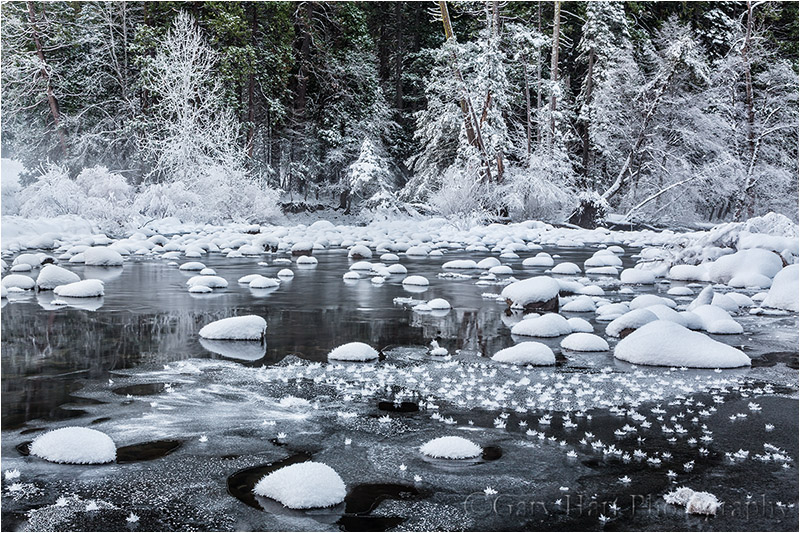
Frozen, Merced River, Valley View, Yosemite
Canon EOS 5D Mark III
1.3 seconds
45 mm
ISO 200
F16
If you’ve ever been in one of my workshops, or (endured) one of my image reviews, you know where I’m going with this (I can sense eyes rolling from here). But I hope the rest of you stick with me, because as much as we try be vigilant, sometimes the emotion of a scene overwhelms our compositional good sense—we see something that moves us, point our camera at it, and click without a lot of thought. While this approach may indeed capture the scene well enough to revive memories or even impress friends, you probably haven’t gotten the most out of it. So before every click, I do a little “border patrol,” a simple mnemonic that reminds me to deal with small distractions on the perimeter that can have a disproportionately large impact on the entire image. (I’d love to say that I coined the term in this context, but I think I got it from Brenda Tharp—not sure where Brenda picked it up.)
To understand the importance of securing your borders, it’s important to understand that our goal as photographers is to create an image that invites viewers to enter, and persuades them to stay. And the surest way to keep viewers in your image is to help them forget the world beyond the frame. Lots of factors go into crafting an inviting, persuasive image—things like balance, visual motion, and relationships are essential (topics for another day), but nothing reminds a viewer of the world beyond the frame faster than objects jutting in or cut off at the edge, or visually “heavy” (large or bright) objects that pull the eye away from the primary scene. To avoid these distractions, for years I’ve been practicing, and advocating, border patrol before clicking. Just run your eyes around the perimeter, note everything that’s on or near the border, and ask yourself if that really is the best place for the edge of the frame.
Sometimes border patrol is easy—a simple scene with just a small handful of objects to organize, all conveniently grouped toward the center, usually requires very little border management. But more often than not we’re dealing with complex scenes containing multiple objects scattered throughout and beyond the frame: leaves, rocks, clouds, whatever, with no obvious demarcation.

Incoming Storm, Mesquite Flat Dunes, Death Valley
Border patrol for this image was relatively simple—with nothing prominent near the edges, I was primarily concerned about visual balance, though I did conduct a bit of border patrol on the sky to ensure that I chose the best place to break the churning (rapidly moving) clouds.
The frigid Yosemite scene at the top of his post was as difficult as it was beautiful. With my camera in live-view mode atop my tripod, I relatively quickly came up with a composition that encompassed the beauty and felt fairly balanced, but all the snow-capped rocks, patches of ice, and randomly distributed hoarfrost made it pretty much impossible to find the perfect place for my border.
The circle of five snow-covered rocks in the left foreground was my foreground anchor—I needed to give these rocks space, and to balance them with the field of hoarfrost blooms in the right foreground. I was very aware of the rocks cut off in the left and right middle-ground, but going any wider introduced all kinds of new problems (just outside the current frame) at the bottom and on both sides. On the other hand, a tighter composition would have cut off the ice-etched trees that stood out so beautifully against the shaded evergreen background. Sigh. So, I did what every photographer must do in virtually every image: compromise. Compromise in this case meant opting for the lesser of multiple evils, hopeful that the unique drama of this frigid scene would be enough to overcome its flaws.
What flaws? I thought (hoped) you’d never ask. After several minutes of shifting up/down, left/right, forward/backward (while crossing my fingers that the ice on which I was stationed would hold out), and zooming in and out, I managed to get all of my icy trees at the top of the frame and find a relatively clean patch of water in front of me for the bottom of the frame. The large rock cut off on the middle right doesn’t bother me too much either—large objects cut in the middle can serve as frames that hold the eye in the scene. But if I could have had complete creative control over this scene (this is where painters have a distinct advantage), I’d have done something about those small rocks cut off on the middle left—I know nobody would be consciously aware of them, but there’s nothing like a clean border to hold a viewer in the scene, and those rocks just aren’t clean to my eye.
Because you can actually practice border patrol, and composition in general, in the comfort of your home, another frequent theme in my image reviews is the value of the crop tool as a learning device. Pick any image—yours or someone else’s—and see how many compositions you can find in it. The goal isn’t to create usable images (you’ll loose too many pixels for that), it’s to train your eye to see things you currently miss in the field. I promise that if you do this enough, you’ll find yourself naturally seeing compositions and fixing obvious problems before you click.
Looking back at 2013, and ahead to 2014
Posted on January 1, 2014
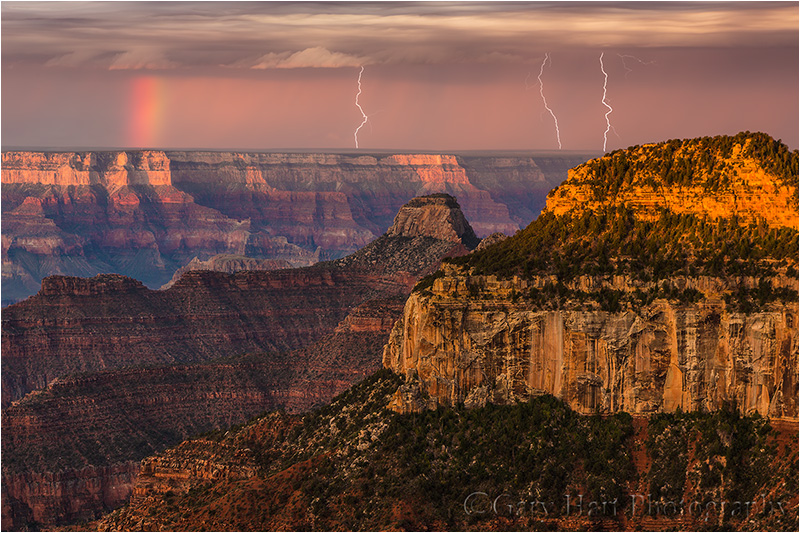
Three Strikes, Bright Angel Point, North Rim, Grand Canyon
This is a single, 1/3 second click that managed capture three simultaneous lightning strikes. Set up on a tripod, I’d composed to balance the frame between the rainbow and the area receiving the most strikes. Rather than try to manually react when I saw a lighting flash, I let my Lightning Trigger detect the lightning and click for me. I got many one and two bolt frames, but this is the only frame that captured three.
Canon EOS 5D Mark III
1/3 second
F/11
ISO 100
24-105 f4L lens
While I’ve been taking a little Holiday break from my blog, I have spent some of my non-family time reviewing my 2013 images. Given the number of trips I take, and images I click, it always amazes me how well I remember every detail of my favorites—who I was with and what the circumstances were, not to mention composition and exposure decisions that are still as clear in my memory as the day I took the picture. I’m guessing it’s that way for other photographers too, because I’m convinced that our best photography comes when we concentrate on those things that move us emotionally. For example, since I’ve always been something of a weather geek, it stands to reason that several of my favorites feature active weather. And another lifetime passion is astronomy, and while I didn’t consciously bias this year’s selections toward the celestial, that sure seems to be how it worked out.
I have lots of great stuff planned for 2014: my regular annual workshops in Death Valley, Yosemite, Hawaii, the Eastern Sierra; my second annual Grand Canyon monsoon workshop with Don Smith; a raft trip down the Grand Canyon in May (bucket list item). And on any photo trip, whether it’s a workshop or a personal trip, I research and plan to make sure the odds for something special are as high as they can be, but it’s usually the unexpected moments that thrill me most—those times when I set out with one intention and found something else, or was disappointed when weather or other conditions beyond my control derailed the original plan.
Case in point: I scheduled an entire workshop around Comet ISON, and while ISON fizzled, if I hadn’t been in Yosemite to photograph it, I never would have witnessed Valley View, decked out in ice, glistening in the light of a full moon. Or the Maui workshop, scheduled before I had any idea of Comet PanSTARRS, that just happened to coincide with the comet’s post-perihelion conjunction with the new moon. But the one that thrill me most was the above sunrise at the Grand Canyon, the final morning of our second workshop—Don and I were going to start the thirteen hour drive home later that morning, and others in the group had flights to rush off to. Given the bland weather forecast, it would have been easy to blow off the shoot and let everyone sleep in. But we got up in the cold and dark, all of us, and were treated to a two hour electric show that started in blackness and culminated with a rainbow as the sun peeked above the canyon’s east rim.
So, without further adieu, and in no particular order, here are my current 2013 favorites (click a thumbnail for a larger version with more info, and to start the slide show):
-

- Before Sunrise, South Tufa, Mono Lake
-
- Facing West, Molokai from West Maui, Hawaii
-

- Moonlight Cathedral, Valley View, Yosemite
-
- White-Out, Cook’s Meadow, Yosemite
-

- Leaf, Bridalveil Creek, Yosemite
-
- Milky Way and Halemaʻumaʻu Crater, Kilauea, Hawaii
-

- Comet PanSTARRS and New Moon, Haleakala, Maui
-
- Autumn Snow, Valley View, Yosemite
-
- Winter Reflection, Half Dome and the Merced River, Yosemite
-

- Three Strikes, Bright Angel Point, Grand Canyon
-
- Color and Light, Bright Angel Point, Grand Canyon
-

- Poppy Pastel, Sierra Foothills, California
-
- Crescent Moon and Oaks at Dusk, Sierra Foothills, California
-

- Night and Day, Crescent Moon Rising Above Mono Lake
-
- Night Lightning, Roosevelt Point, Grand Canyon North Rim
-
- Incoming Storm, Mesquite Flat Dunes, Death Valley
Two out of three ain’t bad
Posted on December 20, 2013

Moonlight Cathedral, El Capitan, Yosemite
Canon EOS 5D Mark III
30 seconds
23 mm
ISO 1600
F8
I scheduled my Yosemite Comet ISON photo workshop way back when astronomers were crossing their fingers and whispering “Comet of the Century.” Sadly, the media took those whispers and amplified them a thousand times—when ISON did its Icarus act on Thanksgiving day, its story became the next in a long line of comet failures (raise your hand if you remember Kohoutek).
But anyone who understands the fickle nature of comets would be foolish to get too excited about (or plan an event solely around) a comet’s promised appearance. So I scheduled this workshop knowing that even if the comet fizzled, storms and snowfall can make winter in Yosemite Valley spectacular. But, because snowfall in Yosemite is also far from a sure thing, to further enhance our chances for something special, in addition to Comet ISON and winter conditions, I scheduled this workshop to coincide with the December full moon. And while we didn’t get the comet, well, to quote Meat Loaf, “two out of three ain’t bad.”
Yosemite Valley received nearly a foot of snow a few days before the workshop started. Given Yosemite frequent sunshine and relatively warm temps, normally that snow would have all but disappeared from the trees and rocks within a few hours, and within a couple of days would have been marred by large brown patches—exactly what happened in the unshaded parts of Yosemite Valley. But because this storm was followed immediately by a cold snap, those parts of the valley that remained all day in the shade of Yosemite’s towering, sheer granite walls (mostly the south and/or west side of the valley) didn’t shed their snow and actually accumulated ice as the week went on.
Valley View was the prime beneficiary of this all day shade—by the time my workshop started, snow-capped rocks, hoarfrost blooms, and a sheet of windowed ice had elevated this always beautiful location to more beautiful than I’ve ever seen it. Full moon notwithstanding, it was the highlight of the workshop. Taking advantage of our unique opportunity, my group photographed Valley View early morning, late afternoon, at sunset, and (as you can see) by moonlight.
There are lots of things human vision can do that the camera can’t—fortunately, one of those things is not see in low light. While moonlight adds beauty to any scene, when a scene starts out off-the-charts-beautiful, moonlight makes it a downright spiritual experience. Though moonlight is beautiful to the eye, even at its brightest, a full moon isn’t bright enough to reveal all the beauty present. Enter the camera.
Giving this scene lots of light allowed me to reveal how it would appear if your eyes could take in as much light as, say, an owl. Or your cat. The blueness of the sky, the sparkling ice crystals, the reflection in the river—that beauty is no less real just because it’s invisible to our eyes.
To reveal all this “invisible” beauty, I started at ISO 800, f4, 15 seconds. But the unusually extreme (for moonlight photography) depth of field this composition required caused me to increase to ISO 1600 and 30 seconds to allow the extra DOF f8 provides. And I was thrilled to discover that there was enough light to enable live-view manual focus (my now preferred focus method for all situations). According to my DOF app, focusing about eight feet into the frame would give me sharpness from front-to-back, but just to be sure, after capture I magnified image in my LCD and checked the ice in the foreground and trees atop El Capitan.
The other problem I needed to deal with was lens flare, an easy thing to forget about when photographing in the dark. But the moon is a bright light source and all the lens flare rules that apply to sunlight photography also apply to moonlight—if moonlight strikes your front lens element, you’ll get lens flare. Since I hate lens hoods, I manually shield my lenses in flare situations. A hat works nicely, but there was no way I was taking my snuggly warm hat off, so I shaded my lens with my hand for the entire 30 seconds of my exposure.
BTW, see that bright light shining through the tree at the base of El Capitan? That’s Jupiter.
Workshop Schedule || Purchase Prints
A Gallery of Snow and Ice
Click an image for a closer look and slide show. Refresh the window to reorder the display.


Oops
Posted on December 17, 2013

Winter Moonrise, Merced River, Yosemite
Canon EOS 5D Mark III
1/10 second
40mm
ISO 800
F16
Last Friday evening, this professional photographer I know spent several hours photographing an assortment of beautiful Yosemite winter scenes at ISO 800. Apparently, he had increased his ISO earlier in the day while photographing a macro scene with three extension tubes—needing a faster shutter speed to freeze his subject in a light breeze, he’d bumped his ISO to 800. Wise decision. But, rushing to escape to the warmth of his car, rather than reset the camera to his default ISO 100 the instant he finished shooting, he packed up his camera with a personal promise to adjust it later, when his fingers were warmer—surely, he rationalized, removing the extension tubes and macro lens would remind him to reset the ISO too. (You’d think.) But, despite shutter speeds nowhere near what they should have been given the light and f-stop, he just kept shooting beautiful scene after beautiful scene, as happy as if he had a brain.
I happen to know for a fact that this very same photographer has done other stupid things. Let’s see…. There was that time, while chasing a sunset at Mono Lake, that he drove his truck into a creek and had to be towed out. And the two (two!) times he left his $8,000 camera beside the road as he motored off to the next spot. And you should see his collection of out-of-focus finger and thumb close-ups (a side effect of hand-holding his graduated neutral density filters). Of course this photographer’s identity isn’t important—what is important is dispelling the myth that professional photographers aren’t immune to amateur mistakes.
And on a completely unrelated note…
Let’s take a look at this image from, coincidentally, last Friday evening. Also completely coincidentally, it too was photographed at ISO 800 (go figure)—not because I made a mistake (after all, I am a trained professional), but, uhhh, but because I think there are just too many low noise Yosemite images. So anyway….
This was night-two of what was originally my Yosemite ISON workshop—but, after the unfortunate demise of Comet ISON and a week of frigid temperatures in Yosemite, became my Yosemite ice-on workshop. That’s because, to the delight of the workshop students (and the immense relief of their leader), much of the one foot of snow that had fallen the Saturday before the workshop’s Thursday start had been frozen into a state of suspended animation by a week of temperatures in the teens and low-twenties.
Each day we rose to find nearly every shaded surface in Yosemite sheathed in a white veneer of snow and ice. (Valley locations that received any sunlight were largely brown and bare.) And the Merced River, particularly low and slow following two years of drought, was covered in ice in an assortment of textures and shapes from frosted glass to blooming flowers. Adding to all this terrestrial beauty was a waxing moon, nearly full, ascending our otherwise boring blue skies and illuminating our nightscapes.
On Friday night I guided my group to this spot just downstream from Leidig Meadow. There we found the moon, still several days from full, glowing high above the valley floor, and Half Dome reflected by a watery window in the ice. I captured many versions of this scene, from tight isolations of the reflections to wide renderings of the entire display. It’s too soon to say which I like best, but I’m starting with this one because it most clearly conveys what we saw that evening.
I chose a vertical composition because including the moon in a horizontal frame would have shrunk Half Dome and the moon, and introduced elements on the right and left that weren’t as strong as Half Dome, its reflection, and the snowy Merced River. (Sentinel Rock is just out of the frame on the right—as striking as it is, I wanted to make this image all about Half Dome.)
My f16 choice was to ensure sharpness throughout the frame, from the ice flowers blooming in the foreground, to Half Dome and its reflection. As you may or may not know, the focus point for a reflection is the focus point of the reflective subject, not the reflective surface. That means when photographing a reflection surrounded by leaves, ice, rocks, or whatever, you need to ensure adequate DOF or risk having either the reflection or its surrounding elements out of focus. Here I probably could have gotten away with f11, but my iPhone and its DOF app were buried beneath several layers of clothes, and using it would have require removing two pair of gloves.
I’d love to say that I chose ISO 800 to freeze the rapids, but I’m not sure you’d buy it. So I’m sticking with my too many low noise Yosemite images story and moving on. (A few cameras ago, ISO 800 would have meant death to this image, but today, thankfully, it’s mostly just a lesson in humility.)
A Yosemite Winter Gallery
Click an image for a closer look, and a slide show. Refresh the screen to reorder the display.


There’s a draft in here
Posted on December 13, 2013
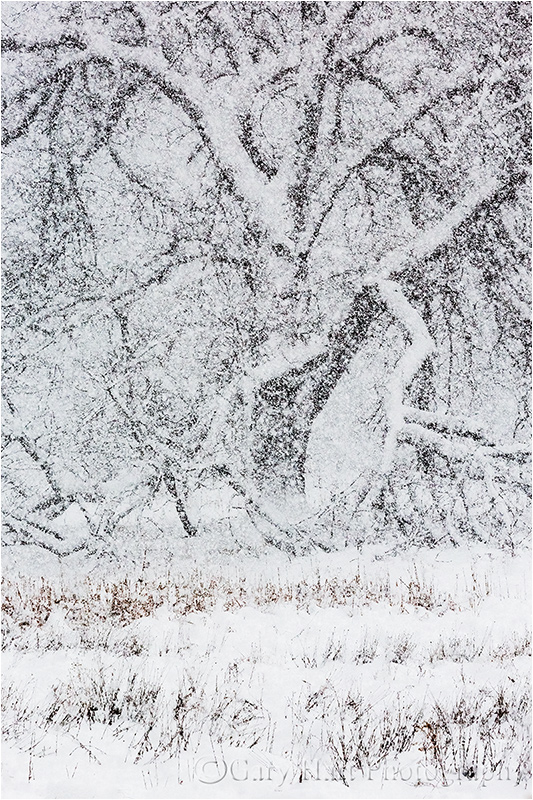
Elm in Blizzard, Cook’s Meadow, Yosemite
Canon EOS 5D Mark III
1/200 second
220mm
ISO 800
F16
Drafting an image
Few writers create a polished piece of writing in a single pass—most start with a draft that gets refined and tightened until it’s ready for publication. It’s an incremental process that builds upon what’s already been done. As somebody who has been writing and taking pictures for a long time, I’ve found a real connection between the creation process of each craft. The most successful photographers aren’t afraid to create “draft” images that move them forward without necessarily delivering them all the way where they want to be.
When I write a blog, I start with an idea and just go with it. But before clicking Publish (or Delete), I read, revise, then re-read and re-revise more times than I can count. Likewise, when I find a scene that might be photo-worthy, I expose, compose, and click without a lot of hand wringing and analysis. But I’m not done after that first click, and I don’t particularly care if it’s not perfect. When my initial (draft) frame is ready, I pop the image up on my LCD, evaluate it, make adjustments, and click again, repeating this cycle until I’m satisfied, or until I decide there’s not an image there. (In the days before digital, the same evaluation process took place through the viewfinder with my camera on a tripod.)
Another tripod plug
It’s the tripod that makes this shoot/critique/refine process work. Much the way a computer allows writers to save, review, and improve what they’ve written (a vast improvement over the paper/pen or typewriter days), a tripod holds your scene while you decide how to make it better. Photographing sans tripod, I have to exactly recreate the previous composition before making my adjustments. But using a tripod, when I’m finished evaluating the image, the composition I just scrutinized is waiting for me right there atop my tripod, allowing each frame to improve on the previous frame.
About this image
Composition isn’t limited to the arrangement and framing of elements in a scene—it can also be the way the image handles depth and motion. For example, living in California, I just don’t get that much opportunity to photograph falling snow. So, on last week’s visit to Yosemite, when I saw the Cook’s Meadow elm tree partially obscured by heavy snowfall, I knew an image was in there, but wasn’t quite sure how to best render the millions of fluttering snowflakes between me and the tree. What shutter speed would freeze (pun unavoidable) the falling flakes, and what depth of field would best convey the falling snow? Would too much DOF be too cluttered? Would not enough DOF be too muddy?
But before solving those problems, I needed a composition. I started with my original vision, a tight, horizontal frame of the tree’s heavy interior—my “draft” image. With my camera on my tripod I tried several successively wider frames, each a slight improvement of the previous one, before jettisoning my tight horizontal plan in favor of a wider vertical composition. Though I knew right away I was on the right track, it still took a half dozen or so incrementally better frames before finally arriving at the composition you see here.
With my composition established, I set to work on the depth and shutter speed question. As good as the LCD on my camera is, I didn’t want to be making those decisions based on what I saw on a credit card size screen, but my tripod enabled me to capture a series of identically framed images, each with a different f-stop and shutter speed. Back home on my computer, I was able compare them all to one and other without being distracted by minor framing differences. I finally decided I like the version with lots of depth field.
Dashing to the snow
Posted on December 9, 2013

Winter Reflection, Half Dome and the Merced River, Yosemite
Canon EOS 5D Mark III
1/13 second
16mm
ISO 100
F16
If there’s anything on Earth more magical than Yosemite with fresh snow, I haven’t seen it. The problem is, Yosemite Valley doesn’t get tons of snow—its relatively low elevation (about 4,000 feet) means the valley often gets rain when most of the Sierra gets snow. And when snow does fall here, it doesn’t stay on the trees for more than a few hours (if you’re lucky). Which is why I’ve always said the secret to photographing snow in Yosemite is to monitor the weather reports and time your visit to arrive before the storm. This strategy gives photographers within relatively easy driving distance, especially those of us without day job, a distinct advantage—from my home in Sacramento I can be in Yosemite Valley in less than four hours (that’s factoring a Starbucks stop in Merced and a fill-up in Mariposa), and I have no problem using darkness to make the roundtrip on the same day.
So last week, when the National Weather Service promised lots of snow in Yosemite for the weekend, I quickly freed up my Saturday. I usually stay just outside the park in El Portal, but because I didn’t want to risk being turned away by a (rare but not unprecedented) weather related park closure, I booked Friday and Saturday nights at Yosemite Lodge, right in the heart of Yosemite Valley—even if the roads shut down, from there I’d be able to walk to enough views to keep me happy all day.
I arrived in the dark to find lots of ice and patches of crusty old snow; I woke dark-and-early Saturday morning to about ten inches of fresh snow. Yippie! The snow fell intermittently throughout the day, with conditions ranging from nearly opaque to classic Yosemite clearing storm drama. Since I was by myself, I was able to deemphasize many of the most frequently photographed spots my workshop expect to photograph and explore random scenes along the Merced. In the morning I concentrated on El Capitan scenes; the afternoon was more about Half Dome.
Of course the classic views are that way for a reason, so, as you can see in this image, I gave them some attention to. Despite not being much of a tourist location, many photographers know about this scene just upstream from Sentinel Bridge. It’s a little hard to find, but usually fairly accessible. But this time getting there forced me to employ a creative parking strategy and to soil about one hundred yards of virgin powder. At this spot a couple of weeks ago I used a telephoto to isolate a single tree clinging to its fall color and reflecting in the river; this visit was my widest lens that got all the work.
The January issue of Outdoor Photographer will include my Yosemite El Capitan Winter Reflection image and a paragraph explaining how to photograph snow in Yosemite Valley. Here’s pretty much what I say there, with a little elaboration:
- Arrive in Yosemite Valley before the storm and plan to stay until it’s over. Getting there before the snow starts makes your life so much simpler; staying until the storm passes not only gets you the coveted “clearing storm” images, it also allows you to photograph all of Yosemite’s iconic features above a snow-covered landscape.
- Despite what Google Maps, your GPS, or your brother-in-law tell you, don’t even think about any route that doesn’t take you through Mariposa and up the Merced River Canyon on Highway 140. The highest point on 140 is Yosemite Valley; all other routes into the park go over 6,000 feet and are much more likely to be icy, closed, or require chains. For people coming from the north that means 99 to Merced and east on 140. Coming from the south, you can either take 99 to Merced (easier) and 140, or 41 to Oakhurst and 49 to Mariposa (faster).
- Carry chains. While you’re rarely asked unless weather threatens, every car entering Yosemite in winter is required to carry them, even 4WD. While 4WD is usually enough to avoid putting chains on, that’s not a sure thing. And if you get caught in a chain check without them, you’re parked right there until the requirement is lifted. If you’re driving your own car to Yosemite, bite the bullet and purchase chains. If you’re flying into California and renting a car, try to get 4WD and keep your fingers crossed that you don’t get asked. Some people will purchase chains and try to return them if they didn’t use them, but that can be risky so check the store’s chain return policy.
- Don’t hole-up in your room while it’s snowing. I generally circle the valley looking for scenes (about a 30 minute roundtrip). If the low ceiling has obscured all the views and you tire of photographing close scenes, park at Tunnel View and wait. Not only is Tunnel View the location of some of Yosemite’s most spectacular clearing storm images, it’s also the first place storms clear. And because you’ll be stunned by how fast conditions in Yosemite can change, waiting at Tunnel View is the best way to avoid missing anything. Another advantage Tunnel View offers is its panoramic view of the entire valley that helps you to decide where to go next. For example, from Tunnel View you can see if Half Dome is emerging from the clouds and there are probably nice images to be had on the east side, or if your best bet will be to stay on the west side and concentrate on El Capitan, Bridalveil Fall, and Cathedral Rocks.
- No matter how spectacular the view is where you are now, force yourself to move on after a while because it’s just as spectacular somewhere else. Trust me.

 Eloquent Images by Gary Hart