Eloquent Images by Gary Hart
Insight, information, and inspiration for the inquisitive nature photographer
In the Pink
Posted on February 14, 2026
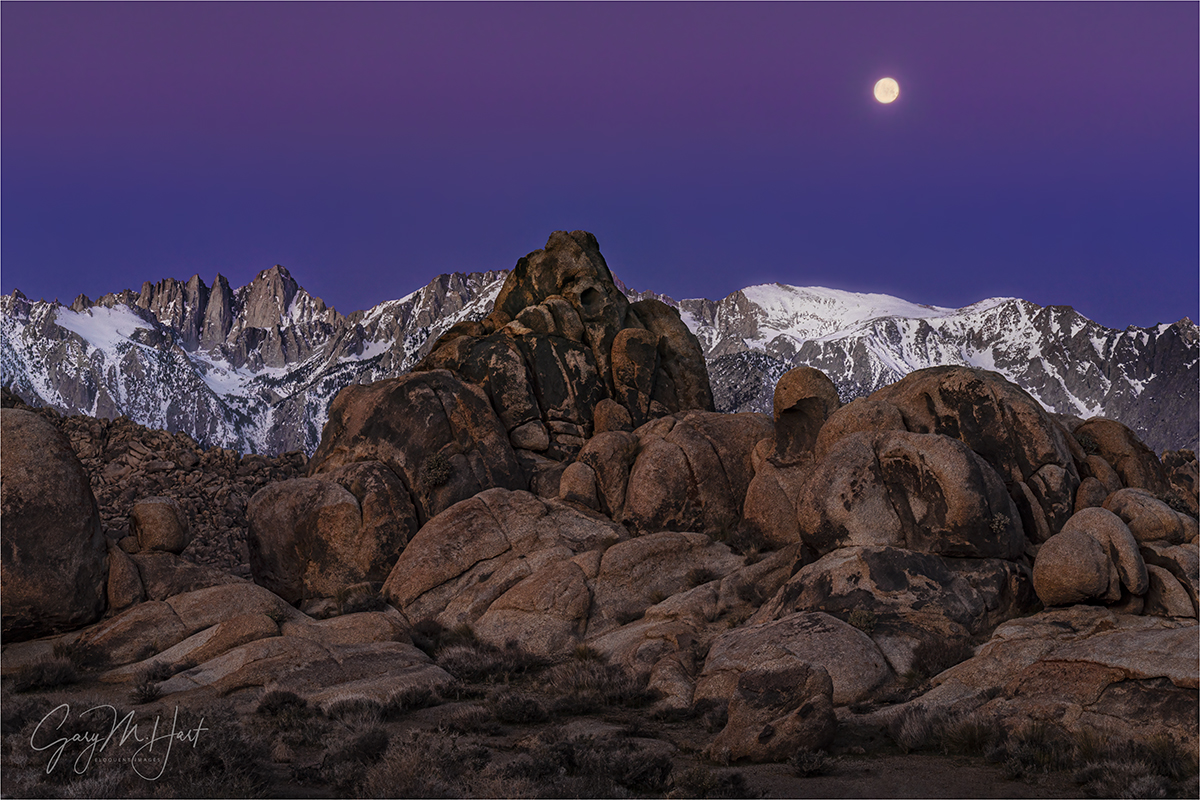
Twilight Wedge and Setting Moon, Mt. Whitney and the Alabama Hills, Eastern Sierra
Sony a7R V
Sony 24-105 G
1/5 second
F/16
ISO 100
The rewards of rising before the sun are many. For me, the opportunity to witness twilight’s soft, cool light slowly warmed by the approaching sun, to breathe in the cleanest air of the day, and to simply be alone with the purest sounds and smells of nature, are ample compensation for whatever chill and sleep deprivation I might experience. And on mornings when the sky is cloudless and the air especially pure, there might just be a bonus.
To collect that bonus, about 20 minutes before sunrise, look for parallel bands of vivid pink and steely blue hugging the horizon opposite the rising sun. Many photographers, myself included, call this early display the “twilight wedge,” but it has other similarly non-scientific names. Closer to the horizon, the dark blue band is actually Earth’s shadow—the final section of sky not receiving any direct light from the soon to appear sun; just above, the pink band is the the day’s first rays of direct sunlight. It’s pink because the sun is just far enough below the eastern horizon that the only its longest, red wavelengths manage to battle through the atmosphere all the way to the other side of the sky. The cleaner the air, the more vivid the twilight wedge’s color. (This color is also possible after sunset, but by day’s end there are usually more color-robbing particles in the air, and Nature’s quiet is often disturbed so much by human activity that some of the magic is lost.) And when towering peaks soar far enough above the viewer’s vantage point that they jut into this pink twilight wedge band, we call it alpenglow.
I love finding beautiful scenes to go with the gorgeous pre-sunrise sky opposite the sun. Near the top of my list is the Alabama Hills, in the shadow of the highest Sierra Nevada peaks. The Alabama Hills are a disorganized jumble of massive, weathered boulders covering many square miles, making an ideal foregrounds for the assortment of serrated peaks looming to the west. A more perfect arrangement for nature photographers couldn’t be assembled—and, as if that’s not enough, the Alabama Hills are also among the best places on Earth to photograph alpenglow.
Of course all this is no secret, and the Alabama Hills has become one of the most popular photography spots in California. To improve my chances of capturing unique images here, I love adding the moon to my Alabama Hills / Sierra Crest scenes. (And when I say “add,” I mean the honorable, old-fashioned way, not with AI or other digital shenanigans.) For years, I’ve timed my Death Valley winter workshop to allow me to take my group to the Alabama Hills, just a 90 minute drive from Death Valley, for the workshop’s final sunset, followed by the moon setting behind the Sierra Crest at sunrise the final morning.
Of course, because there’s only one “best” day in each lunar cycle to photograph a full (-ish) moon setting behind the Sierra Crest, I have no wiggle room when scheduling this workshop—a day early, and the moon is gone before the landscape is light enough to photograph; a day late, and the sky is much too bright by the time the moon drops close to the mountains.
But even nailing the day doesn’t ensure success. Clouds are of course a concern, especially in winter. And each year the timing and position of the moon’s disappearance behind the crest is a little different. In January and early February (when I always schedule this workshop), viewed from my preferred location, the moon sets somewhere between Mt. Whitney and Mt. Williamson (California’s two highest peaks), usually closer to Williamson.

Before Sunrise, Mt. Whitney and the Alabama Hills, California (30 minutes before sunrise)
I like to get my groups out to the Alabama Hills about 30 minutes before we can start photographing the moon. The foreground will still be quite dark to our eyes, and the moon will at least 10 degrees above the crest, but I tell my students to start shooting as soon as we arrive.
Using a long exposure in a frame that doesn’t include the moon (the top of the frame is below the moon), captures much more (mostly shadowless) foreground detail than our eyes see, while juxtaposing the mountains’ light gray granite against a sky that’s darker than the peaks—a magnificently striking sight indeed, especially when there’s snow on the peaks. We’ll keep shooting versions of this until it’s time to include the moon in the festivities.
For any moon photography, the darker the sky, the better the moon stands out. But too early and it’s impossible to capture foreground detail without completely blowing out the moon. For me, the time to photograph any setting full moon starts about 20 minutes before sunrise—basically, as soon as the landscape has brightened enough foreground and lunar detail with one click. And if we’re especially lucky, when that time arrives, we’ll find the moon in the midst of a vivid pink twilight wedge.
This opportunity only lasts a few minutes, because as the sky brightens and the foreground exposure gets easier, the color fades and the essential contrast between the sky and moon decreases. The twilight wedge lasts less than 10 minutes, and is followed by slowly warming sky. By maybe five minutes after sunrise, the good color is long gone and the moon/sky contrast has decreased enough for me to put my camera away.
This year’s Alabama Hills moonset was especially nice. One of my favorite things about my Death Valley / Alabama Hills workshop is that we get two “ideal” (moon setting as the color and light are at their best) sunrise moonsets for the price of one. On our last day in Death Valley, from Zabriskie Point we photograph the moon setting behind Manly Beacon, one of Death Valley’s most striking and recognizable features. Because the mountains behind which the moon sets from Zabriskie rise only about 3 degrees above a flat horizon, this moonset happens much closer to the “official” (flat horizon) sunrise that’s universally used for any celestial rise and set. The next morning we’re in the Alabama Hills—even though the moon sets about an hour later than it did the day before, because the Sierra Crest towers about 10 degrees above the horizon when viewed from the Alabama Hills, the actual moonset we see happens at just about the same time as the prior day’s moonset.
Which is exactly things unfolded for this year’s workshop group. We followed up a beautiful Death Valley Zabriskie Point sunrise moonset, with a similarly outstanding Alabama Hills sunrise moonset the next morning. The vivid hues of the twilight wedge had just peaked when I clicked this image. To my eyes, this entire scene (except the moon), and especially the foreground, was much darker than this image shows. But my camera’s ridiculous dynamic range, combined with Lightroom’s masking that allows me to process the sky and foreground independently from each other, enabled me to expose the scene dark enough to capture essential lunar detail, yet remain confident I had enough recoverable detail in the foreground.
Workshop Schedule || Purchase Prints || Instagram
Alabama Hills Gallery
Click any image to scroll through the gallery LARGE


Gifts From Heaven
Posted on November 3, 2024

Heaven Sent, Comet Tsuchinshan–ATLAS Above the Sierra Crest, Alabama Hills
Sony a7R V
Sony 24-105 f/4 G
ISO 3200
f/4
5 seconds
As much for its (apparently) random arrival as its ethereal beauty, the appearance of a comet has always felt to me like a gift from the heaven. Once a harbinger of great portent, scientific knowledge has eased those comet fears, allowing Earthlings to simply appreciate the breathtaking display.
Unfortunately, scientific knowledge does not equal perfect knowledge. So, while a great comet gives us weeks, months, or even years advance notice of its approach, we can never be certain of how the show will manifest until the comet actually arrives. For every Comet Hale-Bopp, that gave us nearly two years warning before becoming one of the most widely viewed comets in human history, we get many Comet ISONs, which ignited a media frenzy more than a year before its arrival, then completely fizzled just as the promised showtime arrived. ISON’s demise, as well as many highly anticipated comets before and after, taught me not to temper my comet hopes until I actually put eyes on the next proclaimed “comet of the century.” Nevertheless, great show or not, the things we do know about comets—their composition, journey, arrival, and (sometimes) demise—provide a fascinating backstory.
In the simplest possible terms, a comet is a ball of ice and dust that’s (more or less) a few miles across. After languishing for eons in the coldest, darkest reaches of the Solar System, perhaps since the Solar System’s formation, a gravitational nudge from a passing star sends the comet hurtling sunward, following an eccentric elliptical orbit—imagine a stretched rubber band. Looking down on the entire orbit, you’d see the sun tucked just inside one extreme end of the ellipse.
The farther a comet is from the sun, the slower it moves. Some comets take thousands, or even millions, of years to complete a single orbit, but as it approaches the sun, the comet’s frozen nucleus begins to melt. Initially, this just-released material expands only enough to create a mini-atmosphere that remains gravitationally bound to the nucleus, called a coma. At this point the tail-less comet looks like a fuzzy ball when viewed from Earth.
This fuzzy phase is usually the state a comet is in when it’s discovered. Comets are named after their discoverers—once upon a time this was always an astronomer, or astronomers (if discovered at the same time by different astronomers), but in recent years, most new comets are discovered by automated telescopes, or arrays of telescopes, that monitor the sky, like ISON, NEOWISE, PANSTARRS, and ATLAS. Because many comets can have the same common name, astronomers use a more specific code assembled from the year and order of discovery.
As the comet continues toward the sun, the heat increases further and more melting occurs, until some of the material set free is swept back by the rapidly moving charged particles of the solar wind, forming a tail. Pushed by the solar wind, not the comet’s forward motion, the tail always fans out on the side opposite the sun—behind the nucleus as the comet approaches the sun, in front of the comet as it recedes.
Despite accelerating throughout its entire inbound journey, a comet will never move so fast that we’re able to perceive its motion at any given moment. Rather, just like planets and our moon, a comet’s motion relative to the background stars will only be noticeable when viewed from one night to another. And like virtually every other object orbiting the sun, a comet doesn’t create its own light. Rather, the glow we see from the coma and tail is reflected sunlight. The brilliance of its display is determined by the volume and composition of the material freed and swept back by the sun, as well as the comet’s proximity to Earth. The color reflected by a comet’s tail varies somewhat depending on its molecular makeup, but usually appears as some shade of yellow-white.
In addition to the dust tail, some comets exhibit an ion tail that forms when molecules shed by the comet’s nucleus are stripped of electrons by the sun’s ultraviolet radiation. Being lighter than dust molecules, these ions are whisked straight back by the solar wind. Instead of fanning out like the dust tail, these gas ions form a narrow tail that points directly away from the sun. Also unlike the dust tail that shines by reflected light, the ion tail shines by fluorescence, taking on a blue color courtesy of the predominant CO (carbon monoxide) ion.
One significant unknown upon discovery of a new comet is whether it will survive its encounter with the sun at all. While comets that pass close to the sun are more likely to shed large volumes of ice and dust, many sun-grazing comets approach so close that they’re overwhelmed by the sun’s heat and completely disintegrate.
With millions of comets in our Solar System, it would be easy to wonder why they’re not a regular part of our night sky. Actually, Earth is visited by many comets each year, though most are so small, and/or have made so many trips around the sun that they no longer have enough material to put on much of a show. And many comets never get close enough to the sun to be profoundly affected by its heat, or close enough to Earth to shine brightly here.
Despite all the things that can go wrong, every once in a while, all the stars align (so to speak), and the heavens assuage the disappointment of prior underachievers with a brilliant comet. Early one morning in 1970, my dad woke me and we went out in our yard to see Comet Bennett. This was my first comet, a sight I’ll never forget. I was disappointed by the faint smudges of Comet Kohoutek in 1973 (a complete flop compared to its advance billing), and Halley’s Comet in 1986 (just bad orbital luck for Earthlings). Comet Hale-Bopp in 1996 and 1997 was wonderful, while Comet ISON in 2012 disintegrated before it could deliver on its hype.
In 2013 Comet PANSTARRS didn’t put on much of a naked-eye display, but on its day of perihelion, I had the extreme good fortune to be atop Haleakala on Maui, virtually in the shadow of the telescope that discovered it. Even though I couldn’t see the it, using a thin crescent moon I knew to be just 3 degrees from the comet to guide me, I was able to photograph PANSTARRS and the moon together. Then, in the dismal pandemic summer of 2020, Comet NEOWISE surprised us all to put on a beautiful show. I made two trips to Yosemite to photograph it, then was able to photograph it one last time at the Grand Canyon shortly before it faded from sight.
October 2024 promised the potential for two spectacular comets, Comet Tsuchinshan–ATLAS (C/2023 A3) in the first half of the month, and Comet ATLAS (C/2024 S1) at the end of the month. Alas, though this second comet had the potential to be much brighter, it pulled an Icarus and flew too close to the sun (RIP). But Comet Tsuchinshan–ATLAS was another story, brightening beyond expectations.
I shared the story of my trip to photograph Tsuchinshan–ATLAS in my October 16 I’m Not Crazy, I Swear… blog post, but have a couple of things to add about this image. First is how important it is to not get so locked into one great composition that you neglect capturing variety. I captured this wider composition before the image I shared a couple of weeks ago, and was pretty thrilled with it—thrilled enough to consider the night a great success. But I’m so glad that I changed lenses and got the tighter vertical composition shortly before the comet’s head dropped out of sight.
And second is the clearly visible anti-tail that was lost in thin haze near the peaks in my other image. An anti-tail is a faint, post-perihelion spike pointing toward the sun in some comets, caused when larger particles from the coma, too big to be pushed by the solar wind, are left behind. It’s only visible from Earth when we pass through the comet’s orbital plane. Pretty cool.
When will the next great comet arrive? No one knows, but whenever that is, I hope I’ve kindled enough interest that you make an effort to view it. But if you plan to chase comets, either to photograph or simply view, don’t forget the wisdom of astronomer and comet expert, David Levy: “Comets are like cats: they have tails, and do precisely what they want.”
Join me in my Eastern Sierra photo workshop
More Gifts From Heaven
Click any image to scroll through the gallery LARGE


I’m Not Crazy, I Swear…
Posted on October 16, 2024

Comet Tsuchinshan–ATLAS and Mt. Whitney, Alabama Hills, California
Sony α1
Sony 100-400 GM
5 seconds
f/5.6
ISO 3200
Crazy is as crazy does
In college, my best friend and I drove from San Francisco to San Diego so he could attend a dental appointment he’d scheduled before his recent move back to the Bay Area. We drove all night, 10 hours, arriving at 7:55 a.m. for his 8:00 a.m. appointment (more luck than impeccable timing). I dozed in the car while he went in; he was out in less than an hour, and we drove straight home. I remember very little of the trip, except that each of us got a speeding ticket for our troubles. Every time I’ve told that story, I’ve dismissed it with a chuckle as the foolishness of youth. Now I’m not so sure that youth had much to do with it at all.
I’m having second thoughts on the whole foolishness of youth thing because on Monday, my (non-photographer) wife and I drove nearly 8 hours to Lone Pine so I could photograph Comet Tsuchinshan–ATLAS setting behind Mt. Whitney. We arrived at my chosen location in the Alabama Hills about 15 minutes after the 6:20 sunset, then waited impatiently for the sky to darken enough for the comet to appear. I started photographing at around 7:00, and was done when the comet’s head dropped below Mt. Whitney at 7:30. After spending the night in Lone Pine, we left for home first thing the next morning, pulling into the garage just as the sun set. For those who don’t want to do the math, that’s 16 hours on the road for 30 minutes of photography.
In my defense, for this trip I had the good sense (and financial wherewithal) to get a room in Lone Pine Monday night, and didn’t get pulled over once. That this might have been a crazy idea never occurred to me until I was back at the hotel, and that was only in the context of how the story might sound to others—in my mind this trip was worth every mile, and I have the pictures to prove it.
I say that fully aware that my comet pictures will no doubt be lost in the flood of other Comet Tsuchinshan–ATLAS images we’ll see over the next few weeks, many no doubt far more spectacular than mine. My excitement with the fruits of this trip is entirely personal, and to say I’m thrilled to have witnessed and photographed another comet would be an understatement—especially in light of last month’s Image of the Month e-mail citing comets as one of the three most beautiful celestial subjects I’ve ever witnessed. And of those three, comets feel the most personal to me.
Let me explain
When I was ten, my best friend Rob and I spent most of our daylight hours preparing for our spy careers—crafting and trading coded messages, surreptitiously monitoring classmates, and identifying “secret passages” that would allow us to navigate our neighborhood without being observed. But after dark our attention turned skyward. That’s when we’d set up my telescope (a castoff generously gifted by an astronomer friend from my dad’s Kiwanis Club) on Rob’s front lawn (his house had a better view of the sky than mine) to scan the heavens hoping that we might discover something: a comet, quasar, supernova, black hole, UFO—it didn’t really matter. And repeated failures didn’t deter us.
Nevertheless, our celestial discoveries, while not Earth-changing, were personally significant. Through that telescope we saw Jupiter’s moons, Saturn’s rings, and the changing phases of Venus. We also learned to appreciate the vastness of the universe with the observation that, despite their immense size, stars never appeared larger than a pinpoint, no matter how much magnification we threw at them.
To better understand what we saw, Rob and I turned to illustrated astronomy books. Pictures of planets, galaxies, and nebula amazed us, but we were particularly drawn to the comets: Arend-Roland, Ikeya–Seki, and of course the patriarch of comets, Halley’s Comet (which we learned was scheduled to return in 1986, an impossible wait that might as well have been infinity). With their glowing comas and sweeping tails, it was difficult to imagine that anything that beautiful could be real. When it came time to choose a subject for the annual California Science Fair, comets were an easy choice. And while we didn’t set the world on fire with our project presentation, Rob and I were awarded a ribbon of some color (it wasn’t blue), good enough to land us a spot in the San Joaquin County Fair. (Edit: Uncovering the picture, I see now that our ribbon was yellow.)
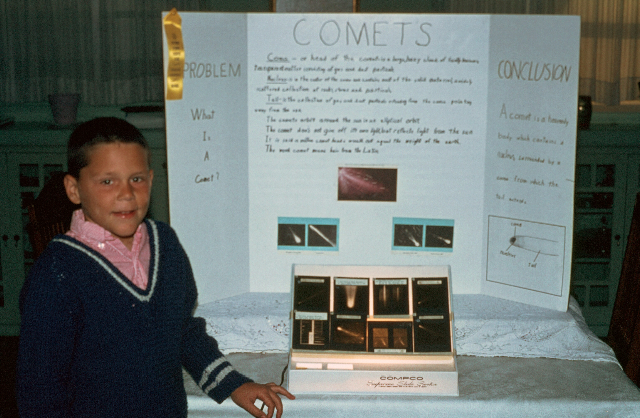
Here I am with the fifth grade science project that started it all. (This is only half of the creative team—somewhere there’s a picture that includes Rob.)
The next milestone in my comet obsession occurred a few years later, after my family had moved to Berkeley and baseball had taken over my life. One chilly winter morning my dad woke me and urged me outside to view what I now know was Comet Bennett. Mesmerized, my smoldering comet interest flamed instantly, expanding to include all things astronomy. It stayed with me through high school (when I wasn’t playing baseball), to the point that I actually entered college with an astronomy major that I stuck with for several semesters, until the (unavoidable) quantification of the concepts I loved sapped the joy from me.
While I went on to pursue other things, my affinity for astronomy continued, and comets in particular remained special. Of course with affection comes disappointment: In 1973 Kohoutek fizzled spectacularly, a failure that somewhat prepared me for Halley’s anticlimax in 1986.
By the time Halley’s arrived, word had come down that it was poorly positioned for its typical display (“the worst viewing conditions in 2,000 years”), making it barely visible this time around, but I can’t wait until 2061! (No really—I can’t wait that long. Literally.) Nevertheless, venturing far from the city lights one moonless January night, I found great pleasure locating without aid (after much effort), Halley’s faint smudge in Aquarius.
After many years with no naked-eye comets of note, 1996 arrived with the promise of two great comets. While cautiously optimistic, Kohoutek’s scars prevented me from getting sucked in by the media frenzy. So imagine my excitement when, in early 1996, Comet Hyakutake briefly approached the brightness of Saturn, with a tail stretching more than twenty degrees (forty times the apparent width of a full moon).
But as beautiful as it was, Hyakutake proved to be a mere warm-up for Comet Hale-Bopp, which became visible to the naked eye in mid-1996 and remained visible until December 1997—an unprecedented eighteen months. By spring of 1997 Hale-Bopp had become brighter than Sirius (the brightest star in the sky), its tail approaching 50 degrees. I was in comet heaven. But alas, family and career had preempted my photography pursuits and I didn’t photograph Hale-Bopp.
Comet opportunities again quieted after Hale-Bopp. Then, in early 2007, Comet McNaught caught everyone off-guard, intensifying unexpectedly to briefly outshine Sirius, trailing a thirty-five degree, fan-shaped tail. McNaught put on a much better show in the Southern Hemisphere; in the Northern Hemisphere, because of its proximity in the sky to the sun, it provided a very small window of visibility, and was easily lost in the bright twilight. This, along with its sudden brightening, prevented McNaught from becoming the media event Hale-Bopp was. I only found out about it by accident, on the last day it would be easily visible in the Northern Hemisphere. By then digital capture had rekindled my photography interest (understatement), so despite virtually no time to prepare, I grabbed my camera and headed to the foothills east of Sacramento, where I managed to capture the McNaught image I share in the gallery below—my first successful comet capture.
Following McNaught, I vowed not to be caught off guard by a comet again. After enduring the frustration of promising (over-hyped?) comets disintegrated by the sun (you broke my heart, Comet ISON), and seeing others’ images of spectacular Southern Hemisphere-only comets (I’m looking at you, Comet Lovejoy), my heart jumped when I came across a website proclaiming the approach of Comet PANSTARRS (a.k.a, C/2011 L4 in less glamorous astro-nerd parlance), discovered not by an individual, but by the Pan-STARRS automated telescope array atop Haleakala on Maui.
Researching further, I learned that PANSTARRS could (fingers crossed) hang low in the western sky at magnitudes brighter than Saturn, for about a week right around its perihelion (closest approach to the Sun) in March 2013, remaining visible as it rises but dims over the following few weeks. Checking my calendar to see if I had any conflicts that week, I realized I’d be on Maui for my workshop during PANSTARRS’ perihelion! Turns out my first viewing of PANSTARRS was atop Haleakala, almost literally in the shadow of the telescope that discovered it. I also got to photograph a rapidly fading PANSTARRS above Grand Canyon on its way back to the farthest reaches of the Solar System.
Then, in 2020, came Comet NEOWISE to brighten our pandemic summer. I was able to make two trips to Yosemite and another to Grand Canyon to photograph NEOWISE (the Yosemite trips were for NEOWISE only).
One more time
Comet Tsuchinshan–ATLAS has been on my radar for at least a year, but not something I monitored closely until September, when it became clear that it was brightening as, or better than, expected. By the end of September I knew that the best Northern Hemisphere views of Tsuchinshan–ATLAS would be in mid-October, but since I was already in the Alabama Hills at the end of September, just a couple of days after the comet’s perihelion, I went out to look for it in the pre-sunrise eastern sky (opposite the gorgeous Sierra view to the west). No luck, but that morning only solidified my resolve to give it another shot when it brightened and returned to the post-sunset sky.
At that point I had no detailed plan, and hadn’t even plotted its location in the sky beyond knowing it would be a little above the western horizon shortly after sunset in mid-October. My criteria were a nice west-facing view, distant enough to permit me to use a moderate telephoto lens. After ruling out the California coast (no good telephoto subjects) and Yosemite Valley (no good west-facing views), I soon realized I’d be returning to the east side of the High Sierra.
At that point I started working on more precise coordinates and immediately eliminated my first (and closest) candidate, Olmsted Point, because the setting comet didn’t align with Half Dome. My next choice was Minaret Vista (near Mammoth), a spectacular view of the jagged Minaret range and nearby Mt. Ritter and Mt. Banner. This was a little more promising—the alignment wasn’t perfect, but it was workable. Then I looked at the Alabama Hills and Mt. Whitney and knew instantly I’d be reprising the long drive back down 395 to Lone Pine.
Though its intrinsic magnitude faded each day after its September 27 perihelion, Tsuchinshan–ATLAS’s apparent magnitude (visible brightness viewed from Earth) continued to increase until its closest approach to Earth on October 12. While its magnitude would never be greater than it was on October 12, the comet was still too close to the sun to stand out against sunset’s vestigial glow. But each night it climbed in the sky, a few degrees farther from the sun, toward darker sky.
Though Tsuchinshan–ATLAS would continue rising into increasingly dark skies through the rest of October, and each night would offer a longer viewing window than the prior night, I chose October 14 as the best combination of overall brightness and dark sky. An added bonus for my aspirations to photograph the comet with Mt. Whitney and the Sierra Crest would be the 90% waxing gibbous moon rising behind me, already high enough by sunset to nicely illuminate the peaks after dark, but still far enough away not to significantly wash out the sky surrounding the comet.
At my chosen spot, I set up two tripods and cameras, one armed with my Sony a7RV and 24-105 lens, the other with my Sony a1 and 100-400 lens. I selected that first location because it put the comet almost directly above Mt. Whitney, 16 degrees above the horizon, at 7 p.m. But since the Sierra crest rises about 10 degrees above the horizon when viewed from the Alabama Hills, I knew going in that the comet’s head would slip behind the mountains at 7:30, slamming shut my window of opportunity after only 30 minutes.
When it first appeared, Tsuchinshan–ATLAS was high enough that I mostly used my 24-105 lens. But as it dropped and moved slightly north (to the right), away from Whitney, we hopped in the car and raced about a mile south, to the location I’d chosen knowing that Tsuchinshan–ATLAS would align perfectly with Whitney as it dropped below the peaks. Most of my images from this location were captured with my 100-400 lens.
I manually focused on the comet’s head, or on a nearby relatively bright star, then checked my focus after each image. The scene continued darkening as I shot, and to avoid too much star motion I increased my ISO rather than extending my shutter speed.
As I photographed, I could barely contain my excitement at the image previews on my cameras’ LCD screens. Tsuchinshan–ATLAS and its long tail were clearly visible to my eyes, but the cameras’ ability to accumulate light made it much brighter than what we saw. The image I share today is one of my final images of the night. Even with a shutter speed of only 5 seconds, at a focal length of right around 200mm, if you look closely you’ll still see a little star motion.
My giddiness persisted on the drive back to Lone Pine and into our very nice (and hard earned) dinner. When our server expressed interest in the comet, I went out to the car and grabbed my camera to share my images with her. Whether or not the enthusiasm she showed was genuine, she received a generous tip for indulging me. And even though I usually wait until I’m home to process my images on my large monitor, I couldn’t help staying up well past lights-out to process this one image, just to reassure myself that I hadn’t messed something up (focus is always my biggest concern during a night shoot).
And finally…
FYI, neither Rob nor I became spies, but we have stayed in touch over the years. In fact, the original plan was for him to join me on this adventure, but circumstances interfered and he had to stay home. But we still have hopes for the next comet, which could be years away, or as soon as late this month….
Workshop Schedule || Purchase Prints || Instagram
My Comet History
Click any image to scroll through the gallery LARGE


Reach for the Sky
Posted on January 31, 2022

Sierra Sunrise, Lone Pine Peak and Mt. Whitney, Alabama Hills
Sony a7RIV
Sony 24-105 G
2 seconds
F/16
ISO 100
We tend to photograph the things we love most, but I don’t think that necessarily happens consciously. For example, I never appreciated the role the sky plays in my photography until someone pointed it out a few years ago. Browsing my galleries to verify, I was amazed at the percentage of my images that include at least one of the following: the sun, the moon, stars, a rainbow, lightning, or dramatic clouds. (And more recently, the northern lights.)
While I never set out to be a “skyscape” photographer, given my background, I guess it makes sense. (Or more succinctly, “Duh.”) As an astronomy enthusiast since I was a child, and an armchair meteorologist since my late teens, I spent most of my formative years with my eyes and mind on the sky. I continued these childhood interests into adulthood, studying both astronomy and meteorology in college (I even majored in astronomy for a few semesters), and to this day can’t pass up a book or article on either topic. Even without a camera, I can spend hours watching clouds form and dissipate, or gazing at the stars.
A few tips for good sky photography
- The amount of sky and landscape a frame gets is pretty much a function of the visual appeal of each: the better the sky relative to the landscape, the more frame real-estate it gets. Both nice? No problem splitting the frame in the middle (despite what the “expert” at your camera club says).
- Clear sky? Use the absolute minimum sky possible—sometimes that’s a thin strip at the top of the frame; other times it’s no sky at all.
- Great sky? Give it most of your frame, with only something like a tree, rock, or water feature as a visual anchor.
- Watch the clouds. Clouds can add as much to a scene as the landscape feature you’re there to photograph. While the rules for compositional elements in the sky are no different than they are for elements in the landscape, I’m afraid clouds are frequently overlooked, leading to things like a towering thunderhead with its top cropped, or a rogue patch of blue intruding into a uniformly cloudy ceiling. Sometimes these things can’t be avoided, but you should always make the edges of your frame a conscious choice, even in the sky.
- As great as clouds are, I especially enjoy including special elements that can be subjects in themselves (like a rainbow, lightning, the Milky Way, the moon, and so on). Rather than showing up and benignly accepting whatever the scene delivers, I aggressively pursue sky subjects by planning my visits to coincide with the best chance for something interesting in the sky. I start with a landscape scene I like, then figure out what sky feature or features I might be able to put with it. How can I get this scene with the Milky Way? What about a full or crescent moon? A rainbow? Lightning? ( (And before you ask, I refuse to add a sky in post—like everything else I photograph, all of my images that include the sky happen with one click.)
- Weather phenomena require a little knowledge and planning, and a lot of luck. For example, whenever I shoot in rain, or just when there’s the potential for rain, I figure out where a rainbow would appear if the sun were to break through (your shadow will point to the center of the rainbow). And don’t think you can just go out and photograph lightning because you’re in an electrical storm and have a camera. Not only is capturing lightning very difficult without knowledge, experience, and the right equipment, it’s just plain dangerous. Read my tips for photographing lightning.
- Night photography is about the stars, so make sure you give enough of your frame to the sky to highlight the stars. My rule of thumb is 2/3 sky, but sometimes I’ll do even more. And exceptions are okay (always!): if the foreground is more spectacular than the starry sky, go ahead and split the frame evenly between the sky and landscape, or give it more landscape than sky.
- While photographing the Milky Way’s isn’t as dangerous as photographing lightning (unless you walk off a cliff in the dark), like lightning photography, including the Milky Way (the right way) also requires a lot of knowledge and experience, as well as the right equipment. Read my tips on photographing the Milky Way.
- The moon is predictable, requiring only clear skies, a sturdy tripod, and maybe some warm clothes. Before any photo trip, I make a point of knowing the moon’s phase and rise/set times and position. Read my tips for photographing the moon.
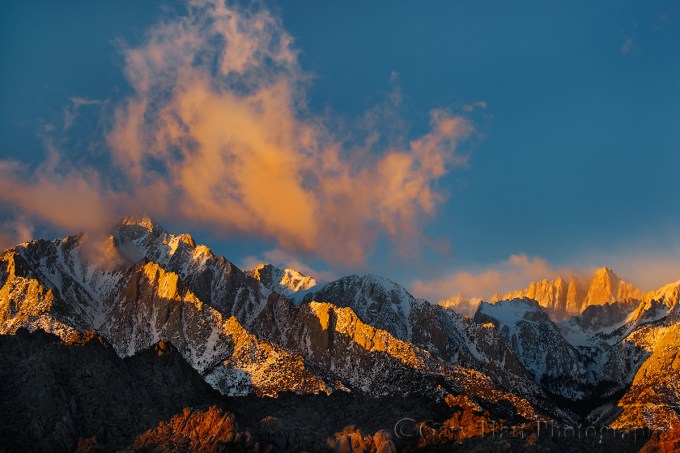
About this image
I captured this scene on the final morning of this year’s Death Valley photo workshop. After three glorious days in Death Valley, we made the 90 minute drive to Lone Pine for a chance to photograph the Alabama Hills at sunset and sunrise. While Death Valley and the Alabama Hills are spectacular landscapes, both are plagued by chronic blue skies, so (speaking of planning for the sky) this workshop is always scheduled around the full moon.
We’d had fantastic clouds throughout our Death Valley stay, but the forecast for Lone Pine was clear skies. No problem, I thought, we’ll have the moon. And we did indeed get the moon, but we also got a bonus layer of thin cirrus clouds that turned a brilliant pink shortly before the sun touched the tallest peaks.
I’d been focused on the moon’s slow descent toward Mt. Williamson (the next peak to the north and just out of the frame on the right) when the color started to kick in. Instead of sticking with Plan A (the moon), I quickly reevaluated the scene and decided that the color in the clouds was best above Lone Pine Peak (on the left) and Mt. Whitney. Vivid color like this doesn’t last long, so I just took the foreground before me, grateful to be in the Alabama Hills, where there’s no such thing as a bad foreground.
With so much going on visually, this is one of those scenes where it’s easy to unconsciously cut off clouds. Ideally every cloud would be a complete entity, surrounded on all sides by blue sky or other clouds. Of course achieving that is easier said than done, but my goal is to make all of my border choices conscious rather than having to later accept what I got because my attention was elsewhere.
Because in my mind the most important cloud feature was the large, pink blob above and right of Lone Pine Peak, I was very careful to include all of it. And you need to take my word that the clouds that run right up to an edge (or just barely poke in from an edge) were in fact seen and consciously handled. But it was impossible to go wide enough on the right to include all of that cloud; and going wide enough to avoid cutting off the other clouds on the edges would have introduced other, even worse, compositional problems.
My point isn’t to justify my choices, it’s merely to point out that they were conscious. (In fact, you may have evaluated this scene differently and made much better choices.) But this underscores one of the things I love most about photography: the blend of conscious and unconscious. I started this post writing about my love of the sky and how that love unconsciously became a major factor in my personal style. Now I finish by emphasizing my drive to be hyper-conscious. And you know what? Each is equally true.
More Clouds
Click an image for a closer look, and to view a slide show.


2020 Highlights: Quality Over Quantity
Posted on December 27, 2020


Being a photographer is more than just capturing images, it’s also very much the experiences that go with their capture. So looking back on a year most notable for its lowlights, and browsing a portfolio that’s by far the smallest of any year since I’ve called myself a photographer, I’m surprised by the number of 2020 experiences that give me shear joy to relive.
So far so good
January 2020 kicked off what appeared to be shaping up to be a banner year, with wonderful conditions in Death Valley and the Alabama Hills: reflections at Badwater, a Zabriskie Point moonset, and a series of beautiful sunrises and sunsets. The year’s first month wrapped up in Iceland with too many highlights to mention, but none more memorable than back-to-back northern lights shoots on the workshop’s final two nights. February followed with some fantastic moonrises in Yosemite—so far so good.
Hit the brakes
Then came March, and the world shut down. Since the end of February, I’ve had to cancel 11 workshops. Lost to COVID and (in one case) wildfires were the Oregon and New Zealand workshops I share with Don Smith, two Yosemite spring workshops, my Grand Canyon raft trip, two Grand Canyon monsoon workshops, and the Eastern Sierra workshop. I was finally able to squeeze in the Yosemite fall color workshop in October, but have since had to cancel the upcoming Iceland workshop (also a collaboration with Don Smith) in January 2021.
But wait…
After wallowing in the isolation of a severely socially distanced spring, early summer arrived and out of nowhere came Comet NEOWISE. I’ve been comet-obsessed since I was 10 years old, so the opportunity to photograph what is arguably the most breathtaking phenomenon to grace the heavens (rivaled only by the northern/southern lights and a total solar eclipse) above Yosemite and the Grand Canyon, was just the elixir I needed. While my two Yosemite trips were comet-specific (8 hours of driving for about an hour of photography each time), my Grand Canyon trip was a (socially distanced) multi-day affair that also featured lightning and beautiful monsoon skies.
After the Grand Canyon in late July, I didn’t really get to do much photography until my Yosemite fall color workshop in late October—a real treat that enabled me to share with a group Yosemite at its autumn, reflective best. Not only was the photography nice, it was a joy to be back with a group of enthusiastic, fun photographers.
Then, just a week later, I hit the jackpot, spending a day in Yosemite photographing snow falling on peak fall color—not just a highlight of my year, but a highlight of my photography life. And finally, in early December I arranged a last-minute gathering with a few of my favorite photography friends to photograph a Yosemite Half Dome moonrise.
Quality (of experience) over quantity (of images)
Compiling the 2020 Highlights gallery at the bottom of this post, I’ve chosen not to focus on the opportunities lost in 2020, but instead to count the blessings I was granted. From sharing the northern lights with an ecstatic group of photographers/friends, to watching the miracle of Comet NEOWISE suspended above two of the most beautiful locations on Earth, to a magical day photographing Yosemite Valley with fresh snow on fall color, 2020 brought me memories that will stand as some of the most outstanding of my life. I can’t say that I’m not looking forward to 2021 more than I look forward to most new years, but I’m going to let 2020’s losses fade in favor of its indelible highlights.
For example
Click the image for the rest of the story (and check out the entire gallery at the bottom)

Sunset Reflection, Badwater, Death Valley (January)
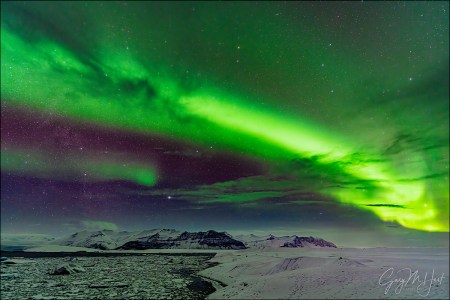
Heaven Sent, Aurora Above Glacier Lagoon, Iceland (January)

Magenta Moonrise, Half Dome and the Merced River, Yosemite (February)

Moon’s Rest, Cloud’s Rest, Yosemite (February)

Comet Neowise and Venus, Half Dome from Glacier Point, Yosemite (July)
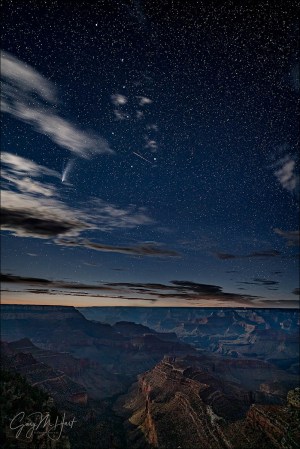
Comet NEOWISE and the Big Dipper, Grandview Point, Grand Canyon (July)

Fall Into Winter, Bridalveil Fall Reflection, Yosemite (November)
A Gallery of My 2020 Highlights
Click an image for a closer look, and to view a slide show.


Dawn’s Early Light
Posted on January 19, 2020

Dawn’s Early Light, Mt. Whitney, Alabama Hills, California
Sony a7RIV
Sony 100-400 GM
30 seconds
F/8
ISO 100
Imagine a world that’s so quiet you can hear nature’s every stirring, a place where each breath holds a pristine bouquet of subtle fragrances and the sky is a continuously shifting kaleidoscope of indigo, blue, yellow, orange, and pink. Maybe you’ve already figured out that I’m describing the very world we live in, before the sun’s light and warmth entice the dirty, noisy, oblivious masses.
The morning magic begins long before the human eye can register detail and color, while a few stars still burn overhead and nearby objects loom as vague shapes. Lacking enough light for the eyes to do their thing, the human experience pre-sunrise is biased toward the non-visual senses, as the sounds of a gentle breeze, flowing water, and stirring creatures mingle with the smells of dew and plants.
For the next 30 minutes, the eastern horizon seems to brighten faster than the rest of the scene. Pushed by the approaching sun, the earth’s shadow hovers in the west, swallowing stars with its steely blue. Following the earth’s shadow is the belt of Venus, as the sun’s longest wavelengths battle through the atmosphere to color the sky pink.
Photographing this pre-sunrise show can begin earlier than your eyes might tell you. Experienced photographers understand that what we perceive as darkness is just our eyes’ relatively limited ability to gather light, combined with the brain’s insistence on processing this limited input instantaneously. But a camera’s sensor accumulates all the light that strikes it for whatever duration we prescribe, thereby stretching the “instant” of perception indefinitely and allowing us to use every possible photon.
Another advantage a digital sensor has over the human eye is its ability to extract color from this apparent darkness. The human eye uses rods and cones to collect light, with the rods doing the heavy lifting in low light, pulling enough monochrome information to discern shapes, but providing little help with color and depth. The cones that complete the scene with color and depth information don’t kick in until there’s much more light. But a digital sensor, though blind to depth, captures photons without discrimination, allowing it to “see” color in very low light.
The ability to capture aspects of the natural world that differ from the human perspective might just be my favorite thing about photography, and these sunrise moments provide a great opportunity to engage the camera’s strength. When the scene is in the same direction as the rising sun, I look for shapes to isolate against the sky, then underexpose enough to turn the shapes into silhouettes, and to prevent the color from being washed out by the sun’s brilliance. When the sun is rising at my back, I take the opposite approach, giving the scene extra light to extract invisible detail from the virtually shadowless light and reveal hidden color in the sky and landscape.
About this image
On the penultimate day of each Death Valley Winter Moon workshop, my group makes the scenic, 90 minute drive from Death Valley to Lone Pine for the workshop’s final sunset and sunrise. The view in the Alabama Hills faces west, so at sunset we’re photographing shaded mountains beneath the brightest part of the sky—not ideal conditions for photography. If we’re lucky enough to get clouds, these Alabama Hills sunsets can still be special, but really it’s the sunrise that we’re here for. At sunrise in the Alabama Hills, we face the Sierra as the sun rises at our back, first coloring the sky with the blue hues of Earth’s shadow, followed by the magenta and pinks of twilight wedge.
Another special aspect of an Alabama Hills sunrise is the Sierra Crest. Towering 10,000 feet above the surrounding terrain, Mt. Whitney and its neighbors jut into the twilight wedge, and for a few sweet seconds take on its pink pastels that photographers call alpenglow.
This year’s sunset was nothing spectacular, but we walked out to the famous Mobius Arch, checked out a couple of other less noteworthy arches nearby, and I pointed out some of the area’s many movie-shoot spots. I was also able to show everyone where the morning sun would rise, and where the moon would set, and introduce them to the most prominent peaks on display: Lone Pine Peak on the left, Mt. Whitney in the middle, and Mt. Williamson on the right.
The forecast for the next morning was clear skies—maybe not dramatic, but good for the planned moonset and ideal for alpenglow on the crest. My general rule for any location is to arrive at least 30 minutes before the “official” (flat horizon) sunrise time, but in the Alabama Hills in winter, I like to get out there even earlier because the warm light from the eastern horizon light reflects off the snow and granite makes the peaks appear to glow in the dark.
The next morning, loading up in the dark at the hotel I glance toward Mt. Whitney and saw a bank of clouds fringing the crest. At first I was concerned that these clouds would obliterate Mt. Whitney, but arriving at our spot in the Alabama Hills, I realized the peak was indeed out, its tip just barely poking into the clouds. We’d arrived about 45 minutes before sunrise, but I barked (gently) at everyone not to delay, that despite what their eyes told them, this light (that still required headlamps to navigate) makes for great photography. Most beelined to the arch, but I saw a telephoto opportunity and quickly set up right next to the car.
White with snow, Mt. Whitney stood in dramatic contrast to the dark sky and foreground. Using the thin strip of clouds to frame the crest, I started by including some of the sky above the clouds, but quickly tightened my composition to simplify the composition. My 30-second exposure to brightened the image far beyond what my eyes saw, and smoothed all detail from the shifting clouds.
The eastern horizon was already gold from the approaching sun, and while I couldn’t really tell that by looking at Whitney, it was apparent with my very first frame. The sun was more than a half-hour from rising, so the light you see on the clouds and Whitney is reflected from the horizon glow, while the darker terrain below Whitney was too low for a direct view of the horizon light.
Workshop Schedule || Purchase Prints
Before the Sun
Click an image for a closer look and to view a slide show.


Static Juxtaposition
Posted on February 9, 2018

Framed Sunset, Mt. Whitney and Mobius Arch, Alabama Hills
Sony a7R III
Sony 12-24 f/4 G
.8 seconds
F/11
ISO 100
My previous post was about dynamic juxtaposition in landscape photography—combining static landscape subjects with transient meteorological and celestial elements. The other side of the juxtaposition coin I call static juxtaposition: combining stationary landscape objects. I am a little reluctant to use the word “static” because there is one element that absolutely can’t be static in these compositions: You.
Since I don’t photograph people or wildlife, I often joke that I don’t photograph anything that moves. And because of this, I need to create motion by encouraging my viewers’ eyes to move through my frame, either providing a path for their eyes to follow and/or a place for them to land. Accomplishing this with static subjects isn’t necessarily difficult, but it does require some physical effort.
Most photographers don’t have a problem getting themselves to the general locations that align foreground and background subjects, but many get a little lazy once they’re there, planting their tripods clinging to the spot like a ship an anchor.
Once I’ve arrived at a location and identified my primary subject, I challenge myself to find at least one other element on a different plane. Sometimes that’s easy, other times…, not so much. Nevertheless, when my subject is in the distance, I look for something closer that has visual weight; likewise, if my subject is nearby, I want something with visual weight in my background. Visual weight is something that pulls the eye: a flower, tree, shrub, leaf, reflection, rock—I could go on, but you get the point. Sometimes it’s not even a distinct entity, but rather a pattern, texture, color, or splash of light.
My secondary subject can have strong aesthetic value or not—sometimes it’s there simply to balance the frame, while other times it has almost as much visual appeal as my primary subject. Regardless of its visual strength, my secondary subject’s placement, both in the frame and relative to the scene’s other visual elements, can make or break an image. And lacking a forklift, pretty much the only way to change the relative position of two static objects in a photographic frame is carefull positioning of the camera (and the photographer behind it!).
Some guidelines
As a general rule I avoid merging my essential visual elements—to do conflates those elements and sacrifices the illusion of depth that’s so essential in a two-dimentional image. Another thing I try to avoid is objects with visual weight at the edge of my frame because anything that pulls my viewers’ eyes toward the image’s boundary dilutes its impact.
Viewers’ eyes move most effectively through a scene by following lines. Sometimes those lines are tangible, like a horizontal horizon, vertical waterfall, or diagonal river. But often it’s up to me to create virtual lines—an implicit, connect-the-dots path between visual elements, or textures and shapes that frame my primary subject and constrain my viewers’ eyes. For example:

Diagonal: This is a strong visual connection because the line created traverses the frame’s top, bottom, left, and right hemispheres.

Linear (yes, I know a diagonal line is linear too): I often do this in a vertical composition to guide the eye to my primary subject. Here I use floating autumn leaves to guide my viewer straight to Half Dome.

Circular: Okay, maybe not literally a circle, more of a frame that surrounds the primary subject. In this case I framed Half Dome and its reflection with the color and texture of grass, spring foliage, and vertical tree trunks.
For example
Last week I was at Mobius Arch beneath Mt. Whitney, the final stop of my annual Death Valley photo workshop. After three days of spectacular Death Valley sunrises and sunsets that seem to be trying to outdo the one before it, I didn’t dare to hope that the string would continue when we moved to the Alabama Hills.
The real show here is sunrise, when day’s first rays of sun color the Sierra Crest with alpenglow’s pink hues, even on clear sky mornings. Sunsets here require a little help. The view here faces west, so at sunset you usually find yourself photographing the shaded side of your subjects against the brightest part of the sky—not really a recipe for success. But a few clouds on the western horizon not only add color and texture, they soften the light. And that’s what happened last week.
Before sunset the thin, translucent cirrus layer was lost in the late afternoon glare, but as the sun dropped below the horizon, the clouds picked up its refracted long wavelengths and colored the sky deepening shades of red. Soon the color was so intense that it shaded weathered granite boulders.
The three elements I wanted to feature in my composition were Mobius Arch, the Sierra Crest (Lone Pine Peak and Mt. Whitney), and the colorful sky. As dramatic as the Sierra Crest is, the star of this scene is the arch. With no real access to a telephoto view, filling my frame with the arch means a wide angle lens that includes too much sky. But the vivid color this evening gave me a rare opportunity to include a sky worthy of the rest of the scene.
My Sony 12-24 f/4 G lens allowed me to within a couple feet of the arch while still fitting it in my frame. With the Sierra Crest framed by the arch, I was careful to position myself so both Lone Pine Peak (on the left) and Mt. Whitney (on the right) were visible. Finally, I needed to decide the camera height. When the sky is less interesting, I raise my camera to fill the arch’s opening with the mountains and minimize the sky. But this evening the colorful sky was an asset, so I dropped as low as I could to maximize it.
At such a wide focal length, depth of field was a piece of cake—I didn’t need to check my hyperfocal app to know that I had lots of margin for error. Focusing toward the back of the arch, I easily achieved the front-to-back sharpness I wanted. Click.
Workshop Schedule || Purchase Prints
A Gallery of Static Juxtapositions


Photograph the Eastern Sierra
Posted on October 10, 2017
First Light, Lone Pine Peak and Mt. Whitney, Alabama Hills, Eastern Sierra (2006)
Canon EOS-1Ds Mark II
Canon 70-200 f/4L
1/20 second
F/8
ISO 200
This is an edited and updated version of my Eastern Sierra article that appeared in the September 2016 edition of “Outdoor Photographer” magazine
Eastern Sierra
Skirting the east side of the Sierra Nevada, US 395 enchants travelers with ever-changing views of California’s granite backbone. Unlike anything on the Sierra’s gently sloped west side, Highway 395 parallels the range’s precipitous east flank in the shadow of jagged peaks that soar up to 2 miles above the blacktop. More than just beautiful, these massive mountains form a natural barrier against incursion from the Golden State’s major metropolitan areas, keeping the Eastern Sierra region cleaner and quieter than its scenery might lead you to expect.
It would be difficult to find any place in the world with a more diverse selection of natural beauty than the 120-mile stretch of 395 between Lone Pine and Lee Vining: Mt. Whitney and the Alabama Hills, the ancient bristlecones of the White Mountains (across the Owens Valley, east of the Sierra), the granite columns of Devil’s Postpile, Mono Lake and its tufa towers, and too many lake-dotted, aspen-lined canyons to count. Long a favored escape for hikers, hunters, and fishermen, in recent years photographers have come to appreciate the rugged, solitary beauty possible only on the Sierra’s sunrise side.
I prefer photographing most Eastern Sierra locations at sunrise, when the day’s first rays paint the mountains with warm light, and the highest peaks are colored rose by alpenglow. (Without clouds, Eastern Sierra sunset light can be tricky, as you’ll be photographing the shady side of the mountains against the brightest part of the sky.) Devoid of large metropolitan areas, low light pollution also makes the Eastern Sierra one California’s finest night photography destinations. But regardless of the time of day, the key to photographing the Eastern Sierra is flexibility—if you don’t like the light in one direction, you usually don’t need to travel far to find something nice in another direction.
Lone Pine area
The southern stretch US 395 bisects the Owens Valley, a flat, arid plane separating the Sierra Nevada to the west from the Inyo ranges to the east. Just west of Lone Pine lies the Alabama Hills. Named for a Confederate Civil War warship, the Alabama Hills’ jumble of weathered granite boulders and proliferation of natural arches would be photogenic in any setting. Putting Mt. Whitney (the highest point in the 48 contiguous states), Lone Pine Peak (the subject of Mac OS X Sierra’s desktop image), and the rest of the serrated southern Sierra crest seems almost unfair.
The Alabama Hills are traversed by a network of unpaved but generally quite navigable roads. To get there, drive west on Whitney Portal Road (the only traffic signal in Lone Pine). After 3 miles, turn right onto Movie Road and start exploring. If you’re struck by a vague sense of familiarity here, it’s probably because for nearly a century the Alabama Hills has attracted thousands of movie, TV show, and commercial film crews.
Mobius Arch (also called Whitney Arch and Alabama Hills Arch) is the most popular photo spot in the Alabama Hills. It’s a good place to start, but settling for this frequently photographed subject risks missing numerous opportunities for truly unique images here. To get to Mobius Arch, drive about a mile-and-half on Movie Road to the dirt parking area at the trailhead. Following the marked trail down and back up the nearby ravine, the arch is an easy ¼ mile walk. There’s not a lot of room here, but if the photographers work together it’s possible to arrange four or five photographers on tripods with Mt. Whitney framed by the arch. And don’t make the mistake many make: the prominent peak on the left is Lone Pine Peak; Mt. Whitney is serrated peak at the back of the canyon.
Sunrise is primetime for Alabama Hills photography, but good stuff can be found here long before the sun arrives. I try to be set up 45 minutes before the sun (earlier if I want to ensure the best position for Whitney Arch) to avoid missing a second of the Sierra’s striking transition from night to day.
The grand finale from anywhere in the Alabama Hills is the rose alpenglow that colors the Sierra crest just before sunrise. Soon after the alpenglow appears, the light will turn amber and slowly slide down the peaks until it reaches your location, warming the nearby boulders and casting dramatic, long shadows. But unless there are clouds to soften the light, you’ll find that the harsh morning light will end your shoot pretty quickly once the sunlight arrives on the Alabama Hills.
Whitney Portal Road (closed in winter) ends about 11 miles beyond Movie Road, at Whitney Portal, the trailhead for the hike to Mt. Whitney and the John Muir Trail. On this paved but steep road, anyone not afraid of heights will enjoy great views looking east over the Alabama Hills and Owens Valley far below, and up-close views of Mt. Whitney looming in the west. At the back of the Whitney Portal parking lot is a nice waterfall that tumbles several hundred feet in multiple steps.
The Alabama Hills are one of my favorite moonlight locations. Because the full moon rises in the east right around sunset, on full moon nights the Alabama Hills and Sierra crest are bathed in moonlight as soon as darkness falls. Lit by the moon, the hills’ rounded boulders mingle with long, eerie shadows, and the snow-capped Sierra granite radiates as if lit from within.
If you find yourself with extra time, drive about 30 miles east of Lone Pine on Highway 136 until you ascend to a plain dotted with photogenic Joshua trees—after you’ve finished photographing the Joshua trees, turn around and retrace the drive back to Lone Pine on 136 to enjoy spectacular panoramic views of the Sierra crest. And just north of Lone Pine on 395 is Manzanar National Historic site, a restored WWII Japanese relocation camp. Camera or not, this historic location is definitely worth taking an hour or two to explore.
Bristlecone pine forest
Continuing north from Lone Pine on 395, on your left the Sierra stretch north as far as the eye can see, while the Inyo mountains on the right transition seamlessly to the White Mountains. Though geologically different from the Sierra, the White Mountains’ proximity and Sierra views make it an essential part of the Eastern Sierra experience.
Clinging to rocky slopes in the thin air above 10,000 feet, the bristlecone pines of the White Mountains are among the oldest living things on earth—many show no signs of giving up after 4,000 years; at least one bristlecone is estimated to be 5,000 years old.
Abused by centuries of frigid temperatures, relentless wind, oxygen deprivation, and persistent drought, the bristlecones display every year of their age. Their stunted, twisted, gnarled, polished wood makes the bristlecones suited for intimate macros and mid-range portraits, or as a striking foreground for a distant panorama.
The two primary destinations in the bristlecone pine forest are the Schulman and Patriarch Groves. Get to the bristlecone pine forest by driving east from Big Pine on Highway 168 and climbing about 13 car-sickness inducing miles. Turn left on White Mountain Road and continue climbing another 10 twisting miles to reach the Schulman Grove. Despite the incline and curves, the road is paved all the way to this point. Stop at the Sierra panorama after about 8 miles for a spectacular view that also makes a great excuse to pause and collect yourself.
Stop at the small visitor center in the Schulman Grove to pay the modest use fee, then choose between the 1-mile Discovery loop trail, and the 4 1/2 mile Methuselah loop trail. Both trails are in good shape, but the extreme up and down in very thin air will test your fitness. Most of the trees on the Methuselah Trail get more morning light, while the majority of the Discovery Trail trees get their light in the afternoon.
If you’re unsure of your fitness, or have limited time, the Discovery Trail is definitely the choice for you. Because the photogenic trees start with the very first steps, on this trail you can turn around at any point without feeling cheated of opportunities to photograph nice bristlecones. And along the way you’ll appreciate the handful of benches for enjoying the view and catching your breath. Hikers who can make it to the top of the switchbacks are rewarded great views of the snow-capped Sierra across the Owens Valley.
The Discovery Trail climbs for a couple hundred more yards beyond the switchbacks, but just as you’re beginning to wonder whether all the effort is worth it, the trail levels, turns, and drops. Soon you’ll round a 90-degree bend and be rewarded for your hard work with two of the most spectacular bristlecones in the entire forest. Spend as much time here as you have, because the rest of the loop back to the parking lot has nothing to compete with these two trees.
The pavement ends at the Schulman Grove, but the unpaved 12-mile drive to the Patriarch Grove is navigable by all vehicles in dry conditions. Home to the Patriarch Tree, the world’s largest bristlecone pine, the Patriarch Grove is more primitive and much less visited than the Schulman Grove. Unlike the Schulman Grove, where I rarely stray far from the trail, I often find the most photogenic bristlecones here by venturing cross-country, over several small ridges east of the Patriarch Tree. Even without a trail, the sparse vegetation and hilly terrain provides enough vantage points that make getting lost difficult.
Clean air, few clouds, and very little light pollution make the bristlecone groves a premier night photography location. On moonless summer and early autumn nights, the bright center of the Milky Way is clearly visible from the slopes of the bristlecone forest. For the best Milky Way images, look for trees that can be photographed against the southern sky. And no matter how warm it is on 395 below, pack a jacket.
The bristlecone forest closes in winter.
Bishop area
An hour north of Lone Pine on 395 is Bishop. Its central location, combined with ample lodging, restaurant, and shopping options make Bishop an excellent hub for an Eastern Sierra trip—if you want to anchor in one spot and venture out to the other Eastern Sierra locations, Bishop is probably your best bet.
West of Bishop are many small but scenic lakes nestled in steep, creek-carved canyons that are lined with aspen (and some cottonwood) that turn brilliant yellow each fall. Many of these canyons can be accessed on paved roads, others via unpaved roads of varying navigability, and a few solely by foot.
Of these canyons, Bishop Creek Canyon is the best combination of accessible and scenic. To get there, drive west on Highway 168 (Line Street in Bishop). After about 15 miles you can decide whether to turn left on the road to South Lake, or continue straight to reach North Lake and Lake Sabrina (pronounced with a long “i”).
One of the area’s most popular sunrise spots, North Lake is a 1-mile signed detour on a narrow, steep, unpaved road—easily navigated in good conditions by all vehicles, but the un-railed, near vertical drop is not for the faint of heart. A mile or so beyond the turn to North Lake the road ends at Lake Sabrina, a fairly large reservoir in the shadow of rugged peaks and surrounded by beautiful aspen (but its bathtub ring when less than full is not for me).
South Lake is another aspen-lined reservoir that shrinks in late summer and autumn. Highlights on South Lake Road are a manmade but photogenic waterfall leaping from the mountainside, clearly visible on the left as you ascend, and Weir Lake, just before South Lake.
Both Bishop Canyon roads are worth exploring, especially in autumn, when the fall color can be spectacular. Each features scenic tarns and dense aspen stands accented by views of nearby Sierra peaks. Rather than beeline to a fall color spot, in autumn I drive the Sabrina and South Lake roads and pick the best color.
Highway 395 north of Bishop features a few of my favorite fall color destinations, including Rock Creek Canyon and McGee Creek. About a half hour north of Bishop, detour west off the highway to postcard-perfect Convict Lake. And just beyond the road to Convict Lake is the upscale resort town of Mammoth Lakes, just a few miles west of 395. The drive on 203 through Mammoth Lakes takes you past the Mammoth Mountain Ski slopes to Minaret Vista. This panoramic view of the sawtooth Minaret Range, Mt. Ritter, and Mt. Banner captures the essence of high Sierra beauty. From here, follow the road down the other side to see the basalt columns of Devil’s Postpile, and to take the short hike to Rainbow Fall.
Lee Vining area
Leaving Bishop, Highway 395 climbs steeply, crests near Crowley Lake, skirts the communities of Mammoth Lakes and June Lake, finally dropping down into the Mono Basin and Lee Vining. Though this is an easy, one-hour drive, you’ll feel like you’ve landed on a different planet. In October, detour onto the June Lake Loop, another popular fall color drive.
By far the most popular Mono Lake location is South Tufa, a garden of limestone tufa towers that line the shore and rise from the lake. Tufa are calcium carbonate protrusions formed by submerged springs and revealed when the lake drops. In addition to the striking tufa towers, South Tufa is on a point that protrudes into the lake, allowing photographers to compose with both tufa and lake in the frame while facing west, north, or east.
To visit South Tufa, turn east on Highway 120 about 5 miles south of Lee Vining. Follow this road for another 5 miles and turn left at the sign for South Tufa. Drive about a mile on an unpaved, dusty but easily navigated road to the large dirt parking lot. From here it’s an easy ¼ mile walk to the lake, but wear your mud shoes if you want to get close to the water. And don’t climb on the tufa.
While South Tufa can be really nice at sunset, mirror reflections on the frequently calm lake surface, and warm light skimming over the low eastern horizon, make this one of California’s premier sunrise locations. To get the most out of a sunrise shoot here, it’s a good idea to photograph South Tufa at sunset to familiarize yourself with the many possibilities here (and who knows, maybe you’ll get lucky and catch one of the Eastern Sierra’s spectacular sunsets).
In the morning, arrive at the lake at least 45 minutes before sunrise to ensure a good spot at this popular location—you can start shooting as soon as you arriving, using long exposures to brighten the scene and smooth the water. I usually start with scenes to the east, capturing tufa silhouettes against indigo sky and water. As the dawn brightens, keep your head on a swivel and be prepared to shift positions with the changing light.
As the sun approaches and the dynamic range increases in the east, I often turn to face west. Soon the highest Sierra peaks are colored with pink alpenglow, followed quickly by the day’s first direct sunlight. With the sun rising beneath the horizon behind me, its light slowly descends the Sierra peaks stretching before me. When the sunlight finally reaches lake level, for a few minutes the tufa towers are awash with warm sidelight, creating wonderful opportunities facing north. As with the Alabama Hills, without clouds to soften the sunlight and make the sky more interesting, the sunrise show is terminated quickly by contrasty light.
Other options in and near Lee Vining are the excellent Mono Lake visitor center on the north side of town, the small but very informative Mono Committee headquarters in the middle of town, any meal at the Whoa Nellie Deli in the Mobil Station (trust me on this), and Bodie, an extremely photogenic ghost town maintained in a state of arrested decay, less than an hour’s drive north. And a sinuous 20-minute drive west, up 120 (closed in winter) lands you at Tioga Pass, Yosemite’s east entrance and the gateway to Tuolumne Meadows.
Fall color in the Eastern Sierra
Each fall the Eastern Sierra becomes a Mecca for photographers chasing the vivid gold coloring the area’s ubiquitous aspen groves. The show starts in late September at the highest elevations, and continues well into October in some of the lower elevations. Fall color timing and locations vary from year-to-year, but the general fall color rule to follow here is: If the trees are still green, just keep climbing.
The best way to photograph the Eastern Sierra’s fall color is to explore: Pick a road that heads west and start climbing until something stops you. To give you a head start, here are a few of my favorite spots, from south to north. (Rather than beeline to specific locations in these ever-changing canyons, I’ve found it’s best to drive slowly and stay alert for opportunities along the way.)
Bishop Creek Canyon: Nice any season it’s open, Bishop Creek Canyon (detailed earlier) comes alive with gold each autumn. Aspen surrounding the canyon’s many lakes make for spectacular reflections. Of these, North Lake is probably the most popular, but autumn mornings can be extremely crowded here. The color in Bishop Creek Canyon usually peaks in late September at the highest elevations (near North Lake, Lake Sabrina, and South Lake), but lasts until mid-October farther down the canyon.
Rock Creek Canyon: Near the crest of the climb out of Bishop on 395, turn left at the sign for Rock Creek Lake. Climb this road along Rock Creek all the way up to its terminus at Mosquito Flat trailhead. Over 10,000 feet, this is the highest paved road in the Sierra. As with Bishop Creek Canyon, the best photography in Rock Creek Canyon is usually found at random points along the road—drive slowly and keep your eyes peeled.
McGee Creek: When you see Crowley Lake on the right, look for the road to McGee Creek on the left. This 2-mile unpaved road is navigable by all vehicles, but take it slow. It ends at a paved parking lot that’s the launching point for a hike up McGee Creek, into the canyon, and the mountains beyond. Unlike most other Eastern Sierra canyons, the dominant tree here is cottonwood. While I’ve had good success photographing along the creek right beside the parking lot, you can find nice color as far up the canyon as your schedule (and fitness) permits.
Convict Lake: The road to Convict Lake is just south of Mammoth Lakes. It’s a 2-mile paved drive to a beautiful lake nestled at the base of towering mountains—definitely worth the short detour off of 395.
June Lake Loop: Between Mammoth Lakes and Lee Vining is a 15 mile loop that exits 395 near the small town of June Lake (look for a gas station on the left) and returns to 395 a few miles down. Along the route you’ll find several lakes, and a waterfall at the very back of the loop (visible from the road).
Lundy Canyon: About 5 miles north of Lee Vining, turn left onto the Lundy Canyon road to enjoy one of my favorite Eastern Sierra fall color spots. The lower half of this road, below Lundy Lake, is often a good place to find late season color, but my favorite photo spots aren’t until road turns bad, just beyond the lake.
Driving slowly and with great care, most vehicles can make the 2 unpaved miles along Mill Creek to the end of the road. In addition to beautiful creek scenes, you’ll find several small, reflective beaver ponds along the way. If you make it to the end of the road, park and follow the trail up the canyon, through an aspen grove, for about ¼ mile to reach a small, waterfall-fed lake. The overgrown lakeshore makes photography here difficult, but a short walk along the shoreline to the left, toward the lake outlet, will take you to a massive beaver dam. Roll up your pants and get your feet (and more) wet for the best views of the lake.
Dunderberg Peak and Virginia Lakes: Shortly after the turn to Lundy Canyon, 395 climbs steeply to Conway Summit, at 8143 feet, the highest point on the entire route. On the left, just past a spectacular view of the entire Mono basin (worth the stop), is the road to Virginia Lakes. Here you’ll find some of the area’s earliest aspen to turn. Just beyond the Virginia Lakes road are colorful views of Dunderberg Peak and its aspen-blanketed slopes.
There’s far too much to photograph in the Eastern Sierra to describe here. Join me in an Eastern Sierra photo workshop to explore all these locations, plus many more less known spots: Eastern Sierra Photo Workshops
Workshop Schedule || Purchase Prints
An Eastern Sierra Gallery


The Range of Light
Posted on February 19, 2017

Twilight Crescent, Mt. Whitney
Sony a7R II
Sony 70-200 f/4
1/3 second
F/11
ISO 160
“… the mighty Sierra, miles in height, and so gloriously colored and so radiant, it seemed not clothed with light but wholly composed of it, like the wall of some celestial city…. Then it seemed to me that the Sierra should be called, not the Nevada or Snowy Range, but the Range of Light.” — John Muir
Anyone who has spent time in or around the Sierra Nevada has to agree that there’s something special about its interaction with light. Towering one to two miles above the surrounding terrain for nearly all of its 400-mile length, the Sierra Nevada are California’s most prominent natural feature. But it’s not just prominence that sets the Sierra apart. The Sierra are almost entirely granite, an intrusive igneous rock comprised primarily of light-toned feldspar and liberally infused with lustrous quartz and mica. Because igneous intrusive rocks form deep beneath the Earth’s surface, constituent minerals cool and harden slowly enough for large, reflective crystals to form.
In addition to its inherently reflective qualities, granite is quite hard and resistant to erosion. Unlike the overlying sedimentary and metamorphic rock that washed downhill as the Sierra pushed (and continues to push) upward, granite remains intact when subjected to wind and rain. Eventually small cracks form; water percolating into these cracks expands as it freezes, widening the cracks further until the granite fractures and a large block separates. The result is large vertical and domed surfaces whose extreme slope and hardness are particularly inhospitable to plant life, even well below the timberline. Granite’s hardness also means that rather than crumbling beneath the weight of the numerous glaciers to scour the Sierra, much of the Sierra granite has been polished to a glassy sheen.
Granite’s light complexion, reflective inclusions, and abundance of exposed, polished surfaces make the Sierra particularly inclined to reflect the color of whatever light illuminates it. This relationship with light is quite evident in Yosemite Valley, nestled in the range’s more moderately sloped west side. When the sun strikes Yosemite’s Half Dome and El Capitan at day’s end, warm sunset light paints these monoliths in brilliant orange and red hues just before the sun is snuffed by the horizon. While this color can be seen at sunset year round, it takes center stage each February when sunset shadow and light conspire to highlight normally insignificant Horsetail Fall’s tumble down El Capitan’s east face.
As exquisite as the light on Yosemite’s granite is, I’m even more drawn to the Sierra’s east side, which gets its best sun at sunrise. Unlike the Sierra’s gradually sloped, relatively moist, and largely foliated west slopes, the Sierra’s east side is much steeper, drier, and therefore sparsely foliated and more exposed. Enhancing the drama, the Eastern Sierra’s towering granite face also catches the earliest possible sunlight, sunlight that has traveled farther and through purer air (because there fewer airborne pollutants in the morning in general, and the sunlight east of the Sierra traverses much less densely populated terrain).
My favorite place to watch the light play on the Eastern Sierra granite is in and near the Alabama Hills, two vertical miles beneath Mt. Whitney and the Sierra’s most precipitous section. Looming above the Owens Valley, 14,505 foot Mt. Whitney is the highest point in the 48 contiguous United States. Unlike many towering peaks that stand by themselves, Mt. Whitney is bounded by 13,000 foot Lone Pine Peak and 14,000 foot Mt. Williamson, all connected by a serrated ridge of 13,000+ foot sharks tooth prominences.
Before sunrise I like to arrive early enough to see the Sierra crest reflect the pale blue of the pre-dawn sky, then watch it warm gradually as the sky brightened before the approaching sun. The color reaches a crescendo when the sun’s longest wavelengths first kiss the highest peaks with pink alpenglow. As the rest of the sun’s visible wavelengths join the party, the crest warms to amber before finally cooling beneath the daylight-blue sky.
At the end of the day the best color arrives after the sun has long disappeared behind the crest and the entire scene is illuminated by a sky well on its way to night. Though the mountains’ color is more subtle than the sunrise show, the Eastern Sierra’s granite when imbued with the pale mauve of evening twilight is no less beautiful. Eventually night takes over and once again the Sierra granite throbs a soft blue.
Early last October I guided my Eastern Sierra workshop group up to Whitney Portal at the base of Mt. Whitney to photograph cascading Whitney Portal Fall in late afternoon shade. On the drive back down we squeezed into a small turnout not too far down the road for the closest view of Whitney that doesn’t require a serious hike. This year’s group got a bonus when a thin slice of brand new moon appeared shortly after sunset.
Mounting my Sony 70-200 f4 on my a7RII, I framed the scene as tightly as I could while still including both Mt. Whitney and the crescent moon. Though the sky was clear, a steady stream of small clouds materialized as if issued by a cloud making machine just out of sight behind the crest to the right of Whitney. Each new cloud scooted to the left and dissipated quickly in drier air near the summit. After composing, metering, and focusing, I waited for the next cloud to appear and clicked this frame in the purple twilight.
PURCHASE PRINTS || PHOTO WORKSHOPS
The Many Colors of Mt. Whitney


Beware the “expert”
Posted on March 4, 2016
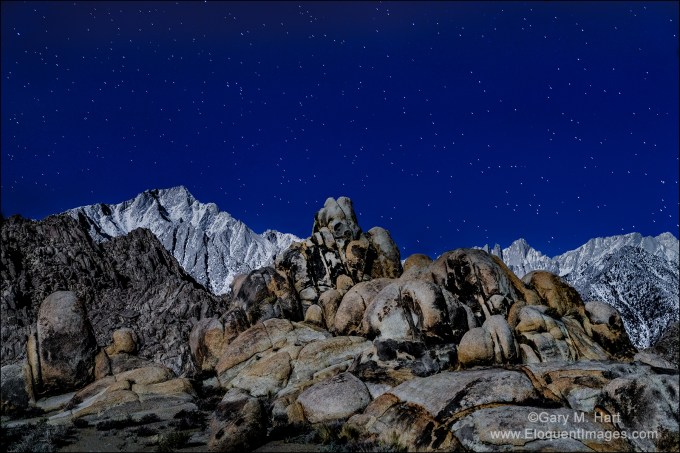
Sierra Moonlight, Mt. Whitney and Lone Pine Peak, Alabama Hills, California
Sony a7R II
Sony/Zeiss 24-70 f4
15 seconds
F/5.6
ISO 3200
Rules are important. The glue of civilization. And after a childhood constrained by bedtimes, homework, and curfews, it’s no wonder that as adults we honor rules simply because, well, simply because. (I mean, who doesn’t wait for however long it takes and with no car or cop in sight, for a light to change?)
As much as civil society relies on universal obedience, not all “rules” are created equal. And our reluctance to question authority inhibits growth. One example would be blind adherence to the (usually) well-intended photography “experts” proliferating in print, online, and (especially) in your local camera club. These self-proclaimed authorities have figured out that people who are just learning are less confident, and tend to respond more to authority than substance.
The camera club paradox
I think camera clubs are great for many reasons: they connect people with a common interest, facilitate the exchange of information and ideas, and provide a forum for sharing our photographic creations. Camera clubs spur us to get out and shoot when we otherwise might stay home, and offer the beginner rules that provide a stable foundation upon which to build her craft.
But camera clubs can also be a breeding ground for self-proclaimed experts, a status often not conferred to the person most qualified, but to the person who spews photographic dogma with the most authority. The result is well-intended but misinformed knowledge that infects a camera club like a mutated virus.
I’m especially troubled when I hear of images shared in a camera club photo competition that were dismissed without consideration because they violated the local “expert’s” idea of an unbreakable photographic rule. Some camera club capital “violations” I’ve seen firsthand or heard about (by no means a comprehensive list):
- Centered subject
- Centered horizon
- Blown highlights
- No detail in the shadows
- Not sharp from front to back (this one really bothers me)
Each of these things can be a problem, but they can be a refreshing expression of creativity as well. And even if they are a problem, refusing to consider an image because it violates someone’s definition of “perfect” discounts all that’s potentially good about it.
If you’re an aspiring photographer and someone dismisses an image for a technical violation, take a step back, inhale, and remind yourself that there are very, very few absolutes in photography. In general, it’s helpful to remember that no matter how strongly it’s stated, advice that doesn’t feel right (even if you can’t articulate why) doesn’t need to be heeded. In fact, the next time someone starts feeding you photography advice in absolutes, run (don’t walk) to the nearest exit.
About this image
I jumped on my anti-expert soapbox after observing several recent workshop participants who were clearly constrained by “rules” enforced by their local camera club. And looking at this image, I realized that there are camera clubs that probably wouldn’t even consider it because I centered the horizon and the teddy-bear shaped rock in the foreground. I also captured a little more star motion than is ideal. But deal breakers? Not to me.
I’d taken my January Death Valley workshop group out to the Alabama Hills for a moonlight shoot on the workshop’s last night. A few in the group walked out to the arch, but most gravitated to this group of boulders a little south of the parking area. As I worked to get the group up to speed with moonlight photography, I tried a few frames of my own.
Most of my moonlight images are fairly wide, and even the closest focus point is far enough away to be at infinity, even wide open. But the rocks here were close enough, and my focal length was long enough (57mm), that I stopped down from f4 to f5.6 to increase my margin for error. And rather than autofocusing on the moon as I normally do, I focused toward the back of the foreground rocks. As I hope you can see in this low-res web version, I made the right focus choices.
The other problem I had to contend with was motion blur in the stars. At the 16mm to 24mm I typically use for night photography (to maximize the number of stars), motion blur isn’t much of a problem, even at 30 seconds. But at nearly 60mm, I didn’t think I could get away with 30 seconds. This is the first time I’d tried my Sony a7RII at night—I usually use my a7S, but I’d heard such good things about the a7RII’s high ISO capability that I thought I’d try it.
Bumping the ISO to 3200 (from my moonlight standard of 800), I was able to drop my shutter speed to 15 seconds. This image is so clean at 3200, and the star motion is visible enough, that I regret now that I didn’t go to ISO 6400 and cut my shutter speed to 8 seconds. Next time….
Workshop schedule
A gallery of potential rejects
(Images that might not make the cut at a camera club competition)
Click an image for a closer look, and a slide show. Refresh the screen to reorder the display.


 Eloquent Images by Gary Hart