Eloquent Images by Gary Hart
Insight, information, and inspiration for the inquisitive nature photographer
Enjoying Yosemite in a fog
Posted on December 14, 2016
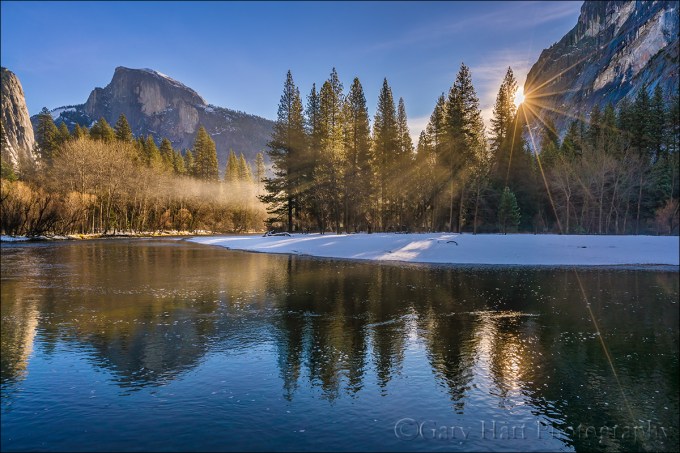
Morning Sun, Half Dome, Yosemite
Sony a7R II
Sony/Zeiss 16-35 f4
1/100 seconds
F/16
ISO 100
One of Yosemite’s most underrated winter treats is the radiation fog that hugs the valley floor on cold, clear, still mornings. Unlike the advection fog that drapes the San Francisco Bay Area (among other places) when (relatively) warm, saturated air passes over the colder ocean and blows inland, radiation fog forms in place when plummeting overnight temperatures cause airborne water vapor to condense.
A sheltered valley with a cold river, soggy meadows, and a spongy forest floor, Yosemite Valley is ideal for the formation of radiation fog. Each winter, storms fill the Merced River and soak the meadows and forest. On nights when there’s no wind to mix the atmosphere, cold air sinks until it meets the water-laden air near the ground. Because cold air can’t hold as much water vapor as warmer air, and the air on the valley floor is completely saturated, the airborne water vapor condenses as soon as the air chills even slightly: Fog.
Often no more than a thin, gray veneer, in radiation fog that’s dense enough to obscure trees across a meadow, it’s sometimes possible to see stars or blue sky overhead. Viewed from a distance (for example, from Tunnel View), Yosemite’s radiation fog appears to be in constant motion, alternately engulfing and revealing treetops, sometimes rising hundreds of feet and completely disappearing in a matter of minutes. With no wind to move the fog, the reality is that what appears to be motion is primarily fog forming and dissipating in place. Yosemite’s radiation fog persists until the air heats enough to hold the available airborne moisture, or the wind picks up and mixes warmer air above with the colder, saturated air below.
About this image
Last Friday morning I went out to scout a new route to one of my favorite Yosemite spots, a bend in the Merced River upstream from Sentinel Bridge with view and reflection of Half Dome. My Yosemite Winter Moon workshop started that afternoon, but the original access here had been obliterated by major roadwork underway in Yosemite Valley, so I needed to make sure I could still get my group out here.
With very little time to spare, I originally left my camera bag in the car, but didn’t get too far before second thoughts sent me back for it. Good thing—after a few minutes of traipsing across crunchy snow, I made it out of the woods and to the river just in time to catch sunlight illuminating a diaphanous radiation fog. Shadows cast by sunlight passing through evergreen branches created a beam effect in the illuminated mist, while upstream a blanket of fog basked in golden sunlight.
The sun was about to disappear behind the granite ridge beneath Glacier Point and I new I only had a few more minutes of this spectacularly illuminated fog. At first I tried to position the sun behind the trees, but at this distance the treetops were so thin that very little blocking occurred and I ended up with a white blob of blown highlights. So I hustled over to the intersection of the ridge’s shadow with the sunlit ground and prepared for a sunstar. Every lens creates a different sunstar effect, some much better than others, and my Sony/Zeiss 16-35 f/4 is my favorite. Stopping down to f/16, I went to work. Moving with the sun so I was always straddling the shadow line, I was able to shoot for about five minutes before the entire beach was in shade and I was finished.
Purchase Prints || Photo Workshops
Yosemite Fog


Photographic matchmaking
Posted on December 7, 2016

Autumn Pool and Cascade, Bridalveil Creek, Yosemite
Sony a7R II
Sony/Zeiss 16-35 f4
6 seconds
F/16
ISO 200
While everyone loves a pretty scene, I’m afraid our aesthetic sense has been numbed by the continuous assault of “stunning” images online. A picture grabs our eyes on Instagram or Facebook and we reflexively click Like and move on to the next (similarly) stunning image. The photography equivalent of pop music, formula fiction, or (most) network television, these images exit our conscious about as fast as they entered because they fail to make a personal connection.
But every once in awhile an image surprises us and we pause, float our eyes around the scene, examine detail, bask in its mood. Who knows the trigger for such a response? Maybe is as simple as aspect of the scene that spurs a memory or taps a longing. Or maybe the connection reaches deeper than that.
Pictures succeed not just by virtue of their visual elements, but also by how those elements are connected. I used to believe that the sole purpose of including visual elements throughout my frame was to create the illusion of depth in photography’s two-dimensional medium. While I still strongly agree, I think the value of multiple points of visual interest goes deeper than that. Just as humans seek interpersonal connections in our daily lives, I think we’re programmed to favor images with relationships between heterogeneous elements in the nature. Not just Grand Canyon, but Grand Canyon speared by lightning; not just Half Dome, but Half Dome beneath a rising full moon; not just glowing Kilauea Caldera, but glowing Kilauea Caldera beneath the Milky Way.
Creating relationships between elements work on a smaller scale as well (albeit, usually without the opportunity for planning that celestial or meteorological phenomena provide)—small forest scenes and intimate macros benefit from inclusion of multiple elements as well. Of course an image with a disorganized arrangement of elements, no matter how beautiful each is individually, probably won’t get a second look. But find a way to organize a scene’s elements in a way that allows the eye to flow effortlessly through the frame and you have the potential for visual synergy—an image that’s greater than the sum of its visual parts.
The opportunity to connect disparate elements is everywhere if you look, from the broadest panorama to the most intimate macro. Whatever the scale, the key is not locking onto your subject until you find something to pair it with. In other words, finding a photo-worthy subject should never be your goal, it should be your starting point.
Without diving too deeply into the concept of visual weight (a subject in and of itself), I try to create a frame with balance between visual elements (not loaded too much in on of the scene’s quadrants: upper left, upper right, lower left, lower right). I also try to keep objects with a strong visual tug away from the edges of my frame. And finally, I look to position my elements so they’re connected by virtual diagonal lines.
About this image
On the final morning of last month’s Yosemite Autumn Moon photo workshop, I set the group loose in the forest beneath Bridalveil Fall to scour the possibilities in and around Bridalveil Creek. Always a workshop favorite, I usually save the Bridalveil Creek until the workshop’s final day, when my students have found their creative zone after three days of shooting and training. This approach seems to pay off, because no matter how much time I give them in there, it never seems to be enough.
When I found this accumulation of just-fallen autumn leaves floating in a glassy pool, I knew I had the start of a nice scene. Scanning my surroundings, I didn’t have to look hard to find a small cascade to connect with my colorful leaves. But with the pool tucked beneath a fallen log, accessing the best angle was tricky. Sprawling nearly flat on my back beneath the overhanging log, with one tripod leg in the water, turned out to be the best way to maximize the virtual diagonal connecting the leaves and cascade.
The other consideration here was depth of field—the leaves started no more than three feet from my lens, while the cascade was about 12 feet away. To ensure maximum sharpness throughout with getting too far into the diffraction zone, I stopped down to f/16 and focused on the back of the leaves. I wasn’t too concerned about shutter speed and the cascade’s blur because the difference between one and six seconds was insignificant, and freezing the water would have required a ridiculously high ISO, while the pool was so still that I could discern no motion at all.
Purchase Prints
Workshop schedule
A Gallery of Relationships


Fall color explained
Posted on November 27, 2016
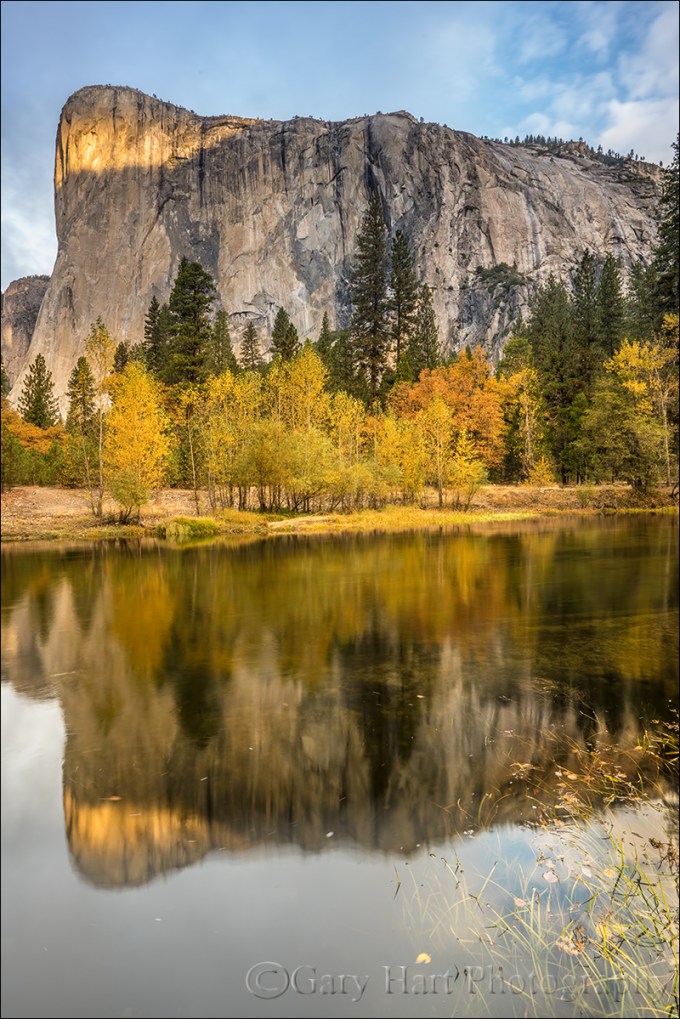
Autumn Morning, El Capitan Reflected in the Merced River, Yosemite
Sony a7R II
Sony/Zeiss 16-35 f4
2 seconds
F/16
ISO 50
Like most photographers in the Northern Hemisphere, my fall color season is about finished. But things are just ramping up along the streets near my home in California’s Central Valley (where winter doesn’t really begin until December, and spring’s first blooms start to pop up at the end of January—sorry). While there’s not a lot for me to photograph in my neighborhood, the opportunity to partake of the visual feast without a camera in my hands is refreshing.
I’m also harvesting the fruits the most intense autumn workshop/travel schedule of my photography life, and appreciating all over again how much I enjoy fall photography. Browsing my autumn images, I’m reminded of the need to understand my subjects. That goes double for the why and when of fall color, a blend of science and myth so intertwined that casual observers often resort to memory, anecdote, and lore to fill knowledge voids with partial truth and downright falsehood.
Innkeeper logic
Show up at at the fall color spot that guy in your camera club said was peaking at this time last year, you might find the same trees displaying lime green mixed with just hints of yellow and orange. Ask the old guy behind the desk at the inn, and you’ll get a head shake and confident explanation that, “The color’s late this year—it hasn’t gotten cold enough yet.” Check into the same inn on the same weekend next year, you might find just a handful of leaves clinging to exposed branches—this time, as the old guy hands you the key, he proclaims, “That hot summer got everything started early—you should have been here last week.”
While “expert” testimony like this sounds like objective truth, it only perpetuates the myths surrounding fall color. Fortunately, science has provided a pretty good understanding of the fall color process to all who want to understand.
It’s all about the sunlight
The leaves of deciduous trees contain a mix of green, yellow, and orange pigments. During the spring and summer growing season, the green chlorophyl pigment overpowers the orange and yellow pigments, keeping the trees green. While this chlorophyl is quickly broken down by sunlight, the photosynthesis that turns sunlight into nutrients that nourish the tree, warmth and long days provide the energy to sustain chlorophyl creation through the summer.
As the days shrink toward autumn, things begin to break down. Cells at the “abscission layer” at the base of the leaves’ stem (the knot where the leaf connects to the branch) begin a thickening process that blocks the transfer of carbohydrates from the leaves to the rest of the tree. Meanwhile, movement of nutrients to the leaves is inhibited as well—without these minerals, the leaves’ chlorophyl production dwindles and finally stops. No longer masked by the chlorophyl’s green, it’s time for the tree’s yellow and orange pigments to shine: Color!
Sunlight and weather
Contrary to popular belief, the timing of the onset of this fall color chain reaction is much more daylight-dependent than temperature- and weather-dependent—triggered by a genetically programmed day/night-duration threshold; contrary to innkeeper-logic, the trees in any given region will commence their transition from green to color at about the same time each year (when the day length drops to a certain point).
Nevertheless, though it doesn’t trigger the process, weather does play a significant part in the intensity, duration, and demise of the color season. Because sunlight breaks down the green chlorophyl, cloudy days after the suspension of chlorophyl creation will slow the coloring process. And while the yellow and orange pigments are present and pretty much just hanging out, waiting all summer for the chlorophyl to relinquish control of the tree’s color, the red and purple pigments are manufactured from sugar stored in the leaves—the more sugar, the more vivid their color. Ample moisture, warm days, and cool (but not freezing) nights after chlorophyl replacement has stopped are most conducive to the creation and retention of the sugars that form the vivid red and purple pigments.
On the other hand, freezing temperatures destroy the color pigments, bringing a premature end to the color display. Drought can stress trees so much that they drop their leaves before the color has a chance to manifest. And wind and rain can wreak havoc with the fall display—go to bed one night beneath a canopy of red and gold, wake the next morning to find the trees bare and the ground blanketed with color.
Of course all these weather factors come in an infinite number of variations that make this year’s color timing and intensity a little different from last year’s and next’s. Despite my need to understand nature’s mysteries, it’s this (perceived) randomness, the impossibility of ever knowing for sure what I’ll encounter, that draws me back.
About this image
Yosemite isn’t an inherently great sunrise location. With most of its views facing east, toward shaded subjects beneath the brightest part of the sunrise sky, sunrise light is difficult here. And without clouds, more the the rule than the exception in California, Yosemite sunrises can be rather bland. But Yosemite’s bland sunrises are more than compensated by the first direct sunlight light visible Yosemite Valley, which starts on the highest points a few minutes after the “official” (flat horizon) sunrise, and progresses over the next hour or so until the valley floor is bathed in sunlight. El Capitan is among the first of Yosemite’s prominent features to benefit from this early light.
I have a mental list of go-to El Capitan views for photographing its first light. Among them is a quiet bend in the river, known affectionately (and unofficially) to photographers as “Tahiti Beach,” with views of Cathedral Rocks, El Capitan, and the Three Brothers. Additionally, the river widens and slows here, providing some of Yosemite Valley’s best reflection opportunities as well.
One morning in the first of this year’s two Yosemite fall color workshops, I guided my group to Tahiti Beach for El Capitan’s first light. Clouds ruled the sky as the first light window opened, but fleeting patches of blue gave me hope. And with the deciduous trees across the river displaying their finest golds and oranges, we weren’t lacking for opportunities in the meantime.
The sun broke through suddenly, spotlighting a thin slice of granite near El Capitan’s summit. Unsure how long the opportunity would last, I moved quickly to compose this wide, vertical frame that emphasized the reflection juxtaposed with a thin veneer of colorful leaves floating at my feet. I reminded myself to heed the frequent admonition I issue my workshop groups: the focal point for a reflection is the focus point for the reflective subject, not the reflective surface. In other words, while the leaves floated in water that was just a few feet from my lens, their focus point was much closer than the infinity focus point of the reflection in the same water. I focused on the leaves, confident that the depth of field provided by f/16 at my 18mm would render El Capitan, the trees, and the reflection acceptably sharp.
Another noteworthy exposure setting in this image is my 50 ISO decision. Though the leaves were completely still, there were slight ripples disturbing the river where most of my reflection lay. Stopping down to f/16, dialing my sensor’s sensitivity to ISO 50, combined with a polarizer carefully tuned to cut the reflective glare on the leaves without diminishing the rest of the reflection too much, allowed a 2-second exposure that smoothed the ripples enough to enhance the reflection.
Purchase Prints
Photo Workshop Schedule
A fall color gallery


Winter is coming
Posted on October 20, 2016

Elm in Blizzard, Cook’s Meadow, Yosemite (2007)
Canon EOS-1Ds Mark II
Canon 70-200 f/4L
1/4 second
F/11.0
ISO 100
Photographing snow-covered Yosemite requires planning and patience: planning to ensure your arrival before the snow stops; patience to wait out the storm when visibility is so poor that you can barely see the nearest tree.
Planning
When the snow stops, Yosemite’s relatively mild temperatures (usually in the 30s when it snows) conspire with sunshine, wind, and gravity to clear the trees in a matter of hours. Meanwhile, park visitors driven inside by the storm, swarm outdoors to gape, quickly adding footprints and spreading mud with their boots, bikes, and cars. In other words, if you delay your departure for Yosemite until you hear that it snowed there, you’re too late. The key is being in the park during the storm.
All winter I monitor the National Weather Service Yosemite forecast and discussion (in-depth forecast analysis) pages for hints of a cold storm. I know there are lots of weather forecast options out there, but most either lack the resources of the NWS, or simply use the NWS data. The NWS may not always nail the forecast, but they’re more consistent and reliable than all the other options.
Sometimes the weather can change at the last minute, but I’m always ready. (It doesn’t hurt that I live less than four hours by car from Yosemite Valley.) In the back of my AWD Subaru Outback all winter are chains (required to be carried in Yosemite in winter, even with AWD/4WD), a portable charger that can recharge a car battery (among other things) in a pinch, and a duffle bag with all my cold weather gear (waterproof pants and upper shell, hat, gloves, umbrella, and ice grips for my shoes).
Patience
Once I decide I’m in, I’m all in. That usually means getting a room in or near Yosemite Valley, driving to the park a day early, and waiting for the snow to start. Once the snow arrives, I don’t hole up in my room, I’m out shooting. Even though Yosemite’s storms often erase all signs of its most recognizable features, stormy weather is a great time to photograph swirling clouds and accumulating snow in glorious (and rare!) solitude.
As much as I love photographing Yosemite in near white-out conditions, I sometimes get too cold, wet, or worn out to continue. But even when I reach that point, I don’t go in. Instead, I park at Tunnel View and wait for the weather to clear. Tunnel View is the perfect place to wait out a Yosemite storm because it’s on the west side of Yosemite Valley (where the clearing usually starts), provides an elevated vantage point with a view all the way down to Half Dome on the valley’s east side, and is spectacular to photograph when the storm clears. It even has decent cell service. And if I’m looking for an excuse to turn on the engine and warm things up, I drive through the tunnel for a view to the west, a preview of coming weather.
My final advice for anyone waiting out a storm at Tunnel View is when the storm clears, don’t spend so much time there that you miss opportunities elsewhere. This is easy to do because the photography will remain spectacular long after you should have moved on to other scenes.
Today’s image
Among my many snowy-Yosemite go-to spots is Cook’s Meadow. On this trip several years ago, until the snow arrived, the meadow was a field of lumpy brown grass, its sentinel elm a bare skeleton in the shadow of Half Dome. But a few inches of overnight snow transformed the bland meadow into an undulating sea of frozen white waves and etched the tree in white.
The snow was still falling when I arrived, wet and fast, slanted by a stiff breeze. Half Dome was gone. I positioned my tripod so the elm stood by itself, balanced in the frame by a stand of evergreens. The falling snow added an interesting dynamic to the otherwise static scene and I chose a 1/4 shutter speed that would blur its motion to streaks of white.
Yosemite Photo Workshops

Snowy Yosemite
Click an image for a closer look and slide show. Refresh the window to reorder the display.


Practicing what I preach
Posted on October 10, 2016
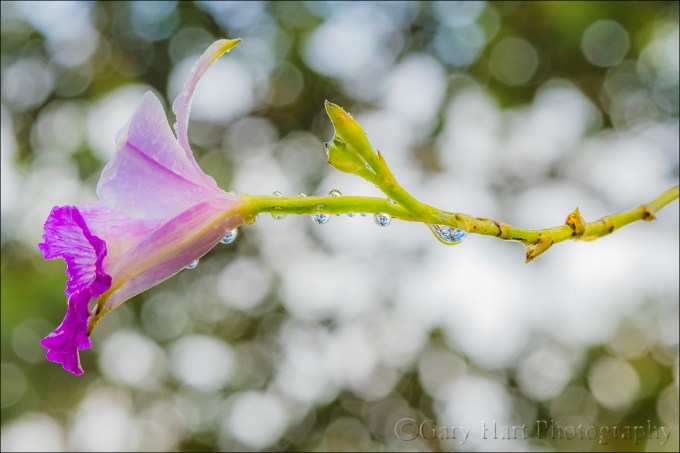
Raindrops on Orchid, Lava Tree State Park, Hawaii
Sony a7R II
Sony FE 90mm f2.8 Macro
1/30 second
F/11
ISO 800
The morning (last week) I started this post I was photographing South Tufa at Mono Lake in 26 degree temperatures. It’s hard to believe that less than three weeks earlier I was wearing a tank top, shorts, and flip-flops while photographing orchids in Hawaii. And later today I’m off to Moab, Utah.
I’d taken my Hawaii workshop group to Lava Tree State Park, long a personal favorite spot for its quiet beauty and intimate scenes. A recent heavy downpour had soaked the ground and left virtually every square inch of foliage glistening with raindrops. Recognizing an opportunity for some extreme close-focus photography, I immediately loaded my macro and extension tubes into my bag and herded my group onto the loop trail that circumnavigates the park.
In the shade just off the trail at the back of the park, a solitary, raindrop-laden orchid caught my eye—exactly what I look for when close-focus photography is my goal. Unfortunately, even with my tripod extended to its maximum height (6 inches above my head), the flower was a few inches too high to photograph at what I considered a good angle. No matter how I tried, I couldn’t find a position that allowed me to emphasize the orchid and its raindrops without blowing out the brilliant sky in the background. Tugging at the back of my brain as I stalked my subject was that frequently uttered photographic mantra, “Never blow the highlights.” But rather than give up, I stood back and considered my options.
Photographic rules are usually based on sound, proven reasoning that guides the neophyte to competent, appealing images. And while I’ll acknowledge that a broken photographic rule can indeed ruin an image, I’ve also spent my entire photographic career espousing the creative merits of breaking rules. If true artistic achievement means doing something new, and there’s already a rule for something, doesn’t that mean it’s been done? In other words, genuine creativity requires breaking the very rules that are supposed to lead to good images.
So what was my problem? Among the most ubiquitous and absolute pieces of photograph dogma is, “Never blow your highlights!” And for the most part I agree that blown highlights ruin an image—in fact I’ve spent a lot of time writing about how to deal with difficult light, and it’s all been based on the premise that we need to save the highlights at all costs. Over the years I’ve written and spoken about exposure techniques, graduated neutral density filters, HDR blending, and silhouettes to save the highlights.
In this case, after exhausting my conventional solutions, it would have been far easier to move on to a different orchid. But I liked this orchid, with its rich color and shimmering raindrops, and the more time I spent with it, the more I liked it. So what if I make it okay to blow the highlights? What if instead of trying to subdue them, I made the highlights a feature of my scene?
Suddenly unshackled, an entirely new world of possibilities opened for me. I eyed the background and realized that turning the bright sky white, I’d have a striking contrast for the properly exposed orchid. Furthermore, the sky breaking through the canopy overhead would be softened by a paper-thin depth of field—if I could find the right aperture, the effect could be quite appealing.
To focus as close as possible, I added a 15mm extension tube to my macro and worked on identifying the angle of view and front/back relationships, eventually refining my the composition in small increments until all felt right. To mitigate a very slight breeze, I set my ISO to 800 and metered on the flower, ignoring the violently flashing highlights. The final piece of the puzzle was determining the f/stop that would give me the best effect. Rather than trust the result on my LCD, I ran the range of f/stops from f/2.8 to f/16, increasing my shutter speed to keep the exposure uniform. Regardless of the f/stop, with my lens more or less parallel to the orchid’s stem, I had a fairly large area of sharpness that included all of the raindrops, most the flower, and much of the stem.
I know this scene won’t garner as much attention as a vivid sunrise or dramatic lightning strike, but really like this image. So I guess the moral here is if you find yourself bound by rules, aggressively seek the unconventional. If a “rule” applies, go ahead and follow the rule for a shot or two, then challenge yourself to break it. You may end up with more failures than successes (but of course nobody needs to know that), but I’ll bet your successes will turn out to be among your favorite images.
Workshop Schedule || Purchase Prints || Instagram
Playing with light
(Creative use of the camera’s “limited” dynamic range)


The nature of time
Posted on October 2, 2016
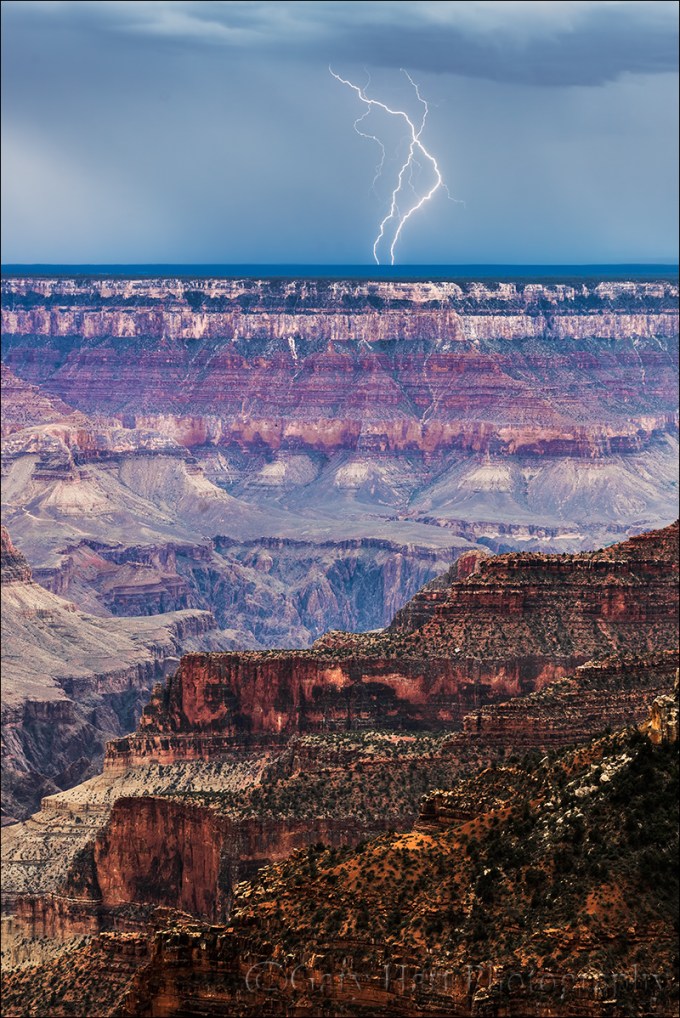
Electric Dance, Grand Canyon
Sony a7R II
Sony/Zeiss 24-70 f4
1/8 second
F/13
ISO 50
Lightning Trigger LT-IV
A few years ago I listened to an NPR show about Time and the arbitrary ways we earthlings measure it. The guest’s thesis was that the hours, days, and years we measure and monitor so closely are an invention established (with increasing precision) by science and technology to serve society’s specific needs. The question posed to listeners was, “What is the most significant measure of time in your life?”
Most callers responded with anecdotes about bus schedules, school years, and work hours that revealed how conventional time measurement tools, the arbitrary units of clocks and calendars, rule our existence. Listening while on my morning run, I was unable to call in to share my own (significantly different) relationship with time, so you’re stuck with reading about it here instead.
Landscape photographers are governed by far more primitive time constructs than the bustling majority. We follow the fundamental laws of nature that inspire but ultimately transcend clocks and calendars: the earth’s rotation on its axis, the earth’s revolution about the sun, and the moon’s motion relative to the earth and sun. The clocks and calendars that have little to do with the picture taking aspect of my life are useful only when I need to interact with the rest of the world on its terms (that is, run the business).
While my days are inexorably tied to the sun’s and moon’s arrival, and my years are ruled by the changing angle of the sun’s rays, I can’t help long for the ability to mark my calendar for the rainbow that arcs above Yosemite Valley at 4:29 p.m. every May 26, or the lightning bolt that strikes the Grand Canyon’s South Rim at 2:45 p.m. each August 18. But Nature, despite human attempts to measure and manipulate it, is its own boss. The best I can do is schedule my personal photo trips and photo workshops to maximize my odds for the good stuff, then show up and hope for the best.
The insignificance of clocks and calendars is never more clear than the first morning following a time change. On the second Sunday of March, when “normal” people moan about rising an hour earlier, the sun thumbs its nose at Daylight Saving Time and rises a mere minute (or so) earlier than it did the day before. So do I. And on the first Sunday of November, as others luxuriate in their extra hour of sleep, I get to sleep an entire minute longer. Yippee.
There’s irony in the immutability of the natural laws responsible for the (perceived) randomness of the very events we landscape photographers covet: Earth’s revolution and rotation, our orbiting Moon, each predictable down to microseconds, set in motion the atmospheric and tidal dynamics that are the catalysts for the unpredictable seasons, weather, and waves we photograph. Ironic or not, I love nature’s mixture of precision and randomness. Though I try to maximize my odds for photographically special natural phenomena, understanding that “it” might not (probably won’t) happen only enhances the thrill when something special does happen.
The lightning in today’s image was certainly not on anyone’s calendar, but knowledge of the Grand Canyon’s August monsoon enabled Don Smith and me to schedule our annual Grand Canyon Monsoon workshops for the best time to be there. And despite the uncertainty, it was no fluke that we had our group on the North Rim and within sprinting distance of the Grand Canyon Lodge viewing deck (with Lightning Triggers primed and ready) when the clouds started building and darkening across the canyon.
This turned out to be a special day. After several fruitless afternoons of ticking seconds that stretched to minutes and hours, our group was treated to a two-hour electric show that left us all giddy and breathless. This strike came and went in milliseconds, so fast that I had no idea that it was actually a pair of intertwined bolts, a secret revealed only by my camera’s ability to freeze time.
Workshop Schedule || Purchase Prints || Instagram
Right place, right time
Click any image to scroll through the gallery LARGE


You’re smarter than your camera, because…
Posted on September 24, 2016

Cradled Crescent, Sierra Foothills
Sony a7RII
Tamron 150-600 (Canon-mount with Metabones IV adapter)
.4 seconds
F/8
ISO 400
Your camera is stupid (and you’re not)
In a previous life, I spent a dozen or so years doing technical support. In this role, job-one was convincing people that, despite all failures and error messages to the contrary, they are in fact smarter than their computers. Most errors occur because the computer just didn’t understand: If I misspel a wurd, you still know what I meen (rite?); not so with a computer. A computer can’t anticipate, reason, or create; given a task, it will blithely continue repeating a mistake, no matter how egregious, until it is instructed otherwise, fails, or destroys itself.
All this applies equally to today’s “smart” cameras—no matter how advanced its technology, a camera just can’t compete with your brain. Really. If I’d have allowed my camera to decide the exposure for this crescent moon scene, I’d have ended up with a useless mess: The camera would have decided that the foreground hillside was important and allowed in enough light to expose distracting detail and completely wash out the color in the sky. But I knew better. Wanting to simplify the scene, I manually metered and banished the insignificant details to the black shadows, capturing only the moon’s delicate shape and a solitary oak silhouetted against the indigo twilight.
It’s scenes like this that cause me to never trust my camera’s decision making, and why, in my (many) decades of serious photography, I’ve never used anything but manual metering. And since I try to have elements at different depths throughout my frame, focus is almost always my decision, not my camera’s, as well.
Today’s cameras are more technologically advanced than ever—their auto exposure and focus capabilities are quite good, good enough that nobody should feel they must switch to manual if they fear it will diminish the pleasure they get from photography. But if you define photographic pleasure as getting the best possible images, try spending a little time mastering manual metering and hyperfocal focus, then use that knowledge to override your camera’s inclinations. In my workshops, where I teach (but never require) manual metering and hyperfocal focus to all who are interested, people frequently marvel at how easy and satisfying it is to take control of their camera.
Photo Workshop Schedule
Overriding my camera’s “brain”
(Images I couldn’t have done in Auto mode)


My camera is a time machine
Posted on September 17, 2016

Sunset Pastoral, Sierra Foothills (2015)
Sony a7R
Tamron 150-600 (Canon-mount with Metabones IV adapter)
.6 seconds
F/9
ISO 100
Photographers frequently complain about what their camera can’t do, and take for granted the things it does well. A lot of this is a frustration with the inability to duplicate the world the way we see it. But honestly, what fun is that? My favorite photographs are those that show me something I might have overlooked or were not visible to my eye to my eye at all. As someone who tries to photograph a world untouched by the hand of Man, I particularly love the camera’s ability to return me to simpler times, reducing a scene to its essence by subtracting reminders of human incursion.
Tequila Sunset, Sierra Foothills, California (2005)
I recently returned to this small stand of oak trees huddled atop a hill in the low foothills east of Sacramento. Since I first photographed this scene over ten years ago, the peaceful country road “my” hill overlooks has evolved into a bustling artery for oblivious commuters. More recently, fencing has sprung up and an arcing dirt road has been carved into the hillside, a harbinger I fear of an impending subdivision. They’re everywhere up here now, these cookie-cutter developments with meaningless, corporate-crafted street names (Aspen Meadows Drive, Teakwood Court), devouring this once bucolic setting like a stage-4 cancer.
Despite the distractions, my camera’s “limited” vision instantly returns me to more peaceful times. Gone in a shutter-click are the highway’s roar and choking exhaust, while the encroaching suburbs are banished by the narrow view of a telephoto lens. And that scar of a road? It disappears in the shadows of the camera’s narrow dynamic range.
Photo workshop schedule
Celebrating the camera’s “limited” vision
Click an image for a closer look and slide show. Refresh the window to reorder the display.


Here comes the sun
Posted on September 12, 2016

Here Comes the Sun, Mather Point, Grand Canyon
Sony a7R II
Sony/Zeiss 16-35 f4
1/8 second
F/18
ISO 100
I rarely shoot at Mather Point because I’m usually working with workshop students struggling to corral the extreme dynamic range of a summer sunrise there. But on this morning a couple of weeks ago, about half the group had congregated at the rail in near the Mather Point amphitheater, allowing me to set up my tripod and occasionally visit my camera. When it became clear that the clouds were setting up for something special, I prepared my composition, set my f-stop to f/18 (in the sunstar zone), and ready my graduated neutral density filter in anticipation of the sun’s first rays peeking out from behind Wotan’s Throne.
Knowledge is power
As with many of my images, I can trace this image’s creation to long before the shutter clicked. That’s because, whenever possible, I avoid arriving at a location without knowing at the very least when and where the sun will appear or disappear. In this case I was familiar enough with the Mather Point in August to know that the sun would rise between Wotan’s Throne and Vishnu Temple. But I needed to be more precise than that.
We’re living in an era of ubiquitous information, carrying mini computers with the potential to make virtually everyone an instant astronomical genius. Though my own workflow for computing sun/moon arrival/departure information was established long before smartphones, it amazes me both how easy the internet and smartphones have made preparation, and how few photographers do it.
I got a little head start because I studied astronomy in college for a few semesters (long enough to learn that the essential math would would wring the marvel from my mind), enough to have good mental picture of the celestial rotations and revolutions that determine what we see overhead and when we see it.
While I’m just geeky enough to prefer plotting all this stuff manually, for most people I recommend starting with one of the excellent apps that automate most of the process. Of the two apps I recommend, PhotoPills and The Photographer’s Ephemeris, I prefer PhotoPills because it seems more complete, but they’re both excellent.
If you’ve tried either of these apps and found them too complicated, don’t be discouraged—neither is so intuitive that you should expect to simply pick it up and use it. But each is logical and well designed, and I promise that the more you use it, the easier it will become. In other words, practice!
Practice
As with most things in photography, it’s best not to be trying to learn to predict the timing and position of the sun or moon when the results matter. Rather, I suggest that you plot tonight’s sunset from the park down the street, or tomorrow’s sunrise from your backyard. Figure out where and when the sun will set or rise, be there to check your results, and then figure out why it didn’t happen exactly as expected. You’ll be surprised by how quickly your predictions improve after repeating this process a few times. Once you feel comfortable with your ability to anticipate a sun or moon rise or set from home, it’s time to take the show on the road—pick a spot you know fairly well and apply your new knowledge there.
Working it out on the fly
For me, celestial preparation from the comfort of my recliner is only half the job. It’s great when I know exactly where I’ll be and when I’ll be there, but the reality of nature photography isn’t quite so simple. On a first visit to a new location, I often end up places I never imagined I’d be—Hmmm, I wonder where that road goes…, or, Gee, I bet the view from the top of that hill would be great…—often with no connectivity.
On location with no connectivity, I need to be able to figure out the celestial details with only the resources at hand. The two iPhone apps I’ve come to rely on most are Focalware (I couldn’t live without this app) and MotionX-GPS.
- Focalware provides sun and moon rise/set times, the moon phase, and the altitude and azimuth of the sun and moon—all for any any time and date, and any location on earth. It uses my phone’s GPS to determine my current location, but doesn’t require cell or wifi connectivity.
- MotionX-GPS gives me topo maps and the ability to plot point-to-point linear distance as well as azimuth. While its maps do require connectivity to download, I can pre-download them to my phone so they’ll be available when I’m offline.
Using these two apps, plus my basic understanding of astronomical dynamics, I’m able to figure out everything necessary to plan a shoot. On this morning at Mather Point, I pulled out my iPhone and opened Focalware to determine the sunrise time and azimuth. I used the MotionX-GPS Measure tool to drop a pin at my current location, then stretch a line, at the angle of the sunrise azimuth, across the canyon until it intersected the horizon. That was all I needed—seeing that this sunrise line passed just to the right of Wotan’s Throne, I was able to set up the composition I wanted.
Workshop Schedule
A gallery of celestial timing


Concise guide to tripod selection for the serious landscape photographer
Posted on September 5, 2016

Electric Scribble, Grand Canyon Lodge, North Rim
Sony a7R II
Sony/Zeiss 24-70 f4
1/6 second
F/9
ISO 200
Lightning Trigger LT-IV
Tripod axiom
There’s an axiom in photography (popularized by Thom Hogan): Photographers purchase three tripods: the first tripod is a flimsy, cheap aluminum/plastic monstrosity; next comes a sturdy but heavy “value” tripod; and finally, they spring for the tripod they should have purchased in the first place—a sturdy, light, expensive tripod that will serve them for decades. You’ll save yourself tons of money by biting the bullet and just starting with the tripod that you covet (and probably already know you’ll eventually end up with).
How tall?
Stooping, even just a few inches, may not seem like a big deal at first, but it gets old really fast. Your primary tripod should be tall enough to elevate your camera to eye level without extending the centerpost—it’s okay if the tripod has a centerpost, and to use it as a last resort when wind or long exposures aren’t a factor, but a centerpost adds weight and makes it impossible to lower your camera all the way to the ground. While not essential, even taller than eye level is better because extra height adds compositional flexibility, the ability to elevate above obstacles, and makes it easier to handle uneven terrain.
Your minimum tripod height (MTH) determines the shortest tripod you can use without stooping or raising the center post. But you don’t need a tripod that’s as tall as you are because you’ll be mounting a camera and head atop the tripod, and your eyes are probably not on top of your head.
Here are the steps for determining if a trip is tall enough for you:
1. Start with the tripod’s fully extended height (legs extended, center post down), easy to find in the manufacturer’s specifications 2. Add the height of your ball-head 3. Add the distance from the base of your camera to the viewfinder 4. Subtract 4 (or so) inches from your height, including shoes (unless you photograph barefoot), to account for the distance from the top of your head to your eyes.Variables dictated by need and preference
- Carbon fiber is lighter and and less prone to vibration than aluminum, but more expensive (see Tripod axiom above). Carbon fiber also doesn’t get as cold on those frigid winter mornings.
- Three leg-section tripods are less work to set up and take down; four leg-section tripods collapse smaller. In theory, the more leg sections a tripod has, the more it’s prone to vibration (each junction is a point of weakness), but this isn’t a big factor with a good tripod.
- And speaking of leg sections, you’ll need to choose between twist locks and flip locks. I find the flip locks a little easier when I’m fully extending and collapsing the tripod at the beginning and end of a shoot, but the twist locks easier for partial adjustments of the legs while I’m shooting. The flip locks can be noisy, and can catch on things.
Tripod head
For landscape photography, I strongly recommend a ball head (pivoting ball that can be controlled by loosening and tightening a single knob) rather than a pan/tilt (a lever for each axis of motion). And stay away from the pistol-grip ball heads—they don’t handle weight well.
Quick-release system
You’ll definitely want some kind of quick-release mechanism that allows you to quickly attach/detach the camera to/from the head. The simplest kind is a metal plate (don’t even consider anything with plastic parts) that mounts to the camera’s tripod screw and matches a corresponding clamp on the head. The clamp might engage/disengage with a lever or twist-knob—get the lever kind.
The flat plates are okay, but the easiest, sturdiest quick-release system is the Arca-Swiss L-plate (the Arca-Swiss style is a standard offered by many quick-release manufacturers). An L-plate is a 90-degree (L-shaped) piece of machined aluminum; one axis mounts flush with the bottom of the camera body, attaching via the tripod mount screw, and the perpendicular axis hugs one side of the camera body (providing a quick-release plate on the bottom and side of the camera). The entire length of both plate axes are quick-mount rails that attach (with a lever or knob) to the corresponding mounting clamp on the tripod head. This rail setup is more secure and easier to mount/unmount than a conventional quick-release plate, making switching between horizontal and vertical orientation a simple mater of releasing the clamp, rotating the body, and re-securing the clamp (it takes longer to read the description than to execute it).
If you’re really serious about your photography, you’ll invest in an L-plate system—once you do, it’ll be hard to imagine how you lived without it. Because every camera model has its own dimensions and unique cable, control, memory card, and battery access points, the best L-plates (like Really Right Stuff) are custom-machined for the body (when you get a new camera, you’ll need a new L-plate).
My tripods
I use two Really Right Stuff tripods: the larger RRS TVC-24L is my primary tripod; I also use a smaller, lighter RRS TQC-14 when I fly or hike. My TVC-24L has a RRS BH-55 (purchased when I was a DSLR shooter but overkill for my Sony mirrorless system— I’d probably get a BH-40 if I had to do it now); my TQC-14 has a BH-30. I’m about 5’ 9” and without the centerpost extended the TQC-14 is just a little shorter than ideal (I need to extend my centerpost a few inches to get my camera to eye level), but it’s a justifiable compromise when weight and/or storage length is a factor. All of my camera bodies and tripod heads are outfitted with RRS Arca Swiss type L-plates and corresponding clamps.
Links
Making the case for using a tripod
Really Right Stuff

Electric Scribble, Grand Canyon Lodge, North Rim
About this image
Electric Scribble, Grand Canyon Lodge, North Rim
The best nature images reveal aspects of the world that the human eye misses. For example, though lightning strikes so fast that it’s already a memory before the brain can process them, the camera’s ability to freeze an instant in time preserves magic moments like this that otherwise would be lost forever.
Lightning’s speed makes photographing it without a tripod virtually impossible: in daylight, it requires a lightning sensor that mounts atop the pre-composed camera and waits for lightning to fire; at night it can be captured with a manual shutter press, but at exposures far too long for hand-holding.
On this afternoon on the North Rim last month, Don Smith and I had our workshop group set up to photograph a series of active thunderstorms skirting the South Rim about 15 miles away from our vantage point on the Grand Canyon Lodge viewing deck. The deck was packed with people enjoying the show. In crowded locations like this I particularly appreciate the height of the RRS 24L, which gave me the flexibility to elevate above heads and other obstacles. The 24L’s sturdiness gave me peace of mind that my camera would remain stable despite all the heavy footsteps nearby.
Virtually all of the strikes were vertical, cloud-to-ground strokes directly across the canyon. But already having a pretty good selection of images like that, my camera was set up (on my tripod, Lightning Trigger ready for action) to favor the composition I wanted rather than in the direction of the most lightning activity.
Most of my lightning captures this afternoon were recorded relatively close to my memory, albeit with much more intricate detail than my eyes saw. This cloud-to-cloud strike, the only lightning I captured with this composition, followed a far too circuitous path for my eye/brain to register, but it was etched forever in pixels by my sensor. Better still, the resulting 42 megapixel raw file gives me the luxury of much closer scrutiny than you get with this 800 pixel jpeg. Magnifying the full file to 100 percent, I’m able to infer that what I have here is only a portion of a rather tangled mess of electricity that skipped in and out of clouds, appearing, disappearing, and doubling back on itself like a tangled thread—all in the blink of an eye.
Photo Workshop Schedule
A gallery of frozen moments in nature


 Eloquent Images by Gary Hart