The right stuff at the Grand Canyon
Posted on August 28, 2014

After Sunset, Point Imperial, Grand Canyon
Canon EOS-5D Mark III
47mm
8 seconds
F/16
ISO 100
I’ve been to the mountaintop
Personal growth should be a lifelong journey. But as a longtime tripod evangelist, I considered many truths carved in stone. Granted, like everyone else, my tripod use (and selection) evolved through my formative photography years. On my path to (perceived) enlightenment, I made the same mistakes most photographers make, mistakes like settling for the tripod I could afford rather than tripod I needed, which only meant spending more money than I would have when I eventually (inevitably) broke down and bought the tripod I needed. And there were those dark years when I believed that in most cases a hand-held shot was just as good as one captured on a tripod. But since my “the center post is more trouble than it’s worth” epiphany about ten years ago, I pretty much believed I knew it all where tripods were concerned.
But last month at the Grand Canyon, I realized that over the last couple of years, some of my tripod truths weren’t immutable as I’d imagined. This was underscored for me during a shoot at Point Imperial, the canyon’s highest vista, when I was able to use my Really Right Stuff tripod and live-view to get shots that wouldn’t have been possible a few years ago.
My (original) tripod commandments
For years my tripod sermon was delivered something like this:
- A tripod for every shot—no exceptions
- Sturdy trumps everything
- Forego the center post—it’s destabilizing, adds extra weight, and makes it impossible to drop your camera to the ground (without a shovel)
- Size does matter—you need a tripod that’s tall enough for you to see through your viewfinder without stooping (without extending the center post)
- Ball-head all the way for landscape shooters (no pan/tilt, no exceptions)
- An L-plate will change your life
Those are the basics; the other tripod variables—cheap vs. light (you can’t have both, no matter what the salesperson or marketing brochure says), three vs. four leg sections, leg-lock design, and collapsed length (for transport in a suitcase or camera bag)—come down to personal preference and budget.
And what’s the big deal about an L-plate?
And L-plate is an L-shaped plate (duh) that attaches at the bottom of your camera and wrapping 90 degrees up one side. It’s really just a two-sided quick-release plate—instead of the standard quick-release that only mounts to the bottom of your camera (forcing you to rotate the head 90 degrees to orient the camera vertically), to orient an L-plate-equiped body vertically, you pop the camera off the head, rotate the camera 90 degrees, and reattach it to the head using the plate’s other side, keeping the head upright (unchanged). Not only does this keep your camera at the same height regardless of its orientation, it’s just much more stable.
Lacking an L-plate, photographers whose tripod is tall enough when the camera is oriented horizontally are sometimes force to stoop or contort when they switch to vertical. Without realizing it, they often compensate for this awkwardness by simply avoiding vertical compositions. I know this because I was one of those photographers—when I switched to an L-plate, my percentage of vertical compositions increased markedly (I actually verified this using Lightroom filters to count the number of horizontal and vertical frames in my library), to the point where my vertical/horizontal images are about 50/50.
What’s your MTH?
By the time they’re serious enough to sign up for a photo workshop, most (but not all) photographers have a sturdy tripod. Still, things aren’t necessarily completely rosy. In addition to a deficient head—either a pan/tilt, or a ball head that’s not strong enough for the camera/lens it’s trying to support (both problems easily solved by going to reallyrightstuff.com and picking the head that best suits your needs, but that’s a discussion for a different day)—a too-short tripod is where I see most novice photographers struggle. Stooping, even just a few inches, may not seem like a big deal at first, but it gets old really fast.
Your minimum tripod height (MTH) is the shortest tripod you can use without stooping or raising the center post. Here are the steps for determining if a trip is tall enough for you:
1. Start with the tripod’s fully extended height (legs extended, center post down), easy to find in the manufacturer’s specifications 2. Add the height of your ball-head (if you have a pan/tilt you need a new head and will be doing this calculation all over again when you get it) 3. Add the distance from the base of your camera to the viewfinderThis gives you the tripod’s maximum usable height. Wait a minute, you say, that’s still not tall enough. To get your MTH, there’s one more step:
4. Subtract 4 inches from your height to account for the distance from the top of your head to your eyes.Old dog, new trick
But in the last year I’ve experienced a minor conversion, opening my mind enough to modify my rigid tripod height recommendations (I used to believe that a tripod that extended above my standing height was unnecessary weight and length)—not only should your tripod be tall enough to use while you stand upright, the ideal tripod is even taller than that, at least 4 inches taller than your viewing height when the legs are planted on flat ground. Extra tripod height allows me to comfortably stand on the uphill side of my camera when the tripod on uneven ground. (If you’re a landscape shooter, how often do you photograph on flat ground?)
Of no less significance is the way a tall tripod allows me to shoot over obstacles. In “ancient” times, photographers needed to to see through their viewfinder to compose and (sometimes) meter, but with the genesis of live-view came the ability to compose and meter without the eyepiece. So while a tall tripod has always been helpful for shooting on level ground, to me this ability to shoot over obstacles is the real game changer.
Going straight to the source
My conversion started with a pilgrimage to Really Right Stuff in San Luis Obispo, about a year-and-a-half ago. I was ready for a new tripod and wanted the best. I’d been quite happy with my Gitzo tripods, but they were purchased before RRS offered tripods—given my long-time experience with RRS heads and L-plates, and what I’d observed in my workshops, I thought I should see whether RRS tripods had supplanted Gitzo at the tripod summit.
RRS doesn’t actually have a retail store, but their beautiful new facility has a nice reception area with many products on display—you might even find the lobby empty when you walk in, but it won’t be long before a door from the back opens and you’ll be greeted by someone who knows more about tripods than you do. My expert was Erik—he spent close to an hour, first patiently demonstrating why the RRS tripods are the best tripods in the world (the comparison was to Gitzo, but his emphasis was on what makes RRS tripods great, rather than what makes Gitzo tripods bad, an approach I appreciated), and then helping me determine which model would best suit me.
I’d arrived with the RRS TVC 33 in mind, but on Erik’s suggestion ended up switching to the RRS TVC 24L Series 2, even though it has four leg sections (extra work extending and collapsing, but more compact when collapsed) and is quite a bit taller than I (believed I) needed. So tall, in fact, that I can almost (but not quite) use it by extending only three leg sections. I’m not going to go into all the reasons I love this tripod (but trust me, I do), but I will say that the extra 8 or so inches above my MTH (I’m about 5’9″) has enabled me to photograph in ways I wouldn’t have been able to do without it.
The paradigm shifting “revelations” I share here (extra-tall is important; Gitzo is no longer the Holy Grail of tripods) apply to photography, but one of the things I love about being forced to reconsider long-held “truths” is the reminder that the instant we believe we have all the answers is the instant we stop growing.
Case in point
All this (finally) brings me to the above image from Point Imperial on my recent Grand Canyon trip. Point Imperial is probably my favorite spot on the North Rim. The railed viewing area isn’t quite large enough for an entire workshop group to work comfortably, but there are enough spots nearby that nobody is disappointed. My favorite location here is on the rocks, just below the railed vista, that jut about 1,000 vertical feet above the canyon. There isn’t a lot of room out here either, and very little margin for error, so after guiding the brave photographers who aren’t afraid of heights out to the edge, I found an out of the way spot a few feet behind them.
It turned out this location was no less precarious than everyone else’s, but being behind the others and a couple of large rocks and shrubs made composing a challenge. Looking around, I decided the best view was on an uneven slope right on the edge, the closer the better. Yikes.
This is where I really appreciated the extra inches my tripod offers. Extending each leg fully, I pushed two legs right up to the edge, keeping myself a safe distance back. With the front (closest to the edge) legs’ planted, to elevate further and get the camera even nearer the edge, pushed the leg closest to me toward the cliff until the other two legs were nearly perpendicular to the ground (directly on the edge). Finally, I leveled the tripod with minor adjustments in the height and placement of the leg closest to me. Once the camera was positioned (about five inches above my eyes), I switched on live-view, composed, metered, and clicked.
As evidenced by the long shutter speed, it was fairly dark when I clicked the image above. Often the best light for photography is opposite the sun after sunset (or before sunrise). The smooth quality of this shadowless light, and the gradual deepening of the rich hues on the horizon, are often missed by the casual observer who is mesmerized by the view toward the setting or rising sun (not possible at Point Imperial at sunset), or unable to appreciate the camera’s ability to bring out more light than the eye can see. But then, you already knew that (right?)….
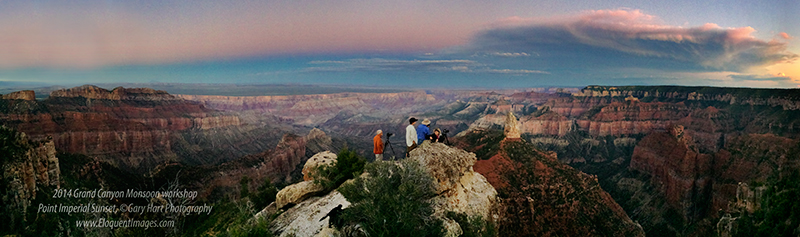
The view from just below the Point Imperial vista (iPhone panorama)
Extra credit
- Read The tripod difference (why I think every landscape shot should be on a tripod)
- Here’s Thom Hogan’s excellent article on buying a tripod
- Visit the Really Right Stuff website: in addition to the best camera support money can buy, there’s great information here
Roll over Ansel
Posted on August 25, 2014
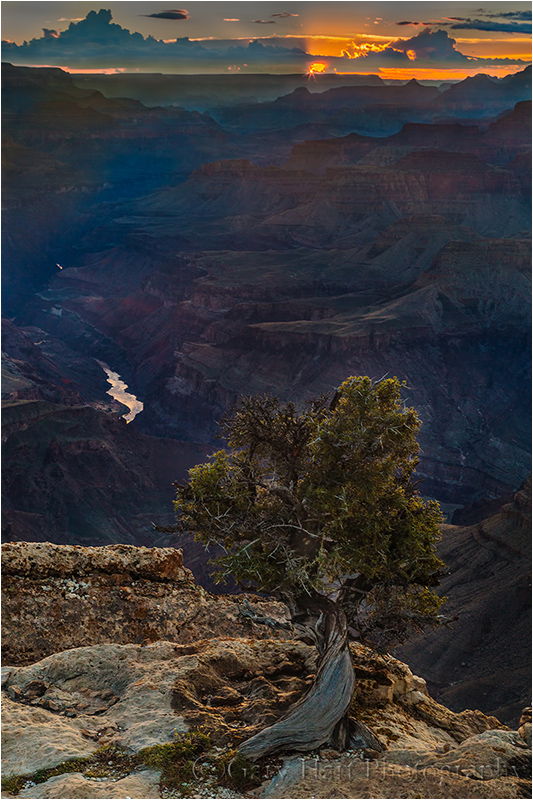
Solitude at Sunset, Lipan Point, Grand Canyon
Canon EOS-5D Mark III
65mm
1.3 seconds
F/20
ISO 100
A few days ago I was thumbing through an old issue of “Outdoor Photographer” magazine and came across an article on Lightroom processing. It started with the words:
“Being able to affect one part of the image compared to another, such as balancing the brightness of a photograph so the scene looks more like the way we saw it rather than being restricted by the artificial limitations of the camera and film is the major reason why photographers like Ansel Adams and LIFE photographer W. Eugene Smith spent so much time in the darkroom.” (The underscores are mine.) Wow, this statement is so far off base that I hardly know where to begin. But because I imagine the perpetuation of this myth must send Ansel Adams rolling over in his grave, I’ll start by quoting the Master himself:
- “When I’m ready to make a photograph, I think I quite obviously see in my minds eye something that is not literally there in the true meaning of the word.”
- “Photography is more than a medium for factual communication of ideas. It is a creative art.”
- “Dodging and burning are steps to take care of mistakes God made in establishing tonal relationships!”
Do those sound like the thoughts of someone lamenting the camera’s “artificial limitations” and its inability to duplicate the world the “way we saw it”? Take a look at just a few of Ansel Adams’ images and ask yourself how many duplicate the world as we see it: nearly black skies, exaggerated shadows and/or highlights, and skewed perspectives. And no color! (Not to mention the fact that an image is a two-dimensional approximation of a three-dimensional world.) Ansel Adams wasn’t trying to replicate scenes more like he saw them, he was trying to use his camera’s unique (not “artificial”) vision to show us aspects of the world we miss or fail to appreciate.
You’ve heard me say this before
The rest of the OP article contained solid, practical information for anyone wanting to come closer to replicating Ansel Adams’ traditional darkroom techniques in the contemporary digital darkroom. But it’s the perpetuation of the idea that photographers are obligated to photograph the world like they saw it that continues to baffle me.
The camera’s vision isn’t artificial, it’s different. To try to force images to be more human-like is to deny the camera’s ability to expand viewers’ perception of the world. Limited dynamic range allows us to emphasize shapes that get lost in the clutter of human vision; a narrow range of focus can guide the eye and draw attention to particular elements of interest and away from distractions; the ability to accumulate light in a single frame exposes color and detail hidden by darkness, and conveys motion in a static medium.
No, this isn’t the way it looked when I was there
While this sunset scene from Lipan Point at the Grand Canyon is more literal than many of my images, it’s not what my eyes saw. To emphasize the solitude of the lone tree, I allowed the shaded canyon to go darker than my eyes saw it. This was possible because a camera couldn’t capture enough light to reveal the shadows without completely obliterating the bright sky (rather than blending multiple images, I stacked Singh-Ray three- and two-stop hard transition graduated neutral density filters to subdue the bright sky).
To convey a mood more consistent with the feeling of precarious isolation of this weather-worn tree, I exposed the scene a little darker than my experience of the moment. The sunstar, which isn’t seen by the human eye but was indeed my camera/lens’ “reality” (given the settings I chose), was another creative choice. Not only does it introduce a ray of hope to an otherwise brooding scene, without the sunstar the top half of the scene would have been too bland for me to include as much of the shadowed canyon as I wanted to.
I’m not trying to pass this image off as a masterpiece (nor am I comparing myself to Ansel Adams), I’m simply trying to illustrate the importance of deviating from human reality when the goal is an evocative, artistic image. Much as music sets the mood in a movie without being an actual part of the scene, a photographer’s handling of light, focus, and other qualities that deviate from human vision play a significant role in the image’s impact.
A Gallery of My Camera’s World
(Stuff my camera saw that I didn’t)


Release the brocken!
Posted on August 14, 2014

Solar Glory, Lipan Point, Grand Canyon
Canon EOS-5D Mark III
100 mm
1/30 second
F/16
ISO 200
So how cool is this? The shadow is me. It’s called a brocken (named for a mountain in Germany), and the rainbow is a solar glory. This extremely rare phenomenon requires the perfect alignment of sunlight, moisture, and observer, and I just happened to find myself at the fortunate convergence of these conditions.
Yesterday evening Don Smith and I photographed the vestiges of a summer storm at Lipan Point on the Grand Canyon’s South Rim. We were there because Zeus had washed out the overnight trip to Toroweap that Don and I had been planning for many months.
Toroweap is a many-thousand foot vertical drop to the Colorado River on the Grand Canyon’s North Rim, at the end of a 60-mile unpaved road. We’d rented a 4-wheel-drive Jeep for the adventure, but after talking to several Grand Canyon rangers who strongly advised against going out there in the rain. So we jettisoned Plan A and quickly improvised Plan B: leave the relative peace and quiet of the North Rim and jet back to the South Rim (where our next workshop is scheduled to start Friday).
The storm broke during our four-plus hour drive from the North Rim to the South Rim, and we were greeted with the kind of river-hugging, monolith-draping clouds I’m accustomed to seeing after a Yosemite storm. Our first stop was Navajo Point, but after some great shooting there we saw that the cloud making machine was working overtime below Lipan Point, just a short drive down the road.
Arriving at Lipan Point about an hour before sunset, we grabbed our gear and scrambled out to the point beneath the railed (tourist) vista, a rocky, knife-like ridge jutting into the canyon with sheer drops on both sides. I was happily photographing a scene up-canyon when Don called out, “Hey, do you see that?!” I looked up and saw a cloud drifting up from the chasm on our ridge’s east side, no more than 100 feet from us. The cloud was fully lit by the low sun, and right in the middle was my shadow encircled by a full rainbow. I know enough about rainbows to understand what’s going on: a rainbow makes a full circle around the anti-solar point, but terrestrial viewers usually find the bottom half interrupted by the horizon. But understanding a phenomenon doesn’t make me any less awestruck by its manifestation. I’d seen this once before, on a plane taking off through a rainstorm—I looked out the window and saw a rainbow encircling the plane’s shadow, but by the time I retrieved my iPhone the plane banked and I lost it.
But this time I had my camera ready for action—I shifted a few feet up the ridge to juxtapose the rainbow against a snag and clicked away. For my first few frames I stood off to the side and the shadow my camera captured was of my camera on the tripod, so I moved behind my camera and squared my shoulders. Those frames included my outline, but it wasn’t until I spread my arms and legs that I got the shadow you see here.
Read more about rainbows in my Rainbows article in the Photo Tips section.
America’s worst idea
Posted on August 13, 2014

Sunrise, Grandview Point, Grand Canyon
Canon EOS-5D Mark III
65 mm
1/4 second
F/11
ISO 100
Today’s homework assignment is “A Cathedral Under Siege,” from the August 9 edition of the “New York Times.”
I really don’t have a lot to add to the thoughts expressed in the article, except that if our National Park system is “America’s best idea,” then what is planned for the Grand Canyon may just be America’s worst idea. I only hope that common sense will prevail over the almighty dollar in time to spare this monumental boondoggle from establishing a precedent that threatens every National Park in America.
(Read a little about this image beneath the gallery.)
A National Park Gallery


About this image
Saturday evening Don Smith and I started the first of two, back-to-back Grand Canyon Monsoon photo workshops. Our first sunset shoot at Desert View was nice, but somewhat limited by haze from smoke caused by several managed fires burning near the canyon’s South Rim. Sunday morning we gathered the group at 4:30 and ushered them to Grandview Point, where we were thrilled to find the haze had cleared—in its place we found the Grand Canyon basking between a mix of clouds and clear sky that usually bodes well for a nice sunrise.
We did indeed enjoy beautiful sunrise reds and pinks that morning, but I think my favorite part of the morning came when the sun crested the horizon and in concert with low, broken clouds sent crepuscular rays skimming the canyon. I quickly pointed my camera upstream and worked on a composition to do the moment justice. The towers, bluffs, and buttes on the left were a must, but they carry a great deal of visual weight. To balance the frame I used the shafting sunlight and Colorado River snaking near the frame’s right side. The low hanging clouds provided a perfect ceiling for my frame. And because the combination of bright sky and canyon shadows created a highlight-to-shadow range that exceeded a camera’s ability to capture, I used a three-stop hard transition graduated neutral density filter from Singh-Ray to bring the difference into a manageable range.
(You might also be interested to know that the proposed tram referenced in the article would land just upriver from the segment of the river you see here.)
The yin and yang of nature photography
Posted on August 7, 2014
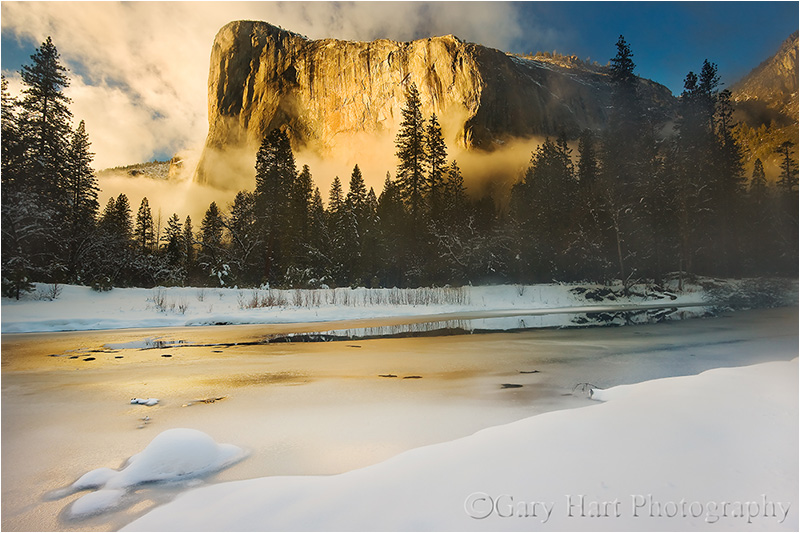
Clearing Storm, El Capitan and the Merced River, Yosemite
Canon 1Ds Mark III
17 mm
1/8 second
F/11
ISO 100
Conducting photo workshops gives me unique insight into what inhibits aspiring nature photographers, and what propels them. The vast majority of photographers I instruct, from beginners to professionals, approach their craft with either a strong analytical or strong intuitive bias—one side or the other is strong, but rarely both. And rather than simply getting out of the way, the underdeveloped (notice I didn’t say “weaker”) side of that mental continuum seems to be in active battle with its dominant counterpart.
On the other hand, the photographers who consistently amaze with their beautiful, creative images are those who have negotiated a balance between their conflicting mental camps. They’re able to analyze and execute the plan-and-setup stage of a shoot, control their camera, then seamlessly relinquish command to their aesthetic instincts as the time to click approaches. The product of this mental détente is a creative synergy that you see in the work of the most successful photograpers.
At the beginning of a workshop I try to identify where my photographers fall on the analytical/intuitive spectrum and nurture their undeveloped side. When I hear, “I have a good eye for composition, but…,” I know instantly that I’ll need to convince him he’s smarter than his camera (he is). Our time in the field will be spent demystifying and simplifying metering, exposure, and depth management until it’s an ally rather than a distracting source of frustration. Fortunately, while much of the available photography education is technical enough to intimidate Einstein, the foundation for mastering photography’s technical side is ridiculously simple.
Conversely, before the sentence that begins, “I know my camera inside and out, but…,” is out of her mouth, I know I’ll need to foster this photographer’s curiosity, encourage experimentation, and help her purge the rules that constrain her creativity. We’ll think in terms of whether the scene feels right, and work on what-if camera games (“What happens if I do this”) that break rules. Success won’t require a brain transplant, she’ll just need to learn to value and trust her instincts.
Technical proficiency provides the ability to control photography variables beyond mere composition: light, motion, and depth. Intuition is the key to breaking the rules that inhibit creativity. In conflict these qualities are mutual anchors; in concert they’re the yin and yang of photography.
About this image
With snow in the forecast for a December morning a few years ago, I drove to Yosemite and waited out the storm. When the snow finally stopped, I made the best of the three or so hours of daylight remaining.
Rather than return to some of the more popular photo locations, like Tunnel View or Valley View, I ended up at this spot along the Merced River. Not only his is a great place for a full view of El Capitan, it’s also just about the only place in Yosemite Valley with a clear view of the Three Brothers (just upriver and out the frame in this image). Downriver here are Cathedral Rocks and Cathedral Spires.
As I’d hoped, the snow was untouched and I had the place to myself. My decision to wrap up my day here was validated when the setting sun snuck through and painted the clouds gold.
Yosemite Winter
Click an image for a closer look and slide show. Refresh the window to reorder the display.


Staying out of the way
Posted on August 1, 2014
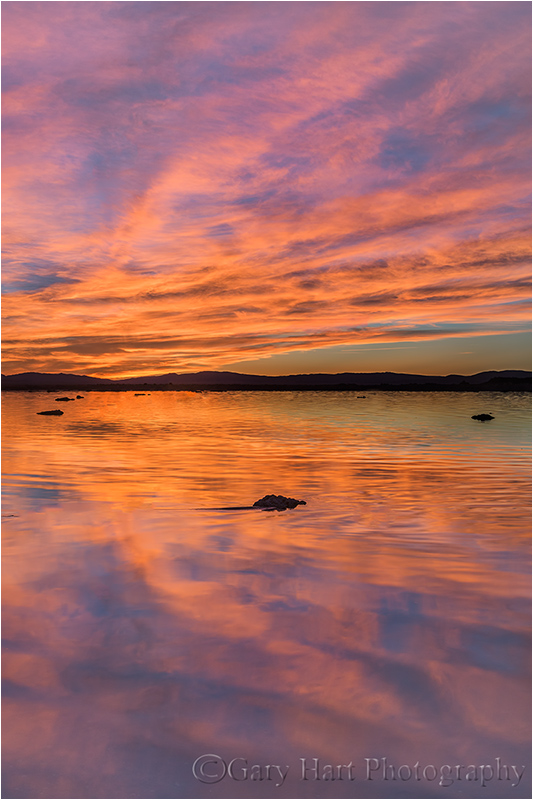
Sunrise Fire, Mono Lake
Canon EOS-5D Mark III
32 mm
1/4 second
F/11
ISO 200
Previously on Eloquent Nature: Road trip!
Sometimes when Mother Nature puts on a show, the best thing a photographer can do is just get out of the way. I’d driven to Mono Lake the previous afternoon to do some night photography and photograph the waning crescent moon before sunrise. After spending the night in the back of my Pilot, I woke at 4:30 and hiked down to the lake. The crescent moon arrived right on time, about an hour before the sun, but I didn’t get any moon images that thrilled me. I was, however, encouraged by the glassy calm of the lake (a distinct change from the previous night) and the promising spread of clouds and sky connecting the horizons.
Waiting in the morning’s utter stillness, it was easy to forget how sleep deprived I was. After fifteen minutes of slow but steady brightening, the color came quickly and for about 30 minutes I was the sole witness to a vivid display that transitioned seamlessly from deep crimson, to electric pink, and finally soft, pastel peach hues. The entire show was duplicated on the lake surface—I could have pointed my camera in any direction to capture something beautiful.
When I get in a situation like this, one that’s both spectacular and rapidly changing, I risk blowing the entire shoot by thinking to much. Thinking in dynamic conditions usually results in things like including foreground elements just because that’s what you’re supposed to do, or spending too much time searching for just the right composition. This problem is particularly vexing at a place like Mono Lake, which is chock full of great visual elements.
I’ve seen many Mono Lake images featuring spectacular color and sparkling reflections, only to be ruined by the inclusion of disorganized or incongruous tufa formations (limestone formations that are the prime compositional element of most Mono Lake images). If you can include the tufa in a way that serves the scene, by all means go for it. But in rapidly changing conditions like I had this morning at Mono Lake, unless I already have my compositions ready, I’m usually more productive when I simplify through subtraction.
This morning I had just enough time before the color arrived to find a spot that didn’t have too much happening in the foreground. Rather than a confusion of tufa formations, I was working with a glassy canvas of lake surface that stretched with little interference to the distant lakeshore. The visual interruptions were few enough, and distant enough, that assembling them into a cohesive foreground was a simple matter of shifting slightly left and right. Handling my shoot this way allowed me to emphasize the scene’s best feature—the vivid color painting the sky and reflecting on the lake. The small tufa mounds dotting the lake surface were relegated to visual resting places that add depth and create virtual lines leading into the scene.
If you look at the images in the Mono Lake Gallery below, you’ll see a variety of foreground treatments that range from simple to complex. The more complex foregrounds are generally the result of enough familiarity and time to anticipate the conditions and assemble a composition. But when I couldn’t find something that worked, I simply stopped trying and allowed the moment to speak for itself.
A Mono Lake Gallery


Road trip!
Posted on July 26, 2014

Summer Night, Mono Lake Beneath the Milky Way
Canon EOS-5D Mark III
28 mm
15 seconds
F/2
ISO 6400
Sacramento isn’t exactly known for its scenery, but as someone who makes his living photographing nature’s beauty, I haven’t found any place I’d rather live (okay, so maybe Hawaii is close). Just listen to this list of scenic locations I can drive to from home in four hours or less (clockwise from southwest to southeast): Pinnacles National Park, Big Sur, Monterey/Carmel, San Francisco, Point Reyes, Muir Woods (and countless other redwood groves), the Napa and Sonoma Valley Wine Country, the Mendocino Coast, Mt. Shasta, Mt. Lassen National Park, Lake Tahoe, Calaveras Big Trees (giant sequoias), Yosemite, and Mono Lake. Not only is each a destination that draws people from all over the world on its own merits, just check out the visual variety on that list.
With a crescent moon due to grace last Friday’s pre-sunrise twilight, Thursday morning I checked my schedule and saw nothing requiring my immediate attention. I clicked through my mental location checklist for sunrise spots that offer view of the eastern horizon—Lake Tahoe and Yosemite would work, but they’re both crowded (and I have enough Yosemite crescent moon images anyway). Mono Lake? Hmmmm…. Not only would Mono Lake work for the moon, it should be dark enough there to photograph the Milky Way above the lake. Road trip!
Within a couple of hours my Pilot was packed, and by early afternoon I was motoring up Highway 50. Aside from my photographic ambitions, another highlight of a Mono Lake trip is the drive itself, which takes me near Lake Tahoe, over Monitor Pass, into the Antelope Valley, and finally onto US 395 beneath the sheer east face of the Sierra crest all the way down to Mono Lake and Lee Vining. I pulled into town at about 6 p.m. and after a quick dinner at the Whoa Nellie Deli (not to be missed—look it up), I was off to the lake. Let the adventure begin.
By far Mono Lake’s most photographed location is South Tufa—with great views of the eastern horizon, it certainly would have qualified for my sunrise shoot, but the best views of the Milky Way would require a view toward the southern horizon. Another problem with South Tufa is the crowds, even at night. Not only have I had to contend with light-painters there (sorry, not my thing), one evening I went down there and found the Japanese Britney Spears shooting a video. (That label is my inference—one of the crew confirmed that she was Japanese, the music sounded just like American Top-40 pop of which Britney was the current queen, and judging by the motorhome, full-size bus, two big-rig trucks, and 1/4 mile long cables snaking all the way from the parking lot to the lake, it was pretty clear this girl was a huge star.) So anyway, Thursday evening I simply opted for the view, peace, and quiet of Mono Lake’s north shore.
Traversed only by a disorganized network of narrow, poorly maintained dirt roads, navigating here is difficult even with a high clearance vehicle. While my Pilot is all-wheel-drive, it’s not designed for off road and I need to take these roads with extra care. My strategy at each junction is to take the spur that trends in the direction of the lake, but over the years I’ve become fairly familiar with this side of the lake and had a general idea of where I wanted to be that night. So far I’ve not found a road that will get me much closer than a half mile from the lake, nor have I ever found an actual trail to the lake—when I think I’m close enough to something nice, I just park and walk toward the lake.
It was about a half hour before sunset when I parked my Pilot in a wide spot near the end of a long dirt road. On most visits I’m out there navigating in the dark before sunrise, so it was nice to actually be able see beyond my headlights while hunting for a spot to shoot. Exiting the car I was blasted by the less-than-pleasant but tolerable smell that is distinctly Mono Lake. It’s there year-round, but seems to be worse in summer.
With nothing to block my view, the lake was in clear sight. Lacking a trail, the route is pretty much a matter of picking a point on the shore making a beeline there. My first few steps dropped me down a short but fairly steep slope into the basin of the ancient Mono Lake. From there it flattens to a gentle slope, first through coarse volcanic sand, and then into a band of tall, soggy grass that eventually peters out into a soup of gray muck. Depending on the location I’ve chosen and the lake level at the time of my visit, the consistency of this muck ranges from damp sponge to shoe-sucking wet cement—this year’s muck fell closer to the wet cement side of the continuum, but my high-top Keens were up to the task. And thankfully, I found large areas where the mud had been baked solid enough to walk on without sinking.
The other feature of note out here is the calcium carbonate (limestone) rocks embedded in the lakeshore (they’re the same makeup as tufa, but a different shape than the more striking South Tufa formations). While these make a great platform for sitting and keeping a camera bag out of the mud, in summer they are literally covered with little black alkali flies. Yes, I said literally covered—the flies are so thick that some rocks are black and any shot that includes a rock starts with shoeing the flies if you want to capture it in its natural gray state. (These flies would be a much worse than a mere annoyance if they were capable of flying higher than one foot above the ground.)
My plan for this trip was to photograph sunset, hang out lakeside waiting for dark, do an hour or so of night photography, return to my Pilot and sleep in the back (air mattress and sleeping bag, thank-you-very-much), then rise at 4:30 and return to the lake in time for the moonrise and and sunrise. I made it down to the lake in time to photograph a sunset that was nice but nothing special by Mono Lake standards. As I waited for dark a warm wind whipped the lake surface into a froth, and I soon became concerned about the thin clouds converging overhead—rain was not a concern, but it started to look like my Milky Way aspirations might be thwarted. Nevertheless I hung out (where else was I to go?) and was eventually rewarded when most of the clouds moved on to mess with some other photographer’s plans.
While not nearly as spectacular as my recent Grand Canyon dark sky nights, there were far more stars than any city-dweller can ever hope to see. An occasional meteor darted into view (see the small one at the top of this picture?), and a few satellites drifted overhead, but the main event was the Milky Way, which poured a river of white that spanned the sky from Scorpio in the south to Cassiopeia in the north. While Lee Vining has not quite achieved sky-washing megalopolis status, it nevertheless created an annoying array of discrete light of varying intensity and color that were more than I wanted to try to deal with in Photoshop. But I found that the farther east along the lakeshore I moved, the less these lights aligned with my scene.
I was having so much fun that I stayed out there until the Earth’s rotation had spun the Milky Way into closer alignment with the Lee Vining “skyline,” sometime after 11:00. By then I really had no idea how far east I’d wandered, so as I trudged back to the car in the pitch black I was extremely thankful (and self congratulatory) for the foresight to have mentally registered my bearings in daylight. While my headlamp guided each next step and illuminated the ten-foot radius of my dark world, navigation was solely by the North Star, which I kept off my right shoulder. I had no illusions that this method would allow me to pinpoint the car in the dark, but my hope was to get close enough that clicking my key fob would activate my horn and lights. For quite a while the key was answered by nothing but crickets, and about the time I started worrying that I’d miscalculated my position and would be spending the night in the mud with the flies, my car flashed and beeped about 100 yards to my right. Hallelujah. Not exactly a bullseye, but close enough.
The next morning came much too early, and while I didn’t get any moon pictures that made me particularly happy, the sunrise was off-the-charts and (along with the Milky Way) more than enough justification for an eight hour roundtrip and less than four hours of sleep. But that’s a story for another day.
Photo Tip: Read more about starlight photography
A starlight gallery


Small steps and giant leaps
Posted on July 20, 2014
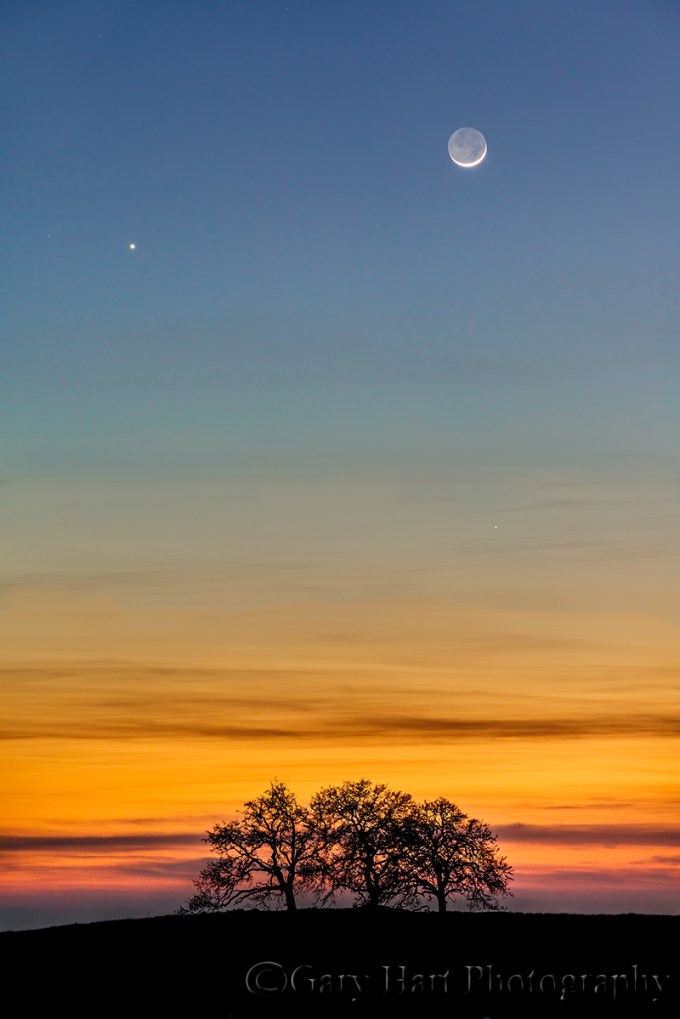
Oak and Crescent, Sierra Foothills, California
Canon EOS-5D Mark III
320 mm
1.6 seconds
F/11
ISO 400
July, 1969
I turned 14 that month. I was into baseball, chess, AM radio, astronomy, and girls—not necessarily in that order. Of particular interest to me in 1969 was the impending moon landing, a milestone I’d been anticipating since tales of American aerospace engineering ingenuity and our heroic astronauts started headlining the Weekly Reader, and my teachers began gathering the class around a portable TV to watch the latest Gemini or Apollo launch or splashdown. If you remember the Sixties, you understand that the unifying buzz surrounding each Apollo mission briefly trumped the divisive tension surrounding headlines detailing Vietnam battles and demonstrations, the Civil Rights movement, and Communist paranoia. Unfortunately, without checking NASA’s schedule or asking for my input, my parents and three couples they knew from college decided mid-July 1969 would be the ideal time for our four families to join forces on a camping trip in the remote, television-free redwoods of Northern California. (“What could we possibly need a television for?”)
Apollo 11 was halfway to the moon when the Locher and Hinshaw families pulled up to our home in Berkeley (the Hardings, coming down from Eastern Washington, would meet us at the campground a couple of days later). The warm greetings exchanged by the adults were balanced by the cool introductions forced on the unfamiliar children. We departed the next morning, caravan style, our cars connected by woefully inadequate walkie-talkies that we’d almost certainly have been better off without (it had seemed like such a good idea at the time). I remember my dad keeping a safe distance behind Hinshaws, as he was convinced that their borrowed trailer, that seemed to veer randomly and completely independently of their car, would surely go careening into the woods on the next curve. But somehow our three-car parade pulled safely into Richardson’s Grove State Park late that afternoon.
In true sixties style, the three dads went immediately to work setting up campsites while the moms donned aprons and combined forces on a community spaghetti dinner. Meanwhile, the younger kids scattered to explore, while the four teens, having only recently met and being far too cool for exploration or anything remotely resembling play, disappeared into the woods, ostensibly on a firewood hunt. Instead, we ended up wandering pretty much aimlessly, kicking pinecones and occasionally stooping for a small branch or twig, just far enough from camp to avoid being drafted into more productive (and closely supervised) labor by the adults.
But just about the time we teens ran out of things not to do, we were relieved to be distracted by my little brother Jim, who had just rushed back into camp breathless, sheet-white, and alone. We couldn’t quite decipher his animated message to the parents, but when we saw our dads drop their tarps and tent poles and rush off in Jim’s tracks toward the nearby Eel River, we were (mildly) curious (to be interested in anything involving parents was also very not cool). So, with feigned indifference, the four of us started wandering in the general direction of the river until we (somehow) found ourselves peering down from the edge of a 50 foot, nearly vertical cliff at the river toward what was clearly the vortex of all the excitement. It was that instant when I think we all ceased being strangers.
The scene before us could have been from a bad slasher movie: Flat on the ground and unconscious (at the very least) was 11 year-old Paul Locher; sitting on a rock, stunned, with a stream of blood cascading from his forehead, was Paul’s 10 year-old brother John. As disturbing as this sight was, nothing could compare to seeing father Don Locher orbiting his injured sons, dazed and covered in blood. The rest of this memory is a blur of hysterics, sirens, rangers, and paramedics.
It wasn’t until the father and sons were whisked away to the small hospital in Garberville, about 10 miles away, that we were able to piece together what had happened. Apparently Paul and John, trying to blaze a shortcut to the river, miscalculated risk and had tumbled down the cliff. My brother at first thought they were messing with him, but when John showed him a rock covered with blood, he sprinted back to fetch the parents. Arriving at the point where the kids had gone over, the fathers made a quick plan. My dad and Larry Hinshaw would rush back to to summon help, and see if they could find a safer path down to the accident scene. Don would stay put and keep an eye on his sons. But shortly after my dad and Larry left, John had looked down at his brother cried, “Daddy, I can see his brains!” Hearing those words, Don panicked and did what any father would do—attempt to reach his boys. Thinking that a small shrub a short distance would make a viable handhold, Don took a small step in its direction, reached for and briefly grasped a branch, lost his grip, and tumbled head-over-heals down to the river.
After what seemed like days but was probably only an hour or two, we were relieved to learn that John needed no more than a few stitches; he was back in camp with us that night. Paul had faired slightly worse, with a concussion and a nasty cut behind his ear—the “brains” his brother had seen was ear cartilage. Paul spent the night in the hospital and was back with us by the time the Harding clan arrived the following afternoon. Don, however, wasn’t quite so fortunate. In addition to a severe concussion, he had opened up his head so completely that over 150 stitches were required to zip things back together. Though Don spent several days in the hospital, needless to say, we were all relieved by the understanding that it could have been much worse.
By Sunday, Don was feeling much better but was still a day or two from release to the dirt and fish guts of our four family campsite. Most of us had visited at one time or another, going in small, brief waves and respecting the hospital’s visiting hours. Nevertheless, there was another priority that had gone unspoken in the first few days following the accident came to prominence with the realization that Don would be fine. I can’t say who first recognized the opportunity, but I’m guessing that Larry Hinshaw had something to do with convincing the nursing staff to look the other way when Don was suddenly host to 20 simultaneous visitors that night. Whatever magic was worked, I’ll never spending that Sunday evening, July 20, 1969, shoehorned into a tiny hospital room, sharing a tiny black-and-white television screen with 20 pairs of eyes, witnessing history.
Besides my parents and two brothers, the rest of the crew that night I’d only met just a few days earlier, but I can still name every single one of them. The relationships formed that week continue to this day. And so do the stories, which, like this story, are filled with some of the greatest joy I’ve ever experienced, and also with some of the greatest tragedy. But it’s this story in particular, the catalyst for all the stories that follow, that explains why the words, “One small step for man, one giant leap for mankind,” have a very personal significance for me.
Today it’s hard for me to look at the moon without remembering that hospital room and the emotional events that enabled me to witness Neil Armstrong’s historic first steps with those special people. As a child of the Sixties who very closely followed all of the milestones and tragedies leading up to that moment, I couldn’t help but wonder while assembling the images for the gallery below about that week’s role in shaping who I am and what I do today.
Workshop Schedule || Purchase Prints
A lunar gallery
Click an image for a closer look, and a slide show. Refresh the screen to reorder the display.


When it rains…
Posted on July 17, 2014

Night Shadow, Kauai, Hawaii
Canon EOS-5D Mark III
28 mm
30 seconds
F/2
ISO 3200
I suspect that nature photographers get themselves into more predicaments than the average person. Case in point:
Following a long day on Kauai that started with a 4:30 a.m. wakeup and continued pretty much nonstop through sunset, I’m not sure why I thought it would be a good idea to extend my day further, especially given that we had another 4:30 a.m. wakeup set for the next day. But there I was, picking my way alone across the wet sand in pitch dark.
I’d wanted to do some night photography on this Kauai visit but had been thwarted by clouds the previous nights. On this night, however, the clouds held back and when I hit the beach it felt like ten thousand stars rushed to welcome me. Living my entire life in areas of light pollution, camera or not I’m always moved by the sight of a truly dark sky. A few thin clouds mingled with the stars, but they were clearly no match for the legions of stars—what could possibly go wrong?
I made my way north along the beach searching something for my foreground. With no moon, the darkness was pretty complete, but once my eyes adjusted I found the easiest going right along the water line, where I could use contrast of the shifting line of lapping surf to keep me on course. Every once in a while a warm wave would wash up and clean the sand from my between my toes.
After a couple hundred yards I came upon a few chunks of wave-worn basalt protruding from the surf and decided I needed to go no further. Exposures between 15 and 30 seconds not only smoothed the waves, they also created a pleasing motion blur in the clouds. I tried a variety of compositions with no illusions I’d get anything special—I just welcomed the excuse to be alone with the stars on a warm Kauai beach. In fact, I was having so much fun that I wasn’t really paying attention to the fact that each frame contained a little less sky and a little more cloud.
The image you see here was one of my last captures. Shortly after clicking it the wind kicked up—spend any time in Hawaii and you learn that a sudden increase in the wind usually means rain isn’t far behind. I looked up. Hmmm. The stars were about gone—when did that happen?
While collapsing my tripod a large raindrop slapped my cheek, then another on my leg. Soon the drops were pelting me and the sand like bullets on Omaha Beach. Getting caught in the rain in Hawaii isn’t nearly as unpleasant as it is most other places (go figure), but Hawaii rain is just as wet as any other rain and I’d gone out with just my camera, one lens, and tripod—sans camera bag I was without rain gear for myself and had nothing to protect my camera (I never claimed to be smart).
I hustled a short distance further up the beach to what I thought would be a shortcut through the condo community situated just above the beach but was blocked by a creek emptying into the ocean—in daylight this wouldn’t have been much of an obstacle, but trying to negotiate rocks and water in the dark wouldn’t have been wise (having already lost one camera to a Hawaii creek this year). I considered scrambling up the hill, but separating me and the easiest route back was a twenty-foot wide, one-foot high groundcover of unknown composition. So I turned and sprinted back down the beach, mindful of the rocks I’d just photographed and suddenly aware that the tide and come in. Surprise number two (see “smart” comment above). My camera was getting a drenched, but to stumble in the dark would risk giving it a saltwater bath.
I considered shoving my camera inside my shirt, but my shirt was about as dry as a bucket of water. Desperate, I looked for a path up the slope and through the ground cover separating me from the manicured lawn (and a quick, illuminated route to safety). Spying a possible gap, I darted into the brush. Dead end. But propelled by momentum and concern for my camera I didn’t break stride, leaping into the brush like Peter Rabbit into a briar patch. (Peter Rabbit I’m not, and I have the scratches to prove it.) Once onto the lawn it was only about a three minute dash back to the resort.
It doesn’t rain like this in California—I’m pretty sure it would have taken a full day to accumulate the amount of rain I got in less than fifteen minutes that night on Kauai. Not only that, it usually takes about a day to build up to it, and then another day to decide it’s done. But of course my rain (it somehow felt personal) stopped right after I made it to the room, before I’d even stopped dripping and huffing.
The next day, while reviewing the images on my computer, I was pleased to find a couple that might have more value than merely the excuse I needed to get out to play with the stars that night. Because it had been so dark while I was out there, it took me a few seconds to sort out the layers in my images, but what you see here, from bottom to top, is the dark, wet sand on which I stood; the white surf washing up on the beach in front of me; an area of dark, calmer water; more waves where the surf hits a volcanic shelf less than 100 yards from shore; a thin stripe of open ocean; and finally sky, clouds, and stars.
The real treat in this image is the unexpected shadow of a tree painted on the nearby surf, cast I’m guessing by the faint light from the condos behind me. I’d love to say this shadow and its perfect position against the white surf was part of my plan, but it wasn’t. Not only did the motion in the surf, which shifted continuously between dark-calm and white-waves, create a constantly changing background, it was just too dark out there for my eyes to register the shadow anyway. But my camera, with its ability smooth motion and absorb more light than my eyes can, gave me something invisible to my eyes. And this ability to capture reality that my eyes miss really is my favorite thing about photography.
* * *
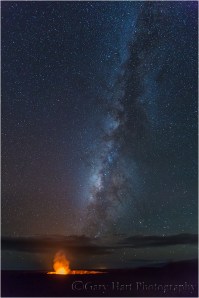
Milky Way and Halemaʻumaʻu Crater, Kilauea, Hawaii
We do night photography in almost all of my photo workshops, including Hawaii
Ode to joyful photography
Posted on July 9, 2014

Revelation, Kauai, Hawaii
Canon EOS-5D Mark III
19 mm
4 seconds
F/16
ISO 100
Photography is a source of joy, right? You know it and I know it. I mean, why else would we spend thousands of dollars on equipment, stagger out of bed hours before the sun, skip dinner, stand all afternoon in freezing rain, or hike three miles in the dark, just to take a picture? If you’ve experienced (or witnessed) the ecstasy evoked by an electric sunrise, rising moon, or vivid rainbow, you understand.
But if photography is such a joyful endeavor, what’s with all the miserable photographers? When that joyful photographer who stood in the rain or hiked in the dark shares the fruits of her labor online, she somehow incites a swarm of miserable photographers who believe that:
- Any photographer using a (Canon, Nikon, Sony, whatever) is a moron
- The horizon line never belongs in the center
- Nobody (else) knows how to process an image
- And a host of other photographic myths
To the miserable, insecure souls who believe they can “elevate” their stature by diminishing others, the next time you feel like criticizing a fellow photographer, fueling the fray on a photography forum, or pontificating at the local photo club, do yourself (and the world) a favor: Pick up your camera, go outside, and take a picture. Then walk around a little bit and take a few more. In fact, just stay outside until you feel better—it won’t take long.
About this image
There’s a direct relationship between the amount of discomfort (misery, sacrifice, or whatever you want to call it) endured to capture an image, and the amount of joy the image manifests. Case in point: This sunrise on Kauai.
It was the last morning of the photo workshop I was co-leading with Don Smith. The group rose dark and early and we drove in a constant rain to our sunrise location about 30 minutes away. On the drive we all had serious concerns that the rain would shut us down entirely, but there were no thoughts of turning back.
As we assembled our gear and prepared for our short hike, the rain eased and a gentle breeze separated the clouds to reveal a few stars and thin crescent moon. But during the ten minute trek out to the ocean view, our breeze stiffened to a gusting, face pummeling wind. We fanned out along the cliffs and waited for the morning to swell on the eastern horizon. The daylight revealed a wall of rain heading our direction, brightening as it advanced, pushed by a wind that was now gale strength, so strong that I hooked my camera bag to my tripod to keep it anchored. As the light of this rising sun filled the oncoming squall, the sky throbbed with color. But despite the ominous signs, we persisted, mesmerized by the fire that now stretched from horizon to zenith.
For about five minutes we were in photographer heaven, and then the weather was on us. As if dowsed by the flood, the light disappeared with the downpour’s arrival. Instantly soaked, we all immediately and independently turned and sprinted toward the cars in a mad panic—with my umbrella powerless against the horizontal raindrops and rain gear warm and dry back at the hotel, I heroically led the retreat (picture George Costanza at the sight of smoke).
No photographer, article of clothing, or piece of a equipment was dry on the drive back, but the mood was unanimous joy. We all knew we’d just shared five minutes of special—not really what you expect when you drive through the dark in a pouring rain, stand on a cliff in a gale, or subject yourself to a thorough soaking, but the reason we do it anyway.
A gallery of joyful captures
-

- Moonlight, Whitney Arch, Alabama Hills, California
-
- Winter Reflection, El Capitan, Yosemite
-

- Champagne Glass Poppies, Merced River Canyon, California
-
- First Light, Yosemite Valley, Yosemite National Park
-
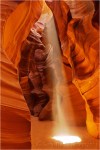
- Divine Spotlight, Upper Antelope Canyon, Arizona
-

- Moonlight Cathedral, Valley View, Yosemite
-
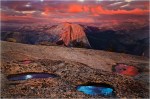
- Sunset Palette, Half Dome from Sentinel Dome, Yosemite National Park
-

- First Snow, El Capitan, Yosemite
-
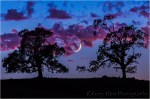
- Crescent and Oaks at Dusk, Sierra Foothills, California
-

- Autumn Moonrise, Half Dome and the Merced River, Yosemite
-

- Three Strikes, Bright Angel Point, Grand Canyon
-
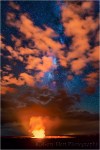
- Fire on High, Kilauea and Milky Way, Hawaii
-
- Autumn Snow, Valley View, Yosemite
-
- Bridalveil Dogwood, Valley View, Yosemite

 Eloquent Images by Gary Hart