Eloquent Images by Gary Hart
Insight, information, and inspiration for the inquisitive nature photographer
Building a scene
Posted on December 21, 2014

Clearing Storm Reflection, El Capitan and Bridalveil Fall, Valley View, Yosemite
Sony a7R
16 mm
.8 seconds
F/11
ISO 100
Lots of variables go into creating a successful landscape image. Many people struggle with the scene variables—light, depth, and motion—that are managed by your camera’s exposure settings: shutter speed, f-stop, ISO. Others struggle more with the composition variables: identifying, isolating, and framing a subject. (I’m not denying that there’s overlap between the exposure and composition sides of image creation, but leveraging that overlap requires independent mastery of both sides.)
Getting the exposure variables out of the way
Because I want to write more about the composition decisions that went into this image, I’ll only touch briefly on my exposure choices for the above image. I approach every scene with at my camera’s best ISO (100) and lens’s “ideal” f-stop (generally f11, where lenses tend to be sharpest, the depth of field is good, and diffraction is minimal).
Given that motion wasn’t a factor (I was on a tripod, the wind was calm, and the river’s motion didn’t concern me), I stuck with ISO 100. And even though the submerged rocks provided lots of visual interest in the immediate foreground, my 16mm focal length provided more than enough depth of field at f11—focusing about four feet into the scene would give me sharpness from around two feet to infinity. That was easy.
With those two variables established, I spot-metered on the brightest part of the scene and set dialed my shutter speed until the exposure was as bright as felt I could get away with without hopelessly blowing the highlights. This ensured that my scene (shadows included) was as bright as I could safely make it.
Here’s what I was thinking
Reflections of El Capitan, Cathedral Rocks, and Bridalveil Fall make Valley View one of the most photographed locations in Yosemite Valley. I usually I try to find something a little different than the standard view here, but the cloudy vestiges of a passing storm reflecting in the Merced River provide an irresistible opportunity to take advantage of everything that makes Valley View so special.
Some scenes you can walk up to and plant your tripod pretty much anywhere without much difference in your background subjects (though that’s rarely the case with foreground/background relationships). That’s not the case at Valley View, where the difficulty starts with distracting, non-photogenic shrubs on the near riverbank—to keep them out of the frame, you need to hop the rocks all the way down to the river.
The bigger problem at Valley View is getting all the primary elements into the image—too far to the left, and El Capitan disappears behind a stand of evergreens; too far to the right and another stand of evergreens occludes most or all of Bridalveil Fall. I moved into the fifteen-foot section of riverbank that gives me what I consider an adequate view of both, and started studying the submerged and protruding rocks right in front of me, looking for a workable foreground.
I’ll often move around quite a bit to control foreground/background subject relationships; in this case I found little benefit from shifting and stayed more or less in the same place. But that doesn’t mean I didn’t vary my shots—I tried a variety of compositions, but wide and tight, horizontal (above) and vertical (below). Some used lots of sky, while others (like this one) minimized the sky to emphasize the foreground. Still others were of the reflection only, or of the reflections with just a thin stripe of the opposite riverbank. The other variable I played with was my polarizer, which I turned to maximize and minimize the reflection, plus a combination (like both images here).

As with many images, composition at the top of the page required some compromises. I liked the way the vertical version leads the eye through the scene, and frames it with the two most striking elements—El Capitan and Bridalveil Fall. But I also wanted a horizontal rendering that would open up the scene and express its broad grandeur.
An often forgotten component of successful photography is what gets left out—an image’s perimeter are frequently home to distractions overlooked by photographers too drawn to their primary subjects. So the problem making a Valley View horizontal composition that’s wide enough to include the reflection and river rocks, is the introduction of potentially distracting elements on the far left and right.
In this case my greatest problem was the scene’s left side, with its bare trees, brown riverbank, and exposed rocks, it was rife with potential distractions to deal with. Shifting the entire composition to the right would have thrown the frame off balance, and added a lot of real estate that wasn’t worthy of the scene. Going tighter would have sacrificed too much river rock and reflection, an essential feature in my mind. I could have removed my shoes and socks, rolled up my pants, and walked forward through the (frigid) water—that move would have solved all my problems, but probably wouldn’t have been appreciated by all the other nearby photographers.
I ended up using the trees and rocks to frame the left side of the image, taking care to allow the entire arc of the riverbank to complete so it didn’t look like the nearby rocks (on the left) belonged a different scene. The vertical version doesn’t have these problems, and though it sacrifices the breadth of the horizontal composition, hold a gun to my head and I might tell you it’s the vertical version I prefer. (But it’s nice to have a choice.)
A Valley View Gallery


Revisiting Photography’s 3 P’s
Posted on December 15, 2014

Parting the Clouds, Yosemite Valley Moonrise, Tunnel View
Sony a7R
72 mm
1/15 second
F/11
ISO 100
Let’s review
I often speak and write about “The 3 P’s of nature photography,” sacrifices a nature photographer must make to consistently create successful images.
- Preparation is your foundation, the research you do that gets you in the right place at the right time, and the vision and mastery of your camera that allows you to wring the most from the moment.
- Persistence is patience with a dash of stubbornness. It’s what keeps you going back when the first, second, or hundredth attempt has been thwarted by unexpected light, weather, or a host of other frustrations, and keeps you out there long after any sane person would have given up.
- Pain is the willingness to suffer for your craft. I’m not suggesting that you risk your life for the sake of a coveted capture, but you do need to be able to ignore the tug of a warm fire, full stomach, sound sleep, and dry clothes, because the unfortunate truth is that the best photographs almost always seem to happen when most of the world would rather be inside.
Picking an image and trying to assign one or more of the 3 P’s to it is a fun little exercise I sometimes use to remind myself to keep doing the extra work. Take a few minutes to scan your favorite captures; ask yourself how many didn’t require at least one of the 3 P’s. (I’ll wait.) …….. See what I mean?
So which of my 3 P’s do I credit for this one? Well, there was the Persistence to continue going out in the rain all week, with no guarantee we’d see anything beyond 100 yards (because in Yosemite, if you stay inside until the rain stops, you’re too late). And of course photographing in the rain is nothing if not a Pain. But more than anything else, this one was about…
Preparation
(If you discount the unavoidable knowledge gained by a lifetime of Yosemite visits and and decades of plain old picture clicking) the preparation for this image started when I plotted the 2014 December moon and determined that it would rise at sunset, nearly full, above Half Dome in the month’s first week. So of course I scheduled a workshop for that week.
But there was more to the preparation than just figuring out where the moon would be. Of course as the workshop approached, I monitored the weather forecast and arrived in Yosemite prepared for rain. (Duh.) And throughout the workshop I monitored the weather obsessively, scouring each National Weather Service forecast update (every six hours), monitoring radar, not to mention the good old fashioned walk-outside-and-look-up technique.
Before going out for our penultimate afternoon shoot, I determined exactly what time the moon would appear above Half Dome, though I had little hope that the clouds would part enough to reveal it. Nevertheless, I wanted to to keep the group within striking distance of Tunnel View, just in case. When the latest weather forecast indicated a possible break in the rain late that afternoon, I started watching the sky closely—a clearing storm plus the moon would be pretty cool for everyone (including this life-long Yosemite photographer). The instant the clouds showed a hint of brightening (a subtle precursor to an imminent break that every photographer should be able to read), I raced everyone back up to Tunnel View.
As we pulled into the Tunnel View lot, not only was the storm starting to clear, a small patch of the first blue sky we’d seen in two days was widening above Half Dome. I held my breath and crossed my fingers for the blue to expand just a little more, because I knew exactly where the moon was and it was oh so close.
We didn’t need to wait long—within five minutes a thin piece of moon poked through, then a little more, and soon there it was, floating in that small blue patch between Half Dome and Sentinel Dome. It hung in there for less than five minutes before the clouds regrouped and swallowed the sky.
Epilogue
With more rain in the forecast, driving down from Tunnel View that night I felt certain that this unexpected, brief convergence of moon and sky was a one-time gift, that the planned moonrise for our final sunset would surely be lost to the clouds. And given what we’d just seen, I was okay with that. But Nature had a different idea….
A Gallery of Extreme Weather Rewards
Click any image to scroll through the gallery LARGE


Dialing it in
Posted on December 10, 2014

Rocks and Reflection, Valley View, Yosemite
Sony a7R
16 mm
1/3 second
F/11
ISO 200
I’m a big fan of the polarizer, so much so that each of my lenses wears a polarizer that never comes off in daylight. A couple of years ago “Outdoor Photographer” magazine published my article on using a polarizer, a slightly modified version of a blog post that appears in the Photo Tips section of this blog.
If you read that article, or pay much attention to what I write here, you know that while a polarizer can really crank up the blue in your sky, I’m not generally a fan of what the polarizer does to the sky. I find blue sky boring—making it more blue just distracts from my primary subject. And worse still, because polarization varies with the angle of view (maximum polarization occurs when composing perpendicular to the sunlight’s direction, minimum when you’re parallel to the sunlight), wide shots (in particular) display “differential polarization” that manifests as unnatural sky-color variation across the frame.
Where I find a polarizer most indispensable is terrestrial reflections. With a simple twist of a polarizer, a mirror reflection on still water is magically erased to reveal submerged rocks and leaves. More than the reflections we see on still water, a properly oriented polarizer removes distracting, color-robbing glare that jumps off of rocks and foliage. And you don’t need direct sunlight to enjoy a polarizer’s benefits—because reflections and glare exist in overcast and full shade conditions, a polarizer can significantly enhance those images as well.
But back to this differential polarization thing. As most know, a polarizer isn’t a filter that you simply slap on a lens and forget about. A rotates in its frame, changing the amount of polarization on the way—if you’re not orienting (rotating) your polarizer with each composition, you’re better off keeping it in your bag. Watching through your viewfinder as you rotate, you’ll see the scene darken and brighten—maximum polarization occurs when the scene is darkest. These changes may appear subtle at first, and in some cases will be barely visible, but the more you train your eye, the easier it becomes to detect even the most subtle polarization.
Since polarization varies with the angle of view, and any image encompasses a broad angle of view, the amount of polarization you see in any given image varies. While differential polarization is a real pain in images with a uniform surface (like a blue sky), understanding that a polarizer isn’t an all or nothing tool allows you to dial the reflection up in some parts of the scene, and down in others. Rather than automatically dialing the polarizer until the scene darkens (maximum polarization), or until the reflection pops out (minimum polarization), turn the polarizer slowly and watch the reflection advance and retreat as you turn.
That’s exactly what I did with the above image from last week’s Yosemite trip. The sunlit vestiges of a day-long rain swirled above Valley View and reflected in the drought-starved Merced River (one storm does not a drought break). Here I opted for a wide, vertical composition that left room for both foreground and sky tightly framed by El Capitan on the left and Cathedral Rocks and Bridalveil Fall on the right.
Faced with a crisp reflection and a submerged jigsaw of river-worn granite, I refused to choose one or the other. Instead, I composed my scene with a group of exposed rocks to anchor my immediate foreground, then carefully dialed away enough reflection to reveal the rounded rocks, while saving the portion of the reflection that duplicated the Yosemite icons.
I use Singh-Ray filters (polarizers and graduated neutral density)
A selective polarization gallery
Click an image for a closer look, and to enjoy the slide show


Classic Yosemite
Posted on December 3, 2014

Clearing Storm, Yosemite Valley, Yosemite
Sony a7R
33 mm
1.6 seconds
F/11
ISO 125
December 3, 2014: A brief post to share my workshop group’s good fortune this morning
I’m in Yosemite this week for my Winter Moon photo workshop. Scheduling a December workshop in Yosemite is one of those high risk/reward propositions—I know full well we could get some serious weather that could make things quite uncomfortable for photography, but winter (okay, so technically it won’t be winter for another two-a-half weeks, but it’s December for heaven’s sake, so don’t quibble) is also the best time to get the kind of conditions that make Yosemite special. In the days leading up to the workshop I’d warned everyone about the impending weather, but I’d also promised them that they were in store for something special at some point during their visit. Then I crossed my fingers….
We started Monday afternoon to blue skies and dry waterfalls, but by Tuesday morning the first major storm of California’s (usually) wet season rolled in and everything changed (literally overnight). A warm system of tropical origin, what this storm lacked in snow, it more than made up for in rain, copious rain. Starting before sunrise, we got a little shooting in before the serious stuff started, but the rest of the day was wet, wet, wet. When weather settles in like this, the ceiling drops and Yosemite’s granite features disappear behind a dense, gray curtain. Nevertheless, we found some nice photography and everyone finished the day saturated but satisfied.
This morning (Wednesday) I got the group up to Tunnel View for sunrise, where were met with more of the same—opaque clouds and lots of rain, but little else. Since Tunnel View is usually the best place to wait out a Yosemite storm (thanks to the panoramic view, and the fact that the weather almost aways clears on Yosemite Valley’s west side first), I told everyone we’d just sit tight and see what happens. A few huddled in the cars, but most of the group donned our head-to-toe rain gear and stood out in the rain, waiting (hoping) for the show to begin.
As if on cue, at just about the advertised sunrise time (there was no actual sunrise to witness), the sky brightened and the curtain parted: El Capitan was first on stage, followed closely by a rejuvenated Bridalveil Fall, and soon thereafter the star of the show, Half Dome, appeared center-stage. Radiating from the valley floor, a thick fog rolled across the scene like a viscous liquid, changing the view by the minute—for nearly an hour everyone got to experience a classic Yosemite clearing storm.
As many times as I’ve witnessed a clearing storm from Tunnel View, the experience never fails to thrill me. Overlaying one of the most beautiful scenes on Earth, infinite combinations of cloud, sky, color, and light make each one unique. And as if that’s not enough, sometimes fresh snow, a rainbow, or rising moon are added to the mix. On this morning the clearing was only temporary, with no direct light or hint of blue sky, and the rain soon returned. Not that this was a problem—with more weather in store, this morning just turned out to be the opening act.
Check out my schedule of upcoming photo workshops
A Tunnel View Clearing Storm Gallery
Click an image for a closer look, and to enjoy the slide show


Visualize, pursue, execute, enjoy
Posted on May 5, 2014

Bridalveil Raindrop, Yosemite
Canon EOS 5D Mark III
1/30 second
100 mm
ISO 1600
F22
I probably worked harder capturing this image than any other image I’ve ever photographed. Worked hard not in terms of physical exertion, but rather in patient pursuit over several years and painstaking execution in difficult conditions. Photographed late last month in Yosemite, this image is something I’ve visualized and actively sought for years. While I have no illusion that this image will be as popular as some of my more conventional images, it makes me so happy that I just have to share everything that went into its capture.
Visualize: The world in a raindrop
I can trace this image back to a spring afternoon a few years ago, when I was doing macro photography in a light rain. My subject was poppies, and peering through my viewfinder I particularly loved the clarity of the raindrops when they snapped into focus. At home on my monitor I magnified one of the images to something like 400% and saw the entire scene surrounding me was inverted in that tiny droplet. The fact of this wasn’t new to me, but actually seeing it up close planted a small seed that bloomed into an obsession I’ve been chasing ever since. I realized that getting even closer to a raindrop might allow me to enlarge its internal scene enough to make it visible without magnification. From that thought it was a short jump to the idea of finding a raindrop that contained a scene others would recognize.
Pursue: If at first you don’t succeed…
Unfortunately, the onset of my raindrop quest coincided with a drought that severely limited my access to raindrops (and if you know anything about me, you know it has to be an actual raindrop—no spray bottles for me). And then there are the daily distractions of running a business, and the fact that many of my trips to prime locations are for workshops, when the time and attention a shot like this requires precludes me from trying it.
Nevertheless, over the last several years I’ve played with my idea when opportunities presented themselves. These experiences allowed me to determine that 100mm macro wouldn’t get me close enough, that I’d need to add multiple extension tubes. And the extremely narrow depth of field that comes with focusing this close would require a very small aperture to get enough of the frame sharp.
These early attempts also enabled me to identify and practice overcoming a few physical challenges: low light, caused not only by the overcast skies, but also by the extension tubes (extension reduces the amount of light reaching the sensor); wind, almost always present in a rain; and a tissue-thin focus plane (even at a small aperture) that severely shrinks my margin for error. I knew going in that it would be difficult, but with each attempt I had to admit that this shot might be even harder than I’d decided it would be the last time I tried it. Of course that’s half the fun.
A couple of weeks ago the (always reliable) weatherman called for an all-day rain in Yosemite. Perfect. Knowing the dogwood were blooming, I freed my schedule and made the 7+ hour roundtrip to Yosemite, leaving early in the morning and returning that night. The raindrop shot wasn’t my sole objective, but it was up there on my list. Unfortunately, while I ended up having a pretty good day, my “all-day” rain stopped about an hour into my visit and I was left to pursue other opportunities.
Undeterred, when the (almost always reliable) weatherman promised more rain a couple of days later, back I went, this time meeting friends Don Smith and Mike Hall. Did I mention that I wanted rain? Well, rain it did. Hard. All day. Donning head-to-toe rain gear, I managed to stay dry, but my equipment wasn’t quite so lucky—without a third arm my umbrella wasn’t much use during the compose/meter/focus phase and the small towel I’d brought to dry things off was completely saturated by the end of our first stop (I should have known better). After that I pretty much contented myself with drying my my lens element just before shooting, trusting (hoping) that my reasonably water-resistant gear would survive—if I wanted to keep shooting, I had no other choice.
As good as the shooting was, by mid-afternoon the three of us were ready to submit to the weather and head for home. But, with my raindrop shot gnawing at the back of my mind, on the way out I suggested a quick stop at the view of Bridalveil Fall on Northside Drive. I’d stopped here on Tuesday and knew the dogwood that hadn’t been quite ready for primetime then would be just about right now. So stop we did (it didn’t take lots of arm twisting).
Execute: Cruel and unusual
While Don and Mike (why does this sound like a drive-time radio program?) went off in search of their own vision, I bee-lined to the “perfect” dogwood I’d identified on Tuesday. But getting a shot like this isn’t just a matter of going out in the rain at a beautiful location. (Full disclosure: there was a time when I believed it might just be.) And in my zealous pursuit, I’d conveniently discounted the difficulties I’d need to deal with:
- Rain (of course I knew it was raining, but I always forget what a pain it is to deal with, even if I just dealt with it fifteen minutes ago)
- My “perfect” tree was on an embankment with a 45-degree slope
- A light but persistent breeze (I never notice a light breeze until I try to do macro)
- Rain (in case you forgot)
Okay, so maybe this won’t be such a quick stop.
After taking stock of the physical difficulties, I attached all three of my extension tubes (72 mm total) to my 100 mm macro lens and scanned the flowers, branches, and leaves for a raindrop that was both large enough to hold the scene (without extreme distortion) and whose long axis (the wide side) was perpendicular to my line of view to Bridalveil Fall. No small feat.
The frustration started immediately: When I did indeed find the “perfect” drop, I realized getting to it without touching the tree (thereby rearranging all its drops) would require powers far beyond my superhero grade. And so it happened that once I navigated “inside” the tree’s canopy to my raindrop, the raindrop was long gone and I had to start over.
Okay, at least I was inside the tree—progress. I ran my eyes along the nearby branches until suddenly, there it was—another perfect (there’s that word again) raindrop dangling from a diagonal branch about 18 inches in front of me. I very carefully maneuvered in its direction, using contortions that might best be described as a hybrid of moves from the party games Twister and Limbo, moves I hadn’t broken out since my (far more limber) college days. (Picture a heist movie where the cat-burglar has to avoid a matrix of electric eye beams to get to the jewels.)
This particular raindrop was about eight inches above my head. Fortunately my new (and wonderfully tall) tripod was up to the task—I extended its legs until my lens was just an inch or two from the drop and began the painstaking process of composing and focusing. With my viewfinder higher than my eye could reach, this part would have been impossible without live-view; with live-view it was a pain but doable.
I found my basic composition fairly quickly, but my ridiculously thin focus plane shifted every time the breeze or nearby raindrop-strike jostled “my” raindrop. Focusing not on the raindrop, but the scene within the raindrop, I waited for a brief lull in the breeze and nudged my focus ring until the equilibrium point around which the drop vibrates was sharp. Then I magnified the drop and waited for the next lull to confirm sharpness. After several attempts I was reasonably confident I was ready to proceed.
Stopping down to f22 with three extension tubes forced me to bump my ISO to 1600 to reach the 1/30 second shutter speed I thought I could get away with. Even this would require timing my shutter for another lull in the breeze, but the alternatives—a larger aperture which would reduce my DOF, or higher ISO that would increase the noise—I wasn’t crazy about.
You’d think after all this I’d be ready to shoot. You’d think. But by now (in case you forgot, it’s still raining) my front lens element was festooned with raindrops. And wiping the lens dry did little good because the slightly upward angle of view oriented my lens ideally for capturing more raindrops. So I extracted the collapsed umbrella I’d proactively jammed in a jacket pocket and carefully threaded it skyward, carefully negotiating the network of overhanging branches without disturbing my raindrop, until the umbrella was in a open space wide enough to unfurl. Open umbrella in my right hand, with my left hand I was able to dry with a small, dry lens cloth I’d also had the foresight stuff in a pocket.
One of the downsides of the “perfect” raindrop is its large size, which gives it a rather inconvenient relationship with gravity. So. After all this preparation and just as I raised my remote release for my first click, my raindrop grew tired of waiting and plunged groundward. True story. Fortunately, an advantage of getting intimate with raindrops is the insight that they tend to reform in the same place. I took a deep breath—with my composition, focus, and exposure already set, I decided to wait (still contorted between branches beneath my umbrella) for the next drop to form. And sure enough, within a couple of minutes I was back in business.
I clicked a dozen or so frames, checking the focus after each, refining the composition slightly, and occasionally varying my exposure settings until I was confident that I had enough frames to give me a pretty good chance of at least one successful image. I probably would have worked on it even longer, but my muscles really were starting to cramp and I figured Don and Mike were ready to move on anyway. Back at the car a cursory run through my images on my LCD was enough to give me hope that I’d achieved my goal, but it wasn’t until I got them home on my large monitor that I was ready to proclaim success.
Enjoy: All’s well that ends well
Most of the images had very slight but nevertheless fatal focus problems—slight motion blur or barely missed focus point—all I needed was one. And this is it.
So what did I end up with? The white stripe on the left is Bridalveil Fall in full spring flow. The branch belongs to my young dogwood tree; behind it are dogwood leaves and new (still greenish) flowers. And inside the raindrop is Bridalveil Fall, Cathedral Rocks, and Leaning Tower. But wait, there’s more: I’d actually had been working on the image a little while before looking closely at the black shape above Bridalveil Fall and realizing that a raven had flashed into my scene at the instant I clicked (it’s in no other frame). Pretty cool.
Four sunsets, part four: Saving the best for last
Posted on February 23, 2014

Twilight Magic, Yosemite Valley from Tunnel View, Yosemite
Canon EOS-1Ds Mark III
3 2/3 seconds
F/11.0
ISO 400
45 mm
- Read the first in the series here: Four sunsets, part one: A Horsetail of a different color
- Read the second in the series here: Four sunsets, part two: Classic Horsetail
- Read the third in the series here: Four sunsets, part three: A marvelous night for a moondance
What I love most about photography is its ability to surprise me. Case in point: the final sunset of my recent Yosemite Horsetail Fall workshop, which delivered just one surprise after another.
I’d told my group that we’d get to photograph another moonrise on our last evening, but only if the clouds cooperated. And as the afternoon wore on, it seemed that the clouds that had cooperated so wonderfully all week wouldn’t be on our side tonight. Assembling everyone on the sloped granite above Tunnel View, I eyed the thin (and shrinking) strip of blue sky on the horizon above Half Dome and checked my watch: 5:10—in about fifteen minutes (less than ten minutes before sunset), with no clouds we’d see a full moon poke into view between Half Dome and Sentinel Dome. But our vantage point gave me a clear view of the clouds racing in that direction and our prospects weren’t good. Rather than stress (much), I stayed philosophical: We’d already had three fantastic sunset shoots, expecting a fourth would be downright greedy.
Nevertheless, it was fun to watch the clouds sprint across the sky and pile up behind Half Dome, changing the scene by the minute. Waiting there, I had thoughts about the throngs gathered on the valley floor, hoping (praying) for Horsetail Fall to light up. My group had been lucky on our first two sunsets, but tonight there’d been no sign of sunlight for at least thirty minutes, and with the cloud machine working overtime behind us, I was pretty certain the Horsetail crowd was in for disappointment.
Anticipating a moonrise, I’d gone up our vantage point with just my tripod, 5DIII, and 100-400 lens. Knowing exactly where the moon would appear, my composition was set well in advance—tight, with Half Dome on the far left and the moonrise point on the far right. But without the moon, I realized that the best shots would likely be wide, so I zipped back to the car and returned with another tripod (doesn’t everyone carry two?), my 1DSIII, and my 24-105. Sitting on the (cold) granite, a tripod on my left and my right, I quickly composed a wide shot with my new setup and resumed my vigilance.
By 5:25 I’d stopped watching the incoming clouds, which were streaming in faster than ever, and turned my focus to the moon’s ground-zero, willing the clouds to part for its arrival. At exactly 5:27 and as if by magic, the white glow of moon’s leading edge burned through the trees downslope from Sentinel Dome. I did a double-take—it was as if the moon had pushed the cloud curtain up and slipped beneath. I shouted, “There it is!” and the furious clicking commenced. We ended with about sixty seconds of moonrise, just long enough for the moon to balance atop the trees, before the clouds settled back into place and snuffed it out.
But the surprises had only just begun. While the whole group still buzzed about the moon, I noticed a faint glow on El Capitan. Not quite believing it (and not wanting to jinx anything), I kept my mouth shut and looked closer. But when the glow persisted, I had to point it out, if for no other reason than confirmation that I wasn’t hallucinating. Within seconds all doubts were dispelled as El Capitan exploded with light from top to bottom. So sudden and intense was the light that I’m surprised we didn’t hear the roar from the Horsetail Fall contingent in the valley below us. And rather than fade, as it often does, the light intensified, warming over the next couple of minutes from amber to orange to red. Soon the color deepened to an electric magenta and spread across the sky and all those clouds I’d been silently cursing just a few minutes earlier became allies, catching the color and reflecting it back to the entire visible world.
Giddy about the show, and focused on my two cameras, I’d long given the moon up for dead. So imagine my surprise when, just as the color reached a crescendo, there the moon was, burning through a translucent veil of clouds. So expansive was the scene that a telephoto couldn’t do it justice, so all of my images following the moon’s resurrection were captured with my 5DIII and 24-105. Exposure became trickier by the minute in the advancing darkness, and eventually, pulling detail from the valley without completely blowing out the moon required a 2-stop hard graduated neutral density filter.
Honestly, this was one of those moments in nature that no camera can do justice. I did my best to come find compositions that captured the majesty of Yosemite Valley, the vivid sky and the way it tinted the entire scene, and that Lazarus moon. But take my word for it, you just had to be there….
* * * *
Four Sunsets
-

- Revelation, Horsetail Fall, Yosemite
-

- Fire on the Mountain, El Capitan and Horsetail Fall, Yosemite
-

- Twilight Magic, Yosemite Valley from Tunnel View, Yosemite
Encore!
Posted on November 11, 2012
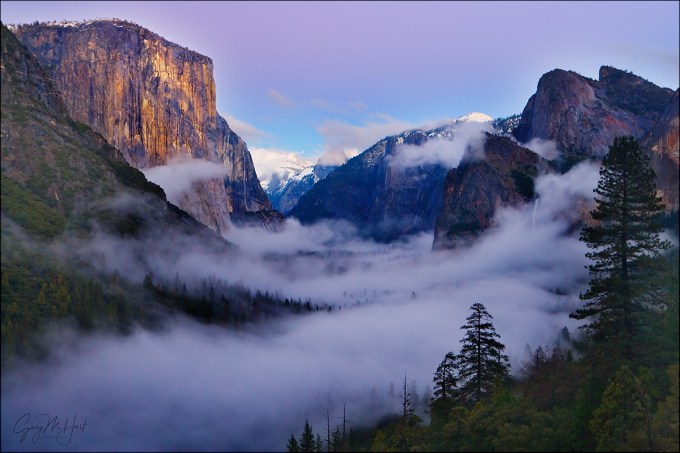
Twilight Fog, Tunnel View, Yosemite
Canon EOS-1Ds Mark II
1.6 seconds
F/7.1
ISO 200
48 mm
Yesterday I spent an incredible day in Yosemite, guiding a group of photographers from the Sacramento area. When I schedule these trips, I do my best to time them for nice conditions, but of course there’s no guarantee things will work out. Yesterday they worked out. Big time. Not only did we catch Yosemite Valley at its fall color peak (it’s late this year), we found everything blanketed with fresh snow that continued to fall lightly, and intermittently, throughout the day. I have lots of images I can’t wait to get to, but until then I offer this one from a few years ago, chosen because it’s quite similar to the scene with which we wrapped up the day yesterday.
Much like last night, the view on this 2005 evening was a classic Yosemite clearing storm. My brother Jay and I arrived at Tunnel View to find El Capitan and Half Dome, partially obscured by swirling clouds, teasing the audience like exotic fan dancers; a carpet of plush fog cushioned the valley floor. With sunlit clouds and granite above a shaded valley, the light was tricky, but as the sun dropped, so did the contrast, making metering simpler. Eventually the direct sunlight left Half Dome entirely, but small, shifting patches spotlighted El Capitan right up until sunset. While the clouds never achieved brilliant sunset pinks and reds, they radiated an ethereal gold that intensified over several minutes before fading.
When the sunlight left entirely, as if on cue, the fog hugging the valley floor expanded, slowly obscuring the scene like a curtain signaling the show’s end. With the view gone, the crowd packed up and headed to wherever they needed to be; suddenly we were alone. But I’ve photographed Yosemite enough to know that it’s a mistake to try to predict the conditions in five minutes based on the conditions now, so I stayed, hoping for an encore.
As quickly as the scene had closed, the foggy curtain pulled back, unveiling Yosemite Valley once more, this time illuminated by the magnificent pink and blue pastels of the Earth’s shadow and belt of Venus. By now the sky was fairly dark, but the remaining faint, shadowless light was enough to reveal the most beautiful view on Earth.
Though this image adds to the seemingly infinite number of Yosemite Tunnel View pictures in my portfolio it remains one of my personal favorites. It’s one of the images I think about every time I consider leaving a scene, and it’s what I showed the group last night when some suggested leaving. So we stayed and were among the very few rewarded with memories of Yosemite Valley’s sweet encore for the drive home.
Workshop Schedule|| Purchase Prints || Instagram
A Gallery of Yosemite Weather
Click any image to scroll through the gallery LARGE


A landscape photographer’s time
Posted on June 25, 2011

Double Rainbow, Yosemite Valley
Canon EOS-1Ds Mark II
38 mm
1/5 seconds
F/16
ISO 100
On my run this morning I listened to an NPR “Talk of the Nation” podcast about time, and the arbitrary ways we Earthlings measure it. The guest’s thesis was that the hours, days, and years we measure and monitor so closely are an invention established (with increasing precision) by science and technology to serve society’s specific needs; the question posed to listeners was, “What is the most significant measure of time in your life?” Most listeners responded with anecdotes about bus schedules, school years, and work hours that revealed how our conventional time measurement tools, clocks and calendars, rule our existence. Listening on my iPhone, I wanted to stop and call to share my own relationship with time, but quickly remembered I wasn’t listening in realtime to the podcast. So I decided to blog my thoughts here instead.
Landscape photographers are governed by far more primitive constructs than the bustling majority, the fundamental laws of nature that inspire, but ultimately transcend, clocks and calendars: the Earth’s rotation on its axis, the Earth’s revolution about the Sun, and the Moon’s motion relative to the Earth and Sun. In other words, clocks and calendars have little to do with the picture taking aspect of my life; they’re useful only when I need to interact with the rest of the world on its terms (that is, run the business).
While my years are ruled by the changing angle of the Sun’s rays, and my days are inexorably tied to the Sun’s and Moon’s arrival, I can’t help fantasize about the ability to schedule my spring Yosemite moonbow workshops (that require a full moon) for the first weekend of each May, or mark my calendar for the blizzard that blankets Yosemite in white at 3:05 p.m. every February 22. But Nature, despite human attempts to manipulate and measure it, is its own boss. The best I can do is adjust my moonbow workshops to coincide with the May (or April) full moon each year; or monitor the weather forecast and bolt for Yosemite when a snowstorm is promised (then wait with my fingers crossed).
The insignificance of clocks and calendars is never more clear than the first morning following a time change. On the last Sunday of March, when “normal” people moan about rising an hour earlier, and the first Sunday of November, as others luxuriate in their extra hour of sleep, it’s business as usual for me. Each spring, thumbing its nose at Daylight Saving Time, the Sun rises a mere minute (or so) earlier than it did the day before; so do I. And each fall, on the first sunrise of Standard Time, I get to sleep an an entire minute longer. Yippee.
Honestly, I love nature’s mixture of precision and (apparent) randomness. I do my best to maximize my odds for something photographically special, but the understanding that “it” might not (probably won’t) happen only enhances the thrill when it, or maybe something unexpected and even better, does happen. The rainbow in today’s image was certainly not on anybody’s calendar; it was a fortuitous convergence of rain and sunlight (and ecstatic photographer). My human “schedule” that evening was a 6 p.m. get-to-know/plan-tomorrow dinner meeting with a private workshop customer. But seeing the potential for a rainbow, I suggested that we defer to Mother Nature, ignore our stomachs, and go sit in the rain. Fortunately he agreed, and we were amply rewarded for our inconvenience and discomfort.
Workshop Schedule || Purchase Prints
A Gallery of Rainbows
Click an image for a closer look, and a slide show. Refresh the screen to reorder the display.


Every picture has a story
Posted on January 7, 2011

Bridalveil Dogwood, Yosemite National Park
Canon EOS 10D
1/15 second
F/22.0
ISO 100
48 mm
Every picture has a story. (And as Rod Stewart reminded us, every picture tells a story as well, but it’s not necessarily the same story and that isn’t really what I want to talk about anyway.) The story of a compelling nature photograph can include every bit of the good stuff that makes for gripping narrative in a book or movie: adventure, peril, suffering, and yes, sometimes even romance, humor, and foolish mishaps.
The story of this image goes back to the beginning of the story of my path as a nature photographer, all the way back to an afternoon when the ten-year-old me joined my father, a serious amateur photographer, on a hike to the top of Sentinel Dome in Yosemite. For those unfamiliar with the most beautiful place on Earth, Yosemite’s Sentinel Dome is a towering, rounded knob of granite that does indeed appear to stand sentinel above the surrounding terrain. At 8,000 feet, its summit provides a 360-degree highlight reel of Yosemite’s most dramatic features: Cathedral Rocks, El Capitan, Yosemite Falls, and Half Dome, among others, are all on prominent display here. With the exception of a single gnarled jeffrey pine, exquisitely captured by Ansel Adams and many other photographers (and now dead and lying on its side), Sentinel Dome’s summit is also as bald as a bowling ball.
On the day of our hike thunderstorms had been firing all afternoon, stabbing the granite near El Capitan and Yosemite Falls just across the valley. Dad’s goal was to photograph lightning, and what vantage point better than Sentinel Dome with its panoramic view, not to mention a photogenic tree for the foreground. My dad wasn’t a stupid man, but personal experience has since helped me understand how his desire to “get the shot” can temporarily overwhelm good sense. So, when the storm crept closer and rain started to fall on our location, rather than descend to safety, Dad handed me an umbrella and asked me to extend it high above his treasured Leica.
So there I stood, proudly and without question, perched atop an elevated and completely exposed peak, extending heavenward a metal rod. I have no memory of fear or even of being aware of the foolishness of our efforts—I just remember sensing Dad’s intense desire to get his shot, and wishing with all my heart for the lightning bolt that would make it happen.
We didn’t get our lightning that day, and more importantly, the lightning didn’t get us. But later that afternoon, as the whole family enjoyed the view in a light rain just down the road at Glacier Point, the storm broke and delivered without warning a brilliant rainbow that arced magnificently across the face of Half Dome. My father, despite being transformed by family priorities from photographer to tourist, still dangled his Leica from his neck—he simply had to lift the camera, meter the scene, and click to get the shot of his lifetime.

Here’s my dad’s Half Dome Rainbow, captured on a summer afternoon in the mid-sixties.
I’ll never forget the contrast of Dad’s emotions that afternoon, which ranged from frustration and disappointment atop Sentinel Dome, to shear euphoria at Glacier Point. I experienced them as strongly as if they were my own, and while photography dropped from my radar as I spent the remainder of my youth occupied with the typical distractions of adolescence, few childhood memories are more permanent than that one. In hindsight it’s clear that Dad’s emotions were a microcosm of the reasons I became a nature photographer. For every success there are ten disappointments, but every once in a while you’re gifted with a surprise that makes all the frustration worthwhile.
Fast-forward to 2004. A gentle spring rain falls as I wander the banks of the Merced River in Yosemite Valley. I have image in mind. Like that afternoon on Sentinel Dome, I have no guarantee of getting the shot I want: a dogwood bloom with one of Yosemite’s landmarks in the background. I make several stops, and as I search I’m only vaguely aware of the steady but light rain (fortunately, there’s no lightning).
I can’t remember how much my thoughts this wet morning drifted to the afternoon on Sentinel Dome with my dad all those years ago, but I have no doubt that it was prime catalyst in my path from enthusiastic assistant, to serious amateur, and ultimately to full-time professional photographer. I now completely understand that need to get the shot with little concern for the consequences, and how easy it can be to mentally eliminate distractions, discomfort, and physical obstacles (and sometimes good sense).
I got my shot that day, a raindrop-festooned dogwood blossom, large and sharp in the foreground, with a roaring Bridalveil Fall soft in the distance. On my drive home I was cold, wet, and happy. Photography’s funny that way. Thanks, Dad.
A sampling of personal favorites
Click an image for a closer look, and a slide show. Refresh the screen to reorder the display.


 Eloquent Images by Gary Hart