Eloquent Images by Gary Hart
Insight, information, and inspiration for the inquisitive nature photographer
Anticipating the exceptional
Posted on July 11, 2015

Morning Glory, Sunrise Clearing Storm, Yosemite Valley
Sony a7R
Sony/Zeiss 24-70
1/50 second
F/16
ISO 100
No one denies that an image records a single, unrepeatable instant. But just as each instant is the culmination of a series of connected preceding events, most images have their own history that can be traced backward, often months or years before the shutter clicked. The moon didn’t just materialize above Half Dome that evening, and a moonbow isn’t just some random event at the base of Lower Yosemite Fall—their appearance can be directly connected to celestial dance that was set in motion with the birth of our Solar System, and can be predicted with surgical precision (minus a few wild card variables like weather and water flow to keep photographers from getting too cocky).
Photographers spend a great deal of time trying to anticipate instants like these. We start with the common-knowledge stuff, things like the February sunset light on Horsetail Fall, a shaft of summer light slanting in Upper Antelope Canyon, or a moonbow in the spring mist billowing beneath Lower Yosemite Fall. But the precision of the celestial choreography that delivers light shafts to slot canyons and moonbows to waterfalls is just as predictable for anonymous hidden trees, lakes, and peaks. Iconic or undiscovered, each of these spectacles are the convergence of location and predictable natural processes just waiting to be appreciated (and photographed!).
Image planning isn’t limited to the sun, moon, and stars. Understanding and monitoring a favorite location’s weather can put you in the right place, with the best chance to add a rainbow, lightning bolt, or fresh snow. And simply finding a complementary foreground/background alignment that connects two or more terrestrial subjects can elevate an image to the next level.
Rather than a fortuitous right-place, right-time convergence, the creative aspect of many images starts long before capture. When I find a new location, or identify a potential subject, my brain immediately starts spinning on the ways I can make it better. Can I align it with another foreground or background subject? What natural phenomena will take the scene to the next level, and how I can be there when it happens?
For example…

Bridalveil Dogwood, Valley View, Yosemite
Before capturing my image of a raindrop-festooned dogwood flower with Bridalveil Fall in the background, I had long visualized a scene somewhere in Yosemite that featured a dogwood bloom aligned with a soft-focus but recognizable Yosemite landmark. I knew I’d need overcast skies that would illuminate the entire scene with diffuse, soft light, then filed my vision away until the next time the forecast predicted clouds during the short window the dogwood bloom in Yosemite.
On my drive to the park, I started mentally working on locations where I might be able to align a dogwood with a recognizable Yosemite subject, the lens I’d use, the amount of background sharpness I wanted, and so on. Once I was in the valley, I was able to conduct a pretty orderly search that eventually led me to this flower near Valley View.
Sometimes bringing my ideas to fruition requires a lot more research, planning, and patience. I’ll start with a scene that appeals to me, then mentally add something that I think will take it to the next level. A moon? Stars? A rainbow? Lightning? Fresh snow? Maybe all of the above (so far not at the same time, sadly).
The moon and stars are a relatively straightforward matter of plotting angles and timing (and hoping the weather cooperates). On the other hand, weather phenomena, such as rainbows, lightning, and snow, require an understanding of the processes behind them, careful and persistent monitoring of long- and short-term weather forecasts (only the National Weather Service for me), and a lot patience while waiting for the moment to arrive. Then, when the moment does arrive, I need to move quickly and not allow myself to be swayed by fear of failure (always a distinct possibility).
For example…

Double Rainbow, Tunnel View, Yosemite
I’d long fantasized about adding a rainbow arcing over Yosemite Valley to the already breathtaking Tunnel View scene. And being a lover of rainbows and a photographer, I’d long ago taken the time to become extremely aware of the why, where, and when of rainbows. Which is how, on a spring afternoon a few years ago, I was in perfect position when my rainbow fantasy came true.
I was in Yosemite to meet customers for dinner, and to plan the next day’s guided tour of the park. But when my mostly sunny drive up the Merced River Canyon turned to rain as I entered Yosemite Valley, my mental wheels started turning—Yosemite weather almost always moves west-to-east, which meant soon Yosemite Valley would have rain on the east side and sunlight low on the western horizon. It wasn’t hard to rearrange my customers’ priorities, and this was our reward.
Celestial phenomena are wonderfully predictable, so much so that I make very few non-spontaneous photo trips without factoring in the moon and/or Milky Way. (My spontaneous trips are usually spurred by the weather forecast.) And there are few locations I photograph that I can’t tell you the altitude and azimuth necessary to align a the sun, moon, or Milky Way with the location’s most prominent feature.
Hawaii, Death Valley, Mono Lake, Alabama Hills (Mt. Whitney), plus many personal favorite subjects near home—I know exactly where I want to be and when I want to be there, and do my best to make it happen, sometimes planning several years in advance. In Yosemite my terrestrial subject is usually Half Dome, and and my celestial subject is usually a rising moon. And depending the direction of the moon’s arrival, I have an array of locations that I know will align with the moon’s appearance.
For example…

Rising Crescent, El Capitan and Half Dome, Yosemite
Tunnel View is my favorite location for photographing a Yosemite moonrise, but it’s not my only location. Across the Merced River Canyon on Big Oak Flat Road is Half Dome View, a turnout vista with a slightly different, less popular view of Half Dome and El Capitan.
From Half Dome View, the visual distance separating the two monoliths is quite narrow, meaning an extremely small margin of error for a photographer hoping to catch the moon splitting the gap. But the idea had always intrigued me, so I went to work with my plotting method (I do it manually using topo maps, moonrise tables, and an HP-11C scientific calculator that does trig functions).
When I discovered that a crescent moon would indeed split this gap before sunrise on a certain May morning in about a year, I started a plan of attack. Despite the fact that I’d never photographed a moonrise from this location, and even the slightest error in computation would foil the attempt, I went ahead and scheduled a workshop for this date. Try to imagine my anxiety as the day approached and the realization that failure wouldn’t just impact me, it would impact my entire group, really started to sink in. And imagine my euphoria (not to mention everyone with me) that morning when the moon slid into the gap, right on schedule.
When photography’s less than ideal, I might leave the camera in my bag, but I don’t stop being a photographer. I spend a lot of non-camera time scouting locations, looking for complementary subjects that I can align with the grand scene. If my primary subject is in the foreground, I add move around until I can align it with a complementary background. And when my subject is in the distance (like Mt. Whitney from the Alabama Hills, or Yosemite Valley from Tunnel View), I spend a lot of time exploring the nearby terrain in search of subjects I can align with the grand primary scene.
When I find a subject that merits something exceptional, I try to wait until I can enhance it with similarly exceptional natural phenomenon.
For example…
Morning Glory, Sunrise Clearing Storm, Yosemite Valley
When I “discovered” this tree, it was love at first sight. But rather than photograph it in the more conventional quality light conditions that are fairly easy to anticipate, or wait for one of Yosemite’s inevitable exceptional but fairly regular moments, I saved my discovery for something truly extraordinary. And, after about ten years of waiting for location, light, conditions, and circumstances (this spot is too small and dangerous for a group), extraordinary finally happened this April.
Anticipating snow, I’d traveled to Yosemite the previous afternoon. A little snow had fallen earlier that day, and while the storm had passed, its cloudy vestiges lingered overhead and in the valley below. While not the winter wonderland I’d hoped for, there was enough snow still hugging the trees that I found some very nice images. Nice enough, in fact, that I’d have been completely satisfied with my captures if my trip had ended right then. But I wasn’t done.
Because more snow was promised overnight, I got a room nearby and returned the next morning. I wasn’t too far into my drive back into the park before it became clear that I was in for something special. The snow had just stopped, and while there wasn’t a lot of snow, the air was cold enough that I knew until the morning sunlight made it all the way down into Yosemite Valley, everything would remain in a state of suspended animation. And the clouds that had deposited the snow were doing their typical slow-clear dance on the valley floor.
I first stopped at a spot along the Merced River and photographed dogwood and El Capitan. I got so caught up in that scene that I lost track of the time and didn’t give myself a lot of time for my next stop, up the hill at “my” tree (that I often check but rarely photograph). I also realized that given the light snowfall on the valley floor, I’d severely underestimated the amount of snow that had fallen just a few hundred feet up the hill from Yosemite Valley.
I found an entire world covered with white, and the sun about ready to pop up over Sentinel Dome—once the sun arrived, I’d only have about 60 seconds of quality photography before the sun overpowered the scene. I quickly grabbed my gear and scrambled up to the tree. Fortunately, I’d photographed here the previous afternoon, so I didn’t really have to hunt for a composition (generally a fairly painstaking, trial-and-error process). With the sun about to appear, I knew I’d need to do a sunstar and set my aperture accordingly. Without a lot of time to play with the exposure, I made the snap judgement to spare the highlights and hope I could recover the shadows laters, and click.
This image was literally the first click I made of the scene this morning—subsequent captures showed increasingly blown highlights as the sun rose into the scene. On my LCD this image looked severely underexposed, but I trusted the histogram on my a7R, which indicated there was indeed detail in the shadows. (Yes, I know I could have accomplished it by bracketing and blending multiple exposures, but I’m a one-click guy.) And when I finally found the courage to process the image, I held my breath as I grabbed the Lightroom Shadows slider and watched my scene appear.
A gallery of “planned” images
Click an image for a closer look, and a slide show. Refresh the screen to reorder the display.


Lucky strike
Posted on June 10, 2015

Half Dome Lightning Strike, Glacier Point, Yosemite
Sony a7S
Sony/Zeiss 24-70
.4 seconds
F/11
ISO 50
A Lightning Trigger in California is usually about as useful as a fishing pole in the Sahara. But every once in a while a little sub-tropical moisture sneaks up the Sierra crest and blossoms into afternoon thunderstorms. I monitor the weather daily (okay, that’s probably understating it a bit) for just these opportunities, rooting for Yosemite thunderstorms the way a Sacramento Kings fan roots for the playoffs. And until last weekend, with just about as much success.
Last week the moist vestiges of Hurricane Blanca were sucked into an unstable airmass above the Sierra, just the thunderstorm recipe I’d been looking for. While each day’s Yosemite forecast called for at least a slight chance of afternoon thunderstorms, the Saturday forecast looked particularly promising. Nevertheless, several days out, the Saturday thunderstorm probability from the National Weather Service varied widely, fluctuating with each report between 40 and 70 percent. But as Saturday approached, the chances settled in at around 60 percent and I made plans to be there.
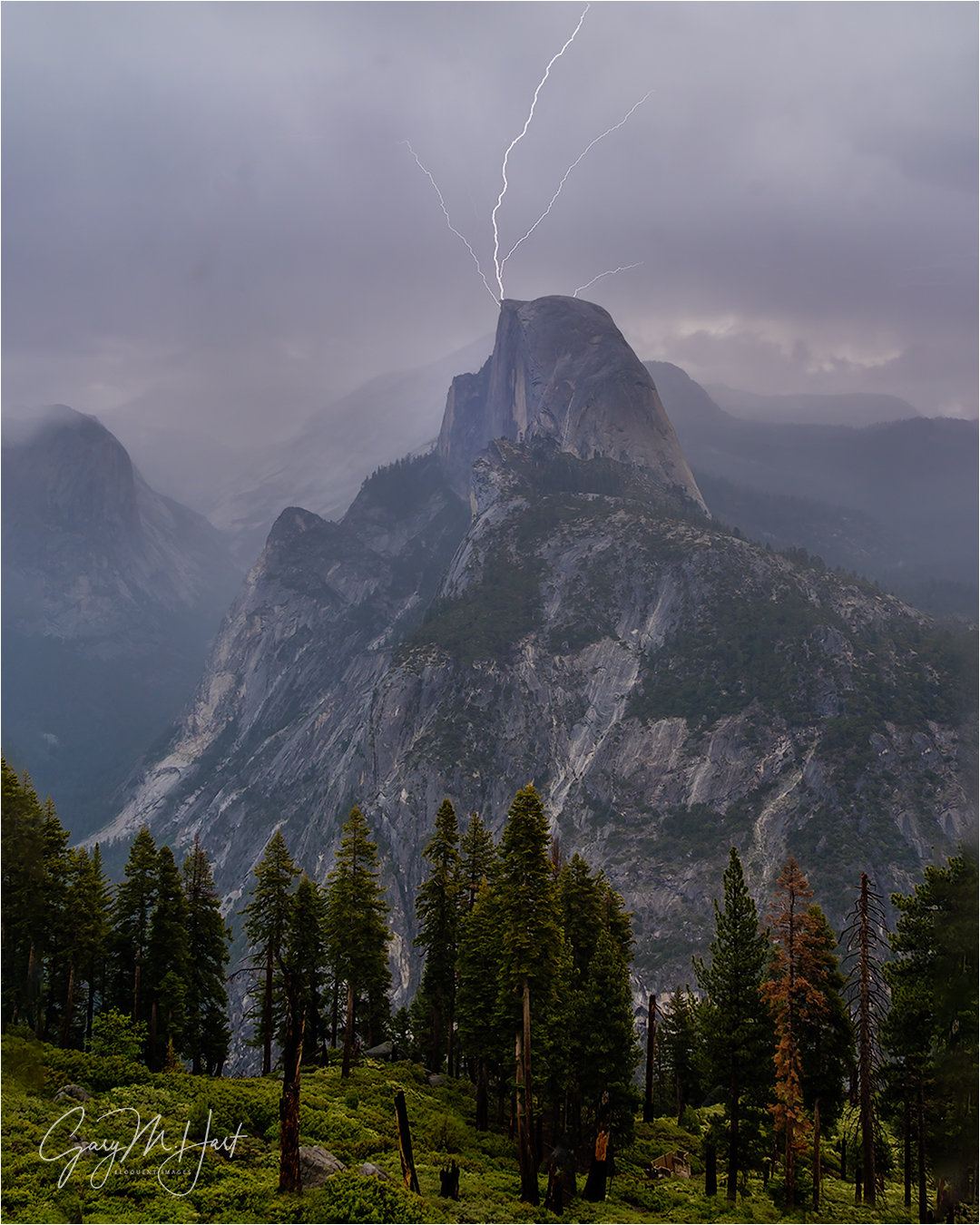
Direct Hit, Half Dome Lightning Strike, Yosemite
Saturday morning my brother Jay and I left Sacramento a little after 8 a.m., and were pulling into Yosemite Valley before noon. Blue sky prevailed upon our arrival, but by the time we finished our sandwiches at Tunnel View, cumulus puffs were sprouting along the crest, a very good sign. Stomachs full, we continued up the road toward Glacier Point. In the forty or so minutes it took to reach Washburn Point, just up the road from Glacier Point, the cumulus puffs had congealed into roiling gray mass that was already delivering coin-size raindrops to my windshield.
The best way to photograph lightning is from a distance (the greater the better), not impossible at the Grand Canyon, where I can stand on one rim and photograph strikes pounding the opposite rim a dozen or more miles away. But my Yosemite lightning target is more specific: Half Dome, which towers above Yosemite Valley like a granite lightning rod, no more than 2 1/2 miles from any vantage point on the Glacier Point road—well within the Margin of Death of even a moderate thunderstorm. (The Margin of Death, or MOD, is my term for the radius surrounding the last lighting strike within which the next bolt could strike.)
In addition to the dramatic profile of Half Dome above Vernal and Nevada Falls, Washburn Point has the advantage of nearby, elevated parking lot that would allow us to set up a Lightning-Trigger-armed camera on a tripod and wait from the safety of the car with a view of the cameras. So, rather than risk trying the more exposed and more remote (much longer sprint to the car) Glacier Point vistas, we started at Washburn Point.
Setting up, we saw lightning firing on the most distant peaks beyond Cloud’s Rest, and safely behind Half Dome. This being my first real attempt with the Lightning Trigger on my Sony bodies (with the exception of one rushed, impromptu, and unexpectedly successful attempt at White Sands last week), I was looking forward to comparing the response of the Sony bodies to my Canon 5D Mark III (shutter lag is a major body-to-body variable that can make or break a lightning shoot). But since Jay didn’t have a Lightning Trigger, and his body is an older Canon 5DII, good brother that I am (plus, he threatened to tell Mom if I didn’t share), I let him use my Lightning Trigger (I have two) and 5DIII.
Soon the rain and wind intensified, the flashes came more frequently, and the thunder grew louder, but rather than retreat to safety, we stayed with our cameras. The activity continued to approach until it seemed to be centered just down the hill in the general direction of Glacier Point, visible to us not as discrete bolts but rather as general flashes in the clouds. Still, we knew the lightning was close because of the relatively short gap separating flash and bang, yet it wasn’t until Jay said he felt the hair standing up on his head and arms that we got smart. Or rather, less stupid.
Back in the car we watched the show at Washburn Point until it abated, then decided to move down the road a bit, to another view closer to Glacier Point. Here we couldn’t see our cameras from the car, but we were able to park within 50 feet or so of their vantage point. Despite the continued dangerously close proximity of the lightning, we again stayed out a little longer than we should have, finally being driven back to shelter not by lightning but by the wet and cold conditions.
This was my first attempt at lightning since my switch to Sony; I was using the a7S because the a7R wasn’t fast enough for lightning (a problem completely cured on the a7RII). The a7S caught all three of the Half Dome hits I saw, with the multi-branched bolts you see here being the most spectacular. My composition was fairly wide for a couple of reasons: first, because the wider I go, the greater my odds of capturing something; second, with Nevada and Vernal Falls on the right, and Tenaya Canyon and Mt. Watkins on the left, the scene justified it.
To say I was lucky this afternoon would be an understatement. Not only did a lightning bolt hit my intended target, my camera captured it (never a sure thing, no matter how fast the camera), and I actually lived to share the shot with you. Here in the comfort of my recliner, I’m kind of at a loss to explain why I thought it was a good idea to stay out with lightning landing well within the MOD. While there are definitely things to tend to while waiting for lightning—shielding the camera from rain, wiping raindrops from the lens, adjusting exposure as the light changes, monitoring that the camera does indeed fire with a visible strike, and simply answering questions from curious onlookers (and preempting their urge to touch the equipment)—none is important enough to risk my life. In my defense, I am much more cautious when I’m guiding a group, which of course will be small consolation to my wife and kids at my funeral.
Photographing daylight lightning
Here are my tips for photographing daylight lightning:
- You need a lightning sensor that detects the lightning and fires your shutter much faster than your reflexes can react. The only sensor that I’ve found to work reliably is the Lightning Trigger by Stepping Stone Products (I get no kickback, I swear). Of course have brands many to choose from, some much cheaper than the Lightning Trigger. While I have no direct experience with many of the other sensors, I do lead lightning workshops and have witnessed some major fails by other brands.
- Your camera must be fast, the faster the better. The speed you’re looking for is the time from the shutter-button press until shutter release: shutter lag. Unfortunately, shutter lag is a difficult number to find, and it’s rarely (never?) provided by the manufacturer. The best resource I’ve found is the Performance tab of the Imaging Resource camera reviews. Even they can’t provide a simple value because there are multiple variables, and you can’t simply assume that your camera is automatically working at the fastest. To ensure the fastest shutter lag possible, turn off autofocus (this is important) and shoot in manual exposure (on some cameras this might not make much difference, but there’s no way of knowing for sure so I think it’s best to just turn it off). The pre-focused time (shutter button pressed halfway) is what you’re going for, but some (most?) triggers don’t do this—the Lightning Trigger does.
- The shutter-speed “sweet spot” is 1/8 to 1/4 second, but anywhere between 1/15 and 1/2 second should work pretty well. If you’re too fast, you risk missing some of the secondary strikes that often accompany the initial strike; if you’re too slow, the lighting tends to get washed out. Keeping the shutter open long enough to get into the sweet spot in broad daylight often requires the lowest ISO possible (it helps if your camera goes down to ISO 50), and a polarizer (I use Singh-Ray). A neutral density filter will work too, but make sure you don’t go too slow with the shutter speed or the lightning you capture might faint or not even visible.
- Come with a strategy for keeping you and (especially) your gear dry. I never go out to photograph in the rain without my waterproof gear, which keeps me dry from head-to-toe: rain hat, parka, waterproof over-pants, waterproof shoes—a stylish ensemble that frees my umbrella for my camera. This strategy works great when there’s no lightning, but—well, let’s just say that an umbrella might not be the best choice when lightning’s in the area. When photographing lightning, I use a waterproof rain cover for my camera (which I won’t recommend because it’s a pain and I’m looking for something I like better—stay tuned). And as much as I hate lens hoods (they just get in the way), I have to admit that they can help keep raindrops off your front lens element. I also make sure to carry multiple lens cloths in my pockets (because there are too many pockets in photography, so it’s just easier to have a cloth in each pocket than it is to remember which pocket I put it in) and check my front element for raindrops frequently. Also handy is a bath towel to dry all of your equipment before you put it away. A chamois (check your local auto parts store) also works great for this. And a garbage or plastic grocery bag (there’s always one in my camera bag) is great for tossing over your camera any time you’re caught in a sudden downpour.
Some links
- Before attempting to photograph lightning, visit the NOAA lightning safety page
- Read my “Outdoor Photographer” article on Grand Canyon monsoon photography (lots of lightning tips)
- Photo Tip: Lightning Photography
- Sign up for a Grand Canyon monsoon photo workshop, where Don Smith and I do our best to get you lightning captures in one of the most beautiful places on Earth (unfortunately, Yosemite doesn’t offer the frequency of thunderstorms necessary to support a lightning workshop)
Upcoming workshops
A stormy weather gallery
Click an image for a closer look, and a slide show. Refresh the screen to reorder the display.


Light fantastic: A photographer’s guide to our most essential subject
Posted on May 27, 2015
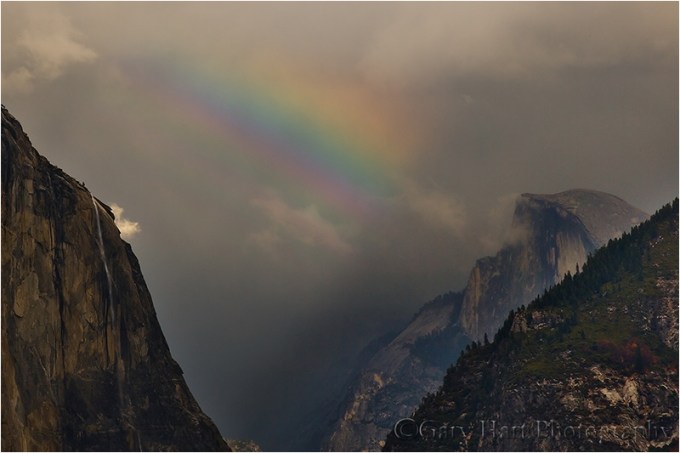
Half Dome and Rainbow, Yosemite (October 2007)
Canon EOS-1Ds Mark II
168 mm
1/40 seconds
F/11
ISO 100
Photograph: “Photo” comes from phos, the Greek word for light; “graph” is from graphos, the Greek word for write. And that’s pretty much what photographers do: Write with light.
Good light, bad light
Because we have no control over the sun, nature photographers spend a lot of time hoping for “good” light and cursing “bad” light (despite the fact that there is no universal definition of “good” and “bad” light). Before embracing someone else’s good/bad light labels, let me offer that I (and most other professional photographers) could probably show you an image that defies any label you’ve heard. The best definition of good light is light that allows us to do what we want to do; bad light is light that prevents us from doing what we want to do.
Studio photographers’ complete control of the light that illuminates (an art in itself) their subjects allows them to create their own “good” light. Nature photographers, on the other hand, rely on sunlight and don’t have that luxury. But knowledge is power: The better we understand light—what it is, what it does, and why it does it—the better we can anticipate the light we seek, and deal with the light we encounter.
The qualities of light

Focused Beam, Upper Antelope Canyon, Arizona
Energy generated by the sun bathes Earth in continuous electromagnetic radiation, its wavelengths ranging from extremely short to extremely long (how’s that for specific?). Among the broad spectrum of electromagnetic solar energy we receive are ultraviolet rays that burn our skin (10-400 nanometers), infrared waves that warm our atmosphere (700 nanometers to 1 millimeter), and the visible spectrum—the very narrow range of wavelengths between ultraviolet and infrared that the human eye sees, in the wavelength range between 400 and 700 nanometers.
When all visible wavelengths are present, we perceive the light as white (colorless). But when light interacts with an object, the object reflects, absorbs, and scatters the light’s wavelengths. When light strikes an opaque (solid) object such as a tree or rock, characteristics of the object determine which of its wavelengths are absorbed; the wavelengths not absorbed are scattered. Our eyes capture this scattered light, send the information to our brains, which translates it into a color.
When light strikes water, some is absorbed and scattered by the surface, enabling us to see the water; some light passes through the water’s surface, enabling us to see what’s in the water; and some light bounces off the surface, enabling us to see reflections.
Let’s get specific
Rainbows
For evidence of light’s colors, look no farther than the rainbow. When light enters a raindrop (or any other drop of water), characteristics of the water cause the light to bend slightly. Because different wavelengths bend different amounts, a single beam of white light is separated into its component colors as it passes through the raindrop. When the separated light strikes the back of the raindrop, it reflects, with different wavelengths (colors) returning at slightly different angles: a rainbow!
Double Rainbow, Yosemite Valley
Canon EOS-1Ds Mark III
1/5 second
F/16.0
ISO 100
38 mm
Blue sky

Poppy Hillside, California Gold Country
White sunlight reaches Earth, the relatively small nitrogen and oxygen molecules that are most prevalent in our atmosphere scatter the shorter wavelengths (violet and blue) first, turning the sky blue. The longer wavelengths (orange and red) continue on to color the sunset sky of someone farther away.
The more direct the sunlight’s path to our eyes (the less atmosphere it passes through), the less chance the longer wavelengths have to scatter and the more pure the blue wavelengths. So when the sun is high in our sky, its light takes the most direct path through the atmosphere and our sky is most blue (all other things equal). In the mountains sunlight has passed through even less atmosphere and the sky appears even more blue than it does at sea level.
On the other hand, when relatively large pollution and dust molecules are present, all the wavelengths (colors) scatter, resulting in a murky, less colorful sky (picture what happens when your toddler mixes all the paints in her watercolor set).
Most photographers (myself included) find homogeneous blue sky boring. Additionally, when the sun is overhead, bright highlights and deep shadows create contrast that cameras struggle to handle.
Sunrise, sunset

Half Dome and Trees at Sunset, Sentinel Dome, Yosemite
Remember the blue light that scattered to color our midday sky? The longer orange and red wavelengths that didn’t scatter overhead, continued on. As the Earth rotates, eventually our location reaches the point where the sun is low and the sunlight that reaches us has had to fight its way through so much atmosphere that it’s been stripped of all blueness, leaving only its longest wavelengths to paint our sunrise/sunset sky shades of orange and red.
When I evaluate a scene for sunrise/sunset color potential, I look for an opening on the horizon for the sunlight to pass through, pristine air (such as the clean air immediately after a rain) that won’t muddy the color, and clouds overhead and opposite the sun, to catch the color.
Overcast and shade
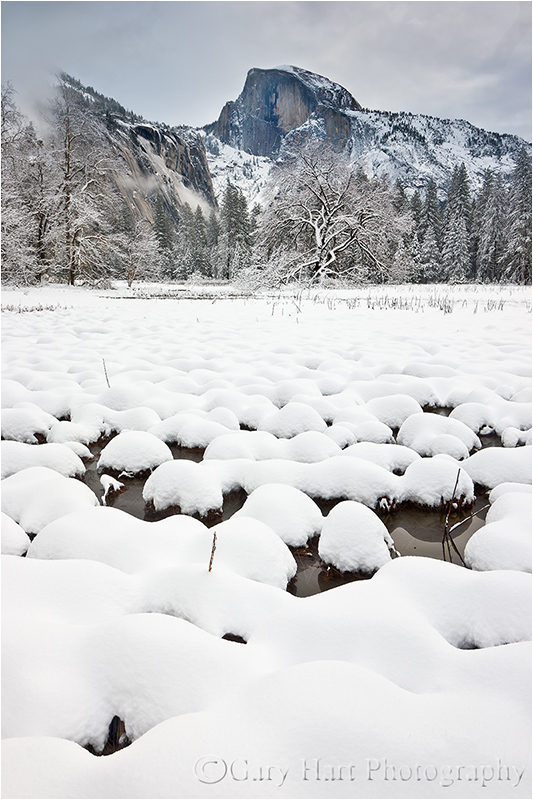
Fresh Snow, Cook’s Meadow, Yosemite
Sunny days are generally no fun for nature photographers. In full sunlight, direct light mixed with dark shadows often force nature photographers to choose between exposing for the highlights or the shadows (or to resort to multi-image blending). So when the sun is high, I hope for clouds or look for shade.
Clouds diffuse the omni-directional sunlight—instead of originating from a single point, overcast light is spread evenly across the sky, filling shadows and painting the entire landscape in diffuse light. Similarly, whether caused by a single tree or a towering mountain, all shadow light is indirect. While the entire scene may be darker, the contrast range in shadow is easily handled by a camera.
Flat gray sky or deep shade may appear dull and boring, but it’s usually the best light for midday photography. When skies are overcast, I can photograph all day—rather than seeking sweeping landscapes, in this light I tend to look for more intimate scenes that don’t include the sky. And when the midday sun shines bright, I try to find subjects in full shade. Overcast and shade is also the best light for blurring water.
Leveraging light
Whether I’m traveling to a photo shoot, or looking for something near home, my decisions are always based on getting myself there when the conditions are best. For example, in Yosemite I generally prefer sunset because that’s when Yosemite Valley’s most photogenic features get late, warm light; Mt. Whitney, on the other side of the Sierra, gets its best light at sunrise; and I’ll only the lush redwood forests along the California coast in rain or fog.
Though I plan obsessively to get myself in the right place at the right time, sometimes Nature throws a curve, just to remind me (it seems) not to get so locked in on my subject and the general tendencies of its light that I fail to recognize the best light at that moment. If I drive to Yosemite for sunset light on Half Dome and am met with thick overcast, I don’t insist on photographing Half Dome. Instead, I detour some of my favorite deep forest spots, like Fern Spring or Bridalveil Creek.
Other times finding the best light is simply a matter of turning around and looking the other direction. Mono Lake is one of those places that reminds me to keep my head on a constant swivel, or risk getting so caught up on the sunrise in front of me that I miss the rainbow behind me.
About this image

Half Dome and Rainbow, Yosemite
On a rainy October afternoon in Yosemite, I did what I often do on rainy afternoons in Yosemite: hang out at Tunnel View, waiting (hoping) for the storm to clear. I’d circled Yosemite Valley in my car several times, but the clouds had dropped well below rim-level and obscured all of Yosemite’s recognizable features.
Yosemite’s clearing usually starts at Tunnel View, and when it happens in the afternoon, a rainbow is possible. But with sunset approaching and the rain showing no sign of relenting, I was losing hope. Anxious for something to do besides wiping the fog from my windshield and listing to rain pelt my roof, I decided to drive through the tunnel for a view to the west (toward the source of any clearing). Seeing nothing promising on the other side, I flipped a quick u-turn and headed back.
The roundtrip was less than five minutes, but I exited the tunnel to see that Half Dome had emerged from the gray muck sporting a vivid rainbow. I screeched to a stop and bolted from the car, changing lenses and wresting my tripod all the way to the vista. I got off just two frames before the light was snuffed, ending up with this image and a valuable lesson: You can’t predict what Yosemite’s weather will be in five minutes based on its weather right now.
(BTW, see that little white cascade trickling down El Capitan’s flank? That’s Horsetail Fall.)
Workshop schedule
Celebrating light
Click an image for a closer look, and a slide show. Refresh the screen to reorder the display.


Nature’s surprises
Posted on April 25, 2015

Emergence, Half Dome from Olmsted Point, Yosemite
Canon EOS-1Ds Mark III
159 mm
3.2 seconds
F/16
ISO 400
October, 2010
One of the things I enjoy most about landscape photography is the element of surprise, the anticipation that comes with never quite knowing what’s going to happen when I go out with my camera. I usually start with a plan, and while there are times I get exactly what I hoped for, many times I don’t. But it’s the times I witness something I never imagined possible that excite me the most.
On the final night of my Eastern Sierra workshops I like to take my groups to Olmsted Point in Yosemite. The Olmsted trip is a particular treat because it presents a view of Half Dome’s less photographed east flank, behind a photogenic foreground of trees, boulders, and glaciated granite. (Another highlight of the Olmsted shoot is the opportunity to photograph Yosemite’s Tuolumne Meadows, the best experience of the High Sierra’s raw granite topography possible without a backpack.) But in 2010, after four days of spectacular photography, my workshop group’s Olmsted finale was jeopardized by an early snowstorm that closed Tioga Pass, the only route into Yosemite from our current base in Lee Vining. Disappointment would have been difficult given all we’d seen so far, but I nevertheless had already planned an alternate sunset location when I got word that Tioga had just reopened. I quickly returned to Plan A.
As we ascended Tioga Pass, the storm’s vestiges darkened the sky and sprinkled our windshield and I wondered about another pass closure trapping us on the wrong side of the pass, suddenly six circuitous hours from our hotel. But the ranger at the entrance station assured me we’d be okay, so we continued on to Olmsted Point, stopping on the way to photograph at a couple of my favorite Tuolumne Meadows locations.
Arriving about an hour before sunset, we found Olmsted Point completely enshrouded by clouds that obscured everything beyond 100 yards. Not quite what I’d envisioned, but the group had lots of fun exploring the nearby granite and creating compositions featuring large boulders (glacial “erratics,” deposited by retreating glaciers) and gnarled trees amidst the dense fog. As sunset approached I kept an anxious eye on the sky hoping for a break, wavering between cautiously optimistic and hopelessly resigned. Nevertheless, I reassured the group (and myself) with one of my favorite Yosemite axioms: It’s impossible to predict what Yosemite will be like in five minutes based on what it’s like right now.
Shortly before “official” sunset (when the sun reaches the horizon on a flat, terrain-free Earth), the sky lightened noticeably. Hmmm. Soon the persistent fog still engulfing us started to glow, first amber and then pink and we quickly realized we were actually in the midst of clouds alive with the sunset color we’d all our lives only seen in the distance. This was both eerie and spectacular and everyone scrambled frantically looking for subjects, trying to photograph a moment that defies photography. Within five minutes the color was gone, leaving us all breathlessly grateful to have witnessed it with others who could validate what we’d just experienced.
With night falling fast and the visibility still measured in yards, it would have been easy to pack up and revel in our success over dinner. But when the clouds in the direction of Half Dome showed signs of thinning, we greedily decided to stay put in the hope that Mother Nature had an encore for us. Just a couple of minutes later the clouds on the western horizon lifted, revealing Half Dome’s granite face against sunset’s orange afterglow.
Everything after that was a blur of churning clouds, exposed granite, and deepening color as Yosemite’s most distinctive monolith emerged from its shroud. We were all positioned in close enough proximity that I could hear everyone’s amazed gasps punctuated by rapid shutter clicks. Confident that everyone else was content to be left alone, I went to work, frantically zooming wider and tighter, changing orientation, and swapping lenses, all in a futile attempt to capture every single compositional possibility before the darkness was complete.
The entire scene, from Cloud’s Rest on the left to Mt. Watkins on the right, swirled with clouds, with Half Dome at the vortex. In this frame I opted for a tight composition to emphasize the churn of clouds surrounding Half Dome. I exposed to hold the color in the sky and timed the exposure to silhouette the trees against an ephemeral finger of clouds rising from Tenaya Canyon. (I’d love to tell you my f-stop was a conscious choice, but if I hadn’t been rushed I’d have been at f11 rather than the f16 left over from a couple minutes earlier when I was trying to include a foreground.)
In addition to some amazing images, my group finished that evening with a first-hand understanding of how long after sunset the shooting can be good. And a good lesson on the rewards of patience. The great stuff doesn’t always happen, and I’ve had many a shoot where I waited in vain long after everyone else had packed up and retreat to comfort and warmth, but whenever I’m tempted to leave just because it would be more comfortable than staying, I remember this night and hang in just a little longer.
Our final clicks that night were thirty second exposures that included stars, late enough that flashlights were necessary to make our way back to the cars. Dinner was really good.
A gallery of unexpected magic
Click an image for a closer look, and a slide show. Refresh the screen to reorder the display.


Exploring the familiar
Posted on April 17, 2015

Snow on Old Tree, Half Dome and Bridalveil Fall, Yosemite
Sony a7R
Sony/Zeiss 24-70
1/30 second
F/16
ISO 100
I spend a lot of time guiding and teaching photographers who have traveled a great distance to capture a particular shot: Horsetail Fall in February, the spring moonbow on Yosemite Fall, the Milky Way above the Kilauea Caldera, to name a few. They’ve seen an image on my website, or someone else’s, and have decided want to add their version to their portfolio. Many have saved money and vacation time for years for the opportunity; others have been chasing the shot without success more times than they can count. Either way, it’s a vicarious rush watching it happen for them.
The captures that make me happiest are the one’s I’ve never seen before. But given that my “job” is guiding people to the scenes I (and others) have photographed many times, I don’t get a lot of opportunity to explore new territory. Instead, I challenge myself to find something new in these heavily photographed areas. And “new” to me is more than just capturing an extraordinary sunset or glorious moonrise, it’s looking beyond the obvious to find a new perspective or fresh interpretation.
Finding new scenes can happen by accident, but there’s no substitute for conscious, calculated exploration. For example, a typical day in Yosemite has lots of blue sky and flat light hours that aren’t conducive to the type of photography I enjoy. Rather than waste that lousy light time simply waiting for the good stuff, I spend it collecting new scenes for later use. In Yosemite that usually means deciding on a subject (Half Dome, El Capitan, Yosemite Falls, Bridalveil Fall, and so on) and poking around looking for foregrounds to put with it.
Despite its apparent permanence, Yosemite is a dynamic environment. Rocks cleave and fall, trees grow and die, water ebbs and flows. Whether it’s walking the bank of the Merced River searching for a reflection of Half Dome, or scrambling granite slopes for a fresh view of Yosemite Valley, there are new perspectives and subjects to be mined everywhere.
When I find something I like, I try to figure out the conditions that would make the best photography. Sometimes this is simply a matter of plotting a moonrise or moonset; other times the best photography requires very specific weather or light. Whatever the condition might be, I do my best to get myself there to photograph it.
Though I photographed this scene just a couple of weeks ago, the view I found on one of these reconnaissance missions several years ago. The first time I saw the twisted remains of this old tree, I imagined it etched with snow. Unfortunately the tree’s location—perched on a ledge above a vertical drop of several hundred feet, is not for the faint of heart, even in the most benign conditions. And getting out here in snow can be downright dangerous.
On my most recent Yosemite trip earlier this month (sandwiched between my Yosemite moonbow workshop and a week-and-half in the Columbia River Gorge), my desire for something new trumped my “respect” for heights. I took a long way around to avoid the cliff as much as possible, then did my best not to look down once I arrived. As I worked, every shift of foot or tripod was planned and tested before execution.
I tried a variety of compositions, wide and tight, vertical and horizontal, that included some or all of the Tunnel View trio: El Capitan, Half Dome, and Bridalveil Fall. Exposure was pretty straightforward, but depth of field was a concern. I stopped down to f16, but chose not to go any smaller due to diffraction (light bending around small apertures to fill the entire sensor can inhibit resolution) concerns. As always in these scenes where I might not be able to achieve complete front-to-back sharpness, I biased my sharpness to my foreground—rather than focusing on Half Dome, I focused on a branch toward the back of the tree.
I actually returned to this scene the next morning, when the snow was much thicker and the light much more difficult. I haven’t had a chance to work with those images, so stay tuned….
A Gallery of the Shot Less Taken
Click an image for a closer look, and a slide show. Refresh the screen to reorder the display.


Half Dome moonrise
Posted on April 4, 2015
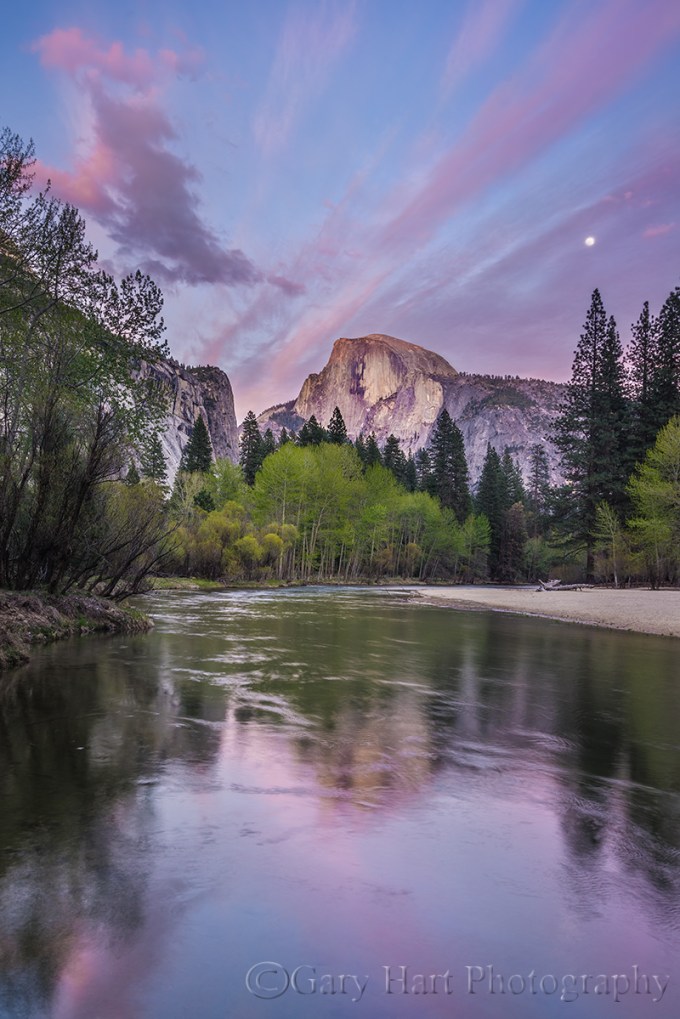
Spring Moon, Half Dome, Yosemite
Sony a7R
Sony/Zeiss 16-35
1.3 seconds
F/11
ISO 80
Last week I was in Arizona (Grand Canyon, Page, Sedona); next week it’ll be Oregon (Columbia River Gorge). But this week my focus is little closer to home, as I enjoy the familiar confines of Yosemite Valley.
The big news here is the water, or rather, the lack thereof. In a lifetime of visits to Yosemite, I’ve never seen the water lower in spring than it is this week, not even close. Most years, the water in Yosemite’s falls peaks in May; this year the flow peaked in February. On my visit to the bridge beneath Lower Yosemite Fall, always a guaranteed drenching in spring, I didn’t feel a single drop. The reflective vernal pool in Cooks meadow is a dirt hole, and the Merced River, which normally roars through Yosemite Valley in spring, is drifting near its leisurely autumn pace.
While these dry conditions might force Yosemite photographers to alter some plans, there is a silver lining to this week’s metaphorical cloud. Thursday night my Yosemite Moonbow and Dogwood workshop group was able to photograph sunset from Glacier Point, which opened last week, the earliest opening on record. And Friday morning we photographed dogwood blooms that already starting to pop out everywhere, a month early.
A particular highlight came Wednesday night. I’d taken my group to a favorite location beside the Merced River, a location I visit so frequently that I usually leave my camera in the car here. But this night, with spring-green cottonwoods framing the upstream riverbank and mix of clouds, sky, and sunlight above Half Dome, it was clear that the conditions were primed for something special. My ace in the hole was the nearly full moon, obscured by clouds when we arrived, that emerged right on cue, just as the sunset pink sky reflected in the Merced River, to provide a perfect accent to an already beautiful scene.
The operative word is accent. As I explained to my group, the moon doesn’t need to be large to be effective. Glowing disk or thin crescent, the moon carries so much emotional weight that, over the right scene and properly placed in the frame, it creates a simple accent that turns a conventionally beautiful scene into something special.
Yosemite, with its host of east-facing vistas, is my favorite spot to photograph a moonrise. Whether it’s a full moon at sunset, or a crescent at sunrise, I do my best to find the Yosemite view that best aligns with the rising moon, scheduling as many workshops and personal visits to coincide with this marvel. When possible the view I choose includes Half Dome, Yosemite’s monolithic centerpiece.
When I can position myself at one of Yosemite’s more distant western vistas, on the opposite side of Yosemite Valley from Half Dome (such as Tunnel View), I have the option of using a telephoto lens to isolate Half Dome in the frame with a magnified moon. When the moon rises too early at one of these distant vantage points, I set up on the east side of Yosemite Valley and closer to Half Dome (raising the horizon so the moon appears later), usually near the Merced River, and use a wide lens that includes the entire scene that uses the moon as an accent.
Of course you don’t need to travel to Yosemite to include the moon in your images. With a little bit of homework, you can find a rising moon in any east-facing scene, or a setting moon in any west-facing scene. To read more about photographing the moon, read the Full Moon and Crescent Moon Photo Tips articles.
Photo workshop schedule
A Half Dome Moonrise Gallery
Click an image for a closer look, and a slide show. Refresh the screen to reorder the display.


The shot less taken
Posted on January 5, 2015
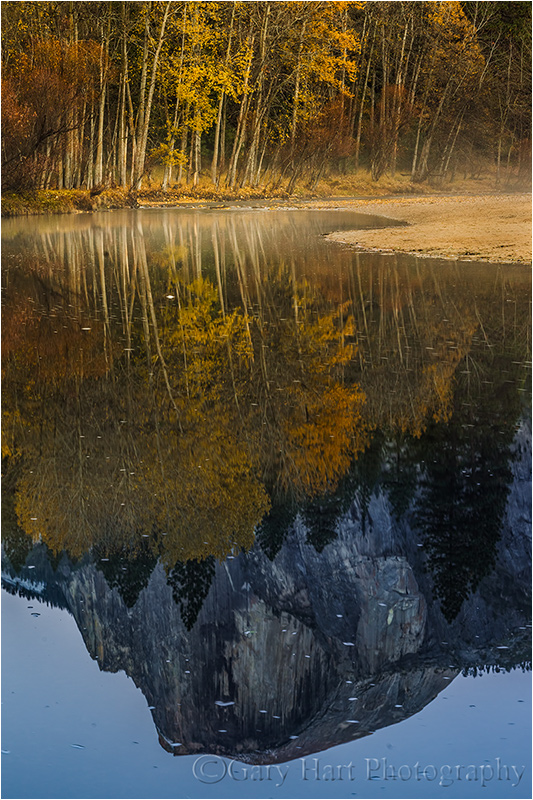
Autumn Reflection, Half Dome, Yosemite
Sony a7R
Sony/Zeiss 24-70
2 seconds
F/16
ISO 200
I’ve never been much of a New Year’s resolution person, but the start of a new year is an opportunity to take stock and regroup. This year I’ve been thinking about the proliferation of derivative images online and in magazines, images that are, no matter how beautiful, simply reproductions of thousands of previous image. Photographers see something they like and go out try to get it themselves.
I understand the urge to impress rather than create (for starters, it’s easier), and confess that I catch myself doing it too. As with pop music and formula fiction, the images that seem to sell best (not to mention garner the most Facebook Likes and “Stunning!” comments), are often facsimiles of preceding material. So photographers who make a living with their images are forced to subvert their creative instincts in favor of putting food on the table; and photographers who do it for pleasure are lured by the attention a well-executed duplicate generates.
The problem is compounded for workshop leaders, who are paid to guide their customers to the iconic spots (why do you think you see so many Yosemite Tunnel View images in my gallery?). My solution is to follow the advice I give my workshop students: Rather than make the “classic” Tunnel View clearing storm or molten Horsetail Fall image your goal, make that image the starting point, before moving on to less conventional ways to capture the scene.
Of course spending lots of time at iconic locations, in the best conditions (or simply getting out anywhere in good conditions), leaves me with a ton of really nice but less creative captures. I share them occasionally, but for the most part I opt for quality over quantity, and usually try to share only the images that stimulated my creative juices. (Another way of putting this would be that I choose to share images that make me happy, rather than images I think will make you happy—sorry.)
Which brings me to the Half Dome reflection image at the top of this post. The first instinct for most at this bend in the Merced River is to capture the wider scene (below), which I certainly did. But most of my clicks this evening were zoomed closer, concentrating on compositions that emphasize the reflection.
I won’t pretend that I’m the first to photograph this scene this way—I share it here to illustrate the way I try to distill a scene to its most essential components. I was leading a group this evening and didn’t take a lot of pictures, but if I’d been by myself I’d have zoomed even tighter on the tree reflection, and certainly would have played with long exposures that would have turned the drifting foam into parallel white streaks.
Even if finding the unique view is already part of your capture paradigm, challenge yourself to do it more. And because it’s only fair to hold myself to the same standard I ask of others, I’m also challenging myself to create more and settle less—it will be my mantra for 2015.

Autumn Twilight, Half Dome and the Merced River, Yosemite
This is a more conventional composition from this location. I captured it about ten minutes after the isolated reflection image above, for no other reason than I thought the twilight tones were pretty (knowing full well I’d probably not do anything with it). And that’s okay too. In fact, if it’s your first visit to a spot, starting with the conventional compositions is more than okay, is a great warm-up to familiarize yourself with the scene.
Photo Workshop Schedule
A gallery of alternate views
Click an image for a closer look, and a slide show. Refresh your screen to reorder the display.


Looking back, looking forward
Posted on December 29, 2014
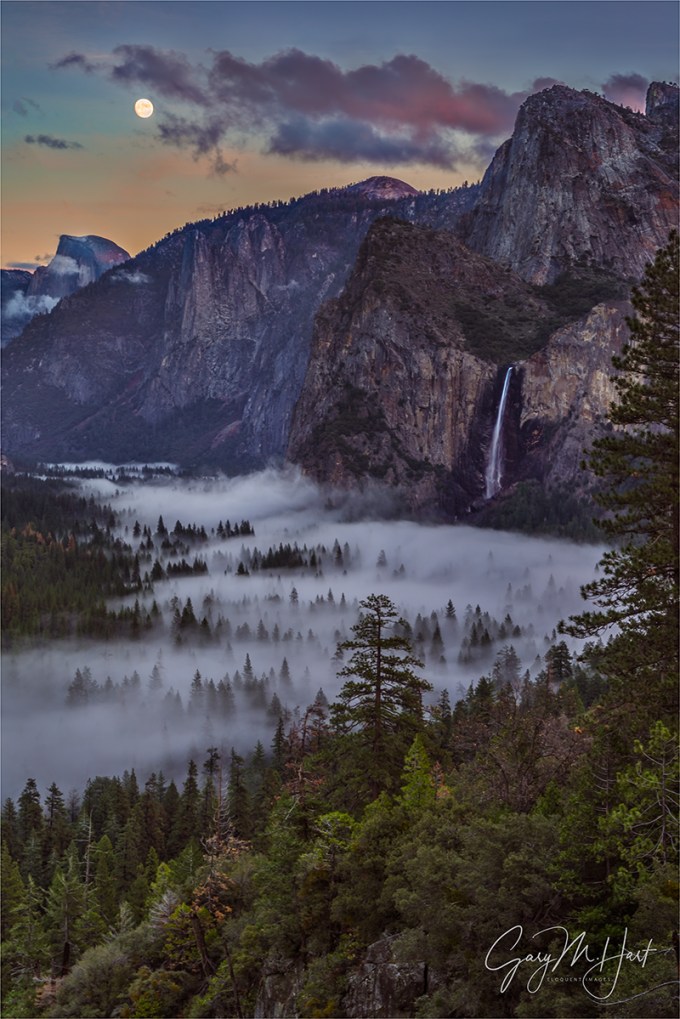
For the final shoot of my final 2014 workshop, I guided my group up the rain-slick granite behind Yosemite’s Tunnel View for a slightly different perspective than they’d seen earlier in the workshop. I warned everyone that slippery rock and the steepness of the slope could make the footing treacherous (and offered a safer alternative), but promised the view would be worth it. Then I crossed my fingers.
While sunset at Tunnel View is often special, the rare sunset event I’d been pointing to for over a year, a nearly full (96%) moon rising into the twilight hues above Half Dome, is a particular highlight, one of my favorite things in the world to witness. But after an autumn dominated by clear skies that would have been perfect for our moonrise, a much needed storm landed just as our workshop started, engulfing Yosemite Valley in dense clouds, recharging the waterfalls, and painting the surrounding peaks white. Rain clouds make great photography, but they’re not so great for viewing the moon.
As you can see from this image, the clouds this evening cooperated, glazing the valley floor, but parting above Half Dome enough to reveal the moon. The moon was already high above Half Dome when it peeked out, and shortly thereafter the retreating storm’s vestiges were fringed with sunset pink. As I often do at these moments, I encouraged everyone to forget their cameras for a minute and just appreciate that they may be viewing the most beautiful thing happening on Earth at this moment. Together we enjoyed what was a once-in-a-lifetime moment for them, and a fitting conclusion to another wonderful year of photography for me.
Like any other photographer who makes an effort to get out in difficult, unpredictable conditions, I had many of these “most beautiful thing on Earth” moments in 2014—they’re what keep me going. The last couple of weeks I’ve been browsing my 2014 captures and re-appreciating my blessings. Among other things, in 2014 I rafted the Colorado River through the Grand Canyon, was humbled by the Milky Way’s glow above the Kilauea Caldera, shivered beneath starlit bristlecone pines, and was electrified by the Grand Canyon monsoon’s pyrotechnics.
Most of my trips start with a plan, and while a lot of my 2o14 experiences followed the script, many deviated from my expectations, often in wonderful ways. My original vision of the moonrise on this December evening was clear skies that would allow the moon to shine; an alternate vision was a sky-obscuring storm that provided photogenic clouds. We ended up with the best of both, a hybrid of clouds and sky that I dared not hope for.
While I have a general plan in place for 2015, some places I’ll be returning to, others I’ll photograph for the first time, I know from experience that my plans won’t always go as planned. Clouds will hide the moon and stars, clear skies will cast harsh light, rivers will flood, waterfalls will wither, rivers will flood. But I also know that many of those thwarted plans will lead to unexpected rewards like this.
Here’s to a great 2015!
2014 in Review
Click an image for a closer look, and a slide show. Refresh your screen to reorder the display.


Revisiting Photography’s 3 P’s
Posted on December 15, 2014

Parting the Clouds, Yosemite Valley Moonrise, Tunnel View
Sony a7R
72 mm
1/15 second
F/11
ISO 100
Let’s review
I often speak and write about “The 3 P’s of nature photography,” sacrifices a nature photographer must make to consistently create successful images.
- Preparation is your foundation, the research you do that gets you in the right place at the right time, and the vision and mastery of your camera that allows you to wring the most from the moment.
- Persistence is patience with a dash of stubbornness. It’s what keeps you going back when the first, second, or hundredth attempt has been thwarted by unexpected light, weather, or a host of other frustrations, and keeps you out there long after any sane person would have given up.
- Pain is the willingness to suffer for your craft. I’m not suggesting that you risk your life for the sake of a coveted capture, but you do need to be able to ignore the tug of a warm fire, full stomach, sound sleep, and dry clothes, because the unfortunate truth is that the best photographs almost always seem to happen when most of the world would rather be inside.
Picking an image and trying to assign one or more of the 3 P’s to it is a fun little exercise I sometimes use to remind myself to keep doing the extra work. Take a few minutes to scan your favorite captures; ask yourself how many didn’t require at least one of the 3 P’s. (I’ll wait.) …….. See what I mean?
So which of my 3 P’s do I credit for this one? Well, there was the Persistence to continue going out in the rain all week, with no guarantee we’d see anything beyond 100 yards (because in Yosemite, if you stay inside until the rain stops, you’re too late). And of course photographing in the rain is nothing if not a Pain. But more than anything else, this one was about…
Preparation
(If you discount the unavoidable knowledge gained by a lifetime of Yosemite visits and and decades of plain old picture clicking) the preparation for this image started when I plotted the 2014 December moon and determined that it would rise at sunset, nearly full, above Half Dome in the month’s first week. So of course I scheduled a workshop for that week.
But there was more to the preparation than just figuring out where the moon would be. Of course as the workshop approached, I monitored the weather forecast and arrived in Yosemite prepared for rain. (Duh.) And throughout the workshop I monitored the weather obsessively, scouring each National Weather Service forecast update (every six hours), monitoring radar, not to mention the good old fashioned walk-outside-and-look-up technique.
Before going out for our penultimate afternoon shoot, I determined exactly what time the moon would appear above Half Dome, though I had little hope that the clouds would part enough to reveal it. Nevertheless, I wanted to to keep the group within striking distance of Tunnel View, just in case. When the latest weather forecast indicated a possible break in the rain late that afternoon, I started watching the sky closely—a clearing storm plus the moon would be pretty cool for everyone (including this life-long Yosemite photographer). The instant the clouds showed a hint of brightening (a subtle precursor to an imminent break that every photographer should be able to read), I raced everyone back up to Tunnel View.
As we pulled into the Tunnel View lot, not only was the storm starting to clear, a small patch of the first blue sky we’d seen in two days was widening above Half Dome. I held my breath and crossed my fingers for the blue to expand just a little more, because I knew exactly where the moon was and it was oh so close.
We didn’t need to wait long—within five minutes a thin piece of moon poked through, then a little more, and soon there it was, floating in that small blue patch between Half Dome and Sentinel Dome. It hung in there for less than five minutes before the clouds regrouped and swallowed the sky.
Epilogue
With more rain in the forecast, driving down from Tunnel View that night I felt certain that this unexpected, brief convergence of moon and sky was a one-time gift, that the planned moonrise for our final sunset would surely be lost to the clouds. And given what we’d just seen, I was okay with that. But Nature had a different idea….
A Gallery of Extreme Weather Rewards
Click any image to scroll through the gallery LARGE


Classic Yosemite
Posted on December 3, 2014

Clearing Storm, Yosemite Valley, Yosemite
Sony a7R
33 mm
1.6 seconds
F/11
ISO 125
December 3, 2014: A brief post to share my workshop group’s good fortune this morning
I’m in Yosemite this week for my Winter Moon photo workshop. Scheduling a December workshop in Yosemite is one of those high risk/reward propositions—I know full well we could get some serious weather that could make things quite uncomfortable for photography, but winter (okay, so technically it won’t be winter for another two-a-half weeks, but it’s December for heaven’s sake, so don’t quibble) is also the best time to get the kind of conditions that make Yosemite special. In the days leading up to the workshop I’d warned everyone about the impending weather, but I’d also promised them that they were in store for something special at some point during their visit. Then I crossed my fingers….
We started Monday afternoon to blue skies and dry waterfalls, but by Tuesday morning the first major storm of California’s (usually) wet season rolled in and everything changed (literally overnight). A warm system of tropical origin, what this storm lacked in snow, it more than made up for in rain, copious rain. Starting before sunrise, we got a little shooting in before the serious stuff started, but the rest of the day was wet, wet, wet. When weather settles in like this, the ceiling drops and Yosemite’s granite features disappear behind a dense, gray curtain. Nevertheless, we found some nice photography and everyone finished the day saturated but satisfied.
This morning (Wednesday) I got the group up to Tunnel View for sunrise, where were met with more of the same—opaque clouds and lots of rain, but little else. Since Tunnel View is usually the best place to wait out a Yosemite storm (thanks to the panoramic view, and the fact that the weather almost aways clears on Yosemite Valley’s west side first), I told everyone we’d just sit tight and see what happens. A few huddled in the cars, but most of the group donned our head-to-toe rain gear and stood out in the rain, waiting (hoping) for the show to begin.
As if on cue, at just about the advertised sunrise time (there was no actual sunrise to witness), the sky brightened and the curtain parted: El Capitan was first on stage, followed closely by a rejuvenated Bridalveil Fall, and soon thereafter the star of the show, Half Dome, appeared center-stage. Radiating from the valley floor, a thick fog rolled across the scene like a viscous liquid, changing the view by the minute—for nearly an hour everyone got to experience a classic Yosemite clearing storm.
As many times as I’ve witnessed a clearing storm from Tunnel View, the experience never fails to thrill me. Overlaying one of the most beautiful scenes on Earth, infinite combinations of cloud, sky, color, and light make each one unique. And as if that’s not enough, sometimes fresh snow, a rainbow, or rising moon are added to the mix. On this morning the clearing was only temporary, with no direct light or hint of blue sky, and the rain soon returned. Not that this was a problem—with more weather in store, this morning just turned out to be the opening act.
Check out my schedule of upcoming photo workshops
A Tunnel View Clearing Storm Gallery
Click an image for a closer look, and to enjoy the slide show


