Eloquent Images by Gary Hart
Insight, information, and inspiration for the inquisitive nature photographer
2015 Grand Canyon raft trip: Getting started
Posted on June 3, 2015

Marble Canyon Rapids, Grand Canyon
Sony a7R
Sony/Zeiss 16-35
1/6 second
F/11
ISO 50
Rafting Grand Canyon last year was a bucket list item, a one-time opportunity to do something I’d dreamed about my entire life. I came into that trip with ridiculously high expectations, all of which were exceeded enough that I scheduled another, then waited a year to find out whether the first one was just lightning in a bottle.
After departing our Las Vegas hotel at 4:45 a.m. and flying to a small airstrip near Lee’s Ferry, we met our guides, absorbed a thorough orientation from Wiley, our experienced, knowledgable, talented, hard working lead guide (this would describe all of our guides), and were on the water before 10:00. We were 2 rafts packed with 28 rafters, 4 guides, equipment, camera gear, and food to sustain the entire operation for six days.
Most in the group were first-timers, excited for sure, but also a little anxious about what lay ahead. Fortunately, starting from Lee’s Ferry, the first day on the river is relatively benign, a gentle float that allows neophyte rafters to ease into the experience and get to know each other. Bobbing downstream at a leisurely pace, we were sprinkled by a few riffles (mini-rapids, unworthy of a name), enjoyed a delicious lunch in the shadow of Navajo Bridge, listened to a couple more brief, on-raft orientation talks, before pulling onshore for the day at around 4:00 p.m.
Our first campsite was at Upper North Canyon in the Marble Canyon section of Grand Canyon (yes, that’s a lot of Canyons). We stumbled through our first “fire-line”—the raft trip equivalent of a bucket-brigade (you know, for when you’re barn’s on fire) that unloads pretty much the entire contents of the raft in about 5 minutes. (By the end of the trip we’d become a well oiled, fire line machine.) After claiming a campsite (picture a 19th century style land rush) and setting up my camp (basically picking a campsite, assembling a cot, and tossing out my sleeping bag), I grabbed my camera and went down to the river in search of an image that would do the view justice.
Though our campsite was chosen for its convenience (location, size, topography), its beauty was pretty representative of Grand Canyon’s entire length. Regrettably, pictures and words cannot display the relentless, humbling awe that engulfs all who venture between the Grand Canyon’s vertical walls. But of course that won’t prevent me from trying.
In this scene I was most struck by the color: the white-on-blue sky, red sandstone walls, and deep green of the Colorado River. Bisecting all this color was a set of white, rock-wrapping rapids. I dropped low and compose wide with my 16-35 to emphasize the foreground rocks and rapids; a vertical orientation included the sky and created the sense that the river was flowing into my frame (and eliminated our campsite, which was just out of the frame to the left).
In refreshing contrast to last year’s trip, the clouds cooperated wonderfully, defusing the late afternoon light to subdue the potentially extreme dynamic range. To convey the water’s motion, I experimented with different shutter speeds, ultimately dropping to ISO 50 to maximize the blur.
The clouds gracing this scene were a harbinger of exciting weather ahead. And while that weather made a good deal more discomfort than the previous year’s trip, it also gave us a corresponding increase in the number of photo opportunities. Stay tuned….
Looking up at Grand Canyon
Click an image for a closer look, and a slide show. Refresh the screen to reorder the display.


Light fantastic: A photographer’s guide to our most essential subject
Posted on May 27, 2015
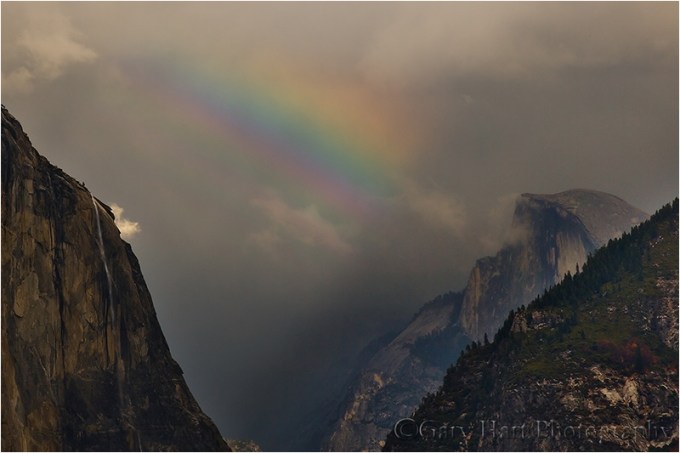
Half Dome and Rainbow, Yosemite (October 2007)
Canon EOS-1Ds Mark II
168 mm
1/40 seconds
F/11
ISO 100
Photograph: “Photo” comes from phos, the Greek word for light; “graph” is from graphos, the Greek word for write. And that’s pretty much what photographers do: Write with light.
Good light, bad light
Because we have no control over the sun, nature photographers spend a lot of time hoping for “good” light and cursing “bad” light (despite the fact that there is no universal definition of “good” and “bad” light). Before embracing someone else’s good/bad light labels, let me offer that I (and most other professional photographers) could probably show you an image that defies any label you’ve heard. The best definition of good light is light that allows us to do what we want to do; bad light is light that prevents us from doing what we want to do.
Studio photographers’ complete control of the light that illuminates (an art in itself) their subjects allows them to create their own “good” light. Nature photographers, on the other hand, rely on sunlight and don’t have that luxury. But knowledge is power: The better we understand light—what it is, what it does, and why it does it—the better we can anticipate the light we seek, and deal with the light we encounter.
The qualities of light

Focused Beam, Upper Antelope Canyon, Arizona
Energy generated by the sun bathes Earth in continuous electromagnetic radiation, its wavelengths ranging from extremely short to extremely long (how’s that for specific?). Among the broad spectrum of electromagnetic solar energy we receive are ultraviolet rays that burn our skin (10-400 nanometers), infrared waves that warm our atmosphere (700 nanometers to 1 millimeter), and the visible spectrum—the very narrow range of wavelengths between ultraviolet and infrared that the human eye sees, in the wavelength range between 400 and 700 nanometers.
When all visible wavelengths are present, we perceive the light as white (colorless). But when light interacts with an object, the object reflects, absorbs, and scatters the light’s wavelengths. When light strikes an opaque (solid) object such as a tree or rock, characteristics of the object determine which of its wavelengths are absorbed; the wavelengths not absorbed are scattered. Our eyes capture this scattered light, send the information to our brains, which translates it into a color.
When light strikes water, some is absorbed and scattered by the surface, enabling us to see the water; some light passes through the water’s surface, enabling us to see what’s in the water; and some light bounces off the surface, enabling us to see reflections.
Let’s get specific
Rainbows
For evidence of light’s colors, look no farther than the rainbow. When light enters a raindrop (or any other drop of water), characteristics of the water cause the light to bend slightly. Because different wavelengths bend different amounts, a single beam of white light is separated into its component colors as it passes through the raindrop. When the separated light strikes the back of the raindrop, it reflects, with different wavelengths (colors) returning at slightly different angles: a rainbow!

Double Rainbow, Yosemite Valley
Canon EOS-1Ds Mark III
1/5 second
F/16.0
ISO 100
38 mm
Blue sky

Poppy Hillside, California Gold Country
White sunlight reaches Earth, the relatively small nitrogen and oxygen molecules that are most prevalent in our atmosphere scatter the shorter wavelengths (violet and blue) first, turning the sky blue. The longer wavelengths (orange and red) continue on to color the sunset sky of someone farther away.
The more direct the sunlight’s path to our eyes (the less atmosphere it passes through), the less chance the longer wavelengths have to scatter and the more pure the blue wavelengths. So when the sun is high in our sky, its light takes the most direct path through the atmosphere and our sky is most blue (all other things equal). In the mountains sunlight has passed through even less atmosphere and the sky appears even more blue than it does at sea level.
On the other hand, when relatively large pollution and dust molecules are present, all the wavelengths (colors) scatter, resulting in a murky, less colorful sky (picture what happens when your toddler mixes all the paints in her watercolor set).
Most photographers (myself included) find homogeneous blue sky boring. Additionally, when the sun is overhead, bright highlights and deep shadows create contrast that cameras struggle to handle.
Sunrise, sunset

Half Dome and Trees at Sunset, Sentinel Dome, Yosemite
Remember the blue light that scattered to color our midday sky? The longer orange and red wavelengths that didn’t scatter overhead, continued on. As the Earth rotates, eventually our location reaches the point where the sun is low and the sunlight that reaches us has had to fight its way through so much atmosphere that it’s been stripped of all blueness, leaving only its longest wavelengths to paint our sunrise/sunset sky shades of orange and red.
When I evaluate a scene for sunrise/sunset color potential, I look for an opening on the horizon for the sunlight to pass through, pristine air (such as the clean air immediately after a rain) that won’t muddy the color, and clouds overhead and opposite the sun, to catch the color.
Overcast and shade
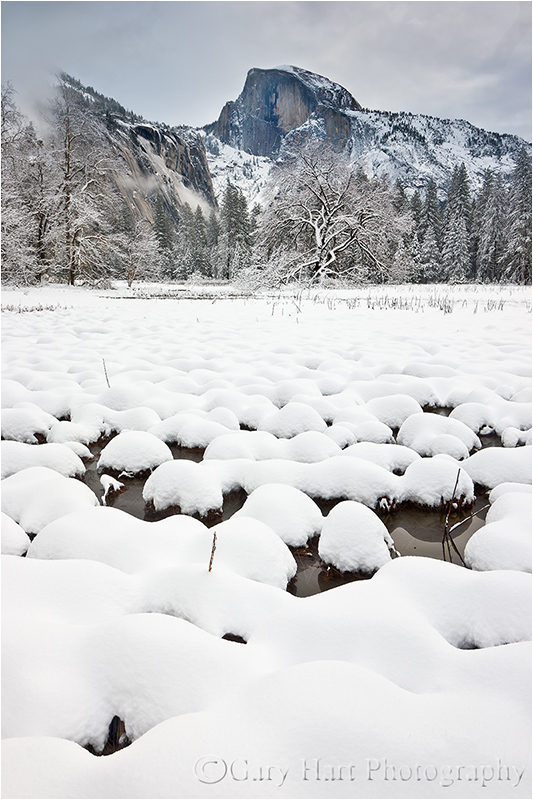
Fresh Snow, Cook’s Meadow, Yosemite
Sunny days are generally no fun for nature photographers. In full sunlight, direct light mixed with dark shadows often force nature photographers to choose between exposing for the highlights or the shadows (or to resort to multi-image blending). So when the sun is high, I hope for clouds or look for shade.
Clouds diffuse the omni-directional sunlight—instead of originating from a single point, overcast light is spread evenly across the sky, filling shadows and painting the entire landscape in diffuse light. Similarly, whether caused by a single tree or a towering mountain, all shadow light is indirect. While the entire scene may be darker, the contrast range in shadow is easily handled by a camera.
Flat gray sky or deep shade may appear dull and boring, but it’s usually the best light for midday photography. When skies are overcast, I can photograph all day—rather than seeking sweeping landscapes, in this light I tend to look for more intimate scenes that don’t include the sky. And when the midday sun shines bright, I try to find subjects in full shade. Overcast and shade is also the best light for blurring water.
Leveraging light
Whether I’m traveling to a photo shoot, or looking for something near home, my decisions are always based on getting myself there when the conditions are best. For example, in Yosemite I generally prefer sunset because that’s when Yosemite Valley’s most photogenic features get late, warm light; Mt. Whitney, on the other side of the Sierra, gets its best light at sunrise; and I’ll only the lush redwood forests along the California coast in rain or fog.
Though I plan obsessively to get myself in the right place at the right time, sometimes Nature throws a curve, just to remind me (it seems) not to get so locked in on my subject and the general tendencies of its light that I fail to recognize the best light at that moment. If I drive to Yosemite for sunset light on Half Dome and am met with thick overcast, I don’t insist on photographing Half Dome. Instead, I detour some of my favorite deep forest spots, like Fern Spring or Bridalveil Creek.
Other times finding the best light is simply a matter of turning around and looking the other direction. Mono Lake is one of those places that reminds me to keep my head on a constant swivel, or risk getting so caught up on the sunrise in front of me that I miss the rainbow behind me.
About this image

Half Dome and Rainbow, Yosemite
On a rainy October afternoon in Yosemite, I did what I often do on rainy afternoons in Yosemite: hang out at Tunnel View, waiting (hoping) for the storm to clear. I’d circled Yosemite Valley in my car several times, but the clouds had dropped well below rim-level and obscured all of Yosemite’s recognizable features.
Yosemite’s clearing usually starts at Tunnel View, and when it happens in the afternoon, a rainbow is possible. But with sunset approaching and the rain showing no sign of relenting, I was losing hope. Anxious for something to do besides wiping the fog from my windshield and listing to rain pelt my roof, I decided to drive through the tunnel for a view to the west (toward the source of any clearing). Seeing nothing promising on the other side, I flipped a quick u-turn and headed back.
The roundtrip was less than five minutes, but I exited the tunnel to see that Half Dome had emerged from the gray muck sporting a vivid rainbow. I screeched to a stop and bolted from the car, changing lenses and wresting my tripod all the way to the vista. I got off just two frames before the light was snuffed, ending up with this image and a valuable lesson: You can’t predict what Yosemite’s weather will be in five minutes based on its weather right now.
(BTW, see that little white cascade trickling down El Capitan’s flank? That’s Horsetail Fall.)
Workshop schedule
Celebrating light
Click an image for a closer look, and a slide show. Refresh the screen to reorder the display.


More love for the Sony a7S
Posted on May 10, 2015

El Capitan and the Big Dipper, El Capitan Meadow, Yosemite
Sony a7S
Sony/Zeiss 16-35
8 seconds
F/8
ISO 6400
In my previous blog I wrote about the flexibility of carrying three mirrorless (compact) bodies, each with its own strengths: the Sony a7R, a7S, and a6000. The a7S is my low-light body; it enables me to freeze motion and extract detail in conditions the were previously impossible. But more than that, I’ve discovered the a7S also makes photography that I’ve been doing for years, noticeably better.
Once upon a time
I got the a7S largely for its ability to pull light out of moonless night scenes, but the more I use it, the more I appreciate the way my a7S eliminates shortcomings I’ve wrestled with in my ten years of moonlight photography. As bright as a full moon is, the sun is nearly 500,000 times brighter (look it up), so achieving adequate moonlight exposure has always required pushing my camera’s light gathering settings to their quality threatening extremes, combining my lens’s widest, poorest quality aperture with star streaking 30-second exposures.
Mitigating these shortcomings meant increasing ISO, but with more sensitivity comes more noise. As high ISO and noise reduction software capabilities improve, so does the quality of my moonlight images, but the improvement has been slow and steady, only marginally perceptible. And it’s not been enough to push me out of the compromised exposure settings zone.
A new paradigm
Enter the a7S. With its spacious sensor and large photosites, the a7S offers ridiculous low light capabilities and I no longer think twice about shooting at 3200, 6400, or 12,800 ISO. And if I need to go higher than that, I know I have at least two more stops of ISO that usually cleans up quite nicely. Suddenly, I’m free to select an aperture I know will ensure the best quality, and a shutter speed that will freeze the stars, then just crank my ISO to a value that delivers the amount of light I want.
But wait, there’s more
Since I’m always on a tripod, most of my lenses are f4—I just can’t justify the bulk and expense of faster glass. But one downside of f4 glass is a less bright viewfinder, making composition and focus difficult in low light. Composition is often by trial and error, but it’s not too bad (and certainly easier than moonless scenes). My moonlight focus solution has always been to compose my shot on the tripod, detach the camera, turn and autofocus on the moon, then return my camera to the tripod—adequate, but a pain.
My a7S sucks so much light into my electronic viewfinder that composition and manual focus in moonlight are a fast, single-step process (I’m guessing moonlight autofocus works too, but I haven’t tried it). Whether I want to focus on the stars, or a particular foreground subject, I simply compose and dial in the sharpness.
For example
I’ve learned that teaching people moonlight photography in the moonbow chaos on the bridge beneath Lower Yosemite Fall is a recipe for disaster, so I usually take my groups out to El Capitan Meadow the night before our moonbow shoot. This spot is easy to get to, it has lots of room, an iconic Yosemite subject, and not too much light pollution (we can just shoot over the headlights). But I go here so much with my groups, I rarely get my camera out anymore.
This month’s group seemed to be doing fine, and I couldn’t resist the sight of the Big Dipper hanging above El Capitan, so I set up my camera and tried a couple of frames with the a7S. Rather than using my standard moonlight recipe (that I’ve been teaching for years)—ISO 800, f4, 20 seconds—I went to a fast shutter speed and mid-range aperture I’ve always longed for (8 seconds, f8) , and compensated with ISO 6400. In my viewfinder El Capitan throbbed with moonlight, and the stars of the Big Dipper stood out like a glow-in-the-dark star chart, making composition and focus effortless.
On my computer back in the hotel I magnified the image to 100 percent in steps, scrutinizing each magnification for noise. I saw none until I got to 100 percent, when I could detect a fine texture in the void between the stars. This cleaned up easily with very low-level noise reduction (Topaz). Examining the image for sharpness and star motion was pure joy as I realized I’d just captured my sharpest, cleanest moonlight image ever.
Learn more about moonlight photography
Join next year’s Yosemite Moonbow photo workshop
A moonlight gallery
Click an image for a closer look, and a slide show. Refresh the screen to reorder the display.


A new way of shooting
Posted on May 6, 2015

Forest Spring, Valley View, Yosemite
Sony a7S
Sony/Zeiss 16-35
1/125 second
F/8
ISO 6400
Regular readers of my blog know of my recent switch from Canon DSLR to Sony mirrorless. I started the transition with the Sony a7R, fully expecting to prefer it over my Canon 5D Mark III enough to justify the switch, but not so much that I’d completely jettison my Canon gear. In addition to 60 percent more resolution than my 5D III, the a7R gave me dynamic range that I never dreamed possible, and significantly better high ISO performance. So, despite a less than trivial adjustment to mirrorless shooting, it didn’t take long to realize that I wasn’t going to miss Canon at all—I haven’t picked up a Canon camera since October.
When it became clear that I was with Sony for the long haul, and because I can’t afford to travel without a backup camera, I started thinking about a backup body. My usual backup body strategy is to complement my full-frame primary body with a crop sensor backup body in case I ever want extra reach with any of my lenses. The Sony a6000 seemed the perfect choice—extremely compact (without a lens, the a6000 fits in the hip pocket of my Levis), more than enough resolution (24 megapixels), compatible with all of my Sony lenses, and inexpensive (easily found for under $600).
Usually my backup bodies gather dust and only come out in an emergency, or perhaps for the occasional long-distance moonrise (when my foreground subject is far enough away that I want as much telephoto reach as possible). What I wasn’t expecting from the a6000 was primary-body image quality in an extremely compact package—not only does the a6000 have (slightly) more resolution than my 5DIII, its high ISO performance and dynamic range is better than the 5DIII (though not as good as the full-frame Sonys). Given all this, I don’t hesitate using the a6000 when I think I might want a little more reach, often juggling it with the a7R for extra flexibility.
Routinely carrying two bodies is certainly not groundbreaking, but it’s new for me. But I wasn’t finished with the a7R and a6000. Given my passion for night photography, it wasn’t long before I added the 12 megapixel Sony a7S to my bag. It took just a couple of night shoots to confirm the raves I’d heard about the a7S’s “magic” ability to see in the dark, but as with the two previous Sony bodies, the a7S proved its value in unexpected ways. More than just a night camera, the high ISO capability of the a7S allows me to freeze daylight motion at twilight and in full shade.
I knew I’d appreciate the size and weight savings of a significantly smaller body and (slightly) smaller lenses, but I thought the primary benefit would simply be a smaller bag. And while I do appreciate the option to travel and hike with a more compact, lighter bag without sacrificing the 20-200mm focal range I consider essential, my primary bag has actually gotten a little heavier since I switched to mirrorless. But with that slight increase in weight comes a significant increase in shooting power and flexibility.
For my entire photography life I switched lenses as my needs dictated (like pretty much every other SLR photographer). Now, with bodies this small, my bag easily holds three, and rather than switching lenses on one primary body, I first decide which body to use based on the composition (wide or long) and conditions (light and motion).
Here’s what I carried in my F-Stop Tilopa during my Canon days:
- 5D Mark III
- Canon 16-35 f2.8L
- Canon 24-105 f4L
- Canon 24-70 f4L
- Zeiss 28 f2
And here’s what my F-Stop Tilopa carries now:
- Sony a7R
- Sony a7S
- Sony a6000
- Sony/Zeiss 16-35 f4
- Sony/Zeiss 24-70 f4
- Sony/Zeiss 70-200 f4
- Zeiss 28 f2 (Canon mount)
- Tamron 150-600 f5-f6.3 (Canon mount)
- Metabones Mark IV Canon to Sony adapter
My primary body is the a7R, but when I want extra reach, I don’t hesitate going to the a6000. Sometimes I carry my a7R with a wide lens and my a6000 with a telephoto. And when I need to freeze motion in low light, the a7S is my body of choice. The addition of the a7S to my bag has made the biggest difference, allowing me to shoot in conditions I’d never have considered before.
Moonrise above a ridge five miles away? No problem—out comes the a6000 and Tamron 150-600 for 900mm of telephoto reach. Breeze-blown dogwood in a shady forest? No problem—here’s my a7S at 6400 ISO.

Ridgetop Moon, Yosemite
Sony a6000
Tamron 150-600 (Canon-mount with Metabones IV adapter)
600mm (900mm full frame equivalent)
1/100 second
F/11
ISO 400
For example
In Yosemite last week I broke out the a6000 and Tamron 150-600 (225-900 full-frame millimeters) for the dogwood, and for a rising full moon. The a7S was my moonlight camera, and just what the doctor ordered when I wanted to photograph wind swaying dogwood in full shade.
On our final morning I guided my workshop group to Valley View to photograph the first light on El Capitan. Beautiful as that scene is, it wasn’t long before a few drifted across the road to an evergreen forest sprinkled with blooming dogwood. A breeze, further augmented by speeding vehicles, limited everyone else to distant views and brightly backlit flowers. I, on the other hand, simply switched to the a7S and bumped my ISO to 6400 to enable a fast enough shutter speed for extreme close photography.
With my 16-35 lens at 16mm, I put the front element about three inches from a bloom in full shade, dialing to f8 to ensure enough depth of field to keep my flower sharp throughout. Even in the dense shade, I was able to achieve a shutter speed fast enough to freeze the breeze. Noise at 6400 ISO? What do you think?
Six months of Sony captures
Click an image for a closer look, and a slide show. Refresh the screen to reorder the display.


Playing the Hand You’re Dealt
Posted on April 27, 2015

Spring Sunrise, Memaloose Overlook, Columbia River Gorge, Oregon
Sony a7R
Sony/Zeiss 24-70
1/13 second
F/11
ISO 400
In family Hearts games when I was a kid, I loved to “shoot the moon” (tremendous reward for success, extreme cost for failure). But simply wanting to shoot the moon wasn’t enough to make it happen, and I didn’t really start winning until I learned to separate my desires from the reality of the moment—I know now to evaluate my cards when they’re dealt, set a strategy, then adjust my strategy as the game unfolds. It’s that way for most card games, and it’s that way with photography.
So much of successful nature photography is about flexibility, an ability to anticipate conditions, establish a plan, then adjust that plan when things don’t play out as expected. That’s why, given nature’s fickle tendencies, I’m never comfortable photographing any location without backup options. I was reminded of this during my recent 10-day, two photo workshop trip to the Columbia River Gorge with Don Smith, where rapidly changing Pacific Northwest weather makes flexibility the name of the game.
The Columbia River Gorge offers a full deck of photo opportunities that include numerous waterfalls in the gorge’s steep tributary canyons, mirror reflections of Mt. Hood and Mt. Adams in small lakes south and north of the gorge, and spring wildflowers blanketing the eastern gorge’s more exposed slopes. Of course merely showing up at a spot and expecting great captures isn’t sufficient: Waterfalls are dramatic subjects the camera struggles to capture in brilliant, midday sunlight; towering volcanos are the first subjects disappear when it rains; and I can photograph wildflowers all day—as long as there’s no wind.
During our workshops, Don and I had to shuffle our groups’ photo locations and timing around snow, rain, and clear skies, temperatures that reached the 80s and dropped into the 20s, and winds that ranged from calm to 40 MPH. Our plan for clear skies was to head to the volcanos; if we were dealt clouds and rain, we would use the diffuse light (subdued dynamic range) to concentrate on the gorge’s waterfalls. And rain or shine, the wildflowers were ideally positioned for sunrise and sunset if the wind cooperated.
Somehow we managed to pull it all off, our trip culminating with a sunrise jackpot on the final morning of the second workshop. The plan that morning was a vast, exposed, wildflower-smothered hillside on the southwest end of the gorge. I’d been monitoring the weather obsessively throughout the trip, and with the morning’s forecast calling for clear skies and calm wind, Don and I were looking forward showing the group these wildflowers backlit by the rising sun’s warm rays.
Despite our optimism for the morning’s shoot, as the group gathered in the dark, a chilly breeze gave me pause. The breeze stiffened on the drive to our planned location, and rather than cling to our original vision and attempt to photograph dancing wildflowers in low light, I started considering options.
Don and I had done extensive scouting in the area on multiple prior visits, and had arrived two days before these workshops for more scouting and to get a handle on conditions. My mind immediately jumped to a sheltered location just a short distance from our planned spot. This location had wildflowers too, but instead of being all about the wildflowers, we’d have lots scenes with rocks and trees above the Columbia River, allowing the clumps of balsam root, lupine, and paintbrush to serve as accents. This location’s advantages were that its primary subjects (rocks, trees, river) would be less affected by wind, and its wildflowers would be a little more sheltered.
The group ended up with an absolutely wonderful shoot that made Don and I look like geniuses. The morning started with a pink sky that reflected beautifully in the river, and ended with an orange ball of sun floating low above the horizon. There were more than enough wildflowers go around, and wind was much less of a problem than it would have been on a more exposed hillside.
Honestly, there was nothing genius about what Don and I did that morning. It should be standard operating procedure for any photographer to base location and timing plans on the expected conditions, but to be familiar enough with the area to have options if the conditions don’t materialize as expected. Additionally, no photographer should get so locked in to a plan, regardless of its potential, that he or she fails to see that it might not work out. (Because what good are options if you don’t use them?)
No shoot is a guaranteed success—sometimes nature’s cards just don’t fall right. But the more options you have, the more you read and respond to conditions, the more winners you’ll come home with.
Workshop Schedule || Purchase Prints || Instagram
A Spring Gallery
Click any image to scroll through the gallery LARGE


Nature’s surprises
Posted on April 25, 2015

Emergence, Half Dome from Olmsted Point, Yosemite
Canon EOS-1Ds Mark III
159 mm
3.2 seconds
F/16
ISO 400
October, 2010
One of the things I enjoy most about landscape photography is the element of surprise, the anticipation that comes with never quite knowing what’s going to happen when I go out with my camera. I usually start with a plan, and while there are times I get exactly what I hoped for, many times I don’t. But it’s the times I witness something I never imagined possible that excite me the most.
On the final night of my Eastern Sierra workshops I like to take my groups to Olmsted Point in Yosemite. The Olmsted trip is a particular treat because it presents a view of Half Dome’s less photographed east flank, behind a photogenic foreground of trees, boulders, and glaciated granite. (Another highlight of the Olmsted shoot is the opportunity to photograph Yosemite’s Tuolumne Meadows, the best experience of the High Sierra’s raw granite topography possible without a backpack.) But in 2010, after four days of spectacular photography, my workshop group’s Olmsted finale was jeopardized by an early snowstorm that closed Tioga Pass, the only route into Yosemite from our current base in Lee Vining. Disappointment would have been difficult given all we’d seen so far, but I nevertheless had already planned an alternate sunset location when I got word that Tioga had just reopened. I quickly returned to Plan A.
As we ascended Tioga Pass, the storm’s vestiges darkened the sky and sprinkled our windshield and I wondered about another pass closure trapping us on the wrong side of the pass, suddenly six circuitous hours from our hotel. But the ranger at the entrance station assured me we’d be okay, so we continued on to Olmsted Point, stopping on the way to photograph at a couple of my favorite Tuolumne Meadows locations.
Arriving about an hour before sunset, we found Olmsted Point completely enshrouded by clouds that obscured everything beyond 100 yards. Not quite what I’d envisioned, but the group had lots of fun exploring the nearby granite and creating compositions featuring large boulders (glacial “erratics,” deposited by retreating glaciers) and gnarled trees amidst the dense fog. As sunset approached I kept an anxious eye on the sky hoping for a break, wavering between cautiously optimistic and hopelessly resigned. Nevertheless, I reassured the group (and myself) with one of my favorite Yosemite axioms: It’s impossible to predict what Yosemite will be like in five minutes based on what it’s like right now.
Shortly before “official” sunset (when the sun reaches the horizon on a flat, terrain-free Earth), the sky lightened noticeably. Hmmm. Soon the persistent fog still engulfing us started to glow, first amber and then pink and we quickly realized we were actually in the midst of clouds alive with the sunset color we’d all our lives only seen in the distance. This was both eerie and spectacular and everyone scrambled frantically looking for subjects, trying to photograph a moment that defies photography. Within five minutes the color was gone, leaving us all breathlessly grateful to have witnessed it with others who could validate what we’d just experienced.
With night falling fast and the visibility still measured in yards, it would have been easy to pack up and revel in our success over dinner. But when the clouds in the direction of Half Dome showed signs of thinning, we greedily decided to stay put in the hope that Mother Nature had an encore for us. Just a couple of minutes later the clouds on the western horizon lifted, revealing Half Dome’s granite face against sunset’s orange afterglow.
Everything after that was a blur of churning clouds, exposed granite, and deepening color as Yosemite’s most distinctive monolith emerged from its shroud. We were all positioned in close enough proximity that I could hear everyone’s amazed gasps punctuated by rapid shutter clicks. Confident that everyone else was content to be left alone, I went to work, frantically zooming wider and tighter, changing orientation, and swapping lenses, all in a futile attempt to capture every single compositional possibility before the darkness was complete.
The entire scene, from Cloud’s Rest on the left to Mt. Watkins on the right, swirled with clouds, with Half Dome at the vortex. In this frame I opted for a tight composition to emphasize the churn of clouds surrounding Half Dome. I exposed to hold the color in the sky and timed the exposure to silhouette the trees against an ephemeral finger of clouds rising from Tenaya Canyon. (I’d love to tell you my f-stop was a conscious choice, but if I hadn’t been rushed I’d have been at f11 rather than the f16 left over from a couple minutes earlier when I was trying to include a foreground.)
In addition to some amazing images, my group finished that evening with a first-hand understanding of how long after sunset the shooting can be good. And a good lesson on the rewards of patience. The great stuff doesn’t always happen, and I’ve had many a shoot where I waited in vain long after everyone else had packed up and retreat to comfort and warmth, but whenever I’m tempted to leave just because it would be more comfortable than staying, I remember this night and hang in just a little longer.
Our final clicks that night were thirty second exposures that included stars, late enough that flashlights were necessary to make our way back to the cars. Dinner was really good.
A gallery of unexpected magic
Click an image for a closer look, and a slide show. Refresh the screen to reorder the display.


A sunny day solution
Posted on April 19, 2015

Wildflowers and Mt. Hood, Columbia Hills State Park, Washington
Sony a7R
Sony/Zeiss 16-35
1/50 second
F/20
ISO 400
For wildflower photography I prefer the diffuse light and soft shadows of a cloudy day, but when Mother Nature delivers clear skies and harsh sunlight, I look for backlight opportunities. Backlit flowers and leaves glow like they’ve been plugged in, and their brilliance allows faster shutter speeds that will compensate for a small aperture and quell a flower-waving breeze.
A frustrating downside of backlight is that the sun is more or less in the direction of your backlit subject, risking lens flare (scattered light that manifests as a contrast-robbing haze or distracting artifacts). If the sun isn’t in your frame, shading your lens will eliminate the lens flare. A lens hood helps, but I find lens hoods more trouble than they’re worth. Instead, when I encounter lens flare, I shade my lenses with my hand, a hat, or an umbrella (no camera bag should be without one). Or better yet, I do my best to position my lens in the shadow of a nearby tree.
But when the sun is in the frame, no amount of shading will work. In these situations I make the best of a bad thing by looking for sunstar opportunities. On last week’s visit to Columbia Hills State Park in southern Washington, I found a hillside awash with wildflowers—mostly yellow balsam root and violet lupine—in brilliant sunlight.
While waiting for the shade to arrive, I decided to take advantage of the backlight and look for a sunstar opportunity. The lupine were in better shape than most of the balsam root, and soon my eyes landed on a colorful group I could balance with Mt. Hood and the setting sun. I stopped down to f20, pulled out my Singh-Ray 2-stop graduated neutral density filter, and waited for the sun to drop to the horizon.
To salvage as much of my highlights as possible, I gave the scene as little exposure as I thought I could get away with. The foreground was pretty dark on my LCD, but the histogram looked okay (not perfect, but manageable)—in Lightroom I was able to pull up the shadows and subdue the highlights enough to work with. Photoshop’s Content Aware Fill tool helped me clean up the worst lens flare, but I still ended up with a little more than I like. (Oh well.)
Here’s my sunstar recipe (excerpted from a previous post):
- Start with a brilliant, fine point of light: The sun is the most logical candidate, but you can do it with the moon, stars, and pretty much any bright artificial light (lighthouse, headlights, and so on). The finer the light source, the more precise the star effect will be, and the less lens flare and blown highlights you’ll have. If it’s the sun you’re using, virtually all of it needs to be hidden to get the delicate, symmetrical distribution of beams that generally work best. In this image the horizon hides most of the sun, but you can use a cloud, tree, rock, or whatever.
- The smaller your aperture, the finer your sunstar will appear: I generally use f16 or smaller (larger f-number).
- Do something to control the highlights: When the sun is entering your frame, you’re invariably dealing with a sky that’s much brighter than your foreground and will need to take steps to avoid the foreground of murky shadows. If you have a foreground shape or shapes against the sky, you could turn the foreground into a silhouette. But when I want to capture foreground detail, I use graduated neutral density filters to hold back the brilliant sky. My 3-stop reverse is my go-to GND in these situations; in particularly difficult light I’ll stack it with a 2-stop hard GND. Whenever I use a GND, I find Lightroom or Photoshop dodging/burning is a great way to disguise the telltale GND transition. HDR blending of multiple images is another way to mitigate extreme sky/foreground contrast (but I don’t do HDR, so you’ll need to Google this). And Photoshop’s Content Aware Tool will help clean up lens flare.
- Different lenses will yield different results: Experiment with your lenses to see which one gives the most pleasing sunstar effect.
- Practice: You can practice sunstars any time the sun’s out. Just go outside with your camera, dial in a small aperture, and hide the sun behind whatever object is convenient (a tree, your house, etc.).
A sunstar gallery
Click an image for a closer look, and a slide show. Refresh the screen to reorder the display.


Exploring the familiar
Posted on April 17, 2015

Snow on Old Tree, Half Dome and Bridalveil Fall, Yosemite
Sony a7R
Sony/Zeiss 24-70
1/30 second
F/16
ISO 100
I spend a lot of time guiding and teaching photographers who have traveled a great distance to capture a particular shot: Horsetail Fall in February, the spring moonbow on Yosemite Fall, the Milky Way above the Kilauea Caldera, to name a few. They’ve seen an image on my website, or someone else’s, and have decided want to add their version to their portfolio. Many have saved money and vacation time for years for the opportunity; others have been chasing the shot without success more times than they can count. Either way, it’s a vicarious rush watching it happen for them.
The captures that make me happiest are the one’s I’ve never seen before. But given that my “job” is guiding people to the scenes I (and others) have photographed many times, I don’t get a lot of opportunity to explore new territory. Instead, I challenge myself to find something new in these heavily photographed areas. And “new” to me is more than just capturing an extraordinary sunset or glorious moonrise, it’s looking beyond the obvious to find a new perspective or fresh interpretation.
Finding new scenes can happen by accident, but there’s no substitute for conscious, calculated exploration. For example, a typical day in Yosemite has lots of blue sky and flat light hours that aren’t conducive to the type of photography I enjoy. Rather than waste that lousy light time simply waiting for the good stuff, I spend it collecting new scenes for later use. In Yosemite that usually means deciding on a subject (Half Dome, El Capitan, Yosemite Falls, Bridalveil Fall, and so on) and poking around looking for foregrounds to put with it.
Despite its apparent permanence, Yosemite is a dynamic environment. Rocks cleave and fall, trees grow and die, water ebbs and flows. Whether it’s walking the bank of the Merced River searching for a reflection of Half Dome, or scrambling granite slopes for a fresh view of Yosemite Valley, there are new perspectives and subjects to be mined everywhere.
When I find something I like, I try to figure out the conditions that would make the best photography. Sometimes this is simply a matter of plotting a moonrise or moonset; other times the best photography requires very specific weather or light. Whatever the condition might be, I do my best to get myself there to photograph it.
Though I photographed this scene just a couple of weeks ago, the view I found on one of these reconnaissance missions several years ago. The first time I saw the twisted remains of this old tree, I imagined it etched with snow. Unfortunately the tree’s location—perched on a ledge above a vertical drop of several hundred feet, is not for the faint of heart, even in the most benign conditions. And getting out here in snow can be downright dangerous.
On my most recent Yosemite trip earlier this month (sandwiched between my Yosemite moonbow workshop and a week-and-half in the Columbia River Gorge), my desire for something new trumped my “respect” for heights. I took a long way around to avoid the cliff as much as possible, then did my best not to look down once I arrived. As I worked, every shift of foot or tripod was planned and tested before execution.
I tried a variety of compositions, wide and tight, vertical and horizontal, that included some or all of the Tunnel View trio: El Capitan, Half Dome, and Bridalveil Fall. Exposure was pretty straightforward, but depth of field was a concern. I stopped down to f16, but chose not to go any smaller due to diffraction (light bending around small apertures to fill the entire sensor can inhibit resolution) concerns. As always in these scenes where I might not be able to achieve complete front-to-back sharpness, I biased my sharpness to my foreground—rather than focusing on Half Dome, I focused on a branch toward the back of the tree.
I actually returned to this scene the next morning, when the snow was much thicker and the light much more difficult. I haven’t had a chance to work with those images, so stay tuned….
A Gallery of the Shot Less Taken
Click an image for a closer look, and a slide show. Refresh the screen to reorder the display.


When seasons collide
Posted on April 11, 2015

Spring Snow, El Capitan, Yosemite
Sony a7R
Sony/Zeiss 24-70
1/8 second
F/11
ISO 100
Ever notice how the best photography happens at nature’s boundaries, the interface separating disparate elements? Sometimes it’s visual elements, like the collision of surf and shore or the intersection of shadow and light. But often we’re moved by images that capture the transition of our experience of the world, such as the color and light that happens when we shift between night and day, or distinctive elements of two seasons together in one frame.
Sunrises and sunsets are a daily occurrence, but the opportunity to capture snow and autumn leaves, or snow and spring flowers, comes just once a year. And until last week, with Yosemite’s waterfalls approaching a summer trickle, and the spring dogwood bloom at least a month early, prospects for the elusive snow with dogwood opportunity didn’t look good.
Storm brewing
Despite Yosemite Valley’s snowless winter, the optimist in me steadfastly monitored an incoming storm, openly defying my internal pessimist that knew the promise of snow would surely fade as the designated day neared. In recent years the pessimist has prevailed in these internal conflicts, thanks to a stream of promising storm after promising storm detoured into the Pacific Northwest by a persistent ridge of high pressure.
But for some reason this storm was different, and while the forecast details changed daily, the one constant was that it seemed determined to defy the ridge. Not only that, this new storm originated in the arctic—what it lacked in tropical (drought busting) moisture, it made up for with air cold enough to deposit snow all the way down to Yosemite Valley.
Obi-Wan Kanobe, you’re my only hope
So, despite the fact that I’d just returned Saturday night from four days in Yosemite (for my spring photo workshop), I found myself on the road back Tuesday morning. With my (4-wheel-drive) Pilot in the shop for some minor body work, I congratulated myself for having the good sense to rent a Jeep when I scheduled the work, even though at the time snow was the last thing on any Californian’s mind.
The queue at the Yosemite entrance station was backed up about a 1/4 mile, and as I idled in a steady rain (the outside temperature was 38F, and with 1500 more feet to climb, I had no doubt it was snowing in Yosemite Valley), it occurred to me that I didn’t actually see anything indicating 4WD anywhere in or on the vehicle. Of course surely a Jeep will have 4WD, but for peace of mind I reached for the manual in the glovebox….
The manual provided no encouraging or discouraging words. As I crept toward the entrance, chain requirement signs seemed to be taunting me, I saw several cars ahead of me turned away for not having chains or 4WD. Approaching the booth, I still wasn’t sure whether I had 4WD (I think I knew, but I was in serious denial), but it dawned on me that without it, my trip was in jeopardy. I rolled to the entrance window and the ranger eyeballed my Jeep—I waved my National Park pass in front of him, and without coming to a complete stop uttered, “These aren’t the droids you’re looking for”, then held my breath as he moved me along. Phew.
Of course my problem was more than simply getting into the park—if conditions truly did merit chains, I knew of no Jedi tricks that would spare me. The snow appeared just a couple of miles up the road, but by the time I got there it was no longer falling and the road turned out to be clear all the way up to the valley. The rest of the afternoon I photographed Yosemite Valley sporting a light but nice dusting of snow. Parking the car for dinner at Yosemite Lodge, I crossed my fingers that the predicted overnight snow would hold off until I retreated to my hotel below the snow line.
No such luck. Stomach full, I exited the cafeteria to at least an inch of new snow, now falling fast enough that my visibility was severely limited and traction was dubious—beautiful indeed, but extremely stressful for this driver. With no other cars on the road, I split the gap in the trees (all actual signs of a road had been obliterated) all the way down the mountain, poking along at about 10 miles per hour but still occasionally unable to resist flipping on my high-beams to recreate a slow-motion Millennium Falcon shift into hyperspace effect.
All’s well that ends well
I made it down the hill without incident, then immediately started stressing about the next morning. If the snow fell this hard all night, Yosemite would surely be spectacular, but lacking chains or 4WD, I’d not be able to get there to enjoy it.
I rose at 5:30 and headed back into the park in the dark. Much to my relief, the snow had stopped in the night, and at each “Chains required” sign I rationalized that the warning was left over from the night before and decided to continue until I actually encountered snow and ice on the road. In Yosemite Valley I found every tree and rock fringed with snow, but the roads were fine.
Freed to concentrate on photography, I knew I had about two hours of quality shooting before the clouds departed, the light hardened, and snow dropped from the trees. My first stop was a personal favorite spot beside the Merced River, too small for a group, where I hoped to find blooms on the dogwood tree that aligns with El Capitan and the Merced River.
I arrived just in time to catch the morning’s first light on El Capitan, the moment made even more dramatic by the diaphanous vestiges of the departing storm. I worked the rapidly changing scene hard, shooting entirely with my 24-70 lens, but using pretty much every millimeter of the lens’s focal range before heading up the hill to Tunnel View.
I drove home thankful for enough snow to photograph, but not so much that I couldn’t navigate, and for the rare opportunity to leverage the late snow and early spring into images capturing the best of both seasons.
Join me in Yosemite next spring
An El Capitan Gallery
Click an image for a closer look, and a slide show. Refresh the screen to reorder the display.


Half Dome moonrise
Posted on April 4, 2015
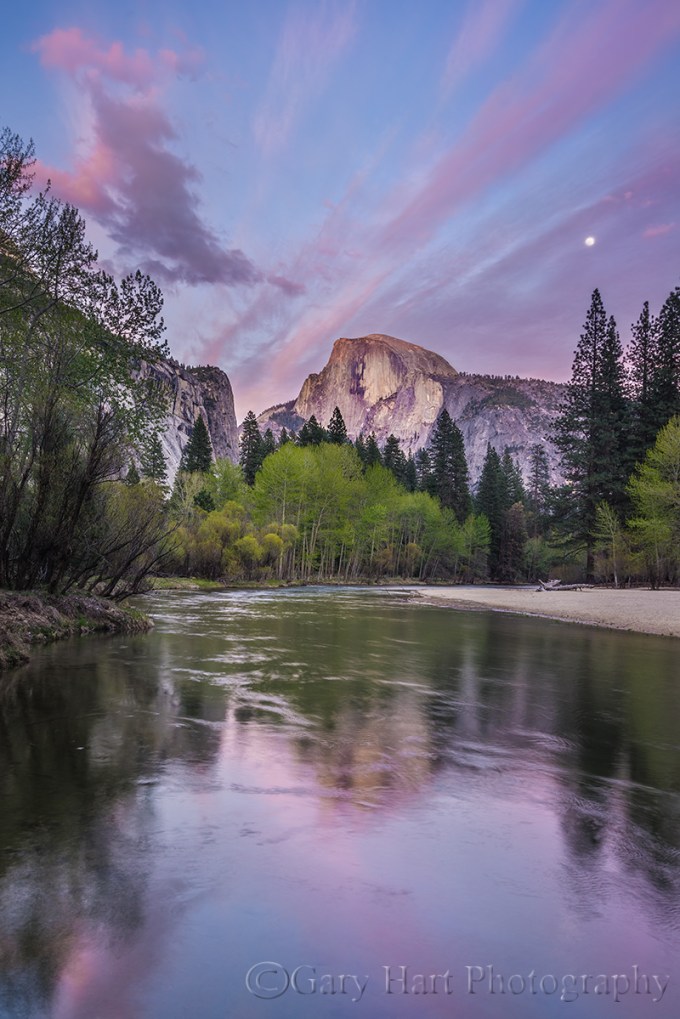
Spring Moon, Half Dome, Yosemite
Sony a7R
Sony/Zeiss 16-35
1.3 seconds
F/11
ISO 80
Last week I was in Arizona (Grand Canyon, Page, Sedona); next week it’ll be Oregon (Columbia River Gorge). But this week my focus is little closer to home, as I enjoy the familiar confines of Yosemite Valley.
The big news here is the water, or rather, the lack thereof. In a lifetime of visits to Yosemite, I’ve never seen the water lower in spring than it is this week, not even close. Most years, the water in Yosemite’s falls peaks in May; this year the flow peaked in February. On my visit to the bridge beneath Lower Yosemite Fall, always a guaranteed drenching in spring, I didn’t feel a single drop. The reflective vernal pool in Cooks meadow is a dirt hole, and the Merced River, which normally roars through Yosemite Valley in spring, is drifting near its leisurely autumn pace.
While these dry conditions might force Yosemite photographers to alter some plans, there is a silver lining to this week’s metaphorical cloud. Thursday night my Yosemite Moonbow and Dogwood workshop group was able to photograph sunset from Glacier Point, which opened last week, the earliest opening on record. And Friday morning we photographed dogwood blooms that already starting to pop out everywhere, a month early.
A particular highlight came Wednesday night. I’d taken my group to a favorite location beside the Merced River, a location I visit so frequently that I usually leave my camera in the car here. But this night, with spring-green cottonwoods framing the upstream riverbank and mix of clouds, sky, and sunlight above Half Dome, it was clear that the conditions were primed for something special. My ace in the hole was the nearly full moon, obscured by clouds when we arrived, that emerged right on cue, just as the sunset pink sky reflected in the Merced River, to provide a perfect accent to an already beautiful scene.
The operative word is accent. As I explained to my group, the moon doesn’t need to be large to be effective. Glowing disk or thin crescent, the moon carries so much emotional weight that, over the right scene and properly placed in the frame, it creates a simple accent that turns a conventionally beautiful scene into something special.
Yosemite, with its host of east-facing vistas, is my favorite spot to photograph a moonrise. Whether it’s a full moon at sunset, or a crescent at sunrise, I do my best to find the Yosemite view that best aligns with the rising moon, scheduling as many workshops and personal visits to coincide with this marvel. When possible the view I choose includes Half Dome, Yosemite’s monolithic centerpiece.
When I can position myself at one of Yosemite’s more distant western vistas, on the opposite side of Yosemite Valley from Half Dome (such as Tunnel View), I have the option of using a telephoto lens to isolate Half Dome in the frame with a magnified moon. When the moon rises too early at one of these distant vantage points, I set up on the east side of Yosemite Valley and closer to Half Dome (raising the horizon so the moon appears later), usually near the Merced River, and use a wide lens that includes the entire scene that uses the moon as an accent.
Of course you don’t need to travel to Yosemite to include the moon in your images. With a little bit of homework, you can find a rising moon in any east-facing scene, or a setting moon in any west-facing scene. To read more about photographing the moon, read the Full Moon and Crescent Moon Photo Tips articles.
Photo workshop schedule
A Half Dome Moonrise Gallery
Click an image for a closer look, and a slide show. Refresh the screen to reorder the display.


 Eloquent Images by Gary Hart