The Dogwood Days of Spring
Posted on May 8, 2023
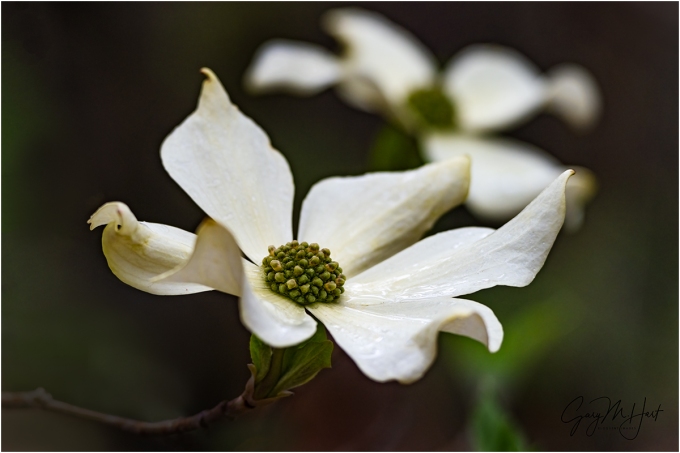
Dogwood Blooms, Yosemite
Sony a7R V
Sony 100-400 GM
2 extension tubes (26mm total)
ISO 800
f/5.6
1/250 second
In my first 14 years leading photo workshops, I never had to cancel a workshop. I have had to scramble a bit thanks to government shutdowns, hurricanes (really), closed roads, and power outages, but no cancellations. That record changed abruptly in spring 2020 when COVID-19 shut down the world, eventually costing me 14 workshops. Then, just as things started to reopen during the pandemic, extreme fire danger in the Eastern Sierra forced me to shut down another workshop.
By doubling up on workshops, and thanks to the patience and understanding of my affected customers, over the subsequent couple of years I was ultimately able to weather the cancellation storm with minimal (manageable) long term damage. In fact, this year’s second Iceland workshop in January was the final COVID make-up workshop—with clear sailing ahead, what could possibly go wrong?
Well…. First, a historically wet and cold winter delivered a historically deep Sierra snowpack. Then, after a cool spring, unseasonably warm temperatures last week goosed the dormant Sierra snowmelt, much of which had nowhere to go but Yosemite Valley, which forced closure of Yosemite Valley, flushing my May Yosemite Moonbow and Wildflowers photo workshop along with it. Not only was this bad news for my customers (not to mention my business), spring happens to be a personal favorite time to be in Yosemite. And this year I was particularly looking forward to all the water in Yosemite’s waterfalls and vernal pools.
For those keeping score at home, that’s 16 workshops lost in 3 years: 1 to fire, 1 to flood, and 14 to pestilence—clearly (as my wife pointed out), famine can’t be far behind. (Anyone who has endured a dinner at the Yosemite Valley Lodge cafeteria knows that’s not as much of a stretch as it sounds.) But seriously, unpredictability is a prime risk of pursuing profession so dependent on the fickle whims of Mother Nature. Still...
This month’s lost workshop was especially frustrating because the National Park Service, looking at the record Sierra snowpack and forecast hot temperatures, preemptively announced the closure of most of Yosemite Valley on the Wednesday before my workshop, which was scheduled to start the following Monday. The closure, they said, would begin at 10 p.m. Friday and continue until Wednesday at the earliest (their words), and possibly longer. Since my spring workshop is set entirely in Yosemite Valley (this year the high country will closed by snow until at least June), and was scheduled to span Monday through Thursday, I had no choice but to cancel. Immediately upon receiving the news, I scrambled to notify the workshop participants, cancel my lodging, and start the process of rescheduling everyone.
So imagine my surprise when, on Saturday, the NPS announced that Yosemite Valley would reopen Sunday, 3 days sooner than their promised “earliest.” Sigh. I instantly contacted my workshop hotel to see if it was too late to reinstate my group’s lodging (it wasn’t), then reached out to the cancelled group to find out who was still able to attend. I told them that even if only half were still available, I’d go ahead with the workshop as originally planned (but also that I’d still honor my cancellation policy for those who could no longer make it). Turns out all but 3 had already cancelled flights or made other plans, sadly confirming that my cancelled workshop count would officially hit 16.
As frustrating as this experience has been, I can’t really fault the NPS. The current Yosemite snowpack is truly unprecedented, and with no upstream dams on the Merced River or its tributaries, there’s absolutely no control over the runoff—the snowpack will send as much water as it wants to, whenever it wants to, and we downstream humans just need to deal with it. Which is exactly what the NPS did: In an abundance of (justifiable) caution, they decided to act proactively by clearing Yosemite Valley before the forecast extreme heat put them in react and evacuate mode. So while I appreciated the advance warning, since the snowmelt wasn’t as extreme as predicted, they soon reversed course—unfortunately too late to save my workshop.
All this got me thinking about how difficult it must be to manage Yosemite. With around 4 million visitors per year, Yosemite is one of the most visited national parks in the United States (the world?). Keeping all these people both safe and happy, while simultaneously protecting the wellbeing and beauty of this most special resource seems like an impossible task.
Yosemite’s total footprint is nearly 1200 square miles (slightly smaller than Rhode Island), but most of this area is remote backcountry that’s accessible only on foot. And instead delighting in the joys of High Sierra hiking and backpacking, virtually every one of Yosemite’s annual visitors tries to cram into the (slightly less than) 6 square miles of Yosemite Valley.
The result is, on a typical summer day, literally more cars in Yosemite Valley than parking places. Those lucky enough to score a parking spot are wise to leave their car there for the duration of their stay and navigate the park on foot, bicycle, or shuttle. In such a compact area teeming with pedestrians, cyclists, and vehicles, each with their own agenda—picture the occupants of Car 1 (including the driver) craning to admire the waterfalls and monoliths overhead, as the driver of Car 2 in front of them spies a pedestrian (or or cyclist, or deer) and slams on the brakes (SMASH!)—it’s a miracle there isn’t even more mayhem than there is.
Another problem the NPS constantly fights is the people who believe the rules only apply to everyone else and decide it’s okay to traipse through a clearly off-limits meadow, or climb over a protective guardrail: “I’m just one person and I’ll be quick”(photographers are especially frequent offenders). And then there are the people who treat Yosemite’s wildlife like personal pets who they need to feed and pose with for selfies.
Witnessing all this bedlam has caused me to realize that, despite my love for Yosemite and the care I take to follow the rules (and to ensure that my workshop students do as well), my mere presence in Yosemite risks making me part of the problem. As a result, I no longer schedule workshops for weekends, or during Yosemite’s most crowded months. In fact, I now refuse to visit Yosemite for any reason from mid-May through mid-October—even when someone offers to pay me for a private tour.
Though I generally resist doing anything in Yosemite in May, this month’s just-cancelled workshop was right on the cusp my self-imposed workshop curfew. But because the May full moon (necessary for a moonbow) fell in the first week the month, the dogwood bloom usually peaks the first week of May, and by starting May 1 I could completely avoid a weekend, I went ahead and scheduled it. I worried a little about the crowds, but never dreamed flooding would be my downfall.
On the other hand, the Yosemite Valley shutdown wasn’t without a small personal upside. Because I schedule my Yosemite workshops only for the times I’d most want to be there myself, I don’t get a lot of opportunity to photograph Yosemite on my own, during my favorite times to be there. But thanks to the cancellation, I was able to make two (!) personal trips to Yosemite—the first, when I’d normally have been doing last-minute workshop prep, was nice but turned out to be a complete photographic dud; the second, on what would have been the workshop’s final two days, was much more photographically successful.
Anxious to see Yosemite at peak water before Yosemite Valley closed, my brother Jay and I departed early on the Friday morning of the 10 p.m. closure day. Though the forecast called for nothing but blue skies, I hoped flooded meadows, blooming dogwood, and relatively few people would compensate. We struck out on all three fronts: while there was definitely a lot of water in the falls and meadows, the Merced wasn’t nearly as high as I’d seen it in prior wet springs; the dogwood were just starting, still quite tiny and mostly green; and the place was absolutely packed with people, to the point where parking was a real challenge. So we circled the valley a couple of times and drove home.
By the following week (the week my workshop had been scheduled for), the weather had cooled significantly and rain and snow had returned to the Sierra. Not only were these cloudy/stormy conditions better for photography, I figured (hoped) by then the dogwood would be really starting to pop. So on Wednesday afternoon Jay and I drove back to Yosemite, checked-in to our hotel, then made it into the park with about an hour to photograph before sunset.
With the dogwood blooming as hoped, we stopped for about 30 minutes to photograph the flowers (yes, I know they’re technically bracts, not flowers) in a light rain near the Pohono Bridge, then made it to the east side of the valley in time to catch a couple of reflections of Yosemite Falls before dark. We waited in the car for complete darkness, hoping the moon would pop out and give us a moonbow at the base of Upper Yosemite Fall, but the clouds seemed pretty committed, so we retreated to the hotel.
The next day was all about the dogwood, one of my absolute favorite things in the world to photograph. We stopped at most of my favorite dogwood spots, photographing a lot of close selective focus scenes like this one, but also some scenes with dogwood in the foreground and Bridalveil Fall or El Capitan in the background. A persistent light rain only made things better. In short, photography heaven.
Dogwood Blooms, Yosemite
This beautiful specimen I found across the road from Valley View, where we ended up photographing for almost an hour-and-a-half. Jay started up the road, while I settled in across from the parking lot and slowly made my way up the road, working both sides as I went. Using my 100-400 exclusively, mostly with extension tubes as well, I started with dogwood that allowed me to include Bridalveil Fall in the background, then the Merced River, and finally simply concentrated on individual flowers, or groups of flowers.
As always, my objective in these close focus scenes is to find a flower or flowers with a complementary background: other flowers, parallel trunks, dark shade, water, and so on. After an hour or so I came across a large tree bursting with large, fresh dogwood blooms and went to work.
It wasn’t long before I found this flower with everything I wanted: it was in perfect shape, with a fully intact central flower cluster and none of the spots or taters that mar older blooms; it glistened with rain; in the background was a similarly flawless specimen; and everything was surrounded by splashes of bright green embedded in dark shade.
I composed as tightly as I could while still including all of both flowers and the arcing branch supporting the nearest one. Even though the breeze was minimal, given limited light I set my ISO to 800 to guard against subtle motion blur. I knew I couldn’t get the entire bloom sharp, so I took special care to focus on the center, then magnified my capture to doublecheck focus after each click.
It’s never a good thing to cancel a workshop, for many reasons, but sometimes good things can come from bad situations if you simply maintain an open mind and keep moving forward.
Workshop Schedule || Purchase Prints || Instagram
A Dogwood Gallery (including a few new ones from this trip)


Image Building (the old fashioned way)
Posted on May 1, 2023
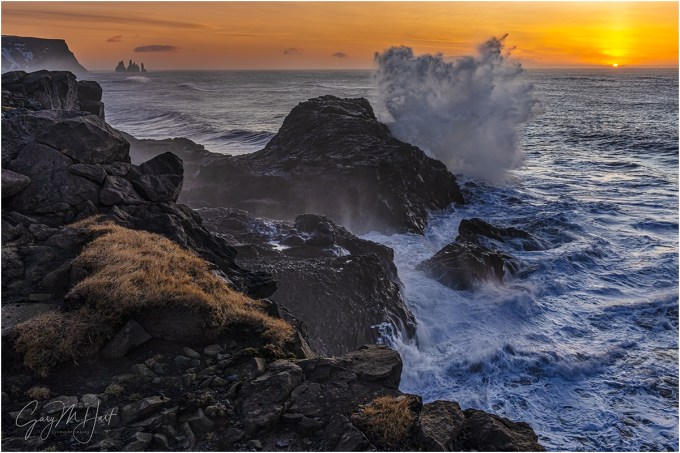
Sun and Surf, Dyrhólaey, Iceland
Sony a7R V
Sony 24-105 f/4 G
ISO 100
f/20
1/20 second
Today it’s possible to open an app on your computer, type in a few descriptive terms, and faster than you can take a sip of coffee your very own beautiful image will appear. No frozen extremities, missed meals, or sleep deprivation required. What could possibly be better than that?
I’ll tell you what’s better: the frozen extremities, missed meals, and sleep deprivation necessary to witness Nature at its best, and to remind me that the best things in life are even better when a little sacrifice is involved. There’s simply no substitute for the multi-sensory opportunity to worship with nature—coming away with a beautiful image is just icing on the cake of the experience of simply being there.
Icing this winter morning’s cake involved more than a little effort, as well as a good degree of physical discomfort. Dyrhólaey, on Iceland’s South Coast, has a network of short but steep trails leading to broad vistas of rugged lava cliffs, a long black sand beach, several sea stacks (including distant Reynisdrangar), and lots of open sea. (It’s also the location of a truly epic aurora show about 10 days earlier, but that’s a different story.)
Since this was a week or so into a workshop (the second of two Iceland workshops Don Smith and I did this past January), and Dyrhólaey is so spread out, after the brief location orientation everyone had scattered quickly to search out their own scene, leaving me to my own devices. Iceland’s interminable gray winter twilight was already underway when we arrived, but actual sunrise was still an hour away, so there was no real rush.
This morning’s temperature (F) and wind (MPH) were both in the teens, but I was bolstered by multiple layers covering virtually every square inch of delicate California skin. Not immediately drawn to any one scene, I was quite content to wander the trails, taking in the view. On my travels I connected with as many in the group as possible, keeping my eyes open for potential images along the way. Eventually I found myself atop the highest point, enjoying a bird’s eye view of the violent surf’s relentless pounding. I stood there at least 15 minutes, completely mesmerized by waves arriving from all possible directions, each one reacting to the rocks a little differently than the waves preceding it.
This surf was on a different scale than anything I’d seen in California or Hawaii—more violent, and clearly more determined to punish anything in its path. Each wave exploded impressively onto the rocks, but occasionally just the right combination of size and direction resulted in a nuclear explosion that mushroomed far enough skyward to obscure some of the sky.
While the sky lacked clouds to add visual interest and catch sunrise color, I recognized the potential for a sunstar when the sun finally crested the horizon. With this thought in mind, I managed to pull myself away from my perch and move along the cliff’s edge, identifying and organizing the various elements for a possible composition.
I knew the sun would be the strongest background element, and decided that putting it on the right of my frame would provide the best foreground. Widening my frame to 27mm allowed me to balance the sun with Reynisdrangar (the 3 sea stacks in the distance). With that framework in place, I moved around looking for the best combination of close foreground that would also allow me to include the large rock with the greatest potential for a big wave. Since the sky wasn’t especially compelling, and I really liked the surf and rocks below me, I minimized the sky in favor of the much more interesting foreground.
Hoping for a sunstar, I stopped down to f/20, which had the added benefit of extra depth of field cushion. I focused on the large grassy patch. With my composition in place, I just stood back and waited for big waves, clicking each time one reached its apex. The biggest waves were few and far between, but I crossed my fingers for one to land while the sun was still on the horizon.
Turns out I got one really big wave—not the biggest I’d seen, but big enough. And as you can see, haze on the horizon meant the sunstar never materialized, but it also kept the sun from washing out the sky’s rich gold sunrise hues. (I actually think I like it better without the sunstar, which might have overpowered the rest of the scene.)
This is probably not a picture that will make me rich, but I like it not only for whatever aesthetic value it might possess, but also for the reminder of this beautiful Iceland morning, the sacrifices we nature photographers make in pursuit of our passion, and for the way my effort to assemble the scene’s disparate elements into a coherent scene actually came together (never a sure thing).
Assembly Required
Click any image to scroll through the gallery LARGE


Tunnel Vision
Posted on April 24, 2023

Spring Rainbow, Bridalveil Fall, Yosemite
Sony a7R V
Sony 24-105 f/4 G
ISO 100
f/10
1/250 second
For everyone who woke up today thinking, “Gee, I sure wish there were more Yosemite pictures from Tunnel View,” you’ve come to the right place. Okay, seriously, the world probably doesn’t actually need any more Tunnel View pictures, but that’s not going to stop me.
Visitors who burst from the darkness of the Wawona Tunnel like Dorothy stepping from her monochrome farmhouse into the color of Oz, are greeted by a veritable who’s who of Yosemite icons: El Capitan, Cloud’s Rest, Half Dome, Sentinel Rock, Sentinel Dome, Cathedral Rocks, Bridalveil Fall, and Leaning Tower.

Yosemite Tunnel View subjects
Camera or not, that’s a lot to take in. First-time visitors might just just snap a picture of the whole thing and call it good. For more seasoned visitors like me, the challenge at Tunnel View is creating unique (or at least less common) images. But that’s not enough to keep me from returning, over and over.
Many people’s mental image of Yosemite was formed by the numerous Ansel Adams prints of this view. And while it’s quite possible those images were indeed captured at Tunnel View, many Adams prints assumed to be Tunnel View were actually captured from nearby Inspiration Point, 1,000 feet higher.
Before Wawona Tunnel’s opening in 1933 completed the current Wawona Road into Yosemite Valley, the vista we now know as Tunnel View was just an anonymous granite slope on the side of a mountain. Before 1933, visitors entering Yosemite from the south navigated Old Wawona Road, a steep, winding track more suited to horses and wagons than motorized vehicles. Inspiration Point was the Tunnel View equivalent on this old road.
To complicate matters further, there are actually three Inspiration Points in Yosemite. The original Inspiration Point is the location where the first non-Native eyes feasted on Yosemite Valley in the mid-19th century. Decades later, Old Wawona Road was carved into the forest and granite to provide an “easier” (relatively speaking) route between Wawona and Yosemite Valley. The valley vista that was established on this route and labeled Inspiration Point is the one popularized by Ansel Adams. But today that version of Inspiration Point has become so overgrown that hikers hardy enough to complete the steep climb up to the Ansel Adams Inspiration Point, must make their way a short distance down the slope to a spot where the view opens up, forming the New Inspiration Point. But I digress…
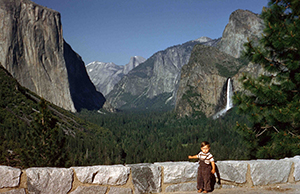
Almost certainly not my first visit
My total visits to Tunnel View, which predate my oldest memories, by now have to exceed 1,000. At first I had no say in the matter, having simply been a passenger on family trips since infancy. But when I became old enough to drive myself, my Tunnel View visits increased—most Yosemite trips included multiple visits.
The Tunnel View counter started clicking even faster as my interest in photography grew. More than just a one-of-a-kind scene to photograph, Tunnel View is also the best place in Yosemite to survey Yosemite Valley for a read on the current conditions elsewhere in the valley.
And as I’ve mentioned (ad nauseam), the view at Tunnel View is beautiful by any standard. And as it turns out, beauty is a pretty essential quality for a landscape image. Unfortunately, another essential landscape image criterion, especially for landscape photographers who pay the bills with their photography, is a unique image—ideally (aspirationally), but not necessarily, a one-of-a-kind image. So Tunnel View’s combination of unparalleled beauty and easy access means million of visitors each year, which makes finding something literally unique (one-of-a-kind) here virtually impossible.
But there are a few things I do to increase my chances of capturing something special enough to at least stand out—things you can do at any popular photo spot. Here are three:
- Experiment with focal length — At Tunnel View usually means using a telephoto to isolate individual elements, or combinations of elements: just El Capitan, or El Capitan and Half Dome; just Half Dome, or Half Dome and Bridalveil Fall; and so on. And an extreme telephoto allows me to zero in on just one aspect of a Tunnel View icon: Half Dome’s summit draped by clouds, El Capitan’s bold diagonals, the mist explosion at Bridalveil’s base, to name just three.
- Look behind you — Even though the granite walls outside Tunnel View’s classic view can’t compete with the money shot, failure to keep an eye on the surrounding walls risks missing light and clouds that can at times be spectacular. And even though I don’t photograph manmade objects, I’ve seen some great images by others using Wawona Tunnel to frame Yosemite Valley, or with the tunnel itself as the subject.
- Include special conditions — My favorite Tunnel View approach is to pair this already beautiful scene with one of the many ephemeral natural events possible here. Not only does the east-facing view mean warm late light on all the granite features, it also makes Tunnel View ideally situated for rising crescent (sunrise) and full (sunset) moons, and afternoon rainbows. And its position on Yosemite Valley’s west end means it’s usually the first place in Yosemite Valley that storms clear. Few sights in Nature more spectacular than a Tunnel View clearing storm, and no two are exactly the same.
The image I’m sharing today combines a couple of these approaches: a tighter than typical focal length, and special conditions. Though the Bridalveil Fall rainbow isn’t exactly unique, its combination of beauty and relative rarity keeps me coming back. And because the sun’s angle at any given moment, as well as the angle of view to Bridalveil Fall, are precisely known, I can predict the rainbow’s appearance each spring afternoon to within a few minutes (it varies slightly with the amount of water in the fall).
This rainbow makes a fantastic first shoot for my spring workshops. Usually I’m content to just stand and watch—and listen to the exclamations from my workshop students—but sometimes it’s to beautiful to resist. This year, with beautiful clouds overhead, dappled sunlight below, and a strong breeze to spread the rainbow’s palette, was one of those times.
Workshop Schedule || Purchase Prints || Instagram
A Tunnel View Gallery


Relationship Building
Posted on April 17, 2023
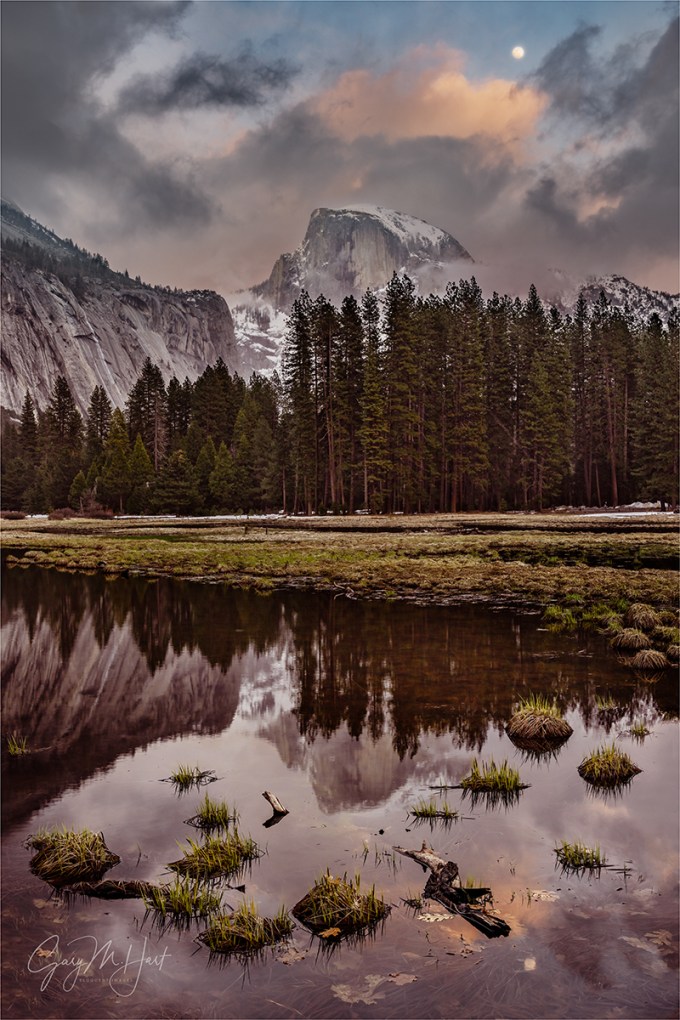
Lunar Reflection, Half Dome and Cook’s Meadow, Yosemite
Sony a7R V
Sony 24-105 f/4 G
ISO 100
f/10
1/8 second
It’s all about relationships
I write a lot about relationships in photography. Often I’m referring relationships with my subjects, which could mean gaining better understanding of a location—not just the where and when of its photo opportunities, but its weather and geology (especially), as well as its flora, fauna, and history. (Of course I love visiting new places too, but I’ve never felt particularly driven to expand my portfolio through relentless pursuit of new locations.)
As important as location relationships are my relationships with the natural phenomena that inspire me understand the science behind the ephemeral phenomena that fascinate me enough to photograph them. Things like lightning, rainbows, reflections, sunrise/sunset color, fall color, and anything celestial simply fascinate me and it never feels like work to study them.
But there’s another side to photography’s relationship coin that takes place within the frame of an image. I’m talking about the visual relationships between disparate subjects—juxtaposing one subject with another physical subject (nearby or distant), or elevating a favorite location by photographing it under the spell of a favorite natural phenomenon.
However these relationships happen, it’s only logical that the best photography takes place when intimate knowledge of location and natural phenomena are combined to create the intra-image relationships that make an image sing.
Sometimes this seems so obvious the we make these connections without realizing we’re doing it. when we visit a vista that includes multiple features, or travel to a favorite location to photograph it with sunset light or fall color. Other times we’re beneficiaries of happy accidents, when something unexpected just happens to manifest while we’re there. And while I love happy accidents as much as anyone, we should never count on them.
In general, the more deliberate we can be about consciously combining the things we love in our photography, the better our images will be. Of course some of my favorite images are happy accidents—something unexpected that just happened to take place while I was there to witness it—but the vast majority were more strategic.
So I guess in a way that would make me a photographic matchmaker, aggressively seeking to create relationships, not just with, but for the things I love most. Whether it’s fresh snow in Yosemite, lightning at Grand Canyon, the northern lights in Iceland, or the Milky Way in New Zealand, it’s usually not an accident that I was there. Of course there are no guarantee any of these things will happen as planned, but I always do my best to maximize my odds.
As much as I’d love to claim that creating these matches makes me some kind of photographic savant, I’m afraid it’s far simpler than that. (Like most people) I can read a weather report and get a few days advance notice of snow in Yosemite Valley; I know that the ingredients for a rainbow are sunlight and airborne water droplets (like rain and waterfall mist), and that my shadow always points in the direction of the rainbow’s center; the time window for any location’s fall color peak is generally common knowledge; and the moon and Milky Way follow precise schedules, and there are plenty of resources that reveal their position in the sky at any time, from any location. All I need to do is act on this information.
Tying it all together
Usually all you need to do to understand the relationships I’m seeking in a workshop is to look at the workshop’s name. The image I’m sharing in this blog post was captured during my Yosemite Moonbow and Wildflowers photo workshop earlier this month—but, as you can see, there is in fact (and fortunately) more to Yosemite in spring than moonbows and wildflowers.
When I scheduled this workshop more than a year ago, I knew for a fact that it would take place during the full moon that’s necessary for the Lower Yosemite Fall moonbow, and that the angle of the rising moon relative to the fall would be just right. And I knew from experience that the odds of wildflowers in April were extremely high. What I didn’t know was whether we’d have clear or cloudy skies, nor could I have anticipated California’s unprecedented wet and cold winter and how it might threaten to throw a wrench in my plans.
This is where the location familiarity part of relationship building comes in handy, as I was able to adjust enough that we ended up with some wonderful photography, albeit something that was much closer to a winter workshop than a spring workshop. This group had chilly temperatures, clouds, a little rain, and lots of snow (mostly on the ground, but a few flakes as well). Nevertheless, as you no doubt know if you read my previous blog post, we were able to catch the very beginning of what has turned out to be a very late (but potentially spectacular) wildflower bloom, so I was able to deliver something as advertised.
The moonbow part of my plan was a little more problematic. While Yosemite Falls is fed entirely by snowmelt, and the Sierra received record snowfall this winter boded well for our chances, the temperatures hadn’t warmed enough yet for the fall to deliver the explosion of mist at its base necessary for the moonbow. (There was nice flow in the fall, just not enough for the moonbow.) We tried, but ended up with a moonlight shoot sans moonbow.
On to Plan B
From the moon to the Milky Way, regular readers of my blog know of my fascination with all things celestial. Orbital geometry aligns Yosemite’s moon with different features as the seasons change, and I try to be there for as many moonrises as possible. Since the full moon happens during this workshop, photographing it is always part of my plan. On the other hand, because the moon doesn’t align as perfectly with Half Dome or El Capitan as it does in winter, it’s more of a bonus than it is something I advertise.
The first night clouds that threatened my moonrise made for great photography, and we kicked off with a nice Tunnel View shoot. Since the wet winter also meant reflective vernal pools in Yosemite Valley’s meadows, to create a sunset match for my workshop students on that cloudy first evening, I opted for the vernal pool in Cook’s Meadow. (For good reason, Cook’s Meadow itself is closed to visitors to allow the meadow to recover from years of pedestrian abuse—we approached the pool from behind, via the trail from the Sentinel Bridge parking lot, and never actually entered the meadow.)
I was actually thinking about multiple matches this evening: not only does this location have a great view of Half Dome, the vernal pool is ideally positioned for a Half Dome reflection. And I knew (but kept to myself for fear of jinxing us) that in the off-chance that the clouds parted, this would be the best location to add the moon to our Half Dome reflection scene.
Between Half Dome, the reflection, and clouds kissed by warm light, I almost forgot about the moon. But about 20 minutes before sunset the clouds opened and there it was. I’d already been strategically moving about to manage the reflection’s relationship to the various features dotting the water’s surface, taking care to frame Half Dome rather than obscure it. So the biggest obstacle I had to overcome was making sure that everyone else had their shot before I got mine.
Since most of us were set up within a few feet of each other, I was able to provide impromptu coaching on how to expose bright enough to capture the shadows without blowing out the moon (read more here). Another (counterintuitive) learning point was to point out that the focus point for a reflection is the same as the focus point for the reflective subject, not the reflective surface (read more here).
One more thing
People ask me if I ever tire of Yosemite, and I can honestly answer, no. Part of keeping Yosemite fresh for me is the infectious excitement that happens when the people I’m with witness something like what we saw this evening. Even without the moon, this Half Dome scene provided a great Yosemite introduction for everyone. But when the clouds lit up and the moon popped out, it elevated to one of those truly special Yosemite moments that I’ll never tire of sharing.
Photographic Matchmaking
Click any image to scroll through the gallery LARGE


Leveraging Light
Posted on April 11, 2023

Glow, California Golden Poppy, Merced River Canyon
Sony a7R V
Sony 100-400 GM
2 extension tubes (26mm total)
ISO 100
f/5.6
1/400 second
In last week’s post I wrote about the importance of distilling a scene to its essence. I suggested that the best way to achieve this is to eliminate all but the scene’s most essential elements, and emphasized using precise cropping to banish unwanted objects to the world outside the frame. And while it could be argued that this careful cropping might be the most essential part of the scene-distilling process (or at least the foundation upon which to build), it’s often not enough.
Many (most?) scenes, even after the most surgical cropping, can remain filled with distractions that dilute the image’s impact. Areas of brightness, distinctive but irrelevant features, and objects cut off or intruding at the sides of the frame are just a few examples of visual elements that can distract the eye and confuse viewers looking for clues about the image’s purpose.
But take heart, all is not lost for photographers able to jettison the urge to “reproduce the world just the way I saw it.” The truth is, reproducing the world as we see it is literally impossible, and the sooner you come to terms with that truth, the better off you’ll be.
Setting aside our own reality to leverage our camera’s reality starts with understanding that “reality” is in fact a moving target defined by the medium interpreting it. Humans’ definition of “real” is founded on the three-dimensional, 360 degree, continuous-motion, multi-sense input delivered to our eye/brain collaboration. A camera, on the other hand, captures a two-dimensional, static, mono-sensory version of our very dynamic world.
But before lamenting your camera’s limitations, pause to consider that, in the grand scheme of perpetual electromagnetic energy that surrounds us, what you and I see is an tiny fraction of the infinite continuum of electromagnetic wavelengths continuously (and ubiquitously) careening about the Universe.
For example, X-ray machines peer into the world of electromagnetic waves in the one nanometer (one billionth of a meter); TVs and radios “see” waves that are measured in centimeters; humans, on the other hand, see only the waves in a very narrow band between (about) 400 and 750 nanometers. Understanding all allows doctors to expose subcutaneous secrets, astronomers to explore our galaxy and beyond, and the military and law enforcement to view “invisible” (to us) infrared signatures that reveal people and objects in complete darkness. In other words, there’s no single absolute visual standard—it’s all relative to the frame of reference.
The photographer’s job is to embrace his or her camera’s unique frame of reference, and to understand the power they possess to convey aspects of the world missed by the human experience. That “instant” a still photo is limited to can actually be stretched with a long exposure that compresses a potentially infinite number of instants to reveal, in a single frame, patterns of motion and flow. And the information a camera can’t see gives photographers incredible power to hide or minimize distractions, to control the world inside their frame, and to emphasize select elements over other elements.
All this might explain why I’ve always considered myself a film photographer with a digital camera. That doesn’t mean I don’t appreciate and use the incredible processing power digital photography brings, but it does mean that the images I process are limited to the photons captured in a single click. I just find no joy in adding information through focus or exposure blending of multiple images. Rather, I prefer leaning into my camera’s visual shortcomings by subtracting the aspects of the scene that don’t serve the image. (There’s nothing wrong with honest image blending, it just doesn’t give me joy.)
The image I share today, a brand new one from last week’s Yosemite Moonbow and Wildflowers photo workshop, got me thinking about the importance of subtracting distractions, and the power of my camera’s relatively narrow (compared to human vision) dynamic range to emphasize the most important qualities my subject. I’ve always loved the way sunlit poppies seem to radiate from within, as if illuminated by their own internal light source, and am always looking for ways to highlight it.
Based on my observations last month (normally a reliable start to the poppy season in Northern California), and the persistence of California’s incredibly chilly spring (by our standards), I wasn’t even sure I’d have a chance do any poppy photography this year. But scouting my poppy spots near Yosemite for last week’s workshop, I was thrilled to see that the poppies were just starting to erupt. They were still quite small, and rather thinly distributed, but were already plentiful enough to photograph. I reasoned (hoped) that a few days of sun might really kick them into gear, so I planned the workshop wildflower shoot for our final afternoon. It turns out I’d reasoned right, and a few days of sunlight was indeed exactly what the doctor ordered.
I found this solitary poppy jutting from a rocky wall in the Merced River Canyon, about 10 miles west of Yosemite Valley. I was especially drawn to the flower’s warm glow, but no matter how I framed it, the rest of the scene was ugly rock, brown dirt, and scraggly weeds.
I’d armed myself this afternoon with my Sony a7R V camera and Sony 100-400 GM lens; to focus closer, I’d also added two extension tubes totaling 26mm. Though it was only mid-afternoon, with the sun well into its daily descent, the shadows were already stretching deep into nearby nooks and crannies.
After studying the scene, I lowered my tripod and positioned my camera beneath the flower for the best view of its backlit, glowing petals. Instead of trying to make the scene look the way I saw it, I took advantage of my camera’s “limited” dynamic range and underexposed enough to blacken the superfluous background detail. The result is this simple image (which required very little processing, BTW) that, while nothing like what my eyes saw, contains only the elements of the scene I was interested in: the glowing poppy and its softly lit stem on a canvas of black shadow.
Workshop Schedule || Purchase Prints || Instagram
Leveraging Light


Distilling the Essence
Posted on April 2, 2023

Frozen, Skógafoss, Iceland
Sony a7R V
Sony 100-400 GM
ISO 100
f/10
1/13 second
The art of subtraction
Presented with a complex world, the nature photographer’s job is to identify a scene’s visually interesting elements and figure out how to use them in an image. While most photographers have no problem seeing what to include in their images, many struggle with what to leave out. But the best pictures usually work at least as much for what’s not in them as for what’s in them.
That’s because, as much as we seek beauty to add to our images, photography is ultimately an art of subtraction. Our ability to ruthlessly subtract elements that, despite their inherent visual appeal, don’t serve the image is an important skill that’s worth cultivating.
When I look back at old images that somehow ended up pleasing me less than the scene excited me when I photographed it (we’ve all been there, right?), I see now that often the problem was that I included too much. The product of my failure was an image with visual busyness that distracted from the main point, or that completely lacked a point, and confused viewers: “What am I supposed to be looking at here?”
As my photography evolved, I started identifying ways to distill complex scenes. One approach is through careful use of exposure variables to manage what I call photography’s “creative triad”: motion, depth, and light—motion blur to smooth turbulent or choppy water; focus blur to soften background and foreground distractions; and silhouette or high key exposure to erase unwanted elements and simplify the scene to just color and shape.
But even before working the creative triad, distilling a scene to its essence requires ruthless (there’s that word again) cropping—simply knowing what to put in, what to leave out, and the confidence (courage) to do it. Start by identifying the elements in the scene that draw the eye. Think in terms of implicit connecting lines that define their relationship to each other. Move around—forward/backward, left/right, up/down—until your prime elements feel organized.
If you’re still not feeling a connection between all of your prime elements, it’s time to start eliminating things—you can always return to that beautiful subject you composed out and feature it in another composition. And if you’re still not finding visual coherence, don’t be afraid to just click an image, stand back and evaluate it on your camera’s LCD screen, and adjust. Then repeat as necessary.
Try this
One simple way to exercise this skill is with the Crop tool in Photoshop or Lightroom. Start with any image (your own or someone else’s—the goal is to train your eye, not to create an image you’ll use), open it in your image processing software of choice (I use Photoshop for this exercise), set the Crop tool to 2/3 aspect ratio (or whatever your camera uses), and see how many new images you can find in the original. Whether the source image was horizontal or vertical, use both orientations of the Crop tool. Again, this is an exercise to train your eye, not to create a usable image, but I’m confident that you’ll find this new vision translates to your viewfinder when you’re in the field.
You can do the same thing on location with a telephoto lens. After you feel like you’ve exhausted all of a scene’s wide options, remove the camera from the tripod, increase your focal length by zooming tighter or switching to a longer lens, and slowly pan with your eye to the viewfinder. Closely monitor your reaction to what you see and honor any urge to stop. The goal isn’t to forgo wide angle compositions, it’s to help identify the scene’s essence, those visual aspects of the scene that matter most. I think you’ll be surprised by what you find (what your eyes originally missed).
For example

Winter Rainbow, Skógafoss, Iceland
Too often we get so caught up in a scene’s grandeur and miss the details that make it special. Most nature photographers when presented with a grand scene go straight to a wide angle lens—a perfectly valid way to start. The problem is, once we feel like we’ve nailed the wide shot, we move on—even if not physically, then at least mentally.
After a long drive from Iceland’s Snæfellsnes Peninsula, still basking in the thrill of the previous night’s aurora show (and oblivious to the show we’d enjoy that night), the Iceland workshop group wasn’t really thinking about much but getting comfortable at our hotel in Vik. But anyone arriving at Skógafoss near Iceland’s South Coast on this January afternoon couldn’t help being excited by the scene’s beauty.
Always an impressive waterfall for the massive amounts of water it dispenses, recent extreme cold (even for Iceland) had turned the abundant mist saturating the surrounding rocks into an icicle convention. But the real eye candy that grabbed everyone’s instant attention was the rainbow ebbing and flowing with the wind above the fall—one second it was there, the next it was gone.
Reinvigorated, we all charged from the bus and “rushed” as fast as our crampons could navigate the frozen path. Wanting to capture all this scene’s beauty, I instantly reached for my Sony α1 which was preloaded with my Sony 16 – 35 f/2.8 GM lens. Each time the rainbow appeared I clicked like crazy, trying a variety of wide compositions and continuing until shadow overtook the fall and the rainbow disappeared for good.
It would have been so easy to be satisfied with my bounty and retreat to the comfortable warmth of the bus. But before leaving I took a few seconds to scrutinize the surrounding ice more closely. And the longer I looked, the more I realized that I was seeing something truly special. I grabbed my Sony a7R V, attached my Sony 100-400 GM lens, and started panning the scene, finally stopping on this beautiful natural ice sculpture.
After attaching my camera to my tripod, I spent the next 20 minutes repositioning, then deliberately clicking and refining, until I was satisfied that I’d found the right location and framing. In the wider image with the rainbow, this section of ice was still illuminated by low, warm sunlight that created deep shadows and bright highlights. But by the time I landed on this composition, the sunlight was gone and all the ice was bathed in cool, soft shadow with minimal contrast.
This is another one of those simple images that probably won’t generate a swarm of social media attention, but it makes me happy because it taps one of the prime reasons I’m a photographer: to reveal Nature’s exquisite intricacies that are often overlooked in favor of more in-your-face beauty.
Workshop Schedule || Purchase Prints || Instagram
Essence Distilled
Click any image to scroll through the gallery LARGE


Happy Photography
Posted on March 29, 2023
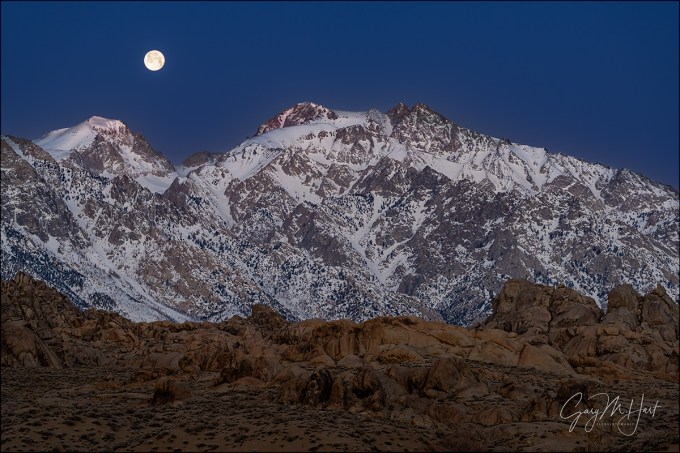
Dawn Moonset, Mt. Williamson and the Alabama Hills, California
Sony a7R V
Sony 100-400 GM
ISO 200
f/8
1/100 second
Sometimes I start a blog post with a very clear idea of what I want to say, and other times I have no idea what I want to say and just go where my mind takes me. I’ll let you decide which this one is.
Digital manipulation has become so widespread that it threatens the credibility of honestly earned images. And now we’re starting to see a proliferation of AI-generated images, algorithmically created using just a few words of description and a database filled with the past creativity and effort of others—no photographer (or even trip outdoors) required.
I’m thinking about this because the Sierra moonset I’m sharing today would be an easy scene to fabricate on a computer: just take any old picture of a mountain, drop a moon in, and voila—suddenly you’re racking up the social media Likes and a host of “Stunning!” comments. But what fun is that?
Where do you find your photographic happiness? I think that’s an important question all photographers should ask themselves from time to time, especially in this age of digital manipulation and oneupmanship.
Speaking only for myself, the best part of making images isn’t the praise, it’s the actually being there to witness Nature do its magnificent thing. And the greatest joy I receive from the images I’ve created is the memory of having been there.
Another personal source of photographic happiness is cultivating relationships with my subjects. Every time I visit a location, I feel the deeper connection that comes with knowing my subject a little better than I did on the previous visit. Wandering, gazing, pondering—all of these activities are as essential to my image capture process as framing a scene and clicking the shutter.
Of course the happiness photography brings me isn’t all taking pictures. For example, I wrote recently about how much the people I meet and guide in my workshops have blessed my life.
Another aspect of my photography life is the immense simply learning about my subjects brings. If a subject appeals to me enough to merit a photograph, it also fascinates me enough to learn more about it.
In fact, sometimes it’s hard to know which came first, the photography or the fascination. Long before I was a photographer (probably starting when I was 9 or 10), I devoured all things astronomy. And a few years later I developed similar interests in geology and meteorology. I can’t say those pursuits are the sole reasons I became a photographer, but I can say with certainty that they’re the primary reason so many of my images include geological features, celestial objects, and interesting clouds and weather.
My (fairly decent) knowledge of the Sierra Nevada and its geological history dates back to my high school and college days, but it wasn’t until I started photographing the Alabama Hills that learned the fascinating specifics of its geology.
Anyone who has visited the Alabama Hills, and hiked the Sierra, can’t help but recognize the obvious differences between their predominant rock: the light gray Sierra rock is so hard it can be polished to a shine by a gliding glacier, while the Alabama Hills’ gritty brown rock surfaces will crumble beneath your fingers. Sierra peaks and prominences tend to be sharp and angular, while the Alabama Hills features are much more rounded. But do just a little research, and you’ll learn that it’s actually the same rock, comprised of the same minerals, formed at the same time, by the same processes.
Both the Sierra Nevada and the Alabama Hills are carved from granite. Starting more than 100 million years ago, subterranean magma intruded into overlying rock, then cooled to form the granite that makes up most of the Sierra Nevada range and the Alabama Hills. Their significant differences are largely due to the way each weathered after the granite formed.
As this newly formed granite waited patiently below in the dark, oceans advanced and receded, depositing hundreds or thousands of feet of new sediment with each iteration. About 5 million years ago, a slow-motion collision of tectonic plates started uplifting the granite and its overlying sedimentary layers to form the current Sierra Nevada. As the mountains rose, erosion accelerated the demise of the softer sedimentary layers, eventually exposing the much harder (more resistant to erosion) granite. This exposed granite was primarily shaped by mechanical weathering—wind, rain and snow, extreme temperature variations, and and many rounds of glaciation—to form the Sierra Nevada we know today.
While the Sierra rose nearby, Alabama Hills granite wasn’t lifted nearly as high. Settling more than 10,000 feet below the Sierra Crest, the Alabama Hills didn’t experience the same extremes as its elevated sibling. Not subjected to the same extreme mechanical erosional forces, the Alabama Hills granite remained subterranean far longer than the Sierra granite. It was subjected chemical weathering that happens when mineral-laden water percolates through overlying sediment and slowly changes to rock’s composition. This altered granite eventually emerged much softer and much more easily rounded by mechanical weathering than the Sierra granite.
There are actually three geological features in this image. Since I’ve given all of the attention so far to the Alabama Hills and Sierra Nevada, maybe I’ll finish a little lunar love.
Once upon a time, there were four primary theories about the Moon’s origin:
- Capture: Earth captured a wandering asteroid and made it its own
- Accretion: Earth and Moon formed at the same time
- Fission: A large glob of molten material spun off the early, molten Earth
- Impact: A Mars-sized planet collided with Earth, ejecting material that later coalesced to form the Moon
If you said 4, give yourself a pat on the back, this is the current consensus. But this theory leaves much unanswered and unexplained, so just pencil it in for now.
From Earth, we can see three distinct lunar features:
- Light areas: These are the highlands—because they’re the oldest rock on the Moon’s surface, the highlands are the most cratered
- Dark areas: Volcanic flow consisting primarily of basalt (think Hawaiian lava)
- Craters: Vestiges of impacts by meteors and comets
And because the Moon has no atmosphere, its features experience very little erosion. Occasionally a meteor will shake things up a bit, and the Moon is under constant bombardment from micro-meteorites that gradual take their erosional toll, but in general the erosional pace on the Moon is much slower than it is on far more dynamic Earth.
Maybe you find all this science boring, but whatever your photographic subjects, I hope they make you as happy as mine make me.
A few words about this image

Dawn Moonset, Mt. Williamson and the Alabama Hills, California
This is the third image I’ve shared from this morning early last month. (You can read about the morning in You Had To Be There and Perfect Timing.) It’s the earliest of the three images, captured in the blue hour, before the sky brightened and alpenglow colored the peaks. This is my favorite time of day to photograph the Sierra Crest, especially in winter, when the snowy peaks seem to glow and stand out in stark contrast to the still-dark sky.
Because the Moon was still a fair distance from Mt. Williamson, this is the widest field of view I used this morning. At 100mm I was able to frame the scene just wide enough to include the Moon, Mt. Williamson, and some of the Alabama Hills, without adding too much sky and (ugly) brown foreground. While I could have used my Sony 24-105 f/4 G lens, I went instead with my Sony 100-400 GM lens. I was especially thrilled with how well my new Sony a7R V handled the extreme dynamic range of the daylight-bright moon and fairly dark early twilight foreground.
(And in case you’re wondering, I used no digital shenanigans for this image. Like all of my images, this is a single click, not a composite.)
Workshop Schedule || Purchase Prints || Instagram
The Alabama Hills


Spring is a State of Mind
Posted on March 20, 2023
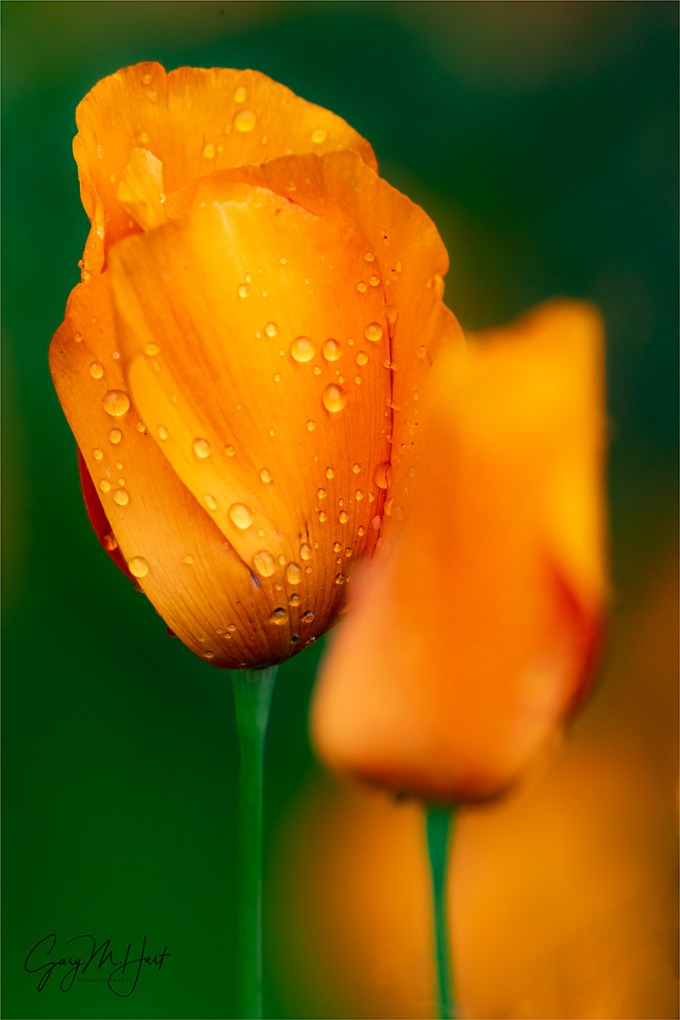
Rainy Day Poppy, Sierra Foothills, California
Sony a7R III
Sony 100-400 GM
Sony 2X Teleconverter + extension tubes
ISO 1600
f/11
1/125 second
According to the calendar, today is the first day of spring—so…, Happy Spring! On the other hand, here in Northern California Mother Nature is delivering very mixed signals. A few trees are blooming, and every few days the sun pops out long enough to forgo a jacket or sweater—but the rain still seems to be coming several times a week, which means (lots of) snow is still falling in the mountains. And the temperatures remain chilly enough that I’ve only dared a short-sleeve shirt once, and my shorts and sandals are still buried in the closet.
Attempting to jumpstart spring, on Saturday my wife and I took advantage of a brief break between storms to drive up into the foothills to check out some of my favorite poppy spots. Usually by mid-March I’ve made this foothills trip several times and am deep into processing the year’s poppy bounty. But on Saturday’s drive we didn’t see a single poppy. Not. One. Poppy. While I was a little disappointed, I certainly wasn’t surprised.
Despite the wildflower shutout, it was a nice drive, and with definite hints of spring. We saw some blue sky, lots of water in the creeks, and hills covered with that happy emerald green that’s only possible in spring (Californians know what I’m talking about).
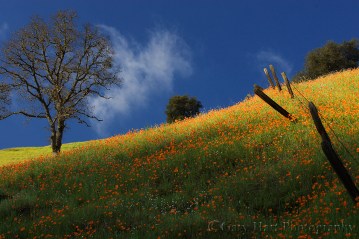
Poppy Hillside, Highway 49, California Gold Country
Our first stop was the site of what remains one of my favorite, and most successful, poppy images. We found the hillside blanketed with peak green, but no poppies. We stayed long enough for me to pull up the picture on my phone and try to figure out where I’d stood for this shot. The fence persists in a similar state of skewed dilapidation, and as my eyes followed its line I mentally relived scaling the deceptively steep hillside. So steep, in fact, that I jettisoned gear to make it up the steepest spot.
A short distance down the hill from this spot is a road that has been the source of many of my favorite poppy images. Sadly, when we got there we found it gated with a “Road Closed” sign, an all too common site this year. This was the final nail in this year’s poppy photography coffin.
But I wasn’t going to go down easy because all this nostalgia really got my poppy juices flowing. So, with no new poppy images to work on, the next day I decided to dig into the archives and try to uncover some I’d missed in previous years. Since I often don’t have time to process everything from any given shoot, I was hopeful that I wouldn’t need to look too long. Starting with a search of processed poppy images, I quickly identified a rainy day shoot from a few years ago that had potential for untapped opportunities.
It actually rained lightly the entire time I was out there, but some of my favorite photography has happened in the rain. And even though poppies don’t usually open when it rains, I found the raindrops more than enough compensation. And with rain gear in my car for just these situations, I stayed warm and dry. My camera? Not so much. I tried working with an umbrella, but after a few minutes realized I was one arm short and just decided to test the water resistance of my Sony a7RIII. I’m happy to say that it passed with flying colors.
A couple of years ago I wrote an article for “Outdoor Photographer” magazine on what I call creative selective focus. (You can read my blog version of this article here.) In it I write about using minimal depth of field to emphasize very select aspects of a scene, and letting the surrounding scene retreat to a complimentary blur.
If you read the article, you know the 3 primary factors for minimizing depth of field: large aperture (small f-number), long focal length, and close focus point. While I could have used my Sony 90mm f/2.8 macro, for close focus photography I really like the compositional flexibility of a zoom lens, so this afternoon I went with my Sony 100-400 GM lens. To increase my focal length (and shrink my depth of field) further, I added my 2X teleconverter (which, I might add, handled the rain perfectly as well). And to focus even closer, I added 26mm of extension. My original plan was try a few lens/extension-tube/teleconverter configurations (including my macro), but I was having so much fun that I ended up shooting with this setup the entire time.
There’s no free lunch in photography—the downside of adding a teleconverter and extension tubes is significantly reduced light. A 2x teleconverter cuts two stops of light, which means my 100-400 that’s normally wide upon f/5.6 at 400mm, wide open becomes f/11. To compensate for light lost to the smaller aperture, added extension, and a cloudy sky, I shot everything this afternoon at either ISO 1600 or ISO 3200 (grateful that there was no wind).
One of the cool things about this kind of photography is how different the world looks through the viewfinder. I love putting my eye to my camera, moving the lens around, and changing focus slowly to see what snaps into view. In this case I was looking for poppies to isolate from their surroundings, as well as nearby features (like other poppies) that I could soften enough to complement my primary subject without competing. Sometimes I had a general idea of a subject before looking through my camera, other times I’d just explore with my eye to my viewfinder until something stopped me.
Because depth of field shrinks not only with focal length, but also with focus distance, every frame I clicked this afternoon had a paper-thin range of sharpness. With such a shallow depth of field, none of these images would have been possible without a tripod. With my composition set on my tripod, I’d pick a focus point (usually, but not always, a prominent raindrop), focus in my viewfinder until I was pretty certain it was sharp, then magnify the focus point in my viewfinder to confirm and tweak the focus.
I finally called it quits when the rain picked up and the approaching twilight forced too much shutter speed compromise.
Workshop Schedule || Purchase Prints || Instagram
My Favorite Poppies


Perfect Timing
Posted on March 14, 2023

Big Moon, Mt. Williamson, California
Sony α1
Sony 200-600 G
Sony 2x teleconverter
ISO 800
f/13
1/500 second
In the Alabama Hills to photograph sunrise in neck-craning proximity to the Sierra Crest, I knew precisely what time, on this date, the sun’s first rays would color the towering granite, and exactly when a 98% moon would would disappear behind the left flank of Mt. Williamson, California’s second highest peak.
Clocks and calendars enable us to time some aspects of our lives, like sunrises and moonsets, to within microseconds. But when I scheduled this sunrise moonset more than a year ago, I had no idea whether the sky would be clear, perhaps feature a few clouds that would catch the sunrise hues, or be completely filled with overcast that would block sunlight and hide the moon. I didn’t know how much snow would drape the peaks, or whether the peaks even would be visible at all.
Clocks and calendars are essential, but as a self-employed landscape photographer, I’m beholden to far more fundamental constructs than the bustling majority is. I work when there’s work to be worked, and play when (fingers crossed) there’s play to be played. The business side of my life sometimes requires a clock and calendar, but the actual photography part is governed by fundamental laws of nature that transcend the rest of the world’s clocks and calendars.
The irrelevance of conventional time measurement is never more clear than immediately following a time change. On the second Sunday of each March, when “normal” people moan about lost sleep and having to rise an hour earlier, the sun thumbs its nose at Daylight Saving Time and rises a mere minute (or so) earlier than it did the day before. So do I. And on the first Sunday of November, as others bask in their extra hour of sleep, I’ll get to sleep an entire minute longer. Yippee.
The immutable natural laws that are the foundation of our clocks and calendars, that keep the world on schedule and enable us to precisely predict events like sunrise/sunset, the moon’s phase and position, as well as countless other celestial phenomena, are also solely responsible for the uncertainty that torments the lives of landscape photographers. While I can’t tell you what thrills me more, the impeccably punctual appearance (or disappearance) of a full moon, or the unpredictable explosion of a lightning bolt, I find it ironic that the precision of a moonset and the (apparent) randomness of a lightning strike are ultimately the product of the same celestial choreography.
Earth’s rotation on its inclined axis and revolution about the Sun, the Moon’s monthly journey around Earth, are are timed to microseconds. But this celestial dance also drives the atmospheric and tidal machinations that generate weather, stir oceans, and make every day unique and unpredictable.
This year the mercurial photography gods smiled on me and my Death Valley workshop group. For our 3 days in Death Valley, instead of the blank blue sky that often greets me here, we had a wonderful mix of clouds and sky—enough clouds to make the sky interesting, but enough sky to allow the sun to color the clouds at sunrise and sunset.
On the workshop’s penultimate day we drove to Lone Pine to wrap up with a sunset and sunrise shoot in the Alabama Hills. The highlight of this trip is always the Alabama Hills sunrise that I try to accent with the moon, just a day past full, setting behind the Sierra Crest. But this is winter, and these are the Sierra Mountains, so success is far from guaranteed.
A few years ago I drove to Yosemite on New Year’s Eve (because what else is there to do on New Year’s Eve?) to photograph a full moon rising between El Capitan and Half Dome. After a successful shoot (nearly thwarted by clouds), I hopped in my car and made the 6 1/2 hour drive to Lone Pine to photograph the moon setting behind Mt. Whitney.
I’d picked out a location along Highway 136 where I could align the moon and Mt. Whitney, and far enough back to allow an extreme telephoto big moon while still including all of Whitney. I went to bed really looking forward to this opportunity to get an image I’d thought about for years, and woke to clouds that completely obscured the moon and Sierra Crest. With nothing better to do, I still drove out to my spot, and even caught a very brief glimpse of the moon about 1/2 hour before zero-hour, but ended up not clicking a single frame. Such are the travails of anyone who pins their hopes on Nature’s fickle whims.
My plan this morning was far less grand. Since I was leading a workshop group, the goal was to get everyone in place for the best possible photography, not to assuage my own failed moonset wounds. And the good fortune that blessed us in Death Valley followed us to Lone Pine. (You can read more about this morning here.) In addition to a clear view of the moon and mountains, I was especially grateful to find the entire Sierra Crest frosted top-to-bottom with snow.
My photography day began in near darkness with my Sony a7R V and Sony 100-400 GM lens, photographing the descending moon throughout the morning’s many stages of advancing light. My starting focal length was 100mm, wide enough to include some of the Alabama Hills, then went progressively tighter as the moon dropped.
My favorite big moon images don’t usually happen until the moon is within a moon-width of the horizon, but I like to give myself a little wiggle room to get the composition balanced and focus just right. So when the moon got about 3 diameters from Mt. Williamson, I turned to my Sony α1, which was standing by with my Sony 200-600 G lens and Sony 2X Teleconverter already attached. And while 3 moon diameters might sound like a reasonable cushion, if you want to appreciate the speed at which the moon transits the sky, try pointing 1200mm at it and keeping it in your frame.
I love my Really Right Stuff Ascend tripod, but because the camera-shake margin of error is microscopic at 1200mm, I had the α1 pre-mounted on my (much more robust) RRS 24L Tripod with the RRS BH-55 ball head (carrying 2 tripods is a luxury I allow myself when I don’t have to fly to my location). I bumped to ISO 800 for a 1/500 second shutter speed, and switched from my standard 2-second timer (beep, beep, beep, BEEEEEEP—the Sony mating call) to a 5-second timer (I’m not crazy about any of Sony’s remote options, wired or wireless), to give the whole setup plenty of time to settle down—probably overkill, but I was taking no chances.
With my composition ready and focused, I just let the moon slide through my frame and started clicking. The alpenglow on Mt. Williamson was just about peaking when to moon first touched it. Perfect timing.
Workshop Schedule || Purchase Prints|| Instagram
More Massive Moons
Click any image to scroll through the gallery LARGE


It’s All About the People
Posted on March 6, 2023

Swoosh, Northern Lights Over Kirkjufell, Iceland
Sony a7R V
Sony 12-24 GM
5 seconds
F/2.8
ISO 6400
As I’ve made abundantly clear in earlier blog posts, 2023 started with my busiest ever workshop stretch. But I’ve finally reached enough of a lull in my schedule to start processing the fruits of all this labor—not nonstop, but maybe one or two images a day if I’m lucky. Part of me feels a little overwhelmed by how how long it could take at that rate, especially since I’m just two months into the year with many more trips ahead. But another part of me looks at the things I’ve seen and photographed and remembers how uncertain I was when I turned my stable life upside-down to start leading photo workshops. If you’d have told me that in 17 years I’d have more images than I have time to process, I’d have taken it with no questions asked, so no complaints.
To say that leading photo workshops has exceeded my expectations would be a vast understatement. I came into it with 20 years of technical communications experience (teaching a programming language, tech writing, and tech support), and thirty years as a serious amateur photographer. And as a California native who grew up camping, backpacking, and (later) photographing all of my initial workshop locations (Yosemite, Eastern Sierra, Death Valley), I was intimately familiar with my subjects. Piece of cake, right?
That said, since photo workshops weren’t really much of a thing 17 years ago, I was totally winging it when I started. Having never actually taken a photo workshop myself, I didn’t even have a template for how it should be done, so I just structured mine the way I thought I’d like a workshop to be run if I were to attend one. Since then I’ve learned so much—and of course much of what I’ve learned is stuff I didn’t even know that I didn’t know. (For example, walkie-talkies seemed like a good idea, so I invested in 15 of them and now have a box of 15 once-used walkie-talkies somewhere in my garage.)
A big unknown for me was the people part of the equation—I like people, but (perhaps you’ve noticed) people can be difficult. Would every group have a difficult person (or two, or three, or…), and how would I handle them? I mean, no longer would I be lecturing programmers and IT geeks in an air conditioned training room, delivering a canned presentation I’d offered countless times before. Leading photo workshops would mean herding a group of individuals with a broad range of fitness, skill, equipment, expectations, and needs, through remote areas in extreme, unpredictable conditions. What could possibly go wrong?
It turns out, not too much. First, I’ve always felt that my best photography memories often come in the most extreme conditions. And guess what—it turns out most other photographers feel the same way, and will gladly endure extreme conditions in exchange for great photography. They’ll also forgive difficult conditions that prevent potentially great photography: a downpour that makes photography impossible, clear skies that bathe beautiful scenery in harsh light, clouds that block a much anticipated moonrise, and so on.
But what about basic human diversity? Surely attempting to integrate a bunch of people with so many differences would be a recipe for disaster. Concerned about mixing struggling beginners with impatient experts, I originally toyed with the idea of minimum equipment and experience requirements. What a mistake that would have been. While most of my workshops include photography skills ranging from enthusiastic beginner to experienced pro or semi-pro, rather than generating tension, these differences have created a synergy, as it turns out most experts love sharing their knowledge and experience with those who need it.
Of course diversity encompasses more than photography skill. I’ve had workshop participants from nearly every continent (no penguins so far), and (I’m pretty sure) every state in the U.S. My workshop participants have been, in no particular order, musicians, computer professionals, artists, physicians, writers, lawyers, corporate executives, electricians, accountants, bond traders, active and retired military, other professional photographers, real estate agents, clergy, stay-at-home dads and moms, a classical composer, a Hollywood graphic artist, and a Hooters girl (a very sweet young lady who would completely dash any preconceived impression of what that might mean). In one workshop I had a rocket scientist and a brain surgeon. I’ve gotten to know a woman who biked across America, and a man who hiked the entire Pacific Crest trail. I’ve had (many) gay and lesbian couples, outspoken liberals and conservatives, a couple of people in a wheelchair, a man in the final stages of cancer, the patriarch of a family that endured one of America’s most public (and irrational) scandals, and a 9/11 survivor. So it’s not hyperbole to say that I’ve learned as much from my students as they’ve learned from me.
The common denominator connecting all this disparity? A passion for photography that unites strangers long enough to overcome superficial differences and appreciate deeper similarities: a love of family, friendship, nature, sharing, and laughter.
Of course it hasn’t all been a Disney movie. One question that comes up from time to time is whether I’ve ever had anyone attend a workshop who I would not allow in a future workshop. For a long time my answer was an immediate and emphatic, No, everyone’s been great. About 8 years ago one person changed that answer, but fortunately that turned out to be a one-off situation that hasn’t been repeated. (And thankfully that person has not attempted to sign up for another workshop.)
The bottom line is that a successful photo workshop is more about its people than it is about the location and conditions. My job is to create an environment that fosters connection, guide them to the best photography possible, then step back and let the participants themselves enjoy each other.
About this image

Swoosh, Northern Lights Over Kirkjufell, Iceland
Of course great locations and conditions can certainly contribute to the happiness factor, and nothing makes a group happier than photographing the spectacular sights they signed up for in the first place.
I’ve already shared a couple of northern lights images from the first of the two Iceland workshops Don Smith and I did in January. Both of those images came from the workshop’s third night of photography, which I called the most spectacular aurora display I’ve ever witnessed. But after spending more time with my images from the previous night, I’m thinking maybe that proclamation was a little too hasty. But anyway, it’s not a competition, so who cares?
On our first night the group was completely shutout by an overcast sky. It didn’t help that later that night I got a text from an Icelandic friend congratulating me on getting the northern lights on the workshop’s first night, and I had to reply that unlike his vantage point in Reykjavik, we had wall-to-wall clouds up on the Snæfellsnes Peninsula.
While the aurora forecast was also good for our second night, the clouds persisted all day. But with clearing forecast that night, we ate dinner at a restaurant just a few minutes from Kirkjufell, then kept an eye on the sky. While waiting for the clouds to part after dinner, we got to watch Iceland’s handball team compete in the handball equivalent of the World Cup. I played a little handball in high school, this is a completely different sport (something like a soccer/basketball hybrid) that is clearly a huge deal in Iceland because half the town was crowded into this little pizza place to watch it. (It’s really a lot of fun to watch and many of us in the group got into it enough that we watched Iceland’s remaining tournament games as well.) But anyway…
The sky was just starting to clear when the game ended; by the time our bus parked at Kirkjufell the lights were dancing in all directions and we raced to the view as fast as our crampons would take us. Since this was most of the group’s first northern lights experience, I spent a few minutes getting people situated with exposure and focus. It was nice that we were the only ones out there (when we started), so everyone was free to spread out and make their own compositions.
Looking up at the variety of colors and ever-shifting forms felt like standing inside a celestial lava lamp. I started with my Sony a1 and Sony 20mm f/1.8 G lens, but the lights covered so much sky that I soon switched to my Sony a7R V, which I’d pre-loaded with my Sony 12 – 24 f/2.8 GM lens.
I moved around based on where the display was best at the moment, most of the time trying to align the aurora with Kirkjufell, but at one point I dropped down to the bottom of the slope and shot in the other direction to capture fanning shafts in the sky above Kirkjufellsfoss (the waterfall). When a magnificent arcing beam stretched across the northern sky, starting in the northeast and continuing out toward the western horizon, I was extremely grateful to have a wide enough focal length to capture the entire arc with Kirkjufell.
Though the temperature was about 10 degrees, with a 20+ MPH wind (and gusts closer to 40 MPH), I hardly noticed the cold. And I suspect no one else did either, because I didn’t hear a single complaint.
Join Don Smith and me for our next aurora chasing adventure
Workshop Schedule || Purchase Prints || Instagram
2023 So Far
Click any image to scroll through the gallery LARGE


 Eloquent Images by Gary Hart