Eloquent Images by Gary Hart
Insight, information, and inspiration for the inquisitive nature photographer
Snow Job
Posted on March 24, 2018

Winter Reflection, Bridalveil Fall and the Merced River, Yosemite
Sony a7R III
Sony 16-35 f/2.8 GM
1/4 second
F/14
ISO 50
I’m afraid that making a living as a photographer sometimes means exchanging time to take pictures for time to make money. On the other hand, my schedule is mine alone, which means when there’s something I really, really want to photograph, such as a moonrise or fresh snow in Yosemite, I can usually arrange my schedule to make it happen. The moon shoots I can plan a year or more in advance, but snow requires a little more vigilance and flexibility.
Early this month, with hints of snow coming to Yosemite Valley, I started clearing space in my schedule. At 4000 feet, Yosemite Valley is often right on the snow-line, so a swing of just a couple hundred feet in either direction can mean the difference between snow and soggy. After watching the weather reports vacillate between snow and rain all week (and adjusting plans more than once), my buddy Mark and I took a chance and made the drive to Yosemite, visions of snowflakes dancing in our heads.
Waiting at the traffic-light-controlled, one-lane detour around the Ferguson Slide on Highway 140, I watched dozens of westbound headlights file past the four or five eastbound taillights idling at the light in front of us. With a storm imminent, it occurred to me that we were participating in a kind of changing of the guard, where the evacuating tourists are replaced by a much smaller contingent of what could only be photographers.
We arrived in Yosemite Valley at about the same time as the rain, circled the valley, secured a cheap room at Yosemite Valley Lodge (in Yosemite, any night with plumbing and solid walls for $150 is in fact a steal), and went to dinner. When the rain continued through dinner and all the way until bedtime, I began to fear the weather report had vacillated once more in the wrong direction.
Peeking out the window at around 4:00 a.m. and seeing more rain, I grudgingly turned off the alarm I’d optimistically set for 6:00 a.m. and went back to sleep. The next thing I knew, Mark was waking me at 6:10 to report six inches of fresh snow, and it was still falling. By 6:15 we were bundled and searching for my car in a parking lot filled with identical white lumps.
The rest of the morning was a blur as Mark and I darted from pristine location to pristine location, marveling at how a few hours of snow can completely transform months of accumulated grime and a thirsty forest dotted with dead and dying trees. For those few hours, Yosemite was new again.
At our first stop, El Capitan Meadow, we photographed El Capitan and Cathedral rocks battling the clouds for dominance. Down the road at Valley View, the snow continued falling but the granite was winning and I soon found myself admiring the reflection of Cathedral Rocks and Bridalveil Fall just upriver from the parking area.
Normally the thin branches overhanging this vantage point are a distraction to avoid, but glazed with snow, they had the potential to make a perfect frame. The reflection was the easy part, but somehow I had to figure out how to feature it and the branches without the branches obliterating the rest of the scene.
To separate Bridalveil Fall and Cathedral Rocks from the glazed branches, I splayed my tripod’s legs and dropped it to the ground, then scooted up to the river’s edge. That still left a few branches dangling too low, so I pushed my camera out even farther by extending one tripod leg into the river. I was aided immensely by the articulating screen of my Sony a7RIII—while I still needed to sit in the snow to get low enough to compose and control my camera, I very much appreciated the ability to sit and look down at my LCD rather than sprawl on my stomach in the snow to get my eye to the viewfinder.
When photographing a scene that includes a reflection and nearby objects, it’s important to remember that the focus point of a reflection is the focus point of the reflective subject, not the reflective surface. (I’ll pause here for a few seconds to let you process this because it’s important.) In this case I was at 16mm; at f/11 that gave me a hyperfocal distance of less than four feet; with the branches about five feet away, front-to-back sharpness wouldn’t be a problem, even focused at infinity. Nevertheless, I chose f/14 for this shot, not for more depth of field, but to (along with ISO 50) stretch my shutter speed enough to smooth a few small ripples in the reflection.
Excitement about a scene can overwhelm good sense—we see something that moves us, and quickly point the camera and click with more enthusiasm than thought. While this approach may indeed record memories and impress friends, it almost certainly denies the scene the attention it deserves. I was indeed very excited about this scene, but between the depth of field, reflection, overhanging branches, moving water, dominant background subjects, not to mention the awkwardness of my position, I had many moving parts to consider.
Rather than attempt perfection on the first click, I addressed the obvious stuff (covered above) with a “rough draft” click. Draft image in hand, I popped my camera off the tripod, stood (ahhhhh), and evaluated my result. I immediately saw two things to address: first, I wanted Cathedral Rocks better framed by the branches; second, I wanted the mid-river, snow-capped rocks away from the right edge of my frame.
I returned my camera to live-view, dropped to ground-level, and replaced the camera on my tripod. Because I hadn’t touched the tripod, the scene on my live-view LCD was the very scene I’d just reviewed—making my prescribed adjustments was a simple matter of panning right a couple of inches and pushing the tripod a little farther into the river. Click.
I love my job.
Join me in Yosemite this winter
Workshop Schedule || Purchase Prints
Yosemite Winter


Tapping the joy
Posted on January 28, 2018

Rainbow and Snowfall, Bridalveil Fall, Yosemite
Sony a7R II
Sony/Zeiss 24-70 f4
1/60 second
F/11
ISO 100
The downside of turning your passion into your profession is that so many decisions are no longer based on the pleasure they bring. Since my early 20s, I’d been very happy as an amateur photographer, picking my photo destinations and the images I clicked for the sheer joy of it. But I knew becoming a professional photographer risked preempting that joy with photography decisions designed to pay the bills.
For that reason, part of my decision to become professional a dozen or so years ago included a personal vow to only photograph what I want to photograph, and to never take a picture just because I thought it would make money. I was able to blend my years of photography experience with my prior career in technical communications (tech writing, training, and support) to create a photography business based on photo workshops, not image sales. Of course I do sell images too, but I’ve always viewed image sales as a bonus rather than something to something I rely on.
I’m thinking about this right now because this image reminds me how little time I actually have to work on my images. I’d totally forgotten about this afternoon from last April, when a storm cleared to reveal a dusting of fresh snow on the granite surrounding Yosemite Valley. As we stood marveling at the majesty, a ray of sun burst through the clouds to paint a vivid rainbow in the mist gathered beneath Bridalveil Fall.
It’s finds like this that remind me of the hundreds (thousands?) of images waiting to be processed and shared, some going back more than ten years. This isn’t a complaint—I can’t image a better life than mine. In fact, instead of lamenting the inability to reap the fruits of my labor, I find comfort in the knowledge of these images’ existence. Even if I never process and share them, they’re a reminder of my good fortune. If there’s a lesson here, maybe it’s that, for me at least, the true joy of photography isn’t the images and the acclaim they evoke, it’s simply the act of capturing them.
Workshop Schedule || Purchase Prints
Some Personal Favorites


Silent Night
Posted on March 21, 2017

Silent Night, Yosemite Valley from Tunnel View
Sony a7R II
Sony/Zeiss 16-35 f/4
20 seconds
F/5.6
ISO 1250
One perk of being a photographer is the opportunity to experience normally crowded locations in relative peace. That’s because the best nature photography usually happens at most people’s least favorite time to be outside: crazy weather and after dark. A couple of weeks ago in Yosemite I got the opportunity to enjoy both.
After spending a snowy Sunday guiding a couple around Yosemite Valley in a snowstorm, I dropped them back at (the hotel formerly known as) The Ahwahnee with nothing but the drive home on my mind. But winding through the valley in the fading twilight I saw signs of clearing skies and made a snap decision to check out the scene at Tunnel View.
I found the vista at Tunnel View gloriously empty. By the time I’d set up my camera and tripod the darkness was nearly complete, but as my eyes adjusted I could make out large, black holes in the once solid clouds overhead. Soon stars dotted the blackness above El Capitan and the white stripe of Bridalveil Fall. Each time light from the waxing gibbous moon slipped through the shifting clouds, the entire landscape lit up as if someone had flipped a switch.
Because the best parts of the view were in a narrow strip starting with the snow-glazed trees beneath me and continuing through the scene and up into the star-studded sky, I opted for a vertical composition. To include as much foreground and sky as possible, I went nearly as wide as my 16-35 lens would allow, more or less centering El Capitan and Bridalveil Fall to give the snow and stars equal billing.
Being completely comfortable with my a7RII’s high ISO performance, I didn’t stress the 1250 ISO that allowed me to stop down to a slightly sharper f/5.6 (virtually every lens is a little sharper stopped down from its largest aperture). Night focus with the Sony a7RII is extremely easy, easier than any camera I’ve ever used that isn’t an a7S/a7SII. Often I manually focus on the stars and use focus peaking* to tell me I’m sharp; in this case I back-button auto-focused on the contrast between the moonlit snow and dark granite near Bridalveil Fall. I chose a long enough shutter speed to capture motion blur in the rapidly moving clouds, knowing the potential for visible star streaking was minimized by my extremely wide focal length.
My favorite thing about that evening? The 20 seconds my shutter was open, when I didn’t have anything to do but stand there and enjoy the view in glorious silence.
* Focus peaking is a mirrorless feature that highlights in the viewfinder the in-focus areas of your scene.
Workshop Schedule || Purchase Prints
Yosemite After Dark
Click an image for a closer look and slide show.


Variations on a scene
Posted on March 14, 2017
Snowfall, Tunnel View, Yosemite
Sony a7R II
Sony/Zeiss 16-35 f/4
1/250 second
F/9
ISO 100
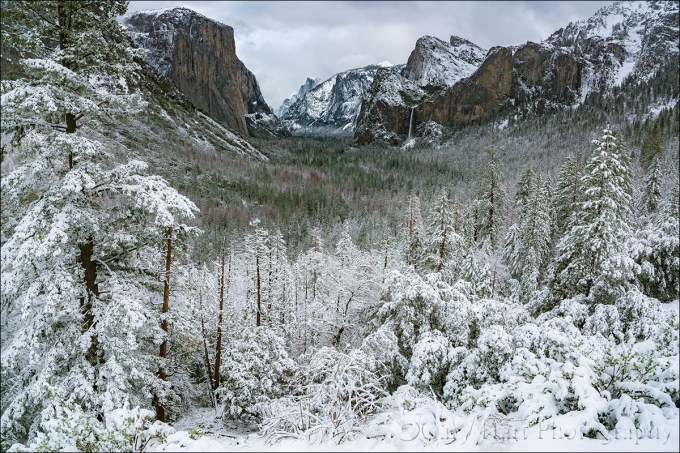
A week or so ago I had the good fortune to be in Yosemite for the most recent snowfall there. All week the National Weather Service had been waffling a bit on the snow—based on the forecast, I probably wouldn’t have made the trip. But I was there anyway, guiding a fun couple from England for the weekend. Following a nice but unspectacular Saturday, we woke Sunday morning to find the world dipped in white.
The snow fell all day, at times so hard that that it was difficult to see more than a couple hundred yards, other times dwindling to a few flakes per minute. During one of the lulls we made our way to Tunnel View for the obligatory shot there. Despite hundreds (thousands?) of pictures of this view, after surveying the scene for a few minutes I couldn’t resist pulling out my camera and tripod.
My general feeling is that people tend to go too wide with their Tunnel View images, shrinking the main features (El Capitan, Half Dome, Bridalveil Fall) to include less exciting granite left of El Capitan and right right of Cathedral Rocks/Bridalveil Fall. That’s why I opt to tighten my horizontal Tunnel View compositions on the left and right, or isolate one or two of the three primary subjects with a telephoto. And when something exciting is happening in the sky (moon, clouds, or color) or foreground (fog, snow, rainbow), I’ll often compose vertically and bias my composition to favor the most compelling part of the scene.
With so many Tunnel View images in my portfolio, that afternoon I consciously set aside my long-held composition biases in favor of something I don’t already have. Of course the feature that most set the scene apart was the snow, so I set out to find the best way to emphasize it. Because the snow level that day was right around 4000 feet, also the elevation of Yosemite Valley, even the three hundred or so feet of elevation gain at Tunnel View resulted in much more snow virtually at my feet than on the distant valley floor. My Sony/Zeiss 16-35 f/4 lens, a great lens that I usually find too wide for Tunnel View, was perfect for highlighting the foreground snow.
Dialing my focal length to about 20mm allowed me to maximize the foreground snow while including minimal less-than-interesting gray sky. Of course going this wide meant shrinking the scene’s “big three” and adding lots of extraneous middle-ground on the left and right. To mitigate that problem I used the snowy pine on the left, often an obtrusive distraction to be dealt with, as a frame for that side of the scene. Not only did the tree block less interesting features, it actually enhanced the snowy effect I sought. On the right the diagonal ridge added a touch of visual motion (diagonal lines are so much stronger visually than horizontal and vertical lines), and it didn’t hurt that much of the bland granite there was covered with snow.
Workshop Schedule || Purchase Prints
A Tunnel View Gallery
Click an image for a closer look and slide show. Refresh the window to reorder the display.


It ain’t over till it’s over
Posted on January 26, 2017

After Twilight, Valley View, Yosemite
Sony a7R II
Sony/Zeiss 24-70 f4
30 seconds
F/8
ISO 800
(How many photography blogs out there quote Yogi Berra? Just sayin’….) During the 1973 baseball season, Yogi Berra was asked about his last place Mets’ chances in the pennant race. His reply, “It ain’t over till it’s over,” was greeted with chuckles, but Yogi got the last laugh when the Mets rallied to make it all the way to the World Series. I couldn’t help thinking of Yogi’s quote on my drive home Monday night with this image, my final click of the day, still fresh in my mind.
When the weatherman promised snow down to 2500 feet on Monday, I drove to Yosemite late Sunday night so I could beat sunrise and have an entire day to play. And snow I found, lots and lots of it, and still falling. The snowfall continued throughout morning, so heavy that my first few hours were limited to photographing close scenes, interspersed with lots of waiting for conditions to improve. But a little before noon the clouds started to thin and the snow became more showery and I was in business.
When the clearing started in earnest I was at Valley View (but it didn’t look anything like this). The rest of the day I spent dashing around Yosemite Valley, chasing the clouds’ parting and the light that came with it. It’s so much fun watching a storm clear in Yosemite, poised beneath Yosemite Falls or Half Dome or El Capitan, and wait for the big reveal when the clouds to pull back.
For sunset I ended up trudging through about 18 inches of virgin snow to a favorite Half Dome reflection spot by the Merced River, recently rendered much less accessible by major roadwork underway in the valley. Throughout the day I’d crossed paths several times with good friend Don Smith who had driven up for the day with our mutual friends Scott and Mike, and they eventually joined me at sunset. As we shot we shared stories of the day—for example, how they had just missed getting crushed by a falling tree (true story). After a half hour of really nice photography, a large cloud set up shop atop Half Dome right around sunset, completely obscuring the scene’s main attraction. Satisfied with a tremendous day of photography, we declared the day, “Over.”
It wasn’t until I was back at my car that fully appreciated how wet everything was—my gear, my car, and even me (a day of plunging through snowdrifts had been enough for the snow to find its way over the top my waterproof boots and underneath my waterproof outer pants). I decided I’d swing into Valley View on my way out of the valley to use the bathroom and change into drier clothes. In the back of my mind was possibility of a parting shot of El Capitan in the late, blue twilight.
The west end of Yosemite Valley gets much less winter sunlight, so while trees had already started shedding the snow on the east side (where I’d photographed sunset), I pulled in at Valley View to find virtually every exposed surface still glistening white. Bridalveil Fall and Cathedral Rocks clearly visible in the fading light, but El Capitan was cloud-shrouded from top to bottom. Still quite cold, tired, and more than a little hungry, this would have been a perfect excuse to beeline home. But the scene was so beautiful, and the light so perfect, that after changing my clothes I just sat in my car, peeled an orange, and waited for El Capitan to show itself.
I didn’t have to wait long. At the first sign of clearing I hopped out and was completely set up by the river before El Capitan appeared. Bumping my ISO to 800, I composed the standard horizontal frame with El Capitan on the left, Leaning Tower on the right, and the Merced River in the foreground. Often the most difficult thing about shooting in low light like this is finding focus, but despite the fact that it was more 30 minutes after sunset, my Sony a7RII was able to autofocus on Cathedral Rocks. I spent a several clicks refining that original composition and was about to call the day “Over” one more time when something moved me to shift my view to the right. As soon as the image popped up on my LCD I knew I was onto something. I refined for about a half dozen more frames, culminating with the one you see here, until I was satisfied that a great day truly was over.
The lesson here, one I learned many years ago but I see many photographers struggle to grasp, is that the camera can still do fantastic things long after your eyes tell you the show is over. Another satisfying reminder from this day is that it’s still possible to enjoy Yosemite in glorious peace. As someone who has seen Yosemite at its congested worst, I relish the solitude possible when I choose times that the average person (tourists, fair weather photographers) won’t venture out: miserable weather, late at night, before sunrise. The entire time I was out there at Valley View that evening I was alone, and only two cars drove by. As Yogi would say, “Nobody goes there anymore—it’s too crowded.”
Workshop Schedule || Purchase Prints
A Twilight Gallery
Click an image for a closer look and slide show. Refresh the window to reorder the display.


The best lens for the job
Posted on December 28, 2016
Dawn, Tunnel View, Yosemite
Sony a7R II
Sony 70-200 f/4
25 seconds
F/8
ISO 200
Probably the workshop question I am asked most is some variation on, “What lens should I use?” While I’m happy to answer any question, this one always makes me cringe because the implicit question is, “Which lenses can I leave behind?”
What many photographers fail to realize is that the “proper” lens isn’t some absolute determined by the scene, a secret known only by the best photographers, it’s a creative choice made by each photographer who visits. While prior captures often imply a general consensus on a scene’s primary composition, that pretty much turns out to be the first composition everyone sees—just the compositions creative photographers should avoid. When I tell you the lens to use, I’m imposing my creative instincts rather than cultivating yours. “Okay, right, I get it. But seriously—what lens should I use?” Sigh.
Suck it up
The best landscape images usually require some sacrifice, so if you’re making lens choices based on what’s most convenient, maybe landscape photography isn’t for you. I’m not talking about risking your life to get the shot, or exceeding your physical limitations, but I am talking about a willingness to experience a little discomfort for your craft. That means venturing out in miserable weather, rising well before the sun, or (gulp) skipping dinner. And yes, it even means lugging a little heavier camera bag than you might prefer.
My general rule is to, at the very least, carry lenses that cover the full-frame focal range from 20mm-200mm. There are some trade-offs in the number of lenses you choose to achieve this. Some carry just one or two zoom lenses, sacrificing speed and image quality for comfort, convenience, and mobility; others go hardcore, lugging an assortment of fast, ultra-sharp primes. I’m in the middle, extremely happy with the combination of quality and compactness I get with my three Sony f/4 zoom lenses: the 16-35, 24-70, and 70-200.
In addition to my three primary lenses, I never go out without my full frame Sony a7RII and 1.5 crop Sony a6300 bodies. Because a 1.5 crop body increases the effective focal length of each lens by 50 percent, with these two bodies I can cover the focal range from 16mm-300mm. I also have a few specialty lenses that may or may not stay in the car (but never at home), depending on the scene, the room in my bag, and how much hiking/climbing/scrambling I’ll be doing: a Tamron 150-600 for extra reach; a Rokinon 24mm f/1.4 lens for starlight; and a Sony 90mm macro.
So seriously, the lens you choose for a scene is part of the creative process that defines you as a photographer, a personal decision that I’m happy to assist, but reluctant to dictate. In fact, it’s a rare scene that’s worthy of capture with one lens that’s not worthy of capture with another. And another. (And I promise that the surest way to need a particular lens is to leave it behind.) I’m not suggesting that you lug Hermione’s purse to every shoot; just try to remember that your images will last far longer than your discomfort.
Case in point
I do a half dozen or so workshops in Yosemite each year, plus a number of private tours. That means I spend a lot of time at Tunnel View. A lot. But I don’t photograph there much anymore unless I think I can get something I don’t already have, which means I do lots of watching other photographers. One thing I notice is how few photographers use a telephoto lens here. Given the breadth of the view, and the volume of existing wide angle Tunnel View images we’ve been conditioned by, reflexively reaching for the wide angle lens at Tunnel View is understandable. But approaching any scene with a preconceived idea of the best lens limits the array of creative opportunities the scene provides.
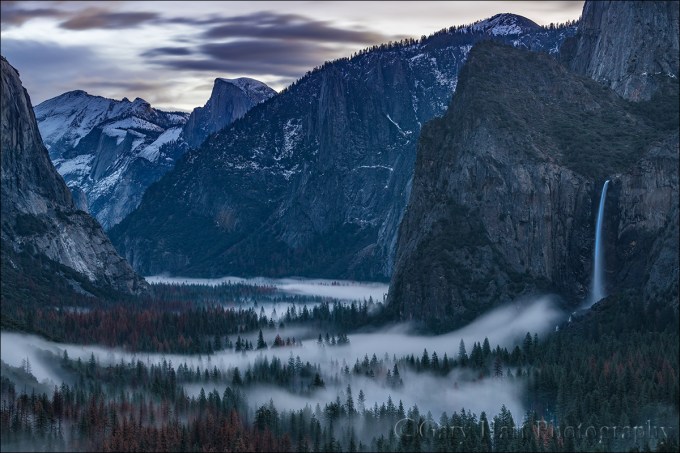
One chilly morning at Tunnel View earlier this month, my winter workshop group enjoyed the snowy granite, wispy fog, and pristine air only possible after a winter storm. Of course we had all of the standard wide angle compositions at our disposal, but when the fog and pastel sky moved me to pull out my camera, it was my 70-200 that I chose to pair with it. I tried a few compositions, before settling on this one that was just wide enough to include Half Dome, Bridalveil Fall, most of the fog, and the only clouds remaining from the storm. Not only would a wide angle lens have shrunk what I felt were the scene’s most significant features, my telephoto lens was able to exclude from my image the bright, empty sky above Half Dome, and most of the dead, brown trees scarring Yosemite Valley.
Because this image was captured 20 minutes before sunrise, the scene my eyes saw was much darker than what my camera captured. Photographers able to see with their camera’s vision rather than their own love photographing in the sweet light only possible at twilight. In this case not only did I benefit from a shadowless foreground, the 25-second exposure smoothed the clouds, fog, and waterfall ethereal quality.
I won’t pretend that this is a groundbreaking capture (far from it), but if I’d have walked up to the scene with a wide angle already mounted instead taking it all in before choosing my lens, I don’t think I’d have been nearly as happy with my results.
Workshop Schedule || Purchase Prints
A Tunnel View Gallery
Click an image for a closer look and slide show. Refresh the window to reorder the display.


Someday My Prints Will Come
Posted on August 1, 2016
First Light, Yosemite Valley
Canon EOS-1Ds Mark III
Canon 24-105L
1/3 second
F/16
ISO 100
Someday is now…
The dilemma
I’ve been selling prints of my images for about fifteen years. I started at weekend art shows and in art galleries, and soon added a modest online store. The art shows in particular were very successful, but as much as I enjoyed them (I truly did), the shows required so much work that I stopped because they detracted from my primary bread and butter, the photo workshops.
Despite my workshop emphasis, I have maintained a small gallery presence, and continue to offer my prints for sale on my website (which I’ve upgraded significantly). While I still sell prints fairly regularly, I know there are many more people who don’t purchase them because they’re just too expensive.
I can explain
Though printing is a pretty labor intensive process, I’ve always insisted on doing it myself, largely because I’ve never trusted anyone else to create the print to my satisfaction. But the amount of work that goes into each print (even after it’s been processed and sized)—from constant maintenance (clearing clogged print heads, monitor calibration, paper and ink management, and so on) to careful packaging and shipping—results in pricing that’s prohibitive for many people.
Finally, a solution
For a long time I’ve sought a solution that would cut me out of the printing and shipping side of the transaction while still yielding quality prints, and think I’ve finally found one. I’ve spent the last few weeks creating a SmugMug website exclusively for showcasing my prints for sale: GaryHartPrints.com. On this new site, instead of coming to me, your print orders will go to the much acclaimed Bay Photo Labs, my longtime lab of choice for jobs my own printer can’t handle (such as prints too large, or paper I don’t offer).
Though these prints won’t have my personal signature, each print has been photographed, processed, copyrighted, and digitally signed by me. I can also vouch for the quality, which will be at least as good as what I can offer. By taking the printing process out of my hands and putting it in the hands of people who do this exclusively, you get more choices, including multiple papers (lustre, glossy, metallic, and gicleé watercolor) and many matting and framing options—all at a much lower price than I can offer by printing directly.
Check it out*
*This site is brand new, so the images you see here are by no means a complete representation of all that’s available. If you don’t see what you’re looking for, just send me message.
About this image
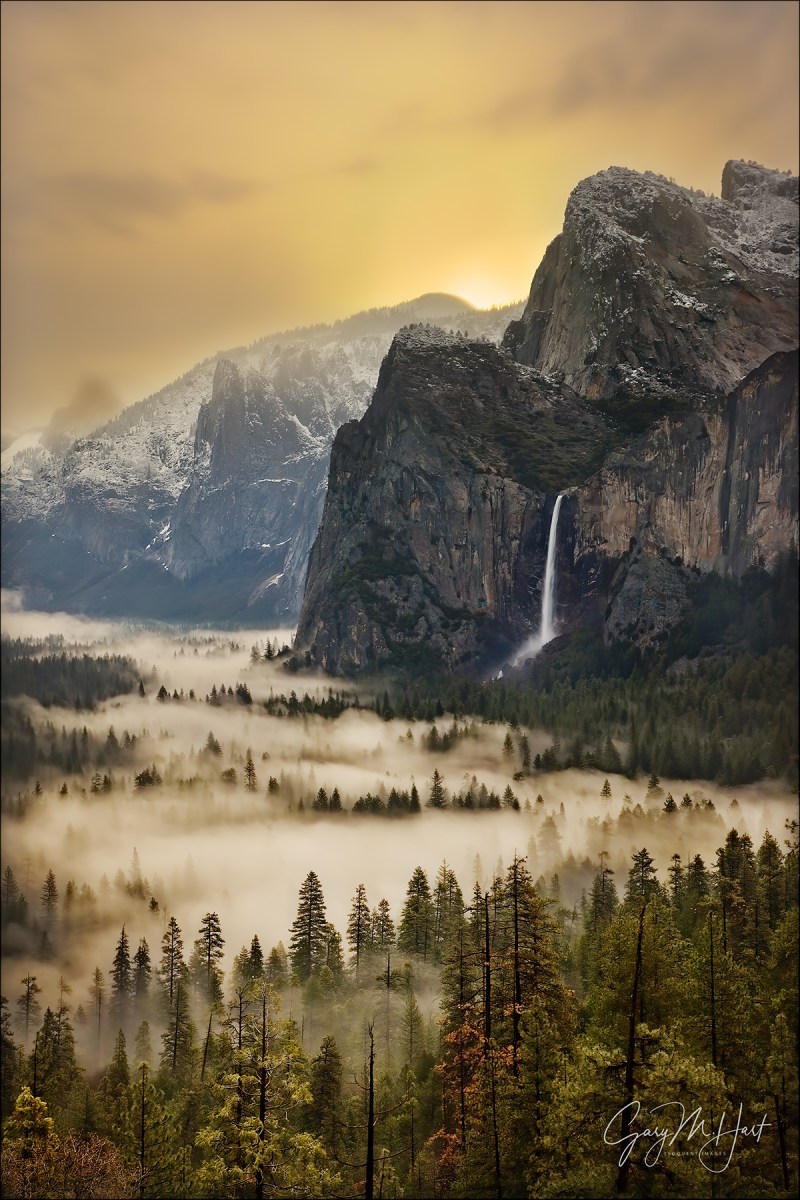
In a post announcing a new print sale website, I thought it appropriate to re-share my most requested image, captured on a chilly April morning in 2009. As with many of my images, it was captured during a workshop. And also like many of my images, it almost didn’t happen.
My workshop group was at Tunnel View overlooking Yosemite Valley, wrapping up our first sunrise shoot. A storm had moved through overnight, dusting the granite walls with snow down to about 5,000 feet (Yosemite Valley is at about 4,000 feet), and soaking the lower elevations with a light rain. With no wind to mix the chilly atmosphere, the coldest air dropped all the way to the saturated valley floor, where it found the dew point and condensed into a ground-hugging fog.
Overhead, the parting storm’s cloudy vestiges covered the scene with a dull, gray blanket of homogenous clouds, so our attention all morning had been on the wispy valley fog below. The dynamic range at Tunnel View is pretty unmanageable when the morning sun arrives, so I was about to move the group on to greener pastures when I noticed a golden glow expanding behind Sentinel Dome. As the color spread, it was apparent that the uniform clouds above were far more translucent than I’d imagined and I put a hold on our exit. Soon I was so mesmerized by the buttery veneer stretch from rim to rim , reflecting softly on the fog below, that I almost forgot about my camera.
I raced to the car to get my gear and sprinted back to set up far faster than I like. By the time I was ready, the sun was just about to crest the ridge behind Sentinel Dome. I worked quickly, using a 2-stop hard graduated neutral density filter to subdue the bright sky. I stopped down to f16 thinking a sunstar might be possible, but the sunlight was too diffused by the clouds.
Of all the pictures of Yosemite that I’ve taken, this is the one that makes it easiest for me to imagine how this heavenly location might have looked before human interference.
America the Beautiful
A gallery of favorites (coming to a wall near you)


Yosemite Moon
Posted on July 21, 2016
Spring Moonrise, Bridalveil Fall and the Merced River Canyon, Yosemite
Sony a7R II
Sony 70-200 f4
1/2 second
F/8
ISO 100
I’m a relationship photographer. By that I mean I’ve never been one of those photographers who expands his portfolio by adding new locations. Rather, I like to get a feel for a place, not just the where and when of its photo opportunities, but its history, geology, flora, and fauna. I much prefer digging deeply into one scenic area to visiting a large variety of scenic areas. This is a personal style thing, and I know my more deliberate approach would drive many photographers crazy, but I’ve learned that I’m rarely very productive on my first visit anywhere, and often not until I’m several visits in.
I’m probably several hundred (thousand?) visits into my Yosemite relationship, with no end in sight. But despite this extensive history, any moonrise above Yosemite Valley, regardless of the phase, still takes my breath away. Orbital geometry aligns Yosemite’s moon with different features as the seasons change, and I try to be there for as many moonrises as possible. Whether it’s the late fall and winter full moon hovering above Yosemite Valley, the summer crescent moon appearing from behind Half Dome, or the spring full moon rising above Bridalveil Fall, I just can’t get enough of it.
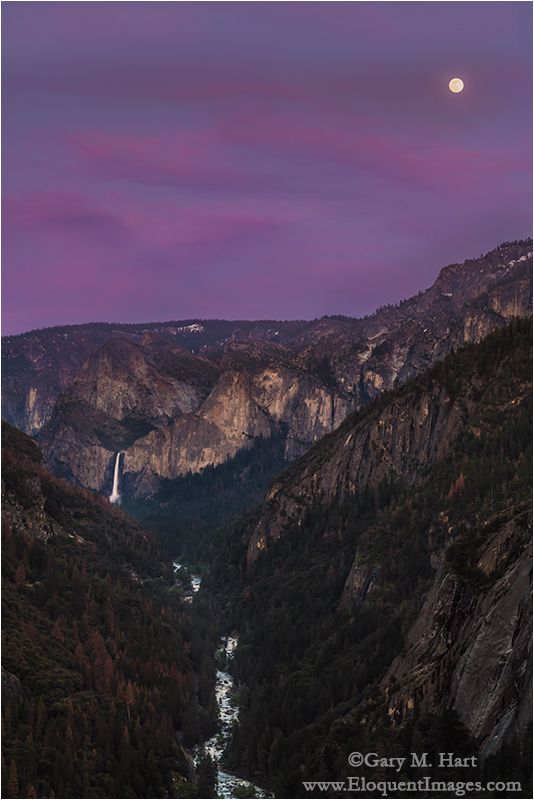
As with most of my Yosemite workshops, a planned highlight for this year’s April Yosemite Moonbow and Wildflowers workshop was a moonrise, this time the Bridalveil Fall full moon. Throughout the workshop we’d enjoyed a Yosemite Valley bursting with more water than I’d seen in several years, a dogwood bloom that was just about at peak, and a sky enhanced by an assortment of beautiful clouds.
When the moonrise day came and the clouds stayed, there were a few concerns for our moonrise. But knowing Yosemite well enough to understand that you can’t predict the conditions five minutes from now based on the conditions right now, I made sure we were in position with cameras ready (and fingers crossed).
Moon or not, the view up the Merced River Canyon that evening was beautiful, but when the moonrise time arrived and the moon didn’t, I scanned the clouds for hints of the moon’s glow. Though there was no sign of it, a little higher, and directly in the moon’s path, the clouds appeared thinner; higher still, actual stripes of blue sky gave me hope.
By the time the moon emerged, nearly ten minutes after sunset, the entire sky had taken on a rich magenta hue. The Merced River Canyon below had become quite dark, but my Singh-Ray two-stop hard-transition graduated neutral density filter held back the (daylight-bright) moon enough for me to give the canyon the light it needed. The final step for this image came in Lightroom and Photoshop, which enabled me to add a little more light to both the canyon and the clouds (which had been darkened along with the moon by the GND), and pull back the highlights in the moon.
One more thing
People ask me if I ever tire of Yosemite, and I can honestly answer, no. Part of keeping it fresh is the infectious excitement when the people I’m with witness something like this moonrise. (I don’t think this makes me unusual—most people get vicarious pleasure from the joy of others’ first experience of something that’s special to us.) This night the moonless pink sky was enough to thrill everyone, but when the moon poozed out, it became one of those once-in-a-lifetime moments for everyone in the group. That just never gets old.
Join me in a Yosemite photo workshop
Yosemite Moons
Click an image for a closer look and slide show. Refresh the screen to reorder the display.


Exploring the familiar
Posted on April 17, 2015

Snow on Old Tree, Half Dome and Bridalveil Fall, Yosemite
Sony a7R
Sony/Zeiss 24-70
1/30 second
F/16
ISO 100
I spend a lot of time guiding and teaching photographers who have traveled a great distance to capture a particular shot: Horsetail Fall in February, the spring moonbow on Yosemite Fall, the Milky Way above the Kilauea Caldera, to name a few. They’ve seen an image on my website, or someone else’s, and have decided want to add their version to their portfolio. Many have saved money and vacation time for years for the opportunity; others have been chasing the shot without success more times than they can count. Either way, it’s a vicarious rush watching it happen for them.
The captures that make me happiest are the one’s I’ve never seen before. But given that my “job” is guiding people to the scenes I (and others) have photographed many times, I don’t get a lot of opportunity to explore new territory. Instead, I challenge myself to find something new in these heavily photographed areas. And “new” to me is more than just capturing an extraordinary sunset or glorious moonrise, it’s looking beyond the obvious to find a new perspective or fresh interpretation.
Finding new scenes can happen by accident, but there’s no substitute for conscious, calculated exploration. For example, a typical day in Yosemite has lots of blue sky and flat light hours that aren’t conducive to the type of photography I enjoy. Rather than waste that lousy light time simply waiting for the good stuff, I spend it collecting new scenes for later use. In Yosemite that usually means deciding on a subject (Half Dome, El Capitan, Yosemite Falls, Bridalveil Fall, and so on) and poking around looking for foregrounds to put with it.
Despite its apparent permanence, Yosemite is a dynamic environment. Rocks cleave and fall, trees grow and die, water ebbs and flows. Whether it’s walking the bank of the Merced River searching for a reflection of Half Dome, or scrambling granite slopes for a fresh view of Yosemite Valley, there are new perspectives and subjects to be mined everywhere.
When I find something I like, I try to figure out the conditions that would make the best photography. Sometimes this is simply a matter of plotting a moonrise or moonset; other times the best photography requires very specific weather or light. Whatever the condition might be, I do my best to get myself there to photograph it.
Though I photographed this scene just a couple of weeks ago, the view I found on one of these reconnaissance missions several years ago. The first time I saw the twisted remains of this old tree, I imagined it etched with snow. Unfortunately the tree’s location—perched on a ledge above a vertical drop of several hundred feet, is not for the faint of heart, even in the most benign conditions. And getting out here in snow can be downright dangerous.
On my most recent Yosemite trip earlier this month (sandwiched between my Yosemite moonbow workshop and a week-and-half in the Columbia River Gorge), my desire for something new trumped my “respect” for heights. I took a long way around to avoid the cliff as much as possible, then did my best not to look down once I arrived. As I worked, every shift of foot or tripod was planned and tested before execution.
I tried a variety of compositions, wide and tight, vertical and horizontal, that included some or all of the Tunnel View trio: El Capitan, Half Dome, and Bridalveil Fall. Exposure was pretty straightforward, but depth of field was a concern. I stopped down to f16, but chose not to go any smaller due to diffraction (light bending around small apertures to fill the entire sensor can inhibit resolution) concerns. As always in these scenes where I might not be able to achieve complete front-to-back sharpness, I biased my sharpness to my foreground—rather than focusing on Half Dome, I focused on a branch toward the back of the tree.
I actually returned to this scene the next morning, when the snow was much thicker and the light much more difficult. I haven’t had a chance to work with those images, so stay tuned….
A Gallery of the Shot Less Taken
Click an image for a closer look, and a slide show. Refresh the screen to reorder the display.


Looking back, looking forward
Posted on December 29, 2014
For the final shoot of my final 2014 workshop, I guided my group up the rain-slick granite behind Yosemite’s Tunnel View for a slightly different perspective than they’d seen earlier in the workshop. I warned everyone that slippery rock and the steepness of the slope could make the footing treacherous (and offered a safer alternative), but promised the view would be worth it. Then I crossed my fingers.
While sunset at Tunnel View is often special, the rare sunset event I’d been pointing to for over a year, a nearly full (96%) moon rising into the twilight hues above Half Dome, is a particular highlight, one of my favorite things in the world to witness. But after an autumn dominated by clear skies that would have been perfect for our moonrise, a much needed storm landed just as our workshop started, engulfing Yosemite Valley in dense clouds, recharging the waterfalls, and painting the surrounding peaks white. Rain clouds make great photography, but they’re not so great for viewing the moon.
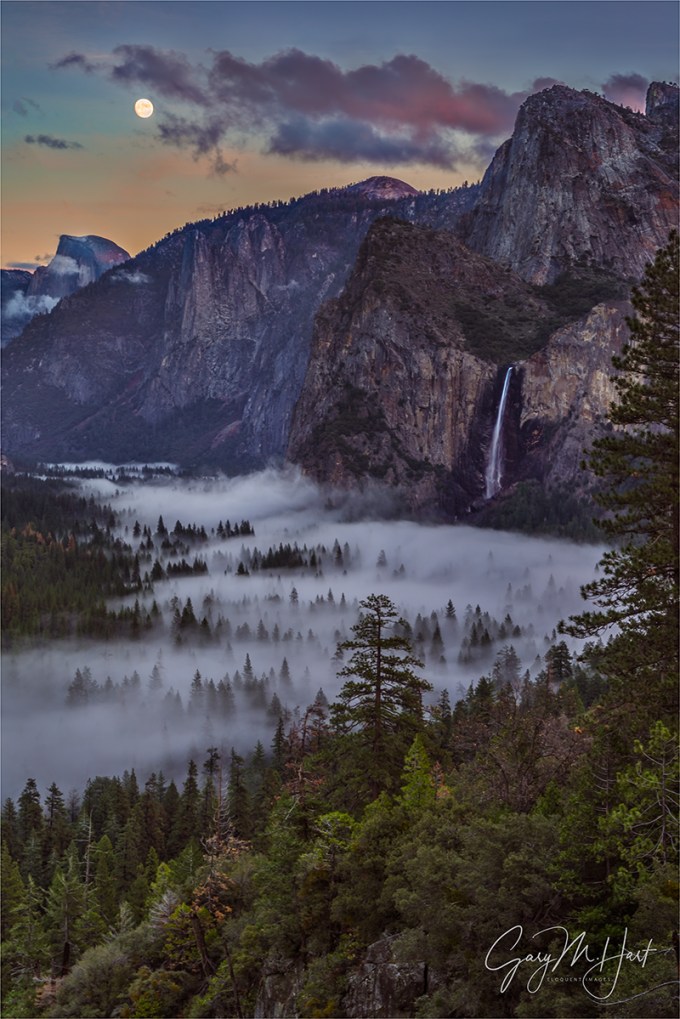
As you can see from this image, the clouds this evening cooperated, glazing the valley floor, but parting above Half Dome enough to reveal the moon. The moon was already high above Half Dome when it peeked out, and shortly thereafter the retreating storm’s vestiges were fringed with sunset pink. As I often do at these moments, I encouraged everyone to forget their cameras for a minute and just appreciate that they may be viewing the most beautiful thing happening on Earth at this moment. Together we enjoyed what was a once-in-a-lifetime moment for them, and a fitting conclusion to another wonderful year of photography for me.
Like any other photographer who makes an effort to get out in difficult, unpredictable conditions, I had many of these “most beautiful thing on Earth” moments in 2014—they’re what keep me going. The last couple of weeks I’ve been browsing my 2014 captures and re-appreciating my blessings. Among other things, in 2014 I rafted the Colorado River through the Grand Canyon, was humbled by the Milky Way’s glow above the Kilauea Caldera, shivered beneath starlit bristlecone pines, and was electrified by the Grand Canyon monsoon’s pyrotechnics.
Most of my trips start with a plan, and while a lot of my 2o14 experiences followed the script, many deviated from my expectations, often in wonderful ways. My original vision of the moonrise on this December evening was clear skies that would allow the moon to shine; an alternate vision was a sky-obscuring storm that provided photogenic clouds. We ended up with the best of both, a hybrid of clouds and sky that I dared not hope for.
While I have a general plan in place for 2015, some places I’ll be returning to, others I’ll photograph for the first time, I know from experience that my plans won’t always go as planned. Clouds will hide the moon and stars, clear skies will cast harsh light, rivers will flood, waterfalls will wither, rivers will flood. But I also know that many of those thwarted plans will lead to unexpected rewards like this.
Here’s to a great 2015!
2014 in Review
Click an image for a closer look, and a slide show. Refresh your screen to reorder the display.


 Eloquent Images by Gary Hart