Eloquent Images by Gary Hart
Insight, information, and inspiration for the inquisitive nature photographer
Turning a Negative Into a Positive in Yosemite
Posted on November 3, 2019

Autumn Reflection, El Capitan, Yosemite
Sony a7RIV
Sony 24-105 G
1.6 seconds
F/16
ISO 200
Update, November 4
Since posting this image yesterday, I’ve gotten a few comments ranging from “Magnificent!” to “What is it?”. If you think it’s magnificent, thanks. For those scratching their head (I understand), it’s a reflection of El Capitan in the Merced River. This sheltered pool was covered with pine needles, with a collection of colorful leaves resting atop the floating pine needles. One problem with sharing this online is that it’s a 61 megapixel capture using my Sony a7RIV; with so much detail, it really needs to be seen on a screen bigger than your cell phone’s, the bigger the better. But of course I can only post so big online (in this case, 1200×800 pixels), and even that relatively low resolution is compromised by website (WordPress, Facebook, Instagram, and so on) compression, so I doubt that even on a computer screen you’ll see the detail as clearly as I can. And I realize in this day of eye-grabbing computer art, images like this don’t go viral, but this kind of photography makes me happy.
Original post
When I was a kid, I loved power outages. As an adult…, uh, not so much. And if you’ve been living under a rock, you may not have heard about the wildfires charring California’s hillsides and soiling our skies, and PG&E’s dubious strategy to mitigate decades of mismanagement by simply shutting off the power to millions of customers on days the fire risk is deemed extreme. I’m fortunate to live Sacramento, which doesn’t get its electricity from PG&E, which means these outages haven’t really been my problem. Until last week.
When I schedule a photo workshop, I do my best to time it for ideal photography conditions, but sadly, some things are beyond my control. In the 15 or so years I’ve been doing this, I’ve had workshops impacted by rain, snow, wind, fog, wildfires, rock slides, and a tropical storm. I can now add power outage to that list.
Last week’s Yosemite Fall Color workshop coincided with the latest round of wind-induced PG&E power outages. We started Monday, and I learned on Sunday that the power had been shut down in Yosemite and the surrounding area, with no estimate for its reactivation. I e-mailed the group an update Sunday evening, reassuring them that our hotel was open even without power, and that the workshop would go on, power or not. There was still no power in Yosemite when I left home early Monday morning, so all I could do was drive and hope for the best.
With no power at workshop start time, I jettisoned my normal orientation presentation and just winged the group introductions and preparation info in the semi-darkness of the hotel’s lounge area. With only one exception, the group’s attitude was wonderfully positive and up for a we’re-all-in-this-together experience (the exception bailed for home in the first ten minutes, which was probably for the best).
One thing you’re quickly reminded of in a hotel without power is that it’s not just darkness you’re dealing with—we also had no heat, no hot water, and no juice to recharge cameras, computers, and cell phones (and no WiFi!). Between flashlights, headlamps, and battery-powered lanterns, most everyone came armed with enough light to navigate their room in the dark. For emergency battery charging, I brought a couple of fully charged power bricks, and Curt, the photographer assisting me with this workshop, came with an industrial strength portable charger that could have illuminated Vegas for a week. The rooms didn’t seem to get too cold until close to bedtime, but extra blankets in every room fixed that. The biggest problem was the no hot water thing—on the first morning I managed to make myself sufficiently presentable with a sponge bath (applied with prayer for power and hot water by the time the next morning rolled around).
Meeting the group before sunrise Tuesday morning I braced for a mutiny, but everyone remained spectacularly upbeat. And because there was little reason to hang in the rooms without light or heat, I ended up replacing some of my standard mid-day break and training time with extra shooting. Even without power, Curt was able to do his sensor cleaning talk, and clean everyone’s sensor, which was a big hit. And with extra time for shooting, I decided to make the 75-minute one-way drive to Olmsted Point (where I haven’t taken a Yosemite group in years), for a sunset and Milky Way shoot.
Much to our delight, we returned from Olmsted Point on Tuesday night to find the hotel lit up like Christmas—lights, heat, and hot water, but alas, no internet for the rest of the week. We had survived about 30 hours without power (from the time the workshop started until our return from the Milky Way shoot) in remarkably good spirits, and in fact I think the whole experience drew the group even closer. The workshop’s final two days went off without a hitch, and by the end, people who were complete strangers at the start were making plans for post-workshop meals and more photography.
The lesson here, one that we already know but sometimes need to be reminded, is that our experience of the world is shaped more by our attitude than the world. We were in Yosemite for heaven’s sake, in one of the most beautiful times to be there, sharing the experience with a group of like-minded individuals. Doing 12-18 workshops a year for nearly 15 years, memories of the individual workshops tend to run together, but this is one I’ll definitely never forget!
About this image
Landscape photographers love clouds, both for the drama they add to the sky and for the way they soften harsh light. So besides the power thing, the other difficulty this workshop faced was no clouds. For four days: Not. One. Cloud. Fortunately, I’ve been photographing Yosemite long enough to know how to make it work without clouds, and the fall color was pretty great—not just on the trees, but also on the ground and in the water.
It also didn’t hurt that the reflections in the Merced River were off the charts (as they pretty much always are in autumn). Virtually every stop offered some reflection of Half Dome or El Capitan in the Merced. And we didn’t have to look to hard to find color to add to the reflections. Frequently it was in the trees lining the far riverbank, but I set my own sights on the yellow and red leaves floating on the near riverbank. With a little careful positioning, I was usually able to juxtapose the floating leaves with the reflection du jour.
On Tuesday morning we found our first nice El Capitan reflection near El Capitan Bridge. I walked along the riverbank until I found this bed of floating pine needles punctuated with an assortment of colorful leaves. I set up my tripod and positioned it so my camera framed the reflection with the most colorful leaves, placing El Capitan in an area with fewer pine needles (and more reflection). I used a polarizer darken the water, but not so much that I lost the reflection of El Capitan (which I dodged slightly in Photoshop to help it stand out).
Read more about photographing reflections
A Gallery of Reflections
Click an image for a closer look and to view a slide show.


Low Hanging Fruit
Posted on October 20, 2019

Winter Reflection, Valley View, Yosemite
Sony a7RII
Sony/Zeiss 24-70 f4
10 seconds
F/7.1
ISO 1600
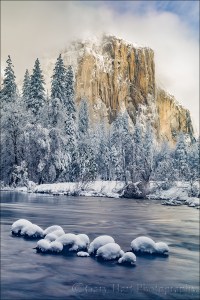
Snowcap, El Capitan, Yosemite
A few days ago I posted an El Capitan in winter image on Instagram. Since it had been nearly three years since that trip, a lot of the specifics of that day had slipped my mind, but when I pulled up the Instagram image’s raw file in Lightroom to check the capture info, a few more of that day’s (so far unprocessed) images caught my eye. The next thing I knew, I was processing this one, and gradually, some of the day’s details returned to me.
Yosemite Valley had been brown and dry beneath an overcast sky when I checked into the lodge the evening prior, but I woke the next morning to a world of white. (This was no surprise—I’d made the trip because snow was forecast.) The snow was still falling after breakfast, and as usually happens in a Yosemite storm, the clouds completely obscured all of Yosemite’s icons. But knowing that the key to photographing snow in Yosemite is to be out in it when the storm breaks, I was quite content to drive into its midst and wait it out. And break it did, turning to flurries with a mix of clouds and blue sky by late morning. The conditions stayed like that the rest of the day and I was in photographer heaven.
I circled Yosemite Valley all day, sometimes targeting specific spots, other times just pulling over when something moved me. By the time the sun set I was pretty certain that I had lots of good stuff on my card, but most important, I was happy. (If just spending time with your subject, regardless of the photographic results, doesn’t make you happy, you probably should be photographing something else.)
On my way out of the park after sunset I made one last stop to photograph this Valley View scene. With its easy access and riverside views of El Capitan, Cathedral Rocks, and Bridalveil Fall, Valley View is low-hanging photography fruit. And it’s especially nice with fresh snow. I’d already stopped here at least once before on that day, capturing last week’s Instagram image late that morning, but I couldn’t resit taking one more peek before heading down the canyon and home.
After the trip I processed a couple of images right away, but like so many of my photo trips, most of the images from this day have languished on a hard drive, victims of the priorities of running a business. This whole experience has been a good reminder of how many unprocessed images I have “in the bank,” waiting to be processed. It has inspired me to make a concentrated effort to go back through my archives to see what might be lurking there. I’ve already excavated a couple besides this one, with more on the way.
And speaking of low hanging fruit, I’ve started by going through my Yosemite snow images, because, well…, how can you go wrong with Yosemite and snow?
Winter is coming
Because winter is right around the corner, and we’ve already entered (just barely) the window when snow is possible in Yosemite, here’s my recipe for photographing Yosemite with snow.
The Early Bird Gets the Snow
If you delay your trip until you hear that it snowed in Yosemite, you’re too late. That’s because Yosemite is only 4,000 feet above sea level and actually warmer in winter than most of the United States. When it does snow there, as soon the snow stops, Yosemite’s relatively mild temperatures collude with sunshine, wind, and gravity to clear the trees in a matter of hours. Not only that, park visitors, driven to shelter by the storm, swarm outside to gape as soon as the snow stops, quickly marring the pristine beauty with footprints, not to mention the mud spread by their boots and tires. In other words, the key to photographing Yosemite with snow is being in the park during the storm (and working fast).
Monitor the weather
All winter I monitor the Yosemite weather forecast for hints of a cold storm. But even this isn’t as simple as you might expect—the single biggest mistake people make when planning a Yosemite snow trip is opening whatever weather site or app is convenient and simply typing in Yosemite. Yosemite Valley is only 4,000 feet above sea level, and virtually the entire rest of the park is higher—up to 13,000 feet elevation. And for some reason, even though Yosemite Valley is where you want to be for snow (and pretty much the only place in Yosemite you can be in winter), most weather resources don’t give the forecast for Yosemite Valley. Instead, they pick some other (random?) elevation that is almost always more likely to get snow than Yosemite Valley. You’d be amazed at how much more frequently snow falls just 500 feet above Yosemite Valley than falls in Yosemite Valley, which means a lot of people end up driving to Yosemite to photograph the snow their weather app promised, then end up marinating all day in a cold rain.
I know there are lots of weather forecast options out there, but most lack the resources of the National Weather Service (or they just use the NWS data). The NWS may not always nail the forecast, but they seem to be more consistent and reliable than any of the other options. But even selecting a generic NWS Yosemite forecast can lead you astray. I recently typed “Yosemite” into the NWS’s forecast input field and was given an assortment of similar options, each of which returned a different location in Yosemite (most not Yosemite Valley). So rather than leave it to chance, to ensure a forecast for the correct elevation, I’ve bookmarked the NWS point forecast for Yosemite Valley.
Chains
When it snows in Yosemite, they do sometimes require chains. Usually 4WD or AWD cars with snow tires are exempt, but not necessarily. Regardless of the conditions, park rules say if you plan to drive in the Yosemite in winter, you must carry chains—even if you have 4WD/AWD. My Subaru Outback is AWD, but when the weather is threatening, I have been asked if I have chains. So they’ve never asked me to prove it, or had to put chains on, but I always carry chains because if they do find that you don’t have chains when they’re required, you’ll need to just park until it chain requirement is lifted.
Driving to Yosemite
Sometimes the chain requirements aren’t for Yosemite Valley, but they do apply to two of the three routes into Yosemite Valley. When a storm is possible, the best way to avoid snow, ice, and chain requirements is to ignore the guidance of your GPS and Google Maps and enter via Mariposa on Highway 140, which comes up the Merced River Canyon and doesn’t ever get as high as 4,000 feet until Yosemite Valley. (Trust me on this.)
That said, any route into Yosemite is subject to closure or restrictions due to slides, flooding, or downed trees. Always check the Yosemite and Caltrans road conditions pages before you leave (I sometimes check them on the way too).
Go-time
Weather in Yosemite is very changeable, and a storm forecast that looked promising one day can completely fizzle the next—or vice versa. Some trips I’ve had a week to prepare for, others I didn’t consider going until I woke up and checked the Yosemite forecast that morning. Because I want to be ready at the drop of a hat, all winter long in the back of my Outback are my chains and a duffle bag with all my cold weather gear: waterproof pants, parka, and shoes, wool hat and gloves, and an umbrella.
When possible, I like to be in Yosemite the day before the snow starts. That said, it isn’t usually difficult to get a room in Yosemite at the last minute when a winter storm threatens, and there have been times when I’ve actually waited until I arrived in the park before booking my room (not necessarily a strategy I’d recommend). Nevertheless, the later I wait to leave, the more likely I’ll be delayed or turned back by a road closure.
Once the snow arrives, rather than hole up in my room, I’m out shooting. Even though Yosemite’s storms often erase all signs of its most recognizable features, stormy weather is a great time to photograph swirling clouds and accumulating snow in glorious (and rare!) solitude. Nice soft light too.
As much as I love photographing Yosemite when snows, the poor visibility and near white-out snowfall can reach a point of diminishing photographic returns. But even then, I don’t go in (or home). Instead, I park at Tunnel View and wait for the weather to clear. Tunnel View is the perfect place to wait out a Yosemite storm because it’s on the west side of Yosemite Valley (where the clearing usually starts), provides an elevated vantage point with a view all the way up the valley to Half Dome, and is spectacular to photograph when the storm clears. It even has decent cell service. And if I’m looking for an excuse to turn on the engine and warm things up, I drive through the tunnel for the view westward, a preview of coming weather.
My final advice for anyone is, when the storm clears, move fast and don’t spend too much time at any one spot, no matter how beautiful it is. It’s a pretty safe bet that if the conditions are beautiful right here, you’re probably missing opportunities elsewhere. The peak conditions, with snow draping every exposed surface, don’t last long, so get your shots and move on—or risk missing out. (This is the voice of experience talking.)
Yosemite Winter Photo Workshop
Yosemite Snow
Click an image for a closer look and to view a slide show.


Endless Possibilities
Posted on September 8, 2019

Winter Moonrise, Horsetail Fall and Half Dome, Yosemite
Sony a7RII
Sony 100-400 GM
ISO 200
f/10
1/160 seconds
This picture from last February features two beautiful photographic phenomena, one with (literally) thousands of cameras trained on it, the other virtually ignored. You might be surprised to learn that for most, the “main event” about to take place in this scene wasn’t the moonrise, it was the light on the thin stripe of waterfall trickling down the diagonal shoulder of El Capitan (the top is in shadow). But while (it seemed) virtually the entire photographic world was elbow-to-elbow in Yosemite Valley hoping for their shot at the day’s last light on Horsetail Fall, I was one of a half dozen or so photographers chilling at Tunnel View, waiting for the moon to rise.
When I’d arrived at Tunnel View and saw a herd of several dozen photographers already set up, I was initially heartened to think that so many photographers had foregone the Horsetail mayhem in favor of the moonrise. But why had they set up so far down the wall, behind trees that obstructed their view of Half Dome? It wasn’t hard to conclude that they weren’t there for the moon at all, they were there for Horsetail Fall. And as I waited for the moon, still more photographers showed up, and though there was plenty of room at spots with a far better view of the entire scene (including Horsetail Fall), every single new arrival crammed in to the scrum pointed at Horsetail Fall.
Photographing Horsetail Fall is kind of like dropping a quarter in a slot machine and hoping all the cherries line up: 1. Sun angle—the light’s right only at sunset for a couple of weeks in February (and October, when the fall is dry); 2. Snowmelt—no snowmelt, no waterfall; 3: Sunlight—all it takes is one cloud to block the sun and send everyone home disappointed. The jackpot? Some version of a picture that’s not much different from thousands (millions?) of other pictures.
Don’t get me wrong—the Horsetail Fall phenomenon is breathtaking, unique, and absolutely photo-worthy. But I do think that photographers, myself included, can be somewhat myopic when it comes to subject choice, deciding far too soon what “the” shot is and missing something even better as a consequence. And when they’re not sure what the shot is, instead of trusting their own vision, they just do what everyone else is doing.
We all could be a little better about considering photo opportunities beyond the obvious. Never is this more clear than in the image reviews in my photo workshops. In my image reviews everyone shares an image taken during the workshop (I project the image for all to see), and I offer constructive feedback. When I started doing workshops, I assumed that the prime benefit from the image reviews would be my “expert” critique, and while I like to think my suggestions do help, I didn’t anticipate how effective this image sharing is at conveying to everyone the unlimited possibilities each scene offers. We’re all photographing the same locations, but the variety of images always catches me off guard. In fact, I can’t tell you how many times I’ve looked at a workshop student’s image and thought, wow, how did I miss that?
It turns out the photographers who locked in on Horsetail this evening were disappointed. A rogue cloud, low in the west and unseen from Yosemite Valley, blocked the sun at just the wrong time. But that’s not the point—even if Horsetail Fall had lit up like red magma, there were other things to photograph in Yosemite that evening. And I wonder how many photographers would have opted to photograph the moonrise had they known about it.
I don’t share this image to pat myself on the back—I came to Yosemite specifically for this shot and didn’t really look for anything else. Therefore, it’s entirely possible that something even more special was happening behind me. (One reason I write these blogs is to remind myself of stuff like this.)
In life, we stop learning the instant we believe we have the answer. It’s equally true that photographers stop being creative the instant they “know” what the shot is. Our ability to grow as photographers is determined by our ability to open our eyes (and mind!) to the endless possibilities not yet visible.
An Evening’s Rewards
Alternate Perspectives
(Views Away from the Conventional Scene)
Click an image for a closer look and to view a slide show.


It’s All About Relationships
Posted on August 25, 2019
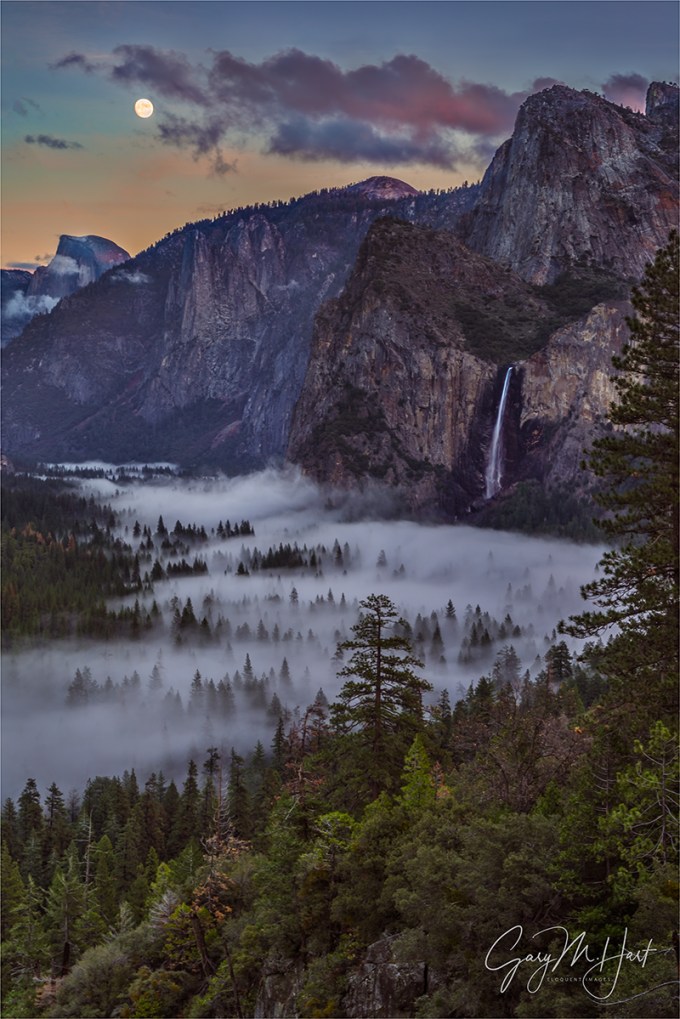
Moon and Mist,Tunnel View, Yosemite
Sony a7R
Sony/Zeiss 24-70 f4
1 second
F/11
ISO 100
Think about how much our lives revolve around relationships: romance, family, friends, work, pets, and so on. They’re such a big part of human existence that it’s no wonder most of the significant compositional choices photographers make involve relationships between elements in our scenes, either to one another or to their environment.
A pretty sunset is nice, but a pretty sunset over the Grand Canyon especially nice. Likewise, why be satisfied with an image of mountain cascade when we can accent the scene with an autumn leaf? And wouldn’t that tree up there on the hill look great beneath a setting crescent moon? Conscious choice or not, these are all relationships—distinct elements connected in a shared moment.
Some photographers are better than others at creating relationships; some do it instinctively, seemingly pulling relationship from thin air no matter where they are to find a nearby tree that perfectly complements a distant peak; others are more calculating, identifying the potential for a future relationship and taking the steps to be there when it happens—a moonrise, the Milky Way, or a rainbow. Most photographers fall somewhere on the continuum connecting these two extremes. And contrary to what you might read online or hear in your camera club, there is no single “best” approach to creating photographic relationships.
The more we can think in terms of finding relationships in nature, adding that extra element to our primary subject, or finding multiple elements and organizing them, through positioning and framing, in a way that guides the eye through the frame, the more our images will connect on a subconscious level that draws people closer and holds them longer.
Relationship heaven
Yosemite visitors burst from the darkness of the Wawona Tunnel like Dorothy stepping from her monochrome farmhouse into the color of Oz. This is Tunnel View, a veritable who’s-who of Yosemite icons chock full of ready-made relationships for photographers to feast on: El Capitan, Cloud’s Rest, Half Dome, Sentinel Rock, Sentinel Dome, Cathedral Rocks, Leaning Tower, and Bridalveil Fall. That’s a lot of stuff to take in without a camera, so it’s easy, especially for first-time or infrequent visitors, to just snap a picture of the whole thing and call it good.
If you keep the camera out a little longer, or visit Tunnel View a few times, relationships within the relationships start to pop out: El Capitan and Half Dome, Half Dome and Bridalveil Fall, Bridalveil Fall and Cathedral Rocks, and so on. But as nice as these combinations are, Yosemite’s truly special stuff doesn’t happen until the conditions cooperate by serving up a clearing storm, rainbow, fresh snow, or rising moon.
I’m fortunate to live close enough to Yosemite to time visits with the idea of adding these little extras to my images. Some of these trips come up at the last minute, spurred by a weather forecast that promises snow or lightning. Other trips I can plan months or years in advance, based on where the sun, moon, or stars will be, or maybe to catch a seasonal feature like fall color. These are the visits that I usually time my Yosemite workshops for: light on Horsetail Fall in February, a moonbow or the dogwood bloom in spring, fall color each autumn, or a rising full moon in winter.
About this image
My goal this December evening a few years ago was a nearly full (96%) moon rising through the twilight hues above Half Dome. It had been on my calendar for over a year, but thanks to a winter storm, the main event was in doubt when I arrived. Fortunately, the clouds soon relented, parting just as the sky started to pink up. As a bonus, the departing storm left the valley floor glazed with a treetop hugging mist. (Talk about an embarrassment of riches.)
When I photograph a scene with so much going on, I first decide the feature or features to highlight—which brings me back to the relationship thing. The entire scene this evening, from El Capitan on the left to Leaning Tower on the right, was beautiful, but I knew the more of it I included, the smaller the moon became—and to me the moon was the star of this show.
When assembling elements in any composition, I start by identifying the objects with visual weight—the objects that will draw viewers’s eyes. Contrast, mass, color, position all play a role in determining visual weight. In this case I identified the moon, Half Dome, and Bridalveil Fall (in that order). Sometimes I can adjust these obects’ relationships to each other by strategic positioning—moving left/right, forward/backward, up/down—but here I was perched on a cliff behind the conventional Tunnel View vista, which limited my mobility.
Evaluating the scene, pretty much everything I wanted in this image was between Half Dome and Cathedral Rocks. I quickly decided that a vertical composition would be best to feature the color in the sky and fog on the valley floor without going wider than necessary. And while I’d normally try to avoid having the two “heaviest” objects on the same side of my frame (the moon and Half Dome), in this scene the right side of the frame had enough extra stuff to balance things. In addition to Bridalveil Fall, I also had bulky Cathedral Rocks and a solitary evergreen standing boldly against the fog.
My final decision was how to handle the nearby evergreen lurking on the right. To gain some separation between the tree and Bridalveil, I moved as far left as my surroundings allowed, enabling me to use the tree as a natural frame on the right border. Click.
Yosemite Relationships
Click an image for a closer look and to view a slide show.


Small Steps and Giant Leaps
Posted on July 20, 2019
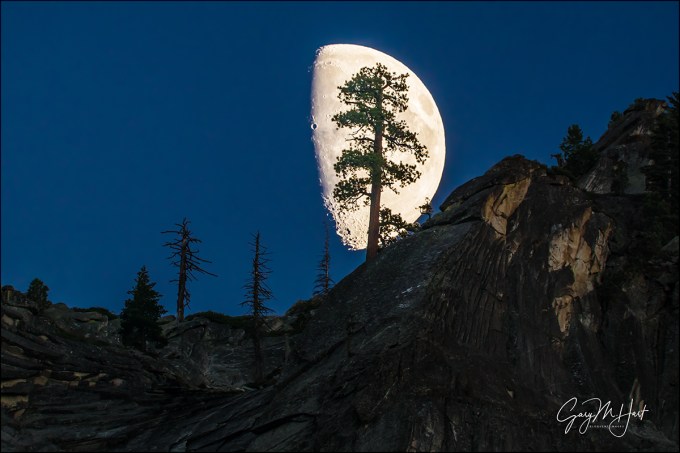
Big Moon, Valley View, Yosemite
Sony a6000
Tamron 150-600 (Canon-mount with Metabones IV adapter)
1/25 second
F/8
ISO 400
The memory of Neil Armstrong’s first steps on the moon has personal significance to me. To honor the 50th anniversary of that achievement, I’m sharing an updated version of my story, first posted five years ago.
July, 1969
I had just turned 14. I was into baseball, chess, AM radio, astronomy, and girls—not necessarily in that order. Of particular interest to me in 1969 was the impending moon landing, a milestone I’d been anticipating since tales of American aerospace engineering ingenuity and our heroic astronauts started headlining the “Weekly Reader,” and my elementary school teachers began gathering the class around a portable TV to watch the latest Mercury, Gemini, or Apollo launch.
If you remember the 60s, you understand that the buzz surrounding each of these missions provided a unifying distraction from the divisive tension spurred by headlines of Vietnam casualties, anti-war demonstrations, Civil Rights clashes, and Communist paranoia. When President Kennedy promised to land a man on the moon by the end of the decade, so far in the future was that goal that in my mind he may just as well have said infinity. But as the decade drew to a close and the promise approached reality, I couldn’t devour enough information on the impending mission.
Unfortunately, without checking NASA’s schedule or asking for my input, my parents and three other couples they knew from graduate school decided mid-July 1969 would be the ideal time for our four families to join forces on a camping trip in the remote, television-free redwoods of Northern California. (“What could we possibly need a television for?”)
Apollo 11 was halfway to the moon when the Locher and Hinshaw families pulled up to our home in Berkeley (the Hardings, coming down from Eastern Washington, would meet us at the campground a couple of days later). The warm greetings exchanged by the adults were balanced by the cool introductions forced on the unfamiliar children.
We departed the next morning, caravan style, our cars connected by woefully inadequate walkie-talkies that we’d almost certainly have been better off without (I’m sure it had seemed like such a good idea at the time). I remember my dad keeping a safe distance behind the Hinshaws, as he was convinced that their borrowed trailer that seemed to veer randomly and completely independently of their car, would surely break free and careen into the woods on the next curve.
Somehow our three-car parade pulled safely into Richardson’s Grove State Park late that afternoon. In true sixties style, the three dads went immediately to work setting up campsites, and the moms donned aprons and combined forces on a community spaghetti dinner. Meanwhile, while the younger kids scattered to explore, the four teens, having only recently met and being far too cool for exploration or anything remotely resembling play, disappeared into the woods, ostensibly on a firewood hunt. Instead, we ended up wandering pretty much aimlessly, kicking pinecones and occasionally stooping for a small branch or twig, lingering just far enough from camp to avoid being drafted into more productive (and closely supervised) labor by the adults.
But just about the time we teens ran out of things not to do, we were relieved to be distracted by my little brother Jim rushing back into camp, breathless, sheet-white, and alone. We couldn’t quite decipher his animated message to the adults, but when we saw our dads drop their tarps and tent poles and rush off in Jim’s tracks toward the nearby Eel River, we were (mildly) curious (to be interested in anything involving parents was also very not cool). So, with feigned indifference, the four of us started wandering in the general direction of the river. Our path was blocked by a 50 foot, nearly vertical cliff that provided a clear view into the vortex of all the excitement. It was the instant of that shared view when I think we all ceased being strangers.
The scene before us could have been from a bad slasher movie: Flat on the ground and unmoving was 11 year-old Paul Locher; sitting on a rock, stunned, with a stream of blood cascading from his forehead, was Paul’s 10 year-old brother John. As disturbing as this sight was, nothing could compare to seeing father Don Locher orbiting his injured sons, dazed and covered in blood. The rest of this memory is a blur of hysterics, sirens, rangers, and paramedics.
It wasn’t until the father and sons were whisked away by ambulance to the small hospital in Garberville, about 10 miles away, that we were able to piece together what had happened. Apparently Paul and John, trying to blaze a shortcut to the river, miscalculated risk and had tumbled down the cliff. My brother at first thought they were messing with him, but when John showed him a rock covered with blood, he sprinted back to fetch the parents.
Conferring at the point where the kids had gone over, the fathers made a quick plan: My dad and Larry Hinshaw would rush back to to summon help, and to see if they could find a safer path down to the accident scene. Don would stay put and keep an eye on his sons. But shortly after my dad and Larry left, John had looked down at his brother cried, “Daddy, I can see his brains!” Hearing those words, Don panicked and did what any father would do—attempt to reach his boys. Thinking that a small shrub a short distance down would make a viable handhold, Don took a small step in its direction, reached for and briefly grasped a branch, lost his grip, and tumbled head-over-heals down to the river.
After what seemed like days but was probably only an hour or two, we were relieved to learn that John needed no more than a few stitches; he was back in camp with us that night. Paul had faired slightly worse, with a concussion and a nasty cut behind his ear—the “brains” his brother had seen was ear cartilage. Paul spent the night in the hospital and was back with us by the time the Harding clan arrived the following afternoon. Don, however, wasn’t quite so fortunate. In addition to a severe concussion, he had opened up his head so completely that over 150 stitches were required to zip things back together. Though Don spent several days in the hospital, we were all consoled by the understanding that it could have been much worse.
By Sunday, Don was feeling much better but was still a day or two from release to the dirt and fish guts of our four family campsite. Most of us had visited the hospital at one time or another in small, brief waves that honored the hospital’s visiting rules. I can’t say who first recognized the opportunity, but I’m guessing that Larry Hinshaw had something to do with convincing the nursing staff to look the other way when Don was suddenly host to 20 simultaneous visitors that night. Whatever magic was worked, I’ll forever remember Sunday evening, July 20, 1969, when our entire group shoehorned into a tiny hospital room to witness history on a tiny, black-and-white television screen.
Besides my parents and two brothers, the rest of the crew that night I’d only met just a few days earlier, but I can still name every single one of them. The relationships formed that week continue to this day. And so do the stories, which, like this story, are filled with some of the greatest joy I’ve ever experienced, and also with some of the greatest tragedy. But it’s this story in particular, the catalyst for all the stories that follow, that explains why the words, “One small step for man, one giant leap for mankind,” have a very personal significance for me. Today it’s hard to look at the moon without remembering that hospital room and the emotional events that enabled me to witness Neil Armstrong’s historic first steps with those very special friends.

Big Moon, Valley View, Yosemite
Photograph the moon with me in a Yosemite photo workshop
Workshop Schedule || Purchase Prints
A lunar gallery
Click an image for a closer look, and a slide show


What’s the Story?
Posted on June 9, 2019
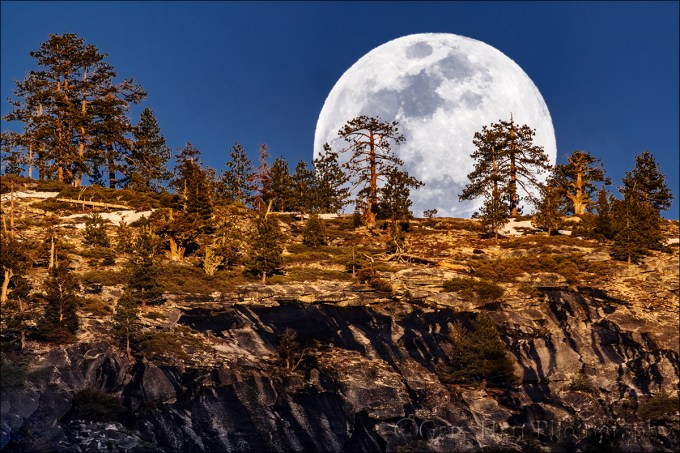
Moonrise Through the Trees, Yosemite
Sony a6300
Sony 100-400 GM
Sony 2x teleconverter
Breakthrough neutral polarizer
ISO 400
f/16
1/200 second
Let’s have a show of hands: How many of you have been advised at some point in the course of your photographic journey to “tell a story with your images”? Okay, now how many of you actually have a clue as to what that actually means? That’s what I thought. Many photographers, with the best of intentions, parrot the “tell a story” advice simply because it sounded good when they heard it, but when pressed further, are unable tell you what they mean.
Telling a story with a photo is easier when photographers can physically stage subjects and light to suit their objective (an art in itself), or in journalistic photography intended to distill the the essence of an instant with a connection to an easily inferred chronology: a homeless man feeding his dog, dead fish floating in the shadow of belching smokestacks, or a wide-receiver spiking a football in the end zone.
This isn’t to say that we landscape photographers can’t tell stories with our images, or that we shouldn’t try. Nor does it mean that one photographic form is inherently more or less creative than another. It just means that the rules, objectives, advantages, and limitations differ from form to form. Nevertheless, simply advising a landscape photographer to tell a story with her images is kind of like a coach telling a pitcher to throw strikes, or a teacher instructing a student to spell better. Okay, fine—now what?
Finding the narrative
First, let’s agree on a definition of “story.” A quick dictionary check reveals that a story is “a narrative, either true or fictitious … designed to interest, amuse, or instruct….” Okay, that works.
The narrative part is motion. Your pictures need it. Narrative motion isn’t simply the motion of the eyes through the frame (also important), it’s a connection that pulls a viewer into and through a frame, and compels him to stay. While narrative motion happens organically in media consumed over time, such as a song, novel, movie, or even a YouTube video, it can only be implied in a still photograph. And unlike the arranged or journalistic photography mentioned above, landscape photographers are tasked with reproducing a static world as we find it—another straightjacket on our narrative options. But without some form of narrative motion, we’re at a dead end story-wise. What’s a photographer to do?
Photography as art
Every art form succeeds more for what happens in the mind of its consumer’s (the viewer or listener) than for the literal experience it delivers to the consumer’s five senses. Again: Every art form succeeds more for what happens in the mind of its consumer’s (the viewer or listener) than for the literal experience it delivers to the consumer’s five senses. A song that doesn’t evoke emotion, or a novel that doesn’t paint mental pictures, it’s soon forgotten. And just as readers of fiction unconsciously fill-in the visual blanks with their own interpretation of a scene, viewers of a landscape image will fill-in the narrative blanks with the personal stories the image inspires. In other words, an image should offer a place for the viewer’s own story to unfold.
Of course the story we’re creating isn’t a literal, “Once upon a time” or “It was a dark and stormy night” (much more appealing in photography than literature, I might add) story. Instead, the image we make must connect with our viewers’ stories to touch an aspect of their world (real or imagined): revive a fond memory; generate fresh insight into a familiar subject; vicarious living—to name just a few possible connections. If we offer images that complete these connections, we’ve given our image’s viewers a reason to enter, a reason to stay, and a reason to return. And most important, we’ve given them a catalyst for their internal narrative.
Shoot what you love (not what you think your audience will love)
Think about your favorite novels. While they might be quite different, I suspect one common denominator is a protagonist with whom you relate. I’m not suggesting that immediately upon finishing that book you hopped on a raft down the Mississippi River, or ran downtown to have a dragon tattooed on your back, but in some way you likely found some personal connection to Huck Finn or Lisbeth Salander that kept you engaged. And the better that connection, the faster the pages turned.
And so it is with photography: Our viewers are looking for a connection, a sense that there’s a piece of the photographer in the frame. Because we can’t possibly know what personal strings our images might tug in others, and because those strings will vary from viewer to viewer, our best opportunity for igniting their story comes when we share our own relationship with a scene and let viewers find their own connection.
What? Didn’t I just say that it’s the viewer’s story we’re after? Well, yes—but really what needs to happen is the viewers’ sense of connection between our story and theirs. If you focus on photographing the scenes that most move you, those scenes (large or small) that might prompt you to nudge a loved-one and say, “Oooh, look at that!,” the more you’ll see and the greater your chance of establishing each viewer’s feeling of connection. Whether you’re drawn to towering mountains, crashing surf, delicate wildflowers, or prickly cactus, that’s where you’ll find your best images.
Where did you get those shoes?
The cool thing is that your viewer doesn’t need to understand your story; she just needs to be confident that there is indeed a story. That’s usually accomplished by avoiding cliché and offering something fresh (I know, easier said than done). For some reason this makes me think of Steely Dan lyrics, which rarely made sense to me, but always felt fresh and I never for a second doubted that they did indeed (somehow) make sense to Donald Fagen and Walter Becker. In other words, rather than becoming a distraction, Steely Dan’s lyrics were a source of intrigue that pulled me in and held me. So when I hear:
I stepped up on the platform
The man gave me the news
He said, You must be joking son
Where did you get those shoes?
I’m not bewildered, I’m intrigued. Steely Dan’s lyrics aren’t trying to tap my truth, they simply reflect their truth (whatever it might be). And even though I have no idea what he’s talking about, the vivid mental picture those lyrics conjure (which may be entirely different, though no more or less valid, than your or his mental picture) allows me to feel a connection. You, on the other hand, may feel absolutely nothing listening to “Pretzel Logic,” while “I Want To Put On My My My My My Boogie Shoes” gives you goosebumps for KC and the Sunshine Band. Different strokes….
Returning from the abstract to put all this into photographic terms, the more your images are true to the world as it resonates with you, and the less you pander to what you think others want to see, the greater the chance your viewer’s story will connect with yours.
For example

Moonrise Through the Trees, Yosemite
Few things in Nature get my heart racing more than the first sliver of silver light heralding the moon’s arrival. With the moon’s appearance comes a sudden release of building anticipation and the frantic
On this evening last March I knew about where the moon would appear, and about when that would be, but with the time approaching and my eyes locked on the anticipated spot, the doubts started to rise. Did I get the angle right? Is that ridgeline higher than I figured? Where did those clouds come from? (It goes like this every time.)
And then there it was. I’d pointed my Sony a6300 (1.5 crop sensor for extra magnification), mounted my Sony 100-400 GM lens and Sony 2x teleconverter, at the spot on the ridge I thought most likely for the moon to appear. I was pretty close, but this was not time for self congratulation. To juxtapose the moon with the two trees I’d picked for my foreground I had to shift about 20. My favorite big moon shots are when some part of the moon still touches some part of the horizon, so my window of opportunity was shrinking fast. And you ever want to appreciate how fast the moon moves across the sky, try photographing it with an extreme telephoto lens. By the time I was moved and recomposed, the moon was already half exposed and rising fast. I managed just a handful of frames before it crested the trees and I switched to a wider lens for a completely different shot.
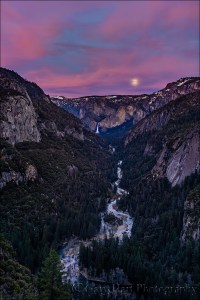
About 15 minutes later, after the clouds had moved in

Tree at Sunset, McGee Creek Canyon, Eastern Sierra
My own story of this solitary, ridge-top tree involved a frantic rush to capture a beautiful but rapidly fading sunset. I was with my brother on a dirt road in the Eastern Sierra. I’d been on this road many times and knew this tree well. Despite its rather ordinary appearance, the tree’s solitary perch atop a barren, rocky ridge had always intrigued me. For as long as I can remember, I’ve dreamed of a home with a sweeping view, and envied this tree’s perpetual 360 view of the Sierra crest to the west, the White Mountains to the east, and Crowley Lake below.
As the sunset started to materialize that evening, I realized that we were close enough that I might be able to include the tree in the sunset shoot. We hustled my truck back down the road, pulling into to a wide spot beneath the ridge several minutes after the best color had faded. Jay, who had no personal connection to “my” tree, stayed in the truck while I sprinted along the road with my camera and tripod until my position aligned the tree with the final, rippled vestiges of sunset. I only clicked a couple of frames, slightly underexposed to hold the color. (The slight blue cast is the color of the twilight light.)

Sunset, McWay Fall, Big Sur
The humorous events leading up to this sunset at McWay Fall in Big Sur are nowhere to be found in the frame. Nevertheless, even after visiting this spot more times than I can count, I have a very personal connection to this moment in particular. There’s power in a plunging waterfall and crashing surf, and promise in the sun’s appearance above an infinite horizon.
An early arrival allowed lots of time to connect with the scene, enabling me to anticipate the moment the sun burst from the clouds and balance it in the frame with McWay Fall. The position of the leading wave is no accident either—had I allowed it to reach the bottom of the frame before I clicked my shutter, it would have created a white line exiting the frame, taking your eyes right with it. That small strip of sand at the bottom of the image becomes a virtual frame that holds you in the scene. The rest is up to you.
* * * *
Those are my stories, and while they’re personally satisfying, I have no illusions that all of that comes across to the viewer. I’ve displayed these prints in many shows and watched people walk right by without breaking stride. But I’ve also been delighted each time someone stops, peers closer, lingers, and ersometimes returns lat. While I have no idea what “story” my images tap in those people, I don’t believe it really matters.
Workshop Schedule || Purchase Prints
A gallery of personal favorites (each with its own story)
Click an image for a closer look, and a slide show. Refresh the screen to reorder the display.


Yosemite for the First Time—Again
Posted on June 2, 2019
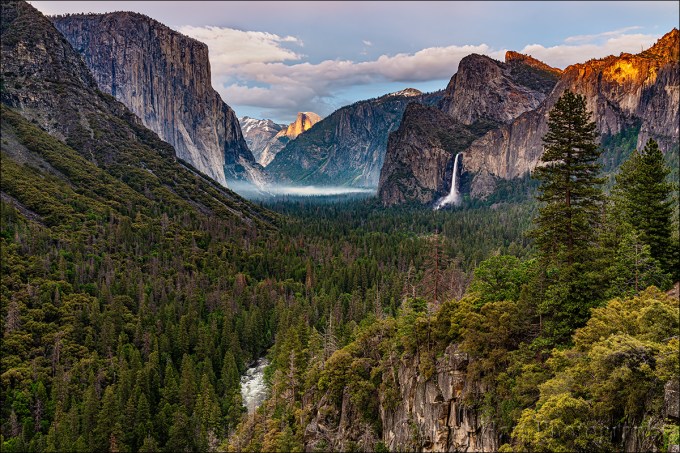
Last Light on Half Dome, Yosemite Valley
Sony a7R III
Sony 24-105 f/4 G
1/9 second
F/9
ISO 100
On Wednesday I made a quick trip to Yosemite to meet my (old and new) friends and fellow photography pros Don Smith and Ron Modra, plus Ron’s wife MB. Since I’d never met Ron and MB in person (though from conversations with Don I felt like I already knew them), and Ron had never been to Yosemite, I broke my personal rule to stay clear of Yosemite from Memorial Day through September (summer is for the tourists). Plus, after a lifetime of visiting Yosemite, there are few Yosemite firsts remaining, so I live vicariously through the first Yosemite experiences of others.
We met in El Portal, where I deposited my car and hopped in the back of Don’s car with MB. With Don driving and Ron riding shotgun, we headed up the hill discussing a strategy to make the most of our time. The plan we crafted was quickly discarded when we learned at the Arch Rock entrance station that Glacier Point, which had been closed since Saturday night, had just opened.
After a quick stop at Tunnel View to give Ron what should be everyone’s first Yosemite view, we zipped up to Glacier Point. Getting out of the car at Glacier Point, I immediately discovered that the beautiful spring day I’d dressed for had turned to winter. But cold is no match for the enthusiasm of the first time witnessing any of Yosemite’s spectacular views. Not only were the clouds spectacular, they did us the courtesy of parting just enough to illuminate Half Dome for a few minutes.
Our successful Glacier Point detour foreshadowed a spectacular day pinballing about Yosemite Valley, hitting all the spots a first-timer needs to see. Even the weather gods smiled on us, delivering thunderstorms filled the sky with billowing clouds and spread beautiful diffuse light across the park, without much rain.
I’m usually the driver for others’ first time Yosemite experiences, so riding in the back seat allowed me to rubberneck like an actual first-timer. There’s El Capitan! there’s Bridalveil Fall! there’s Sentinel Rock! And on down the list of Yosemite celebrities wearing their spring best. We were a little late for the dogwood, and the blooms that remained were in tatters, but everything else was green and the waterfalls were thundering, even for May. At each stop Ron’s excitement reminded me of a kid on Christmas morning, and seeing it all through his eyes, I totally got it. (Ron shot for Sports Illustrated for many decades—I imagine his reaction was no more enthusiastic than mine would be my first time in a Major League clubhouse.)
By 6:30 or so we’d worn Ron and MB out (well, Ron at least). With the rain starting to fall again, they declared their mission accomplished. With little sign of an impending sunset, and against the advice from Don and me, they decided to call it a day so Ron could get back and open the presents he’d so enthusiastically collected all day.
Our last stop was Valley View, where I realized that despite the beautiful conditions, I’d been so caught up in the view that hadn’t taken my camera from my bag all day. Chatting with MB while Don and Ron worked the beautiful scene, we agreed that sometimes it’s nice to enjoy nature without a camera. I know I missed some gorgeous photography, but I felt enriched by the conversation and laughter, and the sublime surroundings I often miss behind a camera.
But…
Saying our goodbyes in El Portal, I noticed breaks in the clouds. Hmmm. Instead of returning to my home in Sacramento, my destination that night was a heretofore undermined hotel between Yosemite and my Thursday destination in Southern California. But with an hour to go until sunset, I did a quick calculation and decided to forego the quickest route (down 140 to Mariposa) and detour back through Yosemite.
Back in the park I found the clouds still hanging in there, delivering the same nice but unspectacular light we’d enjoyed all day. But encouraged by my preview of the sky approaching from the west, I parked at Tunnel View for a few minutes, just to see what happened. I chose Tunnel View for its proximity to my (revised) route, and because when good stuff happens in Yosemite, it usually starts at Tunnel View. Plus, it’s pretty hard to mess up this classic view. And given that my long day was still several hours from ending, I simply wanted to take a pretty picture and Tunnel View was just the low hanging fruit I needed.
So there I waited in my car, one eye on the view, the other on my watch—30 minutes until sunset, 25 minutes, 20 minutes…. About 30 seconds after deciding nothing was going to happen, the granite next to Leaning Tower (the flat granite face just right of Bridalveil Fall) lit up like it had been hit with a spotlight. I was in business.
To get away from the photographers and tourists teeming about the standard vista, I climbed the granite behind the parking lot until I felt alone. I started wide, with my Sony a7RIII and Sony 24-105 lens (I’ve always felt 16-35 is too wide for Tunnel View). When a second spotlight hit Half Dome, I reached into my bag for my Sony a7RII and Sony 100-400 GM. I spent the rest of the shoot switching between the two bodies, trying all the compositions I’ve become so familiar with over the years. My goal this evening wasn’t an artistic masterpiece or some never seen Yosemite perspective, I simply wanted a low-stress shoot that captured this iconic Yosemite scene at its very best. Mission accomplished.
Workshop Schedule || Purchase Prints
A Yosemite Spring Gallery


Yosemite Spring
Posted on April 21, 2019

Moonbow, Lower Yosemite Fall, Yosemite
Sony a7RIII
Sony 12-24 f/4 G
10 seconds
F/4
ISO 1600
There are many (many!) beautiful sights in Yosemite, but when most people think about Yosemite, they think about waterfalls and granite. The granite is forever (virtually), but Yosemite’s waterfalls come and go with the season: exploding from the granite walls in spring, most of Yosemite’s waterfalls are bone dry by summer’s end. And some years are better than others—three springs ago, Bridalveil and Yosemite Falls were barely a trickle, too dry to photograph (unprecedented in my lifetime). The next spring the deafening roar of waterfalls was back, echoing throughout Yosemite Valley.
Moonbow, April 18, 2019
I just returned from my annual Yosemite Moonbow and Dogwood photo workshop on Friday night (technically, it was early Saturday morning). The dogwood are just starting to pop, but the waterfalls are going strong, with enough snow in the high Sierra bank to keep them roaring through summer.
My group photographed more waterfall rainbows than I could count, on both Bridalveil and Yosemite Falls, but the highlight was Thursday night’s lunar rainbow (moonbow) shoot on the bridge beneath Lower Yosemite Fall. Nothing compares to the first time seeing a moonbow. A shimmering silver arc, a moonbow is clearly visible to the naked eye—proper exposure in a camera reveals the moonbow’s vivid color.
A “practice” moonlight shoot the previous night helped prepare everyone for the difficulties of photographing in the dark. And while my group came prepared for moonlight photography, the crowds and mist make things difficult even for the seasoned veteran. The crowds weren’t too bad this year, but while lots of water in the fall means a better moonbow, it also means a wetter photographer.
I feared that the thin cloud cover that had delivered a spectacular sunset just as the full moon rose just an hour or so earlier, would douse the moonlight necessary for a moonbow, but that turned out to be a non-factor. One problem was contrails, more than I’ve ever seen. Some chose to leave the sky (or most of the sky) out of their frame; I opted to include the sky, then carefully execute a contrailecotmy in Photoshop.
Because most of my time on the bridge is spent assisting the group, I only got to click a handful of frames. I started on the (drier) paved open area before the bridge, but after working with a workshop participant on the bridge, I decided the view there was worth getting wet.
I went wider with this year’s images than previous years, using my Sony 12-24 G lens on my Sony a7RIII camera. I focused on the moon, then turned around and set up my composition. Concerned about too much water on my front lens element, I bumped my ISO to 1600 to keep my shutter speed at 10 seconds or faster. When I was ready to click, I wiped down the front of my lens with a towel that I lifted just as my shutter clicked.
Yosemite April 2019 Images
(processed so far)
Shameless plug
I just scheduled my 2020 Yosemite Spring photo workshops, April 5-8 and May 4-7. Both are timed for the full moon to maximize our moonbow chances. And of course it’s not all about waterfalls and rainbows—this year’s spring workshops included some spectacular clearing storms, beautiful moonrises, and brilliant poppies. In addition to great photography, you’ll improve your photo skills with daily training and image reviews. You’ll also have lots of fun.
Yosemite Spring
Click an image for a closer look and to view slide show.


Yosemite in a Raindrop
Posted on March 24, 2019
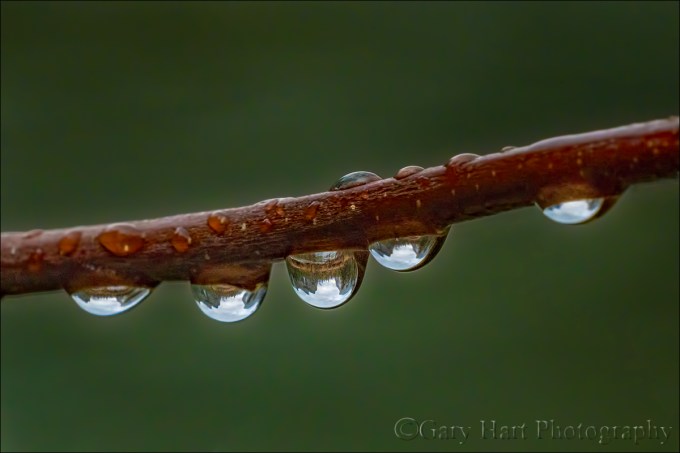
Yosemite in a Raindrop, Valley View, Yosemite
Sony a7RIII
Sony 100-400 GM
15mm extension tube
ISO 3200
f/20
1/200 second
I’ve been to Valley View in Yosemite about a million times. For those not familiar with Yosemite Valley, Valley View (sometimes called Gates of the Valley) is the classic view of El Capitan, Cathedral Rocks, and Bridalveil Fall, with the Merced River in the foreground, that represents Yosemite in countless calendars, postcards, and advertisements. Though all this attention is justified, after a million visits and counting (okay, so maybe I’m exaggerating just a little), you’d think it would be easy to take Valley View’s beauty for granted. But I don’t get tired of visiting here, not ever.

Valley View, Yosemite
Like most spots in Yosemite, the scene at Valley View varies greatly with the season and weather. In spring, Bridalveil Fall explodes from beneath Cathedral Rocks, and the surrounding forest is dotted with blooming dogwood. In autumn, rocks dot the Merced River, and colorful leaves mingle with glassy reflections. And on still winter mornings, a low mist hugs Bridalveil Meadow just across the river, while churning clouds surrounding El Capitan after a storm are a sight to behold. Nevertheless, I’m often content to keep my camera in the bag and just privately appreciate Valley View’s majesty.
But I’m a photographer, and sometimes it’s hard to experience this beauty passively. On those visits when I’m moved to photograph Valley View, I challenge myself to find something that hasn’t been done a million times. The final morning of last week’s Yosemite Moonbow and Wildflowers photo workshop was gray and damp, with occasional sprinkles lingering from a heavier overnight rain. We’d been here earlier in the workshop (in different conditions), and I hadn’t planned to photograph this time, but spotting raindrops clinging to the branches of the shrubs that line the river, I recognized a unique opportunity.
If you know optics, you know that a convex shape bends outward (so water striking its surface would run off; water striking a concave surface would pool inside). Due to this curvature, photons passing through a convex lens are diverted toward the center, where they converge and cross to create an inverted image at the point of convergence (focal point).
In fact, the human eye is a convex lens, projecting its inverted image onto the back its sphere, an image your brain promptly reverses. And photographic lenses are a complex arrangement of convex lens elements that ultimately project onto your camera’s sensor an upside-down image that’s flipped for display by the camera’s firmware.
Compared to these two examples, a dangling raindrop is elegant simplicity. Bound by surface tension, water molecules naturally form a spherical shape that is flattened or stretched slightly by gravity. Because water molecules form an electrostatic bond with foreign surfaces as well, they also adhere to things like leaves and branches, sometimes appearing to defy gravity. This small gift from nature turns a raindrop into a natural convex lens. Courtesy of this natural lens, those who peer closely into a water drop will see an inverted microcosm of the surrounding world, a view that changes with the viewing angle.
There’s potential beauty inside every water drop, but on this morning at Valley View I was in the fortuitous position to photograph raindrops holding one of the most beautiful scenes on Earth. I found a quintet of raindrops lining a branch that had nothing behind it but river. Tiptoeing close, I aligned myself and the raindrops with the Valley View scene and extended my tripod to branch level. I started with my Sony 90mm on my Sony a7RIII, adding extension tubes to get even closer. After working with this combination for a few minutes, I switched to my Sony 100-400 GM (still with extension tubes).
The image you see here is from the 100-400. Depth of field with such a close focus point is paper thin, so I stopped down to f/20 and bumped I my ISO to 3200 to ensure a shutter speed fast enough to minimize the risk of motion blur. To focus, I magnified the raindrop scene in my mirrorless viewfinder. Exposing to avoid blowing out the bright highlights in the (inverted) sky also darkened the river, creating the ideal background.
Join my 2020 Yosemite Moonbow and Wildflowers photo workshop
Workshop Schedule || Purchase Prints
The Many Views of Valley View


Get Out of the Way
Posted on March 3, 2019
(And Let the Scene Speak for Itself)
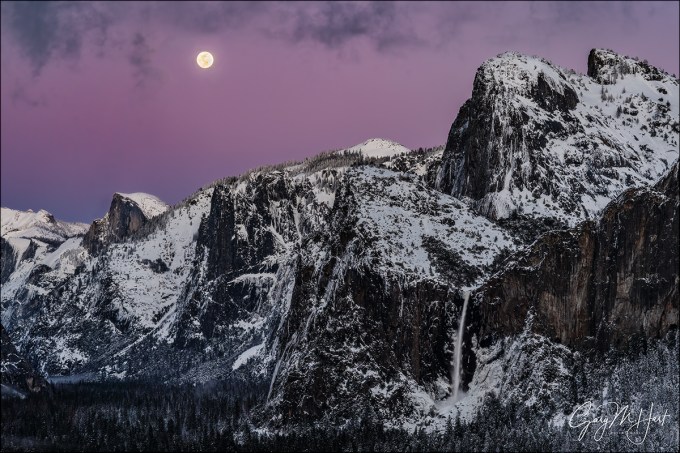
Nightfall, Full Moon and Yosemite Valley, Yosemite
Sony a7R III
Sony 24-105 f/4 G
1/6 second
F/10
ISO 100
As aggressively as I seek creative ways to express nature with my camera, and as important as I think that is, sometimes a scene is so beautiful that it’s best to just get out of the way and let the scene speak for itself. I had one of those experiences last month at Tunnel View in Yosemite.
There’s a reason Tunnel View is one of the most photographed vistas in the world: El Capitan, Half Dome, Cathedral Rocks, Bridalveil Fall—each would be a landscape icon by itself; put them all together in one view and, well…. But the view this evening was truly transcendent, even by Yosemite standards. In Yosemite Valley below, trees and granite still glazed with the snowy vestiges of a departing storm seemed to throb with their own luminance. And above Half Dome a full moon rose through a sky that had been cleansed of all impurities by the departing storm, an otherworldly canvas of indigo, violet, and magenta.
On these crystal-clear, winter-twilight moonrises, the beauty rises with the moon, reaching a crescendo about 20 minutes after sunset, after which the color quickly fades and the landscape darkens. Unfortunately, a some point before the crescendo, the dynamic range becomes so extreme that no camera (not even the dynamic range monster Sony a7RIII) can simultaneously extract usable detail from a daylight-bright moon and dark landscape.
I’d driven to Yosemite solely to photograph this moonrise, an eight hour roundtrip for 40-minutes of photography. Starting with the moon’s arrival about 20 minutes before sunset, I’d juggled three camera bodies and two tripods, first shooting ultra long, then gradually widening to include more of the snowy landscape. Already my captures had more than justified the time and miles the trip would cost me, but watching the moon traverse the deepening hues of Earth’s shadow, I wasn’t ready to stop.
I’ve learned that with a scene this spectacular, conveying the majesty doesn’t require me to pursue the ideal foreground, or do creative things with motion, light, or depth of field. In fact, I’ve come to realize that sometimes a scene can be so beautiful that creative interpretations can dilute or distract from the very beauty that moves me. On this evening in particular, I didn’t want to inject myself into that breathtaking moment, I just wanted to share it.
To simply my images, I opted for a series of frames that used tried-and-true compositions that I’d accumulated after years (decades) of photographing here, the compositions I suggest as “starters” for people who are new to Yosemite, or use myself to jump-start my inspiration: relatively tight horizontal and vertical frames of El Capitan, Half Dome, Bridalveil Fall; El Capitan and Half Dome; or Half Dome and Bridalveil Fall. In the image I share above I concentrated on Half Dome and Bridalveil Fall, capping my frame with the wispy fringes of a large cloud that hovered above Yosemite Valley.
Simplifying my compositions had the added benefit of freeing all of my (limited) brain cells to concentrate on the very difficult exposure. The margin for error when photographing a moon this far after sunset is minuscule—if you don’t get the exposure just right, there’s no fixing it in Photoshop later: too dark and there’s too much noise in the shadows; too bright and lunar detail is permanently erased. The problem starts with the understandable inclination to expose the scene to make the landscape look good on the LCD, pretty much guaranteeing that the moon will be toast. Compounding this problem is the histogram, which most of us have justifiably come to trust as the final arbiter for all exposures. But when a twilight moon (bright moon, dark sky) is involved, even the histogram will fail you because the moon is such a small part of the scene, it barely (if at all) registers on the histogram.
Rather than the histogram, for these dark sky moon images I monitor my LCD’s highlight alert (“blinking highlights”), which is usually the only way to to tell that the moon has been overexposed. If the moon is flashing, I know I’ve given the scene too much light and need to back off until the flashing stops—no matter how dark the foreground looks. This is where it’s essential to know your camera, and how far you can push its exposure beyond where the histogram and highlight alert warn you that you’ve gone too far.
When I’m photographing a full moon rising into a darkening sky, I push the exposure to the point where my highlight alert just starts blinking (only the brightest parts of the moon, not the entire disk, are flashing), then I give it just a little more exposure. I know my Sony a7RIII well enough to know that I can still give it a full stop of light beyond this initial flash point and still recover the highlights later. The shadows? In a scene like this they’ll look nearly black, a reality my histogram will confirm, but I never cease to be amazed by how much detail I can pull out of my a7RIII’s shadows in Lightroom and Photoshop.
I continued shooting for several minutes after this frame, and discovered later that even my final capture contained usable highlights and shadows. I chose this image, captured nearly five minutes before I quit, because it contained the best combination of color, lunar detail, and clean (relatively noise-free) Yosemite Valley.
Photograph the full moon above Half Dome with me this December
Workshop Schedule || Purchase Prints
Letting Nature Speak for Itself
Click an image for a closer look, and a slide show


 Eloquent Images by Gary Hart