Happy Father’s Day, Dad
Posted on June 18, 2017

Sunset Palette, Half Dome from Sentinel Dome, Yosemite
Canon EOS-1Ds Mark II
Canon 24-105L
2 seconds
F/20
ISO 100
June 2017
This summer it will be 13 years since I lost my dad to Alzheimer’s disease. He would have turned 87 next month, and I have no doubt that his body would still be going strong if the Alzheimer’s hadn’t taken over. Sadly, it’s difficult to fully appreciate a parent’s influence until they’re gone. We’re certainly aware of the love, wisdom, advice, discipline, tears, and laughs while we’re in the midst of growing up, but it takes being a parent to fully appreciate our parents’ influence on the adults we become.
Dad was a United Methodist minister who literally practiced what he preached. In 1965, when Martin Luther King issued a plea to clergy to join him, Dad borrowed money and flew across the country to march with Dr. King in Selma, Alabama (he was on national TV getting arrested). His was an inclusive theology that respected all religions: I can remember Dad preaching at the local synagogue on a Saturday, and reciprocating in our Sunday service by opening his pulpit to the rabbi. And I’ve lost track of the number of homeless people, including families with young children, we housed while they tried to get back on their feet.
More than the values he instilled, so many of the things that define me today are directly attributable to my dad’s influence. My love of sports and sense of humor for sure. And when asked how I became a photographer, I have to cite Dad. My standard answer has always been that Dad was a serious amateur photographer whose 80-hour work week offered too little time to pursue his passion, so he made up for lost time on our summer family vacations—I grew up believing that a camera was just a standard outdoor accessory. But I think his influence goes deeper than that. More than simply modeling camera use, Dad instilled his appreciation of nature’s beauty, and his longing for its soothing qualities.
Our vacations were, without exception, camping trips—always tent-camping, though in the later years we splurged on a used, very basic tent trailer (no kitchen, bathroom, or any of the other luxuries available in today’s tent trailers). A few times we (Dad, Mom, my two brothers, and I) hit the road for a longer camping trip, one summer taking a month to camp all the way across the country, another summer venturing into the Canadian Rockies. But usually we took advantage of the mountain scenery (always the mountains) closer to our California home.
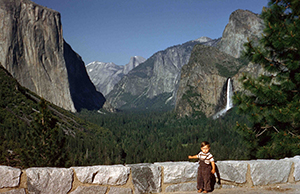
Me, on an early (but probably not my first) Yosemite trip
Of these locations, Yosemite was the clear favorite. Marveling at the Firefall from Camp Curry and Glacier Point, waiting in lawn chairs at the Yosemite dump for the bears to arrive for their evening meal (really), rising in the dark for a fishing expedition to Tuolumne Meadows, family hikes up the Mist Trail to Vernal and Nevada Falls, are just a few of the memories that I only realize in hindsight formed my Yosemite connection.

My father’s rainbow
My favorite Dad photography story happened when I was about ten. It involves an electrical storm atop Sentinel Dome, and his desire to get the shot that was so great that it trumped common sense. As his ignorant assistant, I stretched to hold an umbrella high above Dad’s head to keep his camera dry. (In his defense, as Californians, lightning was a true novelty that trumped full appreciation of its dangers.) We didn’t get the lightning, and more importantly, it didn’t get us. But what I remember more than anything about that day was Dad’s excitement when later that afternoon he was able to photograph a rainbow arcing across the face of Half Dome.
This story has achieved family legend status, and we’ve felt a special connection to Sentinel Dome as a result. When it came time to scatter Dad’s ashes, Sentinel Dome was the obvious choice.
One more thing
I have the reputation for being very lucky where photography conditions are concerned: The clouds that part just as the moon rises, the snowstorm that blankets Yosemite Valley just as the workshop begins, the rainbow arcing across the Grand Canyon. In our family we like to believe that Dad is somehow up there pulling some strings. It’s just the kind of thing he’d do.
I love you, Dad.
Workshop Schedule || Purchase Prints || Instagram
Sharing the Love: A Yosemite Gallery
Click any image to scroll through the gallery LARGE


Merry Nature Photography Day!
Posted on June 15, 2017
For everyone who lay awake all night wondering what they were getting for Nature Photography Day, wait no longer (okay, seriously, as far as I’m concerned every day is Nature Photography Day, but I’ll play along). Here is a collection of my favorite images of nature.
Click an image for a closer look and slide show. Refresh the window to reorder the display.


Workshop Schedule || Purchase Prints
Starry, starry night
Posted on June 9, 2017
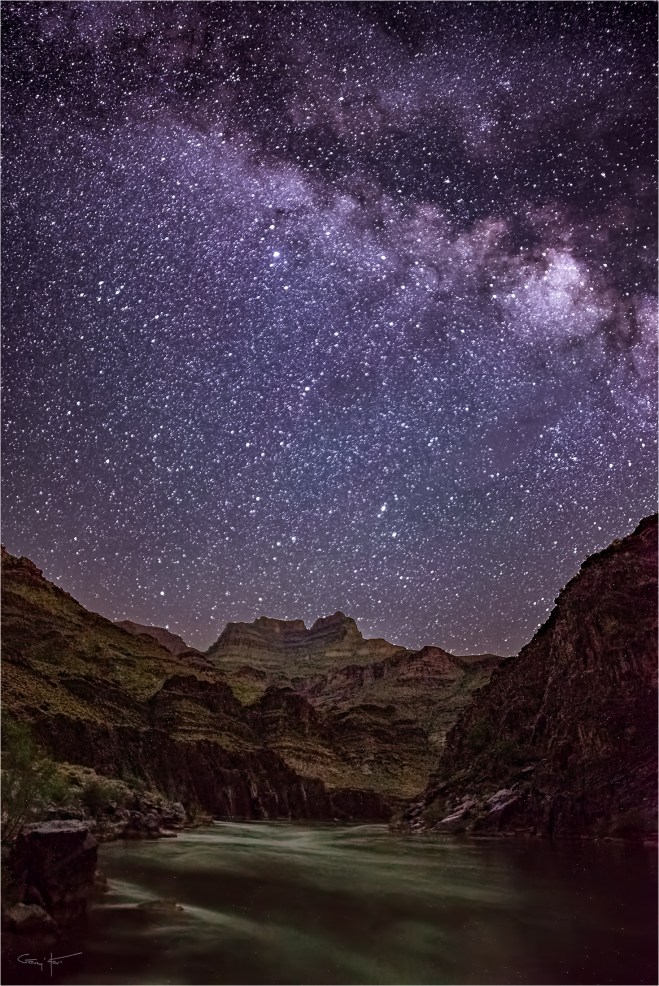
Starry Night, Colorado River and Evans Butte, Grand Canyon
Sony a7S II
Rokinon 24mm f1.4
20 seconds
F/2
ISO 12800
Few experiences in nature surpass a dark sky brimming with an impossible number of stars. The darker the sky the better, and the sky doesn’t get much darker, or more impossible, than a moonless night at the bottom of the Grand Canyon. I schedule my annual Grand Canyon raft trip for the week of the new moon to ensure the darkest skies and the most stars; I prefer May because canyon temperatures are comfortably warm but not yet hot, and the Colorado River runs clear, unmuddied by sediment stirred by the summer monsoon.
As darkness seeps into the mile-deep gorge, the first pinpoints overhead are the planets, some combination of Venus, Jupiter, Mars, Mercury, and Saturn. Soon the darkness is as complete as we ever see it at home, and the planets are joined by the brightest stars in recognizable constellations. But unlike home, the darkening continues, and with every passing minute comes more stars, until it seems the sky can’t possibly hold any more.
Pausing to take it all in, the first thing to catch your eye in the unprecedented dark might be the Big Dipper—in May it’s high overhead as darkness falls, a comforting sight to disoriented observers still not convinced that this sky is real. Perhaps you’ll be temporarily distracted by the blinking lights of a distant jetliner, a silent reminder of the world left behind. A keen eye may discern a faint “star” moving among its neighbors—a satellite, possibly monitoring the weather, or sending GPS coordinates, or maybe even a foreign country secretly observing (smile!). And if you’re patient you might see a streaking meteor (or two, or three…), as if a hidden star has sprinted across the darkness and into a new hiding place.
But this visual feast is only the appetizer, because the main course, the Milky Way’s glowing band, isn’t served until close to midnight (or later, depending on the part of the sky that’s visible from the chosen vantage point). The Milky Way rises in the east, a band of light running north and south, ascending until it eventually spans the sky. Fainter in the north, the Milky Way brightens as your eyes follow it south, toward the glowing galactic core. The photogenic galactic core rises highest in the southern sky, so we hope for campsites with an open view in that direction. Since the Grand Canyon sky is crowded by tight, towering walls, the best views of the sky are usually up- or down-canyon.
Our best south-sky opportunities come on the trip’s first two nights, when we’re in Marble Canyon, the north/south trending section of the Grand Canyon that ends at the Little Colorado River confluence. At the confluence the canyon walls open to offer the trip’s best view of the sky, but just downriver the Colorado turns westward and the walls rise and squeeze closer. Fortunately, rather than beeline to Lake Mead, the Colorado River meanders a bit, bending north here and south there, providing an occasional view of the southern sky throughout the Grand Canyon.
Pulling into camp after a long day on the river, the first thing I do is find a spot for my cot that will ensure the best possible view of the night sky as I fall asleep. With my claim staked, I survey the surroundings for potential night photography scenes. Campsites on the Colorado River are first-come, first-served, and we have to hope we find one that’s oriented properly and has photogenic vantage points. Usually that means down by the river, but sometimes it’s an elevated location with the river in the distance. But if the campsite doesn’t have a photogenic vantage point, I’m not disappointed because nothing can take away my bedtime canopy.
If I find a scene I like, I compose, dial in my night exposure settings, and focus my camera well before dark. Sometimes I’ll compose and leave the camera poised on the tripod, ready for my return in the wee hours of the morning. If I’m afraid someone might stumble on my tripod in the dark, I leave it beside my cot, camera loaded and ready for action when I wake later.
On the trip’s third evening we pulled into camp exhausted but exhilarated after the trip’s most intense day of rapids. I found a view I liked near camp—getting there required a little rock scrambling that was no big deal with the sun out, but would require a bit more care. The Milky Way in May reaches its zenith in the south at around 3 a.m., but since we didn’t have a good view of the southern sky from this site, I decided the best views of the Milky Way would come earlier, when I could photograph it downstream, in the eastern sky. I woke at 1 a.m., grabbed my camera, and stumbled by the screen of my iPhone (the less artificial light my eyes are exposed to, the better they function when I try to photograph in the dark) to the spot I’d chosen. I could tell by a handful of glowing LCDs scattered downstream that I wasn’t the only one shooting. (On the first night I’d given the group instruction and guidance on photographing the Milky Way, but after that everyone was free to pick their spot and time, or stay in bed.)
I shot exclusively with my Sony a7SII and Rokinon 24mm f/1.4 lens. Once I’d perfected the composition and verified the sharpness, sticking with a 20 second shutter speed, I varied my ISO and aperture for more processing options later: ISO 3200, 6400, and 12,800; f1.4 and f2. At these settings I capture more light than my eyes take in—not only does this reveal more of the canyon than I can see, it also reveals even more stars.
I only photographed for about 20 minutes, but was so wired when I returned to my cot that I lay awake for another hour, mesmerized by my glittering ceiling.
Workshop Schedule || Purchase Prints
A Starry, Starry Gallery
Click an image for a closer look and slide show. Refresh the window to reorder the display.


Downhill All the Way
Posted on June 5, 2017

El Capitan Reflection, Yosemite
Canon EOS 10D
1/4 second
F22
ISO 100
27 mm
On Saturday, with little fanfare, Alex Honnold stunned the climbing world when he free-soloed El Capitan in Yosemite, the world’s largest granite monolith. (What’s the big deal? From this image, you can clearly see that it’s downhill all the way….)
But seriously…
Speaking for all non-climbers, Alex Honnold didn’t just stun the entire climbing world, he stunned the entire rational world. Soaring three-thousand feet above Yosemite Valley, El Capitan is the Holy Grail of climbing. Among climbers, if you’ve summited El Cap, you’ve made the Major Leagues.
First conquered by Warren Harding in 1958, today dozens of climbers dot El Capitan’s vertical surface on any non-winter day with reasonable weather in the forecast. But until Saturday, all who scale El Capitan do it with ropes and a virtual hardware store worth of climbing aids. Most require multiple days to summit.
Alex Honnold chose to ascend El Capitan unencumbered by ropes or safety hardware of any sort (free climbing uses ropes for safety only; free-soloing is completely sans rope), scampering up the shear granite the old fashioned way, using only his hands and feet like a kid climbing a tree in his backyard. Even more astonishing, he accomplished his feat in less than four hours.
I’m not a climber, and in fact have a difficult time getting within three feet of any un-railed vertical drop greater than thirty feet. But I’ve always lived vicariously through climbers, devouring climbing books, videos, and documentaries just to marvel at their accomplishments. And for years Alex Honnold has been the climber I’ve followed most closely, not just because he’s the best (he is), but also because of our common affinity for Yosemite, and the fact that my daughters went to high school with him (and I was a Honnold fan even before I knew this connection).
I also admire Alex Honnold not only for his skill and accomplishments, but for his humble demeanor (I suspect that he’d prefer climbing in complete anonymity) and quiet wisdom. And though we’ve never met, I can’t help worrying a little about him when I think of the number of mistakes I make with my camera—”Oops, I’m still at ISO 3200 from last night’s Milky Way shoot”; “Crap, I forgot to orient my polarizer”; “Did I remember to focus?” (I could go on)—and realize that for Alex Honnold, even one small mistake likely means death. I mean, even if I knew with absolute certainty that missing my exposure by just 1/3 stop would cause my camera to explode, I’m pretty sure I’d still be dead long ago.
So hats off to you, Alex Honnold, here’s wishing you many happy years as the world’s greatest living climber.
Links
- Check out this “60 Minutes” segment
- Here he is climbing El Sendero Luminoso in Mexico
- And if the video makes you squeamish, here’s a simple interview
An El Capitan Gallery


Seeing the future
Posted on June 1, 2017

Rapids, Half Dome and Tenaya Creek, Yosemite
Sony a7R II
Sony 12-24 f4 G
12mm
.8 seconds
F/9
ISO 200
Ansel Adams and visualization
Most photographers know that Ansel Adams visualized his prints, and the darkroom work necessary to create them, before clicking the shutter. This ability to look into the future of each capture is part of what set Ansel Adams apart from his peers.
But Adams’ extensive darkroom work is often cited by digital photographers defending their over-processesed images. We’ve all heard (and perhaps even uttered ourselves) statements like, “Ansel Adams spent more time in the darkroom than he did in the field,” or “Ansel Adams would love Photoshop.” Perhaps true, but using Ansel Adams’ darkroom mastery to justify extreme Photoshop processing misses a significant point: Adams’ mental picture of the ultimate print was founded on a synergistic relationship between his vision and his camera’s vision, coupled with a master’s control of capture variables like composition, light, motion, and depth. In other words, Adams’ gift wasn’t merely his darkroom skills, it was an overarching vision that enabled him to make decisions now based on invisible realities he knew he’d encounter later.
I bring this up because I’m concerned about many photographers’ Photoshop-centric “fix it later” approach that seriously undervalues capture technique. This mindset ranges from simple over-reliance on the LCD for exposure with no real understanding of the histogram or how metering works (shoot-review-adjust, shoot-review-adjust, shoot-review-adjust, until the picture looks okay), to photographers who channel their disappointment with an image into an overzealous Photoshop session, pumping color, adding “effects,” or inserting/removing objects until they achieve the ooooh-factor they crave.
The better approach is to understand the potential in a scene, anticipate the processing that will be required to make the most of it, and shoot accordingly. In other words, Photoshop should inform capture decisions, not fix them.
Putting Photoshop in its place
Every image ever shot, film or digital, was processed. Just as the processing piece was easy to ignore when the exposed film you sent to a lab magically returned as prints or slides, many digital shooters, forgetting that a jpeg capture is processed by their camera, brag that their jpeg images are “Exactly the way I shot them.” Trust me, they’re not.
Whether you shoot monochrome film, Fuji Velvia slides, or low-compression jpeg, there’s nothing inherently “pure” about your image. On the other hand, digital landscape photographers who understand that processing is unavoidable, rather than relinquish control of their finished product to black-box processing algorithms in the camera, usually opt for the control provided by raw capture and hands-on processing.
Unfortunately, Photoshop’s power makes it difficult for many to know where to draw the processing line. And every photographer draws that line in a different place—one man’s “manipulation” is another’s “masterpiece.” Photoshop isn’t a panacea; its main function should be to complement the creativity already achieved in the camera, and not to fix problems created (or missed) at capture.
While I’m not a big Photoshop user, I readily acknowledge that it’s an amazing tool that’s an essential part of my workflow. I particularly appreciate that Photoshop gives the me ability to achieve things that are possible with black and white film and a decent darkroom, but difficult-to-impossible with the color transparencies I shot for over 25 years.
Creating an image, from start to finish
I was in Yosemite on a “secret mission” (my inner 10-year-old just loves saying that) for Sony, trying out the yet-to-be-announced (at the time) Sony 12-24 f4 G lens. Among the many places in Yosemite that are especially conducive to ultra-wide photography is Mirror Lake and its view of Half Dome from directly below, and that’s where I started.
Walking up the trail to Mirror Lake, I skirted Tenaya Creek in less than ideal light, scouting potential scenes for later. On the walk back after sunset, I returned to this scene that I’d found and mentally composed earlier. Despite already having an idea of how I wanted to shoot it, there’s quite a bit going on here, so it took some time and a bit of rock scrambling to get all the elements to work together: Half Dome, Tenaya Creek, the nearby evergreen, and the creekside boulders.
While most of the scene was in deep shade, the sky was still relatively bright. Capturing this much dynamic range in an unprocessed jpeg (or color transparency) would have been impossible—my highlights would have been too bright, the color in the sky would have been washed out, and the shadow detail would have been lost to blackness. And that’s exactly what I saw in the jpeg that popped onto my LCD. But despite the crappy looking jpeg on the back of my camera, my histogram told me all my color and detail was there in my raw file.
With a good histogram, I adjusted my ISO up and down, compensating with a corresponding shutter speed adjustment, to get different blur effects in the creek. Opening the raw file in Lightroom, I simply pulled the Highlights slider to the left and the Shadows slider to the right to confirm my successful exposure. While the exposure adjustment was essential, once that was done, there was very little processing left to do. And as much as he enjoyed the dark room, I suspect Ansel would have embraced any technology that gave him more time outdoors with his camera.
Workshop Schedule || Purchase Prints
Different Takes on Half Dome


A Star in the East
Posted on May 22, 2017

Yosemite Falls Sunstar, Yosemite (Sony 12-24 f/4)
Sony a7R II
Sony 12-24 f4 G
12mm
1/30 second
F/20
ISO 100
When Sony asked Don Smith and me to try out their new lenses, I immediately thought of a couple of El Capitan and Half Dome views in Yosemite that would be ideal for the new Sony 12-24 f4 G lens. After great success photographing Yosemite’s granite icons as I’ve never been able to before (okay, well there was that one time last year when I borrowed a friend’s ultra-wide lens), I was ready to go home. But before leaving, I decided to walk up to the bridge beneath Lower Yosemite Fall, which was bursting with spring flow.
With my Yosemite Moonbow and Dogwood workshop starting in just five days, my goal this morning was more to see exactly how wet it is on the bridge than it was to take any more pictures, but I decided to take my camera anyway. On the way back I played with ultra-wide (12mm) vertical compositions of this scene. Still getting used to how much I can actually fit in my frame at 12mm, I flipped the camera to horizontal and was startled to find the sun in the right corner of my viewfinder. Startled because from my location, the top of Yosemite Falls is due north (0 degrees), and the sun at that time was at 125 degrees azimuth (35 degrees south of due east).
I quickly came to terms with this revelation and repositioned myself until the sun was behind a tree, dialed the aperture to f/20, composed, metered, and focused, then clicked as the sun peaked out. For the next ten minutes or so I moved as the sun moved, keeping my lens right on the edge of the tree’s shadow.
I knew the sunstar’s highlights would clip, but I wanted to give the shadows as much light as possible without losing the highlights in the waterfall. And as important as the histogram is in these scenes with brilliant highlights and dark shadows, I knew in this case it wouldn’t tell me the entire story. As I increased the light by lengthening my shutter speed, in my viewfinder (I love mirrorless!) I monitored both the shadow side of the histogram and the highlight alert in the fall. I know that shooting raw on my Sony Alpha bodies, I can increase the exposure a stop beyond where the highlight alert appears, but in this case I found that I only needed to add 2/3 stop before the histogram showed me that I had all the recoverable data in the shadows I needed.
A few words about sunstars
Sunstars can be overdone, but they’re often the best way to make something interesting in difficult light. When I find myself wanting to photograph a clear sky scene facing the sun, I often use the sunstar to add visual interest to a sky that is otherwise pretty boring. Often the sunstar makes an excellent counterbalance to another strong visual object. And while a sunstar isn’t exactly what our eyes see when we look toward the sun, I think it makes a pretty good substitute for the blinding experience of looking into the sun. Take a look at the gallery of images below and ask yourself how many of these images would have been as visually appealing without a sunstar spicing up the sky.
To capture a sunstar, use a small aperture (I usually use f/16 or smaller), remove any filters (to minimize flare), and place the sun on a hard edge with most of the sun obscured: the horizon, a cloud, a tree, a flower, and so on. The more sun visible, the bigger (and more blown out) the sunstar will be. As a general rule, I try to avoid too much sun. And since each lens creates a slightly different sunstar, it helps to experiment with different lenses to determine which ones work best.
I’ll be on my annual Grand Canyon raft trip, off the grid and unable to respond, until May 30
Workshop Schedule || Purchase Prints
A Sunstar Gallery


The cat’s out of the bag…
Posted on May 19, 2017
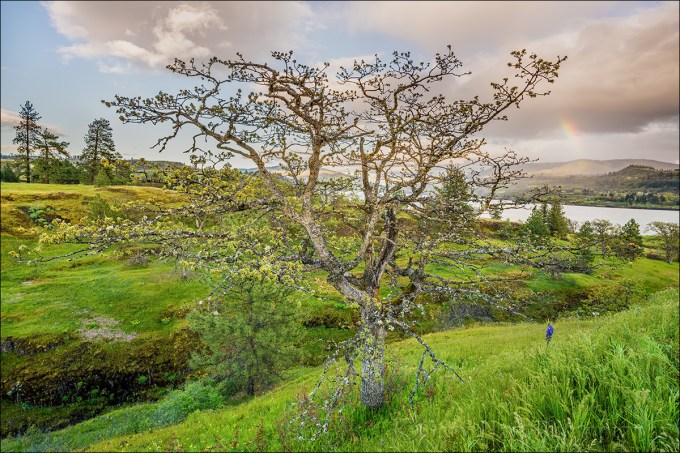
Spring Rainbow, Catherine Creek Trail, Columbia River Gorge
Sony a7R II
Sony 16-35 f2.8 GM
18mm
1/125 second
F/11
ISO 400
For about three weeks I’ve had to bite my tongue about two new Sony lenses I got to try out a few weeks ago. But yesterday Sony announced their brand new 16-35 f2.8 GM and 12-24 f4 G lenses and I’m free to share.
I spent most of this week just outside of Santa Barbara, California with a hundred or so Sony Artisan and Creative Collective photographers at Sony’s Kando Summit. This event was revelatory in many ways: Not only did I get to commune with fellow Sony Artisan’s who had previously been just names on e-mails and pictures on Facebook, I also learned that the future of photography is in the very capable hands of the Collective members—such an impressive group of creative, intelligent young adults.
For most of the Summit the hardware show-stealer was the brand new Sony a9—each of us got our own a9 to play with (but not to keep) for the duration of the event, along with many great photo opportunities (models, sets, and demonstrations) provided to us by Sony. Without going into a lot of detail, I predict that time will prove that the Sony a9 is an actual photography game changer and not just another “next great camera” cliché.
But the availability of the a9 wasn’t a surprise; the surprise (to almost everyone else) was the announcement of the new 16-35 and 12-24 lenses, and their instant availability (again only to borrow). Since I’d already had nearly a week of quality time with them, I passed on this opportunity, but had to jump aside to avoid being trampled by a stampede of photographers intent on getting their hands on these two new lenses.
Don Smith and I were just wrapping up our back-to-back Columbia River Gorge workshops when Sony asked us if we could stay a couple of extra days to try out their two new (super-secret) lenses. They overnighted them to us, and since we had them for a week, Don and I decided we had time to try them for a couple of extra days at our favorite locations closer to home. For me that was Yosemite (Don went to Big Sur). Since I knew I wanted the 12-24 in Yosemite, I took the 16-35 for our two extra days in the CRG.
First Impressions: 16-35 f2.8 GM
The first thing that struck me about this lens was its compactness. As a landscape shooter always on a tripod, I value compactness over speed in a lens, but this one gives me both. Of course it’s not as compact as my Sony/Zeiss 16-35 f4, but it’s noticeably more compact than my Canon 16-35 f2.8 was. I was also pleased with its smoothness of operation and speed of focus—this lens is definitely a joy to use.
Of course compactness and ease of use mean nothing if a lens isn’t sharp, and I can tell you with certainty that this lens is as sharp as we’ve come to expect Sony’s GM lenses to be—that is, ridiculously sharp from corner to corner and throughout the aperture range. I haven’t really taken the time to do a/b tests against any other lenses (I leave the pixel-peeping to others), but I did magnify many images to 100% (on my 27-inch iMac Retina 5K monitor) and can’t imagine that I have any lenses sharper than this one (including primes).
First Impressions: 12-24 f4 G
Even more than with the 16-35, the 12-24 blew me away with its compactness. I’ve handled the Nikon 14-24 f2.8 many times, and actually used Canon’s 11-24 f4, and as sharp as those lenses are, the first thing I remember about those lenses is their heft—they’re beasts, and just too heavy to carry in my bag for regular use. Not so with the Sony 12-24: This lens is 1/3 the weight of Canon’s 11-24—in fact it’s noticeably lighter than the Canon 24-105, and not much heavier than the Canon 17-40. Wow.
Like the 16-35, this lens just felt good on my camera and in my hand. The operation was smooth, and focus was fast and easy. Having rarely shot with a lens this wide, I found myself frequently surprised by how much more I could get in my frame at 12mm than I can at 16mm—suddenly things not possible with a single click before were very doable. With so many views of very large and close subjects (such as El Capitan and Half Dome), this lens was made for Yosemite. And I did an actual double-take at the top of the trail to lower Yosemite Fall when I realized I could get the entire fall and a sunstar (with the sun behind my right shoulder) in one frame (see the gallery below).
Sharpness? Again, I didn’t do any pixel peeping beyond magnifying my images to 100%, but they looked every bit as sharp as the Canon 11-24 images that blew me away when I used it a year ago. I will own this lens the first day it’s available.
About this image
On the first evening with our new toys, Don and I went to Catherine Creek on the Washington side of the Columbia River Gorge. At the trailhead Don headed off in one direction and I went in the other, eventually ending up at this tree that I remembered from previous visits.
With the wind blowing like crazy, probably 25-35 MPH, this lens was perfect for the wide scenes that deemphasize motion. To further ensure against any motion blur I bumped my ISO to 400 and went to work. I started by balancing the tree with a small waterfall that was down the hillside to my left, but when a surprise rainbow fragment popped out above the Columbia River I quickly shifted position. My exposure variables were already set, so all I had to do was compose, focus, and shoot. Good thing, because the rainbow faded quickly and I only had time for a handful of images before it was gone completely.
Listen to Don and I discuss the new lenses on the Alpha Universe Podcast
Sony 16-35 f2.8 GM and Sony 12-24 f4 G Sample Images
Click an image for a closer look and slide show. Refresh the window to reorder the display.


Spring has sprung
Posted on May 15, 2017
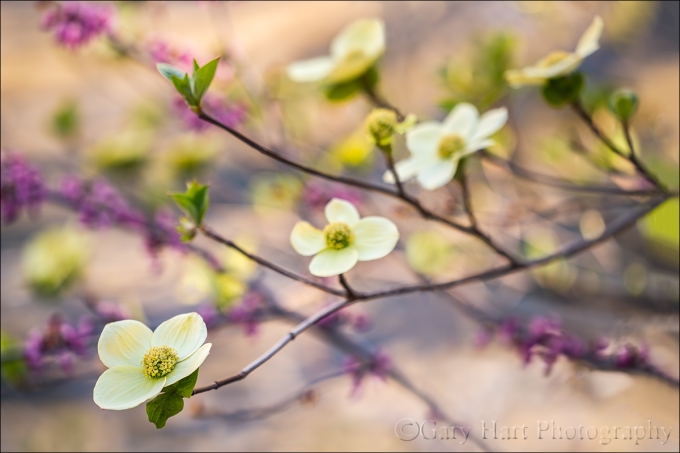
Dogwood and Redbud, Merced River, Yosemite
Sony a7R II
Sony 70-200 f/4
1/40 second
F/4
ISO 200
I spent most of the last week in Yosemite and can confirm that spring has definitely sprung there. The Merced River, swollen by snowmelt, is overspilling its banks, flooding meadows and submerging riverside trails. Reflections are everywhere, and viewing the waterfalls without getting wet? Forget about it.
Another spring highlight is the moonbow that colors the mist beneath Yosemite Falls. A fortunate convergence of Yosemite Falls’ southeast exposure and the angle of the rising full moon when the snowmelt is at its peak make Yosemite one of the best locations in the world to witness a lunar rainbow. I was able to photograph it three times last week, twice with my workshop group and once with a private tour customer. Easily visible to the naked eye as a silvery arc in the billowing mist, a long exposure reveals the moonbow’s true colors.
But of all the spring treats Yosemite offers, for creative photography I think the dogwood might be my favorite. For just a few short weeks in April and May, these graceful blooms shower Yosemite Valley with splashes of white that remind me of the Fourth of July sparklers of my childhood. But unlike the ephemeral sparks of a sparkler, the dogwood progress in slow motion so I can appreciate them at a much more relaxing pace.
I found this branch at the Bridalveil Fall vista on Northside Drive, about a mile east of Valley View. The river was gold with late light, and the air was still as I went to work on the scene. Careful positioning allowed me to juxtapose three layers in my frame: in the foreground is the dogwood branch with varying degrees of detail; the middle-ground is a blend of heavily blurred redbud and more dogwood; all this spring beauty stands out against a backdrop of the sunlit Merced River. I experimented with different depths of field by varying my f-stop, focal length, and focus distance until I was satisfied.
Yosemite Spring
Click an image for a closer look and slide show. Refresh the window to reorder the display.


Moving the eye
Posted on April 29, 2017
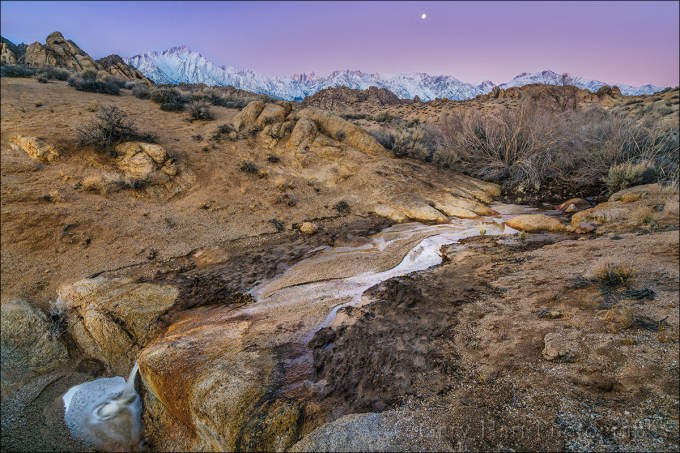
Sierra Dawn, Mt. Whitney and the Alabama Hills, California
Sony a7R II
Sony/Zeiss 16-35 f/4
.4 seconds
F/10
ISO 100
With virtually every still camera now equipped with video capability, the last few years have seen an explosion of nature videos. When done well, videos of nature can be quite effective, conveying motion and engaging both eyes and ears to reveal the world in a manner that’s closer to the human experience than a still image is. But like other sensory media whose demise has been anticipated by the arrival of something “better,” (with apologies to Mark Twain) let me say that the rumors of still photography’s death at the hands of videography have been greatly exaggerated.
Just as I much prefer reading the book to watching the movie, I prefer the unique perspective a still image presents. For example, while motion in a video is similar to being there, a still image gives me the freedom to apply my own motion, at my own pace. A video’s frame rate dictates the pace of my relationship with the scene, while entering the world of a photograph gives my eyes the freedom to linger and explore a scene’s nooks and crannies, to savor its nuances at my own pace.
In a video my eyes are essentially fixed while the scene moves before them. In a still image, on the other hand, my eyes do the moving, often following lines in the scene the way a hiker follows a trail to reach a destination. But also like a hiker, I can choose to venture cross-country through an image to more closely scrutinize whatever looks interesting.
About this image
I’d been in the Eastern Sierra, exploring the Alabama Hills specifically looking for scenes near the famous Mobius Arch that didn’t include the arch. Detouring from the well-worn path back to the car, I headed up a rocky creek bed that was carrying water for the first time in recent memory. Soon the creek’s quiet whisper was replaced by the sound of a more agitated rush, hinting at a little faster water somewhere around the next bend. Continuing upstream, I scrambled up a large boulder and was rewarded with an unobstructed view of the Sierra Crest, freshly glazed with snow. Below me the creek cut a diagonal path across weathered granite, rushing through a narrow gap and over a rocky ledge.
The light was poor for photography that evening, so my camera stayed in my bag. Instead, I simply cinched my jacket against the January wind and appreciated the view. Standing there, I thought about the next day’s sunrise, its softer light, and (especially) the nearly full moon that would descend through twilight’s pastel hues.
Having already plotted the moon’s path, I was able to visualize its nearly full disk at the top of my frame, low in the sky between Mt. Whitney and Mt. Williamson. But including the creek in the same frame would pose a problem. Normally I’d drop to creek level to shrink the middle-ground, but because the creek was in a steep-walled ravine of its own creation, any view that included the creek and the Sierra Crest needed to be on higher ground. So I scanned the nearby terrain and soon found a narrow gap between two elevated rocks, just wide enough for me and my tripod with a little creative contortion (by both tripod and photographer), and just high enough to see the mountains.
The next morning I beelined back to “my” spot and went right to work in the predawn gloaming. Wedged into the rocks about five vertical feet above the creek, my perch felt more awkward than dangerous. To fit the entire scene, I used the full width of my Sony/Zeiss 16-35 lens. I was thrilled by how well each visual element meshed vantage point: the mountains—Lone Pine Peak, Mt. Whitney, and Mt. Williamson connected to the tumbling cascade by a slash of moonlit creek, and moon as the scene’s exclamation point. I even liked the way the nearby granite sand and rocks, and the shrubs stripped bare by winter cold and wind, filled the empty surroundings with a pleasing textures and shapes without distracting.
Once I identified and refined my composition until I was confident I’d done as well as I could with it, I clicked at regular intervals to capture the entire sunrise sequence. The moment of this image was darker to my eyes what you see in this frame, dark enough that the creek still reflected moonlight. I was particularly grateful for the dynamic range of my Sony a7RII, which allowed me to capture all this wonderful detail in my scene without turning the moon into a useless white blob.
Images that Move the Eye
Click an image for a closer look and slide show. Refresh the window to reorder the display.


Dogwood days
Posted on April 21, 2017

Forest Dogwood, Yosemite Valley
Canon EOS 5D Mark III
1/80 second
159 mm
ISO 800
F4
People ask all the time for my favorite season in Yosemite, and I really can’t give them an answer that doesn’t sound like a press conference by a waffling politician—there are things I love about each season in Yosemite, so asking me to choose is like asking me to pick a favorite child. But I can tell you what I like about each season, and I’ve always felt that spring in Yosemite is the most consistently photographable—it doesn’t really matter what the conditions are, I can always find something to photograph.
Spring is when Yosemite’s waterfalls peak, and Yosemite Valley starts to green up. Many of the meadows are home to ephemeral pools that reflect Yosemite’s iconic monoliths, soaring cliffs, and plunging waterfalls. And with all the water in the falls, spring sunshine means rainbow opportunities from many spots if you know when to be there.
Maybe my favorite Yosemite spring treat is dogwood, which usually peaks around May 1, give or take a week or two. I enjoy photographing dogwood in any kind of light, from sunshine, to overcast, to full shade. In sunshine, I put backlit blooms against a dark background, expose for the flower, and go to town. The translucence of these backlit flowers gives them a luminosity that appears to originate from within. In overcast and shade, I opt for soft focus that emphasizes my primary subject and reduces the background to colors, lines, and shapes.
Regardless of the light, I start with a bloom, group of blooms, or entire branch, that I can isolate from surrounding distractions. Once I identify a likely candidate, I maneuver myself until I can get the subject against a complementary background, such as shade, shape, and color.
I worked this scene for about a half hour before I was satisfied. I started with the flower-laden branch and moved around a bit until the background was right. Then I tried a variety of focal lengths to simplify, balance, and soften the composition. Once I was satisfied with my composition, I used live-view to focus toward the front of the center cluster. Finally, I ran the entire range of f-stops from f4 to f16, in one-stop increments, to ensure a variety of bokeh effects to choose from.
A Dogwood Gallery


 Eloquent Images by Gary Hart