Eloquent Images by Gary Hart
Insight, information, and inspiration for the inquisitive nature photographer
2018 Highlights
Posted on December 30, 2018
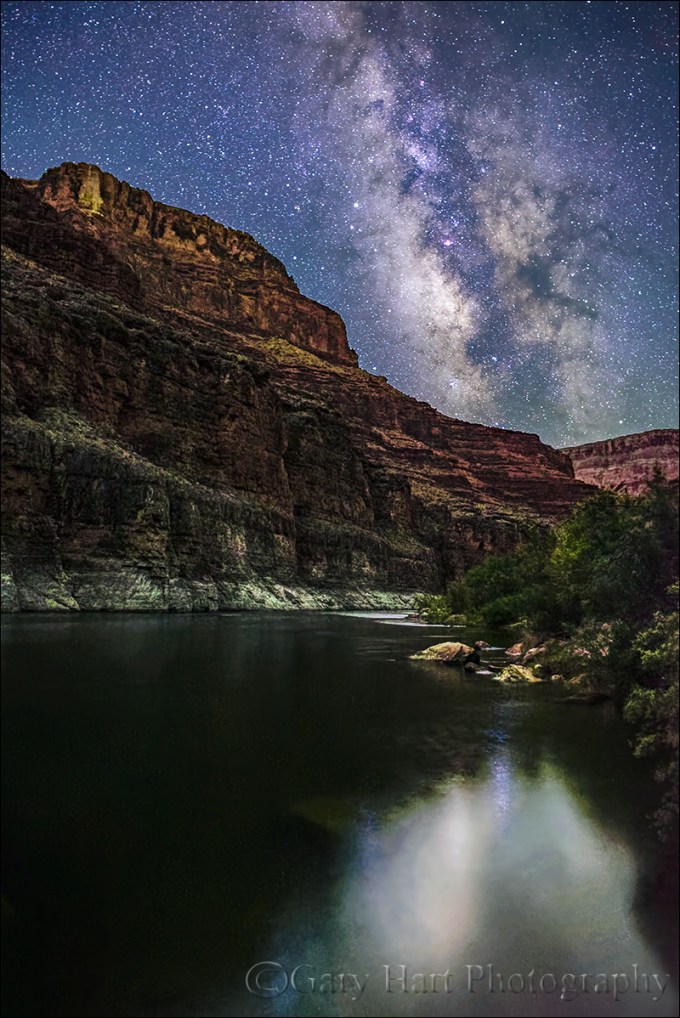
Milky Way Reflection, Colorado River, Grand Canyon
Sony a7S II
Rokinon 24mm f/1.4
20 seconds
f/1.4
ISO 12,800
I’ve always struggled with the “top-whatever” end-of-year countdown of my favorite images because the choices are so subjective and mood dependent, and so many images are favorites as much for their memories as they are for their aesthetic value. And coming up with a predetermined number is arbitrary, and inevitably requires choices I don’t want to make and will almost certainly regret later. One year I may have only seven or eight images that thrill me; the next year I might have two dozen. This year I chose 27, and I still have some left to process.
So rather than attempt to rate and rank my images at year’s end, I prefer using them as a catalyst for reflection. Each December I go through everything I’ve processed from the waning year (this year I know of several that would certainly qualify as a highlight but they’re as yet unprocessed) think about the circumstances of their capture.
I remember
I remember the New Year’s Eve solo drive to Yosemite to photograph the full moon rising behind, followed by a night drive to the other side of the Sierra (a six hour drive in winter) where I hoped to capture the full moon setting behind Mt. Whitney. The Yosemite part of that trip was spectacular, the Mt. Whitney half was a photography flop, but I enjoyed the entire journey.
I remember nearly a month in New Zealand, photographing the South Island’s unmatched beauty in its most beautiful season (hint: brrrrrrr). In New Zealand I hiked on a glacier, photographed the (far superior) Southern Hemisphere version of Milky Way, was chased through a fjord by leaping dolphins, witnessed one of the most vivid crimson sunrises I’ve ever seen, and logged hundreds of quality kilometers with a group of wonderful people.
I remember a solo drive to Yosemite to photograph fresh snow, never a sure thing regardless of the forecast. I approached Yosemite on the evening prior, I felt like a lone spawning salmon fighting up current against the continuous stream of headlights evacuating Yosemite in advance of the storm. I settled into my room in dark and dry Yosemite Valley, and woke to so much snow that I couldn’t find my car. I’m convinced there is nothing, nothing on Earth more beautiful than Yosemite Valley with fresh snow, and with the park mostly vacant and the noise-damping quality of powdery snow, for a few hours I felt like I had heaven all to myself.
I remember chasing lightning on the Grand Canyon’s North Rim, the thrill (and relief) when everyone in both workshop groups captured lightning, and an especially spectacular lightning storm that started in the telephoto distances and chased us to the cars. This year’s Grand Canyon workshops were altered by fires burning in and near the park and I feared that they’d spoil the photography—instead, in addition to all the lightning, we ended up with spectacular red-rubber-ball sunrises and sunsets that allowed genuinely unique images in this heavily photographed destination.


I remember arriving on the Big Island shortly after Kilauea had shut down after 35 years of continuous eruption, and discovering that between the just-concluded Kilauea eruption and the recently depart remnants of Hurricane Lane, I’d lost nearly half of my locations. Instead I ended up finding alternate photo spots that I like even better than the ones I lost. The high point (literally and figuratively) of that trip turned out to be a chilly, first-ever sunset and Milky Way shoot from atop 13,800 foot Mauna Kea.
I remember my Yosemite Fall Color workshop group finding Yosemite Valley at peak fall color, and three beautiful moonrises in my just concluded winter moon workshop. And while thousand of photographers jockeyed for position beneath bone dry Horsetail Fall in February, my workshop group set up elsewhere and photographed one of the most beautiful sunsets of the year.
I remember way back in January, along with my Death Valley workshop group, photographing my first-ever lunar eclipse (on the heals of my first-ever solar eclipse in August of 2017).
And I remember trudging through Grand Canyon sand by starlight to a spot that I’d decided before nightfall was probably not a good Milky Way candidate, and discovering that I was wrong. It turned out the level of the Colorado River level had changed in the night, replacing mushy sand with a swirling pool that rendered the Milky Way’s reflection as a luminous abstract.
Milky Way Reflection, Colorado River, Grand Canyon
I could go on and on about my memories of 2018, but all these great memories also remind me of the unknown highlights in store for 2019. Certainly the planned trips, which include my first-ever Iceland visit (with Don Smith in preparation for our 2020 workshop), my first-ever Oregon Coast workshop (with Don Smith), another raft trip through the Grand Canyon, a return visit to New Zealand, and on and on. But what excites me more than anything is the inevitable surprises, those special moments that dazzle when dazzling is the last thing you expect. Bring it on!
2018 Highlights
(Click an image for a bigger view, and to see a slide show)


Where there’s smoke…
Posted on December 9, 2018

Sun and Smoke, Sierra Foothills, California
Sony a6300
Sony 100-400 GM
Sony 2x teleconverter
ISO 100
f/16
1/8 second
Humans, we have a problem
Earth’s climate is changing, and the smoking gun belongs to us. Sadly, in the United States policy lags insight and reason, and the world is suffering.
Climate change science is complex, with many moving parts that make it difficult to communicate to the general public. Climate change also represents a significant reset for some of the world’s most profitable corporations. Those colliding realities created a perfect storm for fostering the doubt and confusion that persists among people who don’t understand climate science and the principles that underpin it.
I’m not a scientist, but I do have enough science background (majors in astronomy and geology before ultimately earning my degree in economics) to trust the experts and respect the scientific method. I also spent 20 years doing technical communication in the tech industry (tech writing, training, and support) for companies large and small. So I know that the fundamentals of climate change don’t need to intimidate, and the more accessible they can be to the general public, the better off we’ll all be.
It’s personal
Recently it feels like I’ve been living on the climate change front lines. On each visit to Yosemite, more dead and dying trees stain forests that were green as recently as five years ago. And throughout the Sierra (among other places), thirsty evergreens, weakened by drought, are under siege by insects that now thrive in mountain winters that once froze them into submission. More dead trees means more fuel, making wildfires not just more frequent, but bigger and hotter.
Speaking of wildfires, for a week last month I couldn’t go outside without a mask thanks to smoke from the Camp Fire that annihilated Paradise (70 miles away). I have friends who evacuated from each of this November’s three major California wildfires (Camp, Hill, and Woolsey), and last December the Thomas Fire forced a two-week evacuation of Ojai, where my wife and I rent a small place (to be near the grandkids). Our cleanup from the Thomas fire took months, and we still find ash in the most unexpected places (and we were among the lucky who had a home to clean).
The debate is dead
Despite its inevitable (and long overdue) death, the climate change debate continues to stagger on like a mindless zombie. We used to have to listen to the skeptics claim that our climate wasn’t changing at all, so I guess hearing them acknowledge that okay-well-maybe-the-climate-is-changing-but-humans-aren’t-responsible can be considered progress.
Despite what you might read on social media or fringe websites, climate change alternative “explanations” like “natural variability” and “solar energy fluctuations” have been irrefutably debunked by rigorously gathered, thoroughly analyzed, and closely scrutinized data. (And don’t get me started on the whole “scientists motivated by grant money” conspiracy theory.)
Science we all can agree on
One thing that everyone does agree on is the existence of the greenhouse effect, which has been used for centuries to grow plants in otherwise hostile environments.
As you may already know, a greenhouse’s transparent exterior allows sunlight to penetrate and warm its interior. The heated interior radiates at longer wavelengths (infrared) that don’t escape as easily through the greenhouse’s ceiling and walls. That means more heat is added to a greenhouse than exits it, so the interior is warmer than the environment outside.
There’s something in the air
Perhaps the most common misperception about human induced climate change is that it’s driven by all the heat we create when we burn stuff. But that’s not what’s going on, not even close.
Our atmosphere behaves like a greenhouse, albeit with far more complexity. The sun bathes Earth with continuous electromagnetic radiation that includes infrared, visible light, and ultraviolet. Solar radiation not reflected back to space reaches Earth’s surface to heat water, land, and air. Some of this heat makes it back to space, but much is absorbed by molecules in Earth’s atmosphere, forming a virtual blanket that makes Earth warmer than it would be without an atmosphere. In a word, inhabitable.
Because a molecule’s ability to absorb heat depends on its structure, some molecules absorb heat better than others. The two most common molecules in Earth’s atmosphere, nitrogen (N2: two nitrogen atoms) and oxygen (O2: two oxygen atoms), are bound so tightly that they don’t absorb heat. Our atmospheric blanket relies on other molecules to absorb heat: the greenhouse gases.
Also not open for debate is that Earth warms when greenhouse gases in the atmosphere rise, and cools when they fall. The rise and fall of greenhouse gases has been happening for as long as Earth has had an atmosphere. So our climate problem isn’t that our atmosphere contains greenhouse gases, it’s that human activity changes our atmosphere’s natural balance of greenhouse gases.
Earth’s most prevalent greenhouse gas is water vapor. But water vapor responds quickly to temperature changes, leaving the atmosphere relatively fast as rain or snow, while other greenhouse gases hold their heat far longer.
The two most problematic greenhouse gases are carbon dioxide (CO2: one carbon atom bonded with two oxygen atoms) and methane (CH4: one carbon atom bonded with four hydrogen atoms). The common denominator in these “problem” gases is carbon. (There are other, non-carbon-based, greenhouse gases, but for simplicity I’m focusing on the most significant ones.)
Carbon exists in many forms: as a solo act like graphite and diamond, and in collaboration with other elements to form more complex molecules, like carbon dioxide and methane. When it’s not floating around the atmosphere as a greenhouse gas, carbon in its many forms is sequestered in a variety of natural reservoirs called a “carbon sink,” where it does nothing to warm the planet.
Oceans are Earth’s largest carbon sink. And since carbon is the fundamental building block of life on Earth, all living organisms, from plants to plankton to people, are carbon sinks as well. The carbon necessary to form greenhouse gases has always fluctuated naturally between the atmosphere and natural sinks like oceans and plants.
For example, a growing tree absorbs carbon dioxide from the atmosphere, keeping the carbon and expelling oxygen (another simplification of a very complex process)—a process that stops when the tree dies. As the dead tree decomposes, some of its carbon is returned to the atmosphere as methane, but much of it returns to the land where it is eventually buried beneath sediments. Over tens or hundreds of millions of years, some of that sequestered carbon is transformed by pressure and heat to become coal.
Another important example is oil. For billions of years, Earth’s oceans have been host to simple-but-nevertheless-carbon-based organisms like algae and plankton. When these organisms die they drop to the ocean floor, where they’re eventually buried beneath sediment and other dead organisms. Millions of years of pressure and heat transforms these ancient deposits into…: oil.
Coal and oil (hydrocarbons), as significant long-term carbon sinks, were quite content to lounge in comfortable anonymity as continents drifted, mountains lifted and eroded, and glaciers advanced and retreated. Through all this slow motion activity on its surface, Earth’s temperatures ebbed and flowed and life evolved accordingly.
Enter humans. We have evolved, migrated, and built civilizations based on a relatively stable climate. And since the discovery of fire we humans have burned plants for warmth and food preparation. Burning organic material creates carbon dioxide, thereby releasing sequestered carbon into the atmosphere. Who knew that such a significant advance was the first crack in the climate-change Pandora’s Box?
For thousands of years the demand for fuel was met simply by harvesting dead plants strewn about on the ground and the reintroduction of carbon to the atmosphere was minimal. But as populations expanded and technology advanced, so did humans’ thirst for fuel to burn.
We nearly killed off the whales for their oil before someone figured out that those ancient, subterranean metamorphosed dead plants burn really nicely. With an ample supply of coal and oil and a seemingly boundless opportunity for profit, coal and oil soon became the driving force in the world’s economy. Suddenly, hundreds of millions of years worth of sequestered carbon was being reintroduced to our atmosphere as fast as it could be produced—with a corresponding acceleration in greenhouse gases (remember, when we burn hydrocarbons, we create carbon dioxide).
Compounding the fossil-fuel-as-energy problem is the extreme deforestation taking place throughout the world. Not only does burning millions of forest and jungle acres each year instantly reintroduce sequestered carbon to the atmosphere, it destroys a significant sink for present and future carbon.
Scientists have many ways to confirm humans’ climate change culpability. The most direct is probably the undeniable data showing that for millennia carbon dioxide in Earth’s atmosphere hovered rather steadily around 280 parts per million (ppm). Then, corresponding to the onset of the Industrial Revolution in the late 18th century, atmospheric carbon dioxide has risen steadily and today sits somewhere north of 400 ppm, with a bullet.
Humans don’t get a pass on atmospheric methane either. While not nearly as abundant in Earth’s atmosphere as carbon dioxide, methane is an even more powerful greenhouse gas, trapping about 30 times more heat than its more plentiful cousin. Methane is liberated to the atmosphere by a variety of human activities, from the decomposition of waste (sewage and landfill) to agricultural practices that include rice cultivation and bovine digestive exhaust (yes, that would be cow farts).
While the methane cycle is less completely understood than the carbon dioxide cycle, the increase of atmospheric methane also correlates to fossil fuel consumption. Of particular concern (and debate) is the cause of the steeper methane increase since the mid-2000s. Stay tuned while scientists work on that….
Balancing act
For humans, the most essential component of Earth’s habitability is the precarious balance between water’s three primary states: gas (water vapor), ice, and liquid. Since the dawn of time, water’s varied states have engaged in a complex, self-correcting choreography of land, sea, and air inputs—tweak one climate variable here, and another one over there compensates.
Earth’s climate remains relatively stable until the equilibrium is upset by external input like solar energy change, volcanic eruption, or (heaven forbid) a visit from a rogue asteroid. Unfortunately, humans incremented the list of climate catalysts by one with the onset of the Industrial Revolution, and our thirst for fossil fuels.
As we’re learning firsthand in realtime, even the smallest geospheric tweak can initiate a self-reinforcing chain reaction with potentially catastrophic consequences for humanity’s long-term wellbeing. For example, a warmer planet means a warmer ocean and less ice, which means more liquid water and water vapor. Adding carbon dioxide to water vapor kicks off a feedback loop that magnifies atmospheric heat: More carbon dioxide raises the temperature of the air—>warmer air holds more water vapor—>more water vapor warms the air more—>and so on.
But that’s just the beginning. More liquid water swallows coastlines; increased water vapor means more clouds, precipitation, and warmer temperatures (remember, water vapor is a greenhouse gas). Wind patterns and ocean currents shift, changing global weather patterns. Oh yeah, and ice’s extreme albedo (reflectivity) bounces solar energy back to space, so shrinking our icecaps and glaciers means less solar energy returned to space even more solar energy to warm our atmosphere, which only compounds the problems.
Comparing direct measurements of current conditions to data inferred from tree rings, ice and sediment cores, and many other proven methods, makes it clear that human activity has indeed upset the climate balance: our planet is warming. What we’re still working on is how much we’ve upset it (so far), what’s coming, and where the tipping point is (or whether the tipping point is already in our rearview mirror).
We do know that we’re already experiencing the effects of these changes, though it’s impossible to pinpoint a single hurricane, fire, or flood and say this one wouldn’t have happened without climate change. And contrary to the belief of many, everyone will not be warmer. Some places are getting warmer, others are getting cooler; some are wetter, others are drier. The frequency and intensity of storms is changing, growing seasons are changing, animal habitats are shifting or shrinking, and the list goes on….
We won’t fix the problem by simply adjusting the thermostat, building dikes and levees, and raking forests. Until we actually reduce greenhouse gases in our atmosphere, things will get worse faster than we can adjust. But the first step to fixing a problem is acknowledging we have one.
About this image
The Camp Fire had been burning for ten days, devouring Paradise and filling the air in Sacramento with brown smoke so thick that at times not only could we not see the sun, we couldn’t see the end of the block. But on this afternoon, when an orange ball of sun burned through the smoke I donned a mask, grabbed my camera bag, and headed for the hills.
I have a collection of go-to foothill oak trees for sun and moonsets, but most of these trees are too close to my shooting position for the extreme telephoto image I had in mind. Too close because at this kind of focal length, the hyperfocal distance is over a mile. So I made my way to a quiet country road near Plymouth where I thought the trees might just be distant enough to work. But I’m less familiar with this location than many of my others, so I didn’t know exactly how the trees and sun would align. Turning onto the road, I drove slowly, glancing at the sun and trees until they lined up. Because there wasn’t a lot of room to park on either side, I was pleased that the shoulder at the location that worked best was just wide enough for my car.
Envisioning a maximum telephoto shot, I added my Sony 2X teleconverter to my Sony 100-400 GM lens. While my plan was to use my 1.5-crop Sony a6300, when I arrived the sun was high enough that that combination provided too much magnification, so I started with my full frame Sony a7RIII. But soon as the sun dropped to tree level I switched to the a6300 and zoomed as tight as possible.
When I started the sun was still bright enough that capturing its color made the trees complete silhouettes, with no detail or color in the foreground. But as the setting sun sank into increasingly thick smoke, it became redder and redder and my exposure became easier. It always surprises me how fast the sun and moon move relative to the nearby horizon, so found myself running around to different positions to get the right sun and tree juxtaposition as the sun fell. The smoke near the horizon was so thick that it swallowed the sun before it actually set.
Later I plotted my location and the sun’s position on a map and realized that I was pointing right at San Francisco, about 100 miles away, with a large swath of the Bay Area in between. Then I thought about this air that was thick enough to completely obscure the sun, and the millions of people who had been breathing that air for weeks.
I’d be lying if I said I don’t like this image—it’s exactly what I was going for. But I’d be very happy if I never got another opportunity to photograph something like this.
Learn more
- https://climate.nasa.gov/causes/
- https://grist.org/article/we-broke-down-what-climate-change-will-do-region-by-region/
- https://www.ncdc.noaa.gov/monitoring-references/faq/greenhouse-gases.php
Workshop Schedule || Purchase Prints
Solar Energy
Click an image for a closer look and slide show. Refresh the window to reorder the display.


Waiting for the Stars
Posted on December 2, 2018
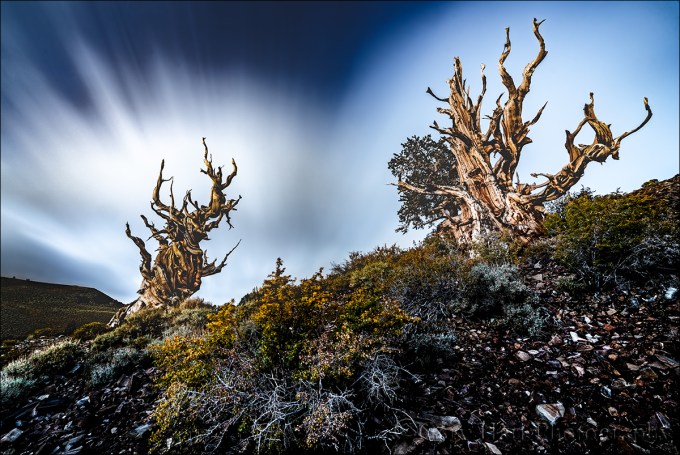
Nightfall, Schulman Grove, White Mountains, California
Sony a7R III
Sony 16-35 f/2.8 GM
Breakthrough 6-stop ND filter
30 seconds
F/11
ISO 400
The bristlecone pines are among the oldest living organisms on earth. Some of these trees pre-date the Roman Empire by 2000 years—and they look every year of their age. The more harsh a bristlecone’s environment, the longer it lives.
As with the giant redwoods, it’s humbling to be among the bristlecone pines. What they lack in bulk they make up for in character, with their corkscrew branches, gnarled trunks, and intricate texture that make them fascinating subjects from any angle or distance, with any lens from wide to macro.
The plan this evening was to photograph these trees until sunset, then wait until dark and photograph them beneath the Milky Way. Despite an afternoon that included rain, fog, and lots of overcast, my hardy Eastern Sierra workshop group bundled up and toughed it out with the hope we’d get lucky. Occasionally patches of clear sky would tease us, only to vanish as quickly as it appeared.
Not getting what you came for is no reason to put the camera away, and I encouraged everyone to keep shooting while we waited. Because I was preparing everyone for a potential night shoot, I just found a composition I liked, set up my tripod in the fading light, and clicked a frame every couple of minutes.
When the darkness was nearly complete and there was still no sign of the Milky Way, we decided it head back down to the cars. I like to be the last one down the trail when we come out of the bristlecones in the dark, so I shot for a few more minutes while the rest of the group packed up. This image is my final frame of the evening. With no moon and a mostly cloudy sky, it was too dark to effectively compose and focus, so I stuck with the composition I’d started with when it was brighter. I used a 30-second exposure at f/11 and ISO 400 to capture more light than my eyes saw. That long exposure also really conveyed the motion in the clouds that had been whipping around overhead all evening. The rather ethereal quality I captured here is a perfect example of why twilight is an underrated time for photography.
Eastern Sierra Photo Workshops
Workshop Schedule || Purchase Prints
A Few Bristlecones


Fresh Takes
Posted on November 25, 2018

Half Dome Autumn Reflection, Sentinel Bridge, Yosemite
Sony a7RIII
Sony 24-105 f/4 G
1/8 second
F/11
ISO 100
I love the iconic captures as much as the next person—scenes like Yosemite’s Horsetail Fall in February, Upper Antelope Canyon’s famous light shaft, or McWay Fall’s tumble into the Pacific, are both gorgeous and a thrill to photograph. But standing elbow-to-elbow with hundreds (or thousands!) of photographers, each recording virtually identical images that are already duplicates of thousands of prior images, while nice, doesn’t necessarily stimulate my creative juices.
Iconic for a Reason
Once upon a time photographing even the most popular scenes in solitude wasn’t difficult. The tourists who overwhelm the best known views during the comfortable times of day would vacate just when the photography started getting good. But with the proliferation of digital photographers and easy exchange of information in our connected world, there aren’t many photography secrets anymore, and the opportunities to make unique images have become more challenging than ever. And if you do capture something special, posting it online is sure to immediately draw photographers like cats to a can opener.
Given that Yosemite Valley’s eight square miles attracts over five million visitors each year, you’d think it would be impossible to find unique perspectives. But on even the busiest summer day, rising for sunrise will give you at least a couple of peaceful hours. And of course in Yosemite’s backcountry, while relatively crowded by wilderness standards, solitude is always just a short detour away.
But the iconic spots earned their recognition for a reason, and first-time (or infrequent) Yosemite visitors want to see them too. For my workshops, in addition to sharing with my students a variety of my favorite more hidden Yosemite spots, I’ve learned to take them to the Yosemite locations they’ve come to know from a lifetime time of viewing Yosemite pictures.
The first visits to vistas like Glacier Point, Tunnel View, Valley View, and Sentinel Bridge still inspire the awe they always have. It’s easy for photographers, overcome by the majesty before them, to fall back on their memory of others’ images and settle for their own version of the same thing. Rather than suggest that my students avoid doing this (for many, these images are the very reason they signed up in the first place), I suggest that they start with the iconic shots they know, but don’t make it their goal. Rather, I encourage them to use those familiar imagers as a starting point for a fresh take that’s more uniquely theirs. I won’t pretend that this approach always, or even frequently, results in something that no one has ever captured, but I think everyone’s photography benefits when that is the goal—not just the images captured today, but the ability to see and execute better images tomorrow as well.
In this year’s Yosemite Fall Color and Reflections workshop we spent most of our time bouncing from one beautiful scene to the next. Autumn, with its colorful leaves and ubiquitous reflections, provides more opportunities for unique captures than any other season, and the color this years was fantastic. But that didn’t prevent us from checking off the icons.
Speaking of icons, my rule of thumb in Yosemite is El Capitan in the morning and Half Dome in the afternoon. But after breakfast one morning, one of the cars said they wanted to go check out Sentinel Bridge, one of the best Half Dome reflections in the park. Normally I resist photographing Half Dome in the morning because its face doesn’t get direct sunlight until late afternoon, but on the way to breakfast I’d noticed the cottonwoods upstream were beautifully backlit and I thought it might be worth checking out. So I scrapped my original plans and we detoured back to the bridge (hey, never let it be said that I’m not flexible).
I’m so glad I listened to the votes from the other car that morning because we ended up with one of the workshop’s highlight shoots. Half Dome was in full shade, sky was a bland blue mixed with a few thin clouds, but the backlit trees were off the charts. We all started with the wider, more conventional views, capturing Half Dome and the trees doubled by their reflection. But that doesn’t take long, and soon I was encouraging everyone to keep working it.
When working out a composition, I always try to figure out where the scene’s action is. In this scene the highlight for me was the upstream trees and their reflection. Wanting as little as possible of the fairly boring sky, I went with a horizontal composition. I also thought a horizontal composition would be best for framing the cottonwoods and reflection with the shaded trees on both sides of the river. To leave no ambiguity about what this image is about, I removed the actual Half Dome entirely, leaving its reflection for context only.
With my Sony 24-105 f/4 G on my Sony a7RIII, I zoomed to a composition that put the “action” front and center, making sure to get all of Half Dome’s reflection but minimal sky, balancing the backlit trees and their reflection toward the top of the from, and framing everything with the darker trees on the edges. Depth of field and motion weren’t concern, so I went with my default ISO 100 and f/11, focused, and clicked.
As anyone who has been in one of my workshops knows, the first click is a draft, an image to review and refine. Evaluating the picture on my LCD, I ran my eyes around my frame and made a few micro adjustments to ensure a tight composition without cutting off the tops of the sunlit tree in the top center, the shaded trunks on the left and right, and the cloud above (below?) Half Dome.
Judging from the variety of images shared in the image reviews, this shoot was a highlight for everyone else too. Some found their own takes on this upstream scene, while a few ventured across the road to capture a completely different scene looking downstream. Not a bad result for a location that wasn’t even on my radar for that morning.
Yosemite Photo Workshops
Workshop Schedule || Purchase Prints
Fresh Takes on Yosemite’s Icons
Click an image for a closer look and slide show. Refresh the window to reorder the display.


It’s the People
Posted on November 22, 2018

Floating Color, El Capitan, Yosemite
The ability to earn my living visiting the most beautiful places in the world is plenty of reason for gratitude, but that’s not what I’m thinking about today. Today I’m thinking about all of the people my workshops have connected me with, and all the laughter and learning they have added to my life.
I’d be lying if I said I wasn’t looking forward to the people part of photo workshops when I started, but I had no idea how much of the joy I get from leading photo workshops comes from the people. Over the last dozen or so years, my workshop students have taught me about their countries, professions, hobbies, religions,… I could go on. I’ve watched workshop participants from virtually every continent on Earth (no penguins yet), with wildly diverse values and world views, blend seamlessly and enthusiastically. Observing this, I’ve learned that despite the exterior tensions that seem to divide our world today, humans have far more in common than we imagine.
Like most people, I have my share of strong opinions about the way things in the world should be. But the people I’ve met in my workshops have shown me that a person’s “goodness” is not determined by his or her political views or any other category that we so conveniently like to slot people into. I’ve seen firsthand that no political affiliation, religious preference, gender, sexual orientation, or ethnicity has a monopoly on warmth, passion, generosity, empathy, patience, or humor. Even more encouraging, I don’t think these workshop epiphanies are mine alone. Workshop after workshop, I get to observe a dozen of the most diverse people imaginable not just set aside differences and work side-by-side, but actually form friendships that transcend conventional boundaries, deep friendships that often continue long after the workshop ends.
I went into the photo workshop business fully prepared to teach others, but completely unprepared for the learning others would offer me.
About this image
With the fall color for this year’s Yosemite Fall Color and Reflections workshop peaking, I had to work overtime to balance the need for quality photo time at each stop with my desire to get my group to all the photo spots. On the workshop’s final day we finally made it to Cathedral Beach, a great up-close view of El Capitan that’s always good for reflections in the fall.
With El Capitan in full sunlight, the river in shade, and nothing stirring the water, all the ingredients were in place for a nice reflection. We’d been photographing reflections all week, but I didn’t get the sense that anyone was tiring of them. Drifting cottonwood leaves added to the beauty and the group quickly spread along a hundred yards or so in search of a composition to make their own.
Often shooting a scene like this I start wide, but this afternoon I started with my Sony 100-400 GM lens, playing with close-ups of the leaves and reflection. After wringing every possibility from this approach, I went to the other extreme and switched to my Sony 12-24 G lens. A wide composition needs a strong foreground, usually the closer the better, so I dropped down to river level and started working on variations of this scene.
While the water was calm, I was close enough to the leaves that even the slightest ripples risked motion blur, so to increase my shutter speed I dialed my Sony a7RIII to ISO 400. At 12mm I have a tremendous amount of depth of field, but the leaves were so close that I decided to play it safe and use f/16. After a check check of my hyperfocal app, I focused on a leaf about 18 inches from my camera knowing that would give me sharpness from the closest leave all the way out to El Capitan.
Yosemite Fall Color and Reflections Photo Workshop
Workshop Schedule || Purchase Prints
An El Capitan Gallery
Click an image for a closer look and slide show. Refresh the window to reorder the display.


That Didn’t Suck
Posted on November 5, 2018
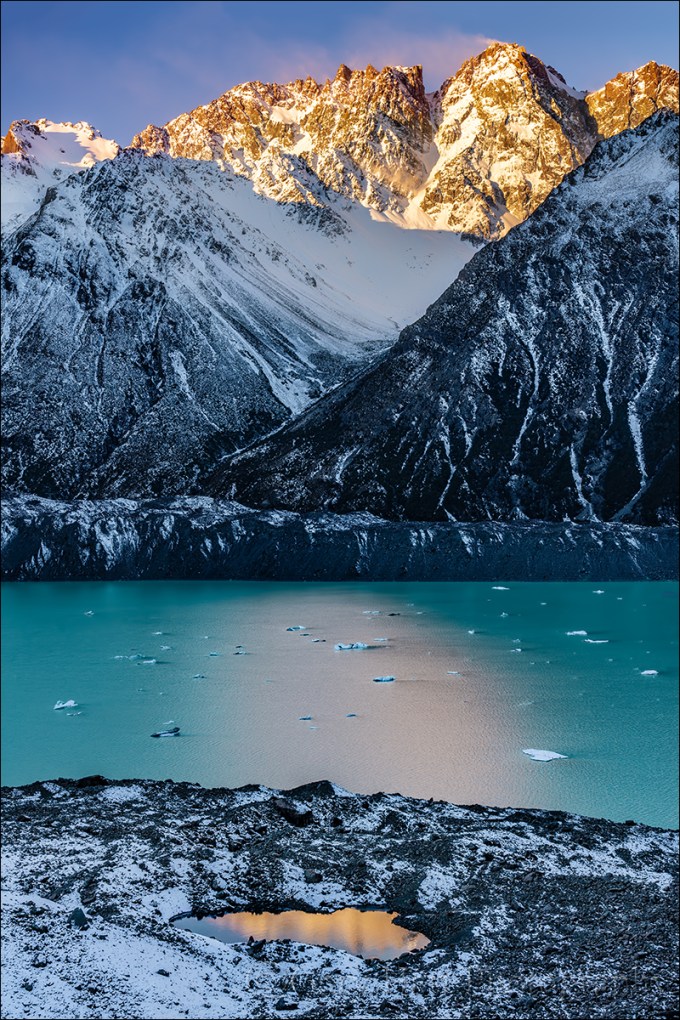
Reflection on the Rocks, Nun’s Veil and Tasman Lake, New Zealand
Sony a7RIII
Sony 24-105 f/4 G
1/13 second
F/11
ISO 100
One evening in New Zealand
I get to a lot of locations and see so many spectacular sights that they sometimes run together. But every once in a while I experience a shoot I know I’ll never forget.
One of (many) highlights of the New Zealand workshop is the hike to Tasman Lake in Aoraki / Mt. Cook National Park. The reward for this short, steep (335 stairs) hike is a 270 degree view that includes 12,000 foot Mt. Cook, icebergs drifting atop turquoise Tasman Lake, Nun’s Veil (pictured here), and the Tasman Valley.
At the trailhead most of the workshop group decided the trail was too icy and opted for a beautiful but less treacherous view a couple miles back down the road. As Don led them to the alternate spot, I guided four members who wanted to brave the icy trail. It turns out the ice wasn’t a big problem, and in fact was completely gone from the trail within a couple hundred yards, and we made it to the vista short of breath but otherwise unscathed.
I’d been up here a few times, but it was the first time for the others, so it was fun to watch their reaction as they summited. Because the trail ends here and the viewing platform is fairly compact, we were able to work in close proximity all evening—having others to share our awe with enhanced the experience even more.
The Tasman Lake view is one of those vistas that’s far too broad to capture with a single frame; any attempt to do so shrinks every feature to the point of insignificance. Opting to divide and conquer by identifying and isolating the scene’s most compelling features, my eye instantly landed on the reflection of Nun’s Veil’s in a small pool down the slope. I soon hopped the vista’s small retaining wall to better center the reflection in the pool, then spent much of the evening here working on compositions that included the reflection. My clicking intensified as light on Nun’s Veil warmed, coloring the wind-whipped snow encircling the peak.
As if all that wasn’t enough, a few minutes after the light left Nun’s Veil, a full moon appeared just to the right of the peak. Despite the advancing night, we were able to photograph the moonrise for a few minutes before the scene became too dark to capture detail in the foreground and moon. But even facing a walk down the icy trail in the dark, we lingered in the moonlight just to marvel at the majesty. As we donned our headlamps for the walk back down the trail, I heard one of the members of the group call my name. “Gary,” long pause. “That didn’t suck.”
New Zealand Photo Workshop
Like reflections? Here’s an article on reflections I wrote a few years ago.
Reflections
Who doesn’t love the soothing tranquility of a good reflection? And like a metaphor in writing, a reflection is an indirect representation that can be more powerful than its literal double by virtue of its ability to engage the brain in different ways than we’re accustomed. Rather than processing the scene directly, we first must mentally reassemble the reflection’s reverse world, and in the process perhaps see the scene a little differently.
Reflections are a powerful photographic tool as well. Water’s universal familiarity makes it an ideal subject for photographers frustrated by their camera’s static representation of our dynamic world. Just as we freeze or blur a waterfall to express turbulent motion, we can include a reflection to convey serenity.
Water reflections come in many forms, from a mirror-sharp reverse of a mountain atop a still pool, to an abstract shuffle of color and texture on a choppy lake. Without getting too far into the physics of light, it’s important to understand that every object we see and photograph (that doesn’t generate its own light) comes to us courtesy of reflected light.
Mirror reflection recipe
The ingredients for a crisp, mirror reflection like the El Capitan image at the top of the page is pretty simple: still water, a reflection subject that’s much brighter than the water’s surface (the greater the contrast the better), and a view angle that matches the angle from the water’s surface to the reflection subject. (The best reflections are usually found on shaded water because there are fewer photons to compete with the photons bouncing from the reflected subject.)
The El Capitan reflection above was a perfect confluence of reflection conditions. Clean, still air, dense shade on the river, and El Capitan’s fully exposed, reflective granite, make early morning the best time for El Capitan reflections. On this April morning I made my way down to the Merced River hoping to photograph the first light on El Capitan reflected in the Merced River. Finding my route down to the river blocked by spring flooding, I was forced to improvise. The morning air was clean and calm, and the ephemeral lake was mirror-still.
Circling the flooded meadow, I found a gap in the trees that opened onto the most complete view and reflection of El Capitan and the Three Brothers I’ve ever seen. So complete in fact, that I couldn’t include it all with my 16-35mm lens at its widest focal length. Fortunately, I was able to borrow a Canon 11-24 lens and Metabones IV adapter from a friend (thanks, Curt!), just wide enough to fit the entire scene at the lens’s shortest focal length.
Playing the angles

Understanding that reflected photons leave the water’s surface at the same angle at which they arrive—imagine the way a tennis ball bounces (if it weren’t affected by spin, wind resistance, or gravity)—helps us get in position for the reflection we want.
A few years ago I found myself atop Sentinel Dome right after an intense rain shower had turned indentations in the granite into small, glistening pools. Rather than simply settle for the vivid sunset coloring the clouds above, I decided to include the sunset reflected in the pools as well. At eye-level the pools reflected blue sky, so I dropped my tripod as low as it would go, almost to granite level, positioning my lens at the same angle to the pools that the red light leaving the clouds struck the water.
When the water’s in motion
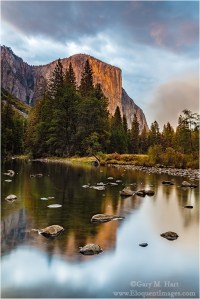
On the Rocks, El Capitan and the Merced River, Yosemite
As spectacular as a crisp, mirror reflection in still water is, it’s easy to overlook the visual potential in a reflection that’s not crisp, or to forget your camera’s ability to render a soft or abstract reflection much better than your eyes view it. While a crisp reflection often dominates the primary subject in an image, a splash of reflected color or shape can provide a striking accent to a dominant primary subject. And a reflection disturbed by the continuously varying angles of rippled or choppy water magically appears when a long exposure smoothes the water’s surface.
In the image on the right, the El Capitan reflection undulating atop the Merced River was barely perceptible to my eyes. But the reflection came to in a 25 second exposure achieved with the help of 2-stop hard graduated neutral density filter that subdued the day’s last rays on the clouds and El Capitan, and a neutral polarizer (with the reflection dialed up) that cut the light on the entire scene by a couple of stops. And since a reflection is never as bright as the actual scene, using a GND meant I need to do a little dodging and burning in Photoshop.
Where to focus
An often misunderstood aspect of reflection photography is where to focus. Though it seems counterintuitive, the focus point of a reflection is the reflection subject, not the reflection surface. This isn’t such a big deal in a scene like the El Capitan reflection at the top of the post, where the focus point of everything of visual significance is infinity, but it’s a very big deal when you want both your reflection and rocks or leaves on the nearby water surface sharp.
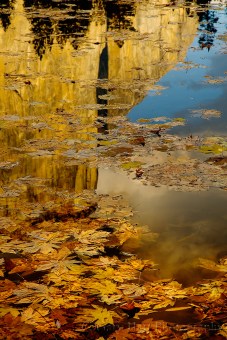
Autumn Reflection, El Capitan, Yosemite
The El Capitan reflection on the right is very different from the El Capitan reflection above, where the extreme depth of field ensured sharpness had I focused on anything in the scene or the reflection. But here the leaves that were my scene’s primary emphasis were just a couple of feet from my camera, while El Capitan was several thousand feet distant. Even though the leaves floated atop the El Capitan reflection, focusing on El Capitan would have softened the leaves. To increase my depth of field, I stopped down to f/18 and focused several feet into the foreground leaves, then magnified the image on my LCD to verify that all of the leaves were sharp. Though El Capitan is slightly soft, a soft reflection is far more forgivable than a soft fore
Think ahead
It seems that reflections often feel like a fortuitous gift that we just stumbled upon. But given that reflections are entirely beholden to the laws of physics, they’re far more predictable than many of the natural elements we photograph. Taking a little time to understand the nature of reflections, and how they’re revealed by a camera, enables photographers to anticipate their appearance.
For example, in Yosemite I know that low flow makes autumn the best time for reflections in the Merced River. On the other hand, when the Merced is rushing with spring runoff, Yosemite’s meadows often shimmer beneath tranquil vernal pools. I plan many trips (and workshops) to take advantage of these opportunities.
Workshop Schedule || Purchase Prints
A Reflection Gallery
Click an image for a closer look and slide show.


A Fall Color Primer
Posted on September 23, 2018
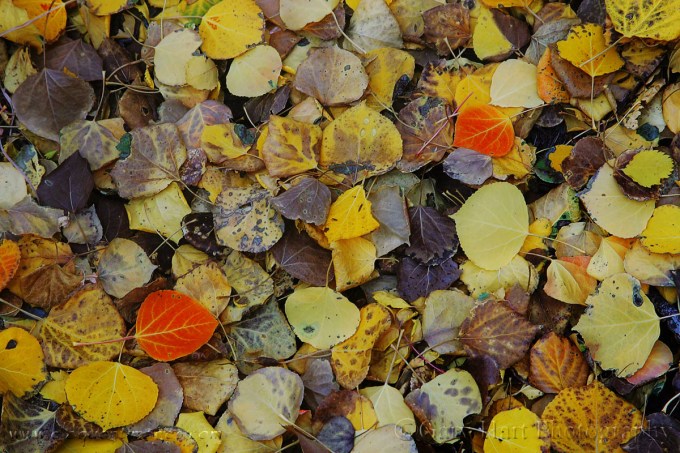
Fallen Color, Rock Creek Canyon, Eastern Sierra
Canon EOS-1D Mark II
1/3 second
F/9.0
ISO 100
85 mm
Autumn has arrived, my favorite season for creative photography. To kick off the festivities, I’m sharing an updated version of a post I wrote a few years ago explaining the often misunderstood process responsible for it all.
Few things get a photographer’s heart racing more than the vivid yellows, oranges, and reds of autumn. And the excitement isn’t limited to photographers—to appreciate that reality, just try navigating the Smoky Mountains backroads on a Sunday afternoon in October.
Innkeeper logic
But despite all the attention, the annual autumn extravaganza is fraught with mystery and misconception. Showing up at the spot that guy in your camera club told you was peaking at this time last year, you might find the very same trees displaying lime green mixed with just hints of yellow and orange, and hear the old guy behind the counter at the inn shake his head and tell you, “It hasn’t gotten cold enough yet—the color’s late this year.” Then, the next year, when you check into the same inn on the same weekend, you find just a handful of leaves clinging to exposed branches—this time as the old guy hands you the key he utters, “That freeze a few weeks ago got the color started early this year—you should have been here last week.”
While these explanations may sound reasonable, they’re not quite accurate. Because the why and when of fall color is complicated, observers resort to memory, anecdote, and lore to fill knowledge voids with partial truth and downright myth. Fortunately, science has given us a pretty good understanding of the fall color process.
It’s all about the sunlight
The leaves of deciduous trees contain a mix of green, yellow, and orange pigments. During the spring and summer growing season, the green chlorophyl pigment overpowers the orange and yellow pigments and the tree stays green. Even though this chlorophyl is quickly broken down by sunlight, it is continuously replaced in the process of photosynthesis that sustains the tree during the long days of summer.
As the days shrink toward autumn, things begin to change. Cells at the abscission layer at the base of the leaves’ stem (the knot where the leaf connects to the branch) start to thicken, blocking the transfer of carbohydrates from the leaves to the branches, and the movement of minerals to the leaves, that had kept the tree thriving all summer. Without these minerals, the leaves’ production of chlorophyl dwindles and finally stops, leaving just the yellow and orange pigments. Voila—color!
Sunlight and weather
Contrary to popular belief, the timing of the onset of this fall color chain reaction is much more daylight-dependent than temperature- and weather-dependent—triggered by a genetically programmed day/night-duration threshold, and contrary to innkeeper-logic, the trees in any given region will commence their transition from green to color at about the same time each year (when the day length drops to a certain point).
Nevertheless, though it doesn’t trigger the process, weather does play a significant part in the intensity, duration, and demise of the color season. Because sunlight breaks down the green chlorophyl, cloudy days after the suspension of chlorophyl creation will slow the coloring process. And while the yellow and orange pigments are present and pretty much just hanging out, waiting all summer for the chlorophyl to relinquish control of the tree’s color, the red and purple pigments are manufactured from sugar stored in the leaves—the more sugar, the more vivid the red. Ample moisture, warm days, and cool (but not freezing) nights after the chlorophyl replacement has stopped are most conducive to the creation and retention of the sugars that form the red and purple pigments.
On the other hand, freezing temperatures destroy the color pigments, bringing a premature end to the color display. Drought can stress trees so much that they drop their leaves before the color has a chance to manifest. And wind and rain can wreak havoc with the fall display—go to bed one night beneath a canopy of red and gold, wake the next morning to find the trees bare and the ground blanketed with color. And of course all these weather factors come in an infinite number of variations, which makes each year’s color timing and intensity a little different from the last.
Despite our understanding of the fall color process, Mother Nature still holds some secrets pretty close to her vest—just when we think we’ve got it all figured out, she’ll surprise us. For example, last year’s Eastern Sierra fall color featured lots of black leaves that I attributed to California’s extreme drought conditions. With the drought persisting, and in fact intensifying, this year, I feared this fall would be even worse. So I was quite pleased to find everything going along right on schedule, with lots of yellow, more red than usual, and hardly a black leaf to be seen. Go figure.
About this image
Driving Rock Creek Canyon north and east of Bishop, I pulled my car over at a random spot and wandered over to the creek. I found trees beyond peak and the creek bank blanketed with yellow aspen leaves, by far the predominant color in the Eastern Sierra. As I turned to return to my car my eyes caught a rare flash of orange. Moving in that direction, I found matching red-orange leaf less than a foot away.
I’m sometimes accused of placing or arranging leaves in my scenes, something I never do, but I understand why people might think that. I very consciously look for leaves that stand out from their surroundings that I can isolate in my frame.
Circling this scene, I didn’t have to work to hard to decide that a symmetrical diagonal arrangement was the way to go. A thin overcast made exposure easy.
Workshop Schedule || Purchase Prints
A Fall Color Gallery


Sony 24mm f/1.4 GM Lens: First thoughts
Posted on September 20, 2018

Moonlight, Sierra Foothills, California
Sony a7R III
Sony 24 f/1.4 GM
10 seconds
F/1.4
ISO 1600
Today Sony announced the lens I’ve been waiting for: the Sony 24, f/1.4 GM. I got a sneak preview of this lens on Maui last week, and again once I got home home. Hurricane Olivia, my workshop (no one was supposed to see me using the lens), and food poisoning significantly limited my use of it, but I did get to play with it enough to share a few thoughts.
Night photography is all about capturing light, the more the better. We bump our ISO as high as the image quality permits, dial in our lens’s widest aperture, and open our shutter as long as we can without obvious star streaks, pushing each exposure variable as far as possible squeeze out every last photon. The shortcomings of each of these compromises is mitigated by an improvement in the others, which is why night photography with the fastest possible lens means I can get the same exposure with a little less star motion and/or noise. So f/1.4 is great, currently pretty much as good as it gets for a lens wide enough for night photography.
Of course fast and wide isn’t much good if the lens is lousy, or difficult to use. I haven’t used the 24 GM a lot, but I’ve used it enough to know that lousy and difficult won’t be a concern.
First Impression
My very first impression, and I suspect this will be everyone’s first impression, is how small this lens is. When I knew it was coming my way I started strategizing how I’d rearrange my bag to accommodate it, but it turns out all I needed to do was empty the slot with a couple of extension tubes and my 2X teleconverter. Contrast that with the Sigma 20mm f/1.4, which is an absolute beast of a lens, both in weight and volume, that could never just live in my bag. But I flew home with the Sony in my bag and was completely unaware of the extra weight. Well done, Sony!

Two Galaxies, West Maui
I only got one night to use the on Maui before I had to return to the real world, and my location options had been severely limited by the recent passage Tropical Storm Olivia (downgraded from a hurricane shortly before landfall), so I drove about half-hour from my condo in Napili to the ultra-dark skies on the northern-most tip of West Maui, where I stumbled in the dark down to the edge of a cliff above the Nakalele Blowhole and shot into a 30-MPH headwind. Not the most ideal conditions, but I made it work for my purposes.
The benefit of a fast lens like this is not just the amount of light it allows into an image, it starts with the simple ability to see enough to simply compose and focus. And as I expected, both composition and manual focus were a piece of cake with Sony 24 1.4. For the Maui night shoot I composed, then magnified the viewfinder of my Sony a7SII and twisted the focus ring until the stars were the finest possible points of light—it took all of about 3 seconds. After my first exposure I magnified the image to verify that it was indeed sharp, then didn’t worry about focus again.
The image on the right features the dimmest part of the Milky Way, opposite the brilliant galactic core we all love to photograph. As a bonus, I also captured M-31, the Andromeda Galaxy—its fuzzy glow in the upper right has traveled over 2 million lightyears and is the farthest we can see with the unaided eye.
About this image
I’d have liked to have done more starlight photography after getting home from Maui, but by the time I recovered enough from a most unwelcome bout of food poisoning that showed up the day I returned, the moon was too prominent in the night sky. Nevertheless, a couple of days ago I sucked it up and drove out to the foothills about an hour from my home and put the lens through its paces beneath a 70 percent gibbous moon.
With the moon high over my right shoulder I looked for scenes facing northeast, where the skies were the least polluted by city glow. I eventually settled on a nearby hillside dotted with oaks fortuitously punctuated by an organized formation of the only clouds in the sky. With so much moonlight present I went with the Sony a7RIII instead of the Sony a7SII. Shooting moonlight at f/1.4 enabled me to get away with a 10-second exposure at ISO 1600.
In the past I’ve usually auto-focused on the moon for my moonlight scenes, but for laughs this night I tried autofocusing on the trees and was shocked to hear my focus indicator beep. Wow, I’ve never been able to autofocus on anything by moonlight, even when the moon was completely full. Next I tried autofocusing on a random star and again heard the confirmation beep—another first. And finally I magnified the view and manually focused on the tree: 3-for-3. Admittedly, with the recent ability to do starlight photography (moonless nights), I don’t do as much moonlight photography as I once did, and I’ve never done it with an f/1.4 lens (because it really isn’t necessary). Nevertheless, I think night focus struggles will be a thing of the past with this lens.
Processing my night images, the first thing I checked was the stars in the corners. In many years of night photography I used three dedicated “night” lenses (lenses that I only use for night photography): Zeiss 28mm f/2, Rokinon 24mm f/1.4, and Sigma 20mm f/1.4. In quest of more light I’ve shot all of them wide open, but I’ve had to live with a fair amount of coma (comatic aberration). My first reaction is that is that this lens is cleaner wide open than any of them.
The bottom line
I haven’t had tons of time to spend with my images, but my first impression is that I’m blown away by this lens. I’ve grown to accept that if I want quality in a lens I need to accept bulk along with it. Apparently that’s not the case, because this lens gave me crazy sharp images wide open, yet felt not much larger than a baseball in my hand.
A Sony 24mm f/1.4 GM Samples
A Maui Memory
Posted on September 14, 2018
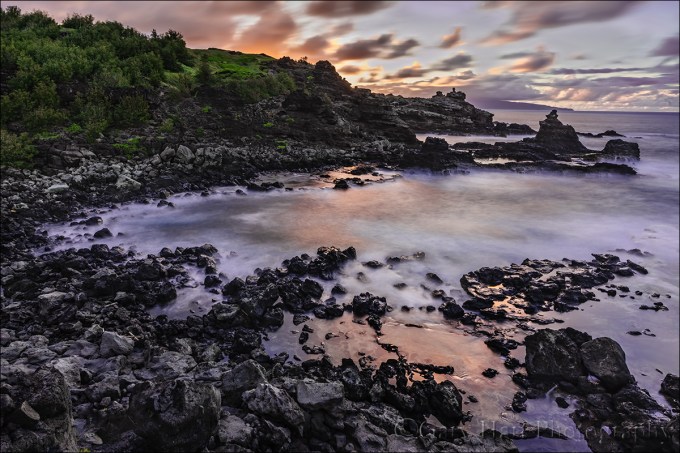
West Maui Tide Pool Sunset, Hawaii
Sony a7R III
Sony 16-35 f/2.8 GM
Breakthrough 6-stop ND filter
20 seconds
F/16
ISO 50
March 2018
Each year I do back-to-back workshops in Hawaii, one on the Big Island and one on Maui (it’s a tough job, but…, well, you know…). This year’s Big Island workshop was complicated first by the recent Kilauea eruption, and then by Hurricane Lane, which deposited 50 inches of rain on our host city Hilo just days before the workshop.
To get my eyes on the damage wrought by Mother Nature, and to scout more alternate locations, I flew to the Big Island five days early (see “tough job” reference above). Despite the complications, the workshop turned out great, with a fantastic group and a few new locations (including a beautiful sunset and Milky Way shoot atop Mauna Kea) added to my tried and true favorites, and I breathed a sigh of relief.
But my dreams of a stress-free Maui workshop were dashed when Hurricane Olivia took laser aim at Maui. Each day I’d check the forecast hoping to see that she had changed course, and each day I was disappointed. Finally, with just a couple days to go, I completely overhauled the workshop, switching lodging and itinerary to avoid the worst of the storm and get the most the island had to offer. I’m happy to say that despite Olivia, we only missed one morning of the workshop and managed to get our Haleakala sunrise in, plus spend a nice day on the Hana road.
My first location adjustment was switching one of my favorite Maui sunset locations, usually a second day destination, to the workshop’s first night because I wasn’t sure we’d be able to get out there the rest of the week. Between dense rainforest and steep, uneven lava, even the walk down here is a bit harrowing, so when I told the group that a few years ago I tried to drive down to this spot, they couldn’t quite believe it. Returning to this spot made me think that it might be time to share the story of my self-inflicted misadventure again. So I dusted off a blog post from five years ago (can’t believe it’s been that long!):
March 2013
On my September scouting trip for my upcoming Maui workshop I hiked cross-country down the rugged flank of West Maui, searching for lava-rock tide pools I’d read about. Scrambling down a steep hill and over sharp rocks, I found the beach I was looking for but decided it was too dangerous for a group. Rather than return the way I came, I continued picking my way along the shore and eventually found another spot I liked better. At first I thought this wouldn’t be suitable for a group either, but climbing out I found an overgrown dirt road/trail leading back to the highway (“highway” in this case is the one-and-a-half lane, mostly-paved, rental-agreement-voiding Highway 340 circling West Maui). But fearing I’d miss this obscure spur from the main road, I saved the trailhead on my GPS.
Last Sunday, the day before my Maui workshop started, I picked up Don Smith (Don assisted this workshop; I’ll return the favor in one of Don’s workshops) at the airport and was excited to share with him the spot I’d “discovered” (it’s not as if I’m the Lewis and Clark of landscape photography—there’s enough debris down there to indicate the spot is known to locals) and off we went. The steady rain that had been falling for most of the afternoon increased with the road’s remoteness and soon we were slaloming around boulders dislodged from the surrounding cliffs by the downpour—at one point we passed a car waylaid by a grapefruit-size rock embedded in its windshield.
Undeterred, we soldiered on through the intensifying rain. This was Don’s first Maui visit, so I narrated the tour with vigor, enthusiastically pointing out the island’s scenic highlights as we passed them, pausing only occasionally to reassure Don that the highway was navigable despite increasing evidence to the contrary, punctuating my confidence with, “And just wait until you see the scene at the end of this ‘secret’ road I discovered.”
Closely monitoring my GPS, at the prescribed location and without hesitation (for dramatic effect) I veered left into a barely distinguishable gap in the trees almost as if I had a brain. The narrow track unfolded between rapidly oscillating wipers, immediately plummeting the steep hill and twisting right. Dense foliage brushed both sides of the car, which by now was clearly losing purchase in the mud. Don hadn’t quite finished a sentence that started, “Are you sure…,” when it began to dawn on me that I’d never intended to actually drive this road, that my plan when I marked it six months earlier was to park at the top and walk down. Oops.
Propelled by momentum and without the benefit of traction put us completely at gravity’s mercy, careening downward (picture the jungle mudslide scene from “Romancing the Stone”). Steering seemed to have more influence on the direction the car faced than it did on its direction of travel and I quickly gave that up. Were it not for the deep ruts that occasionally nudged us back on course, I’m sure we’d have bounced into the jungle. I held my breath as we approached a boulder jutting from the roadbed and exhaled when the undercarriage passed above unscathed. Shortly thereafter the slope moderated somewhat and we slid to a stop, miraculously still on the “road” (more or less).
After a few seconds of cathartic expletives, I scanned our surroundings. Backing up the slippery road was out of the question, but a little farther down the slope we spotted a flat, clear space with a small Y-spur that might enable us to at least turn around. I scrutinized the dash for the switch that would engage the 4-wheel drive (I swear) the guy at rental agency promised my SUV had. When we didn’t find it Don dug the manual from the glovebox—apparently 4WD is an option the powers-that-be at Alamo deem unnecessary on Maui. Uh-oh.
With crossed fingers I gave the car some gas and felt the wheels spin with no effect. More expletives. Don and I exited into the rain to survey our predicament: the road was fast graduating to creek status, and where rubber tires were supposed to be, instead were four mud disks. Scraping the tires clean had little value because the next revolution simply reapplied a fresh layer.
Back in the car I found that cranking the steering wheel hard in both directions gained just enough traction to un-mire the tires and I gingerly rolled the car downhill, away from safety, but at least into a relatively flat, open space. Yay! Once on level ground, and with only a little bit of slip/slide drama, I gingerly pivoted the car into the adjacent spur and nudged back around to face the direction we’d just come. Progress!
Now for the hard part. Looking for the first time toward freedom, we came to grips with the chute that had deposited us: Not only was it steep, at the steepest (and muddiest) point it curved hard-left, but banked hard-right—not exactly an arrangement that would be embraced at Daytona.
I inhaled and goosed the gas and we shot upward, fishtailing like a hooked marlin before losing momentum before coming to a stop a mere fifty feet closer to freedom. This maneuver had also managed to skew the car at a 45-degree angle to the road, its left-front fender in the jungle on one side, its right-rear fender in the jungle on the other. When I gave the car gas the tires spun hopelessly.
Facing defeat we started strategizing Plan B: With an hour of daylight remaining and no cell service, we’d need to walk up to the highway and hope to flag down, in the rain, a good samaritan willing to drive two disheveled, mud-caked strangers back to civilization (about 45 minutes away), then hope to summon a tow truck that would extricate us.
While Don trudged through the rain up to the main road to get help, I stayed with the car, licking my wounds and feeling pretty foolish. It occurred to me that since the road was too narrow for a tow truck, and the distance and tight curve would make winching difficult, even a tow truck wouldn’t guarantee freedom.
Watching Don head back up the hill to seek help, I decided to give extraction one more shot. I shifted the car into reverse, gave it some gas, and cranked the steering wheel back and forth violently until the tires broke free and the car rolled out of the jungle and back onto the muddy trail and back down to the clearing below. So far so good. Once there, I gave the pedal a gentle nudge and reversed slowly all the way to the clearing’s back side (another 20 feet), where I hoped there might be a little more gravel and less mud—and most importantly, a little more room to gather momentum.
With a small prayer I slipped the transmission into in first and floored the accelerator, rocketing ahead with enough forward speed to avoid much of the fishtailing I’d experienced earlier. Peering through flailing wipers I aimed for the small opening that had deposited us, shooting past crumpled shrubs and protruding rocks until the road steepened. With the steepened incline the energy of my forward momentum was replaced by spinning wheels that spewed mud like a dirty firehose, but I just kept my foot to the floor.
Approaching the curve I felt the car start to tilt right and slow almost to 0, but somehow the tires maintained just enough grip to avoid a complete stop. The fishtailing had returned, now exceeded the forward motion but I didn’t care as long as I still had forward motion. I rounded the curve and surprised Don, who dove into the jungle just up the road and turned to cheer me forward. Just as my forward motion was about to to hopelessly be completely transformed into spinning wheels the road leveled, my rear tires grabbed something solid, and I shot forward. Not wanting to slow until the tires kissed pavement I lowered my window and high-fived Don as I flew past and onto the highway. At the top we just couldn’t stop laughing, both at the foolish predicament I’d created, and our utter disbelief that we’d made it out.
March 2018
This year’s visit was far less eventful. We parked at the top and entire group made it down to the water on foot, without incident. After receiving a brief summary of the scene and a return time, the group quickly scattered in search of one of the seemingly infinite number of great photos here. I kept my camera in the bag as I moved around to work with everyone, eventually finding myself atop a jagged rock ridge about 20 feet above pounding surf.
When I saw the sunset color reflecting in the water, I pulled out my Sony a7RIII and added my Breakthrough 6-stop neutral density filter to my Sony 16-35 f/2.8 GM lens. Carefully monitoring my histogram, I dialed in a long exposure that smoothed the surf and blurred the streaking clouds. In my Canon days I’d have needed a graduated neutral density filter (or multiple images) to capture the entire dynamic range in this scene, but the a7RIII has about 3-stops more dynamic range (an entire GND worth!) than my Canon DSLRs did, enabling me to capture this scene’s entire range of light with one click.
A Hawaii Gallery
Click an image for a closer look and slide show. Refresh the window to reorder the display.


Better than a Pot of Gold
Posted on September 2, 2018
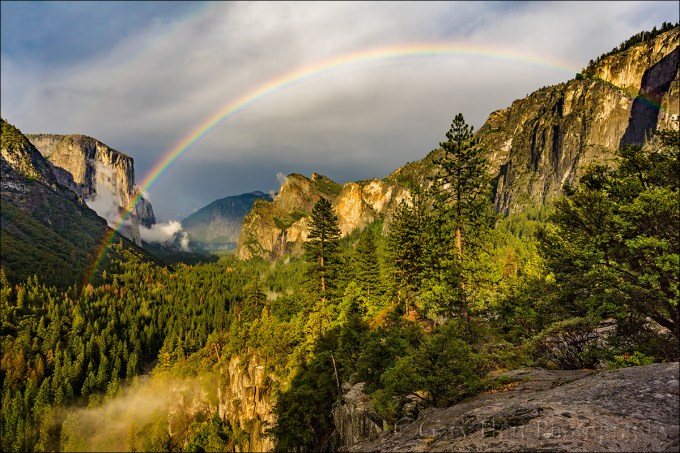
Summer Rainbow, Yosemite Valley
Sony a7R
Sony/Zeiss 16-35 f/4
1/250 second
F/9
ISO 100
My relationship with Yosemite rainbows goes all the way back to my childhood, when a rainbow arcing across the face of Half Dome made my father more excited than I believed possible for an adult. I look back on that experience as the foundation of my interest in photography, my relationship with Yosemite, and my love for rainbows. So, needless to say, photographing a rainbow in Yosemite is a pretty big deal for me.
A few years ago the promise (hope) of lightning drove me to Yosemite to wait in the rain on a warm July afternoon. But after sitting for hours on hard granite, all I got was wet. It became pretty clear that the storm wasn’t producing any lightning, but as the sky behind me started to brighten while the rain continued falling over Yosemite Valley, I realized that conditions were ripe for a rainbow. Sure enough, long after I would have packed up and headed home had I been focused solely on lightning, this rainbow was my reward.
The moral if my story is that despite all appearances to the contrary, rainbows are not random—when sunlight strikes raindrops, a rainbow occurs, every time. The reason we don’t always see the rainbow not because it isn’t happening, it’s because we’re not in the right place. And that place, geometrically speaking, is always the same. Of course sometimes seeing the rainbow requires superhero ability like levitation or teleportation, but when we’re armed with a little knowledge and anticipation, we can put ourselves in position for moments like this.
I can’t help with the anticipation part, but here’s a little knowledge infusion (excerpted from the Rainbow article in my Photo Tips section).
LET THERE BE LIGHT
Energy generated by the sun bathes Earth in continuous electromagnetic radiation, its wavelengths ranging from extremely short to extremely long (and every wavelength in between). Among the broad spectrum of electromagnetic solar energy we receive are ultra-violet rays that burn our skin and longer infrared waves that warm our atmosphere. These wavelengths bookend a very narrow range of wavelengths the human eye sees.
Visible wavelengths are captured by our eyes and interpreted by our brain. When the our eyes take in light consisting of the full range of visible wavelengths, we perceive it as white (colorless) light. We perceive color when some wavelengths are more prevalent than others. For example, when light strikes an opaque (solid) object such as a tree or rock, some of its wavelengths are absorbed; the wavelengths not absorbed are scattered. Our eyes capture this scattered light, send the information to our brains, which interprets it as a color. When light strikes water, some is absorbed and scattered by the surface, enabling us to see the water; some light passes through the water’s surface, enabling us to see what’s in the water; and some light is reflected by the surface, enabling us to see reflections.
(From this point on, for simplicity’s sake, it might help to visualize what happens when water strikes a single drop.)
 Light traveling from one medium to another (e.g., from air into water) refracts (bends). Different wavelengths refract different amounts, causing the light to split into its component colors. Light that passes through a water refracts (bends). Different wavelengths are refracted different amounts by water; this separates the originally homogeneous white light into the multiple colors of the spectrum.
But simply separating the light into its component colors isn’t enough to create a rainbow–if it were, we’d see a rainbow whenever light strikes water. Seeing the rainbow spectrum caused by refracted light requires that the refracted light be returned to our eyes somehow.
A raindrop isn’t flat like a sheet of paper, it’s spherical, like a ball. Light that was refracted (and separated into multiple colors) as it entered the front of the raindrop, continues through to the back of the raindrop, where some is reflected. Red light reflects back at about 42 degrees, violet light reflects back at about 40 degrees, and the other spectral colors reflect back between 42 and 40 degrees. What we perceive as a rainbow is this reflection of the refracted light–notice how the top color of the primary rainbow is always red, and the bottom color is always violet.
FOLLOW YOUR SHADOW
Every raindrop struck by sunlight creates a rainbow. But just as the reflection of a mountain peak on the surface of a lake is visible only when viewed from the angle the reflection bounces off the lake’s surface, a rainbow is visible only when you’re aligned with the 40-42 degree angle at which the raindrop reflects the spectrum of rainbow colors.
Fortunately, viewing a rainbow requires no knowledge of advanced geometry. To locate or anticipate a rainbow, picture an imaginary straight line originating at the sun, entering the back of your head, exiting between your eyes, and continuing down into the landscape in front of you–this line points to the “anti-solar point,” an imaginary point exactly opposite the sun. With no interference, a rainbow would form a complete circle, skewed 42 degrees from the line connecting the sun and the anti-solar point–with you at the center. (We don’t see the entire circle because the horizon gets in the way.)
Because the anti-solar point is always at the center of the rainbow’s arc, a rainbow will always appear exactly opposite the sun (the sun will always be at your back). It’s sometimes helpful to remember that your shadow always points toward the anti-solar point. So when you find yourself in direct sunlight and rain, locating a rainbow is as simple as following your shadow and looking skyward–if there’s no rainbow, the sun’s probably too high.
HIGH OR LOW
Sometimes a rainbow appears as a majestic half-circle, arcing high above the distant terrain; other times it’s merely a small circle segment hugging the horizon. As with the direction of the rainbow, there’s nothing mysterious about its varying height. Remember, every rainbow would form a full circle if the horizon didn’t get in the way, so the amount of the rainbow’s circle you see (and therefore its height) depends on where the rainbow’s arc intersects the horizon.
While the center of the rainbow is always in the direction of the anti-solar point, the height of the rainbow is determined by the height of the anti-solar point, which will always be exactly the same number of degrees below the horizon as the sun is above the horizon. It helps to imagine the line connecting the sun and the anti-solar point as a fulcrum, with you as the pivot–picture yourself in the center of a teeter-totter: as one seat rises above you, the other drops below you. That means the lower the sun, the more of its circle you see and the higher it appears above the horizon; conversely, the higher the sun, the less of its circle is above the horizon and the flatter (and lower) the rainbow will appear.

Assuming a flat, unobstructed scene (such as the ocean), when the sun is on the horizon, so is the anti-solar point (in the opposite direction), and half of the rainbow’s 360 degree circumference will be visible. But as the sun rises, the anti-solar point drops–when the sun is more than 42 degrees above the horizon, the anti-solar point is more than 42 degrees belowthe horizon, and the only way you’ll see a rainbow is from a perspective above the surrounding landscape (such as on a mountaintop or on a canyon rim).
Of course landscapes are rarely flat. Viewing a scene from above, such as from atop Mauna Kea in Hawaii or from the rim of the Grand Canyon, can reveal more than half of the rainbow’s circle. From an airplane, with the sun directly overhead, all of the rainbow’s circle can be seen, with the plane’s shadow in the middle.
DOUBLE YOUR PLEASURE
Not all of the light careening about a raindrop goes into forming the primary rainbow. Some of the light slips out the back of the raindrop to illuminate the sky, and some is reflected inside the raindrop a second time. The refracted light that reflects a second time before exiting creates a secondary, fainter rainbow skewed 50 degrees from the anti-solar point. Since this is a reflection, the order of the colors is the secondary rainbow is reversed.
And if the sky between the primary and secondary rainbows appears darker than the surrounding sky, you’ve found “Alexander’s band.” It’s caused by all the light machinations I just described–instead of all the sunlight simply passing through the raindrops to illuminate the sky, some of the light was intercepted, refracted, and reflected by the raindrops to form our two rainbows, leaving less light for the sky between the rainbows.
Rainbows
Click an image for a closer look and slide show. Refresh the window to reorder the display.


