Eloquent Images by Gary Hart
Insight, information, and inspiration for the inquisitive nature photographer
Dressed for chill
Posted on January 17, 2017
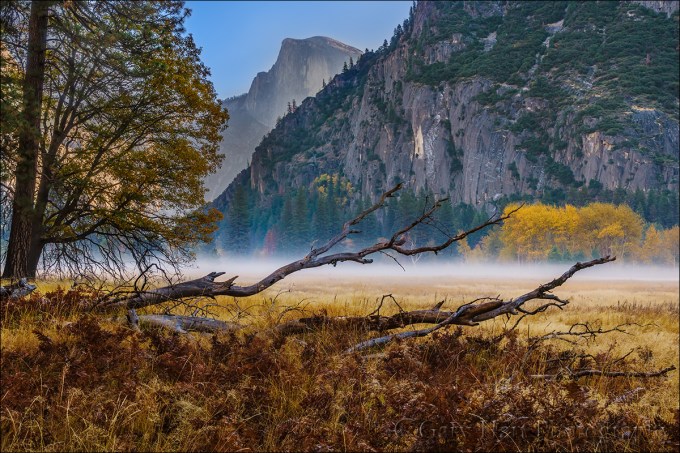
Autumn Morning, Leidig Meadow, Yosemite
Sony a7R II
Sony/Zeiss 24-70 f4
1/15 second
F/11
ISO 125
A regrettable reality of my life is that the best conditions for photography are usually the absolute worst conditions to be outside. Fortunately, I’ve been hardened by decades of San Francisco Giants games at Candlestick Park, the coldest place on Earth. As a photographer, I continue to embrace my mantra for warmth at the ‘Stick: Too much is always better than not enough.
For me it’s all about layers: silk, wool, down, and Gore-Tex. I start winter mornings with wool socks, waterproof boots, silk long-johns (if it’s extremely cold), flannel lined jeans, wool long-sleeve undershirt, wool Pendleton or lined cotton shirt, vest, down jacket, gloves (I have a variety from thin to thick), neck gaiter, and a hat or band that covers my ears. I add and remove layers as conditions dictate, and don’t always wear everything, but I’m never too far from this stuff in winter. And if it’s raining or snowing, I add waterproof pants, a waterproof parka, waterproof boots, and a wide-brim waterproof hat to keep myself dry, freeing my umbrella to keep my gear dry while shooting.
The basic clothes I pack in my suitcase before each trip, but the gloves/hats/umbrella etc. are in a gym bag that is always in my car. In the car I also keep an extra pair of shoes and socks, towel, and garbage bag (to cover my camera when it’s on the tripod). With all this paraphernalia, I’m nice and toasty in whatever extremes the winter throws at me, and I can never use weather as an excuse for missing a shot.
About this image
On a very chilly morning in late October, my workshop group had wrapped up the sunrise shoot and was heading to breakfast when we passed Leidig Meadow beneath a thin veneer of fog. Knowing that the group was cold and hungry, I kept going, but in the cafeteria parking I polled everyone and found that while about half were ready for warmth and a hot breakfast, the other half wanted to return to photograph the meadow. They got no argument from me. In normal conditions this wouldn’t have been possible because Yosemite’s primarily one-way traffic flow would have required a 20-minute loop to return to this spot, and the fog would likely have been long gone. But this year, extensive roadwork had caused the National Park Service to make every open road two-way, and we were back at Leidig Meadow in two minutes.
Yosemite’s radiation fog can come and go in seconds (I crossed my fingers that it hadn’t dissipated in the five minutes since our original drive-by), so as soon as we parked the group grabbed their gear and scattered. Wanting a foreground that was more than just meadow grass, I ran for this downed tree that I’d seen on an earlier visit.
We only got about five minutes of quality shooting in before the fog was gone. All of my shots were some variation on this composition using the log anchoring the bottom of scene, and Half Dome framed by the nearby trees on the left and distant yellow cottonwoods on the right. To maximize my focal length and make Half Dome larger, I moved back as far as I could without losing my framing. The horizontal trunk was far enough away that I was able to achieve depth of field all the way to infinity when I focused there.
Workshop Schedule || Purchase Prints
A Cold Weather Gallery
Click an image for a closer look and slide show. Refresh the window to reorder the display.


Sanity check
Posted on January 7, 2017

Nightfall, Half Dome and Sentinel Fall, Yosemite
Sony a7R II
Sony/Zeiss 24-70 f4
1/2 second
F/9
ISO 100
Are you insane?
Albert Einstein defined insanity as doing the same thing over and over again and expecting different results. Hmmm. For some reason this makes me think of the thousands of aspiring landscape photographers with portfolios brimming with beautiful images that they can’t sell.
Despite a great eye for composition, all the latest gear, insider knowledge of the best locations, and virtual guru status with Photoshop, somehow they haven’t managed to separate themselves from the large pack of other really good photographers. Their solution to anonymity is more: more locations, more equipment, more software. (Perhaps you even know such a photographer.) Compounding the problem, many photographers have become so mesmerized by technology that they turn over control of the most important aspects of their craft to their camera, completely discounting the most powerful tool at their disposal, the one on top of their shoulders.
Knowledge vs. understanding
Just as a new camera won’t make you a better photographer, neither will simply upgrading your knowledge of the latest gear, or accumulating . Knowledge is nothing more than information ingested and regurgitated. On the other hand, understanding is fundamental insight into the workings of a process. While knowledge might enable you to impress table-mates at a dinner party, understanding gives you the ability to use information to create new knowledge—solve problems.
Many photographers invest far too much energy accumulating knowledge, and far too little energy understanding what they just learned. For example, I see many photographers relying on a formula for determining the shutter speed that freezes star motion at a given focal length, oblivious to the fact that this formula doesn’t consider other equally important variables such as display size and the direction the camera is pointing (yes, that’s important). Similarly, simply knowing that a longer shutter speed, bigger aperture, or higher ISO means more light is of limited value if that knowledge doesn’t translate into an understanding of how to manage light, motion, and depth with your camera.
Take control
Pretty much anyone can pick up a camera, put it in auto exposure mode, and compose a nice image. While the automatic modes in most cameras “properly” (conventionally) expose most scenes, they struggle in the limited light, extreme dynamic range, and harsh conditions that artistic nature photographers seek. Worse than that, relying on the automatic exposure modes eliminates a photographer’s best opportunity for creativity—the ability to control a an image’s depth, motion, and light.
Too many aspiring photographers are stuck creatively because their unwavering faith in technology leaves them with a critical deficiency in two fundamental, related photographic principles:
- How a light meter determines the exposure information it gives you. This seems so basic, but auto-exposure and histograms have fooled many into thinking they understand metering and exposure. (Don’t get me wrong—the histogram is a wonderful tool for the photographer who truly understands it.)
- How to use the reciprocal relationship between aperture, shutter speed, and ISO to manage photography’s three variables: light, depth, and motion. This is the universal tool that enables photographers to handle the limiting factors of every scene.
Books and internet resources are a great place to start acquiring these principles, but the knowledge you gain there won’t turn to understanding until you get out with your camera and apply them. When these principles become second nature, you’ll be amazed at what you’ll be able to accomplish with your photography.
Insanity is in the mind of the beholder
If landscape photography already gives you everything you want, by all means continue doing what you’re doing. But if you’re having a hard time achieving a creative goal, I suggest that the solution is likely not doing more of what you’re already doing. Instead, start by reevaluating your comprehension of fundamental photographic principles that you might not have thought about for years. You’ll know you’re there when you have complete control of the light, motion, and depth for every scene you encounter, know how to get the result you want, or understand why it’s simply not possible.
Do I really think you’re insane for doing otherwise? Of course not. But I do think you’ll feel a little more sane if you learn to take more control of your camera.
About this image
The image at the top of the post is from a visit to Yosemite this past December. I’d guided my workshop group here for the rise of a nearly full moon, crossing my fingers that clouds wouldn’t obscure our view. The clouds exited just in the nick of time for us to enjoy a beautiful moonrise into the indigo twilight. I started with fairly tight compositions when the moon was close to Half Dome, but in the still, chilled air shortly after sunset, a thin radiation fog formed above Leidig Meadow and I started looking for a wider composition that would add the meadow to the moon and Half Dome.
Before thinking about the scene’s light, depth, and motion variables, I spent a lot of time just assembling the elements of my composition. I decided to frame the scene with Half Dome on the left and Sentinel Fall on the right, positioning myself so a group of tall foreground evergreens, mirrored by towering Sentinel Rock in the background, anchored the center of my frame. I knew that would require a wide composition that would render the moon very small, but I moved back as far as I could to allow the longest possible focal length to avoid shrinking the moon to pinhole size.
By far my biggest exposure concern was dynamic range—the moon is daylight bright, while the rest of my scene was deeply shaded. Normally I trust my histogram in these high dynamic range situations, but in this case the moon was so small that I knew it wouldn’t register. Instead I used my Sony a7RII’s pre-capture “zebra” highlight alert that indicates the parts of my scene that are overexposed.
At just a little wider than 24mm, with no significant detail in my immediate foreground, I stopped down to a fairly diffraction safe f/9. I’m always at ISO 100 unless I can’t achieve the amount of light I want at my ideal aperture and shutter speed, and in this case ISO 100 worked just fine. With my f-stop and ISO set, I increased my shutter speed slowly, checking the moon after each 1/3-stop click for the zebras (if you don’t shoot mirrorless, you can set blinking highlights and check the moon for “blinkies” when you review the image on your LCD). Since I know my camera well enough to know that I could push my exposure at least a full stop beyond the point where the zebras appeared, then recover the highlights in the Lightroom raw processor.
This image looked quite dark on my LCD, and the histogram was way to the left, but after loading it onto my computer and pulling the Lightroom Shadows slider to the right, I recovered an unbelievable amount of clean (low noise) detail, even in the darkest shadows. I just continue to be blown away by the dynamic range of this a7R Mark 2 sensor that enables me to capture scenes I’d never imagined possible in my previous (Canon) life. In this case I probably could have brightened the image further in processing, but I wanted a more moody, twilight feel.
Workshop Schedule || Purchase Prints
Yosemite Less Traveled


The best lens for the job
Posted on December 28, 2016
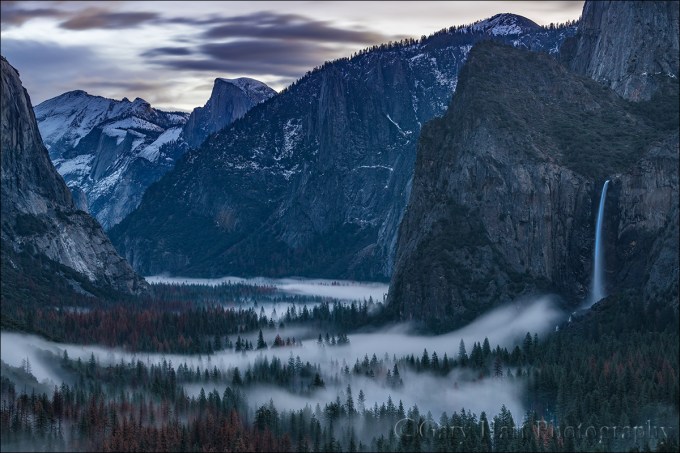
Dawn, Tunnel View, Yosemite
Sony a7R II
Sony 70-200 f/4
25 seconds
F/8
ISO 200
Probably the workshop question I am asked most is some variation on, “What lens should I use?” While I’m happy to answer any question, this one always makes me cringe because the implicit question is, “Which lenses can I leave behind?”
What many photographers fail to realize is that the “proper” lens isn’t some absolute determined by the scene, a secret known only by the best photographers, it’s a creative choice made by each photographer who visits. While prior captures often imply a general consensus on a scene’s primary composition, that pretty much turns out to be the first composition everyone sees—just the compositions creative photographers should avoid. When I tell you the lens to use, I’m imposing my creative instincts rather than cultivating yours. “Okay, right, I get it. But seriously—what lens should I use?” Sigh.
Suck it up
The best landscape images usually require some sacrifice, so if you’re making lens choices based on what’s most convenient, maybe landscape photography isn’t for you. I’m not talking about risking your life to get the shot, or exceeding your physical limitations, but I am talking about a willingness to experience a little discomfort for your craft. That means venturing out in miserable weather, rising well before the sun, or (gulp) skipping dinner. And yes, it even means lugging a little heavier camera bag than you might prefer.
My general rule is to, at the very least, carry lenses that cover the full-frame focal range from 20mm-200mm. There are some trade-offs in the number of lenses you choose to achieve this. Some carry just one or two zoom lenses, sacrificing speed and image quality for comfort, convenience, and mobility; others go hardcore, lugging an assortment of fast, ultra-sharp primes. I’m in the middle, extremely happy with the combination of quality and compactness I get with my three Sony f/4 zoom lenses: the 16-35, 24-70, and 70-200.
In addition to my three primary lenses, I never go out without my full frame Sony a7RII and 1.5 crop Sony a6300 bodies. Because a 1.5 crop body increases the effective focal length of each lens by 50 percent, with these two bodies I can cover the focal range from 16mm-300mm. I also have a few specialty lenses that may or may not stay in the car (but never at home), depending on the scene, the room in my bag, and how much hiking/climbing/scrambling I’ll be doing: a Tamron 150-600 for extra reach; a Rokinon 24mm f/1.4 lens for starlight; and a Sony 90mm macro.
So seriously, the lens you choose for a scene is part of the creative process that defines you as a photographer, a personal decision that I’m happy to assist, but reluctant to dictate. In fact, it’s a rare scene that’s worthy of capture with one lens that’s not worthy of capture with another. And another. (And I promise that the surest way to need a particular lens is to leave it behind.) I’m not suggesting that you lug Hermione’s purse to every shoot; just try to remember that your images will last far longer than your discomfort.
Case in point
I do a half dozen or so workshops in Yosemite each year, plus a number of private tours. That means I spend a lot of time at Tunnel View. A lot. But I don’t photograph there much anymore unless I think I can get something I don’t already have, which means I do lots of watching other photographers. One thing I notice is how few photographers use a telephoto lens here. Given the breadth of the view, and the volume of existing wide angle Tunnel View images we’ve been conditioned by, reflexively reaching for the wide angle lens at Tunnel View is understandable. But approaching any scene with a preconceived idea of the best lens limits the array of creative opportunities the scene provides.
One chilly morning at Tunnel View earlier this month, my winter workshop group enjoyed the snowy granite, wispy fog, and pristine air only possible after a winter storm. Of course we had all of the standard wide angle compositions at our disposal, but when the fog and pastel sky moved me to pull out my camera, it was my 70-200 that I chose to pair with it. I tried a few compositions, before settling on this one that was just wide enough to include Half Dome, Bridalveil Fall, most of the fog, and the only clouds remaining from the storm. Not only would a wide angle lens have shrunk what I felt were the scene’s most significant features, my telephoto lens was able to exclude from my image the bright, empty sky above Half Dome, and most of the dead, brown trees scarring Yosemite Valley.
Because this image was captured 20 minutes before sunrise, the scene my eyes saw was much darker than what my camera captured. Photographers able to see with their camera’s vision rather than their own love photographing in the sweet light only possible at twilight. In this case not only did I benefit from a shadowless foreground, the 25-second exposure smoothed the clouds, fog, and waterfall ethereal quality.
I won’t pretend that this is a groundbreaking capture (far from it), but if I’d have walked up to the scene with a wide angle already mounted instead taking it all in before choosing my lens, I don’t think I’d have been nearly as happy with my results.
Workshop Schedule || Purchase Prints
A Tunnel View Gallery
Click an image for a closer look and slide show. Refresh the window to reorder the display.


Enjoying Yosemite in a fog
Posted on December 14, 2016
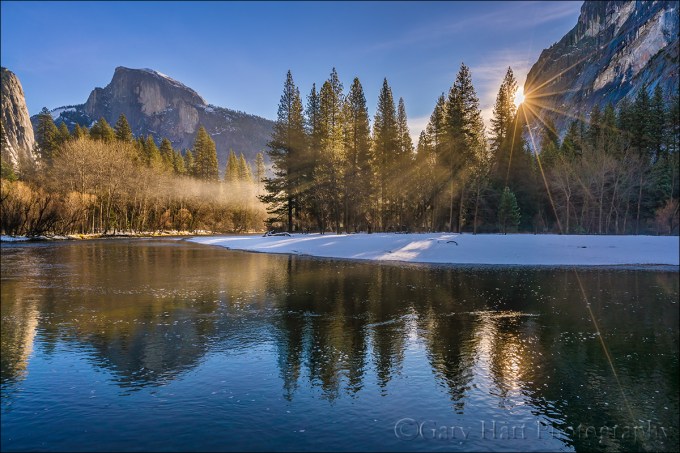
Morning Sun, Half Dome, Yosemite
Sony a7R II
Sony/Zeiss 16-35 f4
1/100 seconds
F/16
ISO 100
One of Yosemite’s most underrated winter treats is the radiation fog that hugs the valley floor on cold, clear, still mornings. Unlike the advection fog that drapes the San Francisco Bay Area (among other places) when (relatively) warm, saturated air passes over the colder ocean and blows inland, radiation fog forms in place when plummeting overnight temperatures cause airborne water vapor to condense.
A sheltered valley with a cold river, soggy meadows, and a spongy forest floor, Yosemite Valley is ideal for the formation of radiation fog. Each winter, storms fill the Merced River and soak the meadows and forest. On nights when there’s no wind to mix the atmosphere, cold air sinks until it meets the water-laden air near the ground. Because cold air can’t hold as much water vapor as warmer air, and the air on the valley floor is completely saturated, the airborne water vapor condenses as soon as the air chills even slightly: Fog.
Often no more than a thin, gray veneer, in radiation fog that’s dense enough to obscure trees across a meadow, it’s sometimes possible to see stars or blue sky overhead. Viewed from a distance (for example, from Tunnel View), Yosemite’s radiation fog appears to be in constant motion, alternately engulfing and revealing treetops, sometimes rising hundreds of feet and completely disappearing in a matter of minutes. With no wind to move the fog, the reality is that what appears to be motion is primarily fog forming and dissipating in place. Yosemite’s radiation fog persists until the air heats enough to hold the available airborne moisture, or the wind picks up and mixes warmer air above with the colder, saturated air below.
About this image
Last Friday morning I went out to scout a new route to one of my favorite Yosemite spots, a bend in the Merced River upstream from Sentinel Bridge with view and reflection of Half Dome. My Yosemite Winter Moon workshop started that afternoon, but the original access here had been obliterated by major roadwork underway in Yosemite Valley, so I needed to make sure I could still get my group out here.
With very little time to spare, I originally left my camera bag in the car, but didn’t get too far before second thoughts sent me back for it. Good thing—after a few minutes of traipsing across crunchy snow, I made it out of the woods and to the river just in time to catch sunlight illuminating a diaphanous radiation fog. Shadows cast by sunlight passing through evergreen branches created a beam effect in the illuminated mist, while upstream a blanket of fog basked in golden sunlight.
The sun was about to disappear behind the granite ridge beneath Glacier Point and I new I only had a few more minutes of this spectacularly illuminated fog. At first I tried to position the sun behind the trees, but at this distance the treetops were so thin that very little blocking occurred and I ended up with a white blob of blown highlights. So I hustled over to the intersection of the ridge’s shadow with the sunlit ground and prepared for a sunstar. Every lens creates a different sunstar effect, some much better than others, and my Sony/Zeiss 16-35 f/4 is my favorite. Stopping down to f/16, I went to work. Moving with the sun so I was always straddling the shadow line, I was able to shoot for about five minutes before the entire beach was in shade and I was finished.
Purchase Prints || Photo Workshops
Yosemite Fog


Photographic matchmaking
Posted on December 7, 2016

Autumn Pool and Cascade, Bridalveil Creek, Yosemite
Sony a7R II
Sony/Zeiss 16-35 f4
6 seconds
F/16
ISO 200
While everyone loves a pretty scene, I’m afraid our aesthetic sense has been numbed by the continuous assault of “stunning” images online. A picture grabs our eyes on Instagram or Facebook and we reflexively click Like and move on to the next (similarly) stunning image. The photography equivalent of pop music, formula fiction, or (most) network television, these images exit our conscious about as fast as they entered because they fail to make a personal connection.
But every once in awhile an image surprises us and we pause, float our eyes around the scene, examine detail, bask in its mood. Who knows the trigger for such a response? Maybe is as simple as aspect of the scene that spurs a memory or taps a longing. Or maybe the connection reaches deeper than that.
Pictures succeed not just by virtue of their visual elements, but also by how those elements are connected. I used to believe that the sole purpose of including visual elements throughout my frame was to create the illusion of depth in photography’s two-dimensional medium. While I still strongly agree, I think the value of multiple points of visual interest goes deeper than that. Just as humans seek interpersonal connections in our daily lives, I think we’re programmed to favor images with relationships between heterogeneous elements in the nature. Not just Grand Canyon, but Grand Canyon speared by lightning; not just Half Dome, but Half Dome beneath a rising full moon; not just glowing Kilauea Caldera, but glowing Kilauea Caldera beneath the Milky Way.
Creating relationships between elements work on a smaller scale as well (albeit, usually without the opportunity for planning that celestial or meteorological phenomena provide)—small forest scenes and intimate macros benefit from inclusion of multiple elements as well. Of course an image with a disorganized arrangement of elements, no matter how beautiful each is individually, probably won’t get a second look. But find a way to organize a scene’s elements in a way that allows the eye to flow effortlessly through the frame and you have the potential for visual synergy—an image that’s greater than the sum of its visual parts.
The opportunity to connect disparate elements is everywhere if you look, from the broadest panorama to the most intimate macro. Whatever the scale, the key is not locking onto your subject until you find something to pair it with. In other words, finding a photo-worthy subject should never be your goal, it should be your starting point.
Without diving too deeply into the concept of visual weight (a subject in and of itself), I try to create a frame with balance between visual elements (not loaded too much in on of the scene’s quadrants: upper left, upper right, lower left, lower right). I also try to keep objects with a strong visual tug away from the edges of my frame. And finally, I look to position my elements so they’re connected by virtual diagonal lines.
About this image
On the final morning of last month’s Yosemite Autumn Moon photo workshop, I set the group loose in the forest beneath Bridalveil Fall to scour the possibilities in and around Bridalveil Creek. Always a workshop favorite, I usually save the Bridalveil Creek until the workshop’s final day, when my students have found their creative zone after three days of shooting and training. This approach seems to pay off, because no matter how much time I give them in there, it never seems to be enough.
When I found this accumulation of just-fallen autumn leaves floating in a glassy pool, I knew I had the start of a nice scene. Scanning my surroundings, I didn’t have to look hard to find a small cascade to connect with my colorful leaves. But with the pool tucked beneath a fallen log, accessing the best angle was tricky. Sprawling nearly flat on my back beneath the overhanging log, with one tripod leg in the water, turned out to be the best way to maximize the virtual diagonal connecting the leaves and cascade.
The other consideration here was depth of field—the leaves started no more than three feet from my lens, while the cascade was about 12 feet away. To ensure maximum sharpness throughout with getting too far into the diffraction zone, I stopped down to f/16 and focused on the back of the leaves. I wasn’t too concerned about shutter speed and the cascade’s blur because the difference between one and six seconds was insignificant, and freezing the water would have required a ridiculously high ISO, while the pool was so still that I could discern no motion at all.
Purchase Prints
Workshop schedule
A Gallery of Relationships


Fall color explained
Posted on November 27, 2016
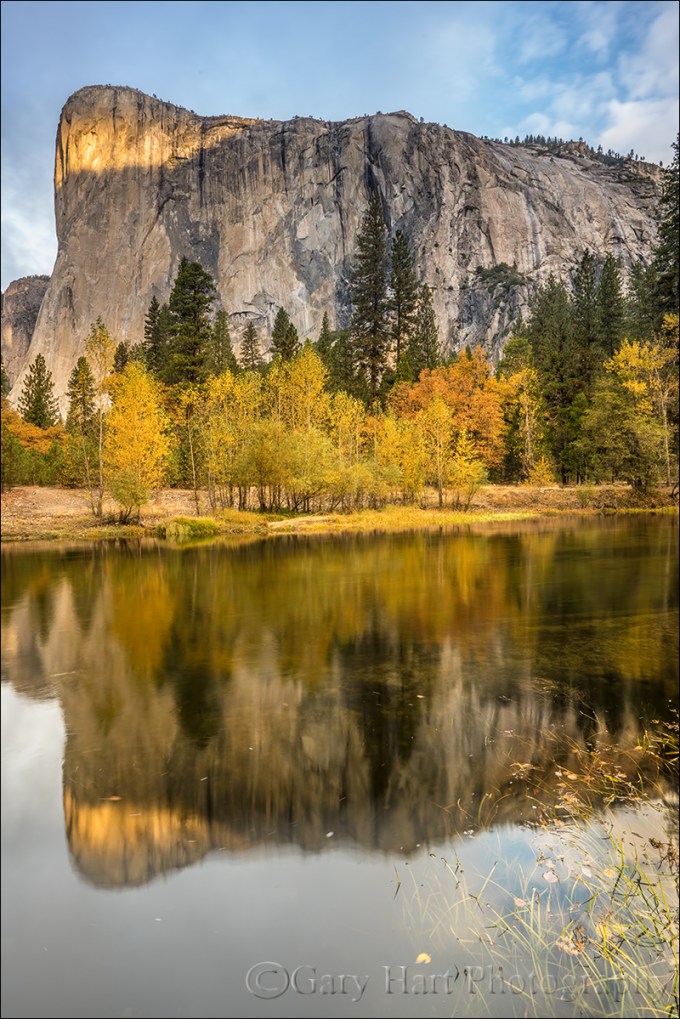
Autumn Morning, El Capitan Reflected in the Merced River, Yosemite
Sony a7R II
Sony/Zeiss 16-35 f4
2 seconds
F/16
ISO 50
Like most photographers in the Northern Hemisphere, my fall color season is about finished. But things are just ramping up along the streets near my home in California’s Central Valley (where winter doesn’t really begin until December, and spring’s first blooms start to pop up at the end of January—sorry). While there’s not a lot for me to photograph in my neighborhood, the opportunity to partake of the visual feast without a camera in my hands is refreshing.
I’m also harvesting the fruits the most intense autumn workshop/travel schedule of my photography life, and appreciating all over again how much I enjoy fall photography. Browsing my autumn images, I’m reminded of the need to understand my subjects. That goes double for the why and when of fall color, a blend of science and myth so intertwined that casual observers often resort to memory, anecdote, and lore to fill knowledge voids with partial truth and downright falsehood.
Innkeeper logic
Show up at at the fall color spot that guy in your camera club said was peaking at this time last year, you might find the same trees displaying lime green mixed with just hints of yellow and orange. Ask the old guy behind the desk at the inn, and you’ll get a head shake and confident explanation that, “The color’s late this year—it hasn’t gotten cold enough yet.” Check into the same inn on the same weekend next year, you might find just a handful of leaves clinging to exposed branches—this time, as the old guy hands you the key, he proclaims, “That hot summer got everything started early—you should have been here last week.”
While “expert” testimony like this sounds like objective truth, it only perpetuates the myths surrounding fall color. Fortunately, science has provided a pretty good understanding of the fall color process to all who want to understand.
It’s all about the sunlight
The leaves of deciduous trees contain a mix of green, yellow, and orange pigments. During the spring and summer growing season, the green chlorophyl pigment overpowers the orange and yellow pigments, keeping the trees green. While this chlorophyl is quickly broken down by sunlight, the photosynthesis that turns sunlight into nutrients that nourish the tree, warmth and long days provide the energy to sustain chlorophyl creation through the summer.
As the days shrink toward autumn, things begin to break down. Cells at the “abscission layer” at the base of the leaves’ stem (the knot where the leaf connects to the branch) begin a thickening process that blocks the transfer of carbohydrates from the leaves to the rest of the tree. Meanwhile, movement of nutrients to the leaves is inhibited as well—without these minerals, the leaves’ chlorophyl production dwindles and finally stops. No longer masked by the chlorophyl’s green, it’s time for the tree’s yellow and orange pigments to shine: Color!
Sunlight and weather
Contrary to popular belief, the timing of the onset of this fall color chain reaction is much more daylight-dependent than temperature- and weather-dependent—triggered by a genetically programmed day/night-duration threshold; contrary to innkeeper-logic, the trees in any given region will commence their transition from green to color at about the same time each year (when the day length drops to a certain point).
Nevertheless, though it doesn’t trigger the process, weather does play a significant part in the intensity, duration, and demise of the color season. Because sunlight breaks down the green chlorophyl, cloudy days after the suspension of chlorophyl creation will slow the coloring process. And while the yellow and orange pigments are present and pretty much just hanging out, waiting all summer for the chlorophyl to relinquish control of the tree’s color, the red and purple pigments are manufactured from sugar stored in the leaves—the more sugar, the more vivid their color. Ample moisture, warm days, and cool (but not freezing) nights after chlorophyl replacement has stopped are most conducive to the creation and retention of the sugars that form the vivid red and purple pigments.
On the other hand, freezing temperatures destroy the color pigments, bringing a premature end to the color display. Drought can stress trees so much that they drop their leaves before the color has a chance to manifest. And wind and rain can wreak havoc with the fall display—go to bed one night beneath a canopy of red and gold, wake the next morning to find the trees bare and the ground blanketed with color.
Of course all these weather factors come in an infinite number of variations that make this year’s color timing and intensity a little different from last year’s and next’s. Despite my need to understand nature’s mysteries, it’s this (perceived) randomness, the impossibility of ever knowing for sure what I’ll encounter, that draws me back.
About this image
Yosemite isn’t an inherently great sunrise location. With most of its views facing east, toward shaded subjects beneath the brightest part of the sunrise sky, sunrise light is difficult here. And without clouds, more the the rule than the exception in California, Yosemite sunrises can be rather bland. But Yosemite’s bland sunrises are more than compensated by the first direct sunlight light visible Yosemite Valley, which starts on the highest points a few minutes after the “official” (flat horizon) sunrise, and progresses over the next hour or so until the valley floor is bathed in sunlight. El Capitan is among the first of Yosemite’s prominent features to benefit from this early light.
I have a mental list of go-to El Capitan views for photographing its first light. Among them is a quiet bend in the river, known affectionately (and unofficially) to photographers as “Tahiti Beach,” with views of Cathedral Rocks, El Capitan, and the Three Brothers. Additionally, the river widens and slows here, providing some of Yosemite Valley’s best reflection opportunities as well.
One morning in the first of this year’s two Yosemite fall color workshops, I guided my group to Tahiti Beach for El Capitan’s first light. Clouds ruled the sky as the first light window opened, but fleeting patches of blue gave me hope. And with the deciduous trees across the river displaying their finest golds and oranges, we weren’t lacking for opportunities in the meantime.
The sun broke through suddenly, spotlighting a thin slice of granite near El Capitan’s summit. Unsure how long the opportunity would last, I moved quickly to compose this wide, vertical frame that emphasized the reflection juxtaposed with a thin veneer of colorful leaves floating at my feet. I reminded myself to heed the frequent admonition I issue my workshop groups: the focal point for a reflection is the focus point for the reflective subject, not the reflective surface. In other words, while the leaves floated in water that was just a few feet from my lens, their focus point was much closer than the infinity focus point of the reflection in the same water. I focused on the leaves, confident that the depth of field provided by f/16 at my 18mm would render El Capitan, the trees, and the reflection acceptably sharp.
Another noteworthy exposure setting in this image is my 50 ISO decision. Though the leaves were completely still, there were slight ripples disturbing the river where most of my reflection lay. Stopping down to f/16, dialing my sensor’s sensitivity to ISO 50, combined with a polarizer carefully tuned to cut the reflective glare on the leaves without diminishing the rest of the reflection too much, allowed a 2-second exposure that smoothed the ripples enough to enhance the reflection.
Purchase Prints
Photo Workshop Schedule
A fall color gallery


Supermoon
Posted on November 14, 2016

Supermoon, Half Dome and El Capitan, Yosemite
Sony a7RII
Tamron 150-600 (Canon-mount with Metabones IV adapter)
1/3 second
F/9
ISO 100
The media tends to distort facts and blow events out of proportion. Perhaps you’ve noticed. The latest example is this week’s “supermoon,” an event heralded on TV, in print, and online like the Second Coming. Okay, now for a little perspective. Despite hype to the contrary, a supermoon occurs at least twice, and up to five times, in a year. In fact, our last supermoon was all the way back in October, and the next one isn’t until December.
But, as I’m sure you’ve heard, this month’s supermoon was special, an event the likes of which we haven’t seen since 1946, and won’t see again until 2034. True enough. But exactly how special was it? Not nearly as special as you might have heard: the diameter of the “epic” November supermoon was only one-half of one percent (.57) larger than the October full moon, and four-fifths of one percent (.84) larger than the December full moon—differences that are impossible to discern with the naked eye. Next year we’ll get two moons that are more than 99 percent the size of this month’s supermoon, and last year we had four.
So why was I out taking pictures of the full moon Sunday night? Because I think every full moon is beautiful, regardless of its size, and I take any opportunity to photograph it over my favorite landscapes. Which is also why each fall I schedule a workshop in Yosemite to coincide with the full moon.
Thursday night my Yosemite Autumn Moon workshop group photographed an 82% (of full) waxing gibbous (on its way to full) moon above Valley View at sunset. For Friday night’s sunset, from a quiet beach beside the Merced River we glimpsed through clouds an 87% moon rising just right of Half Dome. Saturday’s sunset found us beneath a magenta sky at Tunnel View to witness the 96% moon ascend between Sentinel Dome and Cathedral Rocks.
The workshop’s grand finale came Sunday night, when we gathered at the Half Dome vista on Big Oak Flat Road. Though I rarely encounter other photographers for any of my moon rise/set shoots, limited parking and tripod space here prompted me to arrive an hour before sunset. That turned out to be a fortunate decision, as within 30 minutes of our arrival the parking lot was brimming beyond full and photographers swarmed the nearby rocks like ants at a picnic.
With an hour to kill, I made sure everyone in my group was ready (but by now, this being our fourth moonrise, they were experienced veterans) and chatted with other photographers nearby. Comparing notes, it seemed that most (all?) of the other photographers had relied on apps like The Photographer’s Ephemeris and Photo Pills to plot the moon’s arrival location and time, while I was the only one clinging to my old fashioned topo map, scientific calculator, trigonometry plotting approach. (I do it this way because I’ve been plotting the moon since long before the apps were available, I feel like I can be more precise, and I enjoy it—not necessarily in that order.)
In the viewfinder of my Sony a7R Mark II, atop my tripod and armed with my Tamron 150-600 lens to enlarge the moon as much as possible, was the composition I wanted—assuming the accuracy of my calculations. The consensus among others seemed to be that the moon would appear from behind Half Dome’s right flank, anytime between 5:00 and 5:10 p.m. I stuck to my guns that the moon would show up at about 5:05, and that it would be straight over the top of Half Dome. While I saw this more as an opportunity to check my plotting method’s accuracy than a competition between methods, it was pretty thrilling when the moon popped into view right on schedule and on target. Take that, technology!
Since the moon didn’t appear until a full fifteen minutes after sunset, the extreme dynamic range (very dark landscape beneath a daylight-bright moon) made this an extremely tricky exposure for anyone (like me) not interested in compositing two images (one with the moon properly exposed, another with the scene properly exposed). To capture this scene with a single click, I closely monitored the pre-capture “zebra stripes” highlight alert in my a7RII and pushed my exposure 2/3 stop after the first hint of the alert appeared. To hedge my bets and give myself processing options, I varied my exposure 1/3 to 2/3 of a stop in either direction (an exception to my standard workflow because the moon is too small to register on the histogram).
The result was a scene that looked quite dark on my LCD, and a moon with no detail. No problem, I reassured myself, for my a7RII’s ridiculous dynamic range. This morning in Lightroom I adjusted the white balance, pulled up the shadows, and pulled down the highlights. In Photoshop I applied a moderate dose of Topaz DeNoise and did a few minor dodge/burn moves to get the image you see here.
One more thing
The size of the moon in this image has virtually nothing to do with the fact that this was a “supermoon,” and virtually everything to do with the fact that I was far enough away to be able to use a 600mm lens. Click below to read about how to capture your own big moon:

Photo Workshop Schedule
The Moon in all Shapes and Sizes
Click an image for a closer look and slide show. Refresh the window to reorder the display.


Winter is coming
Posted on October 20, 2016

Elm in Blizzard, Cook’s Meadow, Yosemite (2007)
Canon EOS-1Ds Mark II
Canon 70-200 f/4L
1/4 second
F/11.0
ISO 100
Photographing snow-covered Yosemite requires planning and patience: planning to ensure your arrival before the snow stops; patience to wait out the storm when visibility is so poor that you can barely see the nearest tree.
Planning
When the snow stops, Yosemite’s relatively mild temperatures (usually in the 30s when it snows) conspire with sunshine, wind, and gravity to clear the trees in a matter of hours. Meanwhile, park visitors driven inside by the storm, swarm outdoors to gape, quickly adding footprints and spreading mud with their boots, bikes, and cars. In other words, if you delay your departure for Yosemite until you hear that it snowed there, you’re too late. The key is being in the park during the storm.
All winter I monitor the National Weather Service Yosemite forecast and discussion (in-depth forecast analysis) pages for hints of a cold storm. I know there are lots of weather forecast options out there, but most either lack the resources of the NWS, or simply use the NWS data. The NWS may not always nail the forecast, but they’re more consistent and reliable than all the other options.
Sometimes the weather can change at the last minute, but I’m always ready. (It doesn’t hurt that I live less than four hours by car from Yosemite Valley.) In the back of my AWD Subaru Outback all winter are chains (required to be carried in Yosemite in winter, even with AWD/4WD), a portable charger that can recharge a car battery (among other things) in a pinch, and a duffle bag with all my cold weather gear (waterproof pants and upper shell, hat, gloves, umbrella, and ice grips for my shoes).
Patience
Once I decide I’m in, I’m all in. That usually means getting a room in or near Yosemite Valley, driving to the park a day early, and waiting for the snow to start. Once the snow arrives, I don’t hole up in my room, I’m out shooting. Even though Yosemite’s storms often erase all signs of its most recognizable features, stormy weather is a great time to photograph swirling clouds and accumulating snow in glorious (and rare!) solitude.
As much as I love photographing Yosemite in near white-out conditions, I sometimes get too cold, wet, or worn out to continue. But even when I reach that point, I don’t go in. Instead, I park at Tunnel View and wait for the weather to clear. Tunnel View is the perfect place to wait out a Yosemite storm because it’s on the west side of Yosemite Valley (where the clearing usually starts), provides an elevated vantage point with a view all the way down to Half Dome on the valley’s east side, and is spectacular to photograph when the storm clears. It even has decent cell service. And if I’m looking for an excuse to turn on the engine and warm things up, I drive through the tunnel for a view to the west, a preview of coming weather.
My final advice for anyone waiting out a storm at Tunnel View is when the storm clears, don’t spend so much time there that you miss opportunities elsewhere. This is easy to do because the photography will remain spectacular long after you should have moved on to other scenes.
Today’s image
Among my many snowy-Yosemite go-to spots is Cook’s Meadow. On this trip several years ago, until the snow arrived, the meadow was a field of lumpy brown grass, its sentinel elm a bare skeleton in the shadow of Half Dome. But a few inches of overnight snow transformed the bland meadow into an undulating sea of frozen white waves and etched the tree in white.
The snow was still falling when I arrived, wet and fast, slanted by a stiff breeze. Half Dome was gone. I positioned my tripod so the elm stood by itself, balanced in the frame by a stand of evergreens. The falling snow added an interesting dynamic to the otherwise static scene and I chose a 1/4 shutter speed that would blur its motion to streaks of white.
Yosemite Photo Workshops

Snowy Yosemite
Click an image for a closer look and slide show. Refresh the window to reorder the display.


The night sky and me
Posted on August 12, 2016
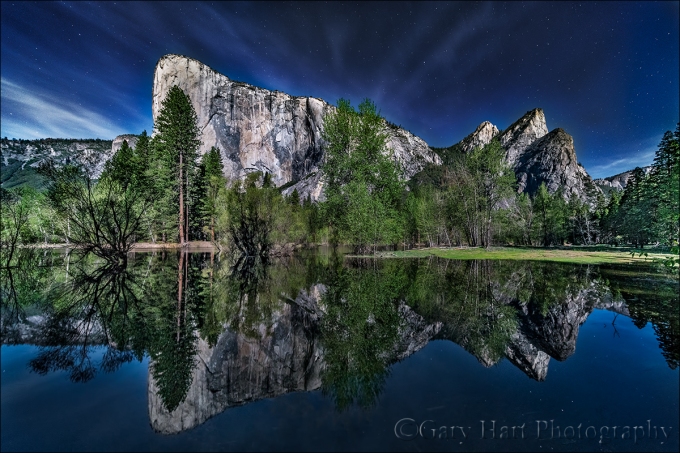
Moonlight Reflection, El Capitan and the Three Brothers, Yosemite
Sony a7R II
Canon 11-24 f/4L with Metabones IV adapter @11mm
20 seconds
F/4
ISO 3200
My relationship with the night sky started when I was ten. Astronauts were my generation’s cowboys, so when I was given a castoff, six-inch reflector telescope by an amateur astronomer friend of my dad, I jumped at the opportunity to explore the celestial frontier on my terms. On clear nights my best friend Rob and I dragged that old black tube onto the front lawn and pointed it, randomly and full of wonder, at the brilliant points of light overhead. With guidance from our dads and the books of Herbert S. Zim, we learned the difference between stars, which despite their great size and temperature, are at such great distance that even the strongest telescope only sees discrete points of light, and planets, nearby worlds reflecting sunlight, which my telescope revealed as glowing disks.
With that telescope Rob and I searched in vain for comets and galaxies, watched Venus and Mercury cycle through phases just like the moon’s, tracked the nightly dance of Jupiter’s Galilean moons, and monitored the changing tilt of Saturn’s rings. Suddenly and hopelessly infected with the astronomy bug, on camping trips I declined the luxury of the family tent in favor of a sleeping bag beneath more stars than I imagined possible. There, nestled to my neck in the bag’s warmth, I’d stretch beneath the boundless ceiling, counting “shooting stars” and scouring the sky for satellites, fighting sleep for as long as my eyelids could hold out. In my later teen years I discovered backpacking and with it skies that inspired ponderings of infinity. My first college major was astronomy, a most impractical aspiration that I managed to correct before quantification of the universe spoiled my appreciation of its elegance.
In my early twenties I discovered photography, but, frustrated by my film camera’s inability to capture the night sky’s beauty, quickly moved on to more terrestrial subjects. Fast forward to the twenty-first century, when the advent of digital photography offered light capturing and processing capabilities impossible with film. My first night subject was the Big Dipper; since then I’ve tried to include some form of night photography in most of my workshops and as many personal shoots as possible, seeking to use my camera’s unique perspective to convey the emotion the night experience brings me, rather than attempt the impossible task of recreating the sky literally.
Among other subjects, I’ve developed a particular fondness for photographing the gold/blue transition-zone separating day and night. Arriving on location well before sunrise gives me a front-row view of the indigo night’s slow retreat in favor of the golden promise of a new day; lingering long after the sun sets, I watch the day’s vestiges linger on the horizon, as if waiting with me for the stars to materialize.
About this image
This year’s Yosemite Moonbow and Wildflowers workshop group had the good fortune to photograph Yosemite brimming with more water than I’ve seen in years. A particular highlight was this location beside the Merced River, one of my favorite early morning spots. The morning we arrived we found my normal vantage points flooded beyond recognition, but rather than let the flooding turn us around, I explored the new shoreline and found view through the trees onto a crystal clear reflection. We stayed and photographed here until bad light and empty stomachs finally drove us to breakfast.
Excited by our good fortune that morning (read The Power of Reflections), I offered to return that night with anyone who wanted to photograph the scene by moonlight. Though I already had a moonbow shoot scheduled for later in the workshop, the moonlight potential here was so great that I wanted to at least give everyone the option of photographing it (on the other hand, with such early mornings, I knew from experience that I needed to give everyone the option to return to the hotel for an early bedtime).
Despite a long drive back from our sunset at Glacier Point, about half the group still joined me for what turned out to be a very memorable moonlight shoot. The already somewhat limited space was made even more difficult by the darkness (we were shaded from the moonlight by trees and the valley wall behind us), but we made it work with great cooperation and no shortage of laughter.
Among other things, this image highlights one of the great joys of photography with today’s advanced technology: the camera’s improving ability to reveal a world previously obscured by night’s dark curtain. (It will only get better.)
Photo Workshop Schedule
A moonlight gallery


Someday My Prints Will Come
Posted on August 1, 2016
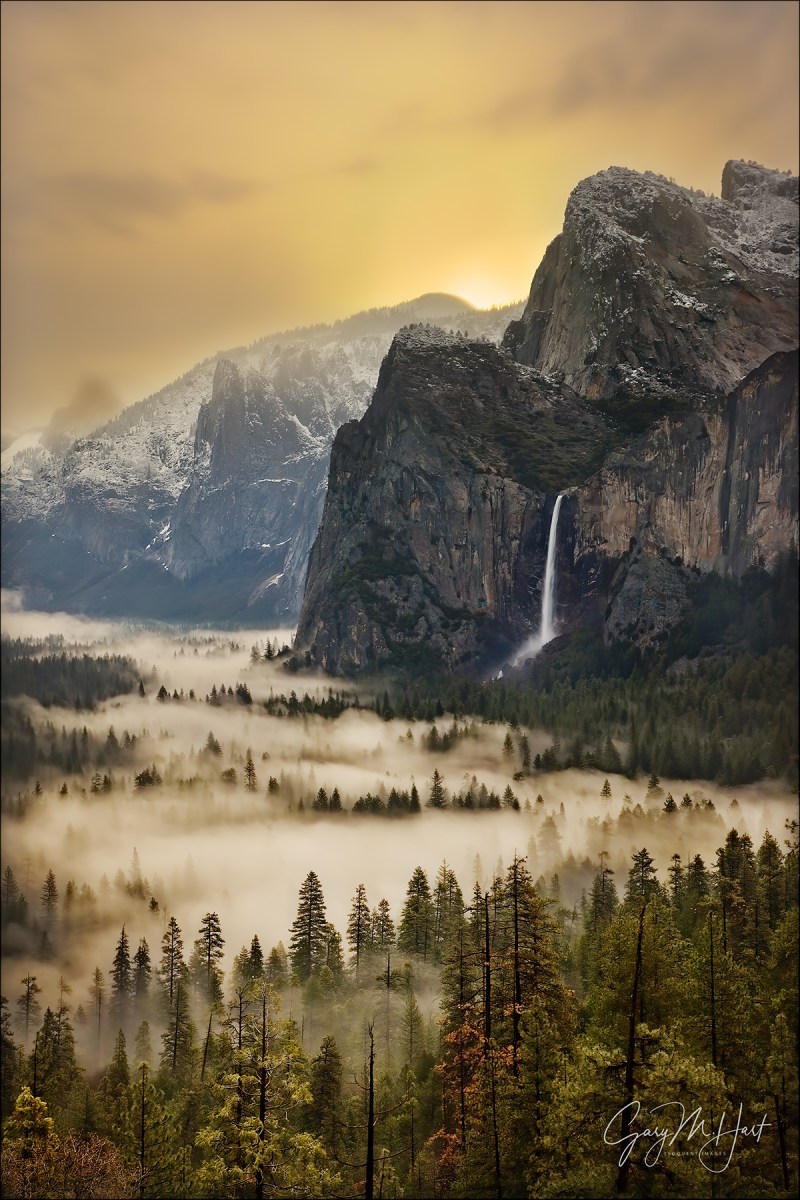
First Light, Yosemite Valley
Canon EOS-1Ds Mark III
Canon 24-105L
1/3 second
F/16
ISO 100
Someday is now…
The dilemma
I’ve been selling prints of my images for about fifteen years. I started at weekend art shows and in art galleries, and soon added a modest online store. The art shows in particular were very successful, but as much as I enjoyed them (I truly did), the shows required so much work that I stopped because they detracted from my primary bread and butter, the photo workshops.
Despite my workshop emphasis, I have maintained a small gallery presence, and continue to offer my prints for sale on my website (which I’ve upgraded significantly). While I still sell prints fairly regularly, I know there are many more people who don’t purchase them because they’re just too expensive.
I can explain
Though printing is a pretty labor intensive process, I’ve always insisted on doing it myself, largely because I’ve never trusted anyone else to create the print to my satisfaction. But the amount of work that goes into each print (even after it’s been processed and sized)—from constant maintenance (clearing clogged print heads, monitor calibration, paper and ink management, and so on) to careful packaging and shipping—results in pricing that’s prohibitive for many people.
Finally, a solution
For a long time I’ve sought a solution that would cut me out of the printing and shipping side of the transaction while still yielding quality prints, and think I’ve finally found one. I’ve spent the last few weeks creating a SmugMug website exclusively for showcasing my prints for sale: GaryHartPrints.com. On this new site, instead of coming to me, your print orders will go to the much acclaimed Bay Photo Labs, my longtime lab of choice for jobs my own printer can’t handle (such as prints too large, or paper I don’t offer).
Though these prints won’t have my personal signature, each print has been photographed, processed, copyrighted, and digitally signed by me. I can also vouch for the quality, which will be at least as good as what I can offer. By taking the printing process out of my hands and putting it in the hands of people who do this exclusively, you get more choices, including multiple papers (lustre, glossy, metallic, and gicleé watercolor) and many matting and framing options—all at a much lower price than I can offer by printing directly.
Check it out*
*This site is brand new, so the images you see here are by no means a complete representation of all that’s available. If you don’t see what you’re looking for, just send me message.
About this image
In a post announcing a new print sale website, I thought it appropriate to re-share my most requested image, captured on a chilly April morning in 2009. As with many of my images, it was captured during a workshop. And also like many of my images, it almost didn’t happen.
My workshop group was at Tunnel View overlooking Yosemite Valley, wrapping up our first sunrise shoot. A storm had moved through overnight, dusting the granite walls with snow down to about 5,000 feet (Yosemite Valley is at about 4,000 feet), and soaking the lower elevations with a light rain. With no wind to mix the chilly atmosphere, the coldest air dropped all the way to the saturated valley floor, where it found the dew point and condensed into a ground-hugging fog.
Overhead, the parting storm’s cloudy vestiges covered the scene with a dull, gray blanket of homogenous clouds, so our attention all morning had been on the wispy valley fog below. The dynamic range at Tunnel View is pretty unmanageable when the morning sun arrives, so I was about to move the group on to greener pastures when I noticed a golden glow expanding behind Sentinel Dome. As the color spread, it was apparent that the uniform clouds above were far more translucent than I’d imagined and I put a hold on our exit. Soon I was so mesmerized by the buttery veneer stretch from rim to rim , reflecting softly on the fog below, that I almost forgot about my camera.
I raced to the car to get my gear and sprinted back to set up far faster than I like. By the time I was ready, the sun was just about to crest the ridge behind Sentinel Dome. I worked quickly, using a 2-stop hard graduated neutral density filter to subdue the bright sky. I stopped down to f16 thinking a sunstar might be possible, but the sunlight was too diffused by the clouds.
Of all the pictures of Yosemite that I’ve taken, this is the one that makes it easiest for me to imagine how this heavenly location might have looked before human interference.
America the Beautiful
A gallery of favorites (coming to a wall near you)


 Eloquent Images by Gary Hart