Tips to improve your full moon photography
Posted on March 24, 2016

Winter Moon, Zabriskie Point, Death Valley
Sony a7R II
Sony/Zeiss 24-70 f4
1/6 second
F/8
ISO 100
Have you ever seen a glowing full moon suspended above a beautiful landscape and been moved enough to grab your camera? And how many times have those pictures actually matched your memory of the moment? Not too many, I’d guess. Either your landscape was completely black, or (more likely) the moon was an ugly white blob. You’ve just experienced an example of the human eye’s vastly superior dynamic range—while you could see detail in the landscape and the moon, your camera could only see one or the other.
Lot’s of scouting and plotting goes into aligning a full moon with a terrestrial subject, as close to the horizon as possible, when the light’s just right. For me, just right means a sky dark enough for the moon to stand out (the darker the better), but not so dark that I lose foreground detail in the twilight shadow. Since I don’t blend images, I need to get the landscape and lunar detail with a single click.
I’ve found that the “right-time” sweet spot for single-click full moon photography is a window about 10 minutes on either side of sunrise/sunset. Since the published sun/moon rise/set times assume a flat-horizon—unless you’re on a boat at sea, the sun and moon will probably be below the horizon when they’re advertised to be rising and setting.
It helps to know that as the moon goes through its 29-day cycle from new to full and back, it rises a little less than an hour later each day (that’s an average that varies with several factors, but it’s a good rule-of-thumb). This generally makes the moon visible in my 20-minute exposure sweet spot the day before it’s full for a sunset moonrise, and the day after it’s full for a sunrise moonset, because there’s more foreground light to work with. But even then the landscape will be bathed in shadow, while the moon remains daylight bright, so getting myself on location in this 20 minute window is only half the battle.
In general, digital cameras have made exposure easier. Shooting film, difficult exposures meant a lot of guessing, bracketing, and (especially) hoping. Shooting digitally, not only can we instantly eyeball each image, the histogram shows us exactly how our exposure worked. Unfortunately, the histogram isn’t much help when the moon’s involved, because the moon doesn’t usually occupy enough image real estate to register on the histogram. If you’re not careful, you might find yourself reveiwing an evening’s worth of images with beautiful histograms and a hopelessly blown moon. What’s a photographer to do?
The key to exposing any high dynamic range scene is pushing the highlights as far as you can without blowning them out. For most scenes the histogram is sufficient, but exposing for the moon requires help from your camera’s Highlight Alert (blinking highlights) feature. And since most cameras allow you to view images in multiple modes (e.g., with the luminosity histogram, RGB histogram, no histogram, full capture information, no capture information, and so on), it’s also important to determine which view or views actually show the blinking highlights (not all do)—if you’re not sure, I suggest intentionally overexposing a scene and reviewing the image in the camera’s various display modes.
Moonrise
When photographing a rising full moon at sunset, simply metering for the landscape works at the outset because there’s still plenty of light to capture foreground detail without overexposing the moon. At this point the histogram tells me everything I need to know. But as the sky darkens, so does the foreground, while the moon remains unchanged.
To keep my histogram in the ideal range as twilight deepens, I add light to my image by bumping the shutter speed in 1/3 stop increments. Each time I increase the shutter speed, I check the image to ensure that the moon’s not blinking. As soon as my exposure causes the moon to blink, I know I’ve reached my highlight threshold and I’m pretty much done adding light.
Once I’ve pushed the moon to my camera’s highlight threshold, I continue shooting until the shadows are so dark that no useable data can be recovered. Because highlight and shadow recovery varies with the camera, I strongly encourage you to familiarize yourself with your camera’s shadow and highlight threshold (how far to the left and right can push the histogram and still get usable detail).
If you’re shooting raw, you can probably push your exposure until part of the moon is blinking, but if the entire lunar disk blinks, you almost certainly will need to back down your exposure. Adding a graduated neutral density filter will hold back the moon enough to buy you five or ten minutes of shooting before the moon blows out.
Moonset (an example)
Photographing a setting full moon at sunrise is the sunset process in reverse—we start with the moon glowing above a landscape much too dark to get detail without hopelessly blowing out the moon, and finish when the moon sets, or when the sky brightens to the point that the moon starts to wash out.
In January, I got my Death Valley Winter Moon workshop group out to Zabriskie Point about 45 minutes before sunrise. The moon was indeed beautiful, but far too bright to photograph with the dark foreground. But it was high enough that I was able to do long exposures without the moon while I waited for the scene to brighten.
About 20 minutes before sunrise I pulled out a 3-stop hard-transition graduated neutral density filter and started including the moon, dialing my exposure down until the moon stopped blinking—the most light I could give the scene without losing the moon. At first the foreground was still far too dark to contain usable detail, but within 5 minutes I started to feel like the scene had brightened enough to allow usable detail (albeit with a fair amount of Lightroom Shadow/Highlight work later).
From that point on, I just worked on a variety of compositions that included the moon. Monitoring my histogram, I shortened my shutter speed to reduce the exposure as the foreground brightened. Eventually the foreground brightened enough that I didn’t need the GND filter.
In a perfect world the moon reaches the horizon while it’s in the sunrise/sunset 20(-ish) minute exposure sweet-spot (sky dark enough that the moon stands out, but not so dark that I can’t get landscape and lunar detail), but this morning the moon was high enough that the contrast flattened before it set.
The above image I captured early in the sweet spot—the foreground looked quite dark on my LCD, while the moon was mostly intact, with a couple of blinking specks. But I knew my Sony a7R II well enough to be confident that simple highlight and shadow adjustments in Lightroom would recover all the necessary detail.
Photo Workshop Schedule
A Full Moon Gallery (Large and Small)


The Art of Subtraction
Posted on March 16, 2016
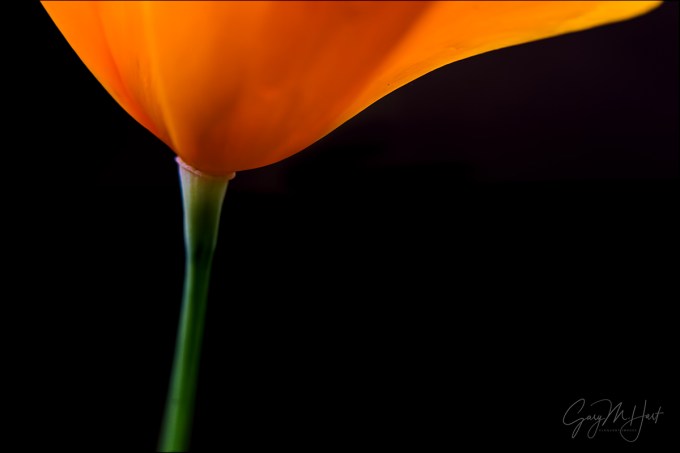
Golden Elegance, California Poppy, Sierra Foothills
Sony a7R II
Sony FE 90mm f2.8 Macro
1/200 seconds
F/4
ISO 3200
Photography is an art of subtraction—presented with a complex world, we identify and organize objects of visual interest and (ideally) do our best to eliminate everything else. It’s this last point that’s often overlooked. The best pictures often work as much for what’s not in them as for what’s in them. Most photographers have no problem seeing what to put in their images, but many struggle with what to leave out. Or how to do it.
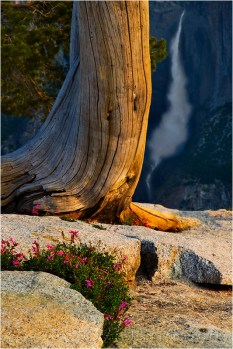
Morning Light, Upper Yosemite Fall from Sentinel Dome, Yosemite
Anything in your frame that doesn’t enhance it is a potential distraction. Removing distractions is often as simple as tightening the composition, or repositioning the camera.
For example, admiring a dramatic waterfall in the distance, you might walk around until you find a colorful bouquet of wildflowers for your foreground—so far so good. With your camera at eye level, you frame the scene with the flowers at the bottom and the waterfall at the top. Click.
The problem is that you also included a vast empty region in the middle of the frame, a region that does nothing more for your image than occupy space. The solution is as simple as dropping your camera to ground level, allowing you to subtract the empty space and replace it with larger flowers and waterfall (because with the flowers and waterfall more aligned, you can increase the focal length).
But compositional adjustments are only the beginning. Where most people stumble is when they have an opportunity to further simplify an image by incorporating the areas of their camera’s vision that differs most significantly from their own vision: light, focus depth, and motion.
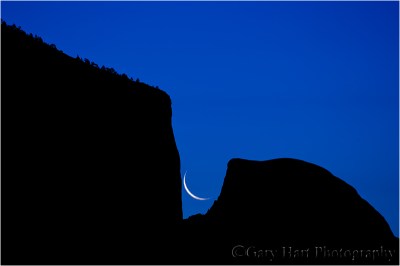
Captive Crescent, El Capitan and Half Dome, Yosemite
Read the story of this image
Light
Photographers frequently lament their camera’s limited dynamic range. And while extra dynamic range in a camera is great, limited dynamic range creates great opportunities to remove distractions and emphasize shape over detail.
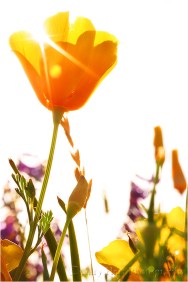
Brilliant Poppy, American River Parkway, Sacramento
Metering and underexposing the highlights in a backlit scene can saturate color and hide distracting details in blackness. I try to find striking subjects that stand out against the sky. Hilltop oak trees work well for this, but I can think of no subject in nature more suitable to silhouette photography than El Capitan and Half Dome in Yosemite. And since a crescent moon is always in the brightest part of the sky just before sunrise or after sunset, I always look for an opportunity to pair a waning crescent against Yosemite’s striking skyline.
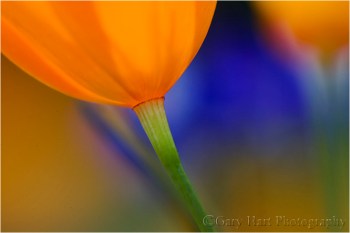
But this approach isn’t limited to silhouettes. In the image at the top of this post, I didn’t want anything to distract from the poppy’s graceful curves, so I positioned the poppy against deep shade and underexposed the scene. This saturated the rich color and blackened everything that wasn’t poppy.
And using dynamic range to subtract distractions isn’t just about turning shadows black. Don’t like a blank blue sky? Metering on a shaded subject against a blue sky can completely blow out the highlights, creating a striking white background for your primary subject.
Focus depth
Poppy Lanterns, Merced River Canyon
One of my favorite techniques for photographing colorful wildflowers and fall foliage is to narrow the range of focus until just a select part of my subject is sharp, softening the rest of the scene to an appealing blur of color and shape. This blur effect improves as depth of focus shrinks, and depth of focus shrinks with:
- Subject distance—the closer the better
- Focal length—the longer the better
- F-stop—small f-stop means large aperture
While I’ve used pretty much every lens in my bag to blur my backgrounds (and foregrounds), I most frequently use telephoto and macro lenses, often with extension tubes.
Not only does this approach help the primary subject—or specific aspects of the primary subject—stand out, when executed properly it can eliminate virtually any background distraction. The most important thing to remember is that even when it will be blurred beyond recognition, the background matters.
Motion
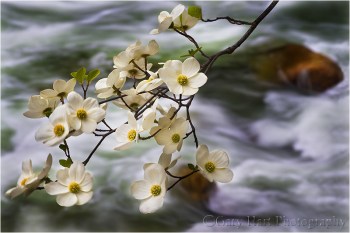
Blurred water often gets labeled as “unnatural” or “cliché.” The unnatural part I’ll dismiss as misinformed—it’s no less natural than water droplets suspended in midair. While I’ll acknowledge that reflexively reaching for a neutral density filter at the slightest hint
Dogwood and Rapids, Merced River, Yosemite
of whitewater might be overdoing it a bit, the cliché label ignores the fact that blurred is often the only way to render moving water (ever try freezing a waterfall or churning cascade in shade or overcast?).
Regardless of your position on blurred water, detail in moving water can create a distraction that competes with your primary subject for attention. Smoothing moving water to one degree or another subtracts this distracting busyness.
Motion blur isn’t just about water—pretty much anything that moves can be softened or eliminated with motion: clouds, blowing leaves and flowers, stars, and so on. While it’s not landscape photography, a device employed by architectural (and other) photographers is adding many stops of neutral density to slow the shutter speed so much that people and vehicles moving in the scene completely disappear.
Regardless of the object that’s moving, as with narrow focus depth, softening the secondary areas of a scene also helps the primary subject stand out by allowing your viewers to focus all their attention where it belongs.
It’s all about control
Because of the zero-sum relationship between photography’s exposure variables—changing one variable requires a complementary change in another—controlling light, depth, and motion is difficult-to-impossible unless you get out of the full auto exposure modes and start making your own exposure decisions. While it can be done in Aperture or Shutter Priority modes, I find Manual metering works best for this level of control. So, if you don’t have enough understanding of metering to shoot in Manual mode, that’s the place to start.
Here are some links from my Photo Tips tab that will help:
Workshop schedule
A gallery of subtraction


Among the wildflowers
Posted on March 9, 2016

Foothill Gold, Mokelumne River, California
Sony a7R II
Sony FE 90mm f2.8 Macro
1/125 seconds
F/4
ISO 4000
Last year, a busy spring schedule and mediocre wildflower bloom conspired to thwart the wildflower photography I love so much. Vowing not to let that happen again this year, a few days ago I packed my gear and headed for the hills with fingers crossed. My goal was a familiar canyon off of Highway 49 in the foothill Gold Country south and east of Sacramento.
This would be the maiden voyage for my brand new Sony 90mm f2.8 macro, and I was really looking forward to seeing if it’s as good as everyone says it is. Not only that, this would be my first wildflower shoot since switch from Canon DSLR to Sony mirrorless nearly a year and a half ago (!).
It’s a sign
On the drive I’d been streaming a Giants Spring Training game, but turning up the canyon I lost my signal, so I opened the Music app on my iPhone, put it in Random mode, and was immediately distracted by an entire hillside of poppies unfolding before me. Each bend in the road seemed to be trying to outdo the one before it, and I was several curves up the road before my ears caught up with my eyes. Of the 5000 or so possibilities on my phone, what I heard was Tom Petty telling me, “You belong among the wildflowers….” (true story). A sign, definitely a sign.
But anyway…
I followed the road to the end to identify the places I wanted to return to. On the drive back I stopped at my first choice and stayed until darkness and rain (not necessarily in that order) drove me out. I started with the macro, but before I was done I’d used every other lens in my bag too: 16-35, 24-70, and 70-200 (and would have used the 150-600 if I hadn’t loaned it to my brother a couple of days earlier)—with and without extension tubes.
With the sun already behind the hills and rain on the way, light was limited, and fading. There wasn’t much wind, but there was just enough flower-swaying breeze to concern me. My f-stop choice was completely tied to the creative side of my composition (selective depth of field), leaving ISO as the only exposure variable for controlling my shutter speed. Rather than guessing before each shot exactly how fast the shutter needed to be and dial in just enough ISO to get there (and remember to adjust each time my f-stop changed or I added extension), I just cranked the ISO to 4000 and went to work. Problem solved.
I found lots of things to photograph, from entire hillsides to individual poppies like this one. Regardless of my depth of field, I took extreme care to ensure that my background complemented my subject. In this case I maneuvered my tripod until my subject was framed by background poppies. It took several frames to get the composition just right; once I was satisfied, I tried it with a variety of f-stops and focus points. (I can’t imagine even attempting this without a tripod.)
More love for Sony
The Sony 90mm macro was as good as advertised. And I can’t tell you how pleased I am with the high ISO capability of the Sony a7RII. Putting my wildflower images up on my large monitor at home confirmed that everything that was supposed to be sharp was indeed sharp, and the noise at 4000 ISO was minimal and easily managed without detail loss—even the images I shot toward the end, in a light rain and fading light, at 6400 ISO were just ridiculously clean.
This ability to push my ISO threshold allows me to shoot scenes I’d never have considered before. Along with the dynamic range and night photography capability, it’s another Sony game changer for me. The a7RII is exceptional, but regardless of the camera you use, I encourage you to test its high ISO capabilities before you find yourself in a situation where ISO matters—you may be surprised by its capabilities.
Another thing I enjoyed about shooting macro with the a7RII was the ease of achieving precise focus. With depths of field measured in millimeters, sometimes fractions of millimeters, identifying the focus point and getting it perfectly sharp is imperative. With my recent Canon DSLRs (1Ds Mark III and 5D Mark III) I’d become a real convert to live-view focus, but glare on the LCD can sometimes make seeing well enough to get precise focus difficult. That problem disappears completely with the ability to view the scene in the viewfinder.
I’m not done
I had so much fun last week, I’ll be going back as often as possible, until the hills brown and the wildflowers fade. With all the rain promised for the next couple of weeks, that might be quite a while—maybe all the way until dogwood season in Yosemite. Life’s good.
Blooming hillsides
Click an image for a closer look, and a slide show. Refresh the screen to reorder the display.


Beware the “expert”
Posted on March 4, 2016
Sierra Moonlight, Mt. Whitney and Lone Pine Peak, Alabama Hills, California
Sony a7R II
Sony/Zeiss 24-70 f4
15 seconds
F/5.6
ISO 3200
Rules are important. The glue of civilization. And after a childhood constrained by bedtimes, homework, and curfews, it’s no wonder that as adults we honor rules simply because, well, simply because. (I mean, who doesn’t wait for however long it takes and with no car or cop in sight, for a light to change?)
As much as civil society relies on universal obedience, not all “rules” are created equal. And our reluctance to question authority inhibits growth. One example would be blind adherence to the (usually) well-intended photography “experts” proliferating in print, online, and (especially) in your local camera club. These self-proclaimed authorities have figured out that people who are just learning are less confident, and tend to respond more to authority than substance.
The camera club paradox
I think camera clubs are great for many reasons: they connect people with a common interest, facilitate the exchange of information and ideas, and provide a forum for sharing our photographic creations. Camera clubs spur us to get out and shoot when we otherwise might stay home, and offer the beginner rules that provide a stable foundation upon which to build her craft.
But camera clubs can also be a breeding ground for self-proclaimed experts, a status often not conferred to the person most qualified, but to the person who spews photographic dogma with the most authority. The result is well-intended but misinformed knowledge that infects a camera club like a mutated virus.
I’m especially troubled when I hear of images shared in a camera club photo competition that were dismissed without consideration because they violated the local “expert’s” idea of an unbreakable photographic rule. Some camera club capital “violations” I’ve seen firsthand or heard about (by no means a comprehensive list):
- Centered subject
- Centered horizon
- Blown highlights
- No detail in the shadows
- Not sharp from front to back (this one really bothers me)
Each of these things can be a problem, but they can be a refreshing expression of creativity as well. And even if they are a problem, refusing to consider an image because it violates someone’s definition of “perfect” discounts all that’s potentially good about it.
If you’re an aspiring photographer and someone dismisses an image for a technical violation, take a step back, inhale, and remind yourself that there are very, very few absolutes in photography. In general, it’s helpful to remember that no matter how strongly it’s stated, advice that doesn’t feel right (even if you can’t articulate why) doesn’t need to be heeded. In fact, the next time someone starts feeding you photography advice in absolutes, run (don’t walk) to the nearest exit.
About this image
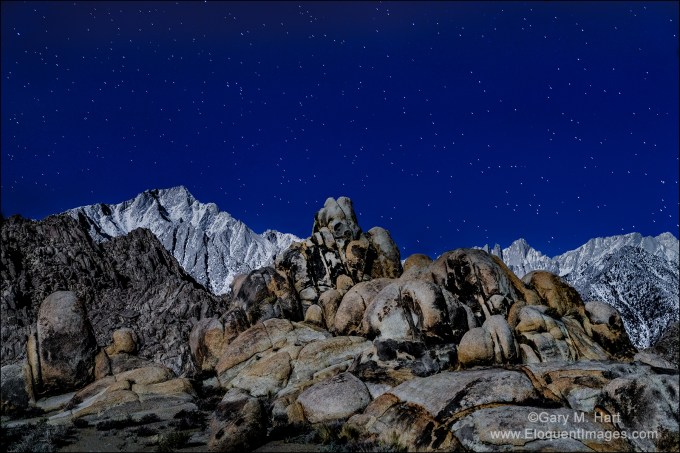
I jumped on my anti-expert soapbox after observing several recent workshop participants who were clearly constrained by “rules” enforced by their local camera club. And looking at this image, I realized that there are camera clubs that probably wouldn’t even consider it because I centered the horizon and the teddy-bear shaped rock in the foreground. I also captured a little more star motion than is ideal. But deal breakers? Not to me.
I’d taken my January Death Valley workshop group out to the Alabama Hills for a moonlight shoot on the workshop’s last night. A few in the group walked out to the arch, but most gravitated to this group of boulders a little south of the parking area. As I worked to get the group up to speed with moonlight photography, I tried a few frames of my own.
Most of my moonlight images are fairly wide, and even the closest focus point is far enough away to be at infinity, even wide open. But the rocks here were close enough, and my focal length was long enough (57mm), that I stopped down from f4 to f5.6 to increase my margin for error. And rather than autofocusing on the moon as I normally do, I focused toward the back of the foreground rocks. As I hope you can see in this low-res web version, I made the right focus choices.
The other problem I had to contend with was motion blur in the stars. At the 16mm to 24mm I typically use for night photography (to maximize the number of stars), motion blur isn’t much of a problem, even at 30 seconds. But at nearly 60mm, I didn’t think I could get away with 30 seconds. This is the first time I’d tried my Sony a7RII at night—I usually use my a7S, but I’d heard such good things about the a7RII’s high ISO capability that I thought I’d try it.
Bumping the ISO to 3200 (from my moonlight standard of 800), I was able to drop my shutter speed to 15 seconds. This image is so clean at 3200, and the star motion is visible enough, that I regret now that I didn’t go to ISO 6400 and cut my shutter speed to 8 seconds. Next time….
Workshop schedule
A gallery of potential rejects
(Images that might not make the cut at a camera club competition)
Click an image for a closer look, and a slide show. Refresh the screen to reorder the display.


Stop the madness
Posted on February 25, 2016
Horsetail Fall and Clouds, El Capitan, Yosemite
Sony a7R II
Sony/Zeiss 24-70 f4
1/40 seconds
F/8
ISO 160
For some background, read about photographing Horsetail Fall
Anyone who doesn’t understand what all the Horsetail hubbub’s about hasn’t seen it. When all the conditions align—ample water (rain and/or snowmelt), sun position, and unobstructed sunset light—there’s nothing in the world that compares. And while these convergences are rare, that doesn’t seem to deter the gawkers who show up to witness it.
Conventional wisdom says that the end of February is the best time to photograph Horsetail Fall. And if there’s one thing many years of photography has taught me, it’s that trophy-hunting photographers rarely deviate from conventional wisdom. Because Yosemite’s proximity to San Francisco, Los Angeles, and all the Central Valley cities makes it an easy target for photographers with only enough time for a quick trip, I usually avoid February’s final two weekends when I schedule my Yosemite Horsetail Fall workshop. But this year I couldn’t resist the full moon, which I knew I could align with Half Dome on multiple workshop nights.
For a workshop leader, another Horsetail Fall dilemma is that when the sunset light isn’t just right, there are many much better photo options elsewhere in the park. Spending an afternoon waiting for Horsetail Fall to do its thing on a day when the light decides to take the day off (always a distinct possibility) means pretty much wasting the best time of day for photography in Yosemite. That problem is compounded by the fact that the western horizon isn’t visible from the valley floor, making it impossible to anticipate what the sunset light is going to do until it’s doing it. For each time I’ve been surprised when a shaft of light slips beneath overcast skies to illuminate El Capitan at the very last minute, I can cite a clear sky sunset that was snuffed by an unseen cloud just as the light started to get good.
My plan for this workshop was to go for Horsetail Thursday evening, and again Friday if Thursday didn’t work out, then concentrate on the moon for the final two sunsets. I figured by the time Saturday came, anyone whose life depended on photographing Horsetail Fall would have enough experience to do it on their own.
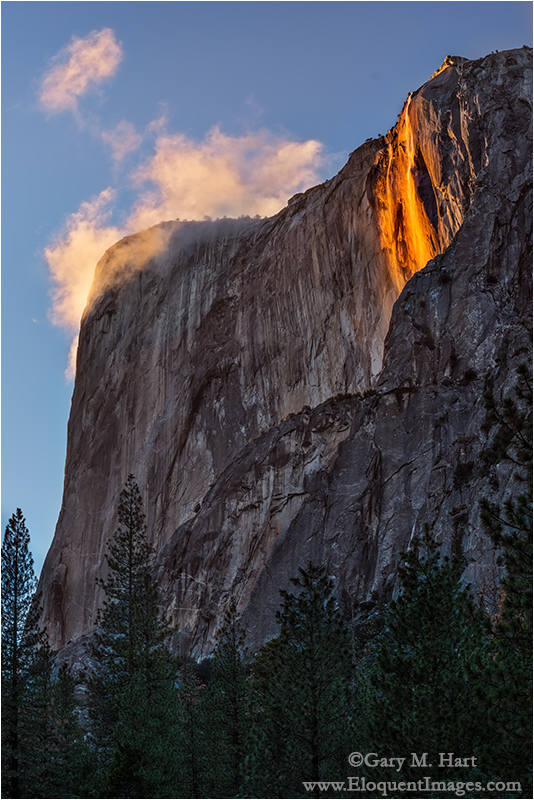
The workshop started Thursday afternoon, and because it had snowed earlier that day, I postponed the orientation until after dinner so we could go straight out and start shooting. After an hour or so photographing light-catching clouds and waterfall rainbows (Horsetail and Bridalveil Falls) from Tunnel View, we beelined to the picnic area beneath El Capitan. Despite the fact that we were far from the first photographers there, my group managed to score the last three legal spaces in the parking lot (that’s not to say others arriving after us weren’t able to employ creative parking strategies), and we found plenty of room to set up and wait with fingers crossed for the Horsetail show.
Aside from a handful of for-the-record images (to remind myself of the conditions for each year), I rarely photograph Horsetail anymore. But conditions that evening were so nice that at one point I actually had both tripods set up, one with my a7RII and 24-70 for wider images, the other with my a6000 and 70-200 for tighter compositions. Rather than the standard stand-around-and-wait-for-the-light-to-get-good experience that’s the hallmark of a Horsetail shoot, lots of water in the fall and clouds swirling on and around El Capitan made our entire 90-minute wait photographable.
While I’ve seen Horsetail get more red than what we saw, everyone was so thrilled that I was able to declare Horsetail Fall captured for 2016, freeing my group to spend the rest of the workshop’s sunsets concentrating on other things. Phew.
It wasn’t until we tried to navigate Yosemite Valley during the workshop’s final three days that I fully appreciated how fortunate we were to be done with Horsetail Fall. I’ll spare you the gory details and instead just give you the bullet points of what we witnessed Friday, Saturday, and Sunday:
- The Southside Drive parking area (with room for a dozen or so cars) closest to the most popular Horsetail View on that side of the river was full by 9 a.m. So were all the prime views of the fall at that location.
- By 3 p.m. (sunset was about 5:45) the parked cars, crammed bumper-to-bumper in Southside Drive’s coned-off left lane, stretched two miles, from just past the Cathedral Beach to Sentinel Meadow (I clocked it on my odometer).
- Many of the early arriving, legally parked cars were completely blocked by a second row of late-arriving cars whose drivers apparently decided that merely being able to fit into an area made it parking spot. The pinned first-arriving drivers would be stuck until the late-arriving drivers moved their cars.
- Many cars had simply gone off-road and parked in the forest, apparently deciding that paying towing and/or ticket charges was preferred to parking legally and walking a mile or two.
- Several times traffic in the lane that was supposed to be moving (not designated for parking) stopped long enough that drivers got out to find out what the holdup was. The only time I saw the cause, it was a driver using the driving lane to turn around and squeeze perpendicularly between two parallel-parked cars.
- On both sides of the road, every possible square inch of forest containing even a partial view of Horsetail Fall was crammed full of tripods, sometimes stacked 100 photographers deep (I didn’t actually count, but I think that’s a pretty good estimate). I heard through the grapevine that the general mood at these scrums was testy.
- I personally redirected many photographers poised to photograph the wrong waterfall—some were clustered around Bridalveil Fall, others had targeted Ribbon Fall.
- We saw man getting handcuffed and arrested by rangers. It may have been a routine DUI arrest, but I wouldn’t be surprised if it was some kind of Horsetail-view real estate violence. Interestingly, that was the only time I saw rangers all weekend—it was almost as if they’d thrown up their hands in defeat.
- After sunset, the lines at the Yosemite Lodge cafeteria stretched out the door, and we heard from others that the cafeteria actually closed for the night while there were still hundreds outside, waiting to get in.
- Gridlock exiting the park after sunset was so bad that some drivers just gave up.
While I can’t fix the crowds, I do believe the Horsetail Fall experience can be both rewarding and enjoyable. Despite the crowds, I still enjoy it after all these years, and I never cease to be awed by the beauty. Here my suggestions for anyone considering joining the fray next year:
- Avoid the weekends. Period.
- While I think the best views on Southside Drive are better than the views from (and near) the El Capitan picnic area, the dense forest near the river means far fewer good views on Southside Drive. Also, the proximity to the river means photographers will to include the river in their frame—they tend to be less than thrilled when someone encroaches on their frame. This all adds up to more tension on Southside Drive.
- Conversely, the mood at the El Capitan picnic is generally more like a tailgate party, with people mingling and barbecuing. That’s because the view of Horsetail Fall is much more open than on Southside Drive, and poor foreground options make it almost exclusively a telephoto location. In other words, everyone is point up with a telephoto lens and no one is in anyone else’s way.
- Arrive early, or be prepared to walk a mile or more.
- If I weren’t leading a group and really wanted to maximize my mobility, I’d bring a bike and just park wherever it’s convenient.
And don’t forget that you have options. If the crowds become too much for you, you could simply forget Horsetail Fall and concentrate on the other great winter scenes that are everywhere in Yosemite.
Avoid the mayhem in my
2017 Yosemite Horsetail Fall and Winter Moon photo workshop
Winter in Yosemite


A Horsetail of a different color
Posted on February 22, 2016
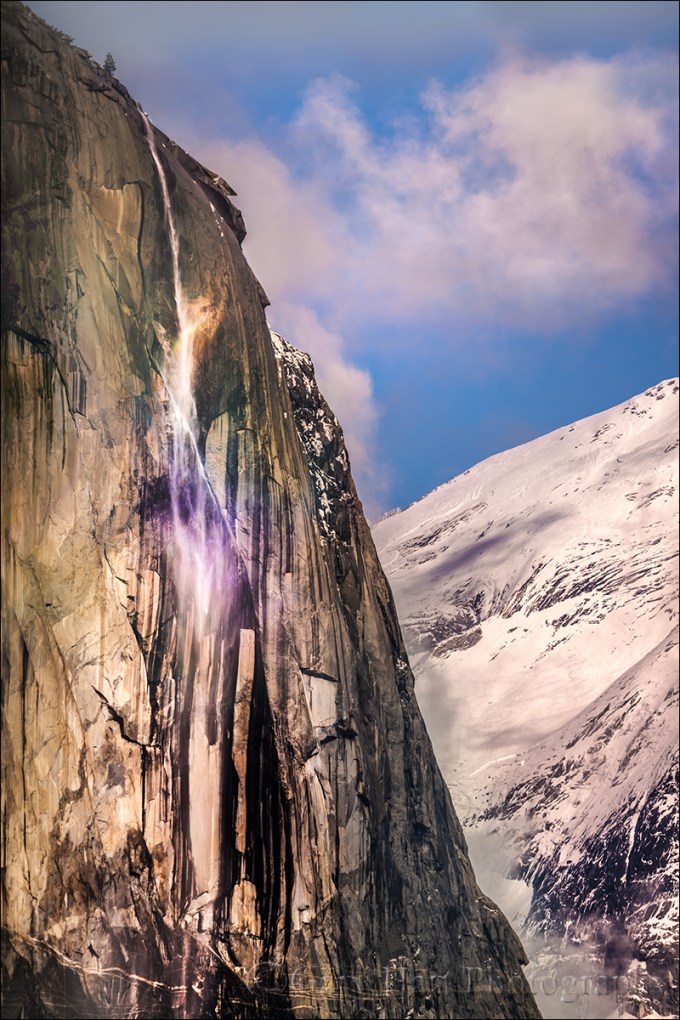
Horsetail Fall Rainbow, El Capitan, Yosemite
Sony a7R II
Tamron 150-600 (Canon-mount with Metabones IV adapter)
1/250 second
F/8
ISO 125
I just returned from my 2016 Yosemite Horsetail Fall photo workshop. I’ve the photographed the midday light shafts at Upper Antelope Canyon, Schwabacher Landing at sunrise, Mesa Arch at sunrise, winter sunset at Pfeiffer Arch, and Horsetail fall each February for over ten years. But nothing compares to the mayhem I witnessed this weekend at Horsetail Fall. Not even close. I’ll be writing more about the experience soon, but right now the only words I have are: Oh. My. God.
But anyway…
About an inch of snow fell the night before my workshop’s 1:30 p.m. Thursday start. Because the storm was clearing and the snow was melting fast, I postponed the orientation that always precedes each workshop’s first shoot and, following quick introductions, hustled the group straight out to photograph what would likely be the best conditions of the workshop.
Our first stop was Tunnel View, and it didn’t disappoint. I rarely get my camera out at Tunnel View unless I can get something truly special, and I had no plan to that afternoon. But the storm had rejuvenated Horsetail Fall enough to make it clearly visible, a rare treat from that distance, and I decided to click a couple of frames.
Extracting my a7RII, I attached my Tamron 150-600 lens and targeted the fall, clicking a few images of the fall amidst shifting clouds. When the clouds opened enough to illuminate El Capitan, I did a double-take when splashes of red, yellow, and violet appeared in Horsetail’s wind-whipped mist.
After alerting my group to the rainbow, I zoomed all the way to 600mm and snapped a few vertical images of my own. With the wind tossing the spray, each image was a little different from the one preceding it. As I clicked this frame, an ephemeral spiral of wind spread the mist, making it the most colorful of the group.
As the sun dropped behind us, the rainbow climbed the fall and finally disappeared. Soon another rainbow appeared, this one at the base of Bridalveil Fall across the valley. We stayed long enough to photograph that rainbow, then headed out for what turned out to be a very successful, more classic Horsetail sunset shoot. Our Horsetail success that night allowed us to concentrate on other Yosemite subjects the rest of the week, while thousands of Horsetail Fall aspirants jockeyed for parking and a clear view through the trees.
Stay tuned for more about the Horsetail Fall experience, which has now officially achieved ridiculous status.
Let me help you photograph Horsetail Fall next February
~ ~ ~
Or, (if you’re brave) you could do it yourself
Ten Years of Horsetail Fall Images
(Look closely at the horizontal, “Twilight Mist” image to see Horsetail’s location)


Don’t settle for the trophy shot
Posted on February 14, 2016
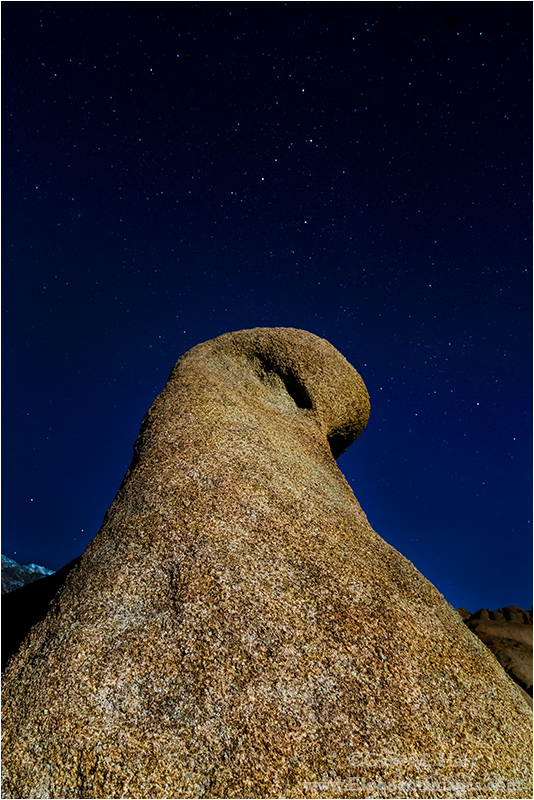
Cassiopeia Above Mobius Arch, Alabama Hills, California
Sony a7R II
Sony/Zeiss 24-70 f4
20 seconds
F/8
ISO 3200
Trophy shot: A beautifully executed capture of a frequently photographed scene.
In Monday’s post I wrote about relationships in nature. They really are everywhere, these juxtapositions of landscape, light, and sky that we photograph by virtue of our timing, position, and creative vision. In their pursuit, photographers label photo spots a “sunrise location” or “sunset location,” research the best time to photograph pretty much every popular landmark, plot the when and where of the moonrise, and…, well, you get the idea.
Unfortunately, in this age of ubiquitous cameras and limitless information, these easy relationship images have become cliché, a “trophy” to display in what seems to be a never-ending “top-this” cycle. While putting a beautiful scene with good light or a vivid sky makes a great foundation for a nice image, elevating an image above trophy status requires a serious infusion of creativity. In other words, rather than settle for an image that’s merely a flawlessly executed version of the same scene we’ve all seen hundreds of times, photographers should be seeking unique relationships between the scene’s varied elements, relationships that look deeper than the conventional treatment.
For example
(Like many other photographers) I’ve photographed California’s Alabama Hills a lot. Here stacked, weathered granite boulders provide a dramatic foreground for Mt. Whitney and the precipitous eastern escarpment of the Sierra Nevada range.
Despite an almost infinite variety of potential foreground subjects, the Alabama Hills trophy shot is Mobius Arch (aka, Whitney Arch), which makes a striking frame for Mt. Whitney. Some version of this composition has been a prime goal for many photographers, but like most easy captures these days, there’s rarely anything special about Mobius Arch images.
As with any location, it helps to start with a nice sky and good light. The natural relationships I try to add to the Alabama Hills’ beauty include sunrise alpenglow on Mt. Whitney, warm light on the granite boulders, and the moon’s disappearance behind the serrated, snow-capped peaks. But as beautiful as these phenomena are, they’re still not enough to set one Mobius Arch image apart from the other.

Moonset, Mt. Whitney and Mobius Arch, Alabama Hills, California
As a workshop leader I have to take my groups to the arch because if they’ve never been here before, it’s probably what they came to see. But my job doesn’t end there—it’s also incumbent on me to help my students find alternate compositions that use the arch in a unique way, or don’t use the arch at all.
I encourage Alabama Hills first-timers to seek relationships that combine the foreground rocks, distant peaks, and whatever is happening in the sky in ways they haven’t seen before. It can take a while, but the longer they work on a scene, the more the hidden relationships start to appear. Eventually most tire of the arch and start wandering off to explore the countless other opportunities nearby.
About this image
Arch or not, a particular Alabama Hills favorite of mine is moonlight, especially in winter, when the snowy crest glows with reflected moonlight. Last month, after three wonderfully cloudy days in Death Valley, my Death Valley workshop group traveled to Lone Pine to wrap up the workshop with a sunset and sunrise in the Alabama Hills. Since our Death Valley moonlight shoot had been preempted, after dinner in Lone Pine I took everyone up to the Mobius Arch area to give moonlight one more try.
The sky that night cooperated wonderfully. I started by bouncing between photographers making sure they’d mastered the exposure and focus challenges of moonlight photography. It wasn’t long before everyone was up to speed (it’s not hard) and scattering in search of their own moonlight boulder, mountain, and sky relationships.
Leading a group doesn’t allow me to do creative photography and natural relationship hunting, but that night I did find a couple of minutes to photograph some favorite compositions in the moonlight. It’s amazing how easily the eyes adjust to moonlight, and soon found myself composing as if we were shooting in daylight. It was also quite cold on this January night, but it’s amazing how easily the cold is ignored when the photography’s good.
When the cold started to trump the photography, I walked out to the arch to round up the people who had ended up there. As I said, I don’t get to hunt for the creative relationships when I’m with a group, but as I was exiting the arch I glanced skyward and saw Cassiopeia hanging in the northern sky. What stopped me was the way the arch’s angled profile seemed to lead directly to the constellation. Since I’ve always found this side of the arch interesting without ever finding something to put with it, I quickly extended my tripod and attached my camera and 24-70 lens.
Lowering the camera to about three feet above the ground emphasized the steep slope and compressed a large chunk of mostly empty sky separating Cassiopeia and the arch’s top. In most of my moonlight compositions, even wide open the focus point for the entire scene is infinity, so I simply autofocus on the moon. But with the arch’s textured granite starting just a couple of feet from my lens, I knew I needed to be careful with my depth of field and focus point.
To increase my depth of field I stopped down to f8, compensating for the lost light by cranking my ISO to 3200 (love the high ISO of the a7RII). I tried a couple frames using nothing but moonlight to manually focus, but after magnifying the images in my LCD, it was clear that I’d need focus help. I asked one of the guys in my group to shine his flashlight about a third of the way up the arch, focused, and clicked. After a quick check of the LCD confirmed that I’d nailed the focus, I packed up my gear and headed back to the cars. This was my only sharp frame.
Photo workshop schedule
The View from the Alabama Hills
Click an image for a closer look, and a slide show. Refresh the screen to reorder the display.


Improve your relationships
Posted on February 8, 2016
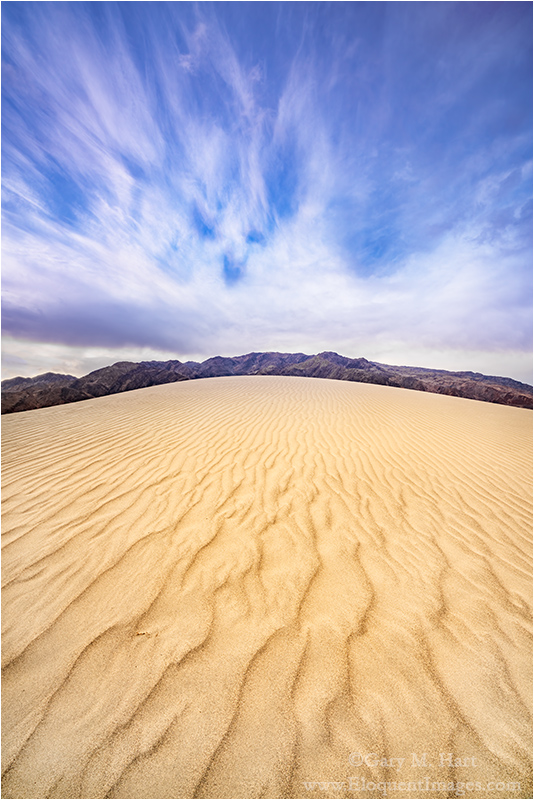
Sand and Sky, Mesquite Flat Dunes, Death Valley
Sony a7R II
Sony/Zeiss 16-35 f4
.4 seconds
F/16
ISO 100
Following a nice sunrise on the dunes, my workshop group had started the undulating trek back to the cars. While we hadn’t gotten a lot of color that morning, we’d been blessed with virgin sand beneath a translucent layer of clouds. Quite content with the soft, low contrast light for most of the morning, right toward the end the sun snuck through to deliver high contrast, light-skimming drama that provided about five minutes of completely different photo opportunities. But the sun had left and it was time to go.
Camera gear secured and backpack hefted onto my shoulders, I pivoted with my mind already on our next stop. But my plan to beeline back to the cars was interrupted when I turned and saw that fingers of cirrus clouds had snuck up behind us. It wasn’t just the clouds, it was the way their shape was mirrored by the pristine, ribbed sand that started at my feet and climbed the dune in front of me.
I quickly dropped my bag and pulled out my a7RII and 16-35. Despite my rush, before extending my tripod, I paused to study the scene. As nice as it was, I realized there were a couple of things I could do to improve it. First I circled the dune until the clouds and ripples were more closely aligned. A good start, but at eye level, the barren slope of Tucki Mountain was too prominent in the frame. I found that by dropping my tripod to about a foot above the sand, I could perfectly frame the dune with the mountain.
I composed my frame at 16mm, as wide as my lens would go, to emphasize the nearby sand, make the dune appear much larger than it really was, and give the clouds enough room to spread. To ensure sufficient depth of field, I stopped down to f16 and manually focused about two feet into the frame. While I thought a vertical orientation would be the best way to move my viewers’ eyes from front to back and to emphasize the linear nature of the parallel clouds and sand, before packing up I captured a couple of horizontal frames too.
I think the lesson here is how easy it is to miss opportunities to control the foreground/background relationships in our scenes. With my group already on its way back to the cars, I was in a hurry and could have very easily snapped off a couple of frames from where I stood when I saw the scene. Instead, I took just a little more time to align my visual elements. Despite my delay, I made it back to the cars with the rest of the group (no chance of anyone getting lost, since the cars were visible from the dunes)—I was a little more out of breath than I otherwise would have been, but that was a sacrifice I was happy to make.
Often the difference between an image that’s merely a well executed rendering of a beautiful scene, and an image that stands out for the (often missed) aspects of the natural world it reveals, are the relationships that connect the scene’s disparate elements.
In this case I only had to move a few feet to align the ridges in the sand with the clouds. But more than an alignment of sand and sky, dropping to the ground enabled me to reduce a less appealing middle-ground and replace it with much more interesting foreground and background. If I’d have dropped even lower, I could have hidden the mountain entirely, but I liked the way its outline mimicked the dune’s outline, and decided to leave in just enough mountain to frame the dune.
The next time you work on a composition, ask yourself what will change if you were to reposition yourself. And don’t forget all the different ways that can happen—not just by moving left or right and between horizontal and vertical, but also by moving up and down, and forward and backward. Not to mention all the possible combinations of those shifts.
Photo workshop schedule
A gallery of relationships in nature
(Images with a not-so-accidental positioning of elements)


Let’s get vertical
Posted on February 2, 2016
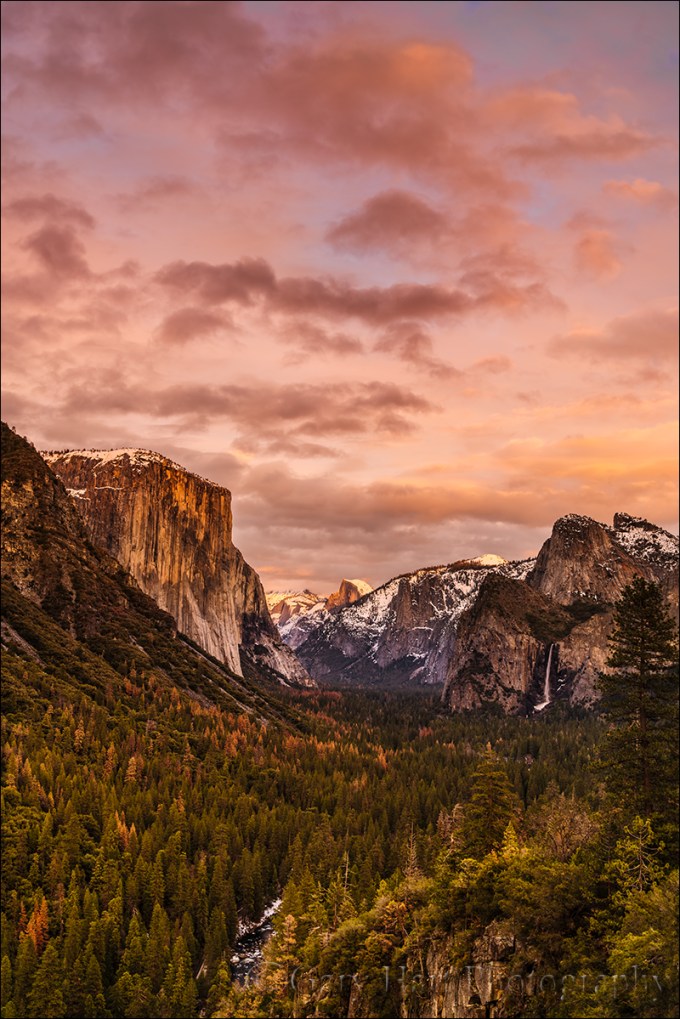
Yosemite Sky, Tunnel View, Yosemite
Sony a7R II
Sony/Zeiss 24-70 f4
.8 seconds
F/8
ISO 100
Who had the bright idea to label horizontal images “landscape,” and vertical images “portrait”? To that person let me just say, “Huh?” As a landscape-only photographer, about half of my images use “portrait” orientation. I wonder if this arbitrary naming bias subconsciously encourages photographers to default to a horizontal orientation for their landscape images, even when a vertical orientation might be best.
Every image contains implicit visual motion that’s independent of the eyes’ movement between the image’s elements. Following the frame’s long side, this flow provides photographers a tool not only for guiding viewers’ eyes, but also for conveying a mood.
For example, orienting a waterfall image vertically complements the water’s motion, instilling a feeling of calm. Conversely, a waterfall image that’s oriented horizontally often contains more visual tension. While there’s no absolute best way to orient a waterfall (or any other scene), you need to understand that there is a choice, and that choice matters.
By moving the eye from front to back, vertical images often enhance the illusion of depth so important in a two-dimensional photo. I find that a foreground element that adds depth to whatever striking background has caught my attention is often lost in a horizontal image.
More than just guiding the eye through the frame, vertical orientation narrows the frame, enabling us to eliminate distractions or less compelling objects left and right of the prime subject(s). Vertical is also my preferred orientation when I want to emphasize a sky full of stars, or dramatic clouds and color.
Want to emphasize a beautiful sky? Go with a vertical image, putting the horizon near the bottom of the frame. When the sky is dull and all the visual action is in the landscape, put the horizon at the top of your frame. When the landscape and sky are equally compelling, go ahead and split the frame across the middle (regardless of what the “experts” at the photo club might say).
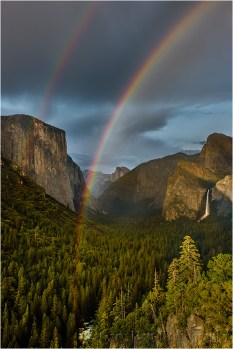
Double Rainbow, Yosemite Valley
While a horizontally oriented scene is often the best way to convey the sweeping majesty of a broad landscape, I particularly enjoy guiding and focusing the eye with vertical compositions of traditionally horizontal scenes. Tunnel View in Yosemite, where I think photographers tend to compose too wide, is a great example. The scene left of El Capitan and right of Cathedral Rocks can’t compete with the El Capitan, Half Dome, Bridalveil Fall triumvirate, yet the world is full of Tunnel View images that shrink this trio to include (relatively) nondescript granite.
When the foreground and sky aren’t particularly interesting, I tend to shoot fairly tight horizontal compositions at Tunnel View. But when a spectacular Yosemite sky, snow-laden trees, or cloud-filled valley demand inclusion, vertical is my go-to orientation because it frees me to celebrate the drama without diluting it.
About this image

Yosemite Sky, Tunnel View, Yosemite
I captured this image last week, at the end of a one-day private tour. Leaving home at 6 a.m., my plan was to enjoy Yosemite Valley and save my photography for the next two days, when I’d be by myself and a storm was forecast. Indeed, my students and I spent the day beneath a layer of gray clouds that, while great for photography, were decidedly unspectacular. With occasional sprinkles to remind us of the looming storm, I was just happy that the serious rain held off until we finished, and that the ceiling never dropped far enough to obscure Yosemite’s icons.
Since my students had left their car at our Tunnel View meeting place, my plan was to wrap up with a “sunset” there. Of course, given the thickening clouds, we had no illusion that we’d be photographing an actual sunset, and were in no hurry to get there.
So imagine my surprise when, while photographing Bridalveil Fall from the turnout on Northside Drive, I saw hints of warmth on Leaning Tower—not direct sunlight, but indirect light that indicated there was sunlight somewhere nearby. I turned and peered through the trees behind me, and saw small patch of direct sunlight on El Capitan. “We need to go!” I barked this so suddenly that I’m surprised I didn’t frighten them. To their credit, we were packed, loaded, and back on the road in 30 seconds, and at Tunnel View in less than ten minutes.
For the next 30 minutes we enjoyed a lesson in Yosemite weather, one more chapter in my as yet unwritten book, “You Can’t Predict What Yosemite Will Be Like in Five Minutes Based On What It’s Like Right Now.” The sunlight started on El Capitan, pouring through an unseen hole in the clouds somewhere down the Merced River Canyon behind us. Once El Capitan was fully illuminated, the light went to work on Half Dome. Soon a formation of broken clouds moved into view overhead, then continued sliding above Yosemite Valley until the entire scene was more sky than cloud.
This image was captured toward the end of the show, after the clouds had moved well into the scene and just before the fading vestiges of warm light left El Capitan and Half Dome. It’s a real treat when the sky at Tunnel View can compete with the scene below, but in this case the sky deserved all the attention I gave it.
Tip of the day
I can think of no single piece of equipment that will make vertical compositions easier than a Really Right Stuff L-plate (there are less expensive options, but I agree with the consensus that Really Right Stuff plates the best). An L-plate is, as its name implies, and L-shaped piece of metal that attaches to your camera’s tripod mount, replacing the standard quick-release plate. Unlike a flat quick-release plate, an L-plate wraps around one side of the body.
Each side fits the standard Arca-Swiss quick-release mount: for a horizontal image, the camera is mounted to the tripod head by part of the plate attached to the camera’s underside; for a vertical composition, you release the camera, rotate it 90 degrees, and attached the part of the plate that wraps the camera’s side. This detach/rotate/reattach can be done in about one second, even in complete darkness.
In addition to speed and convenience, and L-plate ensures maximum stability by keeping your center of gravity directly above the intersection of the tripod’s legs. It also keeps your eye-piece in nearly the same position regardless of the orientation, eliminating the need for you to dip your head or raise your center-post each time you go vertical.
Due to each camera’s unique dimensions, configuration of memory card and battery bays, and electronics ports, L-plates are camera-specific. That means when you get new camera, you’ll likely be getting a new L-plate—a small price to pay for the benefit you’ll get.
Workshop schedule
A vertical gallery
Click an image for a closer look, and a slide show. Refresh the screen to reorder the display.


Finding a new sandbox
Posted on January 28, 2016

Flaming Dunes, Mesquite Flat Dunes, Death Valley
Sony a7R II
Sony/Zeiss 16-35 f4
.4 seconds
F/11
ISO 100
One of my photographic goals is to create images that allow viewers to imagine our world untouched by human hands. That goal sometimes conflicts with the expectations of my photo workshop students, who want to visit the iconic locations they’ve traveled so far to photograph. For the most part I’ve learned to balance those conflicting goals by mixing the popular views with hidden perspectives I’ve found over the years, but in some spots that’s easier said than done.
Few location make it more difficult to escape the crowds than the Mesquite Flat Dunes in Death Valley. The problem with Death Valley’s sand dunes is not just all the people, but that each step, by each person, is etched in the sand for days or weeks. And every year I have to look a little harder to find the pristine sand.
When I first started leading workshops out here (nearly ten years ago), I simply led my groups out onto the large dunes that everyone wants to photograph. I’d found a roadside parking spot, a little up the road from the dunes’ parking area, that shortened the hike and reduced the effort by traveling parallel to the dunes rather than sending us up and over each dune. After fifteen or so minutes of traipsing through sand, we’d usually find a spot that, while not completely untouched by footprints, was at least clean enough that careful composition could isolate enough virgin sand to please everyone.
But other photographers had similar ideas, so few years ago I admitted defeat and decided that it was better to photograph clean sand on the lower dunes than abused sand on the high dunes. After a little scouting I found another spot that, without too much effort, landed us in clean, untouched sand. The dunes here were not as dramatic as the high dunes, but everyone (including Yours Truly) was much happier to have clean sand to play with.
But this year I found a few footprints at this alternate location, and while it wasn’t enough to ruin our sunrise dune shoot, I could read the writing on the sand. Rather than wait for the crowds to catch up, for this year’s dune sunset shoot (the dunes are just too photogenic to do only once), I marched the group out to a completely new dune location, about as far off the beaten path as I felt they could handle. Though this trek took us nearly a mile from the road, our effort was rewarded with flawless sand as far as the eye could see.
To this point in the workshop we’d been blessed with nice clouds, but not enough direct sunlight for good sunrise/sunset color. On this day the forecast called for a return to more standard Death Valley blue skies, and sure enough, that’s the way it started. With the sunlight I was hoping to mix in a few clouds so we could finally get our color, but that afternoon a gray stratus layer rolled in and it looked like we were in for another bland.
Nevertheless, the group was enjoying the soft light on our pristine dunes when we noticed a shaft of sunlight illuminating a distant peak far north of our location. Over the next fifteen minutes or so this late afternoon light expanded south, along the Grapevine Mountains in the east; with it came gaps of blue sky that passed enough warm sunlight to fringe the clouds remaining overhead.
I’d been isolating the dunes and mountains with a telephoto, but when it became clear that we were about to bathed in 360 degrees of colorful sky, I quickly switched to my 16-35 and encouraged everyone else to do the same. The color soon followed, starting gold and slowly transitioning to pink. People were exclaiming and pointing at color and light in all directions so quickly that spinning to keep up almost made me dizzy.
Right before this shot I was photographing color in the east that was so spectacular that I turned to admonish those pointing in any other direction, only to realize that the scene in the west was at least as spectacular as what I’d been shooting. I whipped my tripod around and pointed my camera westward, toward a throbbing wheel of coral cloud, its pink spokes radiating outward to color the white sand.
At these moments I have to consciously force myself to avoid mindless panic shooting. Rather than capture every second of the rapidly changing color, I slowed down enough to ensure everything was right. The depth of field at 16mm depth of field was pretty extreme, so I felt pretty comfortable at f11, and chose a focus point just a few feet in front of me. And while I was pretty confident that my Sony a7RII could handle the dynamic range, I hedged my bets by subduing the brilliant sky with a Singh-Ray 2-stop hard-transition graduated neutral density filter.
It seems like every workshop has at least one memorable shoot, a convergence of landscape and light that unites the group in shared euphoria, and this evening on the dunes was certainly that for this workshop. But honestly, this is a shoot that will stand out in my mind for a long, long time, and I think the others felt the same way. We’d planned to do a moonlight shoot after dinner that night, but it seemed that everyone wanted a little more time to bask in the afterglow of what we’d just witnessed. So, citing our two-mile roundtrip hike and the prospect of fewer clouds the next day, I postponed that plan—I got no complaints.
My 2017 Death Valley workshop is full, but there’s a waiting list…
My complete workshop schedule
A Death Valley Gallery
Click an image for a closer look, and a slide show. Refresh the screen to reorder the display.


 Eloquent Images by Gary Hart