Eloquent Images by Gary Hart
Insight, information, and inspiration for the inquisitive nature photographer
The Motion of the Ocean
Posted on November 24, 2019
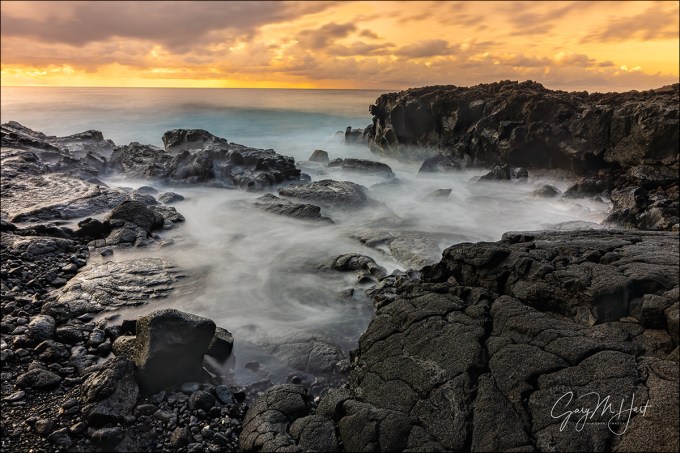
Golden Sunrise, Puna Coast, Hawaii Big Island
Sony a7RIV
Sony 16-35 f/2.8 GM
13 seconds
F/16
ISO 100
Silky water images take a lot of flak for being overused and unnatural. Sure, long exposures that blur a rushing creek into a white stripe, or smooth crashing surf into to a gauzy haze, can be trite (no judgement—these effects can also be beautiful). But the argument that motion blur in a water image is always invalid because it’s not “natural” just doesn’t hold wat…, uhhh…, up to scrutiny.
Think about it—there really are only two ways to capture moving water in a still photo: you can freeze water in place, or blur it. And a water droplet suspended in midair is no more representative of the human experience of that scene than silky water. That’s because the world unfolds to us like a seamless movie of continuous instants, while a camera accumulates light throughout its exposure to conflate those instants into a single frame.
Your options for expressing motion in a still frame aren’t binary—either frozen or blurred—they’re a continuum of choices ranging from discrete airborne droplets to blur completely devoid of detail. The key to capturing flowing water in a still photograph is conveying a sense of motion—how you do it is your creative choice (and blurring water simply because you can, and it looks “cool,” maybe isn’t the best approach).
Not only does your choice for handling water’s motion determine the effect’s visual appeal, it also affects the image’s mood. I find stopped water action in an image to be more stimulating, and blurred water more soothing.
And all motion blurs aren’t alike. There’s a big difference between slight blur that expresses a wave’s movement while retaining its overall size and shape, and extreme blur that purees every detail into a homogenized soup. Whether your goal is to freeze in midair the airborne droplets of a waterfall, smooth wind-whipped chop in a mountain lake, or reveal flow patterns in waves washing over a rocky shore, the key to controlling your point on the water motion continuum is understanding the reciprocal relationship between ISO, f-stop, and shutter speed.
I usually start with a general idea of the amount of blur I want, and try to determine the shutter speed that will get me there. Unfortunately, there is no one-to-one relationship between shutter speed and blur because shutter speed isn’t the only variable. You also need to consider the speed of the water, its distance, your focal length, and whether it’s moving toward/away from you, or across your frame. So I start by guessing the shutter speed (the more you do it, the better you’ll get), then figuring out the ISO/f-stop combination that gets me there. And if I can’t do it with ISO and f-stop, I reach for my neutral density filter.
After my first click I evaluate my blur effect on my in my mirrorless view finder or on my LCD screen and adjust accordingly. I usually take a range of frames at a variety of shutter speeds to have more options later, when I’m viewing my images on my big screen. This is especially true with crashing surf—often I’ll take multiple frames at the same shutter speed because there’s so much variation from wave to wave.
Golden Sunrise, Puna Coast, Hawaii Big Island (September, 2019)
My flight to Hawaii departed on a Friday, and my new Sony a7RIV was scheduled to arrive Monday. But the arrival of a new camera is to a photographer what Christmas morning is to a 5-year-old (do you know any 5-year-olds who would delay Christmas by a week?)—so I had Sony ship the camera to my hotel in Hawaii. So far so good—until Hawaiian Airlines lost my suitcase. In addition to having no change of clothes or toiletry items, I was suddenly without a tripod. The clothing and toiletry essentials were handled with a trip to the Hilo Target, but a camera with no tripod? In my world that’s not much different than that 5-year-old unwrapping the remote-control helicopter he asked for and learning Santa didn’t think to include batteries. Fortunately, after lots of hand wringing and panicked pleas for help, the good folks at Breakthrough Filters overnighted one of their new carbon fiber tripods and I was whole again (Hawaiian got the bill for the $178 FedEx overnight charge as well).
Or so I thought. But using a tripod requires a way to mount the camera to the tripod, and my tripods require a camera-specific mount plate (for the photographers in the audience, that would be an Arca-Swiss-compatible L-Plate from Really Right Stuff). But the a7RIV was so new, RRS didn’t have its L-plate ready. Damn. Just about the time my internal 5-year-old was about to melt down in line at the grocery store, I figured that with a little creative engineering, my Sony a7RIII L-plate could (kind of) attach to my a7RIV—not an ideal arrangement, but enough to get by. I was in business.
A couple of days into the workshop I took the group out to one of my favorite Puna Coast spots for sunrise. As you can see from this picture, the Puna beaches aren’t great for swimming, but its rugged volcanic rock and black sand, along with very violent surf, make the photography here off the charts. I’ve photographed the California Coast from Big Sur to Mendocino, and the Oregon Coast from Bandon to Cannon Beach, but I like the Puna Coast south of Hilo just as much.
Every rock down here is lava. And being just down the mountain from Kilauea (one of the most active volcanoes in the world), all of the Puna lava is relatively new. In fact, the age of most of the Puna rock is measured in decades—during this workshop we did a Milky Way shoot on lava flows that were just one year old.
You’ll primarily find only two kinds of lava on Hawaii: aa and pahoehoe. Both are actually basalt, so the difference between aa and pahoehoe isn’t their composition, it the way the lava flows and cools. Rapidly flowing aa hardens into a jagged jumble, while slower flowing pahoehoe is a smoother, and often ropy, rock. (Pro Tip: I could never remember which lava type was which until I realized that “ah! ah!” is what I’d say if I were to walk barefoot on aa.) In this image, you can see both aa and pahoehoe: pahoehoe in the foreground and on the left (you can even see a little ropiness), and aa in the background on the right.
At any ocean scene, if you stand and watch the surf and rock interaction long enough, you become aware of patterns in the water’s flow. This scene in particular had some wonderful wave action that I very much wanted to convey. When we arrived it was so dark that motion blur impossible to avoid, but that changed as the sun approached the horizon (it always surprises me how quickly the light comes up at the lower latitudes).
By sunrise I’d become pretty familiar with the scene and knew I wanted to start my exposure as a wave large enough to sweep through the foreground was about to break, and that a shutter speed between 10 and 15 seconds would capture all of a single wave’s motion.
With the sun up, achieving a 10-15 second shutter speed is only possible with a neutral density filter. But there was a distracting sheen on the rocks that I wanted to minimize with a polarizer. In these situations in the past, I had to decide between an ND filter or a polarizer, or live with significant vignetting by stacking the two (or by using a Singh-Ray Vari-N-Duo filter). But my Breakthrough 6-stop Dark CPL works as a polarizer, but it also cuts 6 stops of light. And because it’s no thicker than a standard polarizer, it does this without vignetting. (As you can see, I didn’t get rid of all the sheen on the rocks, but I was definitely able to reduce it to a manageable level.)
Since I’m not a big fan of Sony’s wired remote (an understatement), since switching to Sony I’ve almost exclusively used the 2-second timer, making timing waves kind of a pain. But my new Sony Bluetooth Wireless Remote Commander made timing the waves a piece of cake. Though I shot a number of frames with this composition, the action of the water made each frame different. I chose this image because it was the best combination of sunrise light and wave motion.
Epilogue
After a couple of days on the lamb, my suitcase eventually turned up—but it waited until after I’d purchased an entirely new Hawaii wardrobe, plus all the other essentials. Since I always pack my suitcase to within a couple of ounces of the maximum weight allowed anyway, all this extra stuff, not to mention the addition of a new camera and tripod, created a bit of a weight problem. I was able to get back under airline’s weight limit by filling a USPS large flat-rate box with all of my heaviest (non-camera) stuff and mailing it home. And to Hawaiian Airline’s credit, they reimbursed every penny of my extra expenses without blinking.
Read more about photographing motion

Fern Cascade, Russian Gulch Fall, Mendocino
Workshop Schedule || Purchase Prints
World in Motion
Click an image for a closer look and slide show. Refresh the window to reorder the display.


You Can’t Always Get What You Want…
Posted on November 17, 2019

Autumn Accent, Half Dome, Yosemite
Sony a7RIV
Sony 24-105 G
1 second
F/16
ISO 100
(Offered with apologies to the Rolling Stones)
I looked that night at the reflection
My focus app in my hand
I pondered my focus selection
About six feet from where I stand
You can’t always get what you want
You can’t always get what you want
You can’t always get what you want
But if you try sometimes, you just might find
You get what you need
What we wanted was clouds; what we got was, well, the opposite of clouds.
Photographers love clouds for the soft light they spread across the landscape, and their potential to add color and drama to the sky. And if you’ve been following my recent blogs, you no doubt know about the wall-to-wall blue skies in last month’s Yosemite Fall Color workshop. But as much as we love them, perfect light and spectacular skies can make photographers lazy. On the other hand, dealing with conditions that are less than ideal can create opportunities that otherwise would have been missed.
Throughout last month’s workshop I strongly encouraged everyone to minimize or eliminate the sky and instead emphasize the reflection (rather than the reflected subject). This approach is especially effective on sunny days because the best reflections usually happen with the subject is fully lit, the brighter the better.
Besides a sunlit subject, the other half of the reflection equation is a shaded reflective surface. Long removed from the fury of the spring snow melt, but not yet bolstered by the winter storm reinforcements, the Merced River’s low and slow autumn flow means reflections at most riverside vantage points. And while Yosemite’s towering granite walls create nice shade in any season if you know where to look, the low sun of autumn and winter spreads the shade farther and longer—by late autumn, some sections of the Merced get little or no sun all day.
Since this was the first Yosemite visit for many in the group, at each photo location I’d suggest starting with the more conventional mirror reflection composition (the primary subject above its inverted counterpart), but then move on to compositions that concentrate on the reflection itself.
One important aspect of reflection-only compositions is (upright) foreground elements to orient the viewer—a solid object between the reflection and the reflective subject to signal that the world is in fact not upside down. Sometimes a small section of the opposite shore works (taking care to avoid direct sunlight that can pull the eye away from the reflection), but I especially like adding foreground elements that mingle with the reflection.
A side benefit of a reflection-only approach is exposure management, because photographing a fully lit primary subject above its shaded reflection creates dynamic range challenges. Even if you can capture the scene’s entire range of light, the sunlit subject and blue sky are often washed out, while the reflection and its surroundings remain relatively dark. Since the human eye is drawn to a scene’s brightest elements, the shaded reflection is easily overshadowed (pun unavoidable). Not only does eliminating the sunlit portion of the scene simplify exposure, it makes the reflection the brightest part of the frame.
I found this little scene beside the Merced River on the workshop’s final shoot. Arriving just as the face of Half Dome started to warm with late light, I scanned the riverbank until I found a pool lined with yellow cottonwood leaves jettisoned by trees just upstream. I started with my Sony 100-400 GM lens on my Sony a7RIV, targeting a tight composition that featured a pair of leaves (faintly visible here floating atop the dark trees reflected near the base of Half Dome) embedded in Half Dome’s face. But I wanted to include more of the colorful leaves and soon switched to my Sony 24-105 f/4 G lens.
This might be a good time to mention the significant difference an even slight position shift can make in a reflection image. From my original vantage point, Half Dome’s reflection was surrounded by a large void of bland, empty water. That was no problem in a tight composition, but from my original upright position, going wide enough to include all the leaves shrunk Half Dome and added a lot of extraneous scene. So I moved back slightly and dropped my camera to near river level, moving the yellow leaves closer to Half Dome, framing the reflection with color and eliminating most of the empty water.
Another essential and often overlooked consideration when photographing reflections is the counterintuitive truth that the focus point for a reflection is the reflective subject, not the reflective surface. That means that in this scene, even though its reflection was bobbing on water no more than ten feet away, because Half Dome was about three miles distant, the reflection’s focus point is infinity (the same as Half Dome). When you stop to consider that I’m also including leaves that are no more than five feet away, it becomes pretty clear that I have depth of field to consider.
My focal length here was around 35mm, and while I wanted Half Dome’s reflection sharp, the leaves had to be sharp. A quick check of my hyperfocal app told me the hyperfocal distance at 35mm and f/16 (the smallest aperture I use unless I have no choice) was around 8 feet (on my full frame Sony body). In extreme depth of field scenes, not only do I want to bias my sharpness to the closer object(s), when the more distant object is a reflection, a little softness is usually tolerable. Given all this, and since most hyperfocal tables are based on a fairly liberal definition of “acceptable sharpness,” to ensure foreground sharpness I focused about six feet into the frame. And as you can see, Half Dome turned out pretty darn sharp too.
Everyone wants spectacular conditions, and while this group may not have gotten what it wanted, after seeing the results of the workshop (both my own and the group’s), it appears that we got just we need.
2020 Yosemite Fall Color Photo Workshop
A Lot of Reflections
Click an image for a closer look and to view a slide show.


The Milky Way Saves the Day
Posted on November 10, 2019

Yosemite Night, Half Dome and Milky Way from Olmsted Point
Sony a7SII
Sony 24mm f/1.4 GM
20 seconds
F/1.6
ISO 3200
I’m a one-click photographer (no composites or blending), so all of my Milky Way images were captured in a single frame.
I stress a lot before and during a photo workshop. A lot more than people know, and a lot more than I probably should. Some of that stress probably helps me ensure things go smoothly, but some things are just plain irrational because people know I don’t have any control over things like the weather, dogwood bloom, the northern lights, to name just a few of Nature’s fickle whims. But I stress nevertheless.
For example, I schedule my Yosemite Fall Color photo workshop for the best chance to catch peak color. But when you schedule an autumn trip, there’s no guarantee of nailing the color’s peak (I also learned that there’s no guarantee that your hotel will have power, but that’s another story). My ace-in-the-hole for dealing with Yosemite unknowns like this is that even on a “bad” day, it’s still Yosemite. I also remind myself that Yosemite is blessed with a wide variety of deciduous trees to stretch the fall color season, and the low and slow Merced River means ubiquitous mirror reflections. But still, I stress.
I’ve found that the key to minimizing my stress is having options to fall back on when Plan A doesn’t materialize, something that will make the workshop memorable even when things aren’t exactly what we’d hoped for. Which is why, when possible, I try to schedule my workshops around astrophotography options. That way, when I don’t get clouds (which are always preferred over blank blue skies), the conditions are good for astrophotography. But I can’t schedule my fall workshops around the night sky because peak color trumps everything—I just have to take the moon and Milky Way in whatever state I find it. More stress.
This year’s Yosemite autumn workshop got the color and reflections I’d hoped for, but not one cloud in four days. Not only that, a power outage meant no lights, heat, hot water, or WiFi in our hotel for the first two days. The group knew the power outage wasn’t my fault, but that’s not really my idea of how to make a workshop memorable. So I started to look for options.
While I hadn’t planned this workshop around astrophotography, when it started to become clear that no clouds were in our future, I started looking for night sky options. And as luck would have it and through no planning on my part, this workshop straddled the new moon, which meant a possible crescent at sunrise or sunset. Unfortunately, neither the sunrise or sunset crescent aligns with any of Yosemite’s nice views in autumn. Of course another nice thing about a new moon is dark skies, ideal for night and (especially) Milky Way photography. Hmmm….
But trying to photograph the Milky Way posed another problem. In autumn, the Milky Way’s brilliant core glows above the southwest horizon after sunset, then disappears for the night before midnight. And unfortunately, nearly all of Yosemite’s best views face east. The one exception is Olmsted Point, a southwest-facing view of Half Dome on the Tioga road near Tenaya Lake and Tuolumne Meadows. (This was no great discovery—people have been photographing the Milky Way from Olmsted Point for awhile.) Though I’d never done it, the Milky Way from Olmsted Point has been on my to-do list for a long time, but I’ve always resisted taking a group up there because it’s about a 2 1/2 hour roundtrip from our hotel. And at 8000 feet, at the end of October, Olmsted Point is quite chilly after dark.
When I pitched the Milky Way idea to the group, everyone was all for it (the option was to return to a hotel without lights, heat, hot water, or WiFi). Before leaving I gave the group some Milky Way photography training, made sure they had equipment that would work (sturdy tripod, fast and wide lens), and (especially) reminded them to bring their warmest clothing (including a hat and gloves). As a bonus, to break up the drive we made a 30-minute stop at Siesta Lake for some nice color and reflections. Even with that stop, we made it up to Olmsted Point about an hour before sunset.
Olmsted Point is a granite dome with great views of Half Dome’s face from the opposite side viewed from Yosemite Valley. In addition to having some of my favorite foreground options for Half Dome, it’s a great spot to get up close and personal with evidence of Yosemite’s glacial past. Most obvious are the glacial erratics, large (some car-size and larger) boulders carried by glaciers and deposited in place as the glaciers retreated. But you don’t have to look hard to spot other signs of glaciation, like glacial polish (granite with glassy smooth and reflective finish), and glacial striations (grooves scoured in the granite by rocks embedded in the moving ice sheets).
For the sunset shoot we made the five minute walk out to the point itself, but I brought everyone back to the vista at the parking lot for the Milky Way shoot because I didn’t want anyone to get hurt scrambling down in the dark. After dark the temperatures dropped and the wind picked up, so some of the group opted for the warmth of the cars, but the rest of us set up our tripods and cameras, picked our compositions, and focused before it got too dark. Then we waited.
The only restaurant option closed at 9 p.m., which gave us only about 45 minutes of quality Milky Way time before we had to head back down the mountain to avoid missing dinner, but that turned out to be just about right—everyone who stayed out to shoot got nice stuff, and no one froze. I hadn’t been sure that adding this unplanned Milky Way shoot was the right thing to do, but on the drive back I breathed a private sign of relief because the trip had gone even better than I’d hoped. My stress lifted completely when we pulled into the hotel parking lot to find the lights on.
To help you understand and photograph the Milky Way, here’s the Milky Way article from my Photo Tips section
Photograph the Milky Way

Bristlecone Night, Milky Way from the White Mountains, California
Look heavenward on a moonless summer night (in the Northern Hemisphere) far from city light. The first thing to strike you is the shear volume of stars, but as your eyes adjust, your gaze is drawn to a luminous band spanning the sky. Ranging from magnificently brilliant to faintly visible, this is the Milky Way, home to our sun and nearly a half trillion other stars of varying age, size, and temperature.
Size and shape
Though every star you’ve ever seen is part of our Milky Way galaxy, stargazers use the Milky Way label more specifically to identify this river of starlight, gas, and dust spanning the night sky. As you feast your eyes, appreciate that some of the Milky Way’s starlight has traveled 25,000 years to reach your eyes, and light from a star on one edge of the Milky Way would take 100,000 years to reach the other side.

Milky Way look-alike spiral galaxy: This is what our galaxy would look like from the outside, looking in. (The individual stars visible here are “local” and not part of the spiral galaxy depicted here.) Earth would be between two of the spiral arms, about halfway out from the center.
The rest of the sky appears to be filled with far more discrete stars than the region containing the Milky Way, but don’t let this deceive you. Imagine that you’re out in the countryside where the lights of a distant city blend into a homogeneous glow—similarly, the stars in the Milky Way’s luminous band are simply too numerous and distant to resolve individually. On the other hand, the individual pinpoints of starlight that we name and mentally assemble into constellations are just closer, much like the lights of nearby farmhouses. And the dark patches in the Milky Way aren’t empty space—like the trees and mountains that block our view of the city, they’re starlight-blocking interstellar dust and gas, remnants of exploded stars and the stuff of future stars.
Just as it’s impossible to know what your house looks like by peering out a window, it’s impossible to know what the Milky Way looks like by simply looking up on a dark night. Fortunate for us, really smart people have been able to infer from painstaking observation, measurement, reconstruction, and comparison with other galaxies that our Milky Way is flat (much wider than it is tall) and spiral shaped, like a glowing pinwheel, with two major arms and several minor arms spiraling out from its center. Our solar system is in one of the Milky Way’s minor arms, a little past midway between the center and outer edge.
Blinded by the light
Sadly, artificial light and atmospheric pollution have erased the view of the Milky Way for nearly a third of the world’s population, and eighty percent of Americans. Worse still, even though some part of the Milky Way is overhead on every clear night, many people have never seen it.
Advances in digital technology have spurred a night photography renaissance that has enabled the Milky Way challenged to enjoy images of its splendor from the comfort of their recliner, but there’s nothing quite like viewing it in person. With just a little knowledge and effort, you too can enjoy the Milky Way firsthand; add the right equipment and a little more knowledge, and you’ll be able to photograph it as well.
Horizon to Horizon
Understanding that our Solar System is inside the Milky Way’s disk makes it easier to understand why we can see some portion of the Milky Way on any night (assuming the sky is dark enough). In fact, from our perspective, the plane of the Milky Way forms a complete ring around Earth (but of course we can only see half the sky at any given time), with its brightness varying depending on whether we’re looking toward our galaxy’s dense center or sparse outer region.
Where the action is

The Milky Way’s brilliant center, its “galactic core,” radiates above Kilauea on Hawaii’s Big Island
Though the plane of the Milky Way stretches all the way across our sky, when photographers talk about photographing the Milky Way, they usually mean the galactic core—the Milky Way’s center and most densely packed, brightest region. Unfortunately, our night sky doesn’t always face the galactic core, and there are many months when this bright region is not visible at all.
To understand the Milky Way’s visibility in our night sky, it helps to remember that Earth both rotates on its axis (a day), and revolves around the sun (a year). When the side of the planet we’re on rotates away from the sun each day, the night sky we see is determined by our position on our annual trip around the sun—when Earth is between the sun and the galactic core, we’re in position to see the most brilliant part of the Milky Way; in the months when the sun is between earth and the galactic core, the bright part of the Milky Way can’t be seen.
Put in terrestrial terms, imagine you’re at the neighborhood playground, riding a merry-go-round beneath a towering oak tree. You face outward, with your back to the merry-go-round’s center post. As the merry-go-round spins, your view changes—about half of the time you’d rotate to face the oak’s trunk, and about half the time your back is to the tree. Our solar system is like that merry-go-round: the center post is the sun, the Milky Way is the tree, and in the year it takes our celestial merry-go-round to make a complete circle, we’ll face the Milky Way about half the time.
Finding the Milky Way
Just like every other celestial object outside our solar system, the Milky Way’s position in our sky changes with the season and time of night you view it, but it remains constant relative to the other stars and constellations. This means you can find the Milky Way by simply locating any of the constellations in the galactic plane. Here’s an alphabetical list of the constellations* through which the Milky Way passes (with brief notes by a few of the more notable constellations):
- Aquila
- Ara
- Auriga—faintest
- Canis Major—faint
- Carina
- Cassiopeia—faint; its easily recognized “w” (or “m”) shape makes Cassiopeia a good landmark for locating the Milky Way in the northern sky
- Cepheus
- Circinus
- Crux
- Cygnus—bright
- Gemini
- Lacerta
- Lupus
- Monoceros
- Musca
- Norma
- Ophiuchus
- Orion—faint; another easy to recognize constellation that’s good for finding the galactic plane
- Perseus—faint
- Puppis
- Pyxis
- Sagitta
- Sagittarius—brightest, galactic core
- Scorpius—bright
- Scutum
- Serpens
- Taurus—faint
- Triangulum
- Vela
- Vulpecula
* Constellations are comprised of stars that only appear connected by virtue of our Earth-bound perspective—a constellation is a direction in the sky, not a location in space.
If you can find any of these constellations, you’re looking in the direction of some part of the Milky Way (if you can’t see it, your sky isn’t dark enough). But most of us want to see the center of the Milky Way, where it’s brightest, most expansive, and most photogenic. The two most important things to understand about finding the Milky Way’s brilliant center are:
- From our perspective here on Earth, the galactic core is in Sagittarius (and a couple of other constellations near Sagittarius)—when Sagittarius is visible, so is the brightest part of the Milky Way (assuming you can find a dark enough sky)
- Earth’s night side most directly faces Sagittarius in the Northern Hemisphere’s summer months (plus part of spring and autumn)
Armed with this knowledge, locating the Milky Way’s core is as simple as opening one of my (too many) star apps to find out where Sagittarius is. Problem solved. Of course it helps to know that the months when the galactic core rises highest and is visible longest are June, July, and August, and to not even consider looking before mid-March, or after mid-October. If you can’t wait until summer and don’t mind missing a little sleep, starting in April, Northern Hemisphere residents with a dark enough sky can catch Sagittarius and the galactic core rising in the southeast shortly before sunrise. After its annual premier in April, the Milky Way’s core rises slightly earlier each night and is eventually well above the horizon by nightfall.
People who enjoy sleep prefer doing their Milky Way hunting in late summer and early autumn, when the galactic core has been above the horizon for most of the daylight hours, but remains high in the southwest sky as soon as the post-sunset sky darkens enough for the stars to appear. The farther into summer and autumn you get, the closer to setting beneath the western horizon the Milky Way will be at sunset, and the less time you’ll have before it disappears.
Into the darkness
The Milky Way is dim enough to be easily washed out by light pollution and moonlight, so the darker your sky, the more visible the Milky Way will be. To ensure sufficient darkness, I target moonless hours, from an hour or so after sunset to an hour before sunrise. New moon nights are easiest because the new moon rises and sets (more or less) with the sun and there’s no moon all night. But on any night, if you pick a time before the moon rises, or after it sets, you should be fine. Be aware that the closer the moon is to full, the greater the potential for its glow to leak into the scene from below the horizon.
Getting away from city lights can be surprisingly difficult (and frustrating). Taking a drive out into the countryside near home is better than nothing, and while it may seem dark enough to your eyes, a night exposure in an area that you expect to be dark enough reveals just how insidious light pollution is as soon as you realize all of your images are washed out by an unnatural glow on the horizon. Since the galactic core is in the southern sky in the Northern Hemisphere, you can mitigate urban glow in your Milky Way images by heading south of any nearby population area, putting the glow behind you as you face the Milky Way.
Better than a night drive out to the country, plan a trip to a location with a truly dark sky. For this, those in the less densely populated western US have an advantage. The best resource for finding world-class dark skies anywhere on Earth is the International Dark-Sky Association. More than just a resource, the IDA actively advocates for dark skies, so if the quality of our night skies matters to you, spend some time on their site, get involved, and share their website with others.
Photograph the Milky Way
Viewing the Milky Way requires nothing more than a clear, dark sky. (Assuming clean, clear skies) the Milky Way’s luminosity is fixed, so our ability to see it is largely a function of the darkness of the surrounding sky—the darker the sky, the better the Milky Way stands out. But because our eyes can only take in a fixed amount of light, there’s a ceiling on our ability to view the Milky Way with the unaided eye.
A camera, on the other hand, can accumulate light for a virtually unlimited duration. This, combined with technological advances that continue increasing the light sensitivity of digital sensors, means that when it comes to photographing the Milky Way, well…, the sky’s the limit. As glorious as it is to view the Milky Way with the unaided eye, a camera will show you detail and color your eyes can’t see.
Knowing when and where to view the Milky Way is a great start, but photographing the Milky Way requires a combination of equipment, skill, and experience that doesn’t just happen overnight (so to speak). But Milky Way photography doesn’t need to break the bank, and it’s not rocket science.
Equipment
Bottom line, photographing the Milky Way is all about maximizing your ability to collect light: long exposures, fast lenses, high ISO.
Camera
In general, the larger your camera’s sensor and photosites (the “pixels” that capture the light), the more efficiently it collects light. Because other technology is involved, there’s not an absolute correlation between sensor and pixel size and light gathering capability, but a small, densely packed sensor almost certainly rules out your smartphone and point-and-shoot cameras for anything more than a fuzzy snap of the Milky Way. At the very least you’ll want a mirrorless or DSLR camera with an APS-C (1.5/1.6 crop) size sensor. Better still is a full frame mirrorless or DSLR camera. (A 4/3 Olympus or Panasonic sensor might work, but as great as these cameras are for some things, high ISO photography isn’t their strength.
Another general rule is that the newer the technology, the better it will perform in low light. Even with their smaller, more densely packed sensors, many of today’s top APS-C bodies outperform in low light full frame bodies that have been out for a few years, so full frame or APS-C, if your camera is relatively new, it will probably do the job.
If you’re shopping for a new camera and think night photography might be in your future, compare your potential cameras’ high ISO capabilities—not their maximum ISO. Read reviews by credible sources like DP Review, Imaging Resource, or DxOMark (among many others) to see how your camera candidates fare in objective tests.
An often overlooked consideration is the camera’s ability to focus in extreme low light. Autofocusing on the stars or landscape will be difficult to impossible, and you’ll not be able to see well enough through a DSLR’s viewfinder to manually focus. Some bodies with a fast lens might autofocus on a bright star or planet, but it’s not something I’d count on (though I expect within a few years before this capability will become more common).
Having photographed for years with Sony and Canon, and working extensively with most other mirrorless and DSLR bodies in my workshops, I have lots of experience with cameras from many manufacturers. In my book, focus peaking makes mirrorless the clear winner for night focusing. Sony’s current mirrorless bodies (a7RII/RIII, a7S/SII) are by far the easiest I’ve ever used for focusing in the dark—what took a minute or more with my Canon, I can do in seconds using focus peaking with my Sony bodies (especially the S bodies). I use the Sony a7SII, but when I don’t want to travel with a body I only use for night photography, the Sony a7RIII does the job too. Of the major DSLR brands, I’ve found Canon’s superior LCD screen (as of 2019) makes it much easier to focus in extreme low light than Nikon. (More on focus later.)
Lens
Put simply, to photograph the Milky Way you want fast, wide glass—the faster the better. Fast to capture as much light as possible; wide to take in lots of sky. A faster lens also makes focus and composition easier because the larger aperture gathers more light. How fast? F/2.8 or faster—preferably faster. How wide? At least 28mm, and wider is better still. I do enough night photography that I have a dedicated, night-only lens—my original night lens was a Canon-mount Zeiss 28mm f/2; my current night lens is the Sony 24mm f/1.4.
Tripod
It goes without saying that at exposure times up to 30 seconds, you’ll need a sturdy tripod and head for Milky Way photography. You don’t need to spend a fortune, but the more you spend, the happier you’ll be in the long run (trust me). Carbon fiber provides the best combination of strength, vibration reduction, and light weight, but a sturdy (albeit heavy) aluminum tripod will do the job.
An extended centerpost is not terribly stable, and a non-extended centerpost limits your ability to spread the tripod’s legs and get low, so I avoid tripods with a centerpost. But if you have a sturdy tripod with a centerpost, don’t run out and purchase a new one—just don’t extend the centerpost when photographing at night.
Read my tips for purchasing a tripod here.
Other stuff
To eliminate the possibility of camera vibration I recommend a remote release; without a remote you’ll risk annoying all within earshot with your camera’s 2-second timer beep. You’ll want a flashlight or headlamp for the walk to and from the car, and your cell phone for light while shooting. And it’s never a bad idea to toss an extra battery in your pocket. And speaking of lights, never, never, NEVER use a red light for night photography (more on this later).
Getting the shot
Keep it simple
There are just so many things that can go wrong on a moonless night when there’s not enough light to see camera controls, the contents of your bag, and the tripod leg you’re about to trip over. After doing this for many years, both on my own and helping others in workshops, I’ve decided that simplicity is essential.
Simplicity starts with paring down to the absolute minimum camera gear: a sturdy tripod, one body, one lens, and a remote release (plus an extra battery in my pocket). Everything else stays at home, in the car, or if I’m staying out after a sunset shoot, in my bag.
Upon arrival at my night photography destination, I extract my tripod, camera, lens (don’t forget to remove the polarizer), and remote release. I connect the remote and mount my lens—if it’s a zoom I set the focal length at the lens’s widest—then set my exposure and focus (more on exposure and focus below). If I’m walking to my photo site, I carry the pre-exposed and focused camera on the tripod (I know this makes some people uncomfortable, but if you don’t trust your tripod head enough to hold onto your camera while you’re walking, it’s time for a new head), trying to keep the tripod as upright and stable as possible as I walk.
Flashlights/headlamps are essential for the walk/hike out to to and from my shooting location, but while I’m there and in shoot mode, it’s no flashlights, no exceptions. This is particularly important when I’m with a group. Not only does a flashlight inhibit your night vision, its light leaks into the frame of everyone who’s there. And while red lights may be better for your night vision and are great for telescope view, red light is especially insidious about leaking into everyone’s frame, so if you plan to take pictures, no red light! If you follow my no flashlight rule once the photography begins, you’ll be amazed at how well your eyes adjust. I can operate my camera’s controls in the dark—it’s not hard with a little practice, and well worth the effort to learn. If I ever do need to see my camera to adjust something, or if I need to see to move around, my cell phone screen (not the phone’s flashlight, just its illuminated screen) gives me all the light I need.
Composition
A good Milky Way image is distinguished from an ordinary Milky Way image by its foreground. Simply finding a location that’s dark enough to see the Milky Way is difficult enough; finding a dark location that also has a foreground worthy of pairing with the Milky Way usually takes a little planning.
Since the Milky Way’s center is in the southern sky (for Northern Hemisphere observers), I look for remote (away from light pollution) subjects that I can photograph while facing south (or southeast or southwest, depending on the month and time of night). Keep in mind that unless you have a ridiculous light gathering camera (like the Sony a7S or a7S II) and an extremely fast lens (f/2 or faster), your foreground will probably be more dark shape than detail. Water’s inherent reflectivity makes it a good foreground subject as well, especially if the water includes rocks or whitewater.
When I encounter a scene I deem photo worthy, not only do I try to determine its best light and moon rise/set possibilities, I also consider its potential as a Milky Way subject. Can I align it with the southern sky? Are there strong subjects that stand out against the sky? Is there water I can include in my frame?
I’ve found views of the Grand Canyon from the North Rim, the Kilauea Caldera, and the bristlecone pines in California’s White Mountains that work spectacularly. And its hard to beat the dark skies and breathtaking foreground possibilities at the bottom of the Grand Canyon. On the other hand, while Yosemite Valley has lots to love, you don’t see a lot of Milky Way images from Yosemite Valley because not only is there a lot of light pollution, and Yosemite’s towering, east/west trending granite walls give its south views an extremely high horizon that blocks much of the galactic core from the valley floor.
The last few years I’ve started photographing the Milky Way above the spectacular winter scenery of New Zealand’s South Island, where the skies are dark and the Milky Way is higher in the sky than it is in most of North America.
To maximize the amount of Milky Way in my frame, I generally (but not always) start with a vertical orientation that’s at least 2/3 sky. On the other hand, I do make sure to give myself more options with a few horizontal compositions as well. Given the near total darkness required of a Milky Way shoot, it’s often too dark to see well enough to compose that scene. If I can’t see well enough to compose I guess at a composition, take a short test exposure at an extreme (unusable) ISO to enable a relatively fast shutter speed (a few seconds), adjust the composition based on the image in the LCD, and repeat until I’m satisfied.
Focus
Needless to say, when it’s dark enough to view the Milky Way, there’s not enough light to autofocus (unless you have a rare camera/lens combo that can autofocus on a bright star and planet), or even to manually focus with confidence. And of all the things that can ruin a Milky Way image (not to mention an entire night), poor focus is number one. Not only is achieving focus difficult, it’s very easy to think you’re focused only to discover later that you just missed.
Because the Milky Way’s focus point is infinity, and you almost certainly won’t have enough light to stop down for more depth of field, your closest foreground subjects should be far enough away to be sharp when you’re wide open and focused at infinity. Before going out to shoot, find a hyperfocal app and plug in the values for your camera and lens at its widest aperture. Even though it’s technically possible to be sharp from half the hyperfocal distance to infinity, the kind of precise focus focusing on the hyperfocal point requires is difficult to impossible in the dark, so my rule of thumb is to make sure my closest subject is no closer than the hyperfocal distance.
For example, I know with my Sony 24mm f/1.4 wide open on my full frame Sony a7SII, the hyperfocal distance is about 50 feet. If I have a subject that’s closer (such as a bristlecone pine), I’ll pre-focus (before dark) on the hyperfocal distance, or shine a bright light on an object at the hyperfocal distance and focus there, but generally I make sure everything is at least 50 feet away. Read more about hyperfocal focus in my Depth of Field article.
By far the number one cause of night focus misses is the idea that you can just dial any lens to infinity; followed closely by the idea that focused at one focal length means focused at all focal lengths. Because when it comes to sharpness, almost isn’t good enough, if you have a zoom lens, don’t even think of trying to dial the focus ring to the end for infinity. And even for most prime lenses, the infinity point is a little short of all the way to the end, and can vary slightly with the temperature and f-stop. Of course if you know your lens well enough to be certain of its infinity point by feel (and are a risk taker), go for it. And that zoom lens that claims to be parfocal? While it’s possible that your zoom will hold focus throughout its entire focal range, regardless of what the manufacturer claims, I wouldn’t bet an entire shoot on it without testing first.
All this means that the only way to ensure night photography sharpness is to focus carefully on something before shooting, refocus every time your focal length changes, and check focus frequently by displaying and magnifying an image on your LCD. To simplify (there’s that word again), when using a zoom lens, I usually set the lens at its widest focal length, focus, verify sharpness, and (once I know I’m focused) never change the focal length again.
While the best way to ensure focus is to set your focal length and focus before it gets dark, sometimes pre-focusing isn’t possible, or for some reason you need to refocus after darkness falls. If I arrive at my destination in the dark, I autofocus on my headlights, a bright flashlight, or a laser 50 feet or more away. And again, never assume you’re sharp by looking at the image that pops up on the LCD when the exposure completes—always magnify your image and check it after you focus.
For more on focusing in the dark, including how to use stars to focus, read my Starlight Photo Tips article.
Exposure
Exposing a Milky Way image is wonderfully simple once you realize that you don’t have to meter—because you can’t (not enough light). Your goal is simply to capture as many photons as you can without damaging the image with noise, star motion, and lens flaws.
Basically, with today’s technology you can’t give a Milky Way image too much light—you’ll run into image quality problems before you overexpose a Milky Way image. In other words, capturing the amount of light required to overexpose a Milky Way image is only possible if you’ve chosen an ISO and/or shutter speed that significantly compromises the quality of the image with excessive noise and/or star motion.
In a perfect world, I’d take every image at ISO 100 and f/8—the best ISO and f-stop for my camera and lens. But that’s not possible when photographing in near total darkness—a usable Milky Way image requires exposure compromises. What kind of compromises? The key to getting a properly exposed Milky Way image is knowing how far you push your camera’s exposure settings before the light gained isn’t worth the diminished quality. Each exposure variable causes a different problem when pushed too far:
- ISO: Raising ISO to increase light sensitivity comes with a corresponding increase in noise that muddies detail. The noise at any particular ISO varies greatly with the camera, so it’s essential to know your camera’s low-light capability(!). Some of the noise can be cleaned up with noise reduction software (I use Topaz DeNoise 6)—the amount that cleans up will depend on the noise reduction software you use, your skill using that software, and where the noise is (is it marring empty voids or spoiling essential detail?).
- Shutter speed: The longer the shutter stays open, the more motion blur spreads the stars’ distinct pinpoints into streaks. I’m not a big fan of formulas that dictate star photography shutter speeds because I find them arbitrary and inflexible, and they fail to account for the fact that the amount of apparent stellar motion varies with the direction you’re composing (you’ll get less motion the closer to the north or south poles you’re aimed). My general shutter-speed rule of thumb is 30-seconds or less, preferably less—I won’t exceed 30 seconds, and do everything I can to get enough light with a faster shutter speed.
- F-stop: At their widest apertures, lenses tend to lose sharpness (especially on the edges) and display optical flaws like comatic aberration (also called coma) that distorts points of light (like stars) into comet shaped blurs. For many lenses, stopping down even one stop from wide open significantly improves image quality.
Again: My approach to metering for the Milky Way is to give my scene as much light as I can without pushing the exposure compromises to a point I can’t live with. Where exactly is that point? Not only does that question require a subjective answer that varies with each camera body, lens, and scene, as technology improves, I’m less forgiving of exposure compromises than I once was. For example, when I started photographing the Milky Way with my Canon 1DS Mark III, the Milky Way scenes I could shoot were limited because my fastest wide lens was f/4 and I got too much noise when I pushed my ISO beyond 1600. This forced me compromise by shooting wide open with a 30-second shutter speed to achieve even marginal results. In fact, given these limitations, despite trying to photograph the Milky Way from many locations, when I started the only Milky Way foreground that worked well enough was Kilauea Caldera, because it was its own light source (an erupting volcano).
Today (mid-2019) I photograph the Milky Way with a Sony a7S II and a Sony 24mm f/1.4 lens. I get much cleaner images from my Sony at ISO 6400 than got a ISO 1600 on my Canon 1DSIII, and the night light gathering capability of an f/1.4 lens revelatory. At ISO 6400 (or higher) I can stop down slightly to eliminate lens aberrations (though I don’t seem to need to with the Sony lens), drop my shutter speed to 20 or 15 seconds to reduce star motion 33-50 percent, and still get usable foreground detail by starlight.
I can’t emphasize enough how important it is to know your camera’s and lens’s capabilities in low light, and how for you’re comfortable pushing the ISO and f-stop. For each of the night photography equipment combos I’ve used, I’ve established a general exposure upper threshold, rule-of-thumb compromise points for each exposure setting that I won’t exceed until I’ve reached the compromise threshold of the other exposure settings. For example, with my Sony a7SII/24mm f/1.4 combo, I usually start at ISO 6400, f/1.4, and 20 seconds. Those settings will usually get me enough light for Milky Way color and pretty good foreground detail. But if I want more light (for example, if I’m shooting into the black pit of the Grand Canyon from the canyon rim), my first exposure compromise might be to increase to ISO 12800; if I decide I need even more light, my next compromise is to bump my shutter speed to 30 seconds. Or if I want a wider field of view than 24mm, I’ll put on my Sony 16-35 f/2.8 G lens and increase to ISO 12800 and 30 seconds.
These thresholds are guidelines rather than hard-and-fast rules, and they apply to my preferences only—your results may vary. And though I’m pretty secure with this workflow, for each Milky Way composition I try a variety of exposure combinations before moving to another composition. Not only does this give me a range of options to choose between when I’m at home and reviewing my images on a big monitor, it also gives me more insight into my camera/lens capabilities, allowing me to refine my exposure compromise threshold points.
One other option that I’ve started applying automatically is long exposure noise reduction, which delivers a noticeable reduction in noise for exposures that are several seconds and longer.
* In normal situations the Sony a7SII can handle ISO 12,800 without even breathing hard, but the long exposure time required of night photography generates a lot of heat on the sensor with a corresponding increase in noise.
It’s time to click that shutter
You’re in position with the right gear, composed, focused, and exposure values set. Before you actually click the shutter, let me remind you of a couple of things you can do to ensure the best results: First, lower that center post. A tripod center post’s inherent instability is magnified during long exposures, not just by wind, but even by nearby footsteps, the press of the shutter button, and slap of the mirror (and sometimes it seems, by ghosts). And speaking of shutter clicks, you should be using a remote cable or two-second timer to eliminate the vibration imparted when your finger presses the shutter button.
When that first Milky Way image pops up on the LCD, it’s pretty exciting. So exciting in fact that sometimes you risk being lulled into a “Wow, this isn’t as hard as I expected” complacency. Even though you think everything’s perfect, don’t forget to review your image sharpness every few frames by displaying and magnifying and image on your LCD. In theory nothing should change unless you changed it, but in practice I’ve noticed an occasional inclination for focus to shift mysteriously between shots. Whether it’s slight temperature changes or an inadvertent nudge of the focus ring as you fumble with controls in the dark, you can file periodically checking your sharpness falls under “an ounce of prevention….” Believe me, this will save a lot of angst later.
And finally, don’t forget to play with different exposure settings for each composition. Not only does this give you more options, it also gives you more insight into your camera/lens combo’s low light capabilities.
The bottom line
Though having top-of-the-line, low-light equipment helps a lot, it’s not essential. If you have a full frame mirrorless or DSLR camera that’s less than five years old, and a lens that’s f/2.8 or faster, you probably have all the equipment you need to get great the Milky Way images. Even with a cropped sensor, or an f/4 lens, you have a good chance of getting usable Milky Way images in the right circumstances. If you’ve never photographed the Milky Way before, don’t expect perfection the first time out. What you can expect is improvement each time you go out as you learn the limitations of your equipment and identify your own exposure compromise thresholds. And success or failure, at the very least you’ll have spent a magnificent night under the stars.
Workshop Schedule || Purchase Prints
A Milky Way Gallery
Click an image for a closer look and slide show. Refresh the window to reorder the display.


Turning a Negative Into a Positive in Yosemite
Posted on November 3, 2019

Autumn Reflection, El Capitan, Yosemite
Sony a7RIV
Sony 24-105 G
1.6 seconds
F/16
ISO 200
Update, November 4
Since posting this image yesterday, I’ve gotten a few comments ranging from “Magnificent!” to “What is it?”. If you think it’s magnificent, thanks. For those scratching their head (I understand), it’s a reflection of El Capitan in the Merced River. This sheltered pool was covered with pine needles, with a collection of colorful leaves resting atop the floating pine needles. One problem with sharing this online is that it’s a 61 megapixel capture using my Sony a7RIV; with so much detail, it really needs to be seen on a screen bigger than your cell phone’s, the bigger the better. But of course I can only post so big online (in this case, 1200×800 pixels), and even that relatively low resolution is compromised by website (WordPress, Facebook, Instagram, and so on) compression, so I doubt that even on a computer screen you’ll see the detail as clearly as I can. And I realize in this day of eye-grabbing computer art, images like this don’t go viral, but this kind of photography makes me happy.
Original post
When I was a kid, I loved power outages. As an adult…, uh, not so much. And if you’ve been living under a rock, you may not have heard about the wildfires charring California’s hillsides and soiling our skies, and PG&E’s dubious strategy to mitigate decades of mismanagement by simply shutting off the power to millions of customers on days the fire risk is deemed extreme. I’m fortunate to live Sacramento, which doesn’t get its electricity from PG&E, which means these outages haven’t really been my problem. Until last week.
When I schedule a photo workshop, I do my best to time it for ideal photography conditions, but sadly, some things are beyond my control. In the 15 or so years I’ve been doing this, I’ve had workshops impacted by rain, snow, wind, fog, wildfires, rock slides, and a tropical storm. I can now add power outage to that list.
Last week’s Yosemite Fall Color workshop coincided with the latest round of wind-induced PG&E power outages. We started Monday, and I learned on Sunday that the power had been shut down in Yosemite and the surrounding area, with no estimate for its reactivation. I e-mailed the group an update Sunday evening, reassuring them that our hotel was open even without power, and that the workshop would go on, power or not. There was still no power in Yosemite when I left home early Monday morning, so all I could do was drive and hope for the best.
With no power at workshop start time, I jettisoned my normal orientation presentation and just winged the group introductions and preparation info in the semi-darkness of the hotel’s lounge area. With only one exception, the group’s attitude was wonderfully positive and up for a we’re-all-in-this-together experience (the exception bailed for home in the first ten minutes, which was probably for the best).
One thing you’re quickly reminded of in a hotel without power is that it’s not just darkness you’re dealing with—we also had no heat, no hot water, and no juice to recharge cameras, computers, and cell phones (and no WiFi!). Between flashlights, headlamps, and battery-powered lanterns, most everyone came armed with enough light to navigate their room in the dark. For emergency battery charging, I brought a couple of fully charged power bricks, and Curt, the photographer assisting me with this workshop, came with an industrial strength portable charger that could have illuminated Vegas for a week. The rooms didn’t seem to get too cold until close to bedtime, but extra blankets in every room fixed that. The biggest problem was the no hot water thing—on the first morning I managed to make myself sufficiently presentable with a sponge bath (applied with prayer for power and hot water by the time the next morning rolled around).
Meeting the group before sunrise Tuesday morning I braced for a mutiny, but everyone remained spectacularly upbeat. And because there was little reason to hang in the rooms without light or heat, I ended up replacing some of my standard mid-day break and training time with extra shooting. Even without power, Curt was able to do his sensor cleaning talk, and clean everyone’s sensor, which was a big hit. And with extra time for shooting, I decided to make the 75-minute one-way drive to Olmsted Point (where I haven’t taken a Yosemite group in years), for a sunset and Milky Way shoot.
Much to our delight, we returned from Olmsted Point on Tuesday night to find the hotel lit up like Christmas—lights, heat, and hot water, but alas, no internet for the rest of the week. We had survived about 30 hours without power (from the time the workshop started until our return from the Milky Way shoot) in remarkably good spirits, and in fact I think the whole experience drew the group even closer. The workshop’s final two days went off without a hitch, and by the end, people who were complete strangers at the start were making plans for post-workshop meals and more photography.
The lesson here, one that we already know but sometimes need to be reminded, is that our experience of the world is shaped more by our attitude than the world. We were in Yosemite for heaven’s sake, in one of the most beautiful times to be there, sharing the experience with a group of like-minded individuals. Doing 12-18 workshops a year for nearly 15 years, memories of the individual workshops tend to run together, but this is one I’ll definitely never forget!
About this image
Landscape photographers love clouds, both for the drama they add to the sky and for the way they soften harsh light. So besides the power thing, the other difficulty this workshop faced was no clouds. For four days: Not. One. Cloud. Fortunately, I’ve been photographing Yosemite long enough to know how to make it work without clouds, and the fall color was pretty great—not just on the trees, but also on the ground and in the water.
It also didn’t hurt that the reflections in the Merced River were off the charts (as they pretty much always are in autumn). Virtually every stop offered some reflection of Half Dome or El Capitan in the Merced. And we didn’t have to look to hard to find color to add to the reflections. Frequently it was in the trees lining the far riverbank, but I set my own sights on the yellow and red leaves floating on the near riverbank. With a little careful positioning, I was usually able to juxtapose the floating leaves with the reflection du jour.
On Tuesday morning we found our first nice El Capitan reflection near El Capitan Bridge. I walked along the riverbank until I found this bed of floating pine needles punctuated with an assortment of colorful leaves. I set up my tripod and positioned it so my camera framed the reflection with the most colorful leaves, placing El Capitan in an area with fewer pine needles (and more reflection). I used a polarizer darken the water, but not so much that I lost the reflection of El Capitan (which I dodged slightly in Photoshop to help it stand out).
Read more about photographing reflections
A Gallery of Reflections
Click an image for a closer look and to view a slide show.


There’s A Draft In Here
Posted on October 27, 2019
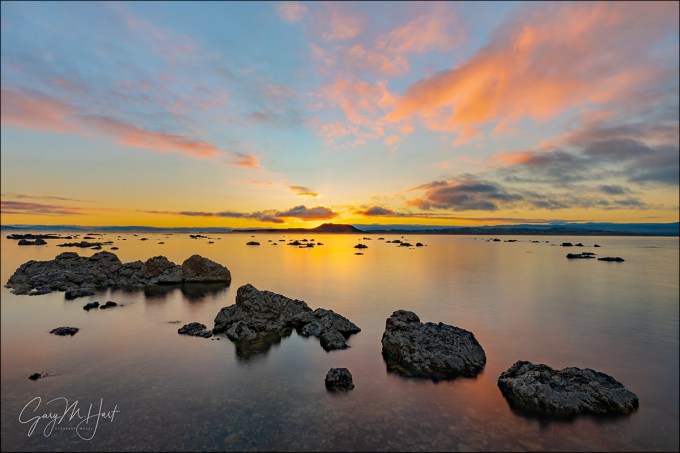
Daybreak, Mono Lake
Sony a7RIII
Sony 16-35 f/2.8 GM
4 seconds
F/18
ISO 200
True story: I once had a workshop participant who put her Nikon D4 in continuous mode, metered, then pressed the shutter and sprayed in a 180 degree arc until the buffer filled. When I asked her what she was doing, she shrugged and said, “It’s Yosemite—there’s sure to be something good in there.” While I couldn’t really disagree with her, I’m guessing she wasn’t seeing a lot of growth as a photographer.
I tend to fall on the other end of the photography spectrum. Rather than a high volume of low-effort images (spray-and-pray), much of my photography style carries over from my film days. Back then, a photographer who wasn’t careful might return from Europe to find that, between the film and the processing, the photographs cost more than the trip. With our wallets forcing us to be more discriminating, we took our time, and checked (and double-checked) every composition and exposure variable before clicking.
Times have changed. While every film click cost us money, every digital click increases the return on our investment. And thanks to ridiculous frame rates, seemingly infinite memory cards, and the ease of deleting in the field, I’m afraid it has become so easy to fire at will that many digital shooters are far too casual with each frame.
The best approach is probably a hybrid of the film and digital paradigms: Careful attention to detail, combined with a no-fear freedom to fail frequently. Just as it’s important to have some kind of plan or objective, it’s just as important to be okay with not knowing how you’re going to get there. In other words, sometimes success can only when you aren’t afraid to create crappy images on the way.
I’ll often approach a scene knowing there’s a image there, but start with no idea were it is. One approach that often works in these situations is to just frame something up and click. Other times I’ll play “what-if” games with myself: What if I do this? Or that? If it works, great; if it doesn’t, I’ve learned something.
There’s a draft in here
As someone who has been writing and taking pictures for a long time, I’ve found a real connection between the creation process of each craft. We can probably agree that few writers create a polished piece of writing in a single pass. Whether it’s an important e-mail, a weekly blog, or a magazine article, I start with an idea and just go with it. But before sending, publishing, or submitting (or deleting), I read, revise, then re-read and re-revise more times than I can count—until I’m satisfied that it’s “perfect.”
Similarly, photographers shouldn’t be afraid to create “draft” images that move them forward without necessarily delivering them all the way where they want to be with one click. When I find a scene that might be photo-worthy, I compose and expose my first click more by feel, without a lot of analysis. But I’m not done after that first click, not even close. And I don’t particularly care that it’s not perfect. This is my first draft, a proof of concept that creates a foundation to build on. When that draft pops up on my LCD, I evaluate it, make adjustments, and click again, repeating this cycle until I’m satisfied, or until I decide there’s not an image there.
Sorry, but there really is no substitute for a tripod
I hear a lot of landscape photographers claim that stabilized bodies and lenses, combined with clean high-ISO sensors, have made the tripod obsolete. Since photography must be a source of pleasure, I won’t argue with anyone who says using a tripod saps their joy. But…. If the joy you receive from photography requires getting the best possible images, you really should be using a tripod.
Applying my draft/revise approach without a tripod is like trying to draw with an an Etch A Sketch (is that still a thing?), then erasing the screen after each click. That’s because after every hand-held click, what’s the first thing you do? If you’re like most photographers, to check your image, you drop the camera from your eye and extend it out front. Before you can make the inevitable adjustments to that hand-held capture, you must return the camera to your eye and completely recreate the composition before making your adjustments.
It’s the tripod that makes this shoot/critique/refine process work. Much the way a computer allows writers to save, review, and incrementally improve what they’ve written, a tripod holds your composition while you decide how to make it better. Shooting this way, each frame becomes an incremental improvement of the preceding frame.
About this image
Composition isn’t limited to the arrangement and framing of elements in a scene—it can also be the way the image conveys the scene’s light, depth, and motion. Setting up this sunrise image, I had to coordinate all of those moving parts.
I’d arrived here with my Eastern Sierra workshop group about 45 minutes before sunrise, plenty of time to familiarize myself with the scene and plan my sunrise composition. I started by identifying my foreground elements, then determined the focus point that would deliver foreground-to-infinity depth of field, and finally worked out my strategy for getting the exposure right using a long enough exposure to smooth the rippled water and maximize the foreground reflection (thanks to my Breakthrough 6-stop ND filter). In my pre-Sony days I’d have had to wrestle with a graduated neutral density filter to manage the highlights, but I knew if I was careful with my histogram, my Sony a7RIII would handle it.
One of the nice things about photographing sunrise at Mono Lake is that you anticipate the sun’s arrival on the eastern horizon by monitoring the shadows sliding down the mountains in the west. So after I found my general composition, I had the luxury of ten minutes of just playing with all the variables, firing frames I knew I wouldn’t use, then evaluating each for balance, depth, and motion effect. I don’t have any specific memory of this frame, but if I look at the series of images leading up to it, I can tell what I was doing.
Oh, and full disclosure: Even though I don’t really remember this specific click, I can tell I was thinking about a sunstar because I shot it at f/18, an f/stop I virtually never use unless I want a sunstar (at 16mm, I certainly didn’t need f/18 for DOF). I could defend myself by saying I stopped down to f/18 to get my exposure to the four seconds I used here (to smooth the water), but that doesn’t fly either because I was at ISO 200. I know if I’d have been paying attention, I’d have used ISO 100 and f/13, allowing the same shutter speed at a cleaner ISO and sharper f-stop. So I guess the moral of this small digression is, don’t let the desire to be perfect hinder your creativity—mistakes happen, they’re usually not the end of the world, and the results will almost certainly be better than spray-and-pray.
Join me for an Eastern Sierra photo workshop
An Eastern Sierra Gallery
Click an image for a closer look and to view a slide show.


Low Hanging Fruit
Posted on October 20, 2019

Winter Reflection, Valley View, Yosemite
Sony a7RII
Sony/Zeiss 24-70 f4
10 seconds
F/7.1
ISO 1600
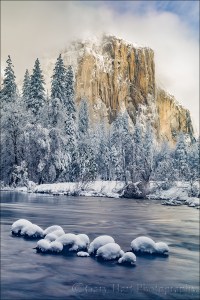
Snowcap, El Capitan, Yosemite
A few days ago I posted an El Capitan in winter image on Instagram. Since it had been nearly three years since that trip, a lot of the specifics of that day had slipped my mind, but when I pulled up the Instagram image’s raw file in Lightroom to check the capture info, a few more of that day’s (so far unprocessed) images caught my eye. The next thing I knew, I was processing this one, and gradually, some of the day’s details returned to me.
Yosemite Valley had been brown and dry beneath an overcast sky when I checked into the lodge the evening prior, but I woke the next morning to a world of white. (This was no surprise—I’d made the trip because snow was forecast.) The snow was still falling after breakfast, and as usually happens in a Yosemite storm, the clouds completely obscured all of Yosemite’s icons. But knowing that the key to photographing snow in Yosemite is to be out in it when the storm breaks, I was quite content to drive into its midst and wait it out. And break it did, turning to flurries with a mix of clouds and blue sky by late morning. The conditions stayed like that the rest of the day and I was in photographer heaven.
I circled Yosemite Valley all day, sometimes targeting specific spots, other times just pulling over when something moved me. By the time the sun set I was pretty certain that I had lots of good stuff on my card, but most important, I was happy. (If just spending time with your subject, regardless of the photographic results, doesn’t make you happy, you probably should be photographing something else.)
On my way out of the park after sunset I made one last stop to photograph this Valley View scene. With its easy access and riverside views of El Capitan, Cathedral Rocks, and Bridalveil Fall, Valley View is low-hanging photography fruit. And it’s especially nice with fresh snow. I’d already stopped here at least once before on that day, capturing last week’s Instagram image late that morning, but I couldn’t resit taking one more peek before heading down the canyon and home.
After the trip I processed a couple of images right away, but like so many of my photo trips, most of the images from this day have languished on a hard drive, victims of the priorities of running a business. This whole experience has been a good reminder of how many unprocessed images I have “in the bank,” waiting to be processed. It has inspired me to make a concentrated effort to go back through my archives to see what might be lurking there. I’ve already excavated a couple besides this one, with more on the way.
And speaking of low hanging fruit, I’ve started by going through my Yosemite snow images, because, well…, how can you go wrong with Yosemite and snow?
Winter is coming
Because winter is right around the corner, and we’ve already entered (just barely) the window when snow is possible in Yosemite, here’s my recipe for photographing Yosemite with snow.
The Early Bird Gets the Snow
If you delay your trip until you hear that it snowed in Yosemite, you’re too late. That’s because Yosemite is only 4,000 feet above sea level and actually warmer in winter than most of the United States. When it does snow there, as soon the snow stops, Yosemite’s relatively mild temperatures collude with sunshine, wind, and gravity to clear the trees in a matter of hours. Not only that, park visitors, driven to shelter by the storm, swarm outside to gape as soon as the snow stops, quickly marring the pristine beauty with footprints, not to mention the mud spread by their boots and tires. In other words, the key to photographing Yosemite with snow is being in the park during the storm (and working fast).
Monitor the weather
All winter I monitor the Yosemite weather forecast for hints of a cold storm. But even this isn’t as simple as you might expect—the single biggest mistake people make when planning a Yosemite snow trip is opening whatever weather site or app is convenient and simply typing in Yosemite. Yosemite Valley is only 4,000 feet above sea level, and virtually the entire rest of the park is higher—up to 13,000 feet elevation. And for some reason, even though Yosemite Valley is where you want to be for snow (and pretty much the only place in Yosemite you can be in winter), most weather resources don’t give the forecast for Yosemite Valley. Instead, they pick some other (random?) elevation that is almost always more likely to get snow than Yosemite Valley. You’d be amazed at how much more frequently snow falls just 500 feet above Yosemite Valley than falls in Yosemite Valley, which means a lot of people end up driving to Yosemite to photograph the snow their weather app promised, then end up marinating all day in a cold rain.
I know there are lots of weather forecast options out there, but most lack the resources of the National Weather Service (or they just use the NWS data). The NWS may not always nail the forecast, but they seem to be more consistent and reliable than any of the other options. But even selecting a generic NWS Yosemite forecast can lead you astray. I recently typed “Yosemite” into the NWS’s forecast input field and was given an assortment of similar options, each of which returned a different location in Yosemite (most not Yosemite Valley). So rather than leave it to chance, to ensure a forecast for the correct elevation, I’ve bookmarked the NWS point forecast for Yosemite Valley.
Chains
When it snows in Yosemite, they do sometimes require chains. Usually 4WD or AWD cars with snow tires are exempt, but not necessarily. Regardless of the conditions, park rules say if you plan to drive in the Yosemite in winter, you must carry chains—even if you have 4WD/AWD. My Subaru Outback is AWD, but when the weather is threatening, I have been asked if I have chains. So they’ve never asked me to prove it, or had to put chains on, but I always carry chains because if they do find that you don’t have chains when they’re required, you’ll need to just park until it chain requirement is lifted.
Driving to Yosemite
Sometimes the chain requirements aren’t for Yosemite Valley, but they do apply to two of the three routes into Yosemite Valley. When a storm is possible, the best way to avoid snow, ice, and chain requirements is to ignore the guidance of your GPS and Google Maps and enter via Mariposa on Highway 140, which comes up the Merced River Canyon and doesn’t ever get as high as 4,000 feet until Yosemite Valley. (Trust me on this.)
That said, any route into Yosemite is subject to closure or restrictions due to slides, flooding, or downed trees. Always check the Yosemite and Caltrans road conditions pages before you leave (I sometimes check them on the way too).
Go-time
Weather in Yosemite is very changeable, and a storm forecast that looked promising one day can completely fizzle the next—or vice versa. Some trips I’ve had a week to prepare for, others I didn’t consider going until I woke up and checked the Yosemite forecast that morning. Because I want to be ready at the drop of a hat, all winter long in the back of my Outback are my chains and a duffle bag with all my cold weather gear: waterproof pants, parka, and shoes, wool hat and gloves, and an umbrella.
When possible, I like to be in Yosemite the day before the snow starts. That said, it isn’t usually difficult to get a room in Yosemite at the last minute when a winter storm threatens, and there have been times when I’ve actually waited until I arrived in the park before booking my room (not necessarily a strategy I’d recommend). Nevertheless, the later I wait to leave, the more likely I’ll be delayed or turned back by a road closure.
Once the snow arrives, rather than hole up in my room, I’m out shooting. Even though Yosemite’s storms often erase all signs of its most recognizable features, stormy weather is a great time to photograph swirling clouds and accumulating snow in glorious (and rare!) solitude. Nice soft light too.
As much as I love photographing Yosemite when snows, the poor visibility and near white-out snowfall can reach a point of diminishing photographic returns. But even then, I don’t go in (or home). Instead, I park at Tunnel View and wait for the weather to clear. Tunnel View is the perfect place to wait out a Yosemite storm because it’s on the west side of Yosemite Valley (where the clearing usually starts), provides an elevated vantage point with a view all the way up the valley to Half Dome, and is spectacular to photograph when the storm clears. It even has decent cell service. And if I’m looking for an excuse to turn on the engine and warm things up, I drive through the tunnel for the view westward, a preview of coming weather.
My final advice for anyone is, when the storm clears, move fast and don’t spend too much time at any one spot, no matter how beautiful it is. It’s a pretty safe bet that if the conditions are beautiful right here, you’re probably missing opportunities elsewhere. The peak conditions, with snow draping every exposed surface, don’t last long, so get your shots and move on—or risk missing out. (This is the voice of experience talking.)
Yosemite Winter Photo Workshop
Yosemite Snow
Click an image for a closer look and to view a slide show.


Go Big or Go Home
Posted on October 13, 2019

Setting Crescent, Sierra Crest, Alabama Hills (California)
Sony a7RIV
Sony 200-600 G
Sony 2x teleconverter
ISO 400
f/13
1/3 second
Like a teenager with his first car, I was itching to take my brand new Sony 200-600 for a spin. But since I don’t photograph wildlife, my ultra-telephoto lenses are used mostly for the moon, and occasionally close-focus stuff like fall color and wildflowers. And as much as I wanted to try it on the moon, I thought the fall color in my Eastern Sierra workshop would be my first opportunity.
Because I schedule the Eastern Sierra workshop to thread the needle between the best chance for peak fall color at North Lake, while avoiding the Lone Pine Film Festival and the Bishop Classic Car Rally, it’s one of the few workshops I do that isn’t timed for something happening in the sky (like the moon, the Milky Way, the northern lights, or lightning). So imagine my excitement when, before this year’s Eastern Sierra workshop, I checked the moon and realized a 6% crescent would be setting behind the Sierra Crest between Lone Pine Peak and Mt. Whitney on the workshop’s first night. Oh boy!
I got the group in position that evening and we all had a blast photographing the new moon slipping toward the serrated Sierra peaks. It started near Lone Pine Peak, and moved closer to Mt. Whitney as it dropped through the darkening sky. My first frames, while the moon was still pretty high, were fairly wide, but as it dropped closer to the mountains, my composition tightened.
When the crescent was just a few degrees above the crest, I grabbed my 200-600 and went to work. But, also like a teenager with his first car, I soon got the urge to soup it up and reached for my Sony 2X teleconverter. This gave me 1200mm at 61 megapixels. Wow.
I always joke that I don’t photograph anything that moves because I want to know my subject will still be there when I’m ready, so for someone as deliberate as I am, it really is startling to see how fast the moon moves through a 1200mm frame. Okay, maybe not as fast as a lion chasing dinner, or a leaping salmon becoming dinner, but instead of trying to track it, I still found it easier to anticipate the spot where the moon would disappear and let it slip into my frame.
It was 35 minutes after sunset when the moon finally reached the crest, making the trickiest part about this scene the exposure. This is the kind of exposure that begs to be handled in Manual mode because a meter would have no clue that I wanted to capture enough contrast between the sky and peaks to create a silhouette, as well as definition in the moonshadow, without completely blowing out the crescent. I also knew that the properly exposed image would look like crap on my LCD (it would require processing to moderate the extreme dynamic range between the dark mountains and bright moon).
To get the exposure right, I slowly pushed the scene brighter until the small blob of highlights in my histogram (the moon) hit the right side, then gave it one more stop of light (so the moon looked completely blown in the preview), knowing (fingers crossed) I could recover them later. I was slightly apprehensive because I still hadn’t processed any images from my new Sony a7RIV, but I was confident that it would have at least as much dynamic range as as my a7RIII, and just approached the exposure the same. All’s well that ends well—phew.
In a workshop my own photography isn’t a priority, so I didn’t get a lot of opportunity to play with my new toys on that trip. But my sense is that I’m going to love this new lens. Though its size means the 200-600 probably won’t replace my Sony 100-400 GM lens (which I love, BTW) as a full-time passenger in my camera bag, it will almost certainly be my default “big moon” lens. And my preliminary feelings are that the dynamic range of the a7RIV is indeed at least as good as the a7RIII (which is pretty incredible too).
Helping my workshop group with this crescent moon shoot got me thinking about metering, and how important it is to have it down cold. I’ve written a document on metering that I provide to all my groups to help them get up to speed before each workshop, but I’ve actually changed the way I meter in the few years since I wrote it. The old approach isn’t invalid (in fact, I think any serious photographer should be able to meter the old fashioned way), but I do think live-view histograms have made it a lot easier. So this week I rewrote my document and am sharing it below. (Please forgive any typos—it’s a work in progress.)
My Next Moon Shoot Opportunity
Exposure Basics
Cameras seem to be getting “smarter” every year. So smart, in fact, that for most scenes, duplicating a two-dimensional version of what your eyes see is a simple matter of pointing your camera and clicking the shutter button. That’s fine if all you care about is recording a memory, but not only is there more to photography than approximating “reality,” there are many creative reasons to override the camera’s choices.
For the creative control that elevates your images above the billions of clicks being cranked out every day, giving your camera the control of photography’s most important decisions ignores an undeniable truth…
Your camera is stupid
Sorry—mine is too. And while I can easily cite many examples, right now it’s just important to understand that your camera thinks the entire world is a middle tone. Regardless of what its meter “sees,” without intervention your camera will do everything in its power to make your picture a middle tone. Sunlit snowman? Lump of coal at the bottom of your Christmas stocking? It doesn’t matter—if you let your camera decide the exposure, your subject will turn out gray.
Modern technology offers faux-intelligence to help overcome this limitation. Usually called something like “matrix” or “evaluative” metering, this solution compares your scene to a large but finite internal database of choices, returning a metering decision based on the closest match. This works pretty well for conventional “tourist” snaps, but often struggles in the warm or dramatic light artistic photographers prefer—and it knows nothing of creativity. If you want to capture more than documentary “I was here” pictures, you really do need to take full control of your camera’s metering and exposure. Fortunately, this isn’t nearly as difficult as most people fear (or as it once was).
Laying the exposure foundation
The amount of light captured for any given scene varies with the camera’s shutter speed, f-stop, and ISO settings. Photographers measure captured light in “stops,” much as a cook uses a cup (of sugar or flour or chocolate chips or whatever) to measure ingredients in a recipe. Adding or subtracting “stops” of light by increasing or decreasing the shutter speed, f-stop, or ISO makes an image brighter or darker.
The simple beauty of metering is that a stop of light is a stop of light is a stop of light—it’s always the same amount of light, whether you change it with the:
- Aperture: The opening light passes through when the shutter opens, measured in f-stops (though aperture and f-stop are almost always used interchangeably, aperture is the actual opening, while f-stop is the ratio of the focal length to the aperture size we use to measure the amount of light that reaches the sensor). Since f-stop is a ratio, the higher the number, the smaller the aperture. Doubling the f-stop number decreases the light by two stops; halving the f-stop number increases the light by two stops. To memorize f-stops in one-stop increments, I keep track of two overlapping f-stop series, one starting at f/1, the other at f/1.4. Doubling then interleaving the results returns one-stop f-stop increments: f/1, f/1.4, f/2, f/2.8, f/4, f/5.6, f/8, f/11, f/16/, f/22, and so on.
- Shutter speed: The time the shutter is open, allowing light to pass through the aperture to reach the sensor. Doubling the shutter speed (open less time) reduces the light by one stop; halving the shutter speed adds one stop.
- ISO: The sensitivity of the sensor (or film) to light. Doubling the ISO adds one stop of light; halving the ISO subtracts one stop.
But while an aperture stop adds/subtracts the same amount of light as a shutter speed or ISO stop, the resulting picture can still vary significantly.
Your aperture choice determines the picture’s depth of field (DOF), while your shutter speed choice determines whether motion in the frame is stopped or blurred. And while an ISO stop also adds/subtracts the same amount of light as shutter speed and aperture without affecting motion and depth, image quality decreases as the ISO increases. So getting the light right is only part of the exposure objective—you also need to consider how you want to handle any motion in the scene, how much DOF to capture, and the ISO that generates the least noise.
Let’s say you’re photographing autumn leaves in a light breeze. You get the exposure right, but the leaves are slightly blurred at 1/15 second. To freeze that blur, you change your shutter speed to 1/30 second, which also reduces the light reaching the sensor by one stop. To replace that lost light (keep the exposure the same), you could open your aperture by a stop (change the f-stop), double the ISO, or make a combination of fractional f-stop and ISO adjustments that total one stop. Each choice will render a different result, but that’s a creative decision your camera isn’t capable of.
Metering modes
Today’s cameras have the ability to measure, or “meter” the light in a scene before the shutter clicks. In fact, most cameras have many different ways of evaluating a scene’s light. Your camera’s metering mode determines the amount of the frame the meter “sees.” The larger the area your meter measures, the greater the potential for a wide range of tones. Since most scenes have a range of tones from dark shadows to bright highlights, the meter will take an average of the tones it finds in its metering zone.
Metering mode options range from “spot” metering a very small part of the scene, to “matrix” (also known as “evaluative”), which looks at the entire scene and actually tries to guess at what it sees. Each camera manufacturer offers a variety of modes and there’s little consensus on name and function (different function for the same name, same function for different names) among manufacturers, so it’s best to read your camera’s manual to familiarize yourself with its metering modes.
Since I want as much control as possible, I prefer spot metering because it’s the most precise. The spot meter covers the smallest area of the frame possible, an imaginary circle in the center 3% (or so, depending on the camera) of the viewfinder. (Some cameras optionally allow you to spot meter on the current focus point instead of the center of the frame.) When spot metering, I can target the part of the frame I deem most important and base my exposure decision on the light reading there.
Spot metering isn’t available in all cameras (this was more true with older models). In some cameras, the most precise (smallest metering area) metering mode available is “partial,” which covers a little more of the scene, somewhere around 10%.
Regardless of the size of the metering zone, the camera will take an average of what it finds. In some modes that average is evenly extracted from the entire zone, in other modes, the average is biased toward the middle: “center-weighted.”
Exposure modes
Don’t confuse the metering mode with the exposure mode. While the metering mode determines what the meter sees, the exposure mode determines the way the camera handles that information. Most mirrorless and DSLR (digital single lens reflex) cameras offer manual, aperture priority, shutter priority, plus a variety of program or automatic exposure modes. Serious landscape photographers usually forego the full automatic/program modes in favor of the manual (my preference) or aperture/shutter priority modes that offer more control.
If you select aperture or shutter priority mode, you specify the aperture (f-stop) or shutter speed, and the camera sets the shutter speed or f-stop that delivers a middle tone based on what the meter sees. But you’re not done. Unless you really do want the middle-tone result the camera desires (possible but far from certain), you then need to adjust the exposure compensation (usually identified by a +/- symbol) to specify the amount you want your subject to be above or below a middle tone.
For example, if you point your camera’s spot-meter at a bright, sunlit cloud, the camera will only give your picture enough light make the cloud a middle tone—but if you’ve only given your scene enough light to make a white cloud gray, it stands to reason that the rest of your picture will be too dark. To avoid this, you would adjust exposure compensation (the +/- symbol) to instruct your camera to make the cloud brighter than a middle tone by adding two stops of light (or however much light you want to give the cloud to make it whatever tone you think it should be).
Rather than aperture priority, I prefer manual mode because I want control: my camera should not be making decisions for me. And once it’s mastered (it really isn’t hard), I think manual metering is easier. But if you can successfully handle each exposure situation with aperture or shutter priority, you’ll be fine—just stay away from the full automatic modes.
Exposure without (and with) compromise
I always try to use my camera’s best ISO, and the aperture that gives me the sharpest frame. Not just the desired DOF, but also the least diffraction (diffraction is a loss of detail caused when light passes through a small opening and spreads slightly—the smaller the opening, the greater the diffraction softening). But sometimes exposure-setting compromise is the only way to achieve the desired results.
For example, when DOF isn’t a consideration, I keep my f-stop in the f/8-f/11 range because it provides a reasonable amount of DOF, and that’s where lenses tend to be sharpest (least distortion), and diffraction is less of a concern (than it is at smaller apertures). But when I need a specific DOF, or want to capture a sunstar (small aperture), I have no problem compromising my f-stop setting to get there.
And I only compromise my ISO when there’s no other way to achieve a certain motion effect. So while ISO 100 is ideal (for my Sony a7RIV and the majority of other cameras), when the wind blows or I want to freeze moving water, I’ll increase my ISO to achieve the motion and DOF combination I need. And if I want a little more motion blur, I have no problem dropping down to ISO 50 to a allow a longer shutter speed.
The simplest way to minimize the need to compromise image quality is to use a tripod. A tripod removes camera shake from the exposure equation, meaning the only time shutter speed matters is when there’s motion in the scene. And when shutter speed doesn’t matter, you can always use the perfect ISO and aperture by going with whatever shutter speed you need, regardless of its length.
Some scenes are all about compromise, even with a tripod. For example, I’d love to photograph the Milky Way at ISO 100, f/8, 1/100 second, but that would give me a black frame. Since star motion increases with shutter speed, I push the ISO as far as I can without getting unfixable noise, open the aperture as wide as I can without obvious distortion—and I still have to live with a shutter speed that gives me a little star motion. All of these exposure choices are compromises that render less than perfect results, but without them, I’d have no Milky Way image at all.
The old fashioned way to meter
Armed with all this exposure understanding, it’s time to think about the best way to read and capture the light in a scene. For most of my photography life, in manual mode I’d set my camera to its native ISO (or to the ISO/ASA of the film I had loaded), determine my aperture (based on the DOF I want and/or the sharpest f-stop for my lens), point my camera’s spot-meter zone at the area on brightest part of the scene, and dial my shutter speed until it indicated the spot-meter zone is the tone I want. (I chose the brightest part of the scene because I know if I don’t blow it out, nothing in my frame will be lost.)
During my film days, and in my early digital life, that approach served me well. In fact, I think every serious photographer should understand metering well enough to do it this way. But….
With digital photography comes the histogram, which used to feel like cheating, but now has completely changed the way I meter.
Digital Metering
In the film days, we didn’t know if the exposure was right until the pictures were processed. To insure against missing the exposure, we’d bracket exposures by (usually) one stop on either side of what we believed to be the correct exposure. Today, thanks to the histogram, bracketing is no longer necessary.
Histogram explained
The histogram is a graph of the tones in an image, from absolute black to absolute white. Instead of clicking and hoping as we did in the film days, the addition of a histogram on every digital camera (that’s not a smartphone) provides photographers instant feedback on each image’s exposure. Better still, live-view histograms in mirrorless viewfinders, or on DLSR and mirrorless LCD screens, provide that essential exposure feedback before we click the shutter.
While any graph has the potential to evoke flashbacks of high school science trauma, a histogram is really quite simple—simple enough to be read and interpreted in the blink of an eye. And not only is your histogram easy to read, it really is your most reliable source of exposure feedback.
Simple Histogram: The shadows are on the left and the highlights are on the right; the far left (0) is absolute black, and the far right (255) absolute white.
When an image is captured on a digital sensor, your camera’s “brain” samples each photosite (the sensor’s individual pixels comprising the megapixel number used to measure sensor resolution), determining a brightness value that ranges from 0 (black) to 255 (white). Every brightness value from 1 to 254 is a shade of gray—the higher a photosite’s number, the brighter its tone.
Armed with the brightness values for each photosite in the image, the camera starts building the image’s histogram. The horizontal axis of the histogram has 256 discrete columns (0-255), one for each possible brightness value, with the 0/black column on the far left, and the 255/white column on the far right (they don’t display as individual columns because they’re crammed so close together).
Despite millions of photosites to sample, your camera builds a new histogram for each image virtually instantaneously, adding each photosite’s brightness value to its corresponding column on the histogram, like stacking poker chips—the more photosites of a particular brightness value, the higher its corresponding column will spike.
RGB histogram
The black-and-white histogram most of us are familiar with is the luminosity histogram. But each photosite on a conventional sensor actually measures the tone of one of three colors: red, green, and blue (RGB). The RGB histogram uses the same pixel sampling process to separate the luminosity histogram into three separate, more granular, graphs, one for each color.
The luminosity histogram shows the detail you captured, but it doesn’t tell you whether you lost color. In fact, the luminosity histogram could look fine even when two of the three RGB channels are clipped (cut off, indicating color is lost). So in high dynamic range scene (extreme highlights and shadows), or scenes with an extreme amount of one color (such a brilliant sunset or a backlit poppy), checking the RGB histogram to ensure that none of the image’s color channels is clipped is especially important. The solution for a clipped RGB channel (or two) is to reduce the exposure.
Reading your histogram
There’s no such thing as a “perfect” histogram shape. Rather, the histogram’s shape is determined by the distribution of light in the scene, while its left/right distribution (whether the graph is skewed to the left or right) is a function of the amount of exposure you’ve chosen to give your image. The histogram graph’s height is irrelevant—information that appears cut off at the top of the histogram just means the graph isn’t tall enough to display all the photosites possessing that tone (or range of tones).
When checking an image’s histogram for exposure, your primary concern should be to ensure that the none of the tone data is cut off on the left (lost shadows) or right (lost highlights). If your histogram appears cut-off on the left side, shadow detail is so dark that it registers as black. Conversely, if your histogram appears cut off on the right side, highlight detail is so bright that it registers as white.
Trusting your histogram
Basing the image’s exposure on the way the picture looks on the LCD is the single biggest exposure mistake I see photographers make. The post-capture review image that displays on your camera’s LCD is great for checking composition, but the range of tones you can see in your review image varies with many factors, such as the review screen’s brightness setting and the amount of ambient light striking the LCD. Even more important, because there’s more information captured than the LCD preview can show, even in the best conditions, you’ll never know how much recoverable data exists in the extreme shadows and highlights by relying on the LCD preview.
It’s human nature to try to expose a scene so the picture on the LCD looks good, but an extreme dynamic range image that looks good on the LCD will likely have unusable highlights or shadows. As counterintuitive as it feels, exposing a high dynamic range scene enough to reveal detail in the darkest shadows brightens the entire scene (not just the shadows), likely pushing the image’s highlights to unrecoverable levels. And making an image dark enough on the LCD to salvage bright highlights darkens the entire scene, all but ensuring that the darkest shadows will be too black.
In fact, a properly exposed, a scene with both bright highlights and dark shadows, such as a sunrise or sunset, will look awful on the LCD (dark shadows and bright highlights) because there’s information there you can’t see (yet). The histogram provides the only reliable representation of the tones you captured (or, in your live-view LCD display or mirrorless electronic viewfinder, of the tones you’re about to capture).
Live-View Metering
Starting with the live-view screen, and now in mirrorless viewfinders, we can view our histogram before clicking the shutter. So instead of guessing the exposure settings that return the tones we want, we have an actual pre-capture picture of the tones to monitor and adjust.
It really is this simple
Using the pre-capture histogram—almost always in my Sony mirrorless viewfinder, but the histogram on a mirrorless or DSLR LCD screen will work too—I start the exposure process as I always have. In manual exposure mode, I default to my camera’s best ISO (100 for most cameras, but definitely not all, so check your camera’s native ISO), and the best f-stop for my composition. I don’t touch these settings unless motion in my scene, such as wind or star movement, forces an ISO and/or f-stop compromise. With ISO and f-stop set, I slowly adjust my shutter speed with my eye on the histogram until it looks right. Click.
Spare the highlights
In a low or moderate contrast scene, I’ll have a little room on both sides of the histogram (the graph doesn’t bump up against either side)—a very easy scene to expose. But in a high dynamic range scene, the difference between the darkest shadows and brightest highlights might stretch beyond one or both sides of the histogram. When a high dynamic range scene forces me to choose between saving the highlights or the shadows, I almost always bias my exposure choice toward sparing the highlights, carefully dialing the shutter speed until the histogram bumps against the right side.
When forced to decide between the highlights or shadows, I almost always try to spare the highlights, for a couple of reasons: First, shadows are usually easy to recover than highlights; second, highlights are almost always more important than shadows. In fact, because the human eye is reflexively drawn to the brightest areas of the frame, I rarely have anything important in the shadows of a high dynamic range scene.
The post-capture histogram is usually more reliable than the pre-capture histogram. Sometimes this doesn’t matter, but in a high dynamic range scene, or any time I push my histogram close to the right side, I verify my exposure by checking the post-capture histogram. Another situation that can sometimes fool the pre-capture histogram is blurred (long exposure) whitewater.
The zebras
Most mirrorless cameras, and many newer DSLRs, offer “zebra” highlight warnings in their pre-capture view. The first time I meter a scene, my camera’s current exposure settings (based on my previous scene) might be far from what the new scene requires. When that’s the case, I push my shutter speed fast until the zebras appear (if my prior exposure was too dark) or disappear (if my prior exposure was too bright), then refine the exposure more slowly while watching the histogram. While these alerts aren’t nearly as reliable as the histogram and should never be relied on for final exposure decisions, I use their appearance as a signal that it’s time to monitor my histogram.
Know your camera
Photographers who shoot raw make exposure decisions with the understanding that the capture exposure is simply the start, and the final exposure is determined by the processing. But the more photons you capture, the greater your latitude for adjustment later.
Trusting the histogram is a great start, but every camera model interprets and displays its exposure information differently. Added to that, the histogram is based on the jpeg the camera displays, so raw shooters always have more image information than their histogram shows—it’s important to know how much more.
With my Sony a7R bodies, I know I’m pretty safe pushing my histogram at least a full stop beyond the left or right (shadows and highlights) histogram boundary. This knowledge enables me to get the most out of even the most challenging high dynamic range scenes.
Practice makes perfect
Like most things in photography, the more you do it, the easier it becomes. For many people reading this, my approach is nothing revolutionary. But if it’s all new to you, or if you feel a little rusty, I suggest that you go out and try it in a low stress situation. Keep working on it whenever you find yourself in a situation where getting the shot doesn’t feel life or death.
When you do get into one of those “Oh my God, look at that!” moments, go back to whatever feels most comfortable to you. I think you’ll find that it won’t take too much practice before the right way is also the most comfortable way.
Workshop Schedule || Purchase Prints
Big (and Big-ish) Moons
Click an image for a closer look and to view a slide show.


Enjoying Our World on Nature’s Terms
Posted on October 7, 2019

Aurora Reflection, Glacier Lagoon, Iceland
Sony a7SII
Sony 16-35 f/2.8 GM
8 seconds
F/2.8
ISO 6400
Nature photographers have a tenuous relationship with clocks and calendars. They’re useful when we need to interact with the rest of the world on its terms, but pursuing our craft requires us to defer to the fundamental laws of nature: the Earth’s rotation on its axis, the Earth’s revolution about the sun, and the moon’s motion relative to the Earth and sun.
While my years are ruled by the changing angle of the sun’s rays, and my days are tied to the sun’s and moon’s arrival and departure, I can’t help fantasize about a world where I could schedule my Grand Canyon monsoon workshop for the lightning bolt and rainbow combination that graces the canyon every August 5 at 2:40 p.m., or the ability to mark my calendar for the blizzard that blankets Yosemite in white every February 7. But nature, despite human attempts to manipulate, subvert, and (when convenient) ignore it, is its own boss. The best I can do is schedule my monsoon workshops to ensure the best odds for lightning and rainbows, or monitor the weather forecast and rush to Yosemite when a snowstorm is promised (then wait with my fingers crossed).
The insignificance of clocks and calendars is never more clear than the first morning following a time change. On the second Sunday of March (or whatever the powers-that-be have changed it to this year), when “normal” people moan about rising an hour earlier, and the first Sunday of November, as others luxuriate in their extra hour of sleep, it’s business as usual for me. Each spring, thumbing its nose at Daylight Saving Time, the sun rises a mere minute (or so) earlier than it did the day before; so do I. And each fall, on the first sunrise of Standard Time, I get to sleep an an entire minute longer. Yippee.
Honestly, I marvel at nature’s blend of precision and (apparent) randomness. I love being able to point to the horizon and say, the moon will appear right there at exactly 5:44. But I also love going out with my camera and an expectation of what might happen, then being completely surprised by what actually does happen.
The aurora in today’s image was certainly not on anyone’s calendar when Don Smith and I planned last January’s Iceland trip. We’d done our best to maximize our odds by scheduling the trip for the heart of aurora season, then performed our due diligence by monitoring the forecast and waiting in the cold and dark each night for something to happen. But nature, while maybe absolutely precise on a cosmic scale, is still largely a mystery to humans. So while it’s possible that the northern lights we witnessed that night were preordained from the Big Bang’s first peep (Heisenberg’s protests notwithstanding), all that matters to me is that I was there to witness them.
Learn about the aurora, and read the story of this night: Chasing the Northern Lights
Workshop Schedule || Purchase Prints
One Unforgettable Night


Chasing the Northern Lights
Posted on September 29, 2019

Aurora on Ice, Glacier Lagoon, Iceland
Sony a7SII
Sony 12-24 f/4 G
15 seconds
F/4
ISO 16,000
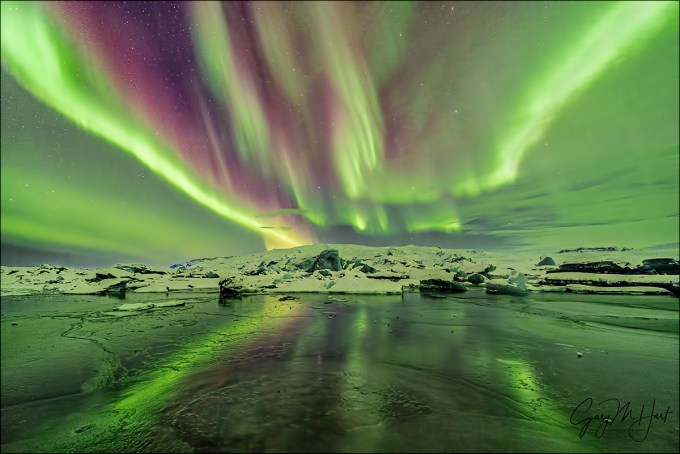
Aurora Streaks, Glacier Lagoon, Iceland
Sony a7SII
Sony 16 – 35 f/2.8 GM
6 seconds
F/2.8
ISO 6400

Northern Lights Reflection, Aurora and Glacier Lagoon, Iceland
Sony a7SII
Sony 16 – 35 f/2.8 GM
8 seconds
F/2.8
ISO 3200
After finally witnessing a total solar eclipse and declaring it the most beautiful thing I’ve ever seen, I started hearing people say things like, “Wait until you see the northern lights.” So when fellow pro photographer Don Smith and I planned an Iceland photo trip to prepare for our upcoming photo workshop, we chose January because it’s right the heart of northern lights season. Could the northern lights’ beauty really rival a total solar eclipse? (Spoiler alert: Yes.)
An Aurora Primer
Our planet is continuously bombarded by solar energy. When this perpetual solar wind encounters Earth’s atmosphere, a narrow range of wavelengths (infrared and visible) passes through to warm us and light our way. But other energy wavelengths in the solar wind interact differently with the molecules they encounter, creating an charge imbalance by stripping electrons.
Instead of penetrating our atmosphere to create havoc on Earth’s surface, most of these charged particles (ions) are intercepted by the magnetosphere, our protective magnetic shield. The magnetosphere is teardrop shaped, with the battered side that faces the sun compressed, and the shielded side behind Earth stretching much farther into space.
As Earth rotates, at any given moment the side facing the sun (the daylight side) looks out through the thinner, compressed side of our magnetosphere, while the night side of Earth faces the extended region of the magnetosphere. Just as the upwind face of a wall or building breaks a wind, the sunward side of the magnetosphere sheds the charged particles and channels them to upper regions of Earth’s leeward (night) side. It’s these ionized molecules dancing high in the night sky that cause an aurora.
The result of these atmospheric machinations is an atmospheric oval of geomagnetic activity corresponding to the intensity of the solar wind—the greater the activity, the greater the oval’s area and the intensity of its aurora activity. The aurora’s color depends on the molecules involved. The most plentiful and frequently activated molecules vibrate in the green wavelengths, but reds and blues are possible as well, depending on the intensity and altitude of the activity.
As with terrestrial weather, there’s no such thing as an aurora “sure thing”—the best we can do is put ourselves in position to be as close to the auroral oval, on nights with the greatest chance for auroral activity. Planning a winter trip to the high latitudes (the higher the better), like Iceland, is a good start.
Another key to aurora chasing is understanding and monitoring the Kp- (or K-) index. The Kp-index is a 0-9 scale of atmospheric electromagnetic activity, with 0 being little or no activity (get some sleep), and 9 being the most extreme activity (don’t forget the sunglasses). Many governments and scientific organizations issue regular Kp forecasts that seem about as reliable as a weather forecast—pretty good, but far from perfect. There are many websites and smartphone apps that will provide you with up-to-date Kp forecasts for your current location—some will even issue alerts.
Let the chase begin
Armed with more knowledge than experience, in the last week of January we set out for Iceland’s frozen hinterlands with visions of auroras dancing in our heads. Fortunate for us, our guide was an Iceland native and an excellent photographer with years of northern lights experience.
By day we photographed all the winter-accessible locations on Iceland’s Snæfellsnes Peninsula and South Coast, benefiting greatly from winter’s 2-hour sunrises and sunsets and a sun that never rose higher than 8 degrees above the horizon. And by night we bundled up and ventured into the frigid dark seeking an electric light show.
For our nightly aurora hunt we’d drive to a pretty scene that had both dark skies (not hard to find in Iceland) and a clear view of the northern sky. There we’d sit for an hour or two, fogging the windows in the guide’s spacious Suburban, regularly stepping into the cold darkness to scan the sky.
We quickly learned the uncertain, frustrating nature of aurora hunting. Nights with potential were stifled by clouds; nights with clear skies were Kp washouts. So with just two nights in Iceland remaining, I was getting a little anxious.
The final two nights would be spent near Glacier Lagoon, a magnificent ocean inlet dotted with floating icebergs and a patchwork of thin ice and reflective water that created an ideal foreground for the northern lights.
The forecasts for Wednesday, our penultimate night, were clear skies, and a 1 or 2 Kp index. Not great, but the best weather/Kp combination of the trip. And our guide assured us that even Kp 1 can deliver an aurora, and Kp 2 can be a very nice display. Pulling into the Glacier Lagoon parking lot beneath a beautiful star-studded sky, we saw no aurora. So we waited.
Soon what I swore was fog appeared above the lagoon, but the guide insisted this was the beginnings of northern lights. Dubious, we followed him down to the lagoon and I was thrilled (understatement) when a long exposure revealed not fog, but my first view of the northern lights! We spent a couple of hours photographing a low-hanging, fuzzy green haze, occasionally infused with hints of red. Except for just a few minutes at its peak, the aurora we photographed that night had no real definition, but I really didn’t care because I could check northern lights off my bucket list. Little did I know that the show that night was just a warm-up for the next night’s experience.
The Kp forecast for Thursday night was 4 or 5, which our guide told us was perfect because anything more than Kp 5 can be too bright. The weather was a different story and all we could do was watch the sky all day and hope. Despite a nearly 100 percent cloud cover at sunset, we optimistically headed back to the lagoon.
Waiting in the lagoon parking lot, the clouds parted to reveal a faint aurora ebb and flow, but stayed in the car because, “This is no better than last night.” (One success and we’re already aurora snobs.) What looked promising out my north-facing side window one minute, all but disappeared the next. Then we noticed new activity in the western sky that went from 0-to-60 so fast that we bolted down to the lagoon like Keystone Cops. By the time I was set up the sky had transformed into a green and red psychedelic extravaganza.
The next two hours were a blur as I witnessed what was quite possibly the most beautiful sight I’ve ever seen in my life. Starting across the lagoon, in the western sky, the show gradually moved south (defying all my expectations), forcing me to constantly shift further up the lagoon to keep the ice and water in my foreground.
With my head on a swivel, I saw glowing tendrils stretch skyward, some touching both the east and west horizons, others pulsing, spiraling, and doubling back until felt like I was inside a giant lava lamp. At one point I tore my eyes from the show above the lagoon and saw the entire eastern sky ablaze with tangled green ribbons so intense that I turned my back on the lagoon and frantically scaled the snowy hill behind me for a better view in that direction. Over the course of maybe 20 minutes, that display rocketed heavenward, filled the entire eastern sky from horizon to zenith, shifted north, and finally back to the west and over the lagoon, forcing me race (and tumble) back down the hill.
The display was still going when we left, but at some point it just felt greedy to keep shooting (and we couldn’t wait to return to the hotel to count our riches).
Lessons learned
Getting a shot like this requires a significant amount of good fortune for sure, but all the good fortune in the world will do you no good if you don’t:
- Bundle up: Winter nights in the high latitudes might just be the coldest temperatures you’ve ever experienced—dress accordingly because few things will shorten or distract a great shoot faster than cold. In addition to a robust, hooded down jacket, I was comfortably toasty in a wool base layer, fleece, wool hat, balaclava, thin liner and heavy gloves, wool socks, and insulated boots
- Learn how to expose, compose, and focus in extremely low light.
- Spend some time before dark to find a foreground to go with your aurora, and look for spots with views in multiple directions. The northern lights are so spectacular, it’s easy to just show up and forget to compose the scene. And while the northern lights tend to concentrate in the northern sky, an intense display can appear in any direction.
- Monitor your exposure constantly: Unlike Milky Way and other night photography, aurora exposures can change by multiple stops in minutes and sometimes seconds. An exposure that worked to capture the aurora’s color and bring out foreground detail one minute, may completely blow out the aurora the next.
- Bring extra batteries (more than you think you’ll need) and keep them warm. (In extreme cold, li-ion batteries can go from 50% charged to exhausted in minutes.) It’s best to store batteries next to your body, and/or and or close to a heat source, like a hand-warmer pouch. And when a battery runs down, it may be reusable once it’s warmed.
- Don’t forget to set the camera aside and take a few minutes to truly appreciate what you’re witnessing.
Celestial Rewards
Click an image for a closer look and to view a slide show.


Monsoon Madness
Posted on September 22, 2019

Serpentine Lightning, Mather Point, Grand Canyon South Rim
Sony a7RIII
Sony 24-105 f/4 G
1/6 second
F/10
ISO 100
Every August for the last seven years, good friend and fellow pro photographer Don Smith and I have done a Grand Canyon Monsoon photo workshop where we attempt to, among many other things, photograph lightning. I say “many other things” because Grand Canyon doesn’t need lightning to be spectacular. And even without lightning, the monsoon storms that build above the canyon most afternoons add beautiful clouds, rainbows, and sunsets to the magnificent vistas. (We also try to include a Milky Way shoot.) But as nice as all that other stuff is, most people come for the lightning. Don and I do our best to establish realistic expectations, because as reliable as the summer monsoon is in the American Southwest, nothing weather related is a sure thing.
This year I got a reminder of that fact by watching the weather forecasts leading up to our workshops. Each year in the weeks before first workshop’s start date, I regularly (obsessively) monitor the Grand Canyon weather forecast. This is a futile exercise that does nothing but add stress because no matter what the forecast is, I get anxious. No lightning? Oh no! This year’s monsoon is a dud (a “nonsoon”). Lots of lightning? Oh no! All the good stuff will be over before we get there. Sigh.
Coming into this year’s workshops, Don and I had done 12 (two per year for six years). For the first few years, I’d estimate that in about half, everyone in the group captured multiple lightning strikes (in some groups the number of successes approached or exceeded 100). In many of the less successful workshop, a few people got lighting and a few didn’t. And a few were a complete shutout. But the last two years had been great, with everyone in both groups getting multiple strikes.
Part of this recent success I attribute to just plain good luck, and part I attribute to experience—Don and I have gotten better at preparing the groups, teaching lightning photography, troubleshooting Lightning Trigger and camera problems, reading and responding to the conditions, and simply knowing where to be and when to be there.
This year’s first workshop would start on July 31, but as July wound down, each day’s forecast called for blue sky. Blank. Blue. Sky. Maybe our run of good luck was about to end. Fire up the anxiety engines. Compounding my stress was the realization that this would be our 13th monsoon workshop. And we had 13 participants—I’m not a particularly superstitious person, but still…. (We normally cap our groups at 12, but a small administrative hiccup resulted in an extra enrollee.)
But, to make a long story just a little shorter, we needn’t have worried. On the day our first workshop started, Mother Nature flipped the lightning switch and by the end of the third day (of five), everyone in Group 1 had their lightning. Phew. As it turned out, that group ended up with multiple lightning opportunities. Halfway there….

Lightning Explosion, Oza Butte, Grand Canyon North Rim
The second group had to wait until the fourth day, and only got one good shot at it, but theirs was one of the most spectacular lightning storms I’ve ever witnessed (Lightning Explosion, Oza Butte)—both for its intensity and its proximity.
Don and I usually use the day between workshops to “recharge” (pun unavoidable), but at dinner that evening we’d been monitoring our (fantastic) lightning app, My Lightning Tracker Pro, we saw that lightning was firing nearby and just couldn’t resist going out on our own.
Picking the lowest hanging fruit, we ended up at easily accessible Mather Point. The show was well underway when we arrived, but didn’t need to wait long before our Lightning Triggers started firing. I captured a dozen or so frames with lightning that evening, some with multiple bolts, but the unique, circuitous path followed by one I share above was my favorite.
I recently rewrote the lightning explanation portion of my Lightning Photo Tips article. As you’ll read below, lightning always follows the easiest path to resolve its polarity discrepancy, so I wonder what atmospheric machinations caused this serpentine bolt.
Lightning Explained
A lightning bolt is the atmospheric manifestation of the truism that opposites attract. In nature, we get a spark when two oppositely charged objects come in close proximity. For example, when you get shocked touching a doorknob, on a very small scale, you’ve been struck by lightning.
The primary process at work in an electrical storm is convection, the circular, up/down flow that happens when heat is applied to a fluid. As air warms, it becomes less dense and rises. The rising air cools with altitude and becomes more dense, causing it to sink. But the sinking air warms as it loses altitude, eventually rising again, and the cycle continues…. (Convection is also the process behind the bubbling of boiling water.)
Convection’s up/down flow creates turbulence knocks together airborne molecules, striping their (negatively charged) electrons. Lighter, positively charged molecules are carried upward in the convection’s updrafts, while the heavier negatively charged molecules remain near the bottom of the cloud. Soon the cloud is electrically polarized, more positively charged at the top than it is at the base.
Extreme polarity can also happen when a negatively charged cloud base hovers above the positively charged ground. Either way, nature resist this charge disparity and tries to resolve it as fast as possible: a lightning bolt.
Nature always finds the easiest path. If the easiest path to electrical equilibrium is between the cloud top and bottom, we get intracloud lightning; if it’s between two different clouds, we get intercloud lightning. A cloud-to-ground strike occurs when the easiest path to equilibrium is between the cloud and ground.
With lightning comes thunder, the sound of air expanding explosively when heated by a 50,000 degree jolt of electricity. The visual component of the lightning bolt that caused the thunder travels at the speed of light, over 186,000 miles per second (from the human perspective, that’s virtually instantaneous, regardless of your distance on Earth). But lightning’s aural component, thunder, only travels at the speed of sound, a little more than 750 miles per hour—a million times slower than light.
Knowing that the thunder occurred at the same time as the lightning flash, and the speed both travel, we can estimate distance of the lightning strike. At 750 miles per hour, thunder will travel about a mile in about five seconds: Dividing the number of seconds between the lightning’s flash and the thunder’s crash by five gives you the lightning’s distance in miles; divide the interval by three for the distance in kilometers. If five seconds pass between the lightning and the thunder, the lightning struck about one mile away; fifteen seconds elapsed means it’s about three miles away.
One of the things I love most about photographing lightning at Grand Canyon is the ability to do it in relative safety. With a few notable exceptions (see Lightning Explosion above), most of the lightning we photograph is at least 10 miles away, distant enough that we rarely hear thunder. I won’t pretend that any lightning photography is completely safe because the safest place to be in an electrical storm is always inside. But standing on one Grand Canyon rim while waiting for lightning to fire on the other rim, as we did this evening, feels more like magic than madness.
Join me at Grand Canyon
Workshop Schedule || Purchase Prints
Monsoon Madness
Click an image for a closer look and to view a slide show.


